EP0565865A1 - Procédé et dispositif pour attribuer des appels de palier aux cabines d'un groupe d'ascenseurs - Google Patents
Procédé et dispositif pour attribuer des appels de palier aux cabines d'un groupe d'ascenseurs Download PDFInfo
- Publication number
- EP0565865A1 EP0565865A1 EP93103915A EP93103915A EP0565865A1 EP 0565865 A1 EP0565865 A1 EP 0565865A1 EP 93103915 A EP93103915 A EP 93103915A EP 93103915 A EP93103915 A EP 93103915A EP 0565865 A1 EP0565865 A1 EP 0565865A1
- Authority
- EP
- European Patent Office
- Prior art keywords
- simulator
- solution
- calculation module
- traffic
- selection device
- Prior art date
- Legal status (The legal status is an assumption and is not a legal conclusion. Google has not performed a legal analysis and makes no representation as to the accuracy of the status listed.)
- Granted
Links
Images

Classifications
-
- B—PERFORMING OPERATIONS; TRANSPORTING
- B66—HOISTING; LIFTING; HAULING
- B66B—ELEVATORS; ESCALATORS OR MOVING WALKWAYS
- B66B1/00—Control systems of elevators in general
- B66B1/24—Control systems with regulation, i.e. with retroactive action, for influencing travelling speed, acceleration, or deceleration
- B66B1/2408—Control systems with regulation, i.e. with retroactive action, for influencing travelling speed, acceleration, or deceleration where the allocation of a call to an elevator car is of importance, i.e. by means of a supervisory or group controller
-
- B—PERFORMING OPERATIONS; TRANSPORTING
- B66—HOISTING; LIFTING; HAULING
- B66B—ELEVATORS; ESCALATORS OR MOVING WALKWAYS
- B66B2201/00—Aspects of control systems of elevators
- B66B2201/20—Details of the evaluation method for the allocation of a call to an elevator car
- B66B2201/211—Waiting time, i.e. response time
-
- B—PERFORMING OPERATIONS; TRANSPORTING
- B66—HOISTING; LIFTING; HAULING
- B66B—ELEVATORS; ESCALATORS OR MOVING WALKWAYS
- B66B2201/00—Aspects of control systems of elevators
- B66B2201/20—Details of the evaluation method for the allocation of a call to an elevator car
- B66B2201/212—Travel time
- B66B2201/213—Travel time where the number of stops is limited
-
- B—PERFORMING OPERATIONS; TRANSPORTING
- B66—HOISTING; LIFTING; HAULING
- B66B—ELEVATORS; ESCALATORS OR MOVING WALKWAYS
- B66B2201/00—Aspects of control systems of elevators
- B66B2201/20—Details of the evaluation method for the allocation of a call to an elevator car
- B66B2201/215—Transportation capacity
-
- B—PERFORMING OPERATIONS; TRANSPORTING
- B66—HOISTING; LIFTING; HAULING
- B66B—ELEVATORS; ESCALATORS OR MOVING WALKWAYS
- B66B2201/00—Aspects of control systems of elevators
- B66B2201/20—Details of the evaluation method for the allocation of a call to an elevator car
- B66B2201/216—Energy consumption
-
- B—PERFORMING OPERATIONS; TRANSPORTING
- B66—HOISTING; LIFTING; HAULING
- B66B—ELEVATORS; ESCALATORS OR MOVING WALKWAYS
- B66B2201/00—Aspects of control systems of elevators
- B66B2201/40—Details of the change of control mode
- B66B2201/403—Details of the change of control mode by real-time traffic data
Definitions
- the invention relates to a method and a device for carrying out the method for allocating calls entered on the floors to the cabins of an elevator group, solutions for the call allocation being calculated by means of a calculation function and the best solution being used.
- the calculation function is to be used to distribute the calls to the cabins according to certain optimization criteria, the minimum criteria for all passengers, for example, or the highest possible transport capacity being used as the optimization criteria or operation objectives.
- Another important aspect in the allocation of calls is the prevailing traffic situation, whereby three, depending on this, traffic categories must be differentiated, namely intermediate storey traffic, upward peak traffic and downward peak traffic.
- EP-B-0 032 213 and EP-A-0 356 731 have disclosed group control devices for intermediate storey traffic, in which mathematical formulas are used to calculate a size corresponding to the waiting times of passengers and called operating costs.
- the calculation is mainly based on the waiting times of the passengers on the floors and in the cabins during a stopover, and the travel times of the passengers in the cabins.
- the operating costs determined for each elevator in the group are compared with one another, the input call being allocated to the cabin which has the lowest operating costs. This is to minimize the average waiting time of all passengers.
- the calculation formula for this type of control is based on an operationally defined goal from the outset. These facilities are not suitable for achieving another surgical goal, such as minimizing long waiting times.
- Elevator group controls of the type described above are, as described for example in DE-A-18 03 648 or EP-B-0 091 554, often equipped with devices for controlling the downward and / or upward peak traffic.
- the building can be emptied in a relatively short time in the event of an extreme accumulation of traffic towards a main stop, for example at the end of work in an office building.
- the devices can be activated by means of a timer or by a measuring device which determines the flow of traffic in the direction of the main stop, and at the same time the operation of calls in the upward direction can be reduced or completely prevented.
- the control algorithm or the calculation formula, in particular in the case of the last-mentioned device is also based on minimizing the waiting time of the passengers and increasing the conveying capacity of the elevator group.
- a considerable period of time may elapse before the time switch mentioned above or the measuring device which determines the traffic flow takes effect, during which both the intermediate storey traffic and the downward peak traffic have to be mastered. This can happen, for example, at the beginning of the lunch break, at the end of the office or due to a sudden increase in traffic at the end of a conference on one or more mezzanine floors. Few passengers occupy cabins for upward journeys, so that many passengers who want to go down have to put up with unbearably long waiting times. In addition, the transport capacity is poorly used in such a case.
- the invention has for its object to propose a method and a device for performing the method of the type mentioned, by means of which avoidance
- behavior of the elevator control that is adapted to the respective operation goals and traffic conditions is always used, so that an optimal call allocation is made possible.
- a solution selection device calculates, based on a solution given for the first time, further possible solutions for the call allocation, which are fed to a simulator.
- a traffic model device connected to the simulator provides information from which the simulator generates factors for the solutions that relate to passengers and / or elevator components.
- the simulator is connected to a calculation module, which evaluates optimization criteria contained in it by means of the calculation function using the factors, so that possible solutions corresponding to the optimization criteria and the traffic conditions are found.
- the calculation module is connected on the output side to the solution selection device, by means of which the best solution for the call allocation is selected.
- the advantages achieved by the invention are, in particular, that the elevator control system automatically adapts to the given operation goals or optimization criteria and changes in traffic conditions.
- the optimization criteria contained in the calculation module can be modified easily and quickly, which has an advantageous effect on special requirements of the operator of the elevator system.
- 1 denotes a traffic model device which is connected to a simulator 2 which generates factors relating to passengers and / or elevator components.
- the simulator 2 On the output side, the simulator 2 is connected to a calculation module 3, which is connected on the input side to an interface, not shown, via which optimization criteria can be entered.
- the calculation module 3 On the output side, the calculation module 3 is connected to a solution selection device 4, to which data on the current situation of the booths and entered calls are supplied and which is connected on the output side to the simulator 2.
- a situation assessment module 5 is connected to the simulator 2 and to the solution selection device 4.
- the x-axis is assigned to the waiting time and the y-axis to the travel time of passengers, the passengers being identified by points in a two-dimensional factor space, and the assignments shown being determined in the simulator 2.
- Data for example relating to traffic density, which is proportional to the number of points, is derived from these assignments for the calculation.
- a neural network can be used that is so adaptable after a learning process that a wide variety of patterns can be recognized. If factors relating to elevator components are required for the calculation, the procedure described above can be followed, for example factors such as energy consumption and number of door openings being projected into a factor space.
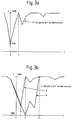
- the x-axis is assigned to the number of passengers who have entered downward calls and the y-axis has been assigned to the mean waiting time, 100% corresponding to the mean waiting time determined using conventional devices. If there are three passengers with upward calls, an improvement in the mean waiting time of approximately 10% (FIG. 3a) and up to 20% (FIG. 3b) is achieved during the change of the type of traffic (increasing number of passengers with downward calls).
- the better mezzanine or down-peak traffic program was chosen as a reference in FIG. 3a. In Fig. 3b, the program for the reference is automatically switched when the number of passengers with down calls exceeds five (characteristic curve A) or eight (characteristic curve B).
- the device described above works as follows: In the solution selection device 4, depending on the current situation of the cabins and entered calls, possible solutions for the call allocation are determined on the basis of a first-time solution calculated according to conventional rules. For this purpose, for example, a method called "alpha pruning" can be used.
- a “tree” is formed, the branches of which are assigned to the cabins and calls to be served by them and thus represent the possible solutions sought.
- the search for solutions to the given situation ends when the latter changes. Probably the best solution is fed to Simulator 2.
- the simulator 2 receives information from the traffic model device about the probable number of passengers waiting on a floor and estimates regarding their possible destinations. From this information, factors for what is probably the best solution are formed (FIG. 2) and transferred to the calculation module 3.
- the optimization criteria are evaluated using the calculation function using the factors, so that a solution corresponding to the optimization criteria and the traffic conditions is found.
- This solution will be the Solution selection device 4 is fed, in which it is checked whether it is the best solution for the call allocation. If it is not the best, then another one is sought from the set of possible solutions.
- the situation assessment module 5 analyzes the present situation on the basis of information obtained from the simulator 2, and uses this to conclude the future situation, taking into account the best solution found. If a best solution found for the call allocation would now lead to an extreme situation, such as group formation of cabins (bunching), this solution is rejected on the basis of the assessment of the situation assessment module 5.
- the device described above can be used for the allocation of floor calls as well as for the allocation of destination calls, i.e. of calls entered on the floors can be used for the desired destination floors.
Landscapes
- Engineering & Computer Science (AREA)
- Automation & Control Theory (AREA)
- Elevator Control (AREA)
Applications Claiming Priority (2)
| Application Number | Priority Date | Filing Date | Title |
|---|---|---|---|
| CH124292 | 1992-04-14 | ||
| CH1242/92 | 1992-04-14 |
Publications (2)
| Publication Number | Publication Date |
|---|---|
| EP0565865A1 true EP0565865A1 (fr) | 1993-10-20 |
| EP0565865B1 EP0565865B1 (fr) | 1996-12-27 |
Family
ID=4205803
Family Applications (1)
| Application Number | Title | Priority Date | Filing Date |
|---|---|---|---|
| EP93103915A Expired - Lifetime EP0565865B1 (fr) | 1992-04-14 | 1993-03-11 | Procédé et dispositif pour attribuer des appels de palier aux cabines d'un groupe d'ascenseurs |
Country Status (3)
| Country | Link |
|---|---|
| EP (1) | EP0565865B1 (fr) |
| DE (1) | DE59304851D1 (fr) |
| FI (1) | FI112789B (fr) |
Cited By (3)
| Publication number | Priority date | Publication date | Assignee | Title |
|---|---|---|---|---|
| GB2288675A (en) * | 1994-04-22 | 1995-10-25 | Hitachi Ltd | Elevator control system |
| WO1996033123A1 (fr) * | 1995-04-21 | 1996-10-24 | Kone Oy | Procede d'affectation d'appels dans un groupe d'ascenseurs |
| DE102014114821A1 (de) * | 2014-10-13 | 2015-12-17 | Thyssenkrupp Ag | Verfahren zum Verarbeiten eines Rufes für ein Aufzugsystem sowie entsprechendes Aufzugsystem |
Citations (2)
| Publication number | Priority date | Publication date | Assignee | Title |
|---|---|---|---|---|
| GB2111244A (en) * | 1981-10-07 | 1983-06-29 | Hitachi Ltd | Control system for group- controlling lift cars |
| GB2235311A (en) * | 1989-06-14 | 1991-02-27 | Hitachi Ltd | A group-management control method and apparatus for an elevator system |
-
1993
- 1993-03-11 DE DE59304851T patent/DE59304851D1/de not_active Expired - Lifetime
- 1993-03-11 EP EP93103915A patent/EP0565865B1/fr not_active Expired - Lifetime
- 1993-04-13 FI FI931640A patent/FI112789B/fi not_active IP Right Cessation
Patent Citations (2)
| Publication number | Priority date | Publication date | Assignee | Title |
|---|---|---|---|---|
| GB2111244A (en) * | 1981-10-07 | 1983-06-29 | Hitachi Ltd | Control system for group- controlling lift cars |
| GB2235311A (en) * | 1989-06-14 | 1991-02-27 | Hitachi Ltd | A group-management control method and apparatus for an elevator system |
Cited By (6)
| Publication number | Priority date | Publication date | Assignee | Title |
|---|---|---|---|---|
| GB2288675A (en) * | 1994-04-22 | 1995-10-25 | Hitachi Ltd | Elevator control system |
| GB2288675B (en) * | 1994-04-22 | 1998-09-09 | Hitachi Ltd | Elevator system |
| WO1996033123A1 (fr) * | 1995-04-21 | 1996-10-24 | Kone Oy | Procede d'affectation d'appels dans un groupe d'ascenseurs |
| AU698715B2 (en) * | 1995-04-21 | 1998-11-05 | Kone Oy | Procedure for allocating landing calls in an elevator group |
| US5932852A (en) * | 1995-04-21 | 1999-08-03 | Kone Oy | Method and apparatus for allocating landing calls in an elevator group |
| DE102014114821A1 (de) * | 2014-10-13 | 2015-12-17 | Thyssenkrupp Ag | Verfahren zum Verarbeiten eines Rufes für ein Aufzugsystem sowie entsprechendes Aufzugsystem |
Also Published As
| Publication number | Publication date |
|---|---|
| EP0565865B1 (fr) | 1996-12-27 |
| DE59304851D1 (de) | 1997-02-06 |
| FI931640A7 (fi) | 1993-10-15 |
| FI112789B (fi) | 2004-01-15 |
| FI931640A0 (fi) | 1993-04-13 |
Similar Documents
| Publication | Publication Date | Title |
|---|---|---|
| EP0443188B1 (fr) | Méthode et dispositif de distribution directe d'appels de groupes d'ascenseurs, basés sur des charges de service et sur des facteurs bonus/malus variables | |
| EP0356731B1 (fr) | Commande groupée avec attribution immédiate des appels | |
| DE3738891C2 (de) | Fahrstuhlanlage mit adaptiver Kabinenrufzuweisung | |
| DE3611173C2 (de) | Fahrstuhlanlage mit mehreren Doppelabteil-Kabinen | |
| DE69833880T2 (de) | Genetisches verfahren zur zuteilung der aufzugszielrufe | |
| DE69302745T2 (de) | Verkehrsmodellierungs- und Vorhersagesystem mit künstlicher Intelligenz | |
| DE69714347T2 (de) | Aufzugssystem mit Gruppensteuerung | |
| EP0091554B1 (fr) | Commande d'un groupe d'ascenseurs comportant un dispositif pour la commande d'une pointe de trafic descendante | |
| DE3820568C2 (fr) | ||
| DE69015978T2 (de) | Verfahren für die Steuerung einer Aufzuggruppe. | |
| EP0312730B1 (fr) | Commande de groupe pour ascenceurs avec commande des cabines dépendant de leur charge | |
| EP0365782B1 (fr) | Dispositif et méthode de commande d'un groupe d'ascenseurs pour cabines à compartiments doubles | |
| EP1418147A1 (fr) | Contrôleur pour ascenseur avec cabine avec plusieurs compartiments | |
| EP0440967A1 (fr) | Commande de groupes pour ascenseurs avec distribution directe d'appels d'une entrée d'appels située sur l'étage | |
| DE3732204A1 (de) | Verfahren zur koordination des verkehrs von aufzuggruppen in gebaeuden mit umsteigetage | |
| DE2459887A1 (de) | Steuervorrichtung fuer aufzuege | |
| DE69200936T2 (de) | Methode zum Hinweis eines Aufzugbenutzers auf eine herannahende Kabine. | |
| DE69517366T2 (de) | Wartezeitanzeige für einen Aufzug | |
| DE2517514A1 (de) | Aufzugssteuersystem | |
| EP0134892B1 (fr) | Commande d'un groupe d'ascenseurs pour cabines à compartiments doubles | |
| DE2512950A1 (de) | Aufzugssteuerung | |
| EP0378834B1 (fr) | Commande d'un groupe d'ascenseurs avec attribution immédiate des appels | |
| EP0308590B1 (fr) | Commande d'un groupe d'ascenceurs avec attribution immédiate des appels | |
| DE60203514T2 (de) | Verfahren zur zuteilung von stockwerkanrufen | |
| EP0565865B1 (fr) | Procédé et dispositif pour attribuer des appels de palier aux cabines d'un groupe d'ascenseurs |
Legal Events
| Date | Code | Title | Description |
|---|---|---|---|
| PUAI | Public reference made under article 153(3) epc to a published international application that has entered the european phase |
Free format text: ORIGINAL CODE: 0009012 |
|
| AK | Designated contracting states |
Kind code of ref document: A1 Designated state(s): CH DE FR LI |
|
| 17P | Request for examination filed |
Effective date: 19940318 |
|
| 17Q | First examination report despatched |
Effective date: 19950530 |
|
| GRAG | Despatch of communication of intention to grant |
Free format text: ORIGINAL CODE: EPIDOS AGRA |
|
| GRAH | Despatch of communication of intention to grant a patent |
Free format text: ORIGINAL CODE: EPIDOS IGRA |
|
| GRAH | Despatch of communication of intention to grant a patent |
Free format text: ORIGINAL CODE: EPIDOS IGRA |
|
| GRAA | (expected) grant |
Free format text: ORIGINAL CODE: 0009210 |
|
| AK | Designated contracting states |
Kind code of ref document: B1 Designated state(s): CH DE FR LI |
|
| REF | Corresponds to: |
Ref document number: 59304851 Country of ref document: DE Date of ref document: 19970206 |
|
| ET | Fr: translation filed | ||
| PLBE | No opposition filed within time limit |
Free format text: ORIGINAL CODE: 0009261 |
|
| 26N | No opposition filed | ||
| PGFP | Annual fee paid to national office [announced via postgrant information from national office to epo] |
Ref country code: CH Payment date: 20110610 Year of fee payment: 19 |
|
| PGFP | Annual fee paid to national office [announced via postgrant information from national office to epo] |
Ref country code: FR Payment date: 20120403 Year of fee payment: 20 |
|
| PGFP | Annual fee paid to national office [announced via postgrant information from national office to epo] |
Ref country code: DE Payment date: 20120323 Year of fee payment: 20 |
|
| REG | Reference to a national code |
Ref country code: CH Ref legal event code: PL |
|
| PG25 | Lapsed in a contracting state [announced via postgrant information from national office to epo] |
Ref country code: CH Free format text: LAPSE BECAUSE OF NON-PAYMENT OF DUE FEES Effective date: 20120331 Ref country code: LI Free format text: LAPSE BECAUSE OF NON-PAYMENT OF DUE FEES Effective date: 20120331 |
|
| REG | Reference to a national code |
Ref country code: DE Ref legal event code: R071 Ref document number: 59304851 Country of ref document: DE |
|
| PG25 | Lapsed in a contracting state [announced via postgrant information from national office to epo] |
Ref country code: DE Free format text: LAPSE BECAUSE OF EXPIRATION OF PROTECTION Effective date: 20130312 |