EP0570250A2 - Structure cristalline de monohydrogénotartrates, procédé de sa préparation et son application - Google Patents
Structure cristalline de monohydrogénotartrates, procédé de sa préparation et son application Download PDFInfo
- Publication number
- EP0570250A2 EP0570250A2 EP93401047A EP93401047A EP0570250A2 EP 0570250 A2 EP0570250 A2 EP 0570250A2 EP 93401047 A EP93401047 A EP 93401047A EP 93401047 A EP93401047 A EP 93401047A EP 0570250 A2 EP0570250 A2 EP 0570250A2
- Authority
- EP
- European Patent Office
- Prior art keywords
- crystal structure
- tartaric acid
- amino
- crystal
- structure according
- Prior art date
- Legal status (The legal status is an assumption and is not a legal conclusion. Google has not performed a legal analysis and makes no representation as to the accuracy of the status listed.)
- Granted
Links
Images
Classifications
-
- G—PHYSICS
- G02—OPTICS
- G02F—OPTICAL DEVICES OR ARRANGEMENTS FOR THE CONTROL OF LIGHT BY MODIFICATION OF THE OPTICAL PROPERTIES OF THE MEDIA OF THE ELEMENTS INVOLVED THEREIN; NON-LINEAR OPTICS; FREQUENCY-CHANGING OF LIGHT; OPTICAL LOGIC ELEMENTS; OPTICAL ANALOGUE/DIGITAL CONVERTERS
- G02F1/00—Devices or arrangements for the control of the intensity, colour, phase, polarisation or direction of light arriving from an independent light source, e.g. switching, gating or modulating; Non-linear optics
- G02F1/35—Non-linear optics
- G02F1/355—Non-linear optics characterised by the materials used
- G02F1/361—Organic materials
- G02F1/3611—Organic materials containing Nitrogen
- G02F1/3612—Heterocycles having N as heteroatom
-
- C—CHEMISTRY; METALLURGY
- C30—CRYSTAL GROWTH
- C30B—SINGLE-CRYSTAL GROWTH; UNIDIRECTIONAL SOLIDIFICATION OF EUTECTIC MATERIAL OR UNIDIRECTIONAL DEMIXING OF EUTECTOID MATERIAL; REFINING BY ZONE-MELTING OF MATERIAL; PRODUCTION OF A HOMOGENEOUS POLYCRYSTALLINE MATERIAL WITH DEFINED STRUCTURE; SINGLE CRYSTALS OR HOMOGENEOUS POLYCRYSTALLINE MATERIAL WITH DEFINED STRUCTURE; AFTER-TREATMENT OF SINGLE CRYSTALS OR A HOMOGENEOUS POLYCRYSTALLINE MATERIAL WITH DEFINED STRUCTURE; APPARATUS THEREFOR
- C30B29/00—Single crystals or homogeneous polycrystalline material with defined structure characterised by the material or by their shape
- C30B29/54—Organic compounds
- C30B29/56—Tartrates
-
- C—CHEMISTRY; METALLURGY
- C30—CRYSTAL GROWTH
- C30B—SINGLE-CRYSTAL GROWTH; UNIDIRECTIONAL SOLIDIFICATION OF EUTECTIC MATERIAL OR UNIDIRECTIONAL DEMIXING OF EUTECTOID MATERIAL; REFINING BY ZONE-MELTING OF MATERIAL; PRODUCTION OF A HOMOGENEOUS POLYCRYSTALLINE MATERIAL WITH DEFINED STRUCTURE; SINGLE CRYSTALS OR HOMOGENEOUS POLYCRYSTALLINE MATERIAL WITH DEFINED STRUCTURE; AFTER-TREATMENT OF SINGLE CRYSTALS OR A HOMOGENEOUS POLYCRYSTALLINE MATERIAL WITH DEFINED STRUCTURE; APPARATUS THEREFOR
- C30B7/00—Single-crystal growth from solutions using solvents which are liquid at normal temperature, e.g. aqueous solutions
Definitions
- the present invention relates to new crystal structures having quadratic nonlinear effects and a wide transparency range extending from visible to near infrared. It also relates to a process for the preparation of these crystal structures and to an electro-optical device comprising such a crystal structure.
- the non-centrosymmetric structure of the crystal gives it a quadratic non-linear susceptibility tensor ⁇ (2) usable in any three-wave mixing configuration of the "all-optical” type (generation of second harmonics, frequency conversion, parametric effects) and electrooptics (Pockels effect).
- the highest non-linear coefficient is oriented along the molecular dipoles parallel to each other in the crystal lattice.
- This crystalline structure, of point symmetry mm2 has an inclination of about 36 ° of the transition dipoles of the organic entity with respect to the crystalline polar axis, which favors the coefficient d31 (of the order of 10 pm / V) and parametric effects requiring phase tuning by birefringence (generation of second harmonics, parametric amplification).
- the coefficients d21 and d22 relate to the coefficients of the quadratic nonlinear susceptibility tensor, the axis 2 being the axis of linear symmetry in the crystallographic group 2 (contrasting rotation).
- GR Meredith (ACS Symposium Series, 233 , 27-56 (1983)) which has developed organic salts for quadratic nonlinear optics, in which cations, having an intra charge transfer character -molecular are associated with chiral, achiral or mineral organic anions.
- the anions used in this reference are independent units which do not organize into a polyanionic structure and the mechanical cohesion of such structures is not yet sufficient.
- one of the objects of the invention is to propose new crystal structures, exhibiting non-linear quadratic effects.
- a second object of the invention is to propose crystal structures exhibiting quadratic non-linear effects which are greater than those of the prior art.
- Another object of the present invention is to provide crystal structures exhibiting non-linear quadratic effects and excellent cohesion of organic molecular entities in the crystal.
- the crystal structure exhibiting nonlinear quadratic effects and a wide transparency range extending from visible to near infrared consists of optionally substituted 2-amino-5-nitropyridinium cations associated with a polyanionic organic matrix formed of left or right monohydrogenotartrate anions.
- the substituents of the 2-amino-5-nitropyridinium cations are those which do not significantly modify the favorable orientation of the polarizable organic entity in the crystal lattice.
- the crystal structure is characterized in that the cation corresponds to the following formula: in which : R represents a hydrogen atom, a methyl or ethyl radical, a hydroxy radical.
- the cation is 2-amino-5-nitropyridinium.
- the invention also relates to a process for the preparation of crystal structures as described above in the description above, characterized in that one mole of optionally substituted 2-amino-5-nitropyridine is mixed with at least a mole of left and / or right tartaric acid in an appropriate solvent, in particular water, in that the mixture is crystallized with, in the case where the tartaric acid used is at least partly racemic (left and right), separation of the left crystals from the right crystals, in that the crystal structures are recovered.
- one mole of optionally substituted 2-amino-5-nitropyridine will be mixed with at least two moles of left or right tartaric acid.
- the crystallization is carried out under the same conditions as that used for the tartaric acid itself. It is therefore a method well known to those skilled in the art.
- obtaining left or right tartaric acid is well known to those skilled in the art and results from separation by successive crystallization of the racemic tartaric acid.
- Monocrystals have the required properties, i.e. a polar crystal structure (space group P2 () compatible with both the requirements of non-linear optics (quadratic effects) and ferroelectricity, a non-response linear and a satisfactory transparency-efficiency compromise.
- space group P2 space group P2
- the following describes a laser cavity with electro-optical triggering provided with a crystal structure according to the invention.
- a crystal structure according to the invention is introduced into the cavity of a laser (for example a YAG laser emitting at 1.06 or 1.34 m and more generally any laser emitting in the transparency range of the crystal of 0.45 at 1.7 m) in a Pockels cell type configuration.
- a laser for example a YAG laser emitting at 1.06 or 1.34 m and more generally any laser emitting in the transparency range of the crystal of 0.45 at 1.7 m
- the play of polarizations and reflections results in a blocking of the emission when the crystal is under tension. In the absence of tension, the crystal becomes again passing and the cavity can emit.
- a general diagram of principle is for example indicated in Hellwarth R.W. "Q Modulation of lasers" in Lasers, vol. 1, A.K Levine ed. (New York, Marcel Dekker, 1966) p. 253.
- the DL tartaric racemic acid is mixed in the same way as in Example 1 with 2-amino-5-nitropyridine and leads to the separation of the left and right isomers.
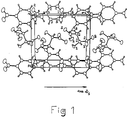
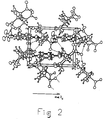
- Figures 1 and 2 attached illustrate for the crystals obtained according to Example 1 the perfect alignment of the molecular dipoles going from the nitro group to the amino group, along the crystallographic axis b, the axis b is the axis of symmetry binary of the space group p21.
- the orientation of the organic dipoles corresponds to the maximization of the coefficients d22 (second-harmonic effects and parametric effects) and r22 (electrooptical effects).
Landscapes
- Chemical & Material Sciences (AREA)
- Physics & Mathematics (AREA)
- Nonlinear Science (AREA)
- Materials Engineering (AREA)
- Metallurgy (AREA)
- Organic Chemistry (AREA)
- Crystallography & Structural Chemistry (AREA)
- Engineering & Computer Science (AREA)
- General Physics & Mathematics (AREA)
- Optics & Photonics (AREA)
- Pyridine Compounds (AREA)
- Plural Heterocyclic Compounds (AREA)
- Crystals, And After-Treatments Of Crystals (AREA)
Abstract
Description
- La présente invention concerne de nouvelles structures cristallines présentant des effets non linéaires quadratiques et une plage de transparence large s'étendant du visible au proche infrarouge. Elle concerne également un procédé de préparation de ces structures cristallines et un dispositif à effet électrooptique comportant une telle structure cristalline.
- La structure non centrosymétrique du cristal lui confère un tenseur de susceptibilité non-linéaire quadratique χ(2) exploitable dans toute configuration de mélange à trois ondes de type "tout-optique" (génération de second-harmonique, conversion de fréquences, effets paramétriques) et électrooptique (effet Pockels). Le coefficient non-linéaire le plus élevé est orienté le long des dipoles moléculaires parallèles entre eux dans la maille cristalline.
- La recherche de structures cristallines présentant des effets non linéaires quadratiques accrus par rapport aux matériaux tels que le dihydrogéno-phosphate de potassium (Okada et al. Jap. J. Appl. Phys. 16, 55, 1977) ainsi qu'une plage de transparence large s'étendant du visible au proche infrarouge s'est orientée au cours des dix dernières années vers les molécules organiques telles qu'elles ont été répertoriées par exemple dans le livre édité par D.S. Chemla et J. Zyss, Academic Press (1987) "Nonlinear Optical Properties of Organic Molecules and Crystals". Parmi les structures cristallines de ce type, on peut citer :
- . le POM (3-méthyl-4-nitropyridine-1-oxyde) (J. Zyss, D.S. Chemla et J.F. Nicoud J. Chem. Phys. 74, 4800, (1981)),
- . le NPP N-(4-nitrophenyl)-L-prolinol) (J. Zyss, J.F. Nicoud et A. Coquillay, J. Chem. Phys. 81, 4160 (1984)),
- . le NPAN (N-(4-nitrophenyl)-N-dimethylamino-aceto-nitrile (P. Vidakovic, M. Coquillay et A. Salin, J. Opt. Soc. Am. B4, 998, (1987).
- Ces cristaux présentent une non-linéarité exceptionnellement élevée (par exemple d₂₁ de l'ordre de 50 pm/V pour le NPP) au prix toutefois d'une transparence limitée vers la partie bleue du spectre. Par ailleurs, la cohésion et la stabilité à l'air de tels cristaux dans des conditions usuelles d'application peut pour certains d'entre eux présenter des inconvénients : c'est en particulier le cas du POM qui doit être immergé dans un liquide protecteur et présente par ailleurs une tendance marquée à la sublimation.
- Il a récemment été proposé par R. Masse et J. Zyss, dans Molecular Engineering 1, 141, 1991, d'encapsuler des molécules organiques non-linéaires dans un réseau "charpente" constitué d'anions minéraux associés entre eux par liaison hydrogène. L'entité organique est conçue de façon à se greffer, par liaison hydrogène simple ou multiple, aux anions minéraux. Les polyanions proposés sont de type arséniate (H₂AsO₄⁻)n sulfate (HSO₄⁻)n ou phosphate (H₂PO₄⁻)n. Un cristal particulièrement intéressant à été identifié dans cette famille : le 2-amino-5-nitropyridinium dihydrogène monophosphate (2A5NPDP).
- Cette structure cristalline, de symétrie ponctuelle mm2 présente une inclinaison de l'ordre de 36° des dipôles de transition de l'entité organique par rapport à l'axe polaire cristallin, ce qui favorise le coefficient d₃₁ (de l'ordre de 10 pm/V) et les effets paramétriques exigeant l'accord de phase par biréfringence (génération de second-harmonique, amplification paramétrique).
- Il est néanmoins souhaitable de trouver d'autres structures cristallines où de préférence un coefficient dii (avec i = 1, 2 ou 3) serait optimisé par l'alignement le plus parfait possible des molécules dans la maille le long d'une direction cristallographique i à l'image des cristaux de MNA (2-méthyl-4-nitroaniline) comme ils ont été décrits par G. Lipscomb, A. Garito et R. Narang, J. Chem. Phys. 75, 1509, (1981) ou des cristaux de DMACB (4,4'-diméthylaminocyanobiphényl) comme ils ont été décrits par J. Zyss, I. Ledoux, M. Bertault, E. Toupet, Chem. Phys. 150, 125, (1991).
- On rappelle que les coefficients d₂₁ et d₂₂ se rapportent aux coefficients du tenseur de susceptibilité non-linéaire quadratique, l'axe 2 étant l'axe de symétrie linéaire dans le groupe cristallographique 2 (rotation contrastée).
- On signalera, par ailleurs, G.R. Meredith (ACS Symposium Series, 233, 27-56 (1983)) qui a développé des sels organiques pour l'optique non-linéaire quadratique, dans lesquels des cations, présentant un caractère de transfert de charge intra-moléculaire sont associés à des anions organiques chiraux, achiraux ou minéraux. Les anions utilisés dans cette référence sont des unités indépendantes qui ne s'organisent pas en une structure polyanionique et la cohésion mécanique de telles structures n'est encore pas suffisante.
- Au vu de l'art antérieur exposé ci-dessus, un des objets de l'invention est de proposer de nouvelles structures cristallines, présentant des effets non-linéaires quadratiques.
- Un second objet de l'invention est de proposer des structures cristallines présentant des effets non-linéaires quadratiques accrus par rapport à ceux de l'art antérieur.
- Un autre objet de la présente invention est de proposer des structures cristallines présentant des effets non-linéaires quadratiques et une excellente cohésion des entités moléculaires organiques dans le cristal.
- D'autres objets de l'invention apparaîtront à la lecture de la description qui va suivre.
- Selon la présente invention, la structure cristalline présentant des effets non-linéaires quadratiques et une plage de transparence large s'étendant du visible au proche infra-rouge est constituée de cations 2-amino-5-nitropyridinium éventuellement substitués associés à une matrice organique polyanionique formée d'anions monohydrogénotartrates gauches ou droits.
- Les substituants des cations 2-amino-5-nitropyridinium sont ceux qui ne modifient pas de façon significative l'orientation favorable de l'entité organique polarisable dans la maille cristalline.
- Les cristaux de monohydrogénotartrates gauches ou droits sont bien connus et sont notamment décrits dans Chemische Krystallographie P. Groth, vol. 3, page 302 et suivantes (1910) ; Acta Cryst. (1966). 21, 237-243 et Appl. Cryst. (1979). 12, 537-544.
- Selon une variante préférée, la structure cristalline est caractérisée en ce que le cation répond à la formule suivante :

dans laquelle :
R représente un atome d'hydrogène, un radical méthyle ou éthyle, un radical hydroxy. - De préférence encore, le cation est le 2-amino-5-nitropyridinium.
- Sans être lié de quelque façon que ce soit à une théorie scientifique, le déposant pense néanmoins que ces structures possèdent une cohésion spécifique due à des liaisons hydrogène courtes des chaînes tartrate entre elles, liaisons qui ne peuvent être rompues par les cations organiques associés.
- On retrouve dans ces cristaux la stabilité, la transparence et la facilité de croissance cristalline des sels de l'acide tartrique.
- D'autres cristaux similaires aux cristaux obtenus à partir du tartrate et présentant la même cohésion pourraîent également être envisagés sans sortir du champ de la présente invention.
- L'invention concerne également un procédé de préparation des structures cristallines telles qu'elles viennent d'être décrites dans la description ci-dessus, caractérisé en ce qu'on mélange une mole de 2-amino-5-nitropyridine éventuellement substitué avec au moins une mole d'acide tartrique gauche et/ou droit dans un solvant approprié, notamment l'eau, en ce que l'on fait cristalliser le mélange avec, dans le cas où l'acide tartrique utilisé est au moins en partie racémique (gauche et droit), séparation des cristaux gauches des cristaux droits, en ce que l'on récupère les structures cristallines.
- De préférence, on mélangera une mole de 2-amino-5-nitropyridine éventuellement substitué avec au moins deux moles d'acide tartrique gauche ou droit.
- La cristallisation s'effectue dans les mêmes conditions que celle mise en oeuvre pour l'acide tartrique lui-même. Il s'agit donc d'une méthode bien connue de l'homme du métier.
- Avantageusement, dans une solution saturée en rotation d'un mélange anions-cations, sera présent un germe cristallin d'une structure cristalline telle que décrite ci-dessus. L'évaporation lente conduit à la cristallisation recherchée, à température constante (ambiante notamment). On peut également abaisser progressivement cette température.
- Dans le cas où l'acide tartrique racémique est utilisé, la cristallisation successive conduit aux structures gauches ou droites recherchées.
- Dans le cas préféré ou l'on utilise les formes optiquement active de l'acide tartrique, l'obtention de l'acide tartrique gauche ou droit est bien connue de l'homme du métier et résulte d'une séparation par cristallisation successive de l'acide tartrique racémique.
- Il est en effet préférable, de combiner des formes préalablement séparées de l'acide tartrique avec la molécule organique. En sélectionnant préalablement au mélange la forme gauche ou droite de l'acide, on évite d'avoir à séparer les deux cristaux ioniques gauches et droites qui résulteraient d'un mélange racémique.
- Les monocristaux possèdent les propriétés requises, c'est-à-dire une structure cristalline polaire (groupe spatial P2₁) compatible à la fois avec les exigences de l'optique non-linéaire (effets quadratiques) et de la ferroélectricité, une réponse non-linéaire et un compromis transparence-efficacité satisfaisant.
- Ils réalisent par ailleurs un empilement quasi parfait de dipôles organiques parallèlement à l'axe polaire 2₁, dans leur structure, maximisant les valeurs des coefficients r₂₂ et d₂₂ des tenseurs électrooptiques et de génération de second-harmonique, l'axe polaire cristallin étant noté 2.
- L'invention concerne un dispositif à effet électrooptique comportant une structure cristalline telle que décrite précédemment. Ces dispositifs génèrent une second-harmonique ou plus généralement une somme ou différence de fréquences. Les applications qui découlent de ces propriétés avantageuses sont nombreuses tant en cristal massif, qu'en structure guidante telles que :
- modulation de phase d'une porteuse optique
- modulation d'amplitude
- coupleur directif,
- croisement électrooptique et plus généralement point de commutation électrooptique,
- échantillonnage électrooptique,
- logique électronique,
- déclenche électrooptique de lasers ("Q-Switch") sans préjudice des applications exigeant un accord de phase par biréfringence telles que :
- génération de second-harmonique,
- conversions de fréquence
- amplification, émission et oscillation paramétriques.
- A titre d'exemple, on décrit ci-après une cavité laser à déclenche électrooptique munie d'une structure cristalline selon l'invention.
- Dans un tel dispositif, une structure cristalline selon l'invention est introduite dans la cavité d'un laser (par exemple un laser YAG émettant à 1.06 ou 1.34 m et plus généralement tout laser émettant dans la plage de transparence du cristal de 0,45 à 1,7 m) dans une configuration de type cellule de Pockels. Le jeu de polarisations et réflexions aboutit à un blocage de l'émission lorsque le cristal est sous tension. En l'absence de tension, le cristal redevient passant et la cavité peut émettre. Un schéma général de principe est par exemple indiqué dans Hellwarth R.W. "Q Modulation of lasers" dans Lasers, vol. 1, A.K Levine ed. (New York, Marcel Dekker, 1966) p. 253.
- L'invention est maintenant illustrée par les exemples de réalisation donnés à titre indicatif :
- Une mole de 2-amino-5-nitropyridine est dissoute dans une solution d'acide tartrique gauche (50 cm³ H₂O) contenant trois moles d'acide. La dissolution est rapide à 50°C.
- La réaction chimique s'écrit :
C₅H₅N₃O₂+L-C₄H₆O₆ C₅H₆N₃O₂⁺ + L-C₄H₅O₆⁻ C₅H₆N₃O₂⁺ .L-C₄H₅O₆⁻
- On opère de la même façon qu'à l'exemple 1 en remplaçant l'acide tartrique gauche par l'acide tartrique droit.
- L'acide racémique DL tartrique est mélangé de la même façon que dans l'exemple 1 avec la 2-amino-5-nitropyridine et conduit à la séparation des isomères gauches et droits.
- Dans tous les cas, l'évaporation des solutions à température ambiante produit de beaux cristaux de monohydrogénotartrates gauches ou droits de 2-amino-5-nitropyridinium que l'on peut confondre avec des cristaux de l'acide gauche tartrique (ou droit), ayant tous deux la même morphologie, celles des sels de symétrie P2₁ gauches ou droits des acides tartriques.
- Des cristaux trapus de 5 mm x 5 mm x 8 mm ont été obtenus aisément. Tous ces cristaux sont jaune clairs, ce qui les distinguent des acides tartriques gauches ou droits.
- Les figures 1 et 2 annexées illustrent pour les cristaux obtenus selon l'exemple 1 l'alignement parfait des dipoles moléculaires allant du groupe nitro au groupe amino, le long de l'axe cristallographique b, l'axe b est l'axe de symétrie binaire du groupe d'espace p₂₁. L'orientation des dipôles organiques correspond à la maximisation des coefficients d₂₂ (effets de second-harmonique et effets paramétriques) et r₂₂ (effets électrooptiques).
Claims (10)
- Structure cristalline présentant des effets non-linéaires quadratiques et une plage de transparence large s'étendant du visible au proche infra-rouge constituée de cations 2-amino-5-nitropyridinium éventuellement substitués associés à une matrice organique polyanionique, d'anions monohydrogénotartrates gauches ou droits.
- Structure cristalline selon la revendication 1, caractérisée en ce que le cation répond à la formule suivante :

R représente un atome d'hydrogène, un radical méthyle ou éthyle, un radical hydroxy. - Structure cristalline selon la revendication 2, caractérisée en ce que le cation est le 2-amino-5-nitropyridinium.
- Procédé de préparation des structures cristallines selon la revendication 1, caractérisé en ce qu'on mélange une mole de 2-amino-5-nitropyridine éventuellement substitué avec au moins un mole d'acide tartrique gauche et/ou droit dans un solvant approprié, notamment l'eau, en ce que l'on fait cristalliser le mélange avec, dans le cas où l'acide tartrique utilisé est au moins en partie racémique (gauche et droit), séparation des cristaux gauches des cristaux droits, en ce que l'on récupère les structures cristallines.
- Procédé de préparation selon la revendication 4, caractérisé en ce qu'on mélange une mole de 2-amino-5-nitropyridine éventuellement substitué avec au moins deux moles d'acide tartrique gauche et/ou droit.
- Procédé de préparation selon l'une des revendications 4 ou 5, caractérisé en ce que, dans la solution saturée de mélange, un germe cristallin d'une structure cristalline selon l'une des revendications 1 à 3 est présent et en ce que la cristallisation est effectuée par évaporation du solvant à température effectuée ambiante ou par abaissement progressif de la température.
- Procédé selon l'une des revendications 4 à 6, caractérisé en ce que l'acide tartrique est une forme gauche ou droite.
- Dispositif à effet électrooptique comportant une structure cristalline selon l'une des revendications 1 à 3.
- Dispositif selon la revendication 8, caractérisé en ce qu'il s'agit d'une cavité laser à déclenche électrooptique.
- Dispositif pour générer une somme ou différence de fréquences, caractérisé en ce qu'il comporte une structure cristalline selon l'une des revendications 1 à 3, notamment un dispositif d'amplification, d'émission et oscillation paramétrique.
Applications Claiming Priority (2)
| Application Number | Priority Date | Filing Date | Title |
|---|---|---|---|
| FR9205077A FR2690464B1 (fr) | 1992-04-24 | 1992-04-24 | Structure cristalline de monohydrogénotartrates présentant des effets non linéaires quadratiques, procédé de préparation desdites structures cristallines et dispositif à effet électrooptique comportant de telles structures. |
| FR9205077 | 1992-04-24 |
Publications (3)
| Publication Number | Publication Date |
|---|---|
| EP0570250A2 true EP0570250A2 (fr) | 1993-11-18 |
| EP0570250A3 EP0570250A3 (en) | 1996-03-13 |
| EP0570250B1 EP0570250B1 (fr) | 1998-06-03 |
Family
ID=9429233
Family Applications (1)
| Application Number | Title | Priority Date | Filing Date |
|---|---|---|---|
| EP93401047A Expired - Lifetime EP0570250B1 (fr) | 1992-04-24 | 1993-04-22 | Structure cristalline de monohydrogénotartrates, procédé de sa préparation et son application |
Country Status (5)
| Country | Link |
|---|---|
| US (1) | US5374734A (fr) |
| EP (1) | EP0570250B1 (fr) |
| JP (1) | JPH0680500A (fr) |
| DE (1) | DE69318887T2 (fr) |
| FR (1) | FR2690464B1 (fr) |
Families Citing this family (6)
| Publication number | Priority date | Publication date | Assignee | Title |
|---|---|---|---|---|
| FR2703680B1 (fr) * | 1993-04-07 | 1995-07-07 | France Telecom | Structure cristalline d'halogénure de 2-amino-5-nitropyridinium, procédé de préparation desdites structures cristallines, et dispositif à effet électrooptique comportant de telles structures. |
| US8173045B2 (en) | 2008-05-28 | 2012-05-08 | University Of Washington | Diels-Alder crosslinkable dendritic nonlinear optic chromophores and polymer composites |
| CN103374756B (zh) * | 2012-04-12 | 2017-05-10 | 应少明 | 一种还原希夫碱锌配合物的二阶非线性光学材料 |
| CN105601562B (zh) * | 2016-01-20 | 2018-03-27 | 新疆农业大学 | 一种有机晶体材料及其制备方法和用途 |
| CN114808137B (zh) * | 2021-01-21 | 2023-09-12 | 北京师范大学 | 非线性光学晶体及其制备方法和应用 |
| CN112981539A (zh) * | 2021-02-08 | 2021-06-18 | 萍乡学院 | 酒石酸2-氨基-5-硝基吡啶非线性光学晶体及其制法和用途 |
Family Cites Families (1)
| Publication number | Priority date | Publication date | Assignee | Title |
|---|---|---|---|---|
| GB9008878D0 (en) * | 1990-04-20 | 1990-06-20 | Secr Defence | Organic compounds |
-
1992
- 1992-04-24 FR FR9205077A patent/FR2690464B1/fr not_active Expired - Lifetime
-
1993
- 1993-04-22 EP EP93401047A patent/EP0570250B1/fr not_active Expired - Lifetime
- 1993-04-22 DE DE69318887T patent/DE69318887T2/de not_active Expired - Lifetime
- 1993-04-23 JP JP5098142A patent/JPH0680500A/ja active Pending
- 1993-04-23 US US08/051,398 patent/US5374734A/en not_active Expired - Lifetime
Also Published As
| Publication number | Publication date |
|---|---|
| FR2690464A1 (fr) | 1993-10-29 |
| EP0570250B1 (fr) | 1998-06-03 |
| JPH0680500A (ja) | 1994-03-22 |
| FR2690464B1 (fr) | 2002-03-01 |
| DE69318887T2 (de) | 1999-03-04 |
| EP0570250A3 (en) | 1996-03-13 |
| DE69318887D1 (de) | 1998-07-09 |
| US5374734A (en) | 1994-12-20 |
Similar Documents
| Publication | Publication Date | Title |
|---|---|---|
| US5804101A (en) | Nonlinear optical materials with reduced aromaticity and bond length alternation | |
| US4780543A (en) | 1-phenyl-3-(2-nitroethenyl)pyrazoline and 1-phenyl-3-(2,2-dicyanoethenyl)pyrazoline | |
| US4746199A (en) | Non-linear optic process using N-(4-nitrophenyl)-2-(hydroxymethyl)-pyrrolidine and deuterated derivatives thereof | |
| EP0570250B1 (fr) | Structure cristalline de monohydrogénotartrates, procédé de sa préparation et son application | |
| EP0619308B1 (fr) | Structures cristallines d'halogénures de 2-amino-5-nitropyridinium, procédé de préparation desdites structures cristallines, et dispositif à effet électrooptique comportant de telles structures | |
| US5460754A (en) | Non-linear optical material, method of manufacturing the same and optical wavelength converter | |
| US5383050A (en) | Organic nonlinear optical material | |
| US5397508A (en) | 2-amino-5-nitropyridinium salts usable in non-linear optics and in electroptics and a process for preparing the same | |
| JP2723797B2 (ja) | 波長変換素子およびそれを用いたレーザー装置 | |
| JPH06345713A (ja) | 分子結晶 | |
| JP2539834B2 (ja) | 非線形光学素子 | |
| JP2901763B2 (ja) | 有機非線形光学材料およびその材料を使用した有機非線形光学薄膜素子 | |
| JP2685380B2 (ja) | 有機非線形光学材料 | |
| JPH04326336A (ja) | 有機非線形光学材料 | |
| JPH06345712A (ja) | 分子結晶 | |
| Hemalatha et al. | Investigation on Thermal, Optical, Second Order and Third Order NLO Properties of a Nonlinear Optical Single Crystal of L-Leucinium Hydrogen Maleate (LLM) | |
| JPH03140927A (ja) | 有機非線形光学材料 | |
| Dhanuskodi et al. | Crystal growth and characterization of a novel organic nonlinear optical material: semicarbazone of p-dimethylamino benzaldehyde | |
| JPH05224256A (ja) | 非線形光学材料 | |
| JPH06160924A (ja) | 分子結晶 | |
| JPH07225402A (ja) | 有機非線形光学材料及びそれを用いた光機能性素子 | |
| JPH0687106B2 (ja) | 有機非線形光学素子 | |
| JPH01134436A (ja) | 非線形光学素子およびその製造方法 | |
| JPH04258928A (ja) | 有機非線形光学材料 | |
| JPH05224257A (ja) | 非線形光学材料 |
Legal Events
| Date | Code | Title | Description |
|---|---|---|---|
| PUAI | Public reference made under article 153(3) epc to a published international application that has entered the european phase |
Free format text: ORIGINAL CODE: 0009012 |
|
| AK | Designated contracting states |
Kind code of ref document: A2 Designated state(s): DE GB |
|
| PUAL | Search report despatched |
Free format text: ORIGINAL CODE: 0009013 |
|
| AK | Designated contracting states |
Kind code of ref document: A3 Designated state(s): DE GB |
|
| 17P | Request for examination filed |
Effective date: 19960819 |
|
| GRAG | Despatch of communication of intention to grant |
Free format text: ORIGINAL CODE: EPIDOS AGRA |
|
| 17Q | First examination report despatched |
Effective date: 19970926 |
|
| GRAG | Despatch of communication of intention to grant |
Free format text: ORIGINAL CODE: EPIDOS AGRA |
|
| GRAH | Despatch of communication of intention to grant a patent |
Free format text: ORIGINAL CODE: EPIDOS IGRA |
|
| GRAH | Despatch of communication of intention to grant a patent |
Free format text: ORIGINAL CODE: EPIDOS IGRA |
|
| GRAA | (expected) grant |
Free format text: ORIGINAL CODE: 0009210 |
|
| RAP1 | Party data changed (applicant data changed or rights of an application transferred) |
Owner name: CENTRE NATIONAL DE LA RECHERCHE SCIENTIFIQUE (CNR Owner name: FRANCE TELECOM |
|
| AK | Designated contracting states |
Kind code of ref document: B1 Designated state(s): DE GB |
|
| REF | Corresponds to: |
Ref document number: 69318887 Country of ref document: DE Date of ref document: 19980709 |
|
| GBT | Gb: translation of ep patent filed (gb section 77(6)(a)/1977) |
Effective date: 19980716 |
|
| PLBE | No opposition filed within time limit |
Free format text: ORIGINAL CODE: 0009261 |
|
| STAA | Information on the status of an ep patent application or granted ep patent |
Free format text: STATUS: NO OPPOSITION FILED WITHIN TIME LIMIT |
|
| 26N | No opposition filed | ||
| REG | Reference to a national code |
Ref country code: GB Ref legal event code: IF02 |
|
| PGFP | Annual fee paid to national office [announced via postgrant information from national office to epo] |
Ref country code: GB Payment date: 20120328 Year of fee payment: 20 |
|
| PGFP | Annual fee paid to national office [announced via postgrant information from national office to epo] |
Ref country code: DE Payment date: 20120326 Year of fee payment: 20 |
|
| REG | Reference to a national code |
Ref country code: DE Ref legal event code: R071 Ref document number: 69318887 Country of ref document: DE |
|
| REG | Reference to a national code |
Ref country code: DE Ref legal event code: R071 Ref document number: 69318887 Country of ref document: DE |
|
| REG | Reference to a national code |
Ref country code: GB Ref legal event code: PE20 Expiry date: 20130421 |
|
| PG25 | Lapsed in a contracting state [announced via postgrant information from national office to epo] |
Ref country code: DE Free format text: LAPSE BECAUSE OF EXPIRATION OF PROTECTION Effective date: 20130423 Ref country code: GB Free format text: LAPSE BECAUSE OF EXPIRATION OF PROTECTION Effective date: 20130421 |