EP0570800A2 - Neue Perinonfarbstoffe zum Massefärben von Kunststoffen - Google Patents
Neue Perinonfarbstoffe zum Massefärben von Kunststoffen Download PDFInfo
- Publication number
- EP0570800A2 EP0570800A2 EP93107561A EP93107561A EP0570800A2 EP 0570800 A2 EP0570800 A2 EP 0570800A2 EP 93107561 A EP93107561 A EP 93107561A EP 93107561 A EP93107561 A EP 93107561A EP 0570800 A2 EP0570800 A2 EP 0570800A2
- Authority
- EP
- European Patent Office
- Prior art keywords
- butyl
- dyes
- parts
- alkyl
- formula
- Prior art date
- Legal status (The legal status is an assumption and is not a legal conclusion. Google has not performed a legal analysis and makes no representation as to the accuracy of the status listed.)
- Granted
Links
- 0 CCCC(C(CC=*)C(N12)=Nc3cccc4c3c1ccc4)C2=O Chemical compound CCCC(C(CC=*)C(N12)=Nc3cccc4c3c1ccc4)C2=O 0.000 description 2
Classifications
-
- C—CHEMISTRY; METALLURGY
- C09—DYES; PAINTS; POLISHES; NATURAL RESINS; ADHESIVES; COMPOSITIONS NOT OTHERWISE PROVIDED FOR; APPLICATIONS OF MATERIALS NOT OTHERWISE PROVIDED FOR
- C09B—ORGANIC DYES OR CLOSELY-RELATED COMPOUNDS FOR PRODUCING DYES, e.g. PIGMENTS; MORDANTS; LAKES
- C09B57/00—Other synthetic dyes of known constitution
- C09B57/12—Perinones, i.e. naphthoylene-aryl-imidazoles
-
- C—CHEMISTRY; METALLURGY
- C08—ORGANIC MACROMOLECULAR COMPOUNDS; THEIR PREPARATION OR CHEMICAL WORKING-UP; COMPOSITIONS BASED THEREON
- C08K—Use of inorganic or non-macromolecular organic substances as compounding ingredients
- C08K5/00—Use of organic ingredients
- C08K5/16—Nitrogen-containing compounds
- C08K5/34—Heterocyclic compounds having nitrogen in the ring
- C08K5/3442—Heterocyclic compounds having nitrogen in the ring having two nitrogen atoms in the ring
- C08K5/3462—Six-membered rings
- C08K5/3465—Six-membered rings condensed with carbocyclic rings
-
- C—CHEMISTRY; METALLURGY
- C08—ORGANIC MACROMOLECULAR COMPOUNDS; THEIR PREPARATION OR CHEMICAL WORKING-UP; COMPOSITIONS BASED THEREON
- C08K—Use of inorganic or non-macromolecular organic substances as compounding ingredients
- C08K5/00—Use of organic ingredients
- C08K5/36—Sulfur-, selenium-, or tellurium-containing compounds
- C08K5/41—Compounds containing sulfur bound to oxygen
- C08K5/42—Sulfonic acids; Derivatives thereof
-
- C—CHEMISTRY; METALLURGY
- C08—ORGANIC MACROMOLECULAR COMPOUNDS; THEIR PREPARATION OR CHEMICAL WORKING-UP; COMPOSITIONS BASED THEREON
- C08K—Use of inorganic or non-macromolecular organic substances as compounding ingredients
- C08K5/00—Use of organic ingredients
- C08K5/36—Sulfur-, selenium-, or tellurium-containing compounds
- C08K5/43—Compounds containing sulfur bound to nitrogen
Definitions
- the invention relates to perinone dyes, a process for their preparation and their use for the mass coloring of plastics.
- the dyes of the formula (I) according to the invention can be prepared by processes known per se (cf. e.g. D.R.P 202 354, Chem. Ber. 75 (1942), 719; Liebigs Ann.
- X and m have the meaning given, represent.
- the condensation can be carried out directly by melting together equimolar amounts of the components of the formulas (11) and (III) at temperatures between 50 ° C and 220 ° C, preferably at 120 to 180 ° C, or more advantageously in a solvent at temperatures between 20 ° C and 220 ° C, preferably 50 to 180 ° C, optionally carried out under pressure, it being possible to remove the water of reaction by distillation.
- Suitable solvents are, for example: chlorobenzene, o-dichlorobenzene, trichlorobenzene, xylene, dimethylformamide, N-methylpyrrolidone, glacial acetic acid, propionic acid, phenol, cresols, phenoxyethanol, glycols and their mono- and dialkyl ethers, alcohols, e.g. Methanol, ethanol, i-propanol, water and aqueous solvents such as e.g. dilute sulfuric acid etc.
- reaction can be carried out with the addition of an acidic catalyst.
- Suitable catalysts include: zinc chloride, p-toluenesulfonic acid, hydrochloric acid, sulfuric acid, organic acids and others.
- the reaction generally takes place under normal pressure, but if appropriate it can also be carried out under elevated pressure, preferably between 1 and 40 bar.
- naphthalene-1,2-dicarboxylic acids can be e.g. according to Chem. Ber. 65 (1932), 1388; ibid. 73 (1940), 19; Liebigs Ann. Chem. 595 (1955), 1; ibid. 684 (1965), 127; J.Am. Soc. 57 (1935), 1851; ibid. 60 (1938), 951; ibid. 67: 345 (1945); ibid. 70 (1948), 2748; ibid. 72: 1035, 1950; J. Org. Chem. 27 (1962), 5; ibid. 29 (1964), 2261; ibid. 32 (1967), 784; ibid.
- Chlorinated or brominated naphthalene-1,2-dicarboxylic acid derivatives can also be obtained by reacting substituted or unsubstituted naphthalene-1,2-dicarboxylic acids with chlorine or bromine, if appropriate in the presence of Lewis acids such as e.g. Iron, aluminum or zinc halides, iron powder, etc. in the melt or in an inert solvent such as e.g. Carbon tetrachloride, carbon tetrachloride, nitrobenzene, o-dichlorobenzene, carbon disulfide etc. be won.
- Lewis acids such as e.g. Iron, aluminum or zinc halides, iron powder, etc.
- an inert solvent such as e.g. Carbon tetrachloride, carbon tetrachloride, nitrobenzene, o-dichlorobenzene, carbon disulfide etc. be won.
- the substituted naphthalene-1,8-diamines used can be e.g. according to D.R.P 122 475; D.R.P 108 166; J. Chem. Soc. (1932) 2310; ibid. (1936), 556, 1338; ibid. (1945), 454, 543; ibid. (1951) 221; J. Prakt. Chem. 94 (1916), 45; Compt. red. 224 (1947), 1569; At. Soc. espan. 31 (1933), 861, 876; J. Org. Chem. 24 (1959), 214 et al. or in analogy.
- the dyes of the formula (I) according to the invention can accordingly be prepared from unsubstituted and / or substituted starting materials with an optionally subsequent substitution exchange.
- Substitution exchange means both the exchange of a hydrogen or other ligand by a substituent, e.g. understood by means of chlorination, bromination, sulfonation, chlorosulfonation or nitration as well as the modification of substituents, as is exemplified below.
- Dyes of the formula (I) in which X and / or Y represent an alkyl or arylaminosulfonyl radical can, in addition to the first-mentioned process, also be obtained from the corresponding dyes of the formula (I) in which X and / or Y represent a chlorosulfonyl radical , with alkyl or arylamines.
- Dyes according to the invention in which X and / or Y are equal to an aryloxysulfonyl radical can also be obtained by reacting the corresponding chlorosulfonyl dyes with phenols or naphthols in the presence of a base, e.g. Pyridine, triethylamine, alkali or alkaline earth carbonates, hydroxides or oxides can be obtained.
- a base e.g. Pyridine, triethylamine, alkali or alkaline earth carbonates, hydroxides or oxides
- Dyes of the formula (I) in which X and / or Y represent alkyloxy or acyloxy can additionally be prepared by alkylation or acylation of the dyes according to the invention in which X and / or Y represent a hydroxyl group.
- Those dyes of the formula (I) with X and / or Y equal to an optionally acylated or alkylated amino group can also be obtained by reduction with conventional reducing agents, e.g. Iron, zinc, sodium sulfide, hydrogen etc. the corresponding compounds in which X and / or Y represent a nitro group, and optionally subsequent acylation or alkylation are obtained.
- the acylation step can also be carried out in the course of the reduction by adding an acylating agent.
- the dyes of the invention are outstandingly suitable for coloring plastics in bulk.
- Bulk dyeing here means in particular processes in which the dye is incorporated into the molten plastic mass, e.g. with the help of an extruder, or in which the dye is already the starting components for the production of the plastic, e.g. Monomers before the polymerization is added.
- thermoplastics for example vinyl polymers, polyesters and polyamides.
- Suitable vinyl polymers are polystyrene, styrene-acrylonitrile copolymers, styrene-butadiene copolymers, styrene-butadiene-acrylonitrile terpolymers, polymethacrylate and others.
- polyesters are: polyethylene terephthalates, polycarbonates and cellulose esters.
- Polystyrene, styrene copolymers, polycarbonates and polymethacrylate are preferred. Polystyrene is particularly preferred.
- the high-molecular compounds mentioned can be present individually or in mixtures, as plastic masses or melts.
- the dyestuffs according to the invention are used in finely divided form, but it is not necessary to use dispersants.
- the dyes (I) are used after the polymerization, they are mixed or ground dry with the plastic granules and this mixture is plasticized and homogenized, for example on mixing rollers or in screws.
- the dyes can also be added to the molten mass and this distribute homogeneously by stirring.
- the material thus pre-colored is then processed as usual, for example by spinning to form bristles, threads, etc., or by extrusion or by injection molding to give molded parts.
- the dyes of the formula (I) are resistant to polymerization catalysts, in particular peroxides, it is also possible to add the dyes to the monomeric starting materials for the plastics and then to polymerize in the presence of polymerization catalysts.
- the dyes are preferably dissolved in the monomeric components or intimately mixed with them.
- the dyes of the formula (I) are preferably used for dyeing the polymers mentioned in amounts of 0.0001 to 1% by weight, in particular 0.01 to 0.5% by weight, based on the amount of polymer.
- pigments that are insoluble in the polymers e.g. Titanium dioxide
- corresponding valuable muted colors can be obtained.
- Titanium dioxide can be used in an amount of 0.01 to 10% by weight, preferably 0.1 to 5% by weight, based on the amount of polymer.
- the process according to the invention gives transparent or covered brilliant, yellowish red to violet colorations with good heat resistance and good light and weather fastness.
- the invention is illustrated, but not limited to the following examples, in which the parts are given by weight, percentages are percentages by weight (% by weight) and Z is a radical to complete a 1,2-naphthylene system.
- 100 parts of a commercially available polycarbonate are dry-mixed in the form of granules with 0.03 part of the dye from Example A).
- the granules dusted in this way are homogenized on a twin-screw extruder at 290 ° C. A transparent red color with good light fastness is obtained.
- the colored polycarbonate is discharged as a strand from the extruder and processed into granules.
- the granules can be processed using the customary methods of packaging thermoplastic materials.
- the dye from Example A 0.025 part of the dye from Example A is mixed with 100 parts of polyethylene terephthalate of a transparent type and homogenized in a 2-screw extruder at 280 ° C. A transparent, red color with good light fastness is obtained. After subsequent granulation, the colored plastic can be processed using the usual methods of thermoplastic molding. If you work with the addition of 1% titanium dioxide, you get a muted color.
- 0.05 part of tert-dodecyl mercaptan and 0.05 part of the dye from Example A) are dissolved in 98.9 parts of styrene.
- This solution is dispersed in a solution of 200 parts of deionized water, 0.3 part of partially saponified polyvinyl acetate (for example Mowiol @ 50/88 from Hoechst) and 0.05 part of dodecylbenzenesulfonate.
- the dispersion is heated to 80 ° C. with vigorous stirring and the polymerization is started.
- the polymer When using the following polymerization conditions: 4 h at 80 ° C, 2 h at 90 ° C, 3 h at 110 ° C, 2 h at 130 ° C, the polymer is obtained in a yield of 98% of theory.
- the polymer is obtained in the form of beads which, depending on the stirring conditions, have a diameter of 0.1 to 1.5 mm (Dso value).
- the polymer is separated from the serum by filtration and dried at 110 ° C. to a residual moisture of 0.5%. After melting in a mixing unit (hot roller), 0.5% zinc stearate and 0.2% ionol are mixed in and the polymer is granulated.
- the polymer can be prepared by the usual methods of thermoplastic molding, e.g. can be processed into red, transparent molded parts using the injection molding process.
- the residence time in the extruder can be up to 30 minutes without affecting the color.
- the dyes described in Table 1 are obtained from the compounds of the formulas (11) and (111), which are colored in plastics according to Example 1 B a) -I) and those in Table 1 achieve the specified colors.
- the dye of the formula given above with 11.0% sulfur content is obtained in an analogous manner to example 66 if 25 parts of a 30% aqueous dimethylamine solution are used instead of the methylamine solution. Yield: 3.1 parts.
- This dye colors plastics according to Example 1 B a) -I) in yellowish red shades.
Landscapes
- Chemical & Material Sciences (AREA)
- Organic Chemistry (AREA)
- Health & Medical Sciences (AREA)
- Chemical Kinetics & Catalysis (AREA)
- Medicinal Chemistry (AREA)
- Polymers & Plastics (AREA)
- Compositions Of Macromolecular Compounds (AREA)
- Coloring (AREA)
Abstract

Description
- Die Erfindung betrifft Perinonfarbstoffe, ein Verfahren zu ihrer Herstellung und ihre Verwendung zum Massefärben von Kunststoffen.
- Perinonfarbstoffe, wie sie z.B. als 2,3-Naphthaloperinone in JP-A-4 909 530 und JP-A-4 909 552 oder als 1,8-Naphthaloperinone in FR-A-1.166.701 und FR-A-1.075.110 (= GB-A-730 692) beschrieben sind, sind zum Färben von Kunststoffen bekannt, weisen aber im Hinblick auf deren Echtheiten gewisse Nachteile auf.
- Nun wurden 1,2-Naphthaloperinonfarbstoffe der allgemeinen Formel (I) gefunden

worin - Z ein Reste zur Vervollständigung eines 1,2-Naphthylensystems ist,
- X C1-C6-Alkyl, Halogen, Nitro, Chlorsulfonyl, Aryloxysulfonyl, Hydroxy, Alkoxy, Acyloxy, ein gegebenenfalls durch Alkyl oder Aryl substituiertes Aminosulfonyl, oder ein ankondensierter cycloaliphatischer oder heterocyclischer Ring ist,
- Y Ci-C6-Alkyl, Aryl, Halogen, Nitro, Hydroxy, Alkoxy, Acyloxy, Chlorsulfonyl, Aryloxysulfonyl, eine gegebenenfalls durch Acyl oder Alkyl substituierte Aminogruppe, ein gegebenenfalls durch Alkyl oder Aryl substituierter Aminosulfonylrest oder ein ankondensierter cycloaliphatischer oder heterocyclischer Ring ist,
- m eine Zahl zwischen 0 und 6,
- n eine Zahl zwischen 0 und 6 ist und für m > 1 X jeweils verschiedene oder gleiche der oben genannten Bedeutungen haben kann, und für n > 1 Y jeweils verschiedene oder gleiche der oben genannten Bedeutungen haben kann.
- In einer besonderen Ausführungsform bedeuten
- X Chlor, Brom, -N02, -OCH3, -OCH2(C6H5), Chlorsulfonyl, -OH, -S020(C6H5), -S02N(CH3)2 -S02NHCH3, Methyl, Ethyl, n-Propyl, Isopropyl, n-Butyl, iso-Butyl, sek.-Butyl, tert.-Butyl oder ein vorzugsweise in 4,5-Stellung ankondensierter cycloaliphatischer 5- oder 6-Ring, wobei -C6H5 hier und auch im folgenden für Phenyl steht,
- Y Fluor, Chlor, Brom, -N02, -OH, -OCH3, -NH2, Chlorsulfonyl, -NHCOCH3, -N(C2Hs)2, Methyl, Ethyl,
- n-Propyl, Isopropyl, n-Butyl, iso-Butyl, sek.-Butyl, tert.-Butyl, ein gegebenenfalls substituiertes Phenyl, ein vorzugsweise in 5,6- bzw. 7,8-Stellung ankondensierter cycloaliphatischer 5- oder 6-Ring oder ein, vorzugsweise in 6,7-Stellung, ankondensierter heterocyclischer 5- oder 6-Ring, der gegebenenfalls ein bis zwei Heteroatome aus der Reihe O, S, N, vorzugsweise Sauerstoff, enthält, m eine Zahl zwischen 0 und 4 und
- n eine Zahl zwischen 0 und 5.
- In einer ganz besonders bevorzugten Ausführungsform bedeuten n und m gleich 0.
- Unter der allgemeinen Formel (I) der erfindungsgemäßen Farbstoffe werden entweder isomerenreine Verbindung der beiden möglichen Ausführungsformen (la) oder (Ib)

oder beliebig zusammengsetzte Mischungen der beiden Komponenten (la) und (Ib) verstanden. Die Indices n und m können dabei den Charakter einer statistischen Angabe haben und somit eine beliebige Zahl des definierten Bereiches annehmen. - Die erfindungsgemäßen Farbstoffe der Formel (I) lassen sich nach an sich bekannten Verfahren (vgl. z.B. D.R.P 202 354, Chem. Ber. 75 (1942), 719; Liebigs Ann.
- Chem. 365 (1909), 128) durch Kondensation von Naphthalin-1,2-dicarbonsäuren bzw. deren Anhydriden der Formel (11)

in welcher - Y und n die genannte Bedeutung besitzen,
- mit Naphthalin-1,8-diaminen der Formel (III)

in welcher - X und m die angeführte Bedeutung haben,
darstellen. - Die Kondensation kann dabei direkt durch Zusammenschmelzen äquimolarer Mengen der Komponenten der Formeln (11) und (III) bei Temperaturen zwischen 50°C und 220°C, vorzugsweise bei 120 bis 180°C, erfolgen, oder vorteilhafter in einem Lösungsmittel bei Temperaturen zwischen 20°C und 220 °C, vorzugsweise 50 bis 180°C, gegebenenfalls unter Druck durchgeführt werden, wobei eine destillative Entfernung des Reaktionswassers erfolgen kann.
- Geeignete Lösungsmittel sind beispielsweise: Chlorbenzol, o-Dichlorbenzol, Trichlorbenzol, Xylol, Dimethylformamid, N-Methylpyrrolidon, Eisessig, Propionsäure, Phenol, Kresole, Phenoxyethanol, Glykole und deren Mono- und Dialkylether, Alkohole, z.B. Methanol, Ethanol, i-Propanol, Wasser und wäßrige Lösungsmittel wie z.B. verdünnte Schwefelsäure u.a..
- Gegebenenfalls kann die Reaktion unter Zusatz eines sauren Katalysators erfolgen.
- Geeignete Katalysatoren sind beispielsweise: Zinkchlorid, p-Toluolsulfonsäure, Salzsäure, Schwefelsäure, organische Säuren u.a..
- Die Reaktion läuft im allgemeinen unter Normaldruck ab, gegebenenfalls kann sie jedoch auch bei erhöhtem Druck, vorzugsweise zwischen 1 und 40 bar durchgeführt werden.
- Die entsprechenden Naphthalin-1,2-dicarbonsäuren (bzw. deren funktionelle Derivate) lassen sich z.B. nach Chem. Ber. 65 (1932), 1388; ibid. 73 (1940), 19; Liebigs Ann. Chem. 595 (1955), 1; ibid. 684 (1965), 127; J.Am. Soc. 57 (1935), 1851; ibid. 60 (1938), 951; ibid. 67 (1945), 345; ibid. 70 (1948), 2748; ibid. 72 (1950), 1035; J. Org. Chem. 27 (1962), 5; ibid. 29 (1964), 2261; ibid. 32 (1967), 784; ibid. 36 (1971), 3755; J. Chem. Soc. (1951), 2488; ibid. (1961), 2701; Aust. J. Chem. 22 (1969) 1721; Przem. Chem. 51 (1972), 227 u.a. bzw. in Analogie dazu darstellen.
- Chlorierte bzw. bromierte Naphthalin-1,2-dicarbonsäurederivate können auch durch Umsetzung von substituierten oder unsubstituierten Naphthalin-1,2-dicarbonsäurenmit Chlor oder Brom gegebenenfalls in Gegenwart von Lewis-Säuren wie z.B. Eisen-, Aluminium- oder Zinkhalogeniden, Eisenpulver u.a. in der Schmelze oder in einem inerten Lösungsmittel wie z.B. Tetrachlorkohlenstoff, Tetrachlorethan, Nitrobenzol, o-Dichlorbenzol, Schwefelkohlenstoff u.a. gewonnen werden.
- Die eingesetzten substituierten Naphthalin-1,8-diamine lassen sich z.B. nach D.R.P 122 475; D.R.P 108 166; J. Chem. Soc. (1932) 2310; ibid. (1936), 556, 1338; ibid. (1945), 454, 543; ibid. (1951) 221; J. prakt. Chem. 94 (1916), 45; Compt. red. 224 (1947), 1569; An. Soc. espan. 31 (1933), 861, 876; J. Org. Chem. 24 (1959), 214 u.a. oder in Analogie dazu herstellen.
- Die erfindungsgemäßen Farbstoffe der Formel (I) können demnach aus unsubstituierten und/oder substituierten Edukten mit einem sich gegebenenfalls anschließenden Substituentenaustausch hergestellt werden. Unter Substituentenaustausch wird dabei sowohl der Austausch eines Wasserstoffs oder anderen Liganden durch einen Substituenten, z.B. mittels Chlorierung, Bromierung, Sulfonierung, Chlorsulfonierung oder Nitrierung als auch die Modifizierung von Substituenten verstanden, wie im folgenden beispielhaft ausgeführt wird.
- Farbstoffe der Formel (I), in denen X und/oder Y für einen Alkyl- oder Arylaminosulfonylrest stehen, lassen sich außer nach dem erstgenannten Verfahren auch aus den entsprechenden Farbstoffen der Formel (I), in denen X und/oder Y einen Chlorsulfonylrest bedeuten, mit Alkyl- bzw. Arylaminen darstellen.
- Erfindungsgemäße Farbstoffe, in denen X und/oder Y gleich einem Aryloxysulfonylrest sind, können auch durch Umsetzung der entsprechenden Chlorsulfonyl-Farbstoffe mit Phenolen oder Naphtholen in Gegenwart einer Base, z.B. Pyridin, Triethylamin, Alkali- bzw. Erdalkalicarbonaten, -hydroxiden oder -oxiden gewonnen werden.
- Farbstoffe der Formel (I), in denen X und/oder Y für Alkyloxy oder Acyloxy stehen, können zusätzlich durch Alkylierung bzw. Acylierung der erfindungsgemäßen Farbstoffe, in welchen X und/oder Y eine Hydroxygruppe bedeuten, dargestellt werden.
- Jene Farbstoffe der Formel (I) mit X und/oder Y gleich einer gegebenenfalls acylierten bzw. alkylierten Aminogruppe können außerdem durch Reduktion mit üblichen Reduktionsmitteln, z.B. Eisen, Zink, Natriumsulfid, Wasserstoff u.a. der entsprechenden Verbindungen, in denen X und/oder Y für eine Nitrogruppe stehen, und gegebenenfalls nachfolgende Acylierung bzw. Alkylierung gewonnen werden. Der Acylierungsschritt kann auch im Zuge der Reduktion durch Zusatz eines Acylierungsmittels erfolgen.
- Die erfindungsgemäßen Farbstoffe eignen sich hervorragend zum Färben von Kunststoffen in der Masse.
- Unter Massefärben werden hierbei insbesondere Verfahren verstanden, bei dem der Farbstoff in die geschmolzene Kunststoffmasse eingearbeitet wird, z.B. unter Zuhilfenahme eines Extruders, oder bei dem der Farbstoff bereits Ausgangskomponenten zur Herstellung des Kunststoffes, z.B. Monomeren vor der Polymerisation, zugesetzt wird.
- Besonders bevorzugte Kunststoffe sind Thermoplaste, beispielsweise Vinylpolymere, Polyester und Polyamide.
- Geeignete Vinylpolymere sind Polystyrol, Styrol-Acrylnitril-Copolymere, Styrol-Butadien-Copolymere, Styrol-Butadien-Acrylnitril-Terpolymere, Polymethacrylat u.a..
- Weiterhin geeignete Polyester sind: Polyethylenterephthalate, Polycarbonate und Celluloseester.
- Bevorzugt sind Polystyrol, Styrol-Mischpolymere, Polycarbonate und Polymethacrylat. Besonders bevorzugt ist Polystyrol.
- Die erwähnten hochmolekularen Verbindungen können einzeln oder in Gemischen, als plastische Massen oder Schmelzen vorliegen.
- Die erfindungsgemäßen Farbstoffe werden in feinverteilter Form zur Anwendung gebracht, wobei Dispergiermittel mitverwendet werden können aber nicht müssen.
- Werden die Farbstoffe (I) nach der Polymerisation eingesetzt, so werden sie mit dem Kunststoffgranulat trocken vermischt oder vermahlen und dieses Gemisch z.B. auf Mischwalzen oder in Schnecken plastifiziert und homogenisiert. Man kann die Farbstoffe aber auch der schmelzflüssigen Masse zugeben und diese durch Rühren homogen verteilen. Das derart vorgefärbte Material wird dann wie üblich z.B. durch Verspinnen zu Borsten, Fäden usw. oder durch Extrusion oder im Spritzguß-Verfahren zu Formteilen weiterverarbeitet.
- Da die Farbstoffe der Formel (I) gegenüber Polymerisationskatalysatoren, insbesondere Peroxiden, beständig sind, ist es auch möglich, die Farbstoffe den monomeren Ausgangsmaterialien für die Kunststoffe zuzusetzen und dann in Gegenwart von Polymerisationskatalysatoren zu polymerisieren. Dazu werden die Farbstoffe vorzugsweise in den monomeren Komponenten gelöst oder mit ihnen innig vermischt.
- Die Farbstoffe der Formel (I) werden vorzugsweise zum Färben der genannten Polymeren in Mengen von 0,0001 bis 1 Gew.-%, insbesondere 0,01 bis 0,5 Gew.-%, bezogen auf die Polymermenge, eingesetzt.
- Durch Zusatz von in den Polymeren unlöslichen Pigmenten, wie z.B. Titandioxid, können entsprechende wertvolle gedeckte Färbungen erhalten werden.
- Titandioxid kann in einer Menge von 0,01 bis 10 Gew.-%, vorzugsweise 0,1 bis 5 Gew.-%, bezogen auf die Polymermenge, verwendet werden.
- Nach dem erfindungsgemäßen Verfahren erhält man transparente bzw. gedeckte brillante, gelbstichig rote bis violette Färbungen mit guter Hitzebeständigkeit sowie guter Licht- und Wetterechtheit.
- In das erfindungsgemäße Verfahren können auch Mischungen verschiedener Farbstoffe der Formel (I) und/oder Mischungen von Farbstoffen der Formel (I) mit anderen Farbstoffen und/oder anorganischen bzw. organischen Pigmenten eingesetzt werden.
- Die Erfindung wird erläutert, jedoch nicht beschränkt auf die folgenden Beispiele, in denen die Teile gewichtsmäßig angegeben sind, Prozentangaben Gewichtsprozente (Gew.-%) bedeuten und Z ein Rest zur Vervollständigung eines 1,2-Naphthylensystems ist.
-
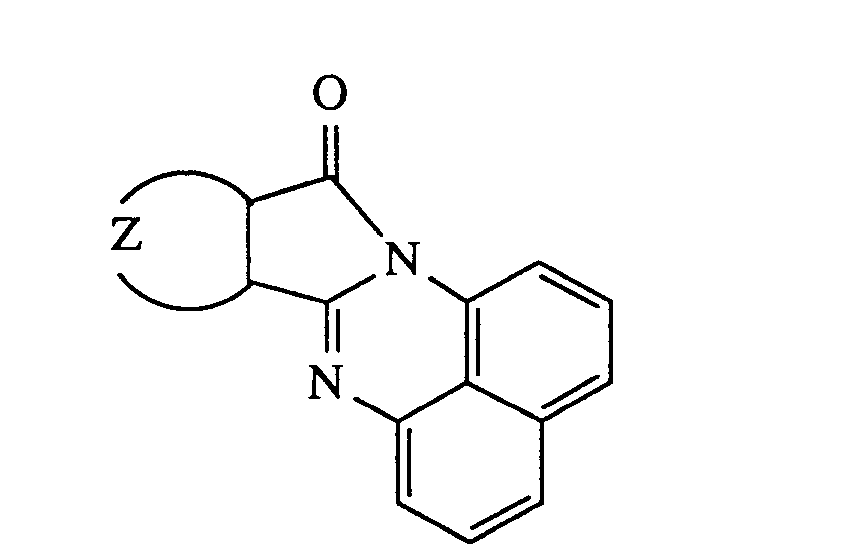
- A) Darstellung
- Eine Mischung von 2,0 Teilen Naphthalin-1,2-dicarbonsäureanhydrid, 1,6 Teilen Naphthalin-1,8-diamin und 20 Teilen Eisessig wird 5 Min. auf 75 ° C erhitzt. Nach dem Erkalten wird der erhaltene Niederschlag abgesaugt und mit Methanol und Wasser gewaschen. Man erhält so 3,0 Teile (94 %) des obigen Farbstoffes. Amax = 499 nm (Toluol).
- 'H-NMR-Protonierungsexperimente in deuteriertem Dimethylsulfoxid/Trifluoressigsäure zeigen, daß der obige Farbstoff in der folgenden isomeren Form vorliegt:

- 1 H-NMR (DMSO): 0 7,5-8,0 (m, 7H), 8,2 (d, J = 8Hz, 1 H), 8,25 (d, J = 8Hz, 1 H), 8,45 (d, J = 8Hz, 2H), 9,05 (d, J = 8Hz, 1 H) ppm. H-NMR (DMSO/Trifluoressigsäure): 0 7,4-7,9 (m, 7H), 8,0 (d, J = 8Hz, 1 H), 8,25-8,35 (m, 2H), 8,4 (d, J = 8Hz, 1 H), 8,85 (d, J = 8Hz, 1 H) ppm.
- B) Färbebeispiele
- 100 Teile Polystyrol-Granulat und 0,02 Teile eines Farbstoffes der obigen Formel werden im Trommelmischer während 15 Minuten intensiv vermischt. Das trocken angefärbte Granulat wird bei 240 °C auf einer Schneckenspritzgießmaschine verarbeitet. Man erhält transparente, rote Platten von sehr guter Lichtechtheit. Anstelle von Polystyrol-Polymerisat können auch Mischpolymerisate mit Butadien und Acrylnitril verwendet werden. Setzt man zusätzlich 0,5 Teile Titandioxid zu, so erhält man farbstarke gedeckte Färbungen.
- 0,015 Teile des Farbstoffes aus Beispiel A) und 100 Teile Polymethylmethacrylat werden trocken vermischt und auf einem 1-Wellenextruder bei 230 °C homogenisiert. Das als Strang aus dem Extruder austretende Material wird granuliert. Es kann anschließend zu Formen verpreßt werden. Man erhält einen transparent rot-gefärbten Kunststoff mit guter Licht- und Wetterechtheit.
- 100 Teile eines handelsüblichen Polycarbonats werden in Form von Granulat mit 0,03 Teilen des Farbstoffes aus Beispiel A) trocken gemischt. Das so bestäubte Granulat wird auf einem 2-Wellenextruder bei 290 °C homogenisiert. Man erhält eine transparente rote Färbung von guter Lichtechtheit. Das gefärbte Polycarbonat wird als Strang aus dem Extruder ausgetragen und zu Granulat verarbeitet. Das Granulat kann nach den üblichen Methoden der Konfektionierung thermoplastischer Massen verarbeitet werden.
- Arbeitet man wie oben beschrieben, aber unter Zusatz von 1 % Titandioxid, so erhält man eine rote gedeckte Färbung.
- Mit 100 Teilen Styrol-Acrylnitril-Copolymerisat werden 0,04 Teile des Farbstoffes aus Beispiel A) trocken vermischt und in einem 2-Wellenextruder bei 190°C homogenisiert, granuliert und dann zu Formen auf übliche Weise verpreßt. Man erhält einen transparent roten Kunststoff von guter Lichtechtheit.
- 0,025 Teile des Farbstoffes aus Beispiel A) werden mit 100 Teilen Polyethylenterephthalat einer transparenten Type vermischt und in einem 2-Wellenextruder bei 280 ° C homogenisiert. Man erhält eine transparente, rote Färbung mit guter Lichtechtheit. Nach anschließender Granulierung kann der eingefärbte Kunststoff nach den üblichen Methoden der thermoplastischen Verformung verarbeitet werden. Arbeitet man unter Zusatz von 1 % Titandioxid, so erhält man eine gedeckte Färbung.
- In 98,9 Teilen Styrol werden 0,05 Teile tert.-Dodecylmercaptan sowie 0,05 Teile des Farbstoffes aus Beispiel A) gelöst. Diese Lösung dispergiert man in einer Lösung aus 200 Teilen entsalztem Wasser, 0,3 Teilen teilverseiftem Polyvinylacetat (z.B. Mowiol@ 50/88 der Fa. Hoechst) und 0,05 Teilen Dodecylbenzolsulfonat. Nach Zusatz von 0,1 Teilen Dibenzoylperoxid in 1 Teil Styrol wird die Dispersion unter kräftigem Rühren auf 80 °C erhitzt und die Polymerisation gestartet. Bei Anwendung folgender Polymerisationsbedingungen: 4 h bei 80 °C, 2 h bei 90 °C, 3 h bei 110°C, 2 h bei 130°C, erhält man das Polymerisat in einer Ausbeute von 98 % der Theorie. Das Polymerisat fällt in Form von Perlen an, die je nach Rührbedingungen einen Durchmesser von 0,1 bis 1,5 mm (Dso-Wert) aufweisen. Das Polymerisat wird durch Filtration vom Serum getrennt, bei 110°C auf eine Restfeuchte von 0,5 % getrocknet. Nach dem Aufschmelzen in einem Mischaggregat (Heißwalze) werden 0,5 % Zinkstearat und 0,2 % lonol zugemischt und das Polymerisat granuliert.
- Das Polymerisat kann nach den üblichen Methoden der thermoplastischen Verformung, z.B. im Spritzguß-Verfahren, zu roten, transparenten Formteilen verarbeitet werden.
- In 74,8 Teilen Styrol und 25 Teilen Acrylnitril werden 0,2 Teile tert.-Dodecylmercaptan sowie 0,01 Teile des Farbstoffes aus Beispiel A) gelöst, diese Lösung wird anschließend in einer Lösung aus 200 Teilen vollentsalztem Wasser und 0,2 Teilen eines mit Natriumhydroxid neutralisierten Copolymerisats von Styrol und Maleinsäureanhydrid dispergiert. Nach Zusatz von 0,1 Teilen Dibenzoylperoxid, gelöst in einem Teil Styrol, wird die Dispersion unter kräftigem Rühren auf 80°C erhitzt und die Polymerisation gestartet. Nach der Polymerisation wie im Beispiel f) wird auch in gleicher Weise, wie im Beispiel angegeben, aufgearbeitet. Als Schmiermittel wird 0,5 % Zinkstearat und als Alterungsschutzmittel 0,5 % lonol auf der Heißwalze eingearbeitet. Das granulierte Polymerisat laßt sich zu transparenten roten Formteilen verspritzen.
- In einem kontinuierlich arbeitenden, überflutet gefahrenen Vorreaktor wird eine Lösung aus 99,95 Teilen Styrol, 0,04 Teilen des Farbstoffes aus Beispiel A) und 0,01 Teilen Di-tert.-butylperoxid eingefahren und bei einer Temperatur von 75 ° C anpolymerisiert. Die aus dem Vorreaktor austretende, anpolymerisierte Lösung (Polystyrol-Gehalt 20 %) wird in einem 2-Wellenschneckenaggregat eingeführt. Die beiden Wellen laufen mit 20 Upm gegenläufig. Die vier heiz- bzw. kühlbaren Segmente der Schneckenmaschine werden in der Reihenfolge Produkteintritt - Produktaustritt auf 110°C, 130°C, 160°C, 180°C gehalten. Das Polymerisat verläßt den Schneckenreaktor mit einer Feststoffkonzentration von 80 %. In einem nachgeschalteten Extruder werden 3 Gew.-Teile lonol und 5 Gew.-Teile Octylalkohol pro 1000 Gew.-Teile Polymerlösung zudosiert, das Polymerisat entgast und anschließend granuliert. Das rot gefärbte Granulat kann zu Formteilen verarbeitet werden.
- 0,02 Teile des Farbstoffes aus Beispiel A) werden in 74,97 Teilen Styrol und 25 Teilen Acrylnitril bzw. Methacrylnitril gelöst. Nach Zugabe von 0,01 Teilen Di-tert.-butylperoxid wird die so erhaltene Lösung in einem kontinuierlich arbeitenden, überflutet gefahrenen Vorreaktor eingefahren. Die Polymerisation und Aufarbeitung erfolgt wie im Beispiel h) angegeben. Das transparente, rote Granulat kann nach den üblichen Methoden der Verarbeitung thermoplastischer Massen zu Profilen und Platten weiterverarbeitet werden.
- In 99,97 Teilen Methylmethacrylat werden 0,03 Teile des Farbstoffes aus Beispiel A) gelöst. Nach Zugabe von 0,1 Teilen Dibenzoylperoxid wird die Lösung auf 120°C erhitzt und die Polymerisation gestartet. Nach 30 Min. wird das anpolymerisierte Methylmethacrylat zwischen zwei Glasplatten bei 80°C während zehn Stunden auspolymerisiert. Man erhält rote, transparente Polymethylmethacrylat-Platten.
- 100 Teile Polyamid-6-Schnitzel, erhalten durch Polymerisation von E-Caprolactam, werden mit 0,05 Teilen des Farbstoffes aus Beispiel A) in einer Schüttelmaschine innig vermischt. Die so erhaltenen gepuderten Schnitzel werden bei 260 °C in einem Extruder aufgeschmolzen, die erhaltene Schmelze durch eine Einloch-Düse vom Durchmesser 0,5 mm gepreßt und der austretende Faden mit einer Geschwindigkeit von ca. 25 m/Min. abgezogen. Der Faden läßt sich in heißem Wasser auf das Vierfache verstrecken. Erhalten wird ein transparent rot gefärbter Faden von ausgezeichneter Lichtechtheit. Will man eine gedeckte Färbung erhalten, so gibt man zusätzlich 0,5 Teile Titandioxid zu.
- Die Verweilzeit im Extruder kann ohne Beeinträchtigung des Farbtons bis zu 30 Minuten betragen.
- Auf analoge Weise wie in Beispiel 1A beschrieben, werden aus den Verbindungen der Formeln (11) und (111) die in der Tabelle 1 beschriebenen Farbstoffe erhalten, die in Kunststoffen entsprechend Beispiel 1 B a)-I) gefärbt werden und die in Tabelle 1 angegebenen Farbtöne erzielen.


-

- b) Setzt man das so gewonnene Anhydrid (2,8 Teile) analog zu Beispiel 1A um, so erhält man 3,8 Teile (95 %) des obigen Farbstoffes. Amax = 500 nm (N-Methylpyrrolidon).
- Es wird analog zu Beispiel 1 B gefärbt und dabei blaustichig rote Färbungen von ausgezeichneter Lichtechtheit erhalten.
-
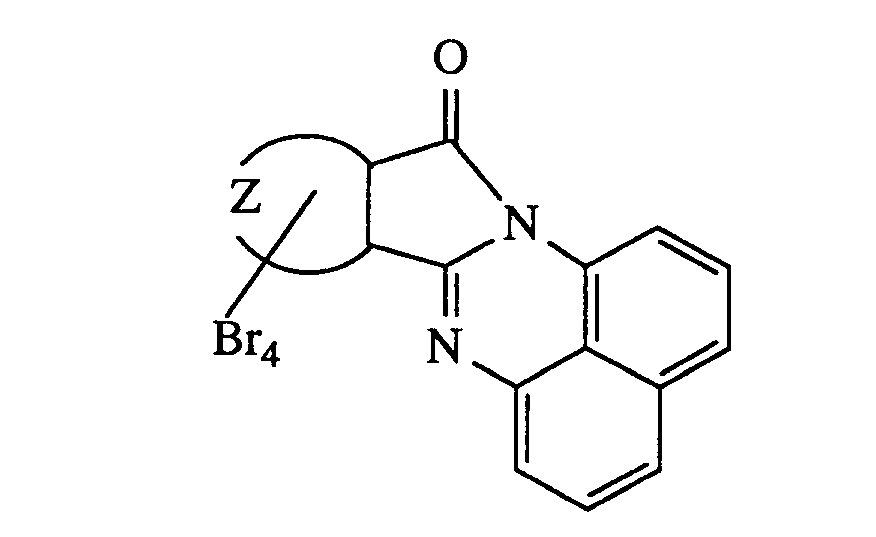
- a) Tetrabromnaphthalin-1,2-dicarbonsäureanhydrid: 2,0 g Naphthalin-1,2-dicarbonsäureahnydrid, 0,05 g Ferrum reductum und 5,2 ml Brom werden unter Verwendung eines langen Intensivkühlers 6 Std. auf 210°C erhitzt. Aufarbeitung analog zu Beispiel 61 a) liefert 5,0 g Tetrabromnaphthalin-1,2-dicarbonsäure, die mit Acetanhydrid in das Anhydrid überführt wird. Ausbeute: 4,8 g (94 %), Bromgehalt: 62,4 % (theoretisch 62,7 %).
- b) Setzt man die so erhaltene Tetrabromverbindung (5,2 Teile) analog zu Beispiel 1A um, so erhält man 6,3 Teile (99 %) des obengenannten Farbstoffes Tetrabrom-1,2-naphthaloperinon. Färbt man diesen analog zu Beispiel 1 B aus, so ergeben sich violette Färbungen mit sehr guter Lichtechtheit. Amax = 523 nm (N-Methylpyrrolidon).
-

- Eine Mischung aus 2,1 Teilen des Farbstoffes aus Beispiel 1, 2,8 Teilen Sulfurylchlorid und 50 Teile N-Methylpyrrolidon wird 20 Std. bei Raumtemperatur gerührt. Dabei werden nach 3,5 Std. und nach 6 Std. jeweils 2,8 Teile Sulfurylchlorid nachgesetzt. Anschließend wird der Niederschlag abgesaugt, mit N-Methylpyrrolidon und Methanol gewaschen und im Vakuum getrocknet. Ausbeute: 1,7 Teile eines Farbstoffes mit 26,2 % Chlorgehalt. Der Farbstoff ergibt in Kunststoffen, entsprechend Beispiel 1 B a)-I) gefärbt, gelbstichig rote Nuancen. λmax = 483 nm (N-Methylpyrrolidon).
-

- 2,1 Teile der Verbindung aus Beispiel 1, 50 Teile Dimethylformamid und 6,9 Teile Brom werden 20 Std. gerührt. Der Niederschlag wird abgesaugt und mit DMF und Methanol gewaschen. Man erhält 3,1 Teile des Farbstoffes mit 37,0 % Bromgehalt, der analog zu Beispiel 1 B a)-I) gefärbt, rote Farbtöne liefert. λmax = 494 nm (N-Methylpyrrolidon).
-

- 4,5 Teile des Farbstoffes aus Beispiel 1 werden in 35 Teilen Chlorsulfonsäure bei Raumtemperatur eingetragen. Anschließend setzt man 3 Teile Thionylchlorid zu und rührt 3 Std. bei 25-30°C nach. Die Lösung wird auf 200 Teile Eis ausgetragen, der erhaltene Niederschlag abgesaugt, mit Wasser gut gewaschen und im Vakuum über KOH getrocknet. Xmax = 467 nm (N-Methylpyrrolidon).
-

- 3,0 Teile der Verbindung aus Beispiel 65 werden in 25 Teilen 30 %iger wäßriger Methylaminlösung bei 15°C eingetragen und 1 Std. bei Raumtemperatur nachgerührt. Dann werden 12,5 Teile Eisessig zugesetzt und die Lösung 10 Min. zum Sieden erhitzt. Nach dem Abkühlen wird der entsprechende Niederschlag abgesaugt und mit Wasser gewaschen. Man erhält 2,9 Teile eines Farbstoffes der obigen Formel mit 11,4 % Schwefelgehalt, der Kunststoffe (entsprechend der Beispiele 1B a)-I)) gelbstichig rot färbt. λmax = 479 um (N-Methylpyrrolidon).
-

- Auf analoge Weise zum Beispiel 66 erhält man den Farbstoff der oben angegebenen Formel mit 11,0 % Schwefelgehalt, wenn man anstelle der Methylaminlösung 25 Teile einer 30 %igen wäßrigen Dimethylaminlösung einsetzt. Ausbeute: 3,1 Teile.
- Dieser Farbstoff färbt Kunststoffe gemäß Beispiel 1 B a)-I) in gelbstichig roten Nuancen.
-

- Eine Mischung aus 3,0 Teilen der Verbindung aus Beispiel 65, 3,4 Teilen Phenol, 6,0 Teilen wasserfreiem Kaliumcarbonat, 30 Teilen Aceton und 30 Teilen N-Methylpyrrolidon wird 20 Std. bei Raumtemperatur verrührt. Danach werden 100 Teile Methanol zugesetzt, der Niederschlag abgesaugt und mit Methanol und Wasser gewaschen. Ausbeute: 1,9 Teile eines Farbstoffes der obigen Formel mit einem Schwefelgehalt von 9,3 %. Analog zu Beispiel 1 B a)-I) ausgefärbt, zeigt dieser Farbstoff gelbstichig rote Farbtöne. λmax = 473 nm (N-Methylpyrrolidon).
Claims (8)

worin

oder deren Anhydride, in denen Y und n die unter Anspruch 1 genannte Bedeutung haben, mit Naphthalin-1,8-diaminen der Formel (III)

in der
Applications Claiming Priority (2)
| Application Number | Priority Date | Filing Date | Title |
|---|---|---|---|
| DE4216761A DE4216761A1 (de) | 1992-05-21 | 1992-05-21 | Neue Perinonfarbstoffe zum Massefärben von Kunststoffen |
| DE4216761 | 1992-05-21 |
Publications (3)
| Publication Number | Publication Date |
|---|---|
| EP0570800A2 true EP0570800A2 (de) | 1993-11-24 |
| EP0570800A3 EP0570800A3 (de) | 1994-11-30 |
| EP0570800B1 EP0570800B1 (de) | 1998-09-23 |
Family
ID=6459377
Family Applications (1)
| Application Number | Title | Priority Date | Filing Date |
|---|---|---|---|
| EP93107561A Expired - Lifetime EP0570800B1 (de) | 1992-05-21 | 1993-05-10 | Neue Perinonfarbstoffe zum Massefärben von Kunststoffen |
Country Status (4)
| Country | Link |
|---|---|
| US (1) | US5466805A (de) |
| EP (1) | EP0570800B1 (de) |
| JP (1) | JP3319626B2 (de) |
| DE (2) | DE4216761A1 (de) |
Cited By (2)
| Publication number | Priority date | Publication date | Assignee | Title |
|---|---|---|---|---|
| EP0683212A1 (de) * | 1994-05-20 | 1995-11-22 | Bayer Ag | Neue Farbstoffe zum Massefärben von Kunststoffen |
| EP0780444A2 (de) | 1995-12-22 | 1997-06-25 | Bayer Ag | Verfahren zur Herstellung polycyclischer Verbindungen |
Families Citing this family (7)
| Publication number | Priority date | Publication date | Assignee | Title |
|---|---|---|---|---|
| US6642245B1 (en) * | 1990-02-01 | 2003-11-04 | Emory University | Antiviral activity and resolution of 2-hydroxymethyl-5-(5-fluorocytosin-1-yl)-1,3-oxathiolane |
| EP0639624A1 (de) * | 1993-08-19 | 1995-02-22 | Bayer Ag | Phthaloperinonfarbstoffe |
| DE59710483D1 (de) * | 1996-09-05 | 2003-08-28 | Bayer Ag | Verbrückte Perinone, Chinophthalone und Perinon-Chinophthalone |
| JP2007302782A (ja) * | 2006-05-11 | 2007-11-22 | Ueno Fine Chem Ind Ltd | フタロペリノン化合物 |
| ITRM20100668A1 (it) * | 2010-12-17 | 2012-06-18 | Bayer Materialscience Ag | Substrato-led a colorazione stabile. |
| US10280366B2 (en) | 2015-06-23 | 2019-05-07 | Instituto Potosino DE Investigación Cientiffica y Technológica A.C. | White light emitting material and method of preparation and uses thereof |
| IL322302A (en) | 2023-01-27 | 2025-09-01 | Lanxess Corp | Flame retardant and orange color combined for use with thermoplastic materials |
Family Cites Families (7)
| Publication number | Priority date | Publication date | Assignee | Title |
|---|---|---|---|---|
| FR1075110A (fr) * | 1950-09-25 | 1954-10-13 | Francolor Sa | Nouveaux dérivés de périnones et procédé de coloration des superpolyamides au moyen des dérivés de périnones |
| GB730692A (en) * | 1953-04-28 | 1955-05-25 | Leonard Ellwood Jones | Improvements in and relating to the colouration of plastic materials |
| GB877910A (en) * | 1956-11-17 | 1961-09-20 | Cie Francaise Des Matleres Col | New dyestuffs derived from perinones and a process for their preparation |
| FR1166701A (fr) * | 1957-02-08 | 1958-11-14 | Cfmc | Procédé de teinture des fibres synthétiques à base de polyesters |
| GB1037377A (en) * | 1964-09-02 | 1966-07-27 | Mitsubishi Chem Ind | Naphthoylene-arylimidazole disperse dyestuffs |
| JPS5436176B2 (de) * | 1972-05-24 | 1979-11-07 | ||
| DE2236555A1 (de) | 1972-07-26 | 1974-02-07 | Bayer Ag | Polycyclische farbstoffe |
-
1992
- 1992-05-21 DE DE4216761A patent/DE4216761A1/de not_active Withdrawn
-
1993
- 1993-05-10 EP EP93107561A patent/EP0570800B1/de not_active Expired - Lifetime
- 1993-05-10 DE DE59308998T patent/DE59308998D1/de not_active Expired - Fee Related
- 1993-05-20 JP JP13989893A patent/JP3319626B2/ja not_active Expired - Fee Related
-
1994
- 1994-12-01 US US08/348,510 patent/US5466805A/en not_active Expired - Lifetime
Cited By (5)
| Publication number | Priority date | Publication date | Assignee | Title |
|---|---|---|---|---|
| EP0683212A1 (de) * | 1994-05-20 | 1995-11-22 | Bayer Ag | Neue Farbstoffe zum Massefärben von Kunststoffen |
| US5621027A (en) * | 1994-05-20 | 1997-04-15 | Bayer Aktiengesellschaft | Dyestuffs for bulk dyeing plastics |
| EP0780444A2 (de) | 1995-12-22 | 1997-06-25 | Bayer Ag | Verfahren zur Herstellung polycyclischer Verbindungen |
| EP0780444A3 (de) * | 1995-12-22 | 1998-10-07 | Bayer Ag | Verfahren zur Herstellung polycyclischer Verbindungen |
| US5830931A (en) * | 1995-12-22 | 1998-11-03 | Bayer Aktiengesellschaft | Process for the preparation of polycyclic compounds |
Also Published As
| Publication number | Publication date |
|---|---|
| JPH0680896A (ja) | 1994-03-22 |
| JP3319626B2 (ja) | 2002-09-03 |
| EP0570800B1 (de) | 1998-09-23 |
| US5466805A (en) | 1995-11-14 |
| DE4216761A1 (de) | 1993-11-25 |
| EP0570800A3 (de) | 1994-11-30 |
| DE59308998D1 (de) | 1998-10-29 |
Similar Documents
| Publication | Publication Date | Title |
|---|---|---|
| EP3470467B1 (de) | Methinfarbstoffe zum färben von kunststoffen | |
| EP0632102B1 (de) | Massefärben von Kunststoffen | |
| EP3470471B1 (de) | Methinfarbstoffe | |
| EP3508536B1 (de) | Methinfarbstoffe zum massefärben von synthetischen polyamiden | |
| EP3470472B1 (de) | Neue methinfarbstoffe | |
| EP3247749B1 (de) | Gelbe methinfarbstoffe | |
| EP0683212A1 (de) | Neue Farbstoffe zum Massefärben von Kunststoffen | |
| EP0639624A1 (de) | Phthaloperinonfarbstoffe | |
| EP0827986B1 (de) | Verbrückte Perinone, Chinophthalone und Perinon-Chinophthalone | |
| EP0570800B1 (de) | Neue Perinonfarbstoffe zum Massefärben von Kunststoffen | |
| EP3489229A1 (de) | Neue methinfarbstoffe | |
| DE69801179T2 (de) | Massefärben mit Chinophthalonfarbstoffen | |
| EP0859032B1 (de) | Verbrückte Anthrachinone | |
| EP0527383B1 (de) | Massefärben von Kunststoffen | |
| EP2039728B1 (de) | Rote Farbstoffmischung | |
| DE19636032A1 (de) | Verbrückte Perinone | |
| EP0705885B1 (de) | Massefärben mit Chinophthalonfarbstoffen | |
| DE19641689A1 (de) | Verfahren zur Herstellung von 1,8-Diaminonaphthalinen und ihrer Derivate der 2,3-Dihydroperimidine | |
| DE4327855A1 (de) | Phthaloperinonfarbstoffe | |
| EP0703270A2 (de) | Massefärben von Kunststoffen | |
| DE68921810T2 (de) | Anthrapyridonverbindungen und Verfahren zu ihrer Herstellung. | |
| DE102007044743A1 (de) | Rote Farbstoffmischung | |
| EP0298917B1 (de) | Verfahren zum Färben von hochmolekularem organischem Material mit Pigmenten auf der Basis von Iminoisoindolin | |
| DE19737724A1 (de) | Verbrückte Anthrachinone | |
| DE19705389A1 (de) | Verbrückte Anthrachinone |
Legal Events
| Date | Code | Title | Description |
|---|---|---|---|
| PUAI | Public reference made under article 153(3) epc to a published international application that has entered the european phase |
Free format text: ORIGINAL CODE: 0009012 |
|
| AK | Designated contracting states |
Kind code of ref document: A2 Designated state(s): CH DE FR GB LI |
|
| PUAL | Search report despatched |
Free format text: ORIGINAL CODE: 0009013 |
|
| AK | Designated contracting states |
Kind code of ref document: A3 Designated state(s): CH DE FR GB LI |
|
| 17P | Request for examination filed |
Effective date: 19950418 |
|
| GRAG | Despatch of communication of intention to grant |
Free format text: ORIGINAL CODE: EPIDOS AGRA |
|
| 17Q | First examination report despatched |
Effective date: 19971202 |
|
| GRAG | Despatch of communication of intention to grant |
Free format text: ORIGINAL CODE: EPIDOS AGRA |
|
| GRAH | Despatch of communication of intention to grant a patent |
Free format text: ORIGINAL CODE: EPIDOS IGRA |
|
| GRAH | Despatch of communication of intention to grant a patent |
Free format text: ORIGINAL CODE: EPIDOS IGRA |
|
| GRAA | (expected) grant |
Free format text: ORIGINAL CODE: 0009210 |
|
| AK | Designated contracting states |
Kind code of ref document: B1 Designated state(s): CH DE FR GB LI |
|
| REG | Reference to a national code |
Ref country code: CH Ref legal event code: EP |
|
| REG | Reference to a national code |
Ref country code: CH Ref legal event code: NV Representative=s name: E. BLUM & CO. PATENTANWAELTE |
|
| REF | Corresponds to: |
Ref document number: 59308998 Country of ref document: DE Date of ref document: 19981029 |
|
| GBT | Gb: translation of ep patent filed (gb section 77(6)(a)/1977) |
Effective date: 19981008 |
|
| ET | Fr: translation filed | ||
| PLBE | No opposition filed within time limit |
Free format text: ORIGINAL CODE: 0009261 |
|
| 26N | No opposition filed | ||
| REG | Reference to a national code |
Ref country code: GB Ref legal event code: IF02 |
|
| PGFP | Annual fee paid to national office [announced via postgrant information from national office to epo] |
Ref country code: GB Payment date: 20030507 Year of fee payment: 11 |
|
| PG25 | Lapsed in a contracting state [announced via postgrant information from national office to epo] |
Ref country code: GB Free format text: LAPSE BECAUSE OF NON-PAYMENT OF DUE FEES Effective date: 20040510 |
|
| GBPC | Gb: european patent ceased through non-payment of renewal fee |
Effective date: 20040510 |
|
| REG | Reference to a national code |
Ref country code: CH Ref legal event code: PFA Owner name: BAYER AG Free format text: BAYER AG# #51368 LEVERKUSEN (DE) -TRANSFER TO- BAYER AG# #51368 LEVERKUSEN (DE) |
|
| REG | Reference to a national code |
Ref country code: CH Ref legal event code: PUE Owner name: LANXESS DEUTSCHLAND GMBH Free format text: BAYER AG# #51368 LEVERKUSEN (DE) -TRANSFER TO- LANXESS DEUTSCHLAND GMBH# #51369 LEVERKUSEN (DE) |
|
| PGFP | Annual fee paid to national office [announced via postgrant information from national office to epo] |
Ref country code: DE Payment date: 20080515 Year of fee payment: 16 Ref country code: CH Payment date: 20080616 Year of fee payment: 16 |
|
| REG | Reference to a national code |
Ref country code: FR Ref legal event code: TP |
|
| REG | Reference to a national code |
Ref country code: CH Ref legal event code: PL |
|
| PG25 | Lapsed in a contracting state [announced via postgrant information from national office to epo] |
Ref country code: LI Free format text: LAPSE BECAUSE OF NON-PAYMENT OF DUE FEES Effective date: 20090531 Ref country code: CH Free format text: LAPSE BECAUSE OF NON-PAYMENT OF DUE FEES Effective date: 20090531 |
|
| REG | Reference to a national code |
Ref country code: FR Ref legal event code: ST Effective date: 20100129 |
|
| PG25 | Lapsed in a contracting state [announced via postgrant information from national office to epo] |
Ref country code: FR Free format text: LAPSE BECAUSE OF NON-PAYMENT OF DUE FEES Effective date: 20090602 |
|
| PGFP | Annual fee paid to national office [announced via postgrant information from national office to epo] |
Ref country code: FR Payment date: 20080514 Year of fee payment: 16 |
|
| PG25 | Lapsed in a contracting state [announced via postgrant information from national office to epo] |
Ref country code: DE Free format text: LAPSE BECAUSE OF NON-PAYMENT OF DUE FEES Effective date: 20091201 |