EP0827986B1 - Verbrückte Perinone, Chinophthalone und Perinon-Chinophthalone - Google Patents
Verbrückte Perinone, Chinophthalone und Perinon-Chinophthalone Download PDFInfo
- Publication number
- EP0827986B1 EP0827986B1 EP97114706A EP97114706A EP0827986B1 EP 0827986 B1 EP0827986 B1 EP 0827986B1 EP 97114706 A EP97114706 A EP 97114706A EP 97114706 A EP97114706 A EP 97114706A EP 0827986 B1 EP0827986 B1 EP 0827986B1
- Authority
- EP
- European Patent Office
- Prior art keywords
- alkyl
- formula
- optionally substituted
- independently
- aryl
- Prior art date
- Legal status (The legal status is an assumption and is not a legal conclusion. Google has not performed a legal analysis and makes no representation as to the accuracy of the status listed.)
- Expired - Lifetime
Links
- DGBWPZSGHAXYGK-UHFFFAOYSA-N perinone Chemical compound C12=NC3=CC=CC=C3N2C(=O)C2=CC=C3C4=C2C1=CC=C4C(=O)N1C2=CC=CC=C2N=C13 DGBWPZSGHAXYGK-UHFFFAOYSA-N 0.000 title description 10
- IZMJMCDDWKSTTK-UHFFFAOYSA-N quinoline yellow Chemical compound C1=CC=CC2=NC(C3C(C4=CC=CC=C4C3=O)=O)=CC=C21 IZMJMCDDWKSTTK-UHFFFAOYSA-N 0.000 title description 7
- 150000001875 compounds Chemical class 0.000 claims description 94
- -1 aryloxysulphonyl Chemical group 0.000 claims description 37
- 229910052736 halogen Inorganic materials 0.000 claims description 35
- 150000002367 halogens Chemical class 0.000 claims description 35
- 125000000217 alkyl group Chemical group 0.000 claims description 26
- 125000003118 aryl group Chemical group 0.000 claims description 25
- 150000003254 radicals Chemical class 0.000 claims description 25
- 229910052794 bromium Inorganic materials 0.000 claims description 20
- 229920003023 plastic Polymers 0.000 claims description 20
- 239000004033 plastic Substances 0.000 claims description 20
- 125000001424 substituent group Chemical group 0.000 claims description 20
- 125000001997 phenyl group Chemical class [H]C1=C([H])C([H])=C(*)C([H])=C1[H] 0.000 claims description 18
- 125000004169 (C1-C6) alkyl group Chemical group 0.000 claims description 16
- 125000003178 carboxy group Chemical group [H]OC(*)=O 0.000 claims description 16
- 229910052801 chlorine Inorganic materials 0.000 claims description 15
- 238000000034 method Methods 0.000 claims description 14
- 238000004043 dyeing Methods 0.000 claims description 13
- 125000002496 methyl group Chemical group [H]C([H])([H])* 0.000 claims description 13
- UFWIBTONFRDIAS-UHFFFAOYSA-N Naphthalene Chemical compound C1=CC=CC2=CC=CC=C21 UFWIBTONFRDIAS-UHFFFAOYSA-N 0.000 claims description 12
- 150000008064 anhydrides Chemical class 0.000 claims description 12
- 229910052731 fluorine Inorganic materials 0.000 claims description 12
- 125000002887 hydroxy group Chemical group [H]O* 0.000 claims description 12
- UHOVQNZJYSORNB-UHFFFAOYSA-N monobenzene Natural products C1=CC=CC=C1 UHOVQNZJYSORNB-UHFFFAOYSA-N 0.000 claims description 12
- 125000000449 nitro group Chemical group [O-][N+](*)=O 0.000 claims description 12
- 150000000000 tetracarboxylic acids Chemical class 0.000 claims description 12
- 125000004104 aryloxy group Chemical group 0.000 claims description 11
- 230000008569 process Effects 0.000 claims description 11
- 125000002252 acyl group Chemical group 0.000 claims description 10
- 125000004191 (C1-C6) alkoxy group Chemical group 0.000 claims description 9
- 125000001495 ethyl group Chemical group [H]C([H])([H])C([H])([H])* 0.000 claims description 9
- 125000000623 heterocyclic group Chemical group 0.000 claims description 9
- 238000002360 preparation method Methods 0.000 claims description 9
- 125000002924 primary amino group Chemical group [H]N([H])* 0.000 claims description 7
- 125000001624 naphthyl group Chemical class 0.000 claims description 6
- 125000005129 aryl carbonyl group Chemical group 0.000 claims description 5
- 125000004391 aryl sulfonyl group Chemical group 0.000 claims description 5
- 125000000732 arylene group Chemical group 0.000 claims description 5
- 125000001449 isopropyl group Chemical group [H]C([H])([H])C([H])(*)C([H])([H])[H] 0.000 claims description 5
- 125000004123 n-propyl group Chemical group [H]C([H])([H])C([H])([H])C([H])([H])* 0.000 claims description 5
- 125000000999 tert-butyl group Chemical group [H]C([H])([H])C(*)(C([H])([H])[H])C([H])([H])[H] 0.000 claims description 5
- 125000000041 C6-C10 aryl group Chemical group 0.000 claims description 4
- 150000005840 aryl radicals Chemical class 0.000 claims description 4
- 125000000051 benzyloxy group Chemical group [H]C1=C([H])C([H])=C(C([H])=C1[H])C([H])([H])O* 0.000 claims description 4
- 125000002837 carbocyclic group Chemical group 0.000 claims description 4
- 125000000956 methoxy group Chemical group [H]C([H])([H])O* 0.000 claims description 4
- 125000006833 (C1-C5) alkylene group Chemical class 0.000 claims description 3
- 125000004108 n-butyl group Chemical group [H]C([H])([H])C([H])([H])C([H])([H])C([H])([H])* 0.000 claims description 3
- 125000002914 sec-butyl group Chemical group [H]C([H])([H])C([H])([H])C([H])(*)C([H])([H])[H] 0.000 claims description 3
- 125000000008 (C1-C10) alkyl group Chemical group 0.000 claims 3
- 125000004448 alkyl carbonyl group Chemical group 0.000 claims 3
- 125000004390 alkyl sulfonyl group Chemical group 0.000 claims 3
- 238000006482 condensation reaction Methods 0.000 claims 1
- OKKJLVBELUTLKV-UHFFFAOYSA-N Methanol Chemical compound OC OKKJLVBELUTLKV-UHFFFAOYSA-N 0.000 description 120
- 239000000975 dye Substances 0.000 description 88
- XLYOFNOQVPJJNP-UHFFFAOYSA-N water Substances O XLYOFNOQVPJJNP-UHFFFAOYSA-N 0.000 description 35
- 239000000203 mixture Substances 0.000 description 34
- 238000000859 sublimation Methods 0.000 description 24
- 230000008022 sublimation Effects 0.000 description 24
- 238000006243 chemical reaction Methods 0.000 description 22
- ISWSIDIOOBJBQZ-UHFFFAOYSA-N Phenol Chemical compound OC1=CC=CC=C1 ISWSIDIOOBJBQZ-UHFFFAOYSA-N 0.000 description 19
- 239000000460 chlorine Substances 0.000 description 13
- RFFLAFLAYFXFSW-UHFFFAOYSA-N 1,2-dichlorobenzene Chemical compound ClC1=CC=CC=C1Cl RFFLAFLAYFXFSW-UHFFFAOYSA-N 0.000 description 12
- 239000004793 Polystyrene Substances 0.000 description 12
- 229920002223 polystyrene Polymers 0.000 description 12
- 0 CCCC(C(C1c2nc(CC)c(CCC)c(*)c2*=*)=O)=C(CCI)C1=O Chemical compound CCCC(C(C1c2nc(CC)c(CCC)c(*)c2*=*)=O)=C(CCI)C1=O 0.000 description 9
- 239000004743 Polypropylene Substances 0.000 description 9
- 229920001155 polypropylene Polymers 0.000 description 9
- IJGRMHOSHXDMSA-UHFFFAOYSA-N Atomic nitrogen Chemical compound N#N IJGRMHOSHXDMSA-UHFFFAOYSA-N 0.000 description 8
- KAKZBPTYRLMSJV-UHFFFAOYSA-N Butadiene Chemical compound C=CC=C KAKZBPTYRLMSJV-UHFFFAOYSA-N 0.000 description 8
- LFQSCWFLJHTTHZ-UHFFFAOYSA-N Ethanol Chemical compound CCO LFQSCWFLJHTTHZ-UHFFFAOYSA-N 0.000 description 8
- GWEVSGVZZGPLCZ-UHFFFAOYSA-N Titan oxide Chemical compound O=[Ti]=O GWEVSGVZZGPLCZ-UHFFFAOYSA-N 0.000 description 8
- 239000004417 polycarbonate Substances 0.000 description 8
- 229920000515 polycarbonate Polymers 0.000 description 8
- 229920000728 polyester Polymers 0.000 description 8
- 239000011541 reaction mixture Substances 0.000 description 8
- 238000003756 stirring Methods 0.000 description 8
- YFOOEYJGMMJJLS-UHFFFAOYSA-N 1,8-diaminonaphthalene Chemical compound C1=CC(N)=C2C(N)=CC=CC2=C1 YFOOEYJGMMJJLS-UHFFFAOYSA-N 0.000 description 7
- PPBRXRYQALVLMV-UHFFFAOYSA-N Styrene Natural products C=CC1=CC=CC=C1 PPBRXRYQALVLMV-UHFFFAOYSA-N 0.000 description 7
- SMUQFGGVLNAIOZ-UHFFFAOYSA-N quinaldine Chemical class C1=CC=CC2=NC(C)=CC=C21 SMUQFGGVLNAIOZ-UHFFFAOYSA-N 0.000 description 7
- 239000002904 solvent Substances 0.000 description 7
- CURLTUGMZLYLDI-UHFFFAOYSA-N Carbon dioxide Chemical compound O=C=O CURLTUGMZLYLDI-UHFFFAOYSA-N 0.000 description 6
- YXFVVABEGXRONW-UHFFFAOYSA-N Toluene Chemical compound CC1=CC=CC=C1 YXFVVABEGXRONW-UHFFFAOYSA-N 0.000 description 6
- GTDPSWPPOUPBNX-UHFFFAOYSA-N ac1mqpva Chemical compound CC12C(=O)OC(=O)C1(C)C1(C)C2(C)C(=O)OC1=O GTDPSWPPOUPBNX-UHFFFAOYSA-N 0.000 description 6
- MVPPADPHJFYWMZ-UHFFFAOYSA-N chlorobenzene Chemical compound ClC1=CC=CC=C1 MVPPADPHJFYWMZ-UHFFFAOYSA-N 0.000 description 6
- 238000001816 cooling Methods 0.000 description 6
- 238000004519 manufacturing process Methods 0.000 description 6
- CTQNGGLPUBDAKN-UHFFFAOYSA-N O-Xylene Chemical compound CC1=CC=CC=C1C CTQNGGLPUBDAKN-UHFFFAOYSA-N 0.000 description 5
- 239000003086 colorant Substances 0.000 description 5
- 238000009833 condensation Methods 0.000 description 5
- 230000005494 condensation Effects 0.000 description 5
- 150000004985 diamines Chemical class 0.000 description 5
- 239000008187 granular material Substances 0.000 description 5
- 239000001048 orange dye Substances 0.000 description 5
- 239000002244 precipitate Substances 0.000 description 5
- MXNVEJDRXSFZQB-UHFFFAOYSA-N 3-hydroxyquinoline-4-carboxylic acid Chemical compound C1=CC=C2C(C(=O)O)=C(O)C=NC2=C1 MXNVEJDRXSFZQB-UHFFFAOYSA-N 0.000 description 4
- OEJMUGQIHDYSOM-UHFFFAOYSA-N 4-oxo-1h-quinoline-2,3-dicarboxylic acid Chemical compound C1=CC=C2C(=O)C(C(O)=O)=C(C(=O)O)NC2=C1 OEJMUGQIHDYSOM-UHFFFAOYSA-N 0.000 description 4
- QTBSBXVTEAMEQO-UHFFFAOYSA-N Acetic acid Chemical compound CC(O)=O QTBSBXVTEAMEQO-UHFFFAOYSA-N 0.000 description 4
- RTZKZFJDLAIYFH-UHFFFAOYSA-N Diethyl ether Chemical compound CCOCC RTZKZFJDLAIYFH-UHFFFAOYSA-N 0.000 description 4
- LRHPLDYGYMQRHN-UHFFFAOYSA-N N-Butanol Chemical compound CCCCO LRHPLDYGYMQRHN-UHFFFAOYSA-N 0.000 description 4
- 239000004952 Polyamide Substances 0.000 description 4
- QAOWNCQODCNURD-UHFFFAOYSA-N Sulfuric acid Chemical compound OS(O)(=O)=O QAOWNCQODCNURD-UHFFFAOYSA-N 0.000 description 4
- 125000005142 aryl oxy sulfonyl group Chemical group 0.000 description 4
- 150000001555 benzenes Chemical class 0.000 description 4
- 230000002146 bilateral effect Effects 0.000 description 4
- 238000004040 coloring Methods 0.000 description 4
- 229920001577 copolymer Polymers 0.000 description 4
- 238000001746 injection moulding Methods 0.000 description 4
- 238000002844 melting Methods 0.000 description 4
- 230000008018 melting Effects 0.000 description 4
- 229910052757 nitrogen Inorganic materials 0.000 description 4
- 229920002647 polyamide Polymers 0.000 description 4
- 229920000642 polymer Polymers 0.000 description 4
- 238000002411 thermogravimetry Methods 0.000 description 4
- 239000004408 titanium dioxide Substances 0.000 description 4
- NLHHRLWOUZZQLW-UHFFFAOYSA-N Acrylonitrile Chemical compound C=CC#N NLHHRLWOUZZQLW-UHFFFAOYSA-N 0.000 description 3
- ZMXDDKWLCZADIW-UHFFFAOYSA-N N,N-Dimethylformamide Chemical compound CN(C)C=O ZMXDDKWLCZADIW-UHFFFAOYSA-N 0.000 description 3
- 239000004698 Polyethylene Substances 0.000 description 3
- DNIAPMSPPWPWGF-UHFFFAOYSA-N Propylene glycol Chemical compound CC(O)CO DNIAPMSPPWPWGF-UHFFFAOYSA-N 0.000 description 3
- ZMANZCXQSJIPKH-UHFFFAOYSA-N Triethylamine Chemical compound CCN(CC)CC ZMANZCXQSJIPKH-UHFFFAOYSA-N 0.000 description 3
- XECAHXYUAAWDEL-UHFFFAOYSA-N acrylonitrile butadiene styrene Chemical compound C=CC=C.C=CC#N.C=CC1=CC=CC=C1 XECAHXYUAAWDEL-UHFFFAOYSA-N 0.000 description 3
- 230000010933 acylation Effects 0.000 description 3
- 238000005917 acylation reaction Methods 0.000 description 3
- 150000001298 alcohols Chemical class 0.000 description 3
- 125000004397 aminosulfonyl group Chemical group NS(=O)(=O)* 0.000 description 3
- 230000008901 benefit Effects 0.000 description 3
- 239000001569 carbon dioxide Substances 0.000 description 3
- 229910002092 carbon dioxide Inorganic materials 0.000 description 3
- 229920000573 polyethylene Polymers 0.000 description 3
- 239000000126 substance Substances 0.000 description 3
- FDLFMPKQBNPIER-UHFFFAOYSA-N 1-methyl-3-(3-methylphenoxy)benzene Chemical compound CC1=CC=CC(OC=2C=C(C)C=CC=2)=C1 FDLFMPKQBNPIER-UHFFFAOYSA-N 0.000 description 2
- WHKZBVQIMVUGIH-UHFFFAOYSA-N 3-hydroxyquinoline-2-carboxylic acid Chemical compound C1=CC=C2C=C(O)C(C(=O)O)=NC2=C1 WHKZBVQIMVUGIH-UHFFFAOYSA-N 0.000 description 2
- IWXCYYWDGDDPAC-UHFFFAOYSA-N 4-[(3,4-dicarboxyphenyl)methyl]phthalic acid Chemical compound C1=C(C(O)=O)C(C(=O)O)=CC=C1CC1=CC=C(C(O)=O)C(C(O)=O)=C1 IWXCYYWDGDDPAC-UHFFFAOYSA-N 0.000 description 2
- CCTOEAMRIIXGDJ-UHFFFAOYSA-N 4-hydroxy-2-benzofuran-1,3-dione Chemical compound OC1=CC=CC2=C1C(=O)OC2=O CCTOEAMRIIXGDJ-UHFFFAOYSA-N 0.000 description 2
- NQRLWRODNCDUHY-UHFFFAOYSA-N 6-n,6-n,2-trimethylacridine-3,6-diamine Chemical compound C1=C(C)C(N)=CC2=NC3=CC(N(C)C)=CC=C3C=C21 NQRLWRODNCDUHY-UHFFFAOYSA-N 0.000 description 2
- WKBOTKDWSSQWDR-UHFFFAOYSA-N Bromine atom Chemical compound [Br] WKBOTKDWSSQWDR-UHFFFAOYSA-N 0.000 description 2
- VEXZGXHMUGYJMC-UHFFFAOYSA-N Hydrochloric acid Chemical compound Cl VEXZGXHMUGYJMC-UHFFFAOYSA-N 0.000 description 2
- UFHFLCQGNIYNRP-UHFFFAOYSA-N Hydrogen Chemical compound [H][H] UFHFLCQGNIYNRP-UHFFFAOYSA-N 0.000 description 2
- XEEYBQQBJWHFJM-UHFFFAOYSA-N Iron Chemical compound [Fe] XEEYBQQBJWHFJM-UHFFFAOYSA-N 0.000 description 2
- JUJWROOIHBZHMG-UHFFFAOYSA-N Pyridine Chemical compound C1=CC=NC=C1 JUJWROOIHBZHMG-UHFFFAOYSA-N 0.000 description 2
- 229960000583 acetic acid Drugs 0.000 description 2
- 229920000122 acrylonitrile butadiene styrene Polymers 0.000 description 2
- 239000000654 additive Substances 0.000 description 2
- 230000000996 additive effect Effects 0.000 description 2
- 230000029936 alkylation Effects 0.000 description 2
- 238000005804 alkylation reaction Methods 0.000 description 2
- 125000002947 alkylene group Chemical group 0.000 description 2
- GCAIEATUVJFSMC-UHFFFAOYSA-N benzene-1,2,3,4-tetracarboxylic acid Chemical compound OC(=O)C1=CC=C(C(O)=O)C(C(O)=O)=C1C(O)=O GCAIEATUVJFSMC-UHFFFAOYSA-N 0.000 description 2
- 230000031709 bromination Effects 0.000 description 2
- 238000005893 bromination reaction Methods 0.000 description 2
- GDTBXPJZTBHREO-UHFFFAOYSA-N bromine Substances BrBr GDTBXPJZTBHREO-UHFFFAOYSA-N 0.000 description 2
- 125000002915 carbonyl group Chemical group [*:2]C([*:1])=O 0.000 description 2
- 239000003054 catalyst Substances 0.000 description 2
- 239000003085 diluting agent Substances 0.000 description 2
- 238000010790 dilution Methods 0.000 description 2
- 239000012895 dilution Substances 0.000 description 2
- XBDQKXXYIPTUBI-UHFFFAOYSA-N dimethylselenoniopropionate Natural products CCC(O)=O XBDQKXXYIPTUBI-UHFFFAOYSA-N 0.000 description 2
- USIUVYZYUHIAEV-UHFFFAOYSA-N diphenyl ether Chemical compound C=1C=CC=CC=1OC1=CC=CC=C1 USIUVYZYUHIAEV-UHFFFAOYSA-N 0.000 description 2
- 239000012362 glacial acetic acid Substances 0.000 description 2
- 229910052739 hydrogen Inorganic materials 0.000 description 2
- 239000001257 hydrogen Substances 0.000 description 2
- 239000000178 monomer Substances 0.000 description 2
- AJDUTMFFZHIJEM-UHFFFAOYSA-N n-(9,10-dioxoanthracen-1-yl)-4-[4-[[4-[4-[(9,10-dioxoanthracen-1-yl)carbamoyl]phenyl]phenyl]diazenyl]phenyl]benzamide Chemical compound O=C1C2=CC=CC=C2C(=O)C2=C1C=CC=C2NC(=O)C(C=C1)=CC=C1C(C=C1)=CC=C1N=NC(C=C1)=CC=C1C(C=C1)=CC=C1C(=O)NC1=CC=CC2=C1C(=O)C1=CC=CC=C1C2=O AJDUTMFFZHIJEM-UHFFFAOYSA-N 0.000 description 2
- LQNUZADURLCDLV-UHFFFAOYSA-N nitrobenzene Chemical compound [O-][N+](=O)C1=CC=CC=C1 LQNUZADURLCDLV-UHFFFAOYSA-N 0.000 description 2
- 239000012299 nitrogen atmosphere Substances 0.000 description 2
- 229940078552 o-xylene Drugs 0.000 description 2
- 125000000951 phenoxy group Chemical group [H]C1=C([H])C([H])=C(O*)C([H])=C1[H] 0.000 description 2
- 239000002685 polymerization catalyst Substances 0.000 description 2
- 238000006116 polymerization reaction Methods 0.000 description 2
- 229920000193 polymethacrylate Polymers 0.000 description 2
- BDERNNFJNOPAEC-UHFFFAOYSA-N propan-1-ol Chemical compound CCCO BDERNNFJNOPAEC-UHFFFAOYSA-N 0.000 description 2
- 230000009467 reduction Effects 0.000 description 2
- 230000002195 synergetic effect Effects 0.000 description 2
- JOXIMZWYDAKGHI-UHFFFAOYSA-N toluene-4-sulfonic acid Chemical compound CC1=CC=C(S(O)(=O)=O)C=C1 JOXIMZWYDAKGHI-UHFFFAOYSA-N 0.000 description 2
- 125000002023 trifluoromethyl group Chemical group FC(F)(F)* 0.000 description 2
- 229920002554 vinyl polymer Polymers 0.000 description 2
- 239000001043 yellow dye Substances 0.000 description 2
- JIAARYAFYJHUJI-UHFFFAOYSA-L zinc dichloride Chemical compound [Cl-].[Cl-].[Zn+2] JIAARYAFYJHUJI-UHFFFAOYSA-L 0.000 description 2
- 125000004178 (C1-C4) alkyl group Chemical group 0.000 description 1
- RELMFMZEBKVZJC-UHFFFAOYSA-N 1,2,3-trichlorobenzene Chemical compound ClC1=CC=CC(Cl)=C1Cl RELMFMZEBKVZJC-UHFFFAOYSA-N 0.000 description 1
- WEDPGDLPFLPTFH-UHFFFAOYSA-N 1,2-dichlorobenzene;phenol Chemical compound OC1=CC=CC=C1.ClC1=CC=CC=C1Cl WEDPGDLPFLPTFH-UHFFFAOYSA-N 0.000 description 1
- GEYOCULIXLDCMW-UHFFFAOYSA-N 1,2-phenylenediamine Chemical compound NC1=CC=CC=C1N GEYOCULIXLDCMW-UHFFFAOYSA-N 0.000 description 1
- QLXHAGHQLRUWLX-UHFFFAOYSA-N 1-n,2-n-dichlorobenzene-1,2-diamine Chemical compound ClNC1=CC=CC=C1NCl QLXHAGHQLRUWLX-UHFFFAOYSA-N 0.000 description 1
- WEEOFHJAGVFCFD-UHFFFAOYSA-N 2-n-chlorobenzene-1,2-diamine Chemical compound NC1=CC=CC=C1NCl WEEOFHJAGVFCFD-UHFFFAOYSA-N 0.000 description 1
- FRPAGJPHUNNVLJ-UHFFFAOYSA-N 2-n-ethylbenzene-1,2-diamine Chemical compound CCNC1=CC=CC=C1N FRPAGJPHUNNVLJ-UHFFFAOYSA-N 0.000 description 1
- KJAAWBYLNVBKPI-UHFFFAOYSA-N 2-n-methoxybenzene-1,2-diamine Chemical compound CONC1=CC=CC=C1N KJAAWBYLNVBKPI-UHFFFAOYSA-N 0.000 description 1
- RPKCLSMBVQLWIN-UHFFFAOYSA-N 2-n-methylbenzene-1,2-diamine Chemical compound CNC1=CC=CC=C1N RPKCLSMBVQLWIN-UHFFFAOYSA-N 0.000 description 1
- NFCPRRWCTNLGSN-UHFFFAOYSA-N 2-n-phenylbenzene-1,2-diamine Chemical class NC1=CC=CC=C1NC1=CC=CC=C1 NFCPRRWCTNLGSN-UHFFFAOYSA-N 0.000 description 1
- QCDWFXQBSFUVSP-UHFFFAOYSA-N 2-phenoxyethanol Chemical compound OCCOC1=CC=CC=C1 QCDWFXQBSFUVSP-UHFFFAOYSA-N 0.000 description 1
- APXJLYIVOFARRM-UHFFFAOYSA-N 4-[2-(3,4-dicarboxyphenyl)-1,1,1,3,3,3-hexafluoropropan-2-yl]phthalic acid Chemical compound C1=C(C(O)=O)C(C(=O)O)=CC=C1C(C(F)(F)F)(C(F)(F)F)C1=CC=C(C(O)=O)C(C(O)=O)=C1 APXJLYIVOFARRM-UHFFFAOYSA-N 0.000 description 1
- GEYAGBVEAJGCFB-UHFFFAOYSA-N 4-[2-(3,4-dicarboxyphenyl)propan-2-yl]phthalic acid Chemical compound C=1C=C(C(O)=O)C(C(O)=O)=CC=1C(C)(C)C1=CC=C(C(O)=O)C(C(O)=O)=C1 GEYAGBVEAJGCFB-UHFFFAOYSA-N 0.000 description 1
- YGCALQVAFAUQHO-UHFFFAOYSA-N 4-chloro-2-methylquinolin-3-ol Chemical compound C1=CC=C2C(Cl)=C(O)C(C)=NC2=C1 YGCALQVAFAUQHO-UHFFFAOYSA-N 0.000 description 1
- ZAMOUSCENKQFHK-UHFFFAOYSA-N Chlorine atom Chemical compound [Cl] ZAMOUSCENKQFHK-UHFFFAOYSA-N 0.000 description 1
- 238000005727 Friedel-Crafts reaction Methods 0.000 description 1
- KFZMGEQAYNKOFK-UHFFFAOYSA-N Isopropanol Chemical compound CC(C)O KFZMGEQAYNKOFK-UHFFFAOYSA-N 0.000 description 1
- SECXISVLQFMRJM-UHFFFAOYSA-N N-Methylpyrrolidone Chemical compound CN1CCCC1=O SECXISVLQFMRJM-UHFFFAOYSA-N 0.000 description 1
- GRYLNZFGIOXLOG-UHFFFAOYSA-N Nitric acid Chemical compound O[N+]([O-])=O GRYLNZFGIOXLOG-UHFFFAOYSA-N 0.000 description 1
- JCXJVPUVTGWSNB-UHFFFAOYSA-N Nitrogen dioxide Chemical compound O=[N]=O JCXJVPUVTGWSNB-UHFFFAOYSA-N 0.000 description 1
- HCHKCACWOHOZIP-UHFFFAOYSA-N Zinc Chemical compound [Zn] HCHKCACWOHOZIP-UHFFFAOYSA-N 0.000 description 1
- HCZHHEIFKROPDY-UHFFFAOYSA-N acide cynurenique Natural products C1=CC=C2NC(C(=O)O)=CC(=O)C2=C1 HCZHHEIFKROPDY-UHFFFAOYSA-N 0.000 description 1
- 230000002378 acidificating effect Effects 0.000 description 1
- 125000004442 acylamino group Chemical group 0.000 description 1
- 125000004423 acyloxy group Chemical group 0.000 description 1
- 239000002318 adhesion promoter Substances 0.000 description 1
- 239000003513 alkali Substances 0.000 description 1
- 125000003545 alkoxy group Chemical group 0.000 description 1
- 150000001346 alkyl aryl ethers Chemical class 0.000 description 1
- 125000003277 amino group Chemical group 0.000 description 1
- 238000004458 analytical method Methods 0.000 description 1
- 239000003125 aqueous solvent Substances 0.000 description 1
- 229910052786 argon Inorganic materials 0.000 description 1
- 150000004982 aromatic amines Chemical class 0.000 description 1
- 150000004984 aromatic diamines Chemical class 0.000 description 1
- 125000005141 aryl amino sulfonyl group Chemical group 0.000 description 1
- 239000002585 base Substances 0.000 description 1
- 230000000740 bleeding effect Effects 0.000 description 1
- 229910052799 carbon Inorganic materials 0.000 description 1
- 125000004432 carbon atom Chemical group C* 0.000 description 1
- 150000004649 carbonic acid derivatives Chemical class 0.000 description 1
- 229920002678 cellulose Polymers 0.000 description 1
- 239000007795 chemical reaction product Substances 0.000 description 1
- 239000003638 chemical reducing agent Substances 0.000 description 1
- 239000003795 chemical substances by application Substances 0.000 description 1
- 238000005660 chlorination reaction Methods 0.000 description 1
- 238000004140 cleaning Methods 0.000 description 1
- 150000001896 cresols Chemical class 0.000 description 1
- 125000000753 cycloalkyl group Chemical group 0.000 description 1
- 230000001419 dependent effect Effects 0.000 description 1
- 150000001983 dialkylethers Chemical class 0.000 description 1
- 125000000118 dimethyl group Chemical group [H]C([H])([H])* 0.000 description 1
- 239000002270 dispersing agent Substances 0.000 description 1
- 238000004821 distillation Methods 0.000 description 1
- 238000001035 drying Methods 0.000 description 1
- 230000008030 elimination Effects 0.000 description 1
- 238000003379 elimination reaction Methods 0.000 description 1
- 125000000219 ethylidene group Chemical group [H]C(=[*])C([H])([H])[H] 0.000 description 1
- 238000001125 extrusion Methods 0.000 description 1
- 150000002334 glycols Chemical class 0.000 description 1
- 229940093915 gynecological organic acid Drugs 0.000 description 1
- 230000026030 halogenation Effects 0.000 description 1
- 238000005658 halogenation reaction Methods 0.000 description 1
- 150000004679 hydroxides Chemical class 0.000 description 1
- 230000006872 improvement Effects 0.000 description 1
- 239000001023 inorganic pigment Substances 0.000 description 1
- 229910052742 iron Inorganic materials 0.000 description 1
- 239000000463 material Substances 0.000 description 1
- 239000000155 melt Substances 0.000 description 1
- 230000005012 migration Effects 0.000 description 1
- 238000013508 migration Methods 0.000 description 1
- 238000002156 mixing Methods 0.000 description 1
- NGNDIKLPAXMFDK-UHFFFAOYSA-N n'-(2-aminophenyl)acetohydrazide Chemical compound CC(=O)NNC1=CC=CC=C1N NGNDIKLPAXMFDK-UHFFFAOYSA-N 0.000 description 1
- 150000004780 naphthols Chemical class 0.000 description 1
- 125000004957 naphthylene group Chemical group 0.000 description 1
- 230000007935 neutral effect Effects 0.000 description 1
- 229910017604 nitric acid Inorganic materials 0.000 description 1
- 150000007524 organic acids Chemical class 0.000 description 1
- 235000005985 organic acids Nutrition 0.000 description 1
- 239000012860 organic pigment Substances 0.000 description 1
- 239000007800 oxidant agent Substances 0.000 description 1
- 150000002978 peroxides Chemical class 0.000 description 1
- 150000002989 phenols Chemical class 0.000 description 1
- 229960005323 phenoxyethanol Drugs 0.000 description 1
- 239000000049 pigment Substances 0.000 description 1
- 229920002285 poly(styrene-co-acrylonitrile) Polymers 0.000 description 1
- 229920002239 polyacrylonitrile Polymers 0.000 description 1
- 229920000139 polyethylene terephthalate Polymers 0.000 description 1
- 229920000098 polyolefin Polymers 0.000 description 1
- 239000004800 polyvinyl chloride Substances 0.000 description 1
- 229920000915 polyvinyl chloride Polymers 0.000 description 1
- 239000000047 product Substances 0.000 description 1
- 235000019260 propionic acid Nutrition 0.000 description 1
- UMJSCPRVCHMLSP-UHFFFAOYSA-N pyridine Natural products COC1=CC=CN=C1 UMJSCPRVCHMLSP-UHFFFAOYSA-N 0.000 description 1
- IUVKMZGDUIUOCP-BTNSXGMBSA-N quinbolone Chemical compound O([C@H]1CC[C@H]2[C@H]3[C@@H]([C@]4(C=CC(=O)C=C4CC3)C)CC[C@@]21C)C1=CCCC1 IUVKMZGDUIUOCP-BTNSXGMBSA-N 0.000 description 1
- 239000002994 raw material Substances 0.000 description 1
- 239000000376 reactant Substances 0.000 description 1
- 239000001044 red dye Substances 0.000 description 1
- 229910052979 sodium sulfide Inorganic materials 0.000 description 1
- GRVFOGOEDUUMBP-UHFFFAOYSA-N sodium sulfide (anhydrous) Chemical compound [Na+].[Na+].[S-2] GRVFOGOEDUUMBP-UHFFFAOYSA-N 0.000 description 1
- 238000009987 spinning Methods 0.000 description 1
- 229920003048 styrene butadiene rubber Polymers 0.000 description 1
- 125000005156 substituted alkylene group Chemical group 0.000 description 1
- 229920001897 terpolymer Polymers 0.000 description 1
- 229920001169 thermoplastic Polymers 0.000 description 1
- 239000004416 thermosoftening plastic Substances 0.000 description 1
- GBXQPDCOMJJCMJ-UHFFFAOYSA-M trimethyl-[6-(trimethylazaniumyl)hexyl]azanium;bromide Chemical compound [Br-].C[N+](C)(C)CCCCCC[N+](C)(C)C GBXQPDCOMJJCMJ-UHFFFAOYSA-M 0.000 description 1
- 238000005406 washing Methods 0.000 description 1
- 230000004580 weight loss Effects 0.000 description 1
- 239000008096 xylene Substances 0.000 description 1
- 239000011701 zinc Substances 0.000 description 1
- 229910052725 zinc Inorganic materials 0.000 description 1
- 239000011592 zinc chloride Substances 0.000 description 1
- 235000005074 zinc chloride Nutrition 0.000 description 1
Classifications
-
- C—CHEMISTRY; METALLURGY
- C09—DYES; PAINTS; POLISHES; NATURAL RESINS; ADHESIVES; COMPOSITIONS NOT OTHERWISE PROVIDED FOR; APPLICATIONS OF MATERIALS NOT OTHERWISE PROVIDED FOR
- C09B—ORGANIC DYES OR CLOSELY-RELATED COMPOUNDS FOR PRODUCING DYES, e.g. PIGMENTS; MORDANTS; LAKES
- C09B57/00—Other synthetic dyes of known constitution
- C09B57/12—Perinones, i.e. naphthoylene-aryl-imidazoles
-
- C—CHEMISTRY; METALLURGY
- C09—DYES; PAINTS; POLISHES; NATURAL RESINS; ADHESIVES; COMPOSITIONS NOT OTHERWISE PROVIDED FOR; APPLICATIONS OF MATERIALS NOT OTHERWISE PROVIDED FOR
- C09B—ORGANIC DYES OR CLOSELY-RELATED COMPOUNDS FOR PRODUCING DYES, e.g. PIGMENTS; MORDANTS; LAKES
- C09B25/00—Quinophthalones
Definitions
- the invention relates to bridged perinones, quinophthalones and perinone quinophthalones, Processes for their manufacture and their use in bulk dyeing of plastics.
- perinone dyes for example from FR-A-1 075 110 or US-A-5,466,805 are known for use in bulk coloring plastics.
- Such compounds are characterized by good temperature stability and high light fastness, but their fastness to sublimation is still in need of improvement.
- Temperatures of over 240 ° C often lead to undesired sublimation of the Dye, which contaminates the implement, which requires complex cleaning measures makes necessary.
- dyes are used for the mass coloring of plastics, in which the middle part is derived from a benzene tetracarboxylic acid.
- DE-A-156 96 70 discloses perinone dyes doubled via carbonyl groups known.
- the compound disclosed in Example 1 on the other hand, has a low one Thermostability in polyamide and on the other hand is the color strength in polystyrene strongly dependent on the processing temperature.
- peri position actually corresponds to the 1,8 position in naphthalene. That meaning is, however, both in the literature and in the sense of the present Registration also extended to arylene, which condensed more than two together Have benzene rings.
- Preferred substituents of Z are: Chlorine, bromine, nitro, methoxy, NH 2 , benzyloxy, hydroxy, -SO 2 O (C 6 H 5 ), -SO 2 N (CH 3 ) 2 , -SO 2 NHCH 3 , methyl, ethyl, n-propyl, isopropyl, n-, sec-, tert-butyl, NHCOCH 3 , -N (C 2 H 5 ) 2 or optionally substituted phenyl.
- Ar 1 and Ar 2 are particularly preferably, independently of one another, a radical to complete an optionally substituted benzene or naphthalene ring, in particular an optionally substituted benzene ring.
- R b1 and R b2 each particularly preferably denote hydrogen.
- B is a C 1 -C 5 alkylene group which is optionally substituted by CF 3 and which can be either straight-chain or branched, and the rest of the formula
- B very particularly preferably represents -CH 2 -, -CH (CF 3 ) -, -C (CF 3 ) 2 - or
- the compounds of formula (I) according to the invention are notable for excellent Fastness to sublimation in the mass dyeing of plastics. Also own they have very good lightfastness, good thermal stability and a particularly high color strength. A comparison in the color strength of, for example, the compounds of the formula (II) compared to the non-doubled quinophthalones shows one more than additive Increase, which shows a synergistic effect.
- doubled quinophthalones in that the color strength is generally significantly higher when the same amount is used for the quinophthalones according to the invention when the hue is almost identical from doubled to unduplicated system.
- quinophthalones of the formula (II) according to the invention have different meanings for Y 1 and Y 2 and / or R a1 and R a2 , and / or Ar 1 and Ar 2 , it may be advantageous to produce the mixtures of symmetrical and asymmetrical which may result from the preparation Add quinophthalones to the intended use.
- radicals Z 1 and Z 2 independently of one another correspond to an optionally substituted peri- (1,8) -naphthylene.
- B is a C 1 -C 5 alkylene group which is optionally substituted by CF 3 and which can be either straight-chain or branched.
- the optionally substituted by CF 3 alkylene group in the meaning of B is bound to the respective aromatics Ar 1 or Ar 2, preferably in the para position to a carboxyl group.
- the compounds of the formula (III) according to the invention are also notable for excellent fastness to sublimation in the mass dyeing of plastics. moreover they have very good light fastness, good thermal stability and a special one high color strength. A comparison in the color strength compared to the not doubled Perinon, for example, shows a more than additive increase, which is a synergistic Effect.
- perinones of the formula (III) according to the invention have different meanings for Z 1 and Z 2 and / or for Ar 1 and Ar 2 , it may be advantageous to use the mixtures of symmetrical and asymmetrical perinones of the formula (III) which may result from the production process supply.
- the compounds of formula (IV) according to the invention are also notable for excellent fastness to sublimation in the mass dyeing of plastics. moreover they have very good light fastness, good thermal stability and a special one high color strength.
- the thermal stability is very good at 300 ° C and well above.
- Production-based mixtures containing compounds are particularly preferred of the formula (IV) and those of the formulas (II) and (III).
- those mixtures of advantage which, in addition to the compound of the formula (IV) 0 to 25% by weight of a compound of formula (II) and 0 to 25% by weight of a compound of the formula (III), the sum of the compounds (IV), (II) and (III) Is 100%.
- the condensation can be carried out directly by melting together equimolar amounts of the components of the formulas (V) and (VI) or (VII) at a temperature of 120 ° C to 250 ° C, or more advantageously by reaction in a solvent at a temperature of 110 ° C to 220 ° C, optionally under pressure, be carried out, a distillative removal of the water of reaction can be done.
- Suitable solvents are, for example: chlorobenzene, o-dichlorobenzene, trichlorobenzene, Xylene, dimethylformamide, N-methylpyrrolidone, glacial acetic acid, propionic acid, Phenol, cresols, phenoxyethanol, glycols and their mono- and dialkyl ethers, alcohols, e.g. Methanol, ethanol, i-propanol, water and aqueous solvents such as e.g. diluted sulfuric acid, etc.
- reaction can be carried out with the addition of an acidic catalyst.
- Suitable catalysts are, for example: zinc chloride, p-toluenesulfonic acid, hydrochloric acid, Sulfuric acid, organic acids etc.
- the tetracarboxylic acid of the formula (V) is particularly preferred in the form of its anhydride used.
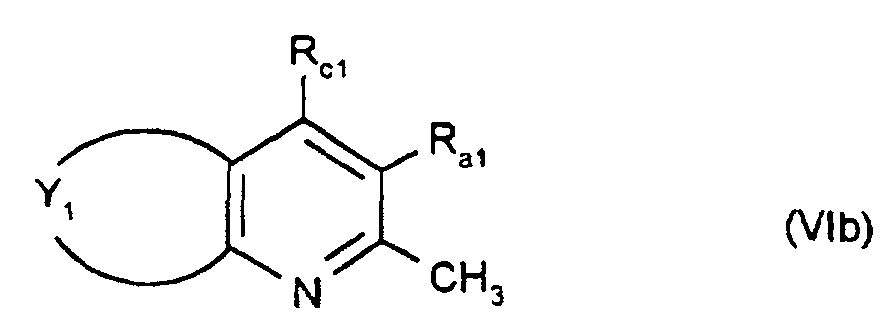
- Preferred compounds of the formula (VI) are quinaldines of the formula (VIa) wherein R 1 , R c , R a and n have the meaning given above.
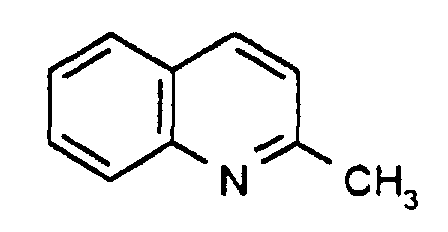
- Suitable quinaldines of the formula (VIa) are, for example, those of the formulas mentioned below:
- the diamines of the formula (VII) are known or can be analog, for example manufacture known diamines.
- Preferred aromatic diamines of the formula (VII) are: o-phenylenediamine, chloro-o-phenylenediamine, dichloro-o-phenylenediamine, methyl-o-phenylenediamine, Ethyl-o-phenylenediamine, methoxy-o-phenylenediamine, acetamino-o-phenylenediamine, Phenyl-o-phenylenediamines, naphthylene-o-diamines, also 1,8-naphthylenediamine, Chlorine-1,8-naphthylenediamine, dichlor-1,8-naphthylenediamine, Methyl-1,8-naphthylenediamine, dimethyl-1,8-naphthylenediamine, methoxy-1,8-naphthylenediamine, Ethoxy-1,8-naphthylenediamine
- an optionally substituted one is used peri-naphthylenediamine used as a compound of formula (VII), in particular 1,8-naphthylene
- the condensation can be carried out directly by melting together equimolar amounts of the components of the formulas (V) and (VIb) or (VIc) at a temperature of 160 ° C to 250 ° C, preferably 180 to 220 ° C, particularly preferably 190 to 200 ° C take place, or more advantageously by reaction in a solvent at a Temperature from 110 ° C to 220 ° C, preferably 160 to 180 ° C, optionally below Pressure are carried out, a distillative removal of the water of reaction can be done.
- Preferred compounds of the formula (VIb) or (VIc) are quinaldines of the formula (VIbb) or the formula (VIcc) wherein R 1 , R 2 , R c1 , R c2 , R a1 , R a2 , n and m have the meaning given above.
- the condensation can be followed by halogenation, in particular chlorination or bromination, this taking place under conditions known per se.
- halogenation in particular chlorination or bromination
- the process according to the invention is also preferably suitable for the preparation of the compounds of the formula (I) which correspond to the formula (III), which is characterized in that tetracarboxylic acids or their anhydrides of the formula (V) with compounds of the formulas (VIIa) and / or (VIIb) condensed wherein the sum of the diamines (VIIa) and (VIIb) used corresponds to two molar equivalents, based on the tetracarboxylic acid (V), and Z 1 and Z 2 have the abovementioned meaning.
- the condensation for the preparation of compounds of formula (III) can directly by melting together equimolar amounts of the components of the Formulas (V) and (VIIa) or (VIIb) at a temperature of 120 ° C to 250 ° C, preferably at 120 to 180 ° C, or more advantageously by implementation in one Solvent at a temperature of 120 ° C to 220 ° C, preferably at 120 to 180 ° C, optionally under pressure, be carried out, a distillation Removal of the water of reaction can take place.
- arylaminosulfonyl radicals can be, for example, from the corresponding Compounds of formula (III) in which a substituent is a chlorosulfonyl radical means represent with alkyl or arylamines.
- Compounds of formula (III) according to the invention in which a substituent is a Aryloxysulfonylrest can also by reacting the corresponding chlorosulfonyl dyes with phenols or naphthols in the presence of a base, e.g. Pyridine, triethylamine, alkali or alkaline earth carbonates, hydroxides or oxides be won.
- a base e.g. Pyridine, triethylamine, alkali or alkaline earth carbonates, hydroxides or oxides be won.
- Those compounds of formula (III) with an optionally acylated or alkylated Amino groups can also be reduced by reduction with conventional reducing agents, e.g. Iron, zinc, sodium sulfide, hydrogen etc. the corresponding connections, in which the corresponding substituent represents a nitro group, and optionally subsequent acylation or alkylation can be obtained.
- the acylation step can also be carried out in the course of the reduction by adding an acylating agent.
- the inventive method is also preferred for the production of Compounds of formula (I) which correspond to formula (IV), characterized in that is that tetracarboxylic acids or their anhydrides of formula (V) with Compounds of formula (VI) and diamines of formula (VII) condensed, wherein the substituents of the compounds mentioned have the meanings given above and the sum of the compounds of the formulas (VI) and (VII) has two molar equivalents, based on the tetracarboxylic acid (V).
- preferred Compounds of the formulas (V) to (VII) are those mentioned above.
- the condensation can be made more directly by melting equimolar Amounts of the components of formulas (V) and (VI) and (VII) at one temperature from 160 ° C to 250 ° C, preferably 180 to 220 ° C, particularly preferably 190 to 200 ° C, or more advantageously in a solvent at a temperature of 110 ° C to 220 ° C, preferably 160 to 180 ° C, optionally under pressure be carried out, a distillative removal of the water of reaction can be done.
- Preferred compounds of the formula (V) according to the invention already correspond to those Preferred forms given above, i.e. of the formula (Va) or (Vb) with the corresponding Substituent meanings, where B is for the compounds of the invention of the formula (V) has the scope of meaning given.
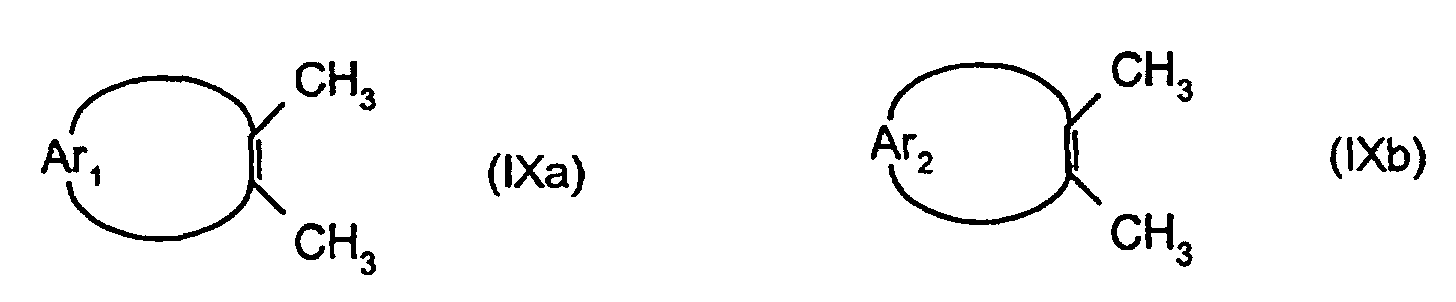
- the invention further relates to a process for the preparation of the compounds of the formula (V), which is characterized in that dichlorides of the formula (VIII) Cl-B-Cl with dimethyl compounds of the formula (IXa) and / or (IXb) under Friedel-Crafts conditions, the amount of the compounds (IXa) and (IXb) used together making up at least 2 mol equivalents per mol of the compound (VIII), and the reaction product obtained is then oxidized and Ar 1 , Ar 2 , and B have the broadest meaning given above.
- a preferred compound of formula (IXa) or (IXb) is o-xylene.
- the compounds of formula (I) according to the invention are outstandingly suitable for Coloring plastics in bulk.
- Mass coloring is understood to mean in particular processes in which the Dye is incorporated into the molten plastic mass, e.g. with the aid of an extruder, or in which the dye is already used as starting components Manufacture of the plastic, e.g. Monomers added before the polymerization becomes.
- thermoplastics for example vinyl polymers, Polyesters and polyamides, as well as polyolefins, especially polyethylene and polypropylene.
- Suitable vinyl polymers are polystyrene, styrene-acrylonitrile copolymers, styrene-butadiene copolymers, Styrene-butadiene-acrylonitrile terpolymers, polymethacrylate, polyvinyl chloride et al
- polyesters are: polyethylene terephthalates, polycarbonates and Celluloseester.
- Polystyrene, styrene copolymers, polycarbonates and polymethacrylate are preferred.
- Polystyrene, polyethylene and polypropylene are particularly preferred.
- the high-molecular compounds mentioned can be used individually or in mixtures, as plastic masses or melts are present.
- the dyes of the invention are used in finely divided form brought, wherein dispersants can be used but do not have to.
- the compounds (I) are used after the polymerization, they are also used mixed or ground dry with the plastic granulate and this mixture e.g. plasticized and homogenized on mixing rollers or in screws. You can do that Add dyes to the molten mass and stir them distribute homogeneously.
- the material thus pre-colored is then, as usual, e.g. by Spinning to bristles, threads etc. or by extrusion or by injection molding processed into molded parts.
- the dyes of formula (I) compared to polymerization catalysts, in particular Peroxides, are resistant, it is also possible to dye the monomers Add raw materials for the plastics and then in the presence of polymerization catalysts to polymerize.
- the dyes are preferred for this dissolved in the monomeric components or intimately mixed with them.
- the dyes of the formula (I) are preferably used for dyeing the polymers mentioned in amounts of 0.0001 to 1% by weight, in particular 0.01 to 0.5% by weight, based on the amount of polymer used.
- pigments that are insoluble in the polymers e.g. titanium dioxide
- corresponding valuable muted stains can be obtained.
- Titanium dioxide can be present in an amount of 0.01 to 10% by weight, preferably 0.1 to 5 wt .-%, based on the amount of polymer, are used.
- the dye has the formula
- the color strength of this dye is about 5% higher than that of the non-doubled dye of the formula based on the same amounts of weight.
- the sublimation, determined by thermogravimetic analysis (TGA) at 300 ° C, of the doubled dye is significantly smaller than that of the unbridged dye of the above formula.
- the dye has the formula
- the color strength of the dye is about 10% higher than that of the same amount of the non-doubled dye of the formula
- the dye has the formula
- plastics such as Polystyrene, polycarbonate, polyester or Polypropylene dyed in neutral yellow tones with very good fastness properties.
- the dye has the structural formula
- Polystyrene, polycarbonate, polyamide, polyester and ABS were in neutral yellows dyed with high temperature resistance and very good fastness properties.
- the dye is thermostable at 400 ° C and sublimates to a much lesser extent (determined by TGA) as the non-doubled dye (formula see example 2).
- the dye has the structural formula
- o-dichlorobenzene instead of o-dichlorobenzene, other solvents such as e.g. o-xylene, phenol, Diphenyl ether or ditolyl ether used.
- o-xylene phenol
- Diphenyl ether ditolyl ether
- the yellowish orange dye colors Plastics such as polystyrene, polycarbonate, polyester, polyamide, polypropylene or Copolymers of acrylonitrile, butadiene and styrene in the mass in sublimation right, lightfast and temperature stable dyeings.
- thermogravimetric analysis there was only a dye loss by sublimation of 5% at 400 ° C. In the unbridged dye of the formula In contrast, the dye loss by sublimation was 9% under the same conditions.
- the dye has the formula
- the dye colored plastics such as polypropylene, polystyrene, polycarbonate, copolymers made of polyacrylonitrile, butadiene and styrene in the mass in yellow orange Colors.
- the dyeings are sublimation-resistant and have high light fastness and high temperature stability.
- the thermogravimetric analysis of the dye showed 400 ° C a weight loss by sublimation which is significantly below that of the non-bridged Compound, as already mentioned in Example 6, was.
- the dye has the structural formula and dyes polyethylene, polypropylene, polystyrene, copolymers of acrylonitrile, butadiene and styrene, polycarbonate and polyester in yellow-orange shades with very good fastness properties such as light fastness, migration fastness, thermal stability and sublimation fastness.
- thermogravimetric analysis of this dye at 400 ° C showed a clear Less loss of substance due to sublimation can be observed than with the unbridged one Dye mentioned in Example 6.
- the yield was 28.9 g of an orange dye of the formula which also contained approximately the same proportions of the bilateral quinophthalone as the bilateral perinone each 10%.
- the dye has an approximately 20% higher color strength than the double-sided perinone dye.
- the dye is thermostable up to 300 ° C and has a very good fastness to sublimation at this temperature.
- the dye has the formula
- the quinophthalone dye on both sides was also mixed with this dye (10%) and the double-sided perinone dye (10%).
- the dye is at 300 ° C thermostable and has a very good fastness to sublimation.
- a part is located on both sides of hydroxy-quinophthalone (10%) and bilateral perinone (10%).
- the dye is thermostable up to 300 ° C and has very good sublimation fastness at this temperature.
- the orange dye has the formula
- thermogravimetric analysis an excellent result is obtained even at 400 ° C Sublimation.
- the yellow dye has the formula
- the dye has the formula
- the dye has the formula
- the red dye has the formula
- the orange dye has the formula
Landscapes
- Chemical & Material Sciences (AREA)
- Organic Chemistry (AREA)
- Heterocyclic Carbon Compounds Containing A Hetero Ring Having Oxygen Or Sulfur (AREA)
- Nitrogen Condensed Heterocyclic Rings (AREA)
- Polyesters Or Polycarbonates (AREA)
- Quinoline Compounds (AREA)
- Nitrogen And Oxygen Or Sulfur-Condensed Heterocyclic Ring Systems (AREA)
Description

- Ar1 und Ar2
- unabhängig voneinander Reste zur Vervollständigung gegebenenfalls substituierter carbocyclischer Aromaten bedeuten, wobei als mögliche Substituenten C1-C6-Alkyl, insbesondere Methyl, Ethyl, n-Propyl, iso-Propyl, n-, sek- und tert-Butyl, Halogen, insbesondere Cl und Br, Alkyl- und Arylcarbonyl, Alkyl- und Arylsulfonyl, Nitro, Aryl, insbesondere gegebenenfalls substituiertes Phenyl, Aryloxysulfonyl, insbesondere -SO2OC6H5, Hydroxy, C1-C6-Alkoxy, wie Methoxy oder Benzyloxy, Aryloxy, wie Phenoxy gegebenenfalls durch Alkyl oder Acyl substituiertes Amino wie NH2, NHCOCH3 und -N(C2H5)2, gegebenenfalls durch Alkyl oder Aryl substituiertes Aminosulfonyl wie SO2N(CH3)2 und SO2NHCH3 oder ein ankondensierter cycloaliphatischer oder heterocyclischer Ring in Frage kommen.
- B
- eine gegebenenfalls durch CF3 substituierte Alkylengruppe, die sowohl
geradkettig oder verzweigt sein kann oder einen Rest der Formel
worin r für eine Zahl von 1-4 steht,

bedeutet, dessen Enden jeweils an ein aromatisches C-Atom der beiden Reste Ar1 und Ar2 gebunden sind,
- X1 und X2
- unabhängig voneinander für einen Rest der Formeln ausgewählt aus der
Gruppe
stehen, wobei sie jeweils so im Ring angeordnet sind, dass die
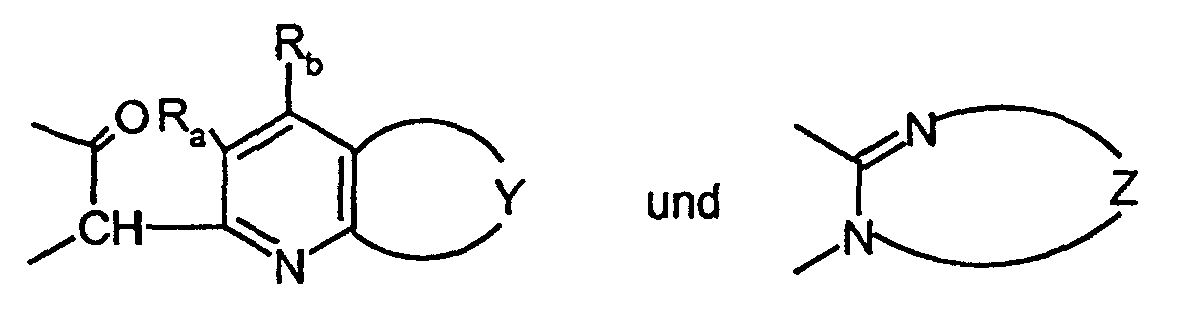 benachbart zur C-C-Doppelbindung steht,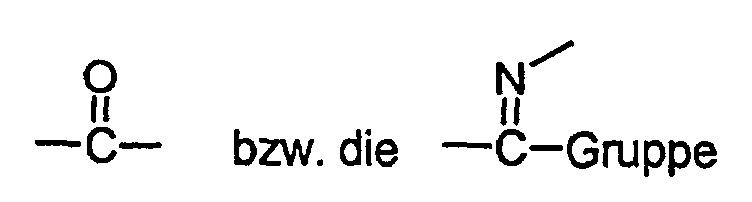
- Y
- den Rest eines gegebenenfalls substituierten Benzol- oder Naphthalinringes bildet, wobei als mögliche Substituenten Halogen, insbesondere Cl und Br, -COOH, -COOR, wobei R für C1-C10-, vorzugsweise C1-C4-Alkyl, insbesondere Methyl und Ethyl, C6-C10-Aryl oder C5-C8-Cycloalkyl steht und C1-C6-Alkyl, insbesondere Methyl in Frage kommen.
- Z
- gegebenenfalls substituiertes ortho-Phenylen, ortho-Naphthylen, peri-(1,8)-Naphthylen oder Arylen aus mehr als zwei miteinander kondensierten Benzolringen bedeutet, wobei die Arylreste, die mehr als zwei miteinander kondensierte Benzolringe aufweisen, in ortho- oder entsprechend einer peri-Stellung im Naphthalin verbrückt sind, wobei als mögliche Substituenten C1-C6-Alkyl, Halogen, Nitro, Aryl, Aryloxysulfonyl, Hydroxy, C1-C6-Alkoxy, Aryloxy, gegebenenfalls durch Alkyl oder Acyl substituiertes Amino, gegebenenfalls durch Alkyl oder Aryl substituiertes Aminosulfonyl oder ein ankondensierter cycloaliphatischer oder heterocyclischer Ring in Frage kommen.
- Ra
- H oder OH bedeuten und
- Rb
- H oder Halogen, insbesondere F, Br und Cl bedeutet
mit Ausnahme von Verbindungen X1 und X2 für einen Rest der Formelstehen, wobei Z die oben angegebene Bedeutung hat und
- B
- einen Rest der Formel

Chlor, Brom, Nitro, Methoxy, NH2, Benzyloxy, Hydroxy, -SO2O(C6H5), -SO2N(CH3)2, -SO2NHCH3, Methyl, Ethyl, n-Propyl, iso-Propyl, n-, sek-, tert.-Butyl, NHCOCH3, -N(C2H5)2 oder gegebenenfalls substituiertes Phenyl.
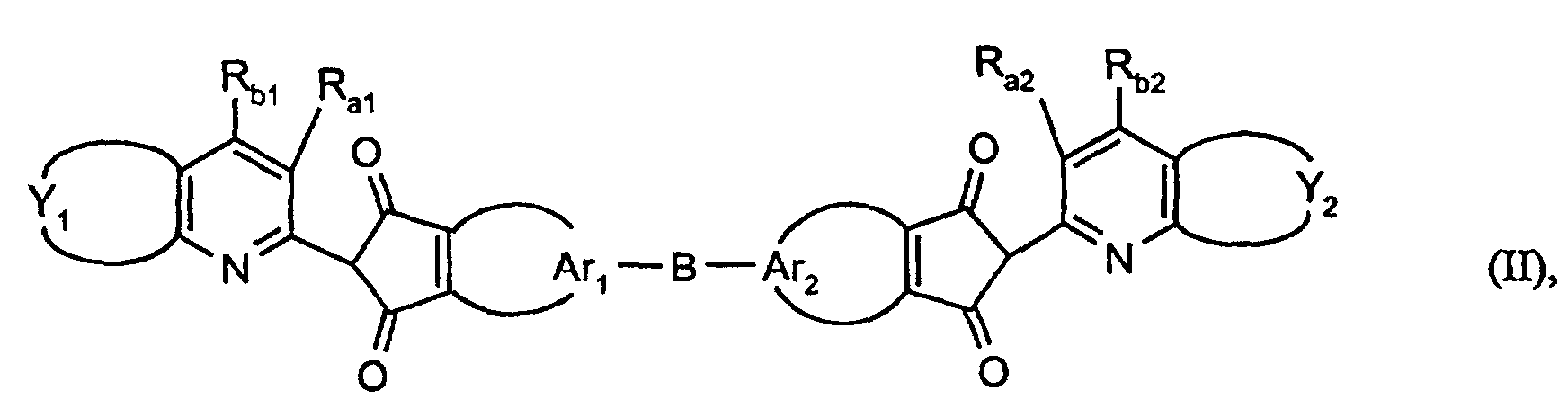
- Y1 und Y2
- unabhängig voneinander den Rest eines gegebenenfalls substituierten Benzol- oder Naphthalinringes bilden, wobei als mögliche Substituenten für die Reste Y1 und Y2 die für den Rest Y angegebenen zu nennen sind,
- Ra1 und Ra2
- unabhängig voneinander H oder OH bedeuten,
- Rb1 und Rb2
- unabhängig voneinander H oder Halogen, insbesondere F, Br oder Cl bedeuten und
- Ar1, Ar2 und B
- die oben angegebene Bedeutung besitzen.
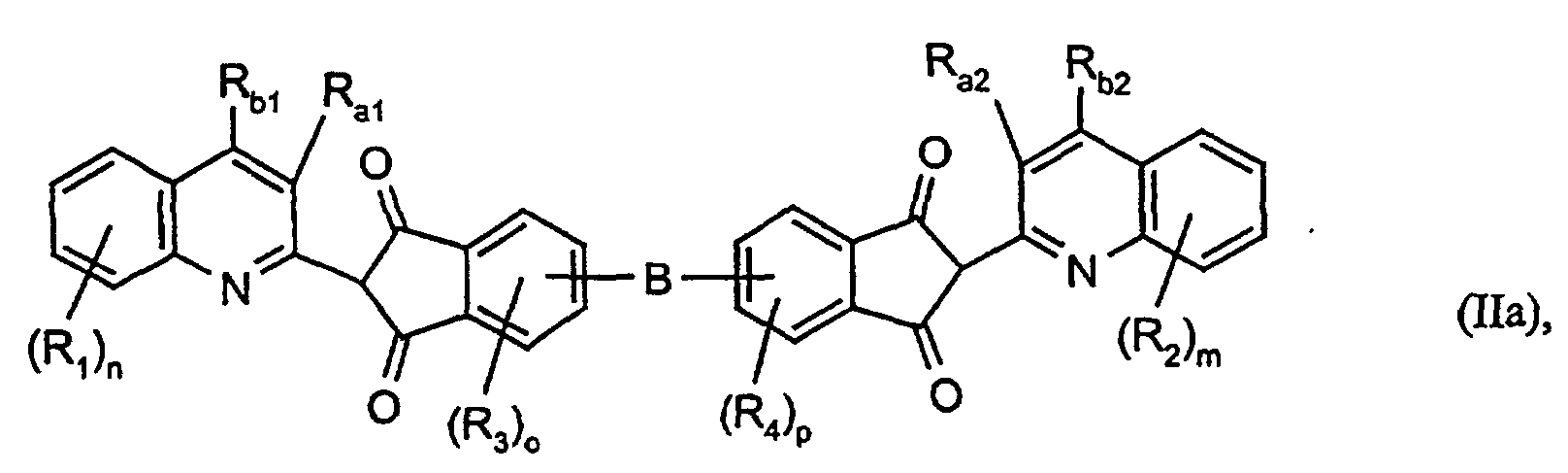
- n und m
- unabhängig voneinander für eine Zahl von 0 bis 4 stehen,
- R1 und R2
- unabhängig voneinander jeweils gleich oder verschiedene Bedeutung besitzen, wie sie für die Substituenten des durch Y1 und Y2 vervollständigten Reste angegeben sind,
- o und p
- unabhängig voneinander eine Zahl von 0 bis 2, insbesondere 0 oder 1 bedeuten,
- R3 und R4
- unabhängig voneinander jeweils gleich oder verschiedene Bedeutung annehmen können, wie sie für die Substituenten der durch Ar1 bzw. Ar2 vervollständigten carbocyclischen Aromaten angegeben sind,
- Rb1 und Rb2
- die obengenannte Bedeutung haben, vorzusweise für H stehen,
- Ra1 und Ra2
- die obengenannte Bedeutung haben, vorzugsweise für OH stehen und
- B
- die obengenannte Bedeutung hat.

-CH2-, -CH2-CH2-, -CH2CH2CH2-, -CH2CH2CH2CH2-,
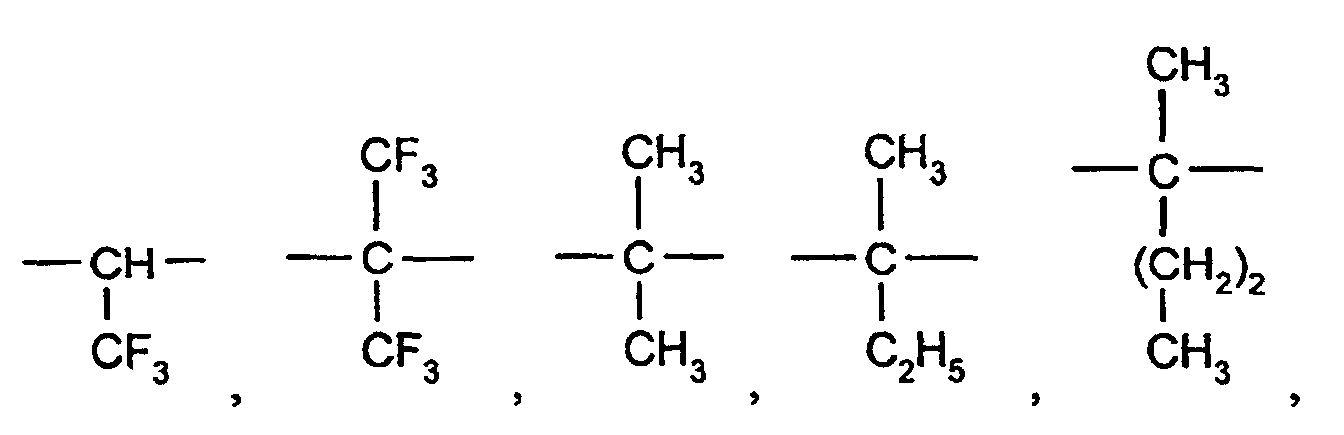


n, m, o und p für 0 stehen.

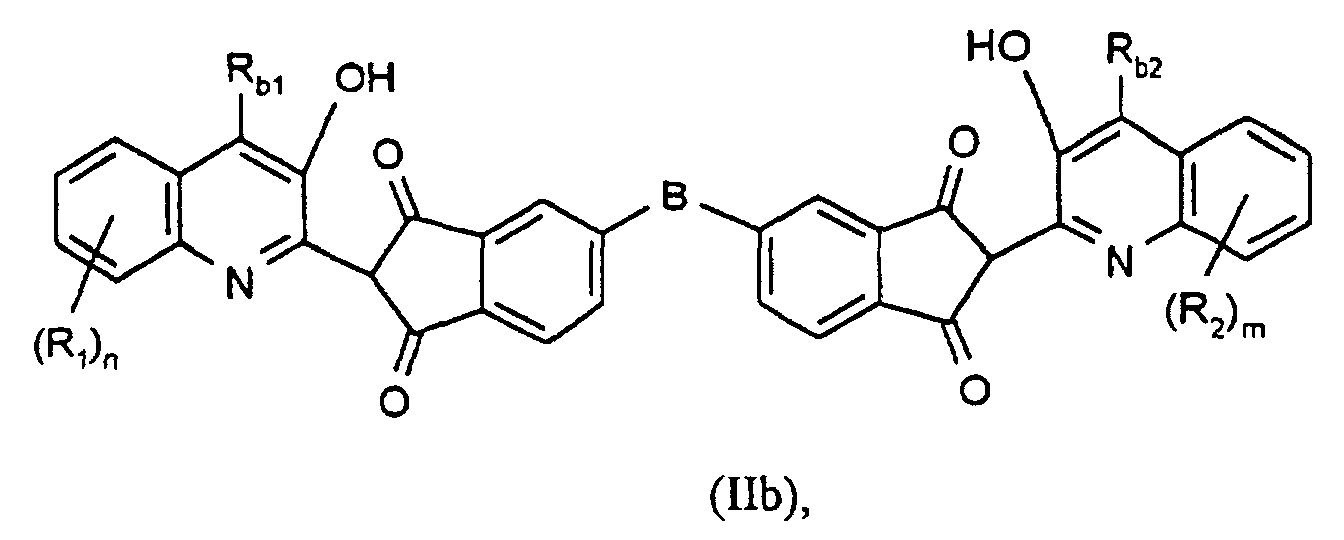
n, m, R1, R2, Rb1, Rb2 und B die oben angegebenen Bedeutungen haben.

- Z1 und Z2
- unabhängig voneinander gegebenenfalls substituiertes ortho-Phenylen, ortho-Naphthylen, peri-(1,8)-Naphthylen oder Arylen aus mehr als zwei miteinander kondensierten Benzolringen bedeuten, wobei die Arylreste, die mehr als zwei miteinander kondensierte Benzolringe aufweisen, in ortho- oder entsprechend einer peri-Stellung im Naphthalin verbrückt sind, wobei als mögliche Substituenten für die Reste Z1 und Z2 die für den Rest Z angegebene in Frage kommen.
Ar1, Ar2 und B die oben angegebenen Bedeutungen besitzen.

- n1 und m1
- unabhängig voneinander für eine Zahl von 0 bis 4 stehen,
- R5 und R6
- unabhängig voneinander jeweils gleich oder verschieden sind und die Bedeutung der fiir die Reste Z1 und Z2 genannten Substituenten annehmen können, insbesondere für Halogen und C1-C6-Alkyl, stehen,
- o und p
- unabhängig voneinander eine Zahl von 0 bis 2, insbesondere 0 oder 1, bedeuten,
- R3 und R4
- unabhängig voneinander jeweils gleich oder verschieden sind und die Bedeutung der für die Reste Z1 und Z2 genannten Substituenten annehmen können, insbesondere Halogen, NO2, -NH-Acyl oder -NH-Alkyl bedeuten und
- B
- die obengenannte Bedeutung hat.
-CH2-, -CH2-CH2-, -CH2CH2CH2-, -CH2CH2CH2CH2-,
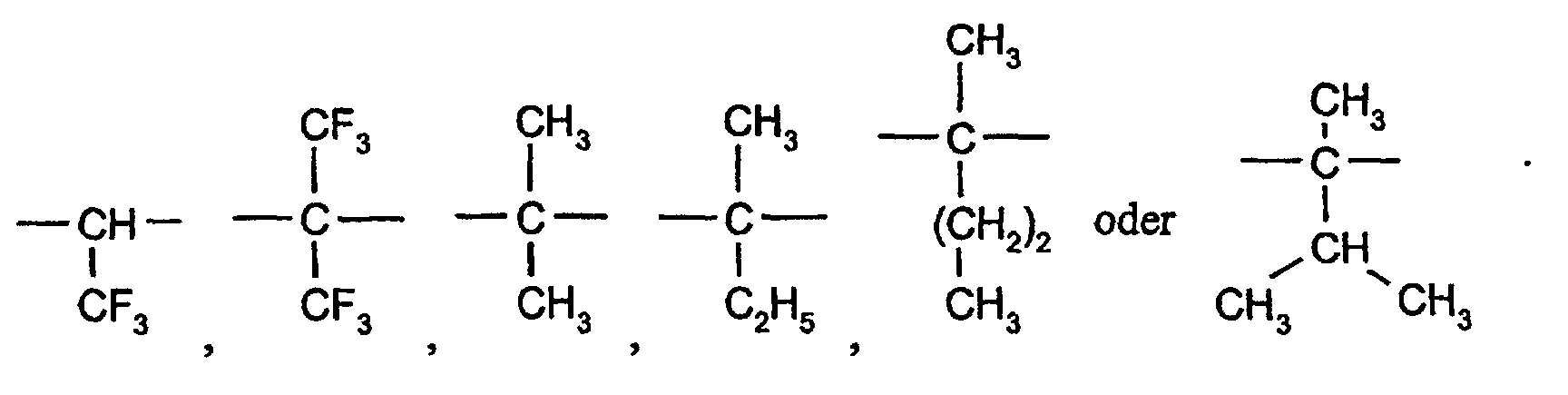
worin
worin
n1, m1, o und p für 0 stehen.

n1, m1, R5, R6 und B die oben angegebenen Bedeutungen haben.
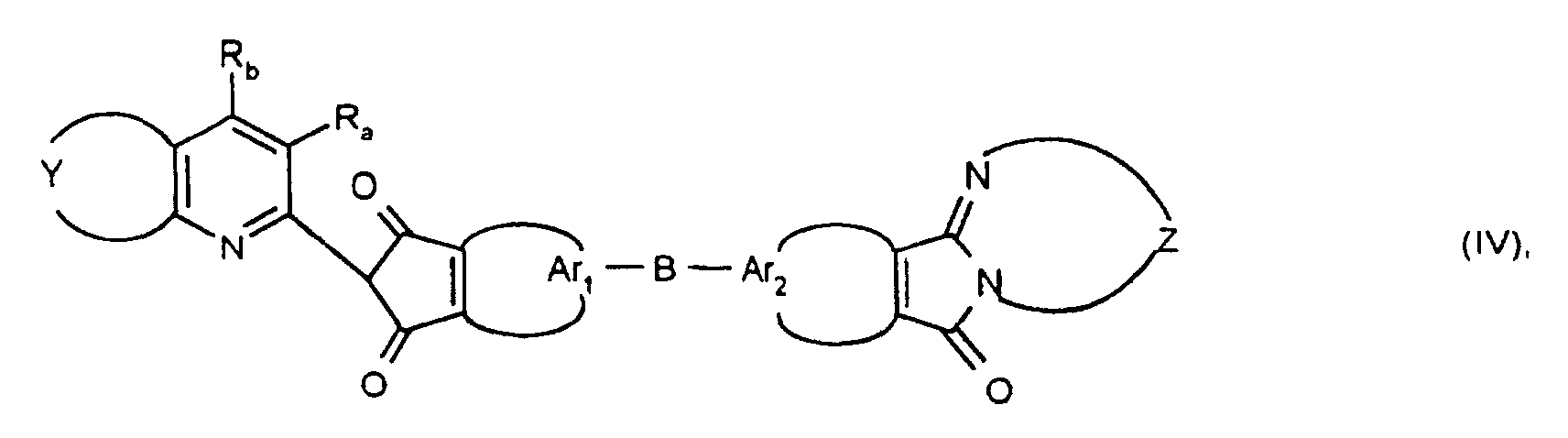
Y, Z, Ra, Rb, Ar1, Ar2 und B die oben angegebene Bedeutung besitzen.
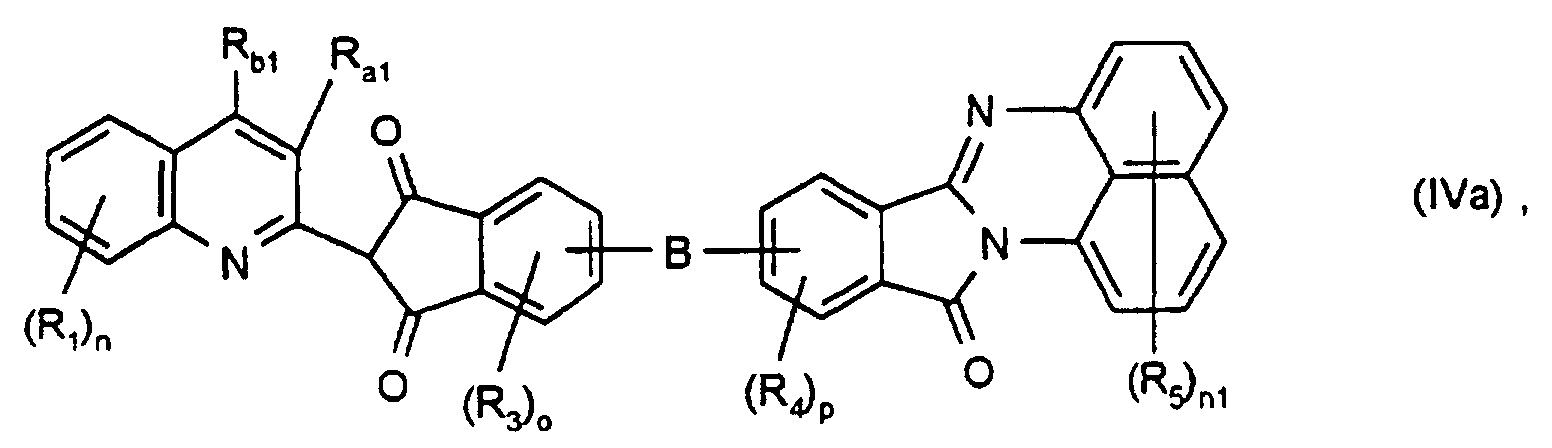
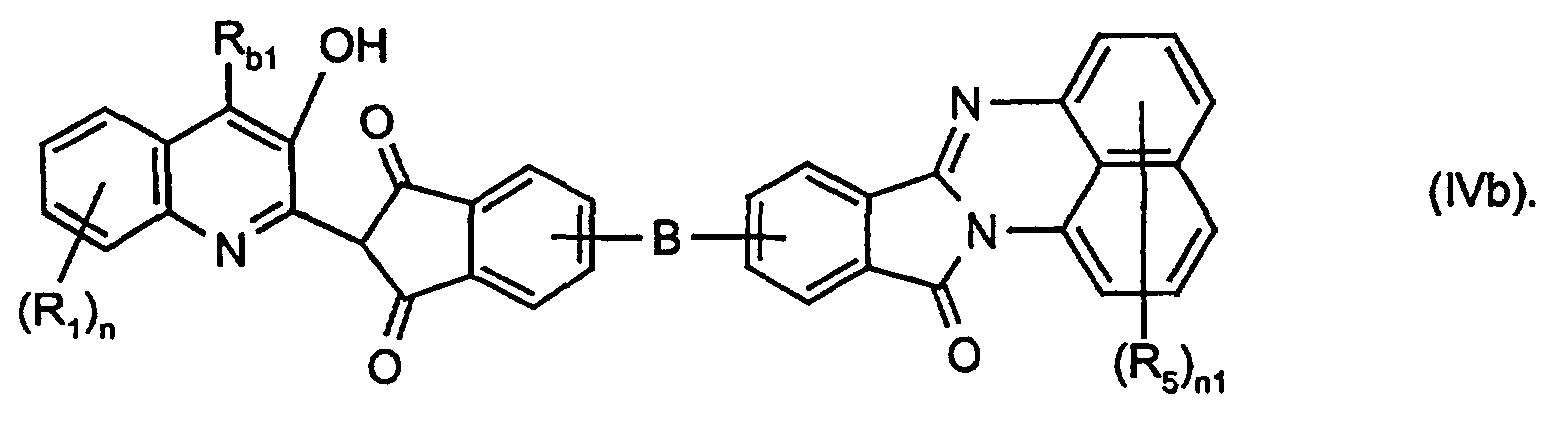
R1, R3, R4, R5, Rb1, Ra1, B, n, p und n1 die oben angegebene Bedeutungen besitzen.

R1, R5, Rb1, B, n und n1 die oben angegebene Bedeutung besitzen.

Ar1, Ar2 und B die obengenannte Bedeutung besitzen,
mit einer oder mehreren Verbindungen der Formeln (VI) und/oder (VII)
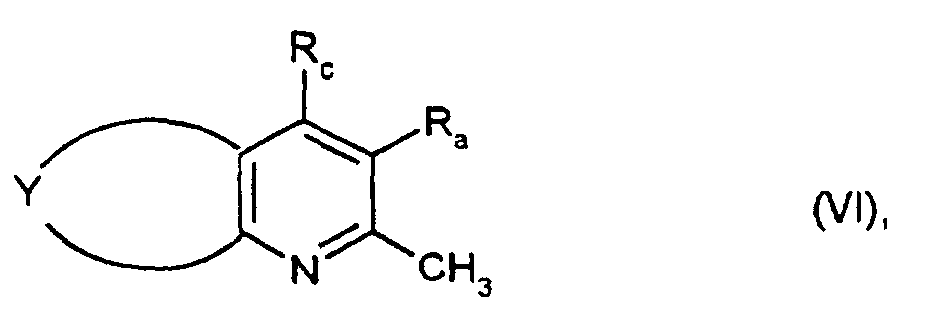
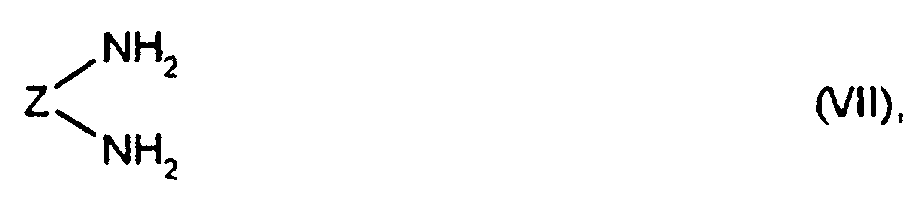
- Rc
- H, COOH oder Halogen, insbesondere F, Br und Cl bedeutet, insbesondere für H oder COOH steht und
- Y, Z und Ra
- die oben angegebene Bedeutung besitzen,

R3, R4, B, o und p die obengenannten Bedeutungen besitzen.

- B
- für -CH2-, -CH(CF3)-, -C(CF3)2-, -C(CH3)2-, -O-,
mit r = 2-4

steht und die obige Ausnahme auch hier gilt.
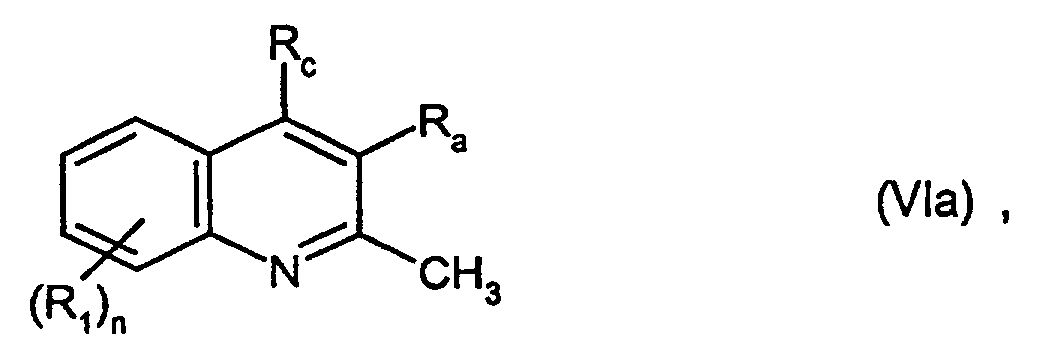
R1, Rc, Ra und n die oben angegebene Bedeutung haben.



- Rc1 und Rc2
- unabhängig voneinander H, COOH oder Halogen, insbesondere F, Br und Cl bedeuten, insbesondere für H oder COOH stehen und
- Ra1, Ra2, Y1 und Y2
- die obengenannte Bedeutung besitzen,
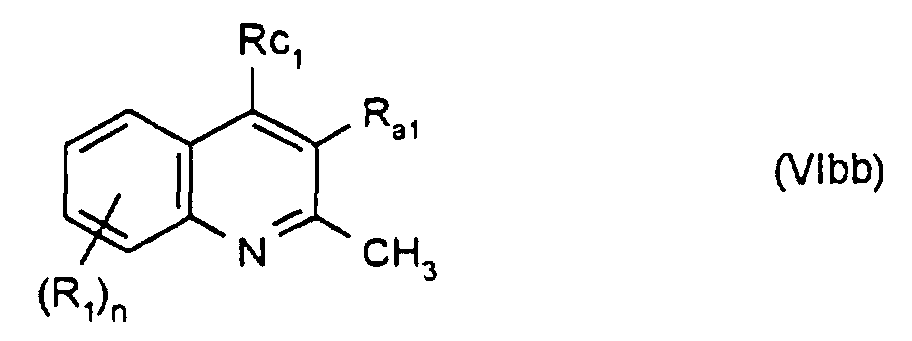

R1, R2, Rc1, Rc2, Ra1, Ra2, n und m die oben angegebene Bedeutung haben.

- B
- einen Rest der Formel
-CH2CH2CH2CH2
Ausbeute: 29,3 g = 91 % d. Th.


Ausbeute: 31,6 g = 93 % d. Th.
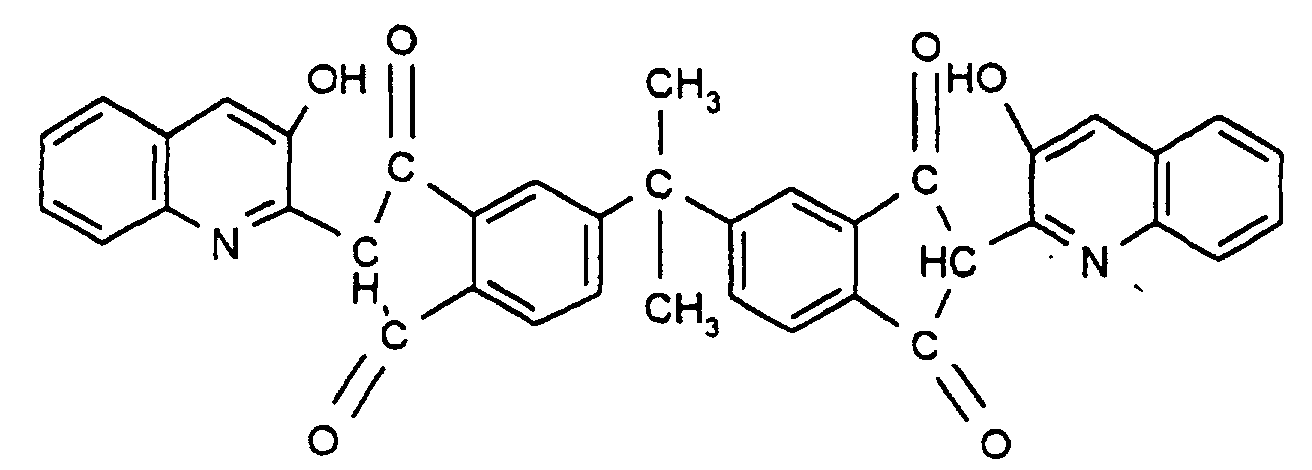


Ausbeute: 31,7 g = 92 % d Th.
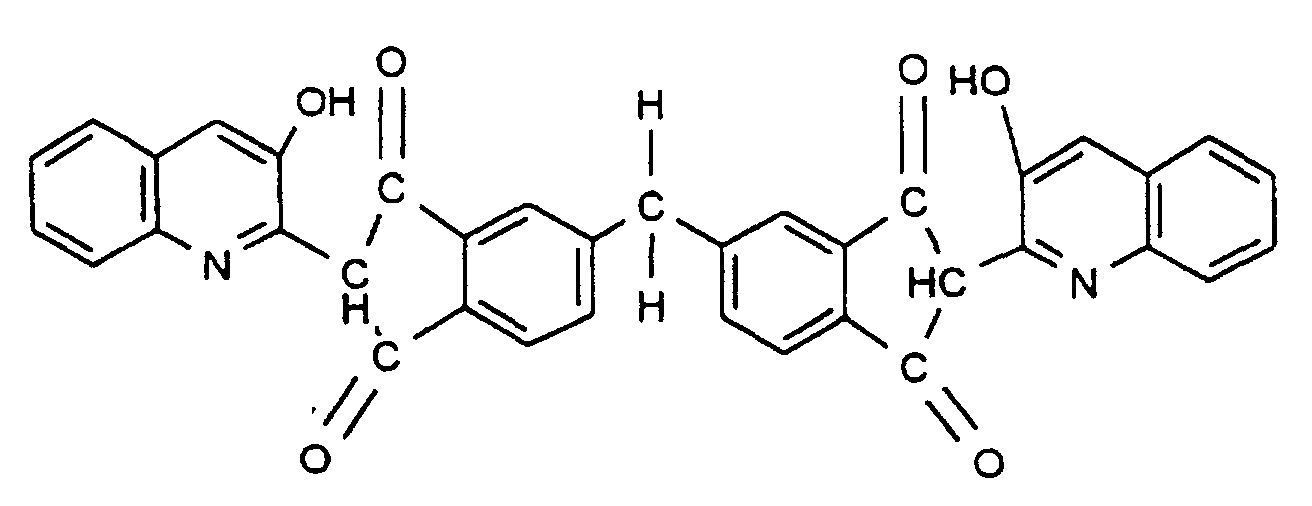
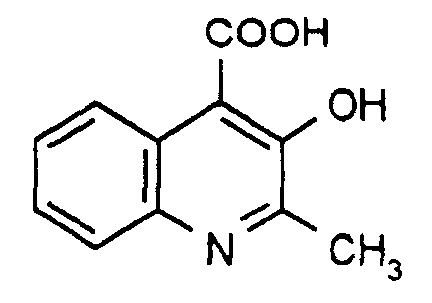
Ausbeute: 39,5 g = 93 % d. Th.
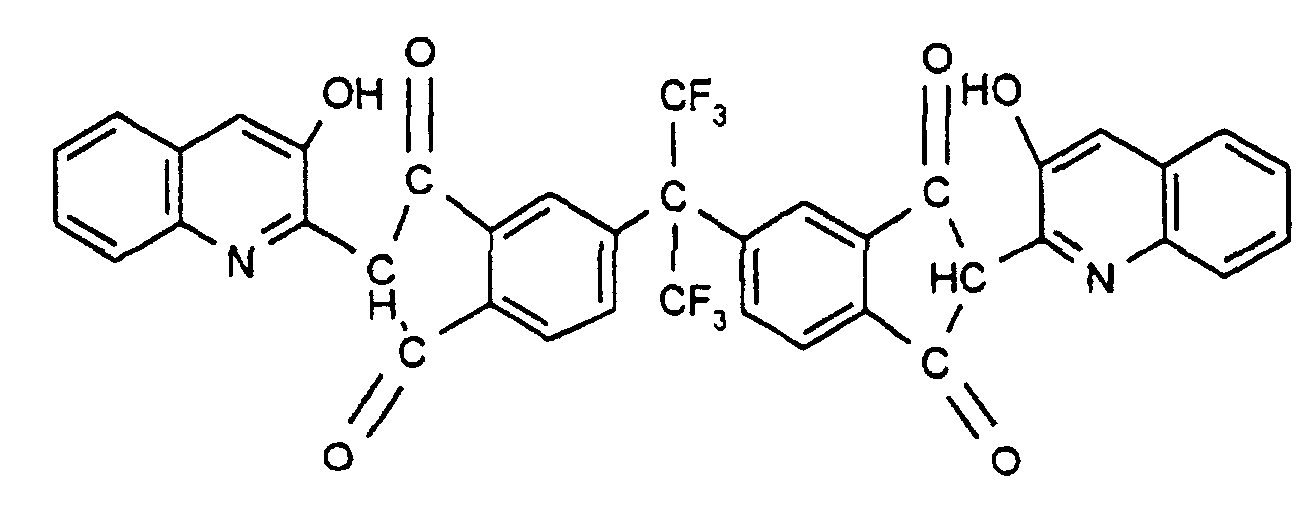
Ausbeute: 27,9 g = 96 % der Theorie.
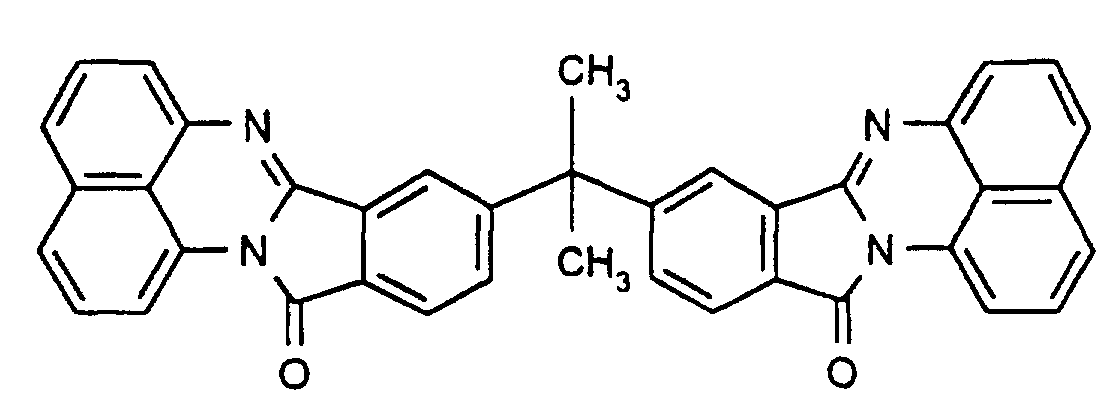

Ausbeute: 27 g = 93 % der Theorie.
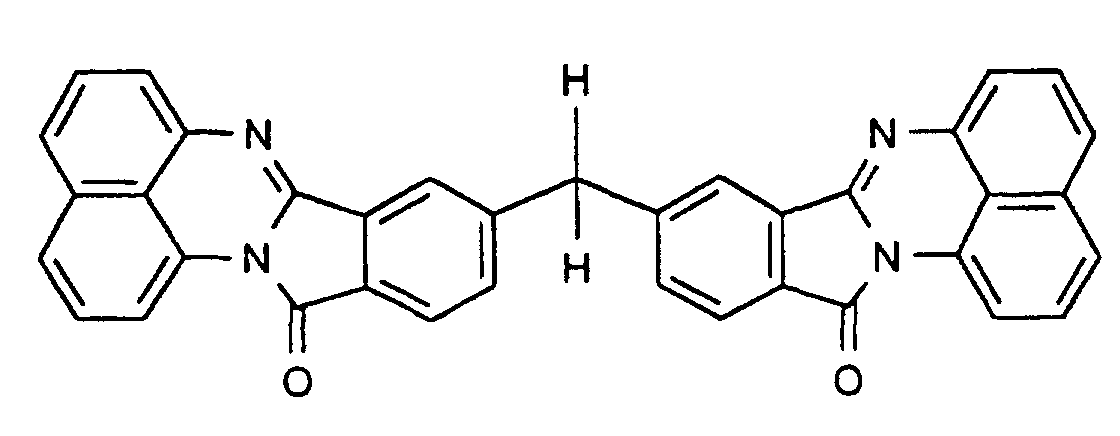
Ausbeute: 19,2 g = 94 % der Theorie.
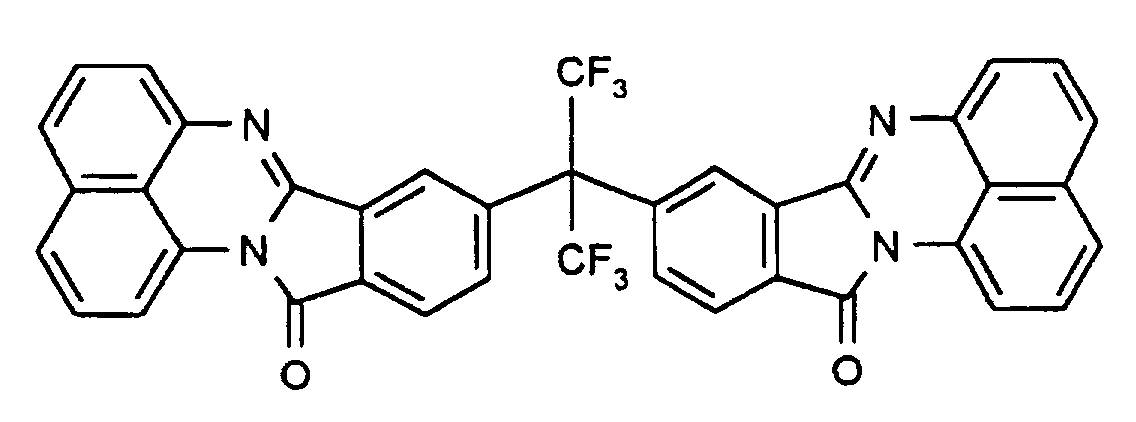

Der Farbstoff hat die gleiche Zusammensetzung wie der des Beispiels 1.

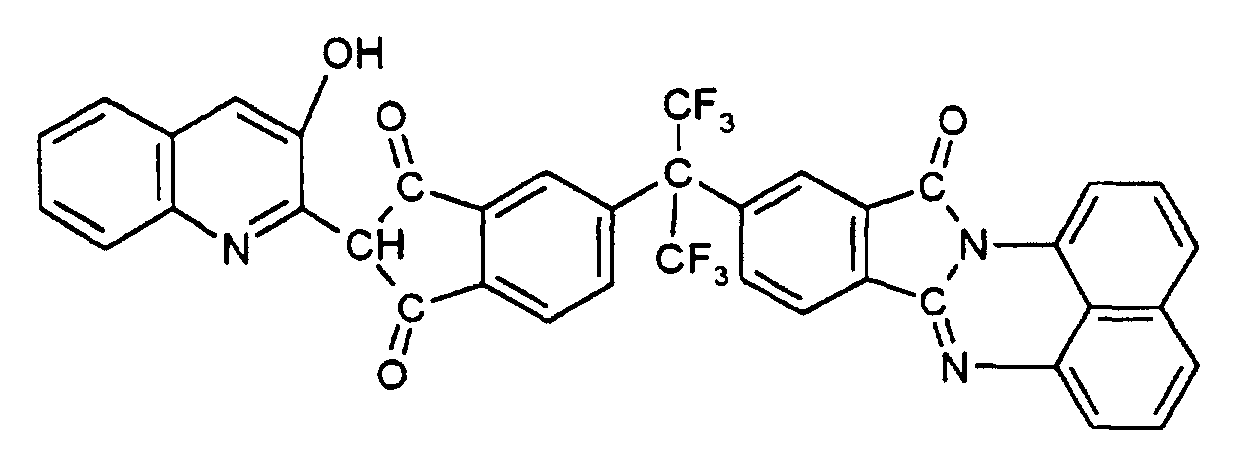

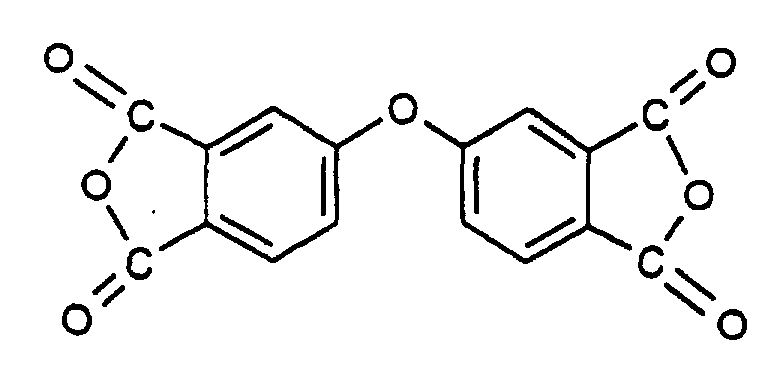
Ausbeute: 12,5g
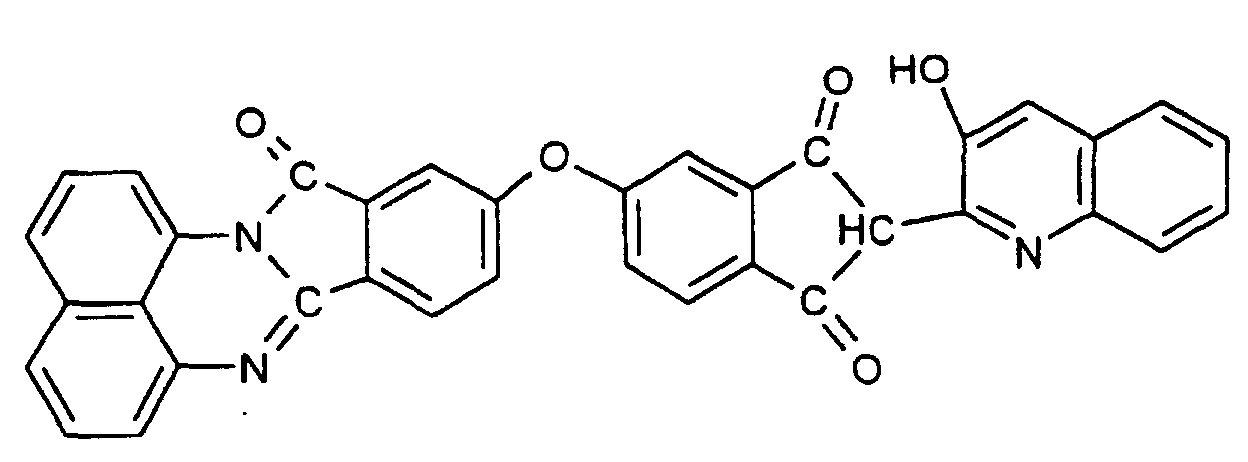
Ausbeute: 26,2 g = 88 % d. Th.
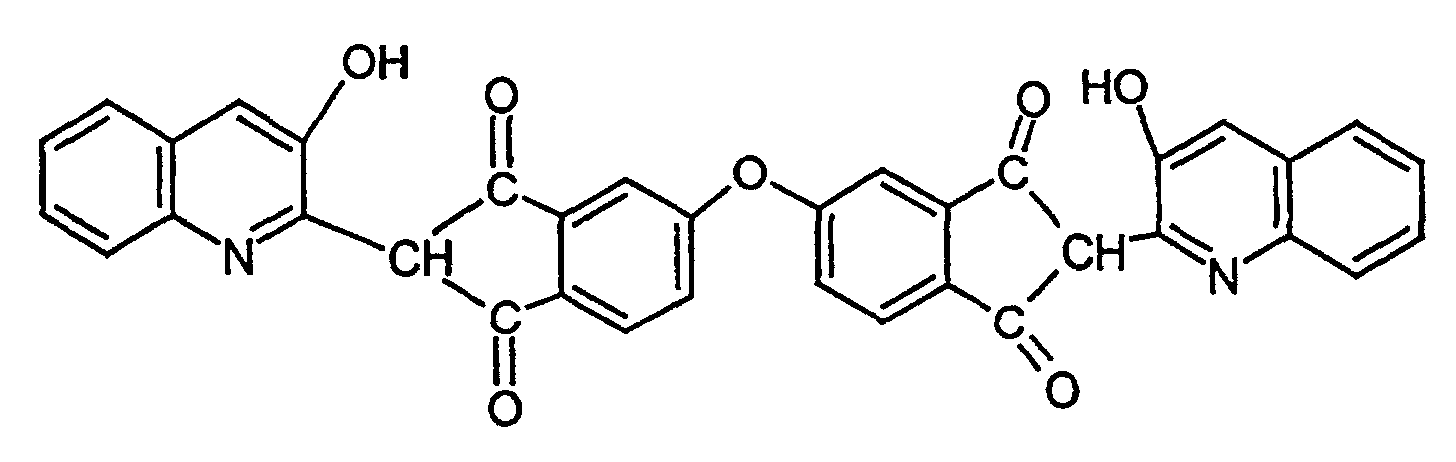
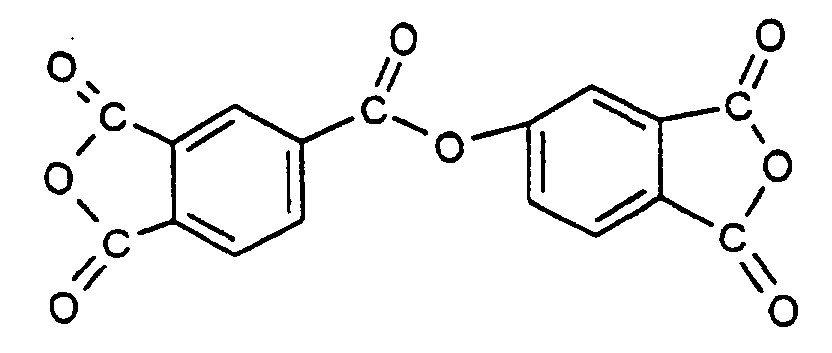
Ausbeute: 14,6 g
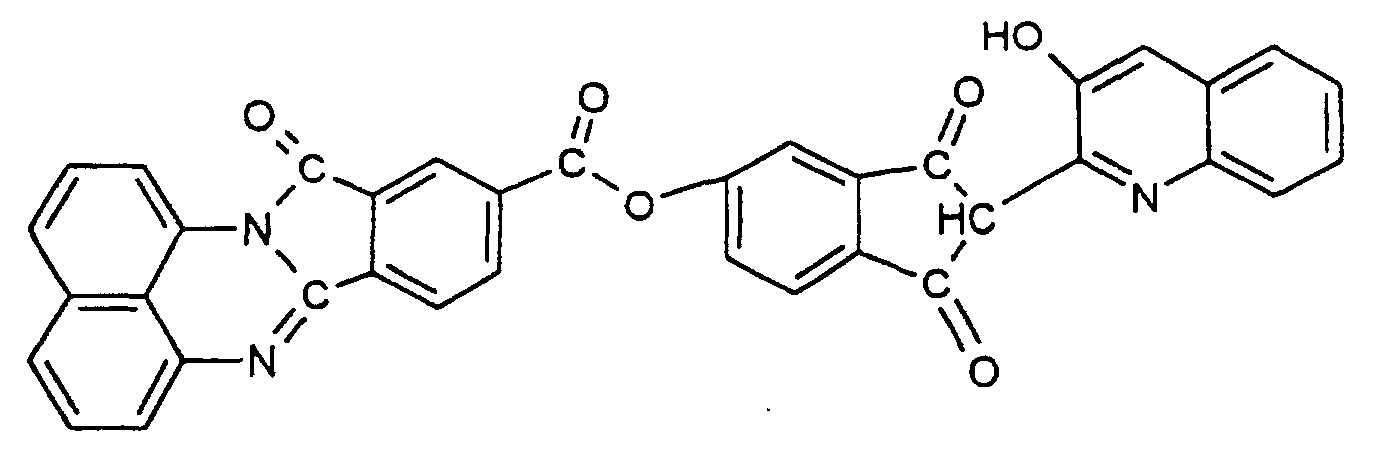
Ausbeute: 27,3 g = 91 % d.Th.
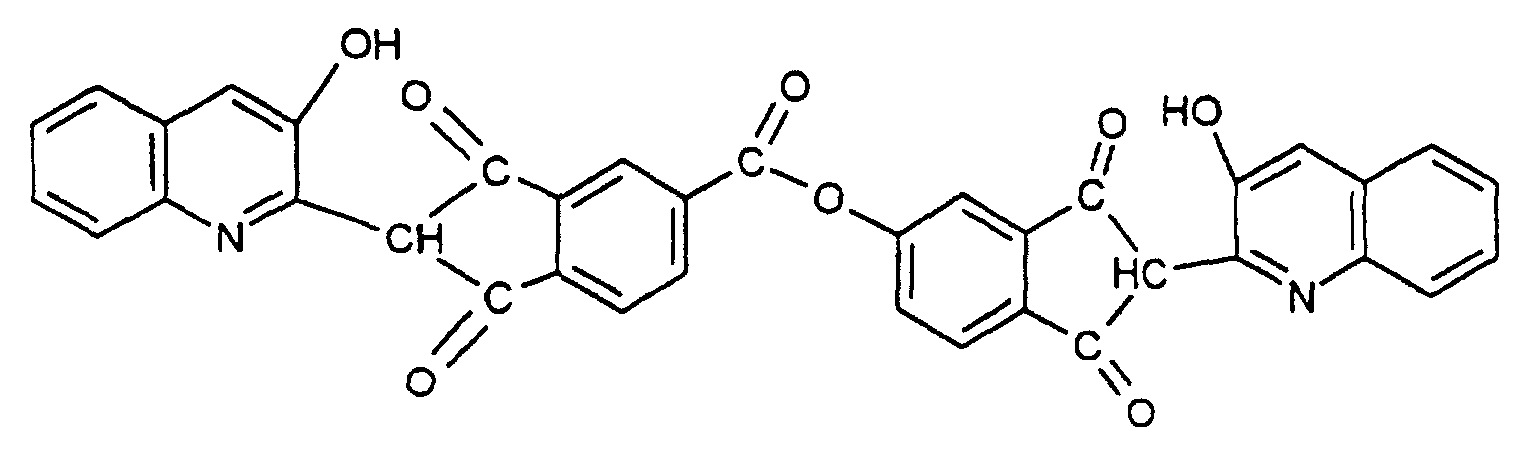
Ausbeute: 27,1 g = 93 % d.Th.
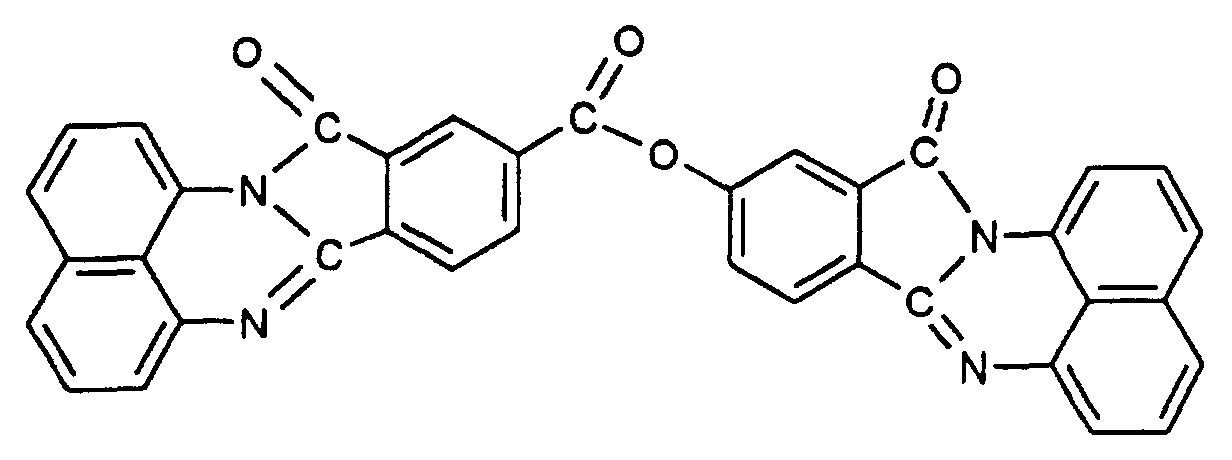
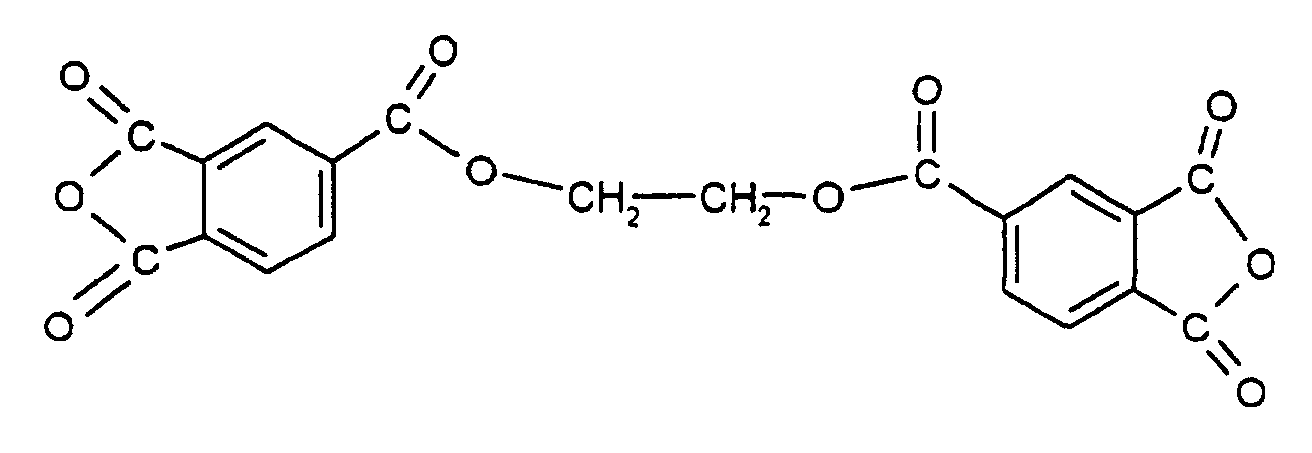
Ausbeute: 29,7 g


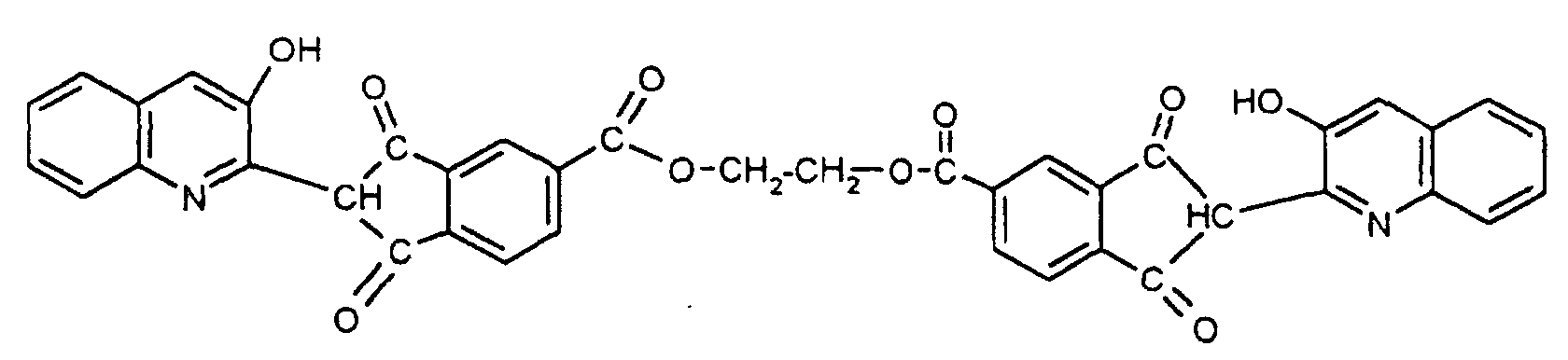
Claims (18)
- Verbindungen der allgemeinen Formel (I) oder deren tautomeren Formenworin

- Ar1 und Ar2
- unabhängig voneinander Reste zur Vervollständigung unsubstituierter oder substituierter carbocyclischer Aromaten bedeuten, wobei als mögliche Substituenten C1-C6-Alkyl, Halogen, Alkyl- und Arylcarbonyl, Alkyl- und Arylsulfonyl, Nitro, Aryl, Aryloxysulfonyl, Hydroxy, C1-C6-Alkoxy, Aryloxy, gegebenenfalls durch Alkyl oder Acyl substituiertes Amino, gegebenenfalls durch Alkyl oder Aryl substituiertes Aminosulfonyl oder ein ankondensierter cycloaliphatischer oder heterocyclischer Ring, in Frage kommen
- B
- eine gegebenenfalls durch CF3 substituierte Alkylengruppe, die
sowohl geradkettig oder verzweigt sein kann oder einen Rest der
Formel
worin r fiir eine Zahl von 1-4 steht,

und- X1 und X2
- unabhängig voneinander für einen Rest der Formeln ausgewählt
aus der Gruppe
stehen, wobei sie jeweils so im Ring angeordnet sind, dass die
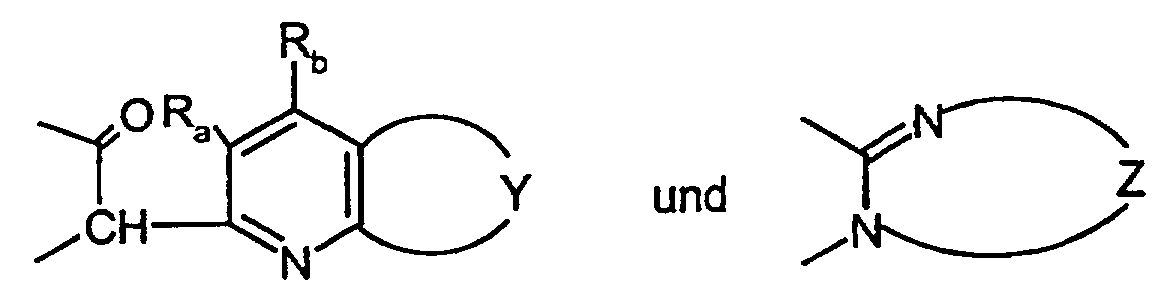 benachbart zur C-C-Doppelbindung steht,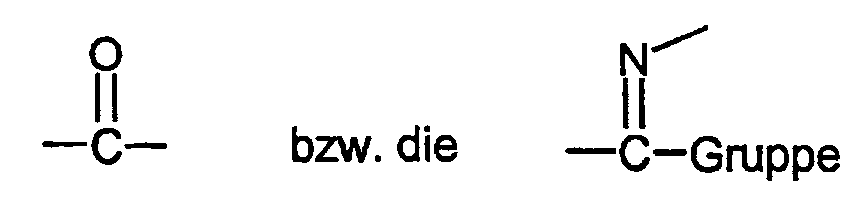
- Y
- den Rest eines gegebenenfalls substituierten Benzol- oder Naphthalinringes bildet, wobei als mögliche Substituenten Halogen, -COOH, -COOR, wobei R für C1-C10-Alkyl, C6-C10-Aryl oder C5-C8-Cycloalkyl steht und C1-C6-Alkyl, in Frage kommen,
- Z
- gegebenenfalls substituiertes ortho-Phenylen, ortho-Naphthylen, peri-(1,8)-Naphthylen oder Arylen aus mehr als zwei miteinander kondensierten Benzolringen bedeutet, wobei die Arylreste, die mehr als zwei miteinander kondensierte Benzolringe aufweisen, in ortho- oder entsprechend einer peri-Stellung im Naphthalin verbrückt sind, wobei als mögliche Substituenten C1-C6-Alkyl, Halogen, Nitro, Aryl, Aryloxysulfonyl, Hydroxy, C1-C6-Alkoxy, Aryloxy, gegebenenfalls durch Alkyl oder Acyl substituiertes Amino, gegebenenfalls durch Alkyl oder Aryl substituiertes Aminosulfonyl oder ein ankondensierter cycloaliphatischer oder heterocyclischer Ring in Frage kommen,
- Ra
- H oder OH bedeuten und
- Rb
- H oder Halogen, insbesondere F, Br und Cl bedeutet
mit Ausnahme von Verbindungen, worin X1 und X2 für einen Rest der Formelstehen, wobei Z die oben angegebene Bedeutung hat und
- B
- einem Rest der Formel
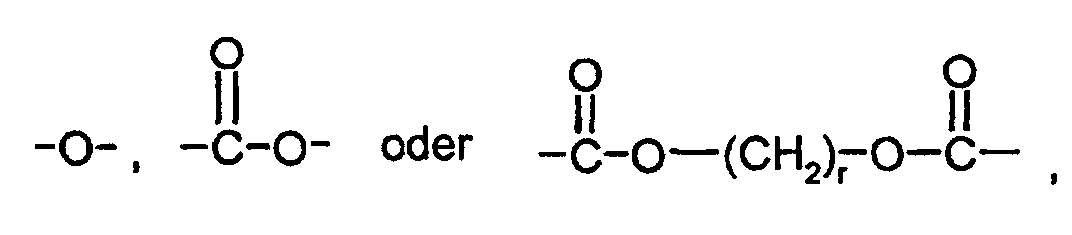
- Verbindungen gemäß Anspruch 1, dadurch gekennzeichnet, dass Ar1 und Ar2 unabhängig voneinander einen Rest zur Vervollständigung eines gegebenenfalls substituierten Benzol- oder Naphthalinringes, insbesondere eines gegebenenfalls substituierten Benzolringes bedeuten.
- Verbindungen gemäß Anspruch 1, die der Formel (II) oder deren tautomeren Formen entsprechenworin
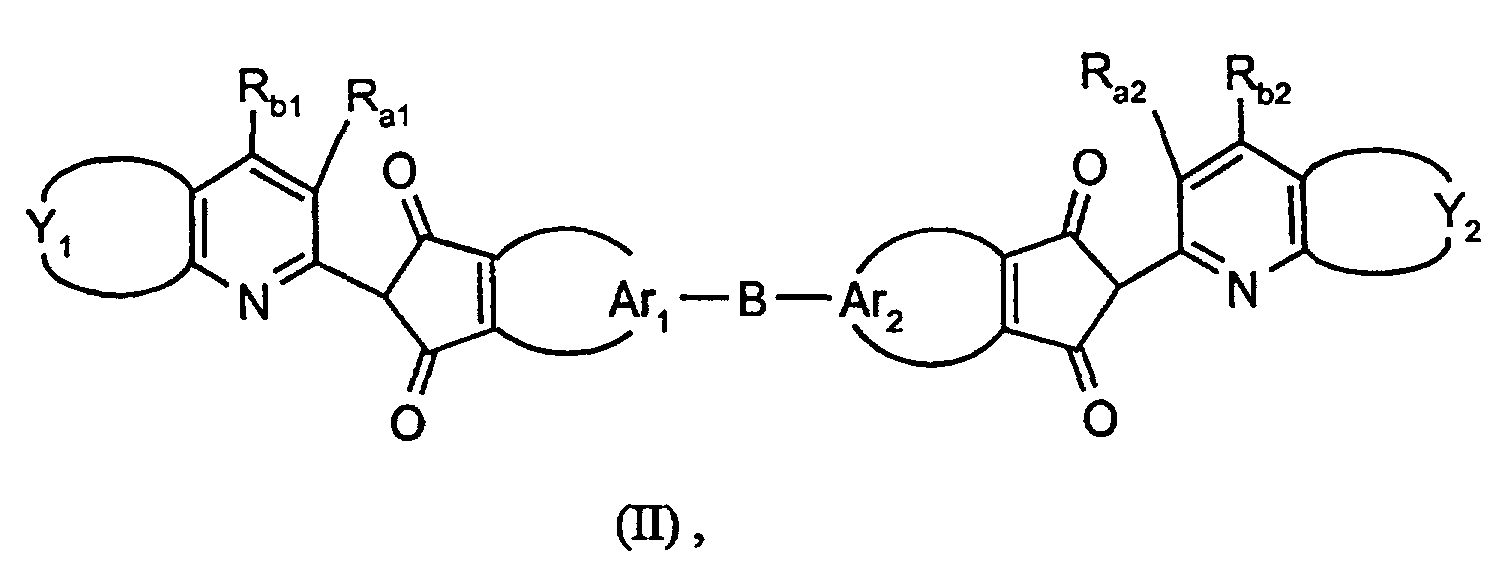
- Y1 und Y2
- unabhängig voneinander den Rest eines gegebenenfalls substituierten Benzol- oder Naphthalinringes bilden,
- Ra1 und Ra2
- unabhängig voneinander H oder OH bedeuten und
- Rb1 und Rb2
- unabhängig voneinander H oder Halogen, insbesondere F, Br oder Cl bedeuten.
- Verbindungen gemäß Anspruch 3, die der Formel (IIa) oder deren tautomeren Formen entsprechenworin

- n und m
- unabhängig voneinander für eine Zahl von 0 bis 4 stehen,
- R1 und R2
- unabhängig voneinander jeweils gleich oder verschieden sind und Halogen, insbesondere Cl und Br, -COOH, -COOR, wobei R fiir C1-C10-Alkyl, insbesondere Methyl und Ethyl, C6-C10-Aryl oder C5-C8-Cycloalkyl steht und C1-C6-Alkyl, insbesondere Methyl bedeuten,
- o und p
- unabhängig voneinander eine Zahl von 0 bis 2, insbesondere 0 oder 1 bedeuten,
- R3 und R4
- unabhängig voneinander jeweils gleich oder verschieden sind und C1-C6-Alkyl, insbesondere Methyl, Ethyl, n-Propyl, iso-Propyl, n-, sek- und tert.-Butyl, Halogen, insbesondere Cl und Br, Alkyl- und Arylcarbonyl, Alkyl- und Arylsulfonyl, Nitro, Aryl, insbesondere gegebenenfalls substituiertes Phenyl, Aryloxysulfonyl, insbesondere -SO2OC6H5, Hydroxy, C1-C6-Alkoxy, wie Methoxy oder Benzyloxy, Aryloxy, wie Phenoxy, gegebenenfalls durch Alkyl oder Acyl substituiertes Amino wie NH2, NHCOCH3 und -N(C2H5)2, gegebenenfalls durch Alkyl oder Aryl substituiertes Aminosulfonyl wie SO2N(CH3)2 und SO2NHCH3 oder einen ankondensierten cycloaliphatischen oder heterocyclischen Ring bedeuten.
- Verbindungen gemäß Anspruch 1, dadurch gekennzeichnet, dass B eine gegebenenfalls durch CF3 substituierte C1-C5-Alkylengruppe, die sowohl geradkettig oder verzweigt sein kann oder ein Rest der Formelmit r = 2 bis 4 ist.

- Verbindungen gemäß Anspruch 1, dadurch gekennzeichnet, dass B für einen Rest der Formeln
-CH2-, -CH2-CH2-, -CH2CH2CH2-, -CH2CH2CH2CH2-,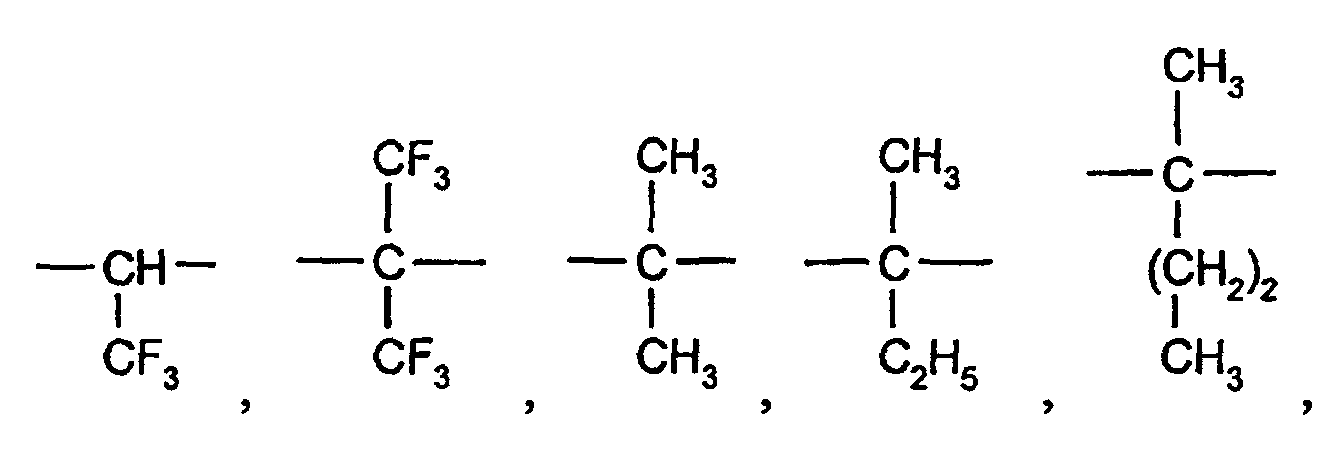 steht.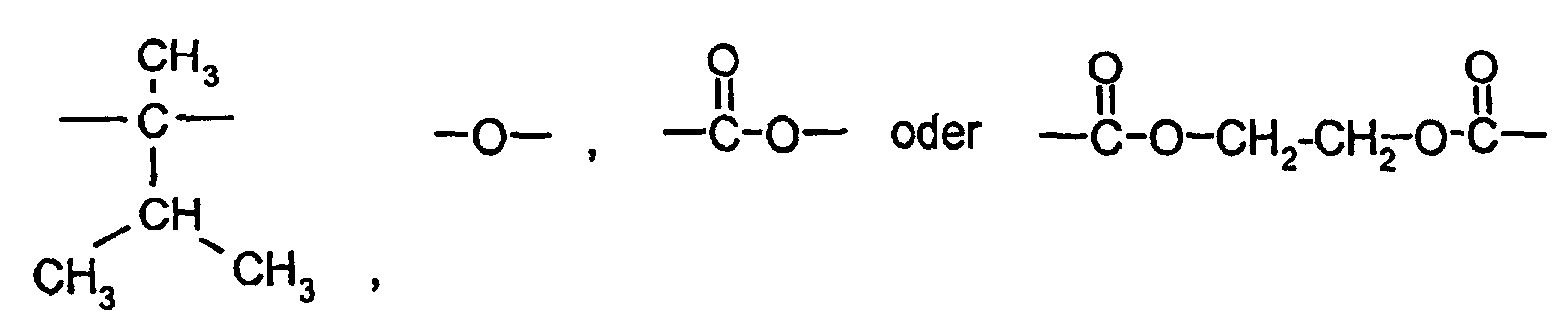
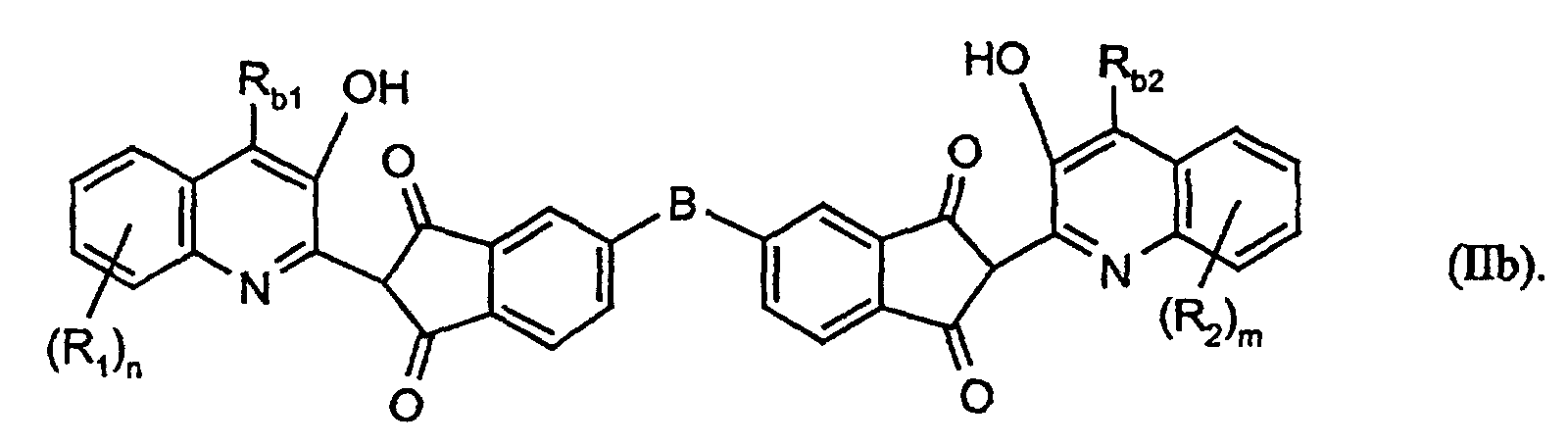
- Verbindungen gemäß Anspruch 4, die der Formel (IIb) oder deren tautomeren Formen entsprechen
- Verbindungen gemäß Anspruch 1, die der Formel (III) oder deren tautomeren Formen entsprechenworin

- Z1 und Z2
- unabhängig voneinander gegebenenfalls substituiertes ortho-Phenylen, ortho-Naphthylen, peri-(1,8)-Naphthylen oder Arylen aus mehr als zwei miteinander kondensierten Benzolringen bedeuten, wobei die Arylreste, die mehr als zwei miteinander kondensierte Benzolringe aufweisen, in ortho- oder entsprechend einer peri-Stellung im Naphthalin verbrückt sind.
- Verbindungen gemäß Anspruch 8, worin die Reste Z1 und Z2 unabhängig voneinander einem gegebenenfalls substituierten peri-(1,8)-Naphthylen entsprechen.
- Verbindungen gemäß Anspruch 8, die der Formel (IIIa) entsprechenworin

- n1 und m1
- unabhängig voneinander für eine Zahl von 0 bis 4 stehen,
- R5 und R6
- unabhängig voneinander jeweils gleich oder verschieden sind und C1-C6-Alkyl, Halogen, Nitro, Aryl, Aryloxysulfonyl, Hydroxy, C1-C6-Alkoxy, Aryloxy, gegebenenfalls durch Alkyl oder Acyl substituiertes Amino, gegebenenfalls durch Alkyl oder Aryl substituiertes Aminosulfonyl oder einen ankondensierten cycloaliphatischen oder heterocyclischen Ring bedeuten, insbesondere für Halogen und C1-C6-Alkyl, stehen,
- o und p
- unabhängig voneinander eine Zahl von 0 bis 2, insbesondere 0 oder 1, bedeuten,
- R3 und R4
- unabhängig voneinander jeweils gleich oder verschieden sind und C1-C6-Alkyl, Halogen, Nitro, Aryl, Aryloxysulfonyl, Hydroxy, C1-C6-Alkoxy, Aryloxy, gegebenenfalls durch Alkyl oder Acyl substituiertes Amino, gegebenenfalls durch Alkyl oder Aryl substituiertes Aminosulfonyl oder einen ankondensierten cycloaliphatischen oder heterocyclischen Ring bedeuten, inbesondere Halogen, NO2, -NH2, -NH-Acyl oder -NH-Alkyl bedeuten.
- Verbindungen gemäß Anspruch 10, die der Formel (IIIb) entsprechen

- Verbindungen gemäß Anspruch 1, die der Formel (IV) oder deren tautomeren Formen

- Verbindungen gemäß Anspruch 12, die der Formel (IVa) oder deren tautomeren Formen entsprechenworin

- Ra1 und Ra2
- unabhängig voneinander H oder OH bedeuten, und
- Rb1 und Rb2
- unabhängig voneinander H oder Halogen, insbesondere F, Br oder Cl bedeuten,
- n und n1
- unabhängig voneinander für eine Zahl von 0 bis 4 stehen,
- R1
- Halogen, insbesondere Cl und Br, -COOH, -COOR, wobei R für C1-C10-Alkyl, insbesondere Methyl und Ethyl, C6-C10-Aryl oder C5-C8-Cycloalkyl steht oder C1-C6-Alkyl, insbesondere Methyl bedeuten,
- o und p
- unabhängig eine Zahl von 0 bis 2, insbesondere 0 oder 1 bedeuten,
- R3 und R4
- unabhängig voneinander jeweils gleich oder verschieden sind, C1-C6-Alkyl, insbesondere Methyl, Ethyl, n-Propyl, iso-Propyl, n-, sek- und tert.-Butyl, Halogen, insbesondere Cl und Br, Alkyl- und Arylcarbonyl, Alkyl- und Arylsulfonyl, Nitro, Aryl, insbesondere gegebenenfalls substituiertes Phenyl, Aryloxysulfonyl, insbesondere -SO2OC6H5, Hydroxy, C1-C6-Alkoxy, wie Methoxy oder Benzyloxy, Aryloxy, wie Phenoxy, gegebenenfalls durch Alkyl oder Acyl substituiertes Amino wie NH2, NHCOCH3 und -N(C2H5)2, gegebenenfalls durch Alkyl oder Aryl substituiertes Aminosulfonyl wie SO2N(CH3)2 und SO2NHCH3 oder einen ankondensierten cycloaliphatischen oder heterocyclischen Ring bedeuten, und
- R5
- C1-C6-Alkyl, Halogen, Nitro, Aryl, Aryloxysulfonyl, Hydroxy, C1-C6-Alkoxy, Aryloxy, gegebenenfalls durch Alkyl oder Acyl substituiertes Amino, gegebenenfalls durch Alkyl oder Aryl substituiertes Aminosulfonyl oder einen ankondensierteeen cycloaliphatischen oder heterocyclischen Ring bedeuten, insbesondere für Halogen und C1-C6-Alkyl steht.
- Verbindungen gemäß Anspruch 13, die der Formel (IVb) oder deren tautomeren Formen entsprechen
- Verfahren zur Herstellung der erfindungsgemäßen Verbindungen der Formel (I) gemäß Anspruch 1, das dadurch gekennzeichnet ist, dass man Tetracarbonsäuren oder deren Anhydride der Formel (V)mit einer oder mehreren Verbindungen der Formeln (VI) und/oder (VII)
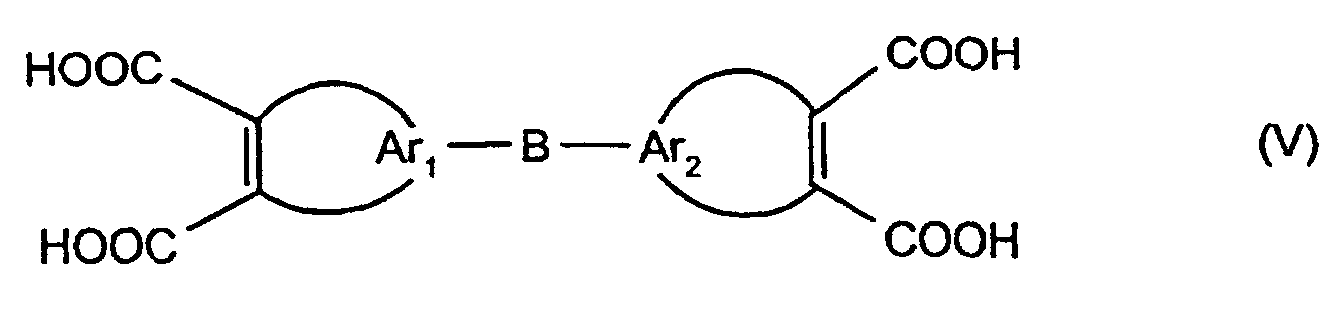
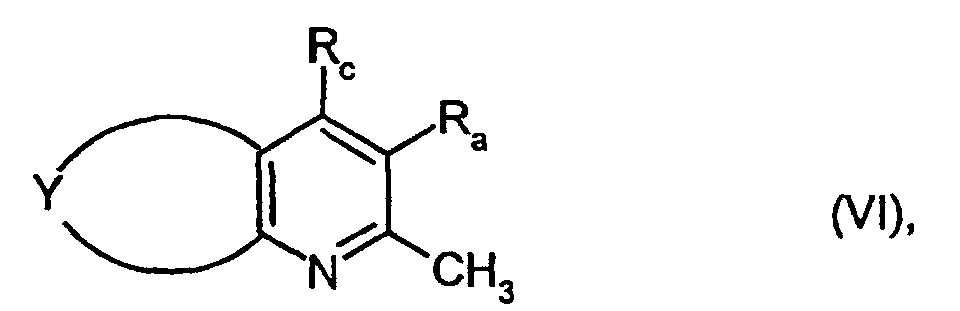 worin
worin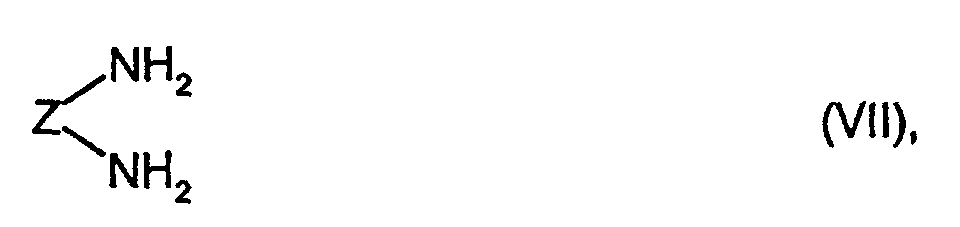
- Rc
- H, COOH oder Halogen, insbesondere F, Br und Cl bedeuten, insbesondere für H oder COOH steht und
- Ar1, Ar2 B, Y, Z und Ra
- die in Anspruch 1 angegebene Bedeutung besitzen,
- Verbindungen der Formel (V) oder deren Anhydride,worin
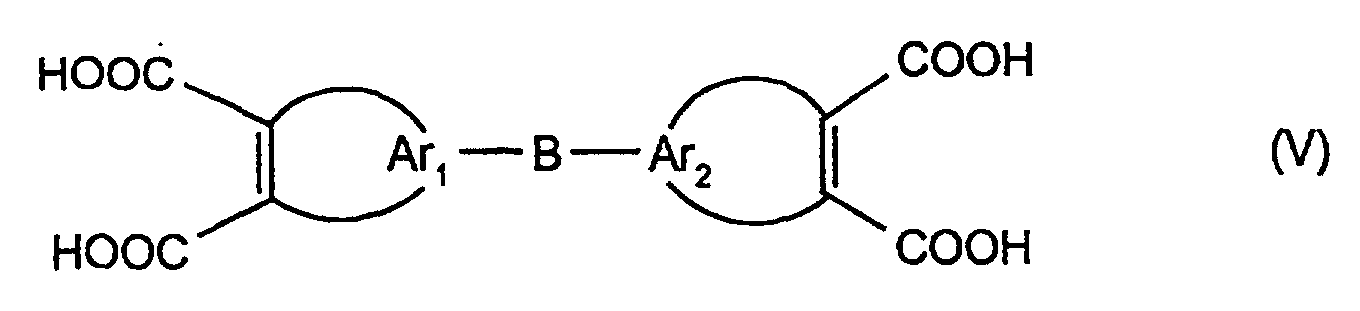
- Ar1 und Ar2
- unabhängig voneinander Reste zur Vervollständigung gegebenenfalls substituierter carbocyclischer Aromaten bedeuten, und
- B
- einen Rest der Formel
-CH2CH2CH2CH2-,oder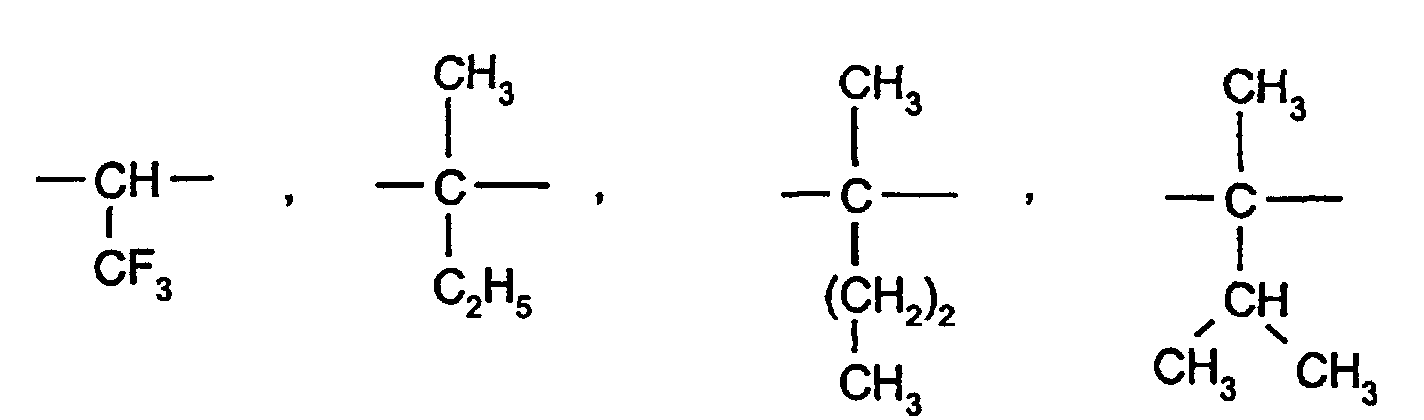

- Verwendung einer Verbindung gemäß Anspruch 1 zum Massefärben von Kunststoffen.
- Kunststoffe, gefärbt mit wenigstens einer Verbindung gemäß Anspruch 1.
Priority Applications (1)
| Application Number | Priority Date | Filing Date | Title |
|---|---|---|---|
| EP01107749A EP1118640B1 (de) | 1996-09-05 | 1997-08-25 | Verbrückte Perinone, Chinophthalone und Perinon-Chinophthalone |
Applications Claiming Priority (6)
| Application Number | Priority Date | Filing Date | Title |
|---|---|---|---|
| DE19636032 | 1996-09-05 | ||
| DE19636033 | 1996-09-05 | ||
| DE1996136032 DE19636032A1 (de) | 1996-09-05 | 1996-09-05 | Verbrückte Perinone |
| DE19636033 | 1996-09-05 | ||
| DE19706900 | 1997-02-21 | ||
| DE19706900 | 1997-02-21 |
Related Child Applications (1)
| Application Number | Title | Priority Date | Filing Date |
|---|---|---|---|
| EP01107749A Division EP1118640B1 (de) | 1996-09-05 | 1997-08-25 | Verbrückte Perinone, Chinophthalone und Perinon-Chinophthalone |
Publications (3)
| Publication Number | Publication Date |
|---|---|
| EP0827986A2 EP0827986A2 (de) | 1998-03-11 |
| EP0827986A3 EP0827986A3 (de) | 1998-10-07 |
| EP0827986B1 true EP0827986B1 (de) | 2002-03-27 |
Family
ID=27216611
Family Applications (2)
| Application Number | Title | Priority Date | Filing Date |
|---|---|---|---|
| EP01107749A Expired - Lifetime EP1118640B1 (de) | 1996-09-05 | 1997-08-25 | Verbrückte Perinone, Chinophthalone und Perinon-Chinophthalone |
| EP97114706A Expired - Lifetime EP0827986B1 (de) | 1996-09-05 | 1997-08-25 | Verbrückte Perinone, Chinophthalone und Perinon-Chinophthalone |
Family Applications Before (1)
| Application Number | Title | Priority Date | Filing Date |
|---|---|---|---|
| EP01107749A Expired - Lifetime EP1118640B1 (de) | 1996-09-05 | 1997-08-25 | Verbrückte Perinone, Chinophthalone und Perinon-Chinophthalone |
Country Status (5)
| Country | Link |
|---|---|
| US (1) | US5955614A (de) |
| EP (2) | EP1118640B1 (de) |
| JP (1) | JPH10140023A (de) |
| DE (2) | DE59710483D1 (de) |
| ES (1) | ES2174156T3 (de) |
Families Citing this family (14)
| Publication number | Priority date | Publication date | Assignee | Title |
|---|---|---|---|---|
| DE10158137A1 (de) * | 2001-11-27 | 2003-05-28 | Bayer Ag | Verbrückte Perinone/Chinophthalone |
| JP5114905B2 (ja) * | 2006-09-22 | 2013-01-09 | 東洋インキScホールディングス株式会社 | 顔料、顔料組成物及び顔料分散体 |
| JP5880154B2 (ja) * | 2011-04-12 | 2016-03-08 | 住友化学株式会社 | 化合物 |
| JP5842370B2 (ja) * | 2011-04-12 | 2016-01-13 | 住友化学株式会社 | 化合物 |
| KR102021024B1 (ko) * | 2011-12-26 | 2019-09-11 | 스미또모 가가꾸 가부시키가이샤 | 염료용 화합물 |
| TWI570190B (zh) * | 2012-02-13 | 2017-02-11 | 住友化學股份有限公司 | 著色硬化性樹脂組合物 |
| JP2013209435A (ja) * | 2012-03-30 | 2013-10-10 | Toyo Ink Sc Holdings Co Ltd | キノフタロン色素、およびそれを用いた着色感光性組成物、およびその用途 |
| US12516177B2 (en) * | 2019-03-15 | 2026-01-06 | Envalior Deutschland Gmbh | High voltage components |
| KR20210141542A (ko) * | 2019-03-15 | 2021-11-23 | 란세스 도이치란트 게엠베하 | 고 전압 구성요소 |
| JP2022045895A (ja) * | 2020-09-09 | 2022-03-22 | 保土谷化学工業株式会社 | 黄色系化合物、該化合物を含有する着色組成物、カラーフィルター用着色剤およびカラーフィルター |
| JP2023080419A (ja) * | 2021-11-30 | 2023-06-09 | 東洋インキScホールディングス株式会社 | キノフタロン顔料、着色組成物、およびカラーフィルタ |
| IL322302A (en) | 2023-01-27 | 2025-09-01 | Lanxess Corp | Flame retardant and orange color combined for use with thermoplastic materials |
| WO2025087592A1 (de) | 2023-10-25 | 2025-05-01 | Lanxess Deutschland Gmbh | Elektromobilitätskomponenten |
| DE202024001709U1 (de) | 2023-10-25 | 2024-11-12 | Lanxess Deutschland Gmbh | Elektromobilitätskomponenten |
Family Cites Families (20)
| Publication number | Priority date | Publication date | Assignee | Title |
|---|---|---|---|---|
| FR1075110A (fr) * | 1950-09-25 | 1954-10-13 | Francolor Sa | Nouveaux dérivés de périnones et procédé de coloration des superpolyamides au moyen des dérivés de périnones |
| US3332964A (en) * | 1963-06-18 | 1967-07-25 | Gulf Research Development Co | Tetraalkyl esters of diphenyl methane 3, 4, 3', 4'-tetracarboxylic acid, diphenyl methane 3, 4, 3', 4'-tetracarboxylic acid and the anhydride of said acids |
| CH463667A (de) * | 1965-01-08 | 1968-10-15 | Sandoz Ag | Verfahren zur Herstellung von Derivaten der Pyromellitsäure |
| GB1091733A (en) * | 1965-03-26 | 1967-11-22 | Ici Ltd | Mass-coloration of polyesters |
| DE1569670A1 (de) * | 1967-04-27 | 1972-02-24 | Basf Ag | Verfahren zur Herstellung von Farbstoffen |
| US3435002A (en) * | 1967-05-15 | 1969-03-25 | Gen Electric | Polyamide acid resins and polyimides therefrom |
| CH492760A (de) * | 1967-05-23 | 1970-06-30 | Basf Ag | Verfahren zur Herstellung von Dispersionsfarbstoffen der Chinophtalonreihe |
| CH557861A (de) * | 1970-12-01 | 1975-01-15 | Ciba Geigy Ag | Verfahren zur herstellung von perinonfarbstoffen. |
| US3965125A (en) * | 1971-02-08 | 1976-06-22 | Trw Inc. | Synthesis of certain bis(phthalic anhydrides) |
| BE785669A (fr) * | 1971-07-01 | 1973-01-02 | Basf Ag | Matieres colorantes et melanges de colorants a base de quinophtalone bromee |
| IT963296B (it) * | 1972-07-24 | 1974-01-10 | Montedison Spa | Copoliimmidi elastomeriche conte nenti fluoro e procedimento per la loro preparazione |
| US3909442A (en) * | 1974-01-07 | 1975-09-30 | American Cyanamid Co | Solubilized orange dye (dialkylsulfonamide derivative) |
| US4167506A (en) * | 1976-11-01 | 1979-09-11 | Teijin Limited | Diazaphenalene derivatives and resin containing color compositions |
| IT1190656B (it) * | 1982-01-18 | 1988-02-24 | Ausimont Spa | Coloranti organici contenenti gruppi silanici e loro processo di preparazione |
| JPS60166325A (ja) * | 1984-02-09 | 1985-08-29 | Sumitomo Bakelite Co Ltd | 耐熱性樹脂の製造方法 |
| DE3738456A1 (de) * | 1987-11-12 | 1989-05-24 | Lentia Gmbh | Schwefelhaltige aromatische tetracarbonsaeuren und deren derivate |
| JP2575791B2 (ja) * | 1988-04-13 | 1997-01-29 | 三井東圧化学株式会社 | デニム用綿糸の染色用染料、これを用いる染色法、ならびに染色物 |
| EP0438382A1 (de) * | 1990-01-19 | 1991-07-24 | Ciba-Geigy Ag | Disubstituierte aromatische Dianhydride und daraus hergestelle Polyimide |
| DE4216761A1 (de) * | 1992-05-21 | 1993-11-25 | Bayer Ag | Neue Perinonfarbstoffe zum Massefärben von Kunststoffen |
| DE4435714A1 (de) * | 1994-10-06 | 1996-04-11 | Bayer Ag | Verfahren zum Massefärben von Kunststoffen mit Chinophthalonfarbstoffen |
-
1997
- 1997-08-25 ES ES97114706T patent/ES2174156T3/es not_active Expired - Lifetime
- 1997-08-25 EP EP01107749A patent/EP1118640B1/de not_active Expired - Lifetime
- 1997-08-25 DE DE59710483T patent/DE59710483D1/de not_active Expired - Fee Related
- 1997-08-25 DE DE59706739T patent/DE59706739D1/de not_active Expired - Fee Related
- 1997-08-25 EP EP97114706A patent/EP0827986B1/de not_active Expired - Lifetime
- 1997-08-28 US US08/919,834 patent/US5955614A/en not_active Expired - Fee Related
- 1997-09-02 JP JP9251458A patent/JPH10140023A/ja not_active Withdrawn
Also Published As
| Publication number | Publication date |
|---|---|
| DE59710483D1 (de) | 2003-08-28 |
| ES2174156T3 (es) | 2002-11-01 |
| EP0827986A2 (de) | 1998-03-11 |
| JPH10140023A (ja) | 1998-05-26 |
| EP1118640B1 (de) | 2003-07-23 |
| EP0827986A3 (de) | 1998-10-07 |
| DE59706739D1 (de) | 2002-05-02 |
| EP1118640A1 (de) | 2001-07-25 |
| US5955614A (en) | 1999-09-21 |
Similar Documents
| Publication | Publication Date | Title |
|---|---|---|
| EP0224445B1 (de) | Pyrrolo-pyrrol Pigmentpräparate, Verfahren zu deren Herstellung sowie ihre Verwendung | |
| EP1118640B1 (de) | Verbrückte Perinone, Chinophthalone und Perinon-Chinophthalone | |
| EP1314754B1 (de) | Verbrückte Perinone/Chinophthalone | |
| DE19727079A1 (de) | Triphendioxazin | |
| EP3470467A1 (de) | Neue methinfarbstoffe | |
| EP3470471A1 (de) | Methinfarbstoffe | |
| EP0780444B1 (de) | Verfahren zur Herstellung polycyclischer Verbindungen | |
| DE10222819A1 (de) | Verfahren zur Herstellung von N,N'-disubstituierten 1,4-Diaminoanthrachinonen | |
| DE10140107B4 (de) | Verfahren zur Herstellung von 1-Amino-4-hydroxyanthrachinonen | |
| EP0683212A1 (de) | Neue Farbstoffe zum Massefärben von Kunststoffen | |
| EP0639624A1 (de) | Phthaloperinonfarbstoffe | |
| CH688237A5 (de) | Triphendioxazin-Verbindungen. | |
| EP0570800B1 (de) | Neue Perinonfarbstoffe zum Massefärben von Kunststoffen | |
| DE19636032A1 (de) | Verbrückte Perinone | |
| EP0859032B1 (de) | Verbrückte Anthrachinone | |
| EP2039728B1 (de) | Rote Farbstoffmischung | |
| DE2157547A1 (de) | Neue Perinonfarbstoffe und Verfahren zu deren Herstellung | |
| EP0829522A1 (de) | Verfahren zur Herstellung von Chinophthalonen | |
| DE2230601B2 (de) | Chinophthalonpigmente und deren Herstellung | |
| EP1293538B1 (de) | Verfahren zur Herstellung von Styrylfarbstoffen | |
| DE1928131C3 (de) | Anthrachinonfarbstoffe, ihre Herstellung und Verwendung | |
| DE19641689A1 (de) | Verfahren zur Herstellung von 1,8-Diaminonaphthalinen und ihrer Derivate der 2,3-Dihydroperimidine | |
| EP0298917B1 (de) | Verfahren zum Färben von hochmolekularem organischem Material mit Pigmenten auf der Basis von Iminoisoindolin | |
| DE2200115A1 (de) | 4,4'-disubstituierte 1,1'-dianthrachinonyle | |
| DE102007044743A1 (de) | Rote Farbstoffmischung |
Legal Events
| Date | Code | Title | Description |
|---|---|---|---|
| PUAI | Public reference made under article 153(3) epc to a published international application that has entered the european phase |
Free format text: ORIGINAL CODE: 0009012 |
|
| AK | Designated contracting states |
Kind code of ref document: A2 Designated state(s): CH DE ES FR GB LI |
|
| AX | Request for extension of the european patent |
Free format text: AL;LT;LV;RO;SI |
|
| PUAL | Search report despatched |
Free format text: ORIGINAL CODE: 0009013 |
|
| AK | Designated contracting states |
Kind code of ref document: A3 Designated state(s): AT BE CH DE DK ES FI FR GB GR IE IT LI LU MC NL PT SE |
|
| 17P | Request for examination filed |
Effective date: 19990407 |
|
| AKX | Designation fees paid |
Free format text: CH DE ES FR GB LI |
|
| 17Q | First examination report despatched |
Effective date: 20000131 |
|
| GRAG | Despatch of communication of intention to grant |
Free format text: ORIGINAL CODE: EPIDOS AGRA |
|
| GRAG | Despatch of communication of intention to grant |
Free format text: ORIGINAL CODE: EPIDOS AGRA |
|
| GRAH | Despatch of communication of intention to grant a patent |
Free format text: ORIGINAL CODE: EPIDOS IGRA |
|
| GRAH | Despatch of communication of intention to grant a patent |
Free format text: ORIGINAL CODE: EPIDOS IGRA |
|
| GRAH | Despatch of communication of intention to grant a patent |
Free format text: ORIGINAL CODE: EPIDOS IGRA |
|
| REG | Reference to a national code |
Ref country code: GB Ref legal event code: IF02 |
|
| GRAA | (expected) grant |
Free format text: ORIGINAL CODE: 0009210 |
|
| AK | Designated contracting states |
Kind code of ref document: B1 Designated state(s): CH DE ES FR GB LI |
|
| REG | Reference to a national code |
Ref country code: CH Ref legal event code: EP |
|
| REG | Reference to a national code |
Ref country code: CH Ref legal event code: NV Representative=s name: E. BLUM & CO. PATENTANWAELTE |
|
| REF | Corresponds to: |
Ref document number: 59706739 Country of ref document: DE Date of ref document: 20020502 |
|
| ET | Fr: translation filed | ||
| ET | Fr: translation filed | ||
| REG | Reference to a national code |
Ref country code: ES Ref legal event code: FG2A Ref document number: 2174156 Country of ref document: ES Kind code of ref document: T3 |
|
| PLBE | No opposition filed within time limit |
Free format text: ORIGINAL CODE: 0009261 |
|
| STAA | Information on the status of an ep patent application or granted ep patent |
Free format text: STATUS: NO OPPOSITION FILED WITHIN TIME LIMIT |
|
| 26N | No opposition filed |
Effective date: 20021230 |
|
| PGFP | Annual fee paid to national office [announced via postgrant information from national office to epo] |
Ref country code: ES Payment date: 20030808 Year of fee payment: 7 |
|
| PGFP | Annual fee paid to national office [announced via postgrant information from national office to epo] |
Ref country code: GB Payment date: 20030820 Year of fee payment: 7 |
|
| PG25 | Lapsed in a contracting state [announced via postgrant information from national office to epo] |
Ref country code: GB Free format text: LAPSE BECAUSE OF NON-PAYMENT OF DUE FEES Effective date: 20040825 |
|
| PG25 | Lapsed in a contracting state [announced via postgrant information from national office to epo] |
Ref country code: ES Free format text: LAPSE BECAUSE OF NON-PAYMENT OF DUE FEES Effective date: 20040826 |
|
| GBPC | Gb: european patent ceased through non-payment of renewal fee |
Effective date: 20040825 |
|
| PGFP | Annual fee paid to national office [announced via postgrant information from national office to epo] |
Ref country code: FR Payment date: 20050809 Year of fee payment: 9 |
|
| PGFP | Annual fee paid to national office [announced via postgrant information from national office to epo] |
Ref country code: DE Payment date: 20050818 Year of fee payment: 9 |
|
| PGFP | Annual fee paid to national office [announced via postgrant information from national office to epo] |
Ref country code: CH Payment date: 20050830 Year of fee payment: 9 |
|
| REG | Reference to a national code |
Ref country code: ES Ref legal event code: FD2A Effective date: 20040826 |
|
| PG25 | Lapsed in a contracting state [announced via postgrant information from national office to epo] |
Ref country code: LI Free format text: LAPSE BECAUSE OF NON-PAYMENT OF DUE FEES Effective date: 20060831 Ref country code: CH Free format text: LAPSE BECAUSE OF NON-PAYMENT OF DUE FEES Effective date: 20060831 |
|
| PG25 | Lapsed in a contracting state [announced via postgrant information from national office to epo] |
Ref country code: DE Free format text: LAPSE BECAUSE OF NON-PAYMENT OF DUE FEES Effective date: 20070301 |
|
| REG | Reference to a national code |
Ref country code: CH Ref legal event code: PL |
|
| REG | Reference to a national code |
Ref country code: FR Ref legal event code: ST Effective date: 20070430 |
|
| PG25 | Lapsed in a contracting state [announced via postgrant information from national office to epo] |
Ref country code: FR Free format text: LAPSE BECAUSE OF NON-PAYMENT OF DUE FEES Effective date: 20060831 |
|
| REG | Reference to a national code |
Ref country code: FR Ref legal event code: TP |