EP0571630B1 - Verfahren zur herstellung einer nickelplatte und einer alkalibatterie - Google Patents
Verfahren zur herstellung einer nickelplatte und einer alkalibatterie Download PDFInfo
- Publication number
- EP0571630B1 EP0571630B1 EP92921263A EP92921263A EP0571630B1 EP 0571630 B1 EP0571630 B1 EP 0571630B1 EP 92921263 A EP92921263 A EP 92921263A EP 92921263 A EP92921263 A EP 92921263A EP 0571630 B1 EP0571630 B1 EP 0571630B1
- Authority
- EP
- European Patent Office
- Prior art keywords
- nickel
- active material
- positive active
- powder
- porous substrate
- Prior art date
- Legal status (The legal status is an assumption and is not a legal conclusion. Google has not performed a legal analysis and makes no representation as to the accuracy of the status listed.)
- Expired - Lifetime
Links
Images
Classifications
-
- H—ELECTRICITY
- H01—ELECTRIC ELEMENTS
- H01M—PROCESSES OR MEANS, e.g. BATTERIES, FOR THE DIRECT CONVERSION OF CHEMICAL ENERGY INTO ELECTRICAL ENERGY
- H01M4/00—Electrodes
- H01M4/02—Electrodes composed of, or comprising, active material
- H01M4/24—Electrodes for alkaline accumulators
- H01M4/26—Processes of manufacture
-
- H—ELECTRICITY
- H01—ELECTRIC ELEMENTS
- H01M—PROCESSES OR MEANS, e.g. BATTERIES, FOR THE DIRECT CONVERSION OF CHEMICAL ENERGY INTO ELECTRICAL ENERGY
- H01M4/00—Electrodes
- H01M4/02—Electrodes composed of, or comprising, active material
- H01M4/24—Electrodes for alkaline accumulators
- H01M4/32—Nickel oxide or hydroxide electrodes
-
- H—ELECTRICITY
- H01—ELECTRIC ELEMENTS
- H01M—PROCESSES OR MEANS, e.g. BATTERIES, FOR THE DIRECT CONVERSION OF CHEMICAL ENERGY INTO ELECTRICAL ENERGY
- H01M4/00—Electrodes
- H01M4/02—Electrodes composed of, or comprising, active material
- H01M4/36—Selection of substances as active materials, active masses, active liquids
- H01M4/48—Selection of substances as active materials, active masses, active liquids of inorganic oxides or hydroxides
- H01M4/52—Selection of substances as active materials, active masses, active liquids of inorganic oxides or hydroxides of nickel, cobalt or iron
-
- H—ELECTRICITY
- H01—ELECTRIC ELEMENTS
- H01M—PROCESSES OR MEANS, e.g. BATTERIES, FOR THE DIRECT CONVERSION OF CHEMICAL ENERGY INTO ELECTRICAL ENERGY
- H01M10/00—Secondary cells; Manufacture thereof
- H01M10/34—Gastight accumulators
- H01M10/345—Gastight metal hydride accumulators
-
- Y—GENERAL TAGGING OF NEW TECHNOLOGICAL DEVELOPMENTS; GENERAL TAGGING OF CROSS-SECTIONAL TECHNOLOGIES SPANNING OVER SEVERAL SECTIONS OF THE IPC; TECHNICAL SUBJECTS COVERED BY FORMER USPC CROSS-REFERENCE ART COLLECTIONS [XRACs] AND DIGESTS
- Y02—TECHNOLOGIES OR APPLICATIONS FOR MITIGATION OR ADAPTATION AGAINST CLIMATE CHANGE
- Y02E—REDUCTION OF GREENHOUSE GAS [GHG] EMISSIONS, RELATED TO ENERGY GENERATION, TRANSMISSION OR DISTRIBUTION
- Y02E60/00—Enabling technologies; Technologies with a potential or indirect contribution to GHG emissions mitigation
- Y02E60/10—Energy storage using batteries
-
- Y—GENERAL TAGGING OF NEW TECHNOLOGICAL DEVELOPMENTS; GENERAL TAGGING OF CROSS-SECTIONAL TECHNOLOGIES SPANNING OVER SEVERAL SECTIONS OF THE IPC; TECHNICAL SUBJECTS COVERED BY FORMER USPC CROSS-REFERENCE ART COLLECTIONS [XRACs] AND DIGESTS
- Y10—TECHNICAL SUBJECTS COVERED BY FORMER USPC
- Y10T—TECHNICAL SUBJECTS COVERED BY FORMER US CLASSIFICATION
- Y10T29/00—Metal working
- Y10T29/49—Method of mechanical manufacture
- Y10T29/49002—Electrical device making
- Y10T29/49108—Electric battery cell making
- Y10T29/49115—Electric battery cell making including coating or impregnating
Definitions
- Nickel electrode plates are used for alkaline batteries such as nickel-zinc batteries, nickel metal-hydride batteries and nickel-cadmium batteries. These batteries are used mainly as power supplies for portable electronic equipment, as portable power supplies and as power supplies for electric vehicles such as electric automobiles and scooters.
- nickel electrode plate such as sintered, pasted, button and pocket types are known for use as the positive electrode in an alkaline battery.
- a sintered-type nickel plate is one in which a powder of positive active material having nickel hydroxide as principal component is filled into a porous substrate formed by sintering nickel powder on a porous substrate such as a punched steel plate or nickel net. Peeling-off of the nickel sintered product is liable to occur (due to weakening of mutual bonding between the sintered nickel powder particles) when the porosity of the substrate is increased. Therefore, a practical limit of porosity has been about 80% and the filling density of active material small: only an energy density of about 400 mAh/cc has been obtained. Pore diameters of the substrate are 10 ⁇ m or less and filling the positive active material requires a troublesome process of repeated solution impregnation.
- a button-type nickel plate is one in which a small quantity of conductive material such as carbon powder is added to the positive active material powder and the composite powder is pressed into a pellet shape.
- a pocket-type nickel plate is one in which a punched steel plate is worked to form a pocket into which the positive active material powder is filled. That is, the positive active material powder is filled directly and sintered nickel powder is not used. Consequently, these plates lack current collecting property and offer an active material utilization efficiency as small as about 50% to 60%, with a performance considerably inferior to that of the sintered type nickel plates which offer an active material utilization efficiency as large as about 90%.
- fine particles such as nickel carbonyl powder are mixed with the positive active material powder but the performance can be improved by only about 10%. This is because nickel hydroxide of poor electric conductivity forms on surfaces of the nickel carbonyl powder particles at a positive electrode charge/discharge potential.
- a pasted-type nickel plate is made, as described in EP-A-337029 and EP-A-403052, by mixing 1 to 30 wt% of CoO (cobalt monoxide) powder with the positive active material powder.
- the powder mixture is formed into a paste using a solvent such as MC (methyl cellulose) or CMC (carboxymethyl cellulose) and the paste is filled into a nickel fibre porous plate.
- CoO is dissolved in electrolyte solution and made to precipitate onto the porous plate and positive active material as ⁇ -Co(OH) 2 which is then subjected to charging to form a conductive network of ⁇ -CoOOH which has good electric conductivity, giving good discharge performance.
- ⁇ -Co(OH) 2 which is then subjected to charging to form a conductive network of ⁇ -CoOOH which has good electric conductivity, giving good discharge performance.
- an aging process is required, i.e.
- pasted-type nickel plates involve the following problems.
- the aim of the present invention is to provide new ways of processing a nickel hydroxide-based positive active material in the preparation of a nickel electrode plate.
- the invention provides a method of making a nickel electrode plate, comprising the steps of
- the invention provides a method of making a nickel electrode plate, comprising the steps of
- the oxidized positive active material may be mixed with cobalt oxyhydroxide powder before filling into the substrate.
- JP-A-59/111264 and JP-A-59/128765 which describe the use of potassium peroxosulphate (among other oxidizing agents) to act on nickel hydroxide powder in a solution of cobalt salt.
- potassium peroxosulphate among other oxidizing agents
- this is done under acid conditions in order to produce a mixed oxide of nickel/cobalt for an electrode, and has no relevance to forming coatings of ⁇ -CoOOH on nickel hydroxide.
- Spherical nickel hydroxide powder including 5 wt% cadmium hydroxide was formed into a paste with 2 wt% CMC, filled into a substrate comprising a nickel fibre porous body, dried for 1 hour at 80°C and then pressed.
- the prepared filled substrate was put in an aqueous solution saturated with dissolved cobalt ions, having potassium hydroxide as principal component and a specific gravity of 1.25. K 2 S 2 O 8 was added up to the molar number or more of cobalt ions, until oxygen gas was produced. After completion of the reaction the filled substrate was rinsed, dried, pressed, and then coated with Teflon® on its surface. Thus, a nickel plate was prepared.
- Spherical nickel hydroxide powder including 5 wt% cadmium hydroxide was put in an aqueous solution saturated with dissolved cobalt ions, having potassium hydroxide as principal component and a specific gravity of 1.25. K 2 S 2 O 8 was added up to the molar number or more of cobalt ions, until oxygen gas was produced.
- the powder was filtered, rinsed and dried. It was then formed into a paste with 2 wt% CMC, filled into a substrate comprising a nickel fibre porous body, dried for 1 hour at 80°C, pressed, and then coated with Teflon® on its surface. Thus, a nickel plate was prepared.
- Spherical nickel hydroxide powder including 5 wt% cadmium hydroxide was mixed with CoOOH powder having a grain size of 1 ⁇ m, at a weight ratio of 95 to 5.
- the prepared mixture was filtered, rinsed and dried. It was then formed into a paste with 2 wt% CMC, filled into a substrate comprising a nickel fibre porous body, dried for 1 hour at 80°C, pressed, and coated with Teflon® on its surface. Thus, a nickel plate was prepared.
- Spherical nickel hydroxide powder including 5 wt% cadmium hydroxide was put in an aqueous solution saturated with dissolved cobalt ions, having potassium hydroxide as principal component and a specific gravity of 1.25. K 2 S 2 O 8 was added up to the molar number or more of cobalt ions until oxygen gas was produced.
- the powder was filtered, rinsed and dried.
- the prepared powder was mixed with CoOOH powder having a grain size of 1 ⁇ m at a weight ratio of 95 to 5.
- the prepared mixture was filtered, rinsed and dried. It was then formed into a paste with 2 wt% CMC, filled into a substrate comprising a nickel fibre porous body, dried for 1 hour at 80°C, pressed, and coated with Teflon® on its surface. Thus, a nickel plate was prepared.
- Spherical nickel hydroxide powder including 5 wt% cadmium hydroxide was mixed with CoO powder having a grain size of 1 ⁇ m and a surface area of 70 m 2 /g at a weight ratio of 95 to 5. This mixing was done in an aqueous solution having potassium hydroxide as principal component and a specific gravity of 1.25, and the mixture was stirred sufficiently.
- the prepared mixture was filtered, rinsed and dried. It was then formed into a paste with 2 wt% CMC, filled into a substrate comprising a nickel fibre porous body, dried for 1 hour at 80°C, pressed, and coated with Teflon® on its surface. Thus, a nickel plate was prepared.
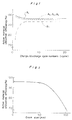
- the nickel plates of embodiments 1 to 4 and the Comparative Example were used as positive electrodes combined with respective negative electrodes (pasted-type cadmium plates) and separators comprising polyamide nonwoven fabrics, forming nickel-cadmium batteries A 1 to A 4 (Embodiments) and B 1 (Comparative) respectively, with nominal capacity of 2.0Ah.
- An aqueous solution having a principal component of potassium hydroxide and a specific gravity of 1.25 was used as the electrolyte solution, and was filled to a level immersing 90% of the volumes of the positive electrode, negative electrode and separator.
- the battery B 1 was subjected to the aging process after filling the electrolyte solution, and subsequent formation by charging.
- the batteries A 1 to A 4 and B 1 were investigated with respect to the relation between the number of charge/discharge cycles and active material utilization efficiency. Charging was done at a charging current of 0.1 CA for 11 hours, and discharging at a discharge current of 0.2 CA. Results are shown in Fig. 1.
- CoO and cobalt ions are oxidised by K 2 S 2 O 8 (oxidising agent) to become ⁇ -CoOOH of good electric conductivity, formed on the surfaces of nickel hydroxide powder particles constituting the positive active material so that a conductive network is formed to improve the conduction efficiency between the positive active material particles and between the positive active material and the substrate.
- K 2 S 2 O 8 oxidising agent
- CoO is not completely converted to ⁇ -CoOOH at the initial stage so that conduction efficiency is low and charging and discharging reactions are incomplete.
- Nickel plates were then formed in the same way as in Embodiment 4 except that the grain size of CoOOH used was adjusted to 10 ⁇ m, 50 ⁇ m and 100 ⁇ m respectively. Batteries the same as the above were formed using these nickel plates, to investigate stabilized active material utilization efficiencies after the batteries had been subjected to several cycles of charging and discharging. Results are shown in Fig. 2, showing that the active material utilization efficiency of CoOOH is decreased when the grain size exceeds 50 ⁇ m. Accordingly, the grain size of CoOOH used is preferably 50 ⁇ m or smaller.
- the present invention can provide a nickel plate for an alkaline battery which offers high active material utilization efficiency from the first cycle and is excellent in discharge characteristics.
- the aging process and the charging and discharging for ⁇ -CoOOH formation are not required, so that productivity is better.
- an intermediate product before getting the ⁇ -CoOOH does not cause the previously-mentioned short-circuiting and bad influences with zinc electrodes.
- this method can provide an alkaline battery such as a nickel-zinc battery having stable performance. The following possible variants should be noted.
Landscapes
- Chemical & Material Sciences (AREA)
- Chemical Kinetics & Catalysis (AREA)
- Electrochemistry (AREA)
- General Chemical & Material Sciences (AREA)
- Inorganic Chemistry (AREA)
- Engineering & Computer Science (AREA)
- Manufacturing & Machinery (AREA)
- Battery Electrode And Active Subsutance (AREA)
Claims (10)
- Verfahren zur Herstellung einer Nickelelektrodenplatte, das die folgenden Schritte umfasst:(a) Einfüllen eines Pulvers aus einem positiven aktiven Material mit Nickelhydroxid als Hauptkomponente in ein dreidimensionales poröses Substrat, das ein alkaliresistentes Material umfasst; und(b) Oxidieren des gefüllten Substrats mit einem Oxidationsmittel, das aus K2S2O8, Na2S2O8, (NH4)2S2O8 und H2O2 ausgewählt ist, in einer Lösung, die auch Cobaltionen enthält, unter Bildung einer leitfähigen β-CoOOH-Beschichtung auf der Oberfläche des positiven aktiven Materials.
- Verfahren zur Herstellung einer Nickelelektrodenplatte, das die folgenden Schritte umfasst:(a) Oxidieren eines Pulvers aus einem positiven aktiven Material mit Nickelhydroxid als Hauptkomponente mit einem Oxidationsmittel, das aus K2S2O8, Na2S2O8, (NH4)2S2O8 und H2O2 ausgewählt ist, in einer Lösung, die auch Cobaltionen enthält, unter Bildung einer leitfähigen β-CoOOH-Beschichtung auf der Oberfläche des positiven aktiven Materials; und(b) Einfüllen des oxidierten positiven aktiven Materials in ein dreidimensionales poröses Substrat, das ein alkaliresistentes Material umfasst.
- Verfahren gemäß Anspruch 2, bei dem das oxidierte positive aktive Material mit Cobaltoxidhydroxid-Pulver gemischt wird, bevor man es in das Substrat einfüllt.
- Verfahren gemäß Anspruch 3, bei dem das Cobaltoxldhydroxld-Pulver eine Korngröße von 50 um oder weniger hat.
- Verfahren gemäß einem der vorstehenden Ansprüche, bei dem das poröse Substrat eine Cobaltplattierung aufweist.
- Verfahren gemäß einem der vorstehenden Ansprüche, bei dem das poröse Substrat eine Faser oder ein Schaumstoffkörper ist.
- Verfahren gemäß einem der vorstehenden Ansprüche, bei dem das alkali-resistente Metall des porösen Substrats Nickel ist.
- Verfahren gemäß einem der vorstehenden Ansprüche, bei dem das in das poröse Substrat eingefüllte Material in Form einer Paste eingefüllt wird.
- Nickelelektrodenplatte, die gemäß einem der Ansprüche 1 bis 8 erhältlich ist.
- Verfahren zur Herstellung einer Alkalibatterie, bei dem eine gemäß einem der Ansprüche 1 bis 8 hergestellte Nickelelektrode mit einer Zink-, Metallhydrid- oder Cadmiumelektrode und einem Separator zusammengesetzt wird.
Applications Claiming Priority (4)
| Application Number | Priority Date | Filing Date | Title |
|---|---|---|---|
| JP302324/91 | 1991-10-21 | ||
| JP30232491 | 1991-10-21 | ||
| JP30232491 | 1991-10-21 | ||
| PCT/JP1992/001359 WO1993008611A1 (fr) | 1991-10-21 | 1992-10-20 | Procede de fabrication d'une plaque de nickel et d'un accumulateur alcalin |
Publications (3)
| Publication Number | Publication Date |
|---|---|
| EP0571630A1 EP0571630A1 (de) | 1993-12-01 |
| EP0571630A4 EP0571630A4 (de) | 1995-04-19 |
| EP0571630B1 true EP0571630B1 (de) | 2002-01-30 |
Family
ID=17907572
Family Applications (1)
| Application Number | Title | Priority Date | Filing Date |
|---|---|---|---|
| EP92921263A Expired - Lifetime EP0571630B1 (de) | 1991-10-21 | 1992-10-20 | Verfahren zur herstellung einer nickelplatte und einer alkalibatterie |
Country Status (4)
| Country | Link |
|---|---|
| US (1) | US5489314A (de) |
| EP (1) | EP0571630B1 (de) |
| DE (1) | DE69232392T2 (de) |
| WO (1) | WO1993008611A1 (de) |
Families Citing this family (29)
| Publication number | Priority date | Publication date | Assignee | Title |
|---|---|---|---|---|
| US5523182A (en) * | 1992-11-12 | 1996-06-04 | Ovonic Battery Company, Inc. | Enhanced nickel hydroxide positive electrode materials for alkaline rechargeable electrochemical cells |
| DE19606879C2 (de) * | 1995-02-23 | 2001-07-05 | Toshiba Kawasaki Kk | Verfahren zur Herstellung einer alkalischen Sekundärbatterie |
| US5744259A (en) * | 1995-05-25 | 1998-04-28 | Matsushita Electric Industrial Co., Ltd. | Nickel positive electrode for alkaline storage battery and sealed nickel-metal hydride storage battery |
| JP3533032B2 (ja) * | 1996-04-03 | 2004-05-31 | 松下電器産業株式会社 | アルカリ蓄電池とその製造方法 |
| US5984982A (en) * | 1997-09-05 | 1999-11-16 | Duracell Inc. | Electrochemical synthesis of cobalt oxyhydroxide |
| JP2947284B2 (ja) * | 1997-12-26 | 1999-09-13 | 松下電器産業株式会社 | アルカリ蓄電池用非焼結式正極およびこれを用いたアルカリ蓄電池 |
| US6177213B1 (en) | 1998-08-17 | 2001-01-23 | Energy Conversion Devices, Inc. | Composite positive electrode material and method for making same |
| US6270535B1 (en) * | 1998-09-04 | 2001-08-07 | Moltech Power Systems, Inc. | Method of forming CoOOH and NiOOH in a NiMH electrochemical cell and an electrochemical cell formed thereby |
| US6790559B2 (en) * | 2001-03-15 | 2004-09-14 | Powergenix Systems, Inc. | Alkaline cells having positive nickel hydroxide electrodes with fluoride salt additives |
| CN100350667C (zh) * | 2001-06-29 | 2007-11-21 | 双向电池公司 | 储氢电池、镍正极、正极活性材料及其制备方法 |
| WO2003021698A1 (en) * | 2001-09-03 | 2003-03-13 | Yuasa Corporation | Nickel electrode material and production method therefor, and nickel electrode and alkaline battery |
| US6991875B2 (en) * | 2002-08-28 | 2006-01-31 | The Gillette Company | Alkaline battery including nickel oxyhydroxide cathode and zinc anode |
| US20040076881A1 (en) * | 2002-10-17 | 2004-04-22 | Bowden William L. | Method of making a battery |
| JP4412936B2 (ja) * | 2003-07-31 | 2010-02-10 | パナソニック株式会社 | オキシ水酸化コバルトおよびその製造方法ならびにそれを用いたアルカリ蓄電池 |
| US9406934B2 (en) | 2012-02-07 | 2016-08-02 | Basf Corporation | Rechargeable battery cell with improved high temperature performance |
| US9425456B2 (en) | 2012-02-07 | 2016-08-23 | Ovonic Battery Company, Inc. | Rechargeable battery cell with improved high temperature performance |
| US20150372285A1 (en) * | 2014-06-24 | 2015-12-24 | Basf Corporation | Metal Hydride Battery Electrodes |
| US10587012B2 (en) | 2015-03-26 | 2020-03-10 | Basf Corporation | Electrolyte compositions comprising ionic liquids and metal hydride batteries comprising same |
| JP7021102B2 (ja) | 2016-03-28 | 2022-02-16 | ビーエーエスエフ コーポレーション | 充電式電池用のシリコンに基づく固体電解質 |
| WO2022145030A1 (en) | 2020-12-29 | 2022-07-07 | Kawasaki Motors, Ltd. | Salt containing electrolytes that promote the formation of proton-conducting rechargeable batteries |
| WO2022145026A1 (en) | 2020-12-29 | 2022-07-07 | Kawasaki Motors, Ltd. | Si-containing alloy for the anode of proton-conducting rechargeable batteries |
| WO2022145027A1 (en) | 2020-12-29 | 2022-07-07 | Kawasaki Motors, Ltd. | Ionic liquid electrolytes including salt additives for use in proton-conducting rechargeable batteries |
| WO2022145029A1 (en) | 2020-12-29 | 2022-07-07 | Kawasaki Motors, Ltd. | Group 14 element-containing metal hydride with a superlattice structure for use in hydrogen storage. |
| WO2022145028A1 (en) | 2020-12-29 | 2022-07-07 | Kawasaki Motors, Ltd. | Group 14 element-containing metal hydrides with a superlattice structure for use in proton-conducting rechargeable batteries |
| WO2022145031A1 (en) | 2020-12-29 | 2022-07-07 | Kawasaki Motors, Ltd. | Processes of hydrogen annealing of si-surfaces |
| WO2022145025A1 (en) | 2020-12-29 | 2022-07-07 | Kawasaki Motors, Ltd. | Bulk si-anode for use in proton-conducting rechargeable batteries |
| US20240429367A1 (en) | 2021-05-13 | 2024-12-26 | Kawasaki Motors, Ltd. | Bipolar battery with proton and hydroxide ion conducting polymer based separator |
| US20240283089A1 (en) | 2021-06-21 | 2024-08-22 | Kawasaki Motors, Ltd. | Proton conducting rechargeable batteries and processes |
| WO2023007751A1 (en) | 2021-07-30 | 2023-02-02 | Kawasaki Motors, Ltd. | Si-containing metal hydrides with expanded superlattice structure for use in proton-conducting rechargeable electrochemical cells |
Family Cites Families (16)
| Publication number | Priority date | Publication date | Assignee | Title |
|---|---|---|---|---|
| US4049027A (en) * | 1976-08-26 | 1977-09-20 | Yardney Electric Corporation | Active material for pressed nickel electrodes |
| JPS544335A (en) * | 1977-06-10 | 1979-01-13 | Tokyo Shibaura Electric Co | Method of making nickel active material for alkali cell |
| EP0028072B1 (de) * | 1979-10-03 | 1984-08-01 | LUCAS INDUSTRIES public limited company | Nickelelektrode, Verfahren zur Herstellung der Nickelelektrode und die Nickelelektrode verwendende elektrochemische Zelle |
| CA1113802A (en) * | 1980-09-02 | 1981-12-08 | William A. Armstrong | Mixed oxide oxygen electrode |
| JPS58152371A (ja) * | 1982-03-05 | 1983-09-09 | Japan Storage Battery Co Ltd | アルカリ電池用正極板の製造法 |
| JPS5923464A (ja) * | 1982-07-29 | 1984-02-06 | Matsushita Electric Ind Co Ltd | 電池用ニツケル電極の製造法 |
| JPS5983348A (ja) * | 1982-11-04 | 1984-05-14 | Matsushita Electric Ind Co Ltd | ニツケル正極の製造法 |
| JPS59111264A (ja) * | 1982-12-14 | 1984-06-27 | Japan Storage Battery Co Ltd | アルカリ電池用正極板 |
| JPS59128765A (ja) * | 1983-01-13 | 1984-07-24 | Japan Storage Battery Co Ltd | 非水電解液電池 |
| EP0284333B1 (de) * | 1987-03-25 | 1995-11-29 | Matsushita Electric Industrial Co., Ltd. | Gasdichte Nickel-Hydridbatterie und Verfahren zur Herstellung |
| JP2589123B2 (ja) * | 1987-10-15 | 1997-03-12 | 三洋電機株式会社 | アルカリ蓄電池用正極板の製造方法 |
| JPH0724218B2 (ja) * | 1988-04-11 | 1995-03-15 | 株式会社ユアサコーポレーション | アルカリ電池用ニッケル電極及びこれを用いた電池 |
| EP0403052B1 (de) * | 1989-06-15 | 1995-06-21 | Yuasa Corporation | Nickelelektrode und diese verwendende alkalische Batterie |
| JPH0824041B2 (ja) * | 1990-05-21 | 1996-03-06 | 株式会社ユアサコーポレーション | ニッケル極板の製造法 |
| JPH07114123B2 (ja) * | 1990-06-04 | 1995-12-06 | 湯浅電池株式会社 | ニッケル亜鉛蓄電池の製造法 |
| JPH0824042B2 (ja) * | 1990-09-19 | 1996-03-06 | 株式会社ユアサコーポレーション | ニッケル水素蓄電池の製造法 |
-
1992
- 1992-10-20 DE DE69232392T patent/DE69232392T2/de not_active Expired - Fee Related
- 1992-10-20 WO PCT/JP1992/001359 patent/WO1993008611A1/ja not_active Ceased
- 1992-10-20 US US08/078,247 patent/US5489314A/en not_active Expired - Fee Related
- 1992-10-20 EP EP92921263A patent/EP0571630B1/de not_active Expired - Lifetime
Also Published As
| Publication number | Publication date |
|---|---|
| EP0571630A1 (de) | 1993-12-01 |
| US5489314A (en) | 1996-02-06 |
| EP0571630A4 (de) | 1995-04-19 |
| DE69232392D1 (de) | 2002-03-14 |
| DE69232392T2 (de) | 2002-08-29 |
| WO1993008611A1 (fr) | 1993-04-29 |
Similar Documents
| Publication | Publication Date | Title |
|---|---|---|
| EP0571630B1 (de) | Verfahren zur herstellung einer nickelplatte und einer alkalibatterie | |
| US6632568B1 (en) | Non-sintered nickel electrode with excellent over-discharge characteristics, an alkaline storage cell having the non-sintered nickel electrode, and a manufacturing method of the non-sintered nickel electrode | |
| EP0817291B1 (de) | Nicht gesinterte Nickelelektrode für alkalische Speicherbatterie, diese enthaltende alkalische Speicherbatterie und Herstellungsverfahren für solch eine Elektrode. | |
| JP3558590B2 (ja) | アルカリ蓄電池用正極活物質の製造方法 | |
| JP4710225B2 (ja) | ニッケル電極材料の製造方法 | |
| JP3617203B2 (ja) | ニッケル水素二次電池の製造方法 | |
| JP2000003707A (ja) | アルカリ蓄電池 | |
| US20050238960A1 (en) | Non-sintered type positive electrode and alkaline storage battery using the same | |
| JP2004071304A (ja) | アルカリ蓄電池用正極活物質ならびにそれを用いた正極およびアルカリ蓄電池 | |
| US6221529B1 (en) | Positive electrode for lithium battery and lithium battery | |
| JP3469766B2 (ja) | 密閉型アルカリ蓄電池用非焼結式ニッケル極及び電池 | |
| US6489059B2 (en) | Alkaline storage battery and positive electrode used for the alkaline storage battery | |
| US7147676B2 (en) | Method of preparing a nickel positive electrode active material | |
| JP3253476B2 (ja) | アルカリ蓄電池用非焼結式ニッケル極 | |
| JP2001155724A (ja) | アルカリ蓄電池 | |
| JP3744642B2 (ja) | ニッケル−金属水素化物蓄電池及びその製造方法 | |
| JP3397216B2 (ja) | ニッケル極板とその製造方法およびこれを用いたアルカリ蓄電池 | |
| JP3229800B2 (ja) | アルカリ蓄電池用非焼結式ニッケル極 | |
| JP3003218B2 (ja) | ニッケル極板の製造法及びアルカリ蓄電池の製造法 | |
| JP3384109B2 (ja) | ニッケル極板 | |
| JP3263601B2 (ja) | アルカリ蓄電池用非焼結式ニッケル極 | |
| JP3233013B2 (ja) | アルカリ蓄電池用ニッケル極 | |
| JP4168293B2 (ja) | アルカリ蓄電池用ペ−スト式水酸化ニッケル正極板 | |
| JP3555473B2 (ja) | アルカリ二次電池用正極の製造方法 | |
| JPH10302829A (ja) | アルカリ二次電池の製造法 |
Legal Events
| Date | Code | Title | Description |
|---|---|---|---|
| PUAI | Public reference made under article 153(3) epc to a published international application that has entered the european phase |
Free format text: ORIGINAL CODE: 0009012 |
|
| 17P | Request for examination filed |
Effective date: 19930712 |
|
| AK | Designated contracting states |
Kind code of ref document: A1 Designated state(s): DE FR GB |
|
| A4 | Supplementary search report drawn up and despatched |
Effective date: 19950302 |
|
| AK | Designated contracting states |
Kind code of ref document: A4 Designated state(s): DE FR GB |
|
| 17Q | First examination report despatched |
Effective date: 19950627 |
|
| GRAG | Despatch of communication of intention to grant |
Free format text: ORIGINAL CODE: EPIDOS AGRA |
|
| GRAG | Despatch of communication of intention to grant |
Free format text: ORIGINAL CODE: EPIDOS AGRA |
|
| GRAG | Despatch of communication of intention to grant |
Free format text: ORIGINAL CODE: EPIDOS AGRA |
|
| GRAG | Despatch of communication of intention to grant |
Free format text: ORIGINAL CODE: EPIDOS AGRA |
|
| GRAG | Despatch of communication of intention to grant |
Free format text: ORIGINAL CODE: EPIDOS AGRA |
|
| GRAH | Despatch of communication of intention to grant a patent |
Free format text: ORIGINAL CODE: EPIDOS IGRA |
|
| GRAH | Despatch of communication of intention to grant a patent |
Free format text: ORIGINAL CODE: EPIDOS IGRA |
|
| GRAA | (expected) grant |
Free format text: ORIGINAL CODE: 0009210 |
|
| REG | Reference to a national code |
Ref country code: GB Ref legal event code: IF02 |
|
| AK | Designated contracting states |
Kind code of ref document: B1 Designated state(s): DE FR GB |
|
| REF | Corresponds to: |
Ref document number: 69232392 Country of ref document: DE Date of ref document: 20020314 |
|
| ET | Fr: translation filed | ||
| PLBE | No opposition filed within time limit |
Free format text: ORIGINAL CODE: 0009261 |
|
| STAA | Information on the status of an ep patent application or granted ep patent |
Free format text: STATUS: NO OPPOSITION FILED WITHIN TIME LIMIT |
|
| 26N | No opposition filed | ||
| PGFP | Annual fee paid to national office [announced via postgrant information from national office to epo] |
Ref country code: DE Payment date: 20061012 Year of fee payment: 15 |
|
| PGFP | Annual fee paid to national office [announced via postgrant information from national office to epo] |
Ref country code: GB Payment date: 20061018 Year of fee payment: 15 |
|
| GBPC | Gb: european patent ceased through non-payment of renewal fee |
Effective date: 20071020 |
|
| PG25 | Lapsed in a contracting state [announced via postgrant information from national office to epo] |
Ref country code: DE Free format text: LAPSE BECAUSE OF NON-PAYMENT OF DUE FEES Effective date: 20080501 |
|
| REG | Reference to a national code |
Ref country code: FR Ref legal event code: ST Effective date: 20080630 |
|
| PGFP | Annual fee paid to national office [announced via postgrant information from national office to epo] |
Ref country code: FR Payment date: 20061010 Year of fee payment: 15 |
|
| PG25 | Lapsed in a contracting state [announced via postgrant information from national office to epo] |
Ref country code: GB Free format text: LAPSE BECAUSE OF NON-PAYMENT OF DUE FEES Effective date: 20071020 |
|
| PG25 | Lapsed in a contracting state [announced via postgrant information from national office to epo] |
Ref country code: FR Free format text: LAPSE BECAUSE OF NON-PAYMENT OF DUE FEES Effective date: 20071031 |