EP0574294A1 - Beschichtetes Blech und Verfahren zur Herstellung dieses Bleches - Google Patents
Beschichtetes Blech und Verfahren zur Herstellung dieses Bleches Download PDFInfo
- Publication number
- EP0574294A1 EP0574294A1 EP93401445A EP93401445A EP0574294A1 EP 0574294 A1 EP0574294 A1 EP 0574294A1 EP 93401445 A EP93401445 A EP 93401445A EP 93401445 A EP93401445 A EP 93401445A EP 0574294 A1 EP0574294 A1 EP 0574294A1
- Authority
- EP
- European Patent Office
- Prior art keywords
- sheet
- bath
- tin
- acid
- process according
- Prior art date
- Legal status (The legal status is an assumption and is not a legal conclusion. Google has not performed a legal analysis and makes no representation as to the accuracy of the status listed.)
- Granted
Links
- 238000004519 manufacturing process Methods 0.000 title claims abstract description 11
- 238000000034 method Methods 0.000 title claims description 39
- 230000008569 process Effects 0.000 title claims description 21
- 239000011135 tin Substances 0.000 claims abstract description 101
- ATJFFYVFTNAWJD-UHFFFAOYSA-N Tin Chemical compound [Sn] ATJFFYVFTNAWJD-UHFFFAOYSA-N 0.000 claims abstract description 88
- 229910052718 tin Inorganic materials 0.000 claims abstract description 87
- 239000010410 layer Substances 0.000 claims abstract description 59
- 229910001220 stainless steel Inorganic materials 0.000 claims abstract description 51
- 239000010935 stainless steel Substances 0.000 claims abstract description 46
- 229910000765 intermetallic Inorganic materials 0.000 claims abstract description 34
- VYZAMTAEIAYCRO-UHFFFAOYSA-N Chromium Chemical compound [Cr] VYZAMTAEIAYCRO-UHFFFAOYSA-N 0.000 claims abstract description 33
- 239000011651 chromium Substances 0.000 claims abstract description 32
- 229910052804 chromium Inorganic materials 0.000 claims abstract description 31
- 239000000203 mixture Substances 0.000 claims abstract description 25
- 239000011247 coating layer Substances 0.000 claims abstract description 16
- 229910052751 metal Inorganic materials 0.000 claims abstract description 15
- 239000002184 metal Substances 0.000 claims abstract description 15
- 239000000758 substrate Substances 0.000 claims abstract description 13
- 238000010438 heat treatment Methods 0.000 claims abstract description 10
- 230000008018 melting Effects 0.000 claims abstract description 5
- 238000002844 melting Methods 0.000 claims abstract description 5
- 239000002253 acid Substances 0.000 claims description 42
- PXHVJJICTQNCMI-UHFFFAOYSA-N Nickel Chemical compound [Ni] PXHVJJICTQNCMI-UHFFFAOYSA-N 0.000 claims description 40
- 239000003792 electrolyte Substances 0.000 claims description 30
- VEXZGXHMUGYJMC-UHFFFAOYSA-N Hydrochloric acid Chemical compound Cl VEXZGXHMUGYJMC-UHFFFAOYSA-N 0.000 claims description 27
- QAOWNCQODCNURD-UHFFFAOYSA-N Sulfuric acid Chemical compound OS(O)(=O)=O QAOWNCQODCNURD-UHFFFAOYSA-N 0.000 claims description 25
- 238000000151 deposition Methods 0.000 claims description 24
- 239000011248 coating agent Substances 0.000 claims description 23
- 238000000576 coating method Methods 0.000 claims description 23
- 229910052759 nickel Inorganic materials 0.000 claims description 21
- 230000008021 deposition Effects 0.000 claims description 19
- 230000010287 polarization Effects 0.000 claims description 19
- 238000007654 immersion Methods 0.000 claims description 17
- FAPWRFPIFSIZLT-UHFFFAOYSA-M Sodium chloride Chemical compound [Na+].[Cl-] FAPWRFPIFSIZLT-UHFFFAOYSA-M 0.000 claims description 15
- PUZPDOWCWNUUKD-UHFFFAOYSA-M sodium fluoride Chemical compound [F-].[Na+] PUZPDOWCWNUUKD-UHFFFAOYSA-M 0.000 claims description 15
- 229910000831 Steel Inorganic materials 0.000 claims description 13
- 238000005238 degreasing Methods 0.000 claims description 13
- 239000010959 steel Substances 0.000 claims description 13
- 229910001128 Sn alloy Inorganic materials 0.000 claims description 11
- 150000001875 compounds Chemical class 0.000 claims description 11
- 229910052500 inorganic mineral Inorganic materials 0.000 claims description 10
- 235000010755 mineral Nutrition 0.000 claims description 10
- 239000011707 mineral Substances 0.000 claims description 10
- 238000005554 pickling Methods 0.000 claims description 10
- 229910052725 zinc Inorganic materials 0.000 claims description 10
- 239000011701 zinc Substances 0.000 claims description 10
- WHOZNOZYMBRCBL-OUKQBFOZSA-N (2E)-2-Tetradecenal Chemical compound CCCCCCCCCCC\C=C\C=O WHOZNOZYMBRCBL-OUKQBFOZSA-N 0.000 claims description 9
- YMWUJEATGCHHMB-UHFFFAOYSA-N Dichloromethane Chemical compound ClCCl YMWUJEATGCHHMB-UHFFFAOYSA-N 0.000 claims description 9
- ZOKXTWBITQBERF-UHFFFAOYSA-N Molybdenum Chemical compound [Mo] ZOKXTWBITQBERF-UHFFFAOYSA-N 0.000 claims description 9
- CDBYLPFSWZWCQE-UHFFFAOYSA-L Sodium Carbonate Chemical compound [Na+].[Na+].[O-]C([O-])=O CDBYLPFSWZWCQE-UHFFFAOYSA-L 0.000 claims description 9
- HEMHJVSKTPXQMS-UHFFFAOYSA-M Sodium hydroxide Chemical compound [OH-].[Na+] HEMHJVSKTPXQMS-UHFFFAOYSA-M 0.000 claims description 9
- 229910052750 molybdenum Inorganic materials 0.000 claims description 9
- 229940044654 phenolsulfonic acid Drugs 0.000 claims description 9
- 150000007513 acids Chemical class 0.000 claims description 8
- 235000011150 stannous chloride Nutrition 0.000 claims description 8
- VTYYLEPIZMXCLO-UHFFFAOYSA-L Calcium carbonate Chemical compound [Ca+2].[O-]C([O-])=O VTYYLEPIZMXCLO-UHFFFAOYSA-L 0.000 claims description 7
- 229910019142 PO4 Inorganic materials 0.000 claims description 7
- 229910021626 Tin(II) chloride Inorganic materials 0.000 claims description 7
- 239000011733 molybdenum Substances 0.000 claims description 7
- 239000011780 sodium chloride Substances 0.000 claims description 7
- 239000011775 sodium fluoride Substances 0.000 claims description 7
- 235000013024 sodium fluoride Nutrition 0.000 claims description 7
- 238000011282 treatment Methods 0.000 claims description 7
- NINIDFKCEFEMDL-UHFFFAOYSA-N Sulfur Chemical compound [S] NINIDFKCEFEMDL-UHFFFAOYSA-N 0.000 claims description 6
- HCHKCACWOHOZIP-UHFFFAOYSA-N Zinc Chemical compound [Zn] HCHKCACWOHOZIP-UHFFFAOYSA-N 0.000 claims description 6
- 229910052799 carbon Inorganic materials 0.000 claims description 6
- 150000001805 chlorine compounds Chemical class 0.000 claims description 6
- KWYUFKZDYYNOTN-UHFFFAOYSA-M Potassium hydroxide Chemical compound [OH-].[K+] KWYUFKZDYYNOTN-UHFFFAOYSA-M 0.000 claims description 5
- 239000004115 Sodium Silicate Substances 0.000 claims description 5
- 238000005275 alloying Methods 0.000 claims description 5
- 239000008139 complexing agent Substances 0.000 claims description 5
- PYRZPBDTPRQYKG-UHFFFAOYSA-N cyclopentene-1-carboxylic acid Chemical compound OC(=O)C1=CCCC1 PYRZPBDTPRQYKG-UHFFFAOYSA-N 0.000 claims description 5
- 239000003960 organic solvent Substances 0.000 claims description 5
- 150000003013 phosphoric acid derivatives Chemical class 0.000 claims description 5
- 235000019795 sodium metasilicate Nutrition 0.000 claims description 5
- NTHWMYGWWRZVTN-UHFFFAOYSA-N sodium silicate Chemical compound [Na+].[Na+].[O-][Si]([O-])=O NTHWMYGWWRZVTN-UHFFFAOYSA-N 0.000 claims description 5
- 229910052911 sodium silicate Inorganic materials 0.000 claims description 5
- TXUICONDJPYNPY-UHFFFAOYSA-N (1,10,13-trimethyl-3-oxo-4,5,6,7,8,9,11,12,14,15,16,17-dodecahydrocyclopenta[a]phenanthren-17-yl) heptanoate Chemical compound C1CC2CC(=O)C=C(C)C2(C)C2C1C1CCC(OC(=O)CCCCCC)C1(C)CC2 TXUICONDJPYNPY-UHFFFAOYSA-N 0.000 claims description 4
- OKTJSMMVPCPJKN-UHFFFAOYSA-N Carbon Chemical compound [C] OKTJSMMVPCPJKN-UHFFFAOYSA-N 0.000 claims description 4
- 150000004673 fluoride salts Chemical class 0.000 claims description 4
- XLYOFNOQVPJJNP-ZSJDYOACSA-N heavy water Substances [2H]O[2H] XLYOFNOQVPJJNP-ZSJDYOACSA-N 0.000 claims description 4
- 150000002500 ions Chemical class 0.000 claims description 4
- 230000007935 neutral effect Effects 0.000 claims description 4
- 239000001119 stannous chloride Substances 0.000 claims description 4
- 239000011593 sulfur Substances 0.000 claims description 4
- 229910052717 sulfur Inorganic materials 0.000 claims description 4
- CYTYCFOTNPOANT-UHFFFAOYSA-N Perchloroethylene Chemical group ClC(Cl)=C(Cl)Cl CYTYCFOTNPOANT-UHFFFAOYSA-N 0.000 claims description 3
- XSTXAVWGXDQKEL-UHFFFAOYSA-N Trichloroethylene Chemical group ClC=C(Cl)Cl XSTXAVWGXDQKEL-UHFFFAOYSA-N 0.000 claims description 3
- KGBXLFKZBHKPEV-UHFFFAOYSA-N boric acid Chemical compound OB(O)O KGBXLFKZBHKPEV-UHFFFAOYSA-N 0.000 claims description 3
- 239000004327 boric acid Substances 0.000 claims description 3
- 229910000019 calcium carbonate Inorganic materials 0.000 claims description 3
- 229910000029 sodium carbonate Inorganic materials 0.000 claims description 3
- 239000004094 surface-active agent Substances 0.000 claims description 3
- 229950011008 tetrachloroethylene Drugs 0.000 claims description 3
- AXZWODMDQAVCJE-UHFFFAOYSA-L tin(II) chloride (anhydrous) Chemical compound [Cl-].[Cl-].[Sn+2] AXZWODMDQAVCJE-UHFFFAOYSA-L 0.000 claims description 3
- 229910000990 Ni alloy Inorganic materials 0.000 claims description 2
- 229910001297 Zn alloy Inorganic materials 0.000 claims description 2
- 239000003513 alkali Substances 0.000 claims description 2
- 235000021317 phosphate Nutrition 0.000 claims 2
- YPFNIPKMNMDDDB-UHFFFAOYSA-K 2-[2-[bis(carboxylatomethyl)amino]ethyl-(2-hydroxyethyl)amino]acetate;iron(3+) Chemical compound [Fe+3].OCCN(CC([O-])=O)CCN(CC([O-])=O)CC([O-])=O YPFNIPKMNMDDDB-UHFFFAOYSA-K 0.000 claims 1
- BZOVBIIWPDQIHF-UHFFFAOYSA-N 3-hydroxy-2-methylbenzenesulfonic acid Chemical compound CC1=C(O)C=CC=C1S(O)(=O)=O BZOVBIIWPDQIHF-UHFFFAOYSA-N 0.000 claims 1
- 235000010216 calcium carbonate Nutrition 0.000 claims 1
- 235000017550 sodium carbonate Nutrition 0.000 claims 1
- XEEYBQQBJWHFJM-UHFFFAOYSA-N Iron Chemical compound [Fe] XEEYBQQBJWHFJM-UHFFFAOYSA-N 0.000 abstract description 19
- 229910052742 iron Inorganic materials 0.000 abstract description 10
- 230000015572 biosynthetic process Effects 0.000 abstract description 4
- 230000004913 activation Effects 0.000 description 15
- 229910045601 alloy Inorganic materials 0.000 description 14
- 239000000956 alloy Substances 0.000 description 14
- 230000007797 corrosion Effects 0.000 description 11
- 238000005260 corrosion Methods 0.000 description 11
- 238000004090 dissolution Methods 0.000 description 8
- 239000000243 solution Substances 0.000 description 6
- 239000000126 substance Substances 0.000 description 5
- NBIIXXVUZAFLBC-UHFFFAOYSA-N Phosphoric acid Chemical compound OP(O)(O)=O NBIIXXVUZAFLBC-UHFFFAOYSA-N 0.000 description 4
- DGAQECJNVWCQMB-PUAWFVPOSA-M Ilexoside XXIX Chemical compound C[C@@H]1CC[C@@]2(CC[C@@]3(C(=CC[C@H]4[C@]3(CC[C@@H]5[C@@]4(CC[C@@H](C5(C)C)OS(=O)(=O)[O-])C)C)[C@@H]2[C@]1(C)O)C)C(=O)O[C@H]6[C@@H]([C@H]([C@@H]([C@H](O6)CO)O)O)O.[Na+] DGAQECJNVWCQMB-PUAWFVPOSA-M 0.000 description 3
- 229910019192 Sn—Cr Inorganic materials 0.000 description 3
- -1 des phosphates Chemical class 0.000 description 3
- 239000011734 sodium Substances 0.000 description 3
- 229910052708 sodium Inorganic materials 0.000 description 3
- JWAZRIHNYRIHIV-UHFFFAOYSA-N 2-naphthol Chemical compound C1=CC=CC2=CC(O)=CC=C21 JWAZRIHNYRIHIV-UHFFFAOYSA-N 0.000 description 2
- 229910000519 Ferrosilicon Inorganic materials 0.000 description 2
- 230000003213 activating effect Effects 0.000 description 2
- 229910000147 aluminium phosphate Inorganic materials 0.000 description 2
- 239000007864 aqueous solution Substances 0.000 description 2
- 239000012298 atmosphere Substances 0.000 description 2
- 239000002585 base Substances 0.000 description 2
- 239000003795 chemical substances by application Substances 0.000 description 2
- 230000009850 completed effect Effects 0.000 description 2
- 238000001816 cooling Methods 0.000 description 2
- 238000010586 diagram Methods 0.000 description 2
- 230000000694 effects Effects 0.000 description 2
- 230000009931 harmful effect Effects 0.000 description 2
- 150000007524 organic acids Chemical class 0.000 description 2
- 235000005985 organic acids Nutrition 0.000 description 2
- 229940072033 potash Drugs 0.000 description 2
- BWHMMNNQKKPAPP-UHFFFAOYSA-L potassium carbonate Substances [K+].[K+].[O-]C([O-])=O BWHMMNNQKKPAPP-UHFFFAOYSA-L 0.000 description 2
- 235000015320 potassium carbonate Nutrition 0.000 description 2
- 229910000679 solder Inorganic materials 0.000 description 2
- 238000012360 testing method Methods 0.000 description 2
- XLYOFNOQVPJJNP-UHFFFAOYSA-N water Substances O XLYOFNOQVPJJNP-UHFFFAOYSA-N 0.000 description 2
- 229910001868 water Inorganic materials 0.000 description 2
- NGNBDVOYPDDBFK-UHFFFAOYSA-N 2-[2,4-di(pentan-2-yl)phenoxy]acetyl chloride Chemical class CCCC(C)C1=CC=C(OCC(Cl)=O)C(C(C)CCC)=C1 NGNBDVOYPDDBFK-UHFFFAOYSA-N 0.000 description 1
- BVKZGUZCCUSVTD-UHFFFAOYSA-L Carbonate Chemical compound [O-]C([O-])=O BVKZGUZCCUSVTD-UHFFFAOYSA-L 0.000 description 1
- ZAMOUSCENKQFHK-UHFFFAOYSA-N Chlorine atom Chemical compound [Cl] ZAMOUSCENKQFHK-UHFFFAOYSA-N 0.000 description 1
- KRHYYFGTRYWZRS-UHFFFAOYSA-N Fluorane Chemical class F KRHYYFGTRYWZRS-UHFFFAOYSA-N 0.000 description 1
- 108010010803 Gelatin Proteins 0.000 description 1
- GRYLNZFGIOXLOG-UHFFFAOYSA-N Nitric acid Chemical compound O[N+]([O-])=O GRYLNZFGIOXLOG-UHFFFAOYSA-N 0.000 description 1
- 241001311547 Patina Species 0.000 description 1
- PMZURENOXWZQFD-UHFFFAOYSA-L Sodium Sulfate Chemical compound [Na+].[Na+].[O-]S([O-])(=O)=O PMZURENOXWZQFD-UHFFFAOYSA-L 0.000 description 1
- 238000003916 acid precipitation Methods 0.000 description 1
- 230000002378 acidificating effect Effects 0.000 description 1
- 239000000654 additive Substances 0.000 description 1
- 150000001450 anions Chemical class 0.000 description 1
- 238000000137 annealing Methods 0.000 description 1
- 238000005452 bending Methods 0.000 description 1
- 238000005219 brazing Methods 0.000 description 1
- 239000000460 chlorine Substances 0.000 description 1
- 229910052801 chlorine Inorganic materials 0.000 description 1
- UOUJSJZBMCDAEU-UHFFFAOYSA-N chromium(3+);oxygen(2-) Chemical class [O-2].[O-2].[O-2].[Cr+3].[Cr+3] UOUJSJZBMCDAEU-UHFFFAOYSA-N 0.000 description 1
- 238000005097 cold rolling Methods 0.000 description 1
- 239000003344 environmental pollutant Substances 0.000 description 1
- 239000000446 fuel Substances 0.000 description 1
- 230000004927 fusion Effects 0.000 description 1
- 229920000159 gelatin Polymers 0.000 description 1
- 239000008273 gelatin Substances 0.000 description 1
- 235000019322 gelatine Nutrition 0.000 description 1
- 235000011852 gelatine desserts Nutrition 0.000 description 1
- 150000004679 hydroxides Chemical class 0.000 description 1
- 230000006698 induction Effects 0.000 description 1
- 230000000670 limiting effect Effects 0.000 description 1
- 230000009021 linear effect Effects 0.000 description 1
- 239000000463 material Substances 0.000 description 1
- 229910017604 nitric acid Inorganic materials 0.000 description 1
- 230000036961 partial effect Effects 0.000 description 1
- 238000002161 passivation Methods 0.000 description 1
- 235000009048 phenolic acids Nutrition 0.000 description 1
- 150000007965 phenolic acids Chemical class 0.000 description 1
- 238000007747 plating Methods 0.000 description 1
- 238000005498 polishing Methods 0.000 description 1
- 238000012545 processing Methods 0.000 description 1
- 230000001681 protective effect Effects 0.000 description 1
- 239000011241 protective layer Substances 0.000 description 1
- 230000001603 reducing effect Effects 0.000 description 1
- 238000007789 sealing Methods 0.000 description 1
- 239000000779 smoke Substances 0.000 description 1
- 229910052938 sodium sulfate Inorganic materials 0.000 description 1
- 235000011152 sodium sulphate Nutrition 0.000 description 1
- 238000005476 soldering Methods 0.000 description 1
- 230000007928 solubilization Effects 0.000 description 1
- 238000005063 solubilization Methods 0.000 description 1
- 238000003892 spreading Methods 0.000 description 1
- 230000007480 spreading Effects 0.000 description 1
- 238000005728 strengthening Methods 0.000 description 1
- 238000004381 surface treatment Methods 0.000 description 1
- JBQYATWDVHIOAR-UHFFFAOYSA-N tellanylidenegermanium Chemical compound [Te]=[Ge] JBQYATWDVHIOAR-UHFFFAOYSA-N 0.000 description 1
- XOLBLPGZBRYERU-UHFFFAOYSA-N tin dioxide Chemical compound O=[Sn]=O XOLBLPGZBRYERU-UHFFFAOYSA-N 0.000 description 1
- 229910001887 tin oxide Inorganic materials 0.000 description 1
- 230000001052 transient effect Effects 0.000 description 1
- 238000009736 wetting Methods 0.000 description 1
Images
Classifications
-
- C—CHEMISTRY; METALLURGY
- C25—ELECTROLYTIC OR ELECTROPHORETIC PROCESSES; APPARATUS THEREFOR
- C25D—PROCESSES FOR THE ELECTROLYTIC OR ELECTROPHORETIC PRODUCTION OF COATINGS; ELECTROFORMING; APPARATUS THEREFOR
- C25D5/00—Electroplating characterised by the process; Pretreatment or after-treatment of workpieces
- C25D5/48—After-treatment of electroplated surfaces
- C25D5/50—After-treatment of electroplated surfaces by heat-treatment
- C25D5/505—After-treatment of electroplated surfaces by heat-treatment of electroplated tin coatings, e.g. by melting
-
- C—CHEMISTRY; METALLURGY
- C25—ELECTROLYTIC OR ELECTROPHORETIC PROCESSES; APPARATUS THEREFOR
- C25D—PROCESSES FOR THE ELECTROLYTIC OR ELECTROPHORETIC PRODUCTION OF COATINGS; ELECTROFORMING; APPARATUS THEREFOR
- C25D5/00—Electroplating characterised by the process; Pretreatment or after-treatment of workpieces
- C25D5/34—Pretreatment of metallic surfaces to be electroplated
- C25D5/36—Pretreatment of metallic surfaces to be electroplated of iron or steel
Definitions
- the present invention relates to a coated sheet and a method of manufacturing this sheet.
- the sealing of a stainless steel sheet is generally carried out on continuous coil processing lines by immersion in an alloy bath based on molten lead.
- the lead-based alloy generally includes tin to facilitate wetting and adhesion of the coating.
- coated sheets are used for roofing buildings because they have many advantages. In particular, they have good weather resistance and good solderability. It is also necessary to mention their lightness (approximately 3kg / m2 for a sheet thickness of 0.4 mm), good mechanical resistance and, in the case of ferritic stainless steel sheets, a low coefficient of linear expansion which makes it possible to obtain an elongation of 1.06 mm / m for a variation of 100 ° C, while in the case of zinc sheets an elongation of 2.20 mm / m is obtained for a variation of 100 ° C.
- a cover made of ferritic stainless steel sheets containing 17% by mass of chromium, coated with a layer of lead-based alloy, has excellent resistance to atmospheric corrosion agents such as acid rain and smoke fallout of fuel.
- sheets coated with alloyed stainless steel are preferably used containing molybdenum at a mass concentration of 1 to 3%.
- the object of the present invention is to provide sheets which can be used as a covering material which do not have the harmful effects and unsightly aspects inherent in coatings containing lead, these sheets having a matt aesthetic appearance, good solderability and being protected against atmospheric corrosion.
- the subject of the invention is a method of manufacturing a coated sheet, used in particular for the manufacture of building roofs, characterized in that one deposits electrolytically on at least one of the faces of a stainless steel sheet containing in its composition by weight more than 16% of chromium, a layer of metallic coating of pure tin or of a tin alloy, the alloying element of which is chosen in particular from zinc and nickel.
- the subject of the invention is also a coated sheet characterized in that it comprises a stainless steel substrate, containing in its composition by weight more than 16% of chromium, covered on at least one of its faces with a layer of metallic coating.
- This sheet 10 comprises a substrate consisting of a sheet 12 of stainless steel containing in its composition by weight more than 16% chromium.
- This sheet 12 has on one of its faces a layer 14 of intermetallic compound comprising at least iron, tin and chromium (Fe-Sn-Cr) and a layer 16 of metallic coating, mainly comprising tin, covering the layer 14 of intermetallic compound.
- the steels used for the manufacture of sheet 12 are of two types.
- a first type corresponds to ferritic grades which contain 17% chromium (Cr) with or without molybdenum (Mo) referenced according to the American standard AISI 430, AISI 434, AISI 439, AISI 444, and the French standard Z3CTNb18.
- a second type corresponds to austenitic grades which contain 18% chromium and at least 6% nickel (Ni) with or without molybdenum referenced according to the American standard AISI 304 and AISI 316.
- stainless steels can be used provided that they contain at least 16% by mass of chromium.
- the layer 16 can be dissolved after an extended use time of several years.
- a sheet 10 is obtained as shown in FIG. 2, the coated face of which no longer comprises any more than the layer 14 of intermetallic compound.
- the coated sheet 10 is manufactured according to a process which will be described below.
- the surface of the stainless steel sheet is degreased.
- the degreasing operation is recommended to guarantee good adhesion of the tin coating. Indeed, if the surface of the stainless steel is not degreased, fatty substances and other non-eliminated surface pollutants are likely to reduce the adhesion of the tin deposit and generate an inhomogeneous deposit comprising areas without coating.
- Degreasing of the sheet can be carried out either chemically or electrolytically.
- the sheet can be degreased chemically by placing it in contact with a solution containing halogenated organic solvents such as methylene chloride, 1,1,1, -trichloroethane, perchlorethylene or trichlorethylene. It is also possible to degrease the sheet chemically using a solution based on alkaline mixtures containing in particular sodium hydroxide, sodium carbonate, sodium metasilicate, phosphates, complexing agents and surfactants.
- halogenated organic solvents such as methylene chloride, 1,1,1, -trichloroethane, perchlorethylene or trichlorethylene.
- the degreasing operation is carried out electrolytically in an electrolytic or electrolyte bath consisting of an aqueous solution containing alkaline mixtures similar to those just mentioned or alternatively calcium carbonate or potash.
- the electrolyte contains 2% by mass of sodium hydroxide and at a temperature of 90 ° C.
- the stainless steel sheet is immersed in the electrolyte for 20 seconds at an intensity of 10A / dm2.
- the polarities are reversed during electrolytic degreasing according to the cathode polarity / anode polarity / cathode polarity cycle.
- the electrolytic degreasing operation can be carried out under other conditions.
- the electrolyte can comprise an alkaline compound in a proportion of 0.5 to 20% by mass.
- the temperature of the electrolyte can be between 20 and 95 ° C.
- the sheet can be subjected to a current density of between 0.1 and 20 A / dm2 for a time greater than 0.1 s.
- Degreasing of the stainless steel sheet 12 is followed by rinsing with water (neutral medium) so as not to contaminate the treatment baths which will be used subsequently.
- the degreasing step of the sheet 12 is preferably followed by a step of pickling the surface of the sheet.
- the pickling of the stainless steel sheet is carried out chemically or electrolytically.
- the sheet can be chemically pickled by immersing it in a bath containing a mineral acid chosen from sulfuric and hydrochloric acids or other mineral acids, the proportion by mass of the acid being in the range of 0.2 to 50% .
- the stainless steel sheet is kept for at least 0.1 s in the bath, the latter having a temperature greater than or equal to 20 ° C.
- the bath contains 0.2 to 40% by mass of hydrochloric acid and at a temperature between 20 and 50 ° C.
- the concentration of the acid in the pickling bath is defined so as to impose a pH of the bath lower than the pH of depassivation of the stainless steel to be treated, at bath temperature.
- the pickling operation is carried out electrolytically in an electrolytic or electrolyte bath consisting of an aqueous solution containing a mineral acid chosen from sulfuric and hydrochloric acids or other mineral acids, in a proportion of 0.2 at 50% by mass.
- the acid has a concentration such that the pH of the solution is less than 1, at the temperature of the bath.
- the sheet is immersed in an electrolyte containing from 1 to 50% by mass of sulfuric acid, having a temperature between 20 and 95 ° C., the sheet being subjected to a current density comprised between 0.1 and 50 A / dm2, the immersion time of the sheet in the electrolyte being greater than 0.1 s.
- the polarities can be alternately cathodic and anodic by completing the treatment in cathodic polarization, or only cathodic.
- the electrolyte contains 3% by mass of sulfuric acid and at a temperature of 40 ° C under a current density of 10 A / dm2, with successively cathodic, anodic and cathodic polarities.
- the pickling of the stainless steel sheet 12 is followed by rinsing with water (neutral medium) so as not to contaminate the treatment baths which will be used subsequently.
- Stainless steel sheets containing more than 16% chromium have an industrial surface state-generated by their manufacturing process including pickling, cold rolling and annealing steps - which does not require a finish such as polishing by mechanical or chemical example.
- the sheet Before depositing the layer of tin or tin alloy on the stainless steel sheet 12, the sheet is activated.
- stainless steels have on their surface a protective layer rich in chromium oxides and hydroxides, called a passive layer.
- the purpose of activation is to eliminate this passive layer in order to obtain good adhesion of the coating, for example of tin, without requiring premetallization of the surface of the sheet, such as nickel plating.
- the activation is carried out under conditions adapted to the grade of the stainless steel to be treated, knowing that the air formation of the passive layer is all the more rapid as the stainless steel is resistant to corrosion. This is particularly the case for steels containing in their composition by weight more than 16% chromium, which require to be activated the use of non-passivating acids. A nitric acid therefore cannot be used.
- the activation of the stainless steel sheet is carried out chemically or electrolytically.
- the sheet can be chemically activated by immersion in a bath containing one or more reducing acids, such as hydrochloric acid, phosphoric acid, sulfuric acid, hydrofluoric, boric, fluoboric acid, as well as phenolic acids. sulfonic, cresol-sulfonic or other organic acids.
- reducing acids such as hydrochloric acid, phosphoric acid, sulfuric acid, hydrofluoric, boric, fluoboric acid, as well as phenolic acids.
- sulfonic, cresol-sulfonic or other organic acids such as hydrochloric acid, phosphoric acid, sulfuric acid, hydrofluoric, boric, fluoboric acid, as well as phenolic acids.
- the stainless steel sheet is kept for at least 0.1 s in the bath, the latter having a temperature greater than or equal to 15 ° C.
- the concentration of the acid in the activation bath is defined so as to impose a pH of the bath lower than the pH of depassivation of the stainless steel to be treated at the bath temperature.
- the de-passivation pH is defined as being the limit pH of the bath below which the passive layer covering the stainless steel is no longer stable, this steel becoming vulnerable to corrosion.
- chemical activation is carried out on a stainless steel sheet of the AISI 430 type, before depositing a layer of tin, by immersing the sheet in a bath containing in particular 9% by mass of acid. hydrochloric. This bath is brought to a temperature of 20 ° C. and the sheet is kept in the bath for approximately 10 s.
- Activation of the sheet by chemical means can be carried out under other conditions.
- the sheet can be immersed in a bath containing 0.2 to 40% by mass of hydrochloric acid.
- the temperature of the bath can be between 15 and 95 ° C.
- Activation can also be carried out electrolytically using an electrolytic bath or electrolyte similar to the bath used for activation by chemical means, that is to say containing an acid chosen from hydrochloric, phosphoric, sulfuric, hydrofluoric acids, boric, fluoboric, phenolsulfonic, cresol-sulfonic or other organic acids, with however an acid concentration such that the pH of the bath is less than 1.
- an acid chosen from hydrochloric, phosphoric, sulfuric, hydrofluoric acids, boric, fluoboric, phenolsulfonic, cresol-sulfonic or other organic acids, with however an acid concentration such that the pH of the bath is less than 1.
- the polarization of the bath is cathodic, or else is alternately anodic and cathodic, the polarization being always cathodic at the end of activation.
- the current density used is greater than 0.1 A / dm2, preferably between 0.1 and 50 A / dm2.
- the stainless steel sheet is maintained for a time greater than 0.1 s in the bath, this bath having a temperature greater than or equal to 15 ° C.
- anodic / cathodic alternative polarization it is preferable to use a bath containing an acid whose anion is electrochemically inactive.
- sulfuric acid is used in preference to hydrochloric acid to avoid any release of chlorine in the anodic phase.
- the treatment is completed in cathodic polarization to prevent any repassivation of the sheet likely to be initiated by anodic polarization.
- Activation can also be carried out electrolytically using an acid electrolyte chosen from the acids mentioned above, at a concentration such that the pH of the bath is less than 1, to which an amount of stannous ions can be added at a concentration between 0.1% and 3% by mass.
- the temperature of the electrolyte is greater than or equal to 15 ° C.
- the sheet is subjected to cathodic polarization at a current density of between 0.1 and 50 A / dm2.
- the immersion time of the sheet in the electrolyte is greater than 0.1 s.
- the activation of an AISI 430 type stainless steel coil is carried out continuously, by cathodic polarization at 10 A / dm2, for 0.8 s, in an electrolyte containing 17% by mass of phenol-sulfonic acid, at a temperature of 20 ° C.
- the anodes placed opposite the strip are made of ferrosilicon alloy.
- the stainless steel coil can be of the AISI 439, AISI 434, AISI 304, AISI 444, AISI 316 or Z3CTNb18 type.
- an electrolytic activation of stainless steel sheets of the AISI 434, AISI 304, AISI 316, AISI 444 type is carried out.
- the activation of the stainless steel sheet is carried out electrolytically. using a bath containing 20% by mass of sulfuric acid. The sheet is kept for 20 s in the bath, the latter being at a temperature of 20 ° C.
- the current density is set at 10 A / dm2. The polarities were reversed during electrolytic activation following the cathode polarity / anode polarity / cathode polarity cycle.
- the activation of an AISI 316 type coil is carried out continuously by electrolytic means.
- the electrolyte contains 17% by mass of phenol-sulfonic acid and 0.5% by mass of stannous ions, at a temperature of 20 ° C.
- the cathodic current density is set to 10 A / dm2.
- the anodes are made of ferrosilicon type alloy and the immersion time is 0.8 s.
- a layer of pure tin or tin alloy is electrolytically deposited without intermediate rinsing to avoid repassivation of the sheet.
- the electrolyte used for activating the sheet is compatible with the electrolyte used for depositing the layer of tin or tin alloy on the sheet.
- the electrolyte contains stannous tin (Sn2 +) in the presence of phenol sulfonic acid or boric and fluoboric acid, or stannous chloride in the presence of chlorides or fluorides alkaline.
- the current density applied to the sheet is greater than 1 A / dm2 and the temperature of the electrolyte greater than 15 ° C.
- the electrolyte contains a solution of stannous tin (Sn2 +) in phenol-sulfonic acid.
- the content of stannous tin is approximately 20 to 40 g / l and the content of phenolsulfonic acid is between 20 and 40 g / l.
- Additives are also added, such as ⁇ -Naphtol (1g / l) and gelatin (2 g / l). They provide finesse, compactness and uniformity to the coating.
- the current density is between 10 and 35 A / dm2, and the bath temperature between 25 and 40 ° C.
- the deposition bath contains stannous chlorides, chlorides and alkaline fluorides.
- the bath contains stannous chloride SnCl2, 2H2O in a proportion in the range [30-90] g / l, sodium fluoride NaF in a proportion in the range [40-60] g / l , sodium chloride NaCl in a proportion in the range [40-60] g / l.
- the bath is used with a current density greater than 1 A / dm2 and a temperature greater than 15 ° C.
- the deposition bath contains stannous tin and boric and fluoboric acids.
- the bath contains stannous tin in a proportion in the range [40-80] g / l, fluoboric acid in a proportion in the range [40-200] g / l and boric acid in a proportion in the range [10-30] g / l.
- the bath is used with a current density greater than 1 A / dm2 and a temperature greater than 15 ° C.
- the tin coating has a relatively small thickness.
- the layer of tin deposited has a thickness of 3 ⁇ m.
- the thickness of the tin layer can reach 30 ⁇ m.
- the sheet has a matt surface appearance and constitutes a product which can be used for the manufacture of roofing for buildings.
- the tin-coated stainless steel sheet is then heated by known means, for example an induction furnace, to a temperature greater than or equal to the melting temperature of the tin (232 ° C.).
- the heating temperature of the tin-coated sheet is 250 ° C.
- the purpose of the heat treatment is to form an intermetallic compound, containing at least iron, tin and chromium, at the interface of the stainless steel sheet and the layer of tin while retaining the appearance matt surface of the tin layer.
- the heat treatment is stopped just after the tin is melted using rapid cooling, the surface appearance obtained is very shiny. To avoid this gloss, and obtain a mat appearance coating, the heat treatment is extended for a sufficient period which depends in particular on the thickness of the tin layer.
- the intermetallic compound grows during the heating period by developing mechanical stresses in the tin layer which disturb the free surface of this layer and cause the reappearance of a matt appearance. The duration of the heat treatment must therefore be long enough to allow the coating not to have a shiny appearance after cooling.
- the heat treatment also contributes to strengthening the adhesion to the stainless sheet of the tin layer by means of the intermetallic compound.
- the presence of the intermetallic compound is demonstrated, for example, by intentiostatic dissolution of the tin layer in a hydrochloric acid solution at 1 mol / l.
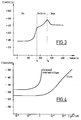
- FIG 3 there is shown the curve of evolution of the dissolution potential of the tin layer as a function of time.
- the time t1 corresponds to the exposure of the layer of intermetallic compound Fe-Sn-Cr and to the end of the dissolution of the layer of pure tin.
- the time t2 corresponds to the end of the dissolution of the layer of Fe-Sn-Cr intermetallic compound and the exposure of stainless steel.
- the time t2-t1 is proportional to the thickness of the layer of intermetallic compound.
- the layer of intermetallic compound has a thickness of approximately 0.7 micrometer.
- the elements constituting the intermetallic compound are identified for example by means of an electronic microprobe.
- the intermetallic compound may contain other elements in addition to iron, tin and chromium.
- the intermetallic compound layer is exposed after a few years of use when the sheet is exposed to the open air and is exposed to the weather.
- the intermetallic compound which remains on the surface of the stainless steel sheet has a dark gray color pronounced of that of "old tin".
- the layer of intermetallic compound has a corrosion resistance far superior to that of tin.
- FIG. 4 represents the plotting of the polarization curves of the layer of intermetallic compound and of the layer of tin placed in a solution of sodium sulfate at 0.01 mole. / 1, airy, at room temperature. It is noted that the dissolution current of the intermetallic compound changes little as a function of the potential, which is characteristic of a high resistance to corrosion. On the contrary, tin, the dissolution current of which increases as a function of the imposed potential, appears to be less resistant to corrosion than the intermetallic compound.
- the sheets comprising a layer of intermetallic compound have good brazability.
- a brazing test of a coated sheet of the type just described was carried out under the following conditions.
- soldering was carried out with an iron and a Pb / Sn rod (33% Sn).
- the solder was tested by a bending test at 180 ° C around a mandrel with a 10 mm radius of curvature. No tearing of the solder was observed.
- the layer of pure tin can be replaced by a layer of alloy mainly containing tin.
- a tin (Sn) and zinc (Zn) alloy can be used, the composition of which by weight is as follows: Sn> 60% Zn ⁇ 40%.
- a tin (Sn) and nickel (Ni) alloy can also be used, the weight composition of which is as follows: Sn> 80% Ni ⁇ 20%.
- the alloy is deposited electrolytically on the stainless steel sheet.
- the sheet coated with alloy is then heated to a temperature greater than or equal to the melting temperature of the alloy, for a sufficient time so that the alloy retains its mat appearance.
- the treatment temperature of the coated sheet, after depositing a layer of pure tin or alloyed tin, is preferably less than 500 ° C. in order to avoid the formation of a yellowish-colored tin oxide, undesirable, on the surface of the coating.
- the intermetallic compound which forms at the interface of the stainless steel sheet and the layer of pure tin or alloyed tin may contain other compounds as iron, tin and chromium depending on the type of steel used and the type of alloy used.
- the sheet metal coating can be arranged on one side of the sheet or on both sides of the sheet.
- the invention has many advantages.
- the layer containing mainly tin deposited electrolytically on a stainless steel sheet has an aesthetic matt appearance which is appreciable when the sheet is placed on the roof of a building.
- the intermetallic compound containing iron, tin and chromium which appears on the surface of the sheet when the tin-based layer has disappeared has a matt appearance reminiscent of that of "old tin” which is appreciated for covering buildings.
- the intermetallic compound layer strongly adheres to the sheet and has very good corrosion resistance.
- the intermetallic compound layer is stable under the influence of an acidic atmosphere or a marine climate.
- the sheet comprising a layer of intermetallic compound containing Fe, Sn and Cr has very good brazability.
Landscapes
- Chemical & Material Sciences (AREA)
- Organic Chemistry (AREA)
- Chemical Kinetics & Catalysis (AREA)
- Electrochemistry (AREA)
- Materials Engineering (AREA)
- Metallurgy (AREA)
- Engineering & Computer Science (AREA)
- Electroplating Methods And Accessories (AREA)
- Laminated Bodies (AREA)
- Application Of Or Painting With Fluid Materials (AREA)
- Other Surface Treatments For Metallic Materials (AREA)
- Paper (AREA)
- Electroplating And Plating Baths Therefor (AREA)
- Physical Vapour Deposition (AREA)
- Solid-Phase Diffusion Into Metallic Material Surfaces (AREA)
Applications Claiming Priority (2)
| Application Number | Priority Date | Filing Date | Title |
|---|---|---|---|
| FR9207120 | 1992-06-12 | ||
| FR9207120A FR2692284B1 (fr) | 1992-06-12 | 1992-06-12 | Tole revetue et procede de fabrication de cette tole. |
Publications (2)
| Publication Number | Publication Date |
|---|---|
| EP0574294A1 true EP0574294A1 (de) | 1993-12-15 |
| EP0574294B1 EP0574294B1 (de) | 1998-04-22 |
Family
ID=9430677
Family Applications (1)
| Application Number | Title | Priority Date | Filing Date |
|---|---|---|---|
| EP93401445A Revoked EP0574294B1 (de) | 1992-06-12 | 1993-06-07 | Verfahren zur Herstellung eines beschichteten Bleches |
Country Status (8)
| Country | Link |
|---|---|
| US (1) | US5433839A (de) |
| EP (1) | EP0574294B1 (de) |
| AT (1) | ATE165401T1 (de) |
| CA (1) | CA2098273C (de) |
| DE (1) | DE69318067T2 (de) |
| ES (1) | ES2115738T3 (de) |
| FR (1) | FR2692284B1 (de) |
| SG (1) | SG48396A1 (de) |
Families Citing this family (16)
| Publication number | Priority date | Publication date | Assignee | Title |
|---|---|---|---|---|
| US6861159B2 (en) | 1992-03-27 | 2005-03-01 | The Louis Berkman Company | Corrosion-resistant coated copper and method for making the same |
| US5597656A (en) * | 1993-04-05 | 1997-01-28 | The Louis Berkman Company | Coated metal strip |
| US5491036A (en) * | 1992-03-27 | 1996-02-13 | The Louis Berkman Company | Coated strip |
| US6652990B2 (en) | 1992-03-27 | 2003-11-25 | The Louis Berkman Company | Corrosion-resistant coated metal and method for making the same |
| US6080497A (en) * | 1992-03-27 | 2000-06-27 | The Louis Berkman Company | Corrosion-resistant coated copper metal and method for making the same |
| US6794060B2 (en) | 1992-03-27 | 2004-09-21 | The Louis Berkman Company | Corrosion-resistant coated metal and method for making the same |
| ES2310112B1 (es) * | 2007-02-27 | 2009-11-11 | Recubrimientos Plasticos, S.A. | Proceso de fabricacion de un panel metalico y panel metalico. |
| DE102008057151A1 (de) * | 2008-11-13 | 2010-05-27 | Henkel Ag & Co. Kgaa | Verfahren zum Herstellen eines elektrolytisch verzinkten hochfesten Stahlbleches |
| EP2738279A4 (de) * | 2011-07-29 | 2015-10-21 | Jfe Steel Corp | Rostfreier stahl für brennstoffzellenseparator |
| EP2722419B1 (de) * | 2012-10-19 | 2018-08-15 | Rohm and Haas Electronic Materials LLC | Dünnes Weißblech |
| ITMI20122261A1 (it) * | 2012-12-28 | 2014-06-29 | Indesit Co Spa | Processo di trattamento superficiale di acciaio inox |
| EP3231893B1 (de) * | 2014-12-12 | 2021-03-31 | Toyo Kohan Co., Ltd. | Verfahren zur herstellung eines metallplattierten edelstahlmaterials |
| JP6628585B2 (ja) * | 2014-12-12 | 2020-01-08 | 東洋鋼鈑株式会社 | 金属めっき被覆ステンレス材の製造方法 |
| JP6753712B2 (ja) * | 2016-07-12 | 2020-09-09 | 東洋鋼鈑株式会社 | 粒状錫めっき鋼板の製造方法 |
| JP2021530611A (ja) * | 2018-06-15 | 2021-11-11 | トデスカン,アルベルト | ステンレス鋼製の物体をコーティングするための電解処理プロセス |
| CN115466997A (zh) * | 2022-09-09 | 2022-12-13 | 福建逢兴机电设备有限公司 | 一种改进型金属件表面电镀加工处理方法 |
Citations (4)
| Publication number | Priority date | Publication date | Assignee | Title |
|---|---|---|---|---|
| US1776603A (en) * | 1926-05-25 | 1930-09-23 | Allegheny Steel Co | Tin-coated chromium iron alloy and method of making the same |
| US2973307A (en) * | 1956-11-16 | 1961-02-28 | Lyon Inc | Method of treating stainless steel |
| EP0080971A1 (de) * | 1981-12-01 | 1983-06-08 | MANNESMANN Aktiengesellschaft | Verfahren zum elektrolytischen Verzinnen von Gegenständen |
| US4764260A (en) * | 1987-04-15 | 1988-08-16 | Gay Ronald N | Process for electroplating nickel over stainless steel |
Family Cites Families (3)
| Publication number | Priority date | Publication date | Assignee | Title |
|---|---|---|---|---|
| JPS59145795A (ja) * | 1983-02-09 | 1984-08-21 | Furukawa Electric Co Ltd:The | 被メツキステンレス鋼の前処理方法 |
| JPS621896A (ja) * | 1985-06-26 | 1987-01-07 | Masami Kobayashi | ステンレス鋼に錫・鉛合金メツキを施す方法 |
| JPH0297695A (ja) * | 1988-10-04 | 1990-04-10 | Kawasaki Steel Corp | 耐食性に優れたDI缶用Snめっきステンレス鋼板及びその製造方法 |
-
1992
- 1992-06-12 FR FR9207120A patent/FR2692284B1/fr not_active Expired - Fee Related
-
1993
- 1993-06-07 SG SG1996009344A patent/SG48396A1/en unknown
- 1993-06-07 AT AT93401445T patent/ATE165401T1/de not_active IP Right Cessation
- 1993-06-07 DE DE69318067T patent/DE69318067T2/de not_active Revoked
- 1993-06-07 EP EP93401445A patent/EP0574294B1/de not_active Revoked
- 1993-06-07 ES ES93401445T patent/ES2115738T3/es not_active Expired - Lifetime
- 1993-06-11 US US08/074,614 patent/US5433839A/en not_active Expired - Lifetime
- 1993-06-11 CA CA002098273A patent/CA2098273C/fr not_active Expired - Fee Related
Patent Citations (4)
| Publication number | Priority date | Publication date | Assignee | Title |
|---|---|---|---|---|
| US1776603A (en) * | 1926-05-25 | 1930-09-23 | Allegheny Steel Co | Tin-coated chromium iron alloy and method of making the same |
| US2973307A (en) * | 1956-11-16 | 1961-02-28 | Lyon Inc | Method of treating stainless steel |
| EP0080971A1 (de) * | 1981-12-01 | 1983-06-08 | MANNESMANN Aktiengesellschaft | Verfahren zum elektrolytischen Verzinnen von Gegenständen |
| US4764260A (en) * | 1987-04-15 | 1988-08-16 | Gay Ronald N | Process for electroplating nickel over stainless steel |
Non-Patent Citations (4)
| Title |
|---|
| CHEMICAL ABSTRACTS, vol. 102, no. 2, Janvier 1985, Columbus, Ohio, US; abstract no. 14113a, 'pretraitment for plating stainless steels' page 488; & JP-A-59 145 795 (FURUKAWA ELECTRIC CO LTD) 21 Août 1984 * |
| PATENT ABSTRACTS OF JAPAN vol. 11, no. 176 (C-426)(2623) 5 Juin 1987 & JP-A-62 001 896 ( MASAMI KOBAYASHI ) 7 Janvier 1987 * |
| PATENT ABSTRACTS OF JAPAN vol. 14, no. 299 (C-733)(4242) 27 Juin 1990 & JP-A-02 097 695 ( KAWASAKI STEEL CORPORATION ) 10 Avril 1990 * |
| WEGST 'stahlschlüssel' 1989, VERLAG STAHLSCHLüSSEL WEGST GMBH, D-7142 MARBACH *page 374 - page 375* * |
Also Published As
| Publication number | Publication date |
|---|---|
| DE69318067D1 (de) | 1998-05-28 |
| SG48396A1 (en) | 1998-04-17 |
| ES2115738T3 (es) | 1998-07-01 |
| CA2098273C (fr) | 2000-04-25 |
| EP0574294B1 (de) | 1998-04-22 |
| CA2098273A1 (fr) | 1993-12-13 |
| FR2692284B1 (fr) | 1995-06-30 |
| DE69318067T2 (de) | 1998-10-01 |
| US5433839A (en) | 1995-07-18 |
| FR2692284A1 (fr) | 1993-12-17 |
| ATE165401T1 (de) | 1998-05-15 |
Similar Documents
| Publication | Publication Date | Title |
|---|---|---|
| EP0574294B1 (de) | Verfahren zur Herstellung eines beschichteten Bleches | |
| JP2779781B2 (ja) | 建築材料のコーティング | |
| CA2802490C (en) | Steel sheet for container and method of manufacturing the same | |
| FR2713665A1 (fr) | Acier inoxydable coloré résistant à la corrosion et procédé pour sa fabrication. | |
| CA2092747C (en) | Hot-dip coated roofing material | |
| EP1466029B1 (de) | Vorbereitung von stahloberflächen zum galvanisieren in aluminiumreichem zinkbad | |
| EP0025396B1 (de) | Verfahren zur Herstellung eines Materials für die Herstellung metallischer Verpackungen, insbesondere Konservendosen, aus einem beschichteten Stahlblech | |
| JP3080014B2 (ja) | 溶融めっき方法 | |
| FR2564488A1 (fr) | Tole d'acier a traitement de surface multicouche a base de chrome douee d'une excellente soudabilite et son procede de production | |
| FR2689142A1 (fr) | Procédé de traitement contre la corrosion, matériau obtenu par ledit procédé et dispositif pour la mise en Óoeuvre du procédé. | |
| US4285782A (en) | Method for providing uranium with a protective copper coating | |
| JP4882432B2 (ja) | 溶融亜鉛めっき鋼板およびその製造装置、ならびに表面処理制御方法、表面処理制御装置 | |
| JP3494134B2 (ja) | 溶融めっき方法 | |
| CA2224055C (en) | Corrosion resistant stainless steel and method of making same | |
| JPH045753B2 (de) | ||
| JP2003082447A (ja) | 溶融亜鉛アルミニウムめっき方法 | |
| JP3191660B2 (ja) | 亜鉛系メッキ鋼板およびその製造方法 | |
| EP0430726A1 (de) | Verfahren zum Behandeln von Oberflächen aus Blei oder Bleilegierungen und mit diesem Verfahren hergestellter Gegenstand | |
| KR20040054271A (ko) | 마찰특성이 우수한 합금화 용융 아연 도금강판 제조방법 | |
| JPH04221053A (ja) | 溶融亜鉛めっきステンレス鋼材の製造方法 | |
| JP5115154B2 (ja) | 高強度合金化溶融亜鉛めっき鋼板の製造方法 | |
| JPH0713308B2 (ja) | プレス成形性、化成処理性、溶接性に優れた亜鉛系めっき鋼板 | |
| BE1004484A6 (fr) | Procede de traitement d'une bande d'acier a galvaniser en continu. | |
| WO1999064168A1 (en) | Manufacturing process for noncontinuous galvanization with zinc-aluminum alloys over metallic manufactured products | |
| JPH0821432A (ja) | 表面に放電溶着した溶融金属耐食性皮膜を有する溶融金属浴浸漬用ロールおよび関連部材 |
Legal Events
| Date | Code | Title | Description |
|---|---|---|---|
| PUAI | Public reference made under article 153(3) epc to a published international application that has entered the european phase |
Free format text: ORIGINAL CODE: 0009012 |
|
| AK | Designated contracting states |
Kind code of ref document: A1 Designated state(s): AT BE CH DE DK ES FR GB IT LI NL SE |
|
| 17P | Request for examination filed |
Effective date: 19940607 |
|
| 17Q | First examination report despatched |
Effective date: 19950913 |
|
| GRAG | Despatch of communication of intention to grant |
Free format text: ORIGINAL CODE: EPIDOS AGRA |
|
| GRAG | Despatch of communication of intention to grant |
Free format text: ORIGINAL CODE: EPIDOS AGRA |
|
| GRAH | Despatch of communication of intention to grant a patent |
Free format text: ORIGINAL CODE: EPIDOS IGRA |
|
| GRAH | Despatch of communication of intention to grant a patent |
Free format text: ORIGINAL CODE: EPIDOS IGRA |
|
| GRAA | (expected) grant |
Free format text: ORIGINAL CODE: 0009210 |
|
| RAP1 | Party data changed (applicant data changed or rights of an application transferred) |
Owner name: USINOR |
|
| AK | Designated contracting states |
Kind code of ref document: B1 Designated state(s): AT BE CH DE DK ES FR GB IT LI NL SE |
|
| REF | Corresponds to: |
Ref document number: 165401 Country of ref document: AT Date of ref document: 19980515 Kind code of ref document: T |
|
| ITF | It: translation for a ep patent filed | ||
| REG | Reference to a national code |
Ref country code: CH Ref legal event code: EP |
|
| GBT | Gb: translation of ep patent filed (gb section 77(6)(a)/1977) |
Effective date: 19980424 |
|
| REF | Corresponds to: |
Ref document number: 69318067 Country of ref document: DE Date of ref document: 19980528 |
|
| REG | Reference to a national code |
Ref country code: ES Ref legal event code: FG2A Ref document number: 2115738 Country of ref document: ES Kind code of ref document: T3 |
|
| PLBQ | Unpublished change to opponent data |
Free format text: ORIGINAL CODE: EPIDOS OPPO |
|
| PLBI | Opposition filed |
Free format text: ORIGINAL CODE: 0009260 |
|
| 26 | Opposition filed |
Opponent name: THE LOUIS BERKMAN COMPANY Effective date: 19990122 |
|
| NLR1 | Nl: opposition has been filed with the epo |
Opponent name: THE LOUIS BERKMAN COMPANY |
|
| APAC | Appeal dossier modified |
Free format text: ORIGINAL CODE: EPIDOS NOAPO |
|
| APAE | Appeal reference modified |
Free format text: ORIGINAL CODE: EPIDOS REFNO |
|
| APAC | Appeal dossier modified |
Free format text: ORIGINAL CODE: EPIDOS NOAPO |
|
| APCC | Communication from the board of appeal sent |
Free format text: ORIGINAL CODE: EPIDOS OBAPO |
|
| APCC | Communication from the board of appeal sent |
Free format text: ORIGINAL CODE: EPIDOS OBAPO |
|
| APAC | Appeal dossier modified |
Free format text: ORIGINAL CODE: EPIDOS NOAPO |
|
| PLBF | Reply of patent proprietor to notice(s) of opposition |
Free format text: ORIGINAL CODE: EPIDOS OBSO |
|
| PLBF | Reply of patent proprietor to notice(s) of opposition |
Free format text: ORIGINAL CODE: EPIDOS OBSO |
|
| PLBF | Reply of patent proprietor to notice(s) of opposition |
Free format text: ORIGINAL CODE: EPIDOS OBSO |
|
| REG | Reference to a national code |
Ref country code: GB Ref legal event code: IF02 |
|
| PGFP | Annual fee paid to national office [announced via postgrant information from national office to epo] |
Ref country code: CH Payment date: 20030515 Year of fee payment: 11 Ref country code: AT Payment date: 20030515 Year of fee payment: 11 |
|
| PGFP | Annual fee paid to national office [announced via postgrant information from national office to epo] |
Ref country code: DK Payment date: 20030519 Year of fee payment: 11 |
|
| PGFP | Annual fee paid to national office [announced via postgrant information from national office to epo] |
Ref country code: NL Payment date: 20030520 Year of fee payment: 11 Ref country code: SE Payment date: 20030520 Year of fee payment: 11 |
|
| PGFP | Annual fee paid to national office [announced via postgrant information from national office to epo] |
Ref country code: GB Payment date: 20030530 Year of fee payment: 11 |
|
| PGFP | Annual fee paid to national office [announced via postgrant information from national office to epo] |
Ref country code: DE Payment date: 20030611 Year of fee payment: 11 |
|
| PGFP | Annual fee paid to national office [announced via postgrant information from national office to epo] |
Ref country code: ES Payment date: 20030612 Year of fee payment: 11 |
|
| PGFP | Annual fee paid to national office [announced via postgrant information from national office to epo] |
Ref country code: FR Payment date: 20030616 Year of fee payment: 11 |
|
| PGFP | Annual fee paid to national office [announced via postgrant information from national office to epo] |
Ref country code: BE Payment date: 20030709 Year of fee payment: 11 |
|
| RDAF | Communication despatched that patent is revoked |
Free format text: ORIGINAL CODE: EPIDOSNREV1 |
|
| RDAG | Patent revoked |
Free format text: ORIGINAL CODE: 0009271 |
|
| STAA | Information on the status of an ep patent application or granted ep patent |
Free format text: STATUS: PATENT REVOKED |
|
| 27W | Patent revoked |
Effective date: 20031128 |
|
| GBPR | Gb: patent revoked under art. 102 of the ep convention designating the uk as contracting state |
Free format text: 20031128 |
|
| REG | Reference to a national code |
Ref country code: CH Ref legal event code: PL |
|
| REG | Reference to a national code |
Ref country code: SE Ref legal event code: ECNC |
|
| NLR2 | Nl: decision of opposition |
Effective date: 20031128 |
|
| APAH | Appeal reference modified |
Free format text: ORIGINAL CODE: EPIDOSCREFNO |
|
| PLAB | Opposition data, opponent's data or that of the opponent's representative modified |
Free format text: ORIGINAL CODE: 0009299OPPO |