EP0574433B1 - 6,9-Bis(amino substituierte) Benzo(G)Phthalazin-5,10-Dionen als Antikrebs-mittel - Google Patents
6,9-Bis(amino substituierte) Benzo(G)Phthalazin-5,10-Dionen als Antikrebs-mittel Download PDFInfo
- Publication number
- EP0574433B1 EP0574433B1 EP92905252A EP92905252A EP0574433B1 EP 0574433 B1 EP0574433 B1 EP 0574433B1 EP 92905252 A EP92905252 A EP 92905252A EP 92905252 A EP92905252 A EP 92905252A EP 0574433 B1 EP0574433 B1 EP 0574433B1
- Authority
- EP
- European Patent Office
- Prior art keywords
- formula
- compound
- amino
- compounds
- alkyl
- Prior art date
- Legal status (The legal status is an assumption and is not a legal conclusion. Google has not performed a legal analysis and makes no representation as to the accuracy of the status listed.)
- Expired - Lifetime
Links
- 0 *c(ccc(O)c1C(c2cnncc22)=O)c1C2=O Chemical compound *c(ccc(O)c1C(c2cnncc22)=O)c1C2=O 0.000 description 1
Classifications
-
- C—CHEMISTRY; METALLURGY
- C07—ORGANIC CHEMISTRY
- C07D—HETEROCYCLIC COMPOUNDS
- C07D403/00—Heterocyclic compounds containing two or more hetero rings, having nitrogen atoms as the only ring hetero atoms, not provided for by group C07D401/00
- C07D403/02—Heterocyclic compounds containing two or more hetero rings, having nitrogen atoms as the only ring hetero atoms, not provided for by group C07D401/00 containing two hetero rings
- C07D403/12—Heterocyclic compounds containing two or more hetero rings, having nitrogen atoms as the only ring hetero atoms, not provided for by group C07D401/00 containing two hetero rings linked by a chain containing hetero atoms as chain links
-
- A—HUMAN NECESSITIES
- A61—MEDICAL OR VETERINARY SCIENCE; HYGIENE
- A61P—SPECIFIC THERAPEUTIC ACTIVITY OF CHEMICAL COMPOUNDS OR MEDICINAL PREPARATIONS
- A61P35/00—Antineoplastic agents
-
- C—CHEMISTRY; METALLURGY
- C07—ORGANIC CHEMISTRY
- C07D—HETEROCYCLIC COMPOUNDS
- C07D237/00—Heterocyclic compounds containing 1,2-diazine or hydrogenated 1,2-diazine rings
- C07D237/26—Heterocyclic compounds containing 1,2-diazine or hydrogenated 1,2-diazine rings condensed with carbocyclic rings or ring systems
Definitions
- Mitoxantrone is a broad spectrum oncolytic agent, whose activity is similar to that of the anthracycline antibiotic doxorubicin. Clinical trials have demonstrated that mitoxantrone has particularly promising activity in the treatment of advanced breast cancer, acute leukemia and lymphoma (Legha, Drugs of Today , (1984), 20 , 629).
- Ametantrone has been reported to be, in animals, about 10-fold less potent and cardiotoxic than mitoxantrone. Because a delayed toxicity is observed only with mitoxantrone after administration of the two drugs by the i.p. route to non -tumor bearing rats at equieffective antitumor dosages, it is suggested that the presence of the 5,8-dihydroxy substitution in mitoxantrone might be implicated in the delayed deaths (Corbet et al., Cancer Chemother. Pharmacol. , (1981), 6 , 161).
- both mitoxantrone and ametantrone have a remarkable myelodepressive toxicity and both compounds show cross-resistance to cell hystotypes developing resistance against doxorubicin mediated by overexpression of glycoprotein P.
- Such a resistance which is named multidrug resistance, involves a number of antitumor antibiotics, among which amsacrine and podophyllotoxinic derivatives, and it is one of the main reasons for therapeutical failures in the treatment of solid tumors with said antibiotics.
- novel anthracenedione antitumor agents having a higher therapeutical index than mitoxantrone and being effective both in inhibiting or delaying the growth of those solid tumors which are more refractory to chemotherapeutic treatment (such as lung, breast and colon tumors) and against tumor histotypes developing multidrug resistance.
- Aza- and diaza anthracene-9,10-diones such as 6,9-bis(ethoxycarbonylamino)benzo[g]quinoline-5,10-dione ( 1 ), 6,9-bis(ethoxycarbonylamino)benzo[g]isoquinoline5,10-dione ( 2 ), 6,9-bis(ethoxycarbonylamino)benzo[g]quinazoline-5,10-dione ( 3 ), were disclosed by Potts et al. (Synthesis, (1983, 31).
- the compound 5 a and 5 b are less cytotoxic than the analogues 6 a and 6 b.
- the compound 5 a which is poorly cytotoxic in vitro, is inactive in vivo, and it is both less active and less potent than the carbocyclic analogue 6 a.
- mitoxantrone has shown good activity in other significative experimental tumors such as murine Lewis lung carcinoma and MXl human mammary carcinoma.
- the compounds of the invention have the following formula (I) wherein X is -OH or -NHR2; R1 and R2, which can be the same or different, are hydrogen; (C1-C10)-alkyl; phenyl; (C7-C10)-aralkyl; (C2-C10)-alkyl containing at least one of the following substituents: -O-R d ; said (C2-C10)-alkyl chain being optionally interrupted by one or more oxygen atoms, by one or more groups of formula and optionally containing one or more double or triple bonds or hydroxy groups; R a is hydrogen; (C1-C10)-alkyl; phenyl; (C7-C10)-aralkyl; (C2-C10)-alkyl substituted with one or more hydroxy groups and/or groups of formula wherein R d is (C1-C10)-alkyl, (C7-C10)-aralkyl; phenyl; R b and R c , which are the same
- the present invention also relates to the tautomeric forms, the racemic and diastereoisomeric mixtures of the compounds of formula (I) as well as to the single enantiomers and diastereoisomers thereof.
- Examples of pharmaceutically acceptable acids which can salify compounds (I) are inorganic acids, such as hydrochloric, hydrobromic, sulfuric, phosphoric, pyrophosphoric acids or organic acids, such as acetic, propionic, citric, benzoic, lactic, maleic, malic, fumaric, succinic, tartaric, glutamic, aspartic, gluconic, ascorbic acids or other conventionally used acids.
- inorganic acids such as hydrochloric, hydrobromic, sulfuric, phosphoric, pyrophosphoric acids or organic acids, such as acetic, propionic, citric, benzoic, lactic, maleic, malic, fumaric, succinic, tartaric, glutamic, aspartic, gluconic, ascorbic acids or other conventionally used acids.
- phenyl and “5-6 membered heterocyclic ring” mean phenyl rings or heterocyclic rings which can optionally contain substituents such as (C1-C4)-alkyl groups; CF3; halogen atoms; nitro, amino, acetylamino, formylamino, dimethylamino, diethylamino, hydroxy, methoxy and ethoxy groups.
- Preferred examples of 5-6 membered aromatic or non aromatic heterocyclic rings containing at least an oxygen or nitrogen atom are, for example, 1-imidazolyl, 1-pyrrolyl, 1-tetrahydropyrrolyl, 1-pyrazolyl, 1-aziridinyl, 4-morpholinyl, 1-piperidinyl, 1-piperazinyl, 1-(4-methyl)piperazinyl, 1-(4-benzyl)piperazinyl, 4-(3-methoxy)morpholinyl, 4-(3-cyano)morpholinyl.
- (C7-C10)-aralkyl groups are benzyl and 4-methoxybenzyl.
- one of R1 and R2 is a straight or branched (C2-C10)-alkyl group, optionally interrupted by one or more hetero-atoms, at least 2 carbon atoms are preferably present between said hetero-atoms.
- Preferred examples of straight or branched (C1-C10)-alkyl groups are methyl, ethyl, n-propyl, sec-propyl, n-butyl, sec-butyl, tert-butyl, n-hexyl, n-pentyl.
- R1 is a substituted (C2-C10)-alkyl group, selected from the group consisting of :
- preferred compounds of the invention are the following ones: 6,9-bis[N-(2-dimethylaminoethyl)amino]benzo[g]phthalazine-5,10-dione; 6,9-bis[N-(2-aminoethyl)amino]benzo[g]phthalazine-5,10-dione; 6,9-bis[N-(3-aminopropyl)amino]benzo[g]phthalazine-5,10-dione; 6,9-bis[N-(4-aminobutyl)amino]benzo[g]phthalazine-5,10-dione; 6,9-bis[N-(2-diethylaminoethyl)amino]benzo[g]phthalazine-5,10-dione; 6,9-bis[N-(2-(2-hydroxyethylamino)ethyl)amino]benzo[g]phthalazine-5,10-dione; 6-
- compounds (I) wherein X is the -NHR2 group can be prepared by reacting a leuco compound of formula (VII) with a compound of formula (III), followed by spontaneous oxidation during the working-up of the reaction mixture, to give a compound of formula (Ia) which then can be subjected to one or more of the above described steps, to give a compound of formula (I) wherein X is the -NHR2 group.
- reaction of compounds (II) with amines (III) can be carried out in the presence of a stoichiometric amount or an excess of compounds (III) in the presence of a solvent such as the compound (III) itself, pyridine, picoline, quinoline, N,N,N',N'-tetramethylethylenediamine and the like, chloroform, methylene chloride, 1,1,1-trichloroethane and the like, optionally in the presence of an inorganic base such as an alkali or alkaline-earth carbonate or hydrogen carbonate or an organic base such as a trialkylamine, e.g.
- the reaction is carried out by reacting compounds (II) in the presence of a molar excess of amine (III) in pyridine at room temperature.
- Reaction of leuco compounds (VII), which can be obtained in situ from compounds (IX) by reduction with a reducing agent such as sodium dithionite in the presence of an inorganic base such as an alkali or alkaline-earth metal hydroxide or carbonate, with amines (III), can be carried out by reacting a stoichiometric amount or an excess of amine (III) in a solvent such as a C1-C4 alcohol, water or mixtures thereof. The reaction can be performed at a temperature from 0°C to the reflux temperature of the solvent.
- Reaction of intermediate (V) with of an alkali or alkaline-earth metal hydroxide or carbonate, to give a compound of formula (Ic), is generally carried out using a stoichiometric amount or an excess of hydroxide or carbonate, in a solvent such as water, a C1-C4 alcohol or mixtures thereof, at a temperature from 0°C to the solvent's reflux temperature.
- the reaction is preferably performed in ethanol, using sodium hydroxide, at reflux temperature.
- the removal of primary- or secondary-amine protecting groups or hydroxy-protecting groups optionally present in compounds of formulae (Ia), (Ib) or (Ic) can be carried out according to well-known methods, such as by hydrolysis of the esters and amides of compounds of formulae (Ia), (Ib) or (Ic) with organic or inorganic acids or bases, or by selective cleavage of the protecting groups, using suitable reducing and oxidizing agents; the preferred reagent of course depending on the nature of the protecting group.
- the multi-step process by which compounds of formula (II) are prepared includes reacting 5,8-dihydroxynaphtho[2,3-c]furane-4,9-dione (VIII) with 80% hydrazine at room temperature, to give 6,9-dihydroxybenzo[g]phthalazine-5,10-dione (IX), which in its turn is reacted with an alkyl, aralkyl or arylsulfonyl chloride of formula (X), to yield compounds of formula (II).
- Reaction of 6,9-dihydroxybenzo[g]phthalazine-5,10-dione (IX) with an alkyl, aralkyl or arylsulfonyl chloride is generally carried out in the presence of a stoichiometric amount or a slight excess of the sulfonyl chloride in a solvent such as chloroform, methylene chloride, 1,1,1-trichloroethane, pyridine, collidine, lutidine and the like, or mixtures thereof, optionally in the presence of an organic or inorganic base, or according to Schotten-Baumann method, at a temperature from room temperature to the reflux temperature of the solvent.
- the reaction is preferably performed using p-toluenesulfonyl chloride in pyridine at room temperature.
- Compound (VIII) is known and can be prepared as described in J. Chem. Res. (M), (1979), 3510-3518.
- the compounds of the invention when administered to animals bearing experimental tumors such as P388 murine leukemia, P388/DOXO doxorubicin-resistant P388 murine leukemia, Lewis lung carcinoma, MXl human mammary carcinoma, LOVO human colorectal tumor, LOVO/DOXO doxorubicin-resistant human colorectal tumor, induce a statistically significant regression in the experimental tumors compared to the control animals treated with the only vehicle (water or physiological saline solution) when the compounds of the invention are administered in the form of pharmaceutically acceptable acid salts, or acid solutions tolerated for the intravenous administration, such as 1% citric acid, 5% lactic acid, when the compounds are used as the free bases).
- experimental tumors such as P388 murine leukemia, P388/DOXO doxorubicin-resistant P388 murine leukemia, Lewis lung carcinoma, MXl human mammary carcinoma, LOVO human colorectal tumor, LOVO/DOXO doxor
- the activity of the induced regression is directly proportional to the used dosage (dose-related pharmacological effect) and to the dosage scheme (e.g. single administration in the day after tumor transplant or repeated administrations at days 3, 5, 9 or 3, 5, 9, 14 after the tumor transplant).
- dose-related pharmacological effect e.g. single administration in the day after tumor transplant or repeated administrations at days 3, 5, 9 or 3, 5, 9, 14 after the tumor transplant.
- the compounds of the invention when administered at the maximum tolerated doses, induce a higher regression of experimental tumors than that caused by doxorubicin and mitoxantrone, at the maximum tolerated doses, under the same experimental conditions.
- the compounds of the invention are markedly more effective than the control drugs in inhibiting the growth of solid tumors which are doxorubicin- and mitoxantrone-resistant.
- the compounds of the invention can be used as the active ingredients in therapeutical compositions for the regression and/or the treatment of tumors in mammals, when administered in amounts ranging from 1 mg to about 0.4 g per kg body weight per day.
- a preferred dosage regimen for optimum results would be from about 1.0 to about 50 mg per kg body weight per day, using unitary dosages so as to administer from about 70 mg to about 3.5 g of active compound to a subject of about 70 kg body weight, in a 24 hour period.
- This dosage regimen can be adjusted to provide optimum therapeutical response. For example, several divided doses can be administered according to the requirements of the therapeutical situation.
- a remarkable practical advantage is that the active compound can be administered by the oral, intravenous, intramuscular or subcutaneous routes.
- compositions of the present invention containing compounds of formula (I) can be used for the treatment of blood cancer diseases such as leukemia or other solid and non-solid tumors such as lung carcinoma, colon carcinoma, melanocarcinoma and mammary tumors.
- blood cancer diseases such as leukemia or other solid and non-solid tumors such as lung carcinoma, colon carcinoma, melanocarcinoma and mammary tumors.
- by regression or treatment is meant arresting or delaying the growth of the tumor.
- Suitable administration forms for intravenous injection are physiological sterile solutions.
- oily or aqueous injectable preparations are also suitable
- suitable forms for the oral administrations are liquid or solid preparations such as syrups, capsules, tablets, and the like.
- N,N-dimethylethylenediamine (1.0 ml) is added to a solution of 6,9-bis(4-toluenesulfonyloxy)benzo[g]phthalazine-5,10-dione (0.16 g) in anhydrous pyridine (10 ml) and the resulting mixture is left under stirring at room temperature under a nitrogen atmosphere for 24 hrs. After distilling off the solvent under reduced pressure, the obtained residue is redissolved in CHCl3 (50 ml) and washed with a 3% NaHCO3 solution (2 x 15 ml). The aqueous phases are discarded.
- N,N-dimethylethylenediamine (0.11 ml) is added to a stirred suspension of 6,9-bis(4-toluenesulfony1oxy)benzo[g]phthalazine-5,10-dione (300 mg) in anhydrous pyridine (5 ml), cooled to 0°C. After 6 hrs at 0°C, the reaction mixture is allowed to warm to room temperature and after 17 hrs the solvent is distilled off under reduced pressure and the residue is purified by column chromatography (SiO2; eluent: chloroform/methanol 100:5).
- N-(Tert-butoxycarbonyl)ethylenediamine (Synthetic Comm., 20 , 2559, (1990)) (340 mg) is added to a suspension of 9-[N-(2-dimethylaminoethyl)amino]-6-(4-toluenesulfonyloxy)benzo[g]phthalazine-5,10-dione (195 mg) in anhydrous pyridine (5 ml) and the resulting mixture is heated to 50°C for 8 hrs, under a nitrogen atmosphere, with stirring.
- H2O ⁇ max (nm); E 1/0 (cm): 245(457); 279(300); 342(95); 669(334).
Landscapes
- Chemical & Material Sciences (AREA)
- Organic Chemistry (AREA)
- Health & Medical Sciences (AREA)
- Chemical Kinetics & Catalysis (AREA)
- General Chemical & Material Sciences (AREA)
- Medicinal Chemistry (AREA)
- Nuclear Medicine, Radiotherapy & Molecular Imaging (AREA)
- Pharmacology & Pharmacy (AREA)
- Life Sciences & Earth Sciences (AREA)
- Animal Behavior & Ethology (AREA)
- General Health & Medical Sciences (AREA)
- Public Health (AREA)
- Veterinary Medicine (AREA)
- Pharmaceuticals Containing Other Organic And Inorganic Compounds (AREA)
- Peptides Or Proteins (AREA)
- Medicines That Contain Protein Lipid Enzymes And Other Medicines (AREA)
Claims (10)
- Verbindungen der Formel (I)

X -OH oder -NHR₂ ist;
R₁ und R₂, die gleich oder verschieden sein können, Wasserstoff sind; (C₁-C₁₀)-Alkyl; Phenyl; (C₇-C₁₀)-Aralkyl;
(C₂-C₁₀)-Alkyl enthaltend wenigstens einen der folgenden Substituenten:
-O-Ra;

Ra ist Wasserstoff; (C₁-C₁₀)-Alkyl; Phenyl; (C₇-C₁₀)-Aralkyl; (C₂-C₁₀)-Alkyl, das substituiert ist mit einer oder mehreren Hydroxy-Gruppen und/oder Gruppen der Formel
Rb und Rc, die gleich oder verschieden sind, sind Wasserstoff; (C₁-C₁₀)-Alkyl; (C₇-C₁₀)-Aralkyl; Phenyl; (C₂-C₁₀)-Alkyl, das substituiert ist mit einer oder mehreren Hydroxy-Gruppen;
eines von Rb und Rc ist eine

oder Rb und Rc bilden zusammen mit dem Stickstoff-Atom, woran sie geknüpft sind, einen Aziridin-Ring oder einen 5- bis 6gliedrigen heterocyclischen aromatischen oder nichtaromatischen Ring, gegebenenfalls enthaltend ein oder mehrere Heteroatome wie etwa Stickstoff und Sauerstoff;
n und m sind unabhängig voneinander null oder die ganzen Zahlen 1 und 2, mit der Maßgabe, daß m und n nicht gleichzeitig null sein können;
wobei Phenyl und die 5-6gliedrigen heterocyclischen Ringe gegebenenfalls Substituenten enthalten können wie etwa (C₁-C₄)-Alkyl-Gruppen; CF₃; Halogenatome; Nitro-, Amino-, Acetylamino-, Formylamino-, Dimethylamino-, Diethylamino-, Hydroxy-, Methoxy- und Ethoxy-Gruppen;
in Form der freien Basen oder deren pharmazeutisch annehmbarer Salze. - Verbindungen nach Anspruch 1, worin R₁ eine substituierte (C₂-C₁₀)-Alkyl-Gruppe ist, ausgewählt aus der Gruppe bestehend aus:- Resten der Formel -(CH₂)p-OH, worin p eine ganze Zahl von 2 bis 4 ist;- Resten der Formel -(CH₂)p-NH₂, worin p wie vorstehend definiert ist;- Resten der Formel -(CH₂)p-NH-(CH₂)q-OH, worin p und q unabhängig voneinander eine ganze Zahl von 2 bis 4 sind;- Resten der Formel
 - Resten der Formel -(CH₂)pNRbRc, worin p wie vorstehend definiert ist und Rb und Rc (C₁-C₆)-Alkyl-Gruppen sind oder, zusammengenommen mit dem Stickstoff-Atom, einen Aziridino-, Pyrrolidino-, Morpholino-, Piperazino-, N-Methylpiperazino-, N-Benzylpiperazino-, Piperidino-Ring bilden;- Resten der Formel
- Verbindungen nach den Ansprüchen 1 und 2, worin X NHR₂ ist.
- Verbindungen nach den Ansprüchen 1 und 2, worin X Hydroxy ist.
- Verfahren zur Herstellung von Verbindungen (I), worin X NHR₅ ist, umfassend die Umsetzung einer Verbindung der Formel (II)

H₂N-Rx (III)
worin Rx eines von R₁ und R₂ ist oder eine Gruppe, die sich in R₁ und R₂ überführen läßt durch Abspalten der Amino- oder Hydroxy-schützenden Gruppen, die gegebenenfalls vorhanden sein können, um eine Verbindung der Formel (Ia) a) ist Rx verschieden von R₁ und R₂, so wird Rx in R₁ und R₂ umgewandelt, um eine Verbindung der Formel (I) zu ergeben;b) ist Rx eine der für R₁ und R₂ vorstehend definierten Gruppen, kann Rx in eine andere R₁- und R₂-Gruppe überführt werden, um eine andere Verbindung der Formel (I) zu ergeben;c) Salzbildung und/oder Solvatation der erhaltenen Verbindung der Formel (I) oder Trennung der Isomere derselben.
 - Verfahren zur Herstellung von Verbindungen (I), worin X NHR₂ ist und R₂ verschieden von R₁ ist, umfassend die Umsetzung einer Verbindung der Formel (II) mit einem Äquivalent einer Verbindung der Formel (IV)
H₂N-R'₁ (IV)
worin R'₁ die gleichen Bedeutungen hat wie R₁ oder eine Gruppe ist, die sich in R₁ überführen läßt durch Abspaltung der Amino- oder Hydroxy-schützenden Gruppen, die gegebenenfalls vorhanden sind, um ein Zwischenprodukt der Formel (V) zu ergeben,
H₂N-R'₂ (VI)
umgesetzt werden kann, worin R'₂ die gleichen Bedeutungen hat wie R₂ oder eine Gruppe ist, die sich in R₂ überführen läßt durch Abspaltung der Amino- oder Hydroxy-schützenden Gruppen, die gegebenenfalls vorhanden sind, um ein Zwischenprodukt der Formel (Ib) zu ergeben,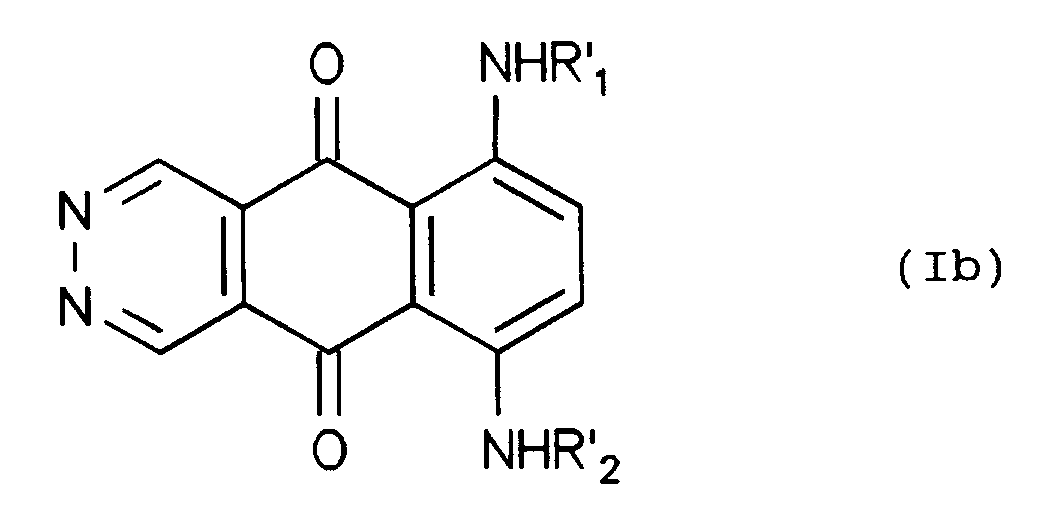 a) ist eines oder sind beide von R'₁ und R'₂ verschieden von R₁ und R₂, so werden R'₁ und R'₂ in R₁ und R₂ umgewandelt;b) sind R'₁ und R'₂ die gleichen wie R₁ und R₂, so können R'₁ und/oder R'₂ in eine andere R₁- und R₂-Gruppe überführt werden, um eine andere Verbindung der Formel (I) zu ergeben;c) Salzbildung und/oder Solvatation der erhaltenen Verbindung der Formel (I) oder Trennung der Isomere derselben.
 - Verfahren zur Herstellung von Verbindungen (I), worin X -NHR₂ ist, umfassend die Umsetzung einer Leuko-Verbindung der Formel (VII)
 a) ist Rx verschieden von R₁ und R₂, so wird Rx in R₁ und R₂ umgewandelt, um eine Verbindung der Formel (I) zu ergeben;b) ist Rx eine der für R₁ und R₂ vorstehend definierten Gruppen, kann Rx in eine andere R₁- und R₂-Gruppe überführt werden, um eine andere Verbindung der Formel (I) zu ergeben;c) Salzbildung und/oder Solvatation der erhaltenen Verbindung der Formel (I) oder Trennung der Isomere derselben.
 - Verfahren zur Herstellung von Verbindungen (I), worin X OH ist, in dem eine Verbindung der Formel (V)
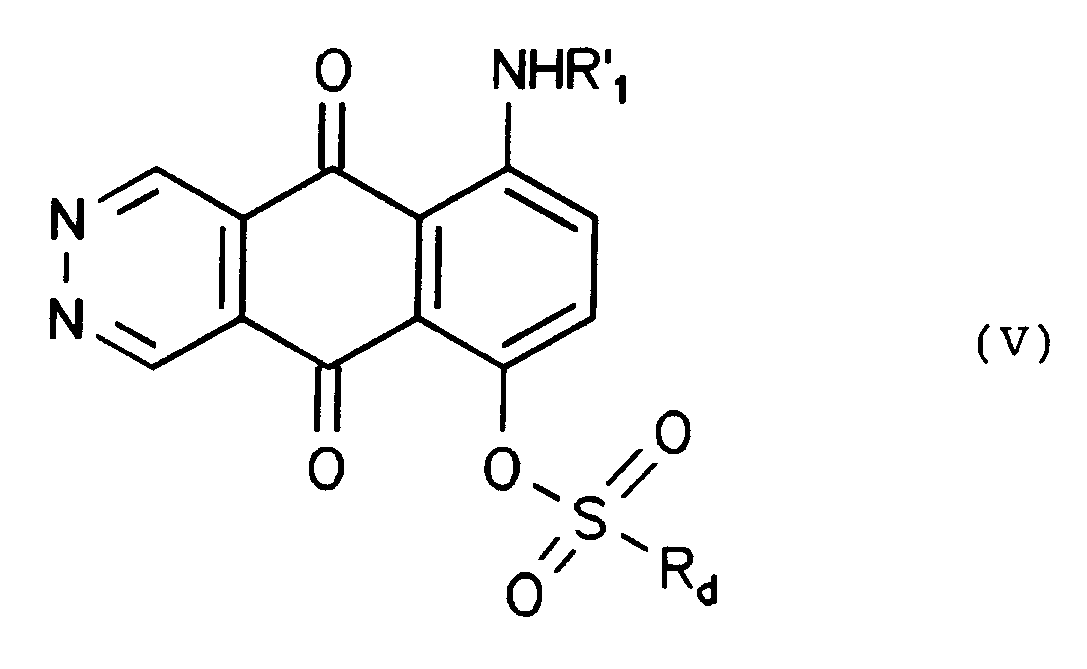
 a) ist R'₁ verschieden von R₁, so wird R'₁ in R₁ umgewandelt, um eine Verbindung (I) zu ergeben, worin X -OH ist;b) ist R'₁ das gleiche wie R₁, so kann R'₁ in eine andere R₁- Gruppe überführt werden, um eine andere Verbindung der Formel (I) zu ergeben, worin X -OH ist;c) Salzbildung und/oder Solvatation der erhaltenen Verbindung der Formel (I) oder Trennung der Isomere derselben.
 - Pharmazeutische Zusammensetzungen, enthaltend als wirksamen Bestandteil eine Verbindung nach den Ansprüchen 1 bis 4 im Gemisch mit geeigneten Trägerstoffen.
- Verwendung der Verbindungen nach den Ansprüchen 1 bis 4 zur Herstellung eines Antitumor-Medikaments.
Applications Claiming Priority (3)
| Application Number | Priority Date | Filing Date | Title |
|---|---|---|---|
| ITMI910600A IT1247879B (it) | 1991-03-08 | 1991-03-08 | 6,9-bis (amino sostituiti) benzo(g) ftalazin-5,10-dioni come farmaci antitumorali. |
| ITMI91060 | 1991-03-08 | ||
| PCT/EP1992/000454 WO1992015307A1 (en) | 1991-03-08 | 1992-03-02 | 6,9-BIS(AMINO SUBSTITUTED)BENZO[g]PHTHALAZINE-5,10-DIONES AS ANTITUMOR AGENTS |
Publications (2)
| Publication Number | Publication Date |
|---|---|
| EP0574433A1 EP0574433A1 (de) | 1993-12-22 |
| EP0574433B1 true EP0574433B1 (de) | 1995-05-31 |
Family
ID=11358923
Family Applications (1)
| Application Number | Title | Priority Date | Filing Date |
|---|---|---|---|
| EP92905252A Expired - Lifetime EP0574433B1 (de) | 1991-03-08 | 1992-03-02 | 6,9-Bis(amino substituierte) Benzo(G)Phthalazin-5,10-Dionen als Antikrebs-mittel |
Country Status (7)
| Country | Link |
|---|---|
| EP (1) | EP0574433B1 (de) |
| JP (1) | JPH06505013A (de) |
| AU (1) | AU1328592A (de) |
| DE (1) | DE69202762T2 (de) |
| ES (1) | ES2073915T3 (de) |
| IT (1) | IT1247879B (de) |
| WO (1) | WO1992015307A1 (de) |
-
1991
- 1991-03-08 IT ITMI910600A patent/IT1247879B/it active IP Right Grant
-
1992
- 1992-03-02 ES ES92905252T patent/ES2073915T3/es not_active Expired - Lifetime
- 1992-03-02 WO PCT/EP1992/000454 patent/WO1992015307A1/en not_active Ceased
- 1992-03-02 AU AU13285/92A patent/AU1328592A/en not_active Abandoned
- 1992-03-02 EP EP92905252A patent/EP0574433B1/de not_active Expired - Lifetime
- 1992-03-02 DE DE69202762T patent/DE69202762T2/de not_active Expired - Fee Related
- 1992-03-02 JP JP4504669A patent/JPH06505013A/ja active Pending
Also Published As
| Publication number | Publication date |
|---|---|
| ES2073915T3 (es) | 1995-08-16 |
| ITMI910600A1 (it) | 1992-09-08 |
| WO1992015307A1 (en) | 1992-09-17 |
| IT1247879B (it) | 1995-01-05 |
| AU1328592A (en) | 1992-10-06 |
| EP0574433A1 (de) | 1993-12-22 |
| DE69202762T2 (de) | 1995-12-07 |
| DE69202762D1 (de) | 1995-07-06 |
| JPH06505013A (ja) | 1994-06-09 |
| ITMI910600A0 (it) | 1991-03-08 |
Similar Documents
| Publication | Publication Date | Title |
|---|---|---|
| FI66379C (fi) | Analogifoerfarande foer framstaellning av terapeutiskt anvaendbara 6-halogen-1,4-dihydro-4-oxo-7-(1-piperazinyl)-1-substituerade 1,8-naftyridin-3-karboxylsyror och salter daerav | |
| WO2023246777A1 (en) | K-ras mutant protein inhibitors | |
| TW202115062A (zh) | Kras突變蛋白抑制劑 | |
| JP3447292B2 (ja) | イミダゾピリジン及び胃腸の疾病の治療のためのその使用 | |
| JP2023525656A (ja) | Egfr阻害剤、その調製方法及びその使用 | |
| EP3584239A1 (de) | O-aminoheteroaryl-alkynyl-haltige verbindung, herstellungsverfahren und verwendung davon | |
| KR20020093086A (ko) | 축합 헤테로아릴 유도체 | |
| HUP0301514A2 (hu) | Benzimidazol származékok, elżállításuk és ezeket tartalmazó gyógyszerkészítmények | |
| WO2022188889A1 (zh) | 作为parp7抑制剂的化合物 | |
| EP0503537A1 (de) | 6,9-Bis(substituiert-amino)benzo[9]isoquinoline-5,10-Dione | |
| CN109575045B (zh) | 噻吩并嘧啶类化合物、其制备方法、药用组合物及其应用 | |
| IL301516A (en) | Acetamido-phenyltetrazol derivatives and methods of using them | |
| AU604726B2 (en) | Antiarrhythmic agent | |
| EP0574433B1 (de) | 6,9-Bis(amino substituierte) Benzo(G)Phthalazin-5,10-Dionen als Antikrebs-mittel | |
| EP0639183B1 (de) | Stickstoffoxide von aza- und diazaanthracendionderivaten, deren herstellung und deren verwendung als antitumormittel | |
| CN102395368A (zh) | 治疗癌症的方法 | |
| EP0785191B1 (de) | Kondensierte indan-derivate und ihre salze | |
| CN114736203A (zh) | 作为bcl-2抑制剂的杂环化合物 | |
| US20240382490A1 (en) | Quinazoline-thiohydantoin fused heterocycles which are suitable for treating, ameliorating or preventing a proliferative disorder | |
| NZ276412A (en) | Aminoalkylamino pyridines and medicaments | |
| CN115850282A (zh) | 靶向降解egfr蛋白的化合物及其制备方法和应用 | |
| MXPA02001493A (es) | Derivados fenantrolin-7-onas y sus aplicaciones terapeuticas.. | |
| CN119241548A (zh) | 含稠合苯环的二氢喋啶酮衍生物及其用途 | |
| CN101450947B (zh) | 7-(3-肟基-4-氨基-4-烷基-1-哌啶基)喹啉羧酸衍生物及其制备方法 | |
| CN118146225A (zh) | 吡唑并三嗪化合物、其制备方法、药物组合物及用途 |
Legal Events
| Date | Code | Title | Description |
|---|---|---|---|
| PUAI | Public reference made under article 153(3) epc to a published international application that has entered the european phase |
Free format text: ORIGINAL CODE: 0009012 |
|
| 17P | Request for examination filed |
Effective date: 19930908 |
|
| AK | Designated contracting states |
Kind code of ref document: A1 Designated state(s): AT BE CH DE DK ES FR GB GR IT LI LU NL SE |
|
| 17Q | First examination report despatched |
Effective date: 19931214 |
|
| GRAA | (expected) grant |
Free format text: ORIGINAL CODE: 0009210 |
|
| AK | Designated contracting states |
Kind code of ref document: B1 Designated state(s): AT BE CH DE DK ES FR GB GR IT LI LU NL SE |
|
| PG25 | Lapsed in a contracting state [announced via postgrant information from national office to epo] |
Ref country code: NL Free format text: LAPSE BECAUSE OF FAILURE TO SUBMIT A TRANSLATION OF THE DESCRIPTION OR TO PAY THE FEE WITHIN THE PRESCRIBED TIME-LIMIT Effective date: 19950531 Ref country code: GR Free format text: LAPSE BECAUSE OF FAILURE TO SUBMIT A TRANSLATION OF THE DESCRIPTION OR TO PAY THE FEE WITHIN THE PRESCRIBED TIME-LIMIT Effective date: 19950531 Ref country code: DK Effective date: 19950531 Ref country code: BE Effective date: 19950531 |
|
| REF | Corresponds to: |
Ref document number: 123220 Country of ref document: AT Date of ref document: 19950615 Kind code of ref document: T |
|
| REF | Corresponds to: |
Ref document number: 69202762 Country of ref document: DE Date of ref document: 19950706 |
|
| ET | Fr: translation filed | ||
| ITF | It: translation for a ep patent filed | ||
| REG | Reference to a national code |
Ref country code: ES Ref legal event code: FG2A Ref document number: 2073915 Country of ref document: ES Kind code of ref document: T3 |
|
| PG25 | Lapsed in a contracting state [announced via postgrant information from national office to epo] |
Ref country code: SE Effective date: 19950831 |
|
| NLV1 | Nl: lapsed or annulled due to failure to fulfill the requirements of art. 29p and 29m of the patents act | ||
| PG25 | Lapsed in a contracting state [announced via postgrant information from national office to epo] |
Ref country code: LU Free format text: LAPSE BECAUSE OF NON-PAYMENT OF DUE FEES Effective date: 19960331 |
|
| PLBE | No opposition filed within time limit |
Free format text: ORIGINAL CODE: 0009261 |
|
| STAA | Information on the status of an ep patent application or granted ep patent |
Free format text: STATUS: NO OPPOSITION FILED WITHIN TIME LIMIT |
|
| 26N | No opposition filed | ||
| PGFP | Annual fee paid to national office [announced via postgrant information from national office to epo] |
Ref country code: GB Payment date: 19980223 Year of fee payment: 7 |
|
| PGFP | Annual fee paid to national office [announced via postgrant information from national office to epo] |
Ref country code: DE Payment date: 19980306 Year of fee payment: 7 |
|
| PGFP | Annual fee paid to national office [announced via postgrant information from national office to epo] |
Ref country code: FR Payment date: 19980310 Year of fee payment: 7 |
|
| PGFP | Annual fee paid to national office [announced via postgrant information from national office to epo] |
Ref country code: CH Payment date: 19980311 Year of fee payment: 7 Ref country code: AT Payment date: 19980311 Year of fee payment: 7 |
|
| PGFP | Annual fee paid to national office [announced via postgrant information from national office to epo] |
Ref country code: ES Payment date: 19980327 Year of fee payment: 7 |
|
| PG25 | Lapsed in a contracting state [announced via postgrant information from national office to epo] |
Ref country code: GB Free format text: LAPSE BECAUSE OF NON-PAYMENT OF DUE FEES Effective date: 19990302 Ref country code: AT Free format text: LAPSE BECAUSE OF NON-PAYMENT OF DUE FEES Effective date: 19990302 |
|
| PG25 | Lapsed in a contracting state [announced via postgrant information from national office to epo] |
Ref country code: ES Free format text: THE PATENT HAS BEEN ANNULLED BY A DECISION OF A NATIONAL AUTHORITY Effective date: 19990303 |
|
| PG25 | Lapsed in a contracting state [announced via postgrant information from national office to epo] |
Ref country code: LI Free format text: LAPSE BECAUSE OF NON-PAYMENT OF DUE FEES Effective date: 19990331 Ref country code: CH Free format text: LAPSE BECAUSE OF NON-PAYMENT OF DUE FEES Effective date: 19990331 |
|
| GBPC | Gb: european patent ceased through non-payment of renewal fee |
Effective date: 19990302 |
|
| REG | Reference to a national code |
Ref country code: CH Ref legal event code: PL |
|
| PG25 | Lapsed in a contracting state [announced via postgrant information from national office to epo] |
Ref country code: FR Free format text: LAPSE BECAUSE OF NON-PAYMENT OF DUE FEES Effective date: 19991130 |
|
| REG | Reference to a national code |
Ref country code: FR Ref legal event code: ST |
|
| PG25 | Lapsed in a contracting state [announced via postgrant information from national office to epo] |
Ref country code: DE Free format text: LAPSE BECAUSE OF NON-PAYMENT OF DUE FEES Effective date: 20000101 |
|
| REG | Reference to a national code |
Ref country code: ES Ref legal event code: FD2A Effective date: 20010604 |
|
| PG25 | Lapsed in a contracting state [announced via postgrant information from national office to epo] |
Ref country code: IT Free format text: LAPSE BECAUSE OF NON-PAYMENT OF DUE FEES;WARNING: LAPSES OF ITALIAN PATENTS WITH EFFECTIVE DATE BEFORE 2007 MAY HAVE OCCURRED AT ANY TIME BEFORE 2007. THE CORRECT EFFECTIVE DATE MAY BE DIFFERENT FROM THE ONE RECORDED. Effective date: 20050302 |