EP0574601B1 - Verbessertes Verfahren und Gerät für optische Zwischenwirkungs- und Durchlassungsvermögenmessungen - Google Patents
Verbessertes Verfahren und Gerät für optische Zwischenwirkungs- und Durchlassungsvermögenmessungen Download PDFInfo
- Publication number
- EP0574601B1 EP0574601B1 EP19920110082 EP92110082A EP0574601B1 EP 0574601 B1 EP0574601 B1 EP 0574601B1 EP 19920110082 EP19920110082 EP 19920110082 EP 92110082 A EP92110082 A EP 92110082A EP 0574601 B1 EP0574601 B1 EP 0574601B1
- Authority
- EP
- European Patent Office
- Prior art keywords
- specimen
- illumination
- different
- signals
- providing
- Prior art date
- Legal status (The legal status is an assumption and is not a legal conclusion. Google has not performed a legal analysis and makes no representation as to the accuracy of the status listed.)
- Expired - Lifetime
Links
- 238000005259 measurement Methods 0.000 title claims description 30
- 230000003287 optical effect Effects 0.000 title claims description 24
- 238000000034 method Methods 0.000 title claims description 17
- 238000002834 transmittance Methods 0.000 title claims description 10
- 238000001514 detection method Methods 0.000 claims description 33
- 238000005286 illumination Methods 0.000 claims description 29
- 239000000523 sample Substances 0.000 claims description 28
- 239000000835 fiber Substances 0.000 claims description 23
- 238000012545 processing Methods 0.000 claims description 3
- 230000004044 response Effects 0.000 claims description 2
- 230000005540 biological transmission Effects 0.000 description 7
- 238000001228 spectrum Methods 0.000 description 7
- 239000011248 coating agent Substances 0.000 description 4
- 238000000576 coating method Methods 0.000 description 4
- 239000010410 layer Substances 0.000 description 4
- 238000010521 absorption reaction Methods 0.000 description 3
- 239000012491 analyte Substances 0.000 description 3
- 230000000694 effects Effects 0.000 description 3
- 239000000463 material Substances 0.000 description 3
- 238000013459 approach Methods 0.000 description 2
- 230000003993 interaction Effects 0.000 description 2
- 239000000203 mixture Substances 0.000 description 2
- 230000005855 radiation Effects 0.000 description 2
- 239000002344 surface layer Substances 0.000 description 2
- 238000012935 Averaging Methods 0.000 description 1
- 240000008042 Zea mays Species 0.000 description 1
- 235000005824 Zea mays ssp. parviglumis Nutrition 0.000 description 1
- 235000002017 Zea mays subsp mays Nutrition 0.000 description 1
- 238000002835 absorbance Methods 0.000 description 1
- 235000005822 corn Nutrition 0.000 description 1
- 238000013461 design Methods 0.000 description 1
- 239000003085 diluting agent Substances 0.000 description 1
- 230000003292 diminished effect Effects 0.000 description 1
- 230000009977 dual effect Effects 0.000 description 1
- 235000013399 edible fruits Nutrition 0.000 description 1
- 230000001747 exhibiting effect Effects 0.000 description 1
- 238000003384 imaging method Methods 0.000 description 1
- 230000031700 light absorption Effects 0.000 description 1
- 239000007788 liquid Substances 0.000 description 1
- 230000007246 mechanism Effects 0.000 description 1
- 210000003205 muscle Anatomy 0.000 description 1
- 238000009659 non-destructive testing Methods 0.000 description 1
- 235000016709 nutrition Nutrition 0.000 description 1
- 230000035764 nutrition Effects 0.000 description 1
- 239000013307 optical fiber Substances 0.000 description 1
- 230000035515 penetration Effects 0.000 description 1
- 239000000843 powder Substances 0.000 description 1
- 230000008569 process Effects 0.000 description 1
- 238000000926 separation method Methods 0.000 description 1
- 125000006850 spacer group Chemical group 0.000 description 1
- 230000003595 spectral effect Effects 0.000 description 1
- 238000000411 transmission spectrum Methods 0.000 description 1
- 235000013311 vegetables Nutrition 0.000 description 1
Images


Classifications
-
- G—PHYSICS
- G01—MEASURING; TESTING
- G01N—INVESTIGATING OR ANALYSING MATERIALS BY DETERMINING THEIR CHEMICAL OR PHYSICAL PROPERTIES
- G01N21/00—Investigating or analysing materials by the use of optical means, i.e. using sub-millimetre waves, infrared, visible or ultraviolet light
- G01N21/17—Systems in which incident light is modified in accordance with the properties of the material investigated
- G01N21/47—Scattering, i.e. diffuse reflection
- G01N21/4738—Diffuse reflection, e.g. also for testing fluids, fibrous materials
- G01N21/474—Details of optical heads therefor, e.g. using optical fibres
-
- G—PHYSICS
- G01—MEASURING; TESTING
- G01N—INVESTIGATING OR ANALYSING MATERIALS BY DETERMINING THEIR CHEMICAL OR PHYSICAL PROPERTIES
- G01N21/00—Investigating or analysing materials by the use of optical means, i.e. using sub-millimetre waves, infrared, visible or ultraviolet light
- G01N21/17—Systems in which incident light is modified in accordance with the properties of the material investigated
Definitions
- the present invention relates to an improved method and apparatus for performing optical interactance and transmittance measurements and, in particular, such method and apparatus where undesired information is discriminated against and desired information is enhanced. Reflectance measurements on small amounts of specimen are also encompassed by the invention.
- a further cause of interference is nonhomogeneous or layered distribution of specimen characteristics, e.g., the layers of skin and fat which cover muscle tissue, the skin which covers the flesh of a fruit or vegetable, or the coating of windows through which measurements are to be made. Often, it is desirable to eliminate the effects of the surface layers to provide information on the underlying portions of the specimen.
- the present invention is directed to solving these problems which cause inaccuracies in spectroscopic determination of qualitative or quantitative characteristics of the specimen.
- Dual pathlength transmission cells with separate detection have been proposed to remove the effects of window coating in transmission measurements through clear liquids. This approach is equivalent to placing a second cell of different thickness in the reference beam of a dual-beam spectrometer. Effects common to the two paths, such as absorption due to the window material, equal deposits on the windows, atmospheric absorption, and the specimen absorption in the equal portion of the pathlength are canceled by taking the simple ratio of the signals derived from the two paths.
- US-A-4 633 087 discloses a non-destructive testing instrument using interactance of near infrared radiation. Light incident in an annular region is detected by a single detector at the centre of this region. A single measurement of the summed light outputs is made.
- Diffuse transmittance and reflectance measurements are usually made on large volumes of specimen to reduce errors by averaging the inhomogeneities.
- the usual procedure is to grind each specimen into a fine powder and mix it with a nonabsorbing diluent or to spread it on a diffusely reflecting background so as to present a large area for reflectance measurement.
- apparatus for improving optical interactance measurements according to claim 8.
- a first aspect of this invention comprises the use of three or more optical apertures shared among the source and illumination functions so as to provide two or more independent signals for further processing and analysis.
- Figure 1A a probe utilizing fiber optics is shown which has two ring apertures surrounding a central round aperture.
- the probe 10 includes a cylindrical outer body 30 in which a concentric inner body 31 is arranged.
- the inner body 31 tapers at the examining end to a central aperture 15.
- the outer body 30 constricts at the examining end to define a conical, inwardly directed wall.
- the tapered end of the inner body 31 defines a second conical wall. Between these two walls is disposed a conical dividing element 33.
- the angles defined by the two walls and the conical dividing element are preferably the same.
- Conical annular spaces or rings (shown in cross-section as 14, 13, 12 and 11) are defined by the two walls and dividing element. In these annular spaces or rings are disposed, in conical fashion, optical fibers 16 and 17 for supplying illumination to the specimen.
- one or more lenses 20 for focusing and transmitting incident light entering the aperture 15.
- each ring is used for illumination by fiber optic elements while the central detection aperture is connected by fiber optics to a detection system, such as a diode-array spectrophotometer.
- the central aperture in one embodiment is 1.2 mm diameter, and the inner ring has a mean diameter of 6 mm with a width of 1 mm. The mean spacing from the inner ring to the central aperture is therefore 3 mm and the minimum spacing is 1.9 mm.
- the outer ring has a mean diameter of 12 mm and a width of 1 mm, providing a mean spacing from source to detection of 6 mm and a minimum spacing of 4.9 mm.
- the tip portion of the probe and the fiber optic elements at the tip portion are angled at approximately 26° with respect to the longitudinal axis of the probe.
- the central detection assembly is movable axially.
- the detection aperture at the distal end of this assembly is normally positioned in the same plane as the source ring apertures, however, it may be moved back and lenses inserted so as to image a detection area on the specimen into the aperture of the detection fibers.
- the lenses 20 in the inner body of the probe are interchangeable and the positions of the lenses and the central detection assembly are adjustable by means of spacers.
- lenses and arrangements for three different specimen sizes for reflectance and one arrangement for interactance are listed in the following Table 1: This reimaging allows control of the size of the detection area and the angular cone within which energy is detected by changing the lenses and their spacing.
- the energy source fibers are arranged in conical form.
- introduction of the energy at an angle directed toward the detector improves the efficiency.
- This feature also provides for diffuse reflectance and transmittance measurements using the same probe as discussed below.
- each source fiber optic bundle preferably, has a small percentage of its input fibers brought out 50 so that the associated source intensity and modulation can be monitored. It will be obvious to one skilled in the art that additional source rings may be provided, each with its distinctive modulation, and that the operation may be reversed to provide a single source by using two or more detection rings coupled to multiple or time- shared detection means.
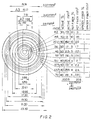
- Figure 2 shows a design comprising 10 large area (8 to 28 mm 2 active area) ring apertures, nominally designated as source rings, and a central aperture plus 2 additional rings of smaller area (2.9 to 3.4 mm 2 ) nominally considered as detection rings.
- the source ring active area is adjusted by the density of active fibers within each ring.
- This structure allows selection of a wide variety of spacings and locations for the measurements using combinations of the three different detection apertures and 10 source apertures. While the examples shown here show ring geometries, other geometries, such as parallel slits or small apertures, which provide substantially constant values of the spacing between all points within a given source aperture and those within a given detection aperture may be used.
- the signals may then be expressed as K 1 *T 1 *I 1 and K 2 *T 1 *I 2 where K 1 and K 2 are system functions involving the relative source intensities, the gain through the system, scattering losses and similar factors.
- the ratio is therefore (K 1 /K 2 ) * (I 1 /I 2 ) and the window coating transmission has been eliminated from the result. Note that any factors common to K 1 and K 2 are also canceled as in the normal use of a reference and the remainder factors may be adjusted so that the K factor becomes unity. Taking the log of the ratio yields "absorbance" A equal to log(I 1 ) - log(I 2 ).
- log(I) will equal (a*t) and the log difference becomes a*(t 1 -t 2 ) where a is the "absorptivity" spectrum which is linearly related to concentration.
- a is the "absorptivity" spectrum which is linearly related to concentration.
- the various signals are derived by absorption of light through different combinations of materials within the specimen. All the signals contain information on the surface layers while the signals derived from the larger spacings contain information on the deeper layers that is diminished or lacking in the signals measured with smaller spacings.
- these signals may be combined in a linear or nonlinear chemometric model so as to extract the desired information. In this case, it is helpful to have the input energy for each source aperture as an additional measured quantity for use in the modeling.
- Each class of specimens requires a different form of model, and subclasses require determination of various model parameters during the calibration process.
- the specimen may be held in a small hole drilled in a flat plate mounted approximately 2 to 4 mm from the end of the fiber-optic probe. It is illuminated via one or both of the outer ring bundles at an angle of incidence of approximately 45 degrees.
- the plate to finished with a mirror surface so that incident energy outside the area of the specimen is reflected at approximately 45 degrees from the normal.
- the diffusely reflected energy is collected by imaging the specimen surface on the central fiber bundle via lenses whose optical axes are coincident with the axis of the probe assembly. The power and spacing of the lenses may be selected so as to select the desired sample area.
- a diffuse or specular reflector may be placed behind the specimen to increase its apparent depth by a factor of at least two.
- the axis of the probe may be positioned vertically with the apertures at the top and a transparent window, such as a microscope slide, positioned with its upper surface at the appropriate distance from the apertures. Specimens may be placed on the window for measurement. Three measurements may be made:
- the "no specimen” energy spectrum it subtracted from the spectrum of the specimen and the spectrum of the reference to correct for residual energy reflected or scattered from the window.
- Still another embodiment utilizes the probe as described above for reflection and an additional fiber bundle is employed behind the specimen to illuminate it. Therefore, the same receiver is utilized for transmittance and reflectance with two different illumination sources being provided. A switching arrangement may be used to alternate between the illumination sources.
- the central detection element may comprise the detector itself rather than the fiberoptic detector bundle.
- an alternate embodiment can be constructed where the direction of light flow can use the light source being provided at the control aperture and one or more of the fiber optic bundles responsive to specimen information.
Landscapes
- Physics & Mathematics (AREA)
- Health & Medical Sciences (AREA)
- Life Sciences & Earth Sciences (AREA)
- Chemical & Material Sciences (AREA)
- Analytical Chemistry (AREA)
- Biochemistry (AREA)
- General Health & Medical Sciences (AREA)
- General Physics & Mathematics (AREA)
- Immunology (AREA)
- Pathology (AREA)
- Investigating Or Analysing Materials By Optical Means (AREA)
Claims (24)
- Verfahren zum Verbessern optischer Wechselwirkungsmessungen, wobei eine Probe an einer Stelle auf ihrer Oberfläche beleuchtet und Energie in einiger Entfernung davon auf der erwähnten Oberfläche der Probe gesammelt wird, welchesdie Bereitstellung einer Beleuchtung (16',17') mittels einer Vielzahl verschiedener Wege durch die Probe, die eine zu messende Eigenschaft aufweist, umfaßt und durch folgende Schritte gekennzeichnet ist:Erfassen einer Vielzahl unabhängiger Signale, die sich gleichzeitig oder in rascher Aufeinanderfolge entwickeln und optische Information darstellen, die von der Probe als Reaktion auf das Licht erhalten wurde, wobei jedes Signal einem bestimmten Weg entspricht und jedes der Vielzahl unabhängiger Signale von Licht stammt, das eine Weglänge zurückgelegt hat, die sich von derjenigen des Lichtes unterscheidet, das eine Weglänge zurückgelegt hat, die jedem anderen der Vielzahl von Signalen zugeordnet ist; undVerarbeitung der Signale mit geeigneten Modellen zur Minimierung von Ungenauigkeiten bei der spektroskopischen Bestimmung qualitativer oder quantitativer Eigenschaften der Probe.
- Verfahren nach Anspruch 1, dadurch gekennzeichnet, daß Licht entlang unterschiedlicher Wege zur Probenoberfläche gesandt wird, wobei das Licht jedes Weges in einen Punkt oder Bereich an dieser Stelle einfällt und in einem anderen allgemeinen Detektionspunkt oder -bereich erfaßt wird, und daß die Entfemung von dem Eintrittspunkt oder -bereich zu dem Detektionspunkt oder -bereich für jeden Fall unterschiedlich ist.
- Verfahren nach Anspruch 1, gekennzeichnet durch den Schritt, bei dem die Beleuchtung (16',17') der Probe gleichzeitig entlang verschiedener Wege bereitgestellt wird.
- Verfahren nach Anspruch 1, gekennzeichnet durch den Schritt, bei dem die Beleuchtung (16', 17') der Probe nacheinander entlang verschiedener Wege bereitgestellt wird.
- Verfahren nach Anspruch 3 oder 4, gekennzeichnet durch den Schritt, bei dem die Beleuchtung (16', 17') der Probe bei unterschiedlichen Frequenzen moduliert und entlang jeweils unterschiedlicher Wege bereitgestellt wird, um ein von einem anderen unabhängig erfaßtes Signal zu unterscheiden.
- Verfahren nach einem der Ansprüche 3 bis 5, gekennzeichnet durch den Schritt, bei dem die Beleuchtung (16', 17') der Probe jeweils mit unterschiedlichen Zeitsequenzcodes entlang der verschiedenen Wege bereitgestellt wird, um ein von einem anderen unabhängig erfaßtes Signal zu unterscheiden.
- Verfahren nach einem der Ansprüche 1 bis 6, gekennzeichnet durch den Schritt, bei dem die Beleuchtung (16', 17') in einem auf die optische Achse der Detektionseinrichtung bezogenen Winkel bereitgestellt wird.
- Gerät zum Verbessern optischer Wechselwirkungsmessungen, wobei eine Probe an einer Stelle auf ihrer Oberfläche beleuchtet und Energie in einiger Entfemung davon auf der erwähnten Oberfläche der Probe gesammelt wird, mitgekennzeichnet durch:einem Mittel zur Erfassung optischer Information (20, 21, 21'), die von der Beleuchtung erzeugt wird, welche von der beleuchteten Probe stammt,einem Mittel zur Versorgung der Probe, die eine zu messende Eigenschaft aufweist, mit Beleuchtung (16', 17') entlang einer Vielzahl verschiedener Wege undein Mittel (11, 12, 13, 14), das auf die erfaßte optische Information anspricht, um eine Vielzahl unabhängiger Signale zu erzeugen, deren Anzahl der Vielzahl von Wegen entspricht, wobei die Signale die von der Probe erhaltene optische Information darstellen und jede Vielzahl unabhängiger Signale von Licht gewonnen wird, das eine Weglänge zurückgelegt hat, die sich von derjenigen des Lichtes unterscheidet, das eine Weglänge zurückgelegt hat, die jeder anderen Vielzahl von Signalen zugeordnet ist; undein Mittel zur Verarbeitung der Signale mit geeigneten Modellen zur Minimierung von Ungenauigkeiten bei der spektroskopischen Bestimmung qualitativer oder quantitativer Eigenschaften der Probe.
- Gerät nach Anspruch 8, dadurch gekennzeichnet, daß Licht entlang verschiedener Wege zur Probenoberfläche gesandt wird, wobei das Licht auf jedem Weg in einen Punkt oder Bereich einfällt, der sich von einem Detektionspunkt oder -bereich unterscheidet, und daß die Entfernung von dem Eintrittspunkt oder -bereich zu dem Detektionspunkt oder -bereich für jeden Fall unterschiedlich ist.
- Gerät nach Anspruch 8, gekennzeichnet durch ein Mittel zum gleichzeitigen Bereitstellen der Beleuchtung (16', 17') entlang der Wege.
- Gerät nach Anspruch 8, gekennzeichnet durch ein Mittel zum sequentiellen Bereitstellen der Beleuchtung (16', 17') entlang der Wege.
- Gerät nach Anspruch 8, gekennzeichnet durch ein Mittel zur Modulation der den Wegen gelieferten Beleuchtung derart, daß jeder Weg eine andere Modulationseigenschaft aufweist, wobei das Gerät auch ein Mittel aufweist, das auf die voneinander unabhängigen Signale anspricht, um diese zu demodulieren.
- Gerät nach einem der Ansprüche 8 bis 12, gekennzeichnet:durch eine längliche Sonde (10) mit einem Gehäuseabschnitt (30, 31) und einem Spitzenabschnitt, wobei der Gehäuseabschnitt (30, 31) ein mittleres röhrenförmiges Element umfaßt, das von einem ringförmigen äußeren Element umgeben ist;dadurch, daß der Spitzenabschnitt eine Mittelöffnung (15), die mit dem mittleren röhrenförmigen Element kommuniziert, und wenigstens eine Ringöffnung aufweist, die mit dem ringförmigen äußeren Element kommuniziert;dadurch, daß der Ring oder die Ringe (11, 12, 13, 14) in dem Spitzenabschnitt in bezug auf die Längsachse der Sonde (10) winkelig angeordnet ist/sind;
und entweder durch:odereine Reihe von Lichtleitfaserbündeln (16, 17), deren Anzahl derjenigen des Ringes oder der Ringe (11, 12, 13, 14) entspricht, der/die in dem äußeren Element angeordnet ist/sind, wobei jedes Bündel so angeordnet ist, daß es an einem Ende aus einem entsprechenden Ring austritt und am anderen Ende an eine Lichtquelle angeschlossen ist; undein optisches Mittel, das in dem mittleren röhrenförmigen Element angeordnet ist, zum Empfang der von einer Probe stammenden optischen Information, die aus der angewandten Beleuchtung einer Probe aus der Mittelöffnung (15) resultiert, und zur Übertragung der Information an eine Erfassungsvorrichtung zum Entwickeln von Signalen, die der optischen Information der Probe entsprechen;eine Vielzahl von Lichtleitfaserbündeln (16, 17), deren Anzahl der Vielzahl von Ringen (11, 12, 13, 14) entspricht, die in dem äußeren Element angeordnet sind, wobei wenigstens ein Bündel so angeordnet ist, daß es an einem Ende aus einem entsprechenden Ring zur Aufnahme der Information der Probe austritt und am anderen Ende zum Anschluß an einen Detektor zum Entwickeln eines Signals angepaßt ist; unddas mittlere röhrenförmige Element an einem Ende mit einer Beleuchtungsquelle verbunden ist, wobei die Beleuchtung aus der Mittelöffnung (15) austritt;wobei voneinander unabhängige Signale als Reaktion auf die Beleuchtung, welche die Information der Probe darstellt, erzeugt werden. - Gerät nach Anspruch 13, dadurch gekennzeichnet, daß jedes Lichtleitfaserbündel (16, 17) am anderen Ende so angeordnet ist, daß es an eine Beleuchtungsquelle angeschlossen werden kann.
- Gerät nach Anspruch 13 oder 14, dadurch gekennzeichnet, daß der Spitzenabschnitt und die Lichtleitfaserelemente (21) am Spitzenabschnitt in einem Winkel von etwa 26° bezüglich der Längsachse der Sonde (10) angeordnet sind.
- Gerät nach einem der Ansprüche 13 bis 15, gekennzeichnet durch wenigstens eine Linse (20), die in dem mittleren röhrenförmigen Element angeordnet ist, um die erhaltene optische Information in der Mittelöffnung (15) zu fokussieren, und durch eine Einrichtung, die auf die fokussierte Information anspricht, um ein dieser Information entsprechendes Signal zu erzeugen.
- Gerät nach Anspruch 16, dadurch gekennzeichnet, daß die Einrichtung, die auf die fokussierte Information anspricht, ein Lichtleitfaserelement (21) zur Übertragung der fokussierten optischen Information an einen Detektor, der auf die von dem Lichtleitfaserelement (21) übertragene Information anspricht, enthält.
- Gerät nach einem der Ansprüche 13 bis 17, gekennzeichnet durch ein Lichtleitfasermittel und einen Detektor zur Bereitstellung eines Signals, das der von der Probe empfangenen Beleuchtung entspricht.
- Gerät nach Anspruch 16, gekennzeichnet durch ein weiteres Mittel, das eine Änderung der Einstellung der Linsen (20) erlaubt.
- Verwendung eines Gerätes nach einem der Ansprüche 8 bis 19 zur verbesserten optischen Wechselwirkungs-, Durchlässigkeits- und Remissionsmessung.
- Verwendung eines Gerätes nach einem der Ansprüche 8 bis 19 oder nach Anspruch 20, dadurch gekennzeichnet, daß die Spitze der Sonde (10) nahe einer Probe geringer Größe so angeordnet wird, daß die reflektierte Energie von der Probe auf die Mittelöffnung (15) gerichtet wird.
- Verwendung nach Anspruch 20 oder 21, dadurch gekennzeichnet, daß man eine zusätzliche Beleuchtungsquelle vorsieht, die Spitze der Sonde (10) benachbart einer nahen Seite einer Probe geringer Größe anordnet, die zusätzliche Beleuchtungsquelle auf einer entfernten Seite der Probe positioniert, die Sonde (10) so verwendet, daß die reflektierte Energie von der Probe auf die Mittelöffnung (15) gerichtet wird und/oder daß die von der zusätzlichen Quelle durch die Probe übertragene Information auf die Mittelöffnung (15) gerichtet wird.
- Verwendung nach einem der Ansprüche 20 bis 22, gekennzeichnet durch die Schritte: Bereitstellung eines zusätzlichen Detektors zum Entwickeln eines elektrischen Signals als Reaktion auf die Beleuchtung, Anordnung der Spitze der Sonde (10) benachbart der nahen Seite der Probe geringer Größe, Positionierung des zusätzlichen Detektors auf einer entfernten Seite der Probe, Verwendung der Sonde (10) derart, daß die reflektierte Energie von der Probe auf die Mittelöffnung (15) gerichtet und/oder die Energieübertragung von der Sonde (10) von dem zusätzlichen Detektor registriert wird.
- Verwendung nach einem der Ansprüche 20 bis 23, gekennzeichnet durch den Schritt der selektiven Auswahl eines Betriebsmodus unter Remission, Durchlässigkeit oder kombinierter Remission und Durchlässigkeit.
Priority Applications (2)
| Application Number | Priority Date | Filing Date | Title |
|---|---|---|---|
| EP19920110082 EP0574601B1 (de) | 1992-06-15 | 1992-06-15 | Verbessertes Verfahren und Gerät für optische Zwischenwirkungs- und Durchlassungsvermögenmessungen |
| DE1992627025 DE69227025T2 (de) | 1992-06-15 | 1992-06-15 | Verbessertes Verfahren und Gerät für optische Zwischenwirkungs- und Durchlassungsvermögenmessungen |
Applications Claiming Priority (1)
| Application Number | Priority Date | Filing Date | Title |
|---|---|---|---|
| EP19920110082 EP0574601B1 (de) | 1992-06-15 | 1992-06-15 | Verbessertes Verfahren und Gerät für optische Zwischenwirkungs- und Durchlassungsvermögenmessungen |
Publications (2)
| Publication Number | Publication Date |
|---|---|
| EP0574601A1 EP0574601A1 (de) | 1993-12-22 |
| EP0574601B1 true EP0574601B1 (de) | 1998-09-16 |
Family
ID=8209710
Family Applications (1)
| Application Number | Title | Priority Date | Filing Date |
|---|---|---|---|
| EP19920110082 Expired - Lifetime EP0574601B1 (de) | 1992-06-15 | 1992-06-15 | Verbessertes Verfahren und Gerät für optische Zwischenwirkungs- und Durchlassungsvermögenmessungen |
Country Status (2)
| Country | Link |
|---|---|
| EP (1) | EP0574601B1 (de) |
| DE (1) | DE69227025T2 (de) |
Cited By (1)
| Publication number | Priority date | Publication date | Assignee | Title |
|---|---|---|---|---|
| US7061616B2 (en) | 2002-03-28 | 2006-06-13 | Samsung Electronics Co., Ltd. | Optical transceiver and method for image density measurement |
Families Citing this family (3)
| Publication number | Priority date | Publication date | Assignee | Title |
|---|---|---|---|---|
| NL1011905C2 (nl) * | 1999-04-27 | 2000-10-30 | Co Peratie Rundveeverbetering | Inrichting voor het analyseren van melk en daarvoor bestemde sensor. |
| NL1013805C2 (nl) * | 1999-04-27 | 2000-10-30 | Co Peratie Rundveeverbetering | Inrichting voor het analyseren van producten en daarvoor bestemde sensor. |
| WO2003060458A1 (en) * | 2002-01-17 | 2003-07-24 | Agilent Technologies, Inc. | Determination of optical properties of a device under test in both directions in transmission and in reflection |
Family Cites Families (5)
| Publication number | Priority date | Publication date | Assignee | Title |
|---|---|---|---|---|
| GB1305192A (de) * | 1969-05-19 | 1973-01-31 | ||
| US4627014A (en) * | 1984-04-09 | 1986-12-02 | Eastman Kodak Company | Method and apparatus for determination of an analyte and method of calibrating such apparatus |
| US4633087A (en) * | 1985-04-24 | 1986-12-30 | Trebor Industries, Inc. | Near infrared apparatus for measurement of organic constituents of material |
| US4800885A (en) * | 1987-12-02 | 1989-01-31 | The Boc Group, Inc. | Blood constituent monitoring apparatus and methods with frequency division multiplexing |
| US5014216A (en) * | 1988-07-19 | 1991-05-07 | Beckman Instruments, Inc. | Concentration determination with multiple wavelength flash photometers |
-
1992
- 1992-06-15 DE DE1992627025 patent/DE69227025T2/de not_active Expired - Fee Related
- 1992-06-15 EP EP19920110082 patent/EP0574601B1/de not_active Expired - Lifetime
Cited By (1)
| Publication number | Priority date | Publication date | Assignee | Title |
|---|---|---|---|---|
| US7061616B2 (en) | 2002-03-28 | 2006-06-13 | Samsung Electronics Co., Ltd. | Optical transceiver and method for image density measurement |
Also Published As
| Publication number | Publication date |
|---|---|
| DE69227025D1 (de) | 1998-10-22 |
| DE69227025T2 (de) | 1999-06-02 |
| EP0574601A1 (de) | 1993-12-22 |
Similar Documents
| Publication | Publication Date | Title |
|---|---|---|
| US7397566B2 (en) | Method and apparatus for optical interactance and transmittance measurements | |
| US6622033B2 (en) | Diffuse reflectance monitoring apparatus | |
| US4734584A (en) | Quantitative near-infrared measurement instrument for multiple measurements in both reflectance and transmission modes | |
| US5258825A (en) | Optical compositional analyzer apparatus and method for detection of ash in wheat and milled wheat products | |
| EP0967954B1 (de) | VORRICHTUNG zur Bestimmung VON STÖRENDEN SUBSTANZEN im PLASMA | |
| EP1576345B1 (de) | Optisches analysesystem | |
| EP0815434B8 (de) | Diffus reflektierende sonde | |
| US6684099B2 (en) | Apparatus and method for reducing spectral complexity in optical sampling | |
| US6124937A (en) | Method and device for combined absorption and reflectance spectroscopy | |
| US5898487A (en) | Apparatus and method for determining the concentrations of hemoglobin derivatives | |
| EP0206433A2 (de) | Verfahren zur Messung des Lichtabsorptionsvermögens eines Flüssigkeitsmediums | |
| EP0965824A2 (de) | Gerät und Verfahren zur spektroskopischen Transmissions- und Reflexionsanalyse | |
| AU711422B2 (en) | Process and device for determining an analyte contained in a scattering matrix | |
| US6111653A (en) | Translucency measurement | |
| JPH06186159A (ja) | 近赤外透過スペクトルによる果実糖度の非破壊測定法 | |
| US20040027659A1 (en) | Sample holder | |
| EP1080366A1 (de) | Optisches gerät | |
| JPS6332352A (ja) | 繊維光学装置 | |
| US4657398A (en) | Simultaneous multiple wavelength photometer | |
| EP0032774A2 (de) | Optische Reflektionsmesseinrichtung | |
| US6995835B2 (en) | Method and apparatus for measuring analytes in blood bags | |
| EP0574601A1 (de) | Verbessertes Verfahren und Gerät für optische Zwischenwirkungs- und Durchlassungsvermögenmessungen | |
| US7623906B2 (en) | Diffuse reflectance spectroscopy | |
| WO2005100955A1 (en) | Method and apparatus for determining the absorption of weakly absorbing and/or scattering liquid samples | |
| DE19751403A1 (de) | Kombinierte Absorptions- und Reflektanzspektroskopie zur synchronen Ermittlung der Absorption, Fluoreszenz, Streuung und Brechung von Flüssigkeiten, Gasen und Festkörpern |
Legal Events
| Date | Code | Title | Description |
|---|---|---|---|
| PUAI | Public reference made under article 153(3) epc to a published international application that has entered the european phase |
Free format text: ORIGINAL CODE: 0009012 |
|
| AK | Designated contracting states |
Kind code of ref document: A1 Designated state(s): DE FR GB |
|
| 17P | Request for examination filed |
Effective date: 19940513 |
|
| 17Q | First examination report despatched |
Effective date: 19960612 |
|
| GRAG | Despatch of communication of intention to grant |
Free format text: ORIGINAL CODE: EPIDOS AGRA |
|
| GRAG | Despatch of communication of intention to grant |
Free format text: ORIGINAL CODE: EPIDOS AGRA |
|
| GRAG | Despatch of communication of intention to grant |
Free format text: ORIGINAL CODE: EPIDOS AGRA |
|
| GRAH | Despatch of communication of intention to grant a patent |
Free format text: ORIGINAL CODE: EPIDOS IGRA |
|
| GRAH | Despatch of communication of intention to grant a patent |
Free format text: ORIGINAL CODE: EPIDOS IGRA |
|
| GRAA | (expected) grant |
Free format text: ORIGINAL CODE: 0009210 |
|
| AK | Designated contracting states |
Kind code of ref document: B1 Designated state(s): DE FR GB |
|
| REF | Corresponds to: |
Ref document number: 69227025 Country of ref document: DE Date of ref document: 19981022 |
|
| ET | Fr: translation filed | ||
| PLBE | No opposition filed within time limit |
Free format text: ORIGINAL CODE: 0009261 |
|
| STAA | Information on the status of an ep patent application or granted ep patent |
Free format text: STATUS: NO OPPOSITION FILED WITHIN TIME LIMIT |
|
| 26N | No opposition filed | ||
| REG | Reference to a national code |
Ref country code: GB Ref legal event code: IF02 |
|
| PGFP | Annual fee paid to national office [announced via postgrant information from national office to epo] |
Ref country code: GB Payment date: 20080630 Year of fee payment: 17 |
|
| PGFP | Annual fee paid to national office [announced via postgrant information from national office to epo] |
Ref country code: FR Payment date: 20081201 Year of fee payment: 17 |
|
| PGFP | Annual fee paid to national office [announced via postgrant information from national office to epo] |
Ref country code: DE Payment date: 20081223 Year of fee payment: 17 |
|
| GBPC | Gb: european patent ceased through non-payment of renewal fee |
Effective date: 20090615 |
|
| REG | Reference to a national code |
Ref country code: FR Ref legal event code: ST Effective date: 20100226 |
|
| PG25 | Lapsed in a contracting state [announced via postgrant information from national office to epo] |
Ref country code: FR Free format text: LAPSE BECAUSE OF NON-PAYMENT OF DUE FEES Effective date: 20090630 |
|
| PG25 | Lapsed in a contracting state [announced via postgrant information from national office to epo] |
Ref country code: GB Free format text: LAPSE BECAUSE OF NON-PAYMENT OF DUE FEES Effective date: 20090615 |
|
| PG25 | Lapsed in a contracting state [announced via postgrant information from national office to epo] |
Ref country code: DE Free format text: LAPSE BECAUSE OF NON-PAYMENT OF DUE FEES Effective date: 20100101 |