EP0574864A2 - Commutàteur optique pour des réseaux de commutation de cellules rapides - Google Patents
Commutàteur optique pour des réseaux de commutation de cellules rapides Download PDFInfo
- Publication number
- EP0574864A2 EP0574864A2 EP93109486A EP93109486A EP0574864A2 EP 0574864 A2 EP0574864 A2 EP 0574864A2 EP 93109486 A EP93109486 A EP 93109486A EP 93109486 A EP93109486 A EP 93109486A EP 0574864 A2 EP0574864 A2 EP 0574864A2
- Authority
- EP
- European Patent Office
- Prior art keywords
- aggregate
- aggregates
- output
- input
- bits
- Prior art date
- Legal status (The legal status is an assumption and is not a legal conclusion. Google has not performed a legal analysis and makes no representation as to the accuracy of the status listed.)
- Granted
Links
- 230000003287 optical effect Effects 0.000 title claims abstract description 37
- YQNRVGJCPCNMKT-JLPGSUDCSA-N 2-(4-benzylpiperazin-1-yl)-n-[(2-hydroxy-3-prop-2-enyl-phenyl)methylideneamino]acetamide Chemical compound OC1=C(CC=C)C=CC=C1\C=N/NC(=O)CN1CCN(CC=2C=CC=CC=2)CC1 YQNRVGJCPCNMKT-JLPGSUDCSA-N 0.000 claims abstract description 8
- 101001139126 Homo sapiens Krueppel-like factor 6 Proteins 0.000 claims abstract description 8
- 101001133600 Homo sapiens Pituitary adenylate cyclase-activating polypeptide type I receptor Proteins 0.000 claims abstract description 8
- 101001080401 Homo sapiens Proteasome assembly chaperone 1 Proteins 0.000 claims abstract description 8
- 102100020679 Krueppel-like factor 6 Human genes 0.000 claims abstract description 8
- 229960005552 PAC-1 Drugs 0.000 claims abstract description 8
- 238000000926 separation method Methods 0.000 claims abstract 4
- 238000007906 compression Methods 0.000 claims description 35
- 230000006835 compression Effects 0.000 claims description 35
- 230000015654 memory Effects 0.000 claims description 18
- 230000002776 aggregation Effects 0.000 claims description 12
- 238000004220 aggregation Methods 0.000 claims description 12
- 238000006243 chemical reaction Methods 0.000 claims description 11
- 238000005070 sampling Methods 0.000 claims description 6
- 238000012546 transfer Methods 0.000 claims description 5
- 101100206633 Arabidopsis thaliana PED1 gene Proteins 0.000 claims description 4
- 230000010354 integration Effects 0.000 claims description 2
- 238000005304 joining Methods 0.000 claims description 2
- 230000001902 propagating effect Effects 0.000 claims description 2
- 230000003247 decreasing effect Effects 0.000 claims 2
- 210000004027 cell Anatomy 0.000 abstract description 45
- 210000000677 aggregate cell Anatomy 0.000 abstract description 3
- 102100032282 26S proteasome non-ATPase regulatory subunit 14 Human genes 0.000 abstract 1
- 101000590281 Homo sapiens 26S proteasome non-ATPase regulatory subunit 14 Proteins 0.000 abstract 1
- 101001114059 Homo sapiens Protein-arginine deiminase type-1 Proteins 0.000 abstract 1
- 230000003111 delayed effect Effects 0.000 description 9
- 238000000034 method Methods 0.000 description 6
- 230000001934 delay Effects 0.000 description 5
- 238000005516 engineering process Methods 0.000 description 5
- 230000005540 biological transmission Effects 0.000 description 3
- 238000000354 decomposition reaction Methods 0.000 description 3
- 238000012545 processing Methods 0.000 description 3
- 230000015572 biosynthetic process Effects 0.000 description 2
- 230000000295 complement effect Effects 0.000 description 2
- 230000006837 decompression Effects 0.000 description 2
- 238000010586 diagram Methods 0.000 description 2
- 230000000694 effects Effects 0.000 description 2
- 230000006870 function Effects 0.000 description 2
- 230000004048 modification Effects 0.000 description 2
- 238000012986 modification Methods 0.000 description 2
- 230000001360 synchronised effect Effects 0.000 description 2
- 239000000969 carrier Substances 0.000 description 1
- 238000009826 distribution Methods 0.000 description 1
- 238000000605 extraction Methods 0.000 description 1
- 238000005111 flow chemistry technique Methods 0.000 description 1
- 238000011017 operating method Methods 0.000 description 1
- 230000008569 process Effects 0.000 description 1
- 230000006798 recombination Effects 0.000 description 1
- 238000005215 recombination Methods 0.000 description 1
- 230000009467 reduction Effects 0.000 description 1
- 230000011664 signaling Effects 0.000 description 1
- 230000000699 topical effect Effects 0.000 description 1
- 238000011144 upstream manufacturing Methods 0.000 description 1
Images

Classifications
-
- H—ELECTRICITY
- H04—ELECTRIC COMMUNICATION TECHNIQUE
- H04L—TRANSMISSION OF DIGITAL INFORMATION, e.g. TELEGRAPHIC COMMUNICATION
- H04L49/00—Packet switching elements
- H04L49/10—Packet switching elements characterised by the switching fabric construction
- H04L49/104—Asynchronous transfer mode [ATM] switching fabrics
-
- H—ELECTRICITY
- H04—ELECTRIC COMMUNICATION TECHNIQUE
- H04L—TRANSMISSION OF DIGITAL INFORMATION, e.g. TELEGRAPHIC COMMUNICATION
- H04L49/00—Packet switching elements
- H04L49/15—Interconnection of switching modules
- H04L49/1553—Interconnection of ATM switching modules, e.g. ATM switching fabrics
-
- H—ELECTRICITY
- H04—ELECTRIC COMMUNICATION TECHNIQUE
- H04Q—SELECTING
- H04Q11/00—Selecting arrangements for multiplex systems
- H04Q11/0001—Selecting arrangements for multiplex systems using optical switching
-
- H—ELECTRICITY
- H04—ELECTRIC COMMUNICATION TECHNIQUE
- H04Q—SELECTING
- H04Q11/00—Selecting arrangements for multiplex systems
- H04Q11/04—Selecting arrangements for multiplex systems for time-division multiplexing
- H04Q11/0428—Integrated services digital network, i.e. systems for transmission of different types of digitised signals, e.g. speech, data, telecentral, television signals
- H04Q11/0478—Provisions for broadband connections
-
- H—ELECTRICITY
- H04—ELECTRIC COMMUNICATION TECHNIQUE
- H04Q—SELECTING
- H04Q11/00—Selecting arrangements for multiplex systems
- H04Q11/0001—Selecting arrangements for multiplex systems using optical switching
- H04Q11/0062—Network aspects
- H04Q11/0066—Provisions for optical burst or packet networks
Definitions
- the present invention relates to optical telecommunication systems, and more particularly it concerns an optical switch for fast cell-switching networks.
- Fast cell (or packet) switching technique also called ATM from the initials of the designation in the English language "Asynchronous Transfer Mode" is becoming more and more important for switching digital flows at very high rates, such as the flows present in the digital broadband integrated service networks.
- the information relevant to the various services is organized into adjacent units with a fixed- length (about 400 bits), called “cells”, comprising an information field and a header field, carrying the connection identifier together with other service information.
- optical technologies Due to the rate and bandwidth requirements by integrated service networks, the use of optical technologies is acquiring an increasing interest in the realization of both transmission lines and switching function. At the present state of technique, however, optical technologies do not allow high processing capacities, and the optical switching systems generally proposed provide the use of an electrical control part (therefore with a high processing capacity) and of an optical transport part (with a high capacity of information flow throughput). Examples of these networks have been described, for example, in the European Patent Applications EP-A-0 224 244 and EP-A-0 411 52 and in the papers: "A Photonic Knockout Switch For High-Speed Packet Networks", presented by K. Y.
- the aim of the invention is to provide an optical switch allowing to fully exploit the capacity of the optical components, and which utilizes hence information flows at a very high rate within it, though in the presence of an electronic control part.
- the switch comprises an interconnection optical network, an electrical control network, termination devices associated to each switch input and to each switch output, splitting information to be forwarded to the electrical control network from the information to be processed in the interconnection network, and recombining into the cell flow the information coming from the control network and from the interconnection network, and means for the time compression of signals to be switched and the time re- expansion of switched signals, and is characterized in that:
- Time compression of packets to be switched through an optical switching network is known in s from Patent No. 1217130 granted in Italy in the name of the Applicant itself, in which, however, individual packets are compressed made up of electrical signals, which are converted into optical form after compression.
- the switch is preferably an ATM digital cross- connect system and the aggregation and compression means form cell aggregates relevant to the same virtual path.
- the application of the invention to a cross-connect system is useful because the traffic to be switched is sufficiently high to allow the formation of cell aggregates without introducing excessive delays.
- an ATM digital cross-connect system comprising an optical switching network and an electronic control network.
- an ATM cross-connect system switches ATM flows at a virtual path level.
- a virtual path is generally associated to semipermanent calls, so that a cross-connect system does not require very frequent re-configurations; this is a typical application where, after configuring the switching network, throughput of a large quantity of traffic must be guaranteed, and it is therefore important that electronic control units should not set any constraint.
- this is obtained thanks to the presence of cell flow processing units, inserted on one side between the line and exchange termination devices providing re-synchronization, extraction of ATM flows from any transmission synchronous supports, label conversion at a virtual path level, conversion into electrical form of the signalling information to be supplied to the control units, etc. and the inputs of the switching network, and inserted on the other side between the outputs of the switching network and the termination devices providing the complementary operations required for inserting the cells again on the transmission carriers.
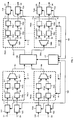
- Fig. 1 the optical connection network is indicated by CM, the electrical control network by CT and the line and exchange termination devices respectively associated to input optical connections E1...Eh...Em...En and to the output connections U1...Uh...Um...Un by TE1...TEh...TEm...TEn, TU1...TUh...TUm...TUn.
- the termination devices TE, TU are well known in the art and they are not part of the invention and this is why they will not be described in detail. A possible example of realization is anyhow described in EP-A-0 411 562.
- Outputs 1 (1-1...1n) of the devices TE are connected to units PAC1...PACk, each of which receives the cells outgoing from one or more devices TE.
- the outputs of the devices TE1...TEh are connected to PAC1 and those of the devices TEm...TEn to PACk.
- the number of lines connected to the units PAC is the same for all these units.
- the units PAC comprise, for each of their input lines:
- each unit PAC includes also a multiplexer MU (MU1...MUk) cyclically scanning the outputs 3 (3-1...3h...3m...3n) of all the compression means PC and concentrating the compressed aggregates on these outputs onto an input line IN (IN1...INk) to the CM switching network.
- Control signals for multiplexers MU are supplied by the system time base, which is part of the control units CT, through the proper connection wires 4-1...4k, schematizing as a whole the connections for signal exchange between units PAC and control units CT.
- the cross- connect system can present 512 input/output links E/U and use a switching network CM with 64 inputs/outputs; each input link can convey cells related to 10 virtual paths; the aggregates (having the same dimensions) can comprise from 8 to 16 cells.
- the aggregation and compression information units are obtained with a duration substantially equal to that of a cell but with contents equal to the sum of the contents of all the cells of an aggregate, and they convey therefore a much greater quantity of information in the time unit.
- the electronic control units CT will process these information units instead of the individual ATM cells and they will hence not have any special speed requirements and will not set any constraints to the optimal exploitation of the optical switching network.
- the fact that cell aggregates are to be processed instead of individual cells does not imply any modification in this control unit, the structure of which is therefore analogous to that already proposed for some prototypes of ATM switches.
- aggregation and compression there will be a proportional increase of the necessary bandwidth, which requires the use of an optical technology for switching network CM.
- Time compression factor C (which can be of the same order of magnitude as the number of cells forming an aggregate) will preferably not be lower than the ratio n/k between cross-connect system inputs and CM connection networks inputs: in this way guard times between aggregates can be left to make connection network operations easier. This becomes specially important if a cell and frequency switching is carried out in the cross-connect system, as described in the mentioned paper by A. de Bosio et al. and in EP-A-0 411 562.
- Outputs OU1...OUk of the switching network CM are connected to demultiplexers DM1...DMk, belonging to respective units PED1...PEDk which perform inverse operations of the units PAC.
- Each demultiplexer DM has one input and as many outputs as the inputs of a multiplexer MU.
- Outputs 5-1...5h...5m...5n of demultiplexers DM are connected to respective means PE1...PEn for the time expansion of the aggregates, followed in their turn by means PD1...PDn for the decomposition of the aggregates into individual cells.
- Means PD receive from means PE the aggregates to be decomposed through the respective connections 6-1...6n, eliminate the additional label and supply the individual cells on connections 7-1...7n towards the devices TU1...TUn.
- the number and the position of the bits making up the label are known and the cells have a constant length, the person skilled in the art has no difficulty in realizing a device capable of performing the required functions: e.g. the units PD can be suitably timed registers.
- Units PED receive the proper control signals from the control units CT through connections 8-1...8k.
- Units PAC, PED are the processing units for the ATM cell flow which are the subject of the invention.
- connection E, U are supposed to be of an optical type, termination devices TE, TU will incorporate the required optical-to-electrical conversion devices and vice versa. This is not an additional complication for the switching system structure since these conversion devices are provided in any case when optical flows on input/output lines are organized as usual according to the standard synchronous digital hierarchy (SDH), because SDH frames are processed in an electrical form.
- Connections 100, 101 schematize the connections between termination devices TE, TU and the control units CT.
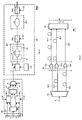
- Fig. 2 shows a possible embodiement of units PA, PC.
- Unit PA mainly consists of a bank of FIFO memories (10 in the example considered) MF1...MFp, each of which organizes a queue of cells relevant to the same virtual path to form aggregates. Considering that memories receive cells at random, the writing/reading control units must be able to recognize the preset number of cells has been written and, once this number is reached, to start reading even if any cell to be inserted in a successive aggregate is still being written. To avoid excessive delays, reading must start in any case after a maximum preset time is out even if the aggregate is not complete.
- This maximum time will be counted by a suitable counter, provided in the control units of the memory itself and started when the first aggregate cell arrives, by using clock signals supplied by the time base of the electrical control network CT by means of wire 40 belonging to one of the connections 4 in Fig 1.
- a suitable counter provided in the control units of the memory itself and started when the first aggregate cell arrives, by using clock signals supplied by the time base of the electrical control network CT by means of wire 40 belonging to one of the connections 4 in Fig 1.
- said control units are incorporated into the blocks MF; memories organized to allow these operating procedures are well known in the art.
- a label valid within the cross-connect system (containing service information in general and information about the aggregate characteristics in particular) will also be added at the head of each aggregate; the label is supplied by TE through the relevant connection 10-1...10p (which is part of line 1 in Fig. 1) and is loaded into the memory when the arrival of the first cell of an aggregate is recognized.
- This label will generally be used by the decomposition units PD.
- Service labels of this type are created by the units TE also in the case of conventional ATM cross-connect systems (e.g. that described by A. L. Fox et al. in the paper "RACE BLINT: a technology solution for the broadband local network", presented at IEE Conference on Integrated Broadband Services and Networks, October 1990, London).
- Cells to be stored come from TE, through a connection 11 (which is also part of line 1) connected to the input of a decoding network DE presenting p outputs respectively connected to memories MF1...MFp.
- DE receives from TE, as control signals, the label bits of each cell arriving to TE (and therefore the bits of the label which has not undergone conversion yet) which identify the virtual path and, according to such label, it routes the cell towards the proper memory MF.
- the outputs of memories MF are connected to the inputs of a selector SL the output of which is output 2 of block PA.
- the selector must act in synchronism with multiplexer MU, and more precisely it must transfer an aggregate to its output at an instant such that, taking into account the time required for compression, the aggregate is present on output connection 3 of the concerned block PAC at the moment when MU is scanning the connection itself.
- the aggregate which SL must transfer to the compression units PC will be the or an aggregate ready in one of the memories MF (e.g. the first one completed) or the or an aggregate for which maximum bold time in memory has already expired.
- the selector will then be associated to a control logic LC receiving from control units of the individual memories MF signals indicating that an aggregate has been formed or that the preset time has expired.
- the different selector inputs can be cyclically scanned.
- the invention could be used in any switching node, by forming cell aggregates which have to follow the same path in the connection network CM.
- Serialized aggregates consisting of bit strings where each bit has the same duration and period as the bits of the cells present on connections E, are supplied to the bit time compression unit PC.
- the unit PC comprises:
- the delay element of the i-th folding element RPi will introduce a delay (y-1)To/2 i .
- each aggregate will be associated to a replica.
- each element RP will be followed by a unit, schematized by switches SW1...SWc, which will be operated to eliminate this replica, as it will better be seen further on.
- switches are controlled by signals supplied by the control units through connections 43-1...43c, which are part of the proper connection 4 in Fig. 1.
- Units such as SW1...SWc are well known in the art, and hence further information is unnecessary.
- the compressed aggregates on lines IN are then switched inside CM with the procedures required by the particular network.
- Fig. 3a shows schematically the aggregate to be compressed, formed by bits the duration of which is substantially equal to period To.
- Figure 3b shows the aggregate converted into optical form, with bits having period To and a strongly reduced duration, arriving at input of coupler A1 of RP1 and propagating towards A2 without undergoing delays in RP1.
- the delay element R1 of RP1 introduces a delay 7To/2 by giving the sequence in Fig. 3c: as it can be seen, bit 1 outgoing from R1 occurs at half the interval between bits 4 and 5 of the non delayed sequence (and therefore at the central instant of the duration of the aggregate); bit 2 outgoing from R1 occurs at half the interval separating the arrival of bits 5 and 6 of the non delayed sequence, etc.
- bit 1 outgoing from R1 occurs at half the interval between bits 4 and 5 of the non delayed sequence (and therefore at the central instant of the duration of the aggregate); bit 2 outgoing from R1 occurs at half the interval separating the arrival of bits 5 and 6 of the non delayed sequence, etc.
- an initial group of bits (bits 1-4 of the non delayed aggregate) is followed by a sequence of bits in which the bits of the second half of the original aggregate are interleaved with those of the first half, and this sequence is still followed by a queue of bits consisting of bits 5-8 of the delayed sequence.
- switch SW1 must be closed for a time substantially equal to yTo/2 (duration of compressed aggregate) starting from the instant when the first bit of the aggregate exits from the delay element R of folding element RP1: considering as instant 0 that when the aggregate to be compressed arrives at the input of RP1, the closure of SW1 must substantially take place after a time 7To/2.
- the delay element introduces a delay equal to 7To/4, i.e. 7/2 of the bit time of the aggregate already compressed by RP1: the first bit of the delayed sequence will reach the input of the output coupler A2 at half the interval separating bits 6 and 3 of the non delayed sequence (and therefore again in correspondence with central instant of the duration of the aggregate). In this way the bits in the second half of the aggregate are interleaved again with those of the first half of the aggregate that is entering into the element.
- the sequence shown in line 3e is obtained, with a duration equal to 1/4 of the original one.
- cell aggregates present at output 5 of a demultiplexer DM (Fig. 1) are supplied at the input of an expandor ES which has C outputs and are transferred simultaneously on C lines 50-1...50C, which terminate at the inputs of the respective gates CA1...CAC, sampling with period To the bit strings present on the respective line 50.
- Control signals for gates CA are supplied by the control units CT through a line 80 which is part of one of the connections 8 in Fig. 1. Also the realization of gates such as gates CA is well known in the art, and hence further information is unnecessary.
- Lines 50 have lengths which are different and progressively increasing from line 50-1 to line 50C and so they introduce a progressively increasing delay on the signals conveyed.
- the interest lies in the relative delay between one line and the line preceding it, which must be equal to the period Tc of the compressed bits.
- Outputs of gates CA1...CAC are connected through respective lines 60-1...60C to an integrator-detector IR which effects an integration in the time of the bits received and their conversion into electrical form, so as to reconstruct the cell aggregates corresponding to those outgoing from blocks PA (formed therefore by bits with period and duration To).
- IR will be made up of a unit reconstituting the bit sequence and of an optical-to-electrical converter.
- Lines 60 have also different lengths, in order to introduce different delays on the bits that conveyed. The delay introduced by each line is a multiple of the overall duration y.Tc of a compressed aggregate and it is progressively increasing, by steps of y.Tc, from line 60C to line 60-1.
- the delay will vary from 0 (line 60C) to (C-1) ⁇ y ⁇ Tc (line 60-1) and, for the generic line 60j, it will be (C-j) ⁇ y ⁇ Tc.
- the reasons for the choice of the given values for the delay introduced by lines 50, 60 will appear clearly from the description of the operation of unit PE, with reference to Fig. 5.
- Fig. 5a shows the situation of the aggregates on lines 50-1...50-4 at the input of the sampling gates CA
- Fig. 5b the situation on lines 60-1...60-4 at the output of the same gates.
- the above described expansion scheme requires the overall length of the aggregates to be a multiple of compression factor C. This does not constitute a limitation because it is sufficient to choose suitably the number of cells in the aggregate, if the length of same does not satisfay this condition.
- multiplexers MU can be replaced by passive combining devices, receiving in a sequential way the compressed aggregates outgoing from one group of compression units PC.
- the demultiplexers DM will be then replaced by complementary passive distribution units. In this case it will be the time base to establish the reading instant of the various aggregates in memories MF so that they arrive at the inputs of the multiplexing unit with the required sequence.
- the folding elements RP could be realized so as to form a number of replicas of the aggregate different from 2, e.g. 3, 5, etc..., obtained by delaying the input aggregate of multiples of To/3, To/5 ...., so that compression ratios will be obtained which are powers of 3, 5, etc.
- the delay element R constituting the x-th path inside the i-th element of the succession of folding elements will have to introduce a delay of (X-1)(y-1)To/z i on the signals that run across it.
Landscapes
- Engineering & Computer Science (AREA)
- Computer Networks & Wireless Communication (AREA)
- Signal Processing (AREA)
- Data Exchanges In Wide-Area Networks (AREA)
- Use Of Switch Circuits For Exchanges And Methods Of Control Of Multiplex Exchanges (AREA)
- Optical Communication System (AREA)
- Time-Division Multiplex Systems (AREA)
Applications Claiming Priority (2)
| Application Number | Priority Date | Filing Date | Title |
|---|---|---|---|
| ITTO920510A IT1257546B (it) | 1992-06-15 | 1992-06-15 | Commutatore ottico per reti a commutazione veloce di cella. |
| ITTO920510 | 1992-06-15 |
Publications (3)
| Publication Number | Publication Date |
|---|---|
| EP0574864A2 true EP0574864A2 (fr) | 1993-12-22 |
| EP0574864A3 EP0574864A3 (fr) | 1994-11-02 |
| EP0574864B1 EP0574864B1 (fr) | 1998-11-11 |
Family
ID=11410535
Family Applications (1)
| Application Number | Title | Priority Date | Filing Date |
|---|---|---|---|
| EP93109486A Expired - Lifetime EP0574864B1 (fr) | 1992-06-15 | 1993-06-14 | Commutàteur optique pour des réseaux de commutation de cellules rapides |
Country Status (6)
| Country | Link |
|---|---|
| US (1) | US5450225A (fr) |
| EP (1) | EP0574864B1 (fr) |
| JP (1) | JP2578060B2 (fr) |
| CA (1) | CA2098358C (fr) |
| DE (2) | DE69321996T2 (fr) |
| IT (1) | IT1257546B (fr) |
Cited By (3)
| Publication number | Priority date | Publication date | Assignee | Title |
|---|---|---|---|---|
| US5604734A (en) * | 1994-06-10 | 1997-02-18 | Telefonaktiebolaget Lm Ericsson | ATM-system adapted three stage switching unit |
| US5734486A (en) * | 1994-11-04 | 1998-03-31 | France Telecom | Optical packet switching system |
| WO2002007356A3 (fr) * | 2000-07-14 | 2002-08-29 | Level 3 Communications Inc | Procede et systeme de transfert de trafic sonet sur un reseau a commutation par paquets |
Families Citing this family (24)
| Publication number | Priority date | Publication date | Assignee | Title |
|---|---|---|---|---|
| DE4405262C1 (de) * | 1994-02-18 | 1995-11-09 | Siemens Ag | Verfahren und Schaltungsanordnung zum Steuern der Übertragung von Nachrichtenblöcken innerhalb eines Übertragungssystems |
| JPH07336299A (ja) * | 1994-06-14 | 1995-12-22 | Oki Electric Ind Co Ltd | 光交換方法および光交換機 |
| US5583868A (en) * | 1994-07-25 | 1996-12-10 | Microsoft Corporation | Method and system for combining data from multiple servers into a single continuous data stream using a switch |
| FR2736777B1 (fr) * | 1995-07-12 | 1997-08-08 | Alcatel Nv | Reseau de transmission optique avec multiplexage de longueurs d'onde |
| JPH09181774A (ja) * | 1995-12-23 | 1997-07-11 | Nec Corp | 光スイッチ装置及び光スイッチ制御方式 |
| US5729548A (en) * | 1995-12-29 | 1998-03-17 | Telefonaktiebolaget Lm Ericsson (Publ.) | High-speed optical data switching system |
| FR2745968B1 (fr) * | 1996-03-08 | 1998-04-03 | Thomson Csf | Procede d'espacement de cellules atm et dispositif pour sa mise en oeuvre |
| US5841560A (en) * | 1996-09-30 | 1998-11-24 | The Trustees Of Princeton University | System for optical pulse train compression and packet generation |
| GB9719895D0 (en) * | 1997-09-18 | 1997-11-19 | British Telecomm | A method of obtaining an optical signal stream |
| KR100237838B1 (ko) | 1997-12-15 | 2000-01-15 | 이계철 | 대용량 광비동기전송 모드스위치 |
| JPH11275614A (ja) * | 1998-03-26 | 1999-10-08 | Nec Corp | 光交換装置 |
| US6721508B1 (en) | 1998-12-14 | 2004-04-13 | Tellabs Operations Inc. | Optical line terminal arrangement, apparatus and methods |
| GB9917880D0 (en) | 1999-07-30 | 1999-09-29 | Roke Manor Research | Fast data modulator |
| GB2361596B (en) * | 2000-04-18 | 2003-12-17 | Roke Manor Research | Improved data compression apparatus and method therefor |
| GB2361847B (en) * | 2000-04-28 | 2003-12-03 | Roke Manor Research | Demultiplexer control system and method |
| US6973229B1 (en) | 2001-02-28 | 2005-12-06 | Lambda Opticalsystems Corporation | Node architecture for modularized and reconfigurable optical networks, and methods and apparatus therefor |
| EP1271825A1 (fr) * | 2001-06-25 | 2003-01-02 | Lucent Technologies Inc. | Procédé et système pour le transport d'information optique multiplexé |
| US7194206B2 (en) * | 2002-05-15 | 2007-03-20 | Altera Corporation | Variable-density optical cross-connect architectures and upgrades |
| US20050089027A1 (en) * | 2002-06-18 | 2005-04-28 | Colton John R. | Intelligent optical data switching system |
| US7873056B2 (en) | 2004-11-18 | 2011-01-18 | Nec Corporation | Switch device, switching method and switch control program |
| US8891963B2 (en) * | 2011-09-09 | 2014-11-18 | Evertz Microsystems Ltd. | Hybrid signal router |
| KR102271008B1 (ko) | 2017-10-27 | 2021-06-29 | 삼성전자주식회사 | 반도체 장치 |
| KR102574322B1 (ko) | 2018-06-27 | 2023-09-05 | 삼성전자주식회사 | 반도체 장치 |
| US20220182740A1 (en) * | 2019-03-20 | 2022-06-09 | Sony Group Corporation | Information processing apparatus, information processing method, and communication system |
Family Cites Families (12)
| Publication number | Priority date | Publication date | Assignee | Title |
|---|---|---|---|---|
| US4706240A (en) * | 1985-11-29 | 1987-11-10 | American Telephone And Telegraph Co., At&T Bell Labs | Switching system having multiple parallel switching networks |
| IT1217130B (it) * | 1987-03-12 | 1990-03-14 | Cselt Centro Studi Lab Telecom | Sistema di commutazione in tecnologia ottica |
| JPH0774861B2 (ja) * | 1987-04-06 | 1995-08-09 | 日本電信電話株式会社 | 光パルス多重化回路 |
| JPS6430350A (en) * | 1987-07-27 | 1989-02-01 | Nippon Telegraph & Telephone | Polyspeed switching system |
| JPH01195428A (ja) * | 1988-01-29 | 1989-08-07 | Nippon Telegr & Teleph Corp <Ntt> | 光時分割多重変復調回路 |
| IT1219054B (it) * | 1988-02-29 | 1990-04-24 | Cselt Centro Studi Lab Telecom | Nodo per rete a commutazione veloce di pacchetto in tecnologia ottico elettrica |
| IT1233075B (it) * | 1989-08-01 | 1992-03-14 | Cselt Centro Studi Lab Telecom | Commutatore veloce di pacchetto e frequenza |
| US5105292A (en) * | 1989-10-02 | 1992-04-14 | Alcatel Cit | Asynchronous optical communication system |
| JP3188448B2 (ja) * | 1989-12-15 | 2001-07-16 | ノバルティス アクチエンゲゼル シャフト | pHを調節されたタンパク質除去洗浄剤 |
| JPH03207197A (ja) * | 1990-01-09 | 1991-09-10 | Fujitsu Ltd | ディジタルクロスコネクト装置 |
| JPH03270536A (ja) * | 1990-03-20 | 1991-12-02 | Mitsubishi Electric Corp | Atm交換装置 |
| US5121240A (en) * | 1990-08-29 | 1992-06-09 | The Trustees Of Columbia University In The City Of New York | Optical packet time compression and expansion |
-
1992
- 1992-06-15 IT ITTO920510A patent/IT1257546B/it active IP Right Grant
-
1993
- 1993-06-10 JP JP16376793A patent/JP2578060B2/ja not_active Expired - Lifetime
- 1993-06-14 DE DE69321996T patent/DE69321996T2/de not_active Expired - Fee Related
- 1993-06-14 EP EP93109486A patent/EP0574864B1/fr not_active Expired - Lifetime
- 1993-06-14 DE DE0574864T patent/DE574864T1/de active Pending
- 1993-06-14 CA CA002098358A patent/CA2098358C/fr not_active Expired - Fee Related
-
1994
- 1994-12-02 US US08/348,770 patent/US5450225A/en not_active Expired - Fee Related
Cited By (4)
| Publication number | Priority date | Publication date | Assignee | Title |
|---|---|---|---|---|
| US5604734A (en) * | 1994-06-10 | 1997-02-18 | Telefonaktiebolaget Lm Ericsson | ATM-system adapted three stage switching unit |
| US5734486A (en) * | 1994-11-04 | 1998-03-31 | France Telecom | Optical packet switching system |
| WO2002007356A3 (fr) * | 2000-07-14 | 2002-08-29 | Level 3 Communications Inc | Procede et systeme de transfert de trafic sonet sur un reseau a commutation par paquets |
| US6831932B1 (en) | 2000-07-14 | 2004-12-14 | Level 3 Communications, Inc. | Transfer of SONET traffic over a packet-switched network |
Also Published As
| Publication number | Publication date |
|---|---|
| EP0574864A3 (fr) | 1994-11-02 |
| JP2578060B2 (ja) | 1997-02-05 |
| JPH0670385A (ja) | 1994-03-11 |
| DE69321996D1 (de) | 1998-12-17 |
| ITTO920510A0 (it) | 1992-06-15 |
| US5450225A (en) | 1995-09-12 |
| CA2098358C (fr) | 1997-06-24 |
| EP0574864B1 (fr) | 1998-11-11 |
| DE69321996T2 (de) | 1999-05-12 |
| ITTO920510A1 (it) | 1993-12-15 |
| DE574864T1 (de) | 1995-06-08 |
| CA2098358A1 (fr) | 1993-12-16 |
| IT1257546B (it) | 1996-01-30 |
Similar Documents
| Publication | Publication Date | Title |
|---|---|---|
| EP0574864B1 (fr) | Commutàteur optique pour des réseaux de commutation de cellules rapides | |
| US5103447A (en) | High-speed ring LAN system | |
| US5841771A (en) | Telecommunications switch apparatus and method for time switching | |
| US5862136A (en) | Telecommunications apparatus and method | |
| US5247518A (en) | High-speed ring lan system | |
| US5715239A (en) | ATM multiplex transmission system having test equipment | |
| EP1045557B1 (fr) | Système de commutation ATM | |
| JP3034631B2 (ja) | 時分割交換システム | |
| US5732085A (en) | Fixed length packet switching apparatus using multiplexers and demultiplexers | |
| US6347096B1 (en) | Method for structuring of digital data which can be transferred in both directions on a passive optical network (PON) in a PON TDMA system | |
| KR100290999B1 (ko) | 음성 통화서비스가 가능한 에이티엠 스위치장치 및 방법 | |
| US6804229B2 (en) | Multiple node network architecture | |
| Finn et al. | Optical services in future broadband networks | |
| US7468988B2 (en) | Methods and systems for improving utilization of high-speed time division multiplexed communications links at signal transfer point | |
| US6788703B2 (en) | DS0 on ATM, mapping and handling | |
| US6885661B1 (en) | Private branch exchange built using an ATM Network | |
| US6778538B2 (en) | Virtual junctors | |
| JPH0522403A (ja) | Stm−atm相互変換制御方式 | |
| US5471465A (en) | Exchange having overdimensioned digital switching network | |
| EP1052813A1 (fr) | Dispositif et procédé de telecom | |
| Minden et al. | An atm wan/lan gateway architecture | |
| Yukimatsu et al. | A photonic ATM backbone network | |
| US6768736B1 (en) | Using an ATM switch to grow the capacity of a switching stage | |
| JP3679214B2 (ja) | 冗長構成システムにおける伝搬位相差吸収方法及び装置 | |
| US6714538B1 (en) | Telephony switching apparatus |
Legal Events
| Date | Code | Title | Description |
|---|---|---|---|
| PUAI | Public reference made under article 153(3) epc to a published international application that has entered the european phase |
Free format text: ORIGINAL CODE: 0009012 |
|
| AK | Designated contracting states |
Kind code of ref document: A2 Designated state(s): DE FR GB IT NL SE |
|
| PUAL | Search report despatched |
Free format text: ORIGINAL CODE: 0009013 |
|
| AK | Designated contracting states |
Kind code of ref document: A3 Designated state(s): DE FR GB IT NL SE |
|
| 17P | Request for examination filed |
Effective date: 19941130 |
|
| EL | Fr: translation of claims filed | ||
| TCNL | Nl: translation of patent claims filed | ||
| DET | De: translation of patent claims | ||
| 17Q | First examination report despatched |
Effective date: 19970513 |
|
| GRAG | Despatch of communication of intention to grant |
Free format text: ORIGINAL CODE: EPIDOS AGRA |
|
| GRAG | Despatch of communication of intention to grant |
Free format text: ORIGINAL CODE: EPIDOS AGRA |
|
| GRAH | Despatch of communication of intention to grant a patent |
Free format text: ORIGINAL CODE: EPIDOS IGRA |
|
| GRAG | Despatch of communication of intention to grant |
Free format text: ORIGINAL CODE: EPIDOS AGRA |
|
| GRAH | Despatch of communication of intention to grant a patent |
Free format text: ORIGINAL CODE: EPIDOS IGRA |
|
| GRAA | (expected) grant |
Free format text: ORIGINAL CODE: 0009210 |
|
| AK | Designated contracting states |
Kind code of ref document: B1 Designated state(s): DE FR GB IT NL SE |
|
| REF | Corresponds to: |
Ref document number: 69321996 Country of ref document: DE Date of ref document: 19981217 |
|
| ET | Fr: translation filed | ||
| PLBE | No opposition filed within time limit |
Free format text: ORIGINAL CODE: 0009261 |
|
| STAA | Information on the status of an ep patent application or granted ep patent |
Free format text: STATUS: NO OPPOSITION FILED WITHIN TIME LIMIT |
|
| 26N | No opposition filed | ||
| PGFP | Annual fee paid to national office [announced via postgrant information from national office to epo] |
Ref country code: SE Payment date: 20000605 Year of fee payment: 8 |
|
| PGFP | Annual fee paid to national office [announced via postgrant information from national office to epo] |
Ref country code: NL Payment date: 20000620 Year of fee payment: 8 |
|
| NLS | Nl: assignments of ep-patents |
Owner name: OTC-OPTICAL TECHNOLOGIES CENTER S.R.L. |
|
| REG | Reference to a national code |
Ref country code: GB Ref legal event code: 732E |
|
| REG | Reference to a national code |
Ref country code: FR Ref legal event code: TP |
|
| REG | Reference to a national code |
Ref country code: GB Ref legal event code: 732E |
|
| PG25 | Lapsed in a contracting state [announced via postgrant information from national office to epo] |
Ref country code: SE Free format text: LAPSE BECAUSE OF NON-PAYMENT OF DUE FEES Effective date: 20010615 |
|
| REG | Reference to a national code |
Ref country code: FR Ref legal event code: TP |
|
| PG25 | Lapsed in a contracting state [announced via postgrant information from national office to epo] |
Ref country code: NL Free format text: LAPSE BECAUSE OF NON-PAYMENT OF DUE FEES Effective date: 20020101 |
|
| REG | Reference to a national code |
Ref country code: GB Ref legal event code: IF02 |
|
| EUG | Se: european patent has lapsed |
Ref document number: 93109486.6 |
|
| NLV4 | Nl: lapsed or anulled due to non-payment of the annual fee |
Effective date: 20020101 |
|
| PGFP | Annual fee paid to national office [announced via postgrant information from national office to epo] |
Ref country code: FR Payment date: 20020517 Year of fee payment: 10 |
|
| PGFP | Annual fee paid to national office [announced via postgrant information from national office to epo] |
Ref country code: GB Payment date: 20020605 Year of fee payment: 10 |
|
| PGFP | Annual fee paid to national office [announced via postgrant information from national office to epo] |
Ref country code: DE Payment date: 20020620 Year of fee payment: 10 |
|
| PG25 | Lapsed in a contracting state [announced via postgrant information from national office to epo] |
Ref country code: GB Free format text: LAPSE BECAUSE OF NON-PAYMENT OF DUE FEES Effective date: 20030614 |
|
| PG25 | Lapsed in a contracting state [announced via postgrant information from national office to epo] |
Ref country code: DE Free format text: LAPSE BECAUSE OF NON-PAYMENT OF DUE FEES Effective date: 20040101 |
|
| GBPC | Gb: european patent ceased through non-payment of renewal fee |
Effective date: 20030614 |
|
| PG25 | Lapsed in a contracting state [announced via postgrant information from national office to epo] |
Ref country code: FR Free format text: LAPSE BECAUSE OF NON-PAYMENT OF DUE FEES Effective date: 20040227 |
|
| REG | Reference to a national code |
Ref country code: FR Ref legal event code: ST |
|
| PG25 | Lapsed in a contracting state [announced via postgrant information from national office to epo] |
Ref country code: IT Free format text: LAPSE BECAUSE OF NON-PAYMENT OF DUE FEES;WARNING: LAPSES OF ITALIAN PATENTS WITH EFFECTIVE DATE BEFORE 2007 MAY HAVE OCCURRED AT ANY TIME BEFORE 2007. THE CORRECT EFFECTIVE DATE MAY BE DIFFERENT FROM THE ONE RECORDED. Effective date: 20050614 |