EP0576184A2 - Tubes de prélèvement de sang à surface modifiée - Google Patents
Tubes de prélèvement de sang à surface modifiée Download PDFInfo
- Publication number
- EP0576184A2 EP0576184A2 EP93304608A EP93304608A EP0576184A2 EP 0576184 A2 EP0576184 A2 EP 0576184A2 EP 93304608 A EP93304608 A EP 93304608A EP 93304608 A EP93304608 A EP 93304608A EP 0576184 A2 EP0576184 A2 EP 0576184A2
- Authority
- EP
- European Patent Office
- Prior art keywords
- tube
- plastic
- glass
- region
- clot
- Prior art date
- Legal status (The legal status is an assumption and is not a legal conclusion. Google has not performed a legal analysis and makes no representation as to the accuracy of the status listed.)
- Granted
Links
Images

Classifications
-
- B—PERFORMING OPERATIONS; TRANSPORTING
- B01—PHYSICAL OR CHEMICAL PROCESSES OR APPARATUS IN GENERAL
- B01L—CHEMICAL OR PHYSICAL LABORATORY APPARATUS FOR GENERAL USE
- B01L3/00—Containers or dishes for laboratory use, e.g. laboratory glassware; Droppers
- B01L3/50—Containers for the purpose of retaining a material to be analysed, e.g. test tubes
- B01L3/508—Rigid containers without fluid transport within
- B01L3/5082—Test tubes per se
-
- G—PHYSICS
- G01—MEASURING; TESTING
- G01N—INVESTIGATING OR ANALYSING MATERIALS BY DETERMINING THEIR CHEMICAL OR PHYSICAL PROPERTIES
- G01N33/00—Investigating or analysing materials by specific methods not covered by groups G01N1/00 - G01N31/00
- G01N33/48—Biological material, e.g. blood, urine; Haemocytometers
- G01N33/483—Physical analysis of biological material
- G01N33/487—Physical analysis of biological material of liquid biological material
- G01N33/49—Blood
- G01N33/4905—Determining clotting time of blood
Definitions
- This invention relates to medical devices and more particularly relates to a blood collection tube having surface regions of different chemistry.
- Blood samples are routinely taken in evacuated tubes, such as glass VACUTAINERTM tubes (Becton, Dickinson and Company).
- One end of a double-ended needle is inserted into a patient's vein.
- the other end of the needle then punctures a septum covering the open end of the VACUTAINERTM tube so that the vacuum in the tube draws the blood sample through the needle into the tube.
- a plurality of samples can be taken using a single needle puncture of the skin.
- Plastic tubes have also been proposed for blood collection. Plastic offers a number of advantages over glass, such as lower breakage, less weight in shipment, and easier disposal by incineration.
- the blood comes into contact with the interior surface of the collection tube.
- the nature of the blood-surface interaction is complex.
- the blood clotting cascade is activated by contact of the blood with a wettable glass surface and the formed clot does not adhere to the glass, making it easy to separate clot from blood plasma by centrifugation.
- the clot is non-adherent, it is subject to resuspension in part or whole into the plasma layer during handling or transportation.
- the same surface properties that lead to easy separation of clot from the serum also allow the clot to move freely in the tube.
- Plastic tubes generally have a nonwettable surface and do not activate the clotting process efficiently. Clots formed in these tubes may be quite gelatinous relative to those in glass. These gelatinous clots adhere tenaciously to plastic surfaces and do not allow for clean separation of serum from clot in conventional hematological centrifuges. However, the adherent clot is not easily disrupted by ordinary handling procedures. Thus, although serum and clot do not separate cleanly in plastic, the clot adheres to the plastic surface, and its mechanical stability is a positive feature not available in glass tubes.
- the ideal blood collection tube for serum separation would exhibit both glass-like and plastic-like surface activity.
- glass-like is used to describe a surface which is substantially hydrophilic, which is wettable by aqueous liquids, which initiates clot formation and which is non-adherent to the formed clot.
- plastic-like is used to describe a surface which is substantially hydrophobic, substantially nonwettable by aqueous liquids, and which does not initiate clot formation to any significant degree, but which is highly adherent to clot material.
- plastic surfaces are coated with a detergent material to render them more glass-like.
- This approach has the disadvantage of adding a soluble foreign material which contaminates the serum and may interfere with subsequent blood analysis.
- plastic microcollection tubes are treated with an oxidative plasma to render the surface more hydrophilic, to achieve faster blood flow and to reduce blood hangup.
- glass surfaces are treated with a plasma to deposit a layer of hydrophobic plastic material.
- This technology is exemplified in U. S. Patent No. 4,188,426 to Auerbach wherein a fluorine-containing layer is plasma-deposited on a variety of surfaces, including plastic and glass.
- the entire interior surface of the tube is substantially modified to interconvert glass-like and plastic-like surfaces and thus does not provide surface chemistry having dual functionality for blood collection.
- Wettability gradients are formed on silicon plates by Elwing et al. in Advances in Colloid and Interface Science , 32,317 (1990).
- the gradients are formed by diffusion-induced silylation using dichlorodimethyl silane.
- An article includes a wall which has a wall surface having a plurality of surface regions which have different surface chemistries. At least one of the regions is substantially plastic-like and at least one of the regions is substantially glass-like.
- the preferred article has an open end, a closed end, a wall and a wall surface.
- the wall which preferably is continuous, includes a side wall and a bottom wall.
- the most preferred article is a tube which may be glass or plastic.
- one surface region is the native glass surface and a second region is the glass surface modified to be plastic-like.
- the surface modified to be plastic-like may preferably be adjacent the bottom wall and may include the bottom wall.
- the native glass surface is preferably adjacent the open end of the tube.
- the plastic tube of the invention has a surface region which may be the native plastic surface and a surface region modified to be glass-like.
- the region modified to be glass-like may preferably be adjacent the open end of the tube, and the native plastic surface region may preferably be adjacent to the bottom wall and may include the bottom wall.
- the article of the invention has two distinctly different kinds of surface properties which provide a dual clinical functionality.
- the glass-like surface promotes clotting and provides a nonadherent surface to the formed blood clots.
- the blood clots adhere strongly to the plastic-like surface region.
- a blood sample taken in the tube of the invention is centrifuged, the blood clots at the glass-like region and the clot flows, pellets and adheres to the plastic-like region.
- a clear serum layer forms above the clot with no fibrin rings and strands suspended in the serum or adhering to the upper region of the tube.
- the strong adherence of the clot to the plastic-like region prevents mechanical remixing of clot and serum when the centrifuged tube is handled or transported.
- the location and size of the different regions is easily predetermined by the treatment process so that the total volume occupied by clot and serum within the tube can be controlled by the location of the interface between the regions.
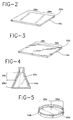
- the Figure illustrates the preferred tube of the invention and shows two regions of different surface chemistry.
- an article surface preferably a continuous surface, is modified to have two or more regions of different chemistry. Regions of different surface chemistry may be formed on a variety of glass or plastic articles, such as films, plates, flasks, bottles, vials and dishes.
- the preferred article geometry is a tube, preferably a tube with one closed end.
- the tube may be combined with a septum over the open end and may be evacuated.
- Evacuated tubes for blood collection are standard in the art as, for example VACUTAINERTM brand tubes (Becton, Dickinson and Company).
- the tube of the invention may be glass or plastic and may be of any shape or size.
- the preferred tube may be cylindrical and may be about 25-250, preferably about 75-100 mm long and 10-20 mm in diameter.
- a plastic-like surface region may be introduced to a portion of the inside wall.
- a glass-like surface region may be introduced to a portion of the inside wall.
- a typical tube 10 of the invention has an open end 12, a closed end 14, a side wall 16 and a bottom wall 18.
- Walls 16 and 18 define an inside wall surface 20 which extends continuously from the top portions 22 and 24 of side wall 16.
- Wall surface 20 includes a region 26 adjacent the open end of the tube and a region 28 adjacent bottom wall 18 and optionally including the portion of inside wall 20 defined by bottom wall 18.
- a glass tube may be treated with a reagent which renders the treated portion of the tube plastic-like.
- the reagent may be a polymer.
- a surface region of a glass tube may be rendered plastic-like by dip coating a solution of a polymer in a volatile solvent on the surface and subsequently evaporating the solvent.
- Suitable polymers for this embodiment of the invention are polyethylene, polystyrene, polyvinyl chloride, polysiloxane and polytetrafluoroethylene.
- Suitable solvents are chloroform, dimethyl formamide, dimethylsulfoxide, dimethylacetamide and the like.
- a monomer may be coated onto the region to be rendered plastic-like and the monomer polymerized in situ .
- the monomer optionally in an inert solvent, can be polymerized by treatment with ultraviolet light so that, after evaporation of the solvent, a layer of polymer coating remains on the region.
- Preferred reagents are silylation reagents, such as, for example, trimethylchlorosilane, methyldimethoxychlorosilane and chloromethyldimethylethoxysilane.
- the most preferred reagents are chlorosilanes having long chain alkyl substituents such as tridodecylchlorosilane and octadecyltrichlorosilane (OTS).
- OTS octadecyltrichlorosilane
- a plastic tube may be treated to have a glass-like region on its interior surface.
- the glass-like region may be introduced at either the closed end of the tube or preferably at the open end.
- the plastic tube may be of any polymer which can be treated to have a glass-like surface region.
- Representative polymers are, for example, polyethylene terephthalate, polyethylene, polypropylene, polytetrafluoroethylene, polysiloxane, polyvinyl chloride and preferably polystyrene (PS).
- Suitable reagents for this embodiment of the invention are chromic acid and preferably sulfuric acid whereby the polymer structure is attacked by the acid with introduction of polar groups.
- the most preferred tube of the invention is a polystyrene blood collection tube treated with sulfuric acid to have a glass-like surface near the tube mouth to enhance the clotting sequence without clot adherence and the native plastic surface in the area near the closed end to enhance adherence of the clot at the bottom of the tube during centrifugation.
- This tube is easily made by immersion of the open end of the polystyrene tube in the sulfuric acid solution, as described in detail in Example II.
- the regions of modified chemistry can be of any size depending merely on how much reagent is added to the tube for bottom-end treatment or how far the mouth of the tube is inserted into the reagent for top end treatment.
- the glass-like surface region may be from about 10-75, preferably about 50 to 60% of the inside wall surface with the remainder of the surface being plastic-like.
- a tissue being cultured in a culture bottle, flask or dish may behave differently when the surface has both glass-like and plastic-like regions.
- a hydrophobic, plastic-like region on glass disposable culture tubes (10 mm X 75 mm, Corning Glass Works) was created by carefully pipetting a 2% chloroform solution of OTS into the tube.
- the total height of the plastic-like region was varied by varying the total volume of OTS solution. Reaction between glass and OTS was allowed to proceed for about 15 minutes at room temperature after which the reactants were aspirated from the tube. Tubes were sequentially rinsed by serial addition and aspiration of chloroform to remove all unreacted OTS. Observation of the shape of water droplets along the tube axis confirmed that the treated region was hydrophobic.
- the tubes were filled with 4.5 ml of citrated porcine blood containing 0.1 molar calcium chloride and incubated for 30 min at 37° C to allow blood to clot. The tubes were then centrifuged under standard hematological conditions (1380 G, 3300 rpm).
- Glass tubes with plastic-like hydrophobic regions of various length in the upper portion of the tube were created by allowing the OTS solution of Example I to contact only the upper portion of the tube. This was accomplished by tilting and rolling the tube while pipetting the OTS solution into the tube, so that only the selected portion was in contact with the silane reagent. Tubes were sequentially rinsed by serial addition and aspiration of chloroform to remove all unreacted OTS. Observation of the shape of water droplets along the tube axis confirmed that the treated region was hydrophobic after tubes were air dried. Blood was clotted and centrifuged in these treated tubes and untreated control tubes as described in Example I.
- Polystyrene culture tubes (Becton Dickinson 12X75 mm) were treated with a radio-frequency oxygen plasma (30 Watts 13.56 MHz, planar diode system held at 250 millitorr oxygen) to oxidize the entire interior and exterior surface of the tubes and produce a glass-like surface treatment.
- a radio-frequency oxygen plasma (30 Watts 13.56 MHz, planar diode system held at 250 millitorr oxygen) to oxidize the entire interior and exterior surface of the tubes and produce a glass-like surface treatment.
- Another set of these plastic tubes were filled with concentrated sulfuric acid to sulfonate the aromatic ring of the polystyrene. After 30 minutes reaction at room temperature, sulfonated tubes were rinsed with copious amounts of distilled water and air dried. Observation of the shape of water droplets along the tube axis confirmed that the treated region was a hydrophilic, water-wettable surface. Blood was allowed to clot in these tubes as described in Example I.
- Example II Sulfuric acid was carefully added with a pipette into the lower portion of polystyrene tubes in a manner similar to that described in Example I using OTS. In this case, however, the lower portions of the tubes were rendered hydrophilic rather than hydrophobic as in Example I.
- the character of blood clots and position relative to the hydrophobic surface region were noted as described in Example I. It was observed that the position of clot adherence along the tube axis positively correlated with the position of the hydrophobic, untreated region on the tube and that the clot was strongly adherent to this layer and did not pellet during centrifugation as described in Example II.
- Examples I-IV show that clot position and adherence within a tube can be controlled by surface treatments that produce plastic-like or glass-like properties, respectively.
Landscapes
- Health & Medical Sciences (AREA)
- Life Sciences & Earth Sciences (AREA)
- Engineering & Computer Science (AREA)
- Chemical & Material Sciences (AREA)
- Hematology (AREA)
- Biomedical Technology (AREA)
- Analytical Chemistry (AREA)
- General Health & Medical Sciences (AREA)
- Physics & Mathematics (AREA)
- Biophysics (AREA)
- Medicinal Chemistry (AREA)
- Chemical Kinetics & Catalysis (AREA)
- Clinical Laboratory Science (AREA)
- Molecular Biology (AREA)
- Urology & Nephrology (AREA)
- Food Science & Technology (AREA)
- Ecology (AREA)
- Biochemistry (AREA)
- General Physics & Mathematics (AREA)
- Immunology (AREA)
- Pathology (AREA)
- Measurement Of The Respiration, Hearing Ability, Form, And Blood Characteristics Of Living Organisms (AREA)
- Investigating Or Analysing Biological Materials (AREA)
- Sampling And Sample Adjustment (AREA)
Applications Claiming Priority (2)
| Application Number | Priority Date | Filing Date | Title |
|---|---|---|---|
| US07/903,111 US5257633A (en) | 1992-06-23 | 1992-06-23 | Surface modified blood collection tubes |
| US903111 | 1992-06-23 |
Publications (3)
| Publication Number | Publication Date |
|---|---|
| EP0576184A2 true EP0576184A2 (fr) | 1993-12-29 |
| EP0576184A3 EP0576184A3 (fr) | 1994-01-19 |
| EP0576184B1 EP0576184B1 (fr) | 1996-12-27 |
Family
ID=25416955
Family Applications (1)
| Application Number | Title | Priority Date | Filing Date |
|---|---|---|---|
| EP93304608A Expired - Lifetime EP0576184B1 (fr) | 1992-06-23 | 1993-06-14 | Tubes de prélèvement de sang à surface modifiée |
Country Status (5)
| Country | Link |
|---|---|
| US (1) | US5257633A (fr) |
| EP (1) | EP0576184B1 (fr) |
| JP (1) | JPH0830703B2 (fr) |
| CA (1) | CA2099097C (fr) |
| DE (1) | DE69306864T2 (fr) |
Cited By (2)
| Publication number | Priority date | Publication date | Assignee | Title |
|---|---|---|---|---|
| EP0629445A3 (fr) * | 1993-06-14 | 1995-02-08 | Becton Dickinson Co | Dispositif de prélèvement de sang par le vide, comprenant un tube en plastique pour accélerer la coagulation. |
| US6548263B1 (en) | 1997-05-29 | 2003-04-15 | Cellomics, Inc. | Miniaturized cell array methods and apparatus for cell-based screening |
Families Citing this family (35)
| Publication number | Priority date | Publication date | Assignee | Title |
|---|---|---|---|---|
| US5318806A (en) * | 1992-10-02 | 1994-06-07 | Becton, Dickinson And Company | Tube having regions of different surface chemistry and method therefor |
| US5378431A (en) * | 1993-06-14 | 1995-01-03 | Becton, Dickinson And Company | Dual pathway clotting enhancer for blood collection tube |
| US5455009A (en) * | 1993-09-14 | 1995-10-03 | Becton, Dickinson And Company | Blood collection assembly including clot-accelerating plastic insert |
| US5320812A (en) * | 1993-10-04 | 1994-06-14 | Becton, Dickinson And Company | Clot activating polyelectrolyte complex and blood collection assembly containing same |
| FI940823A0 (fi) * | 1994-02-22 | 1994-02-22 | Orion Yhtymae Oy | Analysatorkyvett foer turbidimetriska och nefelometriska bestaemningar av helblodsprov |
| US5518615A (en) * | 1994-04-22 | 1996-05-21 | Becton, Dickinson And Company | Blood compatible, shear sensitive gels |
| US6238578B1 (en) * | 1996-12-09 | 2001-05-29 | Sherwood Services Ag | Method for dispensing separator gel in a blood collection tube |
| US6979307B2 (en) * | 1997-06-24 | 2005-12-27 | Cascade Medical Enterprises Llc | Systems and methods for preparing autologous fibrin glue |
| US7745106B2 (en) * | 1997-06-24 | 2010-06-29 | Cascade Medical Enterprises, Llc | Methods and devices for separating liquid components |
| US6077235A (en) * | 1999-02-23 | 2000-06-20 | Becton, Dickinson And Company | Blood collection assembly and method therefor |
| WO2003008937A2 (fr) * | 2001-07-18 | 2003-01-30 | The Regents Of The University Of Michigan | Cytometres de flux et systeme de detection d'une taille reduite |
| US6617152B2 (en) * | 2001-09-04 | 2003-09-09 | Corning Inc | Method for creating a cell growth surface on a polymeric substrate |
| ES2784011T3 (es) | 2002-10-16 | 2020-09-21 | Streck Inc | Procedimiento y dispositivo para recoger y preservar las células para su análisis |
| US20060233676A1 (en) * | 2005-04-13 | 2006-10-19 | Stein Israel M | Glass test tube having protective outer shield |
| US20060233675A1 (en) * | 2005-04-13 | 2006-10-19 | Stein Israel M | Glass test tube having protective outer shield |
| USD572976S1 (en) * | 2007-03-27 | 2008-07-15 | Mansfield Bryan D | Drinking vessel |
| US8979810B1 (en) | 2008-02-25 | 2015-03-17 | Craig Beyer | Nasal aspiration systems and related methods |
| US7947186B2 (en) | 2008-05-22 | 2011-05-24 | Statspin, Inc. | Centrifugal device and method for fluid component separation |
| WO2010024325A1 (fr) * | 2008-08-28 | 2010-03-04 | 積水メディカル株式会社 | Récipient de collecte de sang |
| DE202010018561U1 (de) | 2009-01-21 | 2017-08-28 | Streck Inc. | Blutsammelröhrchen |
| US11634747B2 (en) | 2009-01-21 | 2023-04-25 | Streck Llc | Preservation of fetal nucleic acids in maternal plasma |
| EP3290530B1 (fr) | 2009-02-18 | 2020-09-02 | Streck Inc. | Préservation d'acides nucléiques acellulaires |
| CA2780536C (fr) | 2009-11-09 | 2018-01-02 | Streck, Inc. | Stabilisation d'arn et extraction d'arn present dans des cellules intactes d'un echantillon sanguin |
| WO2012151391A2 (fr) | 2011-05-04 | 2012-11-08 | Streck, Inc. | Compositions virales inactivées et leurs procédés de préparation |
| EP4136972A1 (fr) | 2013-07-24 | 2023-02-22 | Streck, Inc. | Compositions et méthodes de stabilisation de cellules tumorales circulantes |
| US11168351B2 (en) | 2015-03-05 | 2021-11-09 | Streck, Inc. | Stabilization of nucleic acids in urine |
| US20170145475A1 (en) | 2015-11-20 | 2017-05-25 | Streck, Inc. | Single spin process for blood plasma separation and plasma composition including preservative |
| WO2018022991A1 (fr) | 2016-07-29 | 2018-02-01 | Streck, Inc. | Composition de suspension pour contrôle d'analyse hématologique |
| US12378543B2 (en) | 2017-10-19 | 2025-08-05 | Streck Llc | Compositions for hemolysis and coagulation regulation and stabilization of extracellular vesicles |
| AU2018366901B2 (en) * | 2017-11-15 | 2022-02-03 | Radiometer Medical Aps | Heparin-based blood sampler without platelet activation |
| EP3785017B1 (fr) | 2018-04-27 | 2025-09-10 | Becton, Dickinson And Company | Systèmes de collecte pour échantillons triés par cytométrie en flux et procédés les mettant en oeuvre |
| US20220074949A1 (en) | 2018-12-27 | 2022-03-10 | Streck, Inc. | Methods of preparing samples for proteomic analysis |
| US20230050815A1 (en) * | 2019-12-18 | 2023-02-16 | Sekisui Medical Co., Ltd. | Blood collection container |
| US20230314442A1 (en) | 2020-07-01 | 2023-10-05 | Streck, Inc. | Methods of preparing samples for proteomic analysis |
| CN115920145A (zh) * | 2022-12-12 | 2023-04-07 | 武汉维印科技有限责任公司 | 一种含生长因子颗粒的钛制采血管制备方法 |
Family Cites Families (9)
| Publication number | Priority date | Publication date | Assignee | Title |
|---|---|---|---|---|
| AR206892A1 (es) * | 1973-07-23 | 1976-08-31 | Corning Glass Works | Articulo de vidrio con por lo menos una superficie recubierta con oxido de polietileno para inhibir la adhesion de sangre |
| US4188426A (en) * | 1977-12-12 | 1980-02-12 | Lord Corporation | Cold plasma modification of organic and inorganic surfaces |
| US4257886A (en) * | 1979-01-18 | 1981-03-24 | Becton, Dickinson And Company | Apparatus for the separation of blood components |
| JPS596655A (ja) * | 1982-07-02 | 1984-01-13 | Toa Tokushu Denki Kk | 電話機 |
| JPS5967936A (ja) * | 1982-10-08 | 1984-04-17 | テルモ株式会社 | 採血管 |
| DE68925493T2 (de) * | 1988-05-11 | 1996-05-30 | Du Pont Canada | Gerät zum Einsammeln von Blut |
| US4967763A (en) * | 1989-03-13 | 1990-11-06 | Becton, Dickinson And Company | Platelet stable blood collection assembly |
| JPH0363569A (ja) * | 1989-07-31 | 1991-03-19 | Chuo Biseibutsu Kensashiyo:Kk | 血清分離促進剤と血清分離用試験管 |
| JPH03218736A (ja) * | 1990-01-25 | 1991-09-26 | Nissho Corp | 真空採血管 |
-
1992
- 1992-06-23 US US07/903,111 patent/US5257633A/en not_active Expired - Lifetime
-
1993
- 1993-06-14 EP EP93304608A patent/EP0576184B1/fr not_active Expired - Lifetime
- 1993-06-14 DE DE69306864T patent/DE69306864T2/de not_active Expired - Lifetime
- 1993-06-22 JP JP5150512A patent/JPH0830703B2/ja not_active Expired - Fee Related
- 1993-06-23 CA CA002099097A patent/CA2099097C/fr not_active Expired - Fee Related
Cited By (2)
| Publication number | Priority date | Publication date | Assignee | Title |
|---|---|---|---|---|
| EP0629445A3 (fr) * | 1993-06-14 | 1995-02-08 | Becton Dickinson Co | Dispositif de prélèvement de sang par le vide, comprenant un tube en plastique pour accélerer la coagulation. |
| US6548263B1 (en) | 1997-05-29 | 2003-04-15 | Cellomics, Inc. | Miniaturized cell array methods and apparatus for cell-based screening |
Also Published As
| Publication number | Publication date |
|---|---|
| DE69306864D1 (de) | 1997-02-06 |
| DE69306864T2 (de) | 1997-05-22 |
| US5257633A (en) | 1993-11-02 |
| CA2099097C (fr) | 1998-06-23 |
| EP0576184A3 (fr) | 1994-01-19 |
| JPH0830703B2 (ja) | 1996-03-27 |
| CA2099097A1 (fr) | 1993-12-24 |
| EP0576184B1 (fr) | 1996-12-27 |
| JPH0666789A (ja) | 1994-03-11 |
Similar Documents
| Publication | Publication Date | Title |
|---|---|---|
| US5257633A (en) | Surface modified blood collection tubes | |
| EP1031380B1 (fr) | Dispositif de collection de sang et procédé pour sa fabrication | |
| CA2223165C (fr) | Appareil et methode pour la preparation de plasma | |
| EP1199104B1 (fr) | Article médical ayant surface en contact avec le sang | |
| EP0629445B1 (fr) | Dispositif de prélèvement de sang par le vide, comprenant un tube en plastique pour accélerer la coagulation | |
| JP5816613B2 (ja) | 凝固をモニタするための側方流動分析装置及びその方法 | |
| EP0628816B1 (fr) | Particule pour améliorer la coagulation dans des tubes pour le prélèvement du sang par activation de deux voies, dispositif pour le prélèvement du sang et méthode pour produire les particules | |
| US5266199A (en) | Serum separating apparatus | |
| EP0341587B1 (fr) | Appareil pour recueillir du sang | |
| US6428527B1 (en) | Method for coating a blood collection device | |
| US4711820A (en) | Method of siliconization of surfaces with lower alkyl silanes | |
| JP7282520B2 (ja) | 可動ガス注入口を用いてpecvd潤滑層を適用する方法 | |
| US3939834A (en) | Metal coated articles | |
| EP0668786A1 (fr) | Methodes et processus de preparation de fractions de globules rouges | |
| CN1284136A (zh) | 提高表面张力的表面改性 | |
| CA1187091A (fr) | Agent favorisant la coagulation | |
| US6017483A (en) | Receptacle with a fused coating on an interior surface and an injection molding process for forming the article | |
| WO2004046231A1 (fr) | Materiau d'isolation d'adn et procede associe | |
| JP2006001995A (ja) | 生化学用器具 | |
| CA2335409C (fr) | Appareil et methode pour la preparation de plasma | |
| MXPA97009953A (en) | Apparatus and method for the preparation of pla | |
| HK1016535B (en) | Receptacle with a coating on an interior surface and an injection molding process for forming the article | |
| JP2004275862A (ja) | 糖鎖化合物吸着制御実験器具 | |
| HK1033343B (en) | Modification of surfaces in order to increase surface tension |
Legal Events
| Date | Code | Title | Description |
|---|---|---|---|
| PUAI | Public reference made under article 153(3) epc to a published international application that has entered the european phase |
Free format text: ORIGINAL CODE: 0009012 |
|
| PUAL | Search report despatched |
Free format text: ORIGINAL CODE: 0009013 |
|
| AK | Designated contracting states |
Kind code of ref document: A2 Designated state(s): DE FR GB IT |
|
| AK | Designated contracting states |
Kind code of ref document: A3 Designated state(s): DE FR GB IT |
|
| 17P | Request for examination filed |
Effective date: 19940714 |
|
| 17Q | First examination report despatched |
Effective date: 19950301 |
|
| GRAG | Despatch of communication of intention to grant |
Free format text: ORIGINAL CODE: EPIDOS AGRA |
|
| GRAH | Despatch of communication of intention to grant a patent |
Free format text: ORIGINAL CODE: EPIDOS IGRA |
|
| GRAH | Despatch of communication of intention to grant a patent |
Free format text: ORIGINAL CODE: EPIDOS IGRA |
|
| GRAA | (expected) grant |
Free format text: ORIGINAL CODE: 0009210 |
|
| AK | Designated contracting states |
Kind code of ref document: B1 Designated state(s): DE FR GB IT |
|
| REF | Corresponds to: |
Ref document number: 69306864 Country of ref document: DE Date of ref document: 19970206 |
|
| ET | Fr: translation filed | ||
| ITF | It: translation for a ep patent filed | ||
| PLBE | No opposition filed within time limit |
Free format text: ORIGINAL CODE: 0009261 |
|
| STAA | Information on the status of an ep patent application or granted ep patent |
Free format text: STATUS: NO OPPOSITION FILED WITHIN TIME LIMIT |
|
| 26N | No opposition filed | ||
| REG | Reference to a national code |
Ref country code: GB Ref legal event code: IF02 |
|
| PGFP | Annual fee paid to national office [announced via postgrant information from national office to epo] |
Ref country code: IT Payment date: 20070628 Year of fee payment: 15 |
|
| PG25 | Lapsed in a contracting state [announced via postgrant information from national office to epo] |
Ref country code: IT Free format text: LAPSE BECAUSE OF NON-PAYMENT OF DUE FEES Effective date: 20080614 |
|
| PGFP | Annual fee paid to national office [announced via postgrant information from national office to epo] |
Ref country code: DE Payment date: 20120627 Year of fee payment: 20 |
|
| PGFP | Annual fee paid to national office [announced via postgrant information from national office to epo] |
Ref country code: GB Payment date: 20120625 Year of fee payment: 20 Ref country code: FR Payment date: 20120705 Year of fee payment: 20 |
|
| REG | Reference to a national code |
Ref country code: DE Ref legal event code: R071 Ref document number: 69306864 Country of ref document: DE |
|
| REG | Reference to a national code |
Ref country code: GB Ref legal event code: PE20 Expiry date: 20130613 |
|
| PG25 | Lapsed in a contracting state [announced via postgrant information from national office to epo] |
Ref country code: GB Free format text: LAPSE BECAUSE OF EXPIRATION OF PROTECTION Effective date: 20130613 Ref country code: DE Free format text: LAPSE BECAUSE OF EXPIRATION OF PROTECTION Effective date: 20130615 |