EP0576262A2 - Gerät zum Multiplizieren von Ganzzahlen mit vielen Ziffern - Google Patents
Gerät zum Multiplizieren von Ganzzahlen mit vielen Ziffern Download PDFInfo
- Publication number
- EP0576262A2 EP0576262A2 EP93304879A EP93304879A EP0576262A2 EP 0576262 A2 EP0576262 A2 EP 0576262A2 EP 93304879 A EP93304879 A EP 93304879A EP 93304879 A EP93304879 A EP 93304879A EP 0576262 A2 EP0576262 A2 EP 0576262A2
- Authority
- EP
- European Patent Office
- Prior art keywords
- bits
- data
- input
- bit
- output
- Prior art date
- Legal status (The legal status is an assumption and is not a legal conclusion. Google has not performed a legal analysis and makes no representation as to the accuracy of the status listed.)
- Granted
Links
Images









Classifications
-
- G—PHYSICS
- G06—COMPUTING OR CALCULATING; COUNTING
- G06F—ELECTRIC DIGITAL DATA PROCESSING
- G06F7/00—Methods or arrangements for processing data by operating upon the order or content of the data handled
- G06F7/38—Methods or arrangements for performing computations using exclusively denominational number representation, e.g. using binary, ternary, decimal representation
- G06F7/48—Methods or arrangements for performing computations using exclusively denominational number representation, e.g. using binary, ternary, decimal representation using non-contact-making devices, e.g. tube, solid state device; using unspecified devices
- G06F7/52—Multiplying; Dividing
- G06F7/523—Multiplying only
- G06F7/53—Multiplying only in parallel-parallel fashion, i.e. both operands being entered in parallel
- G06F7/5324—Multiplying only in parallel-parallel fashion, i.e. both operands being entered in parallel partitioned, i.e. using repetitively a smaller parallel parallel multiplier or using an array of such smaller multipliers
-
- G—PHYSICS
- G06—COMPUTING OR CALCULATING; COUNTING
- G06F—ELECTRIC DIGITAL DATA PROCESSING
- G06F7/00—Methods or arrangements for processing data by operating upon the order or content of the data handled
- G06F7/38—Methods or arrangements for performing computations using exclusively denominational number representation, e.g. using binary, ternary, decimal representation
- G06F7/48—Methods or arrangements for performing computations using exclusively denominational number representation, e.g. using binary, ternary, decimal representation using non-contact-making devices, e.g. tube, solid state device; using unspecified devices
- G06F7/52—Multiplying; Dividing
- G06F7/523—Multiplying only
- G06F7/533—Reduction of the number of iteration steps or stages, e.g. using the Booth algorithm, log-sum, odd-even
-
- G—PHYSICS
- G06—COMPUTING OR CALCULATING; COUNTING
- G06F—ELECTRIC DIGITAL DATA PROCESSING
- G06F7/00—Methods or arrangements for processing data by operating upon the order or content of the data handled
- G06F7/60—Methods or arrangements for performing computations using a digital non-denominational number representation, i.e. number representation without radix; Computing devices using combinations of denominational and non-denominational quantity representations, e.g. using difunction pulse trains, STEELE computers, phase computers
- G06F7/72—Methods or arrangements for performing computations using a digital non-denominational number representation, i.e. number representation without radix; Computing devices using combinations of denominational and non-denominational quantity representations, e.g. using difunction pulse trains, STEELE computers, phase computers using residue arithmetic
- G06F7/722—Modular multiplication
-
- G—PHYSICS
- G06—COMPUTING OR CALCULATING; COUNTING
- G06F—ELECTRIC DIGITAL DATA PROCESSING
- G06F2207/00—Indexing scheme relating to methods or arrangements for processing data by operating upon the order or content of the data handled
- G06F2207/38—Indexing scheme relating to groups G06F7/38 - G06F7/575
- G06F2207/3804—Details
- G06F2207/3808—Details concerning the type of numbers or the way they are handled
- G06F2207/3852—Calculation with most significant digit first
-
- G—PHYSICS
- G06—COMPUTING OR CALCULATING; COUNTING
- G06F—ELECTRIC DIGITAL DATA PROCESSING
- G06F2207/00—Indexing scheme relating to methods or arrangements for processing data by operating upon the order or content of the data handled
- G06F2207/38—Indexing scheme relating to groups G06F7/38 - G06F7/575
- G06F2207/3804—Details
- G06F2207/386—Special constructional features
- G06F2207/3884—Pipelining
- G06F2207/3892—Systolic array
-
- G—PHYSICS
- G06—COMPUTING OR CALCULATING; COUNTING
- G06F—ELECTRIC DIGITAL DATA PROCESSING
- G06F7/00—Methods or arrangements for processing data by operating upon the order or content of the data handled
- G06F7/60—Methods or arrangements for performing computations using a digital non-denominational number representation, i.e. number representation without radix; Computing devices using combinations of denominational and non-denominational quantity representations, e.g. using difunction pulse trains, STEELE computers, phase computers
- G06F7/72—Methods or arrangements for performing computations using a digital non-denominational number representation, i.e. number representation without radix; Computing devices using combinations of denominational and non-denominational quantity representations, e.g. using difunction pulse trains, STEELE computers, phase computers using residue arithmetic
- G06F7/723—Modular exponentiation
Definitions
- This invention relates to a multiplier apparatus for multiplying integers and, more particularly, to an multiplier apparatus which is suitable for a cryptographic scheme using a cryptographic system such as the RSA cryptosystem, and which multiplies integers of many figures by utilizing multiplication of a small number of figures.
- a multiplier and a divider having many places are required.
- a multiplier for multiplying integers of a small number of figures can be easily arranged because suitable cell libraries, transistor-transistor logic (TTL) devices and the like are available.
- TTL transistor-transistor logic
- ROMs and no cell libraries for realizing a multiplier and a divider of many places. It has been difficult to design a multiplier or a divider of many places in accordance with one's need, because the circuit configuration is very complicated if the configuration of a multiplier or a divider of a small number of places is simply extended.
- a multiplication may be performed by partitioning an input value with respect to a predetermined number of bits.
- a multiplication can be executed by a circuit such as that shown in Fig. 2.
- an object of the present invention is to provide a multiplier apparatus capable of efficiently multiplying integers of many figures with a small-scale circuit.
- Another object of the present invention is to provide a multiplier apparatus for multiplying integers of many figures by utilizing multiplication of integers of a small number of figures.
- Still another object of the present invention is to provide a multiplier apparatus for efficiently performing a multiplication by taking account of carries in a case where integers of many figures are multiplied by partitioning an input value.
- a further object of the present invention is to provide a multiplier apparatus for multiplying integers of many figures which is formed of a plurality of identical processing elements, and which can be suitably formed as an integrated circuit.
- the present invention which achieves these objectives relates to a multiplier apparatus for multiplying n-bit first data representing a first integer and (n x m)-bit second data representing a second integer, the apparatus comprising input means for successively inputting the first data bit by bit from an upper place, a plurality of multiplication means each for multiplying input 1 bit and one of groups of m bits of the second data partitioned with respect to m bits each time 1 bit of the first data is input by the input means, a plurality of memory means, and a plurality of addition means each for adding an output from one of the plurality of multiplication means, lower bits of a value stored in one of the plurality of memory means, and upper bits of a value stored in another one of the plurality of memory means, and for outputting a result of the addition to still another one of the plurality of memory means.
- the present invention which achieves the objectives relates to a multiplier apparatus for multiplying (n ⁇ m)-bit first data representing a first integer and (n ⁇ m)-bit second data representing a second integer, the apparatus comprising input means for successively inputting the first data m bits at a time from an upper place, a plurality of multiplication means each for multiplying input m bits and one of groups of m bits of the second data partitioned with respect to m bits each time m bits of the first data are input by the input means, a plurality of memory means, and a plurality of addition means each for adding an output from one of the plurality of multiplication means, lower bits of a value stored in one of the plurality of memory means, and upper bits of a value stored in another one of the plurality of memory means, and for outputting a result of the addition to still another one of the plurality of memory means.
- the present invention which achieves the objectives relates to a multiplier apparatus for multiplying (n ⁇ m)-bit first data representing a first integer and (n ⁇ m)-bit second data representing a second integer, the apparatus comprising input means for successively inputting the first data m bits at a time from a lower place, a plurality of multiplication means each for multiplying input m bits and one of groups of m bits of the second data partitioned with respect to m bits each time m bits of the first data are input by the input means, a plurality of first memory means, a plurality of addition means each for adding an output from one of the plurality of multiplication means, lower bits of a value stored in one of the plurality of first memory means, and upper bits of a value stored in another one of the plurality of memory means, and for outputting a result of the addition to still another one of the plurality of memory means, and a plurality of second memory means for storing a carry output from one of the plurality of addition means
- the present invention which achieves the objectives relates to a multiplier apparatus for multiplying (n ⁇ m)-bit first data representing a first integer and (n ⁇ m)-bit second data representing a second integer, the apparatus comprising input means for successively inputting the first data m bits at a time from an upper place, a plurality of multiplication means each for multiplying input m bits and one of groups of m bits of the second data partitioned with respect to m bits each time m bits of the first data are input by the input means, a plurality of memory means, and a plurality of addition means each for adding an output from one of the plurality of multiplication means, lower bits of a value stored in one of the plurality of memory means, and upper bits of a value stored in another one of the plurality of memory means, and for outputting a result of the addition to the memory means which has stored the added lower bits.
- the present invention which achieves the objectives relates to a multiplier apparatus for multiplying (n ⁇ m)-bit first data representing a first integer and (n ⁇ m)-bit second data representing a second integer, the apparatus comprising input means for successively inputting the first data m bits at a time from an upper place, a plurality of multiplication means each for multiplying input m bits of the first data and each of groups of m bits of the second data partitioned with respect to m bits each time m bits of the first data are input by the input means, a plurality of memory means, and a plurality of addition means each for adding a lower-m-bit output from one of the plurality of multiplication means, an upper-m-bit output from another one of the plurality of multiplication means, lower bits of a value stored in one of the plurality of memory means, and upper bits of a value stored in another one of the plurality of memory means, and for outputting a result of the addition to the memory means which has stored the added
- the present invention which achieves the objectives relates to a multiplier apparatus for multiplying (n ⁇ m)-bit first data representing a first integer and (n ⁇ m)-bit second data representing a second integer, the apparatus comprising a set of p operational circuits, each of the p operational circuit including input means for successively inputting the first data m ⁇ p bits at a time from a lower place as a set of p groups of m-bit data in parallel with each other, a plurality of multiplication means each for multiplying one of the set of p groups of input m-bit data and one of p groups of data in the second data grouped from data items partitioned from the second data with respect to m bits, a plurality of memory means, and a plurality of addition means.
- Each of the plurality of addition means adds a result of addition of a preceding one of the addition means stored in the corresponding one of the plurality of memory means and outputs from the corresponding two of the plurality of multiplication means each multiplying a series of bits in the second data.
- the addition means outputs a result of the addition to another one of the plurality of memory means. Obtained-multiplication results are successively output by the lowermost addition means in the groups of p operational circuits.
- the present invention which achieves the objectives relates to a multiplier apparatus for multiplying (n ⁇ m)-bit first data representing a first integer and (n ⁇ m)-bit second data representing a second integer, the apparatus comprising n identical processing elements connected one-dimensionally.
- Each of groups of m bits in the first data partitioned with respect to m bits is input to the corresponding one of the n processing elements.
- the second data is successively input m bits at a time from an upper place to the processing element at the uppermost stage.
- Each of the processing elements successively receives results of an operation of the processing element at an upper stage and the groups of m bits of the second data from the upper-stage processing element, multiplies each of the groups of m bits of the second data successively received and the corresponding one of the input groups of m bits of the first data, adds the product of the multiplication to the upper-stage processing element, and successively outputs results of the addition and the groups of m bits of the successively received second data to the processing element at a lower stage. Obtained multiplication results are successively output from the processing element at a lowermost stage.
- the present invention which achieves the objectives relates to a multiplier apparatus for multiplying (n ⁇ m)-bit first data representing a first integer and (n ⁇ m)-bit second data representing a second integer, the apparatus comprising n ⁇ n identical processing elements connected in a two-dimensional array having n rows and n columns.
- Each of groups of m bits in the first data partitioned with respect to m bits is input to the processing elements in the corresponding one of the n columns of the n row ⁇ n column array.
- Each of groups of m bits in the second data partitioned with respect to m bits is input to the corresponding one of the processing elements in the first column.
- Each of the processing elements successively receives the group of m bits of the second data from the same-row preceding-column processing element and a processing result from the preceding-row preceding-column processing element, multiplies each of the group m bits of the second data successively received and the corresponding one of the input groups of m bits of the first data, adds the product of the multiplication and a processing result successively received from the same-row preceding-column processing element, and successively outputs the added processing result to the next-row next-column processing element and the successively received m bits of the second data to the same-row next-column processing element. Obtained multiplication results are output from the processing elements in the final column and the final row.
- m, A, and B be a small integer, an integer of n bits, and an integer of h ⁇ m bits, respectively.
- Integers A and B can be expressed as shown below by being partitioned with respect 1 bit and m bits, respectively.
- A A n-1 ⁇ 2 n-1 + A n-2 ⁇ 2 n-2 + ... + A1 ⁇ 2 + A0
- Partitioned n terms in the equation of A form a bit series A n-1 , A n-2 , ..., A0 from an upper place to a lower place.
- B is also expressed in the same manner.
- a and B are regarded as polynominals and A ⁇ B can therefore be expressed as shown below.
- a ⁇ B A n-1 ⁇ B ⁇ 2 n-1 + A n-2 ⁇ B ⁇ 2 n-2 + ... + A1 ⁇ B ⁇ 2 + A0 ⁇ B
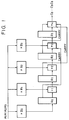
- a multiplier circuit such as that shown in Fig. 1 is formed.
- the circuit shown in Fig. 1 is formed of four (1 ⁇ m)-bit multipliers ( ⁇ B0 to ⁇ B3), four m-bit full adders with a 2-bit carry (+1 to +4), and four (m + 2)-bit registers (R0 to R3).
- the content of each register in the circuit shown in Fig. 1 is "0".
- the values of B i are set in the multipliers ( ⁇ B i ) prior to inputting Ai.
- the full adders having carries in the arrangement shown in Fig. 1 can be realized by a combination of a plurality of two-input full adders and half adders. It is also apparent that a multiplier circuit for achieving the same effect can also be formed by removing the right-end register or by further annexing a full adder and a register.
- the arrangement of the same processing elements each consisting of a multiplier ( ⁇ B j ), a full adder (+j) and a registers (R j ), such as those shown in Fig. 1, is also advantageous in that a large-scale circuit such as a VLSI can be easily realized thereby. It is also apparent that the same operational result can be obtained by using a memory having a plurality of regions R j and by performing operations corresponding to the above-described processing elements successively or parallel to each other on the basis of a software process.
- Integers A and B can be expressed as shown below by being partitioned with respect m bits.
- A A n-1 ⁇ X n-1 + A n-2 ⁇ X n-2 + ... + A1 ⁇ X + A0
- Partitioned n terms in the equation of A form a bit series A n-1 , A n-2 , ..., A0 from an upper place to a lower place.
- B is also expressed in the same manner.
- a and B are regarded as polynominals and A ⁇ B can therefore be expressed as shown below.
- the multiplication result through the places to X n-1 is output if the above-described operational steps are repeated by n clock pulses until A0 is input. Thereafter, the same operational steps are repeated while "0" is input by n clock pulses. The values in the registers are thereby successively output until the multiplication result is entirely output. In this manner, the operation A ⁇ B of integers A and B is performed efficiently as partitioned values of A are input.
- n and m are determined by considering a balance between the operational speed of the multiplier circuit and the complexity of the circuit. If m is greater, the number of clock pulses is smaller and the operational speed is higher, but the circuit is complicate. Also, it can be understood that the circuit formed by arranging processor elements (PE) each consisting of a multiplier ( ⁇ B i ), a full adder (+ i ) and a register (R i ) in accordance with this embodiment can be realized by annexing a full adder (+0) corresponding to the multiplier ( ⁇ B0) and a register (R n-1 ) for storing the output from the full adder (+ n-1 ) to the circuit shown in Fig. 3.
- PE processor elements
- a multiplier circuit of n ⁇ m bits can be realized efficiently by using multipliers of m x m bits in a case where an input value is supplied by being partitioned into n values with respect to m bits. It is apparent that a multiplication can also be executed with the same circuit even when h ⁇ n.
- the output from the multiplier circuit in accordance with this embodiment, inclusive of carries has a (2m + 2)-bit form. It is natural that such carries are added to the forward output, but there is no problem if the multiplication result is processed by being partitioned with respect to several bits in a subsequent circuit, and if the output from the main circuit is used by recognizing this condition. On the contrary, the scale of the subsequent circuit arrangement can be reduced since a many-figure number can be processed part by part.
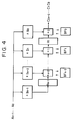
- a carry of A0 ⁇ B1 + A1 ⁇ B0 is stored in the 2-bit buffer BF0 at the right end and used as a carry in an addition after two clock pulses. That is, the carry is calculated with a delay corresponding to two clock cycles because the output from the circuit shown in Fig. 4 becomes higher in place by X per clock pulse while A0 ⁇ B1 + A1 ⁇ B0 represents a 2m-bit value, i.e., a value corresponding to X2.
- each register R i and buffer BF i (A0 ⁇ B i + A1 ⁇ B i ) which is the sum of the output from the register R i+1 at the preceding stage and the output from the corresponding multiplier is stored together with its carry.
- the multiplication result through the places to X n-1 is output if the above-described operational steps are repeated by n clock pulses until A n-1 is input. Thereafter, the same operational steps are repeated while "0" is input by n clock pulses. The values in the registers are thereby successively output until the multiplication result is entirely output.
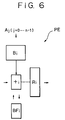
- processing elements each consisting of a multiplier B i , a full adder + i , a buffer BF i and a register R i arranged as shown in Fig. 6 may be used. It is apparent that this embodiment can also be realized by parallel processing using such PEs as shown in Fig. 5.
- the operation A ⁇ B is performed efficiently as partitioned values of A are successively input. It has been explained that a multiplier circuit of n ⁇ m bits can be realized efficiently by using multipliers of m x m bits in a case where an input value is supplied by being partitioned into n values with respect to m bits. It is apparent that a multiplication can also be executed with the same circuit even when h ⁇ n.
- a circuit portion for making a carry with a full adder forms a closed loop by a feedback using a buffer, and the problem of a delay relating to a carry, encountered in multiplication of integers, can therefore be avoided.
- the output from the circuit shown in Fig. 4 or 5, which represents a 2m-bit unit can be formed as an m-bit output by using such a full adder with a buffer. That is, the arrangement may be such that upper m bits in a series of 2m bits are input to an m-bit register and are then input to an m-bit full adder, lower m bits are directly input to the full adder, and a carry is fed back to the full adder with a 1-bit delay.
- the arrangement of the same processing elements, such as those shown in Fig. 5 or 6, is also advantageous in that a large-scale circuit such as a VLSI can be easily realized thereby.
- a multiplier circuit arranged to directly add 2m-bit outputs for the purpose of simplifying the circuit arrangement will be described below.
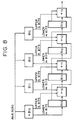
- the output from the full adder is input to the adjacent register on the right side. This means the calculation of the sum of the coefficients of X5, X4, and X3 in the terms (6) and (7) of the above equation.
- the output from each full adder has 2m + 1 bits if there is a carry, since each of A3 ⁇ B i-1 and A2 ⁇ B i represents a 2m-bit value.
- Each register therefore requires 2m + 1 bits.
- each register R i stores operation result with respect to the X places, the most significant bit in each register R i has the same place as the least significant bit in the next but one register R i+2 on the right side.
- the most significant bit in the second-nearest register R2 on the left side, having the same place as the least significant bit of C5, and the most significant bit in the adjacent register R3 on the left side, having the same place as the place X of C5, are also added and output.
- a multiplier circuit of n ⁇ m bits can be realized efficiently by using multipliers of m x m bits in a case where an input value is supplied by being partitioned into n values with respect to m bits. It is apparent that a multiplication can also be executed with the same circuit even when h ⁇ n. It is also apparent that a multiplier circuit for achieving the same effect can also be formed by removing the full adder and the register at the right end or by further annexing a full adder and a register. The arrangement of the same processing elements as shown in Fig. 7 is also advantageous in that a large-scale circuit such as a VLSI can be easily realized thereby.
- the same effect can also be achieved by providing a full adder (+0) between the multiplier ( ⁇ B0) and the register R0 in the circuit shown in Fig. 7.
- the operation in accordance with this embodiment can also be practiced by using a pipe line system designed by considering a groups of a multiplier ( ⁇ B i ), a full adder (+ i ) and a register (R i ) as one processing element (PE). Also, it may be practiced by using a multiplier ( ⁇ B i ), a full adder (+ i )a and a memory having a plurality of areas and by performing programmed sequential or parallel processing.
- a multiplier circuit arranged to partition a 2m-bit output into upper m bits and lower m bits for the purpose of reducing the necessary register size so that the circuit scale is smaller will be described below.
- the upper m bits and the lower m bits are expressed as up(C i-1 ) and down(C i ), as in the equation (12). Accordingly, the coefficient C7' of X7 designating the uppermost place of A ⁇ B shown in the equation (11) is output through the right-end full adder (+13). At this time, if there is a carry from the sum of the upper and lower m bits, the (m + 1)th bit in the corresponding register is stored as a carry bit. The (m + 1)th bit representing a carry has the same place as the least significant bit in the adjacent register on the right side.
- the coefficient C4' of X4 is output from the right-end full adder (+13).
- the coefficients C3' to C0' are calculated with respect to X3 to X0. The calculated values are stored in the registers.
- a multiplier circuit is formed as shown in Fig. 9.
- the multiplier circuit shown in Fig. 9 is formed of four (1 ⁇ 1)-bit multipliers ( ⁇ B20 to ⁇ B23), four 1-bit full adders with a carry (+20 to +23), and four 2-bit registers (R20 to R23). In the initial state, the content of each register in the circuit shown in Fig. 9 is "0".
- the output from the full adder is input to the adjacent register on the right side.
- the 3-input m-bit full adder having a carry can be realized by a combination of a plurality of 2-input full adders and half adders.
- a multiplier circuit for achieving the same effect can also be formed by removing the full adder and the register at the right end or by further annexing a full adder and a register in the circuit shown in Fig. 8 or 9. Since the circuit shown in Fig. 9 is arranged for 1 ⁇ 1 multiplication, it is free from reduplication of places from the multiplier outputs and may have a simpler circuit configuration in comparison with the circuit shown in Fig. 8.
- the arrangement of the same processing elements as shown in Fig. 8 or 9 is also advantageous in that a large-scale circuit such as a VLSI can be easily realized thereby.
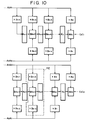
- a multiplier circuit for performing a multiplication with n/2 clock pulses will be described below as an example.
- Such a multiplier circuit may be formed as shown in Fig. 10.
- the multiplier circuit shown in Fig. 10 is formed of a pair of circuits illustrated in upper and lower sections of Fig. 10.
- A1 and A0 are input through an upper line and a lower line, respectively, by the first clock pulse.
- the equation (5) operation result is obtained in such a manner that two lower-place values are simultaneously calculated and output at a time. Accordingly, the number of processing clock pulses necessary for the multiplication of the equation (5) is substantially n/2.
- the circuit shown in Fig. 10 can be formed by arranging the same processing elements each formed as shown in Fig. 11 and is advantageous in that a large-scale circuit such as a VLSI can be easily realized thereby
- a multiplier circuit of n ⁇ m bits can be realized efficiently by using multipliers of m ⁇ m bits in a case where an input value is supplied by being partitioned into n values with respect to m bits. It is apparent that a multiplication can also be executed with the same circuit even when h ⁇ n. In the illustrated embodiment, a multiplication is executed on the basis of n/2 clock pulses by a pair of circuits.
- the output from the circuit shown in Fig. 10, which represents a 2m-bit unit can be formed as an m-bit output by using such a buffered full adder. That is, the arrangement may be such that upper m bits in a series of 2m bits are input to an m-bit register, an output from the register is input to an m-bit full adder, lower m bits are directly input to the full adder, and a carry is fed back to the full adder with a 1-bit delay.
- This circuit configuration can also be used as a high-speed multiplier circuit in a calculation system such as a Galois field using no carry.
- adders may be EXOR circuits.
- a multiplier circuit for performing repeated operations as parallel processing on the basis of a pipe line processing will be described below.
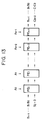
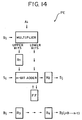
- the multiplier circuit is formed as shown in Fig. 13 and has an overall configuration called a systolic array.
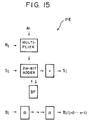
- a systolic array an operation is executed by a pipe line processing using small blocks having the same functions and each called a processing element (PE).
- PE processing element
- B j is input in the order of B0, B1 ... B n-1 , and a preceding stage input S j to PE0 is always "0".
- a block r in Fig. 15 represents a 2m-bit register
- a block BF represents a 2-bit buffer for delaying a carry from the adder two clock cycles.
- a systolic array can be formed of a regular arrangement of simple identical PEs and can easily be formed as a large scale circuit such as a VLSI. Also, a multiplier circuit using such a systolic array can be realized very easily, because the PEs can be controlled by the same control system and because data can be supplied in synchronization with each other by the same clock. If the number of figures of A or B is greatly increased, PEs may be annexed to perform the necessary operation. This type of multiplier circuit therefore has high extendability.
- PEs in accordance with the above embodiment may be arranged two-dimensionally for further parallelized operation, and a multiplier circuit such as that shown in Fig. 16 may be formed.
- the operation of the circuit shown in Fig. 16 is also executed by a pipe line processing.
- values B0 to B n-1 are simultaneously output to corresponding ones of n PEs at the left end (in the left end column), i.e., PE (0, 0) to PE (0, n-1) .
- "0" is input, as S j input, to each of the PEs in the left end column and the PEs in the upper end row from diagonally upper left positions.
- A0 ⁇ B0, A0 ⁇ B1, ..., A0 ⁇ B n-1 of 2m bits are calculated by the multipliers.
- B j is output to the PEs on the right side.
- A0 ⁇ B j + A1 ⁇ B j-1 is calculated from the output S j from the left end PEs one row above (diagonally to the upper left), and the calculation results are output newly as S j to the third row PEs one row below (diagonally to the lower right), while carry cr output from each adder is latched by the flip flop and is output to the fourth PE in the same row.
- the multiplication result A i ⁇ B j in each PE is a 2m-bit value in contrast with m-bit A i , B i , and has places corresponding to X2. However, since the place shift by the calculation effected in each PE is X, the carry is output as a carry signal the next but one PE.
- multiplication results i.e., values of A ⁇ B in X n-1 places are output from the lower end PEs (0, 0) to (n-1, 0) while multiplication results of A ⁇ B and carries above the X n-1 th place are output from the PEs (n-1, 0) to (n-1, n-1) in the right end column.
- n PEs (n, 0) to (n, n-1) and n PEs (n+1, 0) to (n+1, n-1) may be annexed or n adders for performing only carry addition operation may be annexed.
- the circuit of this embodiment a large number of PEs but can be realized by regularly arranging simple and identical PEs. Therefore it can be easily formed as a VLSI or the like. Also it can be realized very easily because the PEs can be controlled by the same control system and because data can be supplied in synchronization with each other by the same clock. Even if the number of figures of A or B is greatly increased, PEs may be annexed to perform the necessary operation. This type of multiplier circuit therefore has high extendability. Also, in this system, a carry from each PE is supplied to the next but one E in synchronization with clock, and the problem a delay relating to a carry, encountered in multiplication of integers, can therefore be avoided.
- the present invention may be applied to any system or apparatus, e.g., a system formed of a plurality of units or an apparatus formed of one unit. Needless to say, the present invention can also be applied to a processing program supplied to a system or an apparatus.
- the present invention makes it possible to provide an efficient, high-speed and extendible integer multiplier circuit which uses small-place multipliers while considering carries in a case where an operation is performed by partitioning an input value of many figures.
Landscapes
- Physics & Mathematics (AREA)
- General Physics & Mathematics (AREA)
- Engineering & Computer Science (AREA)
- Computational Mathematics (AREA)
- Mathematical Analysis (AREA)
- Mathematical Optimization (AREA)
- Pure & Applied Mathematics (AREA)
- Theoretical Computer Science (AREA)
- Computing Systems (AREA)
- General Engineering & Computer Science (AREA)
- Mathematical Physics (AREA)
- Complex Calculations (AREA)
Applications Claiming Priority (24)
| Application Number | Priority Date | Filing Date | Title |
|---|---|---|---|
| JP16708392 | 1992-06-25 | ||
| JP16707992 | 1992-06-25 | ||
| JP167083/92 | 1992-06-25 | ||
| JP4167081A JPH0612231A (ja) | 1992-06-25 | 1992-06-25 | 整数上の乗算回路 |
| JP16708192 | 1992-06-25 | ||
| JP16707792 | 1992-06-25 | ||
| JP4167084A JPH0612237A (ja) | 1992-06-25 | 1992-06-25 | 整数上の乗算回路 |
| JP04167080A JP3129526B2 (ja) | 1992-06-25 | 1992-06-25 | 整数上の乗算回路 |
| JP16707892 | 1992-06-25 | ||
| JP16708092 | 1992-06-25 | ||
| JP167079/92 | 1992-06-25 | ||
| JP16708292 | 1992-06-25 | ||
| JP167078/92 | 1992-06-25 | ||
| JP167080/92 | 1992-06-25 | ||
| JP16708492 | 1992-06-25 | ||
| JP04167079A JP3129525B2 (ja) | 1992-06-25 | 1992-06-25 | 整数上の乗算回路 |
| JP167084/92 | 1992-06-25 | ||
| JP04167078A JP3129524B2 (ja) | 1992-06-25 | 1992-06-25 | 整数上の乗算回路及び乗算方法 |
| JP4167082A JPH0612235A (ja) | 1992-06-25 | 1992-06-25 | 整数上の乗算回路及び乗算方法 |
| JP16708392A JP3210420B2 (ja) | 1992-06-25 | 1992-06-25 | 整数上の乗算回路 |
| JP167082/92 | 1992-06-25 | ||
| JP167077/92 | 1992-06-25 | ||
| JP167081/92 | 1992-06-25 | ||
| JP4167077A JPH0612232A (ja) | 1992-06-25 | 1992-06-25 | 整数上の乗算回路 |
Publications (3)
| Publication Number | Publication Date |
|---|---|
| EP0576262A2 true EP0576262A2 (de) | 1993-12-29 |
| EP0576262A3 EP0576262A3 (de) | 1994-03-23 |
| EP0576262B1 EP0576262B1 (de) | 2000-08-23 |
Family
ID=27573294
Family Applications (1)
| Application Number | Title | Priority Date | Filing Date |
|---|---|---|---|
| EP93304879A Expired - Lifetime EP0576262B1 (de) | 1992-06-25 | 1993-06-23 | Gerät zum Multiplizieren von Ganzzahlen mit vielen Ziffern |
Country Status (3)
| Country | Link |
|---|---|
| US (1) | US5524090A (de) |
| EP (1) | EP0576262B1 (de) |
| DE (1) | DE69329260T2 (de) |
Cited By (4)
| Publication number | Priority date | Publication date | Assignee | Title |
|---|---|---|---|---|
| WO1996005554A1 (en) * | 1994-08-15 | 1996-02-22 | Di, Zongkai | Multiplication operating method and multiplier |
| WO1998019231A1 (en) * | 1996-10-31 | 1998-05-07 | Motorola Limited | Co-processor for performing modular multiplication |
| WO1998019230A1 (en) * | 1996-10-31 | 1998-05-07 | Motorola Limited | Co-processor for performing modular multiplication |
| EP1039372A4 (de) * | 1997-12-17 | 2005-02-02 | Ultraclean Technology Res Inst | Halbleiterkreislauf für arithmetische handlungen und verfahren für arthmetische handlungen |
Families Citing this family (36)
| Publication number | Priority date | Publication date | Assignee | Title |
|---|---|---|---|---|
| US5974437A (en) * | 1996-12-02 | 1999-10-26 | Synopsys, Inc. | Fast array multiplier |
| GB2352309B (en) | 1999-07-21 | 2004-02-11 | Advanced Risc Mach Ltd | A system and method for performing modular multiplication |
| TW561400B (en) * | 2002-04-26 | 2003-11-11 | Silicon Integrated Sys Corp | Systolic product-sum circuit in the dual-basis finite field GF(2m) or GF(2n)) |
| US7769797B2 (en) * | 2004-01-20 | 2010-08-03 | Samsung Electronics Co., Ltd. | Apparatus and method of multiplication using a plurality of identical partial multiplication modules |
| US7366746B2 (en) * | 2004-02-12 | 2008-04-29 | Xerox Corporation | Finite impulse response filter method and apparatus |
| US8190669B1 (en) | 2004-10-20 | 2012-05-29 | Nvidia Corporation | Multipurpose arithmetic functional unit |
| US8073892B2 (en) * | 2005-12-30 | 2011-12-06 | Intel Corporation | Cryptographic system, method and multiplier |
| US8037119B1 (en) * | 2006-02-21 | 2011-10-11 | Nvidia Corporation | Multipurpose functional unit with single-precision and double-precision operations |
| EP2011018B1 (de) | 2006-04-12 | 2016-07-13 | Soft Machines, Inc. | Vorrichtung und verfahren zur verarbeitung einer instruktionsmatrix zur definition paralleler und abhängiger operationen |
| GB2440187A (en) * | 2006-07-17 | 2008-01-23 | Ubidyne Inc | DUC and DDC forming digital transceiver |
| WO2008061154A2 (en) | 2006-11-14 | 2008-05-22 | Soft Machines, Inc. | Apparatus and method for processing instructions in a multi-threaded architecture using context switching |
| US8051123B1 (en) | 2006-12-15 | 2011-11-01 | Nvidia Corporation | Multipurpose functional unit with double-precision and filtering operations |
| US8106914B2 (en) * | 2007-12-07 | 2012-01-31 | Nvidia Corporation | Fused multiply-add functional unit |
| EP3156896B1 (de) | 2010-09-17 | 2020-04-08 | Soft Machines, Inc. | Mehrfach verzweigte einzelzyklusvorhersage mit einem latenten cache für frühe und entfernte verzweigungsvorhersage |
| KR101966712B1 (ko) | 2011-03-25 | 2019-04-09 | 인텔 코포레이션 | 분할가능한 엔진에 의해 인스턴스화된 가상 코어를 이용한 코드 블록의 실행을 지원하는 메모리 프래그먼트 |
| TWI533129B (zh) | 2011-03-25 | 2016-05-11 | 軟體機器公司 | 使用可分割引擎實體化的虛擬核心執行指令序列程式碼區塊 |
| US9842005B2 (en) | 2011-03-25 | 2017-12-12 | Intel Corporation | Register file segments for supporting code block execution by using virtual cores instantiated by partitionable engines |
| US9113644B2 (en) | 2011-04-14 | 2015-08-25 | Aak Denmark A/S | Bloom retarding fat |
| CN103649931B (zh) | 2011-05-20 | 2016-10-12 | 索夫特机械公司 | 用于支持由多个引擎执行指令序列的互连结构 |
| CN107729267B (zh) | 2011-05-20 | 2022-01-25 | 英特尔公司 | 资源的分散分配以及用于支持由多个引擎执行指令序列的互连结构 |
| CN104040490B (zh) | 2011-11-22 | 2017-12-15 | 英特尔公司 | 用于多引擎微处理器的加速的代码优化器 |
| US20150039859A1 (en) | 2011-11-22 | 2015-02-05 | Soft Machines, Inc. | Microprocessor accelerated code optimizer |
| US9904625B2 (en) | 2013-03-15 | 2018-02-27 | Intel Corporation | Methods, systems and apparatus for predicting the way of a set associative cache |
| US9811342B2 (en) | 2013-03-15 | 2017-11-07 | Intel Corporation | Method for performing dual dispatch of blocks and half blocks |
| WO2014150991A1 (en) | 2013-03-15 | 2014-09-25 | Soft Machines, Inc. | A method for implementing a reduced size register view data structure in a microprocessor |
| KR101708591B1 (ko) | 2013-03-15 | 2017-02-20 | 소프트 머신즈, 인크. | 블록들로 그룹화된 멀티스레드 명령어들을 실행하기 위한 방법 |
| WO2014150971A1 (en) | 2013-03-15 | 2014-09-25 | Soft Machines, Inc. | A method for dependency broadcasting through a block organized source view data structure |
| WO2014151043A1 (en) | 2013-03-15 | 2014-09-25 | Soft Machines, Inc. | A method for emulating a guest centralized flag architecture by using a native distributed flag architecture |
| WO2014150806A1 (en) | 2013-03-15 | 2014-09-25 | Soft Machines, Inc. | A method for populating register view data structure by using register template snapshots |
| US9569216B2 (en) | 2013-03-15 | 2017-02-14 | Soft Machines, Inc. | Method for populating a source view data structure by using register template snapshots |
| US9891924B2 (en) | 2013-03-15 | 2018-02-13 | Intel Corporation | Method for implementing a reduced size register view data structure in a microprocessor |
| US9886279B2 (en) | 2013-03-15 | 2018-02-06 | Intel Corporation | Method for populating and instruction view data structure by using register template snapshots |
| US10275255B2 (en) | 2013-03-15 | 2019-04-30 | Intel Corporation | Method for dependency broadcasting through a source organized source view data structure |
| US10140138B2 (en) | 2013-03-15 | 2018-11-27 | Intel Corporation | Methods, systems and apparatus for supporting wide and efficient front-end operation with guest-architecture emulation |
| US9417843B2 (en) | 2013-08-20 | 2016-08-16 | Apple Inc. | Extended multiply |
| DE102019116104A1 (de) * | 2019-06-13 | 2020-12-17 | Infineon Technologies Ag | Kryptographieverarbeitungsvorrichtung und -verfahren zum kryptographischen verarbeiten von daten |
Family Cites Families (9)
| Publication number | Priority date | Publication date | Assignee | Title |
|---|---|---|---|---|
| NL148455B (nl) * | 1948-09-03 | Tech Electr Jarret T E J | Elektrische machine met variabele reluctantie. | |
| US4493048A (en) * | 1982-02-26 | 1985-01-08 | Carnegie-Mellon University | Systolic array apparatuses for matrix computations |
| GB8431925D0 (en) * | 1984-12-18 | 1985-01-30 | Secr Defence | Digital data processor |
| JPS6284335A (ja) * | 1985-10-09 | 1987-04-17 | Hitachi Ltd | 乗算回路 |
| US4939687A (en) * | 1988-11-01 | 1990-07-03 | General Electric Company | Serial-parallel multipliers using serial as well as parallel addition of partial products |
| KR920003494B1 (ko) * | 1989-06-20 | 1992-05-01 | 삼성전자 주식회사 | 디지탈 신호처리 시스템에서의 실시간 2's 콤플리멘트코드 숫자의 승산방법 및 회로 |
| US5117385A (en) * | 1990-03-16 | 1992-05-26 | International Business Machines Corporation | Table lookup multiplier with digital filter |
| US5274832A (en) * | 1990-10-04 | 1993-12-28 | National Semiconductor Corporation | Systolic array for multidimensional matrix computations |
| US5262975A (en) * | 1991-02-12 | 1993-11-16 | Sony Corporation | Serial input multiplier apparatus |
-
1993
- 1993-06-23 EP EP93304879A patent/EP0576262B1/de not_active Expired - Lifetime
- 1993-06-23 DE DE69329260T patent/DE69329260T2/de not_active Expired - Lifetime
-
1995
- 1995-08-08 US US08/512,620 patent/US5524090A/en not_active Expired - Lifetime
Cited By (5)
| Publication number | Priority date | Publication date | Assignee | Title |
|---|---|---|---|---|
| WO1996005554A1 (en) * | 1994-08-15 | 1996-02-22 | Di, Zongkai | Multiplication operating method and multiplier |
| WO1998019231A1 (en) * | 1996-10-31 | 1998-05-07 | Motorola Limited | Co-processor for performing modular multiplication |
| WO1998019230A1 (en) * | 1996-10-31 | 1998-05-07 | Motorola Limited | Co-processor for performing modular multiplication |
| GB2318892B (en) * | 1996-10-31 | 2001-07-11 | Motorola Ltd | Co-processor for performing modular multiplication |
| EP1039372A4 (de) * | 1997-12-17 | 2005-02-02 | Ultraclean Technology Res Inst | Halbleiterkreislauf für arithmetische handlungen und verfahren für arthmetische handlungen |
Also Published As
| Publication number | Publication date |
|---|---|
| EP0576262B1 (de) | 2000-08-23 |
| DE69329260T2 (de) | 2001-02-22 |
| DE69329260D1 (de) | 2000-09-28 |
| EP0576262A3 (de) | 1994-03-23 |
| US5524090A (en) | 1996-06-04 |
Similar Documents
| Publication | Publication Date | Title |
|---|---|---|
| US5524090A (en) | Apparatus for multiplying long integers | |
| US5289397A (en) | High-speed modulo exponentiator device | |
| US5313530A (en) | Calculating apparatus and method of encrypting/decrypting communication data by using the same | |
| US5210710A (en) | Modulo arithmetic processor chip | |
| US6209016B1 (en) | Co-processor for performing modular multiplication | |
| KR20010040263A (ko) | 고속의 정규 곱셈기 구조 | |
| US4965762A (en) | Mixed size radix recoded multiplier | |
| US6061706A (en) | Systolic linear-array modular multiplier with pipeline processing elements | |
| US6018758A (en) | Squarer with diagonal row merged into folded partial product array | |
| JP3213628B2 (ja) | Mを法として長い整数を乗算するための算術ユニット及びそのような乗算デバイスを具えるr.s.a.変換器 | |
| US6065033A (en) | Wallace-tree multipliers using half and full adders | |
| US4337519A (en) | Multiple/divide unit | |
| US4293922A (en) | Device for multiplying binary numbers | |
| US5010511A (en) | Digit-serial linear combining apparatus useful in dividers | |
| EP1430394B1 (de) | Verfahren und vorrichtung zur ausführung von modularen multiplikationen | |
| US4796219A (en) | Serial two's complement multiplier | |
| Liu et al. | A regular parallel RSA processor | |
| US7174015B1 (en) | Methods and apparatus for variable radix scalable modular multiplication | |
| JP3406914B2 (ja) | 演算装置及びこれを備えた暗号化装置、復号装置 | |
| US5084834A (en) | Digit-serial linear combining apparatus | |
| KR100480997B1 (ko) | GF(p)와 GF(2^m)의 유한체 곱셈 연산 장치 | |
| US5948051A (en) | Device improving the processing speed of a modular arithmetic coprocessor | |
| US5327368A (en) | Chunky binary multiplier and method of operation | |
| US4523210A (en) | Fast error checked multibit multiplier | |
| US6651079B1 (en) | High speed pipeline multiplier with virtual shift |
Legal Events
| Date | Code | Title | Description |
|---|---|---|---|
| PUAI | Public reference made under article 153(3) epc to a published international application that has entered the european phase |
Free format text: ORIGINAL CODE: 0009012 |
|
| AK | Designated contracting states |
Kind code of ref document: A2 Designated state(s): DE FR GB IT NL |
|
| PUAL | Search report despatched |
Free format text: ORIGINAL CODE: 0009013 |
|
| AK | Designated contracting states |
Kind code of ref document: A3 Designated state(s): DE FR GB IT NL |
|
| 17P | Request for examination filed |
Effective date: 19940804 |
|
| 17Q | First examination report despatched |
Effective date: 19980406 |
|
| GRAG | Despatch of communication of intention to grant |
Free format text: ORIGINAL CODE: EPIDOS AGRA |
|
| GRAG | Despatch of communication of intention to grant |
Free format text: ORIGINAL CODE: EPIDOS AGRA |
|
| GRAG | Despatch of communication of intention to grant |
Free format text: ORIGINAL CODE: EPIDOS AGRA |
|
| GRAH | Despatch of communication of intention to grant a patent |
Free format text: ORIGINAL CODE: EPIDOS IGRA |
|
| GRAH | Despatch of communication of intention to grant a patent |
Free format text: ORIGINAL CODE: EPIDOS IGRA |
|
| GRAA | (expected) grant |
Free format text: ORIGINAL CODE: 0009210 |
|
| AK | Designated contracting states |
Kind code of ref document: B1 Designated state(s): DE FR GB IT NL |
|
| PG25 | Lapsed in a contracting state [announced via postgrant information from national office to epo] |
Ref country code: IT Free format text: LAPSE BECAUSE OF FAILURE TO SUBMIT A TRANSLATION OF THE DESCRIPTION OR TO PAY THE FEE WITHIN THE PRESCRIBED TIME-LIMIT;WARNING: LAPSES OF ITALIAN PATENTS WITH EFFECTIVE DATE BEFORE 2007 MAY HAVE OCCURRED AT ANY TIME BEFORE 2007. THE CORRECT EFFECTIVE DATE MAY BE DIFFERENT FROM THE ONE RECORDED. Effective date: 20000823 |
|
| REF | Corresponds to: |
Ref document number: 69329260 Country of ref document: DE Date of ref document: 20000928 |
|
| ET | Fr: translation filed | ||
| PLBE | No opposition filed within time limit |
Free format text: ORIGINAL CODE: 0009261 |
|
| STAA | Information on the status of an ep patent application or granted ep patent |
Free format text: STATUS: NO OPPOSITION FILED WITHIN TIME LIMIT |
|
| 26N | No opposition filed | ||
| REG | Reference to a national code |
Ref country code: GB Ref legal event code: IF02 |
|
| PGFP | Annual fee paid to national office [announced via postgrant information from national office to epo] |
Ref country code: NL Payment date: 20090616 Year of fee payment: 17 |
|
| REG | Reference to a national code |
Ref country code: NL Ref legal event code: V1 Effective date: 20110101 |
|
| REG | Reference to a national code |
Ref country code: FR Ref legal event code: ST Effective date: 20110228 |
|
| PG25 | Lapsed in a contracting state [announced via postgrant information from national office to epo] |
Ref country code: NL Free format text: LAPSE BECAUSE OF NON-PAYMENT OF DUE FEES Effective date: 20110101 Ref country code: FR Free format text: LAPSE BECAUSE OF NON-PAYMENT OF DUE FEES Effective date: 20100630 |
|
| PGFP | Annual fee paid to national office [announced via postgrant information from national office to epo] |
Ref country code: GB Payment date: 20110621 Year of fee payment: 19 |
|
| PGFP | Annual fee paid to national office [announced via postgrant information from national office to epo] |
Ref country code: DE Payment date: 20110630 Year of fee payment: 19 |
|
| GBPC | Gb: european patent ceased through non-payment of renewal fee |
Effective date: 20120623 |
|
| REG | Reference to a national code |
Ref country code: DE Ref legal event code: R119 Ref document number: 69329260 Country of ref document: DE Effective date: 20130101 |
|
| PG25 | Lapsed in a contracting state [announced via postgrant information from national office to epo] |
Ref country code: GB Free format text: LAPSE BECAUSE OF NON-PAYMENT OF DUE FEES Effective date: 20120623 Ref country code: DE Free format text: LAPSE BECAUSE OF NON-PAYMENT OF DUE FEES Effective date: 20130101 |
|
| PGFP | Annual fee paid to national office [announced via postgrant information from national office to epo] |
Ref country code: FR Payment date: 20090624 Year of fee payment: 17 |