EP0576659B1 - Membrane, dialyseur, bioreacteur et utilisation du bioreacteur - Google Patents
Membrane, dialyseur, bioreacteur et utilisation du bioreacteur Download PDFInfo
- Publication number
- EP0576659B1 EP0576659B1 EP93903007A EP93903007A EP0576659B1 EP 0576659 B1 EP0576659 B1 EP 0576659B1 EP 93903007 A EP93903007 A EP 93903007A EP 93903007 A EP93903007 A EP 93903007A EP 0576659 B1 EP0576659 B1 EP 0576659B1
- Authority
- EP
- European Patent Office
- Prior art keywords
- fibres
- membrane
- membranes
- dialysis
- fluid
- Prior art date
- Legal status (The legal status is an assumption and is not a legal conclusion. Google has not performed a legal analysis and makes no representation as to the accuracy of the status listed.)
- Expired - Lifetime
Links
- 239000012528 membrane Substances 0.000 title claims abstract description 74
- 238000007873 sieving Methods 0.000 claims abstract description 23
- 238000000502 dialysis Methods 0.000 claims abstract description 19
- 238000001914 filtration Methods 0.000 claims abstract description 18
- 239000007788 liquid Substances 0.000 claims abstract description 13
- 235000015097 nutrients Nutrition 0.000 claims abstract description 9
- 239000000835 fiber Substances 0.000 claims description 30
- 239000012530 fluid Substances 0.000 claims description 26
- 229920000642 polymer Polymers 0.000 claims description 15
- 238000000034 method Methods 0.000 claims description 13
- 210000004369 blood Anatomy 0.000 claims description 12
- 239000008280 blood Substances 0.000 claims description 12
- 239000002699 waste material Substances 0.000 claims description 10
- 239000011148 porous material Substances 0.000 claims description 7
- 229920002492 poly(sulfone) Polymers 0.000 claims description 5
- 239000002952 polymeric resin Substances 0.000 claims 4
- 229920003002 synthetic resin Polymers 0.000 claims 4
- 239000012510 hollow fiber Substances 0.000 abstract description 17
- 239000000463 material Substances 0.000 abstract description 4
- 238000011027 product recovery Methods 0.000 abstract 1
- 239000002904 solvent Substances 0.000 description 23
- KFZMGEQAYNKOFK-UHFFFAOYSA-N Isopropanol Chemical compound CC(C)O KFZMGEQAYNKOFK-UHFFFAOYSA-N 0.000 description 17
- 239000000047 product Substances 0.000 description 14
- 239000000243 solution Substances 0.000 description 13
- 239000000706 filtrate Substances 0.000 description 12
- 239000000203 mixture Substances 0.000 description 9
- XLYOFNOQVPJJNP-UHFFFAOYSA-N water Substances O XLYOFNOQVPJJNP-UHFFFAOYSA-N 0.000 description 7
- 102000036675 Myoglobin Human genes 0.000 description 6
- 108010062374 Myoglobin Proteins 0.000 description 6
- LFQSCWFLJHTTHZ-UHFFFAOYSA-N Ethanol Chemical compound CCO LFQSCWFLJHTTHZ-UHFFFAOYSA-N 0.000 description 5
- 230000008569 process Effects 0.000 description 5
- 238000009987 spinning Methods 0.000 description 5
- 238000006243 chemical reaction Methods 0.000 description 4
- 238000012360 testing method Methods 0.000 description 4
- OKKJLVBELUTLKV-UHFFFAOYSA-N Methanol Chemical compound OC OKKJLVBELUTLKV-UHFFFAOYSA-N 0.000 description 3
- SECXISVLQFMRJM-UHFFFAOYSA-N N-Methylpyrrolidone Chemical compound CN1CCCC1=O SECXISVLQFMRJM-UHFFFAOYSA-N 0.000 description 3
- 230000008901 benefit Effects 0.000 description 3
- 239000000701 coagulant Substances 0.000 description 3
- 239000012141 concentrate Substances 0.000 description 3
- 238000009792 diffusion process Methods 0.000 description 3
- 238000001125 extrusion Methods 0.000 description 3
- 238000001802 infusion Methods 0.000 description 3
- 230000035699 permeability Effects 0.000 description 3
- 238000004382 potting Methods 0.000 description 3
- 229920005989 resin Polymers 0.000 description 3
- 239000011347 resin Substances 0.000 description 3
- 210000002966 serum Anatomy 0.000 description 3
- YEJRWHAVMIAJKC-UHFFFAOYSA-N 4-Butyrolactone Chemical compound O=C1CCCO1 YEJRWHAVMIAJKC-UHFFFAOYSA-N 0.000 description 2
- 102100028967 HLA class I histocompatibility antigen, alpha chain G Human genes 0.000 description 2
- 101710197836 HLA class I histocompatibility antigen, alpha chain G Proteins 0.000 description 2
- 241000287181 Sturnus vulgaris Species 0.000 description 2
- 239000006227 byproduct Substances 0.000 description 2
- 230000003993 interaction Effects 0.000 description 2
- 239000003960 organic solvent Substances 0.000 description 2
- 238000001556 precipitation Methods 0.000 description 2
- 229920001187 thermosetting polymer Polymers 0.000 description 2
- QTBSBXVTEAMEQO-UHFFFAOYSA-M Acetate Chemical compound CC([O-])=O QTBSBXVTEAMEQO-UHFFFAOYSA-M 0.000 description 1
- 241000283690 Bos taurus Species 0.000 description 1
- 108091003079 Bovine Serum Albumin Proteins 0.000 description 1
- OYPRJOBELJOOCE-UHFFFAOYSA-N Calcium Chemical compound [Ca] OYPRJOBELJOOCE-UHFFFAOYSA-N 0.000 description 1
- VEXZGXHMUGYJMC-UHFFFAOYSA-M Chloride anion Chemical compound [Cl-] VEXZGXHMUGYJMC-UHFFFAOYSA-M 0.000 description 1
- WQZGKKKJIJFFOK-GASJEMHNSA-N Glucose Natural products OC[C@H]1OC(O)[C@H](O)[C@@H](O)[C@@H]1O WQZGKKKJIJFFOK-GASJEMHNSA-N 0.000 description 1
- DGAQECJNVWCQMB-PUAWFVPOSA-M Ilexoside XXIX Chemical compound C[C@@H]1CC[C@@]2(CC[C@@]3(C(=CC[C@H]4[C@]3(CC[C@@H]5[C@@]4(CC[C@@H](C5(C)C)OS(=O)(=O)[O-])C)C)[C@@H]2[C@]1(C)O)C)C(=O)O[C@H]6[C@@H]([C@H]([C@@H]([C@H](O6)CO)O)O)O.[Na+] DGAQECJNVWCQMB-PUAWFVPOSA-M 0.000 description 1
- FYYHWMGAXLPEAU-UHFFFAOYSA-N Magnesium Chemical compound [Mg] FYYHWMGAXLPEAU-UHFFFAOYSA-N 0.000 description 1
- 241001465754 Metazoa Species 0.000 description 1
- ZMXDDKWLCZADIW-UHFFFAOYSA-N N,N-Dimethylformamide Chemical compound CN(C)C=O ZMXDDKWLCZADIW-UHFFFAOYSA-N 0.000 description 1
- 239000004952 Polyamide Substances 0.000 description 1
- 239000004695 Polyether sulfone Substances 0.000 description 1
- 239000002202 Polyethylene glycol Substances 0.000 description 1
- 239000004743 Polypropylene Substances 0.000 description 1
- 239000004372 Polyvinyl alcohol Substances 0.000 description 1
- ZLMJMSJWJFRBEC-UHFFFAOYSA-N Potassium Chemical compound [K] ZLMJMSJWJFRBEC-UHFFFAOYSA-N 0.000 description 1
- UWHCKJMYHZGTIT-UHFFFAOYSA-N Tetraethylene glycol, Natural products OCCOCCOCCOCCO UWHCKJMYHZGTIT-UHFFFAOYSA-N 0.000 description 1
- 239000000654 additive Substances 0.000 description 1
- 230000000996 additive effect Effects 0.000 description 1
- 239000007864 aqueous solution Substances 0.000 description 1
- 125000003118 aryl group Chemical group 0.000 description 1
- 230000001580 bacterial effect Effects 0.000 description 1
- 230000015572 biosynthetic process Effects 0.000 description 1
- 210000001124 body fluid Anatomy 0.000 description 1
- 239000011575 calcium Substances 0.000 description 1
- 229910052791 calcium Inorganic materials 0.000 description 1
- 238000001311 chemical methods and process Methods 0.000 description 1
- 239000003795 chemical substances by application Substances 0.000 description 1
- 238000005345 coagulation Methods 0.000 description 1
- 230000015271 coagulation Effects 0.000 description 1
- 230000001419 dependent effect Effects 0.000 description 1
- 239000008121 dextrose Substances 0.000 description 1
- 239000000385 dialysis solution Substances 0.000 description 1
- 239000002019 doping agent Substances 0.000 description 1
- IDGUHHHQCWSQLU-UHFFFAOYSA-N ethanol;hydrate Chemical compound O.CCO IDGUHHHQCWSQLU-UHFFFAOYSA-N 0.000 description 1
- 239000012894 fetal calf serum Substances 0.000 description 1
- 230000004907 flux Effects 0.000 description 1
- 238000009472 formulation Methods 0.000 description 1
- 238000001879 gelation Methods 0.000 description 1
- 239000001963 growth medium Substances 0.000 description 1
- 238000001631 haemodialysis Methods 0.000 description 1
- 230000000322 hemodialysis Effects 0.000 description 1
- 210000003734 kidney Anatomy 0.000 description 1
- 239000011777 magnesium Substances 0.000 description 1
- 229910052749 magnesium Inorganic materials 0.000 description 1
- 238000004519 manufacturing process Methods 0.000 description 1
- 239000003550 marker Substances 0.000 description 1
- 238000005259 measurement Methods 0.000 description 1
- 230000007246 mechanism Effects 0.000 description 1
- 230000002503 metabolic effect Effects 0.000 description 1
- 230000004048 modification Effects 0.000 description 1
- 238000012986 modification Methods 0.000 description 1
- 238000005457 optimization Methods 0.000 description 1
- VLTRZXGMWDSKGL-UHFFFAOYSA-N perchloric acid Chemical class OCl(=O)(=O)=O VLTRZXGMWDSKGL-UHFFFAOYSA-N 0.000 description 1
- 229920002239 polyacrylonitrile Polymers 0.000 description 1
- 229920002647 polyamide Polymers 0.000 description 1
- 229920006393 polyether sulfone Polymers 0.000 description 1
- 229920001223 polyethylene glycol Polymers 0.000 description 1
- -1 polypropylene Polymers 0.000 description 1
- 229920001155 polypropylene Polymers 0.000 description 1
- 229920002635 polyurethane Polymers 0.000 description 1
- 239000004814 polyurethane Substances 0.000 description 1
- 229920002451 polyvinyl alcohol Polymers 0.000 description 1
- 229920000131 polyvinylidene Polymers 0.000 description 1
- 229920000036 polyvinylpyrrolidone Polymers 0.000 description 1
- 239000001267 polyvinylpyrrolidone Substances 0.000 description 1
- 235000013855 polyvinylpyrrolidone Nutrition 0.000 description 1
- 239000011591 potassium Substances 0.000 description 1
- 229910052700 potassium Inorganic materials 0.000 description 1
- 230000037452 priming Effects 0.000 description 1
- 238000005086 pumping Methods 0.000 description 1
- 238000000746 purification Methods 0.000 description 1
- 238000005070 sampling Methods 0.000 description 1
- 238000001878 scanning electron micrograph Methods 0.000 description 1
- 239000011734 sodium Substances 0.000 description 1
- 229910052708 sodium Inorganic materials 0.000 description 1
- 239000000126 substance Substances 0.000 description 1
- 238000010998 test method Methods 0.000 description 1
- 239000012085 test solution Substances 0.000 description 1
- 238000011144 upstream manufacturing Methods 0.000 description 1
- 239000002441 uremic toxin Substances 0.000 description 1
- 239000011800 void material Substances 0.000 description 1
Images

Classifications
-
- B—PERFORMING OPERATIONS; TRANSPORTING
- B01—PHYSICAL OR CHEMICAL PROCESSES OR APPARATUS IN GENERAL
- B01D—SEPARATION
- B01D61/00—Processes of separation using semi-permeable membranes, e.g. dialysis, osmosis or ultrafiltration; Apparatus, accessories or auxiliary operations specially adapted therefor
- B01D61/14—Ultrafiltration; Microfiltration
- B01D61/147—Microfiltration
-
- B—PERFORMING OPERATIONS; TRANSPORTING
- B01—PHYSICAL OR CHEMICAL PROCESSES OR APPARATUS IN GENERAL
- B01D—SEPARATION
- B01D61/00—Processes of separation using semi-permeable membranes, e.g. dialysis, osmosis or ultrafiltration; Apparatus, accessories or auxiliary operations specially adapted therefor
- B01D61/24—Dialysis ; Membrane extraction
- B01D61/243—Dialysis
-
- B—PERFORMING OPERATIONS; TRANSPORTING
- B01—PHYSICAL OR CHEMICAL PROCESSES OR APPARATUS IN GENERAL
- B01D—SEPARATION
- B01D69/00—Semi-permeable membranes for separation processes or apparatus characterised by their form, structure or properties; Manufacturing processes specially adapted therefor
- B01D69/02—Semi-permeable membranes for separation processes or apparatus characterised by their form, structure or properties; Manufacturing processes specially adapted therefor characterised by their properties
-
- B—PERFORMING OPERATIONS; TRANSPORTING
- B01—PHYSICAL OR CHEMICAL PROCESSES OR APPARATUS IN GENERAL
- B01D—SEPARATION
- B01D69/00—Semi-permeable membranes for separation processes or apparatus characterised by their form, structure or properties; Manufacturing processes specially adapted therefor
- B01D69/08—Hollow fibre membranes
-
- C—CHEMISTRY; METALLURGY
- C12—BIOCHEMISTRY; BEER; SPIRITS; WINE; VINEGAR; MICROBIOLOGY; ENZYMOLOGY; MUTATION OR GENETIC ENGINEERING
- C12M—APPARATUS FOR ENZYMOLOGY OR MICROBIOLOGY; APPARATUS FOR CULTURING MICROORGANISMS FOR PRODUCING BIOMASS, FOR GROWING CELLS OR FOR OBTAINING FERMENTATION OR METABOLIC PRODUCTS, i.e. BIOREACTORS OR FERMENTERS
- C12M29/00—Means for introduction, extraction or recirculation of materials, e.g. pumps
- C12M29/16—Hollow fibers
Definitions
- This invention relates to fluid filtration devices, such as blood dialysis devices, bioreactors, and methods pertaining thereto. More specifically, the invention relates to an improved dialysis device or bioreactor having rectifying filtration properties, dual-skinned membranes for performance of such dialysis and other filtration procedures, and methods for using such devices.
- Dialysis membranes and devices perform important life sustaining functions when used in artificial kidneys and other types of filtration devices.
- a well recognized problem of high flux dialyzers is the back filtration from dialysate to the blood of undesirable molecules. Due to the high cost of using sterile, pyrogen-free dialysates, it would be highly desirable to have available a dialysis membrane which could remove relatively large solutes such as B-2 microglobulin while preventing passage of similarly sized molecules from dialysate to blood.
- Membranes, however, which offer a high rate of diffusion of solutes from the blood to dialysate also suffer from high rates of back diffusion of solutes from dialysate back to the blood.
- EP-A-294 737 (Kuraray Co Ltd) describes a polysulfone hollow fibre comprising on its inner layer no pores visible on a scanning electron microscope at 10,000 times magnification, on its outer surface pores of average diameter 500 - 5,000 ⁇ , and a microporous structure inside the membrane.
- EP-A-86,365 (Asati Kasei Kogyo Kabushiki Kaisha) describes an aromatic polysulfone type resin follow fibre having a thickness of less than 100 microns and a three layer structure, with inner and outer layers separated by a void layer.
- An important object of the invention is to provide new and improved membranes for filtration devices such as dialysis devices.
- a further aspect of the invention is to provide improved filtration devices and bioreactors containing membranes with rectifying properties, i.e., have a greater sieving coefficient in one direction than the other, and improved methods using such bioreactors for producing biological products.
- the membranes are dual-skinned membranes such as hollow fibers in which the pore size and structure, and the resulting sieving coefficient, differs between the two opposed surfaces of the membrane.
- the membranes are in the shape of hollow fibers in which the sieving coefficient, or permeability to molecules of a particular size, of the inner wall or skin of the fiber is greater than that of the outer wall.
- Such fibers can be assembled into dialysis devices in accordance with known procedures to provide such dialysis devices in which large solutes can be removed from a fluid, such as blood, flowing within the interior of the fibers to a filtrate or dialysate liquid which surrounds the fibers. Since a tighter or less permeable skin is provided on the outside of the fibers, it has been found that back transport from the outside of the fibers to the inside is substantially reduced.
- Such dual-skinned membranes can be formed by extruding a polymer dissolved in a solvent while contacting at least one surface with a non-solvent for the polymer that is miscible with the solvent. The other surface is also contacted with a non-solvent, but one which is either different from the first non-solvent or which contains a soluble additive that changes the pore size and structure of the skin formed on the dissolved extruded polymer.
- a method of making a dual-skinned membrane includes the steps of providing a solution of a polymer in a solvent liquid, extruding the solution to form a continuous elongated shape (for example, a hollow tube) having a thin cross-section of generally uniform thickness and opposed broad surfaces, contacting one of the surfaces with a first liquid that is miscible with said solvent, but is a non-solvent for said polymer, to form a polymeric skin on said surface.
- the opposite surface is either simultaneously or subsequently contacted with a second liquid non-solvent for said polymer.
- the second non-solvent liquid is also miscible with the solvent-and causes a second polymeric skin having different permeability characteristics from that of the first polymeric skin to be formed on the opposite surface of the membrane.
- the membranes may be incorporated into bioreactors to provide such devices in which transport across the membrane to the reaction vessel occurs at a different rate than does transport back across the membrane from the vessel to a fluid stream used to supply nutrients and to carry away waste byproducts from live cells contained in the vessel.
- Use of such membranes allows costly serum components to pass through the membranes to the cells and then be concentrated in the reaction vessel, thereby reducing the quantity of the serum components required.
- the hollow fiber membrane bioreactors of this invention are dialysis-like devices in which live animal, plant or bacterial cells are grown in the shell space that surrounds the hollow fibers. The fluid flowing through the fibers acts both to supply nutrients to the cells and to remove waste products.
- a continuous hollow cylinder is formed. by extrusion around a core of non-solvent thereby forming a skin on the interior of the cylinder.
- a second skin is formed on the exterior by contacting it with the second non-solvent.
- a bundle of the resultant hollow cylinders or fibers can be used to form a dialysis device.
- One of the non-solvents is an aqueous solution that contains a solute which increases the porosity of the first, inner, skin.
- the outer surfaces of the hollow fibers can be contacted with a different non-solvent composition to form a second skin having different solute permeability characteristics.
- the membranes may be used in rectifying dialysis devices for removing unwanted material from bodily fluids such as blood in which a high rate of filtration of solutes from blood to dialysate is offered, while a substantially lower rate of back filtration of undesired solutes from dialysate to blood is maintained.
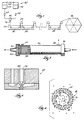
- Figure 1 diagrammatically illustrates a hollow fiber spinning system 60.
- a solution 62 of a polymer in an organic solvent is contained in vessel 64 from where it is pumped to an annular extrusion die 68 by means of a metering pump 66.
- a coagulant solution 72 which is a non-solvent for the polymer is contained in a second vessel 70 and is transferred to die 68 by means of another pump 74.
- non-solvent 72 and the polymer solution 62 at the interface 63 formed as the solutions exit the die in contact with each other determined the ultimate structure and properties of the inner membrane.
- the formed extrudate then falls through an air gap 76 and enters a bath 78 containing a second non-solvent coagulant solution 80.
- the interaction of the extrudate with the second solution 80 determines the structure and properties of the outer membrane.
- the fiber is pulled through bath 78 by means of driver roller 82 and through one or more additional baths 84, as required, to completely extract the solvent from hollow fibers.
- the extracted fiber is finally taken up onto a multi-segment winder 86 and allowed to dry.
- Dried fibers 88 are cut to length and placed in a housing 90.
- the fibers 88 are sealed in the housing by means of a thermosetting resin 92.
- the assembly is fitted with end caps 94 and 96.
- An inlet 97 and outlet 98 for filtrate liquid are also provided on the housing.
- Figure 5 and 6 illustrate in magnified cross-section a typical fiber 88 of the invention showing internal microporous structure 83, an inner skin 85 and an outer skin 87 having different porosity than inner skin 85.
- the overall sieving coefficient is the fraction of the incoming solute that passes through the membrane along with the fluid that is being filtered. It is calculated by dividing the concentration of solute on the downstream side of the membrane by its concentration on the upstream side of the membrane.
- the overall sieving coefficient is equal to the sieving coefficient of the skin, which is the fraction of solute that passes through that skin.
- the sieving coefficient of the skin itself depends only on the relative sizes of the pore and the solute molecule. The tighter the skin (i.e. smaller the pores), the smaller the fraction of a given molecule which will pass through it.
- the concentration of solute which reaches the second skin depends on the characteristics of the first skin as well as the flow conditions, so the overall sieving coefficient is a property of both flow and membrane properties.
- the key to the rectifying membrane, in which the sieving coefficient in one direction is different from the sieving coefficient in the other direction, is that flow in one direction results in buildup of solute within the two skins of the membrane.
- Figure 4 is a schematic of a dual-skinned rectifying membrane 88 in which the outer skin 12 is tighter than the inside skin 14 and fluid is passing from the inside to the outside as a result of an imposed pressure gradient.
- some of the molecules which enter the central area 16 of membrane 88 become trapped when they reach the tighter outer skin 12.
- the concentration inside the membrane goes up until it reaches a steady state value, and the resulting concentration in the fluid 20 outside the fiber goes up along with it.
- the concentration in the fiber lumen 18 has not changed, so the overall sieving coefficient increases with time until it reaches a steady-state value that is higher than would be obtained with the tight skin 12 alone.
- polymers can be employed in the process of the invention to form hollow fibers.
- the polymers must be soluble in at least one organic solvent and insoluble in another liquid that is miscible with the solvent.
- suitable polymers are polysulfone, polyacrylonitrile, polyamide, polyvinylidene diflouride, polypropylene, and polyethersulfone.
- solvents for such polymers include N-methyl-2-pyrrolidone, N,N'-dimethylformamide, N,N'-dimethylacetamide and ⁇ butyrolactone.
- the preferred non-solvent which can be used as a coagulation or gelation agent for formation of the skins is water.
- suitable liquids include methanol, ethanol-water mixtures such as 95 or 99.5 vol% ethanol in water, or isopropyl alcohol.
- Various materials can be added to the non-solvents to form skins of differing porosities. Examples include polyvinyl alcohol, Tetra-ethylene-glycol, poly-ethylene-glycol, perchlorate salts, and polyvinyl pyrrolidone.
- An important advantage of the present invention is the ability to provide fibers having different sieving coefficients for molecules to be filtered out of a liquid which have narrowly defined molecular weight ranges.
- fibers can be provided that have the ability to filter molecules in the range of 5000 to 10,000 differently from one side of the membrane than the other.
- the sieving coefficient differential can also be optimized for molecules having a molecular weight range of 10,000 to 15,000 or even 15,000 to 20,000. Optimization is achieved by adjusting the composition of the coagulant solution and the amount and type of dopants added, as well as by varying the spinning conditions such as flow rate, line speed and gap distance.
- Hollow fibers were prepared using the spinning system and processes described in Figures 1 and 2 under the formulation and process conditions shown in Table I.
- the fibers were assembled into test modules in accordance with Example 3 and the sieving coefficients determined in accordance with the procedure set forth therein.
- the sieving coefficients of the resulting fibers for myoglobin were found to be 0.35 when filtrate flow was directed radially outwardly and 0.80 when filtrate flow was inward.
- FIGS. 5 and 6 are scanning electron micrographs of the resulting fiber in cross-section taken at 2000 times magnification and 400 times magnification, respectively, showing the finger-like structures extending from each boundary and meeting in the middle wall. Sieving coefficients for myoglobin were found to be 0.45 for outward filtrate and 0.90 for inward flow.
- Test modules were assembled by potting 100 fibers in mini-dialyzer cases with a length of about 22 cm and an internal diameter of about 0.6 cm. Polyurethane potting extended approximately 1 cm from each header, leaving an active length of about 20 cm. Dialysate ports were located approximately 1 cm from the potting material at each end.
- the lumen and filtrate compartments were primed with alcohol (isopropanol or ethanol) using a syringe.
- the test module was then rinsed with excess dialysate, pumping 250 ml through lumen with filtrate port closed and then 200 ml more with one filtrate port open.
- the dialysate ports were closed, the infusion pump was set to the desired speed (10.5 ml/min), outflow was determined by timed collection.
- test module was clamped in a vertical position, with fibers perpendicular to the table top.
- An infusion pump was connected to an inlet reservoir, and tubing from the infusion pump was connected to the bottom header. Tubing to waste was connected to the top header.
- the dialysate ports were closed, the pump was started, and the time at which the test solution reached the device was denoted as time zero.
- a bioreactor of the present invention is shown in Figure 7 and consists of a device somewhat similar to the dialysis device shown in Figure 3. In this case, however, the space 89 surrounding the fibers and enclosed by the interior of housing 90 and thermosetting resin 92 forms a reaction vessel for growth of living cells. Ports 97 and 98 are normally closed by means of valves 99 and 100 as indicated. Depending on its size, the product may pass back through the membranes 88 and be purified from the waste stream or it may collect in the shell space which constitutes the reaction vessel from which it may be removed on either a semi-continuous or batch basis.
- Transport of nutrients, waste products and desired biological products across the membrane may be by diffusion and/or convection.
- the axial pressure drop which occurs within the hollow fibers leads to Starling's flow, with convection from the tube side to the shell side at the device inlet and convection from the shell side to the tube side at the device outlet.
- Some types of cells require expensive growth media which may contain 10% bovine fetal calf serum.
- Use of a rectifying membrane allows serum components to pass through the membranes to the cells and then be concentrated in the shell space, thereby reducing the volume of media required. This also reduces the cost of purifying products which pass through the membrane because the volume of the purification stream is smaller.
- Rectifying membranes can also be used to concentrate products directly. If the desired product is formed of molecules that are larger than the metabolic waste products as well as the nutrients, the rectifying membrane device can be used to concentrate the products in the shell space while allowing nutrients to reach the cells and waste products to be washed away by the fluid stream passing through the interiors of the hollow fiber membranes.
Landscapes
- Chemical & Material Sciences (AREA)
- Engineering & Computer Science (AREA)
- Chemical Kinetics & Catalysis (AREA)
- Health & Medical Sciences (AREA)
- Water Supply & Treatment (AREA)
- Organic Chemistry (AREA)
- Life Sciences & Earth Sciences (AREA)
- Bioinformatics & Cheminformatics (AREA)
- Zoology (AREA)
- Wood Science & Technology (AREA)
- Microbiology (AREA)
- Sustainable Development (AREA)
- Biotechnology (AREA)
- Biomedical Technology (AREA)
- Biochemistry (AREA)
- General Engineering & Computer Science (AREA)
- General Health & Medical Sciences (AREA)
- Genetics & Genomics (AREA)
- Urology & Nephrology (AREA)
- Separation Using Semi-Permeable Membranes (AREA)
- External Artificial Organs (AREA)
- Apparatus Associated With Microorganisms And Enzymes (AREA)
Claims (6)
- Fibre membrane polymère creuse à double peau, convenant pour l'hémodialyse, ayant une structure microporeuse formée d'un seul tenant avec des peaux intérieure et extérieure, la peau extérieure étant plus dense que la peau intérieure, la structure microporeuse contenant des pores capables de retenir des solutés d'un domaine de poids moléculaire sélectionné compris dans un domaine de poids moléculaire de 5000 à 20.000 suivant une concentration accrue entre les peaux intérieure et extérieure, la fibre membrane ayant un coefficient de partage d'ensemble pour la traversée dans un sens de fluides contenant des solutés comprenant des molécules dans ledit domaine de poids moléculaire sélectionné qui diffère du coefficient de partage d'ensemble pour la traversée de tels fluides dans le sens opposé.
- Fibre membrane suivant la revendication 1, qui est une fibre comprenant un polymère du type polysulfone.
- Fibre membrane suivant la revendication 1 ou 2, dans laquelle le domaine de poids moléculaire sélectionné est de 5000 à 10.000 ; de 10.000 à 15.000 ou de 15.000 à 20.000.
- Bioréacteur comprenant plusieurs fibres membranes (88) conformes à la revendication 1, 2 ou 3, fixées suivant une orientation dans l'ensemble parallèle dans une enceinte (90), les extrémités opposées de l'enceinte étant formées par une résine polymère qui enveloppe les parties extérieures des fibres, les extrémités opposées des fibres traversant la résine polymère, les parties extérieures des fibres et la partie intérieure de l'enceinte définissant un récipient de bioréaction pour la croissance de cellules vivantes,des moyens d'écoulement d'entrée (96) pour un fluide qui sont en communication d'écoulement de fluide avec les parties intérieures des membranes,des moyens d'écoulement de sortie (94) en communication d'écoulement de fluide avec les autres extrémités des membranes pour un écoulement de sortie du fluide etune ouverture (97, 98) normalement fermée, pour l'introduction et l'extraction de fluides à partir de l'intérieur du récipient.
- Dispositif de dialyse ou dispositif de filtration comprenant plusieurs fibres membranes polymères creuses à double peau (88) conformes à la revendication 1, 2 ou 3, fixées suivant une orientation dans l'ensemble parallèle dans une enceinte (90), les extrémités opposées de l'enceinte étant formées par une résine polymère qui enveloppe les parties extérieures des fibres, les extrémités opposées des fibres traversant la résine polymère, des moyens d'écoulement d'entrée (96) pour un liquide soumis à une dialyse ou à une filtration, lesdits moyens d'écoulement d'entrée étant en communication d'écoulement de fluide avec les parties intérieures des membranes,des moyens d'écoulement de sortie (94) en communication d'écoulement de fluide avec les autres extrémités des membranes pour un écoulement de sortie du liquide après dialyse ou filtration,un trajet d'écoulement de fluide comprenant des passages d'écoulements d'entrée et d'écoulement de sortie (97, 98) en communication d'écoulement de fluide avec l'intérieur de l'enceinte (90), ce qui peut faire s'écouler un second liquide en contact avec les surfaces extérieures des fibres.
- Procédé de production de produits biologiques consistant :à confiner des cellules vivantes dans un bioréacteur conforme à la revendication 4, à faire s'écouler un fluide contenant des éléments nutritifs pour lesdites cellules à travers les fibres membranes polymères creuses (88) de façon à permettre un transfert des éléments nutritifs à travers les membranes vers les cellules,à extraire des cellules des matières formant résidus alors qu'elles sont transférées à travers les fibres vers le fluide, puis à extraire un produit biologique hors du bioréacteur.
Applications Claiming Priority (3)
| Application Number | Priority Date | Filing Date | Title |
|---|---|---|---|
| US07/818,851 US5240614A (en) | 1992-01-10 | 1992-01-10 | Process for removing unwanted materials from fluids and for producing biological products |
| US818851 | 1992-01-10 | ||
| PCT/US1993/000132 WO1993014186A1 (fr) | 1992-01-10 | 1993-01-08 | Dialyseur, membrane et procede de rectification |
Publications (2)
| Publication Number | Publication Date |
|---|---|
| EP0576659A1 EP0576659A1 (fr) | 1994-01-05 |
| EP0576659B1 true EP0576659B1 (fr) | 2001-05-16 |
Family
ID=25226599
Family Applications (1)
| Application Number | Title | Priority Date | Filing Date |
|---|---|---|---|
| EP93903007A Expired - Lifetime EP0576659B1 (fr) | 1992-01-10 | 1993-01-08 | Membrane, dialyseur, bioreacteur et utilisation du bioreacteur |
Country Status (11)
| Country | Link |
|---|---|
| US (1) | US5240614A (fr) |
| EP (1) | EP0576659B1 (fr) |
| JP (1) | JP3197900B2 (fr) |
| KR (1) | KR100254664B1 (fr) |
| CN (1) | CN1031622C (fr) |
| AT (1) | ATE201230T1 (fr) |
| CA (1) | CA2104969A1 (fr) |
| DE (1) | DE69330221T2 (fr) |
| ES (1) | ES2158858T3 (fr) |
| TW (1) | TW265269B (fr) |
| WO (1) | WO1993014186A1 (fr) |
Families Citing this family (44)
| Publication number | Priority date | Publication date | Assignee | Title |
|---|---|---|---|---|
| JP2568043B2 (ja) * | 1991-05-21 | 1996-12-25 | ブラウン・ユニバーシテイ・リサーチ・フアウンデーシヨン | 中空繊維を形成するための装置と該繊維 |
| US5480552A (en) * | 1992-01-10 | 1996-01-02 | Baxter International Inc. | Method for concentrating a solute with an oscillating filtration device |
| US5527467A (en) * | 1992-01-10 | 1996-06-18 | Baxter International Inc. | Rectifying dialyzer, bioreactor and membrane |
| DE69419095T2 (de) * | 1993-03-09 | 2000-02-03 | Baxter International Inc., Deerfield | Rektifikationsdialysator, membran und bioreaktor |
| EP0750938B1 (fr) * | 1995-06-30 | 2005-02-16 | Toray Industries, Inc. | Procédé de fabrication d'une membrane semi-perméable à fibres creuses en polysulfone |
| US5714072A (en) * | 1995-11-06 | 1998-02-03 | Hoechst Celanese Corporation | Method for solvent extraction using a dual-skinned asymmetric microporous membrane |
| EP0946250B1 (fr) * | 1996-11-12 | 2004-06-30 | Whatman Inc. | Membrane polymere et hydrophile d'inversion de phase |
| US5955353A (en) * | 1997-05-22 | 1999-09-21 | Excorp Medical, Inc. | Hollow fiber bioreactor with an extrafilament flow plug |
| WO1999025463A1 (fr) * | 1997-11-14 | 1999-05-27 | Massachusetts Institute Of Technology | Appareil et procede de traitement du sang entier |
| US7186230B2 (en) * | 2002-03-04 | 2007-03-06 | Therakos, Inc | Method and apparatus for the continuous separation of biological fluids into components |
| US7211037B2 (en) | 2002-03-04 | 2007-05-01 | Therakos, Inc. | Apparatus for the continuous separation of biological fluids into components and method of using same |
| US7479123B2 (en) | 2002-03-04 | 2009-01-20 | Therakos, Inc. | Method for collecting a desired blood component and performing a photopheresis treatment |
| US7153286B2 (en) | 2002-05-24 | 2006-12-26 | Baxter International Inc. | Automated dialysis system |
| US7175606B2 (en) | 2002-05-24 | 2007-02-13 | Baxter International Inc. | Disposable medical fluid unit having rigid frame |
| US7238164B2 (en) | 2002-07-19 | 2007-07-03 | Baxter International Inc. | Systems, methods and apparatuses for pumping cassette-based therapies |
| US8029454B2 (en) | 2003-11-05 | 2011-10-04 | Baxter International Inc. | High convection home hemodialysis/hemofiltration and sorbent system |
| US7476209B2 (en) | 2004-12-21 | 2009-01-13 | Therakos, Inc. | Method and apparatus for collecting a blood component and performing a photopheresis treatment |
| CN101400388B (zh) * | 2006-03-09 | 2011-12-14 | 东洋纺织株式会社 | 性能稳定性优良的中空纤维膜及其制造方法和血液净化器 |
| US8062513B2 (en) | 2008-07-09 | 2011-11-22 | Baxter International Inc. | Dialysis system and machine having therapy prescription recall |
| US9514283B2 (en) | 2008-07-09 | 2016-12-06 | Baxter International Inc. | Dialysis system having inventory management including online dextrose mixing |
| US10626399B2 (en) | 2010-01-28 | 2020-04-21 | The Board Of Trustees Of The Leland Stanford Junior University | Methods of treating cognitive symptoms of an aging-associated impairment by modulating C-C chemokine receptor type 3 (CCR3) |
| US20160208011A1 (en) | 2010-01-28 | 2016-07-21 | The Board Of Trustees Of The Leland Stanford Junior University | Ccr3 modulation in the treatment of aging-associated impairments, and compositions for practicing the same |
| US10487148B2 (en) | 2010-01-28 | 2019-11-26 | The Board Of Trustees Of The Leland Stanford Junior University | Methods and compositions for treating aging-associated impairments |
| US8895291B2 (en) | 2010-10-08 | 2014-11-25 | Terumo Bct, Inc. | Methods and systems of growing and harvesting cells in a hollow fiber bioreactor system with control conditions |
| US9161968B2 (en) | 2011-04-08 | 2015-10-20 | The Board Of Trustees Of The Leland Stanford Junior University | Methods of neuroprotection involving macrophage colony stimulating factor receptor agonists |
| JP6612227B2 (ja) | 2013-11-16 | 2019-11-27 | テルモ ビーシーティー、インコーポレーテッド | バイオリアクターにおける細胞増殖 |
| JP6667438B2 (ja) | 2013-12-09 | 2020-03-18 | ザ ボード オブ トラスティーズ オブ ザ レランド スタンフォード ジュニア ユニバーシティー | 老化に関連する状態を処置する方法及び組成物 |
| US10905779B2 (en) | 2013-12-09 | 2021-02-02 | The Board Of Trustees Of The Leland Stanford Junior University | Methods for screening human blood products comprising plasma using immunocompromised rodent models |
| US11008547B2 (en) | 2014-03-25 | 2021-05-18 | Terumo Bct, Inc. | Passive replacement of media |
| WO2016049421A1 (fr) | 2014-09-26 | 2016-03-31 | Terumo Bct, Inc. | Alimentation programmée |
| CN107921188A (zh) | 2015-05-18 | 2018-04-17 | 小利兰·斯坦福大学托管委员会 | 用于治疗衰老相关的损伤的方法和组合物 |
| ES2902467T3 (es) | 2015-06-15 | 2022-03-28 | Univ Leland Stanford Junior | TIMP2 para su uso en el tratamiento de afecciones asociadas al envejecimiento |
| WO2017004592A1 (fr) | 2015-07-02 | 2017-01-05 | Terumo Bct, Inc. | Croissance cellulaire à l'aide de stimuli mécaniques |
| CN105664730B (zh) * | 2016-04-14 | 2017-12-05 | 北京航空航天大学 | 一种可调控液体单向透过范围的复合膜及其制备方法 |
| WO2017205667A1 (fr) | 2016-05-25 | 2017-11-30 | Terumo Bct, Inc. | Expansion cellulaire |
| US11685883B2 (en) | 2016-06-07 | 2023-06-27 | Terumo Bct, Inc. | Methods and systems for coating a cell growth surface |
| US11104874B2 (en) | 2016-06-07 | 2021-08-31 | Terumo Bct, Inc. | Coating a bioreactor |
| US11155785B2 (en) * | 2016-09-30 | 2021-10-26 | Toray Industries, Inc. | Incubated platelet concentration module and method for producing platelet preparation using same |
| US12234441B2 (en) | 2017-03-31 | 2025-02-25 | Terumo Bct, Inc. | Cell expansion |
| WO2018184028A2 (fr) | 2017-03-31 | 2018-10-04 | Terumo Bct, Inc. | Expansion cellulaire |
| US11624046B2 (en) | 2017-03-31 | 2023-04-11 | Terumo Bct, Inc. | Cell expansion |
| GB2619893A (en) | 2021-03-23 | 2023-12-20 | Terumo Bct Inc | Cell capture and expansion |
| US12209689B2 (en) | 2022-02-28 | 2025-01-28 | Terumo Kabushiki Kaisha | Multiple-tube pinch valve assembly |
| USD1099116S1 (en) | 2022-09-01 | 2025-10-21 | Terumo Bct, Inc. | Display screen or portion thereof with a graphical user interface for displaying cell culture process steps and measurements of an associated bioreactor device |
Citations (2)
| Publication number | Priority date | Publication date | Assignee | Title |
|---|---|---|---|---|
| EP0086365A1 (fr) * | 1982-01-29 | 1983-08-24 | Asahi Kasei Kogyo Kabushiki Kaisha | Membrane de fibre creuse de type résine aromatique polysulfone et procédé de sa fabrication |
| EP2242750A1 (fr) * | 2008-02-13 | 2010-10-27 | Bristol-Myers Squibb Company | Dérivés de diphényle à restriction conformationnelle utilisés comme inhibiteurs du virus de l'hépatite c |
Family Cites Families (20)
| Publication number | Priority date | Publication date | Assignee | Title |
|---|---|---|---|---|
| US4230463A (en) * | 1977-09-13 | 1980-10-28 | Monsanto Company | Multicomponent membranes for gas separations |
| FR2380052A1 (fr) * | 1977-02-11 | 1978-09-08 | Akzo Nv | Membrane de dialyse pour l'hemodialyse |
| JPS54145379A (en) * | 1978-05-02 | 1979-11-13 | Asahi Chem Ind Co Ltd | Aromatic polysulfone hollow fiber semipermeable membrane |
| DE2823985C2 (de) * | 1978-06-01 | 1986-01-02 | Akzo Gmbh, 5600 Wuppertal | Dialysemembran |
| US4822489A (en) * | 1981-08-22 | 1989-04-18 | Asahi Kasei Kogyo Kabushiki Kaisha | Aromatic polysulfone type resin hollow fiber membrane and a process for producing the same |
| JPS60246812A (ja) * | 1984-05-18 | 1985-12-06 | Daicel Chem Ind Ltd | ポリスルホン系樹脂製中空糸 |
| DE3584562D1 (de) * | 1984-06-13 | 1991-12-05 | Inst Nat Rech Chimique | Verfahren zur herstellung von hohlfasern und ihre verwendung in membrantrennverfahren. |
| EP0198033A4 (fr) * | 1984-10-09 | 1989-02-09 | Endotronics Inc | Dispositif de culture a fibres creuses pour ameliorer la perfusion de substances nutritives et la concentration des produits, et procede de fonctionnement. |
| JPS61164602A (ja) * | 1985-01-17 | 1986-07-25 | Daicel Chem Ind Ltd | ポリスルホン系樹脂製中空糸膜 |
| JPS621404A (ja) * | 1985-06-27 | 1987-01-07 | Mitsubishi Rayon Co Ltd | 多層複合中空繊維状膜及びその製造法 |
| JP2542572B2 (ja) * | 1985-11-15 | 1996-10-09 | 日機装 株式会社 | 中空繊維 |
| JPS62241528A (ja) * | 1986-04-10 | 1987-10-22 | Nisso Eng Kk | トリクロロエチレン含有排ガスの処理方法 |
| DE3851572T2 (de) * | 1987-06-12 | 1995-05-24 | Kuraray Co | Polysulfon-Hohlfasermembran und Verfahren zu ihrer Herstellung. |
| US5015585A (en) * | 1988-02-23 | 1991-05-14 | Robinson James R | Method and apparatus for culturing and diffusively oxygenating cells on isotropic membranes |
| JPH01299610A (ja) * | 1988-05-28 | 1989-12-04 | Nikkiso Co Ltd | 半透膜およびその製造方法 |
| JPH01310668A (ja) * | 1988-06-09 | 1989-12-14 | Nikkiso Co Ltd | 中空糸型血液浄化装置 |
| US5084349A (en) * | 1988-09-07 | 1992-01-28 | Terumo Kabushiki Kaisha | Hollow cellulose fibers, method for making, and fluid processing apparatus using same |
| US5049276A (en) * | 1988-10-13 | 1991-09-17 | Fuji Photo Film Co., Ltd. | Hollow fiber membrane |
| FR2640638B1 (fr) * | 1988-12-20 | 1991-02-15 | Commissariat Energie Atomique | Bioreacteur et dispositif pour la culture de cellules animales |
| JPH02245176A (ja) * | 1989-03-17 | 1990-09-28 | Nok Corp | 酸素供給型バイオリアクター |
-
1992
- 1992-01-10 US US07/818,851 patent/US5240614A/en not_active Expired - Lifetime
-
1993
- 1993-01-08 WO PCT/US1993/000132 patent/WO1993014186A1/fr not_active Ceased
- 1993-01-08 AT AT93903007T patent/ATE201230T1/de not_active IP Right Cessation
- 1993-01-08 CA CA002104969A patent/CA2104969A1/fr not_active Abandoned
- 1993-01-08 DE DE69330221T patent/DE69330221T2/de not_active Expired - Lifetime
- 1993-01-08 EP EP93903007A patent/EP0576659B1/fr not_active Expired - Lifetime
- 1993-01-08 JP JP51257593A patent/JP3197900B2/ja not_active Expired - Lifetime
- 1993-01-08 ES ES93903007T patent/ES2158858T3/es not_active Expired - Lifetime
- 1993-01-08 KR KR1019930702698A patent/KR100254664B1/ko not_active Expired - Fee Related
- 1993-01-09 CN CN93101176A patent/CN1031622C/zh not_active Expired - Fee Related
- 1993-01-12 TW TW082100142A patent/TW265269B/zh active
Patent Citations (2)
| Publication number | Priority date | Publication date | Assignee | Title |
|---|---|---|---|---|
| EP0086365A1 (fr) * | 1982-01-29 | 1983-08-24 | Asahi Kasei Kogyo Kabushiki Kaisha | Membrane de fibre creuse de type résine aromatique polysulfone et procédé de sa fabrication |
| EP2242750A1 (fr) * | 2008-02-13 | 2010-10-27 | Bristol-Myers Squibb Company | Dérivés de diphényle à restriction conformationnelle utilisés comme inhibiteurs du virus de l'hépatite c |
Non-Patent Citations (1)
| Title |
|---|
| B. KLINKE ET AL: "BETA-2-MICROGLOBULIN ADSORPTION AND RELEASE IN-VITRO: INFLUENCE OF MEMBRANE MATERIAL, OSMOLALITY AND HEPARIN", THE INTERNATIONAL JOURNAL OF ARTIFICIAL ORGANS, vol. 11, no. 5, 1988, pages 355 - 360 * |
Also Published As
| Publication number | Publication date |
|---|---|
| CA2104969A1 (fr) | 1993-07-11 |
| TW265269B (fr) | 1995-12-11 |
| DE69330221D1 (de) | 2001-06-21 |
| KR100254664B1 (ko) | 2000-05-01 |
| US5240614A (en) | 1993-08-31 |
| WO1993014186A1 (fr) | 1993-07-22 |
| JP3197900B2 (ja) | 2001-08-13 |
| JPH06505640A (ja) | 1994-06-30 |
| ATE201230T1 (de) | 2001-06-15 |
| CN1078410A (zh) | 1993-11-17 |
| EP0576659A1 (fr) | 1994-01-05 |
| DE69330221T2 (de) | 2002-04-18 |
| ES2158858T3 (es) | 2001-09-16 |
| CN1031622C (zh) | 1996-04-24 |
Similar Documents
| Publication | Publication Date | Title |
|---|---|---|
| US5240614A (en) | Process for removing unwanted materials from fluids and for producing biological products | |
| US5527467A (en) | Rectifying dialyzer, bioreactor and membrane | |
| EP0692996B1 (fr) | Procede de concentration de solute par changement continuel de la direction de filtration en travers d'une membrane asymetrique | |
| EP0294737B1 (fr) | Membrane en polysulfone sous forme de fibre creuse et son procédé de fabrication | |
| US10188991B2 (en) | Permselective asymmetric membranes | |
| EP1469934A2 (fr) | Membranes de fibres creuses a surface spiralee | |
| CA2007799A1 (fr) | Membrane hydrophile sur support | |
| EP1201293A1 (fr) | Faisceau de fibres creuses pour le traitement extracorporel du sang et du plasma et son procédé de fabrication | |
| RU2108144C1 (ru) | Ацетатцеллюлозная полупроницаемая мембрана в виде полого волокна, способ изготовления половолоконной полупроницаемой ацетатцеллюлозной мембраны, гемодиализатор и прибор для обработки экстракорпоральной крови | |
| EP0644928B1 (fr) | Dialyseur de rectification, bioreacteur et membrane | |
| CA1184716A (fr) | Membrane de plasmaphorese | |
| JP4103037B2 (ja) | 透析液清浄化用中空糸膜およびその製造方法 | |
| EP0824960A1 (fr) | Membrane fibre creuse a base de polymere de polysulfone et son procede de production | |
| US4830796A (en) | Process for preparing a polyester-amide hollow fiber membrane |
Legal Events
| Date | Code | Title | Description |
|---|---|---|---|
| PUAI | Public reference made under article 153(3) epc to a published international application that has entered the european phase |
Free format text: ORIGINAL CODE: 0009012 |
|
| 17P | Request for examination filed |
Effective date: 19930910 |
|
| AK | Designated contracting states |
Kind code of ref document: A1 Designated state(s): AT BE CH DE ES FR GB IT LI NL SE |
|
| 17Q | First examination report despatched |
Effective date: 19970828 |
|
| GRAG | Despatch of communication of intention to grant |
Free format text: ORIGINAL CODE: EPIDOS AGRA |
|
| RTI1 | Title (correction) |
Free format text: MEMBRANE, RECTIFYING DIALYZER, BIOREACTOR AND THE RELEVANT USE THEREOF |
|
| GRAG | Despatch of communication of intention to grant |
Free format text: ORIGINAL CODE: EPIDOS AGRA |
|
| GRAG | Despatch of communication of intention to grant |
Free format text: ORIGINAL CODE: EPIDOS AGRA |
|
| GRAH | Despatch of communication of intention to grant a patent |
Free format text: ORIGINAL CODE: EPIDOS IGRA |
|
| GRAH | Despatch of communication of intention to grant a patent |
Free format text: ORIGINAL CODE: EPIDOS IGRA |
|
| GRAA | (expected) grant |
Free format text: ORIGINAL CODE: 0009210 |
|
| AK | Designated contracting states |
Kind code of ref document: B1 Designated state(s): AT BE CH DE ES FR GB IT LI NL SE |
|
| REF | Corresponds to: |
Ref document number: 201230 Country of ref document: AT Date of ref document: 20010615 Kind code of ref document: T |
|
| REG | Reference to a national code |
Ref country code: CH Ref legal event code: NV Representative=s name: KIRKER & CIE SA Ref country code: CH Ref legal event code: EP |
|
| REF | Corresponds to: |
Ref document number: 69330221 Country of ref document: DE Date of ref document: 20010621 |
|
| ET | Fr: translation filed | ||
| ITF | It: translation for a ep patent filed | ||
| REG | Reference to a national code |
Ref country code: ES Ref legal event code: FG2A Ref document number: 2158858 Country of ref document: ES Kind code of ref document: T3 |
|
| REG | Reference to a national code |
Ref country code: GB Ref legal event code: IF02 |
|
| PLBE | No opposition filed within time limit |
Free format text: ORIGINAL CODE: 0009261 |
|
| STAA | Information on the status of an ep patent application or granted ep patent |
Free format text: STATUS: NO OPPOSITION FILED WITHIN TIME LIMIT |
|
| 26N | No opposition filed | ||
| PGFP | Annual fee paid to national office [announced via postgrant information from national office to epo] |
Ref country code: AT Payment date: 20021219 Year of fee payment: 11 |
|
| PGFP | Annual fee paid to national office [announced via postgrant information from national office to epo] |
Ref country code: NL Payment date: 20021223 Year of fee payment: 11 Ref country code: CH Payment date: 20021223 Year of fee payment: 11 |
|
| PGFP | Annual fee paid to national office [announced via postgrant information from national office to epo] |
Ref country code: BE Payment date: 20030114 Year of fee payment: 11 |
|
| PG25 | Lapsed in a contracting state [announced via postgrant information from national office to epo] |
Ref country code: AT Free format text: LAPSE BECAUSE OF NON-PAYMENT OF DUE FEES Effective date: 20040108 |
|
| PG25 | Lapsed in a contracting state [announced via postgrant information from national office to epo] |
Ref country code: LI Free format text: LAPSE BECAUSE OF NON-PAYMENT OF DUE FEES Effective date: 20040131 Ref country code: CH Free format text: LAPSE BECAUSE OF NON-PAYMENT OF DUE FEES Effective date: 20040131 Ref country code: BE Free format text: LAPSE BECAUSE OF NON-PAYMENT OF DUE FEES Effective date: 20040131 |
|
| PGFP | Annual fee paid to national office [announced via postgrant information from national office to epo] |
Ref country code: ES Payment date: 20040212 Year of fee payment: 12 |
|
| BERE | Be: lapsed |
Owner name: *BAXTER INTERNATIONAL INC. Effective date: 20040131 |
|
| PG25 | Lapsed in a contracting state [announced via postgrant information from national office to epo] |
Ref country code: NL Free format text: LAPSE BECAUSE OF NON-PAYMENT OF DUE FEES Effective date: 20040801 |
|
| REG | Reference to a national code |
Ref country code: CH Ref legal event code: PL |
|
| NLV4 | Nl: lapsed or anulled due to non-payment of the annual fee |
Effective date: 20040801 |
|
| PG25 | Lapsed in a contracting state [announced via postgrant information from national office to epo] |
Ref country code: IT Free format text: LAPSE BECAUSE OF NON-PAYMENT OF DUE FEES;WARNING: LAPSES OF ITALIAN PATENTS WITH EFFECTIVE DATE BEFORE 2007 MAY HAVE OCCURRED AT ANY TIME BEFORE 2007. THE CORRECT EFFECTIVE DATE MAY BE DIFFERENT FROM THE ONE RECORDED. Effective date: 20050108 |
|
| PG25 | Lapsed in a contracting state [announced via postgrant information from national office to epo] |
Ref country code: ES Free format text: LAPSE BECAUSE OF NON-PAYMENT OF DUE FEES Effective date: 20050110 |
|
| REG | Reference to a national code |
Ref country code: ES Ref legal event code: FD2A Effective date: 20050110 |
|
| PGFP | Annual fee paid to national office [announced via postgrant information from national office to epo] |
Ref country code: FR Payment date: 20110301 Year of fee payment: 19 Ref country code: SE Payment date: 20110127 Year of fee payment: 19 Ref country code: DE Payment date: 20110127 Year of fee payment: 19 |
|
| PGFP | Annual fee paid to national office [announced via postgrant information from national office to epo] |
Ref country code: GB Payment date: 20110125 Year of fee payment: 19 |
|
| REG | Reference to a national code |
Ref country code: SE Ref legal event code: EUG |
|
| GBPC | Gb: european patent ceased through non-payment of renewal fee |
Effective date: 20120108 |
|
| REG | Reference to a national code |
Ref country code: FR Ref legal event code: ST Effective date: 20120928 |
|
| PG25 | Lapsed in a contracting state [announced via postgrant information from national office to epo] |
Ref country code: SE Free format text: LAPSE BECAUSE OF NON-PAYMENT OF DUE FEES Effective date: 20120109 Ref country code: DE Free format text: LAPSE BECAUSE OF NON-PAYMENT OF DUE FEES Effective date: 20120801 Ref country code: GB Free format text: LAPSE BECAUSE OF NON-PAYMENT OF DUE FEES Effective date: 20120108 |
|
| REG | Reference to a national code |
Ref country code: DE Ref legal event code: R119 Ref document number: 69330221 Country of ref document: DE Effective date: 20120801 |
|
| PG25 | Lapsed in a contracting state [announced via postgrant information from national office to epo] |
Ref country code: FR Free format text: LAPSE BECAUSE OF NON-PAYMENT OF DUE FEES Effective date: 20120131 |