EP0581733A2 - Reaktivfarbstoffe, Verfahren zu deren Herstellung und deren Verwendung - Google Patents
Reaktivfarbstoffe, Verfahren zu deren Herstellung und deren Verwendung Download PDFInfo
- Publication number
- EP0581733A2 EP0581733A2 EP93810508A EP93810508A EP0581733A2 EP 0581733 A2 EP0581733 A2 EP 0581733A2 EP 93810508 A EP93810508 A EP 93810508A EP 93810508 A EP93810508 A EP 93810508A EP 0581733 A2 EP0581733 A2 EP 0581733A2
- Authority
- EP
- European Patent Office
- Prior art keywords
- alkyl
- radical
- formula
- sulfo
- halogen
- Prior art date
- Legal status (The legal status is an assumption and is not a legal conclusion. Google has not performed a legal analysis and makes no representation as to the accuracy of the status listed.)
- Granted
Links
- GWSMPZJQOXPOFA-UHFFFAOYSA-N CCP[N+](C)(C=C)[O-] Chemical compound CCP[N+](C)(C=C)[O-] GWSMPZJQOXPOFA-UHFFFAOYSA-N 0.000 description 1
Classifications
-
- C—CHEMISTRY; METALLURGY
- C09—DYES; PAINTS; POLISHES; NATURAL RESINS; ADHESIVES; COMPOSITIONS NOT OTHERWISE PROVIDED FOR; APPLICATIONS OF MATERIALS NOT OTHERWISE PROVIDED FOR
- C09B—ORGANIC DYES OR CLOSELY-RELATED COMPOUNDS FOR PRODUCING DYES, e.g. PIGMENTS; MORDANTS; LAKES
- C09B62/00—Reactive dyes, i.e. dyes which form covalent bonds with the substrates or which polymerise with themselves
- C09B62/02—Reactive dyes, i.e. dyes which form covalent bonds with the substrates or which polymerise with themselves with the reactive group directly attached to a heterocyclic ring
- C09B62/022—Reactive dyes, i.e. dyes which form covalent bonds with the substrates or which polymerise with themselves with the reactive group directly attached to a heterocyclic ring the heterocyclic ring being alternatively specified
- C09B62/026—Azo dyes
- C09B62/03—Disazo or polyazo dyes
-
- C—CHEMISTRY; METALLURGY
- C09—DYES; PAINTS; POLISHES; NATURAL RESINS; ADHESIVES; COMPOSITIONS NOT OTHERWISE PROVIDED FOR; APPLICATIONS OF MATERIALS NOT OTHERWISE PROVIDED FOR
- C09B—ORGANIC DYES OR CLOSELY-RELATED COMPOUNDS FOR PRODUCING DYES, e.g. PIGMENTS; MORDANTS; LAKES
- C09B62/00—Reactive dyes, i.e. dyes which form covalent bonds with the substrates or which polymerise with themselves
- C09B62/44—Reactive dyes, i.e. dyes which form covalent bonds with the substrates or which polymerise with themselves with the reactive group not directly attached to a heterocyclic ring
- C09B62/4401—Reactive dyes, i.e. dyes which form covalent bonds with the substrates or which polymerise with themselves with the reactive group not directly attached to a heterocyclic ring with two or more reactive groups at least one of them being directly attached to a heterocyclic system and at least one of them being directly attached to a non-heterocyclic system
- C09B62/4403—Reactive dyes, i.e. dyes which form covalent bonds with the substrates or which polymerise with themselves with the reactive group not directly attached to a heterocyclic ring with two or more reactive groups at least one of them being directly attached to a heterocyclic system and at least one of them being directly attached to a non-heterocyclic system the heterocyclic system being a triazine ring
- C09B62/4411—Azo dyes
- C09B62/4415—Disazo or polyazo dyes
Definitions
- the present invention relates to new reactive dyes, processes for their preparation and their use for dyeing or printing fiber materials.
- the object of the present invention is therefore to find new, improved reactive dyes for dyeing and printing fiber materials which have the qualities characterized above to a high degree.
- the new dyes should above all be distinguished by high fixing yields and high fiber-dye binding stabilities, and moreover the portions which are not fixed on the fiber should be easy to wash out. They should also give dyeings with good general fastness properties, for example light and wet fastness properties.
- Suitable C 1 -C 4 alkyl for R 1 , R 2 and R 3 are, independently of one another, methyl, ethyl, propyl, isopropyl, butyl, isobutyl, sec-butyl or tert-butyl, in particular methyl.
- Suitable C 1 -C 4 alkoxy for R i , R 2 and R 3 are, independently of one another, methoxy, ethoxy, propoxy, isopropoxy, butoxy, isobutoxy, sec-butoxy or tert-butoxy, in particular methoxy.
- Suitable C 2 -C 4 alkanoylamino for R 1 , R 2 and R 3 are, for example, acetylamino or propionylamino, in particular acetylamino, independently of one another.
- halogen for R 1 , R 2 and R 3 independently of one another are, for example: Fluorine, bromine or especially chlorine.
- the radical R 1 is preferably hydrogen.
- the radical R 3 is preferably hydrogen.
- the radical R 2 is preferably sulfo.
- the radical R 2 in particular the radical R 2 as sulfo, is preferably bonded in the ortho position to the azo bridge which connects the radical A to the phenylene agent component.
- R ' is preferably hydrogen or a C 1 -C 4 alkyl radical and particularly preferably hydrogen, methyl or ethyl. R 'is particularly preferably hydrogen.
- the reactive radicals for Y 1 are, in particular, those of the formulas or into consideration, wherein X is a group which can be split off as an anion and
- T is a group which can be split off as an anion, a non-reactive radical or a fiber-reactive radical of the formula or
- U 1 is preferably a group of the formula -CI, -OSO 3 H, -SS0 3 H, -OCO-CH 3 , -OCO-C 6 H 5 or -OPO 3 H 2 , in particular -CI or -OSO 3 H, preferably -OSO 3 H.
- Alk and alk ' are independent of each other e.g. a methylene, ethylene, 1,3-propylene, 1,4-butylene, 1,5-pentylene or 1,6-hexylene radical or their branched isomers.
- Alk and alk ' are preferably a C 1 -C 4 alkylene radical and particularly preferably an ethylene radical.
- Arylene is preferably a 1,3- or 1,4-phenylene radical which is unsubstituted or e.g. is substituted by sulfo, methyl, methoxy or carboxy.
- R is preferably hydrogen.
- R 4 is preferably hydrogen or C 1 -C 4 alkyl, such as methyl, ethyl, propyl, isopropyl, butyl, isobutyl, sec-butyl or tert-butyl. R 4 is particularly preferably hydrogen.
- R 6 preferably denotes hydrogen, methyl or ethyl, especially hydrogen.
- E preferably represents -NH- or -O- and particularly preferably -O-.
- W preferably denotes a group of the formula -CONH- or -NHCO-, in particular a group of the formula -CONH-.
- Hal in the radical Z 1 is preferably chlorine or in particular bromine.
- P is preferably the number 0.
- W is a group of the formula -CONH- or -NHCO-
- R, R 4 , R 5 and R 6 are hydrogen
- E is the radical -O- or -NH-
- U 1 is a group of the formula -CI , -OSO 3 H, -SS0 3 H, -OCO-CH 3 , -OCO-C 6 H 5 or -OPO 3 H 2 , in particular a group of the formula -CI or -OS0 3 H and preferably -OSO 3 H, is.
- X represents, for example, halogen, such as fluorine, chlorine or bromine, sulfo, C 1 -C 4 -alkylsulfonyl or phenylsulfonyl and preferably halogen, in particular fluorine or chlorine.
- T is a group which can be split off as an anion, this is, for example, halogen, such as fluorine, chlorine or bromine, sulfo, C 1 -C 4 -alkylsulfonyl or phenylsulfonyl and preferably halogen, in particular fluorine or chlorine.
- halogen such as fluorine, chlorine or bromine
- sulfo C 1 -C 4 -alkylsulfonyl or phenylsulfonyl
- halogen in particular fluorine or chlorine.
- T stands for a non-reactive radical, this can be, for example, hydroxy, C 1 -C 4 alkoxy, C 1 -C 4 alkylthio, morpholino or optionally substituted amino.
- the optionally substituted amino for T is unsubstituted amino or, for example, NC 1 -C 4 alkylamino or N, N-di-C 1 -C 4 alkylamino, the alkyl optionally being substituted, for example, by sulfo, sulfato, hydroxy, carboxy or phenyl , Cyclohexylamino, NC 1 -C 4 alkyl-N-phenylamino, phenylamino, naphthylamino or NC 1 -C 4 alkyl-N-naphthylamino into consideration, where the phenyl or naphthyl optionally, for example by C 1 -C 4 alkyl, C 1 -C 4 alkoxy, C 2 -
- non-reactive radicals T are amino, methylamino, ethylamino, ß-hydroxyethylamino, N, N-di-ß-hydroxyethylamino, ß-sulfoethylamino, cyclohexylamino, morpholino, o-, m- or p-chlorophenylamino, o-, m- or p-methylphenylamino, o-, m- or p-methoxyphenylamino, o-, m- or p-sulfophenylamino, disulfophenylamino, o-carboxyphenylamino, 1- or 2-naphthylamino, 1-sulfo-2-naphthylamino, 4, 8-disulfo-2-naphthylamino, 1,5-disulfo-2-naphthylamino N-
- T preferably has the meaning C 1 -C 4 alkoxy, C 1 -C 4 alkylthio, hydroxy, amino, NC 1 -C 4 alkylamino, which is unsubstituted in the alkyl part or substituted by hydroxy, sulfato or sulfo , Morpholino, phenylamino unsubstituted in the phenyl ring or naphthyl ring or substituted by sulfo, carboxy, C 2 -C 4 alkanoylamino, C 1 -C 4 alkyl or C 1 -C 4 alkoxy, NC 1 -C 4 alkyl N-phenylamino, naphthylamino or NC 1 -C 4 alkyl-N-naphthylamino.
- Particularly preferred non-reactive radicals T are C 1 -C 4 alkoxy, morpholino, unsubstituted in the phenyl ring or naphthyl ring or by sulfo, carboxy, C 2 -C 4 alkanoylamino, C 1 -C 4 alkyl or C 1 -C 4 Alkoxy substituted phenylamino, NC 1 -C 4 alkyl-N-phenylamino, naphthylamino or NC 1 -C 4 alkyl-N-naphthylamino.
- the radical T is preferably halogen, in particular fluorine or chlorine, unsubstituted in the phenyl ring or naphthyl ring or by sulfo, carboxy, C 2 -C 4 alkanoylamino, C 1 -C 4 alkyl or C 1 -C 4 alkoxy substituted phenylamino, NC 1 -C 4 -alkyl-N-phenylamino, naphthylamino or NC 1 -C 4 -alkyl-N-naphthylamino, or a reactive radical of the formulas (4a) to (4f), for which the meanings given above and favors apply.
- halogen in particular fluorine or chlorine
- the radical X 1 which can be split off as an anion is preferably halogen, in particular fluorine or chlorine.
- X 1 is a non-reactive substituent
- the meanings and preferences mentioned above for T as meaning a non-reactive substituent can be considered.
- the radical X 1 is particularly preferably halogen, in particular fluorine or chlorine.
- Suitable radicals X 2 are nitro, cyano, C 1 -C 4 -alkylsulfonyl, carboxy, chlorine, hydroxy, C 1 -C 4 -alkoxysulfonyl, C 1 -C 4 -alkylsulfinyl, C 1 -C 4 -alkoxycarbonyl or C 2 -C 4 alkanoyl, where the meanings chlorine, cyano and methylsulfonyl are preferred for X 2 .
- X 2 is particularly preferably halogen, in particular chlorine.
- Reactive radicals of the formula (2) are preferred in which X is halogen and the preferences given above apply to T.
- Preferred reactive radicals of the formula (3) are those in which both substituents X 1 are halogen, in particular chlorine or fluorine, and X 2 is halogen, in particular chlorine.
- Particularly preferred reactive radicals of the formula (3) are those in which both substituents X 1 are fluorine or chlorine and X 2 is chlorine.
- Y 1 is preferably a reactive radical of the formula (2) or (3), in which X, X 1 and X 2 are halogen and T is halogen, unsubstituted in the phenyl ring or naphthyl ring or by sulfo, carboxy, C 2 -C 4 -alkanoylamino, C 1 -C 4 alkyl or C 1 -C 4 alkoxy substituted phenylamino, NC 1 -C 4 alkyl-N-phenylamino, naphthylamino or NC 1 -C 4 alkyl-N-naphthylamino or in particular a fiber-reactive radical of the formulas ( 4a) to (4f), where the meanings and preferences given above apply to the reactive radicals of the formulas (4a) to (4f).
- the radical A in the reactive dye of the formula (1) can contain the substituents customary in organic dyes.
- substituents in radical A are: alkyl groups with 1 to 12 carbon atoms, in particular 1 to 4 carbon atoms, such as methyl, ethyl, propyl, isopropyl or butyl, alkoxy groups with 1 to 8 carbon atoms, in particular 1 to 4 carbon atoms, such as methoxy, Aethoxy, propoxy, isopropoxy or butoxy, alkanoylamino groups with 2 to 8 carbon atoms, in particular 2 to 4 carbon atoms, such as acetylamino or propionylamino, phenyl or naphthylamino, alkoxycarbonylamino groups with 2 to 8 carbon atoms, in particular 2 to 4 carbon atoms, alkanoyl groups with 2 to 8 carbon atoms , in particular 2 to 4 carbon atoms, alkoxycarbonyl having 1 to 4 carbon atoms in the alkoxy radical, such as methoxycarbonyl or ethoxycarbonyl, alkyl
- the alkyl radicals can also be interrupted by oxygen (-O-).
- substituents are those which may be interrupted in the alkyl moiety by oxygen (with the exception of methyl) and, for example by hydroxyl, sulfo, sulfato, cyano, optionally substituted by C 1 -C 4 alkyl further substituted C 5 -C 7 - Cycloalkyl or optionally substituted by C 1 -C 4 alkyl, C 1 -C 4 alkoxy, C 2 -C 4 alkanoylamino, halogen or sulfo phenyl or naphthyl.
- Preferred substituents containing a phenyl or naphthyl radical are those which may be further substituted in the phenyl or naphthyl radical by C 1 -C 4 alkyl, C 1 -C 4 alkoxy, C 2 -C 4 alkanoylamino, halogen or sulfo.
- the fiber-reactive radicals in radical A are e.g. Reactive radicals of the formulas (2) and (3) into consideration, which are bonded to the radical A in particular via a bridge member of the formula -N (R ') -, for R' and the reactive radicals of the formulas (2) and (3) the meanings and preferences given above apply.
- Particularly preferred fiber-reactive radicals in the A radical are those of the formulas (2) and (3), in which X, X 1 and X 2 are halogen, in particular fluorine or chlorine, and T is a group which can be split off as an anion or a non-reactive radical.
- Very particularly preferred fiber-reactive radicals in the A radical are those of the formulas (2) and (3), in which X, X 1 and X 2 are halogen, in particular fluorine or chlorine, and T is halogen, hydroxyl, sulfo, C 1 -C 4 -alkoxy , C 1 -C 4 alkylthio, C 1 -C 4 alkylsulfonyl, phenylsulfonyl, morpholino or optionally substituted amino.
- the radical T here is in particular halogen, C 1 -C 4 alkoxy, C 1 -C 4 alkylthio, hydroxy, amino, NC 1 -C 4 alkylamino, which is unsubstituted in the alkyl part or by hydroxy, sulfato or Sulfo is substituted, morpholino, phenylamino which is unsubstituted in the phenyl ring or naphthyl ring or substituted by sulfo, carboxy, C 2 -C 4 alkanoylamino, C 1 -C 4 alkyl or C 1 -C 4 alkoxy, NC 1 -C 4 -Alkyl-N-phenylamino, naphthylamino or NC 1 -C 4 -alkyl-N-naphthylamino.
- the radical T in the phenyl ring or naphthyl ring is very particularly preferably phenylamino which is unsubstituted or substituted by sulfo, carboxy, C 2 -C 4 alkanoylamino, C 1 -C 4 alkyl or C 1 -C 4 alkoxy, NC 1 -C 4 - Alkyl-N-phenylamino, naphthylamino or NC 1 -C 4 -alkyl-N-naphthylamino, sulfo being particularly suitable as a substituent.
- the radical A is preferably an optionally substituted benzene, naphthalene, 6-hydroxypyride (2) -one, pyrazole or pyrimidine radical, the substituents and the meanings and preferences given above being particularly applicable.
- Preferred substituents of the radical A are C 1 -C 4 alkyl, C 1 -C 4 alkoxy, C 2 -C 6 alkanoylamino, C 2 -C 8 alkoxycarbonylamino, optionally by C 1 -C 4 alkyl, C 1 -C 4 alkoxy, C 2 -C 4 alkanoylamino, halogen or sulfo substituted phenyl, phenylamino or benzoylamino, cyano, hydroxyl, carbamoyl, carboxyl, sulfomethyl, ureido, halogen, sulfo, sulfato, amino or by cyano or C 1 -C 12 -Alkyl-substituted amino, where the C 1 -C 12 -alkyl radical is optionally substituted by phenyl, naphthyl, C 5 -C 7 -cycloalkyl, hydroxyl, sulfo
- Particularly preferred radicals A are those of the formulas (5) to (9) and (11).
- Preferred radicals of the formula (5) are those in which R 7 and R 9 are C 1 -C 4 -alkyl.
- R 8 the meaning as cyano, carbamoyl or sulfomethyl is preferred.
- Preferred radicals of the formula (6) are those in which R 10 and R 11 independently of one another are hydroxyl, amino or amino substituted by C 1 -C 8 -alkyl, in particular C 1 -C 4 -alkyl, in which the alkyl radical is optionally substituted by hydroxyl, Sulfo or sulfato is further substituted and, with the exception of methyl, can be interrupted by oxygen.
- R 12 the meaning as hydroxyl, phenyl or optionally substituted by cyano amino is preferred.
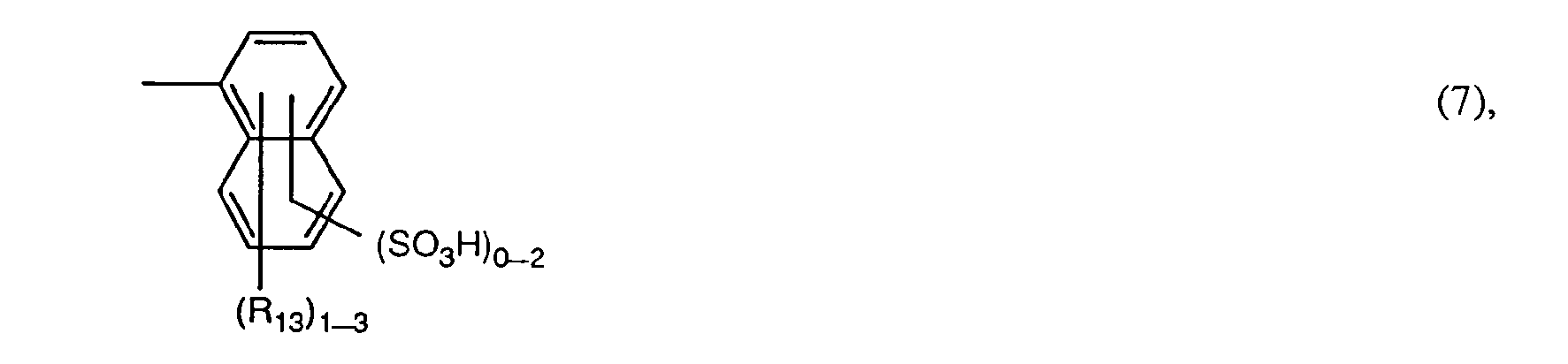
- Preferred radicals of the formula (7) are those in which R 13 represents hydrogen, hydroxyl, amino or NC 1 -C 4 alkylamino.
- the rest of the formula (7) preferably contains only one sulfo group.
- Preferred radicals of the formula (8) are those in which R 15 and R 16 independently of one another are hydrogen, an optionally further substituted halotriazine or halopyrimidine reactive radical or C 1 -C 8 -alkyl which is optionally substituted by hydroxyl, sulfo, sulfato or phenyl, where the Phenyl radical can be further substituted by C 1 -C 4 alkyl, C 1 -C 4 alkoxy, C 2 -C 4 alkanoylamino, halogen or sulfo, in particular by sulfo.
- the radical R 14 is preferably hydrogen, C 2 -C 6 -alkanoylamino, halogen, ureido or sulfo, in particular hydrogen, C 2 -C 6 -alkanoylamino or ureido.
- the aromatic radical bonded in the 1-position is preferably a phenyl radical.
- R 21 is preferably C 1 -C 4 alkyl, in particular methyl,
- R 22 is preferably hydrogen or sulfo, in particular sulfo and
- R 23 is preferably amino.
- radicals of the formulas (5) to (10) only the radicals of the formulas (8) and (9) preferably contain an optionally further substituted halogenopyrimidine or halotriazine reactive radical.
- radicals of the formulas (8) to (10) are preferably the reactive radicals mentioned for the radical A, for which the meanings and preferences given above apply.
- Reactive dyes of the formula (1) are very particularly preferred, in which A is a radical of the formulas (5) to (9) or (11), R 'is hydrogen or C 1 -C 4 -alkyl and Y 1 is a radical of the formulas (2) or (3), where X, X 1 and X 2 are halogen and T is halogen, unsubstituted in the phenyl ring or naphthyl ring or by sulfo, carboxy, C 2 -C 4 alkanoylamino, C 1 -C 4 alkyl or C 1 -C 4- Alkoxy substituted phenylamino, NC 1 -C 4 alkyl-N-phenylamino, naphthylamino or NC 1 -C 4 alkyl-N-naphthylamino or in particular a fiber-reactive radical of the For mine is (4a) to (4f).
- Reactive dyes of the formula are of particular interest wherein R 1 , R 3 , R ', A and Y 1 have the meanings and preferences given above.
- Reactive dyes of the formula are of particular interest wherein Y 1 and A have the meanings and preferences given above.
- the invention further relates to a process for the preparation of the reactive dyes of the formula (1), which is characterized in that an amine of the formula diazotized and on a compound of formula couples and optionally connects a further conversion reaction, where R ', R 1 , R 2 , R 3 , Y 1 and Adie have meanings given under formula (1).
- the diazotization of the amine of the formula (15) is generally carried out by the action of nitrous acid in aqueous mineral acid solution at low temperature, such as e.g. 0 to 10 ° C, the coupling to the coupling component of the formula (16) at acidic, neutral to weakly alkaline pH values, in particular at a pH value from 2 to 8.
- a modified embodiment of the method consists in first using a dye produces that contains a precursor of the reactive radical, and subsequently converts it into the final stage, for example by esterification or an addition reaction.
- a dye in which Z is a HOCH 2 CH 2 - radical can be prepared and this product can be reacted with sulfuric acid so that the hydroxyl group is converted into the sulfato group.
- the sulfation of the hydroxyl group takes place, for example, by reaction with concentrated sulfuric acid at about 0 ° C. to moderately elevated temperature.
- elimination reactions can be connected to the synthesis.
- reactive dyes of the formula (1) which contain sulfatoethylsulfonyl radicals can be eliminated by means of Treat sodium hydroxide, whereby the sulfatoethylsulfonyl residues are converted into vinylsulfonyl residues.
- the reactive dyestuffs of the formula (1) can be prepared by starting from precursors or intermediate products for dyestuffs which contain fiber-reactive residues, or by introducing these fiber-reactive residues into suitable intermediate products having a dye character.
- the amines of formula (15) can be obtained by using a compound of formula wherein R i , R 2 , R 3 and R 'have the meanings given above, with fiber-reactive radicals of the halotriazine or halopyrimidine series, in particular a compound of the formula or
- Hal ' is halogen, in particular fluorine or chlorine, condenses.
- the condensation is usually carried out in aqueous solution, at a temperature of, for example, 0 to 50 ° C and a pH of e.g. 4 to 9.
- the reactive dyes of the formula (1) are suitable for dyeing and printing a wide variety of materials, such as hydroxyl group-containing or nitrogen-containing fiber materials. Examples include silk, leather, wool, polyamide fibers and polyurethanes, and in particular cellulose-containing fiber materials of all kinds called. Such cellulose-containing fiber materials are, for example, the natural cellulose fibers, such as cotton, linen and hemp, as well as cellulose and regenerated cellulose.
- the reactive dyes of the formula (1) are also suitable for dyeing or printing fibers containing hydroxyl groups which are contained in blended fabrics, for example mixtures of cotton with polyester fibers or polyamide fibers.
- the reactive dyes of the formula (1) are particularly suitable for dyeing or printing cellulosic fiber materials or in particular natural or synthetic polyamide fiber materials.
- the dyes according to the invention can be applied to the fiber material and fixed on the fiber in various ways, in particular in the form of aqueous dye solutions and printing pastes. They are suitable both for the exhaust process and for dyeing according to the foulard dyeing process, according to which the goods are impregnated with aqueous, optionally salt-containing dye solutions, and the dyes are fixed after an alkali treatment or in the presence of alkali, if appropriate under the action of heat. They are particularly suitable for the so-called cold residence process, after which the dye is applied to the foulard together with the alkali and is then fixed by storage at room temperature for several hours. After fixation, the dyeings or prints are thoroughly rinsed with cold and hot water, if appropriate with the addition of a dispersing agent which promotes the diffusion of the unfixed portions.
- the reactive dyes of the formula (1) are notable for high reactivity, good fixing power and very good build-up power. They can therefore be used at low dyeing temperatures using the pull-out color process and only require short steaming times with the pad-steam process.
- the degrees of fixation are high and the unfixed portions can be easily washed out, the difference between the degree of exhaustion and the degree of fixation being remarkably small, i.e. the soap loss is very low.
- the reactive dyes of the formula (1) are also particularly suitable for printing, especially on cotton, but also for printing nitrogen-containing fibers, e.g. wool or silk or blended fabrics containing wool or silk.
- the dyeings and prints produced with the dyes according to the invention have a high color strength and a high fiber-dye binding stability, both in the acidic and in the alkaline range, furthermore good light fastness and very good wet fastness properties, such as washing, water, sea water, Over-dyeing and perspiration fastness, as well as good pleating fastness, ironing fastness and rubbing fastness.
- the compound of the formula (102) thus obtained is then added to 500 parts of water and diazotized in the customary manner (by acidification with hydrochloric acid and addition of an aqueous sodium nitrite solution)
- Example 2 parts of the reactive dye obtained in Example 1 are dissolved in 400 parts of water; 1500 parts of a solution containing 53 g of sodium chloride per liter are added. This dye bath is mixed with 100 parts of cotton fabric at 40 ° C. After 45 minutes, 100 parts of a solution containing 16 g of sodium hydroxide and 20 g of calcined soda per liter are added. The temperature of the dyebath is kept at 40 ° C. for a further 45 minutes. The dyed goods are then rinsed, soaped at the boil with a nonionic detergent for a quarter of an hour, rinsed again and dried.
- Example 3 parts of the reactive dye obtained in Example 1 are sprinkled with rapid stirring into 100 parts of a stock thickener containing 50 parts of 5% sodium alginate thickener, 27.8 parts of water, 20 parts of urea, 1 part of sodium m-nitrobenzenesulfonate and 1.2 parts of sodium hydrogen carbonate .
- a cotton fabric is printed with the printing paste thus obtained, and the printed material obtained is dried and steamed in saturated steam at 102 ° C. for 2 minutes. The printed fabric is then rinsed, if necessary soaped at the boil and rinsed again, and then dried.
Landscapes
- Chemical & Material Sciences (AREA)
- Organic Chemistry (AREA)
- Coloring (AREA)
Abstract

worin R1, R2, R3, R', A und Y1 die in Anspruch 1 angegebenen Bedeutungen haben, eignen sich besonders zum Färben oder Bedrucken von cellulosischen Fasermaterialien oder natürlichen oder synthetischen Polyamidfasermaterialien, bei hoher färberischer Ausbeute, und ergeben Färbungen und Drucke mit guten Echtheitseigenschaften.
Description
- Die vorliegende Erfindung betrifft neue Reaktivfarbstoffe, Verfahren zu deren Herstellung und deren Verwendung zum Färben oder Bedrucken von Fasermaterialien.
- Die Praxis des Färbens mit Reaktivfarbstoffen hat in neuerer Zeit zu erhöhten Anforderungen an die Qualität der Färbungen und die Wirtschaftlichkeit des Färbeprozesses geführt. Infolge dessen besteht weiterhin ein Bedarf nach neuen Reaktivfarbstoffen, welche verbesserte Eigenschaften, insbesondere in bezug auf die Applikation, aufweisen.
- Für das Färben werden heute Reaktivfarbstoffe gefordert, die eine ausreichende Substantivität haben und die zugleich eine gute Auswaschbarkeit der nicht fixierten Anteile aufweisen. Sie sollen ferner eine gute färberische Ausbeute aufweisen und hohe Reaktivität besitzen, wobei insbesondere Färbungen mit hohen Fixiergraden geliefert werden sollen. Von den bekannten Farbstoffen werden diese Anforderungen nicht in allen Eigenschaften erfüllt.
- Dervorliegenden Erfindung liegt daher die Aufgabe zugrunde, neue, verbesserte Reaktivfarbstoffe für das Färben und Bedrucken von Fasermaterialien zu finden, welche die oben charakterisierten Qualitäten in hohem Masse besitzen. Die neuen Farbstoffe sollten sich vor allem durch hohe Fixierausbeuten und hohe Faser-Farbstoff-Bindungsstabilitäten auszeichnen, und ausserdem sollten die nicht auf der Faser fixierten Anteile leicht auswaschbar sein. Sie sollten ferner Färbungen mit guten Allgemeinechtheiten, beispielsweise Licht- und Nassechtheiten, ergeben.
- Es hat sich gezeigt, dass mit den weiter unten definierten neuen reaktiven Farbstoffen die gestellte Aufgabe weitgehend gelöst wird.
- Gegenstand der Erfindung sind daher Reaktivfarbstoffe der Formel

worin A ein Rest der Benzolreihe, der Naphthalinreihe oder der heterocyclischen Reihe ist, - R1 und R3 unabhängig voneinander Wasserstoff, C1-C4-Alkyl, C1-C4-Alkoxy,
- C2-C4-Alkanoylamino, Halogen oder Sulfo bedeuten,
- R2 C1-C4-Alkyl, C1-C4-Alkoxy, C2-C4-Alkanoylamino, Halogen oder Sulfo,
- R' Wasserstoff oder unsubstituiertes oder durch Carboxy, Cyano, Hydroxy, Sulfo oder Sulfato substituiertes C1-C4-Alkyl und
- Y1 ein gegebenenfalls weitersubstituierter Halogentriazin- oder Halogenpyrimidin-Reaktivrest ist.
- Als C1-C4-Alkyl kommen für R1, R2 und R3 unabhängig voneinander Methyl, Aethyl, Propyl, Isopropyl, Butyl, Isobutyl, sek.-Butyl oder tert.-Butyl, insbesondere Methyl, in Betracht.
- Als C1-C4-Alkoxy kommen für Ri, R2 und R3 unabhängig voneinander Methoxy, Aethoxy, Propoxy, Isopropoxy, Butoxy, Isobutoxy, sek.-Butoxy oder tert.-Butoxy, insbesondere Methoxy, in Betracht.
- Als C2-C4-Alkanoylamino kommen für R1, R2 und R3 unabhängig voneinander z.B. Acetylamino oder Propionylamino, insbesondere Acetylamino, in Betracht.
- Als Halogen kommen für R1, R2 und R3 unabhängig voneinanderz.B. Fluor, Brom oder insbesondere Chlor in Betracht.
- Der Rest R1 ist bevorzugt Wasserstoff.
- Der Rest R3 ist bevorzugt Wasserstoff.
- Bei dem Rest R2 handelt es sich bevorzugt um Sulfo. Der Rest R2, insbesondere der Rest R2 als Sulfo, ist vorzugsweise in ortho-Stellung zurAzobrücke, welche den Rest A mit der Phenylen-Mittelkomponente verbindet, gebunden.
- R' ist vorzugsweise Wasserstoff oder ein C1-C4-Alkylrest und insbesondere bevorzugt Wasserstoff, Methyl oder Aethyl. Besonders bevorzugt ist R' Wasserstoff.
- Als Reaktivreste kommen für Y1 insbesondere solche der Formeln

oder
in Betracht, worin X eine als Anion abspaltbare Gruppe und - T eine als Anion abspaltbare Gruppe, ein nicht-reaktiver Rest oder ein faserreaktiver Rest der Formel


oder
- ist, wobei Weine Gruppe der Formel -SO2-NR4-, -CONR4- oder-NR4CO- ist, R4 Wasserstoff, unsubstituiertes oder durch Hydroxy, Sulfo, Sulfato, Carboxy oder Cyano substituiertes C1-C4-Alkyl oder ein Rest der Formel

- R6 Wasserstoff oder unsubstituiertes oder durch Hydroxy, Sulfo, Sulfato, Carboxy oder Cyano substituiertes C1-C4-Alkyl, R Wasserstoff, Hydroxy, Sulfo, Sulfato, Carboxy, Cyano, Halogen, C1-C4-Alkoxycarbonyl, C1-C4-Alkanoyloxy, Carbamoyl oder die Gruppe -SO2-Z ist, Z eine Gruppe der Formel -CH=CH2 oder -CH2-CH2-U1 und U1 eine Abgangsgruppe ist, Z1 eine Gruppe der Formel

und Hal Halogen bedeutet, E der Rest -O- oder -NR5- und R5 Wasserstoff oder C1-C4-Atkyt ist, alk und alk' unabhängig voneinander C1-C6-Alkylen bedeuten, arylen einen unsubstituierten oder durch Sulfo, Carboxy, C1-C4-Alkyl, C1-C4-Alkoxy, C2-C4-Alkanyolamino oder Halogen substituierten Phenylen- oder Naphthylenrest bedeutet und p 0 oder 1 ist,
einer der Reste X1 eine als Anion abspaltbare Gruppe ist und der andere RestX1 ein nicht-reaktiver Substituent oder ein Rest der Formeln (4a) bis (4f) oder eine als Anion abspaltbare Gruppe ist und - X2 ein negativer Substituent ist. Geeignete Abgangsgruppen U1 sind z.B. -CI, -Br, -F, -OSO3H, -SS03H, -OCO-CH3, -OPO3H2, -OCO-CCI3, -OCO-CHCI2, -OCO-CH2CI, -OS02-C1-C4-Alkyl, -OSO2-N(C1-C4-Alkyl)2 oder -OCO-C6H5.
- Bevorzugt ist U1 eine Gruppe der Formel -CI, -OSO3H, -SS03H, -OCO-CH3, -OCO-C6H5 oder -OPO3H2, insbesondere -CI oder -OSO3H, vorzugsweise -OSO3H.
- Bei alk und alk' handelt es sich unabhängig voneinanderz.B. um einen Methylen-, Äthylen-, 1,3-Propylen-, 1,4-Butylen-, 1,5-Pentylen- oder 1,6-Hexylenrest oder deren verzweigte Isomere.
- Bevorzugt stehen alk und alk' für einen C1-C4-Alkylenrest und insbesondere bevorzugt für einen Äthylenrest.
- Arylen ist vorzugsweise ein 1,3- oder 1,4-Phenylenrest, der unsubstituiert oder z.B. durch Sulfo, Methyl, Methoxy oder Carboxy substituiert ist.
- R bedeutet bevorzugt Wasserstoff.
- R4 ist vorzugsweise Wasserstoff oder C1-C4-Alkyl, wie Methyl, Aethyl, Propyl, Isopropyl, Butyl, Isobutyl, sek.-Butyl oder tert.-Butyl. Besonders bevorzugt ist R4 Wasserstoff.
- R6 bedeutet bevorzugt Wasserstoff, Methyl oder Aethyl, insbesondere Wasserstoff.
- E steht vorzugsweise für -NH- oder -O- und insbesondere bevorzugt für -O-.
- W bedeutet bevorzugt eine Gruppe der Formel -CONH- oder-NHCO-, insbesondere eine Gruppe der Formel -CONH-.
- Hal im Rest Z1 ist vorzugsweise Chlor oder insbesondere Brom.
- Bevorzugt ist p die Zahl 0.
- Bevorzugt sind solche Reaktivreste, worin W eine Gruppe der Formel -CONH- oder -NHCO-, R, R4, R5 und R6 Wasserstoff, E der Rest -O- oder -NH- und U1 eine Gruppe der Formel -CI, -OSO3H, -SS03H, -OCO-CH3, -OCO-C6H5 oder -OPO3H2, insbesondere eine Gruppe der Formel -CI oder -OS03H und vorzugsweise -OSO3H, ist.
- X steht z.B. für Halogen, wie Fluor, Chlor oder Brom, Sulfo, C1-C4-Alkylsulfonyl oder Phenylsulfonyl und bevorzugt für Halogen, insbesondere für Fluor oder Chlor.
- Bedeutet T eine als Anion abspalt bare Gruppe, so handelt es sich hierbei z.B. um Halogen, wie Fluor, Chlor oder Brom, Sulfo, C1-C4-Alkylsulfonyl oder Phenylsulfonyl und bevorzugt um Halogen, insbesondere um Fluor oder Chlor.
- Steht T für einen nicht-reaktiven Rest, so kann dieser z.B. Hydroxy, C1-C4-Alkoxy, C1-C4-Alkylthio, Morpholino oder gegebenenfalls substituiertes Amino sein. Als gegebenenfalls substituiertes Amino kommt für T unsubstituiertes Amino oder beispielsweise N-C1-C4-Alkylamino oder N,N-Di-C1-C4-Alkylamino, wobei das Alkyl gegebenenfalls z.B. durch Sulfo, Sulfato, Hydroxy, Carboxy oder Phenyl substituiert ist, Cyclohexylamino, N-C1-C4-Alkyl-N-phenylamino, Phenylamino, Naphthylamino oder N-C1-C4-Alkyl-N-naphthylamino in Betracht, wobei das Phenyl oder Naphthyl gegebenenfalls z.B. durch C1-C4-Alkyl, C1-C4-Alkoxy, C2-C4-Alkanoy- lamino, Carboxy, Sulfo oder Halogen substituiert ist, in Betracht.
- Beispiele für geeignete nicht-reaktive Reste T sind Amino, Methylamino, Äthylamino, ß-Hydroxyäthylamino, N,N-Di-ß-Hydroxyäthylamino, ß-Sulfoäthylamino, Cyclohexylamino, Morpholino, o-, m- oder p-Chlorphenylamino, o-, m- oder p-Methylphenylamino, o-, m- oder p-Methoxyphenylamino, o-, m- oder p-Sulfophenylamino, Disulfophenylamino, o-Carboxyphenylamino, 1- oder 2-Naphthylamino, 1-Sulfo-2-naphthylamino, 4,8-Disulfo-2-naphthylamino, 1,5-Disulfo-2-naphthylamino N-Äthyl-N-phenylamino, N-Methyl-N-phenylamino, Methoxy, Äthoxy, n- oder iso-Propoxy sowie Hydroxy.
- Als nicht-reaktiver Rest hat Tvorzugsweise die Bedeutung C1-C4-Alkoxy, C1-C4-Alkylthio, Hydroxy, Amino, N-C1-C4-Alkylamino, das im Alkylteil unsubstituiert oder durch Hydroxy, Sulfato oder Sulfo substituiert ist, Morpholino, im Phenylring oder Naphthylring unsubstituiertes oder durch Sulfo, Carboxy, C2-C4-Alkanoylami- no, C1-C4-Alkyl oder C1-C4-Alkoxy substituiertes Phenylamino, N-C1-C4-Alkyl-N-phenylamino, Naphthylamino oder N-C1-C4-Alkyl-N-naphthylamino.
- Besonders bevorzugte nicht-reaktive Reste T sind C1-C4-Alkoxy, Morpholino, im Phenylring oder Naphthylring unsubstituiertes oder durch Sulfo, Carboxy, C2-C4-Alkanoylamino, C1-C4-Alkyl oder C1-C4-Alkoxy substituiertes Phenylamino, N-C1-C4-Alkyl-N-phenylamino, Naphthylamino oder N-C1-C4-Alkyl-N-naphthylamino.
- Bevorzugt handelt es sich bei dem Rest T um Halogen, insbesondere Fluor oder Chlor, im Phenylring oder Naphthylring unsubstituiertes oder durch Sulfo, Carboxy, C2-C4-Alkanoylamino, C1-C4-Alkyl oder C1-C4-Alkoxy substituiertes Phenylamino, N-C1-C4-Alkyl-N-phenylamino, Naphthylamino oder N-C1-C4-Alkyl-N-naphthylamino, oder um einen reaktiven Rest der Formeln (4a) bis (4f), für welche die oben angegebenen Bedeutungen und Bevorzugungen gelten.
- Bei dem als Anion abspaltbaren RestX1 handelt es sich vorzugsweise um Halogen, insbesondere um Fluor oder Chlor.
- Handelt es sich bei X1 um einen nicht-reaktiven Substituenten, so kommen z.B. die oben für T in der Bedeutung als nicht-reaktiver Substituent genannten Bedeutungen und Bevorzugungen in Betracht.
- Besonders bevorzugt handelt es sich bei dem Rest X1 um Halogen, insbesondere um Fluor oder Chlor.
- Beispiele für geeignete Reste X2 sind Nitro, Cyan, C1-C4-Alkylsulfonyl, Carboxy, Chlor, Hydroxy, C1-C4-Alkoxysulfonyl, C1-C4-Alkylsulfinyl, C1-C4-Alkoxycarbonyl oder C2-C4-Alkanoyl, wobei die Bedeutungen Chlor, Cyano und Methylsulfonyl für X2 bevorzugt sind. Besonders bevorzugt ist X2 Halogen, insbesondere Chlor.
- Bevorzugt sind Reaktivreste der Formel (2), worin X Halogen ist und für T die oben angegebenen Bevorzugungen gelten.
- Als Reaktivreste der Formel (3) sind solche bevorzugt, worin beide Substituenten X1 Halogen, insbesondere Chlor oder Fluor, bedeuten und X2 Halogen, insbesondere Chlor, ist.
- Besonders bevorzugt als Reaktivreste der Formel (3) sind solche, worin beide Substituenten X1 Fluor oder Chlor bedeuten und X2 Chlor ist.
- Bevorzugt ist Y1 ein Reaktivrest der Formel (2) oder (3), worin X, X1 und X2 Halogen bedeuten und T Halogen, im Phenylring oder Naphthylring unsubstituiertes oder durch Sulfo, Carboxy, C2-C4-Alkanoylamino, C1-C4-Alkyl oder C1-C4-Alkoxy substituiertes Phenylamino, N-C1-C4-Alkyl-N-phenylamino, Naphthylamino oder N-C1-C4-Alkyl-N-naphthylamino oder insbesondere ein faserreaktiver Rest der Formeln (4a) bis (4f) ist, wobei fürdie Reaktivreste der Formeln (4a) bis (4f) die oben angegebenen Bedeutungen und Bevorzugungen gelten.
- Der Rest A im Reaktivfarbstoff der Formel (1) kann die bei organischen Farbstoffen üblichen Substituenten enthalten.
- Als Beispiele für Substituenten im Rest A seien genannt: Alkylgruppen mit 1 bis 12 Kohlenstoffatomen, insbesondere 1 bis 4 Kohlenstoffatomen, wie Methyl, Aethyl, Propyl, Isopropyl oder Butyl, Alkoxygruppen mit 1 bis 8 Kohlenstoffatomen, insbesondere 1 bis 4 Kohlenstoffatomen, wie Methoxy, Aethoxy, Propoxy, Isopropoxy oder Butoxy, Alkanoylaminogruppen mit 2 bis 8 Kohlenstoffatomen, insbesondere 2 bis 4 Kohlenstoffatomen, wie Acetylamino oder Propionylamino, Phenyl- oder Naphthylamino, Alkoxycarbonylaminogruppen mit 2 bis 8 Kohlenstoffatomen, insbesondere 2 bis 4 Kohlenstoffatomen, Alkanoylgruppen mit 2 bis 8 Kohlenstoffatomen, insbesondere 2 bis 4 Kohlenstoffatomen, Alkoxycarbonyl mit 1 bis 4 Kohlenstoffatomen im Alkoxyrest, wie Methoxycarbonyl oderAethoxycarbonyl, Alkylsulfonyl mit 1 bis 4 Kohlenstoffatomen, wie Methylsulfonyl oder Aethylsulfonyl, Phenyl- oder Naphthylsulfonyl, Alkoxycarbonyl mit 1 bis 4 Kohlenstoffatomen im Alkoxyrest, wie Methoxycarbonyl oder Aethoxycarbonyl, Benzoyl, gegebenenfalls am Stickstoff durch C1-C4-Alkyl substituiertes Benzoylamino, Phenyl, Naphthyl, Amino, durch C1-C12-Alkyl, Phenyl, Naphthyl oder Cyano mono- oder disubstituiertes Amino, Trifluormethyl, Nitro, Cyano, Hydroxyl, Halogen, wie Fluor, Chlor oder Brom, Carbamoyl, N-Alkylcarbamoyl mit 1 bis 4 Kohlenstoffatomen im Alkylrest, wie N-Methylcarbamoyl oder N-Aethylcarbamoyl, Sulfamoyl, N-Alkylsulfamoyl mit 1 bis 4 Kohlenstoffatomen, wie N-Methylsulfamoyl, N-Aethylsulfamoyl, N-Propylsulfamoyl, N-Isopropylsulfamoyl oder N-Butylsulfamoyl, N-(ß-Hydroxyäthyl)-sulfamoyl, N,N-Di-(ß-hydroxyäthyl)-sulfamoyl, N-Phenylsulfamoyl, Ureido, Carboxy, Sulfomethyl, Sulfo oder Sulfato sowie faserreaktive Reste, wobei die einen Alkyl-, Phenyl- oder Naphthylrest enthaltenden Substituenten im Alkyl-, Phenyl- oder Naphthylrest weitersubstituiert sein können, wie z.B. durch die oben für A genannten Substituenten. Die Alkylreste können zudem durch Sauerstoff (-O-) unterbrochen sein. Bevorzugt als einen Alkylrest enthaltende Substituenten sind solche, welche im Alkylrest durch Sauerstoff unterbrochen sein können (mit Ausnahme von Methyl) und beispielsweise durch Hydroxy, Sulfo, Sulfato, Cyano, gegebenenfalls durch C1-C4-Alkyl weitersubstituiertes C5-C7-Cycloalkyl oder gegebenenfalls durch C1-C4-Alkyl, C1-C4-Alkoxy, C2-C4-Alkanoylamino, Halogen oder Sulfo weitersubstituiertes Phenyl oder Naphthyl substituiert sein können. Bevorzugt als einen Phenyl- oder Naphthylrest enthaltende Substituenten sind solche, welche im Phenyl- oder Naphthylrest durch C1-C4-Alkyl, C1-C4-Alkoxy, C2-C4-Alkanoylamino, Halogen oder Sulfo weitersubstituiert sein können.
- Als faserreaktive Reste im Rest A kommen z.B. Reaktivreste der Formeln (2) und (3) in Betracht, welche insbesondere über ein Brückenglied der Formel -N(R')- an den Rest A gebunden sind, wobei für R' und die Reaktivreste der Formeln (2) und (3) die oben angegebenen Bedeutungen und Bevorzugungen gelten.
- Besonders bevorzugte faserreaktive Reste im Rest Asind solche der Formeln (2) und (3), worin X, X1 und X2 Halogen, insbesondere Fluor oder Chlor, sind und T eine als Anion abspaltbare Gruppe oder ein nicht-reaktiver Rest ist.
- Ganz besonders bevorzugte faserreaktive Reste im Rest Asind solche der Formeln (2) und (3), worin X, X1 und X2 Halogen, insbesondere Fluor oder Chlor, sind und T Halogen, Hydroxy, Sulfo, C1-C4-Alkoxy, C1-C4-Alkylthio, C1-C4-Alkylsulfonyl, Phenylsulfonyl, Morpholino oder gegebenenfalls substituiertes Amino ist. Hierbei handelt es sich bei dem Rest T insbesondere um Halogen, C1-C4-Alkoxy, C1-C4-Alkylthio, Hydroxy, Amino, N-C1-C4-Alkylamino, das im Alkylteil unsubstituiert oder durch Hydroxy, Sulfato oder Sulfo substituiert ist, Morpholino, im Phenylring oder Naphthylring unsubstituiertes oder durch Sulfo, Carboxy, C2-C4-Alkanoylami- no, C1-C4-Alkyl oder C1-C4-Alkoxy substituiertes Phenylamino, N-C1-C4-Alkyl-N-phenylamino, Naphthylamino oder N-C1-C4-Alkyl-N-naphthylamino. Ganz besonders bevorzugt ist der Rest T im Phenylring oder Naphthylring unsubstituiertes oder durch Sulfo, Carboxy, C2-C4-Alkanoylamino, C1-C4-Alkyl oder C1-C4-Alkoxy substituiertes Phenylamino, N-C1-C4-Alkyl-N-phenylamino, Naphthylamino oder N-C1-C4-Alkyl-N-naphthylamino, wobei als Substituent insbesondere Sulfo in Betracht kommt.
- Der Rest A ist bevorzugt ein gegebenenfalls substituierter Benzol-, Naphthalin-, 6-Hydroxypyrid-(2)-on-, Pyrazol- oder Pyrimidinrest, wobei für die Substituenten insbesondere die oben angegebenen Bedeutungen und Bevorzugungen gelten.
- Bevorzugte Substituenten des Restes A sind C1-C4-Alkyl, C1-C4-Alkoxy, C2-C6-Alkanoylamino, C2-C8-Al- koxycarbonylamino, gegebenenfalls durch C1-C4-Alkyl, C1-C4-Alkoxy, C2-C4-Alkanoylamino, Halogen oder Sulfo substituiertes Phenyl, Phenylamino oder Benzoylamino, Cyano, Hydroxyl, Carbamoyl, Carboxyl, Sulfomethyl, Ureido, Halogen, Sulfo, Sulfato, Aminooderdurch CyanooderC1-C12-Alkyl substituiertes Amino, wobei der C1-C12-Alkylrest gegebenenfalls durch Phenyl, Naphthyl, C5-C7-Cycloalkyl, Hydroxyl, Sulfo oder Sulfato substituiert ist, der Phenyl- und Naphthylrest durch C1-C4-Alkyl, C1-C4-Alkoxy, C2-C4-Alkanoylamino, Halogen oder Sulfo und der C5-C7-Cycloalkylrest durch C1-C4-Alkyl weitersubstituiert sein kann und der C1-C12-Alkylrest mit Ausnahme von Methyl durch Sauerstoff unterbrochen sein kann. Als weitere bevorzugte Substituenten des Restes Akommen Reaktivreste in Betracht, für welche die oben angegebenen Bedeutungen und Bevorzugungen gelten.
- Ganz besonders bevorzugt handelt es sich bei dem Rest A um einen Rest der Formel

- worin R7 und Rg unabhängig voneinander Wasserstoff, C1-C4-Alkyl oder gegebenenfalls durch C1-C4-Alkyl, C1-C4-Alkoxy, C2-C4-Alkanoylamino, Halogen oder Sulfo substituiertes Phenyl bedeuten und R8 Wasserstoff, Cyano, Carbamoyl oder Sulfomethyl ist, oder einen Rest der Formel

- worin R10 und R11 unabhängig voneinander Hydroxyl, Amino oder durch C1-C12-Alkyl substituiertes Amino, worin der C1-C12-Alkylrest gegebenenfalls durch Hydroxyl, Sulfo oder Sulfato weitersubstituiert ist und mit Ausnahme von Methyl durch Sauerstoff unterbrochen sein kann, bedeuten und R12 Wasserstoff, C1-C4-Alkyl, Hydroxyl, gegebenenfalls durch Cyano substituiertes Amino oder gegebenenfalls durch C1-C4-Alkyl, C1-C4-Al- koxy, C2-C4-Alkanoylamino, Halogen oder Sulfo substituiertes Phenyl bedeutet, oder einen Rest der Formel

- worin (R13)1-3 für 1 bis 3 gleiche oder voneinander verschiedene Substituenten aus der Gruppe Wasserstoff, C1-C4-Alkyl, C1-C4-Alkoxy, C2-C4-Alkanoylamino, Halogen, Hydroxyl, Amino oder N-mono- oder N,N-Di-C1-C4-Alkylamino steht, oder einen Rest der Formel

- worin R14 Wasserstoff, C1-C4-Alkyl, C1-C4-Alkoxy, C2-C6-Alkanoylamino, C2-C8-Alkoxycarbonylamino, Ureido, Halogen oder Sulfo ist und R15 und R16 unabhängig voneinander Wasserstoff, ein gegebenenfalls weitersubstituierter Halogenpyrimidin- oder Halogentriazin-Reaktivrest oder gegebenenfalls durch Hydroxy, Sulfo, Sulfato, Phenyl oder C5-C7-Cycloalkyl substituiertes C1-C8-Alkyl sind, wobei der Phenylrest durch C1-C4-Alkyl, C1-C4-Alkoxy, C2-C4-Alkanoylamino, Halogen oder Sulfo und der C5-C7-Cycloalkylrest durch C1-C4-Alkyl weitersubstituiert sein kann, oder einen Rest der Formel

- worin R17 Wasserstoff oder C1-C4-Alkyl und R18 C2-C6-Alkanoyl, gegebenenfalls durch C1-C4-Alkyl, C1-C4-Al- koxy, C2-C4-Alkanoylamino, Halogen oder Sulfo substituiertes Benzoyl oder einen gegebenenfalls weitersubstituierten Halogenpyrimidin- oder Halogentriazin-Reaktivrest bedeutet, oder einen Rest der Formel

- worin R19 Wasserstoff, C1-C4-Alkyl, C1-C4-Alkoxy, C2-C4-Alkanoylamino, Halogen oder Sulfo ist und R20 gegebenenfalls durch C1-C4-Alkyl, C1-C4-Alkoxy, C2-C4-Alkanoylamino, Halogen oder Sulfo substituiertes Phenyl oder einen gegebenenfalls weitersubstituierten Halogenpyrimidin- oder Halogentriazin-Reaktivrest bedeutet, oder einen Rest der Formel

- worin R21 C1-C4-Alkyl oder Carboxyl, R22 Wasserstoff, C1-C4-Alkyl, C1-C4-Alkoxy, C2-C4-Alkanoylamino oder Halogen und R23 Hydroxyl oder Amino bedeutet.
- Besonders bevorzugte Reste A sind die der Formeln (5) bis (9) und (11).
- Bevorzugte Reste der Formel (5) sind solche, worin R7 und R9 C1-C4-Alkyl bedeuten. Für R8 ist die Bedeutung als Cyano, Carbamoyl oder Sulfomethyl bevorzugt.
- Bevorzugte Reste der Formel (6) sind solche, worin R10 und R11 unabhängig voneinander Hydroxyl, Amino oder durch C1-C8-Alkyl, insbesondere C1-C4-Alkyl, substituiertes Amino, worin der Alkylrest gegebenenfalls durch Hydroxyl, Sulfo oder Sulfato weitersubstituiert ist und mit Ausnahme von Methyl durch Sauerstoff unterbrochen sein kann, bedeuten. Für R12 ist die Bedeutung als Hydroxyl, Phenyl oder gegebenenfalls durch Cyano substituiertes Amino bevorzugt.
- Bevorzugte Reste der Formel (7) sind solche, worin R13 für Wasserstoff, Hydroxyl, Amino oder N-C1-C4-Alkylamino steht. Vorzugsweise enthält der Rest der Formel (7) nur eine Sulfogruppe.
- Bevorzugte Reste der Formel (8) sind solche, worin R15 und R16 unabhängig voneinander Wasserstoff, ein gegebenenfalls weitersubstituierter Halogentriazin- oder Halogenpyrimidin-Reaktivrest oder gegebenenfalls durch Hydroxy, Sulfo, Sulfato oder Phenyl substituiertes C1-C8-Alkyl sind, wobei der Phenylrest durch C1-C4-Alkyl, C1-C4-Alkoxy, C2-C4-Alkanoylamino, Halogen oder Sulfo, insbesondere durch Sulfo, weitersubstituiert sein kann. Der Rest R14 ist vorzugsweise Wasserstoff, C2-C6-Alkanoylamino, Halogen, Ureido oder Sulfo, insbesondere Wasserstoff, C2-C6-Alkanoylamino oder Ureido.
- Für R17 im Rest der Formel (9) ist die Bedeutung als Wasserstoff bevorzugt.
- Im Rest der Formel (11) handelt es sich bei dem in 1-Stellung gebundenen aromatischen Rest vorzugsweise um einen Phenylrest. R21 ist bevorzugt C1-C4-Alkyl, insbesondere Methyl, R22 ist bevorzugt Wasserstoff oder Sulfo, insbesondere Sulfo und R23 ist bevorzugt Amino.
- Vorzugsweise enthalten von den Resten der Formeln (5) bis (10) nur die Reste der Formeln (8) und (9) einen gegebenenfalls weitersubstituierten Halogenpyrimidin- oder Halogentriazin-Reaktivrest.
- Als gegebenenfalls weitersubstituierter Halogenpyrimidin- oder Halogentriazin-Reaktivrest in den Resten der Formeln (8) bis (10) kommen bevorzugt die für den Rest Agenannten Reaktivreste in Betracht, für welche die oben angegebenen Bedeutungen und Bevorzugungen gelten.
- Ganz besonders bevorzugt sind Reaktivfarbstoffe der Formel (1), worin Aein Rest der Formeln (5) bis (9) oder (11), R' Wasserstoff oder C1-C4-Alkyl und Y1 ein Rest der Formeln (2) oder (3) ist, wobei X, X1 und X2 Halogen bedeuten und T Halogen, im Phenylring oder Naphthylring unsubstituiertes oder durch Sulfo, Carboxy, C2-C4-Alkanoylamino, C1-C4-Alkyl oder C1-C4-Alkoxy substituiertes Phenylamino, N-C1-C4-Alkyl-N-phenylamino, Naphthylamino oder N-C1-C4-Alkyl-N-naphthylamino oder insbesondere ein faserreaktiver Rest der Formein (4a) bis (4f) ist.
- Ganz besonders wichtig sind Reaktivfarbstoffe der Formel

- worin R1, R2, R3, R', A und Y1 die oben angegebenen Bedeutungen und Bevorzugungen haben.
- Von besonderem Interesse sind Reaktivfarbstoffe der Formel

worin R1, R3, R', A und Y1 die oben angegebenen Bedeutungen und Bevorzugungen haben. - Von ganz besonderem Interesse sind Reaktivfarbstoffe der Formel

worin Y1 und A die oben angegebenen Bedeutungen und Bevorzugungen haben. - Gegenstand der Erfindung ist ferner ein Verfahren zur Herstellung der Reaktivfarbstoffe der Formel (1), welches dadurch gekennzeichnet ist, dass man ein Amin der Formel

diazotiert und auf eine Verbindung der Formel
kuppelt und gegebenenfalls eine weitere Umwandlungsreaktion anschliesst, wobei R', R1, R2, R3, Y1 und Adie unter Formel (1) angegebenen Bedeutungen haben. - Die Diazotierung des Amins der Formel (15) erfolgt in der Regel durch Einwirken salpetriger Säure in wässrig-mineralsaurer Lösung bei tiefer Temperatur, wie z.B. 0 bis 10°C, die Kupplung auf die Kupplungskomponente der Formel (16) bei sauren, neutralen bis schwach alkalischen pH-Werten, insbesondere bei einem pH-Wert von 2 bis 8.
- Eine abgewandelte Ausführungsform des Verfahrens besteht darin, dass man zunächst einen Farbstoff herstellt, der eine Vorstufe des Reaktivrestes enthält, und diese nachträglich in die Endstufe umwandelt, z.B. durch Veresterung oder eine Additionsreaktion. Beispielsweise kann man einen Farbstoff, worin Z ein Rest HOCH2CH2- ist, herstellen und dieses Produkt mit Schwefelsäure umsetzen, so dass die Hydroxygruppe in die Sulfatogruppe überführt wird. Die Sulfatierung der Hydroxygruppe erfolgt z.B. durch Umsetzung mit konzentrierter Schwefelsäure bei ca. 0°C bis mässig erhöhter Temperatur.
- Ausserdem können Eliminierungsreaktionen an die Synthese angeschlossen werden. Beispielsweise kann man Reaktivfarbstoffe der Formel (1), welche Sulfatoäthylsulfonylreste enthalten, mit abspaltenden Mitteln, wie z.B. Natriumhydroxid, behandeln, wobei die Sulfatoäthylsulfonylreste in Vinylsulfonylreste übergehen.
- Grundsätzlich lassen sich die Reaktivfarbstoffe der Formel (1) herstellen, indem man von Vorprodukten oder Zwischenprodukten für Farbstoffe, die faserreaktive Reste enthalten, ausgeht, oder diese faserreaktiven Reste in hierfür geeignete Zwischenprodukte mit Farbstoffcharakter einführt.
- In dem erfindungsgemässen Verfahren zur Herstellung der Reaktivfarbstoffe der Formel (1) gelten fürdie Substituenten der Verbindungen der Formeln (15) und (16) die zuvor angegebenen Bedeutungen und Bevorzugungen.
- Die Verbindungen der Formeln (15) und (16) sind bekannt oder können in Analogie zu bekannten Verfahren hergestellt werden.
- So können die Amine der Formel (15) z.B. erhalten werden, indem man eine Verbindung der Formel

worin Ri, R2, R3 und R' die oben angegebenen Bedeutungen haben, mit faserreaktiven Resten der Halogentriazin- oder Halogenpyrimidinreihe, insbesondere einer Verbindung der Formel
oder
- worin X, x1, X2 und T die oben angegebenen Bedeutngen haben und Hal' Halogen, insbesondere Fluor oder Chlor bedeutet, kondensiert.
- Die Kondensation erfolgt in der Regel in wässriger Lösung, bei einer Temperatur von beispielsweise 0 bis 50°C und einem pH von z.B. 4 bis 9.
- Die Reaktivfarbstoffe der Formel (1) eignen sich zum Farben und Bedrucken der verschiedensten Materialien, wie hydroxylgruppenhaltigen oderstickstoffhaltigen Fasermaterialien. Als Beispiele seien Seide, Leder, Wolle, Polyamidfasern und Polyurethane, und insbesondere cellulosehaltige Fasermaterialien aller Art genannt. Solche cellulosehaltige Fasermaterialien sind beispielsweise die natürlichen Cellulosefasern, wie Baumwolle, Leinen und Hanf, sowie Zellstoff und regenerierte Cellulose. Die Reaktivfarbstoffe der Formel (1) sind auch zum Färben oder Bedrucken von hydroxylgruppenhaltigen Fasern geeignet, die in Mischgeweben enthalten sind, z.B. von Gemischen aus Baumwolle mit Polyesterfasern oder Polyamidfasern. Besonders geeignet sind die Reaktivfarbstoffe der Formel (1) zum Färben oder Bedrucken von cellulosehaltigen Fasermaterialien oder insbesondere natürlichen oder synthetischen Polyamidfasermaterialien.
- Die erfindungsgemässen Farbstoffe lassen sich auf verschiedene Weise auf das Fasermaterial applizieren und auf der Faser fixieren, insbesondere in Form von wässrigen Farbstofflösungen und -druckpasten. Sie eignen sich sowohl für das Ausziehverfahren als auch zum Färben nach dem Foulard-Färbeverfahren, wonach die Ware mit wässrigen, gegebenenfalls salzhaltigen Farbstofflösungen imprägniert wird, und die Farbstoffe nach einerAikaiibehandiung oder in Gegenwart von Alkali, gegebenenfalls unterwärmeeinwirkung, fixiert werden. Besonders geeignet sind sie für das sogenannte Kaltverweilverfahren, wonach der Farbstoff zusammen mit dem Alkali auf dem Foulard aufgebracht wird und danach durch mehrstündiges Lagern bei Raumtemperatur fixiert wird. Nach dem Fixieren werden die Färbungen oder Drucke mit kaltem und heissem Wasser, gegebenenfalls unter Zusatz eines dispergierend wirkenden und die Diffusion der nicht fixierten Anteile fördernden Mittels gründlich gespült.
- Die Reaktivfarbstoffe der Formel (1) zeichnen sich durch hohe Reaktivität, gutes Fixiervermögen und ein sehr gutes Aufbauvermögen aus. Sie können daher nach dem Ausziehfarbeverfahren bei niedrigen Färbetemperaturen eingesetzt werden und erfordern beim Pad-Steam-Verfahren nur kurze Dämpfzeiten. Die Fixiergrade sind hoch und die nicht fixierten Anteile können leicht ausgewaschen werden, wobei die Differenz zwischen Ausziehgrad und Fixiergrad bemerkenswert klein, d.h. der Seifverlust sehr gering ist. Die Reaktivfarbstoffe der Formel (1) eignen sich auch besonders zum Druck, vor allem auf Baumwolle, ebenso aber auch zum Bedrucken von stickstoffhaltigen Fasern, z.B. von Wolle oder Seide oder von Mischgeweben, die Wolle oder Seide enthalten.
- Die mit den erfindungsgemässen Farbstoffen hergestellten Färbungen und Drucke besitzen eine hohe Farbstärke und eine hohe Faser-Farbstoff-Bindungsstabilität, sowohl in saurem als auch in alkalischem Bereich, weiterhin eine gute Lichtechtheit und sehr gute Nassechtheitseigenschaften, wie Wasch-, Wasser-, Seewasser-, Ueberfärbe- und Schweissechtheiten, sowie eine gute Plissierechtheit, Bügelechtheit und Reibechtheit.
- Die nachfolgenden Beispiele dienen zur Erläuterung der Erfindung. Die Temperaturen sind in Celsiusgraden angegeben, Teile sind Gewichtsteile, die Prozentangaben beziehen sich auf Gewichtsprozente, sofern nicht anders vermerkt. Gewichtsteile stehen zu Volumenteilen im Verhältnis von Kilogramm zu Liter.
- 7,8 Teile Cyanurchlorid werden in 150 Teilen einer Eiswassersuspension verrührt. Dazu gibt man 11,8 Teile 4-ß-Sulfatoäthylsulfonylanilin und lässt bei einem pH-Wert von 2,5 bis 3,5 und einer Temperatur von 0 bis 5°C während eines Zeitraumes von 2 bis 3 Stunden kondensieren. Zu dem erhaltenen Kondensationsprodukt wird eine Lösung aus 300 Teilen Wasser und 15,82 Teilen eines Amins der Formel

gegeben. Anschliessend wird die Reaktionsmischung mittels einerwässrigen Natriumhydroxidlösung auf einen pH-Wert von 5 gestellt und es wird bei diesem pH-Wert und einer Temperatur von 10 bis 25°C kondensiert. Das Produkt wird durch Zugabe von Kaliumchlorid ausgefällt und anschliessend abfiltriert. Nach Trocknung erhält man 40 Teile einer Verbindung der Formel
- Anschliessend wird die so erhaltene Verbindung der Formel (102) in 500 Teile Wasser gegeben und in üblicher Weise diazotiert (durch Ansäuern mit Salzsäure und Zugabe einer wässrigen Natriumnitritlösung)
- Nun werden 28 Teile β-Naphthol-6-sulfonsäure zugegeben und die Kupplung wird bei einem pH-Wert von 7 und einer Temperatur von 0 bis 20°C ausgeführt. Dann wird der erhaltene Farbstoff umkehrosmotisiert und gefriergetrocknet. Man erhält einen Farbstoff, der in Form der freien Säure der Verbindung der Formel

entspricht. Der Farbstoff der Formel (103) färbt Baumwolle und Wolle in roten Farbtönen. - Analog dem Beispiel 1 können die in der folgenden Tabelle in Spalte 2 angegebenen Reaktivfarbstoffe erhalten werden, die Wolle und Baumwolle in den in Spalte 3 angegebenen Farbtönen färben.


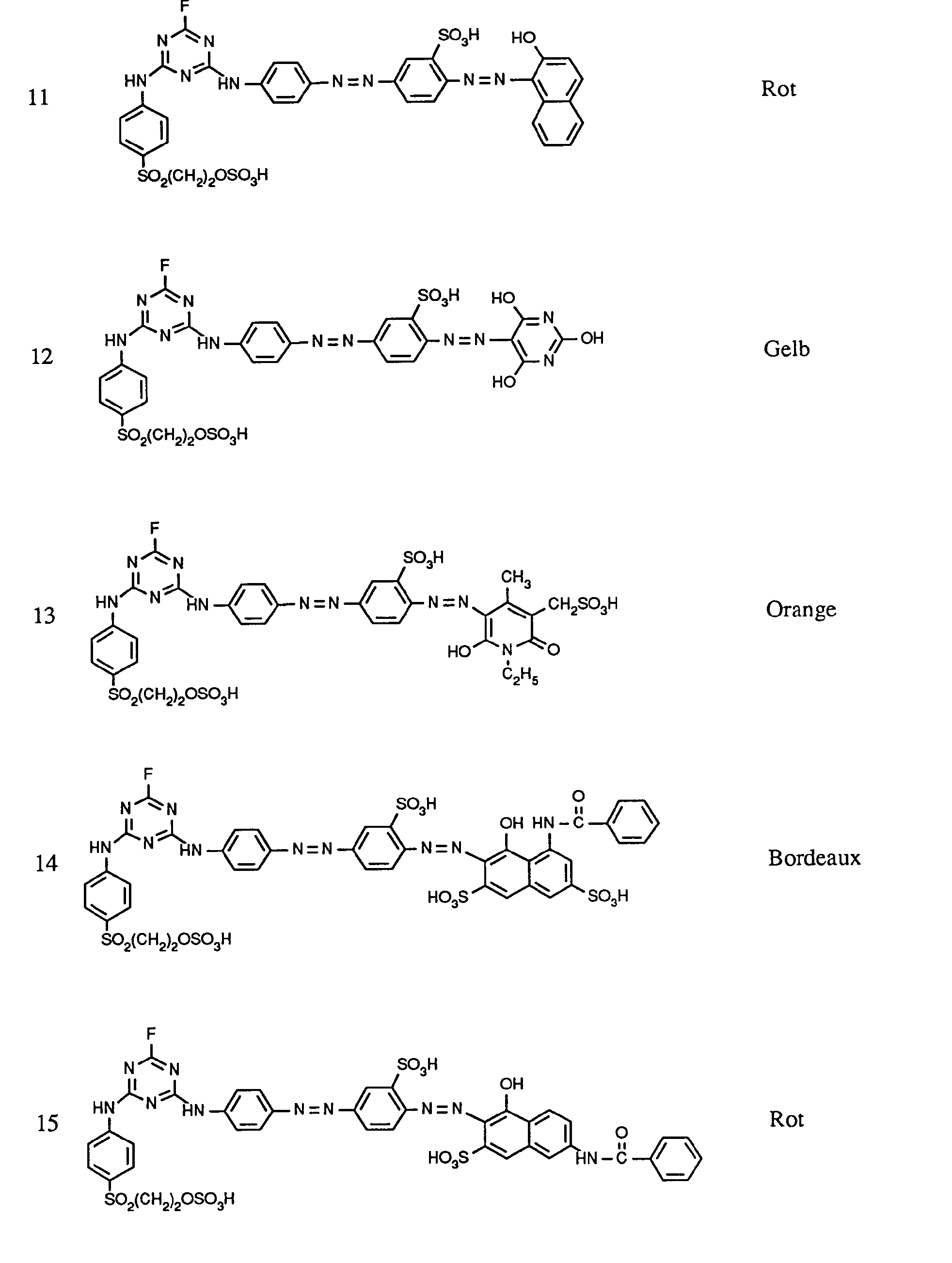

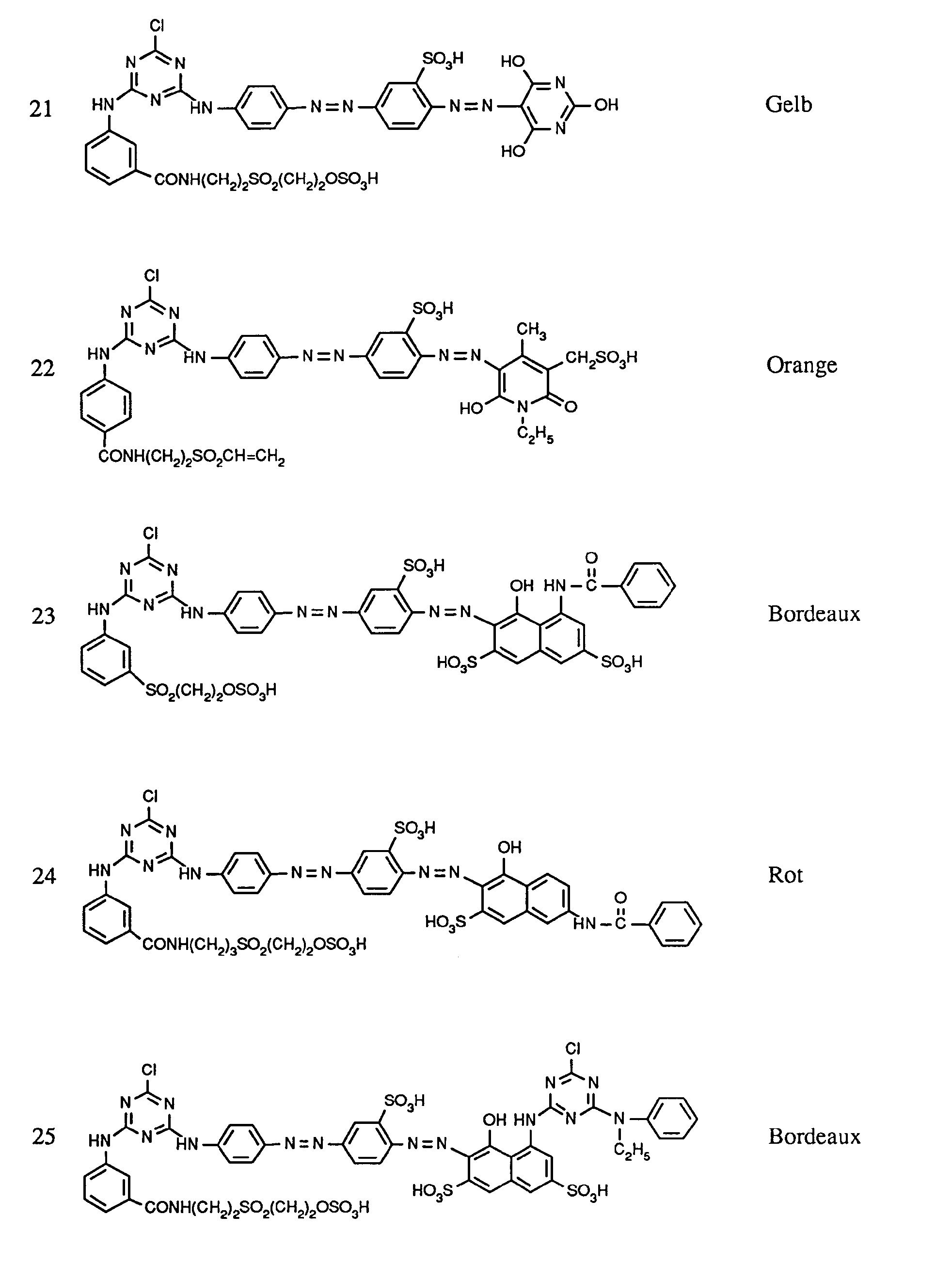


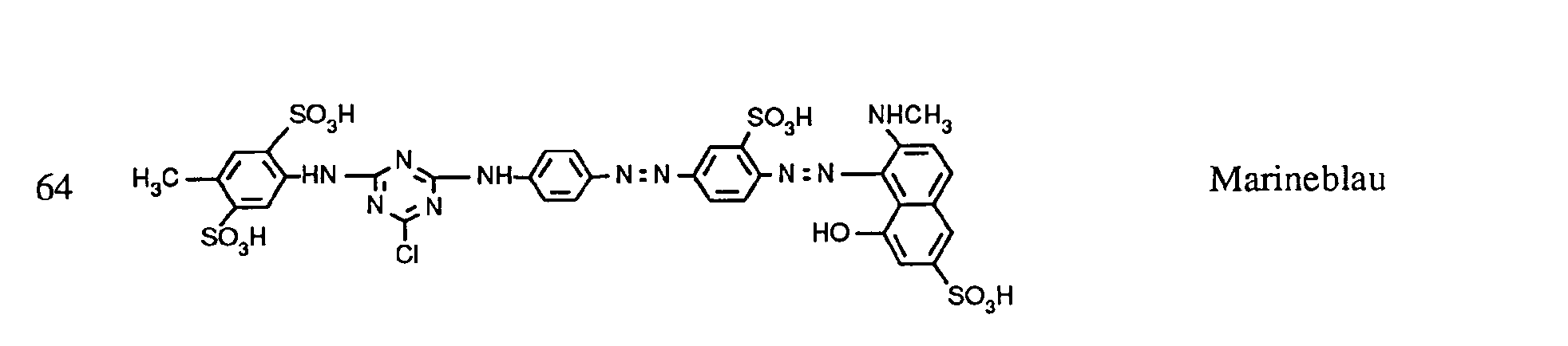
- 2 Teile des gemäss Beispiel 1 erhaltenen Reaktivfarbstoffes werden in 400 Teilen Wasser gelöst; dazu gibt man 1500 Teile einer Lösung, die pro Liter 53 g Natriumchlorid enthält. In dieses Färbebad geht man bei 40°C mit 100 Teilen Baumwollgewebe ein. Nach 45 Minuten werden 100 Teile einer Lösung, die pro Liter 16 g Natriumhydroxyd und 20 g kalziniertes Soda enthält, zugegeben. Die Temperatur des Färbebades wird weitere 45 Minuten bei 40°C gehalten. Danach wird die gefärbte Ware gespült, während einer Viertelstunde mit einem nichtionogenen Waschmittel kochend geseift, nochmals gespült und getrocknet.
- 3 Teile des gemäss Beispiel 1 erhaltenen Reaktivfarbstoffes werden unter schnellem Rühren in 100 Teile einer Stammverdickung, enthaltend 50 Teile 5%ige Natriumalginatverdickung, 27,8 Teile Wasser, 20 Teile Harnstoff, 1 Teil m-nitrobenzolsulfonsaures Natrium sowie 1,2 Teile Natriumhydrogencarbonat, eingestreut. Mit der so erhaltenen Druckpaste bedruckt man ein Baumwollgewebe, trocknet und dämpft den erhaltenen bedruckten Stoff 2 Minuten bei 102°C in gesättigtem Dampf. Das bedruckte Gewebe wird dann gespült, gegebenenfalls kochend geseift und nochmals gespült, und anschliessend getrocknet.
Claims (12)

worin A ein Rest der Benzolreihe, der Naphthalinreihe oder der heterocyclischen Reihe ist,

worin Y1 und Adie in Anspruch 1 angegebenen Bedeutungen haben.

oder
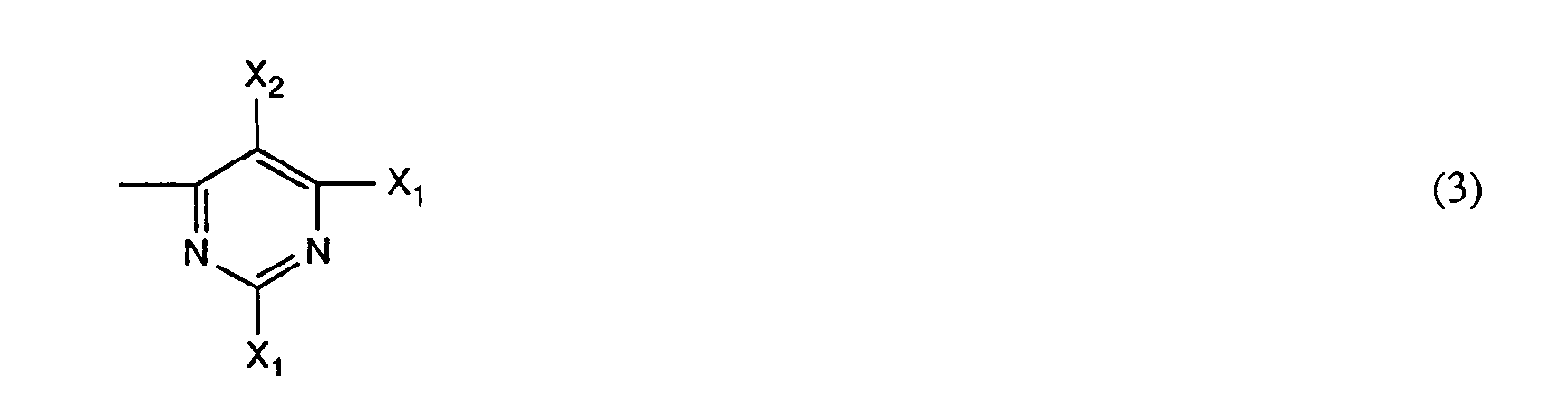
ist, worin X, X1 und X2 Halogen bedeuten und T Halogen oder im Phenylring oder Naphthylring unsubstituiertes oder durch Sulfo, Carboxy, C2-C4-Alkanoylamino, C1-C4-Alkyl oder C1-C4-Alkoxy substituiertes Phenylamino, N-C1-C4-Alkyl-N-phenylamino, Naphthylamino oder N-C1-C4-Alkyl-N-naphthylamino ist, oder worin T ein faserreaktiver Rest der Formel



oder


worin R7 und R9 unabhängig voneinander Wasserstoff, C1-C4-Alkyl oder gegebenenfalls durch C1-C4-Alkyl, C1-C4-Alkoxy, C2-C4-Alkanoylamino, Halogen oder Sulfo substituiertes Phenyl bedeuten und R8 Wasserstoff, Cyano, Carbamoyl oder Sulfomethyl ist, oder ein Rest der Formel



diazotiert und auf eine Verbindung der Formel H-A (16) kuppelt und gegebenenfalls eine weitere Umwandlungsreaktion anschliesst, wobei R', R1, R2, R3, Y1 und A die in Anspruch 1 angegebenen Bedeutungen haben.
Applications Claiming Priority (2)
| Application Number | Priority Date | Filing Date | Title |
|---|---|---|---|
| CH231892 | 1992-07-23 | ||
| CH2318/92 | 1992-07-23 |
Publications (3)
| Publication Number | Publication Date |
|---|---|
| EP0581733A2 true EP0581733A2 (de) | 1994-02-02 |
| EP0581733A3 EP0581733A3 (en) | 1994-05-18 |
| EP0581733B1 EP0581733B1 (de) | 1999-05-26 |
Family
ID=4231007
Family Applications (1)
| Application Number | Title | Priority Date | Filing Date |
|---|---|---|---|
| EP93810508A Expired - Lifetime EP0581733B1 (de) | 1992-07-23 | 1993-07-14 | Reaktivfarbstoffe, Verfahren zu deren Herstellung und deren Verwendung |
Country Status (5)
| Country | Link |
|---|---|
| US (1) | US5486600A (de) |
| EP (1) | EP0581733B1 (de) |
| JP (1) | JPH06157932A (de) |
| DE (1) | DE59309602D1 (de) |
| ES (1) | ES2133375T3 (de) |
Cited By (3)
| Publication number | Priority date | Publication date | Assignee | Title |
|---|---|---|---|---|
| EP0728818A1 (de) * | 1995-02-27 | 1996-08-28 | Ciba-Geigy Ag | Azoarbstoffmischungen und ihre Verwendung |
| EP0774493A1 (de) * | 1995-11-15 | 1997-05-21 | DyStar Textilfarben GmbH & Co. Deutschland KG | Faserreaktive Azofarbstoffe, Verfahren zu ihrer Herstellung und ihre Verwendung |
| WO2008055805A1 (en) * | 2006-11-09 | 2008-05-15 | Huntsman Advanced Materials (Switzerland) Gmbh | Mixtures of reactive dyes and their use in a method for trichromatic dyeing or printing |
Family Cites Families (9)
| Publication number | Priority date | Publication date | Assignee | Title |
|---|---|---|---|---|
| AT238342B (de) * | 1961-11-06 | 1965-02-10 | Ciba Geigy | Verfahren zur Herstellung neuer Disazofarbstoffe |
| US5298607A (en) * | 1978-07-06 | 1994-03-29 | Ciba-Geigy Corporation | Reactive dyes containing fluorotriazine and vinylsulfonyl radicals |
| DE2917059A1 (de) * | 1979-04-27 | 1980-11-06 | Basf Ag | Verfahren zum faerben von hydroxylgruppenhaltigem textilmaterial und neue farbstoffe |
| CH643872A5 (de) * | 1979-12-21 | 1984-06-29 | Sandoz Ag | Disazoverbindungen, verfahren zur herstellung und verwendung. |
| US4663440A (en) * | 1980-06-04 | 1987-05-05 | Sumitomo Chemical Company, Limited | Bisazo brown reactive dye |
| CH660016A5 (de) * | 1983-11-09 | 1987-03-13 | Ciba Geigy Ag | Reaktivfarbstoffe und deren herstellung. |
| BR8606825A (pt) * | 1985-08-14 | 1987-10-27 | Ciba Geigy Ag | Corantes reativos,sua preparacao e emprego |
| DE3717814A1 (de) * | 1987-05-27 | 1988-12-08 | Bayer Ag | Reaktivfarbstoffe |
| EP0495753B1 (de) * | 1991-01-16 | 1997-07-16 | Ciba SC Holding AG | Reaktivfarbstoffe, Verfahren zu deren Herstellung und deren Verwendung |
-
1993
- 1993-07-14 EP EP93810508A patent/EP0581733B1/de not_active Expired - Lifetime
- 1993-07-14 DE DE59309602T patent/DE59309602D1/de not_active Expired - Fee Related
- 1993-07-14 ES ES93810508T patent/ES2133375T3/es not_active Expired - Lifetime
- 1993-07-19 US US08/094,646 patent/US5486600A/en not_active Expired - Fee Related
- 1993-07-22 JP JP5181295A patent/JPH06157932A/ja active Pending
Cited By (6)
| Publication number | Priority date | Publication date | Assignee | Title |
|---|---|---|---|---|
| EP0728818A1 (de) * | 1995-02-27 | 1996-08-28 | Ciba-Geigy Ag | Azoarbstoffmischungen und ihre Verwendung |
| SG49793A1 (en) * | 1995-02-27 | 2001-06-19 | Ciba Sc Holding Ag | Azo dye mixtures and their use |
| EP0774493A1 (de) * | 1995-11-15 | 1997-05-21 | DyStar Textilfarben GmbH & Co. Deutschland KG | Faserreaktive Azofarbstoffe, Verfahren zu ihrer Herstellung und ihre Verwendung |
| US5760193A (en) * | 1995-11-15 | 1998-06-02 | Dystar Textilfarben Gmbh & Co. Deutschland Kg | Triazinyl-substituted fiber-reactive azo dyes wherein the triazinyl groups bear an N-containing substituent, and methods of using same |
| WO2008055805A1 (en) * | 2006-11-09 | 2008-05-15 | Huntsman Advanced Materials (Switzerland) Gmbh | Mixtures of reactive dyes and their use in a method for trichromatic dyeing or printing |
| US8083811B2 (en) | 2006-11-09 | 2011-12-27 | Huntsman International Llc | Mixtures of reactive dyes and their use in a method for trichromatic dyeing or printing |
Also Published As
| Publication number | Publication date |
|---|---|
| JPH06157932A (ja) | 1994-06-07 |
| DE59309602D1 (de) | 1999-07-01 |
| EP0581733A3 (en) | 1994-05-18 |
| US5486600A (en) | 1996-01-23 |
| EP0581733B1 (de) | 1999-05-26 |
| ES2133375T3 (es) | 1999-09-16 |
Similar Documents
| Publication | Publication Date | Title |
|---|---|---|
| EP1137716B1 (de) | Reaktivfarbstoffe, mischungen von reaktivfarbstoffen, deren herstellung und deren verwendung | |
| EP0625549B1 (de) | Reaktivfarbstoffe, Verfahren zu deren Herstellung und deren Verwendung | |
| EP1035171B1 (de) | Azofarbstoffe, deren Herstellung und deren Verwendung | |
| EP0214093A1 (de) | Reaktivfarbstoffe, deren Herstellung und Verwendung | |
| EP0647683B1 (de) | Reaktivfarbstoffe, Verfahren zu deren Herstellung und deren Verwendung | |
| EP0114032B1 (de) | Reaktivfarbstoffe, deren Herstellung und Verwendung | |
| EP0716130B1 (de) | Reaktivfarbstoffe, deren Herstellung und Verwendung | |
| EP0625551B1 (de) | Farbstoffmischungen, Verfahren zu deren Herstellung und deren Verwendung | |
| EP0764694B1 (de) | Reaktivfarbstoffe, ihre Herstellung und Verwendung | |
| EP0803543B1 (de) | Faserreaktive Farbstoffe, ihre Herstellung und Verwendung | |
| EP0748850B1 (de) | Farbstoffe, Verfahren zu deren Herstellung und deren Verwendung | |
| EP1061105B1 (de) | Faserreaktive Farbstoffe, Verfahren zu ihrer Herstellung und ihre Verwendung | |
| EP0776947B1 (de) | Faserreaktive Farbstoffe, ihre Herstellung und Verwendung | |
| EP0581733B1 (de) | Reaktivfarbstoffe, Verfahren zu deren Herstellung und deren Verwendung | |
| EP0581731B1 (de) | Reaktivfarbstoffe, Verfahren zu deren Herstellung und deren Verwendung | |
| EP0581729B1 (de) | Reaktivfarbstoffe, Verfahren zu deren Herstellung und deren Verwendung | |
| EP0641839B1 (de) | Faserreaktive Farbstoffe, deren Herstellung und Verwendung | |
| EP1041121B1 (de) | Farbstoffe, Verfahren zu deren Herstellung und deren Verwendung | |
| EP0581732B1 (de) | Farbstoffmischungen, Verfahren zu deren Herstellung und deren Verwendung | |
| EP0739950A2 (de) | Reaktivfarbstoffe der Dioxazinreihe, ihre Herstellung und Verwendung | |
| EP0708151B1 (de) | Faserreaktive Anthrachinonfarbstoffe, Verfahren zu deren Herstellung und deren Verwendung | |
| EP0761768A1 (de) | Reaktivfarbstoffe, Verfahren zu deren Herstellung und deren Verwendung | |
| EP0712905A1 (de) | Reaktivfarbstoffe, ihre Herstellung und Verwendung | |
| EP0149170A2 (de) | Reaktivfarbstoffe, deren Herstellung und Verwendung | |
| DE60010362T2 (de) | Reaktivfarbstoffe, Verfahren zu deren Herstellung und deren Verwendung |
Legal Events
| Date | Code | Title | Description |
|---|---|---|---|
| PUAI | Public reference made under article 153(3) epc to a published international application that has entered the european phase |
Free format text: ORIGINAL CODE: 0009012 |
|
| AK | Designated contracting states |
Kind code of ref document: A2 Designated state(s): BE CH DE ES FR GB IT LI PT |
|
| PUAL | Search report despatched |
Free format text: ORIGINAL CODE: 0009013 |
|
| AK | Designated contracting states |
Kind code of ref document: A3 Designated state(s): BE CH DE ES FR GB IT LI PT |
|
| 17P | Request for examination filed |
Effective date: 19941103 |
|
| RAP1 | Party data changed (applicant data changed or rights of an application transferred) |
Owner name: CIBA SC HOLDING AG |
|
| RAP3 | Party data changed (applicant data changed or rights of an application transferred) |
Owner name: CIBA SPECIALTY CHEMICALS HOLDING INC. |
|
| 17Q | First examination report despatched |
Effective date: 19971126 |
|
| GRAG | Despatch of communication of intention to grant |
Free format text: ORIGINAL CODE: EPIDOS AGRA |
|
| GRAG | Despatch of communication of intention to grant |
Free format text: ORIGINAL CODE: EPIDOS AGRA |
|
| GRAH | Despatch of communication of intention to grant a patent |
Free format text: ORIGINAL CODE: EPIDOS IGRA |
|
| GRAH | Despatch of communication of intention to grant a patent |
Free format text: ORIGINAL CODE: EPIDOS IGRA |
|
| GRAA | (expected) grant |
Free format text: ORIGINAL CODE: 0009210 |
|
| AK | Designated contracting states |
Kind code of ref document: B1 Designated state(s): BE CH DE ES FR GB IT LI PT |
|
| REG | Reference to a national code |
Ref country code: CH Ref legal event code: EP |
|
| REF | Corresponds to: |
Ref document number: 59309602 Country of ref document: DE Date of ref document: 19990701 |
|
| ITF | It: translation for a ep patent filed | ||
| GBT | Gb: translation of ep patent filed (gb section 77(6)(a)/1977) |
Effective date: 19990721 |
|
| ET | Fr: translation filed | ||
| REG | Reference to a national code |
Ref country code: ES Ref legal event code: FG2A Ref document number: 2133375 Country of ref document: ES Kind code of ref document: T3 |
|
| REG | Reference to a national code |
Ref country code: PT Ref legal event code: SC4A Free format text: AVAILABILITY OF NATIONAL TRANSLATION Effective date: 19990802 |
|
| PLBE | No opposition filed within time limit |
Free format text: ORIGINAL CODE: 0009261 |
|
| STAA | Information on the status of an ep patent application or granted ep patent |
Free format text: STATUS: NO OPPOSITION FILED WITHIN TIME LIMIT |
|
| 26N | No opposition filed | ||
| REG | Reference to a national code |
Ref country code: GB Ref legal event code: IF02 |
|
| PGFP | Annual fee paid to national office [announced via postgrant information from national office to epo] |
Ref country code: CH Payment date: 20030626 Year of fee payment: 11 |
|
| PGFP | Annual fee paid to national office [announced via postgrant information from national office to epo] |
Ref country code: PT Payment date: 20030627 Year of fee payment: 11 |
|
| PGFP | Annual fee paid to national office [announced via postgrant information from national office to epo] |
Ref country code: ES Payment date: 20030707 Year of fee payment: 11 |
|
| PG25 | Lapsed in a contracting state [announced via postgrant information from national office to epo] |
Ref country code: ES Free format text: LAPSE BECAUSE OF NON-PAYMENT OF DUE FEES Effective date: 20040715 |
|
| PG25 | Lapsed in a contracting state [announced via postgrant information from national office to epo] |
Ref country code: LI Free format text: LAPSE BECAUSE OF NON-PAYMENT OF DUE FEES Effective date: 20040731 Ref country code: CH Free format text: LAPSE BECAUSE OF NON-PAYMENT OF DUE FEES Effective date: 20040731 |
|
| PG25 | Lapsed in a contracting state [announced via postgrant information from national office to epo] |
Ref country code: PT Free format text: LAPSE BECAUSE OF NON-PAYMENT OF DUE FEES Effective date: 20050114 |
|
| REG | Reference to a national code |
Ref country code: CH Ref legal event code: PL |
|
| REG | Reference to a national code |
Ref country code: PT Ref legal event code: MM4A Free format text: LAPSE DUE TO NON-PAYMENT OF FEES Effective date: 20050114 |
|
| PGFP | Annual fee paid to national office [announced via postgrant information from national office to epo] |
Ref country code: FR Payment date: 20050617 Year of fee payment: 13 |
|
| PGFP | Annual fee paid to national office [announced via postgrant information from national office to epo] |
Ref country code: DE Payment date: 20050623 Year of fee payment: 13 |
|
| PGFP | Annual fee paid to national office [announced via postgrant information from national office to epo] |
Ref country code: GB Payment date: 20050627 Year of fee payment: 13 |
|
| PGFP | Annual fee paid to national office [announced via postgrant information from national office to epo] |
Ref country code: BE Payment date: 20050810 Year of fee payment: 13 |
|
| REG | Reference to a national code |
Ref country code: ES Ref legal event code: FD2A Effective date: 20040715 |
|
| PG25 | Lapsed in a contracting state [announced via postgrant information from national office to epo] |
Ref country code: GB Free format text: LAPSE BECAUSE OF NON-PAYMENT OF DUE FEES Effective date: 20060714 |
|
| PG25 | Lapsed in a contracting state [announced via postgrant information from national office to epo] |
Ref country code: BE Free format text: LAPSE BECAUSE OF NON-PAYMENT OF DUE FEES Effective date: 20060731 |
|
| PGFP | Annual fee paid to national office [announced via postgrant information from national office to epo] |
Ref country code: IT Payment date: 20060731 Year of fee payment: 14 |
|
| PG25 | Lapsed in a contracting state [announced via postgrant information from national office to epo] |
Ref country code: DE Free format text: LAPSE BECAUSE OF NON-PAYMENT OF DUE FEES Effective date: 20070201 |
|
| GBPC | Gb: european patent ceased through non-payment of renewal fee |
Effective date: 20060714 |
|
| REG | Reference to a national code |
Ref country code: FR Ref legal event code: ST Effective date: 20070330 |
|
| BERE | Be: lapsed |
Owner name: *CIBA SPECIALTY CHEMICALS HOLDING INC. Effective date: 20060731 |
|
| PG25 | Lapsed in a contracting state [announced via postgrant information from national office to epo] |
Ref country code: FR Free format text: LAPSE BECAUSE OF NON-PAYMENT OF DUE FEES Effective date: 20060731 |
|
| PG25 | Lapsed in a contracting state [announced via postgrant information from national office to epo] |
Ref country code: IT Free format text: LAPSE BECAUSE OF NON-PAYMENT OF DUE FEES Effective date: 20070714 |