EP0728818A1 - Azoarbstoffmischungen und ihre Verwendung - Google Patents
Azoarbstoffmischungen und ihre Verwendung Download PDFInfo
- Publication number
- EP0728818A1 EP0728818A1 EP96810097A EP96810097A EP0728818A1 EP 0728818 A1 EP0728818 A1 EP 0728818A1 EP 96810097 A EP96810097 A EP 96810097A EP 96810097 A EP96810097 A EP 96810097A EP 0728818 A1 EP0728818 A1 EP 0728818A1
- Authority
- EP
- European Patent Office
- Prior art keywords
- formula
- sulfo
- substituted
- hydroxy
- alkyl
- Prior art date
- Legal status (The legal status is an assumption and is not a legal conclusion. Google has not performed a legal analysis and makes no representation as to the accuracy of the status listed.)
- Granted
Links
- 239000000203 mixture Substances 0.000 title claims description 47
- 239000000987 azo dye Substances 0.000 title description 2
- -1 sulphomethyl Chemical group 0.000 claims abstract description 157
- 125000000020 sulfo group Chemical group O=S(=O)([*])O[H] 0.000 claims abstract description 36
- 125000002924 primary amino group Chemical group [H]N([H])* 0.000 claims abstract description 32
- 229910052736 halogen Inorganic materials 0.000 claims abstract description 24
- 150000002367 halogens Chemical class 0.000 claims abstract description 21
- 125000000391 vinyl group Chemical group [H]C([*])=C([H])[H] 0.000 claims abstract description 18
- 229920002554 vinyl polymer Polymers 0.000 claims abstract description 18
- 125000003917 carbamoyl group Chemical group [H]N([H])C(*)=O 0.000 claims abstract description 15
- 229910052801 chlorine Inorganic materials 0.000 claims abstract description 15
- 125000000217 alkyl group Chemical group 0.000 claims abstract description 14
- 125000003178 carboxy group Chemical group [H]OC(*)=O 0.000 claims abstract description 11
- 229910052731 fluorine Inorganic materials 0.000 claims abstract description 10
- UHOVQNZJYSORNB-UHFFFAOYSA-N Benzene Chemical compound C1=CC=CC=C1 UHOVQNZJYSORNB-UHFFFAOYSA-N 0.000 claims abstract description 9
- 229910052794 bromium Inorganic materials 0.000 claims abstract description 8
- 125000001624 naphthyl group Chemical group 0.000 claims abstract description 6
- 125000000732 arylene group Chemical group 0.000 claims abstract description 4
- 125000004573 morpholin-4-yl group Chemical group N1(CCOCC1)* 0.000 claims abstract description 4
- 125000000951 phenoxy group Chemical group [H]C1=C([H])C([H])=C(O*)C([H])=C1[H] 0.000 claims abstract description 4
- 125000000664 diazo group Chemical group [N-]=[N+]=[*] 0.000 claims abstract description 3
- 150000002790 naphthalenes Chemical class 0.000 claims abstract description 3
- 150000001875 compounds Chemical class 0.000 claims description 30
- 238000004043 dyeing Methods 0.000 claims description 30
- 125000002887 hydroxy group Chemical group [H]O* 0.000 claims description 24
- 125000001997 phenyl group Chemical group [H]C1=C([H])C([H])=C(*)C([H])=C1[H] 0.000 claims description 22
- 238000000034 method Methods 0.000 claims description 16
- 239000000460 chlorine Substances 0.000 claims description 13
- 239000002657 fibrous material Substances 0.000 claims description 13
- 210000002268 wool Anatomy 0.000 claims description 13
- ZAMOUSCENKQFHK-UHFFFAOYSA-N Chlorine atom Chemical compound [Cl] ZAMOUSCENKQFHK-UHFFFAOYSA-N 0.000 claims description 12
- 239000001257 hydrogen Substances 0.000 claims description 12
- 229910052739 hydrogen Inorganic materials 0.000 claims description 12
- 125000002496 methyl group Chemical group [H]C([H])([H])* 0.000 claims description 10
- 239000004952 Polyamide Substances 0.000 claims description 9
- JJLKTTCRRLHVGL-UHFFFAOYSA-L [acetyloxy(dibutyl)stannyl] acetate Chemical compound CC([O-])=O.CC([O-])=O.CCCC[Sn+2]CCCC JJLKTTCRRLHVGL-UHFFFAOYSA-L 0.000 claims description 9
- 239000011737 fluorine Chemical group 0.000 claims description 9
- 229920002647 polyamide Polymers 0.000 claims description 9
- 125000001637 1-naphthyl group Chemical group [H]C1=C([H])C([H])=C2C(*)=C([H])C([H])=C([H])C2=C1[H] 0.000 claims description 8
- 150000002431 hydrogen Chemical class 0.000 claims description 8
- 125000005184 naphthylamino group Chemical group C1(=CC=CC2=CC=CC=C12)N* 0.000 claims description 8
- 229910052757 nitrogen Inorganic materials 0.000 claims description 8
- WKBOTKDWSSQWDR-UHFFFAOYSA-N Bromine atom Chemical group [Br] WKBOTKDWSSQWDR-UHFFFAOYSA-N 0.000 claims description 7
- UFHFLCQGNIYNRP-UHFFFAOYSA-N Hydrogen Chemical compound [H][H] UFHFLCQGNIYNRP-UHFFFAOYSA-N 0.000 claims description 7
- 125000001309 chloro group Chemical group Cl* 0.000 claims description 7
- 125000004093 cyano group Chemical group *C#N 0.000 claims description 7
- 125000001495 ethyl group Chemical group [H]C([H])([H])C([H])([H])* 0.000 claims description 7
- 125000000956 methoxy group Chemical group [H]C([H])([H])O* 0.000 claims description 7
- PXGOKWXKJXAPGV-UHFFFAOYSA-N Fluorine Chemical group FF PXGOKWXKJXAPGV-UHFFFAOYSA-N 0.000 claims description 6
- 125000003282 alkyl amino group Chemical group 0.000 claims description 6
- 125000002490 anilino group Chemical group [H]N(*)C1=C([H])C([H])=C([H])C([H])=C1[H] 0.000 claims description 6
- GDTBXPJZTBHREO-UHFFFAOYSA-N bromine Chemical group BrBr GDTBXPJZTBHREO-UHFFFAOYSA-N 0.000 claims description 6
- 125000001153 fluoro group Chemical group F* 0.000 claims description 5
- ZHZZWIQPCAMTIM-UHFFFAOYSA-N [C]1=CC=CC2=CC=CC=C12 Chemical compound [C]1=CC=CC2=CC=CC=C12 ZHZZWIQPCAMTIM-UHFFFAOYSA-N 0.000 claims description 4
- CIUQDSCDWFSTQR-UHFFFAOYSA-N [C]1=CC=CC=C1 Chemical compound [C]1=CC=CC=C1 CIUQDSCDWFSTQR-UHFFFAOYSA-N 0.000 claims description 4
- UCFFGYASXIPWPD-UHFFFAOYSA-N methyl hypochlorite Chemical compound COCl UCFFGYASXIPWPD-UHFFFAOYSA-N 0.000 claims description 4
- 125000003161 (C1-C6) alkylene group Chemical group 0.000 claims description 2
- QJGQUHMNIGDVPM-UHFFFAOYSA-N nitrogen group Chemical group [N] QJGQUHMNIGDVPM-UHFFFAOYSA-N 0.000 claims description 2
- 239000007864 aqueous solution Substances 0.000 claims 1
- 125000002349 hydroxyamino group Chemical group [H]ON([H])[*] 0.000 claims 1
- 125000004414 alkyl thio group Chemical group 0.000 abstract description 2
- 229910006069 SO3H Inorganic materials 0.000 abstract 5
- 229910004727 OSO3H Inorganic materials 0.000 abstract 2
- 125000003545 alkoxy group Chemical group 0.000 abstract 2
- 125000003363 1,3,5-triazinyl group Chemical group N1=C(N=CN=C1)* 0.000 abstract 1
- PGLIUCLTXOYQMV-UHFFFAOYSA-N Cetirizine hydrochloride Chemical compound Cl.Cl.C1CN(CCOCC(=O)O)CCN1C(C=1C=CC(Cl)=CC=1)C1=CC=CC=C1 PGLIUCLTXOYQMV-UHFFFAOYSA-N 0.000 abstract 1
- 125000005236 alkanoylamino group Chemical group 0.000 abstract 1
- 125000004453 alkoxycarbonyl group Chemical group 0.000 abstract 1
- 125000002947 alkylene group Chemical group 0.000 abstract 1
- 125000000043 benzamido group Chemical group [H]N([*])C(=O)C1=C([H])C([H])=C([H])C([H])=C1[H] 0.000 abstract 1
- 125000005843 halogen group Chemical group 0.000 abstract 1
- 125000004957 naphthylene group Chemical group 0.000 abstract 1
- 125000000843 phenylene group Chemical group C1(=C(C=CC=C1)*)* 0.000 abstract 1
- 125000004076 pyridyl group Chemical group 0.000 abstract 1
- 239000000975 dye Substances 0.000 description 60
- QTBSBXVTEAMEQO-UHFFFAOYSA-N Acetic acid Chemical compound CC(O)=O QTBSBXVTEAMEQO-UHFFFAOYSA-N 0.000 description 15
- 239000000835 fiber Substances 0.000 description 9
- 239000004753 textile Substances 0.000 description 9
- 239000003795 chemical substances by application Substances 0.000 description 8
- 239000000463 material Substances 0.000 description 8
- XLYOFNOQVPJJNP-UHFFFAOYSA-N water Substances O XLYOFNOQVPJJNP-UHFFFAOYSA-N 0.000 description 8
- 125000004178 (C1-C4) alkyl group Chemical group 0.000 description 7
- BDAGIHXWWSANSR-UHFFFAOYSA-N methanoic acid Natural products OC=O BDAGIHXWWSANSR-UHFFFAOYSA-N 0.000 description 6
- 125000000229 (C1-C4)alkoxy group Chemical group 0.000 description 5
- 238000010411 cooking Methods 0.000 description 5
- 230000008878 coupling Effects 0.000 description 5
- 238000010168 coupling process Methods 0.000 description 5
- 238000005859 coupling reaction Methods 0.000 description 5
- 0 *C(C(N1*)O)=C(*)C=C1O Chemical compound *C(C(N1*)O)=C(*)C=C1O 0.000 description 4
- QGZKDVFQNNGYKY-UHFFFAOYSA-N Ammonia Chemical compound N QGZKDVFQNNGYKY-UHFFFAOYSA-N 0.000 description 4
- VMHLLURERBWHNL-UHFFFAOYSA-M Sodium acetate Chemical compound [Na+].CC([O-])=O VMHLLURERBWHNL-UHFFFAOYSA-M 0.000 description 4
- UIIMBOGNXHQVGW-UHFFFAOYSA-M Sodium bicarbonate Chemical compound [Na+].OC([O-])=O UIIMBOGNXHQVGW-UHFFFAOYSA-M 0.000 description 4
- 238000004040 coloring Methods 0.000 description 4
- 150000003839 salts Chemical class 0.000 description 4
- 239000001632 sodium acetate Substances 0.000 description 4
- 235000017281 sodium acetate Nutrition 0.000 description 4
- OSWFIVFLDKOXQC-UHFFFAOYSA-N 4-(3-methoxyphenyl)aniline Chemical compound COC1=CC=CC(C=2C=CC(N)=CC=2)=C1 OSWFIVFLDKOXQC-UHFFFAOYSA-N 0.000 description 3
- HEMHJVSKTPXQMS-UHFFFAOYSA-M Sodium hydroxide Chemical compound [OH-].[Na+] HEMHJVSKTPXQMS-UHFFFAOYSA-M 0.000 description 3
- 239000003513 alkali Substances 0.000 description 3
- 238000001816 cooling Methods 0.000 description 3
- 235000019253 formic acid Nutrition 0.000 description 3
- 230000020477 pH reduction Effects 0.000 description 3
- 229920003043 Cellulose fiber Polymers 0.000 description 2
- VGGSQFUCUMXWEO-UHFFFAOYSA-N Ethene Chemical compound C=C VGGSQFUCUMXWEO-UHFFFAOYSA-N 0.000 description 2
- 239000005977 Ethylene Substances 0.000 description 2
- VEXZGXHMUGYJMC-UHFFFAOYSA-N Hydrochloric acid Chemical compound Cl VEXZGXHMUGYJMC-UHFFFAOYSA-N 0.000 description 2
- CDBYLPFSWZWCQE-UHFFFAOYSA-L Sodium Carbonate Chemical compound [Na+].[Na+].[O-]C([O-])=O CDBYLPFSWZWCQE-UHFFFAOYSA-L 0.000 description 2
- 239000000654 additive Substances 0.000 description 2
- MDFFNEOEWAXZRQ-UHFFFAOYSA-N aminyl Chemical class [NH2] MDFFNEOEWAXZRQ-UHFFFAOYSA-N 0.000 description 2
- 229910021529 ammonia Inorganic materials 0.000 description 2
- 125000006297 carbonyl amino group Chemical group [H]N([*:2])C([*:1])=O 0.000 description 2
- 125000004705 ethylthio group Chemical group C(C)S* 0.000 description 2
- 239000004744 fabric Substances 0.000 description 2
- 125000003253 isopropoxy group Chemical group [H]C([H])([H])C([H])(O*)C([H])([H])[H] 0.000 description 2
- 125000002816 methylsulfanyl group Chemical group [H]C([H])([H])S[*] 0.000 description 2
- 239000010446 mirabilite Substances 0.000 description 2
- 238000002156 mixing Methods 0.000 description 2
- 125000004123 n-propyl group Chemical group [H]C([H])([H])C([H])([H])C([H])([H])* 0.000 description 2
- QQONPFPTGQHPMA-UHFFFAOYSA-N propylene Natural products CC=C QQONPFPTGQHPMA-UHFFFAOYSA-N 0.000 description 2
- 229910000030 sodium bicarbonate Inorganic materials 0.000 description 2
- 235000017557 sodium bicarbonate Nutrition 0.000 description 2
- LPXPTNMVRIOKMN-UHFFFAOYSA-M sodium nitrite Chemical compound [Na+].[O-]N=O LPXPTNMVRIOKMN-UHFFFAOYSA-M 0.000 description 2
- RSIJVJUOQBWMIM-UHFFFAOYSA-L sodium sulfate decahydrate Chemical compound O.O.O.O.O.O.O.O.O.O.[Na+].[Na+].[O-]S([O-])(=O)=O RSIJVJUOQBWMIM-UHFFFAOYSA-L 0.000 description 2
- 125000001424 substituent group Chemical group 0.000 description 2
- 239000000080 wetting agent Substances 0.000 description 2
- NAWXUBYGYWOOIX-SFHVURJKSA-N (2s)-2-[[4-[2-(2,4-diaminoquinazolin-6-yl)ethyl]benzoyl]amino]-4-methylidenepentanedioic acid Chemical compound C1=CC2=NC(N)=NC(N)=C2C=C1CCC1=CC=C(C(=O)N[C@@H](CC(=C)C(O)=O)C(O)=O)C=C1 NAWXUBYGYWOOIX-SFHVURJKSA-N 0.000 description 1
- USFZMSVCRYTOJT-UHFFFAOYSA-N Ammonium acetate Chemical compound N.CC(O)=O USFZMSVCRYTOJT-UHFFFAOYSA-N 0.000 description 1
- 239000005695 Ammonium acetate Substances 0.000 description 1
- LSNNMFCWUKXFEE-UHFFFAOYSA-M Bisulfite Chemical compound OS([O-])=O LSNNMFCWUKXFEE-UHFFFAOYSA-M 0.000 description 1
- 244000025254 Cannabis sativa Species 0.000 description 1
- 235000012766 Cannabis sativa ssp. sativa var. sativa Nutrition 0.000 description 1
- 235000012765 Cannabis sativa ssp. sativa var. spontanea Nutrition 0.000 description 1
- 240000000491 Corchorus aestuans Species 0.000 description 1
- 235000011777 Corchorus aestuans Nutrition 0.000 description 1
- 235000010862 Corchorus capsularis Nutrition 0.000 description 1
- 229920000742 Cotton Polymers 0.000 description 1
- 229920001353 Dextrin Polymers 0.000 description 1
- 239000004375 Dextrin Substances 0.000 description 1
- DGAQECJNVWCQMB-PUAWFVPOSA-M Ilexoside XXIX Chemical compound C[C@@H]1CC[C@@]2(CC[C@@]3(C(=CC[C@H]4[C@]3(CC[C@@H]5[C@@]4(CC[C@@H](C5(C)C)OS(=O)(=O)[O-])C)C)[C@@H]2[C@]1(C)O)C)C(=O)O[C@H]6[C@@H]([C@H]([C@@H]([C@H](O6)CO)O)O)O.[Na+] DGAQECJNVWCQMB-PUAWFVPOSA-M 0.000 description 1
- WHXSMMKQMYFTQS-UHFFFAOYSA-N Lithium Chemical compound [Li] WHXSMMKQMYFTQS-UHFFFAOYSA-N 0.000 description 1
- 229920002292 Nylon 6 Polymers 0.000 description 1
- ZLMJMSJWJFRBEC-UHFFFAOYSA-N Potassium Chemical compound [K] ZLMJMSJWJFRBEC-UHFFFAOYSA-N 0.000 description 1
- 238000010521 absorption reaction Methods 0.000 description 1
- 125000000738 acetamido group Chemical group [H]C([H])([H])C(=O)N([H])[*] 0.000 description 1
- 229920000615 alginic acid Polymers 0.000 description 1
- 235000010443 alginic acid Nutrition 0.000 description 1
- 235000019257 ammonium acetate Nutrition 0.000 description 1
- 229940043376 ammonium acetate Drugs 0.000 description 1
- 150000003863 ammonium salts Chemical class 0.000 description 1
- 239000002518 antifoaming agent Substances 0.000 description 1
- 230000015572 biosynthetic process Effects 0.000 description 1
- 238000009835 boiling Methods 0.000 description 1
- 239000000872 buffer Substances 0.000 description 1
- 235000009120 camo Nutrition 0.000 description 1
- 229920002678 cellulose Polymers 0.000 description 1
- 239000001913 cellulose Substances 0.000 description 1
- 229920003086 cellulose ether Polymers 0.000 description 1
- 235000005607 chanvre indien Nutrition 0.000 description 1
- 235000013351 cheese Nutrition 0.000 description 1
- 235000019425 dextrin Nutrition 0.000 description 1
- 238000006193 diazotization reaction Methods 0.000 description 1
- 125000003754 ethoxycarbonyl group Chemical group C(=O)(OCC)* 0.000 description 1
- 239000003063 flame retardant Substances 0.000 description 1
- 238000009472 formulation Methods 0.000 description 1
- 238000010438 heat treatment Methods 0.000 description 1
- 239000011487 hemp Substances 0.000 description 1
- 125000002510 isobutoxy group Chemical group [H]C([H])([H])C([H])(C([H])([H])[H])C([H])([H])O* 0.000 description 1
- 125000000959 isobutyl group Chemical group [H]C([H])([H])C([H])(C([H])([H])[H])C([H])([H])* 0.000 description 1
- 125000005929 isobutyloxycarbonyl group Chemical group [H]C([H])([H])C([H])(C([H])([H])[H])C([H])([H])OC(*)=O 0.000 description 1
- 125000001449 isopropyl group Chemical group [H]C([H])([H])C([H])(*)C([H])([H])[H] 0.000 description 1
- 125000005928 isopropyloxycarbonyl group Chemical group [H]C([H])([H])C([H])(OC(*)=O)C([H])([H])[H] 0.000 description 1
- 229910052744 lithium Inorganic materials 0.000 description 1
- 125000001160 methoxycarbonyl group Chemical group [H]C([H])([H])OC(*)=O 0.000 description 1
- 125000006606 n-butoxy group Chemical group 0.000 description 1
- 125000004108 n-butyl group Chemical group [H]C([H])([H])C([H])([H])C([H])([H])C([H])([H])* 0.000 description 1
- 125000003506 n-propoxy group Chemical group [H]C([H])([H])C([H])([H])C([H])([H])O* 0.000 description 1
- 239000004014 plasticizer Substances 0.000 description 1
- 229910052700 potassium Inorganic materials 0.000 description 1
- 239000011591 potassium Substances 0.000 description 1
- 238000002360 preparation method Methods 0.000 description 1
- 125000004805 propylene group Chemical group [H]C([H])([H])C([H])([*:1])C([H])([H])[*:2] 0.000 description 1
- 239000011814 protection agent Substances 0.000 description 1
- 239000004627 regenerated cellulose Substances 0.000 description 1
- 239000005871 repellent Substances 0.000 description 1
- 230000002940 repellent Effects 0.000 description 1
- 125000005920 sec-butoxy group Chemical group 0.000 description 1
- 125000002914 sec-butyl group Chemical group [H]C([H])([H])C([H])([H])C([H])(*)C([H])([H])[H] 0.000 description 1
- 125000005930 sec-butyloxycarbonyl group Chemical group [H]C([H])([H])C([H])([H])C([H])(OC(*)=O)C([H])([H])[H] 0.000 description 1
- 229910052708 sodium Inorganic materials 0.000 description 1
- 239000011734 sodium Substances 0.000 description 1
- 229910000029 sodium carbonate Inorganic materials 0.000 description 1
- 235000010288 sodium nitrite Nutrition 0.000 description 1
- 239000007787 solid Substances 0.000 description 1
- 239000000126 substance Substances 0.000 description 1
- 238000003786 synthesis reaction Methods 0.000 description 1
- 125000004213 tert-butoxy group Chemical group [H]C([H])([H])C(O*)(C([H])([H])[H])C([H])([H])[H] 0.000 description 1
- 125000000999 tert-butyl group Chemical group [H]C([H])([H])C(*)(C([H])([H])[H])C([H])([H])[H] 0.000 description 1
- 125000005931 tert-butyloxycarbonyl group Chemical group [H]C([H])([H])C(OC(*)=O)(C([H])([H])[H])C([H])([H])[H] 0.000 description 1
- 239000002562 thickening agent Substances 0.000 description 1
- GSEJCLTVZPLZKY-UHFFFAOYSA-O triethanolammonium Chemical class OCC[NH+](CCO)CCO GSEJCLTVZPLZKY-UHFFFAOYSA-O 0.000 description 1
- 238000005406 washing Methods 0.000 description 1
Classifications
-
- C—CHEMISTRY; METALLURGY
- C09—DYES; PAINTS; POLISHES; NATURAL RESINS; ADHESIVES; COMPOSITIONS NOT OTHERWISE PROVIDED FOR; APPLICATIONS OF MATERIALS NOT OTHERWISE PROVIDED FOR
- C09B—ORGANIC DYES OR CLOSELY-RELATED COMPOUNDS FOR PRODUCING DYES, e.g. PIGMENTS; MORDANTS; LAKES
- C09B31/00—Disazo and polyazo dyes of the type A->B->C, A->B->C->D, or the like, prepared by diazotising and coupling
- C09B31/02—Disazo dyes
- C09B31/04—Disazo dyes from a coupling component "C" containing a directive amino group
- C09B31/043—Amino-benzenes
-
- C—CHEMISTRY; METALLURGY
- C09—DYES; PAINTS; POLISHES; NATURAL RESINS; ADHESIVES; COMPOSITIONS NOT OTHERWISE PROVIDED FOR; APPLICATIONS OF MATERIALS NOT OTHERWISE PROVIDED FOR
- C09B—ORGANIC DYES OR CLOSELY-RELATED COMPOUNDS FOR PRODUCING DYES, e.g. PIGMENTS; MORDANTS; LAKES
- C09B67/00—Influencing the physical, e.g. the dyeing or printing properties of dyestuffs without chemical reactions, e.g. by treating with solvents grinding or grinding assistants, coating of pigments or dyes; Process features in the making of dyestuff preparations; Dyestuff preparations of a special physical nature, e.g. tablets, films
- C09B67/0033—Blends of pigments; Mixtured crystals; Solid solutions
- C09B67/0046—Mixtures of two or more azo dyes
- C09B67/0055—Mixtures of two or more disazo dyes
- C09B67/0057—Mixtures of two or more reactive disazo dyes
-
- C—CHEMISTRY; METALLURGY
- C09—DYES; PAINTS; POLISHES; NATURAL RESINS; ADHESIVES; COMPOSITIONS NOT OTHERWISE PROVIDED FOR; APPLICATIONS OF MATERIALS NOT OTHERWISE PROVIDED FOR
- C09B—ORGANIC DYES OR CLOSELY-RELATED COMPOUNDS FOR PRODUCING DYES, e.g. PIGMENTS; MORDANTS; LAKES
- C09B31/00—Disazo and polyazo dyes of the type A->B->C, A->B->C->D, or the like, prepared by diazotising and coupling
- C09B31/02—Disazo dyes
- C09B31/12—Disazo dyes from other coupling components "C"
- C09B31/14—Heterocyclic components
-
- C—CHEMISTRY; METALLURGY
- C09—DYES; PAINTS; POLISHES; NATURAL RESINS; ADHESIVES; COMPOSITIONS NOT OTHERWISE PROVIDED FOR; APPLICATIONS OF MATERIALS NOT OTHERWISE PROVIDED FOR
- C09B—ORGANIC DYES OR CLOSELY-RELATED COMPOUNDS FOR PRODUCING DYES, e.g. PIGMENTS; MORDANTS; LAKES
- C09B62/00—Reactive dyes, i.e. dyes which form covalent bonds with the substrates or which polymerise with themselves
- C09B62/44—Reactive dyes, i.e. dyes which form covalent bonds with the substrates or which polymerise with themselves with the reactive group not directly attached to a heterocyclic ring
- C09B62/4401—Reactive dyes, i.e. dyes which form covalent bonds with the substrates or which polymerise with themselves with the reactive group not directly attached to a heterocyclic ring with two or more reactive groups at least one of them being directly attached to a heterocyclic system and at least one of them being directly attached to a non-heterocyclic system
- C09B62/4403—Reactive dyes, i.e. dyes which form covalent bonds with the substrates or which polymerise with themselves with the reactive group not directly attached to a heterocyclic ring with two or more reactive groups at least one of them being directly attached to a heterocyclic system and at least one of them being directly attached to a non-heterocyclic system the heterocyclic system being a triazine ring
- C09B62/4411—Azo dyes
- C09B62/4415—Disazo or polyazo dyes
Definitions
- the present invention relates to mixtures of azo dyes which are particularly suitable for dyeing or printing natural or synthetic polyamide fiber materials and which give dyeings or prints with good general fastness properties.
- C 1 -C 4 alkyl is generally understood to mean methyl, ethyl, n- or isopropyl or n-, iso-, sec- or tert-butyl.
- C 1 -C 4 alkoxy generally includes methoxy, ethoxy, n- or iso-propoxy and n-, iso-, sec- or tert-butoxy.
- Halogen generally stands for example for fluorine, bromine or especially chlorine.
- Examples of C 2 -C 4 alkanoylamino are acetylamino or propionylamino.
- C 1 -C 4 alkoxycarbonyl generally means methoxycarbonyl, ethoxycarbonyl, n- or iso-propoxycarbonyl and n-, iso-, sec- or tert-butoxycarbonyl.
- Examples of C 1 -C 4 alkylthio are methylthio or ethylthio.
- NC 1 -C 4 alkylamino examples are N-methylamino, N-ethylamino, N- (n-propyl) - or N- (iso-propyl) -amino or N- (n-butyl) -, N- (iso-butyl) -, N- (sec.-butyl) - or N- (tert.-butyl) amino.
- K 1 preferably represents a 1- or 2-naphthyl radical which is further substituted by 1 to 4 identical or different radicals from the group consisting of hydroxyl, amino, N-methyl- or N-ethylamino, acetylamino, benzoylamino and sulfo .
- K 1 particularly preferably represents a 1-naphthyl radical which carries 1 to 4 identical or different radicals from the group consisting of hydroxyl, amino and sulfo.
- K 1 particularly preferably represents the 2-amino-6-sulfo-8-hydroxy-1-naphthyl or 2-amino-8-hydroxy-3,6-disulfo-1-naphthyl radical.
- Z in formula (1) denotes a phenyl or naphthyl radical which, in addition to fiber-reactive radicals of the formulas (3a) to (3f), can have the substituents customary in organic dyes.
- substituents include C 1 -C 4 alkyl, C 1 -C 4 alkoxy, halogen, sulfo, hydroxy or carboxy.
- the leaving group U can be, for example, -Cl, -Br, -F, -OSO 3 H, -SSO 3 H, -OCO-CH 3 , -OPO 3 H 2 , -OCO-C 6 H 5 , -OSO 2 -C 1 -C 4 alkyl or -OSO 2 -N (C 1 -C 4 alkyl) 2 .
- U is preferably a group of the formula -Cl, -OSO 3 H, -SSO 3 H, -OCO-CH 3 , -OCO-C 6 H 5 or -OPO 3 H 2 , in particular -Cl or -OSO 3 H and particularly preferred-OSO 3 H.
- Y preferably denotes vinyl, ⁇ -chloroethyl, ⁇ -sulfatoethyl, ⁇ -thiosulfatoethyl, ⁇ -acetoxyethyl, ⁇ -phenoxyethyl or ⁇ -phosphatoethyl and particularly preferably ⁇ -sulfatoethyl or vinyl.
- X preferably means bromine.
- n and m1 independently of one another each preferably represent the number 2, 3 or 4, particularly preferably the number 2 or 3 and particularly preferably the number 2.
- p preferably means the number 0, and q preferably represents the number 1, 2 or 3 and particularly preferably for the number 1 or 2.
- Z preferably denotes a phenyl radical which carries a fiber-reactive radical of the formula (3a) or (3b) and is further unsubstituted or substituted by sulfo, methyl, methoxy, chlorine, hydroxy or methoxy, or a 1- or 2-naphthyl radical which is one carries the fiber-reactive radical of the formula (3a) and is further unsubstituted or substituted by sulfo.
- a preferred embodiment of the present invention relates to compounds of the formula (1), in which Z is a fiber-reactive radical of the formula or and Y is vinyl or ⁇ -sulfatoethyl.
- T is preferably fluorine or chlorine and particularly preferably chlorine.
- V is a non-reactive, optionally substituted amino radical, it can be, for example, amino; NC 1 -C 4 alkylamino or N, N-di-C 1 -C 4 alkylamino, where the alkyl can be substituted, for example, by sulfo, sulfato, hydroxy, carboxy or phenyl; Cyclohexylamino; Phenylamino or naphthylamino, where the phenyl or naphthyl can each be substituted, for example, by C 1 -C 4 alkyl, C 1 -C 4 alkoxy, amino, C 2 -C 4 alkanoylamino, carboxy, sulfo or halogen; or NC 1 -C 4 alkyl-N-phenylamino, where the alkyl and phenyl may optionally be substituted as described above.
- non-reactive amino radicals V are amino, methylamino, ethylamino, ⁇ -hydroxyethylamino, N, N-di- ⁇ -hydroxyethylamino, ⁇ -sulfoethylamino, cyclohexylamino, o-, m- or p-methylphenylamino, o-, m- or p-methoxyphenylamino, o-, m- or p-sulfophenylamino, 2,4- or 2,5-disulfophenylamino, o-carboxyphenylamino, 1- or 2-naphthylamino, 3,6,8-trisulfonaphthylamino, 1,6-disulfonaphthylamino, N-ethyl-N-phenylamino, N-methyl-N- phenylamino, N- ⁇ -sulfoeth
- V as a non-reactive amino radical is preferably amino, unsubstituted or substituted by hydroxyl, sulfo or sulfato, N-mono- or N, N-di-C 1 -C 2 -alkylamino, cyclohexylamino, unsubstituted or by methyl, methoxy, carboxy or Sulfo-substituted phenylamino or naphthylamino or for NC 1 -C 2 alkyl-N-phenylamino and particularly preferably for amino, unsubstituted or substituted by hydroxyl, sulfo or sulfato, NC 1 -C 2 alkylamino or for mono- or disulfophenylamino.
- Preferred non-reactive C 1 -C 4 -alkoxy radicals V are methoxy and iso-propoxy, and as non-reactive C1-C4 alkylthio V methylthio and ethylthio.
- a group of preferred non-reactive radicals V includes hydroxy, C 1 -C 4 alkoxy, morpholino, amino; unsubstituted or substituted in the alkyl part by sulfo, sulfato, hydroxy, carboxy or phenyl NC 1 -C 4 alkylamino or N, N-di-C 1 -C 4 alkylamino, cyclohexylamino; phenylamino or naphthylamino which is unsubstituted or substituted in the phenyl or naphthyl part by C 1 -C 4 alkyl, C 1 -C 4 alkoxy, amino, C 2 C 4 alkanoylamino, carboxy, sulfo or halogen, and unsubstituted or in the alkyl part by sulfo , Sulfato, hydroxy, carboxy or phenyl substituted and / or in the phenyl part by C 1 -C 4
- a group of particularly preferred non-reactive radicals V comprises hydroxyl, methoxy, isopropoxy, morpholino, amino, unsubstituted or substituted by hydroxyl, sulfo or sulfato, N-mono- or N, N-di-C 1 -C 2 -alkylamino , Cyclohexylamino, unsubstituted or substituted by methyl, methoxy, carboxy or sulfo phenylamino or naphthylamino and NC 1 -C 2 alkyl-N-phenylamino.
- alk and alk 'independently of one another each mean, for example, methylene, 1,2-ethylene, 1,3-propylene, 1,4-butylene, 1, 5-pentylene, 1,6-hexylene or their branched isomers.
- arylene are an 1,3- or 1,4-phenylene radical which is unsubstituted or substituted by sulfo, methyl, methoxy or carboxy and in particular an unsubstituted 1,3- or 1,4-phenylene radical.
- R 4 is preferably hydrogen.
- R 5 is preferably hydrogen, C 1 -C 4 alkyl or a radical of the formula in which the meanings and preferences given above apply to R 4 , Y and alk.
- R 5 particularly preferably denotes hydrogen, methyl or ethyl.
- R 6 preferably denotes hydrogen, methyl or ethyl and particularly preferably hydrogen.
- variable B preferably represents -NH- or -O- and particularly preferably -O-.
- variable t preferably stands for the number 0.
- V as a reactive radical is particularly preferably a group of the formula or where Y has the meanings and preferences mentioned above.
- R 1 is preferably methyl
- R 2 is preferably ethyl
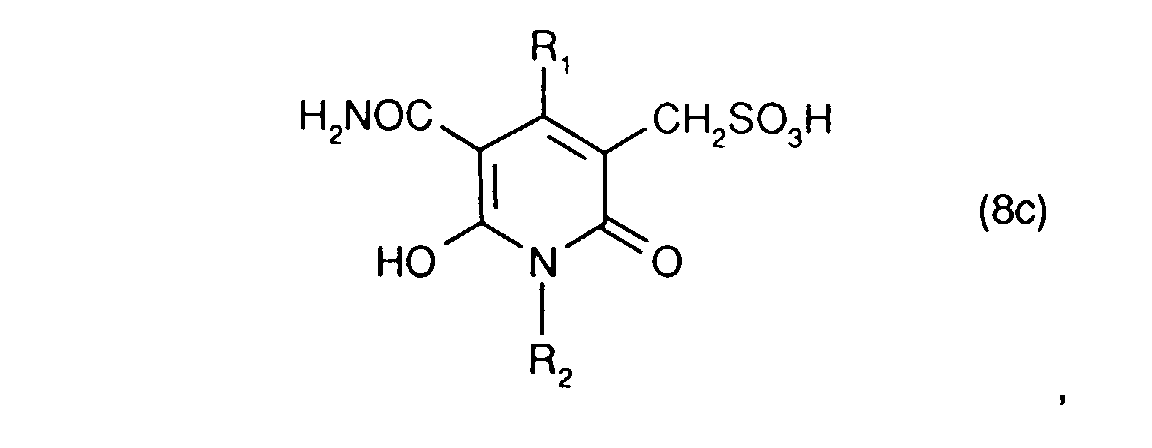
- R 3 is preferably carbamoyl or sulfomethyl.
- the compounds of the formulas (1) and (2) can be synthesized, for example, by using a compound of the formula wherein V, T and Z each have the meaning given above, in a manner known per se, for example with sodium nitrite in a hydrochloric acid medium, diazotized and with a coupling component of the formula wherein K, R 1 , R 2 and R 3 each have the meaning given above, couples.
- a coupling component of the formula instead of the coupling component of the formula (8b) wherein R 1 and R 2 each have the meaning given above, to be used in the process.
- the compounds of formula (7) can, for example, by diazotization of a compound of formula Z-NH 2 and coupling to a compound of formula wherein T, V and Z each have the meaning given above, are prepared.
- the dyes of the formulas (1) and (2) used according to the invention each have at least one sulfo group and preferably in each case 1 to 3 sulfo groups, which in each case either in the form of the free sulfonic acid or preferably as its salt, e.g. as the sodium, lithium, potassium, ammonium salt or as an organic amine salt, e.g. as a triethanolammonium salt.
- the dyes of the formulas (1) and (2) and thus also the dye mixtures generally contain further additives, e.g. Cooking salt or dextrin.
- the dyes of formulas (1) and (2) are in the dye mixture e.g. in a weight ratio of 25: 1 to 1: 1, preferably 20: 1 to 1: 1 and particularly preferably 10: 1 to 1.5: 1.
- the dye mixtures according to the invention can e.g. be produced by mixing the individual dyes. This mixing process takes place e.g. in suitable mills, e.g. Ball or pin mills, as well as in kneaders or mixers.
- Dye mixtures each containing a compound of the formula (1) and (2), in which T and T 1 , V and V 1 and Z and Z 1 are each identical, can also advantageously be obtained by mixed synthesis, ie by reacting a compound of the formula ( 7) can be obtained with a mixture of coupling components of the formulas (8a) and (8b) or (8c) given above.
- the invention further relates to a process for dyeing or printing hydroxyl group-containing or nitrogen-containing fiber materials with the dye mixtures according to the invention.
- fiber materials come e.g. natural cellulose fibers, such as cotton, linen, jute or hemp, as well as modified cellulose fibers such as cellulose or regenerated cellulose.
- the dye mixtures according to the invention are particularly suitable for dyeing or printing natural polyamide fiber materials, e.g. Silk or wool, synthetic polyamide fiber materials, e.g. Polyamide 6 or polyamide 6.6, or of wool and synthetic polyamide blends.
- the dye mixtures according to the invention are particularly suitable for dyeing or printing natural polyamide fiber materials, in particular wool or chlorinated or machine-washable wool.
- the textile fiber material mentioned can be in a wide variety of processing forms, e.g. as fiber, yarn, flake, woven or knitted fabric.
- the dye mixtures according to the invention are suitable for the customary dyeing and printing processes and can be applied and fixed in a wide variety of ways on the fiber material, in particular in the form of aqueous dye solutions or printing pastes. They are suitable both for the exhaust process and for foulard dyeing, after which the goods are impregnated with aqueous, optionally salt-containing dye solutions, and the dyes are fixed after an alkali treatment or in the presence of alkali, if appropriate with the action of heat.
- the dye mixtures according to the invention are also suitable for the so-called cold residence process, according to which the dye is applied to the padding together with the alkali and is then fixed by storage for several hours at room temperature.
- Natural and synthetic polyamide fiber materials are preferably dyed using the exhaust process, at a pH of approximately 3 to 7, in particular 3 to 5, and at temperatures of, for example, 70 to 120 ° C. and in particular 90 to 105 ° C.
- the dye liquors or printing pastes can contain other additives, e.g. known shading dyes, salts, buffer substances, wetting agents, anti-foaming agents, leveling agents or agents influencing the properties of the textile material, e.g. Plasticizers, flame retardants or dirt, water and oil repellents, water softeners and natural or synthetic thickeners, e.g. Alginates or cellulose ethers.
- additives e.g. known shading dyes, salts, buffer substances, wetting agents, anti-foaming agents, leveling agents or agents influencing the properties of the textile material, e.g. Plasticizers, flame retardants or dirt, water and oil repellents, water softeners and natural or synthetic thickeners, e.g. Alginates or cellulose ethers.
- Dye mixtures containing 90 to 25% by weight and preferably 90 to 50% by weight of dye mixture each containing a compound of the formulas (1) and (2) given above and 10-75% by weight and preferably 10 have proven advantageous up to 50% by weight, based in each case on the total solid dye formulation, of a dye of the formula in which Y has the meanings and preferences given above.
- the dye mixtures according to the invention give level dyeings and prints with good general fastness properties, in particular good washing, rubbing, wet, wet rubbing and light fastness.
- the dye mixtures according to the invention are also distinguished by a uniform color build-up, good absorption behavior and high degrees of fixation.
- the otherwise customary post-treatment of the dyeings and prints with so-called fixing agents can be dispensed with.
- parts represent parts by weight.
- the temperatures are degrees Celsius.
- the relationship between parts by weight and parts by volume is the same as that between grams and cubic centimeters.
- Example 1 10 g of wool fabric are dyed in a laboratory dyeing machine using the following liquor:
- the pH of the liquor is 4.5.
- the textile is treated in the dyeing liquor at 40 ° C. for 5 minutes, then heated to a cooking temperature (98 ° C.) at a rate of 1 ° / min and dyed at this temperature for 90 minutes. After the liquor has cooled to 80 ° C., the dyeing is rinsed and finished as usual. A fiber-like and flat black dyeing with good fastness properties is obtained.
- Example 2 10 g of a wool tricot finished according to the Hercoset process to a superwash standard is dyed in a laboratory dyeing machine using the following liquor:
- the pH of the liquor is 4.7.
- the textile material is treated in the dyeing liquor at 40 ° C. for 5 minutes, then heated to 60 ° C. at a rate of 1 ° / min and kept at 60 ° C. for 20 minutes. The mixture is then heated to cooking temperature (98 ° C.) at 1 ° / min and dyed at this temperature for 90 min. After cooling, the textile material is treated in a fresh liquor containing 5 g / l of sodium hydrogen carbonate for 20 min at 80 ° C. and pH 8.3. Then it is rinsed as usual and 1% formic acid, based on the fiber weight, is added to the last rinsing bath for acidification. A fiber-like and flat black dyeing with good fastness properties is obtained.
- Example 3 5 g of loose wool are dyed in a laboratory dyeing machine with the following liquor:
- the pH of the liquor is 4.7.
- the material is treated in the dyeing liquor at 40 ° C. for 5 minutes, then heated to boiling temperature (98 ° C.) at a heating rate of 1 ° C./min and dyed at this temperature for 90 minutes. After the liquor has cooled to 80 ° C., the dyeing is rinsed and finished as usual. A fiber-like and flat black dyeing with good fastness properties is obtained.
- Example 4 1 kg of wool comb yarn in the form of a cheese is composed of a liquor in a circulation apparatus
- Example 5 If the procedure is as described in Example 4, the dyeing liquor is additionally set with 4% by weight, based on the textile material, of a commercially available wool protection agent (Irgasol
- Example 10 10 g of a wool tricot finished according to the Hercoset process to a superwash standard is dyed in a laboratory dyeing machine using the following liquor:
- the pH of the liquor is 4.7.
- the textile material is treated in the dyeing liquor at 40 ° C. for 5 minutes, then heated to 60 ° C. at a rate of 1 ° / min and kept at 60 ° C. for 20 minutes. The mixture is then heated to cooking temperature (98 ° C.) at 1 ° / min and dyed at this temperature for 90 min.
- the textile material is treated in a fresh liquor containing 5 g / l of sodium hydrogen carbonate for 20 min at 80 ° C. and pH 8.3 (the treatment can alternatively be carried out with ammonia, sodium carbonate or sodium hydroxide solution in each case at a pH of 7.5 to 9).
- it is rinsed as usual and 1% formic acid, based on the fiber weight, is added to the last rinsing bath for acidification. A fiber-like and flat black dyeing with good fastness properties is obtained.
Landscapes
- Chemical & Material Sciences (AREA)
- Organic Chemistry (AREA)
- Chemical Kinetics & Catalysis (AREA)
- Coloring (AREA)
- Plural Heterocyclic Compounds (AREA)
- Nitrogen And Oxygen Or Sulfur-Condensed Heterocyclic Ring Systems (AREA)
- Heterocyclic Carbon Compounds Containing A Hetero Ring Having Oxygen Or Sulfur (AREA)
Abstract
Description
- Die vorliegende Erfindung betrifft Mischungen von Azofarbstoffen, die insbesondere zum Färben oder Bedrucken von natürlichen oder synthetischen Polyamidfasermaterialien geeignet sind und dabei Färbungen oder Drucke mit guten Allgemeinechtechtheiten ergeben.
- Gegenstand der vorliegenden Erfindung sind somit Farbstoffgemische enthaltend
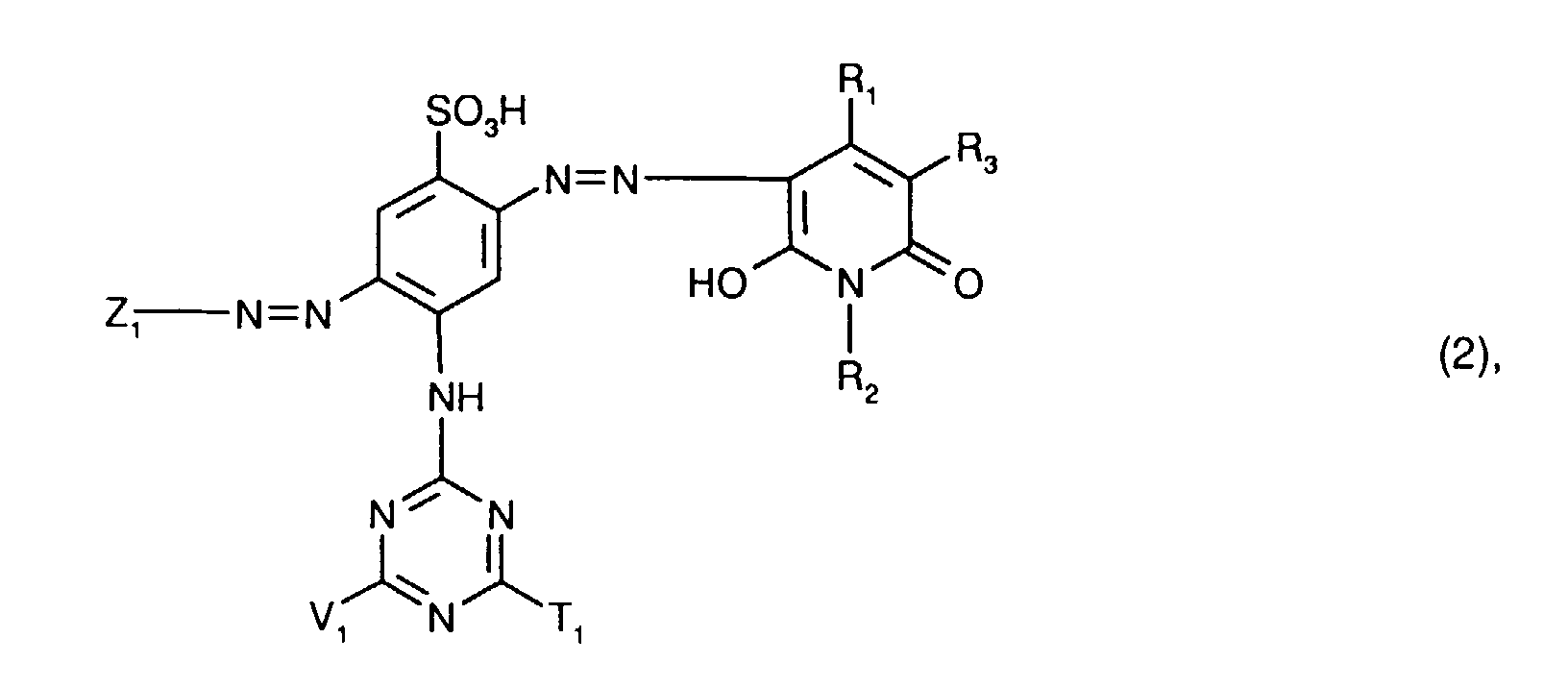
- (a) eine Verbindung der Formel

- K1 ein unsubstituierter oder durch Hydroxy, Amino, N-C1-C4-Alkylamino, C2C4-Alkanoylamino, Benzoylamino, Sulfo oder einen Rest der Formel -SO2-Y weitersubstituierter Naphthylrest ist,
- Z den Rest einer Diazokomponente der Benzol- oder Naphthalinreihe bedeutet, welche mindestens einen faserreaktiven Rest der Formel
-SO2-Y (3a),
-CONH-(CH2)m-SO2-Y (3b),
-CONH-(CH2)m1-O-(CH2)m-SO2-Y (3c),
-(O)p-(CH2)q-CONH-(CH2)m-SO2-Y (3d),
NH-CO-CHX-CH2X- (3e)
oder
NH-CO-CX=CH2 (f)
aufweist, - Y Vinyl oder einen Rest -CH2CH2-U bedeutet und U eine Abgangsgruppe ist,
X für Chlor oder Brom steht,
- p die Zahl 0 oder 1 und m, m1 und q unabhängig voneinander je eine ganze Zahl von 1 bis 6 bedeuten,
- T für Chlor, Fluor, Brom, 3-Carboxypyridin-1-yl oder 3-Carbamoylpyridin-1-yl steht,
- V unabhängig die Bedeutung von T hat oder für einen nicht-reaktiven Rest aus der Gruppe Hydroxy, C1-C4-Alkoxy, Phenoxy, C1-C4-Alkylthio, Morpholino und gegebenenfalls substituiertes Amino oder für einen Reaktivrest der Formel


- R4 Wasserstoff, Hydroxy, Sulfo, Sulfato, Carboxy, Cyano, Halogen, C1-C4-Alkoxycarbonyl, Carbamoyl oder eine Gruppe -SO2-Y, worin Y die zuvor angegebene Bedeutung hat, ist,
- R5 Wasserstoff, gegebenenfalls durch Hydroxy, Sulfo, Sulfato, Carboxy oder Cyano substituiertes C1-C4-Alkyl oder ein Rest

- R6 für Wasserstoff oder C1-C4-Alkyl steht,
- alk und alk' unabhängig voneinander je C1-C6-Alkylen sind,
- arylen einen unsubstituierten oder durch Sulfo, Carboxy, Hydroxy, C1-C4-Alkyl, C1-C4-Alkoxy oder Halogen substituierten Phenylen- oder Naphthylenrest bedeutet,
- Y1 für eine Gruppe -CHX-CH2X oder -CX=CH2 steht , worin X die oben angegebene Bedeutung hat,
- B ein Rest -O- oder -NR6-, worin R6 die oben angegebene Bedeutung hat, ist, und t für die Zahl 0 oder 1 steht, und
- (b) eine Verbindung der Formel

- R1 und R2 unabhängig voneinander je C1-C4-Alkyl sind,
- R3 Carbamoyl, Sulfomethyl oder Cyano bedeutet, und
- T1 unabhängig die zuvor für T angegebene Bedeutung, V1 unabhängig die zuvor für V angegebene Bedeutung und Z1 unabhängig die zuvor für Z angegebene Bedeutung haben.
- Unter C1-C4-Alkyl ist hierbei generell Methyl, Ethyl, n- oder iso-Propyl oder n-, iso-, sec.-oder tert.-Butyl zu verstehen. C1-C4-Alkoxy umfasst generell Methoxy, Ethoxy, n- oder iso-Propoxy und n-, iso-, sec.- oder tert.-Butoxy. Halogen steht generell z.B. für Fluor, Brom oder insbesondere Chlor. Beispiele für C2-C4-Alkanoylamino sind Acetylamino oder Propionylamino. C1-C4-Alkoxycarbonyl bedeutet generell Methoxycarbonyl, Ethoxycarbonyl, n- oder iso-Propoxycarbonyl und n-, iso-, sec.- oder tert.-Butoxycarbonyl. Beispiele für C1-C4-Alkylthio sind Methylthio oder Ethylthio. Beispiele für N-C1-C4-Alkylamino sind N-Methyl-amino, N-Ethylamino, N-(n-Propyl)- oder N-(iso-Propyl)-amino oder N-(n-Butyl)-, N-(iso-Butyl)-, N-(sec.-Butyl)- oder N-(tert.-Butyl)-amino.
- K1 steht in Formel (1) bevorzugt für einen 1- oder 2-Naphthylrest, der durch 1 bis 4 gleiche oder verschiedene Reste aus der Gruppe Hydroxy, Amino, N-Methyl- oder N-Ethylamino, Acetylamino, Benzoylamino und Sulfo weitersubstituiert ist. K1 steht besonders bevorzugt für einen 1-Naphthylrest, der 1 bis 4 gleiche oder verschiedene Reste aus der Gruppe Hydroxy, Amino und Sulfo trägt. K1 steht insbesondere bevorzugt für den 2-Amino-6-sulfo-8-hydroxy-1 -naphthyl- oder 2-Amino-8-hydroxy-3,6-disulfo-1-naphthylrest.
- Z bedeutet in Formel (1) einen Phenyl- oder Naphthylrest, der ausser faserreaktiven Resten der Formeln (3a) bis (3f) die bei organischen Farbstoffen üblichen Substituenten aufweisen kann. Als solche Substituenten seien genannt z.B. C1-C4-Alkyl, C1-C4-Alkoxy, Halogen, Sulfo, Hydroxy oder Carboxy.
- Bedeutet Y einen Rest -CH2CH2U, so kann es sich bei der Abgangsgruppe U z.B. um -Cl, -Br, -F, -OSO3H, -SSO3H, -OCO-CH3, -OPO3H2, -OCO-C6H5, -OSO2-C1-C4-Alkyl oder -OSO2-N(C1-C4-Alkyl)2 handeln. Bevorzugt ist U eine Gruppe der Formel -Cl, -OSO3H, -SSO3H, -OCO-CH3, -OCO-C6H5 oder -OPO3H2, insbesondere -Cl oder -OSO3H und besonders bevorzugt-OSO3H.
- Y bedeutet bevorzugt Vinyl, β-Chlorethyl, β-Sulfatoethyl, β-Thiosulfatoethyl,β-Acetoxyethyl, β-Phenoxyethyl oder β-Phosphatoethyl und besonders bevorzugt β-Sulfatoethyl oder Vinyl.
- m und m1 stehen unabhängig voneinander je bevorzugt für die Zahl 2, 3 oder 4, besonders bevorzugt für die Zahl 2 oder 3 und insbesondere bevorzugt für die Zahl 2. p bedeutet vorzugsweise die Zahl 0, und q steht vorzugsweise für die Zahl 1, 2 oder 3 und besonders bevorzugt für die Zahl 1 oder 2.
- Z bedeutet bevorzugt einen Phenylrest, der einen faserreaktiven Rest der Formel (3a) oder (3b) trägt und weiter unsubstituiert oder durch Sulfo, Methyl, Methoxy, Chlor, Hydroxy oder Methoxy substituiert ist, oder einen 1- oder 2-Naphthylrest, der einen faserreaktiven Rest der Formel (3a) trägt und weiter unsubstituiert oder durch Sulfo substituiert ist.
- Eine bevorzugte Ausführungsform der vorliegenden Erfindung betrifft Verbindungen der Formel (1), worin Z ein faserreaktiver Rest der Formel


- T bedeutet bevorzugt Fluor oder Chlor und besonders bevorzugt Chlor.
- Bedeutet V einen nicht-reaktiven gegebenenfalls substituierten Aminorest, so kann es sich z.B. um Amino; N-C1-C4-Alkylamino oder N,N-Di-C1-C4-Alkylamino, wobei das Alkyl jeweils z.B. durch Sulfo, Sulfato, Hydroxy, Carboxy oder Phenyl substituiert sein kann; Cyclohexylamino; Phenylamino oder Naphthylamino, wobei das Phenyl oder Naphthyl jeweils z.B. durch C1-C4-Alkyl, C1-C4-Alkoxy, Amino, C2-C4-Alkanoylamino, Carboxy, Sulfo oder Halogen substituiert sein kann; oder um N-C1-C4-Alkyl-N-phenylamino, wobei das Alkyl und Phenyl gegebenenfalls wie zuvor geschildert substituiert sein kann, handeln.
- Beispiele für geeignete nicht-reaktive Aminoreste V sind Amino, Methylamino, Ethylamino, β-Hydroxyethylamino, N,N-Di-β-Hydroxyethylamino, β-Sulfoethylamino, Cyclohexylamino, o-, m- oder p-Methylphenylamino, o-, m- oder p-Methoxyphenylamino, o-, m- oder p-Sulfophenylamino, 2,4- oder 2,5-Disulfophenylamino, o-Carboxyphenylamino, 1- oder 2-Naphthylamino, 3,6,8-Trisulfonaphthylamino, 1,6-Disulfonaphthylamino, N-Ethyl-N-phenylamino, N-Methyl-N-phenylamino, N-β-sulfoethyl-N-phenylamino, oder N-β-Hydroxyethyl-N-phenylamino.
- V steht als nicht-reaktiver Aminorest bevorzugt für Amino, unsubstituiertes oder durch Hydroxy, Sulfo oder Sulfato substituiertes N-Mono- oder N,N-Di-C1-C2-Alkylamino, Cyclohexylamino, unsubstituiertes oder durch Methyl, Methoxy, Carboxy oder Sulfo substituiertes Phenylamino oder Naphthylamino oder für N-C1-C2-Alkyl-N-phenylamino und besonders bevorzugt für Amino, unsubstituiertes oder durch Hydroxy, Sulfo oder Sulfato substituiertes N-C1-C2-Alkylamino oder für Mono- oder Disulfophenylamino.
- Bevorzugt als nicht-reaktive C1-C4-Alkoxyreste V sind Methoxy und iso-Propoxy und als nicht-reaktive C1-C4-Alkylthioreste V Methylthio und Ethylthio.
- Eine Gruppe von bevorzugten nicht-reaktiven Resten V umfasst Hydroxy, C1-C4-Alkoxy, Morpholino, Amino; unsubstituiertes oder im Alkylteil durch Sulfo, Sulfato, Hydroxy, Carboxy oder Phenyl substituiertes N-C1-C4-Alkylamino oder N,N-Di-C1-C4-Alkylamino, Cyclohexylamino; unsubstituiertes oder im Phenyl- oder Naphthylteil durch C1-C4-Alkyl, C1-C4-Alkoxy, Amino, C2C4-Alkanoylamino, Carboxy, Sulfo oder Halogen substituiertes Phenylamino oder Naphthylamino, und unsubstituiertes oder im Alkylteil durch Sulfo, Sulfato, Hydroxy, Carboxy oder Phenyl substituiertes und/oder im Phenylteil durch C1-C4-Alkyl, C1-C4-Alkoxy, Amino, C2-C4-Alkanoylamino, Carboxy, Sulfo oder Halogen substituiertes N-C1-C4-Alkyl-N-phenylamino.
- Eine Gruppe von besonders bevorzugten nicht-reaktiven Resten V umfasst Hydroxy, Methoxy, iso-Propoxy, Morpholino, Amino, unsubstituiertes oder durch Hydroxy, Sulfo oder Sulfato substituiertes N-Mono- oder N,N-Di-C1-C2-Alkylamino, Cyclohexylamino, unsubstituiertes oder durch Methyl, Methoxy, Carboxy oder Sulfo substituiertes Phenylamino oder Naphthylamino und N-C1-C2-Alkyl-N-phenylamino.
- Handelt es sich bei V um einen Reaktivrest der Formel (4a) - (4g), so bedeuten alk und alk' unabhängig voneinander je z.B. Methylen, 1,2-Ethylen, 1,3-Propylen, 1,4-Butylen, 1,5-Pentylen, 1,6-Hexylen oder deren verzweigte Isomere. alk und alk' stehen unabhängig voneinander je bevorzugt für einen C1-C4-Alkylenrest und besonders bevorzugt für einen Ethylen- oder Propylenrest.
- Bevorzugte Bedeutungen von arylen sind ein unsubstituierter oder durch Sulfo, Methyl, Methoxy oder Carboxy substituierter 1,3- oder 1,4-Phenylenrest und insbesondere ein unsubstituierter 1,3- oder 1,4-Phenylenrest.
- R4 bedeutet bevorzugt um Wasserstoff.
- R5 bedeutet bevorzugt Wasserstoff, C1-C4-Alkyl oder einen Rest der Formel

- R6 bedeutet bevorzugt Wasserstoff, Methyl oder Ethyl und besonders bevorzugt Wasserstoff.
- Die Variable B steht bevorzugt für -NH- oder -O- und besonders bevorzugt für -O-.
- Die Variable t steht bevorzugt für die Zahl 0.
- Bevorzugt als Reaktivreste der Formel (4a) bis (4g) sind solche, worin R4, R5 und R6 je Wasserstoff, B den Rest -NH- oder -O-, alk und alk' unabhängig voneinander je Ethylen oder Propylen, arylen unsubstituiertes oder durch Methyl, Methoxy, Carboxy oder Sulfo substituiertes Phenylen, Y Vinyl oder β-Sulfatoethyl, Y1-CHBr-CH2Br oder -CBr=CH2 und t die Zahl 0 bedeuten.
- V steht als Reaktivrest besonders bevorzugt für eine Gruppe der Formel


- In der Formel (2) gelten für Z1 unabhängig die zuvor für Z angegebenen Bedeutungen und Bevorzugungen, für T1 unabhängig die zuvor für T angegebenen Bedeutungen und Bevorzugungen und für V1 unabhängig die zuvor für V angegebenen Bedeutungen und Bevorzugungen.
- R1 steht bevorzugt für Methyl, R2 bevorzugt für Ethyl, und R3 bevorzugt für Carbamoyl oder Sulfomethyl.
- Eine bevorzugte Ausführungsform der vorliegenden Erfindung betrifft Farbstoffgemische enthaltend
- (a) eine Verbindung der zuvor angegebenen Formel (1), worin
- K1 einen 1- oder 2-Naphthylrest, der durch 1 bis 4 gleiche oder verschiedene Reste aus der Gruppe Hydroxy, Amino, N-Methyl- oder N-Ethylamino, Acetylamino, Benzoylamino und Sulfo weitersubstituiert ist, bedeutet,
- Z für einen Phenylrest, der einen faserreaktiven Rest der Formel
SO2-Y (3a) (3a)
oder
CONH -(CH2)m-SO2-Y (3b), (3b),
worin Y Vinyl oder β-Sulfatoethyl und m die Zahl 2 oder 3 sind, trägt und weiter unsubstituiert oder durch Sulfo, Methyl, Methoxy, Chlor, Hydroxy oder Methoxy substituiert ist, oder für einen 1- oder 2-Naphthylrest, der einen faserreaktiven Rest der oben angegebenen Formel (3a) trägt und weiter unsubstituiert oder durch Sulfo substituiert ist, steht, - T Fluor oder Chlor ist, und
- V, Hydroxy, C1-C4-Alkoxy, Morpholino, Amino; unsubstituiertes oder im Alkylteil durch Sulfo, Sulfato, Hydroxy, Carboxy oder Phenyl substituiertes N-C1-C4-Alkylamino oder N,N-Di-C1-C4-Alkylamino, Cyclohexylamino; unsubstituiertes oder im Phenyl- oder Naphthylteil durch C1-C4-Alkyl, C1-C4-Alkoxy, Amino, C2-C4-Alkanoylamino, Carboxy, Sulfo oder Halogen substituiertes Phenylamino oder Naphthylamino oder unsubstituiertes oder im Alkylteil durch Sulfo, Sulfato, Hydroxy, Carboxy oder Phenyl substituiertes und/oder im Phenylteil durch C1-C4-Alkyl, C1-C4-Alkoxy, Amino, C2-C4-Alkanoylamino, Carboxy, Sulfo oder Halogen substituiertes N-C1-C4-Alkyl-N-phenylamino bedeutet, und
- (b) eine Verbindung der zuvor angegebenen Formel (2), worin
- R1 und R2 unabhängig voneinander je C1-C4-Alkyl sind,
- R3 für Carbamoyl oder Sulfomethyl steht, und
- T1 unabhängig die oben für T angegebene Bedeutung, V1 unabhängig die oben für V angegebene Bedeutung und Z1 unabhängig die oben für Z angegebene Bedeutung haben.
- Eine besonders bevorzugte Ausführungsform der vorliegenden Erfindung betrifft Farbstoffgemische enthaltend
- (a) eine Verbindung der zuvor angegebenen Formel (1), worin
- K1 einen 1-Naphthylrest, der durch 1 bis 4 gleiche oder verschiedene Reste aus der Gruppe Hydroxy, Amino und Sulfo weitersubstituiert ist, bedeutet,
- Z ein faserreaktiver Rest der Formel


- T Fluor oder Chlor ist, und
- V für Amino, unsubstituiertes oder durch Hydroxy, Sulfo oder Sulfato substituiertes N-C1-C2-Alkylamino oder für Mono- oder Disulfophenylamino steht, und
- (b) eine Verbindung der zuvor angegebenen Formel (2), worin
- R1 Methyl, R2 Ethyl und R3 Carbamoyl oder Sulfomethyl bedeuten, und
- T1 unabhängig die oben für T angegebene Bedeutung, V1 unabhängig die oben für V angegebene Bedeutung und Z1 unabhängig die oben für Z angegebene Bedeutung haben.
- Eine insbesondere bevorzugte Ausführungsform der vorliegenden Erfindung betrifft Farbstoffgemische enthaltend
- (a) eine Verbindung der Formel

- (b) eine Verbindung der Formel

- Die Verbindungen der Formeln (1) und (2) sind z.T. aus der EP-A-647683 bekannt oder können analog dazu hergestellt werden. Die Verbindungen der zuvor angegebenen Formel (2), worin T1 Halogen und V1 β-Sulfoethylamino oder β-Hydroxyethylamino sind und für R1, R2, R3 und Z1 jeweils die zuvor angegebenen Bedeutungen und Bevorzugungen gelten, sind neu und stellen einen weiteren Gegenstand der Erfindung dar.
- Die Synthese der Verbindungen der Formeln (1) und (2) kann z.B. erfolgen, indem man eine Verbindung der Formel


- Die Verbindungen der Formel (7) können z.B. durch Diazotierung einer Verbindung der Formel Z-NH2 und Kupplung auf eine Verbindung der Formel

- Die erfindungsgemäss verwendeten Farbstoffe der Formeln (1) und (2) weisen jeweils mindestens eine Sulfogruppe und vorzugsweise jeweils 1 bis 3 Sulfogruppen auf, welche jeweils entweder in Form der freien Sulfosäure oder vorzugsweise als deren Salz, z.B. als Natrium-, Lithium-, Kalium-, Ammoniumsalz oder als Salz eines organischen Amins, z.B. als Triethanolammoniumsalz, vorliegen. Die Farbstoffe der Formeln (1) und (2) und somit auch die Farbstoffgemische enthalten in der Regel weitere Zusätze, z.B. Kochsalz oder Dextrin.
- Die Farbstoffe der Formeln (1) und (2) liegen in dem Farbstoffgemisch z.B. im Gewichtsverhältnis von 25:1 bis 1:1, vorzugsweise 20:1 bis 1:1 und besonders bevorzugt 10:1 bis 1,5:1, vor.
- Die erfindungsgemässen Farbstoffgemische können z.B. durch Mischung der Einzelfarbstoffe hergestellt werden. Dieser Mischprozess erfolgt z.B. in geeigneten Mühlen, z.B. Kugel- oder Stiftmühlen, sowie in Knetern oder Mixern.
- Farbstoffgemischen enthaltend jeweils eine Verbindung der Formel (1) und (2), worin T und T1, V und V1 und Z und Z1 jeweils identisch sind, können vorteilhaft auch durch Mischsynthese, d.h. durch Umsetzung einer Verbindung der zuvor angegebenen Formel (7) mit einem Gemisch von Kupplungskomponenten der zuvor angegebenen Formeln (8a) und (8b) bzw. (8c) erhalten werden.
- Ein weiterer Gegenstand der Erfindung betrifft ein Verfahren zum Färben oder Bedrucken von hydroxylgruppenhaltigen oder stickstoffhaltigen Fasermaterialien mit den erfindungsgemässen Farbstoffgemischen.
- Als Fasermaterialien kommen z.B. die natürlichen Cellulosefasem, wie Baumwolle, Leinen, Jute oder Hanf, sowie modifizierte Cellulosefasern wie Zellstoff oder regenerierte Cellulose in Frage. Insbesondere eignen sich die erfindungsgemässen Farbstoffgemische zum Färben oder Bedrucken von natürlichen Polyamidfasermaterialien, z.B. Seide oder Wolle, synthetischen Polyamidfasermaterialien, z.B. Polyamid 6 oder Polyamid 6.6, oder von Woll-und synthetischen Polyamidmischgeweben. Die erfindungsgemässen Farbstoffgemische sind besonders geeignet zum Färben oder Bedrucken von natürlichen Polyamidfasermaterialien und hierbei insbesondere von Wolle oder von chlorierter oder waschmaschinenfest ausgerüsteter Wolle.
- Das genannte Textilfasermaterial kann dabei in den verschiedensten Verarbeitungsformen vorliegen, wie z.B. als Faser, Garn, Flocke, Gewebe oder Gewirke.
- Die erfindungsgemässen Farbstoffgemische eignen sich für die üblichen Färbe- und Druckverfahren und lassen sich auf verschiedenste Weise auf das Fasermaterial applizieren und fixieren, insbesondere in Form von wässrigen Farbstofflösungen oder - druckpasten. Sie eignen sich sowohl für das Ausziehverfahren als auch zum Foulard- Färben, wonach die Ware mit wässrigen, gegebenenfalls salzhaltigen Farbstofflösungen imprägniert wird, und die Farbstoffe nach einer Alkalibehandlung oder in Gegenwart von Alkali, gegebenenfalls unter Wärmeeinwirkung, fixiert werden. Die erfindungsgemässen Farbstoffgemische sind ebenfalls für das sogenannte Kaltverweilverfahren geeignet, wonach der Farbstoff zusammen mit dem Alkali auf dem Foulard aufgebracht wird und danach durch mehrstündiges Lagern bei Raumtemperatur fixiert wird.
- Das Färben von natürlichen und synthetischen Polyamidfasermaterialien, insbesondere von Wolle, erfolgt vorzugsweise nach dem Ausziehverfahren, bei einem pH-Wert von ca. 3 bis 7, insbesondere 3 bis 5, und bei Temperaturen von z.B. 70 bis 120 °C und insbesondere 90 bis 105°C.
- Die Färbeflotten oder Druckpasten können ausser Wasser und den Farbstoffen der Formeln (1) und (2) weitere Zusätze, z.B. an sich bekannte Nuancierfarbstoffe, Salze, Puffersubstanzen, Netzmittel, Antischaummittel, Egalisiermittel oder die Eigenschaften des Textilmaterials beeinflussende Mittel, z.B. Weichmachungsmittel, Zusätze zum Flammfestausrüsten oder schmutz-, wasser- und öl-abweisende Mittel sowie wasserenthärtende Mittel und natürliche oder synthetische Verdicker, z.B. Alginate oder Celluloseether, enthalten.
- Als vorteilhaft haben sich z.B. Farbstoffgemische enthaltend 90 bis 25 Gew.-% und vorzugsweise 90 bis 50 Gew.-% Farbstoffmischung enthaltend je eine Verbindung der zuvor angegebenen Formeln (1) und (2) und 10-75 Gew.-% und vorzugsweise 10 bis 50 Gew.-%, jeweils bezogen auf die gesamte feste Farbstofformulierung, eines Farbstoffes der Formel

- Die erfindungsgemässen Farbstoffgemische ergeben egale Färbungen und Drucke mit guten Allgemeinechtheiten, insbesondere guter Wasch-, Reib-, Nass-, Nassreib- und Lichtechtheit. Die erfindungsgemässen Farbstoffgemische zeichnen sich ferner durch gleichmässigen Farbaufbau, gutes Aufziehverhalten und hohe Fixiergrade aus. Weiterhin kann bei den erfindungsgemässen Farbstoffgemischen auf die sonst übliche Nachbehandlung der Färbungen und Drucke mit sogenannten Fixiermitteln verzichtet werden.
- In den folgenden Beispielen stehen Teile für Gewichtsteile. Die Temperaturen sind Celsiusgrade. Die Beziehung zwischen Gewichtsteilen und Volumenteilen ist dieselbe wie diejenige zwischen Gramm und Kubikzentimeter.
-
- 0,2g Natriumacetat
- 0,5g 80%-ige Essigsäure
- 0,2g eines handelsüblichen Egalisiermittels (Albegal B®)
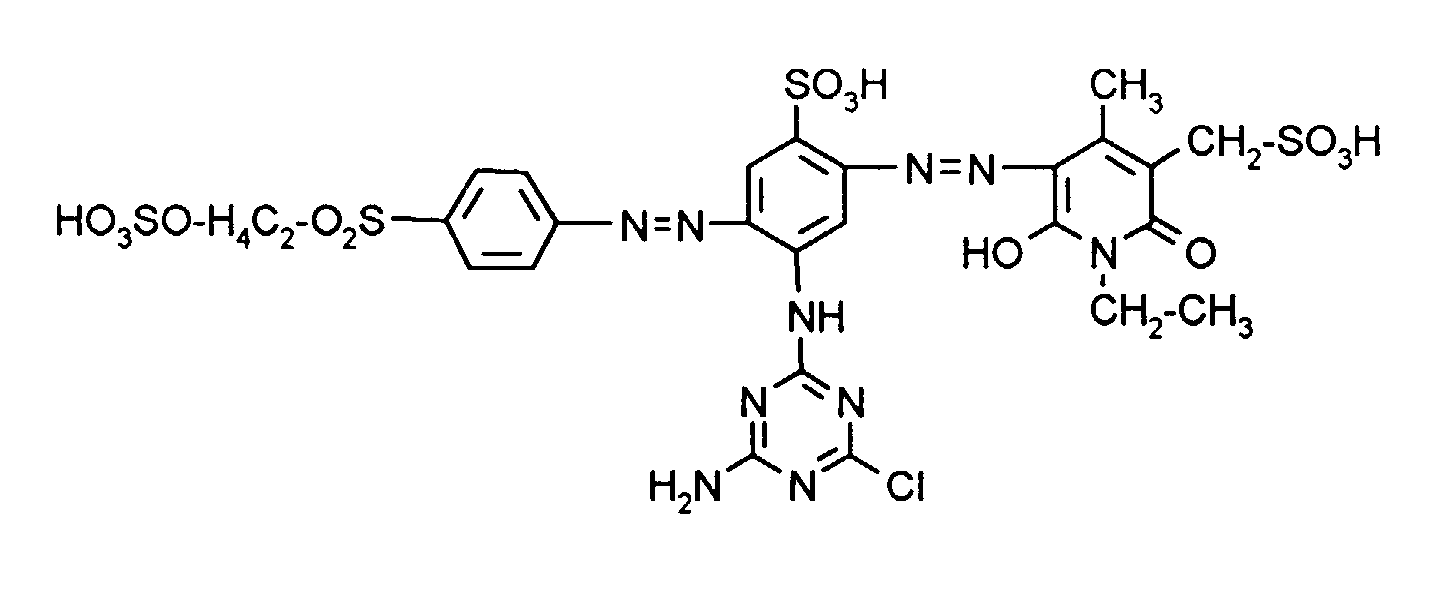
- 0,3 g eines Farbstoffgemisches, bestehend aus 80 Gew.-% Farbstoff der Formel

- Der pH der Flotte beträgt 4,5. Das Textil wird in der Färbeflotte 5 min bei 40°C behandelt, anschliessend mit einer Aufheizrate von 1°/min auf Kochtemperatur (98°C) erwärmt und 90 min bei dieser Temperatur gefärbt. Nach dem Abkühlen der Flotte auf 80°C wird die Färbung wie üblich gespült und fertiggestellt. Man erhält eine faser- und flächenegale schwarze Färbung mit guten Echtheitseigenschaften.
-
- 0,2g Natriumacetat
- 0,5g 80%-ige Essigsäure
- 0,5g Glaubersalz
- 0,2g eines handelsüblichen Egalisiermittels (Albegal B®)
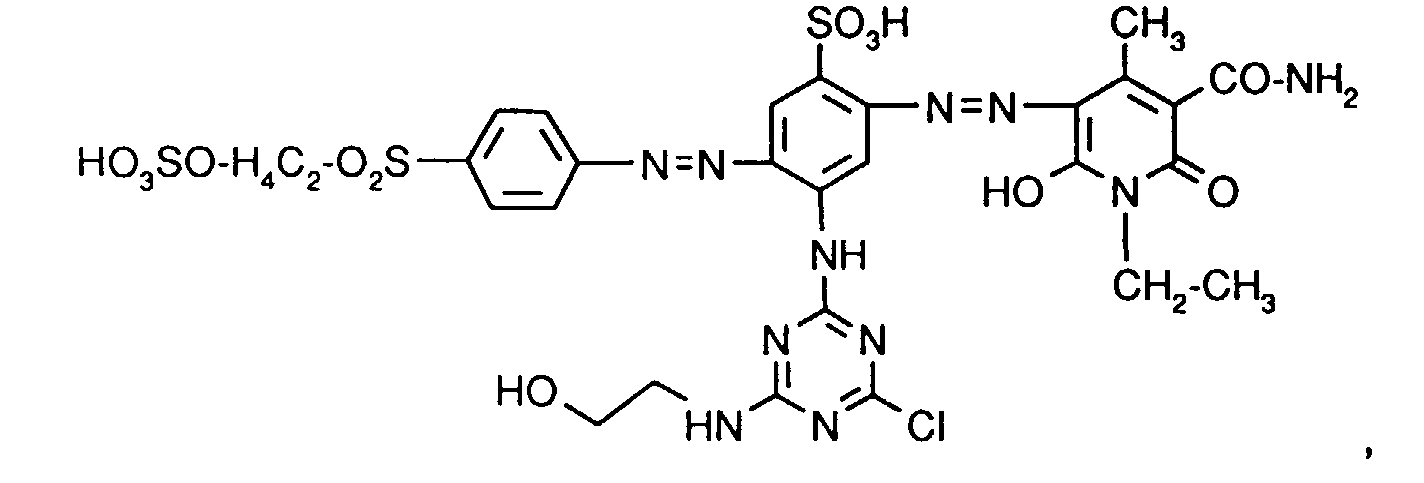
- 0,4 g eines Farbstoffgemisches bestehend aus 75 Gew.-% Farbstoff der Formel


- Der pH der Flotte beträgt 4,7. Das Textilmaterial wird in der Färbeflotte 5 min bei 40 °C behandelt, dann mit einer Aufheizrate von 1 °/min auf 60°C erwärmt und 20 min bei 60°C gehalten. Anschliessend wird mit 1°/min auf Kochtemperatur (98°C) erwärmt und 90 min bei dieser Temperatur gefärbt. Nach dem Abkühlen wird das Textilmaterial in einer frischen 5 g/l Natriumhydrogencarbonat enthaltenden Flotte 20 min bei 80 °C und pH 8,3 behandelt. Dann wird wie üblich gespült und dem letzten Spülbad zum Absäuern 1% Ameisensäure, bezogen auf das Fasergewicht, zugesetzt. Man erhält eine faser- und flächenegale schwarze Färbung mit guten Echtheitseigenschaften.
-
- 0,2g Natriumacetat
- 0,5g 80%-ige Essigsäure
- 0,2g eines handelsüblichen Egalisiermittels (Albegal B®)
- 105 mg eines Farbstoffgemisches, bestehend aus 75 Teilen Farbstoff der Formel


- Der pH der Flotte beträgt 4,7. Das Material wird in der Färbeflotte 5 min bei 40°C behandelt, anschliessend mit einer Aufheizrate von 1°C/min auf Kochtemperatur (98°C) erwärmt und 90 min bei dieser Temperatur gefärbt. Nach Abkühlen der Flotte auf 80°C wird die Färbung wie üblich gespült und fertiggestellt. Man erhält eine faser- und flächenegale schwarze Färbung mit guten Echtheitseigenschaften.
-
- 9 l Wasser,
- 9 g Ammoniumacetat,
- 37 ml 80%-ige Essigsäure,
- 9 g eines nichtionogenen Netzmittels (Albegal FFA®), und
- 20 g eines handelsüblichen Egalisiermittels (Albegal B®),
- 10 min bei 40°C vorbehandelt. Der pH der Flotte beträgt 4,65. Nach Zugabe einer Lösung, die 24 g des Farbstoffs der Formel


- HTW®) zu, färbt bei 105°C und verkürzt die Färbezeit auf 45 min, wird ebenfalls eine faser- und flächenegale schwarze Färbung mit guten Echtheitseigenschaften erhalten.
-


-

-


-

-
- 0,2g Natriumacetat
- 0,5g 80%-ige Essigsäure
- 0,5g Glaubersalz
- 0,2g eines handelsüblichen Egalisiermittels (Albegal B®)
- 0,4 g eines Farbstoffgemisches bestehend aus
45 Gew.-% Farbstoff der Formel


- Der pH der Flotte beträgt 4,7. Das Textilmaterial wird in der Färbeflotte 5 min bei 40 °C behandelt, dann mit einer Aufheizrate von 1 °/min auf 60°C erwärmt und 20 min bei 60°C gehalten. Anschliessend wird mit 1 °/min auf Kochtemperatur (98°C) erwärmt und 90 min bei dieser Temperatur gefärbt. Nach dem Abkühlen wird das Textilmaterial in einer frischen 5 g/l Natriumhydrogencarbonat enthaltenden Flotte 20 min bei 80 °C und pH 8,3 behandelt (Die Behandlung kann alternativ mit Ammoniak, Soda oder Natriumhydroxidlösung jeweils bei einem pH-Wert von 7,5 bis 9 erfolgen). Dann wird wie üblich gespült und dem letzten Spülbad zum Absäuern 1% Ameisensäure, bezogen auf das Fasergewicht, zugesetzt. Man erhält eine faser- und flächenegale schwarze Färbung mit guten Echtheitseigenschaften.
Claims (16)
- Farbstoffgemische enthaltend(a) eine Verbindung der Formel
 K1 ein unsubstituierter oder durch Hydroxy, Amino, N-C1-C4-Alkylamino, C2-C4-Alkanoylamino, Benzoylamino, Sulfo oder einen Rest der Formel -SO2-Y weitersubstituierter Naphthylrest ist,Z den Rest einer Diazokomponente der Benzol- oder Naphthalinreihe bedeutet, welche mindestens einen faserreaktiven Rest der Formel
-SO2- Y (3a),
-CONH-(CH2)m-SO2-Y (3b),
-CONH-(CH2)m1-O-(CH2)m-SO2-Y (3c),
-(O)p-(CH2)q-CONH-(CH2)m-SO2-Y (3d),
-NH - CO - CHX - CH2X (3e)
oder
-NH-CO-CX=CH2 (3f)
aufweist,Y Vinyl oder einen Rest -CH2-CH2-U bedeutet und U eine Abgangsgruppe ist,X für Chlor oder Brom steht,p die Zahl 0 oder 1 und m, m1 und q unabhängig voneinander je eine ganze Zahl von 1 bis 6 bedeuten,T für Chlor, Fluor, Brom, 3-Carboxypyridin-1-yl oder 3-Carbamoylpyridin-1-yl steht,V unabhängig die Bedeutung von T hat oder für einen nicht-reaktiven Rest aus der Gruppe Hydroxy, C1-C4-Alkoxy, Phenoxy, C1-C4-Alkylthio, Morpholino und gegebenenfalls substituiertes Amino oder für einen Reaktivrest der Formel


 R4 Wasserstoff, Hydroxy, Sulfo, Sulfato, Carboxy, Cyano, Halogen, C1-C4-Alkoxycarbonyl, Carbamoyl oder eine Gruppe -SO2-Y, worin Y die zuvor angegebene Bedeutung hat, ist,R5 Wasserstoff, gegebenenfalls durch Hydroxy, Sulfo, Sulfato, Carboxy oder Cyano substituiertes C1-C4-Alkyl oder ein Rest
 R6 für Wasserstoff oder C1-C4-Alkyl steht,alk und alk' unabhängig voneinander je C1-C6-Alkylen sind,arylen einen unsubstituierten oder durch Sulfo, Carboxy, Hydroxy, C1-C4-Alkyl, C1-C4-Alkoxy oder Halogen substituierten Phenylen- oder Naphthylenrest bedeutet,Y1 für eine Gruppe -CHX-CH2X oder -CX=CH2 steht , worin X die oben angegebene Bedeutung hat,B ein Rest -O- oder -NR6-, worin R6 die oben angegebene Bedeutung hat, ist, und t für die Zahl 0 oder 1 steht, und(b) eine Verbindung der Formel
 R1 und R2 unabhängig voneinander je C1-C4-Alkyl sind,R3 Carbamoyl, Sulfomethyl oder Cyano bedeutet, undT1 unabhängig die zuvor für T angegebene Bedeutung, V1 unabhängig die zuvor für V angegebene Bedeutung und Z1 unabhängig die zuvor für Z angegebene Bedeutung haben.
 - Farbstoffgemische gemäss Anspruch 1, dadurch gekennzeichnet, dass K1 in Formel (1) einen 1- oder 2-Naphthylrest, der durch 1 bis 4 gleiche oder verschiedene Reste aus der Gruppe Hydroxy, Amino, N-Methyl- oder N-Ethylamino, Acetylamino, Benzoylamino und Sulfo weitersubstituiert ist, bedeutet.
- Farbstoffgemische gemäss Anspruch 1 oder 2, dadurch gekennzeichnet, dass K1 für einen 1-Naphthylrest, der bis 4 gleiche oder verschiedene Reste aus der Gruppe Hydroxy, Amino und Sulfo trägt, steht.
- Farbstoffgemische gemäss einem der Ansprüche 1 bis 3, dadurch gekennzeichnet, dass Z und Z1 unabhängig voneinander je einen Phenylrest, der einen faserreaktiven Rest der im Anspruch 1 angegebenen Formel (3a) oder (3b) trägt und weiter unsubstituiert oder durch Sulfo, Methyl, Methoxy, Chlor, Hydroxy oder Methoxy substituiert ist, oder einen 1- oder 2-Naphthylrest, der einen faserreaktiven Rest der im Anspruch 1 angegebenen Formel (3a) trägt und weiter unsubstituiert oder durch Sulfo substituiert ist, bedeuten.
- Farbstoffgemische gemäss einem der Ansprüche 1 bis 4, dadurch gekennzeichnet, dass Z und Z1 unabhängig voneinander je einen faserreaktiven Rest der Formel


- Farbstoffgemische gemäss einem der Ansprüche 1 bis 5, dadurch gekennzeichnet, dass T und T1 unabhängig voneinander je Fluor oder Chlor und vorzugsweise je Chlor bedeuten.
- Farbstoffgemische gemäss einem der Ansprüche 1 bis 6, dadurch gekennzeichnet, dass V und V1 unabhängig voneinander je Hydroxy, C1-C4-Alkoxy, Morpholino, Amino; unsubstituiertes oder im Alkylteil durch Sulfo, Sulfato, Hydroxy, Carboxy oder Phenyl substituiertes N-C1-C4-Alkylamino oder N,N-Di-C1-C4-Alkylamino, Cyclohexylamino; unsubstituiertes oder im Phenyl- oder Naphthylteil durch C1-C4-Alkyl, C1-C4-Alkoxy, Amino, C2-C4-Alkanoylamino, Carboxy, Sulfo oder Halogen substituiertes Phenylamino oder Naphthylamino, oder unsubstituiertes oder im Alkylteil durch Sulfo, Sulfato, Hydroxy, Carboxy oder Phenyl substituiertes und/oder im Phenylteil durch C1-C4-Alkyl, C1-C4-Alkoxy, Amino, C2-C4-Alkanoylamino, Carboxy, Sulfo oder Halogen substituiertes N-C1-C4-Alkyl-N-phenylamino bedeuten.
- Farbstoffgemische gemäss einem der Ansprüche 1 bis 7, dadurch gekennzeichnet, dass V und V1 unabhängig voneinander je Amino, unsubstituiertes oder durch Hydroxy, Sulfo oder Sulfato substituiertes N-C1-C2-Alkylamino oder Mono- oder Disulfophenylamino bedeuten.
- Farbstoffgemische gemäss Anspruch 1, dadurch gekennzeichnet, dass sie(a) eine Verbindung der im Anspruch 1 angegebenen Formel (1), worinK1 einen 1- oder 2-Naphthylrest, der durch 1 bis 4 gleiche oder verschiedene Reste aus der Gruppe Hydroxy, Amino, N-Methyl- oder N-Ethylamino, Acetylamino, Benzoylamino und Sulfo weitersubstituiert ist, bedeutet,Z für einen Phenylrest, der einen faserreaktiven Rest der Formel
-SO2-Y (3a)
oder
-CONH-(CH2)m-SO2-Y (3b),
worin Y Vinyl oder β-Sulfatoethyl und m die Zahl 2 oder 3 sind, trägt und weiter unsubstituiert oder durch Sulfo, Methyl, Methoxy, Chlor, Hydroxy oder Methoxy substituiert ist, oder für einen 1- oder 2-Naphthylrest, der einen faserreaktiven Rest der oben angegebenen Formel (3a) trägt und weiter unsubstituiert oder durch Sulfo substituiert ist, steht,T Fluor oder Chlor ist, undV, Hydroxy, C1-C4-Alkoxy, Morpholino, Amino; unsubstituiertes oder im Alkylteil durch Sulfo, Sulfato, Hydroxy, Carboxy oder Phenyl substituiertes N-C1-C4-Alkylamino oder N,N-Di-C1-C4-Alkylamino, Cyclohexylamino; unsubstituiertes oder im Phenyl- oder Naphthylteil durch C1-C4-Alkyl, C1-C4-Alkoxy, Amino, C2-C4-Alkanoylamino, Carboxy, Sulfo oder Halogen substituiertes Phenylamino oder Naphthylamino oder unsubstituiertes oder im Alkylteil durch Sulfo, Sulfato, Hydroxy, Carboxy oder Phenyl substituiertes und/oder im Phenylteil durch C1-C4-Alkyl, C1-C4-Alkoxy, Amino, C2-C4-Alkanoylamino, Carboxy, Sulfo oder Halogen substituiertes N-C1-C4-Alkyl-N-phenylamino bedeutet, und(b) eine Verbindung der im Anspruch 1 angegebenen Formel (2), worinR1 und R2 unabhängig voneinander je C1-C4-Alkyl sind,R3 für Carbamoyl oder Sulfomethyl steht, undT1 unabhängig die oben für T angegebene Bedeutung, V1 unabhängig die oben für V angegebene Bedeutung und Z1 unabhängig die oben für Z angegebene Bedeutung haben, enthalten. - Farbstoffgemische gemäss Anspruch 1, dadurch gekennzeichnet, dass sie(a) eine Verbindung der im Anspruch 1 angegebenen Formel (1), worinK1 einen 1-Naphthylrest, der durch 1 bis 4 gleiche oder verschiedene Reste aus der Gruppe Hydroxy, Amino und Sulfo weitersubstituiert ist, bedeutet,Z ein faserreaktiver Rest der Formel

 T Fluor oder Chlor ist, undV für Amino, unsubstituiertes oder durch Hydroxy, Sulfo oder Sulfato substituiertes N-C1-C2-Alkylamino oder für Mono- oder Disulfophenylamino steht, und(b) eine Verbindung der im Anspruch 1 angegebenen Formel (2), worinR1 Methyl, R2 Ethyl und R3 Carbamoyl oder Sulfomethyl bedeuten, undT1 unabhängig die oben für T angegebene Bedeutung, V1 unabhängig die oben für Vangegebene Bedeutung und Z1 unabhängig die oben für Z angegebene Bedeutung haben, enthalten.
 - Farbstoffgemische gemäss Anspruch 1, dadurch gekennzeichnet, dass sie(a) eine Verbindung der Formel
 (b) eine Verbindung der Formel
- Farbstoffgemische gemäss einem der Ansprüche 1 bis 11, dadurch gekennzeichnet, dass sie die Verbindungen der Formel (1) und (2) im Gewichtsverhältnis von 25:1 bis 1:1 und vorzugsweise 10:1 bis 1,5:1 enthalten.
- Verfahren zum Färben oder Bedrucken von hydroxylgruppenhaltigen oder stickstoffhaltigen Fasermaterialien, dadurch gekennzeichnet, dass man diese Fasermaterialien in einer wässrigen Lösung mit einem Farbstoffgemisch gemäss einem der Ansprüche 1 bis 12 in Kontakt bringt.
- Verfahren gemäss Anspruch 13 zum Färben oder Bedrucken von natürlichen oder synthetischen Polyamidfasermaterialien, besonders von Wolle.
- Verwendung von Farbstoffgemischen gemäss einem der Ansprüche 1 bis 12 zum Färben oder Bedrucken von natürlichen oder synthetischen Polyamidfasermaterialien, besonders von Wolle.
- Verbindungen der Formel (2) gemäss Anspruch 1, dadurch gekennzeichnet, dass T1 Halogen und V1 β-Sulfoethylamino oder β-Hydroxyethylamino sind und R1, R2, R3 und Z1 jeweils die im Anspruch 1 angegebene Bedeutung haben.
Applications Claiming Priority (3)
| Application Number | Priority Date | Filing Date | Title |
|---|---|---|---|
| CH55495 | 1995-02-27 | ||
| CH554/95 | 1995-02-27 | ||
| CH55495 | 1995-02-27 |
Publications (2)
| Publication Number | Publication Date |
|---|---|
| EP0728818A1 true EP0728818A1 (de) | 1996-08-28 |
| EP0728818B1 EP0728818B1 (de) | 2001-07-25 |
Family
ID=4189687
Family Applications (1)
| Application Number | Title | Priority Date | Filing Date |
|---|---|---|---|
| EP96810097A Expired - Lifetime EP0728818B1 (de) | 1995-02-27 | 1996-02-19 | Azoarbstoffmischungen und ihre Verwendung |
Country Status (11)
| Country | Link |
|---|---|
| US (1) | US5690699A (de) |
| EP (1) | EP0728818B1 (de) |
| JP (1) | JP3831001B2 (de) |
| KR (1) | KR100412164B1 (de) |
| CN (1) | CN1066179C (de) |
| DE (1) | DE59607335D1 (de) |
| ES (1) | ES2160791T3 (de) |
| IN (1) | IN192886B (de) |
| MY (1) | MY116497A (de) |
| SG (1) | SG49793A1 (de) |
| TW (1) | TW357185B (de) |
Families Citing this family (1)
| Publication number | Priority date | Publication date | Assignee | Title |
|---|---|---|---|---|
| US6585782B2 (en) * | 2001-02-27 | 2003-07-01 | Everlight Usa, Inc. | Mixtures of reactive dyes and their use |
Citations (4)
| Publication number | Priority date | Publication date | Assignee | Title |
|---|---|---|---|---|
| EP0292825A2 (de) * | 1987-05-27 | 1988-11-30 | Bayer Ag | Reaktivfarbstoffe |
| EP0581733A2 (de) * | 1992-07-23 | 1994-02-02 | Ciba-Geigy Ag | Reaktivfarbstoffe, Verfahren zu deren Herstellung und deren Verwendung |
| EP0632107A1 (de) * | 1993-06-26 | 1995-01-04 | Hoechst Aktiengesellschaft | Wasserlösliche Disazoverbindungen, Verfahren zu ihrer Herstellung und ihre Verwendung als Farbstoffe |
| EP0647683A1 (de) * | 1993-10-07 | 1995-04-12 | Ciba-Geigy Ag | Reaktivfarbstoffe, Verfahren zu deren Herstellung und deren Verwendung |
Family Cites Families (1)
| Publication number | Priority date | Publication date | Assignee | Title |
|---|---|---|---|---|
| DE4203280A1 (de) * | 1992-02-06 | 1993-08-12 | Bayer Ag | Reaktivfarbstoffe, deren herstellung und verwendung |
-
1996
- 1996-02-05 TW TW085101389A patent/TW357185B/zh not_active IP Right Cessation
- 1996-02-17 MY MYPI96000647A patent/MY116497A/en unknown
- 1996-02-19 ES ES96810097T patent/ES2160791T3/es not_active Expired - Lifetime
- 1996-02-19 DE DE59607335T patent/DE59607335D1/de not_active Expired - Lifetime
- 1996-02-19 EP EP96810097A patent/EP0728818B1/de not_active Expired - Lifetime
- 1996-02-23 JP JP03648396A patent/JP3831001B2/ja not_active Expired - Fee Related
- 1996-02-26 KR KR1019960004569A patent/KR100412164B1/ko not_active Expired - Fee Related
- 1996-02-26 US US08/606,899 patent/US5690699A/en not_active Expired - Lifetime
- 1996-02-26 IN IN293MA1996 patent/IN192886B/en unknown
- 1996-02-26 CN CN96102525A patent/CN1066179C/zh not_active Expired - Fee Related
- 1996-02-27 SG SG9606123A patent/SG49793A1/en unknown
Patent Citations (4)
| Publication number | Priority date | Publication date | Assignee | Title |
|---|---|---|---|---|
| EP0292825A2 (de) * | 1987-05-27 | 1988-11-30 | Bayer Ag | Reaktivfarbstoffe |
| EP0581733A2 (de) * | 1992-07-23 | 1994-02-02 | Ciba-Geigy Ag | Reaktivfarbstoffe, Verfahren zu deren Herstellung und deren Verwendung |
| EP0632107A1 (de) * | 1993-06-26 | 1995-01-04 | Hoechst Aktiengesellschaft | Wasserlösliche Disazoverbindungen, Verfahren zu ihrer Herstellung und ihre Verwendung als Farbstoffe |
| EP0647683A1 (de) * | 1993-10-07 | 1995-04-12 | Ciba-Geigy Ag | Reaktivfarbstoffe, Verfahren zu deren Herstellung und deren Verwendung |
Also Published As
| Publication number | Publication date |
|---|---|
| JP3831001B2 (ja) | 2006-10-11 |
| TW357185B (en) | 1999-05-01 |
| EP0728818B1 (de) | 2001-07-25 |
| JPH08253699A (ja) | 1996-10-01 |
| ES2160791T3 (es) | 2001-11-16 |
| HK1005551A1 (en) | 1999-01-15 |
| IN192886B (de) | 2004-05-29 |
| US5690699A (en) | 1997-11-25 |
| SG49793A1 (en) | 2001-06-19 |
| DE59607335D1 (de) | 2001-08-30 |
| KR100412164B1 (ko) | 2004-03-18 |
| KR960031549A (ko) | 1996-09-17 |
| MY116497A (en) | 2004-02-28 |
| CN1066179C (zh) | 2001-05-23 |
| CN1134440A (zh) | 1996-10-30 |
Similar Documents
| Publication | Publication Date | Title |
|---|---|---|
| EP0870807B1 (de) | Mischungen von Reaktivfarbstoffen und deren Verwendung | |
| EP1137716B1 (de) | Reaktivfarbstoffe, mischungen von reaktivfarbstoffen, deren herstellung und deren verwendung | |
| EP0775776B1 (de) | Verfahren zum Di- oder Trichromie-Färben oder -Bedrucken | |
| EP0785237B1 (de) | Reaktivfarbstoffe, ihre Herstellung und Verwendung | |
| KR101433231B1 (ko) | 반응성 염료의 혼합물 및 삼색 염색 또는 날염 방법에서의 이의 용도 | |
| EP0224224A2 (de) | Mischungen wasserlöslicher faserreaktiver Farbstoffe und ihre Verwendung zum Färben | |
| EP0719841B1 (de) | Farbstoffmischung von wasserlöslichen faserreaktiven Azofarbstoffen, Verfahren zu ihrer Herstellung und ihre Verwendung | |
| EP0716130B1 (de) | Reaktivfarbstoffe, deren Herstellung und Verwendung | |
| EP1061105B1 (de) | Faserreaktive Farbstoffe, Verfahren zu ihrer Herstellung und ihre Verwendung | |
| EP1273694A2 (de) | Verfahren zum Färben oder Bedrucken von cellulosehaltigen Fasermaterialien und neue Reaktivfarbstoffe | |
| DE69912227T2 (de) | Rotfärbende Farbstoffmischungen von faserreaktiven Azofarbstoffen und deren Verwendung | |
| EP0803543A1 (de) | Faserreaktive Farbstoffe, ihre Herstellung und Verwendung | |
| EP0775730A1 (de) | Reaktivfarbstoffe, Verfahren zu deren Herstellung und deren Verwendung | |
| EP0775732A1 (de) | Faserreaktive Farbstoffe, ihre Herstellung und Verwendung | |
| EP0761768B1 (de) | Reaktivfarbstoffe, Verfahren zu deren Herstellung und deren Verwendung | |
| EP0969051B1 (de) | Mischungen von Reaktivfarbstoffen und deren Verwendung | |
| EP0728818B1 (de) | Azoarbstoffmischungen und ihre Verwendung | |
| EP1954765B1 (de) | Mischungen von reaktivfarbstoffen und ihre verwendung in einem verfarhen zum trichromatischen färben oder drucken | |
| EP0739950A2 (de) | Reaktivfarbstoffe der Dioxazinreihe, ihre Herstellung und Verwendung | |
| EP0708151B1 (de) | Faserreaktive Anthrachinonfarbstoffe, Verfahren zu deren Herstellung und deren Verwendung | |
| EP0581729B1 (de) | Reaktivfarbstoffe, Verfahren zu deren Herstellung und deren Verwendung | |
| EP1516019A1 (de) | Wasserl sliche faserreaktive disazofarbstoffe, verfahren zu ihrer herstellung und ihre verwndung | |
| EP1041121A1 (de) | Farbstoffe, Verfahren zu deren Herstellung und deren Verwendung | |
| EP0570333B1 (de) | Faserreaktive Anthrachinonfarbstoffe, Verfahren zu deren Herstellung und deren Verwendung | |
| EP3521379A1 (de) | Faserreaktive azofarbstoffe sowie farbstoffgemische, verfahren zu ihrer herstellung und ihre verwendung zum färben oder bedrucken |
Legal Events
| Date | Code | Title | Description |
|---|---|---|---|
| PUAI | Public reference made under article 153(3) epc to a published international application that has entered the european phase |
Free format text: ORIGINAL CODE: 0009012 |
|
| AK | Designated contracting states |
Kind code of ref document: A1 Designated state(s): BE CH DE ES FR GB IT LI |
|
| RAP1 | Party data changed (applicant data changed or rights of an application transferred) |
Owner name: CIBA SC HOLDING AG |
|
| RAP3 | Party data changed (applicant data changed or rights of an application transferred) |
Owner name: CIBA SPECIALTY CHEMICALS HOLDING INC. |
|
| 17P | Request for examination filed |
Effective date: 19970210 |
|
| 17Q | First examination report despatched |
Effective date: 19991118 |
|
| GRAG | Despatch of communication of intention to grant |
Free format text: ORIGINAL CODE: EPIDOS AGRA |
|
| GRAG | Despatch of communication of intention to grant |
Free format text: ORIGINAL CODE: EPIDOS AGRA |
|
| GRAH | Despatch of communication of intention to grant a patent |
Free format text: ORIGINAL CODE: EPIDOS IGRA |
|
| GRAH | Despatch of communication of intention to grant a patent |
Free format text: ORIGINAL CODE: EPIDOS IGRA |
|
| GRAA | (expected) grant |
Free format text: ORIGINAL CODE: 0009210 |
|
| AK | Designated contracting states |
Kind code of ref document: B1 Designated state(s): BE CH DE ES FR GB IT LI |
|
| REG | Reference to a national code |
Ref country code: CH Ref legal event code: EP |
|
| REF | Corresponds to: |
Ref document number: 59607335 Country of ref document: DE Date of ref document: 20010830 |
|
| GBT | Gb: translation of ep patent filed (gb section 77(6)(a)/1977) |
Effective date: 20010823 |
|
| REG | Reference to a national code |
Ref country code: ES Ref legal event code: FG2A Ref document number: 2160791 Country of ref document: ES Kind code of ref document: T3 |
|
| ET | Fr: translation filed | ||
| REG | Reference to a national code |
Ref country code: GB Ref legal event code: IF02 |
|
| PLBE | No opposition filed within time limit |
Free format text: ORIGINAL CODE: 0009261 |
|
| STAA | Information on the status of an ep patent application or granted ep patent |
Free format text: STATUS: NO OPPOSITION FILED WITHIN TIME LIMIT |
|
| 26N | No opposition filed | ||
| PGFP | Annual fee paid to national office [announced via postgrant information from national office to epo] |
Ref country code: CH Payment date: 20030122 Year of fee payment: 8 |
|
| PG25 | Lapsed in a contracting state [announced via postgrant information from national office to epo] |
Ref country code: LI Free format text: LAPSE BECAUSE OF NON-PAYMENT OF DUE FEES Effective date: 20040229 Ref country code: CH Free format text: LAPSE BECAUSE OF NON-PAYMENT OF DUE FEES Effective date: 20040229 |
|
| REG | Reference to a national code |
Ref country code: CH Ref legal event code: PL |
|
| PGFP | Annual fee paid to national office [announced via postgrant information from national office to epo] |
Ref country code: ES Payment date: 20090223 Year of fee payment: 14 |
|
| PGFP | Annual fee paid to national office [announced via postgrant information from national office to epo] |
Ref country code: GB Payment date: 20090106 Year of fee payment: 14 |
|
| PGFP | Annual fee paid to national office [announced via postgrant information from national office to epo] |
Ref country code: BE Payment date: 20090318 Year of fee payment: 14 |
|
| PGFP | Annual fee paid to national office [announced via postgrant information from national office to epo] |
Ref country code: IT Payment date: 20090213 Year of fee payment: 14 |
|
| PGFP | Annual fee paid to national office [announced via postgrant information from national office to epo] |
Ref country code: FR Payment date: 20090206 Year of fee payment: 14 |
|
| BERE | Be: lapsed |
Owner name: *CIBA SPECIALTY CHEMICALS HOLDING INC. Effective date: 20100228 |
|
| GBPC | Gb: european patent ceased through non-payment of renewal fee |
Effective date: 20100219 |
|
| REG | Reference to a national code |
Ref country code: FR Ref legal event code: ST Effective date: 20101029 |
|
| PG25 | Lapsed in a contracting state [announced via postgrant information from national office to epo] |
Ref country code: FR Free format text: LAPSE BECAUSE OF NON-PAYMENT OF DUE FEES Effective date: 20100301 |
|
| PG25 | Lapsed in a contracting state [announced via postgrant information from national office to epo] |
Ref country code: BE Free format text: LAPSE BECAUSE OF NON-PAYMENT OF DUE FEES Effective date: 20100228 |
|
| REG | Reference to a national code |
Ref country code: ES Ref legal event code: FD2A Effective date: 20110310 |
|
| PG25 | Lapsed in a contracting state [announced via postgrant information from national office to epo] |
Ref country code: IT Free format text: LAPSE BECAUSE OF NON-PAYMENT OF DUE FEES Effective date: 20100219 Ref country code: GB Free format text: LAPSE BECAUSE OF NON-PAYMENT OF DUE FEES Effective date: 20100219 |
|
| PG25 | Lapsed in a contracting state [announced via postgrant information from national office to epo] |
Ref country code: ES Free format text: LAPSE BECAUSE OF NON-PAYMENT OF DUE FEES Effective date: 20110309 |
|
| PG25 | Lapsed in a contracting state [announced via postgrant information from national office to epo] |
Ref country code: ES Free format text: LAPSE BECAUSE OF NON-PAYMENT OF DUE FEES Effective date: 20100220 |
|
| PGFP | Annual fee paid to national office [announced via postgrant information from national office to epo] |
Ref country code: DE Payment date: 20120229 Year of fee payment: 17 |
|
| REG | Reference to a national code |
Ref country code: DE Ref legal event code: R119 Ref document number: 59607335 Country of ref document: DE Effective date: 20130903 |
|
| PG25 | Lapsed in a contracting state [announced via postgrant information from national office to epo] |
Ref country code: DE Free format text: LAPSE BECAUSE OF NON-PAYMENT OF DUE FEES Effective date: 20130903 |