EP0583877A1 - Verbesserte Halbleiteranschlussfläche-Struktur und Verfahren - Google Patents
Verbesserte Halbleiteranschlussfläche-Struktur und Verfahren Download PDFInfo
- Publication number
- EP0583877A1 EP0583877A1 EP93305371A EP93305371A EP0583877A1 EP 0583877 A1 EP0583877 A1 EP 0583877A1 EP 93305371 A EP93305371 A EP 93305371A EP 93305371 A EP93305371 A EP 93305371A EP 0583877 A1 EP0583877 A1 EP 0583877A1
- Authority
- EP
- European Patent Office
- Prior art keywords
- region
- conductive
- underlying
- layer
- conductive layer
- Prior art date
- Legal status (The legal status is an assumption and is not a legal conclusion. Google has not performed a legal analysis and makes no representation as to the accuracy of the status listed.)
- Granted
Links
Images

Classifications
-
- H—ELECTRICITY
- H10—SEMICONDUCTOR DEVICES; ELECTRIC SOLID-STATE DEVICES NOT OTHERWISE PROVIDED FOR
- H10W—GENERIC PACKAGES, INTERCONNECTIONS, CONNECTORS OR OTHER CONSTRUCTIONAL DETAILS OF DEVICES COVERED BY CLASS H10
- H10W72/00—Interconnections or connectors in packages
- H10W72/90—Bond pads, in general
-
- H—ELECTRICITY
- H10—SEMICONDUCTOR DEVICES; ELECTRIC SOLID-STATE DEVICES NOT OTHERWISE PROVIDED FOR
- H10W—GENERIC PACKAGES, INTERCONNECTIONS, CONNECTORS OR OTHER CONSTRUCTIONAL DETAILS OF DEVICES COVERED BY CLASS H10
- H10W72/00—Interconnections or connectors in packages
- H10W72/01—Manufacture or treatment
- H10W72/019—Manufacture or treatment of bond pads
-
- H—ELECTRICITY
- H10—SEMICONDUCTOR DEVICES; ELECTRIC SOLID-STATE DEVICES NOT OTHERWISE PROVIDED FOR
- H10W—GENERIC PACKAGES, INTERCONNECTIONS, CONNECTORS OR OTHER CONSTRUCTIONAL DETAILS OF DEVICES COVERED BY CLASS H10
- H10W72/00—Interconnections or connectors in packages
- H10W72/50—Bond wires
-
- H—ELECTRICITY
- H10—SEMICONDUCTOR DEVICES; ELECTRIC SOLID-STATE DEVICES NOT OTHERWISE PROVIDED FOR
- H10W—GENERIC PACKAGES, INTERCONNECTIONS, CONNECTORS OR OTHER CONSTRUCTIONAL DETAILS OF DEVICES COVERED BY CLASS H10
- H10W72/00—Interconnections or connectors in packages
- H10W72/01—Manufacture or treatment
- H10W72/019—Manufacture or treatment of bond pads
- H10W72/01951—Changing the shapes of bond pads
- H10W72/01955—Changing the shapes of bond pads by using masks
-
- H—ELECTRICITY
- H10—SEMICONDUCTOR DEVICES; ELECTRIC SOLID-STATE DEVICES NOT OTHERWISE PROVIDED FOR
- H10W—GENERIC PACKAGES, INTERCONNECTIONS, CONNECTORS OR OTHER CONSTRUCTIONAL DETAILS OF DEVICES COVERED BY CLASS H10
- H10W72/00—Interconnections or connectors in packages
- H10W72/50—Bond wires
- H10W72/531—Shapes of wire connectors
- H10W72/536—Shapes of wire connectors the connected ends being ball-shaped
-
- H—ELECTRICITY
- H10—SEMICONDUCTOR DEVICES; ELECTRIC SOLID-STATE DEVICES NOT OTHERWISE PROVIDED FOR
- H10W—GENERIC PACKAGES, INTERCONNECTIONS, CONNECTORS OR OTHER CONSTRUCTIONAL DETAILS OF DEVICES COVERED BY CLASS H10
- H10W72/00—Interconnections or connectors in packages
- H10W72/50—Bond wires
- H10W72/59—Bond pads specially adapted therefor
-
- H—ELECTRICITY
- H10—SEMICONDUCTOR DEVICES; ELECTRIC SOLID-STATE DEVICES NOT OTHERWISE PROVIDED FOR
- H10W—GENERIC PACKAGES, INTERCONNECTIONS, CONNECTORS OR OTHER CONSTRUCTIONAL DETAILS OF DEVICES COVERED BY CLASS H10
- H10W72/00—Interconnections or connectors in packages
- H10W72/90—Bond pads, in general
- H10W72/921—Structures or relative sizes of bond pads
- H10W72/923—Bond pads having multiple stacked layers
-
- H—ELECTRICITY
- H10—SEMICONDUCTOR DEVICES; ELECTRIC SOLID-STATE DEVICES NOT OTHERWISE PROVIDED FOR
- H10W—GENERIC PACKAGES, INTERCONNECTIONS, CONNECTORS OR OTHER CONSTRUCTIONAL DETAILS OF DEVICES COVERED BY CLASS H10
- H10W72/00—Interconnections or connectors in packages
- H10W72/90—Bond pads, in general
- H10W72/931—Shapes of bond pads
- H10W72/934—Cross-sectional shape, i.e. in side view
-
- H—ELECTRICITY
- H10—SEMICONDUCTOR DEVICES; ELECTRIC SOLID-STATE DEVICES NOT OTHERWISE PROVIDED FOR
- H10W—GENERIC PACKAGES, INTERCONNECTIONS, CONNECTORS OR OTHER CONSTRUCTIONAL DETAILS OF DEVICES COVERED BY CLASS H10
- H10W72/00—Interconnections or connectors in packages
- H10W72/90—Bond pads, in general
- H10W72/951—Materials of bond pads
-
- H—ELECTRICITY
- H10—SEMICONDUCTOR DEVICES; ELECTRIC SOLID-STATE DEVICES NOT OTHERWISE PROVIDED FOR
- H10W—GENERIC PACKAGES, INTERCONNECTIONS, CONNECTORS OR OTHER CONSTRUCTIONAL DETAILS OF DEVICES COVERED BY CLASS H10
- H10W72/00—Interconnections or connectors in packages
- H10W72/90—Bond pads, in general
- H10W72/951—Materials of bond pads
- H10W72/952—Materials of bond pads comprising metals or metalloids, e.g. PbSn, Ag or Cu
Definitions
- the present invention relates generally to semiconductor integrated circuits, and more specifically to formation of a bond pad structure for such circuits.
- an integrated circuit device After an integrated circuit device has completed the fabrication process, it is usually assembled into a package to be utilized on a printed circuit board as part of a larger circuit.
- a metal bond is formed at the bonding pad of the device with a lead extending to the inner lead of the package lead frame.
- bond pad lift off may occur. This problem results when the large, heavy bond is placed on top of layers which have not formed a strong adhesion to the underlying layers.
- barrier layer of a material such as titanium nitride. This barrier layer is utilized to prevent the aluminum from spiking into any underlying conductive layers during later fabrication steps.
- the barrier layer which is usually titanium nitride, does not form a strong adhesion to the oxide underlying the bond pad, and may separate during the bonding process.
- a method for forming an improved bonding pad structure is formed by depositing a barrier layer over an underlying region of a semiconductor device, and then depositing a first conductive layer over the barrier layer. The barrier layer and conductive layer are then patterned and etched to define a conductive region. In a preferred embodiment, the conductive region is formed in the shape of a grid. A second conductive layer is deposited over the conductive region and a portion of the exposed underlying region. The second conductive layer makes a good adhesive contact with the underlying region, thus preventing bond pad lift off.
- Figure 1 depicts a prior art method for forming a bond in an integrated circuit.
- a bond is formed over an underlying region 10 in an integrated circuit.
- Underlying region 10 may be either a semiconductor substrate or an underlying insulating layer.
- Underlying region 10 is typically field oxide in the peripheral region of the integrated circuit.
- a barrier layer 12 is deposited over the device, followed by a first conductive layer 14 .
- a second conductive layer 16 may later be deposited over first conductive layer 14 .
- a bond 18 is then formed from second conductive layer 16 to a lead in the package used to house the integrated circuit device.
- underlying region 10 may be oxide
- barrier layer 12 may be titanium nitride
- first conductive layer 14 and second conductive layer 16 may be aluminum.
- forming bond 18 may cause the titanium nitride layer 12 to separate from the oxide layer 10 .
- Figures 2 and 3 depict a preferred method for forming an improved bond pad in an integrated circuit.
- a bond pad will be formed over an underlying region 20 in an integrated circuit.
- Underlying region 20 may be either a semiconductor substrate or an underlying insulating layer.
- a barrier layer 22 such as titanium nitride is deposited over the device, followed by a first conductive layer 24 , typically of aluminum. These are the conductive and barrier layers deposited during the typical fabrication process to form a first metal interconnect layer.
- barrier layer 22 does not adhere well to underlying layer 20 , which causes bond pad lift off problems in the prior art method as described above.
- a first insulating layer (not shown) is then deposited over first conductive layer 24 , as is typically performed during processing to form an interlevel dielectric layer.
- the device is then patterned and etched to remove a portion of the first insulating layer, leaving only residual sidewalls 28 . This step is typically performed during formation of a via between two conductive layers elsewhere in the device.
- the patterning and etching steps form a conductive region 30 which is comprised of barrier layer 22 , first conductive layer 24 and residual sidewalls 28 .
- a conductive lead typically extends from first conductive region 30 to be utilized for connection to other parts of the chip.
- a second conductive layer 26 is then deposited over conductive region 30 and exposed portions of underlying region 20 to define a bond pad.
- first conductive layer 24 may be aluminum
- barrier layer 22 may be titanium nitride
- residual sidewalls 28 may be oxide
- underlying region 20 may be oxide.
- Second conductive layer 26 may be comprised of a layer of aluminum, a layer of titanium and a layer of aluminum, a layer of titanium and a layer of aluminum and a layer of titanium nitride, a layer of tungsten, or a layer of titanium and tungsten composite.
- underlying region 20 may be polycrystalline silicon.
- first conductive layer 24 is patterned and etched to form conductive region 30 in the shape of a grid.
- Second conductive layer 26 is then deposited over conductive region 30 to form a bond pad.
- Second conductive layer 26 directly contacts underlying region 20 through the holes in the grid. In this manner, second conductive layer 26 contacts the oxide of underlying region 20 which provides a good adhesive surface.
- Second conductive layer 26 is now well attached so that lift off will not occur during bonding.
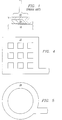
- Figures 4 and 5 depict masks utilized for patterning layers of an integrated circuit substrate to be utilized for a bond pad.
- mask 32 is utilized to form a conductive region 30 in the shape of a grid in first conductive layer 24 .
- Second conductive layer 26 is deposited over conductive region 30 and directly contacts underlying region 20 around the sides of conductive region 30 and also through the holes in the grid.
- a grid pattern allows enough of first conductive layer 24 to remain after the etching process so that first conductive layer 24 may be probe tested in a normal manner before the deposition of second conductive layer 26 and provides surface interconnect for electrical contact between first conductive layer 24 and second conductive layer 26 .
- mask 34 is utilized to form a conductive region 30 in the shape of a ring.
- a larger area of second conductive layer 26 will directly contact underlying region 20 thus further improving the adhesiveness among the layers.
- the area of first conductive layer 24 has decreased making probing more difficult.
- Other shapes, such as rectangles, may be used as a mask to pattern first conductive layer 24 .
- the method described above, and the structure formed thereby provides for an improved bonding pad by improving the adhesiveness among underlying layers of an integrated circuit device.
- an improved bond pad is formed.
- a third conductive layer may be deposited over the device while maintaining the improved adhesion between the layers.
- the present invention may provide a method, wherein the first insulating layer is comprised of oxide.
- the present invention may provide a method, wherein the barrier layer is comprised of titanium nitride.
- the present invention may provide a method, wherein the first conductive layer is comprised of polycrystaline silicon.
- the present invention may provide a method, wherein the first conductive layer is comprised of metal.
- the metal may be aluminum.
- the present invention may provide a method, wherein the second insulating layer is comprised of oxide.
- the present invention may provide a bond pad structure, wherein the sidewall regions are comprised of oxide.
- the present invention may provide a bond pad structure wherein the barrier region is comprised of titanium nitride.
- the present invention may provide a bond pad structure, wherein the conductive region is comprised of metal.
- the metal may be aluminum.
Landscapes
- Wire Bonding (AREA)
- Internal Circuitry In Semiconductor Integrated Circuit Devices (AREA)
Applications Claiming Priority (2)
| Application Number | Priority Date | Filing Date | Title |
|---|---|---|---|
| US07/919,949 US5309025A (en) | 1992-07-27 | 1992-07-27 | Semiconductor bond pad structure and method |
| US919949 | 1992-07-27 |
Publications (2)
| Publication Number | Publication Date |
|---|---|
| EP0583877A1 true EP0583877A1 (de) | 1994-02-23 |
| EP0583877B1 EP0583877B1 (de) | 1997-11-19 |
Family
ID=25442921
Family Applications (1)
| Application Number | Title | Priority Date | Filing Date |
|---|---|---|---|
| EP93305371A Expired - Lifetime EP0583877B1 (de) | 1992-07-27 | 1993-07-08 | Anschlussflächen-Struktur einer integrierten Schaltung und Verfahren zu ihrer Herstellung |
Country Status (4)
| Country | Link |
|---|---|
| US (2) | US5309025A (de) |
| EP (1) | EP0583877B1 (de) |
| JP (1) | JP3453170B2 (de) |
| DE (1) | DE69315278T2 (de) |
Families Citing this family (22)
| Publication number | Priority date | Publication date | Assignee | Title |
|---|---|---|---|---|
| JPH0730012A (ja) * | 1993-07-09 | 1995-01-31 | Fujitsu Ltd | 半導体装置 |
| US5723822A (en) * | 1995-03-24 | 1998-03-03 | Integrated Device Technology, Inc. | Structure for fabricating a bonding pad having improved adhesion to an underlying structure |
| US5703408A (en) * | 1995-04-10 | 1997-12-30 | United Microelectronics Corporation | Bonding pad structure and method thereof |
| US5707894A (en) * | 1995-10-27 | 1998-01-13 | United Microelectronics Corporation | Bonding pad structure and method thereof |
| US6049135A (en) | 1996-05-28 | 2000-04-11 | Kabushiki Kaisha Toshiba | Bed structure underlying electrode pad of semiconductor device and method for manufacturing same |
| US5700735A (en) * | 1996-08-22 | 1997-12-23 | Taiwan Semiconductor Manufacturing Company, Ltd. | Method of forming bond pad structure for the via plug process |
| JPH10223497A (ja) * | 1997-01-31 | 1998-08-21 | Shin Etsu Handotai Co Ltd | 貼り合わせ基板の作製方法 |
| US6143396A (en) * | 1997-05-01 | 2000-11-07 | Texas Instruments Incorporated | System and method for reinforcing a bond pad |
| KR100230428B1 (ko) * | 1997-06-24 | 1999-11-15 | 윤종용 | 다층 도전성 패드를 구비하는 반도체장치 및 그 제조방법 |
| JP4651815B2 (ja) * | 1998-01-23 | 2011-03-16 | ローム株式会社 | ダマシン配線および半導体装置 |
| US5985765A (en) * | 1998-05-11 | 1999-11-16 | Taiwan Semiconductor Manufacturing Company, Ltd. | Method for reducing bonding pad loss using a capping layer when etching bonding pad passivation openings |
| US6552438B2 (en) | 1998-06-24 | 2003-04-22 | Samsung Electronics Co. | Integrated circuit bonding pads including conductive layers with arrays of unaligned spaced apart insulating islands therein and methods of forming same |
| US6163074A (en) * | 1998-06-24 | 2000-12-19 | Samsung Electronics Co., Ltd. | Integrated circuit bonding pads including intermediate closed conductive layers having spaced apart insulating islands therein |
| US6187680B1 (en) | 1998-10-07 | 2001-02-13 | International Business Machines Corporation | Method/structure for creating aluminum wirebound pad on copper BEOL |
| US6191023B1 (en) * | 1999-11-18 | 2001-02-20 | Taiwan Semiconductor Manufacturing Company | Method of improving copper pad adhesion |
| US6365970B1 (en) | 1999-12-10 | 2002-04-02 | Silicon Integrated Systems Corporation | Bond pad structure and its method of fabricating |
| KR100400047B1 (ko) * | 2001-11-19 | 2003-09-29 | 삼성전자주식회사 | 반도체 소자의 본딩패드 구조 및 그 형성방법 |
| US6877534B1 (en) | 2002-11-06 | 2005-04-12 | Collins L. Hendrickson, Jr. | Debris collection stand |
| TWI262347B (en) * | 2004-08-02 | 2006-09-21 | Hannstar Display Corp | Electrical conducting structure and liquid crystal display device comprising the same |
| EP1635399B1 (de) * | 2004-09-08 | 2011-05-04 | STMicroelectronics Srl | Laterale MOS-Anordnung und Verfahren zu deren Herstellung |
| US7573115B2 (en) * | 2006-11-13 | 2009-08-11 | International Business Machines Corporation | Structure and method for enhancing resistance to fracture of bonding pads |
| US8030778B2 (en) * | 2007-07-06 | 2011-10-04 | United Microelectronics Corp. | Integrated circuit structure and manufacturing method thereof |
Citations (7)
| Publication number | Priority date | Publication date | Assignee | Title |
|---|---|---|---|---|
| EP0177251A1 (de) * | 1984-09-25 | 1986-04-09 | Nec Corporation | Halbleiterbauelement mit zuverlässiger Bondfleckenstruktur |
| EP0337064A2 (de) * | 1988-04-15 | 1989-10-18 | International Business Machines Corporation | Legierungsschicht und Metallstruktur zum Herstellen eines elektrischen Kontaktes |
| US4963511A (en) * | 1987-11-30 | 1990-10-16 | Texas Instruments Incorporated | Method of reducing tungsten selectivity to a contact sidewall |
| EP0395072A2 (de) * | 1989-04-27 | 1990-10-31 | Kabushiki Kaisha Toshiba | Anschlussfläche für Halbleiteranordnung |
| EP0418777A2 (de) * | 1989-09-19 | 1991-03-27 | Fujitsu Limited | Halbleiteranordnung auf Scheibenskala |
| EP0488186A1 (de) * | 1990-11-29 | 1992-06-03 | Kabushiki Kaisha Toshiba | Form eines Kontaktfleckes einer Halbleiteranordnung zum Binden mittels eines Drahtbondverfahrens |
| EP0490506A1 (de) * | 1990-11-24 | 1992-06-17 | Nec Corporation | Halbleiter-Anordnung mit einem Kontaktfleck |
Family Cites Families (14)
| Publication number | Priority date | Publication date | Assignee | Title |
|---|---|---|---|---|
| JPS61144851A (ja) * | 1984-12-19 | 1986-07-02 | Hitachi Ltd | 半導体装置 |
| US4705606A (en) * | 1985-01-31 | 1987-11-10 | Gould Inc. | Thin-film electrical connections for integrated circuits |
| JPS61225837A (ja) * | 1985-03-29 | 1986-10-07 | Fujitsu Ltd | 半導体装置の層間接続方法 |
| JPS62174934A (ja) * | 1986-01-28 | 1987-07-31 | Mitsubishi Electric Corp | 半導体装置およびその製造方法 |
| JPS6310542A (ja) * | 1986-07-01 | 1988-01-18 | Nec Corp | 半導体装置 |
| JPS63283040A (ja) * | 1987-05-15 | 1988-11-18 | Toshiba Corp | 半導体装置 |
| JPH01308036A (ja) * | 1988-06-07 | 1989-12-12 | Toshiba Corp | ボンデイングパッド及びその製造方法 |
| JPH02132836A (ja) * | 1988-11-14 | 1990-05-22 | Seiko Epson Corp | 半導体装置 |
| JPH03235381A (ja) * | 1990-02-13 | 1991-10-21 | Fujitsu Ltd | 半導体装置の製造方法 |
| US5189506A (en) * | 1990-06-29 | 1993-02-23 | International Business Machines Corporation | Triple self-aligned metallurgy for semiconductor devices |
| US5149671A (en) * | 1990-12-03 | 1992-09-22 | Grumman Aerospace Corporation | Method for forming multilayer indium bump contact |
| JPH04288843A (ja) * | 1991-03-07 | 1992-10-13 | Mitsubishi Electric Corp | 半導体装置 |
| US5316976A (en) * | 1992-07-08 | 1994-05-31 | National Semiconductor Corporation | Crater prevention technique for semiconductor processing |
| US5248903A (en) * | 1992-09-18 | 1993-09-28 | Lsi Logic Corporation | Composite bond pads for semiconductor devices |
-
1992
- 1992-07-27 US US07/919,949 patent/US5309025A/en not_active Expired - Lifetime
-
1993
- 1993-07-08 DE DE69315278T patent/DE69315278T2/de not_active Expired - Fee Related
- 1993-07-08 EP EP93305371A patent/EP0583877B1/de not_active Expired - Lifetime
- 1993-07-27 JP JP18522393A patent/JP3453170B2/ja not_active Expired - Fee Related
-
1994
- 1994-01-14 US US08/182,845 patent/US5403777A/en not_active Expired - Lifetime
Patent Citations (7)
| Publication number | Priority date | Publication date | Assignee | Title |
|---|---|---|---|---|
| EP0177251A1 (de) * | 1984-09-25 | 1986-04-09 | Nec Corporation | Halbleiterbauelement mit zuverlässiger Bondfleckenstruktur |
| US4963511A (en) * | 1987-11-30 | 1990-10-16 | Texas Instruments Incorporated | Method of reducing tungsten selectivity to a contact sidewall |
| EP0337064A2 (de) * | 1988-04-15 | 1989-10-18 | International Business Machines Corporation | Legierungsschicht und Metallstruktur zum Herstellen eines elektrischen Kontaktes |
| EP0395072A2 (de) * | 1989-04-27 | 1990-10-31 | Kabushiki Kaisha Toshiba | Anschlussfläche für Halbleiteranordnung |
| EP0418777A2 (de) * | 1989-09-19 | 1991-03-27 | Fujitsu Limited | Halbleiteranordnung auf Scheibenskala |
| EP0490506A1 (de) * | 1990-11-24 | 1992-06-17 | Nec Corporation | Halbleiter-Anordnung mit einem Kontaktfleck |
| EP0488186A1 (de) * | 1990-11-29 | 1992-06-03 | Kabushiki Kaisha Toshiba | Form eines Kontaktfleckes einer Halbleiteranordnung zum Binden mittels eines Drahtbondverfahrens |
Also Published As
| Publication number | Publication date |
|---|---|
| DE69315278D1 (de) | 1998-01-02 |
| US5403777A (en) | 1995-04-04 |
| JP3453170B2 (ja) | 2003-10-06 |
| JPH06204281A (ja) | 1994-07-22 |
| EP0583877B1 (de) | 1997-11-19 |
| DE69315278T2 (de) | 1998-04-02 |
| US5309025A (en) | 1994-05-03 |
Similar Documents
| Publication | Publication Date | Title |
|---|---|---|
| EP0583877B1 (de) | Anschlussflächen-Struktur einer integrierten Schaltung und Verfahren zu ihrer Herstellung | |
| US5834365A (en) | Method of forming a bonding pad | |
| US5707894A (en) | Bonding pad structure and method thereof | |
| US5470793A (en) | Method of via formation for the multilevel interconnect integrated circuits | |
| US6444295B1 (en) | Method for improving integrated circuits bonding firmness | |
| US5723822A (en) | Structure for fabricating a bonding pad having improved adhesion to an underlying structure | |
| US20020005568A1 (en) | Semiconductor device and method for manufacturing | |
| US6306750B1 (en) | Bonding pad structure to prevent inter-metal dielectric cracking and to improve bondability | |
| US20020084513A1 (en) | Integrated circuits and methods for their fabrication | |
| EP1609179B1 (de) | Innerlich verstärkte anschlussflächen | |
| EP0540312B1 (de) | Höckerelektrodenstruktur und Halbleiterchip mit dieser Struktur | |
| US6084312A (en) | Semiconductor devices having double pad structure | |
| KR100691051B1 (ko) | 반도체 디바이스 및 본드 패드 형성 프로세스 | |
| EP0899788A2 (de) | Halbleiteranordnung und Verfahren mit verbesserter flacher Oberfläche | |
| EP0547906B1 (de) | Verfahren zur Herstellung von Kontakten in Löchern in integrierten Schaltungen | |
| EP1003209A1 (de) | Verfahren zur Herstellung eines Halbleiterbauelements | |
| US5915201A (en) | Trench surrounded metal pattern | |
| EP0056908A2 (de) | Halbleiteranordnung | |
| JP2739842B2 (ja) | 半導体装置の製造方法 | |
| JPS62136857A (ja) | 半導体装置の製造方法 | |
| JP2822879B2 (ja) | 半導体装置の製造方法及びエッチング方法 | |
| KR100313530B1 (ko) | 반도체 소자의 패드 형성방법 | |
| JPH0529375A (ja) | 半導体装置 | |
| JPH02192134A (ja) | 半導体集積回路 | |
| KR20010046388A (ko) | 패드 형성방법 |
Legal Events
| Date | Code | Title | Description |
|---|---|---|---|
| PUAI | Public reference made under article 153(3) epc to a published international application that has entered the european phase |
Free format text: ORIGINAL CODE: 0009012 |
|
| AK | Designated contracting states |
Kind code of ref document: A1 Designated state(s): DE FR GB IT |
|
| 17P | Request for examination filed |
Effective date: 19940818 |
|
| 17Q | First examination report despatched |
Effective date: 19960425 |
|
| GRAG | Despatch of communication of intention to grant |
Free format text: ORIGINAL CODE: EPIDOS AGRA |
|
| GRAH | Despatch of communication of intention to grant a patent |
Free format text: ORIGINAL CODE: EPIDOS IGRA |
|
| GRAH | Despatch of communication of intention to grant a patent |
Free format text: ORIGINAL CODE: EPIDOS IGRA |
|
| GRAA | (expected) grant |
Free format text: ORIGINAL CODE: 0009210 |
|
| AK | Designated contracting states |
Kind code of ref document: B1 Designated state(s): DE FR GB IT |
|
| REF | Corresponds to: |
Ref document number: 69315278 Country of ref document: DE Date of ref document: 19980102 |
|
| ITF | It: translation for a ep patent filed | ||
| ET | Fr: translation filed | ||
| PGFP | Annual fee paid to national office [announced via postgrant information from national office to epo] |
Ref country code: GB Payment date: 19980629 Year of fee payment: 6 |
|
| PGFP | Annual fee paid to national office [announced via postgrant information from national office to epo] |
Ref country code: FR Payment date: 19980709 Year of fee payment: 6 |
|
| PGFP | Annual fee paid to national office [announced via postgrant information from national office to epo] |
Ref country code: DE Payment date: 19980720 Year of fee payment: 6 |
|
| PLBE | No opposition filed within time limit |
Free format text: ORIGINAL CODE: 0009261 |
|
| STAA | Information on the status of an ep patent application or granted ep patent |
Free format text: STATUS: NO OPPOSITION FILED WITHIN TIME LIMIT |
|
| 26N | No opposition filed | ||
| PG25 | Lapsed in a contracting state [announced via postgrant information from national office to epo] |
Ref country code: GB Free format text: LAPSE BECAUSE OF NON-PAYMENT OF DUE FEES Effective date: 19990708 |
|
| PG25 | Lapsed in a contracting state [announced via postgrant information from national office to epo] |
Ref country code: FR Free format text: THE PATENT HAS BEEN ANNULLED BY A DECISION OF A NATIONAL AUTHORITY Effective date: 19990731 |
|
| GBPC | Gb: european patent ceased through non-payment of renewal fee |
Effective date: 19990708 |
|
| PG25 | Lapsed in a contracting state [announced via postgrant information from national office to epo] |
Ref country code: DE Free format text: LAPSE BECAUSE OF NON-PAYMENT OF DUE FEES Effective date: 20000503 |
|
| REG | Reference to a national code |
Ref country code: FR Ref legal event code: ST |
|
| PG25 | Lapsed in a contracting state [announced via postgrant information from national office to epo] |
Ref country code: IT Free format text: LAPSE BECAUSE OF NON-PAYMENT OF DUE FEES;WARNING: LAPSES OF ITALIAN PATENTS WITH EFFECTIVE DATE BEFORE 2007 MAY HAVE OCCURRED AT ANY TIME BEFORE 2007. THE CORRECT EFFECTIVE DATE MAY BE DIFFERENT FROM THE ONE RECORDED. Effective date: 20050708 |