EP0593290B1 - Kernantigenprotein des Hepatitis C-Virus, sowie diagnostisches Verfahren und Satz von Reagenzen - Google Patents
Kernantigenprotein des Hepatitis C-Virus, sowie diagnostisches Verfahren und Satz von Reagenzen Download PDFInfo
- Publication number
- EP0593290B1 EP0593290B1 EP93308185A EP93308185A EP0593290B1 EP 0593290 B1 EP0593290 B1 EP 0593290B1 EP 93308185 A EP93308185 A EP 93308185A EP 93308185 A EP93308185 A EP 93308185A EP 0593290 B1 EP0593290 B1 EP 0593290B1
- Authority
- EP
- European Patent Office
- Prior art keywords
- hcv
- polypeptide
- core antigen
- dna molecule
- positive
- Prior art date
- Legal status (The legal status is an assumption and is not a legal conclusion. Google has not performed a legal analysis and makes no representation as to the accuracy of the status listed.)
- Expired - Lifetime
Links
Images


Classifications
-
- C—CHEMISTRY; METALLURGY
- C07—ORGANIC CHEMISTRY
- C07K—PEPTIDES
- C07K14/00—Peptides having more than 20 amino acids; Gastrins; Somatostatins; Melanotropins; Derivatives thereof
- C07K14/005—Peptides having more than 20 amino acids; Gastrins; Somatostatins; Melanotropins; Derivatives thereof from viruses
-
- A—HUMAN NECESSITIES
- A61—MEDICAL OR VETERINARY SCIENCE; HYGIENE
- A61P—SPECIFIC THERAPEUTIC ACTIVITY OF CHEMICAL COMPOUNDS OR MEDICINAL PREPARATIONS
- A61P1/00—Drugs for disorders of the alimentary tract or the digestive system
- A61P1/16—Drugs for disorders of the alimentary tract or the digestive system for liver or gallbladder disorders, e.g. hepatoprotective agents, cholagogues, litholytics
-
- A—HUMAN NECESSITIES
- A61—MEDICAL OR VETERINARY SCIENCE; HYGIENE
- A61P—SPECIFIC THERAPEUTIC ACTIVITY OF CHEMICAL COMPOUNDS OR MEDICINAL PREPARATIONS
- A61P31/00—Antiinfectives, i.e. antibiotics, antiseptics, chemotherapeutics
- A61P31/12—Antivirals
-
- A—HUMAN NECESSITIES
- A61—MEDICAL OR VETERINARY SCIENCE; HYGIENE
- A61K—PREPARATIONS FOR MEDICAL, DENTAL OR TOILETRY PURPOSES
- A61K39/00—Medicinal preparations containing antigens or antibodies
-
- C—CHEMISTRY; METALLURGY
- C12—BIOCHEMISTRY; BEER; SPIRITS; WINE; VINEGAR; MICROBIOLOGY; ENZYMOLOGY; MUTATION OR GENETIC ENGINEERING
- C12N—MICROORGANISMS OR ENZYMES; COMPOSITIONS THEREOF; PROPAGATING, PRESERVING, OR MAINTAINING MICROORGANISMS; MUTATION OR GENETIC ENGINEERING; CULTURE MEDIA
- C12N2770/00—MICROORGANISMS OR ENZYMES; COMPOSITIONS THEREOF; PROPAGATING, PRESERVING, OR MAINTAINING MICROORGANISMS; MUTATION OR GENETIC ENGINEERING; CULTURE MEDIA ssRNA viruses positive-sense
- C12N2770/00011—Details
- C12N2770/24011—Flaviviridae
- C12N2770/24211—Hepacivirus, e.g. hepatitis C virus, hepatitis G virus
- C12N2770/24222—New viral proteins or individual genes, new structural or functional aspects of known viral proteins or genes
-
- Y—GENERAL TAGGING OF NEW TECHNOLOGICAL DEVELOPMENTS; GENERAL TAGGING OF CROSS-SECTIONAL TECHNOLOGIES SPANNING OVER SEVERAL SECTIONS OF THE IPC; TECHNICAL SUBJECTS COVERED BY FORMER USPC CROSS-REFERENCE ART COLLECTIONS [XRACs] AND DIGESTS
- Y10—TECHNICAL SUBJECTS COVERED BY FORMER USPC
- Y10S—TECHNICAL SUBJECTS COVERED BY FORMER USPC CROSS-REFERENCE ART COLLECTIONS [XRACs] AND DIGESTS
- Y10S436/00—Chemistry: analytical and immunological testing
- Y10S436/82—Hepatitis associated antigens and antibodies
-
- Y—GENERAL TAGGING OF NEW TECHNOLOGICAL DEVELOPMENTS; GENERAL TAGGING OF CROSS-SECTIONAL TECHNOLOGIES SPANNING OVER SEVERAL SECTIONS OF THE IPC; TECHNICAL SUBJECTS COVERED BY FORMER USPC CROSS-REFERENCE ART COLLECTIONS [XRACs] AND DIGESTS
- Y10—TECHNICAL SUBJECTS COVERED BY FORMER USPC
- Y10S—TECHNICAL SUBJECTS COVERED BY FORMER USPC CROSS-REFERENCE ART COLLECTIONS [XRACs] AND DIGESTS
- Y10S530/00—Chemistry: natural resins or derivatives; peptides or proteins; lignins or reaction products thereof
- Y10S530/82—Proteins from microorganisms
- Y10S530/826—Viruses
Definitions
- the invention relates to a DNA molecule, a polypeptide expressed by the molecule and their use in diagnosis and their methods of production. More particularly, it relates to a diagnostic DNA molecule, a diagnostic protein, diagnostic antibodies and a protective polypeptide for hepatitis C virus.
- hepatitis arising from blood transfusion are viral-inducted, and distinguishable from other forms of viral-associated liver diseases caused by known hepatitis viruses such as hepatitis A virus (HAV) and hepatitis B virus (HBV).
- HAV hepatitis A virus
- HBV hepatitis B virus
- the etiological agent(s) of said Non-A, Non-B hepatitis (NANBH) has long been sought by many research groups and is presently believed to be the hepatitis C virus (HCV).
- Post-transfusion hepatitis (PTH) occurs in approximately 10% of transfusion patients, and NANBH accounts for up to 90% of these cases.
- the major problem in this disease is the frequent progression to chronic liver damage (25-55%). Therefore, the demand for sensitive, specific methods for detecting HCV in contaminated blood or blood products is significant.
- HCV may be a flavivirus or flavi-like virus.
- flavivirus contains a central nucleocapsid surrounded by a lipid bilayer.
- C nucleocapsid
- E1, E2 glycosylated envelope proteins
- NS1-5 nonstructural proteins
- WO91/15516 discloses the nucleotide and corresponding amino-acid sequence of a section of the HCV genome ( Figure 8A). This section codes for the HCV core protein and part of the envelope protein. WO92/11370 also discloses nucleotide and amino-acid sequences of parts of the HCV genome. However, in comparison with the DNA and amino-acid sequences given in the aforementioned publications, the molecules of the current invention differ both in sequence and in length.
- ELISA enzyme-linked immunosorbent assay
- the invention discloses a DNA molecule coding for an HCV core antigen protein and provides an alternative of HCV antibody assay.
- the invention provides a DNA molecule coding for a polypeptide displaying the antigenicity of a hepatitis C virus (HCV) core antigen protein, the polypeptide having the amino-acid sequence given in Figure 1B (SEQ ID NO: 4). More specifically, the invention provides a DNA molecule derived from the genome of HCV. The DNA molecule was cloned from the plasma of a patient with hepatitis C via a Polymerase Chain Reaction (PCR) technique.
- PCR Polymerase Chain Reaction
- the DNA molecule of the invention is capable of producing, in an appropriate host, viral polypeptides displaying the antigenicity of an HCV core antigen protein.
- the method may be carried out by immunoassay or Western blotting which is characterized by using said HCV core antigen as a probe, capable of binding to antibodies directed against HCV in samples, to form an antigen-antibody complex.
- the invention also includes a method for detecting HCV antibodies in samples by using said HCV core antigen protein combined with an HCV nonstructural protein as probes.
- the cloned DNA molecule is subject to a hybridization with original HCV particles for identification.
- the molecule thus obtained is designated EN-80-2.
- the DNA sequence of the molecule EN-80-2 is given in Fig. 1A (SEQ ID No: 3).
- the DNA molecule is derived from the genome of HCV nucleocapsid and envelope regions and has 669bp.
- the invention also provides a polypeptide displaying the antigenicity of an HCV core antigen protein.
- the amino acid sequence of the polypeptide is given in Fig. 1B (SEQ ID No: 4).
- the polypeptide has a molecular weight of about 25,000 as measured by electrophoresis through a sodium dodecyl sulfate-polyacrylamide gel and is deduced to have about 220 amino acids.
- the ability of the obtained polypeptide to bind to HCV antibodies is confirmed by Western Blotting. Obviously, the polypeptide is reactive with the sera of the patients with hepatitis C but not reactive with the sera of persons without hepatitis C.
- the method for detecting HCV antibodies in samples is included in the invention.
- the method is characterized by the HCV core antigen's capability of binding to HCV antibodies as a probe.
- the method can be carried out by immunoassay or Western Blotting.
- a preferred method is solid-phase immunoassay.
- the solid phase such as microtiter plates, beads and semipermeable membranes can be used to carry out the immunoassay.
- the substances as labels include enzymes, isotopes, fluorescent materials and any other materials which can be directly detected.
- the immunoassay is conveniently achieved by a Sandwich method. Particularly, an enzyme-linked immunosorbent assay (ELISA) was established.
- ELISA enzyme-linked immunosorbent assay
- the ELISA comprises: 1) coating the polypeptide of the present invention onto a solid phase, 2) incubating a sample suspected of containing HCV antibodies with the polypeptide coated onto said solid phase under conditions which allow the formation of an antigen-antibody complex, 3) adding an anti-antibody (such as anti-IgG) conjugated with a label to be captured by the resulting antigen-antibody complex bound to the solid phase, and 4) measuring the captured label and determining whether the sample has HCV antibodies.
- an anti-antibody such as anti-IgG conjugated with a label to be captured by the resulting antigen-antibody complex bound to the solid phase
- the cloned DNA molecule is subject to a hybridization with original HCV particle for identification.
- the obtained molecule is designated EN-80-2.
- the DNA sequence of the molecule EN-80-2 is given in Fig. 1A (SEQ ID No: 3).
- the DNA molecule is derived from the genome of HCV nucleocapsid and envelope regions and has 669bp.
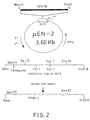
- the expression plasmid pEN-2 is incubated with E. coli BL21 (DE3) at 37°C overnight.
- the E. coli colonies producing HCV core antigen protein are selected by screening their expression products by Western Blotting.
- the selected clone, designated Clone EN-80-2, is exemplified by a culture deposited in American Type Culture Collection, MD, USA, on 14 July 1993 (Access Number ATCC 55451).
- the transformed E. coli colonies are incubated in a conditioned culture medium.
- the colonies are centrifuged and lysed by freezing-defrosting cycles and enzyme-digestion.
- the protein product is released by the lysed cells and purified by chromatography.
- the purity of the obtained polypeptide is more than 90%.
- the paper is washed with Wash Buffer (PBS-Tween 20, pH 7.4) and blocked with Blocking Buffer (0.1M NaCl, 5mM EDTA, 50mM Tris, pH 7.2-7.4, 0.2% fetal bovine serum albumin, 0.05% Nonidet p-40, 1M urea) overnight.
- Wash Buffer PBS-Tween 20, pH 7.4
- Blocking Buffer 0.1M NaCl, 5mM EDTA, 50mM Tris, pH 7.2-7.4, 0.2% fetal bovine serum albumin, 0.05% Nonidet p-40, 1M urea
- test samples When the readings of test samples are more than NCx but less than the CO value by 20%, the samples should be regarded as questionable samples and the assay has to be repeated for those samples.
- TSGH 56 > 2.0 positive positive TSGH 57 > 2.0 positive positive G 23 1.469 positive positive G 30 > 2.0 positive positive G 32 > 2.0 positive positive G 49 > 2.0 positive positive G 56 > 2.0 positive positive G 58 > 2.0 positive positive G 114 1.559 positive positive G 128 > 2.0 positive positive G 186 > 2.0 positive positive G 208 > 2.0 positive positive G 214 > 2.0 positive positive G 231 > 2.0 positive positive G 250 > 2.0 positive positive Y 1 > 2.0 positive positive USB 9 > 2.0 positive positive USB 19 > 2.0 positive positive USB 20 > 2.0 positive positive USB 23 0.952 positive positive USB 27 0.753 positive positive G 11 0.147 negative negative G 12 0.077 negative negative G 13 0.061 negative negative G 14 0.116 negative negative G 15 0.139 negative negative G 229 0.517 positive negative negative
- the antibodies against HCV core antigen protein can be produced by immunizing an animal with the core antigen protein according to the invention.
- a BAL-B/C mouse is immunized with the purified core antigen protein as described in Example II mixed with an adjuvant; and then the spleen cells are fused with mouse myceloma cells (FO cell line) using polyethylene glycol to form hybridoma cells.
- the desired clone producing monoclonal antibodies can be obtained by screening the titer of the antibodies produced by the hybridoma clones so prepared.
Landscapes
- Health & Medical Sciences (AREA)
- Chemical & Material Sciences (AREA)
- Life Sciences & Earth Sciences (AREA)
- Organic Chemistry (AREA)
- Medicinal Chemistry (AREA)
- General Health & Medical Sciences (AREA)
- Virology (AREA)
- Gastroenterology & Hepatology (AREA)
- Public Health (AREA)
- Biophysics (AREA)
- General Chemical & Material Sciences (AREA)
- Pharmacology & Pharmacy (AREA)
- Animal Behavior & Ethology (AREA)
- Chemical Kinetics & Catalysis (AREA)
- Nuclear Medicine, Radiotherapy & Molecular Imaging (AREA)
- Veterinary Medicine (AREA)
- Proteomics, Peptides & Aminoacids (AREA)
- Molecular Biology (AREA)
- Genetics & Genomics (AREA)
- Biochemistry (AREA)
- Oncology (AREA)
- Bioinformatics & Cheminformatics (AREA)
- Engineering & Computer Science (AREA)
- Communicable Diseases (AREA)
- Peptides Or Proteins (AREA)
- Measuring Or Testing Involving Enzymes Or Micro-Organisms (AREA)
- Preparation Of Compounds By Using Micro-Organisms (AREA)
- Micro-Organisms Or Cultivation Processes Thereof (AREA)
- Medicines Containing Antibodies Or Antigens For Use As Internal Diagnostic Agents (AREA)
Claims (17)
- DNS-Molekül, das für ein Polypeptid kodiert, das die Antigenität eines Hepatitis-C-Virus-(HCV)-Kernantigenproteins darstellt, wobei das Polypeptid die in Figur 1B angegebene Aminosäuresequenz (SEQ.ID-Nr.: 4) aufweist.
- DNS-Molekül, das für ein Polypeptid kodiert, das die Antigenität eines HCV-Kernantigenproteins darstellt, das aus der in Figur 1A angegebenen DNS-Sequenz (SEQ.ID-Nr.: 3) besteht.
- DNS-Molekül nach einem der Ansprüche 1 bis 2, das aus dem Plasma eines mit HCV infizierten Patienten kloniert ist.
- Expressionsvektor, der ein DNS-Molekül gemäß einem der Ansprüche 1 bis 2 aufweist.
- Verfahren zum Klonieren eines DNS-Moleküls gemäß einem der Ansprüche 1 bis 2, das das Isolieren von RNS aus Seren von Hepatitis-C-Patienten und das Klonieren des DNS-Moleküls mittels einer Polymerase-Kettenreaktions-(PCR)-Technik umfaßt.
- Verfahren nach Anspruch 5, wobei die folgenden Sequenzen als Primer verwendet werden:
- Polypeptid, das die Antigenität eines HCV-Kernantigens zeigt und die in Figur 1B angegebene Aminosäuresequenz (SEQ.ID-Nr.: 4) aufweist.
- Polypeptid nach Anspruch 7 mit einem Molekulargewicht von etwa 25.000.
- Polypeptid nach Anspruch 7, das durch einen Expressionsvektor nach Anspruch 4 hergestellt ist.
- Verfahren zur Herstellung eines Polypeptids, das die Antigenität eines HCV-Kernantigenproteins darstellt, durch die Expression eines DNS-Moleküls nach einem der Ansprüche 1 bis 2.
- Plasmid zur Expression eines Polypeptids, das die Antigenität eines HCV-Kernantigenproteins darstellt, das mit pEN-2 bezeichnet ist und unter der Eingangsnummer ATCC 55451 in Klon EN-80-2 hinterlegt ist.
- E. Coli, das zur Herstellung eines die Antigenität eines HCV-Kernantigenproteins zeigenden Polypeptids transformiert ist und als Klon EN-80-2 bezeichnet ist und unter der Eingangsnummer ATCC 55451 hinterlegt ist.
- Verfahren zur Detektion von HCV-Antikörpern in Proben, gekennzeichnet durch die Verwendung eines Polypeptids nach Anspruch 7 als eine Probe, die dazu in der Lage ist, Antikörper zu binden, die gegen ein HCV-Antigen in Proben gerichtet ist, um einen Antigen-Antikörper-Komplex zu bilden.
- Verfahren nach Anspruch 13, gekennzeichnet durch die Verwendung eines Polypeptids nach Anspruch 7 in Kombination mit einem nicht-strukturellen HCV-Protein als Proben.
- Kit bzw. Reaktionssatz zur Analyse von Proben auf die Anwesenheit von HCV-Antikörpern in Proben, das bzw. der ein Polypeptid nach Anspruch 7 aufweist.
- Verfahren zur Herstellung von gegen HCV-Kernantigen gerichteten Antikörpern, das das Immunisieren eines Tieres mit einem Polypeptid nach Anspruch 7 umfaßt.
- Impfstoffe zur Vorbeugung einer HCV-Infektion, die ein immunogenes Polypeptid nach Anspruch 7 aufweisen.
Applications Claiming Priority (3)
| Application Number | Priority Date | Filing Date | Title |
|---|---|---|---|
| US96348392A | 1992-10-16 | 1992-10-16 | |
| US963483 | 1992-10-16 | ||
| JP4311615A JP2778886B2 (ja) | 1992-10-16 | 1992-11-20 | C型肝炎ウィルスのコア抗原タンパク質及びそれを用いての診断方法及びキット |
Publications (3)
| Publication Number | Publication Date |
|---|---|
| EP0593290A2 EP0593290A2 (de) | 1994-04-20 |
| EP0593290A3 EP0593290A3 (de) | 1995-03-01 |
| EP0593290B1 true EP0593290B1 (de) | 2002-04-10 |
Family
ID=26566825
Family Applications (1)
| Application Number | Title | Priority Date | Filing Date |
|---|---|---|---|
| EP93308185A Expired - Lifetime EP0593290B1 (de) | 1992-10-16 | 1993-10-14 | Kernantigenprotein des Hepatitis C-Virus, sowie diagnostisches Verfahren und Satz von Reagenzen |
Country Status (3)
| Country | Link |
|---|---|
| US (2) | US5645983A (de) |
| EP (1) | EP0593290B1 (de) |
| JP (1) | JP2778886B2 (de) |
Families Citing this family (20)
| Publication number | Priority date | Publication date | Assignee | Title |
|---|---|---|---|---|
| US5639594A (en) * | 1990-02-16 | 1997-06-17 | United Biomedical, Inc. | Linear and branched peptides effective in diagnosing and detecting non-A, non-B hepatitis |
| US6153378A (en) * | 1992-10-16 | 2000-11-28 | Bionova Corporation | Diagnosis of, and vaccination against, a positive stranded RNA virus using an isolated, unprocessed polypeptide encoded by a substantially complete genome of such virus |
| US7070790B1 (en) * | 1993-06-29 | 2006-07-04 | The United States Of America As Represented By The Department Of Health And Human Services | Nucleotide and deduced amino acid sequences of the envelope 1 and core genes of isolates of hepatitis C virus and the use of reagents derived from these sequences in diagnostic methods and vaccines |
| WO1995030746A1 (en) * | 1994-05-10 | 1995-11-16 | The General Hospital Corporation | Antisense inhibition of hepatitis c virus |
| WO1996034013A1 (en) * | 1995-04-28 | 1996-10-31 | Srl, Inc. | Antigen peptide compound and immunoassay method |
| US6127116A (en) | 1995-08-29 | 2000-10-03 | Washington University | Functional DNA clone for hepatitis C virus (HCV) and uses thereof |
| US7235394B1 (en) | 1995-08-29 | 2007-06-26 | Washington University | Functional DNA clone for hepatitis C virus (HCV) and uses thereof |
| US7049428B1 (en) | 1998-03-04 | 2006-05-23 | Washington University | HCV variants |
| US7338759B1 (en) | 1997-03-04 | 2008-03-04 | Washington University | HCV variants |
| FR2760367B1 (fr) | 1997-03-06 | 1999-04-30 | Pasteur Merieux Serums Vacc | Composition vaccinale destinee a la prevention ou au traitement des hepatites c |
| ES2286852T3 (es) * | 1997-08-04 | 2007-12-01 | Advanced Life Science Institute, Inc. | Metodos para detectar o analizar virus. |
| US6030771A (en) * | 1997-08-25 | 2000-02-29 | Centers For Disease Control And Prevention | Mosaic protein and restriction endonuclease assisted ligation method for making the same |
| CA2305192C (en) * | 1998-07-30 | 2009-10-13 | Advanced Life Science Institute, Inc. | Method for assaying hepatitis c virus |
| US6803214B1 (en) * | 1999-08-27 | 2004-10-12 | Institut Pasteur | Nucleic acids and new polypeptides associated with and/or overlapping with hepatitis C virus core gene products |
| JP2002125688A (ja) * | 2000-10-30 | 2002-05-08 | Tosoh Corp | C型肝炎ウイルスの高感度検出のためのオリゴヌクレオチドおよび検出法 |
| KR100434117B1 (ko) * | 2000-11-03 | 2004-06-04 | 동화약품공업주식회사 | Hcv유래 재조합 혼합항원을 이용한 c형 간염바이러스의 검출방법과 진단키트 |
| WO2002090572A2 (en) * | 2001-05-09 | 2002-11-14 | Third Wave Technologies, Inc. | Nucleic acid detection in pooled samples |
| US20060166320A1 (en) * | 2004-10-01 | 2006-07-27 | Penelope Mavromara | In vitro expression of the HCV ARFP/F-core‘coding open reading frame |
| JP5642972B2 (ja) | 2007-02-21 | 2014-12-17 | ユニバーシティー オブ マサチューセッツUniversity of Massachusetts | C型肝炎ウイルス(hcv)に対するヒト抗体およびその使用 |
| CN117890589A (zh) * | 2022-10-08 | 2024-04-16 | 菲鹏生物股份有限公司 | 一种多表位HCV core抗体组合及检测试剂盒 |
Family Cites Families (10)
| Publication number | Priority date | Publication date | Assignee | Title |
|---|---|---|---|---|
| JPH02500880A (ja) * | 1987-11-18 | 1990-03-29 | カイロン コーポレイション | Nanbvの診断用薬およびワクチン |
| US5350671A (en) * | 1987-11-18 | 1994-09-27 | Chiron Corporation | HCV immunoassays employing C domain antigens |
| KR0185373B1 (ko) * | 1989-03-17 | 1999-05-01 | 로버트 피. 블랙버언 | Hcv 폴리단백질에서 유래되는 hcv 아미노산 서열 부분을 포함하는 폴리펩티드 및 그 사용 |
| US5106726A (en) * | 1990-02-16 | 1992-04-21 | United Biomedical, Inc. | Synthetic peptides specific for the detection of antibodies to HCV |
| HU217025B (hu) * | 1990-04-04 | 1999-11-29 | Chiron Corp. | Hepatitis C vírus-(HCV) antigénkészítmények az anti-HCV-antitestek kimutatására immunoassay-kben |
| DE69132332T2 (de) * | 1990-04-06 | 2000-11-30 | Genelabs Technologies, Inc. | Hepatitis c-virus-epitope |
| JP3050395B2 (ja) * | 1990-06-12 | 2000-06-12 | 国立感染症研究所長 | C型肝炎ウイルス抗原ポリペプチド、その産生方法および抗体の検出方法 |
| CA2049679C (en) * | 1990-08-24 | 2005-06-21 | Sushil G. Devare | Hepatitis c assay utilizing recombinant antigens |
| DE4041304A1 (de) * | 1990-12-21 | 1992-06-25 | Mikrogen Molekularbiol Entw | Von strukturproteinen des hepatitis c-virus abgeleitete polypeptide, testkits, die diese polypeptide enthalten und impfstoffe gegen infektionen von hepatitis c-viren |
| JP3244284B2 (ja) * | 1991-02-14 | 2002-01-07 | 武田薬品工業株式会社 | C型肝炎ウイルス関連抗体および抗原の測定法 |
-
1992
- 1992-11-20 JP JP4311615A patent/JP2778886B2/ja not_active Expired - Lifetime
-
1993
- 1993-10-14 EP EP93308185A patent/EP0593290B1/de not_active Expired - Lifetime
- 1993-10-26 US US08/143,578 patent/US5645983A/en not_active Expired - Fee Related
- 1993-10-26 US US08/143,579 patent/US5625034A/en not_active Expired - Fee Related
Also Published As
| Publication number | Publication date |
|---|---|
| US5645983A (en) | 1997-07-08 |
| US5625034A (en) | 1997-04-29 |
| EP0593290A2 (de) | 1994-04-20 |
| JP2778886B2 (ja) | 1998-07-23 |
| EP0593290A3 (de) | 1995-03-01 |
| JPH06153960A (ja) | 1994-06-03 |
Similar Documents
| Publication | Publication Date | Title |
|---|---|---|
| EP0593290B1 (de) | Kernantigenprotein des Hepatitis C-Virus, sowie diagnostisches Verfahren und Satz von Reagenzen | |
| US6312889B1 (en) | Combinations of hepatitis c virus (HCV) antigens for use in immunoassays for anti-HCV antibodies | |
| US5683864A (en) | Combinations of hepatitis C virus (HCV) antigens for use in immunoassays for anti-HCV antibodies | |
| KR100206150B1 (ko) | 항-에이치씨브이 항체에 대한 면역분석용 씨형 간염 바이러스(에이치디브이)항원의 조합체 | |
| EP0644202B1 (de) | Synthetische Antigene zum Nachweis von Antikörpern gegen Hepatitis C-Virus | |
| EP0627000B1 (de) | Expressionssystem in säugetieren für hcv-proteine | |
| WO1997044469A2 (en) | Multiple epitope fusion protein | |
| EP2397566A1 (de) | Verfahren zur gleichzeitigen Detektion von HCV-Antigenen und HCV-Antikörpern | |
| CA2045323C (en) | Non-a, non-b hepatitis virus genomic cdna and antigen polypeptide | |
| EP1412538B1 (de) | Verfahren zum gleichzeitigen nachweis von hcv-antigenen und hcv-antikörpern | |
| EP0472207A2 (de) | Nachweis von Hepatits C mit Verwendung rekombinanter Antigene | |
| EP0642666B2 (de) | Verfahren zur detektion von hepatitis c | |
| US5747240A (en) | Epitope mapping of the c33 region of HCV | |
| EP0593291A2 (de) | Nichtstrukturales Protein des Hepatitis C-Virus, sowie diagnostisches Verfahren und Testsatz | |
| EP0532746B1 (de) | Nicht-a, nicht-b hepatitis test | |
| AU639560C (en) | Combinations of hepatitis C virus (HCV) antigens for use in immunoassays for anti-HCV antibodies | |
| WO1993011158A2 (en) | Non-a, non-b peptides | |
| AU5809694A (en) | Peptides from the c33 region of hcv, antibodies thereto and methods for the detection of hcv | |
| WO1991004341A1 (en) | Hdv-specific peptides | |
| JPH06153959A (ja) | C型肝炎ウィルスの非構造タンパク質及びそれを用いての診断方法及びキット | |
| HK1127641A (en) | Method for early recognition of the seroconversion of an antibody to hepatitis c |
Legal Events
| Date | Code | Title | Description |
|---|---|---|---|
| PUAI | Public reference made under article 153(3) epc to a published international application that has entered the european phase |
Free format text: ORIGINAL CODE: 0009012 |
|
| AK | Designated contracting states |
Kind code of ref document: A2 Designated state(s): DE FR GB NL |
|
| PUAL | Search report despatched |
Free format text: ORIGINAL CODE: 0009013 |
|
| AK | Designated contracting states |
Kind code of ref document: A3 Designated state(s): DE FR GB NL |
|
| 17P | Request for examination filed |
Effective date: 19950710 |
|
| RIN1 | Information on inventor provided before grant (corrected) |
Inventor name: WANG, CHENG-NAN Inventor name: LIAO, JAW-CHING |
|
| 17Q | First examination report despatched |
Effective date: 19980702 |
|
| GRAG | Despatch of communication of intention to grant |
Free format text: ORIGINAL CODE: EPIDOS AGRA |
|
| GRAG | Despatch of communication of intention to grant |
Free format text: ORIGINAL CODE: EPIDOS AGRA |
|
| GRAH | Despatch of communication of intention to grant a patent |
Free format text: ORIGINAL CODE: EPIDOS IGRA |
|
| GRAH | Despatch of communication of intention to grant a patent |
Free format text: ORIGINAL CODE: EPIDOS IGRA |
|
| REG | Reference to a national code |
Ref country code: GB Ref legal event code: IF02 |
|
| GRAA | (expected) grant |
Free format text: ORIGINAL CODE: 0009210 |
|
| RIC1 | Information provided on ipc code assigned before grant |
Free format text: 7C 12N 15/51 A, 7C 12N 15/40 B, 7C 07K 14/18 B, 7A 61K 39/29 B, 7G 01N 33/576 B, 7C 12Q 1/68 B, 7C 12Q 1/70 B |
|
| AK | Designated contracting states |
Kind code of ref document: B1 Designated state(s): DE FR GB NL |
|
| REF | Corresponds to: |
Ref document number: 69331796 Country of ref document: DE Date of ref document: 20020516 |
|
| ET | Fr: translation filed | ||
| PG25 | Lapsed in a contracting state [announced via postgrant information from national office to epo] |
Ref country code: GB Free format text: LAPSE BECAUSE OF NON-PAYMENT OF DUE FEES Effective date: 20021014 |
|
| PLBE | No opposition filed within time limit |
Free format text: ORIGINAL CODE: 0009261 |
|
| 26N | No opposition filed |
Effective date: 20030113 |
|
| PG25 | Lapsed in a contracting state [announced via postgrant information from national office to epo] |
Ref country code: NL Free format text: LAPSE BECAUSE OF NON-PAYMENT OF DUE FEES Effective date: 20030501 Ref country code: DE Free format text: LAPSE BECAUSE OF NON-PAYMENT OF DUE FEES Effective date: 20030501 |
|
| GBPC | Gb: european patent ceased through non-payment of renewal fee |
Effective date: 20021014 |
|
| PG25 | Lapsed in a contracting state [announced via postgrant information from national office to epo] |
Ref country code: FR Free format text: LAPSE BECAUSE OF NON-PAYMENT OF DUE FEES Effective date: 20030630 |
|
| NLV4 | Nl: lapsed or anulled due to non-payment of the annual fee |
Effective date: 20030501 |
|
| REG | Reference to a national code |
Ref country code: FR Ref legal event code: ST |