EP0593831A1 - Langkettige Fettalkohole mit neurotropischer und gedächtnissfördernder Wirkung - Google Patents
Langkettige Fettalkohole mit neurotropischer und gedächtnissfördernder Wirkung Download PDFInfo
- Publication number
- EP0593831A1 EP0593831A1 EP92440127A EP92440127A EP0593831A1 EP 0593831 A1 EP0593831 A1 EP 0593831A1 EP 92440127 A EP92440127 A EP 92440127A EP 92440127 A EP92440127 A EP 92440127A EP 0593831 A1 EP0593831 A1 EP 0593831A1
- Authority
- EP
- European Patent Office
- Prior art keywords
- compositions according
- ether
- mmol
- compounds
- hexane
- Prior art date
- Legal status (The legal status is an assumption and is not a legal conclusion. Google has not performed a legal analysis and makes no representation as to the accuracy of the status listed.)
- Granted
Links
Images

Classifications
-
- C—CHEMISTRY; METALLURGY
- C07—ORGANIC CHEMISTRY
- C07C—ACYCLIC OR CARBOCYCLIC COMPOUNDS
- C07C33/00—Unsaturated compounds having hydroxy or O-metal groups bound to acyclic carbon atoms
- C07C33/05—Alcohols containing rings other than six-membered aromatic rings
- C07C33/14—Alcohols containing rings other than six-membered aromatic rings containing six-membered rings
-
- C—CHEMISTRY; METALLURGY
- C07—ORGANIC CHEMISTRY
- C07C—ACYCLIC OR CARBOCYCLIC COMPOUNDS
- C07C31/00—Saturated compounds having hydroxy or O-metal groups bound to acyclic carbon atoms
- C07C31/13—Monohydroxylic alcohols containing saturated rings
- C07C31/133—Monohydroxylic alcohols containing saturated rings monocyclic
- C07C31/135—Monohydroxylic alcohols containing saturated rings monocyclic with a five or six-membered rings; Naphthenic alcohols
- C07C31/1355—Monohydroxylic alcohols containing saturated rings monocyclic with a five or six-membered rings; Naphthenic alcohols with a six-membered ring
-
- C—CHEMISTRY; METALLURGY
- C07—ORGANIC CHEMISTRY
- C07C—ACYCLIC OR CARBOCYCLIC COMPOUNDS
- C07C403/00—Derivatives of cyclohexane or of a cyclohexene or of cyclohexadiene, having a side-chain containing an acyclic unsaturated part of at least four carbon atoms, this part being directly attached to the cyclohexane or cyclohexene or cyclohexadiene rings, e.g. vitamin A, beta-carotene, beta-ionone
- C07C403/06—Derivatives of cyclohexane or of a cyclohexene or of cyclohexadiene, having a side-chain containing an acyclic unsaturated part of at least four carbon atoms, this part being directly attached to the cyclohexane or cyclohexene or cyclohexadiene rings, e.g. vitamin A, beta-carotene, beta-ionone having side-chains substituted by singly-bound oxygen atoms
- C07C403/08—Derivatives of cyclohexane or of a cyclohexene or of cyclohexadiene, having a side-chain containing an acyclic unsaturated part of at least four carbon atoms, this part being directly attached to the cyclohexane or cyclohexene or cyclohexadiene rings, e.g. vitamin A, beta-carotene, beta-ionone having side-chains substituted by singly-bound oxygen atoms by hydroxy groups
-
- C—CHEMISTRY; METALLURGY
- C07—ORGANIC CHEMISTRY
- C07B—GENERAL METHODS OF ORGANIC CHEMISTRY; APPARATUS THEREFOR
- C07B2200/00—Indexing scheme relating to specific properties of organic compounds
- C07B2200/09—Geometrical isomers
-
- C—CHEMISTRY; METALLURGY
- C07—ORGANIC CHEMISTRY
- C07C—ACYCLIC OR CARBOCYCLIC COMPOUNDS
- C07C2601/00—Systems containing only non-condensed rings
- C07C2601/12—Systems containing only non-condensed rings with a six-membered ring
- C07C2601/14—The ring being saturated
-
- C—CHEMISTRY; METALLURGY
- C07—ORGANIC CHEMISTRY
- C07C—ACYCLIC OR CARBOCYCLIC COMPOUNDS
- C07C2601/00—Systems containing only non-condensed rings
- C07C2601/12—Systems containing only non-condensed rings with a six-membered ring
- C07C2601/16—Systems containing only non-condensed rings with a six-membered ring the ring being unsaturated
Definitions
- the present invention relates to a new group of long-chain fatty alcohols having properties useful in the treatment of neurodegenerative diseases and for functional recovery following damage to the nervous tissue or during brain aging or also for improving cognitive functions. in a healthy subject, especially his memory.
- the new group of compounds according to the invention consists of the compounds of general formula: wherein said chain has 7 to 25 carbon atoms, and is saturated or has a double bond of cis or trans configuration in ⁇ of the primary alcohol function.
- the compounds A1, A2 and A3, belonging to this group, and of formula: contain only one theoretical isomer.
- the compounds B1, B2 and B3, belonging to this group, and of formula: contain only four theoretical isomers and two in practice, in the case of a catalytic hydrogenation from the corresponding type A precursors.
- This number of isomers is very low if we compare it for example to that of the isomers of the compound closest to B1, but bearing two methyl groups in position 5 and 9, which is 16.
- This limitation of the problems of stereochemistry has for advantage, in addition to reducing the difficulties of synthesis and the increase in the purity of the products, to limit the number of biological studies, and consequently to increase the chances of registration of these products by the administrative authorities in the countries where the 'We are considering the commercial exploitation of these products.
- the compounds according to the invention promote differentiation (extension of neurites) and neuronal survival in vitro in rats. They can therefore be useful in the treatment of neurodegenerative diseases and for functional recovery following traumatic or chemical damage to nervous tissue. Furthermore, it has been found that, in addition to their neurotrophic effect on sick or aging subjects, the new compounds according to the invention exert a neurotropic effect on healthy and normal subjects, promoting and improving their cognitive capacities.
- the invention therefore also relates to pharmaceutical compositions comprising at least one of the derivatives according to the invention, at effective doses of the order of 0.1 to 100 mg / kg (single or repeated administration), in particular from 5 to 50 mg / kg.
- the pharmaceutical compositions of the invention are administered parenterally or orally. The latter is the way preferable and allows a good cerebral passage to be obtained at a rate compatible with the desired therapeutic effect.
- the brain / blood ratio is clearly greater than 1.6 hours after administration, and shows a good affinity of the molecules for the nervous tissue.
- the maximum concentration is obtained in the brain between 6 and 24 hours after oral administration.
- step l The tetrahydropyrannyl ether of compound A1 obtained by the 2 synthetic routes, steps i or j , is deprotected in step l .
- a catalytic hydrogenation makes it possible to pass from compound A to compound B in step m .
- the alcohol obtained in step a (2 g; 7.74 mmol) is dissolved in anhydrous dichloromethane and added to a solution of pyridinium chlorochromate (3.3 g; 15.5 mmol; PCC) in 100 ml of dichloromethane at room temperature for 3 hours.
- the mixture is then filtered on a Florisil column (eluent: hexane / ether: 1/1) then purified by chromatography on a silica column (hexane / ether: 9/1).
- the yield is 70% (1.39 g; 5.42 mmol).
- the 1,10-decanediol (12 g; 69 mmol) is dissolved in cyclohexane (170 ml) and a 48% aqueous hydrobromic acid solution (170 ml) and the mixture is heated at reflux for 3 hours. After cooling, the organic phase is neutralized with a saturated sodium bicarbonate solution and extracted with hexane.
- the bromoalcohol is purified by chromatography on a silica column (hexane / ethyl acetate: 9/1). The yield is 56% (9.16 g; 38.64 mmol).
- the yield is 75%.
- the sulfone obtained in step e (6.35 g; 22.8 mmol) is dissolved in 10 ml of acetic acid and then, at 12 ° C., concentrated sulfuric acid (32 eq, 19.8 ml) is added ) and allowed to react for 30 minutes at this temperature.
- the reaction medium is washed with a saturated solution of sodium bicarbonate twice, extracted with dichloromethane then dried with magnesium sulphate and evaporated.
- the product is purified by recrystallization from hexane. The yield is 81% (5.10 g; 18.31 mmol).
- the cyclized sulfone (200 mg; 0.70 mmol; 1.1 eq) is dissolved in anhydrous THF and a few drops of anhydrous HMPT.
- 1 eq of Butyllithium (0.63 mmol) is added and the mixture is left to react at -78 ° C for 2 hours.
- the aldehyde obtained in step b (162 mg; 0.63 mmol; 1 eq) dissolved in THF is added and the mixture is left to react for 2 hours at -78 ° C.
- the hydroxysulfone prepared in step g (198 mg; 0.37 mmol) is dissolved in 40 ml of anhydrous methanol.
- Na2HPO4 (236 mg; 1.66 mmol) and sodium amalgam (6% Hg; 2.37 g) are added.
- the reaction medium is left to react at 4 ° C. for 7 hours before hydrolysing the reaction medium. Extraction is carried out 3 times with dichloromethane and the product is purified by chromatography on silica (hexane / ether: 9/1). The yield is 70% (98 mg 0.26 mmol).
- the cyclized sulfone (1.7 g; 6 mmol) is dissolved in anhydrous THF and 1 eq of tBuOK at room temperature.
- the bromide (1 mmol) is then added at -30 ° C.
- the reaction medium is allowed to return to ambient temperature and it is left to react for 5 hours.
- the medium is hydrolyzed and extracted 3 times with ether and the solvent is evaporated. Purification is carried out by chromatography on silica (hexane / ether: 9/1). The yield is 60% (1.86 g; 3.60 mmol).
- the sulfone prepared in step j (518 mg; 1 mmol) is dissolved in 40 ml of anhydrous methanol.
- Na2HPO4 142 mg; 4.3 mmol
- sodium amalgam 6% Hg; 1.8 g
- Extraction is carried out 3 times with ether and the product is purified by chromatography on silica (hexane / ether: 9/1). The yield is 99% (374 mg; 0.99 mmol).
- the olefin is dissolved in methanol at room temperature for 30 minutes with p- toluenesulfonic acid.
- the methanol is evaporated and the residue is taken up with ether.
- the organic phase is washed with a solution of NaHCO3, dried with MgSO4 and evaporated.
- the derivatives of the invention were tested on neurons of the central nervous system in primary culture. Cultures are prepared from the brains of rat embryos. Neurons come from one of the following three brain areas: the cortex from 14-day embryos, the hippocampus and the septum from 18-day embryos. The cells are seeded at low density (105 cells / coverslip) on coverslips pretreated with poly-L-lysine. The cells are maintained in a chemically defined culture medium. The derivatives tested are added on the first day of cell culture at doses varying from 10 ⁇ 9 M to 10 ⁇ 4 M. The medium is changed every four days with the addition of the compounds to be tested.
- the survival of the neurons in culture is monitored using a phase contrast microscope.
- the control cells degenerate after 11 days of culture while the number of surviving cells is significantly high in the cultures treated with the derivatives of the invention.
- the compounds tested promote the differentiation of the three types of neurons and promote the survival of cortex and hippocampal neurons.
- the use of these culture models makes it possible to demonstrate the specificity of action of the compounds on each type of cell.
- NGF nerve growth factor
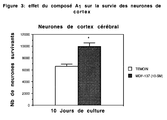
- FIG . 3 represents the effect of compound A1 on the survival of cortex neurons.
- This graph represents the number of neurons surviving after 10 days of culture.
- the properties described above are not limited to neurons of cerebral origin, but also apply to the peripheral nervous system.
- a lesion of the peripheral nerves leads to an axonal degeneration, called Wallerian degeneration.
- the compounds of the invention promote the regeneration of the proximal part of the injured nerve, which has the effect of allowing the reinnervation of the terminal organ. This action restores the function of the re-innervated organ through treatment with this compound.
- the molecules falling within the scope of the invention have neurotrophic activity in vivo . From a morphological point of view, these molecules have a differentiating effect and a neuronal survival effect in various models of lesion. From a functional point of view, the compounds of the invention have a behavioral and biochemical restoration effect, in particular on the model of lesion of the basal magnocellular nucleus (NBM) in rats (Dubois et al ., 1985). The activity of the compounds of the invention can be demonstrated using the experimental model described below.
- Rats carrying the NBM lesion having received a treatment with a compound of the invention do not exhibit a learning deficit in a passive avoidance response.
- NL or NBM lesion (NBM) rats are treated intraperitoneally or orally either with a control solution, consisting of the solvent alone, or with a compound of the invention.
- a control solution consisting of the solvent alone, or with a compound of the invention.
- the rats are subjected to the learning of a passive avoidance response.
- the rat is placed at the end of a narrow and strongly lit aisle leading to a large dark compartment.
- the learning session includes as many tests necessary to obtain the criterion. There is a learning deficit in the NBM / Control group and a learning curve in the NBM / compound group similar to that of the NL groups.
- the walking activity of the molecules coming within the scope of the invention is highlighted using several behavioral tests requesting the working, reference, short-term spatial memory (spontaneous or reinforced alternation behavior, spatial discrimination in a T-maze), long-term spatial memory (recognition of an initially new environment; retention of a passive avoidance response), olfactory memory (social memory of a young fellow), visual (comparison not deferred samples).
- short-term spatial memory spontaneous or reinforced alternation behavior, spatial discrimination in a T-maze
- long-term spatial memory recognition of an initially new environment; retention of a passive avoidance response
- olfactory memory social memory of a young fellow
- visual comparativetaneous or reinforced alternation behavior, spatial discrimination in a T-maze
- facilitation of storage is observed in animals which have received an oral or intraperitoneal route a solution containing these molecules.
- the rats having received this long chain fatty alcohol have a percentage of spontaneous alternations higher than those treated with the control solution; which indicates a facilitation of short-term working memory.
- Rats receive daily intraperitoneal injections for 10 days of a control solution or a compound of the invention. The day of the last injection, each animal is subjected to a 10-minute habituation session during which he can freely explore the T-maze. Five days later, the behavior of spontaneous alternations is measured during 11 successive tests.
- the promoting effect of the compounds of the invention can be generalized to several forms of memory (short / long term memory; working memory / reference; spatial, olfactory, visual memory). This effect appears after repeated or single treatment administered orally or intraperitoneally.
- Pharmacological treatment is not the only way to promote functional recovery following damage to the central nervous system. Indeed it is possible to replace certain neurons or to compensate for a neurotransmitter deficit using a nerve graft.
- the grafted tissue most often consists of fetal nervous tissue.
- the transplant can act on several levels to stimulate functional recovery. It can reconstruct a circuit that has been interrupted by an injury or can provide neurotransmitters necessary for the functioning of certain neural circuits.
- the compounds of the invention are capable of promoting the taking of a nerve graft thanks to their capacity to stimulate survival and neuronal differentiation.
- the extension of neurites from the grafted nervous tissue promotes its contact with the surrounding tissues and therefore the functioning of the neural circuit.
- good neuronal survival within the graft is necessary in order to ensure its long-term functioning.
- the compounds of the invention can be used as neurotrophics in diseases neurodegenerative thanks to their functional recovery effect following damage to the nervous tissue but also as nootropics, thanks to their facilitating effect on memory capacities.
- the derivatives of the invention promote differentiation and neuronal survival. In vivo , they are able to compensate for the memory deficit after brain damage.
- the derivatives of the invention can therefore be advantageously used in certain neurodegenerative diseases. Their good bioavailability and the obtaining of chemically and optically pure products will make them particularly useful therapeutic tools.
Landscapes
- Chemical & Material Sciences (AREA)
- Organic Chemistry (AREA)
- Acyclic And Carbocyclic Compounds In Medicinal Compositions (AREA)
- Medicines Containing Plant Substances (AREA)
- Fats And Perfumes (AREA)
- Organic Low-Molecular-Weight Compounds And Preparation Thereof (AREA)
- Steroid Compounds (AREA)
Priority Applications (5)
| Application Number | Priority Date | Filing Date | Title |
|---|---|---|---|
| DE69200126T DE69200126D1 (de) | 1992-11-18 | 1992-11-18 | Langkettige Fettalkohole mit neurotropischer und gedächtnissfördernder Wirkung. |
| EP92440127A EP0593831B1 (de) | 1992-11-18 | 1992-11-18 | Langkettige Fettalkohole mit neurotropischer und gedächtnissfördernder Wirkung |
| AT9292440127T ATE105282T1 (de) | 1992-11-18 | 1992-11-18 | Langkettige fettalkohole mit neurotropischer und gedaechtnissfoerdernder wirkung. |
| PCT/FR1993/001059 WO1994011343A1 (fr) | 1992-11-18 | 1993-10-28 | Alcools gras a longue chaine a action neurotrophique et promnesiante, et leur procede de preparation |
| AU54238/94A AU5423894A (en) | 1992-11-18 | 1993-10-28 | Long chain fatty alcohols with neurotrophic and paramnesic activity, and method of preparation |
Applications Claiming Priority (1)
| Application Number | Priority Date | Filing Date | Title |
|---|---|---|---|
| EP92440127A EP0593831B1 (de) | 1992-11-18 | 1992-11-18 | Langkettige Fettalkohole mit neurotropischer und gedächtnissfördernder Wirkung |
Publications (2)
| Publication Number | Publication Date |
|---|---|
| EP0593831A1 true EP0593831A1 (de) | 1994-04-27 |
| EP0593831B1 EP0593831B1 (de) | 1994-05-04 |
Family
ID=8211775
Family Applications (1)
| Application Number | Title | Priority Date | Filing Date |
|---|---|---|---|
| EP92440127A Expired - Lifetime EP0593831B1 (de) | 1992-11-18 | 1992-11-18 | Langkettige Fettalkohole mit neurotropischer und gedächtnissfördernder Wirkung |
Country Status (5)
| Country | Link |
|---|---|
| EP (1) | EP0593831B1 (de) |
| AT (1) | ATE105282T1 (de) |
| AU (1) | AU5423894A (de) |
| DE (1) | DE69200126D1 (de) |
| WO (1) | WO1994011343A1 (de) |
Cited By (2)
| Publication number | Priority date | Publication date | Assignee | Title |
|---|---|---|---|---|
| WO1999008987A1 (en) * | 1997-08-13 | 1999-02-25 | Meiji Milk Products Co., Ltd. | Cyclohexenone long-chain alcohol and medicament containing same |
| WO2000047199A1 (en) * | 1999-02-10 | 2000-08-17 | Meiji Dairies Corporation | Use of a cyclohexenone long-chain alcohol for treating neurodegenerative diseases |
Families Citing this family (1)
| Publication number | Priority date | Publication date | Assignee | Title |
|---|---|---|---|---|
| FR2860233B1 (fr) * | 2003-09-26 | 2007-10-19 | Univ Pasteur | Composes promoteurs de la differenciation des precurseurs d'oligodendrocytes et modulateurs de l'activation microgliale, compositions et utilisations. |
Citations (2)
| Publication number | Priority date | Publication date | Assignee | Title |
|---|---|---|---|---|
| US3578686A (en) * | 1968-04-26 | 1971-05-11 | Sterling Drug Inc | 2-hydroxy - 3 -((3,3,5-trimethylcyclohexyl)-alkyl) - 1,4-naphthoquinones and their preparation |
| WO1991005754A2 (fr) * | 1989-10-13 | 1991-05-02 | Medafor | Derives des alcools gras a longue chaine, leurs applications, notamment en tant que molecules cytotrophiques et cytoprotectrices, et compositions pharmaceutiques les contenant |
Family Cites Families (1)
| Publication number | Priority date | Publication date | Assignee | Title |
|---|---|---|---|---|
| FR78168E (fr) * | 1960-06-23 | 1962-06-15 | Bayer Ag | Procédé de fabrication d'hexadécadiène-(10, 12)-ol |
-
1992
- 1992-11-18 AT AT9292440127T patent/ATE105282T1/de active
- 1992-11-18 EP EP92440127A patent/EP0593831B1/de not_active Expired - Lifetime
- 1992-11-18 DE DE69200126T patent/DE69200126D1/de not_active Expired - Lifetime
-
1993
- 1993-10-28 AU AU54238/94A patent/AU5423894A/en not_active Abandoned
- 1993-10-28 WO PCT/FR1993/001059 patent/WO1994011343A1/fr not_active Ceased
Patent Citations (2)
| Publication number | Priority date | Publication date | Assignee | Title |
|---|---|---|---|---|
| US3578686A (en) * | 1968-04-26 | 1971-05-11 | Sterling Drug Inc | 2-hydroxy - 3 -((3,3,5-trimethylcyclohexyl)-alkyl) - 1,4-naphthoquinones and their preparation |
| WO1991005754A2 (fr) * | 1989-10-13 | 1991-05-02 | Medafor | Derives des alcools gras a longue chaine, leurs applications, notamment en tant que molecules cytotrophiques et cytoprotectrices, et compositions pharmaceutiques les contenant |
Cited By (3)
| Publication number | Priority date | Publication date | Assignee | Title |
|---|---|---|---|---|
| WO1999008987A1 (en) * | 1997-08-13 | 1999-02-25 | Meiji Milk Products Co., Ltd. | Cyclohexenone long-chain alcohol and medicament containing same |
| WO2000047199A1 (en) * | 1999-02-10 | 2000-08-17 | Meiji Dairies Corporation | Use of a cyclohexenone long-chain alcohol for treating neurodegenerative diseases |
| US7166642B1 (en) | 1999-02-10 | 2007-01-23 | Meiji Dairies Corporation | Use of cyclohexenone long-chain alcohol for treating neurodegenerative diseases |
Also Published As
| Publication number | Publication date |
|---|---|
| ATE105282T1 (de) | 1994-05-15 |
| WO1994011343A1 (fr) | 1994-05-26 |
| EP0593831B1 (de) | 1994-05-04 |
| AU5423894A (en) | 1994-06-08 |
| DE69200126D1 (de) | 1994-07-07 |
Similar Documents
| Publication | Publication Date | Title |
|---|---|---|
| EP0448697B1 (de) | Analoge von vitamin a und ihre verwendung, insbesondere als cytotrophische und cytoprotective substanzen sowie diese substanzen enthaltende arzneimittel | |
| EP0862547B1 (de) | Aus einer pflanze von geschlecht commiphora extrajierte produkte, insbesondere aus der pflanze commiphora mukul, und diese enthaltende extrakten sowie deren verwendung in der kosmetik | |
| CA1041083A (fr) | Esters des 21-thiol-steroides_ | |
| EP0233106A1 (de) | (-)-Benzhydrylsulfinylacetamid, Verfahren zur Herstellung und Verwendung in der Therapie | |
| EP3454875B1 (de) | Verfahren zur herstellung von celastrol und pentacyclischen triterpenderivaten | |
| EP0349469B1 (de) | Pharmazeutisches Präparat mit hautregenerierenden Eigenschaften, das den Wirkstoff der Mimosa tenuiflora enthält und Verfahren zu dessen Herstellung | |
| FR2459248A1 (fr) | Hemi-esters du cholesterol utilisables en medecine et leur procede de fabrication | |
| EP0192521B1 (de) | 3-Phenyltetrahydropyridin-Derivate, Herstellungsverfahren und Verwendung in Therapien | |
| FR2617401A1 (fr) | Composition cosmetique a action-cellulitique et amincissante dont le principe actif est une 1-hydroxyalkyxanthine | |
| EP0593831B1 (de) | Langkettige Fettalkohole mit neurotropischer und gedächtnissfördernder Wirkung | |
| WO2000044863A1 (fr) | Procede d'obtention d'une huile enrichie en acides gras hydroxyoctadecadienoiques (hode) ou de ses esters, a partir d'un melange huileux contenant de l'acide linoleique, ou ses esters | |
| EP0479631A1 (de) | Spiro[4,5]decanderivate, Verfahren zu ihrer Herstellung und diese enthaltende pharmazeutische Zubereitungen | |
| EP0498718A1 (de) | Verwendung von 4-(3-trifluormethylphenyl)-1,2,3,6-Tetrahydropyridinderivaten als freie Radikalfänger | |
| EP3122329A1 (de) | Kosmetische und/oder dermatologische zusammensetzung zum färben der haut | |
| CA1155438A (fr) | Derives d'amino-14 steroides, et procede pour leur preparation | |
| EP0739887A1 (de) | Cyclohexanverbindungen, Verfahren zu deren Herstellung un deren pharmazeutische Zusammensetzungen | |
| MC1344A1 (fr) | Derives de la pyrrolidine,leur preparation et leurs utilisations therapeutiques | |
| CA1186311A (fr) | Procede de preparation de nouveaux derives de 20,21- d'inoreburnamenine eventuellement substitues sur le cycle e | |
| FR2510577A1 (fr) | Composes organiques azotes extraits de plantes et leurs derives, leur preparation et leurs utilisations therapeutiques, notamment en tant qu'agents antineoplastiques | |
| CH646146A5 (fr) | Derive du 1alpha,25-dihydroxy cholecalciferol et son procede de preparation. | |
| FR2468582A1 (fr) | Antibiotiques de type macrolide, leur procede de preparation et compositions therapeutiques les contenant | |
| EP0388308B1 (de) | Retinsäureester von D-Desosamin, Verfahren zu deren Herstellung und ihre Verwendung in der Human- oder Veterinärmedizin und in der Kosmetik | |
| WO2001028549A1 (fr) | Composes anti-ischemiques | |
| FR2858320A1 (fr) | Utilisation d'un derive d'acide (dihydro)jasmonique comme agent desquamant. | |
| EP0126691B1 (de) | Verfahren zur Herstellung eines therapeutisch anwendbaren Extraktes aus Brackenridgea zanguebarica, Extrakt und entsprechendes Medikament |
Legal Events
| Date | Code | Title | Description |
|---|---|---|---|
| PUAI | Public reference made under article 153(3) epc to a published international application that has entered the european phase |
Free format text: ORIGINAL CODE: 0009012 |
|
| GRAA | (expected) grant |
Free format text: ORIGINAL CODE: 0009210 |
|
| 17P | Request for examination filed |
Effective date: 19921120 |
|
| AK | Designated contracting states |
Kind code of ref document: A1 Designated state(s): AT BE CH DE DK ES FR GB GR IE IT LI LU MC NL PT SE |
|
| AK | Designated contracting states |
Kind code of ref document: B1 Designated state(s): AT BE CH DE DK ES FR GB GR IE IT LI LU MC NL PT SE |
|
| PG25 | Lapsed in a contracting state [announced via postgrant information from national office to epo] |
Ref country code: SE Free format text: THE PATENT HAS BEEN ANNULLED BY A DECISION OF A NATIONAL AUTHORITY Effective date: 19940504 Ref country code: NL Effective date: 19940504 Ref country code: MC Free format text: LAPSE BECAUSE OF NON-PAYMENT OF DUE FEES Effective date: 19940504 Ref country code: IT Free format text: LAPSE BECAUSE OF FAILURE TO SUBMIT A TRANSLATION OF THE DESCRIPTION OR TO PAY THE FEE WITHIN THE PRE;WARNING: LAPSES OF ITALIAN PATENTS WITH EFFECTIVE DATE BEFORE 2007 MAY HAVE OCCURRED AT ANY TIME BEFORE 2007. THE CORRECT EFFECTIVE DATE MAY BE DIFFERENT FROM THE ONE RECORDED.SCRIBED TIME-LIMIT Effective date: 19940504 Ref country code: GR Free format text: LAPSE BECAUSE OF FAILURE TO SUBMIT A TRANSLATION OF THE DESCRIPTION OR TO PAY THE FEE WITHIN THE PRESCRIBED TIME-LIMIT Effective date: 19940504 Ref country code: GB Effective date: 19940504 Ref country code: ES Free format text: THE PATENT HAS BEEN ANNULLED BY A DECISION OF A NATIONAL AUTHORITY Effective date: 19940504 Ref country code: DK Effective date: 19940504 Ref country code: DE Effective date: 19940504 Ref country code: AT Effective date: 19940504 |
|
| REF | Corresponds to: |
Ref document number: 105282 Country of ref document: AT Date of ref document: 19940515 Kind code of ref document: T |
|
| REF | Corresponds to: |
Ref document number: 69200126 Country of ref document: DE Date of ref document: 19940707 |
|
| PG25 | Lapsed in a contracting state [announced via postgrant information from national office to epo] |
Ref country code: PT Effective date: 19940804 |
|
| NLV1 | Nl: lapsed or annulled due to failure to fulfill the requirements of art. 29p and 29m of the patents act | ||
| GBV | Gb: ep patent (uk) treated as always having been void in accordance with gb section 77(7)/1977 [no translation filed] |
Effective date: 19940504 |
|
| PG25 | Lapsed in a contracting state [announced via postgrant information from national office to epo] |
Ref country code: LU Free format text: LAPSE BECAUSE OF NON-PAYMENT OF DUE FEES Effective date: 19941130 Ref country code: LI Effective date: 19941130 Ref country code: CH Effective date: 19941130 Ref country code: BE Effective date: 19941130 |
|
| REG | Reference to a national code |
Ref country code: IE Ref legal event code: FG4D Free format text: 60638 |
|
| PLBE | No opposition filed within time limit |
Free format text: ORIGINAL CODE: 0009261 |
|
| PG25 | Lapsed in a contracting state [announced via postgrant information from national office to epo] |
Ref country code: IE Free format text: LAPSE BECAUSE OF NON-PAYMENT OF DUE FEES Effective date: 19950419 |
|
| REG | Reference to a national code |
Ref country code: IE Ref legal event code: FD4D Ref document number: 60638 Country of ref document: IE |
|
| 26N | No opposition filed | ||
| BERE | Be: lapsed |
Owner name: MEDAFOR Effective date: 19941130 |
|
| PG25 | Lapsed in a contracting state [announced via postgrant information from national office to epo] |
Ref country code: FR Effective date: 19950731 |
|
| REG | Reference to a national code |
Ref country code: CH Ref legal event code: PL |
|
| REG | Reference to a national code |
Ref country code: FR Ref legal event code: ST |