EP0594119B1 - Doppler-Effekt-Geschwindigkeitssensor für Fahrzeuge, der verschiedene Geschwindigkeitsbestimmungsregeln abhängig vom Empfängerausgangsniveau gebraucht - Google Patents
Doppler-Effekt-Geschwindigkeitssensor für Fahrzeuge, der verschiedene Geschwindigkeitsbestimmungsregeln abhängig vom Empfängerausgangsniveau gebraucht Download PDFInfo
- Publication number
- EP0594119B1 EP0594119B1 EP93116866A EP93116866A EP0594119B1 EP 0594119 B1 EP0594119 B1 EP 0594119B1 EP 93116866 A EP93116866 A EP 93116866A EP 93116866 A EP93116866 A EP 93116866A EP 0594119 B1 EP0594119 B1 EP 0594119B1
- Authority
- EP
- European Patent Office
- Prior art keywords
- speed
- vehicle
- ground
- receiver
- doppler
- Prior art date
- Legal status (The legal status is an assumption and is not a legal conclusion. Google has not performed a legal analysis and makes no representation as to the accuracy of the status listed.)
- Expired - Lifetime
Links
- 230000001052 transient effect Effects 0.000 claims description 18
- 230000001133 acceleration Effects 0.000 claims description 5
- 230000000694 effects Effects 0.000 claims description 5
- 239000010426 asphalt Substances 0.000 claims description 4
- XLYOFNOQVPJJNP-UHFFFAOYSA-N water Substances O XLYOFNOQVPJJNP-UHFFFAOYSA-N 0.000 claims description 2
- 230000003247 decreasing effect Effects 0.000 claims 1
- 230000001186 cumulative effect Effects 0.000 description 16
- 238000001514 detection method Methods 0.000 description 6
- 238000010586 diagram Methods 0.000 description 3
- 238000000034 method Methods 0.000 description 3
- 230000008859 change Effects 0.000 description 2
- 230000000994 depressogenic effect Effects 0.000 description 2
- 230000007547 defect Effects 0.000 description 1
- 230000001419 dependent effect Effects 0.000 description 1
- 238000002474 experimental method Methods 0.000 description 1
- 230000006870 function Effects 0.000 description 1
- 238000009499 grossing Methods 0.000 description 1
- 230000001788 irregular Effects 0.000 description 1
- 230000033001 locomotion Effects 0.000 description 1
- 238000004519 manufacturing process Methods 0.000 description 1
- 238000012544 monitoring process Methods 0.000 description 1
- 230000003287 optical effect Effects 0.000 description 1
- 230000008569 process Effects 0.000 description 1
- 230000009467 reduction Effects 0.000 description 1
- 238000005070 sampling Methods 0.000 description 1
- 230000035945 sensitivity Effects 0.000 description 1
Images




Classifications
-
- G—PHYSICS
- G01—MEASURING; TESTING
- G01S—RADIO DIRECTION-FINDING; RADIO NAVIGATION; DETERMINING DISTANCE OR VELOCITY BY USE OF RADIO WAVES; LOCATING OR PRESENCE-DETECTING BY USE OF THE REFLECTION OR RERADIATION OF RADIO WAVES; ANALOGOUS ARRANGEMENTS USING OTHER WAVES
- G01S15/00—Systems using the reflection or reradiation of acoustic waves, e.g. sonar systems
- G01S15/02—Systems using the reflection or reradiation of acoustic waves, e.g. sonar systems using reflection of acoustic waves
- G01S15/50—Systems of measurement, based on relative movement of the target
- G01S15/58—Velocity or trajectory determination systems; Sense-of-movement determination systems
- G01S15/60—Velocity or trajectory determination systems; Sense-of-movement determination systems wherein the transmitter and receiver are mounted on the moving object, e.g. for determining ground speed, drift angle, ground track
-
- G—PHYSICS
- G01—MEASURING; TESTING
- G01S—RADIO DIRECTION-FINDING; RADIO NAVIGATION; DETERMINING DISTANCE OR VELOCITY BY USE OF RADIO WAVES; LOCATING OR PRESENCE-DETECTING BY USE OF THE REFLECTION OR RERADIATION OF RADIO WAVES; ANALOGOUS ARRANGEMENTS USING OTHER WAVES
- G01S13/00—Systems using the reflection or reradiation of radio waves, e.g. radar systems; Analogous systems using reflection or reradiation of waves whose nature or wavelength is irrelevant or unspecified
- G01S13/02—Systems using reflection of radio waves, e.g. primary radar systems; Analogous systems
- G01S13/50—Systems of measurement based on relative movement of target
- G01S13/58—Velocity or trajectory determination systems; Sense-of-movement determination systems
- G01S13/60—Velocity or trajectory determination systems; Sense-of-movement determination systems wherein the transmitter and receiver are mounted on the moving object, e.g. for determining ground speed, drift angle, ground track
Definitions
- the present invention relates to a Doppler-effect speed detecting apparatus adapted to detect or determine the ground speed of a motor vehicle, utilizing the Doppler effect of waves.
- the detection or determination of the running speed of the vehicle with high precision is required for achieving adequate control of the vehicle motions in relation to the vehicle running speed, for example, for effecting anti-lock regulation of braking forces of the wheels or traction control of the drive wheels.
- An anti-lock or traction control of a braking system to regulate the brake forces or drive forces applied to the wheels is implemented in special running conditions of the vehicle in which the slip ratio of the wheels is considerably higher than in an ordinary running condition. In such special running conditions, therefore, the accuracy of estimation of the actual running speed of the vehicle based on the speeds of the wheels is limited.
- such a Doppler-effect ground-speed detecting apparatus has (a) a transmitter for transmitting a wave toward the ground or road surface, (b) a receiver for receiving a portion of the transmitted wave which is reflected by the ground surface, and (c) a signal processor or ground-speed determining means for determining the ground speed of the vehicle, according to the Doppler effect or shift, on the basis of the frequencies of the waves as transmitted from the transmitter and as received by the receiver (hereinafter referred to as "transmitted and received waves").
- the Doppler-effect ground-speed detecting technique suffers from inherent drawbacks not encountered on the prior art which utilizes the wheel speed sensors to estimate the ground speed of the vehicle. That is, since a Doppler-effect ground-speed detecting apparatus utilizes a wave that is irregularly reflected by the road surface, the detecting accuracy of this apparatus is affected by the road surface condition, more precisely, the wave reflecting condition of the road surface. Described in detail, the component of the transmitted wave to be irregularly reflected by the road surface is reduced with a result of lowering the output level of the receiver, when the road surface on which the vehicle is running has a relatively high degree of smoothness, for instance, when the road surface is covered with water or iced. The lowering of the output level of the receiver leads to undesirable reduction in the accuracy of detection of the ground speed of the vehicle.
- This apparatus includes (a) vehicle speed estimating means for obtaining an estimated vehicle speed on the basis of the speeds of the vehicle wheels, (b) receiver-output detecting means for detecting the output level of the receiver of the Doppler-effect speed sensor, and (c) ground-speed determining means for determining the vehicle ground speed on the basis of the frequencies of the transmitted and received waves when the output level of the receiver detected by the receiver-output detecting means is higher than a predetermined threshold value, and determining as the vehicle ground speed the estimated vehicle speed obtained by the vehicle speed estimating means when the detected output level of the receiver is not higher than the threshold value.
- the inventors of the present invention have continued efforts to pursue techniques for detecting the ground speed of a motor vehicle with sufficiently high accuracy even when the output level of the receiver is comparatively low.
- the present inventors has recognized a fact that there exists a given correlation between the actual vehicle ground speed, and the original vehicle ground speed as determined by the ground-speed determining means on the basis of the frequencies of the transmitted and received waves (hereinafter referred to as "originally determined vehicle ground speed"), irrespective of the output level of the receiver as compared with a predetermined threshold.
- the originally determined vehicle ground speed is lower than the actual vehicle ground speed when the output level of the receiver is relatively low, in the case where the transmitter and receiver are attached to the vehicle body such that the boresights or optical axes of the transmitter and receiver are inclined in the backward or reverse running direction of the vehicle.
- the amount of decrease of the originally determined vehicle ground speed with respect to the actual vehicle ground speed increases with an increase in the actual ground speed.
- the originally determined vehicle ground speed is higher than the actual vehicle ground speed when the output level is relatively low.
- the amount of increase of the originally determined vehicle ground speed with respect to the actual vehicle ground speed increases with an increase in the actual ground speed.
- a ground velocity sensor with drop-out detection is known from document EP-A-0 188 906.
- the drop-out detection is achieved by a drop-out detector monitoring the amplitude of the received signal.
- two different rules are used depending on the output level of a receiver of a Doppler-effect speed detecting arrangement for determining the vehicle ground speed.
- the output of a low-pass filter is kept unchanged as long as the amplitude of the output signal of the receiver is lower than a threshold value, whereupon the ground speed which has last been determined under normal circumstances is maintained. Accordingly, the currently detected frequencies are ignored when the output level of the receiver is lower than the threshold value.
- this object is accomplished by a Doppler-effect speed detecting apparatus as defined in claim 1.
- the ground-speed determining means may be arranged to first calculate the vehicle ground speed on the basis of the frequencies of the transmitted and reflected waves and according to the predetermined first rule, irrespective of the output level of the receiver as compared with the threshold value, and determine the calculated ground speed as the vehicle ground speed when the receiver output level is higher than the threshold value, or compensate the calculated ground speed according to the second rule to thereby obtain a compensated vehicle speed as the ground speed when the receiver output level is not higher than the threshold value.
- This arrangement is an example of the type which directly utilizes the originally determined vehicle ground speed.
- the parameter Va may be any suitable variable which reflects or approximates the actual ground speed of the vehicle, such as the originally determined ground speed per se, or the estimated vehicle speed as obtained on the basis of the speeds of the vehicle wheels as described above.
- the compensated vehicle speed when the output level of the receiver is not higher than the threshold value may be obtained by first suitably compensating or adjusting a parameter or parameters influencing the determination of the actual ground speed, for example, at least one of the frequencies of the transmitted and received waves and the angle of inclination of the transmitter and receiver, and then calculating the compensated vehicle speed according to the compensated parameter or parameters.
- the compensation of the parameter or parameters corresponds to the predetermined second rule. This arrangement is an example of the type which indirectly utilizes the originally determined vehicle ground speed.
- the output level of the receiver is detected by the receiver-output detecting means, and the vehicle ground speed is determined on the basis of the frequencies of the transmitted and received waves, according to the first rule when the receiver output level is higher than the threshold value, and according to the second rule when the receiver output level is equal to or lower than the threshold value.
- the first rule is formulated on an assumption that the output level of the receiver is not insufficient due to the road surface condition
- the second rule is formulated on an assumption that the receiver output level is insufficient due to the road surface condition to such an extent that the ground speed as determined on the basis of the frequencies of the transmitted and reflected waves should be compensated to determine the actual ground speed.
- the Doppler-effect speed detecting apparatus utilizes the originally determined vehicle ground speed directly or indirectly to determine the vehicle ground speed with a minimum of lowering of the detecting accuracy when the output level of the receiver is relatively low.
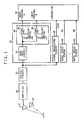
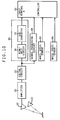
- the apparatus includes a transmitter 10 and a receiver 12, which are attached to the underside of the vehicle body such that the boresights or axes of the transmitter and receiver 10, 12 are inclined in a backward running direction of the vehicle, at a predetermined angle ⁇ (e.g., 45°) relative to the ground or road surface.
- ⁇ e.g. 45°
- the transmitter 10 includes a piezoelectric element for converting an electric signal received from a suitable oscillator, into a wave in the form of a ultrasonic wave, which is transmitted toward the road surface.
- the receiver 12 receives a portion of the ultrasonic wave which is transmitted from the transmitter 10 and irregularly reflected by the road surface.
- the receiver 12 includes a piezoelectric element for converting the received ultrasonic wave into an electric signal.
- the receiver 12 is connected to an amplifier 20 and a filter circuit 22, so that the electric signal generated by the receiver 12 is first amplified by the amplifier 20 and then filtered by the filter circuit 22 to eliminate noises included therein.
- the filter circuit 22 is connected to a receiver-output detecting circuit 30 for detecting the output level of the receiver 12.
- the detecting circuit 30 incorporates a peak-hold circuit 34, and a discriminating circuit 44 including two comparators 36, 38 and two variable resistors 40, 42.
- the peak-hold circuit 34 detects and holds a peak level of the electric signal received from the filter circuit 22, namely, a peak value of the periodically changing level of the output voltage signal of the receiver 12.
- the output of the peak-hold circuit 34 is connected to a positive input of the comparator 36 and a positive input of the comparator 38.
- variable resistors 40, 42 are connected to negative inputs of the comparators 36, 38, respectively, so that a first reference voltage Vref1 and a second reference voltage Vref2 are applied to the respective comparators 36, 38.
- the second reference voltage Vref2 is lower than the first reference voltage Vref1.
- the comparator 36 produces a high-level output signal when the voltage level at the positive input is higher than the reference first reference voltage ref1, and a low-level output signal when the voltage level at the positive input is equal to or lower than the first reference voltage Vref1.
- the comparator 37 produces a high-level and a low-level output signal, as a result of comparison of the positive input voltage with the second reference voltage Vref2.
- the receiver-output detecting circuit 30 is therefore capable of determining the level of the output voltage signal of the receiver 12 on the basis of the voltage levels of the output signals of the two comparators 36, 38, more particularly, determining whether the output level of the receiver 12 is relatively high, medium or relatively low. Described in detail, the high-level output signal of the comparator 36 indicates that the output level of the receiver 12 is in a high range, while the low-level output signal of the comparator 38 indicates that the output level of the receiver 12 is in a low range. Further, the low-level output level of the comparator 36 and the high-level output level of the comparator 38 indicate that the output level of the receiver 12 is in a medium range.
- a signal processing circuit 48 which is adapted to calculate a provisional vehicle speed VPRV (original vehicle speed indicated above) on the basis of the electric signal received from the filter circuit 22, and a signal (not shown) indicative of the frequency of the ultrasonic wave generated by the transmitter 10, according to the principle of the Doppler effect well known in the art.
- the receiver-output detecting circuit 30 and the signal processing circuit 48 are connected to inputs of a controller 50.
- the output of the comparator 36 is connected to an input terminal A of the controller 50, while the output of the comparator 38 is connected to an input terminal B of the controller 50.
- the controller 50 also receives output signals of four wheel speed sensors 60 representative of the rotating speeds of respective four wheels of the vehicle, that is, front left and right wheels, and rear left and right wheels.
- the controller 50 is constituted principally by a computer incorporating a central processing unit (CPU), a read-only memory (ROM), and a random-access memory (RAM).
- the ROM stores programs for executing a routine for calculating an estimated vehicle speed VSO, a routine for compensating the provisional vehicle speed VPRV as illustrated in the flow chart of Fig. 2, and a routine for calculating a final vehicle speed VFNL. These routines will be described below.
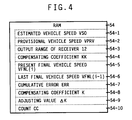
- the RAM of the computer of the controller 50 is generally indicated at 52 in Fig. 4.
- the RAM has various memory areas including: a memory area 54-1 for storing data indicative of the estimated vehicle speed VSO; a memory area 54-2 for storing data indicative of the provisional vehicle speed VPRV calculated by the signal processing circuit 48; a memory area 54-3 for storing data indicative of the range of the output level of the receiver 12; a memory area 54-4 for storing data indicative of a compensating coefficient KK; a memory area 54-5 for storing data indicative of a present final vehicle speed VFNL(i); a memory area 54-6 for storing data indicative of a last final vehicle speed VFNL(i-1); a memory area 54-7 for storing data indicative of a cumulative error ERR; a memory area 54-8 for storing data indicative of a compensating coefficient K; a memory area 54-9 for storing data indicative of an adjusting value ⁇ K; and a memory area 54-10 for storing data indicative of a count CC which is incremented at a time interval
- the routine for calculating the estimated vehicle speed VSO is effected to calculate the present estimated vehicle speed VSO(i) on the basis of the speeds VW of the front left and right and rear left and right wheels as detected by the respective wheel speed sensors 60. More specifically, the routine is adapted to first obtain the following three wheel speed values: (1) a highest one of the currently detected speeds VW of the four wheels; .(2) a maximum wheel speed calculated on the basis of the last estimated vehicle speed VSO(i-1); and (3) a minimum wheel speed calculated on the basis of the last estimated vehicle speed VSO(i-1). The calculation of the maximum and minimum speeds will be described. Then, an intermediate value of the above three values is determined as the present estimated vehicle speed VSO(i).
- the maximum wheel speed indicated at (2) above is calculated as VSO(i-1) + GACC ⁇ , while the minimum wheel speed indicated at (3) above is calculated as VSO(i-1) - GDEC ⁇ .
- GACC and GDEC represent upper limits (predetermined constants) of acceleration and deceleration of the vehicle, respectively, while a represents a sampling interval of the estimated vehicle speed VSO(i), that is, the cycle time of the final vehicle speed calculating routine of Fig. 3.
- the estimated vehicle speed VSO(i) thus calculated is stored in the memory area 54-1 of the RAM 54.
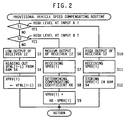
- the provisional vehicle speed compensating routine is effected to process the provisional vehicle speed VPRV in three different ways, depending upon the determination based on the output levels of the two comparators 36, 38.
- the present provisional vehicle speed VPRV (i) as currently calculated by the signal processing circuit 48 is stored in the memory area 54-2 of the RAM 54. In this case, the output VPRV (i) of the circuit 48 is not compensated.
- the output VPRV of the circuit 48 is ignored, since the output level lower than the second reference voltage Vref2 indicates a relatively high possibility of any defect of the receiver 12.
- the last final vehicle speed VFNL(i-1) which will be described by reference to the flow chart of Fig. 3 is read out from the memory area 54-6 of the RAM 54 and stored in the memory area 54-2 as the present provisional vehicle speed VPRV(i).
- the output VPRV(i) of the signal processing circuit 48 needs suitable compensation.
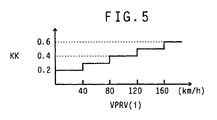
- the output VPRV(i) as produced by the circuit 48 is compensated to obtain a compensated vehicle speed Vcom according to an equation VPRV(i) + KK ⁇ VPRV(i) , wherein KK represents a compensating coefficient (0 through 1) which is determined by the present provisional vehicle speed VPRV(i), and according to a predetermined relationship between KK and VPRV(i), such that the compensating coefficient KK increases with the provisional vehicle speed VPRV(i), as indicated in Fig. 5, by way of example.
- the provisional vehicle speed VPRV(i) which is multiplied by the compensating coefficient KK is considered to be a parameter which reflects or approximates the actual vehicle speed.
- the data representative of this relationship are stored in the ROM of the computer of the controller 50.
- This routine is effected with a predetermined cycle time.
- Each cycle of execution of the routine is started with step S1 to determine whether the output level of the comparator 36 received by the input terminal A of the controller 50 is high or not. If the output level of the comparator 36 is high, an affirmative decision (YES) is obtained in step S1, and the control flow goes to step S10 in which the controller 50 determines that the output level of the receiver 12 is in the high range. Then, the control goes to step S11 to receive the present provisional vehicle speed VPRV(i) from the signal processing circuit 48, and to step S12 in which the received present provisional vehicle speed VPRV(i) is stored in the memory area 54-2 of the RAM 54. The control then returns to step S1 to execute the next cycle.
- step S1 If the output level at the input terminal A is low, on the other hand, a negative decision (NO) is obtained in step S1, and the control flow goes to step S2 to determine whether the output level of the comparator 38 received by the input terminal B is high or not. If the output level of the comparator 38 is low, a negative decision (NO) is obtained in step S2, and step S3 is implemented to determine that the output level of the receiver 13 is in the low range.
- the control then goes to step S4 to read the last final vehicle speed VFNL(i-1) stored in the memory area 54-6 of the RAM 54, and to step S5 in which the last final vehicle speed VFNL(i-1) is stored as the present provisional vehicle speed VPRV(i) in the memory area 54-2 of the RAM 54. The control then returns to step S1.
- step S6 the control flow goes to step S6 in which the controller 50 determines that the output level of the receiver 12 is in the medium range.
- step S7 the control flow goes to step S7 to receive the present provisional vehicle speed VPRV(i) from the signal processing circuit 48, and to step S8 to determine the compensating coefficient KK, on the basis of the present provisional vehicle speed VPRV(i) and according to the predetermined VPRV(i)-KK relationship stored in the ROM of the controller 50, which is illustrated in Fig. 5 for illustrative purpose only.
- Step S8 is followed by step S9 in which the present provisional vehicle speed VPRV(i) is compensated according the equation VPRV(i) + KK ⁇ VPRV(i) . That is, the compensated provisional vehicle speed Vcom is a sum of the currently obtained provisional vehicle speed VPRV(i) and a value KK ⁇ VPRV(i), the latter value being an amount of compensation determined by the compensating coefficient KK which in turn is determined by the present provisional vehicle speed VPRV(i).
- This routine is one of the subject matters of co-pending application Serial No. 08/070,104 assigned to one of the assignees of the present application.
- step S102 there will be described the routine in the case where the output level of the receiver 12 is in the high range, namely, when the affirmative decision (YES) is obtained in step S102.
- the present routine is adapted so that the final vehicle speed VFNL when the vehicle is in a steady running state is determined by compensating the provisional vehicle speed VPRV (as stored in the memory area 54-2 in step S12) on the basis of a relationship between VSO and VPRV in the steady running state, and the final vehicle speed VFNL when the vehicle is in a transient running state is determined by compensating the provisional vehicle speed VPRV on the basis of a relationship between VSO and VPRV which was obtained in the preceding steady running state.
- the steady running state is defined as a state in which the estimated vehicle speed VSO obtained from the wheel speeds VW represents the actual ground speed of the vehicle with sufficiently high accuracy, with the vehicle running at a comparatively constant speed.
- the transient running state is defined as a state in which the estimated vehicle speed VSO considerably deviates from the actual vehicle ground speed, with the vehicle speed changing at a comparatively high rate.
- the provisional vehicle speed VPRV(i) is read out from the memory area 54-2 of the RAM 54, and the final final value VFNL(i) of the vehicle speed (ground speed) is calculated by multiplying the provisional vehicle speed VPRV(i) by the currently effective compensating coefficient K(i).
- the compensating coefficient K(i) is determined differently in the steady and transient running states of the vehicle. In the steady running state, an adjusting value ⁇ K for updating the compensating coefficient K(i) or obtaining the compensating coefficient K(i+1) used in the next cycle is calculated by first calculating a difference VSO(i) - VFNL(i-1) and then dividing the difference by VSO(i).
- the difference is calculated by subtracting the last final vehicle speed VFNL(i-1) stored in the memory area 54-6 from the present estimated vehicle speed VSO(i) stored in the memory area 54-1.
- the compensating coefficient K(i+1) used in the next cycle is determined by adding the calculated adjusting value ⁇ K to the present compensating value K(i).
- the final value of the compensating coefficient K at the end of the period of the last steady running state of the vehicle is used as the next compensating coefficient K(i+1).
- the adjusting value ⁇ K(i) for obtaining the updated or present compensating coefficient K(i) may be a predetermined constant which is a small value
- the final vehicle speed calculating routine of Fig. 3 is formulated according to the principle described above so that the compensating coefficient K for calculating the final vehicle speed VFNL from the provisional vehicle speed VPRV is updated only when the vehicle is running in the steady state, and is fixed at the last value at the end of the period of the last steady running state of the vehicle when the vehicle is in the transient state.
- the present routine of Fig. 3 is executed with the cycle time ⁇ (ms), to update or calculate the estimated vehicle speed VSO, provisional vehicle speed VPRV and final vehicle speed VFNL at the time interval ⁇ , as indicated in Fig. 6.
- the compensating coefficient K is updated at a time interval ⁇ (ms) longer than the cycle time ⁇ of the routine of Fig. 3, as also indicated in Fig. 6. Therefore, the compensating coefficient K(i) remains constant for the time duration ⁇ during which the speed values VSO, VPRV and VFNL are obtained at the shorter time interval ⁇ (at which a value "j" is incremented).
- successive final vehicle speed values VFNL are obtained on the basis of the updated provisional vehicle speed values VPRV and the same compensating coefficient K during each time period ⁇ .
- a cumulative error ERR is calculated at the time interval ⁇ .
- the cumulative error ERR is a sum of differences VSO(i,J) - VFNL(i-1, jmax) which are obtained at the time interval ⁇ during each time period ⁇ .
- the cumulative error ERR is stored in the memory area 54-7 of the RAM 54, and an average of the cumulative error ERR is obtained as ERR/jmax, at the end of each time period ⁇ , so that the adjusting value ⁇ K(i+1) is calculated by dividing the average cumulative error ERR by an average of the estimated vehicle speed values VSO obtained in each time period ⁇ .
- the steady running state of the vehicle is detected if the following three conditions are satisfied:
- the non-operated state of the brake pedal is detected by an output signal of a brake switch which is turned on when the brake pedal is depressed.
- the acceleration or deceleration value of the vehicle is obtained as a difference between the successive two values of the estimated vehicle speed VSO.
- the acceleration or deceleration value is not excessive if the absolute value of the above difference is smaller than a predetermined threshold G 0 .
- the predetermined range of the average estimated vehicle speed VSO(i) is defined by a lower limit A (e.g., 40km/h) and an upper limit B (e.g., 70km/h).
- the adjusting value ⁇ K is obtained at the time interval ⁇ , irrespective of whether the vehicle is in the steady running state or the transient running state.
- the obtained adjusting value ⁇ K(i+1) is added to the present adjusting value ⁇ K(i) to determine the next compensating coefficient K(i+1).
- the next adjusting value ⁇ K(i+1) is set to zero, that is, the present compensating coefficient K(i) is used as the next compensating coefficient K(i+1).
- the updated compensating value K(i) and the updated adjusting value ⁇ K(i) are stored in the memory areas 54-8 and 54-9 of the RAM 54, respectively.
- the last value of the compensating coefficient K used in a steady running period of the vehicle is used as the initial value of the compensating coefficient K in the next steady running period which follows a transient running period between the two steady running periods.
- the compensating coefficient K is not reset to "1" at the beginning of each steady running period the vehicle.
- the value "i" used in the routine of Fig. 3 is incremented each time the output level of the receiver 12 is changed from the low or medium range to the high range, and also each time the time period ⁇ (ms) has passed while the output level of the receiver 12 is in the high range.
- the value "j” is incremented each time the time period ⁇ (ms) has passed, and is reset to "1" when the value "i" is incremented.
- the above explanation refers to the manner of determining the compensating coefficient K used to determine the final vehicle speed VFNL when the output level of the receiver 12 is in the high range.
- the normal control adapted to update the compensating coefficient K as described above is inhibited until the receiver output level rises to fall in the high range.
- a special control is effected to fix the compensating coefficient K at the last value used in the preceding normal control period, and the final vehicle speed values VFNL(i) are determined on the basis of the provisional vehicle speed values VPRV(i) updated at the time interval ⁇ and the fixed or constant compensating coefficient K.
- the compensating coefficient K stored in the memory area 54-8 of the RAM 54 is reset to the initial value "1"
- the cumulative error ERR and the last final vehicle speed VFNL(i-1) which are stored in the respective memory areas 54-7 and 54-6 are reset to the initial value "0”.
- the routine of Fig. 3 is executed with the cycle time ⁇ (ms).
- step S101 is implemented to read out the compensating coefficient K (initially reset to "1") from the memory area 54-8, as the presently effective compensating coefficient K(i). Further, the provisional vehicle speed VPRV is read out from the memory area 54-2, as the presently effective provisional vehicle speed VPRV(i,j), e.g., VPRV(1,1) in the first cycle of execution of the routine. Then, the final vehicle speed VFNL(i,j), e.g., VFNL(1,1) in the first cycle is calculated by multiplying the provisional vehicle speed VPRV(i,j) by the compensating coefficient K(i). The calculated final vehicle speed VFNL(i,j) is stored in the memory area 54-5 as the present final vehicle speed VFNL(i).
- step S102 determines whether the range of the output level of the receiver 12 determined in the provisional vehicle speed compensating routine of Fig. 2 is the high range or not. If the output level of the receiver 12 is in the high range, an affirmative decision (YES) is obtained in step S102, and the control flow goes to step S103.
- step S103 the estimated vehicle speed VSO is read out from the memory area 54-1, as the present estimated vehicle speed VSO(i,j), e.g., VSO(1,1). Further, the last final vehicle speed VFNL(i-1) which is initially reset to "0" is read out from the memory area 54-6, as VFNL(i-1, jmax), e.g., VFNL(0,jmax), and the cumulative error ERR which is also initially reset to "0" is read out from the memory area 54-7.
- the difference VSO(i,j) - VFNL(i-1,jmax) is calculated, and the read-out cumulative error ERR is added to the calculated difference to thereby update the cumulative error ERR, that is, to obtain the currently effective cumulative error ERR.
- the updated ERR is stored in the memory area 54-7.
- step S104 determines whether the count CC which is incremented at the time interval ⁇ (cycle time of the routine) and stored in the memory area 54-10 is equal to or larger than a threshold CC 0 which corresponds to the time period ⁇ (ms) as indicated in Fig. 6.
- a negative decision NO is obtained in step S104, and the control flow returns to step S101.
- step S104 When the time period ⁇ has passed as a result of repeated implementation of steps S101-S104, an affirmative decision (YES) is obtained in step S104, and the control flow goes to step S105 to read out the cumulative error ERR from the memory area 54-7, and calculate an average by dividing the error ERR by jmax. Further, the estimated vehicle speed values VSO stored in the memory area 54-1 are read out, and an average of these values VSO is calculated by dividing the sum of the values VSO by jmax.
- the adjusting value ⁇ K(i+1), e.g., ⁇ K(2) to be used in step S31 in the next cycle of execution of the routine is obtained as a quotient calculated by dividing the average cumulative error ERR by the calculated average of the estimated vehicle speed values VSO. Further, the cumulative error ERR stored in the memory area 54-7 and the count CC stored in the memory area 54-10 are reset to "0", for the next implementation of steps S103 and S104.
- Step S105 is adapted to reset the adjusting value ⁇ K(i+1) to "0" immediately after it is found that the average of the estimated vehicle speed values VSO is substantially zero.
- step S106 is implemented to determine whether the brake switch is on
- step S107 is implemented to determine whether the absolute value of the vehicle acceleration or deceleration value (rate of change in the value VSO) is equal to or larger than a predetermined threshold value G 0 .
- step S108 is then implemented to determine whether the average of the estimated vehicle speed values VSO is equal to or lower than a predetermined lower limit A
- step S109 is implemented to determine whether the above average is equal to or higher than a predetermined upper limit B.
- step S110 the adjusting value ⁇ K(i+1) is added to the presently effective compensating coefficient K(i) to obtain the next compensating coefficient K(i+1).
- the obtained coefficient K(i+1) is stored in the memory area 54-8 of the RAM 54.
- step S106-S109 If an affirmative decision (YES) is obtained in any one of the above four steps S106-S109, this indicates that the vehicle is running in the transient state. In this case, the control flow goes to step S111 in which the currently effective compensating coefficient K(i) is determined as the next compensating coefficient K(i+1). Thus, the compensating coefficient K stored in the memory area 54-8 remains unchanged.
- the compensating coefficient K is updated each time the affirmative decision (YES) is obtained in step S104 while the vehicle is running in the steady state, with the provisional vehicle speed VPRV (estimated speed VSO) slowing changing or held substantially constant.
- the graph of Fig. 7 shows an example of a change in the provisional vehicle speed VPRV, wherein the vehicle first runs in a steady state at a substantially constant speed during a first period indicated at "i", and then runs in a transient state with a rapid drop of the speed during the following second and third periods indicated at "i+1" and "i+2". These periods correspond to the time interval ⁇ .
- step S110 is implemented to update the compensating coefficient K.
- step S111 rather than S110 is implemented, whereby the compensating coefficient K(i+1) used in the second period is used as K(i+2) in the third or "i+2"-th period.
- step S111 is implemented in the second or "i+1"-th period even if the provisional vehicle speed VPRV starts to drop in an early portion of the "i+1"-th period as in the example of Fig. 7, because the step S108 to detect the excessive drop of the vehicle speed for example is implemented in a relatively terminal part of the steady state checking portion (S106-S109) of the routine.
- the graph of Fig. 8 shows another example of the vehicle running condition in which the vehicle is in the transient running state in the first or "i"-th period, and is returned to the steady running state in the following "i+1"-th and "i+2"-th periods.
- the updating of the compensating coefficient K is inhibited with step S111 implemented during the "i"-th and "i+1"-th periods, but the coefficient K is updated in step S110 in the "i+2"-th period.
- step S112 is implemented to to reset the cumulative error ERR and the count CC
- step S111 is implemented to maintain the presently effective compensating coefficient K(i) stored in the memory area 54-8, that is, use the present value K(i) as the next compensating coefficient K(i+1).
- the control then returns to step S101.
- the computer of the controller 50 effects a special control in which the updating of the compensating coefficient K is inhibited, with steps S103-S110 being skipped, and step S112 is implemented to clear the memory areas 54-7 and 54-10 of the RAM 54.
- the special control is replaced by the normal control when the output level of the receiver 12 returns to the normal level, as indicated in Fig. 9.
- the compensating coefficient K stored in the memory area 54-8 is not updated, that is, the compensating coefficient K(i-1) used in the preceding normal control period is used as the effective coefficient (i).
- the constant coefficient K(i) is used to compensate the provisional vehicle speed values VPRV(i) to obtain the final vehicle speed values VFNL(i) in the special control period.
- receiver-output detecting circuit 30 cooperates with a portion of the controller 50 assigned to execute the routine of Fig. 2 to provide receiver-output detecting means for detecting the output level of the receiver 12, and that the signal processing circuit and the wheel speed sensors 60 cooperate with a portion of the controller 50 assigned to execute the routines of Figs. 2 and 3 to constitute means for determining the final vehicle speed as the ground speed of the vehicle.
- the present second embodiment is identical with the first embodiment, except that an A/D converter 70 is used in place of the discriminating circuit 44.
- the output signal of the peak-hold circuit 34 which is the peal value of the voltage output signal of the filter circuit 22 is converted by the A/D converter 70 into a digital signal indicative of the output level of the receiver 12.
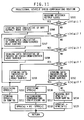
- the read-only memory of the computer of the controller 50 stores the same estimated vehicle speed calculating routine and final vehicle speed calculating routine as used in the first embodiment, and a provisional vehicle speed calculating routine which is illustrated in the flow chart of Fig. 11 and is different from that illustrated in Fig. 3.
- the computer of the controller 50 uses a random-access memory (RAM) indicated generally at 56 in Fig. 12.
- RAM random-access memory
- the RAM 56 has various memory areas including: a memory area 56-1 for storing the estimated vehicle speed VSO as described above; a memory area 56-2 for storing the provisional vehicle speed VPRV as described above; a memory area 56-3 for storing the present final vehicle speed VFNL(n) as described above; a memory area 56-4 for storing the last final vehicle speed VFNL(n-1) as described above; a memory area 56-5 for storing the output level L of the receiver 12 as represented by the digital output signal of the A/D converter 70; a memory area 56-6 for storing data indicative of the condition of the road surface on which the vehicle is running; a memory area 56-7 for storing the compensating coefficient KK determined in the provisional vehicle speed compensating routine of Fig. 11; and a memory area 56-7 for storing the cumulative error ERR as described above.
- the provisional vehicle speed compensating routine of Fig. 11 is adapted such that the condition of the road surface on which the vehicle is running is estimated or guessed on the basis of the output signal received from the A/D convertor 70, so that the provisional vehicle speed VPRV calculated by the signal processing circuit 48 is compensated depending upon the estimated road surface condition.
- the effective provisional vehicle speed VPRV is determined in three different ways corresponding to the high, medium and low ranges of the output level of the receiver 12.
- the effective provisional vehicle speed VPRV is determined in three different ways depending upon the output level of the receiver 12.
- condition of the road surface condition is estimated by comparing the detected output level of the receiver 12 (level of the digital output of the A/D converter 70) with five threshold values. This comparison permits the estimation of the road surface condition, because the relationship between the output level of the receiver 12 and the road surface condition is empirically known. It is noted that specific forms of the road surface condition correspond to different ranges of friction coefficient of the road surface.
- step S201 is implemented to read the output level L(n) of the receiver 12 currently stored in the memory area 56-5 of the RAM 56.
- the output level L(n) is stored in the memory area 56-5 according to a suitable control program, on the basis of the digital output signal of the A/D converter 70.
- This control program includes steps for smoothing the digital output signal of the converter 70, so that noises are eliminated from the output level L(n) stored in the RAM 56.
- Step S201 is followed by step S202 to compare the output level L(n) with a first threshold value L 1 . If the output level L(n) is equal to or higher than the threshold value L 1 , the control flow goes to step S206 to determine that the present road surface condition is that of a dry asphalt road surface. Data indicative of this nature of the road surface are stored in the memory area 56-6 of the RAM 56. In this case, steps S203-S209 are skipped, and step S210 is implemented.
- step S203 is implemented to compare the output level L(n) with a second threshold value L 2 smaller than L 1 . If the output level L(n) is equal to or higher than the threshold value L 2 , the control flow goes to step S207 to determine that the present road surface condition is that of a compacted-snow-covered road surface, and store data indicative of this nature of the road surface in the memory area 56-6. Step S207 is followed by step S210. If the output level L(n) is lower than the second threshold level L 2 , step S204 is implemented to compare the output level L(n) with a third threshold level L 3 smaller than L 2 .
- step S208 determines that the present road surface is a frozen or fresh-snow-covered road surface, and store data indicative of this determination in the memory area 56-6.
- step S210 is implemented following step S208.
- step S205 is implemented to compare the output level L(n) with a fourth threshold valve L 4 smaller than L 3 . If the output level L(n) is equal to or higher than the fourth threshold value L 4 , step S209 is implemented to determine that the present road surface is a wet asphalt road surface, and store data indicative of this determination in the memory area 56-6. Step S209 is followed by step S210. If the output level L(n) is lower than the fourth threshold value L 4 , step S212 is implemented to determine that the present road surface condition is that of a water-covered or submerged road surface, and store data indicative of this determination in the memory area 56-6.
- Step S212 is followed by step S213 to compare the output level L(n) with a fifth threshold value L 5 smaller than L 4 . If the output level L(n) is equal to or higher than the threshold value L 5 , step S216 is implemented. If the output level L(n) is lower than the threshold value L 5 , step S214 is implemented.
- steps S202 through S205 and step S213 are provided to classify the output level L(n) into six ranges which correspond: four cases in which the affirmative decision (YES) is obtained in steps S202, S203, S304 and S205; one case in which the negative decision (NO) is obtained in step S213; and one case in which the affirmative decision (YES) is obtained in step S213.
- step S210 is implemented to receive the provisional vehicle speed VPRV(n) from the signal processing circuit 48, and then step S211 is implemented to store the received speed VPRV(n) in the memory area 56-2 of the RAM 56.
- step S213 is considered to correspond to step S3 of Fig. 2 in which the output level of the receiver 12 is determined to be in the low range.
- step S214 is implemented to read out the last final vehicle speed VFNL(n-1) from the memory area 56-4 of the RAM 56
- step S215 is implemented to store the last final vehicle speed VFNL(n-1) in the memory area 56-2 as the effective provisional vehicle speed VPRV(n).
- step S213 is considered to correspond to step S6 of Fig. 2 in which the output level of the receiver 12 is determined to be in the medium range.
- step S216 is implemented to receive the provisional vehicle speed VPRV(n) from the signal processing circuit 48, and then step S217 is implemented to determine the compensating coefficient KK.
- This coefficient KK is determined in the same manner as described with respect to step S8 of the first embodiment, namely, according to a suitable relationship between VPRV and KK, as indicated in the graph of Fig. 5. The relationship is represented by a data map stored in the read-only memory of the controller 50.
- Step S217 is followed by step S218 in which a product of the value VPRV(n) and the coefficient KK is added to the value VPRV(n), to compensate the provisional vehicle speed VPRV as received from the circuit 48, namely, to obtain a compensated vehicle speed Vcom, namely, to determine the effective provisional vehicle speed VPRV(n) to be stored in the memory area 56-2.
- the final vehicle speed calculating routine is executed as described with respect to the first embodiment.
- the threshold values L 1 through L 5 are set as follows, for example:
- these threshold values may be suitably selected depending upon the sensitivity of the receiver 12, mounting conditions of the transmitter and receiver 10, 12 and other parameters of the Doppler-effect vehicle-speed detecting apparatus.
- the second embodiment is capable of estimating the friction coefficient of the road surface in the form of different road surface conditions that are estimated by comparing the detected output level L(n) of the receiver 12 with the five threshold values, as well as determining the effective provisional vehicle speed VPRV in different ways depending upon the detected output level L(n).
- the condition or friction coefficient of the road surface can be estimated from the detected output level L(n), since the actual road surface condition and the actual output level L(n) of the receiver 12 has a known relationship, that is, the relationship between these parameters is known by experiments.
- the estimated road surface condition or friction coefficient, as well as the detected vehicle ground speed can be utilized for controlling the slip ratio of the wheels of the vehicle.
- the apparatus according to the second embodiment capable of estimating the road surface condition and determining the final vehicle speed VFNL is small-sized and economical to manufacture, as compared with a combination of two devices adapted to perform the above-indicated two functions independently of each other.
- the portion of the controller 50 assigned to execute the routine of Fig. 11 constitutes a part of the means for determining the final vehicle speed on the basis of the provisional vehicle speed calculated from the output signal of the receiver 12.
- the transmitter and receiver 10, 12 are attached to the vehicle body such that the boresights or axes of the transmitter and receiver are inclined in the backward or reverse running direction of the vehicle.
- the effective provisional vehicle speed VPRV(i) stored in the RAM 54, 56 and used in the routine of Fig. 3 to calculate the final vehicle speed VFNL is obtained by adding (KK ⁇ VPRV) to the original provisional vehicle speed VPRV as received from the circuit 48.
- the effective provisional vehicle speed when the receiver output level is in the medium range is obtained by subtracting (KK ⁇ VPRV) from the original provisional vehicle speed, if the axes of the transmitter and receiver 10, 12 are inclined in the forward running direction of the vehicle.
- the provisional vehicle speed VPRV(i) is used as a parameter which reflects or approximates the actual vehicle speed and which is multiplied by the compensating coefficient KK in step S9 or S218, this parameter VPRV(i) may be replaced by the estimated vehicle speed VSO calculated from the wheel speeds detected by the wheel speed sensors 60, since the estimated vehicle speed VSO also reflects or approximates the actual vehicle speed.
Landscapes
- Engineering & Computer Science (AREA)
- Radar, Positioning & Navigation (AREA)
- Remote Sensing (AREA)
- Physics & Mathematics (AREA)
- Computer Networks & Wireless Communication (AREA)
- General Physics & Mathematics (AREA)
- Acoustics & Sound (AREA)
- Measurement Of Velocity Or Position Using Acoustic Or Ultrasonic Waves (AREA)
- Optical Radar Systems And Details Thereof (AREA)
- Radar Systems Or Details Thereof (AREA)
Claims (18)
- Dopplereffekt-Geschwindigkeiterfassungsvorrichtung zum Erfassen einer Bodengeschwindigkeit eines Motorfahrzeugs, umfassend:dadurch gekennzeichnet, daßeinen Sender (10) zum Senden einer Welle zu einer Fahrbahnoberfläche hin;einen Empfänger (12) zum Empfangen eines Teils der gesendeten Welle, die von der Fahrbahnoberfläche reflektiert wird;eine Empfängerausgangssignal-Erfassungseinrichtung (30, 50) zum Erfassen eines Ausgangspegels des Empfängers; undeine Bodengeschwindigkeit-Ermittlungseinrichtung (48, 50, 60) zum Ermitteln der Bodengeschwindigkeit des Fahrzeugs in Übereinstimmung mit dem Doppler-Effekt auf der Grundlage einer Frequenz der gesendeten Welle und einer Frequenz des reflektierten Teils der gesendeten Welle, wobei die Bodengeschwindigkeit-Ermittlungseinrichtung die Bodengeschwindigkeit in Übereinstimmung mit einer vorbestimmten ersten Regel ermittelt, wenn der Ausgangspegel des Empfängers höher ist als ein vorbestimmter Schwellenwert, und in Übereinstimmung mit einer vorbestimmten zweiten Regel, die sich von der ersten Regel unterscheidet, wenn der Ausgangspegel nicht höher ist als der erste Schwellenwert,die Bodengeschwindigkeit-Ermittlungseinrichtung (48, 50, 60) die Bodengeschwindigkeit in Übereinstimmung mit der vorbestimmten ersten und zweiten Regel auf der Grundlage der Frequenzen der gesendeten Welle und des reflektierten Teils der gesendeten Welle, welche Frequenzen aktuell erfaßt werden, ermittelt.
- Dopplereffekt-Geschwindigkeiterfassungsvorrichtung nach Anspruch 1, bei der der Sender und Empfänger (10, 12) derart an einem Aufbau des Motorfahrzeugs befestigt sind, daß Achsen des Senders und Empfängers relativ zu der Fahrbahnoberfläche in einer Rückwärtsfahrrichtung des Fahrzeugs geneigt sind, und bei der die Bodengeschwindigkeit-Ermittlungseinrichtung (48, 50, 60) eine kompensierte Bodengeschwindigkeit in Übereinstimmung mit der vorbestimmten zweiten Regel durch Erhöhen der in Übereinstimmung mit der vorbestimmten ersten Regel berechneten Bodengeschwindigkeit um einen Betrag proportional zu einem Parameter, der die Bodengeschwindigkeit reflektiert, berechnet.
- Dopplereffekt-Geschwindigkeiterfassungsvorrichtung nach Anspruch 1, bei der der Sender und Empfänger (10, 12) derart an einem Aufbau des Motorfahrzeugs befestigt sind, daß Achsen des Senders und Empfängers relativ zu der Fahrbahnoberfläche in einer Vorwärtsfahrrichtung des Fahrzeugs geneigt sind, und bei der die Bodengeschwindigkeit-Ermittlungseinrichtung (48, 50, 60) eine kompensierte Bodengeschwindigkeit in Übereinstimmung mit der vorbestimmten zweiten Regel durch Verringern der in Übereinstimmung mit der vorbestimmten ersten Regel berechneten Bodengeschwindigkeit um einen Betrag proportional zu einem Parameter, der die Bodengeschwindigkeit reflektiert, berechnet.
- Dopplereffekt-Geschwindigkeiterfassungsvorrichtung nach einem der vorangehenden Ansprüche, bei der die Empfängerausgangssignal-Erfassungseinrichtung (30, 50) eine Spitzenwert-Halteeinrichtung (34) zum Halten eines Spitzenwerts eines Ausgangssignals des Empfängers (12) und eine Ausgangspegel-Ermittlungseinrichtung (44, 50, 70) zum Ermitteln des Ausgangspegels des Empfängers auf der Grundlage des Spitzenwerts des Ausgangssignals des Empfängers beinhaltet.
- Dopplereffekt-Geschwindigkeiterfassungsvorrichtung nach Anspruch 4, bei der die Ausgangspegel-Ermittlungseinrichtung (44, 50, 70) eine Vergleichseinrichtung (44, 50, 70) zum Vergleichen des Spitzenwerts des Ausgangssignals des Empfängers (12) mit wenigstens einem Schwellenwert (Vref1, Vref2; L4, L5) und Klassifizieren des Spitzenwerts in eine Vielzahl von Bereichen, die durch den wenigstens einen Schwellenwert definiert sind, wobei die Anzahl der Vielzahl der Bereiche um eins größer ist als die Anzahl des wenigstens einen Schwellenwerts, umfaßt.
- Dopplereffekt-Geschwindigkeiterfassungsvorrichtung nach Anspruch 5, bei der der wenigstens eine Schwellenwert aus zwei Schwellenwerten besteht und die Ausgangspegel-Ermittlungseinrichtung (44, 50, 70) den Spitzenwert in einen hohen Bereich, einen mittleren Bereich und einen niedrigen Bereich, die durch die beiden Schwellenwerte definiert sind, klassifiziert, und bei der die Bodengeschwindigkeit-Ermittlungseinrichtung (48, 50, 60) die Bodengeschwindigkeit des Fahrzeugs in Übereinstimmung mit der vorbestimmten ersten Regel ermittelt, wenn der Spitzenwert des Ausgangssignals des Empfängers (12) in dem hohen Bereich liegt, und in Übereinstimmung mit der vorbestimmten zweiten Regel ermittelt, wenn der Spitzenwert in dem mittleren Bereich liegt, und die Bodengeschwindigkeit-Ermittlungseinrichtung dann, wenn der Spitzenwert in dem niedrigen Bereich liegt, die Bodengeschwindigkeit, die unmittelbar bevor sich der Spitzenwert so weit verringert hat, daß er in den niedrigen Bereich fällt, ermittelt wurde, beibehält.
- Vorrichtung nach einem der Ansprüche 1 bis 6, bei der dann, wenn der Ausgangspegel des Empfängers 12 nicht größer ist als der Schwellenwert, die Bodengeschwindigkeit-Ermittlungseinrichtung (48, 50, 60) eine kompensierte Bodengeschwindigkeit des Fahrzeugs in Übereinstimmung mit der vorbestimmten zweiten Regel berechnet, indem sie die Bodengeschwindigkeit (VPRV) wie gemäß der vorbestimmten ersten Regel berechnet ändert, und die kompensierte Bodengeschwindigkeit als eine endgültige Bodengeschwindigkeit (VFNL) des Fahrzeugs ermittelt.
- Dopplereffekt-Geschwindigkeiterfassungsvorrichtung nach Anspruch 7, bei der die vorbestimmte zweite Regel aus einer Regel zum Berechnen einer kompensierten Bodengeschwindigkeit Vcom als der endgültigen Bodengeschwindigkeit in Übereinstimmung mit der nachstehenden Gleichung besteht:
- Vprv =
- Bodengeschwindigkeit wie in Übereinstimmung mit der vorbestimmten ersten Regel ermittelt;
- KK =
- Kompensationskoeffizient; und
- Va =
- Parameter, der eine tatsächliche Bodengeschwindigkeit des Fahrzeugs annähert.
- Dopplereffekt-Geschwindigkeiterfassungsvorrichtung nach Anspruch 8, bei der der Parameter Va aus der Bodengeschwindigkeit Vprv wie in Übereinstimmung mit der vorbestimmten ersten Regel berechnet besteht.
- Dopplereffekt-Geschwindigkeiterfassungsvorrichtung nach Anspruch 8, bei der der Parameter Va aus einer geschätzten Fahrzeuggeschwindigkeit (VSO), die auf der Grundlage von Drehzahlen (VW) einer Vielzahl von Rädern des Fahrzeugs erhalten wird, besteht.
- Dopplereffekt-Geschwindigkeiterfassungsvorrichtung nach Anspruch 10, bei der die geschätzte Fahrzeuggeschwindigkeit (VSO) als ein mittlerer von drei Werten bestehend aus: einer höchsten der Drehzahlen (VW) der Räder; einer maximalen Radgeschwindigkeit, die auf der Grundlage der letzten geschätzten Fahrzeuggeschwindigkeit VSO(i-1) berechnet wird; und einer kleinsten Radgeschwindigkeit, die auf der Grundlage der letzten geschätzten Fahrzeuggeschwindigkeit VSO(i-1) berechnet wird, erhalten wird.
- Dopplereffekt-Geschwindigkeiterfassungsvorrichtung nach einem der vorangehenden Ansprüche, ferner umfassend eine Fahrbahnoberflächenzustand-Schätzeinrichtung (50) zum Abschätzen eines Zustands der Fahrbahnoberfläche auf der Grundlage des Ausgangspegels des Empfängers (12), der durch die Empfängerausgangssignal-Erfassungseinrichtung (30, 50) erfaßt wird.
- Dopplereffekt-Geschwindigkeiterfassungsvorrichtung nach Anspruch 12, bei der die Fahrbahnoberflächenzustand-Schätzeinrichtung (50) einen Reibungskoeffizienten der Fahrbahnoberfläche als den Zustand der Fahrbahnoberfläche abschätzt.
- Dopplereffekt-Geschwindigkeiterfassungsvorrichtung nach Anspruch 12, bei der die Fahrbahnoberflächenzustand-Schätzeinrichtung (50) den Zustand der Fahrbahnoberfläche derart abschätzt, daß die Fahrbahnoberfläche als eine von einer Vielzahl von unterschiedlichen Fahrbahnoberflächenzuständen einschließlich: einer trockenen Asphaltfahrbahnoberfläche; einer mit verdichtetem Schnee bedeckten Fahrbahnoberfläche; einer gefrorenen Fahrbahnoberfläche; einer mit frischem Schnee bedeckten Fahrbahnoberfläche; einer nassen Asphaltfahrbahnoberfläche; und einer mit Wasser bedeckten Fahrbahnoberfläche klassifiziert wird.
- Dopplereffekt-Geschwindigkeiterfassungsvorrichtung nach einem der vorangehenden Ansprüche, ferner umfassend:eine Beziehung-Ermittlungseinrichtung (50) zum Ermitteln einer Beziehung zwischen der geschätzten Fahrzeuggeschwindigkeit (VSO) und der durch die Bodengeschwindigkeit-Ermittlungseinrichtung (48, 50, 60) ermittelten Bodengeschwindigkeit, wenn sich das Fahrzeug in einem gleichmäßigen Fahrzustand befindet, in dem die geschätzte Fahrzeuggeschwindigkeit die Bodengeschwindigkeit des Fahrzeugs genau repräsentiert; undeiner Kompensationseinrichtung (50) zum Einstellen der Bodengeschwindigkeit wie durch die Bodengeschwindigkeit-Ermittlungseinrichtung (48, 50, 60) ermittelt auf der Grundlage der durch die Beziehung-Ermittlungseinrichtung ermittelten Beziehung, wenn sich das Fahrzeug in einem Übergangsfahrzustand befindet, in dem die geschätzte Fahrzeuggeschwindigkeit die Bodengeschwindigkeit des Fahrzeugs nicht genau repräsentiert.
- Dopplereffekt-Geschwindigkeiterfassungsvorrichtung nach Anspruch 15, bei der die Kompensationseinrichtung die Bodengeschwindigkeit in dem Übergangszustand des Fahrzeugs auf der Grundlage der Beziehung, die durch die Beziehung-Ermittlungseinrichtung in dem gleichmäßigen Fahrzustand des Fahrzeugs, der dem Übergangszustand unmittelbar vorangeht, ermittelt wurde, einstellt.
- Dopplereffekt-Geschwindigkeiterfassungsvorrichtung nach Anspruch 15, bei der die Beziehung-Ermittlungseinrichtung als die Beziehung ein Verhältnis (K) der geschätzten Fahrzeuggeschwindigkeit zu der Bodengeschwindigkeit wie durch die Bodengeschwindigkeit-Ermittlungseinrichtung bestimmt ermittelt, wenn sich das Fahrzeug in dem gleichmäßigen Fahrzustand befindet, und die Kompensationseinrichtung dann, wenn sich das Fahrzeug in dem Übergangsfahrzustand befindet, die Bodengeschwindigkeit durch Multiplizieren der Bodengeschwindigkeit mit dem Verhältnis einstellt.
- Dopplereffekt-Geschwindigkeiterfassungsvorrichtung nach einem der Ansprüche 15 bis 17, bei der die Beziehung-Ermittlungseinrichtung ermittelt, daß sich das Fahrzeug in dem gleichmäßigen Fahrzustand befindet, wenn wenigstens die nachstehenden beiden Bedingungen (i) und (ii) erfüllt sind:(i) ein absoluter Wert einer Beschleunigung des Fahrzeugs ist kleiner als ein vorbestimmter Wert; und(ii) die geschätzte Fahrzeuggeschwindigkeit liegt innerhalb eines Bereichs, der durch eine vorbestimmte obere Grenze und eine vorbestimmte untere Grenze definiert ist.
Priority Applications (1)
| Application Number | Priority Date | Filing Date | Title |
|---|---|---|---|
| EP96110498A EP0738901A3 (de) | 1992-10-20 | 1993-10-19 | Doppler-Effekt-Geschwindigkeitssensor für Fahrzeuge, der verschiedene Geschwindigkeitsbestimmungsregeln abhängig von Empfängerausgangsniveau gebraucht |
Applications Claiming Priority (4)
| Application Number | Priority Date | Filing Date | Title |
|---|---|---|---|
| JP306526/92 | 1992-10-20 | ||
| JP30652692 | 1992-10-20 | ||
| JP5230353A JP2687083B2 (ja) | 1992-10-20 | 1993-09-16 | ドップラ式対地車速検出装置 |
| JP230353/93 | 1993-09-16 |
Related Child Applications (1)
| Application Number | Title | Priority Date | Filing Date |
|---|---|---|---|
| EP96110498A Division EP0738901A3 (de) | 1992-10-20 | 1993-10-19 | Doppler-Effekt-Geschwindigkeitssensor für Fahrzeuge, der verschiedene Geschwindigkeitsbestimmungsregeln abhängig von Empfängerausgangsniveau gebraucht |
Publications (2)
| Publication Number | Publication Date |
|---|---|
| EP0594119A1 EP0594119A1 (de) | 1994-04-27 |
| EP0594119B1 true EP0594119B1 (de) | 1998-09-23 |
Family
ID=26529298
Family Applications (2)
| Application Number | Title | Priority Date | Filing Date |
|---|---|---|---|
| EP93116866A Expired - Lifetime EP0594119B1 (de) | 1992-10-20 | 1993-10-19 | Doppler-Effekt-Geschwindigkeitssensor für Fahrzeuge, der verschiedene Geschwindigkeitsbestimmungsregeln abhängig vom Empfängerausgangsniveau gebraucht |
| EP96110498A Withdrawn EP0738901A3 (de) | 1992-10-20 | 1993-10-19 | Doppler-Effekt-Geschwindigkeitssensor für Fahrzeuge, der verschiedene Geschwindigkeitsbestimmungsregeln abhängig von Empfängerausgangsniveau gebraucht |
Family Applications After (1)
| Application Number | Title | Priority Date | Filing Date |
|---|---|---|---|
| EP96110498A Withdrawn EP0738901A3 (de) | 1992-10-20 | 1993-10-19 | Doppler-Effekt-Geschwindigkeitssensor für Fahrzeuge, der verschiedene Geschwindigkeitsbestimmungsregeln abhängig von Empfängerausgangsniveau gebraucht |
Country Status (4)
| Country | Link |
|---|---|
| US (1) | US5428359A (de) |
| EP (2) | EP0594119B1 (de) |
| JP (1) | JP2687083B2 (de) |
| DE (1) | DE69321186T2 (de) |
Families Citing this family (22)
| Publication number | Priority date | Publication date | Assignee | Title |
|---|---|---|---|---|
| US5488289A (en) * | 1993-11-18 | 1996-01-30 | National Semiconductor Corp. | Voltage to current converter having feedback for providing an exponential current output |
| DE4428663A1 (de) * | 1994-08-12 | 1996-02-15 | Tilmann Noller | Geschwindigkeitsmesser |
| US5760731A (en) * | 1995-12-19 | 1998-06-02 | Fisher Controls International, Inc. | Sensors and methods for sensing displacement using radar |
| DE19715999A1 (de) * | 1997-04-17 | 1998-10-22 | Daimler Benz Ag | Radar-Anordnung zur Straßenzustandserkennung in einem Kraftfahrzeug |
| RU2128848C1 (ru) * | 1997-09-10 | 1999-04-10 | Общество с ограниченной ответственностью Инженерный центр | Способ измерения дальности до источника шумоизлучения |
| JP3261345B2 (ja) * | 1997-09-12 | 2002-02-25 | 本田技研工業株式会社 | レーダーの出力制御装置 |
| US5929802A (en) * | 1997-11-21 | 1999-07-27 | Raytheon Company | Automotive forward looking sensor application |
| US5959570A (en) * | 1997-11-21 | 1999-09-28 | Raytheon Company | Automotive forward looking sensor blockage detection system and related techniques |
| DE50100149D1 (de) | 2000-03-07 | 2003-05-15 | Sulzer Markets & Technology Ag | Verfahren und Anordnung zur Beurteilung des Reibverhaltens zwischen zwei Gegenlaufpartnern |
| EP1132730B1 (de) * | 2000-03-07 | 2003-04-09 | Sulzer Markets and Technology AG | Verfahren und Anordnung zur Beurteilung des Reibverhaltens zwischen zwei Gegenlaufpartnern |
| US20030022681A1 (en) * | 2001-07-24 | 2003-01-30 | Ruppel Christopher D. | Adaptive dynamic technique for multi-path signal processing |
| US6611227B1 (en) | 2002-08-08 | 2003-08-26 | Raytheon Company | Automotive side object detection sensor blockage detection system and related techniques |
| FR2851047B1 (fr) * | 2003-02-12 | 2005-09-16 | Serge Vincent Lopez | Systeme d'asservissement de l'information vitesse d'un vehicule fournie par tout organe lie a la vitesse des roues |
| DE10360890A1 (de) * | 2003-12-19 | 2005-07-21 | Robert Bosch Gmbh | Radarsensor und Verfahren zu dessen Betrieb |
| JP4211809B2 (ja) * | 2006-06-30 | 2009-01-21 | トヨタ自動車株式会社 | 物体検出装置 |
| JP4979544B2 (ja) * | 2007-11-09 | 2012-07-18 | 株式会社日立製作所 | 車両速度検出装置 |
| WO2009123957A1 (en) * | 2008-03-31 | 2009-10-08 | Valeo Radar Systems, Inc. | Automotive radar sensor blockage detection apparatus and method |
| US20110224865A1 (en) * | 2010-03-11 | 2011-09-15 | Honeywell International Inc. | Health monitoring systems and methods with vehicle velocity |
| JP6188105B2 (ja) | 2015-02-03 | 2017-08-30 | エスゼット ディージェイアイ テクノロジー カンパニー リミテッドSz Dji Technology Co.,Ltd | 信号源の位置及び速度を決定するシステム、方法、コンピュータプログラム、回避する方法、及び無人航空機 |
| CN106646489B (zh) * | 2017-03-07 | 2023-04-25 | 北京汽车集团越野车有限公司 | 一种车速检测方法、装置及汽车 |
| JP7087826B2 (ja) * | 2018-08-24 | 2022-06-21 | 株式会社アイシン | 走行支援装置 |
| CN111862631B (zh) * | 2019-05-24 | 2022-07-29 | 北京骑胜科技有限公司 | 交通工具行驶检测方法、装置、电子设备及可读存储介质 |
Family Cites Families (20)
| Publication number | Priority date | Publication date | Assignee | Title |
|---|---|---|---|---|
| US3701568A (en) * | 1970-09-30 | 1972-10-31 | Bendix Corp | Adaptive braking system utilizing doppler radar |
| JPS5313752B2 (de) * | 1972-05-30 | 1978-05-12 | ||
| JPS51127976A (en) * | 1975-04-30 | 1976-11-08 | Hitachi Ltd | Abnormality detection method of vehiche speed and/or wheel circumferen tial speed detector |
| JPS5930309B2 (ja) * | 1975-10-17 | 1984-07-26 | 日本信号株式会社 | 磁気カ−ド処理装置 |
| GB2034147B (en) * | 1978-09-26 | 1983-02-09 | Nissan Motor | Doppler radar mounting structure for motor vehicles |
| US4366546A (en) * | 1979-09-07 | 1982-12-28 | Hitachi, Ltd. | Signal processor for skid control device |
| US4414548A (en) * | 1981-03-30 | 1983-11-08 | Trw Inc. | Doppler speed sensing apparatus |
| US4728954A (en) * | 1984-12-20 | 1988-03-01 | Deere & Company | Ground velocity sensor with drop-out detection |
| JP2525372B2 (ja) * | 1986-08-15 | 1996-08-21 | 富士通テン株式会社 | アンチスキツド制御装置 |
| US4893287A (en) * | 1987-12-17 | 1990-01-09 | Caterpillar Inc. | Velocity reference system |
| JP2590169B2 (ja) * | 1987-12-29 | 1997-03-12 | 住友電気工業株式会社 | 車両の基準車輪速計算装置 |
| US4942558A (en) * | 1988-03-31 | 1990-07-17 | Micro-Trak Systems, Inc. | Ultrasonic velocity sensor |
| JPH01314987A (ja) * | 1988-06-16 | 1989-12-20 | Nissan Motor Co Ltd | ドップラ式速度計 |
| JP2600879B2 (ja) * | 1988-12-27 | 1997-04-16 | 株式会社日本自動車部品総合研究所 | トップラレーダ速度検出方法 |
| JPH04105083A (ja) * | 1990-08-27 | 1992-04-07 | Mazda Motor Corp | 路面状態検出装置 |
| JPH04212086A (ja) * | 1990-09-10 | 1992-08-03 | Toyota Motor Corp | 対地車体速度検出装置 |
| US5243564A (en) * | 1991-08-05 | 1993-09-07 | Toyota Jidosha Kabushiki Kaisha | Doppler-effect vehicle ground-speed detecting apparatus having means for detecting vehicle body inclination |
| JPH0549943A (ja) * | 1991-08-20 | 1993-03-02 | Sakai Chem Ind Co Ltd | 酸化触媒 |
| JPH0580152A (ja) * | 1991-09-20 | 1993-04-02 | Nissan Motor Co Ltd | 超音波ドツプラ方式対地速度計 |
| JP2679533B2 (ja) * | 1992-05-13 | 1997-11-19 | トヨタ自動車株式会社 | ドップラ式対地車速検出装置 |
-
1993
- 1993-09-16 JP JP5230353A patent/JP2687083B2/ja not_active Expired - Fee Related
- 1993-10-18 US US08/136,819 patent/US5428359A/en not_active Expired - Fee Related
- 1993-10-19 EP EP93116866A patent/EP0594119B1/de not_active Expired - Lifetime
- 1993-10-19 EP EP96110498A patent/EP0738901A3/de not_active Withdrawn
- 1993-10-19 DE DE69321186T patent/DE69321186T2/de not_active Expired - Fee Related
Also Published As
| Publication number | Publication date |
|---|---|
| DE69321186D1 (de) | 1998-10-29 |
| JPH06186329A (ja) | 1994-07-08 |
| US5428359A (en) | 1995-06-27 |
| EP0738901A3 (de) | 1996-11-20 |
| JP2687083B2 (ja) | 1997-12-08 |
| EP0594119A1 (de) | 1994-04-27 |
| DE69321186T2 (de) | 1999-04-29 |
| EP0738901A2 (de) | 1996-10-23 |
Similar Documents
| Publication | Publication Date | Title |
|---|---|---|
| US5428359A (en) | Doppler-effect vehicle speed sensor using different speed determining rules depending upon receiver output | |
| EP1065089B1 (de) | Abstandsbezogenes Fahrgeschwindigkeitsregelsystem mit Bremsungsunterdrückung bei Zielfahrzeugtverlust | |
| US6668637B2 (en) | Tire air pressure estimating apparatus | |
| US5513907A (en) | Method and circuit configuration for determining a frictional value | |
| US5521594A (en) | Road surface condition detector for automotive vehicle | |
| JP2590169B2 (ja) | 車両の基準車輪速計算装置 | |
| KR100367573B1 (ko) | 경사추정장치및경사대응차량제어장치및방법및이들을사용한차량 | |
| US6445335B1 (en) | Method of detecting a radar characteristic, a radar characteristic, detection apparatus, and a recording medium recording data for detecting a radar characteristic | |
| KR970705214A (ko) | 평활한 빗물-감응 와이퍼 제어 시스템(A Smooth Rain-Responsive Wiper Control) | |
| US5016017A (en) | Doppler radar speed detecting method and apparatus therefor | |
| JPH0410676B2 (de) | ||
| US5373446A (en) | Vehicle ground-speed detecting apparatus | |
| US5058019A (en) | Vehicle speed estimation using wheel speed measurements | |
| US5861836A (en) | Circuit configuration having radar equipment for determining a distance or a relative speed | |
| US5243564A (en) | Doppler-effect vehicle ground-speed detecting apparatus having means for detecting vehicle body inclination | |
| JP3983158B2 (ja) | 電波レーダの信号処理方法 | |
| EP0645288B1 (de) | Gerät zur Haftfeststellung der Räder auf der Strasse | |
| JP2679533B2 (ja) | ドップラ式対地車速検出装置 | |
| US5583800A (en) | Vehicle speed sensor utilizing relationship between vehicle wheel speed and doppler-effect speed | |
| US4992945A (en) | Method and apparatus for distinguishing skidding wheels of a vehicle from drive train vibrations | |
| JPH09159765A (ja) | 車両用レーダ装置 | |
| JPH04315080A (ja) | 車間距離測定装置 | |
| JP2679527B2 (ja) | 対地車速検出装置 | |
| JP3119394B2 (ja) | 車載用レーダ | |
| JPH068488Y2 (ja) | 路面状態検出装置 |
Legal Events
| Date | Code | Title | Description |
|---|---|---|---|
| PUAI | Public reference made under article 153(3) epc to a published international application that has entered the european phase |
Free format text: ORIGINAL CODE: 0009012 |
|
| 17P | Request for examination filed |
Effective date: 19931019 |
|
| AK | Designated contracting states |
Kind code of ref document: A1 Designated state(s): DE FR GB |
|
| 17Q | First examination report despatched |
Effective date: 19951220 |
|
| GRAG | Despatch of communication of intention to grant |
Free format text: ORIGINAL CODE: EPIDOS AGRA |
|
| GRAG | Despatch of communication of intention to grant |
Free format text: ORIGINAL CODE: EPIDOS AGRA |
|
| GRAH | Despatch of communication of intention to grant a patent |
Free format text: ORIGINAL CODE: EPIDOS IGRA |
|
| GRAH | Despatch of communication of intention to grant a patent |
Free format text: ORIGINAL CODE: EPIDOS IGRA |
|
| GRAA | (expected) grant |
Free format text: ORIGINAL CODE: 0009210 |
|
| AK | Designated contracting states |
Kind code of ref document: B1 Designated state(s): DE FR GB |
|
| DX | Miscellaneous (deleted) | ||
| REF | Corresponds to: |
Ref document number: 69321186 Country of ref document: DE Date of ref document: 19981029 |
|
| ET | Fr: translation filed | ||
| PLBE | No opposition filed within time limit |
Free format text: ORIGINAL CODE: 0009261 |
|
| STAA | Information on the status of an ep patent application or granted ep patent |
Free format text: STATUS: NO OPPOSITION FILED WITHIN TIME LIMIT |
|
| 26N | No opposition filed | ||
| REG | Reference to a national code |
Ref country code: GB Ref legal event code: IF02 |
|
| PGFP | Annual fee paid to national office [announced via postgrant information from national office to epo] |
Ref country code: FR Payment date: 20021008 Year of fee payment: 10 |
|
| PGFP | Annual fee paid to national office [announced via postgrant information from national office to epo] |
Ref country code: GB Payment date: 20021016 Year of fee payment: 10 |
|
| PGFP | Annual fee paid to national office [announced via postgrant information from national office to epo] |
Ref country code: DE Payment date: 20021024 Year of fee payment: 10 |
|
| PG25 | Lapsed in a contracting state [announced via postgrant information from national office to epo] |
Ref country code: GB Free format text: LAPSE BECAUSE OF NON-PAYMENT OF DUE FEES Effective date: 20031019 |
|
| PG25 | Lapsed in a contracting state [announced via postgrant information from national office to epo] |
Ref country code: DE Free format text: LAPSE BECAUSE OF NON-PAYMENT OF DUE FEES Effective date: 20040501 |
|
| GBPC | Gb: european patent ceased through non-payment of renewal fee |
Effective date: 20031019 |
|
| PG25 | Lapsed in a contracting state [announced via postgrant information from national office to epo] |
Ref country code: FR Free format text: LAPSE BECAUSE OF NON-PAYMENT OF DUE FEES Effective date: 20040630 |
|
| REG | Reference to a national code |
Ref country code: FR Ref legal event code: ST |