EP0596423B1 - Gerät zur Schichtkodierung/-dekodierung für ein progressives Eingangsbildsignal - Google Patents
Gerät zur Schichtkodierung/-dekodierung für ein progressives Eingangsbildsignal Download PDFInfo
- Publication number
- EP0596423B1 EP0596423B1 EP19930117577 EP93117577A EP0596423B1 EP 0596423 B1 EP0596423 B1 EP 0596423B1 EP 19930117577 EP19930117577 EP 19930117577 EP 93117577 A EP93117577 A EP 93117577A EP 0596423 B1 EP0596423 B1 EP 0596423B1
- Authority
- EP
- European Patent Office
- Prior art keywords
- picture signal
- interlace
- sampling
- signal
- decoded picture
- Prior art date
- Legal status (The legal status is an assumption and is not a legal conclusion. Google has not performed a legal analysis and makes no representation as to the accuracy of the status listed.)
- Expired - Lifetime
Links
Images



Classifications
-
- H—ELECTRICITY
- H04—ELECTRIC COMMUNICATION TECHNIQUE
- H04N—PICTORIAL COMMUNICATION, e.g. TELEVISION
- H04N5/00—Details of television systems
- H04N5/76—Television signal recording
- H04N5/91—Television signal processing therefor
- H04N5/92—Transformation of the television signal for recording, e.g. modulation, frequency changing; Inverse transformation for playback
- H04N5/926—Transformation of the television signal for recording, e.g. modulation, frequency changing; Inverse transformation for playback by pulse code modulation
- H04N5/9261—Transformation of the television signal for recording, e.g. modulation, frequency changing; Inverse transformation for playback by pulse code modulation involving data reduction
- H04N5/9264—Transformation of the television signal for recording, e.g. modulation, frequency changing; Inverse transformation for playback by pulse code modulation involving data reduction using transform coding
-
- H—ELECTRICITY
- H04—ELECTRIC COMMUNICATION TECHNIQUE
- H04N—PICTORIAL COMMUNICATION, e.g. TELEVISION
- H04N19/00—Methods or arrangements for coding, decoding, compressing or decompressing digital video signals
- H04N19/50—Methods or arrangements for coding, decoding, compressing or decompressing digital video signals using predictive coding
-
- H—ELECTRICITY
- H04—ELECTRIC COMMUNICATION TECHNIQUE
- H04N—PICTORIAL COMMUNICATION, e.g. TELEVISION
- H04N19/00—Methods or arrangements for coding, decoding, compressing or decompressing digital video signals
- H04N19/10—Methods or arrangements for coding, decoding, compressing or decompressing digital video signals using adaptive coding
- H04N19/102—Methods or arrangements for coding, decoding, compressing or decompressing digital video signals using adaptive coding characterised by the element, parameter or selection affected or controlled by the adaptive coding
- H04N19/103—Selection of coding mode or of prediction mode
- H04N19/112—Selection of coding mode or of prediction mode according to a given display mode, e.g. for interlaced or progressive display mode
-
- H—ELECTRICITY
- H04—ELECTRIC COMMUNICATION TECHNIQUE
- H04N—PICTORIAL COMMUNICATION, e.g. TELEVISION
- H04N19/00—Methods or arrangements for coding, decoding, compressing or decompressing digital video signals
- H04N19/10—Methods or arrangements for coding, decoding, compressing or decompressing digital video signals using adaptive coding
- H04N19/134—Methods or arrangements for coding, decoding, compressing or decompressing digital video signals using adaptive coding characterised by the element, parameter or criterion affecting or controlling the adaptive coding
- H04N19/136—Incoming video signal characteristics or properties
-
- H—ELECTRICITY
- H04—ELECTRIC COMMUNICATION TECHNIQUE
- H04N—PICTORIAL COMMUNICATION, e.g. TELEVISION
- H04N19/00—Methods or arrangements for coding, decoding, compressing or decompressing digital video signals
- H04N19/10—Methods or arrangements for coding, decoding, compressing or decompressing digital video signals using adaptive coding
- H04N19/169—Methods or arrangements for coding, decoding, compressing or decompressing digital video signals using adaptive coding characterised by the coding unit, i.e. the structural portion or semantic portion of the video signal being the object or the subject of the adaptive coding
- H04N19/187—Methods or arrangements for coding, decoding, compressing or decompressing digital video signals using adaptive coding characterised by the coding unit, i.e. the structural portion or semantic portion of the video signal being the object or the subject of the adaptive coding the unit being a scalable video layer
-
- H—ELECTRICITY
- H04—ELECTRIC COMMUNICATION TECHNIQUE
- H04N—PICTORIAL COMMUNICATION, e.g. TELEVISION
- H04N19/00—Methods or arrangements for coding, decoding, compressing or decompressing digital video signals
- H04N19/50—Methods or arrangements for coding, decoding, compressing or decompressing digital video signals using predictive coding
- H04N19/503—Methods or arrangements for coding, decoding, compressing or decompressing digital video signals using predictive coding involving temporal prediction
-
- H—ELECTRICITY
- H04—ELECTRIC COMMUNICATION TECHNIQUE
- H04N—PICTORIAL COMMUNICATION, e.g. TELEVISION
- H04N19/00—Methods or arrangements for coding, decoding, compressing or decompressing digital video signals
- H04N19/50—Methods or arrangements for coding, decoding, compressing or decompressing digital video signals using predictive coding
- H04N19/503—Methods or arrangements for coding, decoding, compressing or decompressing digital video signals using predictive coding involving temporal prediction
- H04N19/51—Motion estimation or motion compensation
- H04N19/577—Motion compensation with bidirectional frame interpolation, i.e. using B-pictures
-
- H—ELECTRICITY
- H04—ELECTRIC COMMUNICATION TECHNIQUE
- H04N—PICTORIAL COMMUNICATION, e.g. TELEVISION
- H04N19/00—Methods or arrangements for coding, decoding, compressing or decompressing digital video signals
- H04N19/50—Methods or arrangements for coding, decoding, compressing or decompressing digital video signals using predictive coding
- H04N19/59—Methods or arrangements for coding, decoding, compressing or decompressing digital video signals using predictive coding involving spatial sub-sampling or interpolation, e.g. alteration of picture size or resolution
-
- H—ELECTRICITY
- H04—ELECTRIC COMMUNICATION TECHNIQUE
- H04N—PICTORIAL COMMUNICATION, e.g. TELEVISION
- H04N19/00—Methods or arrangements for coding, decoding, compressing or decompressing digital video signals
- H04N19/60—Methods or arrangements for coding, decoding, compressing or decompressing digital video signals using transform coding
-
- H—ELECTRICITY
- H04—ELECTRIC COMMUNICATION TECHNIQUE
- H04N—PICTORIAL COMMUNICATION, e.g. TELEVISION
- H04N19/00—Methods or arrangements for coding, decoding, compressing or decompressing digital video signals
- H04N19/60—Methods or arrangements for coding, decoding, compressing or decompressing digital video signals using transform coding
- H04N19/61—Methods or arrangements for coding, decoding, compressing or decompressing digital video signals using transform coding in combination with predictive coding
-
- H—ELECTRICITY
- H04—ELECTRIC COMMUNICATION TECHNIQUE
- H04N—PICTORIAL COMMUNICATION, e.g. TELEVISION
- H04N19/00—Methods or arrangements for coding, decoding, compressing or decompressing digital video signals
- H04N19/80—Details of filtering operations specially adapted for video compression, e.g. for pixel interpolation
-
- H—ELECTRICITY
- H04—ELECTRIC COMMUNICATION TECHNIQUE
- H04N—PICTORIAL COMMUNICATION, e.g. TELEVISION
- H04N7/00—Television systems
- H04N7/01—Conversion of standards, e.g. involving analogue television standards or digital television standards processed at pixel level
-
- H—ELECTRICITY
- H04—ELECTRIC COMMUNICATION TECHNIQUE
- H04N—PICTORIAL COMMUNICATION, e.g. TELEVISION
- H04N19/00—Methods or arrangements for coding, decoding, compressing or decompressing digital video signals
- H04N19/30—Methods or arrangements for coding, decoding, compressing or decompressing digital video signals using hierarchical techniques, e.g. scalability
-
- H—ELECTRICITY
- H04—ELECTRIC COMMUNICATION TECHNIQUE
- H04N—PICTORIAL COMMUNICATION, e.g. TELEVISION
- H04N5/00—Details of television systems
- H04N5/76—Television signal recording
- H04N5/84—Television signal recording using optical recording
- H04N5/85—Television signal recording using optical recording on discs or drums
-
- H—ELECTRICITY
- H04—ELECTRIC COMMUNICATION TECHNIQUE
- H04N—PICTORIAL COMMUNICATION, e.g. TELEVISION
- H04N5/00—Details of television systems
- H04N5/76—Television signal recording
- H04N5/91—Television signal processing therefor
- H04N5/93—Regeneration of the television signal or of selected parts thereof
- H04N5/94—Signal drop-out compensation
- H04N5/945—Signal drop-out compensation for signals recorded by pulse code modulation
Definitions
- This invention relates to an encoding and/or decoding apparatus suitable for use with information recording and/or reproduction apparatus in which a storage type moving picture medium such as an optical disk or a magnetic tape is used and information transmission and/or reception apparatus such as television conference systems, moving picture telephone systems and broadcasting equipments.
- a storage type moving picture medium such as an optical disk or a magnetic tape
- information transmission and/or reception apparatus such as television conference systems, moving picture telephone systems and broadcasting equipments.
- One of moving picture encoding and/or decoding systems wherein a spatial resolution between an input picture and an output picture is varied is a layer encoding/decoding system investigated in the ISO-IEC/JTCl/SC29/WGll.
- the layer encoding/decoding system basically on the encoder side, an input image of a low resolution is encoded in a lower layer to form a bit stream, and a decoded picture of the bit stream of the lower layer is converted by up conversion and used for encoding of an other input picture of an upper layer having a high resolution.
- the decoded picture of the lower layer is converted by up conversion and used for decoding of a bit stream of the upper layer.
- the layer encoding/decoding system has a subject to be solved in that, since it is constructed so as to cope only with the case wherein the input is an interlace picture, it cannot cope with another case wherein the input is a non-interlace image.
- GLOBECOM '86 IEEE GLOBAL TELECOMMUNICATIONS CONFERENCE, HOUSTON (US), 1.-4.12. 1986, BELLISIO et al : 'TELEVISION CODING FOR BROADBAND ISDN, pages 894-900, describes a coder wherein a non-interlaced HDTV input signal is downsampled to form an interlaced EQTV signal. This interlaced EQTV signal is then upsampled and combined with the non-interlaced HDTV signal in order to encode a detail signal.
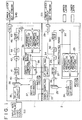
- FIG. 1 An encoding system or encoder according to the present invention will be described with reference to FIG. 1. First, a lower layer encoder block 2 will be described.
- processing is performed in units of a macro block.
- An input video signal S21 of a high resolution having a non-interlace structure is inputted to a down sampling circuit 22, in which it is converted into an interlace image of a low resolution.
- a motion vector from a motion estimator 37 is referred to to adaptively determine whether or not the input video signal S21 should be passed through a low-pass filter upon sampling of the data.
- the motion vector may be supplied from a motion estimator 24 which will be hereinafter described. In this instance, however, since a motion vector of an image a little prior in time is used, the encoding efficiency on the upper layer side sometimes exhibits a rather low level. Details of the down sampling circuit 22 will be hereinafter described.
- An interlace picture of a block format sampled by down sampling by the down sampling circuit 22 is stored into a frame memory set 23 and used for detection of a motion vector by the motion estimator 24.
- the motion estimator 24 detects a motion vector from a reference picture at present using a forward predictive picture and a backward predictive picture from among pictures stored in the frame memory set 23.
- detection of a motion vector one of motion vectors with which the absolute value sum of differences between fields or frames in units of a block is determined as a motion vector.
- a motion compensation frame memory set 25 in which selection of a macro block type is formed. Then, a predictive picture corresponding to the thus selected macro block type is sent to a difference unit 26.
- the difference unit 26 calculates a difference between the input picture and the predictive picture and outputs the difference to a discrete cosine transform (DCT) circuit 27.
- DCT discrete cosine transform
- the DCT circuit 27 transforms the input picture data or the difference data in units of a block by discrete cosine transform making use of a two-dimensional correlation of a video signal and outputs transform data obtained by the discrete cosine transform to a quantization circuit 28.
- the quantization circuit 28 quantizes the DCT transform data with a quantization step size, which is determined for each macro block or slice, and supplies quantization data obtained at an output terminal thereof as a result of the quantization to a variable length coding (VLC) circuit 29 and a dequantization circuit 30.
- VLC variable length coding
- the VLC circuit 29 processes the quantization data by variable length coding processing together with the quantization scale, the macro block type, the motion vector and so forth and outputs a lower layer bit stream S31 obtained by the variable length coding as transmission data.
- the dequantization circuit 30 dequantizes the quantization data sent out from the quantization circuit 28 into dequantization data and decodes the transform data of the output data before the transformation by the quantization circuit. Then, the dequantization circuit 30 supplies the dequantization data to an inverse discrete cosine transform (IDCT) circuit 32.
- IDCT inverse discrete cosine transform
- the IDCT circuit 32 transforms the dequantization data decoded by the dequantization circuit 30 back into decoded picture data by inverse transform processing to that of the DCT circuit and outputs the decoded picture data to the motion compensation frame memory set 25.
- the motion compensation frame memory set 25 performs motion compensation based on the motion vector supplied thereto from the motion estimator 24 and writes the decoded picture as a forward predictive picture or a backward predictive picture into the frame memories.
- the difference from the predictive picture is transmitted as an output of the IDCT circuit 32 to the motion compensation frame memory set 25, and accordingly, local decoding is performed by adding the difference to the predictive picture using an adder 33.
- the predictive picture here is identical with the picture decoded by the lower layer decoder, and forward, backward or bidirectional prediction is performed for a picture for next processing based on the predictive picture.
- the locally decoded picture outputted from the adder 33 is supplied also to an up sampling circuit 34. While the locally decoded picture of the lower layer has an interlace structure, interpolation is performed for the locally decoded picture by the up sampling circuit 34 so that the locally decoded picture is converted into a non-interlace picture similarly to that of the upper layer, and the non-interlace picture is inputted to a spatio-temporal predictor 39 of the upper layer.
- the up sampling circuit 34 adaptively refers to both of a picture from the upper layer which includes same spatial sample points with a full degree of accuracy but are different in temporal sample points and another picture from the lower layer which has a lower resolution due to sampling but has same temporal sampling points based on the motion information to produce a non-interlace interpolation picture. Details of the up sampling circuit 34 will be hereinafter described.
- the construction of the upper layer will be described.
- the input non-interlace video signal S21 is processed while remaining in the full degree of accuracy.
- the input non-interlace video signal S21 is delayed by a delay circuit 35 and then stored into a frame memory 36, whereafter detection of a motion vector is performed for the input non-interlace video signal S21 by a motion estimator 37.
- the motion estimator 37 operates similarly to the motion estimator 34.
- the information of the motion vector is sent to a motion compensation frame memory set 38, and a corresponding predictive picture is inputted to a spatio-temporal predictor 39.
- the spatio-temporal predictor 39 adaptively selects, by weighting, the predictive picture from the motion compensation frame memory set 38, that is, a predictive picture from the temporal direction, and the predictive picture from the up sampling circuit 34, that is, another predictive picture from the spatial direction.
- the spatio-temporal predictor 39 determines a coefficient ⁇ based on the motion information from the motion estimator 37, applies weighting of 1 - ⁇ to the predictive picture in the temporal direction, that is, the predictive picture of the upper layer and applies weighting of ⁇ to the predictive picture in the spatial direction, that is, the predictive picture from the lower layer, and then sends the thus weighted predictive pictures to a cumulative difference unit 40.
- the difference unit 40 calculates a difference between the input picture and the predictive pictures and outputs the difference to a discrete cosine transform circuit (DCT) 41.
- DCT discrete cosine transform circuit
- the DCT circuit 41 transforms the input picture data or the difference data by discrete cosine transform making use of a two-dimensional correction of a video signal and outputs transform data obtained by the discrete cosine transform to a quantization circuit 42.
- the quantization circuit 42 quantizes the DCT transform data with a quantization step size, which is determined for each macro block or slice, and supplies quantization data obtained at an output terminal thereof as a result of the quantization to a variable length coding (VLC) circuit 43 and a dequantization circuit 44.
- VLC variable length coding
- the VLC circuit 43 processes the quantization data by variable length coding processing together with the quantization scale, the macro block type, the motion vector and so forth and outputs an upper layer bit stream S45 obtained by the variable length coding as transmission data.
- the dequantization circuit 44 dequantizes the quantization data sent out from the quantization circuit 42 into a representative value to obtain dequantization data and decodes the transform data back of the output data before the transformation by the quantization circuit 42. Then, the dequantization circuit 44 supplies the dequantization data to an inverse discrete cosine transform (IDCT) circuit 46.
- IDCT inverse discrete cosine transform
- the IDCT circuit 46 transforms the dequantization data decoded by the dequantization circuit 44 back into decoded picture data by inverse transform processing to that of the DCT circuit 41 and outputs the decoded picture data to the motion compensation frame memory set 38.
- the motion compensation frame memory set 38 performs local decoding based on the motion vector supplied thereto from the motion estimator 37, the macro block type and the motion vector, and writes the locally decoded picture as a forward predictive picture or a backward predictive picture into the frame memories.
- the difference from the predictive picture is transmitted as an output of the IDCT circuit 46 to the motion compensation frame memory set 38, and accordingly, local decoding is performed by adding the difference to the predictive picture using an adder 47.
- the predictive picture here is identical with the picture decoded by the upper layer decoder, and forward or bidirectional prediction is performed for a picture for next processing based on the predictive picture.
- FIG. 3 shows the construction of the down sampling circuit 22.
- An input picture is inputted to a low-pass filter 71, and a switch 73 adaptively selects the input picture or the output picture of the low-pass filter 71 in response to a motion vector.
- the output of the switch 73 is alternately sampled by a sampling circuit 72. Since the picture after such sampling includes reflected components, normally it is acted upon uniformly by the low-pass filter 71, but due to the characteristic that the input is a non-interlace video signal, when the motion is small, sample points which are identical in spatial positions with but different in temporal positions from thinned out points are present without fail.
- FIG. 4 illustrates operation of the down sampling circuit 22.
- two columns of dots respectively indicate the positions of pixels arranged in the vertical direction in a single picture.
- the down sampling circuit 22 thins out those pixels at alternate positions from two pictures while sampling only those pixels surrounded by squares in FIG. 4 to convert the input non-interlace video signal into an interlace picture.
- the two points surrounded by a dotted line in FIG. 4 represent identical data, and accordingly, filtering processing is unnecessary as described above.
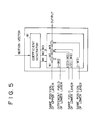
- FIG. 5 shows the construction of the up sampling circuit 34.
- the input to the up sampling circuit 34 includes data of the upper layer which are at the same spatial positions but are at different temporal positions, data interpolated from sample points of the same field of the lower layer, and data at the corresponding points from a different field of the lower layer. Weighting interpolation is thus performed for the inputs using coefficients w1, w2 and w3 which are adaptively determined by a coefficient generator 81.
- FIG. 6 illustrates operation of the up sampling circuit 34.
- two left side columns of dots respectively indicate the positions of pixels arranged in a vertical direction in a single picture of the upper layer.
- the other two right side columns of dots respectively indicate the positions of pixels arranged in a vertical direction in a single picture of the lower layer.
- the up sampling circuit 34 performs, for a pixel for which interpolation should be performed, interpolation from adjacent pixels in the same field of the lower layer and weighting interpolation from a pixel of the other field of the lower layer and another pixel at the same spatial position of the upper layer using the coefficients of w1 and w2, respectively.
- the up sampling circuit 34 adds the interpolation values obtained using the coefficients of w1 and w2 and the value at the same position of the lower layer, that is, the value of the point for which interpolation should be performed, with the weight of the coefficient of w3. For example, when the pixel for which interpolation should be performed is at the position of 205, the up sampling circuit 34 performs interpolation from the adjacent pixels 201 and 202 in the same field of the lower layer and weighted interpolation from the pixel 203 at the same position in the other field of the lower layer and the pixel 204 at the same spatial position of the upper layer using the coefficients of w1 and w2.
- the pixel 205 at the same position of the lower layer referred to with the coefficient of 1 - w3 is a point for which interpolation of zero has been performed, and since the value is 0, it does not have an influence upon the interpolation.
- the pixel for which interpolation should be performed is at the position of 206, that is, when the pixel 206 of the lower layer which is not equal to zero is present at the same position for which interpolation should be performed, since the points referred to with the coefficients of 1 - w1 and 1 - w2 are points for which interpolation of zero has been performed, they have no influence upon the interpolation.
- the down sampling circuit 22 and the up sampling circuit 34 can be adapted to conversion of a resolution at some other ratio than sampling or interpolation of 2:1 by suitably selecting an interpolation filter and sample points.
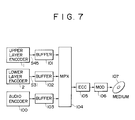
- FIG. 7 shows an example of a recording apparatus for a lower layer bit stream and an upper layer bit stream.
- an upper layer bit stream S45 outputted from the upper layer encoder 1 and a lower layer bit stream S31 outputted from the lower layer encoder 2 are multiplexed, after passing buffers 101 and 102, respectively, by a multiplexing circuit 104 with an audio signal, which has been encoded by an audio encoder 100 and passed through a buffer 103, and a synchronizing signal not shown.
- a multiplexed bit stream outputted from the multiplexing circuit 104 is processed by addition processing of a code for error correction by an error correction code addition circuit 105, and then processed by predetermined modulation by a modulator 106, whereafter it is recorded as concave and convex pits on a master disk 107 by means of a laser beam.
- a stamper is formed making use of the master disk 107, and a large number of copy disks, such as, for example, optical disks, are formed using the stamper.
- a lower layer bit stream S51 is inputted to the decoder of the lower layer by way of a transmission medium such as an optical disk.
- the bit stream S51 is inputted to a variable length decoding (IVLC) circuit 52.
- the variable length decoding circuit 52 decodes the bit stream S51 and outputs quantization data, a motion vector, a macro block type, a predictive mode, a quantization scale and so forth.
- a dequantization circuit 53 dequantizes the quantization data outputted from the variable length decoding circuit 52 into a representative value based on the quantization scale to obtain dequantization data and decodes the transform data before the transformation by the quantization circuit of the encoder. Then, the dequantization circuit 53 supplies the dequantization data to an inverse discrete cosine transform (IDCT) circuit 54.
- IDCT inverse discrete cosine transform
- the IDCT circuit 54 transforms the dequantization data decoded by the dequantization circuit 53 back into decoded picture data by inverse transform processing to that of the DCT circuit 27 and outputs the decoded picture data to a motion compensation frame memory set 55. Further, the decoded picture data having an interlace structure is simultaneously outputted as a lower layer output to an up sampling circuit 57.
- the motion compensation frame memory set 55 performs decoding based on the output data of the IDCT circuit 54, the macroblock type and the motion vector and writes the decoded picture as a forward predictive picture or a backward predictive picture into the frame memories.
- a difference from a predictive picture is transmitted as the output of the IDCT circuit 54 to the motion compensation frame memory set 55, and accordingly, decoding is performed by adding the difference to the predictive picture using an adder 56 to form a lower layer picture S66 having an interlace structure as a decoded picture.
- the predictive picture here is identical with the picture decoded by the local decoder of the encoder, and forward, backward or bidirectional prediction is performed for a picture for next processing based on the predictive picture.
- the output picture S66 of the lower layer is inputted to the up sampling circuit 57, in which it is processed by interpolation so that it is converted into a non-interlace picture.
- the non-interlace picture is inputted to a spatio-temporal predictor 58.
- the up sampling circuit 57 operates similarly to the up sampling circuit 34 described hereinabove in connection with the encoder.
- An upper layer input bit stream 59 is inputted to the upper layer.
- the bit stream 59 is inputted to a variable length decoding (IVLC) circuit 60.
- the variable length decoding circuit 60 decodes the bit stream 59 and outputs quantization data, a motion vector, a macroblock type and a quantization scale.
- a dequantization circuit 61 dequantizes the quantization data outputted from the variable length decoding circuit 60 into a representative value based on the quantization scale to obtain dequantization data and decodes the transform data before the transformation by the quantization circuit of the encoder. Then, the dequantization circuit 61 supplies the dequantization data to an inverse discrete cosine transform (IDCT) circuit 62.
- IDCT inverse discrete cosine transform
- the IDCT circuit 62 transforms the dequantization data decoded by the dequantization circuit 61 back into decoded picture data by inverse transform processing to that of the DCT circuit 41 and outputs the decoded picture data to a motion compensation frame memory set 63. Further, the decoded picture data having an interlace structure is simultaneously outputted as an upper layer output picture S65 having a non-interlace structure.
- the motion compensation frame memory set 63 performs decoding based on the output data of the IDCT circuit 62, the macro block type and the motion vector and writes the decoded picture as a forward predictive picture or a backward predictive picture into the frame memories.
- the picture corresponding to the selected macro block type is inputted to the spatio-temporal predictor 58.
- the spatio-temporal predictor 58 operates similarly to the spatio-temporal predictor 39 of FIG. 1 in the encoder described hereinabove.
- a picture obtained by adaptively weighting a predictive picture of the upper layer which has a spatially high resolution but is different in temporal sample points and another predictive picture of the lower layer which may possibly be inferior in spatial resolution but is same in temporal sample points is outputted from the spatio-temporal predictor 58.
- decoding is performed by adding the difference to the predictive picture using an adder 64.
- both of the output of a non-interlace picture and the output of an interlace picture can be obtained from an upper layer input bit stream and a lower layer output bit stream.
- bit stream outputted from the encoder is recorded onto an optical disk, it may otherwise be sent out into a transmission line for the ISDN or the communications by satellites.
Landscapes
- Engineering & Computer Science (AREA)
- Multimedia (AREA)
- Signal Processing (AREA)
- Compression Or Coding Systems Of Tv Signals (AREA)
- Image Processing (AREA)
- Television Systems (AREA)
- Compression, Expansion, Code Conversion, And Decoders (AREA)
Claims (14)
- Videosignalcodiervorrichtungdadurch gekennzeichnet,mit einer Unterabtasteinrichtung (22) zum Abtasten eines nicht zeilensprungverschachtelten (progressiven) Eingangsvideosignal mit Unterabtastung zur Erzeugung eines zeilensprungverschachtelten Bildsignals,mit einer ersten Codiereinrichtung (23-33) zum Codieren des zeilensprungverschachtelten Bildsignals zur Erzeugung eines ersten Bitstroms,mit einer Überabtasteinrichtung (34) zum Abtasten des Videosignals auf der Basis des ersten Bitstroms mit Überabtastung zur Erzeugung eines progressiven Bildsignals,sowie mit einer zweiten Codiereinrichtung (35-47) zum Codieren des progressiven Eingangsbildsignals unter Verwendung des progressiven Bildsignals aus der Uberabtasteinrichtung zur Erzeugung eines zweiten Bitstroms,wobei die erste Codiereinrichtung (23-33) eine erste Umwandlungseinrichtung (26, 27, 28) zur Durchführung einer vorbestimmten Umwandlung des zeilensprungverschachtelten Bildsignals aufweist sowie eine erste lokale Decodiereinrichtung (30, 32, 33) zum lokalen Decodieren des Ausgangssignals der ersten Umwandlungseinrichtung (26, 27, 28) zur Erzeugung eines ersten lokal decodierten Bildsignals, wobei die Überabtasteinrichtung (34) das erste lokal decodierte Bildsignal mit Überabtastung abtastet, um das progressive Bildsignal zu erzeugen,
daß die zweite Codiereinrichtung (35-47) aufweist:eine zweite Umwandlungseinrichtung (40, 41, 42) zur Durchführung einer vorbestimmten Umwandlung des progressiven Eingangssignals,eine zweite lokale Decodiereinrichtung (44, 46, 47) zum lokalen Decodieren des Ausgangssignals der zweiten Umwandlungseinrichtung (40, 41, 42) zur Erzeugung eines zweiten lokal decodierten Bildsignals,eine Bewegungskompensationseinrichtung (38) zur Durchführung einer Bewegungskompensation des zweiten lokal decodierten Bildsignals zur Erzeugung eines ersten prädiktiven Bildsignals undeine Prädiktionsbilderzeugungseinrichtung (39) zum Erzeugen eines zweiten pradiktiven Bildsignals auf der Basis des von der Überabtasteinrichtung (34) ausgegebenen progressiven Bildsignals und des ersten prädiktiven Bildsignals, - Videosignalcodiervorrichtung nach Anspruch 1,
dadurch gekennzeichnet,
daß die Unterabtasteinrichtung (22) eine Ausdunneinrichtung aufweist zum Ausdünnen von Pixeln des progressiven Eingangsvideosignal sowie eine Filtereinrichtung zum Umschalten zwischen Filterung und Nichtfilterung des Eingangssignals der Ausdünneinrichtung in Abhängigkeit von der Bewegungsinformation. - Videosignalcodiervorrichtung nach Anspruch 1 oder 2,
dadurch gekennzeichnet,
daß die Überabtasteinrichtung (34) eine Interpolationseinnchtung aufweist zur Durchführung einer Interpolation auf der Basis von Pixeln des ersten prädiktiven Bildsignals an den gleichen Positionen und/oder von Pixeln des ersten lokal decodierten Bildsignals an den gleichen Positionen eines benachbarten Halbbilds. - Videosignalcodiervorrichtung nach Anspruch 3,
dadurch gekennzeichnet,
daß die Interpolationseinnchtung eine Koeffizientengeneratoreinrichtung (81) aufweist zur Generierung eines vorbestimmten Koeffizienten in Abhängigkeit von der Bewegungsinformation. - Videosignaldecodiervorrichtungmit einer ersten Decodiereinrichtung (52-56) zur Erzeugung eines zeilensprungverschachtelten decodierten Bildsignals aus einem ersten Eingangsbitstrom,mit einer Überabtasteinrichtung (57) zum Abtasten des zeilensprungverschachtelten Bildsignals mit Überabtastung zur Erzeugung eines ersten progressiven decodierten Signals,mit einer zweiten Decodiereinrichtung (60-64) zur Erzeugung eines zweiten progressiven decodierten Signals aus einem zweiten Bitstrom,mit einer Bewegungskompensationseinrichtung (63) zur Durchführung einer Bewegungskompensation des zweiten progressiven decodierten Bildsignals zur Erzeugung eines ersten prädiktiven Bildsignals undmit einer Prädiktionsbilderzeugungseinrichtung (58) zur Erzeugung eines zweiten Pradiktionsbildsignals für die Decodierung des zweiten progressiven decodierten Bildsignals auf der Basis des ersten progressiven decodierten Bildsignals und des ersten Prädiktionsbildsignals.
- Videosignaldecodiervorrichtung nach Anspruch 5,
dadurch gekennzeichnet,
daß die Überabtasteinrichtung (57) eine Interpolationseinnchtung aufweist zur Durchfuhrung einer Interpolation auf der Basis von Pixeln des ersten prädiktiven Bildsignals an den gleichen Positionen und/oder von Pixeln des ersten lokal decodierten Bildsignals an den gleichen Positionen eines benachbarten Halbbilds. - Videosignaldecodiervorrichtung nach Anspruch 6,
dadurch gekennzeichnet,
daß die Interpolationseinnchtung eine Koeffizientengeneratoreinrichtung (81) aufweist zur Generierung eines vorbestimmten Koeffizienten in Abhängigkeit von der Abhängigkeit von der Bewegungsinformation. - Videosignalcodierverfahren mit den Verfahrensschritten;dadurch gekennzeichnet,Abtasten eines progressiven Eingangsvideosignals mit Unterabtastung zur Erzeugung eines zeilensprungverschachtelten Bildsignals,Codieren des zeilensprungverschachtelten Bildsignals zur Erzeugung eines ersten Bitstroms,Abtasten eines Signals auf der Basis des ersten Bitstroms mit Überabtastung zur Erzeugung eines progressiven Bildsignals,Codieren des progressiven Eingangsbildsignals unter Verwendung des mit Überabtastung gebildeten progressiven Bildsignals zur Erzeugung eines zweiten Bitstroms,wobei der Verfahrensschritt des Codierens des zeilensprungverschachtelten Bildsignals die Verfahrensschritte umfaßt:Durchführen einer vorbestimmten Umwandlung des zeilensprungverschachtelten Bildsignals zur Erzeugung von ersten Koeffizientendaten undlokales Decodieren der Koeffizientendaten zur Erzeugung eines ersten lokal decodierten Bildsignals, wobei das erste lokal decodierte Bildsignal einer Überabtastung unterzogen wird, um das progressive Bildsignal zu erzeugen,
daß der Verfahrensschritt des Codierens des progressiven Eingangssignals die Verfahrensschritte umfaßt:Durchführen einer vorbestimmten Umwandlung des progressiven Bildsignals zur Erzeugung von zweiten Koeffizientendaten,lokales Decodieren der zweiten Koeffizientendaten zur Erzeugung eines zweiten lokal decodierten Bildsignals,Durchführen einer Bewegungskompensation des zweiten lokal decodierten Bildsignals zur Erzeugung eines ersten prädiktiven Bildsignals undBilden eines zweiten prädiktiven Bildsignals auf der Basis des ersten lokal decodierten Bildsignals und des ersten prädiktiven Bildsignals. - Videosignalcodierverfahren nach Anspruch 8,
dadurch gekennzeichnet,
daß beim Unterabtasten in Abhängigkeit von der Bewegungskompensation zwischen Filterung und Nichfilterung umgeschaltet wird. - Videosignalcodierverfahren nach Anspruch 8 oder 9,
dadurch gekennzeichnet,
daß beim Überabtasten eine Interpolation auf der Basis von Bildelementen des ersten prädiktiven Bildsignals an den gleichen Positionen und/oder von Pixeln des ersten lokal decodierten Bildsignals an den gleichen Positionen eines benachbarten Halbbilds durchgeführt wird. - Videosignalcodierverfahren nach Anspruch 10,
dadurch gekennzeichnet,
daß der Verfahrensschritt des Interpolierens den Verfahrensschritt umfaßt, daß vorbestimmte Gewichtungen von Pixeln des ersten prädiktiven Bildsignals an den gleichen Positionen und/oder von Pixeln des ersten lokal decodierten Bildsignals an den gleichen Positionen eines benachbarten Halbbilds in Abhängigkeit von der Bewegungsinformation vorgenommen werden. - Videosignaldecodierverfahren mit den Verfahrensschritten:Bilden eines zeilensprungverschachtelten decodierten Bildsignals aus einem ersten Eingangsbitstrom,Abtasten des zeilensprungverschachtelten decodierten Bildsignals mit Uberabtastung zur Erzeugung eines ersten progressiven decodierten Bildsignals,Bilden eines zweiten progressiven decodierten Bildsignals aus einem zweiten Bitstrom,Durchführen einer Bewegungskompensation des zweiten progressiven decodierten Bildsignals zur Erzeugung eines ersten prädiktiven Bildsignals undBilden eines zweiten prädiktiven Bildsignals zum Decodieren des zweiten progressiven decodierten Bildsignals auf der Basis des ersten zeilensprungverschachtelten decodierten Bildsignals und des ersten prädiktiven Bildsignals.
- Videosignaldecodierverfahren nach Anspruch 12,
dadurch gekennzeichnet,
daß beim Überabtasten eine Interpolation auf der Basis von Pixeln des ersten prädiktiven Bildsignals an den gleichen Positionen und/oder von Pixeln des zeilensprungverschachtelten decodierten Bildsignals an den gleichen Positionen eines benachbarten Halbbilds durchgeführt wird. - Videosignaldecodierverfahren nach Anspruch 13,
dadurch gekennzeichnet,
daß der Verfahrensschritt des Interpolierens den Verfahrensschritt umfaßt, daß vorbestimmte Gewichtungen von Pixeln des ersten prädiktiven Bildsignals an den gleichen Positionen und/oder von Pixeln des ersten lokal decodierten Bildsignals an den gleichen Positionen eines benachbarten Halbbilds vorgenommen werden.
Applications Claiming Priority (2)
| Application Number | Priority Date | Filing Date | Title |
|---|---|---|---|
| JP29420492A JP3545000B2 (ja) | 1992-11-02 | 1992-11-02 | 画像信号符号化装置、画像信号復号化装置 |
| JP294204/92 | 1992-11-02 |
Publications (3)
| Publication Number | Publication Date |
|---|---|
| EP0596423A2 EP0596423A2 (de) | 1994-05-11 |
| EP0596423A3 EP0596423A3 (en) | 1994-09-28 |
| EP0596423B1 true EP0596423B1 (de) | 1999-02-24 |
Family
ID=17804673
Family Applications (1)
| Application Number | Title | Priority Date | Filing Date |
|---|---|---|---|
| EP19930117577 Expired - Lifetime EP0596423B1 (de) | 1992-11-02 | 1993-10-29 | Gerät zur Schichtkodierung/-dekodierung für ein progressives Eingangsbildsignal |
Country Status (7)
| Country | Link |
|---|---|
| US (1) | US5475435A (de) |
| EP (1) | EP0596423B1 (de) |
| JP (1) | JP3545000B2 (de) |
| KR (1) | KR940013224A (de) |
| CN (1) | CN1048612C (de) |
| DE (1) | DE69323586T2 (de) |
| TW (1) | TW325944U (de) |
Families Citing this family (48)
| Publication number | Priority date | Publication date | Assignee | Title |
|---|---|---|---|---|
| CA2126467A1 (en) * | 1993-07-13 | 1995-01-14 | Barin Geoffry Haskell | Scalable encoding and decoding of high-resolution progressive video |
| CA2127151A1 (en) * | 1993-09-21 | 1995-03-22 | Atul Puri | Spatially scalable video encoding and decoding |
| DE4416967A1 (de) * | 1994-05-13 | 1995-11-16 | Thomson Brandt Gmbh | Verfahren und Vorrichtung zur Transcodierung von Bitströmen mit Videodaten |
| US5809201A (en) | 1994-06-24 | 1998-09-15 | Mitsubishi Denki Kabushiki Kaisha | Specially formatted optical disk and method of playback |
| EP1282317B1 (de) * | 1994-06-24 | 2004-04-07 | Mitsubishi Denki Kabushiki Kaisha | Optische Platte und Verfahren zur Wiedergabe |
| EP1411734B1 (de) * | 1994-06-24 | 2005-05-11 | Mitsubishi Denki Kabushiki Kaisha | Optische Platte und Verfahren zur Wiedergabe |
| US5644361A (en) * | 1994-11-30 | 1997-07-01 | National Semiconductor Corporation | Subsampled frame storage technique for reduced memory size |
| EP0731614B1 (de) * | 1995-03-10 | 2002-02-06 | Kabushiki Kaisha Toshiba | Bildkodierungs-/-dekodierungsvorrichtung |
| US6957350B1 (en) | 1996-01-30 | 2005-10-18 | Dolby Laboratories Licensing Corporation | Encrypted and watermarked temporal and resolution layering in advanced television |
| US6259738B1 (en) * | 1996-10-31 | 2001-07-10 | Kabushiki Kaisha Toshiba | Video encoding apparatus and video decoding apparatus |
| JP4034380B2 (ja) * | 1996-10-31 | 2008-01-16 | 株式会社東芝 | 画像符号化/復号化方法及び装置 |
| KR100326641B1 (ko) | 1996-12-06 | 2002-08-27 | 마츠시타 덴끼 산교 가부시키가이샤 | 영상신호의전송,부호화,복호화방법및장치와광디스크의기록및재생방법 |
| JP3763172B2 (ja) * | 1996-12-16 | 2006-04-05 | ソニー株式会社 | ディジタル信号復号方法及び装置、並びにディジタル信号再生装置 |
| US6057884A (en) * | 1997-06-05 | 2000-05-02 | General Instrument Corporation | Temporal and spatial scaleable coding for video object planes |
| JP3844844B2 (ja) * | 1997-06-06 | 2006-11-15 | 富士通株式会社 | 動画像符号化装置及び動画像符号化方法 |
| KR100482282B1 (ko) * | 1997-07-03 | 2005-07-11 | 주식회사 팬택앤큐리텔 | 신축형(스케일러블)부호화시고위계층(EnhancementLayer)부호화방법 |
| US6477202B1 (en) * | 1997-09-03 | 2002-11-05 | Matsushita Electric Industrial Co., Ltd. | Apparatus of layered picture coding, apparatus of picture decoding, methods of picture decoding, apparatus of recording for digital broadcasting signal, and apparatus of picture and audio decoding |
| US6108041A (en) * | 1997-10-10 | 2000-08-22 | Faroudja Laboratories, Inc. | High-definition television signal processing for transmitting and receiving a television signal in a manner compatible with the present system |
| US6014182A (en) * | 1997-10-10 | 2000-01-11 | Faroudja Laboratories, Inc. | Film source video detection |
| JP3164056B2 (ja) * | 1998-03-19 | 2001-05-08 | 日本ビクター株式会社 | 動画像符号化復号化装置、動画像符号化復号化方法及び動画像符号記録媒体 |
| KR100335105B1 (ko) * | 1998-12-23 | 2002-05-04 | 구자홍 | 영상의 부호화 및 복호화 방법 |
| JP2001203988A (ja) | 2000-01-21 | 2001-07-27 | Nec Corp | 画像復号装置、半導体装置、及び画像復号方法 |
| JP2002010251A (ja) * | 2000-06-19 | 2002-01-11 | Matsushita Electric Ind Co Ltd | 映像信号符号化装置および映像信号復号化装置 |
| US20020126759A1 (en) * | 2001-01-10 | 2002-09-12 | Wen-Hsiao Peng | Method and apparatus for providing prediction mode fine granularity scalability |
| US8374237B2 (en) | 2001-03-02 | 2013-02-12 | Dolby Laboratories Licensing Corporation | High precision encoding and decoding of video images |
| US7266150B2 (en) | 2001-07-11 | 2007-09-04 | Dolby Laboratories, Inc. | Interpolation of video compression frames |
| US8111754B1 (en) | 2001-07-11 | 2012-02-07 | Dolby Laboratories Licensing Corporation | Interpolation of video compression frames |
| US6816552B2 (en) * | 2001-07-11 | 2004-11-09 | Dolby Laboratories Licensing Corporation | Interpolation of video compression frames |
| US20030112863A1 (en) | 2001-07-12 | 2003-06-19 | Demos Gary A. | Method and system for improving compressed image chroma information |
| EP1442601A1 (de) * | 2001-10-26 | 2004-08-04 | Koninklijke Philips Electronics N.V. | Verfahren und vorrichtung für räumlicher skalierbarkeit kodierung |
| WO2003036979A1 (en) * | 2001-10-26 | 2003-05-01 | Koninklijke Philips Electronics N.V. | Spatial scalable compression scheme using adaptive content filtering |
| EP1520426A1 (de) * | 2002-06-28 | 2005-04-06 | Koninklijke Philips Electronics N.V. | Räumliche skalierbarkeit kodierung |
| JP3975188B2 (ja) | 2002-09-30 | 2007-09-12 | 三星電子株式会社 | 色相の空間予測符号化を利用した映像の符号化及び復号化方法及び装置 |
| EP1455534A1 (de) * | 2003-03-03 | 2004-09-08 | Thomson Licensing S.A. | Skalierbare Kodierung und Dekodierung von digitalen Zeilensprungvideosignalen |
| CN1781312A (zh) * | 2003-04-29 | 2006-05-31 | 皇家飞利浦电子股份有限公司 | 图像处理装置 |
| EP1700482A1 (de) * | 2003-12-22 | 2006-09-13 | Koninklijke Philips Electronics N.V. | Kompatibles verschachteltes sdtv und progressives hdtv |
| KR100667806B1 (ko) * | 2005-07-07 | 2007-01-12 | 삼성전자주식회사 | 영상 부호화 및 복호화 방법 및 장치 |
| JP5017825B2 (ja) * | 2005-09-15 | 2012-09-05 | ソニー株式会社 | 復号装置および復号方法 |
| US8451899B2 (en) | 2006-01-09 | 2013-05-28 | Lg Electronics Inc. | Inter-layer prediction method for video signal |
| US8315308B2 (en) * | 2006-01-11 | 2012-11-20 | Qualcomm Incorporated | Video coding with fine granularity spatial scalability |
| US7817184B1 (en) | 2006-03-15 | 2010-10-19 | The Directv Group, Inc. | Methods and apparatus to test receivers |
| DE102006032021A1 (de) * | 2006-07-10 | 2008-01-17 | Nokia Siemens Networks Gmbh & Co.Kg | Verfahren und Enkodiervorrichtung zum Kodieren eines Bildbereiches eines Bildes einer Bildsequenz in zumindest zwei Qualitätsstufen, sowie Verfahren und Dekodiervorrichtung zum De-kodieren eines ersten kodierten Datenstroms und eines zweiten kodierten Datenstroms |
| CN101287119B (zh) * | 2008-04-28 | 2010-06-02 | 北京大学深圳研究生院 | 基于频谱的图像分层编解码方法及系统 |
| WO2010017166A2 (en) | 2008-08-04 | 2010-02-11 | Dolby Laboratories Licensing Corporation | Overlapped block disparity estimation and compensation architecture |
| KR101686958B1 (ko) * | 2009-07-10 | 2016-12-16 | 삼성전자주식회사 | 계층적 영상 부호화에서의 공간 예측 방법 및 장치 |
| EP2801193B1 (de) | 2012-01-04 | 2016-10-26 | Dolby Laboratories Licensing Corporation | Zweischichtige abwärtskompatible progressive videoausgabe |
| DK2850829T3 (da) * | 2012-05-14 | 2022-03-07 | V Nova Int Ltd | Dekomponering af residualen data under kodning, afkodning og rekonstruktion af signaler i et gradueret hierarki |
| JP2016005032A (ja) | 2014-06-13 | 2016-01-12 | ソニー株式会社 | 符号化装置、符号化方法、カメラ、レコーダおよびカメラ一体型レコーダ |
Family Cites Families (3)
| Publication number | Priority date | Publication date | Assignee | Title |
|---|---|---|---|---|
| US5128791A (en) * | 1990-08-13 | 1992-07-07 | Bell Communications Research, Inc. | Multi-channel HDTV system |
| JPH04177992A (ja) * | 1990-11-09 | 1992-06-25 | Victor Co Of Japan Ltd | 階層性を有する画像符号化装置 |
| US5353119A (en) * | 1990-11-15 | 1994-10-04 | Sony United Kingdom Limited | Format conversion of digital video signals, integration of digital video signals into photographic film material and the like, associated signal processing, and motion compensated interpolation of images |
-
1992
- 1992-11-02 JP JP29420492A patent/JP3545000B2/ja not_active Expired - Lifetime
-
1993
- 1993-10-27 TW TW085218477U patent/TW325944U/zh unknown
- 1993-10-28 US US08/145,325 patent/US5475435A/en not_active Expired - Lifetime
- 1993-10-29 DE DE69323586T patent/DE69323586T2/de not_active Expired - Lifetime
- 1993-10-29 EP EP19930117577 patent/EP0596423B1/de not_active Expired - Lifetime
- 1993-11-02 KR KR1019930023308A patent/KR940013224A/ko not_active Ceased
- 1993-11-02 CN CN93114263A patent/CN1048612C/zh not_active Expired - Lifetime
Also Published As
| Publication number | Publication date |
|---|---|
| JP3545000B2 (ja) | 2004-07-21 |
| EP0596423A3 (en) | 1994-09-28 |
| CN1090116A (zh) | 1994-07-27 |
| DE69323586T2 (de) | 1999-06-24 |
| US5475435A (en) | 1995-12-12 |
| CN1048612C (zh) | 2000-01-19 |
| DE69323586D1 (de) | 1999-04-01 |
| KR940013224A (ko) | 1994-06-25 |
| TW325944U (en) | 1998-01-21 |
| JPH06153183A (ja) | 1994-05-31 |
| EP0596423A2 (de) | 1994-05-11 |
Similar Documents
| Publication | Publication Date | Title |
|---|---|---|
| US5475435A (en) | Layer encoding apparatus and layer decoding apparatus for input non-interlace video signal | |
| JP3381855B2 (ja) | 画像信号符号化方法および画像信号符号化装置、並びに画像信号復号化方法および画像信号復号化装置 | |
| EP0782342B1 (de) | Videokodierer und -dekodierersystem und -methoden | |
| US6173013B1 (en) | Method and apparatus for encoding enhancement and base layer image signals using a predicted image signal | |
| KR100311294B1 (ko) | 화상신호부호화방법및화상신호부호화장치및화상신호복호화방법및화상신호복호화장치 | |
| US5446498A (en) | Scaling interlaced images for encoding and decoding of digital video signals of multiple scanning standards | |
| JPH06343173A (ja) | 可変解像度イメージの生成を助ける空間/周波数ハイブリッドビデオ符号化 | |
| JPH09224254A (ja) | 動き推定のための装置および方法 | |
| US5191414A (en) | Interfield predictive encoder and decoder for reproducing a signal subjected to predictive encoding by encoder into an image signal | |
| JPH07212761A (ja) | 階層符号化装置及び階層復号化装置 | |
| US6219103B1 (en) | Motion-compensated predictive coding with video format conversion | |
| US5905534A (en) | Picture decoding and encoding method and apparatus for controlling processing speeds | |
| JP2755851B2 (ja) | 動画像符号化装置及び動画像符号化方法 | |
| JPH0678294A (ja) | 符号化方法、符号化装置、および復号化装置 | |
| US6556714B2 (en) | Signal processing apparatus and method | |
| JP2000036963A (ja) | 画像符号化装置、画像符号化方法および画像復号化装置 | |
| EP0944264B1 (de) | Vorrichtung und Verfahren zur Kodierung/Dekodierung von Bewegtbildern und Speichermedium zur Speicherung von den kodierten Bewegtbildern | |
| JPH06205397A (ja) | 動画像符号化装置 | |
| JP3301375B2 (ja) | 画像信号符号化装置及び方法、画像信号復号装置及び方法 | |
| JP2883592B2 (ja) | 動画像復号化装置及び動画像復号化方法 | |
| Eisips et al. | Global motion estimation for image sequence coding applications | |
| JP2883585B2 (ja) | 動画像符号化装置及び動画像符号化方法 | |
| JP3186406B2 (ja) | 画像合成符号化方法及び画像合成装置 | |
| JP4210925B2 (ja) | 画像信号生成装置および方法、並びに、画像信号再生装置および方法 | |
| JPH0795590A (ja) | 映像信号処理装置、映像信号処理方法及び撮像装置 |
Legal Events
| Date | Code | Title | Description |
|---|---|---|---|
| PUAI | Public reference made under article 153(3) epc to a published international application that has entered the european phase |
Free format text: ORIGINAL CODE: 0009012 |
|
| AK | Designated contracting states |
Kind code of ref document: A2 Designated state(s): DE FR GB |
|
| PUAL | Search report despatched |
Free format text: ORIGINAL CODE: 0009013 |
|
| AK | Designated contracting states |
Kind code of ref document: A3 Designated state(s): DE FR GB |
|
| 17P | Request for examination filed |
Effective date: 19950306 |
|
| 17Q | First examination report despatched |
Effective date: 19970214 |
|
| GRAG | Despatch of communication of intention to grant |
Free format text: ORIGINAL CODE: EPIDOS AGRA |
|
| GRAG | Despatch of communication of intention to grant |
Free format text: ORIGINAL CODE: EPIDOS AGRA |
|
| GRAH | Despatch of communication of intention to grant a patent |
Free format text: ORIGINAL CODE: EPIDOS IGRA |
|
| GRAH | Despatch of communication of intention to grant a patent |
Free format text: ORIGINAL CODE: EPIDOS IGRA |
|
| GRAA | (expected) grant |
Free format text: ORIGINAL CODE: 0009210 |
|
| AK | Designated contracting states |
Kind code of ref document: B1 Designated state(s): DE FR GB |
|
| REF | Corresponds to: |
Ref document number: 69323586 Country of ref document: DE Date of ref document: 19990401 |
|
| ET | Fr: translation filed | ||
| PLBE | No opposition filed within time limit |
Free format text: ORIGINAL CODE: 0009261 |
|
| STAA | Information on the status of an ep patent application or granted ep patent |
Free format text: STATUS: NO OPPOSITION FILED WITHIN TIME LIMIT |
|
| 26N | No opposition filed | ||
| REG | Reference to a national code |
Ref country code: GB Ref legal event code: IF02 |
|
| REG | Reference to a national code |
Ref country code: GB Ref legal event code: 746 Effective date: 20120703 |
|
| REG | Reference to a national code |
Ref country code: DE Ref legal event code: R084 Ref document number: 69323586 Country of ref document: DE Effective date: 20120614 |
|
| PGFP | Annual fee paid to national office [announced via postgrant information from national office to epo] |
Ref country code: DE Payment date: 20121023 Year of fee payment: 20 Ref country code: FR Payment date: 20121031 Year of fee payment: 20 |
|
| PGFP | Annual fee paid to national office [announced via postgrant information from national office to epo] |
Ref country code: GB Payment date: 20121019 Year of fee payment: 20 |
|
| REG | Reference to a national code |
Ref country code: DE Ref legal event code: R071 Ref document number: 69323586 Country of ref document: DE |
|
| REG | Reference to a national code |
Ref country code: GB Ref legal event code: PE20 Expiry date: 20131028 |
|
| PG25 | Lapsed in a contracting state [announced via postgrant information from national office to epo] |
Ref country code: GB Free format text: LAPSE BECAUSE OF EXPIRATION OF PROTECTION Effective date: 20131028 Ref country code: DE Free format text: LAPSE BECAUSE OF EXPIRATION OF PROTECTION Effective date: 20131030 |