EP0596679B1 - Borazinderivate von Polycarbosilanen und davon abgeleitetes keramisches Material - Google Patents
Borazinderivate von Polycarbosilanen und davon abgeleitetes keramisches Material Download PDFInfo
- Publication number
- EP0596679B1 EP0596679B1 EP93308710A EP93308710A EP0596679B1 EP 0596679 B1 EP0596679 B1 EP 0596679B1 EP 93308710 A EP93308710 A EP 93308710A EP 93308710 A EP93308710 A EP 93308710A EP 0596679 B1 EP0596679 B1 EP 0596679B1
- Authority
- EP
- European Patent Office
- Prior art keywords
- borazine
- polycarbosilane
- reaction
- polymer
- ring
- Prior art date
- Legal status (The legal status is an assumption and is not a legal conclusion. Google has not performed a legal analysis and makes no representation as to the accuracy of the status listed.)
- Expired - Lifetime
Links
Classifications
-
- C—CHEMISTRY; METALLURGY
- C08—ORGANIC MACROMOLECULAR COMPOUNDS; THEIR PREPARATION OR CHEMICAL WORKING-UP; COMPOSITIONS BASED THEREON
- C08G—MACROMOLECULAR COMPOUNDS OBTAINED OTHERWISE THAN BY REACTIONS ONLY INVOLVING UNSATURATED CARBON-TO-CARBON BONDS
- C08G77/00—Macromolecular compounds obtained by reactions forming a linkage containing silicon with or without sulfur, nitrogen, oxygen or carbon in the main chain of the macromolecule
- C08G77/60—Macromolecular compounds obtained by reactions forming a linkage containing silicon with or without sulfur, nitrogen, oxygen or carbon in the main chain of the macromolecule in which all the silicon atoms are connected by linkages other than oxygen atoms
-
- C—CHEMISTRY; METALLURGY
- C08—ORGANIC MACROMOLECULAR COMPOUNDS; THEIR PREPARATION OR CHEMICAL WORKING-UP; COMPOSITIONS BASED THEREON
- C08G—MACROMOLECULAR COMPOUNDS OBTAINED OTHERWISE THAN BY REACTIONS ONLY INVOLVING UNSATURATED CARBON-TO-CARBON BONDS
- C08G79/00—Macromolecular compounds obtained by reactions forming a linkage containing atoms other than silicon, sulfur, nitrogen, oxygen, and carbon with or without the latter elements in the main chain of the macromolecule
- C08G79/08—Macromolecular compounds obtained by reactions forming a linkage containing atoms other than silicon, sulfur, nitrogen, oxygen, and carbon with or without the latter elements in the main chain of the macromolecule a linkage containing boron
Definitions
- the present invention relates to a method of preparing borazine modified polycarbosilane polymers.
- the method comprises reacting a polycarbosilane polymer with a material comprising at least one borazine ring for a time sufficient to produce the desired polymer.
- This invention also relates to the polymers produced by this method and to the ceramic articles derived from their pyrolysis at temperatures greater than 800°C.
- polycarbosilane oligomers, cyclics, resins and linear polymers are known in the art. Generally, such polymers are characterized by having backbones with alternating silicon and carbon atoms. Polycarbosilanes are useful as precursors to silicon carbide and related ceramics. Metallic compounds have been incorporated into prior art polycarbosilanes to enhance the stability of the polymers and the resulting ceramic fibers in U.S. Patent No. 4,342,712; U.S. Patent No. 4,515,742 and U.S. Patent No. 4,220,660.
- the present invention provides a method of forming a borazine modified polycarbosilane by reacting a borazine with a polycarbosilane.
- the present invention also provides borazine modified polycarbosilane polymers and the ceramics derived from the pyrolysis of these polymers.
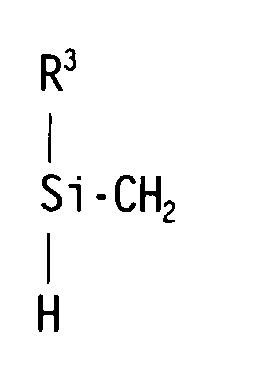
- borazine modified polycarbosilane polymers are prepared by reacting a material comprising at least one borazine ring having a hydrogen atom attached to at least one nitrogen or boron atom thereof, with a polycarbosilane polymer having a backbone of alternating silicon and carbon, and comprising at least one unit of the structure: for a time sufficient to form the product borazine modified polymers at a temperature of below 300°C., wherein R 3 is independently selected from methyl radicals and silicon substituted alkyl radicals.
- the present invention is based on our finding that borazine can be used to modify the polycarbosilane polymers claimed herein to form their borazine modified derivatives.
- the proposed method whereby this reaction occurs can be described as follows:
- Polycarbosilanes are commercially available and methods of making polycarbosilanes are well known in the art.
- the polycarbosilanes useful herein have a backbone of alternating silicon and carbon. They may contain one or more cyclic structures and may be linear or branched.
- the polycarbosilanes comprise at least one unit of the structure: wherein each R 3 is independently selected from methyl radicals and silicon substituted alkyl radicals.
- the Si-H bond is the proposed reactive site of the polycarbosilane in reaction mechanism [I].
- a preferred polycarbosilane reactant contains at least one Si-H bond.
- the most preferred polycarbosilanes are formed from the decomposition of organopolysilanes such as, for example, polymethylsilanes, followed by polymerization of the resultant carbosilanes.
- organopolysilanes such as, for example, polymethylsilanes
- Yajima et al. in "Synthesis of Continuous Silicon Carbide Fibre With High Tensil Strength and High Young's Modulus," J. Mat. Sci., vol. 13, pp. 2569-2579 (1978), teaches that the synthesis of polycarbosilane takes place at a temperature between 350 and 500°C. Preferred is a reaction temperature equal to or above 400°C.
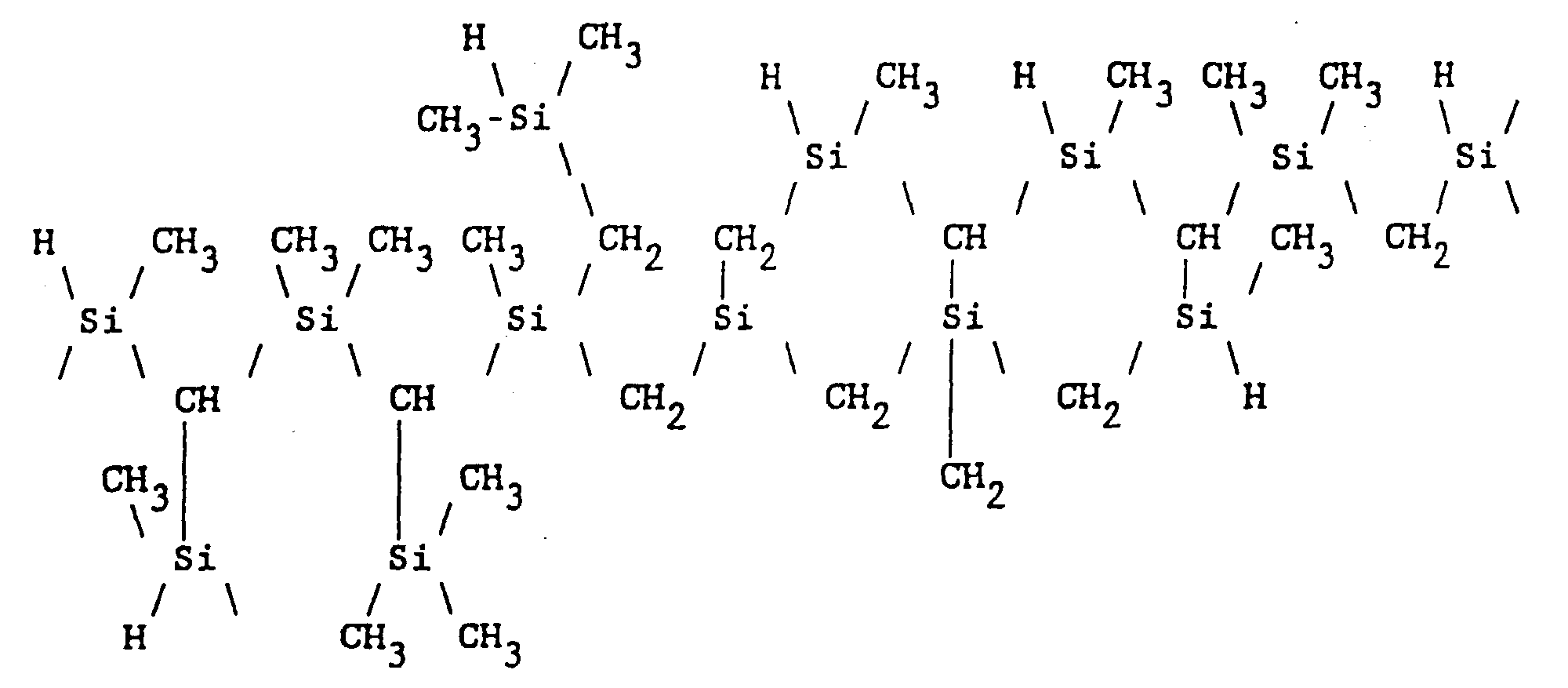
- the higher molecular weight polycarbosilane products formed by this process comprise cyclic and "ladder-bonded" arrangements as described by structure [II]:
- the lower molecular weight polycarbosilane products comprise ring arrangements as represented by structure [III]:
- Polycarbosilanes formed by this process may also contain a relatively small number of residual Si-Si bonds. These Si-Si bonds can react with borazine to modify the polycarbosilane.
- the polycarbosilane polymer is reacted with a material comprising at least one borazine ring to produce the desired borazine modified polycarbosilane polymer.
- the starting material useful herein comprises at least one borazine ring having a hydrogen atom attached to at least one nitrogen or boron atom thereof. Any material known in the art comprising at least one such borazine ring can be used in the present invention.
- a preferred embodiment of the invention comprises reacting the polycarbosilane with a material comprising at least one borazine ring of the general formula (BR 1 -NR 2 ) 3 wherein at least one R 1 or R 2 is a hydrogen atom.
- the remaining R 1 and R 2 in said borazine ring are independently selected from hydrogen atoms, hydrocarbon radicals containing 1 to 20 carbon atoms, borazine substituted hydrocarbon radicals and radicals containing boron and nitrogen.
- the hydrocarbon radicals can be linear or cyclic groups.
- R 1 and R 2 can be, for example, alkyl radicals such as methyl, ethyl, propyl, isopropyl, hexyl, or octadecyl; alkenyl radicals such as vinyl, allyl or hexenyl; cycloaliphatic radicals such as cyclopentyl, cyclohexyl or cyclohexenyl; aromatic hydrocarbon radicals such as phenyl or tolyl.
- R 1 and R 2 can also be any polyvalent hydrocarbon radical such as methylene, dimethylene, trimethylene or octadecamethylene.
- materials comprising borazine ring useful herein can be monomers such as, for example, (BH-NH) 3 , mono-B-methyl borazine, di-B-methyl borazine, mono-N-ethyl borazine, di-N-methyl borazine, tri-N-propyl borazine, mono-N-di-B-methyl borazine, mono-B-vinyl borazine or mono-N-phenyl-di-N-methyl borazine and borazanaphthalene.
- Materials comprising borazine ring useful herein can also be polymers such as, for example, polyborazylene, polyvinyl borazine and organic copolymers of polyvinyl borazine.
- the proposed reactive sites in the reaction are the B-H and N-H bonds.
- the reactivity of the materials comprising borazine ring increases with the increased number of B-H and N-H bonds. Therefore, the most preferred material comprising borazine ring is (BH-NH) 3 .
- the minimum amount of the material comprising borazine ring used in the present invention is generally the desired amount of borazine incorporated in the polycarbosilane.
- An excess borazine may be used to prevent a crosslinking reaction of the polymers.
- the amount of excess borazine used is only limited by the cost effectiveness of the process. Preferred is an amount of the material comprising borazine ring which dissolves the polycarbosilane reactant to form a homogenous solution.
- the reaction of the polycarbosilane and material comprising borazine ring is generally conducted by merely mixing the reactants in a suitable reaction vessel. This reaction can also be conducted in the presence of a solvent.
- the solvents which may be used herein include any which acts as a solvent for the material comprising borazine ring, the polycarbosilane polymer and the borazine modified polycarbosilane polymer without adversely affecting any of the species.
- the solvents may be, for example, solvents not containing active N-H bonds such as ethers, alkanes or aromatic hydrocarbons. Most preferred is a reaction conducted without solvents.
- the above reactants are generally brought together in a essentially anhydrous atmosphere. What is meant by essentially anhydrous is that the reaction is preferably carried out in a absolutely anhydrous atmosphere but minute amounts of moisture can be tolerated.
- the reaction of the polycarbosilane polymer can be conducted in the presence of a catalyst.
- the catalyst which can be employed in the present reaction is any catalyst used in the art to facilitate the dehydrogenation reaction between the borazine ring and the polycarbosilane polymer.
- the dehydrogenation catalyst can be, for example, platinum dibromide.
- the dehydrogenation catalyst can also be, for example, osmium (II), rhodium (II) or ruthenium (II) metals, each containing ligands comprising phosphines and/or carbonyls.
- the reaction of the polycarbosilane polymer is generally conducted in a reaction environment wherefrom the hydrogen byproduct is periodically removed.
- the reaction can be conducted in a static vacuum reaction environment with a hydrogen headspace wherefrom the hydrogen byproduct is periodically removed from the reaction vessel.
- reaction can be conducted under reflux in an inert atmosphere wherefrom the hydrogen gas is periodically purged from the system with an inert gas.
- inert atmosphere it is meant that the reaction is carried out under a blanket of inert gas such as argon, nitrogen or helium.
- the reaction can be conducted in a pressure vessel as shown in Examples 1 and 2 below. Since the increase in pressure (e.g., up to 5 bar (atm)) drives the reaction forward, removal of the hydrogen byproduct may not be necessary.
- increase in pressure e.g., up to 5 bar (atm)
- the reactants can be reacted at any temperature below the boiling point of the material comprising the borazine ring, unless elevated pressures are employed. Under atmospheric pressure, the reactants can be reacted at room temperature, but preferred is a slightly elevated temperature to induce the reaction. More preferred is reaction temperature below 300°C. Even more preferred is a reaction temperature below 100°C. The most preferred reaction temperature is between 60 and 80°C. The length of time that the reaction requires depends on the temperature employed and the polymer viscosity one wishes to achieve. Under increased pressure, the reaction can run to completion in less time. The amount of borazine incorporated into the polycarbosilane polymer can also be readily controlled by the reaction time, temperature and pressure.
- the unreacted material comprising the borazine ring can be removed from the reaction vessel by means of liquid removal methods well known in the art.
- the removal can be performed by, for example, vacuum evaporation or distillation.
- the unreacted material comprising the borazine ring can then be recycled.
- the borazine modified polycarbosilane polymer produced by the above reaction is then merely recovered from solution. Methods such as recrystallization or simple evaporation of the solvent under heat and/or vacuum are known in the art and useful herein.
- the process of this invention may produce polymers having number average molecular weights higher than, equivalent to or less than those of the starting polycarbosilane polymers. Modification of the polymers has been confirmed by 11 B NMR data which show a fairly clean derivatization, and by IR data which show the presence of B-H, B-N, and N-H stretches that were not present in the polycarbosilane starting material.
- the derivatized polymers of this invention are especially valuable since they are soluble and easily curable at elevated temperatures. Such curability is critical in applications such as ceramic fibers, coatings on ceramic-ceramic and carbon-carbon composites, ceramic monoliths and ceramic matrix composites.
- polycarbosilane samples of the general formula Si 1.00 C 1.96 H 4.87 were obtained from Dow Corning Corp. (Midland, MI).
- Borazine of the formula (BH-NH) 3 was purchased from Callery Chemical Co., and was purified by refraction through -45°, -78° and -196° trap series, with only the material collected at -78° used. Benzene was freshly distilled from sodium benzophenone.
- Elemental analyses of carbon, hydrogen and nitrogen for both the polymers and the ceramics were performed on a Control Equipment Corporation 240-XA Elemental Analyzer.
- Oxygen analyses were done on a Leco Oxygen Analyzer equipped with an Oxygen Determinator 316 (Model 783700) and an Electrode Furnace EF100.
- Silicon and boron compositions were determined by a fusion technique which consisted of converting the material to soluble forms of silicon and boron followed by analyzing the solute for total silicon or boron by atomic absorption spectrometry.
- X-ray diffraction (XRD) characterization was performed on a Norelco Philips vertical goniometer (Type 42271/0) fitted with a closed sample chamber, sample spinner, graphite monochromator, scintillation counter, and a long fine focus copper target tube. All synthetic manipulations were carried out by using standard high vacuum or inert-atmosphere techniques.
- GPC Gel permeation chromatography
- Diffuse-reflectance IR spectra were obtained on a Perkin-Elmer 7770 Fourier transform spectrophotometer equipped with the appropriate diffuse-reflectance attachment.
- 11 B NMR spectra at 64.2 MHz were obtained on a Bruker AF-200 spectrometer equipped with the appropriate decoupling accessories. All 11 B shifts were referenced to BF 3 -O(C 2 H 5 ) 2 (0.0 ppm) with a negative sign indicating an upfield shift.
- Borazine modified polymers (1) and (2) had elemental compositions consistent with the formulae listed in Table 1 (Polymer Composition). IR spectra for polymers (1) and (2) show absorptions characteristic of the borazinyl BH (2510 cm -1 ) and NH (3450 cm -1 ), polymer SiH at (2099 cm -1 ) and saturated CH (2890-3000 cm -1 ) with the relative intensities of these absorptions changing according to the polymer composition. With increasing borazine content, the backbone SiH and CH absorptions decrease, while the borazine BH and NH absorptions increase.
- the 11 B decoupled proton NMR spectra of both reactant and product samples show broad resonances centered at 4.81 ppm (NH), 4.52 ppm (BH), and a very strong resonance at 0.27 ppm (saturated C-H attached to Si and SiH) with the relative intensities characteristic of their borazine and polycarbosilane compositions.
- the 11 B NMR spectra for all modified polymers contained similar features; however, the resonances in the higher borazine content polymer (1) were broadened.
- Table 3 summarizes the ceramic yield and compositions for the ceramics derived from the precursor polymer (PCS) and the borazine modified polymers (1) and (2). Ceramic Yield, Elemental and XRD Analyses of the Polycarbosilane Precursor and Borazine Modified Product after pyrolysis to 1800°C.
Landscapes
- Chemical & Material Sciences (AREA)
- Health & Medical Sciences (AREA)
- Chemical Kinetics & Catalysis (AREA)
- Medicinal Chemistry (AREA)
- Polymers & Plastics (AREA)
- Organic Chemistry (AREA)
- Silicon Polymers (AREA)
- Ceramic Products (AREA)
- Polymers With Sulfur, Phosphorus Or Metals In The Main Chain (AREA)
Claims (15)
- Verfahren zum Ausbilden eines borazinmodifizierten Polycarbosilanpolymers durch Umsetzen eines Materials, das mindestens einen Borazinring aufweist mit einem an mindestens ein Stickstoff- oder Boratom desselben gebundenen Wasserstoffatom, mit einem Polycarbosilanpolymer, das mindestens eine Einheit der Formelenthält, bei einer Temperatur unter 300° C für eine zum Ausbilden des borazinmodifizierten Polymerproduktes ausreichende Zeit, wobei R3 unabhängig aus Methylresten und Silicium, das mit Alkylresten substituiert ist, ausgewählt ist.
- Verfahren nach Anspruch 1, dadurch gekennzeichnet, daß der Borazinring der allgemeinen Formel (BR1-NR2)3 genügt, wobei mindestens ein R1 oder R2 ein Wasserstoffatom ist, die verbleibenden R1- und R2-Reste unabhängig ausgewählt sind aus Wasserstoffatomen, Kohlenwasserstoffresten mit 1 bis 20 Kohlenstoffatomen und Resten, die Bor und Stickstoff enthalten.
- Verfahren nach Anspruch 2, dadurch gekennzeichnet, daß das Borazinring enthaltende Material ausgewählt ist aus (BH-NH)3, Borazannapthalin, Polyborazylen und Polyvinylborazin.
- Verfahren nach Anspruch 1, dadurch gekennzeichnet, daß das Polycarbosilanpolymer gebildet wird durch Zersetzungsreaktion von Polymethylsilan bei einer Temperatur zwischen 400 und 500° C und anschließende Polymerisation der erhaltenen Carbosilane.
- Verfahren nach Anspruch 1, dadurch gekennzeichnet, daß das Polycarbosilanpolymer cyclische und Leiterpolymeranordnungen der Formelenthält.
- Verfahren nach Anspruch 1, dadurch gekennzeichnet, daß das Polycarbosilanpolymer Ringanordnungen der Formelenthält.

- Verfahren nach Anspruch 1, dadurch gekennzeichnet, daß die Reaktionstemperatur im Bereich von 60 bis 80° C liegt.
- Verfahren nach Anspruch 1, dadurch gekennzeichnet, daß das Borazinring enthaltende Material und Polycarbosilan zusammen in einer im wesentlichen wasserfreien Atmosphäre umgesetzt werden.
- Verfahren nach Anspruch 1, dadurch gekennzeichnet, daß die Reaktion in einem statischen Vakuumsystem mit Wasserstoffkopfraum ausgeführt wird, aus dem Wasserstoffgas periodisch entfernt wird.
- Verfahren nach Anspruch 1, dadurch gekennzeichnet, daß die Reaktion von Polycarbosilanpolymer unter Rückfluß in einer inerten Atmosphäre ausgeführt wird, aus der Wasserstoffgas periodisch mit einem Inertgas herausgespült wird.
- Verfahren nach Anspruch 1, dadurch gekennzeichnet, daß die Reaktion von Polycarbosilanpolymer unter einem Druck über atmosphärischem Druck ausgeführt wird.
- Verfahren nach Anspruch 1, dadurch gekennzeichnet, daß die Reaktion von Polycarbosilanpolymer in einem Lösemittel ausgeführt wird, ausgewählt aus der Gruppe bestehend aus Alkanen, Ethern und aromatischen Kohlenwasserstoffen.
- Verfahren nach Anspruch 1, dadurch gekennzeichnet, daß die Reaktion des Polycarbosilanpolymers in Gegenwart eines Katalysators ausgeführt wird, der die Dehydrogenierungsreaktion zwischem dem Borazinring und dem Polycarbosilan fördert.
- Borazinmodifiziertes Polycarbosilanpolymer, hergestellt nach dem Verfahren von Anspruch 1.
- Verwendung des borazinmodifizierten Polycarbosilanpolymers nach Anspruch 14, um einen keramischen Gegenstand auszubilden, wobei das Polymer auf eine Temperatur über 800° C erwärmt wird.
Applications Claiming Priority (2)
| Application Number | Priority Date | Filing Date | Title |
|---|---|---|---|
| US07/970,517 US5256753A (en) | 1992-11-02 | 1992-11-02 | Borazine derivatized polycarbosilane polymers and the ceramics derived therefrom |
| US970517 | 1992-11-02 |
Publications (3)
| Publication Number | Publication Date |
|---|---|
| EP0596679A2 EP0596679A2 (de) | 1994-05-11 |
| EP0596679A3 EP0596679A3 (de) | 1995-05-03 |
| EP0596679B1 true EP0596679B1 (de) | 1999-03-10 |
Family
ID=25517074
Family Applications (1)
| Application Number | Title | Priority Date | Filing Date |
|---|---|---|---|
| EP93308710A Expired - Lifetime EP0596679B1 (de) | 1992-11-02 | 1993-11-01 | Borazinderivate von Polycarbosilanen und davon abgeleitetes keramisches Material |
Country Status (5)
| Country | Link |
|---|---|
| US (1) | US5256753A (de) |
| EP (1) | EP0596679B1 (de) |
| JP (1) | JPH0797449A (de) |
| CA (1) | CA2102025A1 (de) |
| DE (1) | DE69323829T2 (de) |
Families Citing this family (3)
| Publication number | Priority date | Publication date | Assignee | Title |
|---|---|---|---|---|
| US6187703B1 (en) * | 1995-10-06 | 2001-02-13 | The United States Of America As Represented By The Secretary Of The Navy | High temperature ceramics derived from linear carborane-(siloxane or silane)-acetylene copolymers |
| US7749425B2 (en) * | 2005-12-21 | 2010-07-06 | General Electric Company | Nanoscale ceramic composites and methods of making |
| CN105694048B (zh) * | 2016-01-22 | 2020-05-19 | 中国人民解放军国防科学技术大学 | 聚硼硅氮烷粘结剂的制备方法 |
Family Cites Families (8)
| Publication number | Priority date | Publication date | Assignee | Title |
|---|---|---|---|---|
| GB2009196B (en) * | 1977-10-26 | 1982-04-15 | Res Inst For Special Inorganic | Polycarbosilane process for its prudiction and its use as material for producing silicon carbide |
| US4342712A (en) * | 1979-06-28 | 1982-08-03 | Ube Industries, Ltd. | Process for producing continuous inorganic fibers |
| CA1167216A (en) * | 1980-12-18 | 1984-05-15 | Kiyohito Okamura | Continuous inorganic fibers and process for production thereof |
| JPS60120725A (ja) * | 1983-12-05 | 1985-06-28 | Shin Etsu Chem Co Ltd | 有機金属共重合体およびその製造方法 |
| JPS60139820A (ja) * | 1983-12-27 | 1985-07-24 | Shin Etsu Chem Co Ltd | けい素、炭素、ほう素および窒素含有無機繊維の製造方法 |
| JPH02240141A (ja) * | 1989-02-06 | 1990-09-25 | Ethyl Corp | プレセラミツク組成物及びセラミツク製品 |
| JPH04153226A (ja) * | 1990-10-16 | 1992-05-26 | Shin Etsu Chem Co Ltd | ホウ素含有シラザン重合体の製造方法及びセラミックスの製造方法 |
| JP3290463B2 (ja) * | 1992-05-29 | 2002-06-10 | 東燃ゼネラル石油株式会社 | 熱硬化性ケイ素ホウ素含有共重合体及びその製法 |
-
1992
- 1992-11-02 US US07/970,517 patent/US5256753A/en not_active Expired - Fee Related
-
1993
- 1993-10-29 CA CA002102025A patent/CA2102025A1/en not_active Abandoned
- 1993-11-01 EP EP93308710A patent/EP0596679B1/de not_active Expired - Lifetime
- 1993-11-01 DE DE69323829T patent/DE69323829T2/de not_active Expired - Fee Related
- 1993-11-02 JP JP5274012A patent/JPH0797449A/ja active Pending
Also Published As
| Publication number | Publication date |
|---|---|
| DE69323829D1 (de) | 1999-04-15 |
| CA2102025A1 (en) | 1994-05-03 |
| EP0596679A3 (de) | 1995-05-03 |
| EP0596679A2 (de) | 1994-05-11 |
| DE69323829T2 (de) | 1999-11-11 |
| US5256753A (en) | 1993-10-26 |
| JPH0797449A (ja) | 1995-04-11 |
Similar Documents
| Publication | Publication Date | Title |
|---|---|---|
| CA1239526A (en) | Polyhydridosilanes and their conversion to pyropolymers | |
| US5412053A (en) | Polymers containing alternating silsesquioxane and bridging group segments and process for their preparation | |
| US4310651A (en) | Method for preparing silicon carbide | |
| JP2760555B2 (ja) | ポリボロシラザン及びその製造方法 | |
| US4788309A (en) | Method of forming compounds having Si-N groups and resulting products | |
| JP2507714B2 (ja) | 新規ポリチタノシラザン及びその製造方法 | |
| US5292830A (en) | Thermosetting copolymers, silicon carbide-based fiber and processes for producing same | |
| EP0596680B1 (de) | Borazinderivate von Hydridopolysilazanpolymeren | |
| US5171736A (en) | Preceramic organosilicon-boron polymers | |
| US5364920A (en) | Method of crosslinking polysilazane polymers | |
| US4730026A (en) | Cross-linked organosilazane polymers | |
| KR100241988B1 (ko) | 경화성 붕소 개질된 하이드로폴리실라잔 중합체 | |
| US5312649A (en) | Diorganosilacetylene-alt-diorganosilvinylene polymers and a process densifying porous silicon-carbide bodies | |
| EP0596679B1 (de) | Borazinderivate von Polycarbosilanen und davon abgeleitetes keramisches Material | |
| JPH0655819B2 (ja) | プレセラミックアセチレン列ポリシラン及びその調製方法、並びに炭化ケイ素含有セラミック物品調製方法 | |
| EP0139257B1 (de) | Verfahren zur Herstellung von Siliciumcarbid | |
| Boury et al. | Stoichiometric silicon carbide from borate‐catalyzed polymethylsilane–polyvinylsilane formulations | |
| US4889904A (en) | Process for the preparation of methylpolysilanes having controlled carbon content | |
| US4534948A (en) | Method for preparing silicon carbide | |
| WO1990014381A1 (en) | Silyl- and disilanyl-1,3-butadiyne polymers from hexachloro-1,3-butadiene | |
| US5202399A (en) | Poly(b-alkenyl-borazine) ceramic precursors | |
| US5025075A (en) | Methylpolysilanes and method for their preparation | |
| Ko et al. | Synthesis and characterization of poly (3, 4-benzo-1-phenyl-1-silapentene) and poly (3, 4-benzo-1-silapentene) | |
| JPH03170533A (ja) | ポリシラザン及びその製法 | |
| CA2004395A1 (en) | Oligomeric silazanes and process for their preparation |
Legal Events
| Date | Code | Title | Description |
|---|---|---|---|
| PUAI | Public reference made under article 153(3) epc to a published international application that has entered the european phase |
Free format text: ORIGINAL CODE: 0009012 |
|
| AK | Designated contracting states |
Kind code of ref document: A2 Designated state(s): DE FR GB |
|
| PUAL | Search report despatched |
Free format text: ORIGINAL CODE: 0009013 |
|
| AK | Designated contracting states |
Kind code of ref document: A3 Designated state(s): DE FR GB |
|
| RAP1 | Party data changed (applicant data changed or rights of an application transferred) |
Owner name: UNIVERSITY OF PENNSYLVANIA Owner name: DOW CORNING CORPORATION |
|
| 17P | Request for examination filed |
Effective date: 19950918 |
|
| 17Q | First examination report despatched |
Effective date: 19971114 |
|
| GRAG | Despatch of communication of intention to grant |
Free format text: ORIGINAL CODE: EPIDOS AGRA |
|
| GRAG | Despatch of communication of intention to grant |
Free format text: ORIGINAL CODE: EPIDOS AGRA |
|
| GRAH | Despatch of communication of intention to grant a patent |
Free format text: ORIGINAL CODE: EPIDOS IGRA |
|
| GRAH | Despatch of communication of intention to grant a patent |
Free format text: ORIGINAL CODE: EPIDOS IGRA |
|
| GRAA | (expected) grant |
Free format text: ORIGINAL CODE: 0009210 |
|
| AK | Designated contracting states |
Kind code of ref document: B1 Designated state(s): DE FR GB |
|
| REF | Corresponds to: |
Ref document number: 69323829 Country of ref document: DE Date of ref document: 19990415 |
|
| ET | Fr: translation filed | ||
| PLBE | No opposition filed within time limit |
Free format text: ORIGINAL CODE: 0009261 |
|
| 26N | No opposition filed | ||
| REG | Reference to a national code |
Ref country code: GB Ref legal event code: IF02 |
|
| PGFP | Annual fee paid to national office [announced via postgrant information from national office to epo] |
Ref country code: DE Payment date: 20021014 Year of fee payment: 10 |
|
| PGFP | Annual fee paid to national office [announced via postgrant information from national office to epo] |
Ref country code: FR Payment date: 20021016 Year of fee payment: 10 |
|
| PGFP | Annual fee paid to national office [announced via postgrant information from national office to epo] |
Ref country code: GB Payment date: 20021017 Year of fee payment: 10 |
|
| PG25 | Lapsed in a contracting state [announced via postgrant information from national office to epo] |
Ref country code: GB Free format text: LAPSE BECAUSE OF NON-PAYMENT OF DUE FEES Effective date: 20031101 |
|
| PG25 | Lapsed in a contracting state [announced via postgrant information from national office to epo] |
Ref country code: DE Free format text: LAPSE BECAUSE OF NON-PAYMENT OF DUE FEES Effective date: 20040602 |
|
| GBPC | Gb: european patent ceased through non-payment of renewal fee |
Effective date: 20031101 |
|
| PG25 | Lapsed in a contracting state [announced via postgrant information from national office to epo] |
Ref country code: FR Free format text: LAPSE BECAUSE OF NON-PAYMENT OF DUE FEES Effective date: 20040730 |
|
| REG | Reference to a national code |
Ref country code: FR Ref legal event code: ST |