EP0596805A1 - Fernbetätigungssystem zum Sperren und Entsperren von Türen und Öffnungsteilen eines Kraftfahrzeugs - Google Patents
Fernbetätigungssystem zum Sperren und Entsperren von Türen und Öffnungsteilen eines Kraftfahrzeugs Download PDFInfo
- Publication number
- EP0596805A1 EP0596805A1 EP93402710A EP93402710A EP0596805A1 EP 0596805 A1 EP0596805 A1 EP 0596805A1 EP 93402710 A EP93402710 A EP 93402710A EP 93402710 A EP93402710 A EP 93402710A EP 0596805 A1 EP0596805 A1 EP 0596805A1
- Authority
- EP
- European Patent Office
- Prior art keywords
- signal
- passenger compartment
- portable device
- signals
- locking
- Prior art date
- Legal status (The legal status is an assumption and is not a legal conclusion. Google has not performed a legal analysis and makes no representation as to the accuracy of the status listed.)
- Granted
Links
- 238000001514 detection method Methods 0.000 claims abstract description 18
- 230000005540 biological transmission Effects 0.000 claims abstract description 16
- 230000004044 response Effects 0.000 claims description 10
- 238000000034 method Methods 0.000 claims description 7
- 230000003213 activating effect Effects 0.000 claims description 5
- 230000008054 signal transmission Effects 0.000 claims description 5
- 230000008569 process Effects 0.000 claims description 4
- 230000005855 radiation Effects 0.000 claims description 3
- 238000012795 verification Methods 0.000 claims description 2
- 238000010586 diagram Methods 0.000 description 7
- 230000000007 visual effect Effects 0.000 description 5
- 238000005259 measurement Methods 0.000 description 3
- 230000001960 triggered effect Effects 0.000 description 3
- 238000004891 communication Methods 0.000 description 2
- 206010027175 memory impairment Diseases 0.000 description 2
- 108091026890 Coding region Proteins 0.000 description 1
- WHXSMMKQMYFTQS-UHFFFAOYSA-N Lithium Chemical compound [Li] WHXSMMKQMYFTQS-UHFFFAOYSA-N 0.000 description 1
- 230000004913 activation Effects 0.000 description 1
- 230000006978 adaptation Effects 0.000 description 1
- 238000013459 approach Methods 0.000 description 1
- 238000000429 assembly Methods 0.000 description 1
- 230000008901 benefit Effects 0.000 description 1
- 230000000295 complement effect Effects 0.000 description 1
- 239000004020 conductor Substances 0.000 description 1
- 230000001419 dependent effect Effects 0.000 description 1
- 238000005265 energy consumption Methods 0.000 description 1
- 230000006870 function Effects 0.000 description 1
- 230000006698 induction Effects 0.000 description 1
- 229910052744 lithium Inorganic materials 0.000 description 1
- 230000003287 optical effect Effects 0.000 description 1
- 210000000056 organ Anatomy 0.000 description 1
- 230000002035 prolonged effect Effects 0.000 description 1
- 238000005070 sampling Methods 0.000 description 1
- 239000013585 weight reducing agent Substances 0.000 description 1
Images


Classifications
-
- G—PHYSICS
- G07—CHECKING-DEVICES
- G07C—TIME OR ATTENDANCE REGISTERS; REGISTERING OR INDICATING THE WORKING OF MACHINES; GENERATING RANDOM NUMBERS; VOTING OR LOTTERY APPARATUS; ARRANGEMENTS, SYSTEMS OR APPARATUS FOR CHECKING NOT PROVIDED FOR ELSEWHERE
- G07C9/00—Individual registration on entry or exit
- G07C9/00174—Electronically operated locks; Circuits therefor; Nonmechanical keys therefor, e.g. passive or active electrical keys or other data carriers without mechanical keys
- G07C9/00309—Electronically operated locks; Circuits therefor; Nonmechanical keys therefor, e.g. passive or active electrical keys or other data carriers without mechanical keys operated with bidirectional data transmission between data carrier and locks
-
- G—PHYSICS
- G07—CHECKING-DEVICES
- G07C—TIME OR ATTENDANCE REGISTERS; REGISTERING OR INDICATING THE WORKING OF MACHINES; GENERATING RANDOM NUMBERS; VOTING OR LOTTERY APPARATUS; ARRANGEMENTS, SYSTEMS OR APPARATUS FOR CHECKING NOT PROVIDED FOR ELSEWHERE
- G07C9/00—Individual registration on entry or exit
- G07C9/00174—Electronically operated locks; Circuits therefor; Nonmechanical keys therefor, e.g. passive or active electrical keys or other data carriers without mechanical keys
- G07C2009/00753—Electronically operated locks; Circuits therefor; Nonmechanical keys therefor, e.g. passive or active electrical keys or other data carriers without mechanical keys operated by active electrical keys
- G07C2009/00769—Electronically operated locks; Circuits therefor; Nonmechanical keys therefor, e.g. passive or active electrical keys or other data carriers without mechanical keys operated by active electrical keys with data transmission performed by wireless means
- G07C2009/00793—Electronically operated locks; Circuits therefor; Nonmechanical keys therefor, e.g. passive or active electrical keys or other data carriers without mechanical keys operated by active electrical keys with data transmission performed by wireless means by Hertzian waves
-
- G—PHYSICS
- G07—CHECKING-DEVICES
- G07C—TIME OR ATTENDANCE REGISTERS; REGISTERING OR INDICATING THE WORKING OF MACHINES; GENERATING RANDOM NUMBERS; VOTING OR LOTTERY APPARATUS; ARRANGEMENTS, SYSTEMS OR APPARATUS FOR CHECKING NOT PROVIDED FOR ELSEWHERE
- G07C2209/00—Indexing scheme relating to groups G07C9/00 - G07C9/38
- G07C2209/60—Indexing scheme relating to groups G07C9/00174 - G07C9/00944
- G07C2209/63—Comprising locating means for detecting the position of the data carrier, i.e. within the vehicle or within a certain distance from the vehicle
Definitions
- the present invention relates to a system for remotely controlling the locking and unlocking of the doors and openings of a passenger compartment, in particular of a motor vehicle.
- the purpose of such a system is to ensure locking or unlocking without the use of a mechanical key, or of any device requiring manual intervention on the part of the user.
- the authorized drivers each have a portable device, for example in the form of a badge, ensuring communication with an on-board assembly when the wearer of the device approaches the vehicle.
- the invention relates more precisely to such a system integrating a function for recognizing the forgetting of a device on board inside the passenger compartment. This situation occurs when the driver leaves the garment, in the pocket of which he has stored the portable device, but also when a second authorized driver has taken his place in the passenger compartment, and remains in the vehicle, or leaves his clothing in the passenger compartment after the driver's exit. It is essential that the locking and unlocking system manages its situations to prevent the driver from inadvertently locking, the device remaining locked inside the vehicle, or even inadvertent unlocking, the vehicle then offering no security against the flight.
- the European patent EP140137 describes a system comprising an on-board transceiver assembly and a portable transceiver assembly. This document describes a solution for recognizing the situation in which the badge has been forgotten in the vehicle, consisting in measuring for a determined period the level of the signal received by the on-board receiver, and transmitted by the portable device. When the signal variations within a given period of time are less than a predetermined value, the on-board system produces an alarm signal.
- EP426114 A second solution is known from the prior art, described in European patent application EP426114, which also consists in determining the position of a portable card-shaped device using a detector integrated into the on-board system. The position is determined not by measuring the level variation, but by using several antennas installed at different points on the vehicle, and making it possible to determine the origin of the emission, and therefore the position of the card relative to the interior of the vehicle.
- This solution also involves the almost continuous transmission of a signal from the portable transmitter, and therefore has substantially the same drawbacks as the first solution.
- the object of the present invention is to provide a system for detecting that the on-board device has been forgotten without resorting to prolonged transmission from the portable device, in order to reduce consumption and avoid disturbances due to variations in voltage. feed. Furthermore, a system according to the invention is compatible with a supply of the portable device by induction.
- the portable device therefore emits, after the vehicle has stopped, a signal only for a very short time, and this essentially in the case where the portable device has been forgotten inside the passenger compartment, which constitutes a priori an exceptional situation.
- the system according to the invention comprises a plurality of individualized portable devices, each of said portable devices emitting a signal of the second type S Pi comprising an identification sequence of the on-board device considered, in the event of detection of forgotten inside the cabin.
- This embodiment makes it possible to identify a particular device, in the case where several conductors are each provided with a personalized device, and to temporarily deactivate the forgotten portable device, while authorizing the use of the other devices.
- the on-board assembly emits a first signal S E1 before the doors are locked, as well as a second signal S Ever after the doors are locked.
- the portable device comprises a memory circuit for recording the level M1 of the first signal S E1 and the level M2 of the second signal S Ever detected by the receiver, and a computer for generating a signal for activating the signal transmission sequence S Forgotten of the second type corresponding to the detection of a forgotten portable device, in the case where the difference between the two memorized levels M2, M2 is less than a predetermined value ⁇ M.
- the on-board assembly also transmits a third signal S Etemp after a predetermined delay after the transmission of the second signal S Ever , the portable device memorizing the level M3 of said third signal S Etemp detected.
- the computer of the portable device also controls the emission of a signal S Pixie of the second type corresponding to the detection of a forgotten device in the case where the difference between the level M2 of the second and the level M3 of the third stored signals is less at a predetermined value ⁇ M '.
- the on-board assembly comprises means for transmitting signals, selectively by an internal antenna, placed inside the passenger compartment and whose radiation lobes are mainly confined inside the passenger compartment, by an external antenna arranged near the driver's door and whose emission lobes are mainly confined to the outside of the vehicle, and by a second external antenna (61) disposed near the door opposite to that of the driver and whose emission lobes are mainly confined outside the vehicle, the portable device emitting an S Pvid signal corresponding to the detection of the forgotten device in the event that the receiver does not detect S Eextd signals after reception of an S Ever signal of the first type corresponding to the information "Doors locked".
- the on-board assembly also transmits signals of the first type S E1 at the time of actuation of the door handle, and in that the portable device emits a signal S Pzzi of the second type corresponding to the forgetting of the portable device when the signal S E detected at the time of reception of said actuation signal from the handle corresponds to the signal S Eint emitted by the indoor antenna.
- the on-board assembly comprises means for transmitting signals S E1ext and S E1int at the time of closing the driver's door, the signal S E1int transmitted by the interior antenna comprising a specific coding, transmission means by the internal antenna of a second series of signals corresponding to the locking of the passenger compartment, means for transmitting, after a predetermined delay, by the external antenna provided on the driver's side of a third series of signals, and means for subsequently emitting, by the external antenna provided on the side opposite that of the driver, a fourth series of signals, and in that the portable device comprises means for generating a signal S Pvid in response to the reception of the coded signals S E1int , as well as an identification signal in response to the reception of an unencrypted signal S E.
- the on-board assembly comprises means for interrupting the verification process when the on-board receiver receives an identification signal S P , in response to the emission of the signal emitted at the time of closing the door.
- Figure 1 shows the block diagram of a non-limiting exemplary embodiment of the invention.
- the system mainly comprises two sub-assemblies, a portable device (1) in the form of a badge and an on-board system (2) installed in the vehicle.
- the badge (1) a term which will be used in the following description to designate the portable device, comprises a power source (3), for example a lithium battery. It also includes an omnidirectional antenna (4), for transmitting and receiving radio frequency signals.
- a reception circuit (5) of known type is connected to a microprocessor circuit (6) capable of sampling the level of the signal detected by the receiver, and of recognizing the different types of signals received.
- the microprocessor circuit (6) is connected to a random access memory (7) capable of storing digital information relating to the level of the signal received by the receiver (5).
- the microprocessor circuit (6) also controls the transmitter (8).
- the on-board assembly (2) also includes one or more antennas (11), housed in the passenger compartment or outside the vehicle.
- a transmitter (12) generates a coded signal S E for the transmission of information relating to the state of the vehicle.
- This information comes from a computer (13) receiving signals from different contacts detecting the open or closed state of the vehicle doors, the position of the locking means, the actions on the door handles, and in general any information. useful relating to the state of various parts of the vehicle.
- This information is preferably transmitted via a serial communication BUS.
- the on-board assembly also comprises a receiver (14) delivering signals to a computer (15) controlling the locking members, the starting control member, the audible or visual alert systems, and possibly the motorized adjustments of different parts of the vehicle requiring special adaptation to each driver referenced, for example the settings of the mirrors, the driver's seat or the height of the steering wheel.
- FIG. 2 represents the timing diagram of the exchanges of signals between the badge (1) and the on-board assembly (2) in a so-called normal situation, in which the driver leaves his vehicle without forgetting his badge, and without a passenger n forget a badge inside the vehicle.
- the detection of the badge forgotten in the vehicle after locking the doors is based on the measurement of the level of the signal S E received by the receiver at different times, before and after locking. These moments are chosen at times when the driver, normally wearing the badge, is a priori at different distances from the transmitting antenna. all on board.
- the level of the signal S E measured on several consecutive messages by the computer (6) connected to the receiver (5) of the badge remains substantially constant, the badge can be considered to have remained in the passenger compartment, and it is necessary to alert in this case the driver.
- the level measured is different, it is considered that the badge has changed position and has moved away from the passenger compartment with the driver.
- the locking process can then continue normally.
- the signal S E is transmitted by an indoor antenna.
- each badge includes in a random access memory or in a read-only memory a unique specific code suitable for identifying the badge, and consequently the person to whom the badge is allocated.
- the computer Upon reception of the signal (31) by the receiver (14) of the on-board assembly (2), the computer (15) controls the locking of the starting control member.
- the signal (21) from a micro-sensor changes state and triggers the transmission of a coded message (33) on the interconnection BUS.
- the computer (15) in return commands the transmission of an identification request signal (34).
- the badge (1) Upon receipt of this signal, the badge (1) emits an identification signal (35).
- This identification signal (35) causes the transmission on the BUS of a coded message (36) controlling the locking (37) of the doors.
- the sensors detecting the lock trigger on the BUS a coded message activating the emission of a signal S E (38).
- This signal is detected by the badge receiver (5) (1) and its level is digitized. This level is stored in the memory (7) in the form of information M2.
- the two levels M1 and M2 are then compared.
- the levels M1 and M2 are different, and the computer (6) of the badge (1) does not command emission S p .
- the on-board transmitter After a predetermined delay of approximately one second following the reception of the coded message (39) corresponding to the release of the door handle, the on-board transmitter emits a signal giving rise to the detection by the badge (1) of a level M3.
- the level M3 is different from M2, and consequently the transmitter (8) of the badge (1) remains inactive.
- FIG. 3 represents the situation in which a badge has been forgotten inside the vehicle.
- the difference between the levels M2 and M1 is in this case less than a predetermined threshold value, and consequently, the computer (6) of the badge (1) controls the emission of a signal S P.zzi (50).
- This signal is detected by the receiver (14) of the on-board assembly (2), and the computer transmits on the BUS a coded message (51) causing the unlocking (52) and the activation of an audible alert signal. (53).
- the on-board computer deactivates the codes identifying the badges forgotten until the next unlocking operation.
- FIG. 4 represents a schematic view of a vehicle equipped with a system according to the second variant.
- This variant has the advantage of allowing the instantaneous prohibition of the locking of doors when the badge is forgotten inside the passenger compartment (zones 73 and 73 '), whereas with detection by level variation measurement, the relatively long measurement time (of the order of a few seconds) imply a locking and unlocking sequence for the doors in the event of a badge being forgotten in the passenger compartment being detected.
- the emission lobes of the interior antenna (60), the exterior antenna (61) placed on the driver's side, and the exterior antenna (62) placed on the opposite side are shown diagrammatically by hatched surfaces.
- the external antennas (61, 62) are for example arranged in the exterior mirrors.
- the signals received by the badge come only from the indoor antenna (60). In this case, an alert signal should be triggered, and the locking of the doors should be prevented if the doors are not yet locked, or, if the doors are already locked, the door will be unlocked.
- the areas (73) and (73 ′) correspond to interior areas of the vehicle in which the badge receives signals from both the interior antenna (60) and one of the exterior antennas, respectively (61), (62).
- an alert signal should be triggered, and the locking of the doors should be prevented if the doors are not yet locked, or, if the doors are already locked, the door will be unlocked.
- the areas (74) and (74 ′) correspond to areas outside the vehicle in which the badge receives signals from both the interior antenna (60) and one of the exterior antennas, respectively (61), (62). When the badge is in this area, the doors must be locked after the badge has been identified.
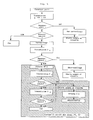
- FIG. 5 represents the flow chart of the procedure for detecting a forgotten badge according to this second variant, using antennas as shown in FIG. 4.
- the badge includes a receiver and a computer triggering the emission of an identification signal comprising a code specific to the badge considered in response to a signal from the on-board transmitter, or the emission of a signal corresponding to the situation forgetting the badge if the signal from the on-board transmitter has a specific coding sequence, whatever the antenna excited by the on-board transmitter.
- the badge If the badge detects specific code sequences transmitted by the internal antenna (60), it responds that it is forgotten by a signal S forgetfulness.
- the on-board transmitter transmits, via the internal antenna, an S Eint signal comprising a specific sequence as well as a coded S Eext signal via the external antennas (61, 62).
- the badge is in the interior area (73)
- its receiver receives the S Eint signal including the sequence specific identifying the indoor antenna (60) as well as the signal S ext of the outdoor antenna (61)
- the badge computer calculates in return the transmission of a signal comprising coded information corresponding to the forgetting of the badge inside the vehicle.
- the on-board computer prevents the doors from locking and activates an audible or visual alert signal.
- the computer controls the transmission of a signal comprising a badge identification sequence, and in response, the on-board computer controls the locking of the doors, then orders the emission of a new signal S Eint by the interior antenna (60), without specific code. If the badge responds with an identification signal, it is considered to have remained inside the vehicle and the on-board computer causes the doors to be unlocked, and an audible or visual alert to be triggered.
- the on-board computer commands the emission of an S Eextg signal without specific sequence, approximately 10 seconds after locking the doors, via the external antenna on the driver's side (62) only. If the badge responds with an identification signal, the on-board computer triggers the audible or visual alert. If the driver does not unlock the doors, the on-board computer deactivates the badge.
- the on-board computer controls the emission of another signal S Eextd without specific sequence, by means of the exterior antenna (61) on the passenger side only.
- the on-board computer triggers the audible or visual alert. The detection procedure is finished.
- the zones (74, 74 ') are zones where the badge is rarely found. If it is there, this would simply lead to false detection without affecting the safety of the vehicle.
- the skilled person will be able to make various variants without departing from the scope of the invention.
- the nature of the signals is not limited to radio signals.
Landscapes
- Engineering & Computer Science (AREA)
- Computer Networks & Wireless Communication (AREA)
- Physics & Mathematics (AREA)
- General Physics & Mathematics (AREA)
- Lock And Its Accessories (AREA)
- Selective Calling Equipment (AREA)
Applications Claiming Priority (2)
| Application Number | Priority Date | Filing Date | Title |
|---|---|---|---|
| FR9213421A FR2697864B1 (fr) | 1992-11-06 | 1992-11-06 | Système pour commander à distance le verrouillage et le déverrouillage des portes et des ouvrants d'un habitacle, notamment d'un véhicule automobile. |
| FR9213421 | 1992-11-06 |
Publications (2)
| Publication Number | Publication Date |
|---|---|
| EP0596805A1 true EP0596805A1 (de) | 1994-05-11 |
| EP0596805B1 EP0596805B1 (de) | 1998-02-04 |
Family
ID=9435327
Family Applications (1)
| Application Number | Title | Priority Date | Filing Date |
|---|---|---|---|
| EP93402710A Expired - Lifetime EP0596805B1 (de) | 1992-11-06 | 1993-11-04 | Fernbetätigungssystem zum Sperren und Entsperren von Türen und Öffnungsteilen eines Kraftfahrzeugs |
Country Status (6)
| Country | Link |
|---|---|
| US (1) | US5499022A (de) |
| EP (1) | EP0596805B1 (de) |
| JP (1) | JP3407955B2 (de) |
| DE (1) | DE69316830T2 (de) |
| ES (1) | ES2113508T3 (de) |
| FR (1) | FR2697864B1 (de) |
Cited By (8)
| Publication number | Priority date | Publication date | Assignee | Title |
|---|---|---|---|---|
| EP0741221A1 (de) * | 1995-05-03 | 1996-11-06 | Ford Motor Company | Anordnung zum Identifizieren der Richtung eines Senders |
| FR2737932A1 (fr) * | 1995-08-16 | 1997-02-21 | Ecia Equip Composants Ind Auto | Systeme d'echange d'informations codees entre au moins un objet portatif porte par un utilisateur et un vehicule automobile |
| EP0788948A3 (de) * | 1995-09-16 | 2000-06-21 | Bayerische Motoren Werke Aktiengesellschaft, Patentabteilung AJ-3 | Verfahren zur Verbesserung des Diebstahlschutzes von Kraftfahrzeugen mit einer elektronischen Wegfahrsicherung sowie Vorrichtung zur Durchführung des Verfahrens |
| EP1041226A1 (de) * | 1999-04-02 | 2000-10-04 | Valeo Securite Habitacle | Vorrichtung zum Sichern eines mit einem Identifizierungsmittel und einem Identifizierer ausgerüsteten Zugangssystems für Kraftfahrzeuge |
| EP1050641A1 (de) * | 1999-05-07 | 2000-11-08 | Valeo Securité Habitacle | Verriegelungsverfahren für ein Kraftfahrzeug und Vorrichtung zur Durchführung des Verfahrens |
| US6765471B1 (en) | 1999-04-02 | 2004-07-20 | Valeo Securite Habitacle | Device for improving the security of an access system equipped with an identification means and an identifier, for a motor vehicle |
| RU2441969C1 (ru) * | 2010-12-29 | 2012-02-10 | Открытое акционерное общество "Авангард" | Электронный замок |
| CN108780591A (zh) * | 2015-08-31 | 2018-11-09 | 法雷奥舒适驾驶助手公司 | 对于确定车辆和车辆进入起动识别器之间的距离的方法 |
Families Citing this family (55)
| Publication number | Priority date | Publication date | Assignee | Title |
|---|---|---|---|---|
| US5835022A (en) * | 1995-08-02 | 1998-11-10 | Nissan Motor Co., Ltd. | Keyless entry system |
| US5723912A (en) * | 1996-04-25 | 1998-03-03 | Trw Inc. | Remote keyless entry system having a helical antenna |
| DE69822967T2 (de) * | 1997-01-21 | 2005-04-14 | Koninklijke Philips Electronics N.V. | Zugangskontrollsystem zum Überwachen des Betretens mindestens eines Raumes und Produkt, welches dieses Zugangskontrollsystem enthält |
| DE19738323C1 (de) * | 1997-09-02 | 1999-02-04 | Siemens Ag | Verfahren zum und Kraftfahrzeug mit einer Einrichtung zum Lokalisieren eines einen Transponder enthaltenden Freigabebauteils |
| DE19746749C2 (de) * | 1997-10-23 | 1999-12-02 | Bosch Gmbh Robert | Einrichtung zum Verriegeln und Entriegeln einer Tür |
| DE19752029B4 (de) * | 1997-11-24 | 2004-02-26 | Siemens Ag | Diebstahlschutzsystem für ein Kraftfahrzeug |
| US5831520A (en) * | 1998-01-14 | 1998-11-03 | Ford Motor Company | Anti-lockout smart key system |
| DE19839350B4 (de) * | 1998-08-28 | 2005-06-30 | Daimlerchrysler Ag | Fahrzeugschließanlage |
| DE19839355C1 (de) * | 1998-08-28 | 2000-04-13 | Daimler Chrysler Ag | Fahrzeugsicherungssystem mit Keyless-Go-Funktionalität |
| DE19851135A1 (de) * | 1998-11-05 | 2000-05-18 | Trw Automotive Electron & Comp | Verfahren zur drahtlosen Datenübertragung, insbesondere für die Kfz-Technik |
| DE19922980A1 (de) * | 1999-05-19 | 2000-12-07 | Bosch Gmbh Robert | Verfahren zur schlüssellosen Verriegelung eines Kraftfahrzeugs |
| JP4649703B2 (ja) * | 1999-08-27 | 2011-03-16 | トヨタ自動車株式会社 | 移動体自動施錠装置 |
| DE19941351A1 (de) * | 1999-08-31 | 2001-03-01 | Mannesmann Vdo Ag | Positionserkennung für Funkschlüssel |
| EP1238177B2 (de) * | 1999-11-29 | 2009-03-25 | Brose Schliesssysteme GmbH & Co. KG | Türaussengriffanordnung |
| DE19957549C2 (de) * | 1999-11-30 | 2002-04-25 | Siemens Ag | Diebstahlschutzsystem für ein Kraftfahrzeug und Verfahren zum Betreiben eines Diebstahlschutzsystems |
| FR2807238A1 (fr) * | 2000-02-22 | 2001-10-05 | Trw Inc | Systeme et procede pour telecommander une fonction d'un vehicule |
| JP3934845B2 (ja) * | 2000-03-02 | 2007-06-20 | 株式会社東芝 | 移動通信端末 |
| DE10013542A1 (de) * | 2000-03-20 | 2001-09-27 | Philips Corp Intellectual Pty | Anordnung für ein Zugangssicherungssystem ("Passive Keyless Entry System") |
| DE10017973A1 (de) * | 2000-04-11 | 2001-10-31 | Bosch Gmbh Robert | System zur Kontrolle der Zugangsberechtigung zu einem Fahrzeug |
| US20050257411A1 (en) * | 2000-08-18 | 2005-11-24 | Wootton John R | Apparatus and method for user control of appliances |
| US6856238B2 (en) * | 2000-08-18 | 2005-02-15 | John R. Wootton | Apparatus and method for user control of appliances |
| GB2371137B (en) * | 2000-09-19 | 2004-06-16 | Land Rover Uk Ltd | A security system |
| WO2002038895A1 (en) * | 2000-10-20 | 2002-05-16 | Blue Soltech Co., Ltd | Control system for door and indoor appliances by using radio communication |
| US6572015B1 (en) * | 2001-07-02 | 2003-06-03 | Bellsouth Intellectual Property Corporation | Smart card authorization system, apparatus and method |
| US6705531B1 (en) | 2001-07-02 | 2004-03-16 | Bellsouth Intellectual Property Corp. | Smart card system, apparatus and method with alternate placement of contact module |
| US6604685B1 (en) * | 2001-07-02 | 2003-08-12 | Bellsouth Intellectual Property Corporation | Optical smart card system, apparatus and method |
| US6616054B1 (en) | 2001-07-02 | 2003-09-09 | Bellsouth Intellectual Property Corporation | External power supply system, apparatus and method for smart card |
| JP3646077B2 (ja) * | 2001-07-05 | 2005-05-11 | 株式会社ホンダロック | 車載機器遠隔制御装置 |
| US6634408B2 (en) * | 2001-07-10 | 2003-10-21 | Wesley M. Mays | Automatic barrier operator system |
| DE10159604A1 (de) * | 2001-12-05 | 2003-06-12 | Atmel Germany Gmbh | Verfahren zur Erkennung einer Weiterleitung bei einer kontaktlosen Datenübertragung |
| DE10160964B4 (de) * | 2001-12-12 | 2004-02-05 | Siemens Ag | Verfahren und Vorrichtung zum Diebstahlschutz von Kraftfahrzeugen |
| JP3546041B2 (ja) * | 2002-02-15 | 2004-07-21 | 日産自動車株式会社 | 車載機器通信制御装置 |
| FR2837014B1 (fr) * | 2002-03-08 | 2004-07-09 | Valeo Electronique | Procede de scrutation de badges identifiant pour vehicule automobile |
| US6906612B2 (en) * | 2002-04-11 | 2005-06-14 | Lear Corporation | System and method for vehicle passive entry having inside/outside detection |
| DE10221427B4 (de) * | 2002-05-14 | 2013-08-14 | Continental Automotive Gmbh | Verfahren und Vorrichtung zum Lokalisieren einer Sende- und Empfangseinrichtung |
| US7119709B2 (en) * | 2002-08-06 | 2006-10-10 | Tri/Mark Corporation | Electronic access security and keyless entry system |
| US8350669B2 (en) * | 2002-08-06 | 2013-01-08 | Trimark Corporation | Electronic access security and keyless entry system |
| ITTO20030756A1 (it) * | 2002-09-30 | 2004-04-01 | Honda Motor Co Ltd | Sistema di chiave elettrica per veicolo. |
| JP3894870B2 (ja) * | 2002-10-08 | 2007-03-22 | 本田技研工業株式会社 | 車両用遠隔施錠・解錠装置 |
| DE10346643B4 (de) * | 2002-10-09 | 2006-06-29 | Honda Motor Co., Ltd. | Drahtlose Sperr/Entsperrvorrichtung |
| JP4706352B2 (ja) * | 2005-06-21 | 2011-06-22 | パナソニック株式会社 | 施錠システム |
| US7961076B2 (en) * | 2006-02-28 | 2011-06-14 | International Business Machines Corporation | Methods and apparatuses for remote control of vehicle devices and vehicle lock-out notification |
| JP2008050892A (ja) * | 2006-08-28 | 2008-03-06 | Alps Electric Co Ltd | キーレスエントリー装置 |
| US7850078B2 (en) * | 2007-04-23 | 2010-12-14 | Lear Corporation | Remote control reactivation |
| JP5350719B2 (ja) * | 2008-09-02 | 2013-11-27 | 株式会社デンソー | 車両のドアロック装置 |
| US8284020B2 (en) * | 2009-12-22 | 2012-10-09 | Lear Corporation | Passive entry system and method for a vehicle |
| JP5604314B2 (ja) * | 2011-01-13 | 2014-10-08 | オムロンオートモーティブエレクトロニクス株式会社 | 電波送受体の検出装置、検出システム及び検出方法 |
| ITBO20120712A1 (it) * | 2012-12-28 | 2014-06-29 | Trw Automotive Italia S R L | Sistema perfezionato di accesso ed avviamento passivi per un autoveicolo |
| JP6172086B2 (ja) | 2014-08-08 | 2017-08-02 | トヨタ自動車株式会社 | 車両制御装置 |
| JP6395110B2 (ja) * | 2014-09-10 | 2018-09-26 | 株式会社デンソー | 電子キーシステム |
| JP6287714B2 (ja) * | 2014-09-11 | 2018-03-07 | 株式会社デンソー | 電子キーシステム |
| JP2016089589A (ja) * | 2014-11-11 | 2016-05-23 | 株式会社オートネットワーク技術研究所 | 車両用通信システム、車載機、及びコンピュータプログラム |
| WO2017158787A1 (ja) * | 2016-03-17 | 2017-09-21 | 三菱電機株式会社 | 携帯端末装置及び車載装置 |
| CN114547580B (zh) * | 2020-11-26 | 2025-08-15 | 华为技术有限公司 | 解锁电子设备的方法及电子设备 |
| KR20230084810A (ko) * | 2021-12-06 | 2023-06-13 | 현대자동차주식회사 | 차량 제어 시스템 및 차량의 제어 방법 |
Citations (2)
| Publication number | Priority date | Publication date | Assignee | Title |
|---|---|---|---|---|
| EP0158354A2 (de) * | 1984-04-12 | 1985-10-16 | Nissan Motor Co., Ltd. | Zutritt-System, ohne Schlüssel, für Fahrzeugeinrichtungen, das einen kompakten, tragbaren Kode-Funksender aufweist; und Massnahme, um zu verhindern, dass der Benutzer den Sender in dem Fahrzeug einschliesst |
| FR2589186A1 (fr) * | 1985-10-28 | 1987-04-30 | Kokusan Kinzoku Kogyo Kk | Systeme de verrouillage et de deverrouillage pour voiture, commande par un signal radio |
Family Cites Families (3)
| Publication number | Priority date | Publication date | Assignee | Title |
|---|---|---|---|---|
| JPS6065875A (ja) * | 1983-09-19 | 1985-04-15 | 日産自動車株式会社 | 車両用施錠制御装置 |
| DE69029990T2 (de) * | 1989-11-02 | 1997-06-12 | Nissan Motor | Schlüsselloses Schlosssystem für ein Kraftfahrzeug |
| US5113182B1 (en) * | 1990-01-19 | 1995-11-07 | Prince Corp | Vehicle door locking system detecting that all doors are closed |
-
1992
- 1992-11-06 FR FR9213421A patent/FR2697864B1/fr not_active Expired - Fee Related
-
1993
- 1993-11-04 US US08/147,944 patent/US5499022A/en not_active Expired - Fee Related
- 1993-11-04 ES ES93402710T patent/ES2113508T3/es not_active Expired - Lifetime
- 1993-11-04 EP EP93402710A patent/EP0596805B1/de not_active Expired - Lifetime
- 1993-11-04 DE DE69316830T patent/DE69316830T2/de not_active Expired - Fee Related
- 1993-11-08 JP JP27817193A patent/JP3407955B2/ja not_active Expired - Fee Related
Patent Citations (2)
| Publication number | Priority date | Publication date | Assignee | Title |
|---|---|---|---|---|
| EP0158354A2 (de) * | 1984-04-12 | 1985-10-16 | Nissan Motor Co., Ltd. | Zutritt-System, ohne Schlüssel, für Fahrzeugeinrichtungen, das einen kompakten, tragbaren Kode-Funksender aufweist; und Massnahme, um zu verhindern, dass der Benutzer den Sender in dem Fahrzeug einschliesst |
| FR2589186A1 (fr) * | 1985-10-28 | 1987-04-30 | Kokusan Kinzoku Kogyo Kk | Systeme de verrouillage et de deverrouillage pour voiture, commande par un signal radio |
Non-Patent Citations (1)
| Title |
|---|
| MOTOKI HIRANO ET AUTRES: "keyless entry system with radio card transponder", IEEE TRANSACTIONS ON INDUSTRIAL ELECTRONICS AND CONTROL INSTRUMENTATION, vol. 35, no. 2, 1 May 1988 (1988-05-01), NEW YORK US, pages 208 - 216, XP000096890, DOI: doi:10.1109/41.192651 * |
Cited By (11)
| Publication number | Priority date | Publication date | Assignee | Title |
|---|---|---|---|---|
| EP0741221A1 (de) * | 1995-05-03 | 1996-11-06 | Ford Motor Company | Anordnung zum Identifizieren der Richtung eines Senders |
| US5710548A (en) * | 1995-05-03 | 1998-01-20 | Ford Motor Company | Transmitter direction identifier |
| FR2737932A1 (fr) * | 1995-08-16 | 1997-02-21 | Ecia Equip Composants Ind Auto | Systeme d'echange d'informations codees entre au moins un objet portatif porte par un utilisateur et un vehicule automobile |
| EP0788948A3 (de) * | 1995-09-16 | 2000-06-21 | Bayerische Motoren Werke Aktiengesellschaft, Patentabteilung AJ-3 | Verfahren zur Verbesserung des Diebstahlschutzes von Kraftfahrzeugen mit einer elektronischen Wegfahrsicherung sowie Vorrichtung zur Durchführung des Verfahrens |
| EP1041226A1 (de) * | 1999-04-02 | 2000-10-04 | Valeo Securite Habitacle | Vorrichtung zum Sichern eines mit einem Identifizierungsmittel und einem Identifizierer ausgerüsteten Zugangssystems für Kraftfahrzeuge |
| FR2791728A1 (fr) * | 1999-04-02 | 2000-10-06 | Valeo Securite Habitacle | Dispositif pour securiser un systeme d'acces equipe d'un moyen d'identification et d'un identifiant, pour un vehicule automobile |
| US6765471B1 (en) | 1999-04-02 | 2004-07-20 | Valeo Securite Habitacle | Device for improving the security of an access system equipped with an identification means and an identifier, for a motor vehicle |
| EP1050641A1 (de) * | 1999-05-07 | 2000-11-08 | Valeo Securité Habitacle | Verriegelungsverfahren für ein Kraftfahrzeug und Vorrichtung zur Durchführung des Verfahrens |
| FR2793335A1 (fr) * | 1999-05-07 | 2000-11-10 | Valeo Securite Habitacle | Procede de condamnation d'un vehicule automobile, et dispositif pour sa mise en oeuvre |
| RU2441969C1 (ru) * | 2010-12-29 | 2012-02-10 | Открытое акционерное общество "Авангард" | Электронный замок |
| CN108780591A (zh) * | 2015-08-31 | 2018-11-09 | 法雷奥舒适驾驶助手公司 | 对于确定车辆和车辆进入起动识别器之间的距离的方法 |
Also Published As
| Publication number | Publication date |
|---|---|
| US5499022A (en) | 1996-03-12 |
| EP0596805B1 (de) | 1998-02-04 |
| FR2697864A1 (fr) | 1994-05-13 |
| FR2697864B1 (fr) | 1995-01-06 |
| JP3407955B2 (ja) | 2003-05-19 |
| ES2113508T3 (es) | 1998-05-01 |
| JPH06207484A (ja) | 1994-07-26 |
| DE69316830T2 (de) | 1998-05-20 |
| DE69316830D1 (de) | 1998-03-12 |
Similar Documents
| Publication | Publication Date | Title |
|---|---|---|
| EP0596805B1 (de) | Fernbetätigungssystem zum Sperren und Entsperren von Türen und Öffnungsteilen eines Kraftfahrzeugs | |
| FR2749607A1 (fr) | Procede de deverrouillage des portieres et/ou de desactivation d'un dispositif electronique d'immobilisation pour vehicule automobile, et dispositif pour sa mise en oeuvre | |
| EP0748492B1 (de) | Verfahren und vorrichtung zur detektierung, identifizierung und sicherung von gegenständen gegen diebstahl | |
| EP1119835B1 (de) | Räumliche trenn- oder annäherungswarnvorrictung über oder unter einem vorbestim-mten limit | |
| FR2949268A1 (fr) | Dispositif de detection d'entree et de reconnaissance de badges transpondeurs, systeme de surveillance le comprenant et procede de surveillance mis en oeuvre par ledit systeme | |
| FR3052902B1 (fr) | Capteur d'alarme, systeme comprenant un tel capteur, et procede d'utilisation de ce systeme d'alarme | |
| EP0770749A2 (de) | Handfreies System zum Entriegeln und/oder Öffnen eines Kraftfahrzeugteiles | |
| FR2740414A1 (fr) | Systeme de communication prevu entre une cle de contact et un vehicule et protege contre les fausses manoeuvres | |
| FR2709512A1 (fr) | Dispositif télécommandable de contrôle d'accès. | |
| EP1362753B1 (de) | Steuerung eines systems für den zugang und/oder den start eines kraftfahrzeugs in einer frequenzgestörten zone | |
| EP1041227B1 (de) | Mit einer Warnvorrichtung ausgerüstetes handfreies Zugangssystem für ein Kraftfahrzeug | |
| EP3020220B1 (de) | Vorrichtung und verfahren zur steuerung des zugriffs auf mindestens eine maschine | |
| FR2700625A1 (fr) | Procédé de verrouillage d'un véhicule commandé par un signal radio et dispositif de mise en Óoeuvre. | |
| FR2541022A1 (fr) | Appareil de telesignalisation | |
| EP1499522A1 (de) | System zur steuerung des zugangs zu einem und/oder des starts eines kraftfahrzeugs mit benutzerwarnungsmittel | |
| FR2897708A1 (fr) | Procede et dispositif de condamnation automatique des portes d'un vehicule | |
| FR2811188A1 (fr) | Procede securise de gestion du fonctionnement d'un appareil par un utilisateur et le materiel pour la mise en oeuvre du procede | |
| WO2003005309A1 (fr) | Procede de deverrouillage 'sans cle' d'une porte d'acces a un espace clos | |
| FR2791728A1 (fr) | Dispositif pour securiser un systeme d'acces equipe d'un moyen d'identification et d'un identifiant, pour un vehicule automobile | |
| WO2002023498A1 (fr) | Procede de mise en oeuvre et dispositif de surveillance destine a prevenir lors d'une intrusion dans la zone qu'il surveille | |
| EP1721793B1 (de) | Freihändiges Kontrollsystem für Fahrzeuge | |
| WO2004047040A1 (fr) | Systeme de securite pour des personnes susceptibles d'etre immergees | |
| WO2010043357A1 (fr) | Procede et dispositif de commande a distance de toit ouvrant de vehicule | |
| FR2741178A1 (fr) | Installation de protection contre le vol pour des vehicules automobiles | |
| EP1270349A1 (de) | Startberechtigungssystem eines Kraftfahrzeugs |
Legal Events
| Date | Code | Title | Description |
|---|---|---|---|
| PUAI | Public reference made under article 153(3) epc to a published international application that has entered the european phase |
Free format text: ORIGINAL CODE: 0009012 |
|
| AK | Designated contracting states |
Kind code of ref document: A1 Designated state(s): DE ES GB IT |
|
| 17P | Request for examination filed |
Effective date: 19941010 |
|
| R17P | Request for examination filed (corrected) |
Effective date: 19941010 |
|
| GRAG | Despatch of communication of intention to grant |
Free format text: ORIGINAL CODE: EPIDOS AGRA |
|
| 17Q | First examination report despatched |
Effective date: 19970604 |
|
| GRAG | Despatch of communication of intention to grant |
Free format text: ORIGINAL CODE: EPIDOS AGRA |
|
| GRAH | Despatch of communication of intention to grant a patent |
Free format text: ORIGINAL CODE: EPIDOS IGRA |
|
| GRAH | Despatch of communication of intention to grant a patent |
Free format text: ORIGINAL CODE: EPIDOS IGRA |
|
| GRAA | (expected) grant |
Free format text: ORIGINAL CODE: 0009210 |
|
| AK | Designated contracting states |
Kind code of ref document: B1 Designated state(s): DE ES GB IT |
|
| GBT | Gb: translation of ep patent filed (gb section 77(6)(a)/1977) |
Effective date: 19980206 |
|
| ITF | It: translation for a ep patent filed | ||
| REF | Corresponds to: |
Ref document number: 69316830 Country of ref document: DE Date of ref document: 19980312 |
|
| REG | Reference to a national code |
Ref country code: ES Ref legal event code: FG2A Ref document number: 2113508 Country of ref document: ES Kind code of ref document: T3 |
|
| PLBE | No opposition filed within time limit |
Free format text: ORIGINAL CODE: 0009261 |
|
| STAA | Information on the status of an ep patent application or granted ep patent |
Free format text: STATUS: NO OPPOSITION FILED WITHIN TIME LIMIT |
|
| 26N | No opposition filed | ||
| REG | Reference to a national code |
Ref country code: GB Ref legal event code: IF02 |
|
| PGFP | Annual fee paid to national office [announced via postgrant information from national office to epo] |
Ref country code: GB Payment date: 20041022 Year of fee payment: 12 |
|
| PGFP | Annual fee paid to national office [announced via postgrant information from national office to epo] |
Ref country code: DE Payment date: 20041109 Year of fee payment: 12 |
|
| PGFP | Annual fee paid to national office [announced via postgrant information from national office to epo] |
Ref country code: ES Payment date: 20041112 Year of fee payment: 12 |
|
| PG25 | Lapsed in a contracting state [announced via postgrant information from national office to epo] |
Ref country code: IT Free format text: LAPSE BECAUSE OF NON-PAYMENT OF DUE FEES;WARNING: LAPSES OF ITALIAN PATENTS WITH EFFECTIVE DATE BEFORE 2007 MAY HAVE OCCURRED AT ANY TIME BEFORE 2007. THE CORRECT EFFECTIVE DATE MAY BE DIFFERENT FROM THE ONE RECORDED. Effective date: 20051104 Ref country code: GB Free format text: LAPSE BECAUSE OF NON-PAYMENT OF DUE FEES Effective date: 20051104 |
|
| PG25 | Lapsed in a contracting state [announced via postgrant information from national office to epo] |
Ref country code: ES Free format text: LAPSE BECAUSE OF NON-PAYMENT OF DUE FEES Effective date: 20051105 |
|
| PG25 | Lapsed in a contracting state [announced via postgrant information from national office to epo] |
Ref country code: DE Free format text: LAPSE BECAUSE OF NON-PAYMENT OF DUE FEES Effective date: 20060601 |
|
| GBPC | Gb: european patent ceased through non-payment of renewal fee |
Effective date: 20051104 |
|
| REG | Reference to a national code |
Ref country code: ES Ref legal event code: FD2A Effective date: 20051105 |