EP0596847A2 - Adaptive Vorrichtung zur Verbesserung der Grundfrequenz-Impulse und Verfahren zur Verwendung in einer CELP-Suchschleife - Google Patents
Adaptive Vorrichtung zur Verbesserung der Grundfrequenz-Impulse und Verfahren zur Verwendung in einer CELP-Suchschleife Download PDFInfo
- Publication number
- EP0596847A2 EP0596847A2 EP93850206A EP93850206A EP0596847A2 EP 0596847 A2 EP0596847 A2 EP 0596847A2 EP 93850206 A EP93850206 A EP 93850206A EP 93850206 A EP93850206 A EP 93850206A EP 0596847 A2 EP0596847 A2 EP 0596847A2
- Authority
- EP
- European Patent Office
- Prior art keywords
- codebook
- excitation vector
- adaptive codebook
- input signal
- adaptive
- Prior art date
- Legal status (The legal status is an assumption and is not a legal conclusion. Google has not performed a legal analysis and makes no representation as to the accuracy of the status listed.)
- Withdrawn
Links
Images



Classifications
-
- H—ELECTRICITY
- H04—ELECTRIC COMMUNICATION TECHNIQUE
- H04B—TRANSMISSION
- H04B14/00—Transmission systems not characterised by the medium used for transmission
- H04B14/02—Transmission systems not characterised by the medium used for transmission characterised by the use of pulse modulation
- H04B14/04—Transmission systems not characterised by the medium used for transmission characterised by the use of pulse modulation using pulse code modulation
-
- G—PHYSICS
- G10—MUSICAL INSTRUMENTS; ACOUSTICS
- G10L—SPEECH ANALYSIS TECHNIQUES OR SPEECH SYNTHESIS; SPEECH RECOGNITION; SPEECH OR VOICE PROCESSING TECHNIQUES; SPEECH OR AUDIO CODING OR DECODING
- G10L19/00—Speech or audio signals analysis-synthesis techniques for redundancy reduction, e.g. in vocoders; Coding or decoding of speech or audio signals, using source filter models or psychoacoustic analysis
- G10L19/04—Speech or audio signals analysis-synthesis techniques for redundancy reduction, e.g. in vocoders; Coding or decoding of speech or audio signals, using source filter models or psychoacoustic analysis using predictive techniques
- G10L19/08—Determination or coding of the excitation function; Determination or coding of the long-term prediction parameters
- G10L19/12—Determination or coding of the excitation function; Determination or coding of the long-term prediction parameters the excitation function being a code excitation, e.g. in code excited linear prediction [CELP] vocoders
-
- G—PHYSICS
- G10—MUSICAL INSTRUMENTS; ACOUSTICS
- G10L—SPEECH ANALYSIS TECHNIQUES OR SPEECH SYNTHESIS; SPEECH RECOGNITION; SPEECH OR VOICE PROCESSING TECHNIQUES; SPEECH OR AUDIO CODING OR DECODING
- G10L19/00—Speech or audio signals analysis-synthesis techniques for redundancy reduction, e.g. in vocoders; Coding or decoding of speech or audio signals, using source filter models or psychoacoustic analysis
- G10L2019/0001—Codebooks
- G10L2019/0002—Codebook adaptations
-
- G—PHYSICS
- G10—MUSICAL INSTRUMENTS; ACOUSTICS
- G10L—SPEECH ANALYSIS TECHNIQUES OR SPEECH SYNTHESIS; SPEECH RECOGNITION; SPEECH OR VOICE PROCESSING TECHNIQUES; SPEECH OR AUDIO CODING OR DECODING
- G10L19/00—Speech or audio signals analysis-synthesis techniques for redundancy reduction, e.g. in vocoders; Coding or decoding of speech or audio signals, using source filter models or psychoacoustic analysis
- G10L2019/0001—Codebooks
- G10L2019/0013—Codebook search algorithms
-
- G—PHYSICS
- G10—MUSICAL INSTRUMENTS; ACOUSTICS
- G10L—SPEECH ANALYSIS TECHNIQUES OR SPEECH SYNTHESIS; SPEECH RECOGNITION; SPEECH OR VOICE PROCESSING TECHNIQUES; SPEECH OR AUDIO CODING OR DECODING
- G10L25/00—Speech or voice analysis techniques not restricted to a single one of groups G10L15/00 - G10L21/00
- G10L25/93—Discriminating between voiced and unvoiced parts of speech signals
Definitions
- the present invention relates to a codebook excited linear prediction (CELP) coder.
- CELP codebook excited linear prediction
- the invention has particular application in digital cellular networks but may also be advantageous in any telecommunications product line that employs low bit rate CELP voice coding.
- the present invention provides an improved CELP search loop and method for use in a CELP coder. It provides a pitch pulse enhancer and method for use in a CELP search loop of a CELP coder that will enhance the pitch pulse structure of an adaptive codebook of the CELP search loop by speeding up the convergence of the adaptive codebook. This is in part because the pitch pulse enhancer is adaptive to a voicing measure of input speech. Additional advantages of the invention will be set forth in the description which follows.
- a CELP search loop for coding an input signal comprising adaptive codebook means for storing a variable set of excitation vectors, fixed codebook means for storing a fixed set of excitation vectors, codebook searching means for searching the adaptive codebook to determine an optimal adaptive codebook excitation vector, and for searching the fixed codebook to determine an optimal fixed codebook excitation vector, total excitation vector producing means for producing a total excitation vector from the optimal adaptive codebook excitation vector and the optimal fixed codebook excitation vector, voicing measure determining means for determining a voicing measure of the input signal, the voicing measure being voiced when the input signal includes voiced speech and the voicing measure being unvoiced when the input signal does not include voiced speech, modifying means for modifying the total excitation vector in accordance with the voicing measure of the input signal, and updating means for updating the adaptive codebook means by storing the modified total excitation vector in the adaptive codebook means.
- an adaptive pitch pulse enhancer for use in a CELP search loop
- the CELP search loop including an adaptive codebook having a variable set of excitation vectors stored therein, a fixed codebook having a fixed set of excitation vectors stored therein, an adaptive codebook search loop for searching the adaptive codebook to determine an optimal adaptive codebook excitation vector, and a fixed codebook search loop for searching the fixed codebook to determine an optimal fixed codebook excitation vector, the CELP search loop producing a total excitation vector from the optimal adaptive codebook excitation vector and the optimal fixed codebook excitation vector, and the adaptive pitch pulse enhancer comprising voicing measure determining means for determining a voicing measure of the input signal, the voicing measure being voiced when the input signal includes voiced speech and the voicing measure being unvoiced when the input signal does not include voiced speech, modifying means for modifying the total excitation vector in accordance with the voicing measure of the input signal, and updating means for updating the adaptive codebook by
- a method of coding an input signal using a CELP search loop comprising the steps of storing a variable set of excitation vectors in an adaptive codebook, storing a fixed set of excitation vectors in a fixed codebook, searching the adaptive codebook to determine an optimal adaptive codebook excitation vector, searching the fixed codebook to determine an optimal fixed codebook excitation vector, producing a total excitation vector from the optimal adaptive codebook excitation vector and the optimal fixed codebook excitation vector, determining a voicing measure of the input signal, the voicing measure being voiced when the input signal includes voiced speech and the voicing measure being unvoiced when the input signal does not include voiced speech, modifying the total excitation vector in accordance with the voicing measure of the input signal, and updating the adaptive codebook by storing the modified total excitation vector in the adaptive codebook.
- a CELP search loop including an adaptive codebook having a variable set of excitation vectors stored therein, a fixed codebook having a fixed set of excitation vectors stored therein, an adaptive codebook search loop for searching the adaptive codebook to determine an optimal adaptive codebook excitation vector, and a fixed codebook search loop for searching the fixed codebook to determine an optimal fixed codebook excitation vector, the CELP search loop producing a total excitation vector from the optimal adaptive codebook excitation vector and the optimal fixed codebook excitation vector, a method of enhancing the pitch pulse structure of the adaptive codebook is provided comprising the steps of determining a voicing measure of the input signal, the voicing measure being voiced when the input signal includes voiced speech and the voicing measure being unvoiced when the input signal does not include voiced speech, modifying the total excitation vector in accordance with the voicing measure of the input signal, and updating the adaptive codebook by storing the modified total excitation vector in the adaptive codebook.
- CELP search loop 10 comprises a preprocessor 20, subtracters 30, 40 and 50, a linear prediction filter 60, an adaptive codebook 70, a fixed codebook 80, multipliers 90 and 100, an adder 110, weighting filters 120 and 130, summers 140 and 150, a subframe delay 160, a pitch pulse enhancer 170, a rescaler 180, and a voicing measurer 190.
- CELP search loop 10 of FIG. 1 comprises firmware which can be processed by a digital signal processor, such as the Texas Instrument TMS320C30, as is known to those skilled in the art.
- a digital signal processor such as the Texas Instrument TMS320C30
- linear prediction filter 60 is shown in Fig. 1 as three separate functional blocks, linear prediction filter 60, preferably, comprises a single functional unit.
- subframe delay 160 is a conceptual functional block only as is known to those skilled in the art and is, therefore, indicated by dashed lines.
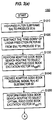
- CELP search loop 10 preferably, operates on a subframe basis, that is, each pass of flow diagram 1000 is performed on a single subframe in a sequence of subframes of digitized data. Further, each subframe, preferably, comprises a block of 40 samples of an input analog speech signal.
- step S1010 an input digitized speech signal S(n), which is the nth subframe of digitized data in a sequence of n subframes, is preprocessed by preprocessor 20.
- preprocessor 20 comprises a high pass filter for high pass filtering S(n) to produce S'(n), as is known to those skilled in the art. Control then passes to step S1020.
- step S1020 the "ring down,” i.e., the zero-input response, of linear prediction filter 60 is subtracted from S'(n) to produce S ⁇ (n), as is known to those skilled in the art. Control then passes to step S1030.
- step S1030 an adaptive codebook search routine is performed, whereby the contents of adaptive codebook 70 are sequentially searched and analyzed to select an optimal adaptive codebook excitation vector which, when processed by linear prediction filter 60, most nearly resembles S ⁇ (n).
- Linear prediction filter 60 comprises, for example, an all-pole filter which processes the incoming excitation vector into a synthesized speech signal SA m (n), as is known to those skilled in the art.
- difference signal DA m (n) is an indication of how closely excitation vector VA m (n), when multiplied by gain GA m (n) and processed by linear prediction filter 60, resembles S ⁇ (n). In particular, the smaller the difference signal DA m ,(n), the closer the resemblance.
- This difference signal is then weighted by weighting filter 120 and summed over the length of the subframe S(n) by summer 140. The output of summer 140 is then used to vary adaptive codebook index ACindex m (n) to select the next excitation vector from adaptive codebook 70, as is also known to those skilled in the art.
- the above adaptive codebook search routine continues until each of the vectors VA1(n) through VA p (n) is read from adaptive codebook 70, multiplied by a respective gain at multiplier 90, processed by linear prediction filter 60, and compared to S ⁇ (n).
- the optimal adaptive codebook excitation vector i.e., that excitation vector VA1(n) through VA p (n) which, when multiplied by its respective gain and processed by linear prediction filter 60, most nearly resembles S ⁇ (n)
- the optimal adaptive codebook excitation vector is found by comparing the difference signals produced at subtracter 40 for each excitation vector VA1(n) through VA p (n) and selecting the excitation vector which produces the smallest difference signal. As shown in FIG. 1, the optimal adaptive codebook excitation vector is designated as VA opt (n). Control then passes to step S1040.
- step S1040 an adaptive codebook residual signal, i.e., the difference signal produced by the subtraction of the synthesized speech signal corresponding to optimal adaptive codebook excitation vector VA opt (n) from S ⁇ (n) at subtracter 40, is provided at subtracter 50. As shown in FIG. 1, this residual signal is designated as R(n).
- control passes to step S1050.
- step S1050 a fixed codebook search routine is performed, whereby the contents of fixed codebook 80 are sequentially searched and analyzed to select an optimal fixed codebook excitation vector which, when processed by linear prediction filter 60, most nearly resembles residual signal R(n). It should be evident from the following that the fixed codebook search routine is somewhat similar to the adaptive codebook search routine.
- linear prediction filter 60 comprises, for example, an all-pole filter which processes the incoming excitation vector into a synthesized speech signal SF d (n), as is known to those skilled in the art.
- synthesized speech signal SF d (n) is subtracted from residual signal R(n) at subtracter 50 to produce a difference signal DF d (n).
- the difference signal DF d (n) is an indication of how closely excitation vector VF d (n), when multiplied by gain GF d (n) and processed by linear prediction filter 60, resembles residual signal R(n).
- This difference signal is then weighted by weighting filter 130 and summed over the length of subframe S(n) by summer 150.
- the output of summer 150 is then used to vary fixed codebook index FCindex d (n) to select the next excitation vector from fixed codebook 80, as is known to those skilled in the art.
- the above fixed codebook search routine continues until each of the vectors VF1(n) through VF r (n) is read from fixed codebook 80, multiplied by a respective gain at multiplier 100, processed by linear prediction filter 60, and compared to residual signal R(n).
- the optimal fixed codebook excitation vector i.e., that excitation vector VF1(n) through VF r (n) which, when multiplied by its respective gain and processed by linear prediction filter 60, most nearly resembles residual signal R(n) is applied to adder 110.
- the optimal fixed codebook excitation vector is found by comparing the difference signals produced at subtracter 50 for each excitation vector VF1(n) through VF r (n) and selecting the excitation vector which produces the smallest difference signal. As shown in FIG. 1, the optimal fixed codebook excitation vector is designated as VF opt (n). Upon completion of step S1050, control passes to step S1060.
- step S1060 optimal adaptive and fixed codebook excitation vectors VA opt (n) and VF opt (n) are added together by adder 110 to produce total excitation vector X(n). Control then passes to step S1070.
- Step S1070 will now be described in detail with reference to the block diagram shown in FIG. 2 and the flow diagram 2000 shown in FIG. 4.
- voicing measurer 190 of FIG. 1 comprises an average pitch prediction gain unit 200, an average pitch lag deviation unit 210, an average adaptive codebook gain unit 220, and classification logic 230.
- step 2010 voicing measurer 190 initializes pitch enhancement factor PEFACT.
- pitch enhancement factor PEFACT is initialized such that it equals one. Control then passes to step S2020.
- step S2020 average pitch prediction gain unit 200 determines an average pitch prediction gain APG.
- average pitch prediction gain unit 200 receives as input signals total excitation vector X(n) and adaptive codebook excitation vector VA m (n) and determines a pitch prediction gain PG, as follows: where N is the frame length of subframe S(n) and, as explained above preferably equals 40 samples. Then, average pitch prediction unit 200 determines average pitch prediction gain APG by averaging pitch prediction gain PG over M subframes, as follows: Preferably, M is equal to 5-10 subframes.
- control passes to step S2030.
- step S2030 classification logic 230 compares average pitch prediction gain APG to a first pitch prediction gain threshold APG thresh1 . It should be understood that the value of APG thresh1 depends on the application of the present invention and can be determined by one skilled in the art. If classification logic 230 determines that APG is greater than APG thresh1 , control passes to step S2090, wherein classification logic 230 sets voicing measure VM(n) equal to one (indicating that subframe S(n) is voiced) and control then passes to step S2100. Otherwise, control passes to step S2040.
- step S2040 average pitch lag deviation unit 210 determines an average pitch lag deviation APD.
- step S2050 classification logic 230 compares average pitch lag deviation APD to a first pitch lag threshold APD thresh1 .
- APD thresh1 the value of APD thresh1 depends on the application of the present invention and can be determined by one skilled in the art. If classification logic 230 determines that APD is less than APD thresh1 , control passes to step S2090, wherein classification logic 230 sets voicing measure VM(n) equal to one (indicating that subframe S(n) is voiced) and control then passes to step S2100. Otherwise, control passes to step S2060.
- step S2060 average adaptive codebook gain unit 220 determines an average adaptive codebook gain ACG.
- average adaptive codebook gain unit 220 receives as an input signal adaptive codebook gain GA m (n) and determines average adaptive codebook gain ACG, as follows: where, as explained above, M is the number of subframes over which the average is taken. Control then passes to step S2070.
- step S2070 classification logic 230 compares average pitch prediction gain to a second pitch prediction gain threshold APG thresh2 , compares average pitch lag deviation APD to a second pitch lag threshold APD thresh2 , and compares average adaptive codebook gain ACG to a first adaptive codebook gain threshold ACG thresh1 .
- classification logic 230 determines that APG is greater than APG thresh2 , that APD is less than APD thresh2 and that ACG is greater than ACG thresh1 , then control passes to step S2090, wherein classification logic 230 sets voicing measure VM(n) equal to one (indicating that subframe S(n) is voiced) and control then passes to step S2100. Otherwise, control passes to step S2080.
- step S2080 classification logic 230 sets voicing measure VM(n) equal to zero. As explained above, this indicates that subframe S(n) is unvoiced. Control then passes to step S2100.
- step S2100 control passes to step S2110.
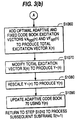
- step S2110 pitch pulse enhancer modifies total excitation vector X(n) to produce Y ⁇ (n) as shown above in Eqn. 1.0. Control then passes to step S1080 of FIG. 3(b).
- voicing measurer 190 determines the voicing measure of subframe S(n) by using only synthesis parameters, thereby eliminating the need of explicitly transmitting voicing information to the synthesis side of CELP search loop 10.
- step S1080 is provided to maintain the energy level of total excitation vector X(n) in Y(n).
- step S1070 has the effect of altering the total energy level of total excitation vector X(n) and step S1080 serves to restore the total energy of Y ⁇ (n) to that level.
- control passes to step S1090.
- step S1090 rescaler updates adaptive codebook 70 using Y(n).
- Y(n) is stored in adaptive codebook 70 as a new excitation vector for use in the processing of a subsequent input subframe, i.e., input signal S(n+1).
- Y(n) is stored in the last location of adaptive codebook 70, i.e., location p, thereby shifting the excitation vectors stored in previous locations forward and causing that vector stored in the first location to be discarded.
- control passes back to step S1010 wherein the entire process of FIGS. 3(a)-3(b) is performed on a subsequent input subframe S(n+1).
Landscapes
- Engineering & Computer Science (AREA)
- Signal Processing (AREA)
- Physics & Mathematics (AREA)
- Health & Medical Sciences (AREA)
- Audiology, Speech & Language Pathology (AREA)
- Human Computer Interaction (AREA)
- Computational Linguistics (AREA)
- Acoustics & Sound (AREA)
- Multimedia (AREA)
- Computer Networks & Wireless Communication (AREA)
- Compression, Expansion, Code Conversion, And Decoders (AREA)
- Electrically Operated Instructional Devices (AREA)
- Analogue/Digital Conversion (AREA)
- Transmission Systems Not Characterized By The Medium Used For Transmission (AREA)
Applications Claiming Priority (2)
| Application Number | Priority Date | Filing Date | Title |
|---|---|---|---|
| US97044792A | 1992-11-02 | 1992-11-02 | |
| US970447 | 1992-11-02 |
Publications (2)
| Publication Number | Publication Date |
|---|---|
| EP0596847A2 true EP0596847A2 (de) | 1994-05-11 |
| EP0596847A3 EP0596847A3 (de) | 1995-06-14 |
Family
ID=25516958
Family Applications (1)
| Application Number | Title | Priority Date | Filing Date |
|---|---|---|---|
| EP93850206A Withdrawn EP0596847A3 (de) | 1992-11-02 | 1993-10-29 | Adaptive Vorrichtung zur Verbesserung der Grundfrequenz-Impulse und Verfahren zur Verwendung in einer CELP-Suchschleife. |
Country Status (9)
| Country | Link |
|---|---|
| US (1) | US5528727A (de) |
| EP (1) | EP0596847A3 (de) |
| JP (1) | JPH06214599A (de) |
| KR (1) | KR960013961B1 (de) |
| AU (1) | AU654094B2 (de) |
| CA (1) | CA2108623A1 (de) |
| FI (1) | FI934615A7 (de) |
| NO (1) | NO933940L (de) |
| TW (1) | TW242724B (de) |
Cited By (7)
| Publication number | Priority date | Publication date | Assignee | Title |
|---|---|---|---|---|
| WO1997000516A1 (en) * | 1995-06-16 | 1997-01-03 | Nokia Mobile Phones Limited | Speech coder |
| US5799271A (en) * | 1996-06-24 | 1998-08-25 | Electronics And Telecommunications Research Institute | Method for reducing pitch search time for vocoder |
| WO1999045532A1 (en) * | 1998-03-04 | 1999-09-10 | Telefonaktiebolaget Lm Ericsson (Publ) | Speech coding including soft adaptability feature |
| WO2000011657A1 (en) * | 1998-08-24 | 2000-03-02 | Conexant Systems, Inc. | Completed fixed codebook for speech encoder |
| US6556966B1 (en) | 1998-08-24 | 2003-04-29 | Conexant Systems, Inc. | Codebook structure for changeable pulse multimode speech coding |
| US6714907B2 (en) | 1998-08-24 | 2004-03-30 | Mindspeed Technologies, Inc. | Codebook structure and search for speech coding |
| EP2154681A3 (de) * | 1997-12-24 | 2011-12-21 | Mitsubishi Electric Corporation | Verfahren und Vorrichtung zur Sprachdekodierung |
Families Citing this family (15)
| Publication number | Priority date | Publication date | Assignee | Title |
|---|---|---|---|---|
| KR100389895B1 (ko) * | 1996-05-25 | 2003-11-28 | 삼성전자주식회사 | 음성 부호화 및 복호화방법 및 그 장치 |
| US6470309B1 (en) * | 1998-05-08 | 2002-10-22 | Texas Instruments Incorporated | Subframe-based correlation |
| US7072832B1 (en) * | 1998-08-24 | 2006-07-04 | Mindspeed Technologies, Inc. | System for speech encoding having an adaptive encoding arrangement |
| US6240386B1 (en) * | 1998-08-24 | 2001-05-29 | Conexant Systems, Inc. | Speech codec employing noise classification for noise compensation |
| US6449313B1 (en) * | 1999-04-28 | 2002-09-10 | Lucent Technologies Inc. | Shaped fixed codebook search for celp speech coding |
| US6704701B1 (en) * | 1999-07-02 | 2004-03-09 | Mindspeed Technologies, Inc. | Bi-directional pitch enhancement in speech coding systems |
| US6959274B1 (en) | 1999-09-22 | 2005-10-25 | Mindspeed Technologies, Inc. | Fixed rate speech compression system and method |
| US20030135374A1 (en) * | 2002-01-16 | 2003-07-17 | Hardwick John C. | Speech synthesizer |
| KR100546758B1 (ko) * | 2003-06-30 | 2006-01-26 | 한국전자통신연구원 | 음성의 상호부호화시 전송률 결정 장치 및 방법 |
| US7536298B2 (en) | 2004-03-15 | 2009-05-19 | Intel Corporation | Method of comfort noise generation for speech communication |
| KR100795727B1 (ko) * | 2005-12-08 | 2008-01-21 | 한국전자통신연구원 | Celp기반의 음성 코더에서 고정 코드북 검색 장치 및방법 |
| MY152845A (en) * | 2006-10-24 | 2014-11-28 | Voiceage Corp | Method and device for coding transition frames in speech signals |
| EP2099025A4 (de) * | 2006-12-14 | 2010-12-22 | Panasonic Corp | Audiocodierungseinrichtung und audiocodierungsverfahren |
| PL3058568T3 (pl) * | 2013-10-18 | 2021-07-05 | Fraunhofer Gesellschaft zur Förderung der angewandten Forschung e.V. | Koncepcja kodowania sygnału audio i dekodowania sygnału audio z wykorzystaniem związanych z mową informacji kształtowania widmowego |
| ES3042587T3 (en) * | 2013-10-18 | 2025-11-21 | Fraunhofer Ges Forschung | Concept of encoding an audio signal and decoding an audio signal using deterministic and noise like information |
Family Cites Families (6)
| Publication number | Priority date | Publication date | Assignee | Title |
|---|---|---|---|---|
| US4910781A (en) * | 1987-06-26 | 1990-03-20 | At&T Bell Laboratories | Code excited linear predictive vocoder using virtual searching |
| US5060269A (en) * | 1989-05-18 | 1991-10-22 | General Electric Company | Hybrid switched multi-pulse/stochastic speech coding technique |
| JP2626223B2 (ja) * | 1990-09-26 | 1997-07-02 | 日本電気株式会社 | 音声符号化装置 |
| US5138661A (en) * | 1990-11-13 | 1992-08-11 | General Electric Company | Linear predictive codeword excited speech synthesizer |
| US5233660A (en) * | 1991-09-10 | 1993-08-03 | At&T Bell Laboratories | Method and apparatus for low-delay celp speech coding and decoding |
| US5327520A (en) * | 1992-06-04 | 1994-07-05 | At&T Bell Laboratories | Method of use of voice message coder/decoder |
-
1993
- 1993-10-18 CA CA002108623A patent/CA2108623A1/en not_active Abandoned
- 1993-10-19 FI FI934615A patent/FI934615A7/fi unknown
- 1993-10-25 AU AU50336/93A patent/AU654094B2/en not_active Ceased
- 1993-10-29 EP EP93850206A patent/EP0596847A3/de not_active Withdrawn
- 1993-11-01 KR KR1019930022970A patent/KR960013961B1/ko not_active Expired - Lifetime
- 1993-11-01 NO NO933940A patent/NO933940L/no unknown
- 1993-11-02 TW TW082109136A patent/TW242724B/zh active
- 1993-11-02 JP JP5274406A patent/JPH06214599A/ja active Pending
-
1995
- 1995-05-03 US US08/434,096 patent/US5528727A/en not_active Expired - Lifetime
Cited By (14)
| Publication number | Priority date | Publication date | Assignee | Title |
|---|---|---|---|---|
| ES2146155A1 (es) * | 1995-06-16 | 2000-07-16 | Nokia Mobile Phones Ltd | Sintetizadores de voz, metodos para sintetizar voz y para mejorar una voz sintetizada y los correspondientes dispositivo de radio y señal de sintesis. |
| AU714752B2 (en) * | 1995-06-16 | 2000-01-13 | Nokia Technologies Oy | Speech coder |
| WO1997000516A1 (en) * | 1995-06-16 | 1997-01-03 | Nokia Mobile Phones Limited | Speech coder |
| US5799271A (en) * | 1996-06-24 | 1998-08-25 | Electronics And Telecommunications Research Institute | Method for reducing pitch search time for vocoder |
| EP2154681A3 (de) * | 1997-12-24 | 2011-12-21 | Mitsubishi Electric Corporation | Verfahren und Vorrichtung zur Sprachdekodierung |
| US9263025B2 (en) | 1997-12-24 | 2016-02-16 | Blackberry Limited | Method for speech coding, method for speech decoding and their apparatuses |
| US9852740B2 (en) | 1997-12-24 | 2017-12-26 | Blackberry Limited | Method for speech coding, method for speech decoding and their apparatuses |
| WO1999045532A1 (en) * | 1998-03-04 | 1999-09-10 | Telefonaktiebolaget Lm Ericsson (Publ) | Speech coding including soft adaptability feature |
| US6058359A (en) * | 1998-03-04 | 2000-05-02 | Telefonaktiebolaget L M Ericsson | Speech coding including soft adaptability feature |
| EP1267329A1 (de) * | 1998-03-04 | 2002-12-18 | Telefonaktiebolaget L M Ericsson (Publ) | Sprachkodierung unter Verwendung einer weich einsetzenden Adaptation |
| WO2000011657A1 (en) * | 1998-08-24 | 2000-03-02 | Conexant Systems, Inc. | Completed fixed codebook for speech encoder |
| US6714907B2 (en) | 1998-08-24 | 2004-03-30 | Mindspeed Technologies, Inc. | Codebook structure and search for speech coding |
| US6173257B1 (en) | 1998-08-24 | 2001-01-09 | Conexant Systems, Inc | Completed fixed codebook for speech encoder |
| US6556966B1 (en) | 1998-08-24 | 2003-04-29 | Conexant Systems, Inc. | Codebook structure for changeable pulse multimode speech coding |
Also Published As
| Publication number | Publication date |
|---|---|
| FI934615A0 (fi) | 1993-10-19 |
| AU5033693A (en) | 1994-05-12 |
| JPH06214599A (ja) | 1994-08-05 |
| NO933940D0 (no) | 1993-11-01 |
| EP0596847A3 (de) | 1995-06-14 |
| NO933940L (no) | 1994-05-03 |
| KR960013961B1 (ko) | 1996-10-10 |
| US5528727A (en) | 1996-06-18 |
| FI934615A7 (fi) | 1994-05-03 |
| AU654094B2 (en) | 1994-10-20 |
| TW242724B (de) | 1995-03-11 |
| KR940012931A (ko) | 1994-06-24 |
| CA2108623A1 (en) | 1994-05-03 |
Similar Documents
| Publication | Publication Date | Title |
|---|---|---|
| US5528727A (en) | Adaptive pitch pulse enhancer and method for use in a codebook excited linear predicton (Celp) search loop | |
| KR100417635B1 (ko) | 광대역 신호들 코딩에서 적응성 대역폭 피치 검색 방법 및디바이스 | |
| JP3160852B2 (ja) | 会話の急速符号化のためのデプス第一代数コードブック | |
| US6594626B2 (en) | Voice encoding and voice decoding using an adaptive codebook and an algebraic codebook | |
| US6763330B2 (en) | Receiver for receiving a linear predictive coded speech signal | |
| AU666599B2 (en) | Voice coder system | |
| DE69934320T2 (de) | Sprachkodierer und verfahren zur codebuch-suche | |
| US5668925A (en) | Low data rate speech encoder with mixed excitation | |
| EP0802524B1 (de) | Sprachkodierer | |
| EP0766232B1 (de) | Vorrichtung zur Sprachkodierung | |
| EP0762386A2 (de) | Verfahren und Vorrichtung zur CELP-Kodierung eines Audiosignals mit Unterscheidung zwischen Sprach- und Nichtsprachabschnitten | |
| EP0342687B1 (de) | Überträgungssystem für codierte Sprache mit Codebüchern zur Synthetisierung von Komponenten mit niedriger Amplitude | |
| EP0815554A1 (de) | Linear-prädiktiver analyse-durch-synthese sprachkodierer | |
| EP0801377B1 (de) | Vorrichtung zur Signalkodierung | |
| US5434947A (en) | Method for generating a spectral noise weighting filter for use in a speech coder | |
| US5173941A (en) | Reduced codebook search arrangement for CELP vocoders | |
| EP1048024B1 (de) | Verfahren zur sprachkodierung bei hintergrundrauschen | |
| JP3137176B2 (ja) | 音声符号化装置 | |
| JP3616432B2 (ja) | 音声符号化装置 | |
| US5649051A (en) | Constant data rate speech encoder for limited bandwidth path | |
| US5797119A (en) | Comb filter speech coding with preselected excitation code vectors | |
| EP0744069B1 (de) | Lineare vorhersage durch impulsanregung | |
| EP1083548A2 (de) | Verfahren zur Regelung des Gewinnfaktors eines CELP Sprachdekodierers | |
| JPH08185199A (ja) | 音声符号化装置 | |
| JPH08320700A (ja) | 音声符号化装置 |
Legal Events
| Date | Code | Title | Description |
|---|---|---|---|
| PUAI | Public reference made under article 153(3) epc to a published international application that has entered the european phase |
Free format text: ORIGINAL CODE: 0009012 |
|
| 17P | Request for examination filed |
Effective date: 19931115 |
|
| AK | Designated contracting states |
Kind code of ref document: A2 Designated state(s): AT BE CH DE DK ES FR GB GR IT LI NL SE |
|
| PUAL | Search report despatched |
Free format text: ORIGINAL CODE: 0009013 |
|
| AK | Designated contracting states |
Kind code of ref document: A3 Designated state(s): AT BE CH DE DK ES FR GB GR IT LI NL SE |
|
| 17Q | First examination report despatched |
Effective date: 19970710 |
|
| STAA | Information on the status of an ep patent application or granted ep patent |
Free format text: STATUS: THE APPLICATION IS DEEMED TO BE WITHDRAWN |
|
| 18D | Application deemed to be withdrawn |
Effective date: 19980121 |