EP0597423B1 - Azetidinonverbindung und Verfahren zu ihrer Herstellung - Google Patents
Azetidinonverbindung und Verfahren zu ihrer Herstellung Download PDFInfo
- Publication number
- EP0597423B1 EP0597423B1 EP93118085A EP93118085A EP0597423B1 EP 0597423 B1 EP0597423 B1 EP 0597423B1 EP 93118085 A EP93118085 A EP 93118085A EP 93118085 A EP93118085 A EP 93118085A EP 0597423 B1 EP0597423 B1 EP 0597423B1
- Authority
- EP
- European Patent Office
- Prior art keywords
- group
- compound
- salt
- alkyl
- formula
- Prior art date
- Legal status (The legal status is an assumption and is not a legal conclusion. Google has not performed a legal analysis and makes no representation as to the accuracy of the status listed.)
- Expired - Lifetime
Links
- 0 CC(**)C(C([C@@](C)*N(C(*)CS1)C1=S)N1)C1=O Chemical compound CC(**)C(C([C@@](C)*N(C(*)CS1)C1=S)N1)C1=O 0.000 description 6
Classifications
-
- C—CHEMISTRY; METALLURGY
- C07—ORGANIC CHEMISTRY
- C07D—HETEROCYCLIC COMPOUNDS
- C07D401/00—Heterocyclic compounds containing two or more hetero rings, having nitrogen atoms as the only ring hetero atoms, at least one ring being a six-membered ring with only one nitrogen atom
- C07D401/02—Heterocyclic compounds containing two or more hetero rings, having nitrogen atoms as the only ring hetero atoms, at least one ring being a six-membered ring with only one nitrogen atom containing two hetero rings
- C07D401/06—Heterocyclic compounds containing two or more hetero rings, having nitrogen atoms as the only ring hetero atoms, at least one ring being a six-membered ring with only one nitrogen atom containing two hetero rings linked by a carbon chain containing only aliphatic carbon atoms
-
- C—CHEMISTRY; METALLURGY
- C07—ORGANIC CHEMISTRY
- C07D—HETEROCYCLIC COMPOUNDS
- C07D265/00—Heterocyclic compounds containing six-membered rings having one nitrogen atom and one oxygen atom as the only ring hetero atoms
- C07D265/04—1,3-Oxazines; Hydrogenated 1,3-oxazines
-
- A—HUMAN NECESSITIES
- A61—MEDICAL OR VETERINARY SCIENCE; HYGIENE
- A61P—SPECIFIC THERAPEUTIC ACTIVITY OF CHEMICAL COMPOUNDS OR MEDICINAL PREPARATIONS
- A61P31/00—Antiinfectives, i.e. antibiotics, antiseptics, chemotherapeutics
- A61P31/04—Antibacterial agents
-
- C—CHEMISTRY; METALLURGY
- C07—ORGANIC CHEMISTRY
- C07D—HETEROCYCLIC COMPOUNDS
- C07D205/00—Heterocyclic compounds containing four-membered rings with one nitrogen atom as the only ring hetero atom
- C07D205/02—Heterocyclic compounds containing four-membered rings with one nitrogen atom as the only ring hetero atom not condensed with other rings
- C07D205/06—Heterocyclic compounds containing four-membered rings with one nitrogen atom as the only ring hetero atom not condensed with other rings having one double bond between ring members or between a ring member and a non-ring member
- C07D205/08—Heterocyclic compounds containing four-membered rings with one nitrogen atom as the only ring hetero atom not condensed with other rings having one double bond between ring members or between a ring member and a non-ring member with one oxygen atom directly attached in position 2, e.g. beta-lactams
-
- C—CHEMISTRY; METALLURGY
- C07—ORGANIC CHEMISTRY
- C07D—HETEROCYCLIC COMPOUNDS
- C07D217/00—Heterocyclic compounds containing isoquinoline or hydrogenated isoquinoline ring systems
- C07D217/22—Heterocyclic compounds containing isoquinoline or hydrogenated isoquinoline ring systems with hetero atoms or with carbon atoms having three bonds to hetero atoms with at the most one bond to halogen, e.g. ester or nitrile radicals, directly attached to carbon atoms of the nitrogen-containing ring
- C07D217/24—Oxygen atoms
-
- C—CHEMISTRY; METALLURGY
- C07—ORGANIC CHEMISTRY
- C07D—HETEROCYCLIC COMPOUNDS
- C07D239/00—Heterocyclic compounds containing 1,3-diazine or hydrogenated 1,3-diazine rings
- C07D239/70—Heterocyclic compounds containing 1,3-diazine or hydrogenated 1,3-diazine rings condensed with carbocyclic rings or ring systems
- C07D239/72—Quinazolines; Hydrogenated quinazolines
- C07D239/86—Quinazolines; Hydrogenated quinazolines with hetero atoms directly attached in position 4
- C07D239/88—Oxygen atoms
-
- C—CHEMISTRY; METALLURGY
- C07—ORGANIC CHEMISTRY
- C07D—HETEROCYCLIC COMPOUNDS
- C07D265/00—Heterocyclic compounds containing six-membered rings having one nitrogen atom and one oxygen atom as the only ring hetero atoms
- C07D265/04—1,3-Oxazines; Hydrogenated 1,3-oxazines
- C07D265/12—1,3-Oxazines; Hydrogenated 1,3-oxazines condensed with carbocyclic rings or ring systems
-
- C—CHEMISTRY; METALLURGY
- C07—ORGANIC CHEMISTRY
- C07D—HETEROCYCLIC COMPOUNDS
- C07D265/00—Heterocyclic compounds containing six-membered rings having one nitrogen atom and one oxygen atom as the only ring hetero atoms
- C07D265/04—1,3-Oxazines; Hydrogenated 1,3-oxazines
- C07D265/12—1,3-Oxazines; Hydrogenated 1,3-oxazines condensed with carbocyclic rings or ring systems
- C07D265/14—1,3-Oxazines; Hydrogenated 1,3-oxazines condensed with carbocyclic rings or ring systems condensed with one six-membered ring
- C07D265/20—1,3-Oxazines; Hydrogenated 1,3-oxazines condensed with carbocyclic rings or ring systems condensed with one six-membered ring with hetero atoms directly attached in position 4
- C07D265/22—Oxygen atoms
-
- C—CHEMISTRY; METALLURGY
- C07—ORGANIC CHEMISTRY
- C07D—HETEROCYCLIC COMPOUNDS
- C07D279/00—Heterocyclic compounds containing six-membered rings having one nitrogen atom and one sulfur atom as the only ring hetero atoms
- C07D279/04—1,3-Thiazines; Hydrogenated 1,3-thiazines
- C07D279/08—1,3-Thiazines; Hydrogenated 1,3-thiazines condensed with carbocyclic rings or ring systems
-
- C—CHEMISTRY; METALLURGY
- C07—ORGANIC CHEMISTRY
- C07D—HETEROCYCLIC COMPOUNDS
- C07D403/00—Heterocyclic compounds containing two or more hetero rings, having nitrogen atoms as the only ring hetero atoms, not provided for by group C07D401/00
- C07D403/02—Heterocyclic compounds containing two or more hetero rings, having nitrogen atoms as the only ring hetero atoms, not provided for by group C07D401/00 containing two hetero rings
- C07D403/06—Heterocyclic compounds containing two or more hetero rings, having nitrogen atoms as the only ring hetero atoms, not provided for by group C07D401/00 containing two hetero rings linked by a carbon chain containing only aliphatic carbon atoms
-
- C—CHEMISTRY; METALLURGY
- C07—ORGANIC CHEMISTRY
- C07D—HETEROCYCLIC COMPOUNDS
- C07D413/00—Heterocyclic compounds containing two or more hetero rings, at least one ring having nitrogen and oxygen atoms as the only ring hetero atoms
- C07D413/02—Heterocyclic compounds containing two or more hetero rings, at least one ring having nitrogen and oxygen atoms as the only ring hetero atoms containing two hetero rings
- C07D413/06—Heterocyclic compounds containing two or more hetero rings, at least one ring having nitrogen and oxygen atoms as the only ring hetero atoms containing two hetero rings linked by a carbon chain containing only aliphatic carbon atoms
-
- C—CHEMISTRY; METALLURGY
- C07—ORGANIC CHEMISTRY
- C07D—HETEROCYCLIC COMPOUNDS
- C07D417/00—Heterocyclic compounds containing two or more hetero rings, at least one ring having nitrogen and sulfur atoms as the only ring hetero atoms, not provided for by group C07D415/00
- C07D417/02—Heterocyclic compounds containing two or more hetero rings, at least one ring having nitrogen and sulfur atoms as the only ring hetero atoms, not provided for by group C07D415/00 containing two hetero rings
- C07D417/06—Heterocyclic compounds containing two or more hetero rings, at least one ring having nitrogen and sulfur atoms as the only ring hetero atoms, not provided for by group C07D415/00 containing two hetero rings linked by a carbon chain containing only aliphatic carbon atoms
-
- C—CHEMISTRY; METALLURGY
- C07—ORGANIC CHEMISTRY
- C07D—HETEROCYCLIC COMPOUNDS
- C07D477/00—Heterocyclic compounds containing 1-azabicyclo [3.2.0] heptane ring systems, i.e. compounds containing a ring system of the formula:, e.g. carbapenicillins, thienamycins; Such ring systems being further condensed, e.g. 2,3-condensed with an oxygen-, nitrogen- or sulphur-containing hetero ring
- C07D477/02—Preparation
- C07D477/04—Preparation by forming the ring or condensed ring systems
Definitions
- This invention relates to a novel compound useful as a synthetic intermediate of a 1 ⁇ -methylcarbapenem derivative having an antibacterial activity, a process for preparation thereof and a use thererof.
- 1 ⁇ -Methylcarbapenem derivatives have been of great interests for their excellent antibacterial activities against a wide range of microorganisms including Gram positive and Gram negative bacteria, especially against Cephem-resistant bacteria, and their excellent stabilities in the human bodies.
- Said 1 ⁇ -methylcarbapenem derivatives have been synthesized by various processes up to now. In these processes, following three kinds of compounds have been known as the important synthetic intermediates :
- the above process is unsatisfactory in that the yield of the compound having the 1'-methyl group with ⁇ -configuration which shows an excellent pharmacological activity is low, because in preparing the compound [ A ] by the above process, said process is not the stereoselective synthetic process and the mixture of the compound [ A ] having the 1'-methyl group with ⁇ -configuration and ⁇ -configuration is obtained.
- various processes for stereoselectively preparing the compounds [ A ], [ B ] and [ C ] have been widely investigated and a typical process includes those utilizing the Aldol-type reaction or the Reformatsky-type reaction.
- Japanese Patent Publication (unexamined) No. 252786 of 1987 discloses a process for the preparation of the compound [ A ] in which R a is t-butyldimethylsilyloxyethyl group, which comprises reacting a compound of the formula [ D ] : with a propionamide compound of the formula : in the presence of dibutylboron triflate to give a compound of the formula : and then hydrolyzing the product.
- Japanese Patent Publication (unexamined) No. 284176 of 1988 discloses a process for the preparation of the compounds [ B ] and [ C ], which comprises reacting the compound [ D ] with a compound of the formula : in the presence of tin triflate to give a compound of the formula : , reacting the product with a compound of the formula : in the presence of imidazole, subjecting the product to diazotization, and then converting the product into the compound [ B ] or [C].
- Japanese Patent Publication (unexamined) Nos. 77384 of 1987, 169781 of 1987, 246550 of 1987 and 292269 of 1990 disclose the processes using the following compound instead of the above propionamide compound.
- Japanese Patent Publication (unexamined) No. 178262 of 1990 discloses a process for the preparation of the compound [ B ] or [ C ], which comprises reacting the compound [ D ] with an ⁇ -bromopropionamide compound of the formula : wherein Tr is triphenylmethyl group, in the presence of zinc to give a compound of the formula [E] : wherein Tr is the same as defined above, hydrolyzing the product to give the compound [A] and then converting the product into the compound [ B ] or [ C ].
- Japanese Patent Publication (unexamined) Nos. 10765 of 1988 and 188662 of 1988 disclose the processes using the following compound instead of the above ⁇ -bromopropionamide compound.
- the process utilizing the Reformatsky-type reaction has some defects in that ⁇ -methyl group can not be introduced stereoselectively or in that it is difficult to synthesize the ⁇ -bromopropionic acid compound.
- ⁇ -methyl group-introduced product into the compound [ B ] or [C]
- An object of the present invention is to provide a novel azetidinone compound useful as a synthetic intermediate of a 1 ⁇ -methylcarbapenem derivative having an antibacterial activity. Another object is to provide a novel synthetic intermediate which can be converted into not only the compound [ A ] by hydrolysis but also the 1 ⁇ -methylcarbapenem compound by introducing a protected or unprotected carboxymethyl group to N-position thereof, and then subjecting the product to intramolecular cyclization. Another object is to provide a novel process for preparing the above synthetic intermediate stereoselectively by making use of the Reformatsky reaction. Still another object is to provide a novel process for preparing a 1 ⁇ -methylcarbapenem derivative or an intermediate thereof using the above synthetic intermediate.
- substituent on Ring B examples include a halogen atom, a lower alkyl group, a lower alkoxy group, and an aryl group, and the benzene ring may have one to four substituent(s) which is (are) the same or different.
- R 1 examples include a 1-hydroxyethyl group which may be protected, and the protecting group of hydroxy group include any group which is used conventionally as a protecting group of hydroxy group.
- the protecting group of hydroxy group include a lower alkoxy-carbonyl group, a halogeno-lower alkoxy-carbonyl group, an lower alkyl group substituted by a pheny group which may have substituent(s) (e.g., a benzyl group which may be substituted by nitro group or a lower alkoxy group), a tri-lower alkylsilyl group, a lower alkoxy-carbonyl group substituted by a pheny group which may have substituent(s) (e.g., a benzyloxycarbonyl group which may be substituted by nitro group or a lower alkoxy group).
- Examples of the substituent on the imino group (Y) include a lower alkyl group, an acyl group, and an aralkyloxycarbonyl group.
- Examples of the substituent on the methylene group (Z) include a C 3-7 alkylene group which may have substituent(s), a C 1-20 alkyl group which may have substituent(s), a C 4-7 cycloalkyl group which may have substituent(s), an aryl group, an aralkyl group, and a heterocyclic group, and one to two substituent(s) which are the same or different may be substituted on the methylene group.
- acyl group examples include a lower alkanoyl group, a lower alkoxy-carbonyl group, a substituted or unsubstituted phenylcarbonyl group or a substituted or unsubstituted phenyl-lower alkoxycarbonyl group; those of an aryl group include a substituted or unsubstituted phenyl group; those of an aralkyl group include a lower alkyl group substituted by a substituted or unsubstituted phenyl group; and those of a heterocyclic group include a substituted or unsubstituted 4- to 7-membered heterocyclic group containing oxygen atom, nitrogen atom or sulfur atom as a hetero atom (e.g., furyl group, pyrrolyl group, thienyl group).
- a heterocyclic group include a substituted or unsubstituted 4- to 7-membered heterocyclic group containing oxygen atom, nitrogen atom or sulfur
- examples of the substituent on the above alkylene moiety, alkyl moiety, cycloalkyl moiety, phenyl moiety and heterocyclic moiety include a lower alkyl group, a lower alkoxy group, a halogen atom and an amino group which may be protected.
- a protecting group of an amino group any group which is conventionally used as a protecting group of the amino group in the field of Peptide Chemistry may,be used.
- preferred compounds are those of the formula [ I ] wherein the 3-position of the azetidinone skeleton has S configuration, Ring B is a benzene ring which may be substituted by a halogen atom, a lower alkyl group or a lower alkoxy group, Y is oxygen atom, sulfur atom, methylene group or an imino group substituted by a lower alkyl group, and Z is a methylene group which may be substituted by one to two group(s) selected from a group consisting of a C 3-7 alkylene group, a C 1-20 alkyl group and an aralkyl group.
- more preferred compounds are those of the formula [ I ] wherein Ring B is an unsubstituted benzene ring, X is oxygen atom, Y is oxygen atom, and Z is a methylene group substituted by a C 3-7 alkylene group, a methylene group substituted by a di- C 1-20 alkyl group or a methylene group substituted by a di-(phenyl-lower alkyl)group.
- Another more preferred compounds are those of the formula [ I ] wherein a substituent of Z is a bulky group such as a C 4-7 alkylene group, a C 4-20 alkyl group, or a phenyl-lower alkyl group
- most preferred compounds are those of the formula [ I ] wherein Z is pentamethylene-substituted methylene group (i.e., cyclohexylidene group) or dibutyl-substituted methylene group.
- the compound [ I ] may exist in the form of two optical isomers and this invention includes these optical isomers and a mixture thereof.
- Examples of a salt of the azetidinone compound [ I ] include an inorganic acid addition salt such as hydrochloride, hydrobromide, sulfate and the like, and an organic acid addition salt such as acetate, oxalate, tartrate, fumarate, maleate, and benzenesulfonate
- the azetidinone compound [I] ] can be prepared by reacting an ⁇ -halopropionamide compound [II] or a salt thereof with a compound of the formula [III]: wherein L 1 is a leaving group, and R 1 is the same as defined above.
- the reaction of the ⁇ -halopropionamide compound [ II ] with the compound [III] can be preferably carried out in an appropriate solvent in the presence of a metal compound which is used in the Grignard-type reaction, especially a metal compound which suitably forms a chelate between the compounds [II] ] and [III].
- a metal compound which is used in the Grignard-type reaction especially a metal compound which suitably forms a chelate between the compounds [II] ] and [III].
- metal compound includes zinc, magnesium, magnesium-magnesium bromide, tin, zinc-copper couple, zinc chloride-lithium naphthylide, lithium and aluminum.
- preferred examples are zinc and magnesium.
- As the leaving group (L 1 ) any leaving group which can be easily replaced by a nucleophilic agent can be used.
- any leaving group which can easily separates from the compound [III] together with the halogen atom (L 0 ) of the ⁇ -halopropionamide compound [II] and then a carbon-carbon bond can be formed, may be used.
- groups include an acyloxy group, a lower alkylsulfonyloxy group, an arylsulfonyloxy group, a lower alkylsulfonyl group, an arylsulfonyl group, an arylthio group and a halogen atom.
- an acyloxy group is preferred.
- any inert solvent can be used. For example, tetrahydrofuran, toluene, xylene, dimethoxyethane, dimethylformamide, and dimethylsulfoxide are preferably used.
- the ⁇ -halopropionamide compound [II] is used in an amount of 1 to 3 moles, preferably 1.3 to 1.7 moles, per one mole of the compound [III].
- the metal compound e.g., zinc, magnesium
- the reaction is preferably carried out in the presence of a halogenated compound such as methyl iodide or 1,2-dibromoethane or a mixture of such halogenated compound and iodine.
- a halogenated compound such as methyl iodide or 1,2-dibromoethane or a mixture of such halogenated compound and iodine.
- This reaction is preferably carried out at a temperature of -20 to 100 °C, especially at a temperature of 50 to 80 °C in the case of using zinc and at a temperature of -20 to 30 °C in the case of using magnesium.
- a Lewis acid e.g., zinc bromide, triethylboran, trimethylsilylchloride, magnesium bromide
- the reaction is accelerated and the reaction time can be shortened.
- the ⁇ -halopropionamide compound [II] which is one of the starting compounds of the present invention is a novel compound and can be prepared by reacting a benzene compound of the formula [IV] ]: wherein symbols are the same as defined above or a salt thereof, with a 2-halogenopropionic acid compound of the formula [ V ] : wherein L 0 is the same as defined above, a salt or a reactive derivative thereof.
- the reaction of the benzene compound [ IV ] with the 2-halogenopropionic acid compound [ V ] can be preferably carried out in an appropriate solvent in the presence of a dehydrating agent.
- a dehydrating agent include carbonyldiimidazole, dicyclohexylcarbodiimide, N-hydroxysuccinimide, and 1-hydroxybenzotriazole, Ether, methylene chloride, tetrahydrofuran, and acetonitrile are preferably used as the solvent.
- the reaction is preferably carried out at a temperature of -30 to 70 °C, especially at a temperature of 0 to 30 °C.
- reaction of the benzene compound [IV] with the reactive derivative of the 2-halogenopropionic acid compound [ V ] can be carried out in an appropriate solvent in the presence of an acid acceptor.
- the reactive derivative of the 2-halogenopropionic acid compound [ V ] include the corresponding acid halide or acid anhydride
- the acid acceptor examples include bases such as an alkali metal hydride, an alkali metal, a lower alkyl lithium, phenyllithium, pyridine and a di-lower alkyl aniline.
- bases such as an alkali metal hydride, an alkali metal, a lower alkyl lithium, phenyllithium, pyridine and a di-lower alkyl aniline.
- Ether, benzene, dichloromethane, and chloroform are preferably used as the solvent.
- the reaction is preferably carried out at a temperature of -80 to 50 °C.
- a desired 1 ⁇ -methylcarbapenem type antibacterial agent can be prepared, for example, by reacting the azetidinone compound [ I ] or a salt thereof with an acetic acid compound of the formula [ VI ] : L 2 ⁇ CH 2 ⁇ COOR 2 wherein R 2 is hydrogen atom or an ester residue, and L 2 is a leaving group, or a salt thereof to give a N-substituted azetidinone compound of the formula [VII]: wherein symbols are the same as defined above, subjecting the compound [VII] ] or a salt thereof to intramolecular cyclization, subjecting the product to esterification to give a 1 ⁇ -methyl-2-oxycarbapenem derivative of the formula [VIII]: wherein a group of the formula :
- a 1 ⁇ -methylcarbapenem derivative of the formula [ X ] : wherein R 11 is a hydroxy-substituted lower alkyl group which may be protected, R 21 is a hydrogen atom or an ester residue and R 3 is an organic group, or a salt thereof, may be prepared by carrying out the following three steps in arbitrary orders ;
- R 2 in the acetic acid compound [VI] in the N-substituted azetidinone compound [VII] or in the 1 ⁇ -methyl-2-oxycarbapenem derivative [VIII] ] and R 21 in the 1 ⁇ -methylcarbapenem derivative [ X ] are ester residues, examples of such ester residues include those which can be metabolized or hydrolyzed in the human body or those which can be used as a protecting group of carboxyl group.
- ester residue which can be metabolized or hydrolyzed in the human body examples include a group of the formula : -Q-OCOR 4 , -Q-OCO 2 R 4 or -Q-O-R 4 (wherein Q is a lower alkylene group, and R 4 is a lower alkyl group, a cycloalkyl group, a lower alkenoyl group, a lower alkoxy-lower alkyl group or a lower alkanoyloxy-lower alkyl group).
- ester residue examples include a lower alkanoyloxy-lower alkyl group, a cycloalkylcarbonyloxy-lower alkyl group, a lower alkenoyloxy-lower alkyl group, a lower alkoxy-lower alkanoyloxy-lower alkyl group, a lower alkanoyloxy-lower alkoxy-lower alkyl group, a lower alkoxy-lower alkyl group, a lower alkoxy-lower alkoxy-lower alkyl group, a lower alkoxy-carbonyloxy-lower alkyl group, and a lower alkoxy-lower alkoxy-carbonyloxy-lower alkyl group.
- ester residue which can be used as a protecting group of carboxyl group examples include any one which can be easily removed by a conventional method, for example, a lower alkyl group, a lower alkenyl group, a halogeno-lower alkyl group, nitrobenzyl group, a lower alkoxy-benzyl group, and a benzhydryl group.
- esterified hydroxy group of the formula : -OA examples include those which can be easily replaced by the group : -SR 3 , for example, a di-arylphosphoryloxy (e.g., diphenylphosphoryloxy) or di-lower alkylphosphoryloxy group shown by a formula : -OP(O)(OR 0 ) 2 (wherein R 0 is an aryl group or a lower alkyl group), an unsubstituted or substituted lower alkylsulfonyloxy group (e.g., methanesulfonyloxy group, ethanesulfonyloxy group, trifluoromethanesulfonyloxy group), an unsubstituted or substituted arylsulfonyloxy group (e.g., benzenesulfonyloxyy group, toluenesulfonyloxy group), a lower alkanoyloxy group (e.g., acet
- the preferred examples include the esterified hydroxy group such as a di-arylphosphoryloxy group, a di-lower alkylphosphoryloxy group, an unsubstituted or substituted lower alkylsulfonyloxy group, and an unsubstituted or substituted arylsulfonyloxy group
- Examples of such group include a lower alkyl group, a cycloalkyl group, a phenyl group, a 4- to 8-membered aliphatic heterocyclic group, a 4- to 8-membered heteroaromatic ring.
- those groups may have one or more substituent(s), and examples of such substituents include a lower alkyl group, hydroxy group, a lower alkoxy group, a lower alkylamino group, mercapto group, a lower alkylthio group, amidino group, guanidino group, carbamoyl group, thiocarbamoyl group, sulfamoyl group, cyano group, carboxyl group, a lower alkoxy-carbonyl group, an aralkyloxycarbonyl group, oxo group, a halogen atom, a cycloalkyl group, a phenyl group, a 4- to 8-membered aliphatic heterocyclic group, a 4- to 8-membered heteroaromatic ring.
- substituents include a lower alkyl group, hydroxy group, a lower alkoxy group, a lower alkylamino group, mercapto group, a lower alkyl
- the reaction of the azetidinone compound [ I ] with the acetic acid compound [VI] ] can be carried out in an appropriate solvent in the presence of a base.
- the leaving group (L 2 ) include a halogen atom, an acyloxy group and a sulfonyloxy group (e.g., p-toluenesulfonyloxy group or methanesulfonyloxy group).
- the base examples include an organic base such as 1,8-diazabicyclo[5.4.0.]undec-7-en, an alkali metal compound such as an alkali metal hydride, an alkali metal hydroxide or an alkali metal carbonate and a metal salt of amine such as sodium amide, lithium diisopropylamide and sodium bis(trimethylsilyl)amide. Tetrahydrofuran, benzene, dichloromethane and the like may be used as the solvent.
- the reaction is preferably carried out at a temperature of -50 to -20 °C.
- the intramolecular cyclization of the N-substituted azetidinone compound [VII] can be carried out in the presence of a base.
- a base include those which are used in the Dieckmann-type reaction, for example, an alkali metal salt of amine (e.g., sodium bis(trimethylsilyl)amide, lithium bis(trimethylsilyl)amide), an alkali metal salt of alcohol (e.g., potassium tert-butoxide), and an alkali metal hydride (e.g., sodium hydride).
- the base may be used in an amount of 1.0 to 3.0 moles, preferably 2.0 to 2.5 moles, per one mole of the compound [VII]. ].
- the solvent examples include tetrahydrofuran, ethylene glycol dimethyl ether, dioxane, toluene, diethyl ether, and benzene.
- the reaction is preferably carried out at a temperature of -78 to 50 °C, especially at a temperature of -60 to 10 °C.
- the compound having a structure of the formula [ XI ]: wherein symbols are the same as defined above is produced in this intramolecular cyclization.
- the intramolecular cyclization product thus obtained may be isolated from the reaction mixture or subjected to the subsequent esterification without isolation. However, the intramolecular cyclization and the esterification may be preferably carried out subsequently in the same solvent without isolating the cyclization product.
- the esterification of the intramolecular cyclization product can be carried out by reacting it with an esterifying reagent for hydroxy group.
- the esterifying reagent for hydroxy group include a reactive derivative (e.g., a corresponding acid halide, a corresponding acid anhydride) of a di-aryl phosphate (e.g., diphenyl phosphate), a di-lower alkyl phosphate (e.g., diethyl phosphate), an unsubstituted or substituted lower alkanesulfonic acid (e.g., methanesulfonic acid, ethanesulfonic acid, trifluoromethanesulfonic acid), an unsubstituted or substituted arylsulfonic acid (e.g., benzenesulfonic acid, toluenesulfonic acid), a lower alkanoic acid (e.g., acetic acid) or an arylcarbox
- the preferred esterifying reagents for hydroxy group include the reactive derivative (e.g., a corresponding acid halide, a corresponding acid anhydride) of a di-aryl phosphate, a di-lower alkylphosphate, an unsubstituted or substituted lower alkanesulfonic acid or an unsubstituted or substituted arylsulfonic acid.
- the esterifying reagent for hydroxy group may be used in an amount of 1.0 to 4.0 moles, preferably 2.0 to 3.0 moles, per one mole of the compound [VII].
- the reaction is preferably carried out at a temperature of -75 to 40 °C, especially at a temperature of -60 to 10 °C.
- the intramolecular cyclization and/or the esterification can be carried out in the presence or absence of an acid, but it is preferred to carry out the reaction in the presence of an acid.
- an acid Both a Lewis acid and a protonic acid can be used as the acid, but the Lewis acid may be preferably used.
- the protonic acid is used as the acid in the intramolecular cyclization, it must be added into a reaction vessel after addition of the base.
- the Lewis acid examples include a metal halide such as cupric chloride, cuprous iodide, zinc chloride, zinc iodide, zinc fluoride, ferric chloride, stannous chloride, and stannic chloride, a silyl compound such as a tri-lower alkyl halogenosilane (e.g., trimethylchlorosilane, t-butyldimethylchlorosilane), and tetrahalogenosilane (e.g., tetrachlorosilane).
- the Lewis acid may be used in an amount of 0.1 to 2.0 moles, preferably 1.0 to 1.5 moles, per one mole of the compound [VII].
- Examples of the protonic acid include sulfuric acid, p-toluenesulfonic acid, acetic acid, citric acid, hydrochloric acid, phosphoric acid and boric acid.
- the protonic acid may be used in an amount of 0.1 to 1.0 mole per one mole of the compound [VII].
- the esterifying reagent may be preferably used in an amount of 1.2 to 1.5 moles per one mole of the compound [VII].
- the reaction of the 1 ⁇ -methyl-2-oxycarbapenern derivative [VIII] with the thiol compound [ IX ], the optional step for removing the hydroxy-protecting group of the compound [VIII] in which R 1 is a protected hydroxy-substituted lower alkyl group and the optional step for removing the ester residue of R 2 of the compound [VIII] in which R 2 is an ester residue may be carried out in a conventional method.
- the removal of the hydroxy-protecting group of R 1 or the ester residue of R 2 may be performed by hydrolysis or reduction.
- the azetidinone compound [ I ] or a salt thereof can be converted by hydrolysis thereof into an azetidinonepropionic acid compound (an excellent synthetic intermediate of the carbepenem-type compound) of the formula [XII]: wherein R 1 is the same as defined above, and further the compound [XII] ] or a salt thereof can be converted into the compound [VIII] or a salt thereof in a conventional method, for example, according to the method described in Japanese Patent Publication (unexamined) No. 123182 of 1982.
- the hydrolysis of the compound [ I ] or a salt thereof can be carried out in a conventional method, but it is preferably carried out in an appropriate solvent in the presence of hydrogen peroxide and an alkali metal hydroxide.
- the solvent include a mixture of water and an organic solvent such as dioxane, tetrahydrofuran, dimethylformamide or methanol, preferably a mixture of water and tetrahydrofuran.
- the alkali metal hydroxide include lithium hydroxide, sodium hydroxide and potassium hydroxide, preferably lithium hydroxide.
- Hydrogen peroxide may be used in an amount of 1 to 10 moles, preferably 6 to 8 moles, per one mole of the compound [ I ], and the alkali metal hydroxide may be used in an amount of 1 to 5 moles, preferably 2 to 3 moles, per one mole of the compound [ I ]. It is preferred to carry out the reaction at a temperature of -10 to 30 °C, especially at a temperature of -5 to 5°C.
- the compounds [ I ], II], [ IV ], [V], [ VI ], [ VII ], [ VIII ], [ IX ], [ X ], [ XI ] and [XII] ] may be also used in the form of an appropriate salt thereof which is suitable for each of the above compounds.
- Such salt examples include a metal salt such as sodium salt or potassium salt; an amine salt such as trialkylamine salt, pyridine salt, ethanolamine salt, triethanolamine salt or dicyclohexylamine salt; an inorganic acid addition salt such as hydrochloride, hydrobromide or sulfate; and an organic acid addition salt such as acetate, oxalate, tartrate, fumarate, maleate or benzenesulfonate.
- a metal salt such as sodium salt or potassium salt
- an amine salt such as trialkylamine salt, pyridine salt, ethanolamine salt, triethanolamine salt or dicyclohexylamine salt
- an inorganic acid addition salt such as hydrochloride, hydrobromide or sulfate
- an organic acid addition salt such as acetate, oxalate, tartrate, fumarate, maleate or benzenesulfonate.
- the azetidinone compound [I] ] or a salt tereof can be converted into the 1 ⁇ -methyl-2-oxycarbapenem derivative [VIII] ] or a salt tereof and the 1 ⁇ -methylcarbapenem derivative [X] ] or a salt tereof with retaining the stereo-structure.
- the benzene compound [ IV ] in which Y is oxygen atom, sulfur atom or an imino group which may have substituent(s) may be prepared according to the method described in Journal of the American Chemical Society Vol.72, p721 (1950).
- the compound [XIII] ] in which X is oxygen atom and Y is sulfur atom may be prepared by halogenating a compound of the formula [XV]: wherein Ring B is the same as defined above, to give a compound of the formula [ XVI ]: wherein X 2 is a halogen atom, and Ring B is the same as defined above, subjecting the compound [ XVI ] to amidation to give a compound of the formula [XVII]: wherein Ring B is the same as defined above, and then reducing the compound [XVII].
- the compound [XIII] in which X is oxygen atom and Y is an imino group which may have substituent(s) may be prepared by reacting a compound of the formula [XVIII] : wherein Y 1 is an imino group which may have substituent(s), and other symbols are the same as defined above, with ammonia.
- the compound [XIII] in which X is sulfur atom and Y is sulfur atom or an imino group which may have substituent(s) may be prepared by subjecting the compound [XIII] in which X is oxygen atom and Y is sulfur atom or an imino group which may have substituent(s) to thiocarbonylation.
- the benzene compound [IV] ] in which Y is methylene group may be prepared by reacting the compound of the formula [ XIX ] : wherein L 3 is a halogen atom or hydroxy group, and Ring B is the same as defined above, with a compound of the formula [XX] : HZ-NO 2 wherein Z is the same as defined above, to give a compound of the formula [XXI]: wherein symbols are the same as defined above, reducing the compound [ XXI ] to give a compound of the formula [XXII]: wherein symbols are the same as defined above, reacting the product with a compound of the formula [XXIII]: wherein X is the same as defined above, and then subjecting the product to intramolecular cyclization.
- the condensation reaction of the compound [XIII] with the compound [ XIV ] may be carried out in an appropriate solvent in the presence of an acid.
- the acid include an organic acid (e.g., p-toluenesulfonic acid) and an inorganic acid (e.g., sulfuric acid, hydrochloric acid).
- the preferred solvent include an organic solvent which has a boiling point higher than water (e.g., toluene). It is preferred to carry out the reaction at a temperature of 50 to 180 °C,especially at a temperature of 80 to 130 °C.
- the halogenation of the compound [ XV ] may be carried out by treating the compound with a halogenating agent in an appropriate solvent.
- a halogenating agent include thionyl chloride and phosphorus oxychloride
- the solvent include an inert one such as toluene. It is preferred to carry out the reaction at a temperature of 20 to 120 °C, especially at a temperature of 70 to 80 °C.
- the amidation of the compound [ XVI ] may be carried out by treating the compound with ammonia in an appropriate solvent.
- Ammonia may be preferably used in the form of aqueous ammonia, and examples of the preferred solvent include a solvent which can be mixed with water, for example, ethers such as dioxane and alcohols such as ethanol. It is preferred to carry out the reaction at a temperature of 30 to 120 °C, especially at a temperature of 80 to 90 °C.
- the reduction of the compound [ XVII ] may be carried out in an appropriate solvent in the presence of zinc and an acid catalyst.
- acid catalyst include an inorganic acid such as hydrochloric acid
- preferred solvent include ethers such as dioxane. It is preferred to carry out the reaction at a temperature of 40 to 100 °C, especially at a temperature of 60 to 70 °C.
- the reaction of the compound [XVIII] with ammonia may be carried out in an appropriate solvent.
- Ammonia may be used in the form of aqueous ammonia, and examples of the preferred solvent include water, ethers which can be mixed with water (e.g., dioxane) and alcohols (e.g., ethanol). It is preferred to carry out the reaction at a temperature of 0 to 100 °C, especially at a temperature of 25 to 80 °C.
- the thiocarbonylation of the compound [XIII] in which X is oxygen atom and Y is sulfur atom or an imino group which may have substituent(s) may be carried out by treating the compound with a thiocarbonylation agent in an appropriate solvent.
- a thiocarbonylation agent examples include 2,4-bis (4-methoxyphenyl)-1,3-dithia-2,4-diphosphetane-2,4-disulfide, 2,4-dimethyl-1,3-dithia-2,4-diphosphetane-2,4-disulfide and phosphorus pentasulfide.
- the solvent examples include any inert one such as dimethoxyethane, pyridine, xylene, toluene and benzene. It is preferred to carry out the reaction at a room temperature or under heating, especially at a temperature of 60 to 100 °C.
- the reaction of the compound [ XIX ] with the compound [XX] may be carried out in an appropriate solvent in the presence of an acid acceptor.
- the acid acceptor include an alkali metal hydride, an alkali metal, an alkali metal fluoride, a lower alkyl-lithium and phenyllithium.
- the solvent include dimethylformamide and tetrahydrofuran. It is preferred to carry out the reaction under cooling or with heating, for example, at a temperature of 30 to 120 °C, especially at a temperature of 30 to 80 °C.
- the reduction of the compound [ XXI ] may be carried out in an appropriate solvent either by treating the compound with a reducing agent or by catalytic hydrogenation.
- examples of the reducing agent include a metal hydride such as lithium aluminum hydride, sodium bis (methoxyethoxy)aluminum hydride and sodium borohydride
- examples of the solvent include ethers such as tetrahydrofuran, diethyl ether and dioxane. It is preferred to carry out the reaction at a temperature of 0 to 100 °C, especially at a temperature of 30 to 60 °C.
- the catalyst in the case of catalytic hydrogenation, preferred examples of the catalyst include palladium-carbon and palladium-black.
- the solvent include alcohols such as methanol and ethanol. It is preferred to carry out the reaction at a temperature of 0 to 70 °C, especially at a temperature of 20 to 30 °C.
- the reaction of the compound [ XXII ] with the compound [ XXIII ] may be carried out in an appropriate solvent in the presence or absence of an acid acceptor.
- the acid acceptor include a base such as an alkali metal, an alkali metal hydride, an alkali metal hydroxide, an alkali metal alkoxide, an alkali earth metal hydroxide,an alkali earth metal alkoxide, a lower alkyl-lithium, phenyllithium, pyridine and di-lower alkylaniline.
- the solvent include dimethylformamide, tetrahydrofuran and ether.
- the subsequent intramolecular cyclization of the product may be carried out in the presence of a dehydrating agent.
- the dehydrating agent include polyphosphoric acid and phosphorus oxychloride.
- the solvent include an inert one such as toluene and benzene. It is preferred to carry out the reaction at a temperature of 50 to 150 °C, especially at a temperature of 80 to 130 °C.
- lower alkyl group examples include a straight-chain or branch-chain alkyl group of 1 to 6, preferably 1 to 4 carbon atoms, a straight-chain or branch-chain alkylene group of 1 to 6, preferably 1 to 4 carbon atoms and a straight-chain or branch-chain alkoxy group of 1 to 6, preferably 1 to 4 carbon atoms, respectively.
- lower alkanoyl group and “lower alkenyl group” include a straight-chain or branch-chain alkanoyl group of 2 to 8, preferably 2 to 6 carbon atoms and a straight-chain or branch-chain alkenyl group of 2 to 8, preferably 2 to 6 carbon atoms, respectively.
- lower alkenoyl group and “cycloalkyl group” include a straight-chain or branch-chain alkenoyl group of 3 to 8, preferably 3 to 6 carbon atoms and a cycloalkyl group of 3 to 8, preferably 4 to 7 carbon atoms, respectively.
- a solution of 89.1 ml of 2-bromopropionyl bromide in 95 ml of methylene chloride and a solution of 61.13 g of pyridine in 95 ml of methylene chloride are added dropwise to a suspension of 140 g of spiro[2,3-dihydro-4H-1,3-benzoxazine-2,1'-cyclohexan]-4-one in 190 ml of methylene chloride under nitrogen atmosphere at -5 °C during about 45 minutes. Then the mixture is stirred at a room temperature for 6 hours. The reaction mixture is poured into 5oo ml of water and the mixture is extracted with methylene chloride.
- the pH of the mixture is adjusted to about 10 by adding dropwise 5 ml of 1.5N aqueous sodium sulfite at the same temperature and tetrahydrofuran is removed under reduced pressure.
- the precipitated crystals are removed by filtration and the aqueous layer of the filtrate is washed with 20 ml of chloroform.
- 10 ml of 10% hydrochloric acid are added thereto and the pH of the mixture is adjusted to about one.
- the aqueous layer is extracted with 30 ml of ethyl acetate.
- the ethyl acetate layer is dried and then evaporated under reduced pressure to give the crude product.
- a mixture of 10 ml of tetrahydrofuran and a small amount of iodine is added to 437 mg of magnesium piece at a room temperature and 0.75 g of 1,2-dibromoethane are added dropwise thereto with stirring.
- a solution of 1.51 g of 1,2-dibromoethane in 3 ml of tetrahydrofuran is added dropwise thereto. Then, the mixture is refluxed for 30 minutes.
- the mixture is cooled to a temperature of 5 °C and to this cooled liquid is added dropwise a mixture of 1.15 g of (3R, 4R)-4-acetoxy-3-[(1R)-1-t-butyldimethylsilyloxyethyl]-2-azetidinone and 2.11 g of 3-(2-bromopropionyl)-spiro[2,3-dihydro-4H-1,3-benzoxazine-2,1'-cyclohexan]-4-one in 5 ml of tetrahydrofuran. Then, the mixture is stirred at 10 °C for one hour.
- Nitrocyclohexane and benzylbromide are subjected to condensation reaction in the presence of sodium hydride to obtain 1-benzyl-1-nitrocyclohexane.
- the product is reduced with lithium aluminum hydride to obtain 1-benzyl-1-aminocyclohexane.
- the product is reacted with methyl chloroformate to obtain 1-benzyl-1-methoxycarbonylaminocyclohexane, and the product is subjected to intramolecular cyclization in the presence of phosphorous oxychloride to obtain spiro[1,2,3,4-tetrahydroisoquinoline-2,1'-cyclohexan]-1-one.
- the azetidinone compound [ I ] or a salt thereof can be prepared stereoselectively.
- Said azetidinone compound [ I ] is a useful synthetic intermediate of the 1 ⁇ -methylcarbapenem derivative [ X ] having an antibacterial activity because the compound [ I ] has the partial skeleton (i.e., supporting group) of the formula : wherein symbols are the same as defined above, which is suitable for preparing the 1 ⁇ -methylcarbapenem skeleton.
- the compound [II] ] or a salt thereof can be converted into the compound [I] or a salt thereof with high stereoselectivity by reacting it with the compound [III], and hence an optical resolution must not be required and the expensive compound [III] can be used efficiently.
- the compound [ I ] or a salt thereof can be easily converted into the compound [XII] or a salt thereof which is an important intermediate of the 1 ⁇ -methylcarbapenem derivative by hydrolysis because the compound [ I ] has the 1'- ⁇ -methyl group at the 4-position of the azetidinone skeleton.
- the thus-obtained compound [VII] ] can be converted into the compounds [XI] ] or a salt thereof and [VIII] ] or a salt thereof by intramolecular cyclization without activating the side-chain group at the 4-position of the azetidinone skeleton by chemical modification.
- the supporting group of the present invention can be recovered as the compound [ IV ] or a salt thereof in the intramolecular cyclization, and therefore, the compound [ I ] or a salt thereof is useful as a synthetic intermediate of the 1 ⁇ -methylcarbapenem derivative [ X ] or a salt thereof from either an operational or economical point of view.
- the ⁇ -halopropionamide compound [ II ] or a salt thereof can be readily prepared.
- the compound [II] ] in which both X and Y are oxygen atoms and the Ring B is unsubstituted benzene ring can be prepared from commercially available salicylamide by two steps.
- the 1 ⁇ -methylcarbapenem derivative [ X ] or a salt thereof can be easily prepared in an industrial scale because it is not necessary to perform the optical resolution, to use the expensive Lewis acid such as tin triflate or boron triflate and to activate the side-chain group at the 4-position of the azetidinone skeleton by chemical modification.
Landscapes
- Organic Chemistry (AREA)
- Chemical & Material Sciences (AREA)
- Health & Medical Sciences (AREA)
- Life Sciences & Earth Sciences (AREA)
- Molecular Biology (AREA)
- Public Health (AREA)
- Veterinary Medicine (AREA)
- Medicinal Chemistry (AREA)
- Nuclear Medicine, Radiotherapy & Molecular Imaging (AREA)
- Pharmacology & Pharmacy (AREA)
- Oncology (AREA)
- Animal Behavior & Ethology (AREA)
- General Health & Medical Sciences (AREA)
- General Chemical & Material Sciences (AREA)
- Communicable Diseases (AREA)
- Chemical Kinetics & Catalysis (AREA)
- Pharmaceuticals Containing Other Organic And Inorganic Compounds (AREA)
- Plural Heterocyclic Compounds (AREA)
- Nitrogen Condensed Heterocyclic Rings (AREA)
- Other In-Based Heterocyclic Compounds (AREA)
- Nitrogen- Or Sulfur-Containing Heterocyclic Ring Compounds With Rings Of Six Or More Members (AREA)
- Heterocyclic Carbon Compounds Containing A Hetero Ring Having Nitrogen And Oxygen As The Only Ring Hetero Atoms (AREA)
Claims (22)
- Azetidinon-Verbindung der Formel [I]:worin
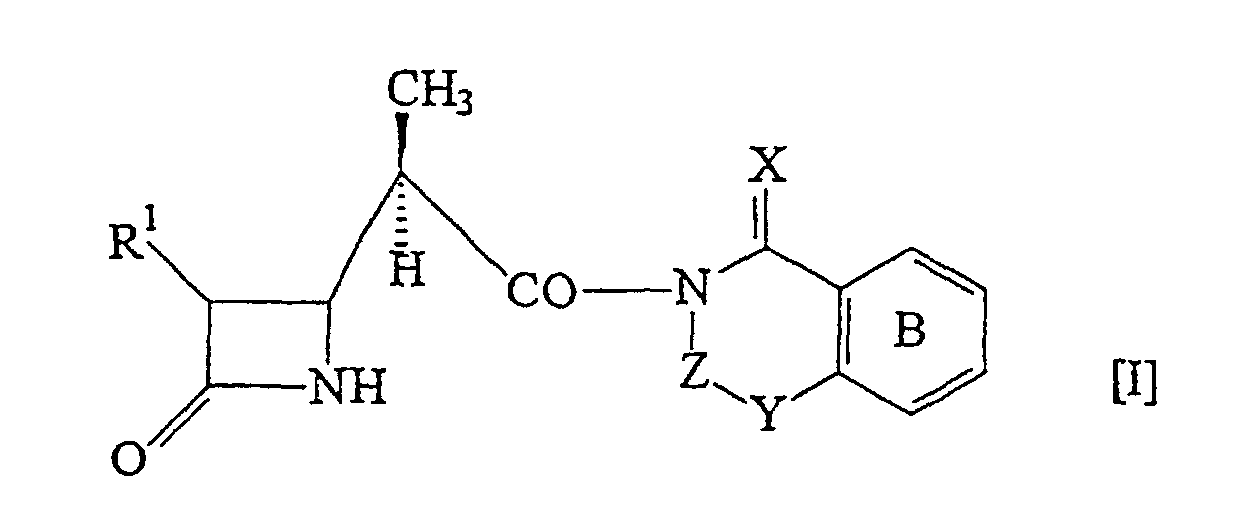 Ring B ein Benzol-Ring ist, der mit einer bis vier Gruppen substituiert sein kann, ausgewählt aus Halogen, C1-6-Alkyl, C1-6-Alkoxy und Phenyl, das mit C1-6-Alkyl, C1-6-Alkoxy, Halogen oder gegebenenfalls geschütztem Amino substituiert sein kann,R1 Hydroxy-substituiertes C1-6-Alkyl ist, das mit einer Gruppe geschützt sein kann, die ausgewählt ist aus (C1-6-Alkoxy)carbonyl, Halogen-(C1-6-alkoxy)carbonyl, Tri-(C1-6-alkyl)silyl oder Phenyl-C1-6-alkyl oder Phenyl-(C1-6-alkoxy)carbonyl (wobei die Phenyl-Gruppe jeweils mit Nitro oder mit C1-6-Alkoxy substituiert sein kann),X O oder S ist,Y O, S, CH2 oder eine Imino-Gruppe ist, die mit C1-6-Alkyl oder einer Acyl-Gruppe substituiert sein kann, ausgewählt aus C2-8-Alkanoyl, (C1-6-Alkoxy)carbonyl oder Phenylcarbonyl oder Phenyl(C1-6-alkoxy)carbonyl (wobei die Phenyl-Gruppe jeweils mit C1-6-Alkyl, C1-6-Alkoxy, Halogen oder gegebenenfalls geschütztem Amino substituiert sein kann), undZ eine Methylen-Gruppe ist, die mit einer oder zwei Gruppen substituiert sein kann, ausgewählt aus C3-7-Alkylen, C1-20-Alkyl, C4-7-Cycloalkyl, Phenyl (jeder dieser Substituenten kann mit C1-6-Alkyl, C1-6-Alkoxy, Halogen oder gegebenenfalls geschütztem Amino substituiert sein), Phenyl-C1-6-alkyl (wobei die Phenyl-Gruppe mit C1-6-Alkyl, C1-6-Alkoxy, Halogen oder gegebenenfalls geschütztem Amino substituiert sein kann) oder einer 4- bis 7-gliedrigen heterocyclischen Gruppe, die Sauerstoff, Stickstoff oder Schwefel als Heteroatom enthält, gegebenenfalls substituiert mit C1-6-Alkyl, C1-6-Alkoxy, Halogen oder gegebenenfalls geschütztem Amino,oder ein Salz davon.
 - Verbindung gemäß Anspruch 1, worin Ring B ein Benzol-Ring ist, der mit einem Halogenatom, C1-6-Alkyl oder C1-6-Alkoxy substituiert sein kann, Y O, S, CH2 oder eine mit C1-6-Alkyl substituierte Imino-Gruppe ist und Z eine Methylen-Gruppe ist, die mit einer oder zwei Gruppen substituiert sein kann, ausgewählt aus C3-7-Alkylen, C1-20-Alkyl und Phenyl-C1-6-alkyl (wobei die Phenyl-Gruppe mit C1-6-Alkyl, C1-6-Alkoxy, Halogen oder gegebenenfalls geschütztem Amino substituiert sein kann).
- Verbindung gemäß Anspruch 2, worin Ring B ein unsubstituierter Benzol-Ring ist, X = O, Y = O und Z eine mit C3-7-Alkylen, Di-C1-20-alkyl oder Di-(phenyl-C1-6-alkyl) substituierte Methylen-Gruppe ist.
- Verbindung gemäß Anspruch 3, worin Z eine Pentamethylen-substituierte oder Dibutyl-substituierte Methylen-Gruppe ist.
- Verbindung gemäß einem der Ansprüche 1 bis 4, worin die 3-Position des Azetidinon-Gerüsts die S-Konfiguration aufweist.
- Verbindung gemäß Anspruch 1, die 3-{(2R)-2-[(3S,4R)-3-[(1R)-1-t-Butyldimethylsilyl-oxyethyl]-2-oxoazetidin-4-yl]propionyl}spiro[2,3-dihydro-4H-1,3-benzoxazin-2,1'-cyclohexan]-4-on ist.
- Verfahren zur Herstellung einer Azetidinon-Verbindung der Formel [I] wie in Anspruch 1 definiert oder eines Salzes davon, welches das Umsetzen einer α-Halogenpropionamid-Verbindung der Formel [II]:worin L0 ein Halogenatom ist und die anderen Symbole wie in Anspruch 1 definiert sind, oder eines Salzes davon mit einer Verbindung der Formel [III] umfaßt:
 worin L1 eine Abgangsgruppe ist und R1 wie oben definiert ist, und, falls erforderlich, ferner das Konvertieren des Produkts zu einem Salz davon.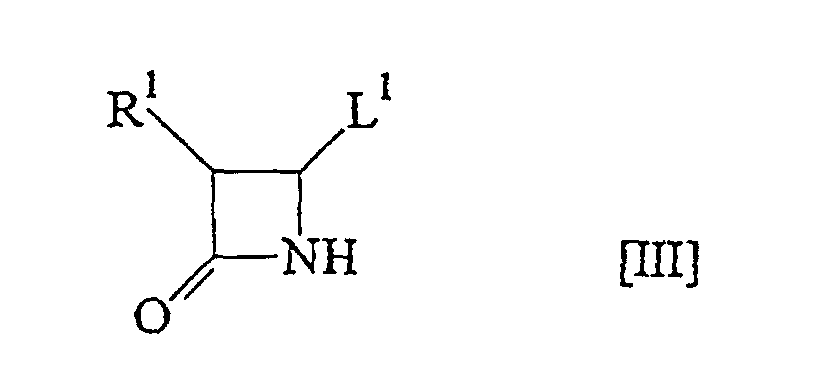
- α-Halogenpropionamid-Verbindung der Formel [II] wie in Anspruch 7 definiert oder ein Salz davon.
- Verbindung gemäß Anspruch 8, worin Ring B ein Benzol-Ring ist, der mit einem Halogenatom, C1-6-Alkyl oder C1-6-Alkoxy substituiert sein kann, Y O, S, CH2 oder eine mit C1-6-Alkyl substituierte Imino-Gruppe ist und Z eine Methylen-Gruppe ist, die mit einer oder zwei Gruppen substituiert sein kann, ausgewählt aus C3-7-Alkylen, C1-20-Alkyl und Phenyl-C1-6-alkyl (wobei die Phenyl-Gruppe mit C1-6-Alkyl, C1-6-Alkoxy, Halogen oder gegebenenfalls geschütztem Amino substituiert sein kann).
- Verbindung gemäß Anspruch 9, worin Ring B ein unsubstituierter Benzol-Ring ist, X = 0, Y = O und Z eine mit C3-7-Alkylen, Di-C1-20-alkyl oder Di-(phenyl-C1-6-alkyl) substituierte Methylen-Gruppe ist.
- Verbindung gemäß Anspruch 10, worin Z eine Pentamethylen-substituierte oder Dibutyl-substituierte Methylen-Gruppe ist.
- Verbindung gemäß Anspruch 8, die 3-(2-Brompropionyl)-spiro[2,3-dihydro-4H-1,3-benzoxazin-2,1'-cyclohexan]-4-on ist.
- Verfahren zur Herstellung einer α-Halogenpropionamid-Verbindung gemäß Anspruch 8, welches das Umsetzen einer Benzol-Verbindung der Formel [IV]:worin die Symbole wie oben definiert sind, oder eines Salzes davon mit einer 2-Halogenpropionsäure-Verbindung der Formel [V]:
 worin L0 wie oben definiert ist, oder eines Salzes oder eines reaktiven Derivats davon und, falls erforderlich, ferner das Konvertieren des Produkts zu einem Salz davon umfaßt.
- Verfahren zur Herstellung eines 1β-Methyl-2-oxycarbapenem-Derivats der Formel [VIII]:worin
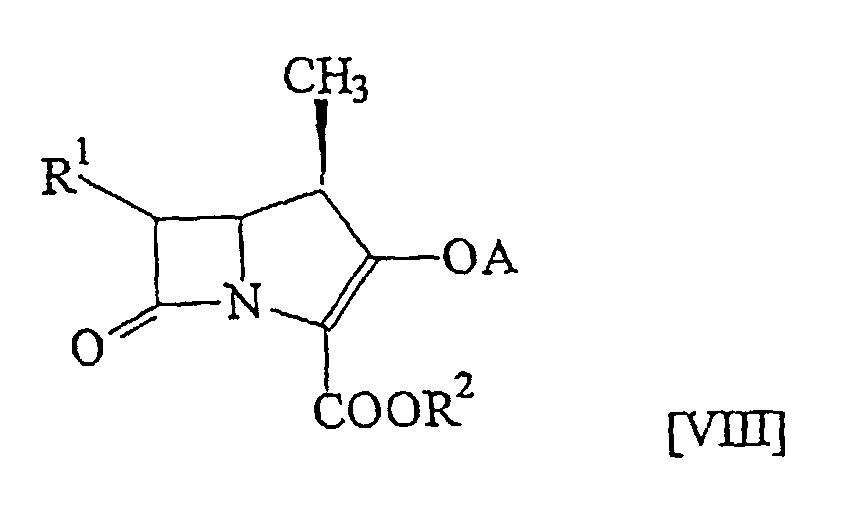 oder eines Salzes davon,R1 wie in Anspruch 1 definiert ist,R2 H oder ein Ester-Rest ist, ausgewählt aus C1-6-Alkyl, C2-8-Alkenyl, Halogen-(C1-6-alkyl), Nitrobenzyl, (C1-6-Alkoxy)benzyl, Benzhydryl und einer Gruppe der Formel: -Q-OCOR4, -Q-OCO2R4, -Q-O-R4 (worin Q C1-6-Alkylen ist und R4 C1-6-Alkyl, C3-8-Cycloalkyl, C3-8-Alkenoyl, (C1-6-Alkoxy)-C1-6-alkyl oder (C2-8-Alkanoyl)oxy-C1-6-alkyl) ist unddie Gruppe -OA eine veresterte Hydroxy-Gruppe ist, ausgewählt aus Diphenyl- oder Di-(C1-6-alkyl)-phosphoryloxy der Formel -OP(O)(OR0)2 (R0 ist Phenyl oder C1-6-Alkyl), C1-6-Alkylsulfonyloxy, Trifluormethansulfonyloxy, Benzolsulfonyloxy, Toluolsulfonyloxy, C2-8-Alkanoyloxy und Benzoyloxy,
welches die folgenden Schritte umfaßt:a) Umsetzen einer Azetidinon-Verbindung der Formel [I] wie in Anspruch 1 definiert oder eines Salzes davon mit einer Essigsäure-Verbindung der Formel [VI]:worin die Symbole wie oben definiert sind, b) Unterwerfen der obigen Verbindung [VII] oder eines Salzes davon der intramolekularen Cyclisierung,c) Unterwerfen des intramolekularen Cyclisierungsprodukts oder eines Salzes davon der Veresterung undd) falls erforderlich, ferner Konvertieren des Produkts zu einem Salz davon.
 - Verfahren gemäß Anspruch 14, worin eines oder beide aus intramolekularer Cyclisierung der N-substituierten Azetidinon-Verbindung [VII] oder eines Salzes davon und Veresterung des intramolekularen Cyclisierungsproduktes oder eines Salzes davon in Gegenwart einer Lewis-Säure durchgeführt wird (werden).
- Verfahren zur Herstellung eines 1β-Methyl-carbapenem-Derivats der Formel [X]:worin R11 wie für R1 in Anspruch 1 definiert ist, R21 wie für R2 in Anspruch 14 definiert ist und R3 eine organische Gruppe ist, ausgewählt aus C1-6-Alkyl, C3-8-Cycloalkyl, Phenyl, einer 4- bis 8-gliedrigen aliphatischen heterocyclischen Gruppe, einem 4- bis 8-gliedrigen heteroaromatischen Ring (die jeweils einen oder mehrere Substituenten aufweisen können, ausgewählt aus C1-6-Alkyl, Hydroxyl, C1-6-Alkoxy, C1-6-Alkylamino, Mercapto, C1-6-Alkylthio, Amidino, Guanidino, Carbamoyl, Thiocarbamoyl, Sulfamoyl, Cyano, Carboxyl, (C1-6-Alkoxy)carbonyl, Phenyl-(C1-6-alkoxy)carbonyl, Oxo, Halogen, C3-8-Cycloalkyl, Phenyl, einer 4- bis 8-gliedrigen aliphatischen heterocyclischen Gruppe und einem 4- bis 8-gliedrigen heteroaromatischen Ring), oder eines Salzes davon,
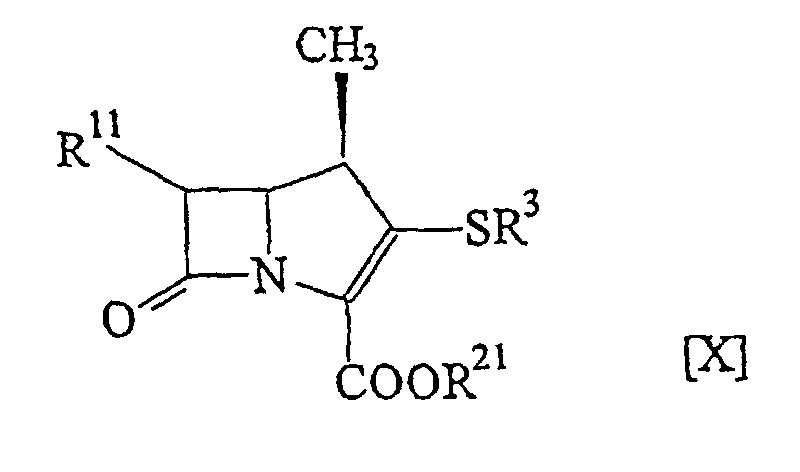
welchesdie Schritt a) bis c) wie in Anspruch 14 definiert, um ein 1β-Methyloxycarbapenem-Derivat der Formel [VIII] zu ergeben, undd) Konvertieren der Verbindung [VIII] oder eines Salzes davon zum entsprechenden 1β-Methylcarbapenem-Derivat der Formel [X] oder einem Salz davon in einem bekannten Verfahren umfaßt. - Verfahren gemäß Anspruch 16, worin R1 1-Hydroxyethyl ist, das geschützt sein kann, und R3 2-Thioxopyrrolidin-4-yl ist.
- Verfahren zur Herstellung einer Azetidinonpropionsäure-Verbindung der Formel [XII]:worin R1 wie in Anspruch 1 definiert ist, oder eines Salzes davon, welches das Hydrolysieren einer Azetidinon-Verbindung der Formel [I] wie in Anspruch 1 definiert oder eines Salzes davon und, falls erforderlich, ferner das Konvertieren des Produkts zu einem Salz davon umfaßt.
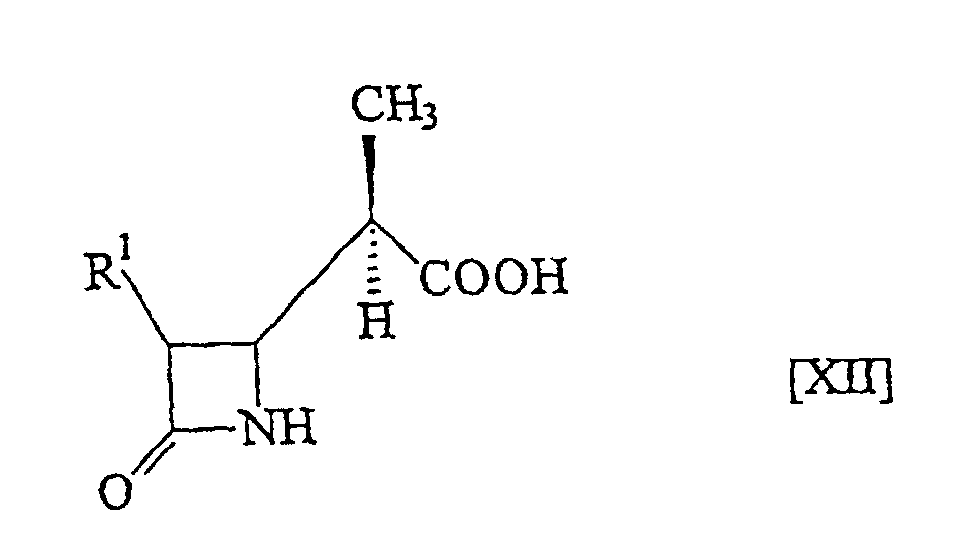
- Verfahren gemäß Anspruch 18, worin die Verbindung der Formel [I] durch Umsetzen einer α-Halogenpropionamid-Verbindung der Formel [II] wie in Anspruch 7 definiert oder eines Salzes davon mit einer Verbindung der Formel [III] wie in Anspruch 7 definiert erhalten wird.
- Verfahren zur Herstellung eines 1β-Methyl-2-oxycarbapenem-Derivats der Formel [VIII]:worin R1, R2 und -OA wie in Anspruch 14 definiert sind, oder eines Salzes davon, welches die folgenden Schritte umfaßt:
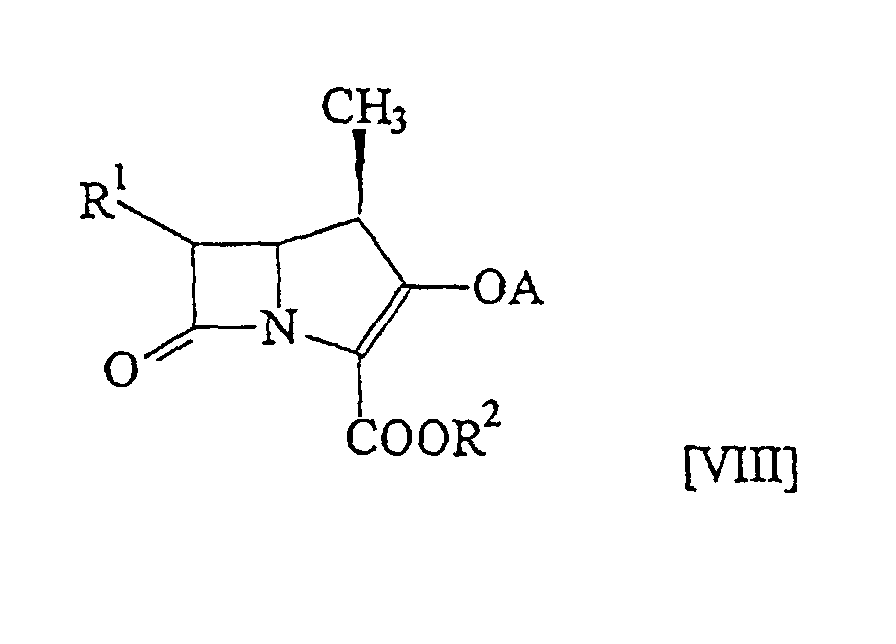 a) Hydrolysieren einer Azetidinon-Verbindung der Formel [I] oder eines Salzes davon, um eine Azetidinonpropionsäure-Verbindung der Formel [XII] wie in Anspruch 18 definiert zu ergeben, undb) Konvertieren der Verbindung [XII] oder eines Salzes davon zum entsprechenden 1β-Methyl-2-oxycarbapenem-Derivat [VIII] oder einem Salz davon in einem bekannten Verfahren.
 - Verfahren zur Herstellung eines 1β-Methyl-carbapenem-Derivats der Formel [X]:worin R11, R21 und R3 wie in Anspruch 16 definiert sind, oder eines Salzes davon, welches die folgenden Schritte umfaßt:
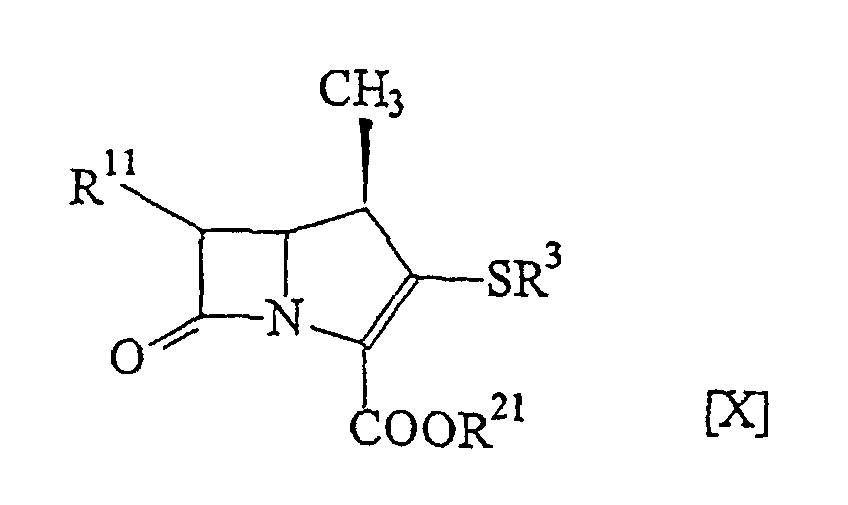 a) Hydrolysieren einer Azetidinon-Verbindung der Formel [I] oder eines Salzes davon, um eine Azetidinonpropionsäure-Verbindung der Formel [XII] wie in Anspruch 18 definiert zu ergeben, undb) Konvertieren der Verbindung [XII] oder eines Salzes davon zum entsprechenden 1β-Methyl-2-oxycarbapenem-Derivat [X] oder einem Salz davon in einem bekannten Verfahren.
 - Verfahren gemäß Anspruch 21, worin R1 1-Hydroxyethyl ist, das geschützt sein kann, und R3 2-Thioxopyrrolidin-4-yl ist.
Applications Claiming Priority (12)
| Application Number | Priority Date | Filing Date | Title |
|---|---|---|---|
| JP30366292 | 1992-11-13 | ||
| JP30366292 | 1992-11-13 | ||
| JP303662/92 | 1992-11-13 | ||
| JP11146093 | 1993-05-13 | ||
| JP111460/93 | 1993-05-13 | ||
| JP11146093 | 1993-05-13 | ||
| JP16918293 | 1993-07-08 | ||
| JP16918293 | 1993-07-08 | ||
| JP169182/93 | 1993-07-08 | ||
| JP23815593 | 1993-09-24 | ||
| JP23815593 | 1993-09-24 | ||
| JP238155/93 | 1993-09-24 |
Publications (3)
| Publication Number | Publication Date |
|---|---|
| EP0597423A2 EP0597423A2 (de) | 1994-05-18 |
| EP0597423A3 EP0597423A3 (de) | 1995-04-12 |
| EP0597423B1 true EP0597423B1 (de) | 2002-03-06 |
Family
ID=27469913
Family Applications (1)
| Application Number | Title | Priority Date | Filing Date |
|---|---|---|---|
| EP93118085A Expired - Lifetime EP0597423B1 (de) | 1992-11-13 | 1993-11-08 | Azetidinonverbindung und Verfahren zu ihrer Herstellung |
Country Status (12)
| Country | Link |
|---|---|
| US (1) | US5442055A (de) |
| EP (1) | EP0597423B1 (de) |
| JP (1) | JP2897153B2 (de) |
| KR (3) | KR100231223B1 (de) |
| AT (1) | ATE214061T1 (de) |
| CA (1) | CA2102772C (de) |
| DE (1) | DE69331652T2 (de) |
| DK (1) | DK0597423T3 (de) |
| ES (1) | ES2173087T3 (de) |
| IL (2) | IL107532A (de) |
| PT (1) | PT597423E (de) |
| SG (1) | SG50416A1 (de) |
Families Citing this family (16)
| Publication number | Priority date | Publication date | Assignee | Title |
|---|---|---|---|---|
| US5731431A (en) * | 1991-12-26 | 1998-03-24 | Nippon Soda Co., Ltd. | Process for preparing 4-substituted azetidinone derivatives |
| US6011150A (en) * | 1992-11-13 | 2000-01-04 | Tanabe Seiyaku Co., Ltd. | Azetidinone compound and process for preparation thereof |
| US5550229A (en) * | 1993-06-23 | 1996-08-27 | Tanabe Seiyaku Co., Ltd. | Alkylation process for preparing azetidinone compound and starting compound therefor |
| DE69405922T2 (de) * | 1993-06-30 | 1998-01-29 | Nippon Soda Co | Verfahren zur Herstellung von 4-substituierten Azetidinon-Derivaten |
| JPH09143156A (ja) * | 1995-11-17 | 1997-06-03 | Tanabe Seiyaku Co Ltd | アセトキシアゼチジノン誘導体の製法及びその合成中間体 |
| JP3450193B2 (ja) | 1998-07-24 | 2003-09-22 | 高砂香料工業株式会社 | 4−置換アゼチジノン誘導体の製造方法 |
| KR100377448B1 (ko) * | 2000-08-10 | 2003-03-26 | 동화약품공업주식회사 | 카바페넴 항생물질의 중간체 및 그의 제조방법 |
| JP2008056564A (ja) * | 2004-11-12 | 2008-03-13 | Shionogi & Co Ltd | アゼチジノン誘導体の製造方法 |
| AU2009277936B2 (en) | 2008-07-30 | 2014-11-27 | Sun Pharmaceutical Industries Limited | Process for the preparation of carbapenem compounds |
| HUE034911T2 (hu) | 2009-07-27 | 2018-03-28 | Gilead Sciences Inc | Fúzionált heterociklusos vegyületek mint ioncsatorna modulátorok |
| EP2588197B1 (de) | 2010-07-02 | 2014-11-05 | Gilead Sciences, Inc. | Kondensierte heterozyklische verbindungen als ionenkanalmodulatoren |
| WO2012154760A1 (en) | 2011-05-10 | 2012-11-15 | Gilead Sciences, Inc. | Fused heterocyclic compounds as sodium channel modulators |
| UY34171A (es) | 2011-07-01 | 2013-01-31 | Gilead Sciences Inc | Compuestos heterocíclicos fusionados como moduladores del canal iónico |
| NO3175985T3 (de) | 2011-07-01 | 2018-04-28 | ||
| CN108774188A (zh) * | 2018-07-23 | 2018-11-09 | 湖北宇阳药业有限公司 | 一种美罗培南中间体的制备方法 |
| CN110025619B (zh) * | 2019-04-29 | 2022-03-22 | 江苏汉阔生物有限公司 | 美罗培南中间体在制备抗氧化药物中的应用 |
Family Cites Families (22)
| Publication number | Priority date | Publication date | Assignee | Title |
|---|---|---|---|---|
| US4194047A (en) * | 1975-11-21 | 1980-03-18 | Merck & Co., Inc. | Substituted N-methylene derivatives of thienamycin |
| EP0010348A1 (de) * | 1978-09-12 | 1980-04-30 | Imperial Chemical Industries Plc | Heterocyclische Trichlormethyl-Derivate, Verfahren zu ihrer Herstellung und ihre Verwendung |
| US4350631A (en) * | 1980-12-18 | 1982-09-21 | Merck & Co., Inc. | 6- and 4-Substituted-1-azabicyclo[3.2.0]heptan-3,7-dione-2-carboxylates |
| JPS5910570A (ja) * | 1982-07-08 | 1984-01-20 | Wakamoto Pharmaceut Co Ltd | 新規イソカルボスチリル誘導体及びその製法 |
| JPS60202886A (ja) * | 1984-03-27 | 1985-10-14 | Sankyo Co Ltd | 1―置換カルバペネム―3―カルボン酸誘導体 |
| JPS615081A (ja) * | 1984-06-18 | 1986-01-10 | Sankyo Co Ltd | 1−置換カルバペネム−3−カルボン酸誘導体の製造法 |
| DK270685A (da) * | 1984-06-29 | 1985-12-30 | Hoffmann La Roche | Carbapenemderivater |
| JPS6225286A (ja) * | 1985-07-26 | 1987-02-03 | 株式会社東芝 | 核融合装置用電源装置 |
| EP0213610A1 (de) * | 1985-08-31 | 1987-03-11 | Lederle (Japan) Ltd. | Azetidin-2-on-Derivate und Verfahren zu ihrer Herstellung |
| JPS6277384A (ja) * | 1985-10-01 | 1987-04-09 | Nippon Redarii Kk | アゼチジン−2−オン誘導体及びその製造方法 |
| JPS62252785A (ja) * | 1986-01-08 | 1987-11-04 | Sankyo Co Ltd | 4−置換β−ラクタム化合物 |
| JPS62169781A (ja) * | 1986-01-21 | 1987-07-25 | Sankyo Co Ltd | β−ラクタム化合物 |
| JP2789190B2 (ja) * | 1986-01-27 | 1998-08-20 | 住友製薬株式会社 | 新規なβ−ラクタム誘導体およびその製造法 |
| GB8607921D0 (en) * | 1986-04-01 | 1986-05-08 | Fujisawa Pharmaceutical Co | 3,4-disubstituted-2-azetidinone derivatives |
| JP2510860B2 (ja) * | 1987-02-02 | 1996-06-26 | 住友製薬株式会社 | 新規なβ−ラクタム誘導体の製造方法 |
| JPS63284176A (ja) * | 1987-05-15 | 1988-11-21 | Nippon Redarii Kk | (1r,5r,6s)−6−〔(1r)−1−ヒドロキシエチル〕−1−メチルカルバペネム−3−カルボン酸誘導体の高立体選択的製造方法 |
| DE68919508T2 (de) * | 1988-04-01 | 1995-07-20 | Sankyo Co | 2-(Heterocyclylthio)carbapenemderivate, deren Herstellung und deren Verwendung als Antibiotika. |
| JPH02178262A (ja) * | 1988-12-28 | 1990-07-11 | Sumitomo Pharmaceut Co Ltd | 1―(2′―ハロプロピオニル)ピロリジン―2―オン誘導体 |
| JPH0662547B2 (ja) * | 1989-01-10 | 1994-08-17 | 田辺製薬株式会社 | グリシン誘導体 |
| JPH02292269A (ja) * | 1989-05-06 | 1990-12-03 | Lederle Japan Ltd | 活性アミド化合物 |
| CA2050255C (en) * | 1990-09-07 | 1997-02-04 | Tameo Iwasaki | 1-methylcarbapenem derivatives and process for preparation thereof |
| DE69231874T2 (de) * | 1991-12-26 | 2001-09-27 | Nippon Soda Co. Ltd., Tokio/Tokyo | Verfahren zur herstellung von 4-substituierten azetidinon-derivaten |
-
1993
- 1993-11-05 US US08/148,917 patent/US5442055A/en not_active Expired - Lifetime
- 1993-11-08 EP EP93118085A patent/EP0597423B1/de not_active Expired - Lifetime
- 1993-11-08 PT PT93118085T patent/PT597423E/pt unknown
- 1993-11-08 DK DK93118085T patent/DK0597423T3/da active
- 1993-11-08 AT AT93118085T patent/ATE214061T1/de active
- 1993-11-08 SG SG1996000950A patent/SG50416A1/en unknown
- 1993-11-08 DE DE69331652T patent/DE69331652T2/de not_active Expired - Lifetime
- 1993-11-08 IL IL10753293A patent/IL107532A/en not_active IP Right Cessation
- 1993-11-08 ES ES93118085T patent/ES2173087T3/es not_active Expired - Lifetime
- 1993-11-09 CA CA002102772A patent/CA2102772C/en not_active Expired - Lifetime
- 1993-11-12 JP JP5283148A patent/JP2897153B2/ja not_active Expired - Lifetime
- 1993-11-12 KR KR1019930024017A patent/KR100231223B1/ko not_active Expired - Lifetime
-
1997
- 1997-09-26 IL IL12184297A patent/IL121842A0/xx unknown
-
1999
- 1999-04-22 KR KR1019990014373A patent/KR100252404B1/ko not_active Expired - Lifetime
- 1999-08-16 KR KR1019990033676A patent/KR100256863B1/ko not_active Expired - Lifetime
Also Published As
| Publication number | Publication date |
|---|---|
| KR100256863B1 (ko) | 2000-05-15 |
| KR100231223B1 (ko) | 1999-11-15 |
| IL107532A (en) | 1999-06-20 |
| IL107532A0 (en) | 1994-02-27 |
| SG50416A1 (en) | 1998-07-20 |
| EP0597423A2 (de) | 1994-05-18 |
| IL121842A0 (en) | 1998-02-22 |
| CA2102772A1 (en) | 1994-05-14 |
| JP2897153B2 (ja) | 1999-05-31 |
| KR100252404B1 (en) | 2000-04-15 |
| EP0597423A3 (de) | 1995-04-12 |
| DE69331652D1 (de) | 2002-04-11 |
| KR940011460A (ko) | 1994-06-21 |
| US5442055A (en) | 1995-08-15 |
| JPH07165760A (ja) | 1995-06-27 |
| CA2102772C (en) | 2001-04-03 |
| DK0597423T3 (da) | 2002-05-21 |
| ATE214061T1 (de) | 2002-03-15 |
| DE69331652T2 (de) | 2002-10-17 |
| ES2173087T3 (es) | 2002-10-16 |
| PT597423E (pt) | 2002-06-28 |
Similar Documents
| Publication | Publication Date | Title |
|---|---|---|
| US5703234A (en) | Heterocyclic alkanamide | |
| US5631363A (en) | Azetidinone compound and process for preparation thereof | |
| US5442055A (en) | Azetidinone compound and process for preparation thereof | |
| US6011150A (en) | Azetidinone compound and process for preparation thereof | |
| US4269772A (en) | Synthesis of thienamycin via trans-3-carboxymethylene-4-carboxy-5-methyl-Δ2 -isoxazoline | |
| EP0032400B1 (de) | (3SR, 4RS)-3-((RS)-1-Hydroxyäthyl)- und - ((RS)-1-Acyloxyäthyl)-2-oxo-4-azetidinessigsäure-Verbindungen und Verfahren zu deren Herstellung | |
| KR950013767B1 (ko) | 키랄성 아제티디논 화합물 및 이의 제조방법 | |
| EP0213610A1 (de) | Azetidin-2-on-Derivate und Verfahren zu ihrer Herstellung | |
| US4414155A (en) | Synthesis of thienamycin via esters of (3SR, 4RS)-3-[(SR)-1-hydroxyethyl]-β,2-dioxo-4-azetidinebutanoic acid | |
| JP3118143B2 (ja) | アゼチジノン化合物の新規な製法およびその新規原料化合物 | |
| US6242596B1 (en) | Preparation of betamethyl carbapenem intermediates | |
| KR20020013988A (ko) | 카바페넴 항생물질의 중간체 및 그의 제조방법 | |
| FI111942B (fi) | Uusi atsetidinoniyhdiste, menetelmä sen stereoselektiiviseksi valmistamiseksi ja sen käyttö synteettisenä välituotteena 1-beta-metyylikarbapeneemijohdannaisen valmistamiseksi | |
| JPS6056954A (ja) | ペネム化合物およびその製造方法 | |
| US4499278A (en) | Trans-3-carboxymethylene-4-carboxy-5-methyl-delta2-isoxazoline as intermediate | |
| US4443599A (en) | 8-Oxo-3-oxa-1-azabicyclo[4.2.0]octanes containing a chiral center | |
| US6080854A (en) | Process for synthesizing carbapenem intermediates | |
| US5359059A (en) | Process for preparing carbapenem derivatives | |
| JP2643753B2 (ja) | 2−オキシカルバペネム誘導体の製法 | |
| Mastalerz et al. | Synthesis of a 4. beta.-(Hydroxymethyl) carbapenem | |
| JP2810731B2 (ja) | β―ラクタム化合物の製法 | |
| JP2970928B2 (ja) | 二環式γ―ラクタム誘導体 | |
| JPH0770116A (ja) | 4−置換アゼチジノン誘導体の製造方法 | |
| RU2175971C2 (ru) | Способ получения 2-галогенметилпенемов и производные 2-азетидинона в качестве промежуточных соединений | |
| US5629419A (en) | Process for preparing 4-mercaptopyrrolidine intermediate compounds and a process for their use in preparing carbapenem -2-em-3 carboxylic acids |
Legal Events
| Date | Code | Title | Description |
|---|---|---|---|
| PUAI | Public reference made under article 153(3) epc to a published international application that has entered the european phase |
Free format text: ORIGINAL CODE: 0009012 |
|
| AK | Designated contracting states |
Kind code of ref document: A2 Designated state(s): AT BE CH DE DK ES FR GB GR IE IT LI LU MC NL PT SE |
|
| PUAL | Search report despatched |
Free format text: ORIGINAL CODE: 0009013 |
|
| AK | Designated contracting states |
Kind code of ref document: A3 Designated state(s): AT BE CH DE DK ES FR GB GR IE IT LI LU MC NL PT SE |
|
| 17P | Request for examination filed |
Effective date: 19950608 |
|
| 17Q | First examination report despatched |
Effective date: 19970129 |
|
| GRAG | Despatch of communication of intention to grant |
Free format text: ORIGINAL CODE: EPIDOS AGRA |
|
| GRAG | Despatch of communication of intention to grant |
Free format text: ORIGINAL CODE: EPIDOS AGRA |
|
| GRAH | Despatch of communication of intention to grant a patent |
Free format text: ORIGINAL CODE: EPIDOS IGRA |
|
| GRAH | Despatch of communication of intention to grant a patent |
Free format text: ORIGINAL CODE: EPIDOS IGRA |
|
| REG | Reference to a national code |
Ref country code: GB Ref legal event code: IF02 |
|
| GRAA | (expected) grant |
Free format text: ORIGINAL CODE: 0009210 |
|
| AK | Designated contracting states |
Kind code of ref document: B1 Designated state(s): AT BE CH DE DK ES FR GB GR IE IT LI LU MC NL PT SE |
|
| REF | Corresponds to: |
Ref document number: 214061 Country of ref document: AT Date of ref document: 20020315 Kind code of ref document: T |
|
| REG | Reference to a national code |
Ref country code: CH Ref legal event code: NV Representative=s name: BOVARD AG PATENTANWAELTE Ref country code: CH Ref legal event code: EP |
|
| REF | Corresponds to: |
Ref document number: 69331652 Country of ref document: DE Date of ref document: 20020411 |
|
| REG | Reference to a national code |
Ref country code: DK Ref legal event code: T3 |
|
| REG | Reference to a national code |
Ref country code: PT Ref legal event code: SC4A Free format text: AVAILABILITY OF NATIONAL TRANSLATION Effective date: 20020308 |
|
| REG | Reference to a national code |
Ref country code: GR Ref legal event code: EP Ref document number: 20020400799 Country of ref document: GR |
|
| ET | Fr: translation filed | ||
| REG | Reference to a national code |
Ref country code: ES Ref legal event code: FG2A Ref document number: 2173087 Country of ref document: ES Kind code of ref document: T3 |
|
| PLBE | No opposition filed within time limit |
Free format text: ORIGINAL CODE: 0009261 |
|
| STAA | Information on the status of an ep patent application or granted ep patent |
Free format text: STATUS: NO OPPOSITION FILED WITHIN TIME LIMIT |
|
| 26N | No opposition filed |
Effective date: 20021209 |
|
| REG | Reference to a national code |
Ref country code: CH Ref legal event code: PFA Owner name: TANABE SEIYAKU CO., LTD. Free format text: TANABE SEIYAKU CO., LTD.#2-10, DOSHO-MACHI 3-CHOME#CHUO-KU OSAKA (JP) -TRANSFER TO- TANABE SEIYAKU CO., LTD.#2-10, DOSHO-MACHI 3-CHOME#CHUO-KU OSAKA (JP) |
|
| PGFP | Annual fee paid to national office [announced via postgrant information from national office to epo] |
Ref country code: MC Payment date: 20120927 Year of fee payment: 20 |
|
| PGFP | Annual fee paid to national office [announced via postgrant information from national office to epo] |
Ref country code: DK Payment date: 20121105 Year of fee payment: 20 Ref country code: LU Payment date: 20121126 Year of fee payment: 20 |
|
| PGFP | Annual fee paid to national office [announced via postgrant information from national office to epo] |
Ref country code: FR Payment date: 20121012 Year of fee payment: 20 Ref country code: DE Payment date: 20121114 Year of fee payment: 20 Ref country code: IE Payment date: 20121003 Year of fee payment: 20 Ref country code: CH Payment date: 20121106 Year of fee payment: 20 Ref country code: BE Payment date: 20121030 Year of fee payment: 20 |
|
| PGFP | Annual fee paid to national office [announced via postgrant information from national office to epo] |
Ref country code: GB Payment date: 20121126 Year of fee payment: 20 Ref country code: GR Payment date: 20121017 Year of fee payment: 20 Ref country code: ES Payment date: 20121016 Year of fee payment: 20 Ref country code: SE Payment date: 20121113 Year of fee payment: 20 Ref country code: PT Payment date: 20120508 Year of fee payment: 20 Ref country code: IT Payment date: 20121121 Year of fee payment: 20 |
|
| PGFP | Annual fee paid to national office [announced via postgrant information from national office to epo] |
Ref country code: NL Payment date: 20121130 Year of fee payment: 20 Ref country code: AT Payment date: 20121127 Year of fee payment: 20 |
|
| REG | Reference to a national code |
Ref country code: DE Ref legal event code: R071 Ref document number: 69331652 Country of ref document: DE |
|
| REG | Reference to a national code |
Ref country code: DK Ref legal event code: EUP Effective date: 20131108 |
|
| REG | Reference to a national code |
Ref country code: CH Ref legal event code: PL Ref country code: PT Ref legal event code: MM4A Free format text: MAXIMUM VALIDITY LIMIT REACHED Effective date: 20131108 |
|
| REG | Reference to a national code |
Ref country code: NL Ref legal event code: V4 Effective date: 20131108 |
|
| REG | Reference to a national code |
Ref country code: GB Ref legal event code: PE20 Expiry date: 20131107 |
|
| BE20 | Be: patent expired |
Owner name: *TANABE SEIYAKU CO. LTD Effective date: 20131108 |
|
| REG | Reference to a national code |
Ref country code: AT Ref legal event code: MK07 Ref document number: 214061 Country of ref document: AT Kind code of ref document: T Effective date: 20131108 |
|
| REG | Reference to a national code |
Ref country code: IE Ref legal event code: MK9A |
|
| REG | Reference to a national code |
Ref country code: SE Ref legal event code: EUG |
|
| REG | Reference to a national code |
Ref country code: ES Ref legal event code: FD2A Effective date: 20140115 |
|
| PG25 | Lapsed in a contracting state [announced via postgrant information from national office to epo] |
Ref country code: PT Free format text: LAPSE BECAUSE OF EXPIRATION OF PROTECTION Effective date: 20131115 Ref country code: DE Free format text: LAPSE BECAUSE OF EXPIRATION OF PROTECTION Effective date: 20131109 Ref country code: IE Free format text: LAPSE BECAUSE OF EXPIRATION OF PROTECTION Effective date: 20131108 Ref country code: GB Free format text: LAPSE BECAUSE OF EXPIRATION OF PROTECTION Effective date: 20131107 |
|
| REG | Reference to a national code |
Ref country code: GR Ref legal event code: MA Ref document number: 20020400799 Country of ref document: GR Effective date: 20131109 |
|
| PG25 | Lapsed in a contracting state [announced via postgrant information from national office to epo] |
Ref country code: ES Free format text: LAPSE BECAUSE OF EXPIRATION OF PROTECTION Effective date: 20131109 |