EP0597434B1 - Interrupteur à vide - Google Patents
Interrupteur à vide Download PDFInfo
- Publication number
- EP0597434B1 EP0597434B1 EP93118102A EP93118102A EP0597434B1 EP 0597434 B1 EP0597434 B1 EP 0597434B1 EP 93118102 A EP93118102 A EP 93118102A EP 93118102 A EP93118102 A EP 93118102A EP 0597434 B1 EP0597434 B1 EP 0597434B1
- Authority
- EP
- European Patent Office
- Prior art keywords
- electrode
- coil
- movable
- vacuum interrupter
- main
- Prior art date
- Legal status (The legal status is an assumption and is not a legal conclusion. Google has not performed a legal analysis and makes no representation as to the accuracy of the status listed.)
- Expired - Lifetime
Links
Images





Classifications
-
- H—ELECTRICITY
- H01—ELECTRIC ELEMENTS
- H01H—ELECTRIC SWITCHES; RELAYS; SELECTORS; EMERGENCY PROTECTIVE DEVICES
- H01H33/00—High-tension or heavy-current switches with arc-extinguishing or arc-preventing means
- H01H33/60—Switches wherein the means for extinguishing or preventing the arc do not include separate means for obtaining or increasing flow of arc-extinguishing fluid
- H01H33/66—Vacuum switches
- H01H33/664—Contacts; Arc-extinguishing means, e.g. arcing rings
- H01H33/6644—Contacts; Arc-extinguishing means, e.g. arcing rings having coil-like electrical connections between contact rod and the proper contact
-
- H—ELECTRICITY
- H01—ELECTRIC ELEMENTS
- H01H—ELECTRIC SWITCHES; RELAYS; SELECTORS; EMERGENCY PROTECTIVE DEVICES
- H01H33/00—High-tension or heavy-current switches with arc-extinguishing or arc-preventing means
- H01H33/60—Switches wherein the means for extinguishing or preventing the arc do not include separate means for obtaining or increasing flow of arc-extinguishing fluid
- H01H33/66—Vacuum switches
- H01H33/664—Contacts; Arc-extinguishing means, e.g. arcing rings
- H01H33/6644—Contacts; Arc-extinguishing means, e.g. arcing rings having coil-like electrical connections between contact rod and the proper contact
- H01H33/6645—Contacts; Arc-extinguishing means, e.g. arcing rings having coil-like electrical connections between contact rod and the proper contact in which the coil like electrical connections encircle at least once the contact rod
Definitions
- the present invention relates generally to a vacuum interrupter which is used in a vacuum circuit breaker or the like, and more particularly to a vacuum interrupter having an electrode-structure which generates a magnetic field in the direction parallel to an electric arc generated after disconnection of the vacuum interrupter.
- a vacuum interrupter for interrupting a heavy-current in an evacuated envelope diffusion of an arc generated after disconnection operation of the vacuum interrupter have been studied in order to improve interruption characteristic thereof.
- the diffusion of the arc is performed by a magnetic field which is generated by an arc current flowing after the disconnection operation.
- a conventional vacuum interrupter comprising such an arc diffusion means is elucidated hereafter with reference to FIGs. 12 to 14.
- FIG. 12 is a cross-section of a side view showing schematic structure of the conventional vacuum interrupter.
- an evacuated envelope 4 is composed of a cylindrical insulating container 1 and end plates 2 and 3 for sealing both ends of the insulating container 1.
- a disc-shaped stationary electrode assembly 6 connected to a stationary electrode rod 5 and a disc-shaped movable electrode assembly 7 connected to a movable electrode rod 8 are arranged in opposed relationship in the evacuated envelope 4.
- the movable electrode assembly 7 is constructed so as to connect or disconnect with respect to the stationary electrode assembly 6 by an operation mechanism (not shown) connected mechanically to the movable electrode rod 8.
- a bellows 10 is disposed between the end plate 3 and the movable electrode rod 8, and thereby air-tightness of the evacuated envelope 4 is maintained and the movable electrode rod 8 is permitted to move in the axial direction (upward or downward in FIG.12).
- a shield 9 is arranged in a manner of surrounding the stationary electrode assembly 6 and the movable electrode assembly 7 in the evacuated envelope 4.
- the magnetic field in the axial direction serves to diffuse a plasma arc produced between both the electrode assemblies onto entire surfaces of the stationary electrode assembly 6 and the movable electrode assembly 7 which are arranged in opposed relationship.
- An arc voltage across the stationary electrode assembly 6 and the movable electrode assembly 7 is decreased by diffusing the plasma arc during the disconnection operation, and a temperature rise in both the electrode assemblies is significantly suppressed.
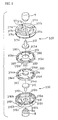
- FIG.13 is an exploded perspective assembly view of a movable electrode assembly 7 in the vacuum interrupter of US-A-4 473 731 and GB-A-2 111 309
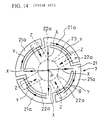
- FIG.14 is a plan view of the movable electrode assembly 7 shown in FIG.13.
- a movable electrode 21 is mounted on the top of a movable electrode rod 8 through a short circuit member 22, and is supported at the central part by a support member 23 which is made of high resistance material and fixed on the movable electrode rod 8.
- Four arms 21a are formed on the peripheral portion of the movable electrode 21 along the circumference thereof.
- four arms 22a extending in radial directions are formed on the short circuit member 22. The ends of the arms 22a of the short circuit member 22 contact the respective arms 21a of the movable electrode 21, and the movable electrode 21 is electrically connected to the short circuit member 22.
- the movable electrode assembly 7 comprising the movable electrode 21, the movable electrode rod 8, the short circuit member 22 and the support member 23 shown in FIG.13 is arranged in the evacuated envelope 4 in opposed relationship to the stationary electrode assembly 6 as shown in FIG.12.
- FIG.14 current paths of the arc current are illustrated by arrows.
- the arc current flows from the central part P of the movable electrode 21 to the connection parts of the arms 21a in the radial direction as shown by arrows X, and passes through the arms 21a along the circumference of the movable electrode 21 as shown by arrows Y. Subsequently, the arc current flows to the movable electrode rod 8 through the arms 22a of the short circuit member 22 in the radial directions as shown by arrows Z. Consequently, four fan-shaped current paths are formed as shown in the plan view of FIG.14, and magnetic fields in the axial direction are generated in these fan-shaped regions by the known right-handed screw rule.
- the plasma arc produced between the stationary electrode assembly 6 and the movable electrode assembly 7 is diffused by the magnetic field.
- the intensity of the magnetic field in the fan-shaped region is larger than that in the region between neighboring two fan-shaped regions. Therefore, the intensity of the magnetic field is not uniform between the stationary electrode assembly 6 and the movable electrode assembly 7, and the plasma arc is not effectively diffused owing to the lack of uniformity of the magnetic field.
- a vacuum interrupter according to the preamble of claim 1 is known from EP-A-0 113 961.
- An object of the present invention is to provide a vacuum interrupter in which a uniform magnetic field is generated between a stationary electrode and a movable electrode by guiding an arc current along full circumference of the stationary electrode and the movable electrode.
- the coil part arranged along the circumference of the coil electrode is protruded to the back surface of the main electrode and contacts the main electrode Therefore, the magnetic field in the axial direction of the coil electrode is enhanced, and leak of magnetic flux decreases. Consequently, suitable distribution of the magnetic field is realizable, and the arc in disconnection operation is effectively diffused. And thereby the vacuum interrupter having superior disconnection characteristic can be provided. Moreover, the vacuum interrupter which is superior in mechanical strength of the coil electrode can be provided.
- FIG.1 is an exploded perspective assembly view of the electrode assembly of the vacuum interrupter in a first embodiment.
- coil electrodes 43 made of conductive material are provided with ring-shaped holding parts 43a at the central parts which are put on the bosses 5a and 8a of the electrode rods 5 and 8.
- Four arms 43b are extended from the holding part 43a to the radial direction.
- Arc-shaped coil parts 43c are connected to the ends of the respective arms 43b and are arranged on a circular.
- the coil parts 43c are protruded in the axial direction and contact with the back surface of the respective disc-shaped main electrodes 41 at the entire circumferential surfaces 43d.
- Support members 42 mechanically support the back surfaces of the respective main electrodes 41.
- the support members 42 are made of high resistance material such as stainless steel, and rod parts 42a are inserted in a supporting hole 8b of the electrode rods 8 and are fixed thereby.
- a disc-shaped supporting part 42b supports the central part of the main electrodes 41.
- FIG.2(a) is a perspective view showing disconnection state of the electrode assemblies.
- Currents flow from an arc spot P generated on the main electrode 41a to the circumference of the main electrode in radial direction as shown by dotted lines.
- the currents reach the coil part 43c of the coil electrode 43, the current flows in the coil part 43c which is lower in resistance than the main electrode 41a, and reaches the electrode rod 8 through the arm parts 43b and the holding part 43a of the coil electrode 43 shown in FIG.2(b).
- the current flows in the directions shown by dotted lines with arrow in the other main electrode 41b. Consequently, the magnetic field in the axial direction is generated between both the main electrodes and thereby the arc is diffused.
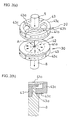
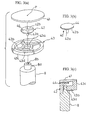
- a cross-shaped good conductivity member 44 for example, is formed on the upper surface 44b of the support member 42 as shown in FIG.3a in the first embodiment such that the main part of the current from the arc spot P flows to the ends of the coil parts 43c through the cross-shaped good conductive member 44 formed on the upper surface of the support member 42. Subsequently, the current flows to the electrode rod 8 through the arm parts 43b of the coil electrode 43 and the holding part 43a.
- the good conductivity member 44 formed on the upper surface of the support member 42 serves to lead the arc current generated on the main electrode 41 to the end of the coil part 43c as much as possible. Consequently, the current flowing the coil part 43c is increased, and the intensity of the magnetic field is increased.
- the good conductivity member 44 may be formed to other shape which can effectively flows the current to the coil part 43c other than the cross, for example may be formed to a disk-shape as shown in FIG.3(b).
- the good conductivity member 44 serves to reduce the resistance between both the electrode assemblies and to suppress the current which leaks to the electrode rod 8 through the main electrodes 41 and the support members 42.
- FIG.3(c) is a partial cross-section of assembled movable electrode assembly 43.
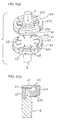
- FIG.4(a) is a perspective view of the electrode assemblies of the vacuum interrupter in a second embodiment.
- high resistance parts 45 are slots or fillers made of high resistance material such as stainless steel filled in the slots and are disposed inward from the circumference of the main electrode 41 along the circumference.
- the high resistance parts 45 are formed along the arm parts 43b of the coil electrodes 43 extending to the radial directions and the arm parts 43c extending along the circumference, and are terminated at the positions which are shorter than the arm length of the arm parts 43c.
- other high resistance parts 46 are formed in the radial directions of the main electrode 41.
- the high resistance parts 46 are made of high resistance material such as stainless steel or may be substituted with slits.
- Other configuration in the second embodiment is identical with that of the first embodiment, and therefore elucidation is omitted.
- the high resistance parts 45 formed along the circumference serve to flow the current along the coil part 43c as much as possible.
- the intensity of the magnetic field generated by the coil electrodes 43 is enhanced, and uniformity of the magnetic field is improved.
- the high resistance parts 46 in the radial directions of the second embodiment serve to prevent the reduction of the magnetic field in the axial direction due to the eddy current which is generated on the main electrode 41.
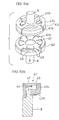
- reentrants 47 are formed on the central contact surfaces of the main electrodes 41a and 41b so as to reduce the resistance between both the electrode assemblies and to be easy to move the arc.
- FIG.5(b) is a partial cross-section of the electrode assembly in the example.
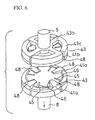
- Protrusions 48 may be formed on the main electrodes 41a and 41b as shown in FIG.6 to obtain the same effect as the reentrants 47 in FIG.5(b).
- the number of the arm parts 43b and the coil parts 43c of the coil electrode 43 may be changed in order to vary the intensity of the magnetic field in accordance with the change of operation condition or contact material of the vacuum interrupter. In the above-mentioned case, the same effect is realizable.
- a high withstand voltage characteristic is required to withstand a voltage due to a shock wave other than the voltage in the frequency of an electric utility. For this reason, the vacuum interrupter must be configurated so as to maintain the high withstand voltage characteristic between the stationary electrode and the movable electrode.
- the conventional vacuum interrupter having the electrodes for generating the magnetic field in the axial direction since the outer diameter of the main electrode is substantially equal to the outer diameter of the coil electrode, a radius of curvature in the circumferential part of the main electrode must be increased in order to improve the withstand voltage characteristic. In order to increase the radius of curvature, a thickness of the main electrode must be increased, and thus there is a difficulty to miniaturize the vacuum interrupter.
- FIG.7 is a perspective view of the electrode assemblies of a vacuum interrupter for elucidating for the subject matter of the present invention, which is, however, not part of the present invention
- FIG.8 is an exploded perspective assembly view of the electrode assemblies in FIG.7
- FIG.9 is a cross-section of a movable electrode assembly 330 in FIG.7.
- Both the electrode assemblies of the vacuum interrupter shown in FIG.7 are arranged in the evacuated envelope, and are configurated to connect or disconnect with each other by the operation mechanism (not shown).
- the electrode assemblies comprise a stationary electrode assembly 320 fixed on the evacuated envelope through a insulating member and a movable electrode assembly 330 which is connected or disconnected with the stationary electrode assembly 320 by moving upward or downward by activation of the operation mechanism.
- the configuration of the stationary electrode assembly 320 is substantially identical with that of the movable electrode assembly 330, and one of them is inverted and is arranged in opposed relationship to the other.
- the stationary electrode assembly 320 comprises the stationary electrode rod 5, a stationary coil electrode 311, a support member 312 and a stationary main electrode 313, and the movable electrode assembly 330 comprises the movable electrode rod 8, a movable coil electrode 316, a support member 315 and a movable main electrode 314.
- the stationary coil electrode 311 comprises a ring-shaped holding part 311a put on the stationary electrode rod 5 at the center part, four arm parts 311b extended from the holding part 311a in the radial directions and coil parts 311c connected to the respective arm parts 311b.
- the movable coil electrode 316 comprise a ring-shaped holding part 316a put on the boss 8a of the movable electrode rod 8 at the center part, and four arm parts 316b extended from the holding part 316a to the radial directions.
- the end surface of each arm part 316b is connected to an end of each arc-shaped coil part 316c, and these coil parts 316c are substantially arranged on the same circumference.
- a circular stepped pit is formed on the upper surface (the face opposed to the stationary electrode assembly 320) of the coil parts 316c, and in which the movable main electrode 314 is inserted.
- the movable main electrode 314 is provided with four arc-shaped circumference parts 314a separated from the movable main electrode 314 by respective slots 390. These circumferential parts 314a of the main electrode 314 is inserted in the stepped pit formed on the upper surface of the coil part 316c of the movable coil electrode 316. Moreover, a salient contact 314b which serves as an arc generation position is formed on the center part of the surface of the movable main electrode 314 opposing to the stationary main electrode 313.
- FIG.9 is a cross-section of the movable electrode assembly 330, showing the state that the movable main electrode 314 is inserted in the movable coil electrode 316.
- the circumferential part of the surface of the movable main electrode 314 opposing to the stationary main electrode 313 is made to a curved surface having a radius of curvature c 1 .
- the circumferential part opposing to stationary main electrode 313 of the coil part 316c of the movable coil electrode 316 is made to a curved surface having a radius of curvature C 2 .
- the circumferential edge of the salient contact 314b is made to a curved surface of a radius of curvature C 3 .
- the radius of curvature c 2 of the circumferential part of the coil parts 316c is made to equal to be the radius of curvature c 1 of the circumferential part of the movable main electrode 314 or to be larger than the radius of curvature c 1 .
- the stationary coil electrode 311 and the movable coil electrode 316 are made of alloy of Cu or Ag including Cu, Cu+Cr as main material.
- the support member 315 is made of high resistance material such as stainless steel and mechanically supports the movable main electrode 314 by contacting the lower surface of the movable main electrode 314.
- a dot-shaped shaft 315a extending in the axial direction of the support member 315 is inserted in a support hole formed on the boss 8a of the movable electrode rod 8 and is fixed thereby.
- the vacuum interrupter described above an electric field on the circumferential parts of the electrode assemblies 320 and 330 is relaxed by means of the curved part formed on the circumferential parts of the main electrodes and the coil electrodes. Moreover, since the coil parts 311c and 316c of the respective coil electrodes 311 and 316 are configurated so as to oppose directly, the magnetic field in the axial direction is effectively generated between both the electrodes. Consequently, the vacuum interrupter described above is superior in the withstand voltage characteristic and disconnection characteristic and is usable for a switch in a high voltage circuit.
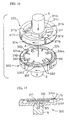
- FIG.10 is a perspective view of the electrode assemblies of the vacuum interrupter in a third embodiment
- FIG.11 is a cross-section of a movable electrode assembly 330 in the electrode assemblies of FIG.10.
- elements having the same structure and function as the elements shown in Figs. 7 to 9 are identified by like numerals and the elucidation is omitted.
- the stationary electrode assembly 320 and the movable electrode assembly 330 shown in FIG.10 are arranged in the evacuated envelope in opposed relationship and have substantially the same structure.
- the movable electrode assembly 330 is configurated to connect or disconnect with the stationary electrode assembly 320, and they are arranged in point symmetry.
- the movable electrode assembly 330 comprises the movable coil electrode 316 having curved circumferential part and a movable main electrode 324 having plural slots 360 in the radial directions.
- the movable main electrode 324 is provided with slots 350 along the circumference.
- the movable main electrode 324 is inserted in the circular stepped pit of the movable coil electrode 316 in a similar manner shown in FIG.10.
- the plural slots 360 formed on the movable main electrode 324 in the radial directions regulate the direction of the current to desired directions in the movable main electrode 324 in generation of the arc. Consequently, a uniform magnetic field in the axial direction is generated between both the electrodes by the current flowing along the circumference of the coil parts 316c of the movable coil electrode 316.
- a cross-shaped conducting member or a disk-shaped conducting member 317 is formed on the upper surface of the support member 315 contacting the movable main electrode 324.
- the conducting member 317 is made of a good conductor and serves to effectively lead the current flowed in the movable main electrode 324 to the circumferential part 324a of the movable main electrode 324.
- the current in generation of the arc is effectively led to the circumferential parts of both the electrodes and the coil parts of both the coil electrodes by contacting the conducting member 317 to the back face of the movable main electrode 324. Thereby the intensity of the magnetic field in the axial direction is enhanced between both the electrodes.
- the radius of curvature c 2 of the circumferential parts of the coil parts 316c is made to be equal to or more than the radius of curvature c 1 of the circumferential parts 324a of the movable main electrode 324.
- the vacuum interrupter in the third embodiment is superior in the withstand voltage characteristic and the disconnection characteristic.
Landscapes
- High-Tension Arc-Extinguishing Switches Without Spraying Means (AREA)
Claims (3)
- Interrupteur à vide comportant une paire d'ensembles à électrode aménagés dans une enveloppe sous vide de manière à se connecter et à se déconnecter l'un l'autre à l'aide de tiges d'électrode respectives (5, 8), dans lequel :caractérisé en ce que :au moins l'un desdits ensembles à électrode comprend une électrode principale (41) et une électrode à bobine (43), etladite électrode à bobine (43) est montée sur la surface arrière de ladite électrode principale (41) et comprend :des parties de bras (43b) s'étendant à partir de ladite tige d'électrode (5, 8), etdes parties de bobine (43c) connectées aux dites parties de bras respectives (43b), en saillie sur ladite électrode principale (41) et aménagées sur une circonférence, dans lesquellesles surfaces supérieures desdites parties de bobine (43c) de ladite électrode à bobine (43) sont connectées à la surface arrière de ladite électrode principale (41) sur la totalité de sa circonférence, et ainsi, un champ magnétique dans le sens axial desdits ensembles à électrode est généré entre ladite paire d'ensembles à électrode par un courant passant dans ladite électrode principale (41) et dans ladite électrode à bobine (43),
un élément de support (42) est disposé afin de supporter ladite électrode principale (41) par contact avec la surface arrière de celle-ci, et ledit élément de support (42) comprend un élément (44) à haute conductivité électrique formé sur la surface supérieure de celui-ci de manière à s'étendre à partir de la partie centrale dudit élément de support (42) jusqu'à la circonférence. - Interrupteur à vide selon la revendication 1, caractérisé en ce qu'une partie à haute résistance (45) est disposée sur le côté intérieur de ladite partie de bobine (43c) de ladite électrode à bobine (43) le long de la circonférence de ladite électrode principale (41) connectée à ladite partie de bobine (43c).
- Interrupteur à vide selon les revendications 1 ou 2, caractérisé en ce qu'une partie à haute résistance (46) est disposée sur le côté intérieur de ladite partie de bobine (43c) de ladite électrode à bobine (43) dans le sens radial de ladite électrode principale (41).
Applications Claiming Priority (27)
| Application Number | Priority Date | Filing Date | Title |
|---|---|---|---|
| JP32609092 | 1992-11-10 | ||
| JP326092/92 | 1992-11-10 | ||
| JP32609292 | 1992-11-10 | ||
| JP326090/92 | 1992-11-10 | ||
| JP32609092 | 1992-11-10 | ||
| JP32609292 | 1992-11-10 | ||
| JP335146/92 | 1992-11-19 | ||
| JP33514692 | 1992-11-19 | ||
| JP33514692 | 1992-11-19 | ||
| JP335147/92 | 1992-11-19 | ||
| JP33514792 | 1992-11-19 | ||
| JP33514792 | 1992-11-19 | ||
| JP16542993 | 1993-07-05 | ||
| JP16542993 | 1993-07-05 | ||
| JP16543093 | 1993-07-05 | ||
| JP16543093 | 1993-07-05 | ||
| JP165429/93 | 1993-07-05 | ||
| JP165430/93 | 1993-07-05 | ||
| JP181301/93 | 1993-07-22 | ||
| JP18130093 | 1993-07-22 | ||
| JP18130193 | 1993-07-22 | ||
| JP18130193 | 1993-07-22 | ||
| JP181300/93 | 1993-07-22 | ||
| JP18130093 | 1993-07-22 | ||
| JP5271959A JP2861757B2 (ja) | 1992-11-10 | 1993-10-29 | 真空バルブの電極装置 |
| JP27195993 | 1993-10-29 | ||
| JP271959/93 | 1993-10-29 |
Publications (3)
| Publication Number | Publication Date |
|---|---|
| EP0597434A2 EP0597434A2 (fr) | 1994-05-18 |
| EP0597434A3 EP0597434A3 (fr) | 1995-02-08 |
| EP0597434B1 true EP0597434B1 (fr) | 2001-03-07 |
Family
ID=27577504
Family Applications (1)
| Application Number | Title | Priority Date | Filing Date |
|---|---|---|---|
| EP93118102A Expired - Lifetime EP0597434B1 (fr) | 1992-11-10 | 1993-11-08 | Interrupteur à vide |
Country Status (5)
| Country | Link |
|---|---|
| US (3) | US5495085A (fr) |
| EP (1) | EP0597434B1 (fr) |
| JP (1) | JP2861757B2 (fr) |
| DE (1) | DE69329987T2 (fr) |
| PT (1) | PT597434E (fr) |
Families Citing this family (35)
| Publication number | Priority date | Publication date | Assignee | Title |
|---|---|---|---|---|
| JP2861757B2 (ja) * | 1992-11-10 | 1999-02-24 | 三菱電機株式会社 | 真空バルブの電極装置 |
| TW265452B (fr) * | 1994-04-11 | 1995-12-11 | Hitachi Seisakusyo Kk | |
| FR2727565B1 (fr) | 1994-11-29 | 1997-01-17 | Schneider Electric Sa | Interrupteur electrique, notamment sous vide |
| DE4446672A1 (de) * | 1994-12-15 | 1996-09-12 | Slamecka Ernst | Vakuumschalter-Kontaktanordnung |
| JP3462367B2 (ja) * | 1997-06-27 | 2003-11-05 | 株式会社日立製作所 | 複合絶縁開閉装置 |
| GB2341004B (en) * | 1998-08-21 | 2002-07-17 | Alstom Uk Ltd | Improvements in vacuum interrupters |
| DE19957228B4 (de) * | 1999-11-27 | 2009-04-23 | Moeller Gmbh | Kontaktanordnung für eine Vakuumschaltkammer |
| DE10065091A1 (de) * | 2000-12-21 | 2002-06-27 | Siemens Ag | Kontaktanordnung für eine Vakuumschaltröhre |
| JP4480443B2 (ja) | 2004-03-31 | 2010-06-16 | 富士通株式会社 | 液晶表示装置及び液晶表示装置の製造方法 |
| JP4667032B2 (ja) * | 2004-12-10 | 2011-04-06 | 三菱電機株式会社 | 真空バルブ |
| FR2903221B1 (fr) * | 2006-06-30 | 2013-12-20 | Schneider Electric Ind Sas | Procede de fixation d'un element dans un appareil electrique et appareil electrique tel une ampoule a vide comportant au moins deux parties fixees suivant un tel procede |
| KR101261967B1 (ko) * | 2009-03-11 | 2013-05-08 | 엘에스산전 주식회사 | 진공인터럽터의 전극 |
| FR2946792A1 (fr) * | 2009-06-10 | 2010-12-17 | Areva T & D Sa | Enroulement pour contact d'ampoule a vide a moyenne tension a endurance amelioree, ampoule a vide et disjoncteur, tel qu'un disjoncteur sectionneur d'alternateur associes. |
| FR2946790B1 (fr) * | 2009-06-10 | 2011-07-01 | Areva T & D Sa | Contact pour ampoule a vide a moyenne tension a coupure d'arc amelioree, ampoule a vide et disjoncteur, tel qu'un disjoncteur sectionneur d'alternateur associes. |
| FR2946791B1 (fr) * | 2009-06-10 | 2011-09-23 | Areva T & D Sa | Contact pour ampoule a vide a moyenne tension a structure renforcee, ampoule a vide et disjoncteur, tel qu'un disjoncteur sectionneur d'alternateur associes. |
| JP5350317B2 (ja) * | 2009-09-30 | 2013-11-27 | 株式会社日立製作所 | 真空開閉器、または開閉器用の電極もしくは真空開閉器の製造方法 |
| JP2011242879A (ja) * | 2010-05-14 | 2011-12-01 | Panasonic Corp | 接続装置 |
| KR20130000677A (ko) * | 2011-06-23 | 2013-01-03 | 엘에스산전 주식회사 | 진공 인터럽터의 전극 조립체 |
| CN102522257B (zh) * | 2011-12-09 | 2015-07-15 | 沈阳工业大学 | 盘式旋磁纵吹真空灭弧室 |
| CN102522259B (zh) * | 2011-12-09 | 2015-07-15 | 沈阳工业大学 | 盘型叠式旋磁纵吹真空灭弧室 |
| FR2991097B1 (fr) | 2012-05-24 | 2014-05-09 | Schneider Electric Ind Sas | Dispositif de controle d'arc pour ampoule a vide |
| DE102012221844A1 (de) * | 2012-11-29 | 2014-06-05 | Siemens Aktiengesellschaft | Schaltkontakt für Vakuumschaltröhren |
| KR101601619B1 (ko) * | 2013-03-05 | 2016-03-08 | 미쓰비시덴키 가부시키가이샤 | 진공 밸브 |
| US9006600B2 (en) | 2013-06-14 | 2015-04-14 | Eaton Corporation | High current vacuum interrupter with sectional electrode and multi heat pipes |
| CN104282494B (zh) * | 2013-07-12 | 2017-04-12 | 富士电机机器制御株式会社 | 接点装置和使用它的电磁接触器 |
| US9373468B2 (en) * | 2014-09-16 | 2016-06-21 | Tyco Electronics Corporation | Arc control for contactor assembly |
| CN104269319B (zh) * | 2014-10-15 | 2016-12-07 | 国网浙江临海市供电公司 | 一种带有防扭真空灭弧室的断路器 |
| US9640353B2 (en) * | 2014-10-21 | 2017-05-02 | Thomas & Betts International Llc | Axial magnetic field coil for vacuum interrupter |
| CN109494116B (zh) * | 2018-11-07 | 2020-10-13 | 平高集团有限公司 | 一种线圈式纵向磁场触头组件及真空灭弧室 |
| CN109308976B (zh) * | 2018-11-07 | 2020-07-10 | 平高集团有限公司 | 线圈式纵向磁场触头组件及真空灭弧室 |
| US11721503B2 (en) * | 2019-04-23 | 2023-08-08 | Mitsubishi Electric Corporation | Vacuum interrupter |
| CN110853975B (zh) * | 2019-11-27 | 2021-11-02 | 云南电网有限责任公司电力科学研究院 | 一种碟式触头 |
| WO2021240733A1 (fr) * | 2020-05-28 | 2021-12-02 | 三菱電機株式会社 | Soupape à vide |
| DE112022003277T5 (de) * | 2021-06-29 | 2024-05-02 | Mitsubishi Electric Corporation | Vakuumschalter |
| JP7548264B2 (ja) * | 2022-03-30 | 2024-09-10 | 三菱電機株式会社 | 真空バルブ |
Family Cites Families (44)
| Publication number | Priority date | Publication date | Assignee | Title |
|---|---|---|---|---|
| US3089936A (en) * | 1960-02-23 | 1963-05-14 | Gen Electric | Contact structure for an electric circuit interrupter |
| US3405300A (en) * | 1965-07-07 | 1968-10-08 | Matsushita Electric Industrial Co Ltd | Gas filled coaxial type electric switch with magnetic field cut-off |
| FR1491235A (fr) * | 1966-02-22 | 1967-08-11 | Comp Generale Electricite | Générateur de choc |
| US3522399A (en) * | 1968-03-08 | 1970-07-28 | Gen Electric | Vacuum-type circuit interrupter with contacts having particularly shaped circumferentially spaced slots |
| US3811070A (en) * | 1972-10-25 | 1974-05-14 | Westinghouse Electric Corp | Laser initiated three electrode type triggered vacuum gap device |
| FR2279216A1 (fr) * | 1973-09-10 | 1976-02-13 | Tokyo Shibaura Electric Co | Interrupteur a vide a champ magnetique |
| JPS5422813B2 (fr) * | 1973-09-10 | 1979-08-09 | ||
| US3980850A (en) * | 1974-12-19 | 1976-09-14 | Westinghouse Electric Corporation | Vacuum interrupter with cup-shaped contact having an inner arc controlling electrode |
| US4152625A (en) * | 1978-05-08 | 1979-05-01 | The United States Of America As Represented By The Secretary Of The Army | Plasma generation and confinement with continuous wave lasers |
| JPS5826132B2 (ja) * | 1978-11-22 | 1983-06-01 | 株式会社日立製作所 | 真空しや断器 |
| JPS5847627Y2 (ja) * | 1979-06-27 | 1983-10-31 | 株式会社明電舎 | 真空しや断器 |
| JPS5624722A (en) * | 1979-08-01 | 1981-03-09 | Tokyo Shibaura Electric Co | Vacuum breaker |
| JPS55159524A (en) * | 1980-06-02 | 1980-12-11 | Tokyo Shibaura Electric Co | Vacuum breaker |
| JPS5776713A (en) * | 1980-10-30 | 1982-05-13 | Tokyo Shibaura Electric Co | Vacuum valve |
| JPS57191922A (en) * | 1981-05-21 | 1982-11-25 | Meidensha Electric Mfg Co Ltd | Vacuum breaker |
| JPS57192637U (fr) * | 1981-05-30 | 1982-12-07 | ||
| JPS57212719A (en) * | 1981-06-24 | 1982-12-27 | Hitachi Ltd | Vacuum breaker |
| DE3133799A1 (de) * | 1981-08-26 | 1983-03-17 | Siemens AG, 1000 Berlin und 8000 München | "kontaktanordnung fuer vakuumschalter" |
| US4512867A (en) * | 1981-11-24 | 1985-04-23 | Andreev Anatoly A | Method and apparatus for controlling plasma generation in vapor deposition |
| JPS58100325A (ja) * | 1981-12-09 | 1983-06-15 | 三菱電機株式会社 | 真空しや断器 |
| US4588879A (en) * | 1982-11-30 | 1986-05-13 | Kabushika Kaisha Meidensha | Vacuum interrupter |
| JPS59101732A (ja) * | 1982-12-01 | 1984-06-12 | 株式会社明電舎 | 真空インタラプタの電極 |
| JPS59114716A (ja) * | 1982-12-21 | 1984-07-02 | 株式会社東芝 | 真空バルブ |
| JPS59169013A (ja) * | 1983-03-15 | 1984-09-22 | 株式会社明電舎 | 真空インタラプタ |
| CA1236868A (fr) * | 1983-03-15 | 1988-05-17 | Yoshiyuki Kashiwagi | Interrupteur sous vide |
| JPS6051851U (ja) * | 1983-09-17 | 1985-04-11 | 株式会社東芝 | 真空バルブ |
| US4553002A (en) * | 1983-12-05 | 1985-11-12 | Westinghouse Electric Corp. | Axial magnetic field vacuum-type circuit interrupter |
| DE3415743A1 (de) * | 1984-04-26 | 1985-10-31 | Siemens AG, 1000 Berlin und 8000 München | Kontaktanordnung fuer einen vakuumschalter |
| JPS61195528A (ja) * | 1985-02-22 | 1986-08-29 | 三菱電機株式会社 | 真空しや断器の電極構造 |
| DE3510981A1 (de) * | 1985-03-22 | 1985-10-31 | Ernst Prof. Dr.techn.habil. 1000 Berlin Slamecka | Vakuumschalter - erregerkontaktanordnung |
| GB8510441D0 (en) * | 1985-04-24 | 1985-05-30 | Vacuum Interrupters Ltd | High current switch contacts |
| JPS6217054U (fr) * | 1985-07-17 | 1987-01-31 | ||
| JPS6231917A (ja) * | 1985-08-02 | 1987-02-10 | 三菱電機株式会社 | 真空放電応用機器の電極構造 |
| WO1987006052A1 (fr) * | 1986-03-26 | 1987-10-08 | Siemens Aktiengesellschaft Berlin Und München | Systeme de contacts pour interrupteur a vide avec champ magnetique axial |
| DE3610245A1 (de) * | 1986-03-26 | 1987-10-01 | Siemens Ag | Kontaktanordnung fuer vakuumschalter mit axialem magnetfeld und verfahren zur herstellung der zugehoerigen kontaktstuecke |
| JPH0619938B2 (ja) * | 1987-03-10 | 1994-03-16 | 三菱電機株式会社 | 真空開閉装置 |
| SE461761B (sv) * | 1988-05-03 | 1990-03-19 | Fiz Tekh Inst Ioffe | Elektrisk ljusbaaganordning |
| US4978893A (en) * | 1988-09-27 | 1990-12-18 | The United States Of American As Epresented By The United States The Department Of Energy | Laser-triggered vacuum switch |
| JPH02270233A (ja) * | 1989-04-10 | 1990-11-05 | Toshiba Corp | 真空バルブ |
| DE3915287C2 (de) * | 1989-05-10 | 1997-12-18 | Sachsenwerk Ag | Kontaktanordnung für einen Vakuumschalter |
| JPH03272530A (ja) * | 1990-03-20 | 1991-12-04 | Fuji Electric Co Ltd | 真空遮断器用真空バルブ |
| DE4013903A1 (de) * | 1990-04-25 | 1990-11-22 | Slamecka Ernst | Magnetfeld-kontaktanordnung fuer vakuumschalter |
| JPH05190062A (ja) * | 1992-01-16 | 1993-07-30 | Hitachi Ltd | 真空遮断器用電極 |
| JP2861757B2 (ja) * | 1992-11-10 | 1999-02-24 | 三菱電機株式会社 | 真空バルブの電極装置 |
-
1993
- 1993-10-29 JP JP5271959A patent/JP2861757B2/ja not_active Expired - Fee Related
- 1993-11-04 US US08/145,743 patent/US5495085A/en not_active Expired - Lifetime
- 1993-11-08 PT PT93118102T patent/PT597434E/pt unknown
- 1993-11-08 DE DE69329987T patent/DE69329987T2/de not_active Expired - Fee Related
- 1993-11-08 EP EP93118102A patent/EP0597434B1/fr not_active Expired - Lifetime
-
1995
- 1995-06-07 US US08/475,333 patent/US5597993A/en not_active Expired - Fee Related
- 1995-06-07 US US08/478,392 patent/US5646386A/en not_active Expired - Fee Related
Also Published As
| Publication number | Publication date |
|---|---|
| US5597993A (en) | 1997-01-28 |
| US5495085A (en) | 1996-02-27 |
| US5646386A (en) | 1997-07-08 |
| EP0597434A2 (fr) | 1994-05-18 |
| DE69329987D1 (de) | 2001-04-12 |
| JPH0785754A (ja) | 1995-03-31 |
| PT597434E (pt) | 2001-07-31 |
| EP0597434A3 (fr) | 1995-02-08 |
| DE69329987T2 (de) | 2001-10-25 |
| JP2861757B2 (ja) | 1999-02-24 |
Similar Documents
| Publication | Publication Date | Title |
|---|---|---|
| US5495085A (en) | Vacuum interrupter | |
| US4473731A (en) | Vacuum circuit interrupter | |
| US4260864A (en) | Vacuum-type circuit interrupter with an improved contact with axial magnetic field coil | |
| EP0329410B1 (fr) | Interrupteur à vide | |
| US4117288A (en) | Vacuum type circuit interrupter with a contact having integral axial magnetic field means | |
| CA1224233A (fr) | Interrupteur sous vide | |
| EP0349303B1 (fr) | Interrupteur à vide | |
| EP0443236A1 (fr) | Interrupteur à vide à champ magnétique axial | |
| KR100484076B1 (ko) | 진공단속기용전극조립체,축방향자계단속기용전극코일및진공단속기용전극코일제조방법 | |
| US6426475B2 (en) | Vacuum valve | |
| US5691522A (en) | Vacuum interrupter with a single internal assembly for generating an axial magnetic field | |
| EP0133368B2 (fr) | Contact pour interrupteur haut courant | |
| JPS6171520A (ja) | 真空開閉器具の接触子装置 | |
| CA1157071A (fr) | Interrupteur a vide avec contacts de transfert a dispositif generateur d'un champ magnetique axial | |
| EP0052371A2 (fr) | Interrupteur à vide | |
| US4504711A (en) | Vacuum switching tube having magnetic field electrodes | |
| US4617434A (en) | Contact arrangement for a vacuum interrupter | |
| US4401868A (en) | Vacuum interrupter with a spacially modulated axial magnetic field contact | |
| JP3243162B2 (ja) | 真空バルブ | |
| JP3219483B2 (ja) | 真空バルブ | |
| CA1066334A (fr) | Disjoncteur a vide a deux ensembles de contacts electriquement en parallele | |
| JPH11260207A (ja) | 真空バルブ | |
| JPH11329173A (ja) | 真空バルブ | |
| JPS6347219B2 (fr) | ||
| RU98108811A (ru) | Контактная система вакуумной дугогасительной камеры |
Legal Events
| Date | Code | Title | Description |
|---|---|---|---|
| PUAI | Public reference made under article 153(3) epc to a published international application that has entered the european phase |
Free format text: ORIGINAL CODE: 0009012 |
|
| AK | Designated contracting states |
Kind code of ref document: A2 Designated state(s): DE GB PT |
|
| PUAL | Search report despatched |
Free format text: ORIGINAL CODE: 0009013 |
|
| AK | Designated contracting states |
Kind code of ref document: A3 Designated state(s): DE GB PT |
|
| 17P | Request for examination filed |
Effective date: 19950614 |
|
| 17Q | First examination report despatched |
Effective date: 19980701 |
|
| GRAG | Despatch of communication of intention to grant |
Free format text: ORIGINAL CODE: EPIDOS AGRA |
|
| GRAG | Despatch of communication of intention to grant |
Free format text: ORIGINAL CODE: EPIDOS AGRA |
|
| GRAG | Despatch of communication of intention to grant |
Free format text: ORIGINAL CODE: EPIDOS AGRA |
|
| GRAH | Despatch of communication of intention to grant a patent |
Free format text: ORIGINAL CODE: EPIDOS IGRA |
|
| GRAH | Despatch of communication of intention to grant a patent |
Free format text: ORIGINAL CODE: EPIDOS IGRA |
|
| GRAA | (expected) grant |
Free format text: ORIGINAL CODE: 0009210 |
|
| AK | Designated contracting states |
Kind code of ref document: B1 Designated state(s): DE GB PT |
|
| REF | Corresponds to: |
Ref document number: 69329987 Country of ref document: DE Date of ref document: 20010412 |
|
| REG | Reference to a national code |
Ref country code: GB Ref legal event code: 727 |
|
| REG | Reference to a national code |
Ref country code: GB Ref legal event code: 727A |
|
| REG | Reference to a national code |
Ref country code: PT Ref legal event code: SC4A Free format text: AVAILABILITY OF NATIONAL TRANSLATION Effective date: 20010411 |
|
| EN | Fr: translation not filed | ||
| REG | Reference to a national code |
Ref country code: GB Ref legal event code: 727B |
|
| REG | Reference to a national code |
Ref country code: GB Ref legal event code: IF02 |
|
| PLBE | No opposition filed within time limit |
Free format text: ORIGINAL CODE: 0009261 |
|
| STAA | Information on the status of an ep patent application or granted ep patent |
Free format text: STATUS: NO OPPOSITION FILED WITHIN TIME LIMIT |
|
| 26N | No opposition filed | ||
| PGFP | Annual fee paid to national office [announced via postgrant information from national office to epo] |
Ref country code: DE Payment date: 20061102 Year of fee payment: 14 |
|
| PGFP | Annual fee paid to national office [announced via postgrant information from national office to epo] |
Ref country code: PT Payment date: 20061107 Year of fee payment: 14 |
|
| PGFP | Annual fee paid to national office [announced via postgrant information from national office to epo] |
Ref country code: GB Payment date: 20061108 Year of fee payment: 14 |
|
| REG | Reference to a national code |
Ref country code: PT Ref legal event code: MM4A Free format text: LAPSE DUE TO NON-PAYMENT OF FEES Effective date: 20080508 |
|
| GBPC | Gb: european patent ceased through non-payment of renewal fee |
Effective date: 20071108 |
|
| PG25 | Lapsed in a contracting state [announced via postgrant information from national office to epo] |
Ref country code: PT Free format text: LAPSE BECAUSE OF NON-PAYMENT OF DUE FEES Effective date: 20080508 |
|
| PG25 | Lapsed in a contracting state [announced via postgrant information from national office to epo] |
Ref country code: DE Free format text: LAPSE BECAUSE OF NON-PAYMENT OF DUE FEES Effective date: 20080603 |
|
| PG25 | Lapsed in a contracting state [announced via postgrant information from national office to epo] |
Ref country code: GB Free format text: LAPSE BECAUSE OF NON-PAYMENT OF DUE FEES Effective date: 20071108 |