EP0601182B1 - Anorganische bauplatte und herstellungsverfahren - Google Patents
Anorganische bauplatte und herstellungsverfahren Download PDFInfo
- Publication number
- EP0601182B1 EP0601182B1 EP19920916120 EP92916120A EP0601182B1 EP 0601182 B1 EP0601182 B1 EP 0601182B1 EP 19920916120 EP19920916120 EP 19920916120 EP 92916120 A EP92916120 A EP 92916120A EP 0601182 B1 EP0601182 B1 EP 0601182B1
- Authority
- EP
- European Patent Office
- Prior art keywords
- layer portion
- inorganic
- middle layer
- outer layer
- board according
- Prior art date
- Legal status (The legal status is an assumption and is not a legal conclusion. Google has not performed a legal analysis and makes no representation as to the accuracy of the status listed.)
- Expired - Lifetime
Links
Images



Classifications
-
- B—PERFORMING OPERATIONS; TRANSPORTING
- B28—WORKING CEMENT, CLAY, OR STONE
- B28B—SHAPING CLAY OR OTHER CERAMIC COMPOSITIONS; SHAPING SLAG; SHAPING MIXTURES CONTAINING CEMENTITIOUS MATERIAL, e.g. PLASTER
- B28B19/00—Machines or methods for applying the material to surfaces to form a permanent layer thereon
- B28B19/003—Machines or methods for applying the material to surfaces to form a permanent layer thereon to insulating material
-
- B—PERFORMING OPERATIONS; TRANSPORTING
- B28—WORKING CEMENT, CLAY, OR STONE
- B28B—SHAPING CLAY OR OTHER CERAMIC COMPOSITIONS; SHAPING SLAG; SHAPING MIXTURES CONTAINING CEMENTITIOUS MATERIAL, e.g. PLASTER
- B28B1/00—Producing shaped prefabricated articles from the material
- B28B1/52—Producing shaped prefabricated articles from the material specially adapted for producing articles from mixtures containing fibres, e.g. asbestos cement
- B28B1/522—Producing shaped prefabricated articles from the material specially adapted for producing articles from mixtures containing fibres, e.g. asbestos cement for producing multi-layered articles
-
- B—PERFORMING OPERATIONS; TRANSPORTING
- B28—WORKING CEMENT, CLAY, OR STONE
- B28B—SHAPING CLAY OR OTHER CERAMIC COMPOSITIONS; SHAPING SLAG; SHAPING MIXTURES CONTAINING CEMENTITIOUS MATERIAL, e.g. PLASTER
- B28B1/00—Producing shaped prefabricated articles from the material
- B28B1/52—Producing shaped prefabricated articles from the material specially adapted for producing articles from mixtures containing fibres, e.g. asbestos cement
- B28B1/526—Producing shaped prefabricated articles from the material specially adapted for producing articles from mixtures containing fibres, e.g. asbestos cement by delivering the materials on a conveyor of the endless-belt type
-
- B—PERFORMING OPERATIONS; TRANSPORTING
- B28—WORKING CEMENT, CLAY, OR STONE
- B28B—SHAPING CLAY OR OTHER CERAMIC COMPOSITIONS; SHAPING SLAG; SHAPING MIXTURES CONTAINING CEMENTITIOUS MATERIAL, e.g. PLASTER
- B28B19/00—Machines or methods for applying the material to surfaces to form a permanent layer thereon
- B28B19/0015—Machines or methods for applying the material to surfaces to form a permanent layer thereon on multilayered articles
-
- B—PERFORMING OPERATIONS; TRANSPORTING
- B28—WORKING CEMENT, CLAY, OR STONE
- B28B—SHAPING CLAY OR OTHER CERAMIC COMPOSITIONS; SHAPING SLAG; SHAPING MIXTURES CONTAINING CEMENTITIOUS MATERIAL, e.g. PLASTER
- B28B5/00—Producing shaped articles from the material in moulds or on moulding surfaces, carried or formed by, in or on conveyors irrespective of the manner of shaping
- B28B5/02—Producing shaped articles from the material in moulds or on moulding surfaces, carried or formed by, in or on conveyors irrespective of the manner of shaping on conveyors of the endless-belt or chain type
- B28B5/026—Producing shaped articles from the material in moulds or on moulding surfaces, carried or formed by, in or on conveyors irrespective of the manner of shaping on conveyors of the endless-belt or chain type the shaped articles being of indefinite length
- B28B5/027—Producing shaped articles from the material in moulds or on moulding surfaces, carried or formed by, in or on conveyors irrespective of the manner of shaping on conveyors of the endless-belt or chain type the shaped articles being of indefinite length the moulding surfaces being of the indefinite length type, e.g. belts, and being continuously fed
-
- B—PERFORMING OPERATIONS; TRANSPORTING
- B32—LAYERED PRODUCTS
- B32B—LAYERED PRODUCTS, i.e. PRODUCTS BUILT-UP OF STRATA OF FLAT OR NON-FLAT, e.g. CELLULAR OR HONEYCOMB, FORM
- B32B5/00—Layered products characterised by the non- homogeneity or physical structure, i.e. comprising a fibrous, filamentary, particulate or foam layer; Layered products characterised by having a layer differing constitutionally or physically in different parts
- B32B5/18—Layered products characterised by the non- homogeneity or physical structure, i.e. comprising a fibrous, filamentary, particulate or foam layer; Layered products characterised by having a layer differing constitutionally or physically in different parts characterised by features of a layer of foamed material
-
- E—FIXED CONSTRUCTIONS
- E04—BUILDING
- E04F—FINISHING WORK ON BUILDINGS, e.g. STAIRS, FLOORS
- E04F13/00—Coverings or linings, e.g. for walls or ceilings
- E04F13/07—Coverings or linings, e.g. for walls or ceilings composed of covering or lining elements; Sub-structures therefor; Fastening means therefor
- E04F13/08—Coverings or linings, e.g. for walls or ceilings composed of covering or lining elements; Sub-structures therefor; Fastening means therefor composed of a plurality of similar covering or lining elements
- E04F13/16—Coverings or linings, e.g. for walls or ceilings composed of covering or lining elements; Sub-structures therefor; Fastening means therefor composed of a plurality of similar covering or lining elements of fibres or chips, e.g. bonded with synthetic resins, or with an outer layer of fibres or chips
-
- Y—GENERAL TAGGING OF NEW TECHNOLOGICAL DEVELOPMENTS; GENERAL TAGGING OF CROSS-SECTIONAL TECHNOLOGIES SPANNING OVER SEVERAL SECTIONS OF THE IPC; TECHNICAL SUBJECTS COVERED BY FORMER USPC CROSS-REFERENCE ART COLLECTIONS [XRACs] AND DIGESTS
- Y10—TECHNICAL SUBJECTS COVERED BY FORMER USPC
- Y10T—TECHNICAL SUBJECTS COVERED BY FORMER US CLASSIFICATION
- Y10T428/00—Stock material or miscellaneous articles
- Y10T428/24—Structurally defined web or sheet [e.g., overall dimension, etc.]
- Y10T428/24942—Structurally defined web or sheet [e.g., overall dimension, etc.] including components having same physical characteristic in differing degree
- Y10T428/24992—Density or compression of components
-
- Y—GENERAL TAGGING OF NEW TECHNOLOGICAL DEVELOPMENTS; GENERAL TAGGING OF CROSS-SECTIONAL TECHNOLOGIES SPANNING OVER SEVERAL SECTIONS OF THE IPC; TECHNICAL SUBJECTS COVERED BY FORMER USPC CROSS-REFERENCE ART COLLECTIONS [XRACs] AND DIGESTS
- Y10—TECHNICAL SUBJECTS COVERED BY FORMER USPC
- Y10T—TECHNICAL SUBJECTS COVERED BY FORMER US CLASSIFICATION
- Y10T428/00—Stock material or miscellaneous articles
- Y10T428/249921—Web or sheet containing structurally defined element or component
- Y10T428/249953—Composite having voids in a component [e.g., porous, cellular, etc.]
- Y10T428/249971—Preformed hollow element-containing
- Y10T428/249973—Mineral element
-
- Y—GENERAL TAGGING OF NEW TECHNOLOGICAL DEVELOPMENTS; GENERAL TAGGING OF CROSS-SECTIONAL TECHNOLOGIES SPANNING OVER SEVERAL SECTIONS OF THE IPC; TECHNICAL SUBJECTS COVERED BY FORMER USPC CROSS-REFERENCE ART COLLECTIONS [XRACs] AND DIGESTS
- Y10—TECHNICAL SUBJECTS COVERED BY FORMER USPC
- Y10T—TECHNICAL SUBJECTS COVERED BY FORMER US CLASSIFICATION
- Y10T428/00—Stock material or miscellaneous articles
- Y10T428/249921—Web or sheet containing structurally defined element or component
- Y10T428/249953—Composite having voids in a component [e.g., porous, cellular, etc.]
- Y10T428/249971—Preformed hollow element-containing
- Y10T428/249974—Metal- or silicon-containing element
-
- Y—GENERAL TAGGING OF NEW TECHNOLOGICAL DEVELOPMENTS; GENERAL TAGGING OF CROSS-SECTIONAL TECHNOLOGIES SPANNING OVER SEVERAL SECTIONS OF THE IPC; TECHNICAL SUBJECTS COVERED BY FORMER USPC CROSS-REFERENCE ART COLLECTIONS [XRACs] AND DIGESTS
- Y10—TECHNICAL SUBJECTS COVERED BY FORMER USPC
- Y10T—TECHNICAL SUBJECTS COVERED BY FORMER US CLASSIFICATION
- Y10T428/00—Stock material or miscellaneous articles
- Y10T428/249921—Web or sheet containing structurally defined element or component
- Y10T428/249953—Composite having voids in a component [e.g., porous, cellular, etc.]
- Y10T428/249986—Void-containing component contains also a solid fiber or solid particle
-
- Y—GENERAL TAGGING OF NEW TECHNOLOGICAL DEVELOPMENTS; GENERAL TAGGING OF CROSS-SECTIONAL TECHNOLOGIES SPANNING OVER SEVERAL SECTIONS OF THE IPC; TECHNICAL SUBJECTS COVERED BY FORMER USPC CROSS-REFERENCE ART COLLECTIONS [XRACs] AND DIGESTS
- Y10—TECHNICAL SUBJECTS COVERED BY FORMER USPC
- Y10T—TECHNICAL SUBJECTS COVERED BY FORMER US CLASSIFICATION
- Y10T428/00—Stock material or miscellaneous articles
- Y10T428/249921—Web or sheet containing structurally defined element or component
- Y10T428/249953—Composite having voids in a component [e.g., porous, cellular, etc.]
- Y10T428/249987—With nonvoid component of specified composition
- Y10T428/24999—Inorganic
Definitions
- the present invention relates to an inorganic constructional board for use as wall backing material or the like, and a method of manufacturing the same.
- an inorganic constructional board used as wall backing material or the like are required to have various performance characteristics including nail-holding strength, bending strength and impact strength of more than definite values, fire resistance, water and humidity resistance, severability and the like. Therefore, a plaster board has been conventionally used for the inorganic construction board.
- the plaster board has a specific gravity of more than 0.74 and is required to have a certain degree of thickness in order to provide a desired bending strength. This will necessitate the use of a large-size plaster board, which involves excessive weight that is inconvenient from the standpoints of transport and work execution.
- Both surfaces of the plaster board are made of paper, which result in the following disadvantages. Once the plaster board has absorbed water, the strength is noticeably reduced. Moreover, when the paper of both surfaces of the plaster board has been separated, the strength, water resistance and the like are extremely deteriorated.
- the calcium silicate board has a large specific gravity (0.9 or more), which involves great weight per piece and inconvenience from the standpoints of transport and work execution.
- the calcium silicate board is used as sheathing material, for example, eaves ceiling by virtue of their excellent resistance to water and humidity, there is a problem that such board cannot be used in a very cold region because the freezing and thawing endurance of the board is of the order of about 50 cycles (which corresponds to two or three years of use)
- US-A-3734661 discloses a panel having a fireproof middle layer of expanded glass balls and polyurethane foam covered on each surface by a cover.
- US-A-4013810 discloses a panel having a middle layer of glass spheres mixed with foam poly sulfone, and outer layers formed of a mixture of poly sulfone thermoplastic resin and graphite fibre (although no proportions are given).
- the invention provides a constructional board according to claim 1.
- the inorganic foamed material which forms the middle layer portion is intended to reduce the weight, maintaining the compressive strength.
- Such material may be, for example, perlite, "Shirasu” foamed material, silica flour, or foamed glass material. These material may be used alone or in combination of two or more kinds.
- the proportion of such inorganic foamed material in the middle layer portion is 50 to 95 wt %. If the proportion is less than 50 wt %, no effective reduction in specific gravity is obtainable in spite of an improvement in the strength as a result of relative increase of the proportion of the fibrous material. If the proportion is more than 95 wt %, it is difficult to obtain a uniform layer formation incorporating the fibrous material.
- the fibrous material used in forming the middle layer portion is to interconnect particles of the inorganic foamed material.
- the fibrous material is principally mineral fibers, such as rock wool, slag wool or the like. Any remaining fibers composing the fibrous material may be one or more of synthetic resin fibers including polypropylene fibers or the like; or organic fibers, such as pulp or the like.
- Such fibrous material to form the middle layer portion is added within a proportional range of 1 to 30 wt % as required. If the proportion is less than 1 wt %, particles of the inorganic foamed material cannot sufficiently be interconnected. If the proportion is more than 30 wt %, weight reduction cannot be achieved because of a relative decrease in the amount of the inorganic foamed material.
- the binder used in forming the middle layer portion is to integrally bind the fibrous material and the inorganic foamed material together.
- binder material may be enumerated, for example, synthetic resin, such as polyvinyl alcohol resin or phenolic resin, or starch, which may be used alone or in combination of two or more kinds.
- mineral fiber used in forming the outer layer portions may be enumerated, for example, rock wool, slag wool, mineral wool, and glass fiber. These may be used alone or in combination of two or more kinds.
- the proportion of mineral fiber in the outer layer portions is 20 to 60 wt %. If the proportion is less than 20 wt %, the resulting bending strength is so low that the surface is likely to become broken when it is subjected to screw driving. If the proportion is more than 60 wt %, the proportion of inorganic powder material is so low that it is not possible to obtain a reasonable level of hardness in both surface hardness and total hardness.
- the inorganic powder material used in forming the outer layer portion is intended to improve the hardness and to enhance the screw-holding capability, maintaining the fire proofing property.
- inorganic powder material may be enumerated, for example, calcium carbonate, silica sand, microsilica, slag, aluminum hydroxide or the like.
- the proportion of the inorganic powder material in the outer layer portions is 40 to 70 wt %. If the proportion is less than 40 wt %, the desired surface hardness cannot be obtained. If the proportion is more than 70 wt %, there is a relative decrease in the proportion of the mineral fiber material and, therefore, the desired strength cannot be obtained.
- the strength of the outer layer portions is greatest where the inorganic powder material having a particle size of 150 ⁇ is used.
- the inorganic powder material may be of 40 ⁇ to 300 ⁇ .
- the material of the binder used in forming the outer layer portions, and the proportion thereof, are same as those described with respect to the middle layer portion. Therefore, description of them is omitted.
- organic fiber material such as pulp
- the total proportion of the organic components be less than 7 wt %.
- the specific gravity of the middle layer portion is preferably less than 0.4. If the specific gravity is more than 0.4, it is difficult to attain weight reduction with respect to the inorganic constructional board. At the same time, considerable high pressure is required during the process of manufacture, which will considerably hinder productivity. However, in case where preference is placed upon strength rather than weight reduction, the specific gravity of the middle layer portion may be 0.4 to 0.7.
- the specific gravity of the outer layer portions is preferably more than 0.6, especially more than 0.7. The reason for this is described hereinafter.
- each outer layer portion is formed in such a way that the proportion of inorganic powder material is held constant, for example, at 60 wt %, and that proportions of other materials are varied, there are correlations, as can be seen from Fig. 1 and 2, between the specific gravity of the outer layer portion and the surface hardness, and between the specific gravity and the bending strength, respectively, so that both the surface hardness and the bending strength will increase as the specific gravity increases.
- the specific gravity of the outer layer portion is more than 0.7.
- the specific gravity of the outer layer portion is more than 0.8. If the specific gravity is less than 0.8, an outer layer portion of good denseness cannot be obtained, and the increased water absorption makes it impracticable to obtain the desired water resistance.
- Total specific gravity should be determined according to the required application for use of the inorganic constructional board. However, if emphasis is placed upon weight reduction by reducing the total specific gravity, any sufficient strength cannot be obtained. Considering from a balance between strength and weight reduction, therefore, it is desirable to determine 0.55 to be a lower limit of total specific gravity.
- the specific gravity of the middle layer portion is less than 0.4, while the specific gravity of the outer layer portions is more than 0.7.
- both surfaces of the lightweight middle layer portion are covered with hard and densely structured outer layer portions, and therefore it is possible to obtain an inorganic constructional board having hard surface enough to hold a screw, high bending strength and insignificant heat conductivity, which are desired characteristic features for the backing material.
- the board is more lightweight than the plaster board, which permits easy handling and easy transport.
- the specific gravity of the middle layer portion is less than 0.4, while the specific gravity of the outer layer portions is more than 0.8.
- the lightweight middle layer portion is covered with outer layer portions having greater hardness and greater denseness. Therefore, a lightweight inorganic constructional board which has high resistance to water and moisture, greater surface hardness enough to hold a screw, high bending strength, and freezing and thawing endurance superior to that of any calcium silicate board is obtained.
- the specific gravity of the middle layer portion is 0.4 to 0.6, while that of the outer layer portions is more than 0.7. According to this mode, the specific gravity of the middle layer portion is closer to that of the outer layer portions, so that the weight of the board is greater than that of plaster board or calcium silicate board.
- the board of the invention has improved shearing strength such that the board can be used as a wall backing material for a strength member.
- a second object of the invention is to provide a method for advantageously manufacturing an inorganic constructional board of the above described type.
- the invention provides a method of manufacturing a constructional board according to claim 14.
- the step of forming the middle layer portion is a dry process for spreading and depositing a mixture of inorganic foamed material, fibrous material, binder and the like on the lower layer portion to a uniform thickness.
- the mixture for forming the middle layer portion may be a mere mixture of inorganic foamed material, fibrous material, binder and the like.
- the mixture may be moderately moistened.
- the dry mode of the invention is advantageous in that considerable reduction can be achieved in the time and cost involved in the process of drying.
- the middle layer portion In this dry mode, a mixture of component materials for the middle layer portion is spread and deposited on a wet inorganic mat which is formed in a plate-like configuration. Therefore, even if the middle layer portion is in the condition that the mixture is simply deposited on the wet inorganic mat, the middle layer portion may be transportable and may be packed with a large amount of inorganic foamed material.
- the step of forming a middle layer portion is a wet process for foaming a wet inorganic mat from a slurry composed of inorganic foamed material, fibrous material, binder and the like.
- a wet inorganic mat for a middle layer portion is stacked on a wet inorganic mat for a lower layer portion, and a wet inorganic mat for an upper layer portion is stacked on the middle layer portion, whereby a laminated structure is obtained.
- wet inorganic mats for upper and lower layers may be simultaneously stacked on both surfaces of the wet inorganic mat for middle layer portion.
- wet inorganic mats are laid one on another to form stacked layers.
- This permits good interlocking between individual fibers so that interlocked fibers can hold inorganic powder or inorganic particles therebetween. Therefore, even where the proportion of binder is reduced, it is possible to readily produce a non-combustible material which nevertheless has high impact strength. Further, the product thus obtained has an advantage that it is unlikely to suffer any interface peeling, because during the stages of pressing and/or drying, the binder present in the middle layer portion is activated by the heat supplied via the wet inorganic mats of the upper and lower layer portions.
- the slurry from which are formed wet inorganic mats for upper, lower and middle layer portions is obtained by putting individual component materials into water, and agitating the same to allow uniform dispersion thereof.
- Wet inorganic mats are made from this slurry by employing a former.
- wet inorganic mats for upper, lower and middle layer portions conventional methods may be selectively employed.
- process is carried out by employing, for example, a Fourdrinier-type former, which permits high speed mat making, or a cylinder-type former, which permits good fiber interlocking and can produce high-strength wet inorganic mats.
- the step of pressing the stacked structure to form an integral laminate is a process for forcing out interparticle air and bringing the layers of the stacked structure into close contact with each other, wherein the mineral fibers and the inorganic foamed material of the wet inorganic mats are allowed to interlock together so that the lower, middle and upper layer portions are further integrated into unity.
- the drying method to be followed in the step of heating to dry the integral laminate is not particularly limited, and may be suitably selected from conventional methods.
- heating may be carried out to activate the binder, which is effective for the purpose of reducing the time required in the subsequent step of heating to dry the integral laminate.
- the step of pressing the stacked structure to form integral laminate is carried out by employing a hot press.
- the hot press may be a continuous belt-type hot press.
- a steel-made belt portion of the continuous belt-type hot press is constantly heated to a temperature of 100°C to 200°C. If the temperature is less than 100°C, long time is required for activation of the binder, resulting in a decrease in line speed. If the temperature is more than 200°C, the moisture on the surface of the wet inorganic mat which is in contact with the belt portion of the hot press is rapidly evaporated, so that the binder cannot sufficiently be activated.
- the heating temperature at the continuous belting press need not be uniform.
- the temperature may be varied according to the position for pressing. For example, the heating temperature may be gradually raised as the work proceeds rearward so that any rapid temperature rise within the wet inorganic mats can be prevented.
- a loading pressure of 2 kg/cm 2 or more is required to restrain the spring back of individual layers, so that high thickness accuracy can be obtained.
- the loading pressure need not be constant, and may be once removed midway in the course of pressing operation, then applied again. According to such a method, in the case of producing a inorganic construction board having high thickness, it is possible to conveniently reduce the internal pressure of the inorganic mats including water to prevent them from rupturing.
- binder activation is carried out under heating and pressing conditions.
- This provides high heating efficiency which, in turn, permits binder activation to be effected in a short time. Further, it is no longer necessary to expose the wet inorganic mats to saturated vapor, so that the time required for passage of the mats through a dryer can be reduced. This enables high-speed continuous production, resulting in remarkable improvement in productivity.
- the loading pressure applied during binder activation eliminates possible spring back of the wet inorganic mats, which results in higher thickness accuracy. Therefore, sanding work required for thickness equalization is reduced, which eliminates possible material loss.
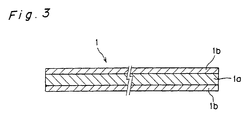
- An inorganic constructional board 1 comprising a middle layer portion 1a and outer layer portions 1b placed on both surfaces of the middle layer portion was obtained as shown in Fig. 3.
- Respective compositions of the middle layer portion 1a and outer layer portions 1b are as follows: Middle layer portion Inorganic foamed material: perlite 82 wt % Fibrous material: rock wool and pulp 10 wt % Binder : phenolic resin and starch 8 wt % Outer layer portions Mineral fiber : rock wool 27 wt % Inorganic powder : calcium carbonate 60 wt % Binder : phenolic resin and starch 8 wt % Reinforcement : pulp 5 wt %
- the perlite was of the type having a unit volumetric mass of 0.08 (kg/1) and an average particle size of 300 ⁇
- the calcium carbonate was of the type having a particle size of 50 mesh through.
- This inorganic constructional board 1 was manufactured in the following way.
- the constituent materials of the outer layer portions namely, rock wool, calcium carbonate, phenolic resin and starch, and pulp of the above mentioned proportions were put into fresh water together with some small quantities of sizing agent and flocculating agent, and agitation was effected to give an aqueous slurry having a concentration of 2 %.
- the slurry was conducted to Fourdrinier-type formers 11, 15, shown in Fig. 4, wherein mat forming operation was carried out.
- wet inorganic mats 12, 16 having a thickness of 2.0 mm and a specific gravity of 0.6, which would be used as lower and upper layer portions, were obtained.
- the constituent materials for the middle layer portion namely, perlite, pulp, and phenolic resin and starch of the above mentioned proportions were put into fresh water together with some small quantities of sizing agent and flocculating agent, and agitation was effected to give an aqueous slurry having a concentration of 2 %.
- the slurry was conducted to a cylinder-type former 13 shown in Fig. 4, wherein mat forming operation was carried out.
- a wet inorganic mat 14 having a thickness of 11 mm and a specific gravity of 0.15, which would be used as the middle layer portion, was obtained.
- the stacked unit 17 was integrally pressed by a continuous belt-type hot press 18 (loading pressure, 5 kg/cm 2 ; heating temperature, 180 °C), whereby a laminate 17a having a thickness of 9 mm was obtained. Then, the laminate 17a was cut by a cutter 19 to a suitable length, and was dried by a dryer 20 at a heating temperature of 180 °C for 60 minutes.
- an inorganic constructional board sample 1 was obtained, wherein the upper and lower layer portions had a thickness of 1.5 mm and a specific gravity of 0.8 respectively; the middle layer portion had a thickness of 6 mm and a specific gravity of 0.28; and the board had a total thickness of 9 mm and a total specific gravity of 0.45.
- Example 2 In the same way as in Example 1 was obtained an inorganic constructional board which comprised a middle layer portion of the following composition, and outer layer portions of the following composition placed on opposite surfaces of the middle layer portion.
- Middle layer portion Inorganic foamed material: perlite 80 wt %
- Fibrous material rock wool 13 wt %
- Binder phenolic resin and starch 7 wt %
- Outer layer portions Mineral fiber : rock wool 36 wt %
- Inorganic powder calcium carbonate 57 wt %
- Binder phenolic resin and starch 7 wt % Reinforcement : none
- the perlite was of the type having a unit volumetric mass of 0.08 (kg/1) and an average particle size of 300 ⁇
- the calcium carbonate was of the type having a particle size of 50 mesh through.
- the upper and lower layers after pressing and drying, had a thickness of 1.5 mm and a specific gravity of 0.8 respectively, and the middle layer had a thickness of 6 mm and a specific gravity of 0.28.
- a commercially available plaster board having a thickness of 9 mm and a specific gravity of 0.74 was taken as a sample.
- Example 1 Example 2 Comp.
- Example 1 Thickness (mm) 9.0 9.0 9.0 Specific gravity 0.45 0.45 0.74 Bending strength (kgf/cm 2 ) 75 70 50
- Heat conductivity (kcal/mh°C.) 0.06 0.06 0.27 Fire resistance semi-noncomb acceptable noncomb acceptable semi-noncomb acceptable
- the specific gravity in Examples 1 and 2 is 25 to 40 % smaller than that in Comparative Example 1.
- a 40 % difference in specific gravity means that where the weight of a standard-size plaster board is about 11 kg, the weight of an inorganic constructional board of the same size according to the invention is about 6.7 kg. Therefore, in the case of plaster board, even when only about one half of available loading capacity of, for example, a truck can be utilized because of weight limitation, inorganic constructional boards of the invention can be loaded to the full available capacity of the truck. This provides for not only considerable saving in distribution cost, but also ease of manual transport to and handling at the construction site.
- Examples 1, 2 are lower than those in Comparative Example 1, generally a surface hardness of 150 (kgf) is unlikely to allow depression or the like and involves no problem from the standpoint of practical application.
- An inorganic constructional board is required to have a screw penetratability on the order of more than 2.5 times the weight of the board, but this poses no problem from the standpoint of practical application, because the inorganic constructional board of the present invention per se is lightweight.
- the inorganic constructional board of the invention is about 40 % lighter than the commercially available plaster board and can be used in same way as such plaster board.
- An inorganic constructional board which comprised a middle layer portion of the following composition, and outer layer portions of the following composition placed on opposite surfaces of the middle layer portion.
- Middle layer portion Inorganic foamed material: perlite 38 wt % "Shirasu" foamed material 30 wt % Fibrous material: rock wool 20 wt %
- Binder powdered phenol and starch 7 wt %
- Other material aluminum hydroxide 5 wt %
- Mineral fiber rock wool 40 wt %
- Inorganic powder calcium carbonate 50 wt % aluminum hydroxide 5 wt %
- Binder powdered phenol and starch 5 wt %
- the perlite used was of the type having a unit volumetric mass of 0.08 (kg/1) and an average particle size of 300 ⁇ , and the calcium carbonate was of the type having a particle size of 50 mesh through.
- the aluminum hydroxide in the middle layer portion was added to improve fire resistance.
- This inorganic constructional board was manufactured in the following way.
- materials for the middle layer portion namely, perlite, "Shirasu” foamed material, rock wool, aluminum hydroxide and powdered phenol and starch of the above mentioned proportions were mixed under spraying water of which ratio was 50 to their solid content of 100, whereby a mixture 23 for the middle layer portion was obtained.
- the stacked structure 26 was pressed by a roll press 27 under a pressure of 15 kg/cm 2 , whereby a laminate having a thickness of 6 mm was obtained. Then, the laminate was dried by a dryer 28 at a temperature of 180°C for 90 minutes and was cut by a cutter 29 to a suitable length.
- an inorganic constructional board was obtained, wherein the upper and lower layer portions had a thickness of 1.5 mm and a specific gravity of 1.0 respectively; the middle layer portion had a thickness of 3 mm and a specific gravity of 0.2; and the board had a total thickness of 6 mm and a total specific gravity of 0.6.
- This board was taken as Sample 3.
- a commercially available calcium silicate board was taken as a sample.
- Example 3 Comp.
- Example 2 Specific gravity 0.6 0.9 Thickness (mm) 6 6
- Weight per piece (kg/pce) 6 9
- Bending strength (kg/cm 2 ) 95
- Screw penetrability (kgf) 21 56
- Surface hardness (kgf) 93
- Water absorption (%) 25
- Example 3 is two thirds of that of Comparative Example 2. This shows that while for the transport of calcium silicate boards, only one half or less of the available loading capacity of a truck can be utilized because of current weight limitation standards, inorganic constructional boards of the present invention can be loaded on the truck in a 50 % greater volumetric quantity than calcium silicate boards. This provides for considerable saving in distribution cost and also ease of transport to and mounting at the construction site.
- Example 3 board Since the Example 3 board has 25 % greater bending strength than Comparative Example 2, it is much less liable to become deformed and is easier to use.
- Example 3 The screw penetrability of Example 3 is lower than that of Comparative Example 2. However, since it is believed that a screw penetrability of the order of 2.5 or more times the weight of the constructional board involves no problem from the standpoint of practical use and the Example 3 board is smaller in weight than Comparative Example 2, there is no particular problem.
- the freezing and thawing endurance of the Comparative Example 2 board is 50 cycles, which means that the board can withstand only 2 to 3 years of use, whereas that of the Example 3 board is 300 cycles, which means a capability of withstanding 10 to 20 years of use. Therefore, in a cold region, the Example 3 board of the invention can be used, without any inconvenience, for an outdoor structure, such as eaves ceiling or the like which is not directly exposed to rainwater.
- Example 3 inorganic constructional board of the invention has a low specific gravity, a light weight and an excellent freezing and thawing property in comparison with the calcium silicate board of Comparative Example 2.
- Example 3 An inorganic constructional board having a middle layer portion and outer (upper and lower) layer portions of the same compositions as Example 3 was manufactured in same way as in Example 3.
- a flat plate press was employed under a loading pressure of 20 kg/cm 2 .
- the upper and lower layer portions had a thickness of 2.5 mm and a specific gravity of 0.7 mm respectively; the middle layer portion had a thickness of 7 mm and a specific gravity of 0.45; the board had a total thickness of 12 mm and a total specific gravity of 0.55.
- a commercial available plaster board having a thickness of 12 mm and a specific gravity of 0.74 was taken as a sample.
- Example 4 Comp.
- Example 3 Thickness (mm) 12 12 Specific gravity 0.55 0.74 Bending strength (kg/cm 2 ) 200 60 - 65 Shearing strength (kg/cm 2 ) 28 13.8 - 14.8
- the bending strength of Example 4 is 200 kgf/cm 2 or about three times that of Comparative Example 3 i.e. 60 - 65 kgf/cm 2
- the shearing strength of Example 4 is 28 kgf/cm 2 , or about two times that of Comparative Example 3 i.e. 13.8 - 14.8 kgf/cm 2 .
- the plaster board when using a 12 mm-thick plaster board as a bearing wall member, the plaster board is taken as 1.0 in terms of wall magnification if it is used alone. In order to increase this magnification rate, it is necessary to use a diagonal wooden bracing having a thickness of 3 cm and a width of 9 cm (Japanese Ministry of Construction, Notification No. 1100).
- the inorganic constructional board according to the present invention corresponds to a material which is qualified as a wall magnification of 1.5 material itself alone, and can also be well used as a bearing wall member or a wall backing material for a strength member.
Landscapes
- Engineering & Computer Science (AREA)
- Chemical & Material Sciences (AREA)
- Ceramic Engineering (AREA)
- Mechanical Engineering (AREA)
- Manufacturing & Machinery (AREA)
- Architecture (AREA)
- Civil Engineering (AREA)
- Structural Engineering (AREA)
- Laminated Bodies (AREA)
- Panels For Use In Building Construction (AREA)
Claims (19)
- Bauplatte (1), umfassend:einen Mittelschichtteil (1a) undAußenschichtteile (1b), die an beiden Oberflächen des Mittelschichtteils angeordnet sind;
dadurch gekennzeichnet, dass:der Mittelschichtteil (1a) 50 - 95 Gew.-% eines anorganischen, geschäumten Materials, 1 - 30 Gew.-% eines faserartigen, hauptsächlich aus Mineralfaser bestehenden Materials und ein Bindemittel umfasst, wobei die Gesamtmenge des organischen Materials in dem Bindemittel weniger als 15 Gew.-% beträgt, unddie Außenschichtteile (1b) 20 - 60 Gew.-% eines faserartigen, hauptsächlich aus Mineralfaser bestehenden Materials, 40 - 70 Gew.-% eines anorganischen Pulvermaterials und ein Bindemittel umfassen, wobei die Gesamtmenge des organischen Materials, das das Bindemittel umfasst, weniger als 15 Gew.-% beträgt. - Bauplatte nach Anspruch 1, wobei der Mittelschichtteil eine relative Dichte von weniger als 0,4 aufweist und die Außenschichtteile eine relative Dichte von mehr als 0,7 aufweisen.
- Bauplatte nach Anspruch 1, wobei der Mittelschichtteil eine relative Dichte von weniger als 0,4 aufweist und die Außenschichtteile eine relative Dichte von mehr als 0,8 aufweisen.
- Anorganische Bauplatte nach Anspruch 1, wobei der Mittelschichtteil eine relative Dichte von 0,4 bis 0,7 aufweist und die Außenschichtteile eine relative Dichte von mehr als 0,7 aufweisen.
- Bauplatte nach einem beliebigen der vorhergehenden Ansprüche, wobei es sich bei dem anorganischen, geschäumten Material um ein oder mehrere Materialien handelt, die aus der Gruppe bestehend aus Perlit, geschäumtem Shirasu-Material, Quarzmehl und geschäumtem Glasmaterial ausgewählt sind.
- Bauplatte nach einem beliebigen der vorhergehenden Ansprüche, wobei die Mineralfaser der Außenschichtteile wenigstens eine Mineralfaser ist, die aus der Gruppe bestehend aus Steinwolle, Schlackenwolle, Mineralwolle und Glasfaser ausgewählt ist.
- Bauplatte nach einem beliebigen der vorhergehenden Ansprüche, wobei das faserartige Material des Mittelschichtteils wenigstens eine Mineralfaser ist, die aus der Gruppe bestehend aus Steinwolle, Schlackenwolle oder dergleichen ausgewählt ist.
- Bauplatte nach einem beliebigen der vorhergehenden Ansprüche, wobei das faserartige Material der Außen- und Mittelschichtteile eine Mineralfaser als Hauptkomponente, eine Kunstharzfaser und/ oder eine organische Faser umfasst.
- Bauplatte nach einem beliebigen der vorhergehenden Ansprüche, wobei das Bindemittel der Mittel- und Außenschichtteile wenigstens ein Material ist, das aus der Gruppe bestehend aus Polyvinylalkohol-Harz, Phenolharz und Stärke ausgewählt ist.
- Bauplatte nach einem beliebigen der vorhergehenden Ansprüche, wobei das anorganische Pulvermaterial wenigstens ein Pulver ist, das aus der Gruppe bestehend aus Calciumcarbonat, Quarzsand, Mikrosilicamaterial, Schlacke und Aluminiumhydroxid ausgewählt ist.
- Bauplatte nach einem beliebigen der vorhergehenden Ansprüche, wobei das anorganische Pulver eine mittlere Teilchengröße von 40 µm bis 300 µm aufweist.
- Bauplatte nach einem beliebigen der vorhergehenden Ansprüche, wobei die Gesamtmenge des Materials der organischen Komponente der Mittel- und Außenschichtteile weniger als 15 Gew.-% beträgt.
- Bauplatte nach einem beliebigen der vorhergehenden Ansprüche, wobei die Gesamtmenge des Materials der organischen Komponente der Mittel- und Außenschichtteile weniger als 7 Gew.-% beträgt.
- Verfahren zur Herstellung einer Bauplatte, die einen Mittelschichtteil (1a) und auf beiden Oberflächen des Mittelschichtteils angeordnete Außenschichtteile (1b) umfasst, wobei das Verfahren dadurch gekennzeichnet ist, dass es die Schritte des:kontinuierlichen Formens zweier nasser anorganischer Matten für die jeweiligen Außenschichtteile aus einer Aufschlämmung, die als Hauptbestandteile 20 - 60 Gew.-% eines faserartigen, hauptsächlich aus einer Mineralfaser bestehenden Materials, 40 - 70 Gew.-% eines anorganischen Pulvermaterials und ein Bindemittel enthält, wobei die Gesamtmenge des organischen, das Bindemittel einschließenden Materials weniger als 15 Gew.-% beträgt;Formens eines Mittelschichtteils (1a) auf der Oberfläche eines der Außenschichtteile, während der Außenschichtteil in einer Richtung bewegt wird, wobei der Mittelschichtteil 50 - 95 Gew.-% eines anorganischen, geschäumten Materials, 1 - 30 Gew.-% eines faserartigen, hauptsächlich aus Mineralfaser bestehenden Materials und ein Bindemittel umfasst, wobei die Gesamtmenge der organischen, das Bindemittel einschließenden Komponente weniger als 15 Gew.-% beträgt;Schichtens der anderen nassen anorganischen Matte für den oberen Schichtteil auf den Mittelschichtteil;Pressens der im vorherigen Schritt erhaltenen Schichtstruktur, wodurch ein integrales Laminat gebildet wird, und desErwärmens, wodurch das integrale Laminat getrocknet wird,
umfasst. - Verfahren zur Herstellung einer Bauplatte nach Anspruch 14, wobei der Schritt des Formens des Mittelschichtteils das Verteilen und Abscheiden einer Mischung zur Bildung des Mittelschichtteils auf der nassen anorganischen Matte für den Außenschichtteil in einer gleichmäßigen Dicke umfasst, wobei die Mischung das anorganische, geschäumte Material, das faserartige Material und das Bindemittel in den jeweils vorbestimmten Anteilen umfasst.
- Verfahren zur Herstellung einer Bauplatte nach Anspruch 14, wobei der Schritt des Formens des Mittelschichtteils die Schritte des:Herstellens einer Aufschlämmung durch das Vermischen des anorganischen, geschäumten Materials, des faserartigen Materials und des Bindemittels in den jeweils vorbestimmten Anteilen und deskontinuierlichen Formens einer nassen anorganischen Matte für den Mittelschichtteil aus der Aufschlämmung
umfasst. - Verfahren zur Herstellung einer Bauplatte nach Anspruch 14, wobei der Schritt des Formens des Mittelschichtteils die Schritte des:Bewegens der beiden nassen anorganischen Matten für die Außenschichtteile in die jeweils selbe Richtung und desVerteilens und Abscheidens einer Mischung zur Bildung des Mittelschichtteils auf einer der nassen anorganischen Matten für die Außenschichtteile in einer gleichmäßigen Dicke, wobei die Mischung das anorganische, geschäumte Material, das faserartige Material und das Bindemittel in den jeweils vorbestimmten Anteilen umfasst,wobei der Schritt des Schichtens das Schichten der anderen nassen anorganischen Matte für den oberen Schichtteil auf dem Mittelschichtteil umfasst, der durch das Verteilen und Abscheiden der Mischung im vorherigen Schritt erhalten wurde, undder Schritt des Pressens das Pressen der im vorherigen Schritt erhaltenen Schichtstruktur unter Bildung des integralen Laminats durch Verwendung einer Heißpresse umfasst.
- Verfahren zur Herstellung einer Bauplatte nach einem beliebigen der Ansprüche 14 bis 17, wobei die nasse anorganische Matte unter Verwendung eines Formers vom Fourdrinier-Typ gebildet wird.
- Verfahren zur Herstellung einer Bauplatte nach einem beliebigen der Ansprüche 14 bis 17, wobei ein Former vom Zylindertyp beim Schritt der Bildung der nassen anorganischen Matte verwendet wird.
Applications Claiming Priority (19)
| Application Number | Priority Date | Filing Date | Title |
|---|---|---|---|
| JP19418391 | 1991-08-02 | ||
| JP194182/91 | 1991-08-02 | ||
| JP19418491 | 1991-08-02 | ||
| JP194184/91 | 1991-08-02 | ||
| JP3194182A JPH0533463A (ja) | 1991-08-02 | 1991-08-02 | 無機質建築板 |
| JP19418291 | 1991-08-02 | ||
| JP3194184A JPH0533465A (ja) | 1991-08-02 | 1991-08-02 | 無機建築板 |
| JP3194183A JP2655954B2 (ja) | 1991-08-02 | 1991-08-02 | 無機建築板 |
| JP194183/91 | 1991-08-02 | ||
| JP207895/91 | 1991-08-20 | ||
| JP20789591 | 1991-08-20 | ||
| JP20789591A JPH0832411B2 (ja) | 1991-08-20 | 1991-08-20 | 無機建築板の製造方法 |
| JP3225755A JP2515450B2 (ja) | 1991-09-05 | 1991-09-05 | 無機建築板の製造方法 |
| JP225755/91 | 1991-09-05 | ||
| JP22575591 | 1991-09-05 | ||
| JP338368/91 | 1991-12-20 | ||
| JP3338368A JP2713518B2 (ja) | 1991-12-20 | 1991-12-20 | 無機建築板の製造方法 |
| JP33836891 | 1991-12-20 | ||
| PCT/JP1992/000970 WO1993003238A1 (fr) | 1991-08-02 | 1992-07-31 | Panneau inorganique de construction et procede de production dudit panneau |
Publications (3)
| Publication Number | Publication Date |
|---|---|
| EP0601182A1 EP0601182A1 (de) | 1994-06-15 |
| EP0601182A4 EP0601182A4 (en) | 1996-05-22 |
| EP0601182B1 true EP0601182B1 (de) | 2000-06-07 |
Family
ID=27553683
Family Applications (1)
| Application Number | Title | Priority Date | Filing Date |
|---|---|---|---|
| EP19920916120 Expired - Lifetime EP0601182B1 (de) | 1991-08-02 | 1992-07-31 | Anorganische bauplatte und herstellungsverfahren |
Country Status (7)
| Country | Link |
|---|---|
| US (1) | US5648154A (de) |
| EP (1) | EP0601182B1 (de) |
| KR (1) | KR0150509B1 (de) |
| AU (1) | AU657162B2 (de) |
| CA (1) | CA2114620C (de) |
| DE (1) | DE69231156T2 (de) |
| WO (1) | WO1993003238A1 (de) |
Families Citing this family (11)
| Publication number | Priority date | Publication date | Assignee | Title |
|---|---|---|---|---|
| EP0928672A1 (de) * | 1997-07-28 | 1999-07-14 | Carlos Fradera Pellicer | Verfahren zum formen eines einstückigen offenen festkörpers mit lufthärtenden flüssigmaterialien, so hergestellter körper und anlage zur herstellung solcher körper |
| US6319312B1 (en) | 1998-11-18 | 2001-11-20 | Advanced Construction Materials Corp. | Strengthened, light weight wallboard and method and apparatus for making the same |
| US6340388B1 (en) | 1998-11-18 | 2002-01-22 | Advanced Construction Materials Corp. | Strengthened, light weight wallboard and method and apparatus for making the same |
| US6251979B1 (en) | 1998-11-18 | 2001-06-26 | Advanced Construction Materials Corp. | Strengthened, light weight wallboard and method and apparatus for making the same |
| DE19952931A1 (de) * | 1999-11-03 | 2001-05-10 | Saint Gobain Isover G & H Ag | Gebundenes Mineralwolleprodukt mit Feuerschutzfunktion sowie Brandschutzelement mit dem gebundenen Mineralwolleprodukt |
| DE102006008686A1 (de) * | 2006-02-24 | 2007-09-06 | Deutsche Amphibolin-Werke Von Robert Murjahn Stiftung & Co Kg | Verkleidungssystem |
| US8178016B2 (en) * | 2007-05-31 | 2012-05-15 | Werzalit Gmbh + Co. Kg | Method for manufacturing a multilayered composite molded part |
| CN101695954B (zh) * | 2009-09-14 | 2012-10-10 | 辽宁渤海装饰材料有限公司 | 船用铠装防火隔热板制造方法 |
| GB0921625D0 (en) * | 2009-12-10 | 2010-01-27 | Woolstencroft David | Floor structure |
| JP6666632B2 (ja) * | 2015-12-26 | 2020-03-18 | エスケー化研株式会社 | 積層体 |
| US20230160578A1 (en) * | 2021-11-22 | 2023-05-25 | Douglas A. Baker | Fireplace mantel and related methods |
Family Cites Families (23)
| Publication number | Priority date | Publication date | Assignee | Title |
|---|---|---|---|---|
| US1883486A (en) * | 1930-07-29 | 1932-10-18 | Johns Manville | Laminated sheet material |
| US2008718A (en) * | 1932-07-23 | 1935-07-23 | Johns Manville | Structural material and method of making the same |
| US2692219A (en) * | 1951-07-05 | 1954-10-19 | Owens Corning Fiberglass Corp | Structural panel |
| DE1923192A1 (de) * | 1969-05-07 | 1970-11-19 | Establishment Bornex | Sandwichbauelement |
| US3734661A (en) * | 1970-10-19 | 1973-05-22 | Pottuz L Joly | Apparatus for the continuous manufacturing of construction panels |
| AU479157B2 (en) * | 1973-02-26 | 1974-08-29 | W.R. Grace & Co. | Gypsum plaster composition |
| JPS51131513A (en) * | 1975-05-13 | 1976-11-16 | Okura Industrial Co Ltd | Method of producing reinforced lighttweight boards |
| US4013810A (en) * | 1975-08-22 | 1977-03-22 | The Babcock & Wilcox Company | Sandwich panel construction |
| JPS5846619B2 (ja) * | 1976-01-31 | 1983-10-18 | 株式会社アイジ−技術研究所 | 耐火建材 |
| US4225383A (en) * | 1978-02-02 | 1980-09-30 | The Dow Chemical Company | Highly filled sheets and method of preparation thereof |
| US4297311A (en) * | 1978-12-07 | 1981-10-27 | Conwed Corporation | Method of manufacturing improved mineral board |
| JPS6014701B2 (ja) * | 1979-08-31 | 1985-04-15 | 松下電工株式会社 | 軽量外壁材及びその製造方法 |
| JPS5641881A (en) * | 1979-09-06 | 1981-04-18 | Ibigawa Electric Ind Co Ltd | Lightweight high strength inorganic board and manufacture thereof |
| JPS5641880A (en) * | 1979-09-06 | 1981-04-18 | Ibigawa Electric Ind Co Ltd | Lightweight high strength inorganic board and manufacture thereof |
| JPS56130341A (en) * | 1980-03-19 | 1981-10-13 | Takeda Chemical Industries Ltd | Manufacture of refractory heat insulating material |
| JPS5943809B2 (ja) * | 1981-09-16 | 1984-10-24 | ウシオ電機株式会社 | ウエハ−上のアモルファスシリコンもしくは多結晶シリコンをエピタキシアル成長させる方法 |
| JPS5983985A (ja) * | 1982-10-30 | 1984-05-15 | 松下電工株式会社 | 発泡セラミツク板の製造方法 |
| DE3513918A1 (de) * | 1985-04-17 | 1986-10-23 | Deutsche Heraklith Ag, 8346 Simbach | Mehrschicht-leichtbauplatte |
| US4695494A (en) * | 1986-11-25 | 1987-09-22 | Georgia-Pacific Corporation | Fire-resistant article and method of manufacture |
| JPS6477533A (en) * | 1987-05-07 | 1989-03-23 | Sekisui Chemical Co Ltd | Inorganic composite molding material |
| JPS63285179A (ja) * | 1987-05-18 | 1988-11-22 | Daiken Trade & Ind Co Ltd | 無機質繊維板及びその製造方法 |
| JPH0688823B2 (ja) * | 1990-01-23 | 1994-11-09 | ニチハ株式会社 | 無機質成形板およびその製造方法 |
| DE4142286C2 (de) * | 1991-12-20 | 1995-01-05 | Siempelkamp Gmbh & Co | Dreischichtige Baustoffplatte auf Gipsbasis und Verfahren zur Herstellung |
-
1992
- 1992-07-31 AU AU23902/92A patent/AU657162B2/en not_active Ceased
- 1992-07-31 EP EP19920916120 patent/EP0601182B1/de not_active Expired - Lifetime
- 1992-07-31 CA CA 2114620 patent/CA2114620C/en not_active Expired - Fee Related
- 1992-07-31 WO PCT/JP1992/000970 patent/WO1993003238A1/ja not_active Ceased
- 1992-07-31 US US08/190,105 patent/US5648154A/en not_active Expired - Fee Related
- 1992-07-31 KR KR1019940700336A patent/KR0150509B1/ko not_active Expired - Fee Related
- 1992-07-31 DE DE69231156T patent/DE69231156T2/de not_active Expired - Fee Related
Also Published As
| Publication number | Publication date |
|---|---|
| DE69231156T2 (de) | 2001-02-15 |
| EP0601182A4 (en) | 1996-05-22 |
| CA2114620A1 (en) | 1993-02-18 |
| EP0601182A1 (de) | 1994-06-15 |
| WO1993003238A1 (fr) | 1993-02-18 |
| KR0150509B1 (ko) | 1998-10-15 |
| US5648154A (en) | 1997-07-15 |
| AU657162B2 (en) | 1995-03-02 |
| DE69231156D1 (de) | 2000-07-13 |
| CA2114620C (en) | 2000-10-03 |
| AU2390292A (en) | 1993-03-02 |
Similar Documents
| Publication | Publication Date | Title |
|---|---|---|
| US4303722A (en) | Building components | |
| KR950008561B1 (ko) | 경중량 건축 자재 보드 | |
| EP0601182B1 (de) | Anorganische bauplatte und herstellungsverfahren | |
| EP0475302B1 (de) | Leichtbauplatte | |
| US2434466A (en) | Composite board | |
| EP1919699B1 (de) | Leichte platte | |
| JPH0333838B2 (de) | ||
| JPH0550417A (ja) | 無機建築板の製造方法 | |
| EP1633555B1 (de) | Mehrschichtige, hochdichte mineralfaserplatte, vorrichtung und verfahren zur herstellung der platte | |
| JP2825696B2 (ja) | 無機建築板の製造方法 | |
| JP2680772B2 (ja) | 無機建築板 | |
| JPH0313334A (ja) | 複合合板 | |
| JP3223928B2 (ja) | 耐火複合板 | |
| JP3865897B2 (ja) | 耐火性野地板 | |
| JP2670003B2 (ja) | 無機質板状体 | |
| JP2801493B2 (ja) | 無機建築板の製造方法 | |
| JP2509071B2 (ja) | 無機建築板およびその製造方法 | |
| CN2338401Y (zh) | 机制不燃复合板 | |
| JPH0868180A (ja) | 建築用複合板 | |
| JPH10317578A (ja) | 吸放湿性板材 | |
| JPH10319969A (ja) | 吸遮音吸放湿性板材 | |
| JPH0533465A (ja) | 無機建築板 | |
| JPH09144158A (ja) | 無機建築板 | |
| JPH0552023A (ja) | 無機建築板 | |
| JPH0820089A (ja) | 無機質板状体 |
Legal Events
| Date | Code | Title | Description |
|---|---|---|---|
| PUAI | Public reference made under article 153(3) epc to a published international application that has entered the european phase |
Free format text: ORIGINAL CODE: 0009012 |
|
| 17P | Request for examination filed |
Effective date: 19940221 |
|
| AK | Designated contracting states |
Kind code of ref document: A1 Designated state(s): DE IT SE |
|
| A4 | Supplementary search report drawn up and despatched | ||
| AK | Designated contracting states |
Kind code of ref document: A4 Designated state(s): DE FR GB IT SE |
|
| 17Q | First examination report despatched |
Effective date: 19980302 |
|
| GRAG | Despatch of communication of intention to grant |
Free format text: ORIGINAL CODE: EPIDOS AGRA |
|
| GRAG | Despatch of communication of intention to grant |
Free format text: ORIGINAL CODE: EPIDOS AGRA |
|
| GRAH | Despatch of communication of intention to grant a patent |
Free format text: ORIGINAL CODE: EPIDOS IGRA |
|
| GRAH | Despatch of communication of intention to grant a patent |
Free format text: ORIGINAL CODE: EPIDOS IGRA |
|
| RBV | Designated contracting states (corrected) |
Designated state(s): DE IT SE |
|
| GRAA | (expected) grant |
Free format text: ORIGINAL CODE: 0009210 |
|
| AK | Designated contracting states |
Kind code of ref document: B1 Designated state(s): DE IT SE |
|
| REF | Corresponds to: |
Ref document number: 69231156 Country of ref document: DE Date of ref document: 20000713 |
|
| ITF | It: translation for a ep patent filed | ||
| EN | Fr: translation not filed | ||
| PLBE | No opposition filed within time limit |
Free format text: ORIGINAL CODE: 0009261 |
|
| STAA | Information on the status of an ep patent application or granted ep patent |
Free format text: STATUS: NO OPPOSITION FILED WITHIN TIME LIMIT |
|
| 26N | No opposition filed | ||
| PGFP | Annual fee paid to national office [announced via postgrant information from national office to epo] |
Ref country code: SE Payment date: 20050719 Year of fee payment: 14 |
|
| PGFP | Annual fee paid to national office [announced via postgrant information from national office to epo] |
Ref country code: DE Payment date: 20050815 Year of fee payment: 14 |
|
| PGFP | Annual fee paid to national office [announced via postgrant information from national office to epo] |
Ref country code: IT Payment date: 20060731 Year of fee payment: 15 |
|
| PG25 | Lapsed in a contracting state [announced via postgrant information from national office to epo] |
Ref country code: SE Free format text: LAPSE BECAUSE OF NON-PAYMENT OF DUE FEES Effective date: 20060801 |
|
| PG25 | Lapsed in a contracting state [announced via postgrant information from national office to epo] |
Ref country code: DE Free format text: LAPSE BECAUSE OF NON-PAYMENT OF DUE FEES Effective date: 20070201 |
|
| EUG | Se: european patent has lapsed | ||
| PG25 | Lapsed in a contracting state [announced via postgrant information from national office to epo] |
Ref country code: IT Free format text: LAPSE BECAUSE OF NON-PAYMENT OF DUE FEES Effective date: 20070731 |