EP0602825B1 - Intégration logique d'éléments multiples de réseau dans un réseau de gestion de télécommunication - Google Patents
Intégration logique d'éléments multiples de réseau dans un réseau de gestion de télécommunication Download PDFInfo
- Publication number
- EP0602825B1 EP0602825B1 EP93309579A EP93309579A EP0602825B1 EP 0602825 B1 EP0602825 B1 EP 0602825B1 EP 93309579 A EP93309579 A EP 93309579A EP 93309579 A EP93309579 A EP 93309579A EP 0602825 B1 EP0602825 B1 EP 0602825B1
- Authority
- EP
- European Patent Office
- Prior art keywords
- network element
- network
- osi
- dsne
- reachable
- Prior art date
- Legal status (The legal status is an assumption and is not a legal conclusion. Google has not performed a legal analysis and makes no representation as to the accuracy of the status listed.)
- Expired - Lifetime
Links
- 230000010354 integration Effects 0.000 title description 2
- 238000004891 communication Methods 0.000 claims description 21
- 230000005540 biological transmission Effects 0.000 claims description 16
- 238000012423 maintenance Methods 0.000 claims description 6
- 238000012360 testing method Methods 0.000 description 44
- 230000003287 optical effect Effects 0.000 description 23
- 230000004044 response Effects 0.000 description 19
- 238000010586 diagram Methods 0.000 description 10
- 230000006870 function Effects 0.000 description 9
- 230000000694 effects Effects 0.000 description 7
- 239000003795 chemical substances by application Substances 0.000 description 6
- RGNPBRKPHBKNKX-UHFFFAOYSA-N hexaflumuron Chemical compound C1=C(Cl)C(OC(F)(F)C(F)F)=C(Cl)C=C1NC(=O)NC(=O)C1=C(F)C=CC=C1F RGNPBRKPHBKNKX-UHFFFAOYSA-N 0.000 description 5
- 238000011161 development Methods 0.000 description 3
- 238000000034 method Methods 0.000 description 2
- 101710104937 Non-specific acid phosphatase Proteins 0.000 description 1
- 230000006399 behavior Effects 0.000 description 1
- 230000008859 change Effects 0.000 description 1
- 238000006243 chemical reaction Methods 0.000 description 1
- 230000002708 enhancing effect Effects 0.000 description 1
- 239000000835 fiber Substances 0.000 description 1
- 230000003993 interaction Effects 0.000 description 1
- 238000012986 modification Methods 0.000 description 1
- 230000004048 modification Effects 0.000 description 1
- 238000000638 solvent extraction Methods 0.000 description 1
Images







Classifications
-
- H—ELECTRICITY
- H04—ELECTRIC COMMUNICATION TECHNIQUE
- H04Q—SELECTING
- H04Q3/00—Selecting arrangements
- H04Q3/0016—Arrangements providing connection between exchanges
- H04Q3/0062—Provisions for network management
-
- H—ELECTRICITY
- H04—ELECTRIC COMMUNICATION TECHNIQUE
- H04L—TRANSMISSION OF DIGITAL INFORMATION, e.g. TELEGRAPHIC COMMUNICATION
- H04L43/00—Arrangements for monitoring or testing data switching networks
- H04L43/50—Testing arrangements
-
- H—ELECTRICITY
- H04—ELECTRIC COMMUNICATION TECHNIQUE
- H04L—TRANSMISSION OF DIGITAL INFORMATION, e.g. TELEGRAPHIC COMMUNICATION
- H04L69/00—Network arrangements, protocols or services independent of the application payload and not provided for in the other groups of this subclass
-
- H—ELECTRICITY
- H04—ELECTRIC COMMUNICATION TECHNIQUE
- H04L—TRANSMISSION OF DIGITAL INFORMATION, e.g. TELEGRAPHIC COMMUNICATION
- H04L9/00—Cryptographic mechanisms or cryptographic arrangements for secret or secure communications; Network security protocols
- H04L9/40—Network security protocols
-
- H—ELECTRICITY
- H04—ELECTRIC COMMUNICATION TECHNIQUE
- H04L—TRANSMISSION OF DIGITAL INFORMATION, e.g. TELEGRAPHIC COMMUNICATION
- H04L61/00—Network arrangements, protocols or services for addressing or naming
- H04L61/45—Network directories; Name-to-address mapping
- H04L61/4505—Network directories; Name-to-address mapping using standardised directories; using standardised directory access protocols
- H04L61/4517—Network directories; Name-to-address mapping using standardised directories; using standardised directory access protocols using open systems interconnection [OSI] directories, e.g. X.500
-
- H—ELECTRICITY
- H04—ELECTRIC COMMUNICATION TECHNIQUE
- H04Q—SELECTING
- H04Q2213/00—Indexing scheme relating to selecting arrangements in general and for multiplex systems
- H04Q2213/13516—Indexing scheme relating to selecting arrangements in general and for multiplex systems agents or brokers - user, terminal etc., also OSI agent/managers
Definitions
- This invention relates to digital communications systems.
- telecommunications management network that is advantageously used to automatically maintain identity information of network elements in a centralized database and to automatically distribute identity information of all the related network elements is disclosed in a co-pending patent application, filed concurrently herewith.
- a so-called "Directory Services Network Element” (DSNE) is employed to maintain and distribute the network element identity information.
- Each network element including the DSNE in the telecommunications management network operates as a logically separable entity from an Operations, Administration, Maintenance and Provisioning (OAM&P) standpoint.
- OAM&P Operations, Administration, Maintenance and Provisioning
- control nodes each maintain a topology database while other nodes (ordinary nodes) only maintain information on local topology.
- the topology databases are maintained in the control nodes in the presence of changes in the network.
- the method also provides for selection of a particular control node from which a particular ordinary node will obtain necessary routing information. More specifically, control nodes identify adjacent control nodes and, upon determining changes in network status, such network status changes are communicated to the adjacent control nodes.
- the ordinary node refers to the single control node co-existing in the ordinary node's domain, from which to obtain information necessary for routing purposes.
- the problems related to development cost and time required to support new transmission interfaces in a digital communication system provisioned as a DSNE are overcome by partitioning the telecommunications management network in such a manner that permits the integration of the DSNE with other network elements, or portions thereof, to present an external appearance of it being a single, integrated network element from an OAM&P perspective.
- This is realized by provisioning the integrated network element, or portions thereof, such that it can only provide its identity information to the DSNE and can only receive the DSNE identity information.
- the DSNE will not provide the identity information of the integrated network element, or portions thereof, to any network elements in a sub-network interfaced to the integrated network element. Consequently, the fact that the network element, or portions thereof, has been integrated into the DSNE is transparent to the network elements in the interface sub-network and the DSNE and integrated network element appear to the sub-network as a single "new DSNE".
- FIG. 1 shows in simplied block diagram form, details of a Network Element 100 (DSNE/NE) which may be employed as either a Directory Services Network Element (DSNE) or a remote Network Element (NE) in a telecommunications management network.
- Network Element 100 is referred to as DSNE/NE 100.
- microprocessor 101 read only memory (ROM) 102, random access memory (RAM) 103, non-volatile memory (FLASH) 104 and direct memory access unit (DMA) 105 which form a local processor complex within DSNE/NE 100.
- ROM read only memory
- RAM random access memory
- FLASH non-volatile memory
- DMA direct memory access unit
- Microprocessor 101 is interfaced via RS-232 driver/receiver 106 and LAPB controller 107 via circuit path 108 to an external network management system (not shown). Operation of units 106 and 107 are well-known in the art. Microprocessor 101 is also interfaced via IEEE 802.3 LAN controller 109 and circuit path 110 to a so-called intra-office local area network (LAN) (not shown). Additionally, microprocessor 101 is interfaced via LAPD controllers 111-1 through 111-N and corresponding optical interfaces 112-1 through 112-N, respectively, to fiber optic links 114-1 through 114-N. Again, LAPD controllers 111 and optical interfaces 112 are well-known in the art.
- FIG. 2 shows, in simplied form, the logical operation of DSNE/NE 100 when configured as DSNE 201 and also as remote NE 204 to effect directory services registration.
- DSNE/NE 100 of FIG. 1 is provisioned to provide Distribution Manager (DM) function 202 and includes a global Directory Information Base (DIB) 203.
- DM Distribution Manager
- DIB Directory Information Base
- DA Distribution Agent
- DSNE/NE 100 of FIG. 1 typically includes all the routines to effect both the functions of DSNE 201 and the functions of remote NE 204 and depending on how it is configured, the appropriate ones of DM 202, DIB 203, DA 205 and cache 206 will be activated.
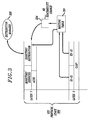
- FIG. 3 shows in simplied form, an Open System Interconnection (OSI) protocol stack 300 which includes at least network layer 3 including appropriate routing protocols and applications layer 7.
- the OSI protocol stack typically would include other layers for supporting other functionality as desired by the implementor.
- OSI protocol stack is known in the art and is defined in ISO/ICE 7498:1987.
- each layer operates independently of the other layers and was specifically designed to allow interaction between adjacent layers only and not between layers separated by other layers.
- a so-called newly reachable remote NE element, for example, 204 of FIG. 2 is automatically registered in DSNE 201.
- IS-IS Intermediate System-Intermediate System
- ES-IS End System-Intermediate System
- network layer 3 of the OSI protocol stack 300 to dynamically maintain identity information of newly reachable network element 204 in routing table 301 and by enhancing the routing exchange protocol interface to automatically supply an indication that either newly reachable network element 204 has been detected or an indication that an existing network element has ceased to be reachable to applications layer 7 of ISO protocol stack 300 and, specifically, therein to a directory distribution protocol.
- the enhancement to the routing exchange protocol and its interface is shown in FIG. 3A and described below.
- the directory distribution protocol in layer 7 interfaces with distribution manager 202 (FIG. 2) in such a manner as will be described below.
- DSNE 201 and NE 204 will be operating the IS-IS and ES-IS routing protocols so that DSNE 201 will be able to automatically detect the presence of a newly reachable network element or network elements which cease to be reachable. Consequently, the indications of newly reachable network elements and indications that existing network elements cease to be reachable are maintained via distribution manager 202 automatically and the need for manually inputting such information, as was done in the past, is eliminated.
- Protocols IS-IS and ES-IS are well-known in the art and are defined in ISO/IEC 10589:1991 and ISO/IEC 9542:1988, respectively.
- Network layer 3 also includes a connectionless network protocol (CLNP) which provides a connectionless mode of network service, as defined in ISO/IEC 8473:1988.
- Applications layer 7 also includes a subset of the directory services protocol as defined in CCITT Recommendation X.500:1988.
- the associated control service element (ACSE), in applications layer 7, is employed to establish associations between applications routines residing in different network elements, and is defined in CCITT Recommendations X.217 and X.227. Specifically, by way of an example, there would be an association established via ACSE between the distribution manager (DM) in DSNE 201 and the distribution agent (DA) in remote NE 204.
- DM distribution manager
- DA distribution agent
- FIG. 3A is a flow chart illustrating the enchancement made to the routing exchange protocol and its interface in the network layer to automatically supply an indication that either a newly reachable network element has been detected or an indication that an existing network element has ceased to be reachable to applications layer 7 of ISO protocol stack 300 (FIG. 3) and, specifically, therein to a directory distribution protocol.
- the routine of FIG. 3A would typically be stored in flash 104 of the DSNE/NE 100 (FIG. 1) and is employed when provisioned as a DSNE.
- the routing exchange protocol is entered via step 311. Thereafter, step 312 causes the known normal protocol functions of the routing exchange protocol to be performed.
- step 313 tests to determine if any newly reachable network element(s) has been added to the routing table of the routing exchange protocol. If the test result in step 313 is no, step 314 is by-passed and control is passed to step 315. If the test result in step 313 is yes, control is passed to step 314 which generates an indication(s) that a newly reachable network element(s) has been detected which indication is automatically supplied to applications layer 7 and, therein, to the directory distribution protocol. In this manner, the routing exchange protocol interface is enchanced.
- step 315 tests to determine if any network element(s) which is no longer reachable has been removed from the routing tables of the routing exchange protocol. If the test result in step 315 is no, step 316 is by-passed and control is returned to step 312. If the test result in step 315 is yes, control is passed to step 316 which generates an indication(s) that an existing network element(s) has ceased to be reachable and automatically supplies the indication(s) to the applications layer 7 and, therein, to a directory distribution protocol. Again, in this manner the routing exchange protocol interface is enhanced. Thereafter, control is returned to step 312. Again, it is noted that the loop comprising steps 312 through 316 effects the enchancement to the routing exchange protocol and its interface.
- FIG. 4 is a flow chart illustrating the operation of DSNE 201 in automatically registering identity information of remote network elements.
- the routine of FIG. 4 would typically be stored in flash 104 of the DSNE/NE 100 (FIG. 1) and is employed when provisioned as a DSNE.
- step 401 indicates the DSNE 201 startup.
- step 402 causes a routing table to be obtained from network layer 3, specifically routing table 301 of FIG. 3.
- step 403 tests to determine if there are any entries to register in routing table 301.
- the DSNE 201 is going to attempt to register all entries populated in routing table 301.
- the entries in routing table 301 are identity information, i.e., network addresses, of remote network elements forming one or more sub-networks with DSNE 201. If there are entries in routing table 301, step 404 will obtain the next entry. Upon obtaining an entry, step 405 will call a distribution manager (DM) routine which performs the automatic registration of the network address. The distribution manager routine is shown in FIG. 5 and described below. Upon performing the automatic registration in step 405, control is passed to step 406 which tests to determine whether a so-called SONET Management Sub-network Branch (SMSB) should be updated. If the test result in step 406 is yes, then, step 407 calls a DM update SMSB routine to effect the updating of the SMSB automatically.
- SMSB SONET Management Sub-network Branch
- control is returned to step 403, and steps 403 through 406 (or 407) are iterated until all network addresses of remote network elements in routing table 301 (FIG. 3) have been registered.
- steps 403 through 406 or 407 are iterated until all network addresses of remote network elements in routing table 301 (FIG. 3) have been registered.
- control is passed to step 408 where the routine waits until a "newly reachable NE" indication is received from the enhanced routing exchange protocol interface, in accordance with the principles of the invention.
- control is passed to step 409 and the DM registration routine of FIG. 5 is called. Again, the DM registration routine effects the automatic registration of the network address of the newly reachable remote NE.
- control is passed to step 410 which tests to determine whether an SMSB should be updated.
- step 410 If the test result in step 410 is no, control is returned to step 408. If the test result in step 410 is yes, then, step 411 calls a DM update SMSB routine to effect the updating of the SMSB automatically. Thereafter, control is returned to step 408. Details of the DM update SMSB are shown in FIG. 7 and described below.
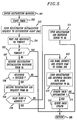
- FIG. 5 is a flow chart illustrating the operation of the distribution manager (DM) registration routine employed in FIG. 4. Again, this routine is also stored in flash 104 (FIG. 1). Specifically, the DM registration routine is entered via step 501. Thereafter, step 502 starts a timer. The interval of the timer is such as to allow for the automatic registration of a remote network element, e.g., NE 204 (FIG. 2) and is left to the implementor. Step 503 causes DSNE 201 (FIG. 2) to send a registration initialization request to the remote NE 204 and, therein, to a so-called distribution agent (DA) routine which is shown in FIG. 6 and described below.
- DA distribution agent
- Step 504 causes DSNE 201 to wait for either a response from the DA in the remote NE 204 or the time out of the timer in step 502.
- Step 505 tests to determine if the timer has timed out. If the result is yes, the timer has timed out and control is returned to the routine in FIG. 4. If the test result in step 505 is no, step 507 causes DSNE 201 to receive a valid response, i.e., receive registration initialization response from the DA in the remote NE 204.
- Step 508 tests whether the DA in the remote NE 204 successfully provided a valid response. If the test result is no, control is returned via step 506 to the routine of FIG. 4.
- step 508 determines whether the test result in step 508 is yes. If the test result in step 508 is yes, a valid response has been received and step 509 causes the DSNE 201 to receive a registration add request from the DA in the remote NE 204. Thereafter, step 510 tests to determine whether the name and address, i.e., the identity information of the remote NE 204 is valid. If the test result is no, step 511 sends a registration add response error indication to the DA in the remote NE 204 and control is returned via step 506 to the routine shown in FIG. 4. If the test result in step 510 is yes, the identity information of the remote NE 204 is valid and step 512 causes that identity information and an update flag to be added to global DIB 203.
- step 513 automatically causes a registration add response success indication along with identity information of DSNE 201 to the DA in the remote NE 204.
- step 514 tests to determine whether the update flag supplied in step 512 indicates that the SMSB information should be updated. That is, whether or not the newly registered remote NE 204 should receive, identity information of any other network elements in the SMSB including NE 204. If the test result in step 514 is no, control is returned via step 506 to the routine of FIG. 4. If the test result in step 514 is yes, step 515 causes an update SMSB indication to be supplied to the routine of FIG. 4 which, in turn, as indicated above, causes the identity information of the remote NE 204 to be automatically distributed to any other elements in the SMSB including NE 204.
- FIG. 6 is a flow chart of the distribution agent (DA) routine employed in the remote network elements to automatically provide identity information to the DSNE.
- the routine is also typically stored in flash 104 of each of the network elements (FIG. 1).
- the DA routine is entered via step 601.
- step 602 causes the remote NE 204 (FIG. 2) to receive a registration initialization request from the DM routine of FIG. 5 employed in DSNE 201 (FIG. 2).
- step 603 tests to determine whether the registration initialization request is valid. If the test result is no, step 604 causes a registration initialization response error to be sent to the DM routine of FIG. 5 in DSNE 201.
- the routine is exited via step 605.
- step 606 causes a registration initialization response success indication to be sent to the DM routine of FIG. 5 in DSNE 201.
- Step 607 causes a timer to be started. The interval of the timer is such as to allow the identity information of the remote NE 204 to be sent to the DM routine in DSNE 201 and obtain a response indicating reception from the DM routine of FIG. 5 in DSNE 201.
- step 608 causes a registration add request with the NE 204 identity information to be automatically sent to the DM routine in DSNE 201.
- Step 609 causes the DA to wait for a response from the DM or time-out of the timer.
- Step 610 tests to determine if the timer interval has elapsed. If the test result in 610 is yes, no response has been obtained from the DM and the routine is exited via step 605. If the test result in step 610 is no, a response has been obtained from the DM and step 611 causes reception of the registration add response from the DM routine in DSNE 201. Then, step 612 tests to determine whether the received registration add response is valid. If the test result is no, the routine is exited via step 605. If the test result in step 612 is yes, the registration add response is valid and step 613 causes the identity information of DSNE 201 to be stored in local cache 206 (FIG. 2) of NE 204.
- FIG. 7 is a flow chart showing the steps of the DM update SMSB routine of FIG. 4.
- the DM update SMSB routine is entered via step 701.
- the routine is typically stored in flash 104 of the DSNE/NE 100 (FIG. 1) and is employed when provisioned as a DSNE .
- step 702 causes the SMSB identity information to be retrieved from global directory information base (DIB) 203 in DSNE 201 (FIG. 2).
- Step 703 tests to determine if any of the SMSB network elements require to be updated. If the test result is no, control is returned via step 704 to the routine of FIG. 4. If the test result in step 703 is yes, a timer is started.
- DIB global directory information base
- step 706 causes an update request with the SMSB information to be sent to the DA in a network element, e.g. NE 204.
- step 707 causes DSNE 201 to wait for a response or time out of the timer in step 705.
- Step 708 tests to determine if the timer has elapsed. If the test result is yes, control is passed to step 712. If the test result in step 708 is no, step 709 causes DSNE 201 to receive an update response from the DA of the remote NE 204. Then, step 710 tests to determine whether an update flag supplied from the DA in remote NE 204 is changed.
- step 712 tests to determine if any more of the SMSB network elements require to be updated. If the test result in step 712 is no, control is returned via step 704 to the routine of FIG. 4. If the test result in step 712 is yes, then, control is returned to step 705 and steps 705 through 712 are iterated until all necessary network element updates are performed.
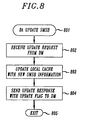
- FIG. 8 is a flow chart illustrating the operation of the update SMSB distribution agent routine employed in the remote network elements, e.g., NE 204 (FIG. 2), to automatically update the local cache in the network element.
- the routine is typically stored in flash 104 of each of the network elements.
- the DA update SMSB routine is entered in step 801.
- step 802 causes the network element to receive an update request from the DM in DSNE 201.
- step 803 causes the local cache in NE 204 to be updated with the new SMSB identity information.
- Step 804 causes an update response with an update flag to be sent to the DM in DSNE 201.
- the DA update SMSB routine is exited via step 805.
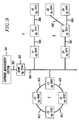
- FIG. 9 shows, in simplied block diagram form, a sample network 900 incorporating the inventions.
- network management system 901 which may be, for example, a known operations and support system employed to manage a telecommunications network.
- Network management system 901 is interfaced to DSNE 902 which may be, for example, a Digital Access and Cross Connect System (DACS), a digital multiplexer or the like.
- DACS Digital Access and Cross Connect System
- DACS IV-2000 commercially available from AT&T
- DDM-2000 also commercially available from AT&T.
- DSNE 902 and network management system 901 communicate via link 903 using, for example, the known X.25 packet protocol.
- the interface in DSNE 902 to communications link 903 is RS-232 Driver/Receiver 106 and LAPB controller 107.
- DSNE 902 communicates via local area network (LAN) 904 with a number of sub-networks.
- LAN local area network
- DSNE 902 interfaces via LAN 904 with sub-network A, including network elements A1, A2 and A3, sub-network B, including network elements B1, B2, B3 and B4 and sub-network C, including network elements C1, C2, C3 and C4.
- the interface in DSNE 902 to LAN 904 is, in this example, IEEE 802.3 LAN controller 109, which is well known in the art.
- network elements A1, B 1 and C1 each interface to LAN 904 via IEEE 802.3 LAN controller 109 (FIG. 1).
- network elements A1, A2 and A3 communicate with each other via optical links.
- network element A1 communications with network element A2 via optical link 905 and network element A2 communicates with network element A3 via optical link 906.
- LAPD controller 111 and optical interface 112 are employed to interface with a corresponding optical link in sub-network A.
- network elements B1, B2, B3 and B4 interface with each other via optical links.
- network element B 1 communicates with network element B2 via optical link 907
- network elements B2 and B3 communicate via optical link 908
- network elements B2 and B4 communicate via optical link 909.
- a LAPD controller 111 and an optical interface 112 are employed to interface with each of the corresponding optical links in sub-network B.
- network elements C1, C2, C3 and C4 interface with each other via optical links.
- network elements C1 and C2 communicate via optical link 910
- network elements C2 and C3 communicate via optical link 911
- network elements C3 and C4 communicate via optical link 912
- network elements C4 and C1 communicate via optical link 913.
- a LAPD controller 111 and an optical interface 112 are employed to interface with a corresponding optical link.
- each of the network elements including DSNE 902, has its own unique network address and unique name specific to the telecommunications management network.
- communications among network elements (DSNE and/or NEs) is via a data communications channel (DCC).
- DCC data communications channel
- FIG. 10 is a table of directory information base (DIB) included in DSNE 902 of FIG. 9. Shown are the network names, i.e., target identifiers (TIDs), network addresses, i.e., network service access points (NSAPs) of the network elements and which SMSB the particular network element is included in.
- NSAPs are defined in ISO/IEC 8348:1987/addendum 2:1988. However, for simplicity and clarity of exposition NSAPs having fewer numbers are described here. Thus, for example, DSNE 902 having NSAP "xy 2744" is included in all the SMSB's.
- Network elements A1 through A3 having NSAPs “xy 9247”, “xy 7741” and “xy 1012", respectively, are included in SMSB “A”
- network elements B1 through B4 having NSAPs “xy 2571”, “xy 3314”, “xy 0241” and “xy 4447”, respectively, are included in SMSB “B”
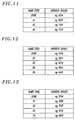
- FIG. 11 shows a table of identity information distributed by DSNE 902 of FIG. 9, in accordance with the principles of the invention, to network elements A1, A2 and A3 of sub-network A. It is noted that the network names and network addresses of the other network elements in the sub-network A and the DSNE are supplied to each network element. Again, the DSNE and NEs A1, A2 and A3 form SMSB "A".
- FIG. 12 is a table of identity information distributed by the DSNE 902 of FIG. 9, in accordance with the principles of the invention, to network elements B1, B2, B3 and B4 of sub-network B.
- the network names and network addresses of the other network elements in the sub-network B and the DSNE are supplied to each of the network elements.
- the DSNE and NEs B1, B2, B3 and B4 form SMSB "B".
- FIG. 13 is a table of identity information distributed by the DSNE 902 of FIG. 9 to network elements C1, C2, C3 and C4 of sub-network C.
- the network names and network addresses of the other network elements in the sub-network C and the DSNE are supplied to each of the network elements.
- the DSNE and NEs C1, C2, C3 and C4 form SMSB "C"
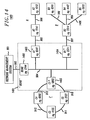
- FIG. 14 shows, in simplied block diagram form, a telecommunications management system 1400 in which network elements, or portions thereof, are integrated with DSNE 1402 to form a single new "DSNE"1401.
- the telecommunications network of FIG. 14, from an apparatus point of view, is similar to that of FIG. 9, except that network elements A1*, B1* and C1*, or portions thereof as will be explained below, are essentially integrated with DSNE 1402 to form a so-called new "DSNE" 1401, which appears to the sub-networks as a single network element from an OAM&P perspective.
- DSNE 1402 performs both end systems functions, as well as, intermediate systems functions. That is to say, DSNE 1402 is capable of terminating applications messages, as well as, routing and relaying messages to SMSBs A, B and C, in this example.
- Those network elements of network 1400 which are essentially identical to those shown in network 900 of FIG. 9 are similarly numbered and will not be described in detail again.
- new "DSNE” 1401 appears, in accordance with the invention, to be a single integrated DSNE to each of sub-networks A, B and C.
- sub-network A now includes only network elements A2 and A3
- sub-network B now includes network elements B2 through B5
- sub-network C now includes only network elements C2 through C4.
- Network elements A1* (1403), B1* (1404) and C1* (1405) are integrated into new "DSNE” 1401 and appear as “routers” or so-called “intermediate systems” (ISs) to the other network elements in SMSBs A, B and C, respectively.
- new "DSNE” 1401 can provide optical interfaces to each of sub-networks A, B and C of FIG. 14 without the need of expending significant development time and cost.
- DSNE 1402 of FIG. 4 shown in simplified form, are details of DSNE 1402 of FIG. 4. Note that, the only difference between DSNE 1402 of FIG. 15 and DSNE/NE 100 of FIG. 1 are that unnecessary elements have been eliminated. In DSNE 1402 flash memory 104 LAPD controller 111 and optical interfaces 112 have been eliminated. Otherwise, the remaining elements in DSNE 1402 are identical to those in DSNE/NE 100 of FIG. 1 and have been similarly numbered and will not be described again.
- FIG. 16 shown in simplified form, are details of the network elements A1*, B1* and C1* of FIG. 14. Note that the only differences between the network element of FIG. 16 and the network element of FIG. 1 are that the RS-232 driver/receiver 106 and LAPB controller 107 of FIG. 1 have been eliminated. Otherwise, the remaining elements in the network element of FIG. 16 have been similarly numbered to those in FIG. 1 and will not be described again.
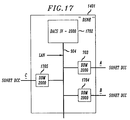
- FIG. 17 shows, in simplified form, an implementation of "DSNE" 1401 employing commercially available equipment units.
- a DACS IV-2000 (1702) which is commercially available from AT&T, which would interface with the external network management system (not shown) and interface via a LAN 904 to DDM-2000 digital multiplexer units, or portions thereof (see FIG. 16), namely, 1703, 1704 and 1705 to provide optical interfaces to a plurality of SMSBs A, B and C, respectively.
- the SONET data communications channel from each of the DDM-2000's integrated into the DSNE would be utilized to communicate with remote network elements in each of the sub-networks.
- the SONET data communications channel bytes D1-D3 and/or D4-D12 of the SONET overhead channel.
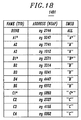
- FIG. 18 is a table of directory information base (DIB) included in DSNE 1402 of FIG. 14. Shown are the network names (TIDs), network addresses (NSAPs) of the network elements and which SMSB the particular network element is included in. Thus, for example, DSNE 1402 is included in all the SMSBs.
- Network element A1* is included in sub-network A*.
- Network elements A2 and A3 are included in sub-network A.
- Network element B1* is included in sub-network B*.
- Network elements B2 through B5 are included in sub-network B.
- Network element C1* is included in sub-network C*.
- Network elements C2 through C4 are included in sub-network C.
- the network elements having an * indicates that they are integrated into "DSNE" 1401.
- the new single "DSNE" 1402 includes DSNE 1401 and NEs A1*, B1* and C1*.
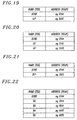
- FIG. 19 shows a table of identity information distributed by DSNE 1402 to network element A 1*.
- the identity and name of network element A 1* is only shared with DSNE 1402.
- Network element A1* appears transparent to network elements A2 and A3 of sub-network A from an Operations, Administration, Maintenance and Provisioning (OAM&P) perspective.
- OAM&P Operations, Administration, Maintenance and Provisioning
- FIG. 20 shows a table of identity information distributed by DSNE 1402 via network element A1* and, hence, "DSNE” 1401 of FIG. 14 to network elements A2 and A3 of sub-network A.
- the network names and network addresses of the other network elements in the sub-network and DSNE 1402 are supplied to each network element in the sub-network A.
- SMSB SMSB
- FIG. 21 shows a table of identity information distributed by DSNE 1402 to network element B1*.
- the identity and name of network element B1* is only shared with DSNE 1402.
- Network element B1* appears transparent to network elements B2 through B5 of sub-network B from an Operations, Administration, Maintenance and Provisioning (OAM&P) perspective.
- OAM&P Operations, Administration, Maintenance and Provisioning
- FIG. 22 is a table of identity information distributed by DSNE 1402 via network element B1* and, hence, "DSNE" 1401 of FIG. 14, to network elements B2, B3, B4 and B5 of sub-network B.
- the network names and network addresses of the other network elements in the sub-network B and DSNE 1402 are supplied to each of the network elements.
- "DSNE" 1401 and NEs B2, B3, B4 and B5 form SMSB "B".
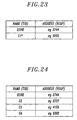
- FIG. 23 shows a table of identity information distributed by DSNE 1402 to network element C1*.
- the identity and name of network element C1* is only shared with DSNE 1402.
- Network element C1* appears transparent to network elements C2 through C4 of sub-network C from an Operations, Administration, Maintenance and Provisioning (OAM&P) perspective.
- OAM&P Operations, Administration, Maintenance and Provisioning
- FIG. 24 is a table of identity information distributed by DSNE 1402 via network element C1* and, hence, "DSNE" 1401 of FIG. 14, to network elements C2, C3 and C4 of sub-network C.
- the network names and network addresses of the other network elements in the sub-network C and DSNE 1402 are supplied to each of the network elements.
- "DSNE" 1401 and NEs C2, C3 and C4 form SMSB "C".
Landscapes
- Engineering & Computer Science (AREA)
- Computer Networks & Wireless Communication (AREA)
- Computer Security & Cryptography (AREA)
- Signal Processing (AREA)
- Computer And Data Communications (AREA)
- Data Exchanges In Wide-Area Networks (AREA)
- Exchange Systems With Centralized Control (AREA)
Claims (12)
- Elément de réseau intégré destiné à être utilisé dans un système de transmission numérique comportant au moins un autre élément de réseau comprenant :un premier élément de réseau fourni comme élément de réseau de services d'annuaire (DSNE) ;au moins un deuxième élément de réseau comportant un moyen pour supporter une pile de protocole d'interface standard ouverte (OSI) ayant au moins une couche de réseau OSI comportant des protocoles de routage OSI, et un moyen pour connecter ledit au moins deuxième élément de réseau par l'intermédiaire d'un canal de communications de données audit au moins un autre élément de réseau, ledit canal de communications de données étant utilisé pour supporter des données de la pile de protocole OSI ;ledit premier élément de réseau comportant un moyen pour supporter une pile de protocole d'interface standard ouverte (OSI) ayant au moins une couche de réseau OSI comportant des protocoles de routage OSI et une couche d'applications comportant un protocole de distribution d'annuaire, un moyen pour connecter ledit premier élément de réseau audit au moins deuxième élément de réseau par l'intermédiaire d'un canal de communications de données, ledit canal de communications de données étant utilisé pour supporter des données de pile de protocole OSI, un moyen pour utiliser lesdits protocoles de routage OSI pour détecter par l'intermédiaire des données de pile de protocole OSI reçues fournies à partir dudit au moins deuxième élément de réseau qu'au moins un autre élément de réseau est maintenant joignable et pour fournir automatiquement une indication dudit au moins un autre élément de réseau nouvellement joignable audit protocole de distribution d'annuaire dans ladite couche d'application, un moyen pour obtenir automatiquement des informations d'identité de réseau à partir dudit au moins un autre élément de réseau nouvellement joignable indiqué par l'intermédiaire dudit au moins deuxième élément de réseau et un moyen pour fournir automatiquement de manière contrôlable par l'intermédiaire dudit au moins deuxième élément de réseau lesdites informations d'identité de réseau dudit au moins un autre élément de réseau nouvellement joignable à n'importe quels autres éléments de réseau dans un sous-réseau comportant ledit au moins un autre élément de réseau nouvellement joignable, ledit premier élément de réseau étant fourni pour fournir uniquement ses informations d'identité de réseau audit au moins deuxième élément de réseau et ne pas fournir les informations d'identité de réseau dudit au moins deuxième élément de réseau à n'importe lequel des autres éléments de réseau, dans lequel ledit au moins deuxième élément de réseau apparaít transparent auxdits autres éléments de réseau du point de vue des opérations, de l'administration, de la maintenance ou de l'approvisionnement.
- Elément de réseau intégré selon la revendication 1, dans lequel ledit premier élément de réseau comporte un moyen pour fournir automatiquement de manière contrôlable audit au moins un autre élément de réseau nouvellement joignable par l'intermédiaire dudit au moins deuxième élément de réseau des informations d'identité d'autres éléments de réseau inclus dans ledit sous-réseau comportant ledit au moins un autre élément de réseau nouvellement joignable.
- Elément de réseau intégré selon la revendication 2, dans lequel ledit premier élément de réseau comporte en outre un moyen pour utiliser lesdits protocoles de routage OSI pour détecter par l'intermédiaire de données de pile de protocole OSI reçues fournies à partir dudit au moins deuxième élément de réseau que ledit au moins un autre élément de réseau n'est plus joignable et pour fournir automatiquement une indication dudit au moins un autre élément de réseau qui n'est plus joignable audit protocole de distribution d'annuaire dans ladite couche d'application, un moyen pour obtenir automatiquement des informations d'identité de réseau dudit au moins un autre élément de réseau qui n'est plus joignable et un moyen pour fournir automatiquement de manière contrôlable lesdites informations de réseau dudit au moins un autre élément de réseau qui n'est plus joignable par l'intermédiaire dudit au moins deuxième élément de réseau à n'importe lequel des autres éléments de réseau dans ledit sous-réseau.
- Elément de réseau intégré selon la revendication 3, dans lequel ledit premier élément de réseau comporte en outre un gestionnaire de distribution, une base d'informations d'annuaire, un moyen pour fournir ladite indication depuis le protocole de distribution d'annuaire dans ladite couche d'applications audit gestionnaire de distribution et un moyen pour ajouter lesdits informations d'identité dudit au moins un autre élément de réseau nouvellement joignable à ladite base d'informations d'annuaire.
- Elément de réseau intégré selon la revendication 4 dans lequel ledit premier élément de réseau comporte en outre un moyen pour fournir ladite indication qu'au moins un autre élément de réseau joignable n'est plus joignable depuis le protocole de distribution d'annuaire dans ladite couche d'applications dudit gestionnaire de distribution et un moyen pour supprimer lesdites informations d'identité dudit au moins un autre élément de réseau qui n'est plus joignable à partir de ladite base d'informations d'annuaire.
- Elément de réseau intégré selon la revendication 1, comportant une pluralité de dits deuxièmes éléments de réseau, chacun de ladite pluralité de deuxièmes éléments de réseau comportant un moyen pour acheminer des données depuis ledit premier élément de réseau vers au moins un autre élément de réseau dans un sous-réseau formé par lui et ledit au moins un autre élément de réseau.
- Elément de réseau intégré selon la revendication 1, dans lequel ledit au moins deuxième élément de réseau comporte un moyen pour acheminer des données depuis ledit premier élément de réseau vers au moins un autre élément de réseau.
- Elément de réseau intégré selon la revendication 7, dans lequel ledit au moins deuxième élément de réseau comporte un moyen pour acheminer des données depuis ledit au moins un autre élément de réseau vers ledit premier élément de réseau.
- Système de transmission numérique comprenant :un premier élément de réseau fourni comme élément de réseau de services d'annuaire (DSNE) ;au moins un autre élément de réseau ; etau moins un deuxième élément de réseau comportant un moyen pour supporter une pile de protocole d'interface standard ouverte (OSI) ayant au moins une couche de réseau OSI comportant des protocoles de routage OSI, et un moyen pour connecter ledit au moins deuxième élément de réseau par l'intermédiaire d'un canal de communications de données audit au moins un autre élément de réseau, ledit canal de communications de données étant utilisé pour supporter des données de la pile de protocole OSI ;ledit premier élément de réseau comportant un moyen pour supporter une pile de protocole d'interface standard ouverte (OSI) ayant au moins une couche de réseau OSI comportant des protocoles de routage OSI et une couche d'applications comportant un protocole de distribution d'annuaire, un moyen pour connecter ledit premier élément de réseau audit au moins deuxième élément de réseau par l'intermédiaire d'un canal de communications de données, ledit canal de communications de données étant utilisé pour supporter des données de pile de protocole OSI, un moyen pour utiliser lesdits protocoles de routage OSI pour détecter par l'intermédiaire des données de pile de protocole OSI reçues fournies à partir dudit au moins deuxième élément de réseau qu'au moins un autre élément de réseau est maintenant joignable et pour fournir automatiquement une indication dudit au moins un autre élément de réseau nouvellement joignable audit protocole de distribution d'annuaire dans ladite couche d'application, un moyen pour obtenir automatiquement des informations d'identité de réseau à partir dudit au moins un autre élément de réseau nouvellement joignable indiqué par l'intermédiaire dudit au moins deuxième élément de réseau et un moyen pour fournir automatiquement de manière contrôlable par l'intermédiaire dudit au moins deuxième élément de réseau lesdites informations d'identité de réseau dudit au moins un autre élément de réseau nouvellement joignable à n'importe quels autres éléments de réseau dans un sous-réseau comportant ledit au moins un autre élément de réseau nouvellement joignable, ledit premier élément de réseau étant fourni pour fournir uniquement ses informations d'identité de réseau audit au moins deuxième élément de réseau et ne pas fournir les informations d'identité de réseau dudit au moins deuxième élément de réseau à l'un quelconque des autres éléments de réseau, dans lequel ledit au moins deuxième élément de réseau apparaít transparent auxdits autres éléments de réseau du point de vue des opérations, de l'administration, de la maintenance ou de l'approvisionnement.
- Système de transmission selon la revendication 9, comportant une pluralité de dits deuxièmes éléments de réseau, chacun de ladite pluralité de deuxièmes éléments de réseau comportant un moyen pour acheminer des données depuis ledit premier élément de réseau vers au moins un autre élément de réseau dans un sous-réseau formé par lui et ledit au moins un autre élément de réseau.
- Système de transmission selon la revendication 9, dans lequel ledit au moins deuxième élément de réseau comporte un moyen pour acheminer des données depuis ledit premier élément de réseau vers ledit au moins un autre élément de réseau.
- Système de transmission selon la revendication 11, dans lequel ledit au moins deuxième élément de réseau comporte un moyen pour acheminer des données depuis ledit au moins un autre élément vers ledit premier élément de réseau.
Applications Claiming Priority (2)
| Application Number | Priority Date | Filing Date | Title |
|---|---|---|---|
| US990385 | 1992-12-14 | ||
| US07/990,385 US5335229A (en) | 1992-12-14 | 1992-12-14 | Logical integration of multiple network elements in a telecommunications management network |
Publications (3)
| Publication Number | Publication Date |
|---|---|
| EP0602825A2 EP0602825A2 (fr) | 1994-06-22 |
| EP0602825A3 EP0602825A3 (fr) | 1998-03-11 |
| EP0602825B1 true EP0602825B1 (fr) | 2001-12-05 |
Family
ID=25536098
Family Applications (1)
| Application Number | Title | Priority Date | Filing Date |
|---|---|---|---|
| EP93309579A Expired - Lifetime EP0602825B1 (fr) | 1992-12-14 | 1993-12-01 | Intégration logique d'éléments multiples de réseau dans un réseau de gestion de télécommunication |
Country Status (5)
| Country | Link |
|---|---|
| US (1) | US5335229A (fr) |
| EP (1) | EP0602825B1 (fr) |
| JP (1) | JP2883796B2 (fr) |
| CA (1) | CA2109189C (fr) |
| DE (1) | DE69331263T2 (fr) |
Families Citing this family (7)
| Publication number | Priority date | Publication date | Assignee | Title |
|---|---|---|---|---|
| WO1996020448A1 (fr) * | 1994-12-23 | 1996-07-04 | Southwestern Bell Technology Resources, Inc. | Plateforme de reseau flexible et systeme de traitement d'appel |
| JP3024033U (ja) * | 1995-10-24 | 1996-05-17 | 有限会社サンク | 吸殻収集装置付灰皿 |
| US6032175A (en) * | 1996-10-17 | 2000-02-29 | International Business Machines Corporation | Enhanced directory services in compound wide/local area networks |
| JP2000333663A (ja) | 1999-05-25 | 2000-12-05 | Japan Tobacco Inc | 喫味用物品若しくはその部品の密度検出装置 |
| TR200103586T2 (tr) * | 2000-10-25 | 2005-01-24 | Japan Tobacco Inc. | Tütün tatma aleti için yoğunluk kontrol cihazı |
| US7170862B1 (en) | 2001-07-31 | 2007-01-30 | Cisco Technology, Inc. | Partitioning a network element into multiple virtual network elements |
| US20090041460A1 (en) * | 2007-08-10 | 2009-02-12 | Bernard Marc R | Method and apparatus to provide bonded optical network devices |
Citations (1)
| Publication number | Priority date | Publication date | Assignee | Title |
|---|---|---|---|---|
| US4644532A (en) * | 1985-06-10 | 1987-02-17 | International Business Machines Corporation | Automatic update of topology in a hybrid network |
Family Cites Families (6)
| Publication number | Priority date | Publication date | Assignee | Title |
|---|---|---|---|---|
| JPS62109451A (ja) * | 1985-11-04 | 1987-05-20 | インタ−ナショナル ビジネス マシ−ンズ コ−ポレ−ション | データ伝送ネットワークの通信パス確立・不可用性データ収集方法 |
| US4800488A (en) * | 1985-11-12 | 1989-01-24 | American Telephone And Telegraph Company, At&T Bell Laboratories | Method of propagating resource information in a computer network |
| JPS63214043A (ja) * | 1987-03-02 | 1988-09-06 | Fujitsu Ltd | パケツト通信サ−ビス方式 |
| FR2649842B1 (fr) * | 1989-07-17 | 1994-04-08 | Alcatel Cit | Reseau d'acces pour service de telephonie sans fil |
| JPH03148940A (ja) * | 1989-11-06 | 1991-06-25 | Hitachi Ltd | Lanとisdnとの相互接続方式 |
| DE4041442C1 (en) * | 1990-12-21 | 1992-06-25 | Siemens Ag, 8000 Muenchen, De | Method of localising communication end devices - after each activation of end devices, stored position information is called up with call up procedure via serial data interface |
-
1992
- 1992-12-14 US US07/990,385 patent/US5335229A/en not_active Expired - Lifetime
-
1993
- 1993-10-25 CA CA002109189A patent/CA2109189C/fr not_active Expired - Fee Related
- 1993-12-01 DE DE69331263T patent/DE69331263T2/de not_active Expired - Lifetime
- 1993-12-01 EP EP93309579A patent/EP0602825B1/fr not_active Expired - Lifetime
- 1993-12-10 JP JP5340918A patent/JP2883796B2/ja not_active Expired - Fee Related
Patent Citations (1)
| Publication number | Priority date | Publication date | Assignee | Title |
|---|---|---|---|---|
| US4644532A (en) * | 1985-06-10 | 1987-02-17 | International Business Machines Corporation | Automatic update of topology in a hybrid network |
Also Published As
| Publication number | Publication date |
|---|---|
| US5335229A (en) | 1994-08-02 |
| CA2109189C (fr) | 1999-12-14 |
| CA2109189A1 (fr) | 1994-06-15 |
| JP2883796B2 (ja) | 1999-04-19 |
| DE69331263T2 (de) | 2002-08-08 |
| EP0602825A3 (fr) | 1998-03-11 |
| EP0602825A2 (fr) | 1994-06-22 |
| DE69331263D1 (de) | 2002-01-17 |
| JPH06232868A (ja) | 1994-08-19 |
Similar Documents
| Publication | Publication Date | Title |
|---|---|---|
| EP0602824B1 (fr) | Appareil et méthode d'enregistrement automatique d'informations d'identité d'éléments de réseau | |
| US5537547A (en) | Automatic network element identity information distribution apparatus and method | |
| EP0602823B1 (fr) | Détection automatique des éléments de réseau accessibles | |
| US5513171A (en) | Arrangement for dynamically deriving a telephone network management database from telephone network data | |
| KR100277138B1 (ko) | 전기통신 시스템 | |
| US5453979A (en) | Method and apparatus for generating route information for asynchronous transfer mode cell processing | |
| JPH07183944A (ja) | アクセスネットワーク装置 | |
| JP2004515967A (ja) | ネットワークエンドデバイスの物理的ロケーションを自動的に識別するシステム | |
| CN1214831A (zh) | 电信网络节点中的地址分配方法 | |
| EP0602825B1 (fr) | Intégration logique d'éléments multiples de réseau dans un réseau de gestion de télécommunication | |
| US6993019B2 (en) | Method for mapping translation type in No. 7 gateway signaling network | |
| US5987520A (en) | Closed user group preprocessing decision for efficient call security validation | |
| US6381237B1 (en) | Trail explorer and method for exploring trails in a communication network | |
| KR0152390B1 (ko) | 이동통신 시스템에서의 제어국과 기지국간의 다중화된 중계선 경로 구성 및 그 제어방법 | |
| EP0968587B1 (fr) | Systeme de commutation en telecommunications, a commande de supervision facilement configurable | |
| US20020065829A1 (en) | Apparatus and method for synchronizing databases in distributed communication systems | |
| EP0426356A2 (fr) | Méthode de sélection de route dans un réseau de télécommunications | |
| US7486668B2 (en) | Communicating an identification parameter of a network node | |
| KR20010080170A (ko) | 통신 네트워크에서의 종단 관리 | |
| KR100397924B1 (ko) | 브이오아이피 시스템에서의 아이피 어드레스 및 맥어드레스 관리 방법 | |
| EP1162863B1 (fr) | Gestion d'informations de protocole dans des réseaux PNNI hiérarchiques | |
| JPH02235460A (ja) | アクセス情報パスの管理方式 |
Legal Events
| Date | Code | Title | Description |
|---|---|---|---|
| PUAI | Public reference made under article 153(3) epc to a published international application that has entered the european phase |
Free format text: ORIGINAL CODE: 0009012 |
|
| AK | Designated contracting states |
Kind code of ref document: A2 Designated state(s): DE ES FR GB IT SE |
|
| PUAL | Search report despatched |
Free format text: ORIGINAL CODE: 0009013 |
|
| AK | Designated contracting states |
Kind code of ref document: A3 Designated state(s): DE ES FR GB IT SE |
|
| 17P | Request for examination filed |
Effective date: 19980828 |
|
| 17Q | First examination report despatched |
Effective date: 19991213 |
|
| GRAG | Despatch of communication of intention to grant |
Free format text: ORIGINAL CODE: EPIDOS AGRA |
|
| GRAG | Despatch of communication of intention to grant |
Free format text: ORIGINAL CODE: EPIDOS AGRA |
|
| GRAH | Despatch of communication of intention to grant a patent |
Free format text: ORIGINAL CODE: EPIDOS IGRA |
|
| GRAH | Despatch of communication of intention to grant a patent |
Free format text: ORIGINAL CODE: EPIDOS IGRA |
|
| GRAA | (expected) grant |
Free format text: ORIGINAL CODE: 0009210 |
|
| AK | Designated contracting states |
Kind code of ref document: B1 Designated state(s): DE ES FR GB IT SE |
|
| PG25 | Lapsed in a contracting state [announced via postgrant information from national office to epo] |
Ref country code: IT Free format text: LAPSE BECAUSE OF FAILURE TO SUBMIT A TRANSLATION OF THE DESCRIPTION OR TO PAY THE FEE WITHIN THE PRE;WARNING: LAPSES OF ITALIAN PATENTS WITH EFFECTIVE DATE BEFORE 2007 MAY HAVE OCCURRED AT ANY TIME BEFORE 2007. THE CORRECT EFFECTIVE DATE MAY BE DIFFERENT FROM THE ONE RECORDED.SCRIBED TIME-LIMIT Effective date: 20011205 |
|
| REG | Reference to a national code |
Ref country code: GB Ref legal event code: IF02 |
|
| REF | Corresponds to: |
Ref document number: 69331263 Country of ref document: DE Date of ref document: 20020117 |
|
| PG25 | Lapsed in a contracting state [announced via postgrant information from national office to epo] |
Ref country code: SE Free format text: LAPSE BECAUSE OF FAILURE TO SUBMIT A TRANSLATION OF THE DESCRIPTION OR TO PAY THE FEE WITHIN THE PRESCRIBED TIME-LIMIT Effective date: 20020305 |
|
| PG25 | Lapsed in a contracting state [announced via postgrant information from national office to epo] |
Ref country code: ES Free format text: LAPSE BECAUSE OF FAILURE TO SUBMIT A TRANSLATION OF THE DESCRIPTION OR TO PAY THE FEE WITHIN THE PRESCRIBED TIME-LIMIT Effective date: 20020627 |
|
| PLBE | No opposition filed within time limit |
Free format text: ORIGINAL CODE: 0009261 |
|
| STAA | Information on the status of an ep patent application or granted ep patent |
Free format text: STATUS: NO OPPOSITION FILED WITHIN TIME LIMIT |
|
| 26N | No opposition filed | ||
| PG25 | Lapsed in a contracting state [announced via postgrant information from national office to epo] |
Ref country code: GB Free format text: LAPSE BECAUSE OF NON-PAYMENT OF DUE FEES Effective date: 20021201 |
|
| GBPC | Gb: european patent ceased through non-payment of renewal fee | ||
| PGFP | Annual fee paid to national office [announced via postgrant information from national office to epo] |
Ref country code: FR Payment date: 20100108 Year of fee payment: 17 |
|
| PGFP | Annual fee paid to national office [announced via postgrant information from national office to epo] |
Ref country code: DE Payment date: 20091222 Year of fee payment: 17 |
|
| REG | Reference to a national code |
Ref country code: FR Ref legal event code: ST Effective date: 20110831 |
|
| PG25 | Lapsed in a contracting state [announced via postgrant information from national office to epo] |
Ref country code: FR Free format text: LAPSE BECAUSE OF NON-PAYMENT OF DUE FEES Effective date: 20110103 |
|
| REG | Reference to a national code |
Ref country code: DE Ref legal event code: R119 Ref document number: 69331263 Country of ref document: DE Effective date: 20110701 |
|
| PG25 | Lapsed in a contracting state [announced via postgrant information from national office to epo] |
Ref country code: DE Free format text: LAPSE BECAUSE OF NON-PAYMENT OF DUE FEES Effective date: 20110701 |