EP0604037B1 - Procédé de protection de barre collectrice - Google Patents
Procédé de protection de barre collectrice Download PDFInfo
- Publication number
- EP0604037B1 EP0604037B1 EP93309660A EP93309660A EP0604037B1 EP 0604037 B1 EP0604037 B1 EP 0604037B1 EP 93309660 A EP93309660 A EP 93309660A EP 93309660 A EP93309660 A EP 93309660A EP 0604037 B1 EP0604037 B1 EP 0604037B1
- Authority
- EP
- European Patent Office
- Prior art keywords
- busbar
- current
- line
- lines
- value
- Prior art date
- Legal status (The legal status is an assumption and is not a legal conclusion. Google has not performed a legal analysis and makes no representation as to the accuracy of the status listed.)
- Expired - Lifetime
Links
Images



Classifications
-
- G—PHYSICS
- G01—MEASURING; TESTING
- G01R—MEASURING ELECTRIC VARIABLES; MEASURING MAGNETIC VARIABLES
- G01R31/00—Arrangements for testing electric properties; Arrangements for locating electric faults; Arrangements for electrical testing characterised by what is being tested not provided for elsewhere
- G01R31/08—Locating faults in cables, transmission lines, or networks
-
- H—ELECTRICITY
- H02—GENERATION; CONVERSION OR DISTRIBUTION OF ELECTRIC POWER
- H02H—EMERGENCY PROTECTIVE CIRCUIT ARRANGEMENTS
- H02H7/00—Emergency protective circuit arrangements specially adapted for specific types of electric machines or apparatus or for sectionalised protection of cable or line systems, and effecting automatic switching in the event of an undesired change from normal working conditions
- H02H7/22—Emergency protective circuit arrangements specially adapted for specific types of electric machines or apparatus or for sectionalised protection of cable or line systems, and effecting automatic switching in the event of an undesired change from normal working conditions for distribution gear, e.g. bus-bar systems; for switching devices
Definitions
- the present invention relates to electrical and electronic circuitry, and particularly concerns a busbar protection method which, in order to protect a busbar, makes it possible to detect a fault on a busbar of a transmission and distribution system, and to localise the faulty point to a specific section of the busbar.
- FIG. 2 A part of a single line diagram in a conventional substation illustrating the high voltage side of the busbars in detail is seen in Figure 2.
- busbars X and Y There are two busbars X and Y, and interlink lines, which are configured to interlink both X and Y busbars.
- the transformers 1B and 2B as well as the transmission lines A and B are connected to the interlink lines and further to the X and Y busbars via line switches LX- and LY-, which serve to selectively connect the transformers and transmission lines to either of the X and Y busbars.
- the line switches LX- and LY- are generally called isolators.
- additional apparatus not illustrated in the Figure are also connected to the duplicated busbar in the same way.
- references in the Figure include the letter L to designate the line switch, the letters CB for the circuit breaker, the letters BCT for the current transformer of the line side, the letters LCT for the current transformer of the busbar side, the letters TCT for the current transformer of the transformer, the letter X for the X busbar, and the letter Y for the Y busbar.
- symbols following a hyphen designate the location where the apparatus is installed.
- omission of the characters following a hyphen such as the reference LX- designates generally the character of the apparatus and not the location where the apparatus is installed.
- the lines A-1L, A-2L, B-1L and B-2L as well as the transformers 1B and 2B are connected to the duplicated busbar via the circuit breakers CB-.
- the current transformers LCT- and BCT- are installed on both sides of the circuit breakers CB-.
- the current transformers LCT- connected to the busbar side serve to protect the lines or the apparatus such as transformers
- the current transformers BCT- connected to the line or the additional apparatus serve to protect the busbar.
- the current transformers LCT- and BCT- are collectively connected to the busbars, the lines or the additional apparatus.
- the current transformers which are installed near the busbar are designated as LCT-
- those connected to the apparatus are designated as BCT-.
- another interlink line which interlinks both of the busbars comprises a circuit breaker CB-B, the LX-B and LY-B as well as the CT-X and CT-Y.
- Lines such as transmission lines and apparatus such as transformers are connected in general to the duplicated busbar so as to equalise load on both of the busbars as far as possible. If the line 1L is connected to the X busbar, for instance as shown in the following Figure 3, then the line 2L is connected to the Y busbar. As a result, the current flowing through the circuit breaker CB-B which interlinks both of the busbars is nearly zero.
- the known protection method for the duplicated busbar system is as described in the following.
- Figure 3 illustrates the principle of a collective protection method of the duplicated busbar.
- all of the secondary circuits of the current transformers BCT- installed in the lines or in the apparatus such as transformers are connected in parallel and a detecting relay RY is also connected in parallel to the circuit thereof. Consequently, the sum total of the detected current of all of the current transformers BCT- flows through the relay RY.
- the relay RY is actuated, when the foregoing current flowing through the relay exceeds the predetermined threshold by means of which errors of the current transformer are taken into account.
- the fault on the duplicated busbar occurs on either side of the X busbar or the Y busbar, but in a few cases simultaneously on both sides of the two busbars. Accordingly, it is desirable to detect the fault and identify whether it is the X busbar or of the Y busbar is faulty.
- data from circuit elements is provided to a busbar protection device 1.
- the data comprises the current signals emanating from the current transformers BCT-, which are installed in the lines, apparatus etc; the current signals emanating from the current transformers BCT- interlinking the busbars; and the output signals indicating the switching state of the line switches LX- and LY-, i.e. "open” or "closed” signals.
- a digital processor 1 is built in the busbar protection device.
- the above mentioned input signals are sampled by the digital processing device with a certain period, and, on the basis of the data thereof, digital computing is then performed according to the following calculations.
- the inequality (1) is satisfied, i.e. if I is greater than the threshold value K, then this indicates that the fault has occurred on the X busbar.
- the inequality (2) indicates that the fault has occurred on the Y busbar
- the inequality (3) indicates that the fault has occurred somewhere on the busbars without the faulty busbar (the X busbar or the Y busbar) being identified.
- EP-A-0 400 230 describes a system for detecting a fault within a substation in which at least one input line and a plurality of busbar disconnecting switches are connected in circuit portions connecting the input line and output lines with each other.
- the system uses a plurality of optical current sensors to detect current flows in the lines and fault location detecting means using information from the current sensors to determine if a fault condition exists.
- the object of the present invention is to eliminate the foregoing problems associated with conventional busbar protection methods.
- a method of detecting and localising a fault in a busbar (X,Y) to which a plurality of lines or apparatus (A,B) is connected, on the basis of the currents detected by a current detector (BCT) installed in the busbar and respective ones installed in the lines or apparatus characterised in that said method comprises the steps of; a) computing a first value of current flowing at the junction of the line and the busbar using the current detected by the current detector installed in the busbar (CT); b) computing a second value of the current at the junction of the line and the busbar from the currents detected by the current detectors installed in the lines; c) calculating the difference of the first and second computed values; d) comparing the difference with a predetermined threshold value; and e) determining that a fault exists at the point if the difference exceeds the threshold value.
- CT current detector
- a second aspect of the present invention is characterised in a method of protecting a busbar, wherein, in protecting a busbar by judging whether a fault has occurred or not, on the basis of the current detected by the current detectors installed in the busbar and at least in two lines or apparatus connected thereto, a line or apparatus is designated as A, another line or apparatus is designated as B, a connection point of the line or apparatus A to the busbar is designated as A1 and a second connection point of the line or apparatus B to the busbar is designated as B1, and on the basis of the currents detected by the foregoing detectors, computing the difference of the current flowing out from the connection point A1 toward the connection point B1 and the current flowing into the connection point B1 from the direction of the connection point A1, it is consequently judged in particular that, if the foregoing current exceeds a predetermined value, the fault has occurred on the section between the connection points A1 and B1.
- a third aspect of the present invention is characterised in the method of protecting a busbar, wherein, in protecting a busbar by judging whether a fault has occurred or not, on the basis of the current detected by the current detectors installed in the busbar and at least two lines or apparatus connected thereto, a line or apparatus is designated as A, another line or apparatus neighbouring thereto is designated as B, a connection point of the line or apparatus A to the busbar is designated as A1 and a second connection point of the line or apparatus B to the busbar is designated as B1, and further the location of a current detector installed in the line or apparatus A is designated as A2, the current of the line A is computed from the currents detected by the current detectors excluding the current detector of the location A2, the difference of the current in line A and the current detected by the current detector of the location A2 is computed, the foregoing first current difference not exceeding a predetermined value, computing a second current difference between the current flowing out from the connection point A1 toward the connection point B1 and the current flowing into the
- the present invention is characterised in the method of protecting a busbar, wherein the busbar belongs to a duplicated busbar system to each busbar of which a line or apparatus is connected via a line switch, and it is possible to select for computing the current value of the current detectors according to the information on the switching state of the line switches, or wherein the busbar belongs to a single busbar system.
- the present invention is characterised in the method of protecting the duplicated busbar system, wherein designating two busbars as X busbar and Y busbar, designating a line or apparatus connected to the connection point S, to which the X busbar and the Y busbar are also connected via a line switch LX-A and a line switch LY-A respectively, as line or apparatus A, and then the line switch LX-A being closed and the line LY-A being open, computing the current flowing through the line switch LX-A from the current detected by the current detector, computing the difference of the above current and the current detected by the current detector installed in the line or apparatus A, it is consequently judged in particular that, if the foregoing current difference exceeds a predetermined value, the fault has occurred on the section between the connection point S and the line switch LY-A.
- the resulting fault current is expressed as an operational sum of the output current of each current transformer, that is, of the observable values.
- the current computed as the operational sum is zero in normal conditions where no fault occurs on the busbar, but, in the case of a fault, reaches a definite value other than zero. Noticing this point, it is possible to detect the fault, localising the faulty point to the specific section. If the currents of the first and second sections are zero, but the current sum exceeds a predetermined threshold, then it is judged that the fault has occurred on the end section of the busbar.
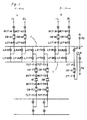
- the current i A1 in Figure 1 corresponds to the current IA1
- currents i A2 , i B , i B1 , i B2 , i T1 , i T2 also correspond to currents IA2, IB, etc, respectively.
- any type of current detector may be used including, but not limited to, the current transformer (CT).
- a fault which has occurred on either of the foregoing sections is collectively dealt with as the fault on the X busbar or on the Y busbar.
- the current i A1P is equal to zero, when no fault occurs. Accordingly, if the current i A1P is not zero, this indicates that the fault has occurred at the point P.
- the present invention sets a predetermined threshold K against the current i A1P at the point P, which is expressed as the operations of the observable values.
- i A1P > K it is judged that the fault has occurred on the section between the connection point of the line A-1L to the X busbar and the current transformer BCT-A1 by which the current i A1 is detected.
- this may be anywhere between the connection point to the busbar and the current transformer BCT-A1. This holds also between the connection point to the busbar and the current transformer BCT-A2, BCT-B1, BCT-B2, BCT-T1 and BCT-T2.
- the current i Q or i R is expressed as the operations of the observable values. This holds in other busbar sections between the neighbouring line outlets.
- This category is dealt with in the same way as one where a fault has occurred on the X busbar or the Y busbar. If a fault has occurred on the X busbar end, the currents, i A1P , i Q and i R of the points of the aforementioned categories (1) and (2) are nearly zero, and in addition, if the current i N of the following equation (9) exceeds a predetermined threshold, then it is considered that the fault has occurred on either of the busbar ends.
- i N i A1 + i T1 + i B1 + i B
- categories (1), (2) and (3) are described separately. However, it is a general practice to integrate these categories in order to detect the fault and to thus protect the busbar with the protecting relays.
- the present invention is described as for the case of duplicated busbars, but it is also applicable to the case of a single busbar or a ring busbar.
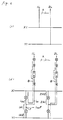
- Figure 5 is a connection diagram showing a part of the A-line 1L and 2L in Figure 2, and particularly relating to Figure 4.
- Figure 5a shows the part of the A-line 1L and 2L in Figure 4
- Figure 5b shows the portion of the A-line 1L and 2L.
- the section with the chained line B in Figure 5b is dealt with in Figure 4.
- the sections 1A1, 1A2, 2A1 and 2A2 are the ones to which the electric power is not supplied but the voltage is applied.
- the sections 1A2 and 2A2 can be dealt with collectively with the busbars connected thereto, and thus be included in category (2).
- the sections 1A1 and 2A1 are not included in the aforementioned category (2), and so the method proceeds as the following.
- the current i A1 F can be expressed in terms of some of the observable values i A1 , i A2 , i B1 , i B2 , i T1 , i T2 and i B and this indicates that the fault on the point F is included in the section 1A1.
- the current i 1A1 F is zero. If the current i 1A1 F is not zero, then it indicates that the fault has occurred on the point F, thus localising the fault to point F in the section 1A1.
- the present invention sets a predetermined value K1 for the current i 1A1 on the point F: i 1A1 > K1
- the present invention provides a more fine busbar protection method, which enables the faulty point to be localised to a specific section of the busbar, and is thus more efficient than the conventional one.
Landscapes
- Physics & Mathematics (AREA)
- General Physics & Mathematics (AREA)
- Locating Faults (AREA)
- Emergency Protection Circuit Devices (AREA)
Claims (6)
- Procédé de détection et de localisation d'un défaut dans une barre bus (X, Y) à laquelle est reliée une pluralité de lignes ou d'appareils (A, B), sur la base des courants détectés par un détecteur (CT) de courant installé dans la barre bus et par des détecteurs respectifs (BCT) installés sur les lignes ou dans les appareils, ledit procédé étant caractérisé en ce qu'il comprend les étapes consistant à:a) calculer une première intensité du courant circulant à la jonction de la ligne et de la barre bus à l'aide du courant détecté par le détecteur de courant installé dans la barre bus;b) calculer une deuxième intensité du courant à la jonction de la ligne et de la barre bus à partir des courants détectés par les détecteurs de courant installés sur les lignes;c) calculer la différence entre la première et la deuxième valeurs calculées;d) comparer la différence avec une valeur de seuil prédéterminée; ete) déterminer qu'un défaut existe au niveau du point si la différence dépasse la valeur de seuil.
- Procédé selon la revendication 1, dans lequel deux lignes (A, B) sont reliées à une barre bus, caractérisé en ce qu'une première intensité de courant en un point de la barre bus situé entre les points de raccordement des lignes (A, B) est calculée d'après des courants détectés dans la barre bus et sur une des lignes (A), et une deuxième intensité de courant en un point de la barre bus situé entre les points de raccordement des lignes est calculée d'après des courants détectés dans la barre bus et sur les autres lignes (B), et en ce que si la différence dépasse la valeur de seuil, il est déterminé qu'un défaut existe dans la barre bus entre les points de raccordement des lignes.
- Procédé selon la revendication 2, dans lequel:a) une première intensité de courant à la jonction d'une première des lignes et de la barre bus est calculée d'après des courants détectés dans la barre bus et sur la deuxième ligne, une deuxième intensité de courant à la jonction de la première ligne et de la barre bus est calculée d'après le courant détecté sur la première ligne, la différence entre les première et deuxième intensités calculées étant comparée avec une valeur de seuil;b) une troisième intensité de courant en un point de la barre bus situé entre les points de raccordement des première et deuxième lignes est calculée d'après des courants détectés dans la barre bus et sur la première ligne, une quatrième intensité de courant en un point de barre bus situé entre les points de raccordement des première et deuxième lignes est calculée d'après des courants détectés dans la barre bus et sur la deuxième ligne, la différence entre les troisième et quatrième valeurs calculées étant comparée avec une valeur de seuil;c) si les différences ne dépassent pas les valeurs de seuil, la somme opératoire des courants pénétrant dans la barre bus ou sortant de celle-ci, à l'exclusion de l'extrémité de la barre bus, est calculée et comparée avec une valeur limite prédéterminée; etd) on détermine que, si la somme précitée des intensités dépasse la valeur limite prédéterminée, le défaut est survenu dans la partie formant extrémité de la barre bus.
- Procédé selon l'une quelconque des revendications 1 à 3, dans lequel la barre bus appartient à un système double de barre bus à chaque barre bus duquel une ligne ou un appareil sont reliés par d'intermédiaire d'un commutateur de ligne, le procédé étant caractérisé en ce que les détecteurs de courant servant à calculer l'intensité du courant sont sélectionnés en fonction d'informations sur l'état de commutation des commutateurs de ligne.
- Procédé selon l'une quelconque des revendications 1 à 4, dans lequel la barre bus appartient à un seul système de barre bus.
- Procédé selon la revendication 4, dans lequel une première (X) barre bus et une deuxième (Y) barre bus sont reliées à une ligne (A) en un point de connexion (S), respectivement par l'intermédiaire d'un commutateur LX-A de ligne et d'un commutateur LY-A de ligne, le commutateur LX-A de ligne étant fermé et le commutateur LY-A de ligne étant ouvert; caractérisé par les étapes consistant, premièrement, à calculer l'intensité du courant traversant le commutateur LX-A de ligne d'après le courant détecté par le détecteur de courant; deuxièmement, calculer la différence d'intensité entre le courant traversant le commutateur LX-A de ligne et le courant détecté par un détecteur de courant installé sur la ligne ou dans l'appareil A; comparer la différence d'intensité avec une valeur prédéterminée; et, par conséquent, juger en particulier que si la différence précitée d'intensité depasse une valeur prédéterminée, le défaut s'est produit dans la partie située entre le point de raccordement S et le commutateur LY-A de ligne.
Applications Claiming Priority (4)
| Application Number | Priority Date | Filing Date | Title |
|---|---|---|---|
| JP325569/92 | 1992-12-04 | ||
| JP32556992 | 1992-12-04 | ||
| JP99996/93 | 1993-04-27 | ||
| JP5099996A JPH06225448A (ja) | 1992-12-04 | 1993-04-27 | 母線保護方法 |
Publications (2)
| Publication Number | Publication Date |
|---|---|
| EP0604037A1 EP0604037A1 (fr) | 1994-06-29 |
| EP0604037B1 true EP0604037B1 (fr) | 1998-07-08 |
Family
ID=26441084
Family Applications (1)
| Application Number | Title | Priority Date | Filing Date |
|---|---|---|---|
| EP93309660A Expired - Lifetime EP0604037B1 (fr) | 1992-12-04 | 1993-12-02 | Procédé de protection de barre collectrice |
Country Status (4)
| Country | Link |
|---|---|
| US (1) | US5566082A (fr) |
| EP (1) | EP0604037B1 (fr) |
| JP (1) | JPH06225448A (fr) |
| DE (1) | DE69319561T2 (fr) |
Families Citing this family (14)
| Publication number | Priority date | Publication date | Assignee | Title |
|---|---|---|---|---|
| US6249230B1 (en) * | 1999-03-18 | 2001-06-19 | Abb Power T&D Company Inc. | Ground fault location system and ground fault detector therefor |
| US7006085B1 (en) * | 2000-10-30 | 2006-02-28 | Magic Earth, Inc. | System and method for analyzing and imaging three-dimensional volume data sets |
| EP1223652A1 (fr) * | 2001-01-16 | 2002-07-17 | Abb Research Ltd. | Procédé pour localiser une faute dans un réseau de distribution d'énergie |
| US8804291B2 (en) | 2011-12-12 | 2014-08-12 | Utc Fire & Security Americas Corporation, Inc. | Line isolators for isolating multiple faults in emergency systems |
| GB2518188B (en) * | 2013-09-12 | 2020-11-18 | Ea Tech Limited | Fault level monitor |
| US9520254B2 (en) * | 2014-06-24 | 2016-12-13 | Eaton Corporation | Circuit interrupter including thermal trip assembly and printed circuit board Rogowski coil |
| CN106662608A (zh) * | 2014-08-29 | 2017-05-10 | 西门子公司 | 确定电力传输线路故障方向的方法和装置 |
| WO2019148391A1 (fr) * | 2018-01-31 | 2019-08-08 | 西门子公司 | Procédé et dispositif de détection de défaillance de réseau électrique avec ressource d'énergie distribuée |
| JP7008551B2 (ja) * | 2018-03-20 | 2022-01-25 | 三菱電機株式会社 | 故障判定装置、および保護継電装置 |
| DK3650871T3 (da) * | 2018-11-08 | 2024-02-26 | Nkt Hv Cables Ab | Strømkabelmålesystem |
| CN110707667B (zh) * | 2019-09-10 | 2022-02-18 | 许继电气股份有限公司 | 一种直流配电网直流线路保护方法及装置 |
| CN113030831B (zh) * | 2021-03-10 | 2024-02-06 | 国网山西省电力公司检修分公司 | 一种快速查找运行状态下电压互感器故障的方法 |
| CN113241844B (zh) * | 2021-06-23 | 2022-06-14 | 广东电网有限责任公司 | 一种10kV母线的分段备自投方法及设备 |
| CN114465236B (zh) * | 2022-04-11 | 2022-07-08 | 赫兹曼电力(广东)有限公司 | 配电网应对接地故障的自愈方法及配电网 |
Family Cites Families (20)
| Publication number | Priority date | Publication date | Assignee | Title |
|---|---|---|---|---|
| US3771049A (en) * | 1971-01-05 | 1973-11-06 | Dossert Mfg Corp | Fault indicator and locator for buried cables and zero sequence current sensing device |
| CH577762A5 (fr) * | 1974-02-27 | 1976-07-15 | Bbc Brown Boveri & Cie | |
| US4096539A (en) * | 1976-08-31 | 1978-06-20 | Scaturro Angelo J | Detector of backfeed electrical currents |
| JPS5829471B2 (ja) * | 1978-10-30 | 1983-06-22 | 東京電力株式会社 | 事故点判別方式 |
| US4290013A (en) * | 1979-06-22 | 1981-09-15 | Genrad, Inc. | Method of and apparatus for electrical short testing and the like |
| FR2504331B1 (fr) * | 1981-04-17 | 1989-12-08 | Prigent Hubert | Dispositif de detection de courant pour localiser une boucle resistive ou non dans une ligne bifilaire ou pour commuter deux lignes bifilaires |
| DE3122109A1 (de) * | 1981-06-04 | 1983-01-05 | Licentia Patent-Verwaltungs-Gmbh, 6000 Frankfurt | Elektronische schalt-, schutz- und ueberwachungsvorrichtung fuer niederspannungs-verteileranlagen |
| US4459693A (en) * | 1982-01-26 | 1984-07-10 | Genrad, Inc. | Method of and apparatus for the automatic diagnosis of the failure of electrical devices connected to common bus nodes and the like |
| US4514845A (en) * | 1982-08-23 | 1985-04-30 | At&T Bell Laboratories | Method and apparatus for bus fault location |
| JPS5996824A (ja) * | 1982-11-19 | 1984-06-04 | 三菱電機株式会社 | 母線保護継電器 |
| DD275144A1 (de) * | 1984-08-15 | 1990-01-10 | Orgreb Inst Kraftwerke | Schaltungsanordnung zum schutz von sammelschienen |
| DD257332A1 (de) * | 1986-09-04 | 1988-06-08 | Magdeburg Starkstrom Anlagen | Zentraler kurzschlussschutz in schalt- und verteilungsanlagen |
| SE459706B (sv) * | 1987-11-12 | 1989-07-24 | Asea Ab | Laengsdifferentialskydd |
| US5138265A (en) * | 1988-11-30 | 1992-08-11 | Sumitomo Electric Industries, Ltd. | Apparatus and system for locating thunderstruck point and faulty point of transmission line |
| US5125738A (en) * | 1988-12-13 | 1992-06-30 | Sumitomo Electric Industries, Ltd. | Apparatus and system for locating a point or a faulty point in a transmission line |
| US5043655A (en) * | 1989-03-14 | 1991-08-27 | John Fluke Mfg. Co., Inc. | Current sensing buffer for digital signal line testing |
| US5243293A (en) * | 1989-05-29 | 1993-09-07 | Ngk Insulators, Ltd. | System utilizing optical current sensors for detecting fault location in substation |
| JPH03180936A (ja) * | 1989-12-08 | 1991-08-06 | Matsushita Electric Ind Co Ltd | 内部バスのテスト回路 |
| US5250894A (en) * | 1992-03-31 | 1993-10-05 | Bridges Electric, Inc. | Current sensing system having electronic compensation circuits for conditioning the outputs of current sensors |
| SE9201972L (sv) * | 1992-06-26 | 1993-11-29 | Asea Brown Boveri | Förfarande och anordning för att bestämma den felström som uppstår vid ett fel på kraftlinjer vid kortslutning mellan fas/faser till jord |
-
1993
- 1993-04-27 JP JP5099996A patent/JPH06225448A/ja active Pending
- 1993-12-02 DE DE69319561T patent/DE69319561T2/de not_active Expired - Fee Related
- 1993-12-02 EP EP93309660A patent/EP0604037B1/fr not_active Expired - Lifetime
- 1993-12-06 US US08/161,513 patent/US5566082A/en not_active Expired - Fee Related
Also Published As
| Publication number | Publication date |
|---|---|
| DE69319561D1 (de) | 1998-08-13 |
| US5566082A (en) | 1996-10-15 |
| DE69319561T2 (de) | 1998-10-29 |
| EP0604037A1 (fr) | 1994-06-29 |
| JPH06225448A (ja) | 1994-08-12 |
Similar Documents
| Publication | Publication Date | Title |
|---|---|---|
| EP0604037B1 (fr) | Procédé de protection de barre collectrice | |
| KR100246203B1 (ko) | 송전선로 고저항 지락 고장 제어시스템 및 그 제어방법 | |
| US6839210B2 (en) | Bus total overcurrent system for a protective relay | |
| EP0901698B1 (fr) | Protection de terre pour systeme a sources multiples | |
| EP1311912A2 (fr) | Systeme de selection de zones de protection dans des relais commandes par microprocesseurs dans un systeme d'alimentation | |
| KR102057201B1 (ko) | 고장 판정 장치, 및 보호 계전 장치 | |
| EP2175538A2 (fr) | Procédé amélioré de relais de protection différentielle de courant de ligne et relais amélioré pour transformateurs branchés dans des zones. | |
| US6684134B1 (en) | Electrical fault protection system | |
| KR102115243B1 (ko) | 보호 릴레이 장치 | |
| EP0626107B1 (fr) | Procede et dispositif empechant la surstabilisation d'un circuit de protection differentielle longitudinale en cas de panne interne | |
| WO2012136241A1 (fr) | Gestion des défauts pendant la maintenance du disjoncteur dans un poste de commutation extérieur à barre-bus à double disjoncteur | |
| JP2020167774A (ja) | 保護装置 | |
| Hughes et al. | Numerical busbar protection benefits of numerical technology in electrical substation | |
| Kasztenny et al. | Digital low-impedance bus differential protection with reduced requirements for CTs | |
| Kasztenny et al. | Digital low-impedance bus differential protection–Review of principles and approaches | |
| Kasztenny et al. | A new algorithm for digital low-impedance protection of busbars | |
| JP4836663B2 (ja) | ループ系統保護装置と方法 | |
| WO2008071899A1 (fr) | Procédé et appareil pour protéger un bus dans un système électrique triphasé de puissance | |
| JP3824804B2 (ja) | 保護リレー装置 | |
| JPH0583844A (ja) | 距離継電装置 | |
| JPS62110432A (ja) | 保護継電装置 | |
| JP3843663B2 (ja) | 保護リレー装置 | |
| JPH0125295B2 (fr) | ||
| JPH07143666A (ja) | 地絡保護装置 | |
| JPH02174519A (ja) | デジタル保護リレー装置 |
Legal Events
| Date | Code | Title | Description |
|---|---|---|---|
| PUAI | Public reference made under article 153(3) epc to a published international application that has entered the european phase |
Free format text: ORIGINAL CODE: 0009012 |
|
| 17P | Request for examination filed |
Effective date: 19940426 |
|
| AK | Designated contracting states |
Kind code of ref document: A1 Designated state(s): DE FR GB |
|
| 17Q | First examination report despatched |
Effective date: 19950830 |
|
| GRAG | Despatch of communication of intention to grant |
Free format text: ORIGINAL CODE: EPIDOS AGRA |
|
| GRAG | Despatch of communication of intention to grant |
Free format text: ORIGINAL CODE: EPIDOS AGRA |
|
| GRAH | Despatch of communication of intention to grant a patent |
Free format text: ORIGINAL CODE: EPIDOS IGRA |
|
| GRAH | Despatch of communication of intention to grant a patent |
Free format text: ORIGINAL CODE: EPIDOS IGRA |
|
| GRAA | (expected) grant |
Free format text: ORIGINAL CODE: 0009210 |
|
| AK | Designated contracting states |
Kind code of ref document: B1 Designated state(s): DE FR GB |
|
| PG25 | Lapsed in a contracting state [announced via postgrant information from national office to epo] |
Ref country code: FR Free format text: LAPSE BECAUSE OF FAILURE TO SUBMIT A TRANSLATION OF THE DESCRIPTION OR TO PAY THE FEE WITHIN THE PRESCRIBED TIME-LIMIT Effective date: 19980708 |
|
| REF | Corresponds to: |
Ref document number: 69319561 Country of ref document: DE Date of ref document: 19980813 |
|
| PG25 | Lapsed in a contracting state [announced via postgrant information from national office to epo] |
Ref country code: GB Free format text: LAPSE BECAUSE OF NON-PAYMENT OF DUE FEES Effective date: 19981202 |
|
| EN | Fr: translation not filed | ||
| PLBE | No opposition filed within time limit |
Free format text: ORIGINAL CODE: 0009261 |
|
| STAA | Information on the status of an ep patent application or granted ep patent |
Free format text: STATUS: NO OPPOSITION FILED WITHIN TIME LIMIT |
|
| 26N | No opposition filed | ||
| GBPC | Gb: european patent ceased through non-payment of renewal fee |
Effective date: 19981202 |
|
| PGFP | Annual fee paid to national office [announced via postgrant information from national office to epo] |
Ref country code: DE Payment date: 20001129 Year of fee payment: 8 |
|
| PG25 | Lapsed in a contracting state [announced via postgrant information from national office to epo] |
Ref country code: DE Free format text: LAPSE BECAUSE OF NON-PAYMENT OF DUE FEES Effective date: 20020702 |