EP0604689B1 - Procédé de régénération d'un catalyseur à base d'un alumino- gallosilicate cristallin sur lequel est déposé du coke - Google Patents
Procédé de régénération d'un catalyseur à base d'un alumino- gallosilicate cristallin sur lequel est déposé du coke Download PDFInfo
- Publication number
- EP0604689B1 EP0604689B1 EP92311696A EP92311696A EP0604689B1 EP 0604689 B1 EP0604689 B1 EP 0604689B1 EP 92311696 A EP92311696 A EP 92311696A EP 92311696 A EP92311696 A EP 92311696A EP 0604689 B1 EP0604689 B1 EP 0604689B1
- Authority
- EP
- European Patent Office
- Prior art keywords
- catalyst
- oxygen
- process according
- gas
- regeneration
- Prior art date
- Legal status (The legal status is an assumption and is not a legal conclusion. Google has not performed a legal analysis and makes no representation as to the accuracy of the status listed.)
- Expired - Lifetime
Links
Images
Classifications
-
- B—PERFORMING OPERATIONS; TRANSPORTING
- B01—PHYSICAL OR CHEMICAL PROCESSES OR APPARATUS IN GENERAL
- B01J—CHEMICAL OR PHYSICAL PROCESSES, e.g. CATALYSIS OR COLLOID CHEMISTRY; THEIR RELEVANT APPARATUS
- B01J38/00—Regeneration or reactivation of catalysts, in general
- B01J38/04—Gas or vapour treating; Treating by using liquids vaporisable upon contacting spent catalyst
- B01J38/12—Treating with free oxygen-containing gas
-
- B—PERFORMING OPERATIONS; TRANSPORTING
- B01—PHYSICAL OR CHEMICAL PROCESSES OR APPARATUS IN GENERAL
- B01J—CHEMICAL OR PHYSICAL PROCESSES, e.g. CATALYSIS OR COLLOID CHEMISTRY; THEIR RELEVANT APPARATUS
- B01J29/00—Catalysts comprising molecular sieves
- B01J29/90—Regeneration or reactivation
Definitions
- This invention relates to a process for the regeneration of a coke-deposited catalyst which comprises crystalline aluminogallosilicate.
- Crystalline aluminogallosilicate catalysts are now used in a wide variety of applications such as for the catalytic conversion of paraffins and/or olefins with 2-7 carbon atoms into aromatic hydrocarbons, for the catalytic conversion of methanol or dimethyl ether into lower olefins and for the disproportionation of toluene. These reactions are generally performed at a temperature of 300°C or more.
- silicate catalysts are gradually inactivated because of deposition of coke on the catalyst surfaces. Regeneration of the spent catalysts has been hitherto performed by burning the coke.
- the conventional regeneration method has a problem because the catalytic activities are considerably lowered upon repeated regeneration treatment.
- the present invention has been made with the above problem in view.
- a process for the regeneration of a catalyst which comprises a crystalline aluminogallosilicate and which has deposited coke thereon, comprising contacting an oxygen-containing gas having a moisture content of 0.2% by volume or less with said catalyst at a temperature of 400-600°C to burn said coke.
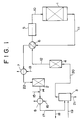
- FIG. 1 is a flow diagram schematically showing an apparatus suitable for carrying out the process of the present invention.
- Any known crystalline aluminogallosilicate silicate catalysts may be used for the purpose of the present invention.
- catalysts composed of a binder and a crystalline aluminogallosilicate and used for the catalytic aromatization of aliphatic hydrocarbons are catalysts composed of a binder and a crystalline aluminogallosilicate and used for the catalytic aromatization of aliphatic hydrocarbons.
- the crystalline aluminogallosilicate has a skeleton comprised of SiO 4 , AlO 4 and GaO 4 tetrahedra and may be produced by the gel crystallization and method using hydrothermal synthesis or by the method of inserting gallium into the lattice skeleton of an aluminosilicate or inserting aluminum into the lattice skeleton of a gallosilicate.
- the preferred crystalline aluminogallosilicate has a skeletal structure having an aluminum content of 0.1 to 2.5% by weight, a gallium content of 0.1 to 5% by weight, an SiO 2 /(Al 2 O 3 + Ga 2 O 3 ) molar ratio of 18-640, preferably 28-110, an SiO 2 /Al 2 O 3 molar ratio of 32-890, preferably 45-140 and an SiO 2 /Ga 2 O 3 molar ratio of 41-2,300, preferably 80-500.
- the aluminogallosilicate preferably has a composition represented by the following formula in terms of molar ratios of the oxides when calcined at 500 °C or higher: aM x O bAl 2 O 3 Ga 2 O 3 cSiO 2 wherein M represents a metal selected from the group consisting of alkali metals, alkaline earth metals and mixtures thereof, x is 2 when M is an alkali metal and 1 when M is an alkaline earth metal, a is a positive number of (b+1) ⁇ 3, preferably (b+1) ⁇ 2, b is a number of 0.04-72.0, preferably 0.5-6.0 and c is a number of 41-2,300, preferably 80-500 and wherein at least a portion of the metal M may optionally replaced by proton.
- M represents a metal selected from the group consisting of alkali metals, alkaline earth metals and mixtures thereof
- x is 2 when M is an alkali metal and 1 when M is an alka
- MFI type and MEL type silicates belong to the structural type of the known zeolites of the kind published in "The Structure Commission of the International Zeolite Association” (Atlas of Zeolite Structure Types, W. M. Meiyer and D. H. Olson (1978), Distribute by Polycrystal Book Service, Pittsburgh, PA, USA).
- the particle size of the crystalline aluminogallosilicate to be used in the present invention is 0.05-20 ⁇ m and that at least 80 % by weight of the crystalline aluminogallosilicate should have a particle size of 0.1-10 ⁇ m, in order for the catalyst to exhibit a desired activity retentivity and other catalytic activities. More preferably at least 80 % by weight of the crystalline aluminogallosilicate has a particle size of 0.5-5 ⁇ m, most preferably 1-3 ⁇ m.
- the crystalline aluminogallosilicate preferably is in the form of aggregated particles (secondary particles) composed of primary particles having a particle size of 0.02-2 ⁇ m.
- the above crystalline aluminogallosilicate is generally used in the form of a mixture with a binder.
- the binder serves to improve mechanical properties such as strength, wear resistance and moldability.
- suitable binders are alumina, silica, aluminaboria, silicaalumina and the like inorganic oxides.
- the content of the binder in the catalyst is preferably 10-70 % by weight. Addition of phosphorus to these inorganic binders can further improve mechanical strengths of the molded catalysts.
- a mixture of the silicate and the binder is formulated as a cylindrical shape, a granule, a sphere, a sheet, a pellet or the like shape by means of extrusion molding, spray drying, tableting press, tumbling or an oil drop method.
- an organic lubricant may be advantageously used.
- the aluminogallosilicate catalyst may be subjected to activation treatments commonly adopted for conventional zeolite catalysts, as desired.
- the catalyst may be converted into an ammonium form by ion exchange in an aqueous solution containing an ammonium salt such as ammonium chloride, ammonium nitrate, ammonium fluoride or ammonium hydroxide.
- the ammonium-form catalyst may further subjected to ion exchange treatment or impregnation treatment in an aqueous solution containing ions of a desired metal other than alkali metals and alkaline earth metals for the introduction of the desired metals into the catalyst.
- the aluminogallosilicate catalyst in the ammonium form may also be converted into a acid form by calcination in the atmosphere of air, nitrogen or hydrogen at 200-800 °C, preferably 350-700 °C for 3-24 hours.
- the acid catalyst may be further treated with hydrogen or a mixture of nitrogen and hydrogen under the above conditions.
- the above crystalline aluminogallosilicate catalysts are packed in a suitable catalytic conversion zone or reactor for the aromatization of olefins and/or paraffins with 2-7 carbon atoms, the conversion of methanol or dimethyl ether into lower olefins, the disproportionation of toluene or the like conversion reactions.
- the catalysts are gradually inactivated due to the deposition of coke on the surfaces thereof.
- an oxygen-containing gas having a moisture content of 0.2 % by volume or less is contacted with the crystalline aluminogallosilicate catalyst at a temperature of 400-600 °C, preferably 420-580 °C to burn the coke deposited on the spent catalyst.
- the oxygen content of the oxygen-containing gas is preferably 0.05-10 % by volume, more preferably 0.1-8 % by volume and may be air diluted with nitrogen or carbon dioxide to provide a predetermined oxygen concentration.
- the oxygen-containing gas may be a mixed gas obtained by blending nitrogen, carbon dioxide and oxygen.
- the contact of the spent catalyst with the oxygen-containing gas may be carried out after displacing the spent catalyst contained in the catalytic conversion zone to a regeneration zone such as a combusition tower.
- the regeneration may be performed on the spent catalyst in the catalytic conversion zone.
- the coke on the spent catalyst is burnt and removed therefrom.
- the content of moisture in the oxygen-containing gas is preferably 300 ppm by volume (0.03 % by volume) or less, more preferably 50 ppm by volume (0.005 % by volume) or less.
- the regeneration is generally continued until the oxygen consumption is no longer detected and/or until the temperature of the zone in which the regeneration is performed is no longer increased.
- the catalyst By maintaining the content of moisture in the oxygen-containing gas in an extremely low level, the catalyst can be effectively regenerated without causing inactivation thereof.
- Inactivation of the catalyst during regeneration treatments in the conventional method is considered to be attributed to the presence of moisture; i.e. moisture is considered to interact with active sites of the catalyst to cause the inactivation thereof.
- the regeneration of the crystalline aluminogallosilicate catalyst having deposited coke thereon is performed by a process including the steps of:
- step (a) As the moisture adsorbent used in step (a), there may be mentioned a crystalline aluminosilicate (synthetic zeolite such as A-type zeolite), naturally occurring zeolite, diatomaceous earth, sepiolite, activated alumina, silica gel and silica alumina. Commercially available A-type zeolite (molecular sieves) may be suitably used.
- Step (a) is generally performed at a temperature of 15-50 °C, preferably 20-40 °C and a pressure of ambient pressure to 10 kg/cm 2 G.
- Step (b) is generally performed at a temperature of 400-600 °C, preferably 420-580 °C, and a pressure of ambient pressure to 10 kg/cm 2 G and with a gas hourly space velocity (GHSV) on weight basis of 300-4,000/hour, preferably 500-3,000/hour.
- GHSV gas hourly space velocity
- step (c) at least a portion of the waste combustion gas obtained in step (b) is recycled to step (a) as at least part of the oxygen-containing gas.
- the gas to be recycled is first cooled to a temperature at which step (a) is performed and is mixed, if necessary, with a make-up oxygen gas and then fed to step (a).
- the combustion gas contains sulfur oxides such as SO 2 and SO 3 (which may be derived from sulfur accumulated on the catalyst during catalytic conversion stage)
- a sulfur oxide adsorbent As the adsorbent there may be mentioned a silicate (synthetic zeolite), naturally occurring zeolite, diatomaceous earth, sepiolite, alumina, silica, silica alumina and activated carbon.
- the contact with the sulfur oxide adsorbent is generally performed at a temperature of 100-200 °C, preferably 120-170 °C and a pressure of ambient pressure to 10 kg/cm 2 G.
- the SO 2 adsorbed by the adsorbent is converted to SO 3 upon contact with oxygen.
- the SO 3 on the adsorbent is converted into H 2 SO 4 upon contact with moisture which is formed in step (b) by reaction of hydrogen contained in the catalyst with oxygen.
- the sulfuric acid thus formed is accumulated in the adsorbent.
- a catalyst regeneration zone containing a spent, crystalline aluminogallosilicate catalyst to be regenerated, as 2 a sulfur oxide adsorbing zone containing a sulfur oxide adsorbent, as 3 a gas-liquid separator, as 4 a moisture adsorbing zone containing a moisture adsorbent, as 5 a heater, as 6 a heat exchanger, and as 7 and 8 coolers.
- a first, oxygen-containing gas is introduced through a line 20 into the moisture adsorbing zone where it is brought into contact with the moisture adsorbent to remove moisture contained in the first gas and to obtain a second, oxygen containing gas having a moisture content of 0.2 % by volume or less.
- the second gas is successively heated in the heat exchanger 6 and in the heater 5 and is introduced through a line 10 into the regeneration zone 1.
- the second gas is contacted with the spent catalyst at a temperature of 400-600 °C so that the coke deposited on the catalyst is burnt and is converted into CO and CO 2 .
- the hydrogen and sulfur if present on the catalyst are also converted into H 2 O and sulfur oxides, respectively.
- the combustion gas containing CO, CO 2 , H 2 O and sulfur oxides is discharged from the regeneration zone and is fed through a line 11 to the heat exchanger 6 where it is heat exchanged with the above-mentioned second, oxygen-containing gas supplied through the line 12.
- the exhaust gas is further cooled in the cooler 7 by indirect heat exhcange with a cooling water supplied through a line 13 and is then introduced through a line 22 into the sulfur oxide adsorbing zone 2 where the waste gas is contacted with the sulfur oxide adsorbent to fix the sulfur oxides as sulfuric acid.
- the waste gas from which sulfur oxides have been removed is passed through a line 14 to a cooler 8 and is cooled there with a cooling medium supplied through a line 16.
- the cooled waste gas is then fed through a line 17 to the gas-liquid separator 3.
- Condensed water is discharged from the separator 3 through a line 21 while the gas is fed through the line 20 to the moisture adsorbing zone 4 as the aforesaid first, oxygen-containing gas.
- Designated as 18 is a line for discharging a portion of the recycling gas therethrough.
- Nitrogen gas and oxygen gas are supplied through lines 15 and 19, respectively to maintain the oxygen content of the first, oxygen-containing gas in a predetermined range.
- the catalyst in the regeneration zone 1 is thus regenerated as the process proceeds without causing inactivation of the catalyst.
- a catalyst composed of alumina (binder) and a crystalline aluminogallosilicate having a particle size in the range of 0.1-10 ⁇ m was prepared.
- the crystalline aluminogallosilicate contained a 80 % by weight portion having a particle size in the range of 1-4 ⁇ m and had a SiO 2 /Ga 2 O 3 molar ratio of 186.8, a SiO 2 /(Al 2 O 3 + Ga 2 O 3 ) molar ratio of 48.7 and a SiO 2 /Al 2 O 3 molar ratio of 65.9.
- the catalyst was converted into proton-form and used for the aromatization of light naphtha.
- the catalyst was packed in a reactor and the light naphtha was allowed to be passed through the packed catalyst at a temperature of 538 °C under an ambient pressure with LHSV of 2/hour for 24 hours.
- the product discharged from the reactor was analysed after 2 hours and 24 hours from the start of the reaction for the calculation of the aromatics yield R.
- Example 1 was repeated in the same manner as described except that the regeneration of the catalyst was performed without using the moisture adsorbing zone 4.
- the oxygen-containing gas supplied to the regeneration zone had a moisture content of 3.5 % by volume.
- Table 1 Reaction Time (hour) Aromatics Yield (%) Catalyst (Regeneration Number) standard 1 3 5
- a catalyst composed of alumina (binder) and a crystalline aluminogallosilicate having a particle size in the range of 0.1-2 ⁇ m was prepared.
- the crystalline aluminogallosilicate contained a 80 % by weight portion having a particle size in the range of 0.5-2 ⁇ m and had a SiO 2 /Ga 2 O 3 molar ratio of 158.9, a SiO 2 /(Al 2 O 3 + Ga 2 O 3 ) molar ratio of 46.1 and a SiO 2 /Al 2 O 3 molar ratio of 64.8.
- the catalyst was converted into proton-form and used for the aromatization of light naphtha.
- the catalyst was packed in a reactor and the light naphtha was allowed to be passed through the packed catalyst at a temperature of 550 °C under a pressure of 3 kg/cm 2 G with LHSV of 1 hour -1 for 48 hours while recycling a light hydrocarbon fraction.
- the product discharged from the reactor was analysed after 14 hours and 24 hours from the start of the reaction for the calculation of the aromatics yield R.
- the used catalyst was subjected to a regeneration treatment using the system illustrated in Fig. 1 under the following conditions: Oxygen-containing gas (line 10) Oxygen content: 0.05-5.0 % by volume Moisture content: less than 1 ppm by volume Regeneration zone (1) Regeneration time: 30 hours Temperature: 400-550 °C GHSV: 2,000 hour -1 Pressure: 4.5 kg/cm 2 G Combustion exhaust gas (line 11) Moisture content: maximum 0.2 % by volume.
- Example 2 was repeated in the same manner as described except that the regeneration of the catalyst was performed without using the moisture adsorbing zone 4.
- the oxygen-containing gas supplied to the regeneration zone had a moisture content of 2 % by volume when measured under ambient pressure.
- Table 2 Reaction Time (hour) Aromatics Yield (%) Catalyst (Regeneration Number) standard 1 2 9
- Example 2 14 57.5 57.5 57.2 56.9 24 56.6 56.6 57.0 55.9
Landscapes
- Chemical & Material Sciences (AREA)
- Engineering & Computer Science (AREA)
- Materials Engineering (AREA)
- Organic Chemistry (AREA)
- Chemical Kinetics & Catalysis (AREA)
- Catalysts (AREA)
- Production Of Liquid Hydrocarbon Mixture For Refining Petroleum (AREA)
- Organic Low-Molecular-Weight Compounds And Preparation Thereof (AREA)
Claims (10)
- Procédé pour la régénération d'un catalyseur qui comprend un aluminogallosilicate cristallin et sur lequel est déposé du coke, comprenant la mise en contact d'un gaz contenant de l'oxygène ayant une teneur en humidité de 0,2% en volume ou moins avec ledit catalyseur à une température de 400-600°C.
- Procédé selon la revendication 1, dans lequel ledit aluminogallosilicate cristallin a une teneur en aluminium de 0,1 à 2,5% en poids, une teneur en gallium de 0,1% à 5% en poids, un rapport molaire SiO2/(Al2O3 + Ga2O3) de 18-640, un rapport molaire SiO2/Al2O3 de 32-890 et un rapport molaire SiO2/Ga2O3 de 41-2300.
- Procédé selon la revendication 2, dans lequel ledit aluminogallosilicate cristallin a une composition représentée par la formule suivante exprimée en rapports molaires des oxydes lorsqu'il est calciné à 500°C ou plus:
aMxO bAl2O3 Ga2O3 cSiO2
dans laquelle M représente un métal choisi parmi le groupe constitué de métaux alcalins, de métaux alcalinoterreux et de mélanges de ceux-ci, x vaut 2 lorsque M est un métal alcalin et 1 lorsque M est un métal alcalino-terreux, a est un nombre positif valant (b+1)±3, b est un nombre valant 0,04-72,0 et c est un nombre valant 41-2300 et dans laquelle au moins une portion du métal M peut être éventuellement remplacée par un proton. - Procédé selon l'une quelconque des revendications précédentes, dans lequel ledit aluminogallosilicate cristallin a une granulométrie de 0,05-20 mm, au moins 80% en poids de celui-ci ayant une granulométrie de 0,1-10 mm.
- Procédé selon l'une quelconque des revendications précédentes, comprenant les étapes de:(a) mise en contact d'un premier gaz contenant de l'oxygène avec un adsorbant d'humidité pour obtenir un second gaz contenant de l'oxygène ayant une teneur en humidité de 0,2% en volume ou moins;(b) mise en contact dudit second gaz avec ledit catalyseur à une température de 400-600°C pour brûler ledit coke et pour obtenir un gaz de combustion résiduaire; et(c) recyclage d'au moins une partie dudit gaz de combustion résiduaire à l'étape (a) sous forme d'une partie au moins dudit premier gaz.
- Procédé selon la revendication 5, dans lequel ledit adsorbant d'humidité comprend de la zéolite de type A ou de l'alumine activée.
- Procédé selon la revendication 5 ou la revendication 6, dans lequel ledit premier gaz a une teneur en oxygène de 0,05-10% en volume.
- Procédé selon l'une quelconque de revendications 5-7, dans lequel ledit gaz de combustion résiduaire contient des oxydes de soufre et est mis en contact avec un adsorbant d'oxyde de soufre pour en éliminer lesdits oxydes de soufre avant le recyclage à l'étape (a).
- Procédé selon la revendication 8, dans lequel ledit adsorbant de dioxyde de soufre comprend du charbon activé.
- Procédé selon l'une quelconque des revendications précédentes, dans lequel ledit catalyseur est mis en contact avec ledit gaz contenant de l'oxygène ayant une teneur en humidité de 0,2% en volume ou moins à une température de 420°-580°C.
Priority Applications (5)
| Application Number | Priority Date | Filing Date | Title |
|---|---|---|---|
| JP3195998A JPH0515784A (ja) | 1991-07-10 | 1991-07-10 | 触媒の再生方法 |
| US07/993,848 US5306682A (en) | 1991-07-10 | 1992-12-21 | Process for the regeneration of coke-deposited, crystalline silicate catalyst |
| EP92311696A EP0604689B1 (fr) | 1991-07-10 | 1992-12-22 | Procédé de régénération d'un catalyseur à base d'un alumino- gallosilicate cristallin sur lequel est déposé du coke |
| DE1992617498 DE69217498T2 (de) | 1992-12-22 | 1992-12-22 | Verfahren zum Regenerieren eines mit Koks abgelagerten, kristallinen Aluminium-Gallium-Silicat-Katalysators |
| AU30377/92A AU656048B2 (en) | 1991-07-10 | 1992-12-23 | Process for the regeneration of coke-deposited, crystalline silicate catalyst |
Applications Claiming Priority (4)
| Application Number | Priority Date | Filing Date | Title |
|---|---|---|---|
| JP3195998A JPH0515784A (ja) | 1991-07-10 | 1991-07-10 | 触媒の再生方法 |
| US07/993,848 US5306682A (en) | 1991-07-10 | 1992-12-21 | Process for the regeneration of coke-deposited, crystalline silicate catalyst |
| EP92311696A EP0604689B1 (fr) | 1991-07-10 | 1992-12-22 | Procédé de régénération d'un catalyseur à base d'un alumino- gallosilicate cristallin sur lequel est déposé du coke |
| AU30377/92A AU656048B2 (en) | 1991-07-10 | 1992-12-23 | Process for the regeneration of coke-deposited, crystalline silicate catalyst |
Publications (2)
| Publication Number | Publication Date |
|---|---|
| EP0604689A1 EP0604689A1 (fr) | 1994-07-06 |
| EP0604689B1 true EP0604689B1 (fr) | 1997-02-12 |
Family
ID=27422907
Family Applications (1)
| Application Number | Title | Priority Date | Filing Date |
|---|---|---|---|
| EP92311696A Expired - Lifetime EP0604689B1 (fr) | 1991-07-10 | 1992-12-22 | Procédé de régénération d'un catalyseur à base d'un alumino- gallosilicate cristallin sur lequel est déposé du coke |
Country Status (4)
| Country | Link |
|---|---|
| US (1) | US5306682A (fr) |
| EP (1) | EP0604689B1 (fr) |
| JP (1) | JPH0515784A (fr) |
| AU (1) | AU656048B2 (fr) |
Families Citing this family (12)
| Publication number | Priority date | Publication date | Assignee | Title |
|---|---|---|---|---|
| US20020120169A1 (en) * | 1995-01-13 | 2002-08-29 | Michel Spagnol | Process facilitating the regeneration of a catalyst based on a zeolite used in an acylation reaction, catalyst and use |
| US5741749A (en) * | 1996-02-13 | 1998-04-21 | Arco Chemical Technology, L.P. | Regeneration of a titanium-containing molecular sieve |
| BE1010716A3 (fr) * | 1996-10-25 | 1998-12-01 | Solvay | Procede de regeneration de catalyseurs de type silicalite au titane. |
| RU2113902C1 (ru) * | 1997-03-18 | 1998-06-27 | Закрытое акционерное общество "Отделение морских систем ОКБ им.П.О.Сухого" | Способ и устройство для регенерации закоксованного катализатора |
| DE19723949A1 (de) | 1997-06-06 | 1998-12-10 | Basf Ag | Verfahren zur Regenerierung eines Zeolith-Katalysators |
| FR2781393B1 (fr) | 1998-07-22 | 2000-08-25 | Rhone Poulenc Fibres | Procede de regeneration d'un catalyseur d'hydrolyse cyclisante d'un aminonitrile en lactame et utilisation du catalyseur regenere pour la fabrication de lactames |
| RU2159676C1 (ru) * | 1999-06-07 | 2000-11-27 | Общество с ограниченной ответственностью "Севергазпром" ОАО "Газпром" | Способ регенерации катализаторов дегидроциклодимеризации алифатических углеводородов |
| FR2839307B1 (fr) * | 2002-05-03 | 2004-07-09 | Solvay | Procede de desulfuration d'un melange d'hydrocarbures |
| DE102004008573A1 (de) * | 2004-02-19 | 2005-09-08 | Stockhausen Gmbh | Ein Verfahren zur Entfernung kohlenstoffhaltiger Rückstände in einem Reaktor |
| US7479468B2 (en) * | 2004-04-15 | 2009-01-20 | Exxonmobil Chemical Patents Inc. | Integrating an air separation unit into an oxygenate-to-olefins reaction system |
| WO2011136765A1 (fr) | 2010-04-28 | 2011-11-03 | Exxonmobil Chemical Patents Inc. | Régénération de catalyseurs d'oligomérisation, et leur utilisation |
| JP7271975B2 (ja) * | 2018-02-09 | 2023-05-12 | 東ソー株式会社 | 芳香族化合物製造触媒の再生方法 |
Citations (1)
| Publication number | Priority date | Publication date | Assignee | Title |
|---|---|---|---|---|
| US5155075A (en) * | 1991-03-01 | 1992-10-13 | Chevron Research And Technology Company | Low temperature regeneration of coke deactivated reforming catalysts |
Family Cites Families (10)
| Publication number | Priority date | Publication date | Assignee | Title |
|---|---|---|---|---|
| US4259176A (en) * | 1979-09-13 | 1981-03-31 | Chevron Research Company | Restricting silica content of catalyst inventory to prevent alumina poisoning for SOx control |
| US4280898A (en) * | 1979-11-05 | 1981-07-28 | Standard Oil Company (Indiana) | Fluid catalytic cracking of heavy petroleum fractions |
| US4344768A (en) * | 1981-03-27 | 1982-08-17 | Baker Instruments Corp. | Automatic pipettor |
| US4542114A (en) * | 1982-08-03 | 1985-09-17 | Air Products And Chemicals, Inc. | Process for the recovery and recycle of effluent gas from the regeneration of particulate matter with oxygen and carbon dioxide |
| US4724271A (en) * | 1985-12-09 | 1988-02-09 | Uop Inc. | Regeneration of dehydrocyclodimerization catalyst |
| FR2611739B1 (fr) * | 1987-03-06 | 1989-07-07 | Inst Francais Du Petrole | Procede d'activation d'un catalyseur d'isomerisation de paraffines normales |
| US5202513A (en) * | 1987-07-15 | 1993-04-13 | Research Association For Utilization Of Light Oil | Process for producing aromatic hydrocarbons |
| US4973778A (en) * | 1987-12-29 | 1990-11-27 | Mobil Oil Corp. | Continuous swing tubular reactor-regenerator |
| US5001095A (en) * | 1989-11-16 | 1991-03-19 | Uop | Method and apparatus for controlling moisture by flue gas segregation |
| US5043057A (en) * | 1990-06-25 | 1991-08-27 | Exxon Research And Engineering Company | Removal of sulfur from recycle gas streams in catalytic reforming |
-
1991
- 1991-07-10 JP JP3195998A patent/JPH0515784A/ja active Pending
-
1992
- 1992-12-21 US US07/993,848 patent/US5306682A/en not_active Expired - Fee Related
- 1992-12-22 EP EP92311696A patent/EP0604689B1/fr not_active Expired - Lifetime
- 1992-12-23 AU AU30377/92A patent/AU656048B2/en not_active Ceased
Patent Citations (1)
| Publication number | Priority date | Publication date | Assignee | Title |
|---|---|---|---|---|
| US5155075A (en) * | 1991-03-01 | 1992-10-13 | Chevron Research And Technology Company | Low temperature regeneration of coke deactivated reforming catalysts |
Also Published As
| Publication number | Publication date |
|---|---|
| EP0604689A1 (fr) | 1994-07-06 |
| JPH0515784A (ja) | 1993-01-26 |
| AU656048B2 (en) | 1995-01-19 |
| AU3037792A (en) | 1994-07-07 |
| US5306682A (en) | 1994-04-26 |
Similar Documents
| Publication | Publication Date | Title |
|---|---|---|
| US7419930B2 (en) | Catalytic composition for the aromatization of hydrocarbons | |
| CA1174219A (fr) | Obtention d'un nouvel aluminosilicate cristallin pour la conversion catalytique de methanol et/ou dimethylether en hydrocarbures | |
| CA1108084A (fr) | Traitement du gas-oil | |
| US4357265A (en) | Catalytic cracking catalyst | |
| EP0604689B1 (fr) | Procédé de régénération d'un catalyseur à base d'un alumino- gallosilicate cristallin sur lequel est déposé du coke | |
| US4247416A (en) | Crystalline zeolite ZSM-25 | |
| JPS6092221A (ja) | メタノールのオレフインへの変換方法 | |
| EP0557527B1 (fr) | Procede de production d'essence de base a haut indice d'octane | |
| US3276993A (en) | Compositions and methods for the conversion of hydrocarbons employing a crystalline alumina-silicate catalyst composite | |
| US4415439A (en) | Catalytic cracking catalyst | |
| US5085762A (en) | Catalytic cracking of hydrocarbons | |
| EP0493040A2 (fr) | Procédé de production d'hydrocarbures aromatiques à partir d'hydrocarbures aliphatiques | |
| EP0804959B1 (fr) | Catalyseur antipollution et son procede d'utilisation | |
| CN100473461C (zh) | 一种碳四液化石油气芳构化的催化剂及其制备方法 | |
| US4437978A (en) | Cracking catalyst compositions for reduction of sulfur content in coke | |
| EP0652040B1 (fr) | Procédé et catalyseur pour la réduction de NOx dans des gaz de combustion | |
| JPS61246135A (ja) | パラフイン系炭化水素の芳香族炭化水素への転化方法 | |
| US4187199A (en) | Hydrocarbon conversion catalyst | |
| US4165275A (en) | Lowering sulfur oxide output from catalyst regeneration | |
| US4354924A (en) | Dual component chromia silicate cracking catalyst | |
| US3390101A (en) | Catalyst activation process | |
| EP0010362B1 (fr) | Catalyseur de craquage et son emploi avec des charges contenant du soufre | |
| JP2759099B2 (ja) | 炭化水素油の流動接触分解用触媒組成物ならびにそれを用いる流動接解分解法 | |
| CA1202295A (fr) | Methode de production d'un zeolite a teneur de multiples elements metalliques occlus, et produit ainsi obtenu | |
| JPH0543484A (ja) | 芳香族炭化水素の製造方法 |
Legal Events
| Date | Code | Title | Description |
|---|---|---|---|
| PUAI | Public reference made under article 153(3) epc to a published international application that has entered the european phase |
Free format text: ORIGINAL CODE: 0009012 |
|
| 17P | Request for examination filed |
Effective date: 19931029 |
|
| AK | Designated contracting states |
Kind code of ref document: A1 Designated state(s): DE FR GB NL |
|
| RAP1 | Party data changed (applicant data changed or rights of an application transferred) |
Owner name: MITSUBISHI OIL CO., LTD. Owner name: CHIYODA CORPORATION |
|
| 17Q | First examination report despatched |
Effective date: 19950705 |
|
| GRAG | Despatch of communication of intention to grant |
Free format text: ORIGINAL CODE: EPIDOS AGRA |
|
| GRAH | Despatch of communication of intention to grant a patent |
Free format text: ORIGINAL CODE: EPIDOS IGRA |
|
| GRAH | Despatch of communication of intention to grant a patent |
Free format text: ORIGINAL CODE: EPIDOS IGRA |
|
| GRAA | (expected) grant |
Free format text: ORIGINAL CODE: 0009210 |
|
| AK | Designated contracting states |
Kind code of ref document: B1 Designated state(s): DE FR GB NL |
|
| REF | Corresponds to: |
Ref document number: 69217498 Country of ref document: DE Date of ref document: 19970327 |
|
| ET | Fr: translation filed | ||
| PLBE | No opposition filed within time limit |
Free format text: ORIGINAL CODE: 0009261 |
|
| STAA | Information on the status of an ep patent application or granted ep patent |
Free format text: STATUS: NO OPPOSITION FILED WITHIN TIME LIMIT |
|
| 26N | No opposition filed | ||
| REG | Reference to a national code |
Ref country code: FR Ref legal event code: TP |
|
| REG | Reference to a national code |
Ref country code: GB Ref legal event code: 732E |
|
| PGFP | Annual fee paid to national office [announced via postgrant information from national office to epo] |
Ref country code: FR Payment date: 20001212 Year of fee payment: 9 |
|
| PGFP | Annual fee paid to national office [announced via postgrant information from national office to epo] |
Ref country code: DE Payment date: 20001218 Year of fee payment: 9 |
|
| PGFP | Annual fee paid to national office [announced via postgrant information from national office to epo] |
Ref country code: GB Payment date: 20001220 Year of fee payment: 9 |
|
| PGFP | Annual fee paid to national office [announced via postgrant information from national office to epo] |
Ref country code: NL Payment date: 20001231 Year of fee payment: 9 |
|
| PG25 | Lapsed in a contracting state [announced via postgrant information from national office to epo] |
Ref country code: GB Free format text: LAPSE BECAUSE OF NON-PAYMENT OF DUE FEES Effective date: 20011222 |
|
| REG | Reference to a national code |
Ref country code: GB Ref legal event code: IF02 |
|
| PG25 | Lapsed in a contracting state [announced via postgrant information from national office to epo] |
Ref country code: NL Free format text: LAPSE BECAUSE OF NON-PAYMENT OF DUE FEES Effective date: 20020701 |
|
| PG25 | Lapsed in a contracting state [announced via postgrant information from national office to epo] |
Ref country code: DE Free format text: LAPSE BECAUSE OF NON-PAYMENT OF DUE FEES Effective date: 20020702 |
|
| GBPC | Gb: european patent ceased through non-payment of renewal fee |
Effective date: 20011222 |
|
| PG25 | Lapsed in a contracting state [announced via postgrant information from national office to epo] |
Ref country code: FR Free format text: LAPSE BECAUSE OF NON-PAYMENT OF DUE FEES Effective date: 20020830 |
|
| NLV4 | Nl: lapsed or anulled due to non-payment of the annual fee |
Effective date: 20020701 |
|
| REG | Reference to a national code |
Ref country code: FR Ref legal event code: ST |