EP0604934A1 - Kontinuierliche Herstellung gelierter Schmelzen mikroausgefällter Dispersionen - Google Patents
Kontinuierliche Herstellung gelierter Schmelzen mikroausgefällter Dispersionen Download PDFInfo
- Publication number
- EP0604934A1 EP0604934A1 EP93120907A EP93120907A EP0604934A1 EP 0604934 A1 EP0604934 A1 EP 0604934A1 EP 93120907 A EP93120907 A EP 93120907A EP 93120907 A EP93120907 A EP 93120907A EP 0604934 A1 EP0604934 A1 EP 0604934A1
- Authority
- EP
- European Patent Office
- Prior art keywords
- particle
- dispersion
- photographic
- microprecipitated
- small
- Prior art date
- Legal status (The legal status is an assumption and is not a legal conclusion. Google has not performed a legal analysis and makes no representation as to the accuracy of the status listed.)
- Granted
Links
- 239000006185 dispersion Substances 0.000 title claims abstract description 121
- 239000000155 melt Substances 0.000 title claims abstract description 45
- 238000004519 manufacturing process Methods 0.000 title claims abstract description 31
- 239000002245 particle Substances 0.000 claims abstract description 66
- 238000002360 preparation method Methods 0.000 claims abstract description 21
- 108010010803 Gelatin Proteins 0.000 claims description 60
- 239000008273 gelatin Substances 0.000 claims description 60
- 229920000159 gelatin Polymers 0.000 claims description 60
- 235000019322 gelatine Nutrition 0.000 claims description 60
- 235000011852 gelatine desserts Nutrition 0.000 claims description 60
- 238000000034 method Methods 0.000 claims description 37
- 239000003795 chemical substances by application Substances 0.000 claims description 21
- 238000000576 coating method Methods 0.000 claims description 21
- 239000000463 material Substances 0.000 claims description 19
- 238000002156 mixing Methods 0.000 claims description 17
- XLYOFNOQVPJJNP-UHFFFAOYSA-N water Substances O XLYOFNOQVPJJNP-UHFFFAOYSA-N 0.000 claims description 17
- 239000002904 solvent Substances 0.000 claims description 15
- 230000008569 process Effects 0.000 claims description 14
- 239000004094 surface-active agent Substances 0.000 claims description 12
- 229920000642 polymer Polymers 0.000 claims description 11
- 239000000975 dye Substances 0.000 claims description 10
- 239000011248 coating agent Substances 0.000 claims description 8
- 239000004816 latex Substances 0.000 claims description 7
- 229920000126 latex Polymers 0.000 claims description 7
- 238000009835 boiling Methods 0.000 claims description 6
- 239000000203 mixture Substances 0.000 claims description 4
- 230000003287 optical effect Effects 0.000 claims description 2
- 230000005855 radiation Effects 0.000 claims description 2
- 239000006096 absorbing agent Substances 0.000 claims 1
- 239000011358 absorbing material Substances 0.000 claims 1
- 239000003638 chemical reducing agent Substances 0.000 claims 1
- 230000009034 developmental inhibition Effects 0.000 claims 1
- 230000000694 effects Effects 0.000 abstract description 11
- 238000011437 continuous method Methods 0.000 abstract description 3
- 230000003252 repetitive effect Effects 0.000 abstract 1
- 239000000243 solution Substances 0.000 description 24
- 230000009257 reactivity Effects 0.000 description 10
- 238000002474 experimental method Methods 0.000 description 9
- 239000000047 product Substances 0.000 description 8
- 239000002002 slurry Substances 0.000 description 7
- 238000001556 precipitation Methods 0.000 description 6
- 238000004128 high performance liquid chromatography Methods 0.000 description 5
- 239000007788 liquid Substances 0.000 description 5
- 150000001875 compounds Chemical class 0.000 description 4
- 238000013461 design Methods 0.000 description 4
- 238000009826 distribution Methods 0.000 description 4
- 238000005189 flocculation Methods 0.000 description 4
- 230000016615 flocculation Effects 0.000 description 4
- 238000005259 measurement Methods 0.000 description 4
- 238000012545 processing Methods 0.000 description 4
- LSNNMFCWUKXFEE-UHFFFAOYSA-N Sulfurous acid Chemical compound OS(O)=O LSNNMFCWUKXFEE-UHFFFAOYSA-N 0.000 description 3
- 238000004458 analytical method Methods 0.000 description 3
- 230000008901 benefit Effects 0.000 description 3
- 238000005859 coupling reaction Methods 0.000 description 3
- 238000011161 development Methods 0.000 description 3
- 238000002296 dynamic light scattering Methods 0.000 description 3
- 239000000499 gel Substances 0.000 description 3
- 239000010410 layer Substances 0.000 description 3
- 230000007935 neutral effect Effects 0.000 description 3
- 239000007800 oxidant agent Substances 0.000 description 3
- 230000001590 oxidative effect Effects 0.000 description 3
- 230000009467 reduction Effects 0.000 description 3
- BVKZGUZCCUSVTD-UHFFFAOYSA-L Carbonate Chemical compound [O-]C([O-])=O BVKZGUZCCUSVTD-UHFFFAOYSA-L 0.000 description 2
- 235000008733 Citrus aurantifolia Nutrition 0.000 description 2
- RVGRUAULSDPKGF-UHFFFAOYSA-N Poloxamer Chemical compound C1CO1.CC1CO1 RVGRUAULSDPKGF-UHFFFAOYSA-N 0.000 description 2
- 235000011941 Tilia x europaea Nutrition 0.000 description 2
- 230000002378 acidificating effect Effects 0.000 description 2
- 150000001732 carboxylic acid derivatives Chemical class 0.000 description 2
- 150000001735 carboxylic acids Chemical class 0.000 description 2
- 238000006243 chemical reaction Methods 0.000 description 2
- 238000010438 heat treatment Methods 0.000 description 2
- 238000010348 incorporation Methods 0.000 description 2
- 238000011534 incubation Methods 0.000 description 2
- 230000003993 interaction Effects 0.000 description 2
- 239000004571 lime Substances 0.000 description 2
- 238000003801 milling Methods 0.000 description 2
- 238000005086 pumping Methods 0.000 description 2
- 238000000926 separation method Methods 0.000 description 2
- 238000001179 sorption measurement Methods 0.000 description 2
- 239000003381 stabilizer Substances 0.000 description 2
- 238000003756 stirring Methods 0.000 description 2
- 238000006277 sulfonation reaction Methods 0.000 description 2
- 108010032039 (rat secretin-27)-Gly-rhodamine Proteins 0.000 description 1
- RIRCXOPPHPEPHL-UHFFFAOYSA-N C[O]([O]=O)[O](C(F)(F)F)=O Chemical compound C[O]([O]=O)[O](C(F)(F)F)=O RIRCXOPPHPEPHL-UHFFFAOYSA-N 0.000 description 1
- 101100172886 Caenorhabditis elegans sec-6 gene Proteins 0.000 description 1
- XZMCDFZZKTWFGF-UHFFFAOYSA-N Cyanamide Chemical compound NC#N XZMCDFZZKTWFGF-UHFFFAOYSA-N 0.000 description 1
- 229920004890 Triton X-100 Polymers 0.000 description 1
- 239000013504 Triton X-100 Substances 0.000 description 1
- 239000003929 acidic solution Substances 0.000 description 1
- 239000012190 activator Substances 0.000 description 1
- 239000000443 aerosol Substances 0.000 description 1
- 238000013019 agitation Methods 0.000 description 1
- 239000003637 basic solution Substances 0.000 description 1
- 230000008033 biological extinction Effects 0.000 description 1
- 239000006227 byproduct Substances 0.000 description 1
- 230000008859 change Effects 0.000 description 1
- 239000003153 chemical reaction reagent Substances 0.000 description 1
- 230000001112 coagulating effect Effects 0.000 description 1
- 239000011247 coating layer Substances 0.000 description 1
- 239000008367 deionised water Substances 0.000 description 1
- 229910021641 deionized water Inorganic materials 0.000 description 1
- 230000001419 dependent effect Effects 0.000 description 1
- 238000010586 diagram Methods 0.000 description 1
- 238000001035 drying Methods 0.000 description 1
- 239000000839 emulsion Substances 0.000 description 1
- 238000011156 evaluation Methods 0.000 description 1
- 238000005562 fading Methods 0.000 description 1
- 230000003311 flocculating effect Effects 0.000 description 1
- 238000009472 formulation Methods 0.000 description 1
- 230000002209 hydrophobic effect Effects 0.000 description 1
- 238000012933 kinetic analysis Methods 0.000 description 1
- 230000007246 mechanism Effects 0.000 description 1
- -1 potassium ferricyanide Chemical compound 0.000 description 1
- BHZRJJOHZFYXTO-UHFFFAOYSA-L potassium sulfite Chemical compound [K+].[K+].[O-]S([O-])=O BHZRJJOHZFYXTO-UHFFFAOYSA-L 0.000 description 1
- 235000019252 potassium sulphite Nutrition 0.000 description 1
- 238000000746 purification Methods 0.000 description 1
- 239000002516 radical scavenger Substances 0.000 description 1
- 239000011541 reaction mixture Substances 0.000 description 1
- 238000002398 sedimentation field-flow fractionation Methods 0.000 description 1
- 230000035945 sensitivity Effects 0.000 description 1
- 239000002356 single layer Substances 0.000 description 1
- ZNVGYHOBTCWGTO-UHFFFAOYSA-N solutin Natural products Cc1cc(O)cc2OC(C)(O)C(=O)c12 ZNVGYHOBTCWGTO-UHFFFAOYSA-N 0.000 description 1
- 230000006641 stabilisation Effects 0.000 description 1
- 238000011105 stabilization Methods 0.000 description 1
- 238000012360 testing method Methods 0.000 description 1
- 239000012498 ultrapure water Substances 0.000 description 1
Images




Classifications
-
- G—PHYSICS
- G03—PHOTOGRAPHY; CINEMATOGRAPHY; ANALOGOUS TECHNIQUES USING WAVES OTHER THAN OPTICAL WAVES; ELECTROGRAPHY; HOLOGRAPHY
- G03C—PHOTOSENSITIVE MATERIALS FOR PHOTOGRAPHIC PURPOSES; PHOTOGRAPHIC PROCESSES, e.g. CINE, X-RAY, COLOUR, STEREO-PHOTOGRAPHIC PROCESSES; AUXILIARY PROCESSES IN PHOTOGRAPHY
- G03C1/00—Photosensitive materials
- G03C1/005—Silver halide emulsions; Preparation thereof; Physical treatment thereof; Incorporation of additives therein
-
- G—PHYSICS
- G03—PHOTOGRAPHY; CINEMATOGRAPHY; ANALOGOUS TECHNIQUES USING WAVES OTHER THAN OPTICAL WAVES; ELECTROGRAPHY; HOLOGRAPHY
- G03C—PHOTOSENSITIVE MATERIALS FOR PHOTOGRAPHIC PURPOSES; PHOTOGRAPHIC PROCESSES, e.g. CINE, X-RAY, COLOUR, STEREO-PHOTOGRAPHIC PROCESSES; AUXILIARY PROCESSES IN PHOTOGRAPHY
- G03C7/00—Multicolour photographic processes or agents therefor; Regeneration of such processing agents; Photosensitive materials for multicolour processes
- G03C7/30—Colour processes using colour-coupling substances; Materials therefor; Preparing or processing such materials
- G03C7/388—Processes for the incorporation in the emulsion of substances liberating photographically active agents or colour-coupling substances; Solvents therefor
-
- G—PHYSICS
- G03—PHOTOGRAPHY; CINEMATOGRAPHY; ANALOGOUS TECHNIQUES USING WAVES OTHER THAN OPTICAL WAVES; ELECTROGRAPHY; HOLOGRAPHY
- G03C—PHOTOSENSITIVE MATERIALS FOR PHOTOGRAPHIC PURPOSES; PHOTOGRAPHIC PROCESSES, e.g. CINE, X-RAY, COLOUR, STEREO-PHOTOGRAPHIC PROCESSES; AUXILIARY PROCESSES IN PHOTOGRAPHY
- G03C1/00—Photosensitive materials
- G03C1/74—Applying photosensitive compositions to the base; Drying processes therefor
- G03C2001/7481—Coating simultaneously multiple layers
-
- G—PHYSICS
- G03—PHOTOGRAPHY; CINEMATOGRAPHY; ANALOGOUS TECHNIQUES USING WAVES OTHER THAN OPTICAL WAVES; ELECTROGRAPHY; HOLOGRAPHY
- G03C—PHOTOSENSITIVE MATERIALS FOR PHOTOGRAPHIC PURPOSES; PHOTOGRAPHIC PROCESSES, e.g. CINE, X-RAY, COLOUR, STEREO-PHOTOGRAPHIC PROCESSES; AUXILIARY PROCESSES IN PHOTOGRAPHY
- G03C2200/00—Details
- G03C2200/11—Blue-sensitive layer
-
- G—PHYSICS
- G03—PHOTOGRAPHY; CINEMATOGRAPHY; ANALOGOUS TECHNIQUES USING WAVES OTHER THAN OPTICAL WAVES; ELECTROGRAPHY; HOLOGRAPHY
- G03C—PHOTOSENSITIVE MATERIALS FOR PHOTOGRAPHIC PURPOSES; PHOTOGRAPHIC PROCESSES, e.g. CINE, X-RAY, COLOUR, STEREO-PHOTOGRAPHIC PROCESSES; AUXILIARY PROCESSES IN PHOTOGRAPHY
- G03C2200/00—Details
- G03C2200/20—Colour paper
-
- Y—GENERAL TAGGING OF NEW TECHNOLOGICAL DEVELOPMENTS; GENERAL TAGGING OF CROSS-SECTIONAL TECHNOLOGIES SPANNING OVER SEVERAL SECTIONS OF THE IPC; TECHNICAL SUBJECTS COVERED BY FORMER USPC CROSS-REFERENCE ART COLLECTIONS [XRACs] AND DIGESTS
- Y10—TECHNICAL SUBJECTS COVERED BY FORMER USPC
- Y10S—TECHNICAL SUBJECTS COVERED BY FORMER USPC CROSS-REFERENCE ART COLLECTIONS [XRACs] AND DIGESTS
- Y10S430/00—Radiation imagery chemistry: process, composition, or product thereof
- Y10S430/136—Coating process making radiation sensitive element
Definitions
- the invention deals with the continuous manufacturing of gelled premelts for small-particle microprecipitated dispersions to obtain gelled premelts that are invariant in viscosity, coupler content, and turbidity with time, to provide a roboust and variability free product.
- microprecipitated dispersions R-1 to R-3 and R-5 to R-7.
- MPS microprecipitated slurries
- the microprecipitated dispersions have relatively narrow particle size distribution compared to conventional milled dispersion prepared by milling in the presence of gelatin as described by Ono et al (R-8).
- PCP dispersions can be precipitated by similar pH-shift mechanism in the presence of a base-ionizing group combining polymer latex where, after precipitation, the photographic agent gets loaded inside the polymer latex particles (R-4).
- the particle size is of the order of the polymer particles which can be anywhere between 50 to 800 nm.
- Microprecipitated dispersions of the types mentioned above are generally prepared in the absence of gelatin. For the purpose of coating, it is necessary to add gelatin to such dispersions. It has been found earlier that small particle microprecipitated dispersions, when admixed with gelatin, produce excessive melt viscosities that are unsuitable for preparation of photographic coatings, single layer, or multilayer (R-6). There are two probable explanations for high viscosity of gelatin melts of such small-particle melts. The first cause is possibly due to the relatively higher increase in the excluded volume of the small-particle melts compared to conventional large-particle dispersions due to the presence of the gelatin adsorption layer as indicated in (R-6) column 3, line 38, as appended by reference.
- Conventional milled dispersions have relatively broad size distributions, and their mean diameters lie between 100 and 1000 nm, preferably between 100 and 400 nm.
- MPS or PCP dispersions are usually much smaller in size and have very narrow size distribution.
- dispersions with particle diameter smaller than 100 nm as "small-particle dispersions”.
- the saturation gelatin need is between 1.0 and 100 g of gelatin per g of the dispersed material.
- the ratio of gelatin to dispersed phase is between about 0.5 to about 2.0.
- Use of larger amounts of gelatin than the conventional range leads to thicker coating layers and, hence, loss of sharpness in the photographic product. Therefore, use of normal gelatin levels in small-particle dispersions leads to fractional surface coverage and, hence, "bridging" of dispersed particles (et. Fig. 2) which results in high viscosity melts.
- bridging of particles have been described as "sensitized flocculation" (R-9).
- Microprecipitated dispersions have many advantages over conventional milled dispersions Many solvent-free microprecipitated dispersions of photographic agents can provide dispersions that are much more active than their conventional milled analogs as described in referecnes (R-3), (R-6), and (R-7). Other microprecipitated dispersions can be rendered active by incorporation of a polymer latex (R-6), high boiling coupler solvents (R-2), or liquid carboxylic acids (R-5). Many microprecipitated dispersions of photographic couplers produce dyes that are much more stable to fade compound to their conventional analogs (R-3), (R-6), and (R-7).
- An object of the invention is to overcome disadvantages of prior photographic production processes and products.
- An object of this invention is to reduce the cost of photographic products.
- Another object of this invention is to provide a process of preparation of microprecipitated coupler dispersion melts that produce image dyes with greater stability from fading.
- a further object of this invention is to provide a large-scale continuous manufacturing procedure for the preparation of gelled microprecipitated dispersion melts that produce low and invariant viscosity dispersion melts throughout the entire manufacturing procedure.
- Another object of the invention is to provide a large scale continuous manufacturing procedure for the preparation of gelled microprecipitated dispersion melts that produce constant turbidity "floc-free" dispersion melts throughout the entire manufacturing procedure.
- the invention is accomplished by continuously providing a first flow of a small-particle microprecipitated slurry of a photographic agent in water and a second continuous flow of a gelatin solution at a constant rate and mixing the two solutions to continuously produce a gelled dispersion melt of the photographic material.
- the invention has numerous advantages over prior processes for forming photographic materials.
- the dispersion melts of the invention have the advantage that they do not flocculate over time and produce dispersion melts of invariant activity and photographic characteristics.
- the continuous mixing of the invention causes the particles to be covered with gel without the use of a large amounts of gel in the dispersion. Therefore, there is virtually no flocculation, as the particles are covered with gelatin and surfactant, thereby remaining in the dispersion rather than coagulating and flocculating.
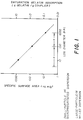
- Fig. 1 illustrates the specific surface area and saturation gelatin need for both small-particle microprecipitated and large-particle milled dispersions as a function of particle diameter.
- Fig. 2 illustrates a sensitized floc.
- Fig. 3 illustrates the continuous melt preparation device of this invention.
- Fig. 4 illustrates the viscosity control effect of APG-225 on the viscosity of gelled "small-particle” dispersion melt coupler (Y-1).
- Fig. 5 illustrates the effect of the viscosity control agent APG-225 on the ADRA reactivity of the gelled MPS "small-particle" dispersion melts.
- Fig. 6 illustrates the effect of gelatin addition rate and temperature on the turbidity of the formed dispersion melt, according to process of prior art.
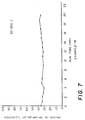
- Fig. 7 illustrates invariance of melt viscosity as a function of manufacturing time in the continuous melt-making process of this invention.
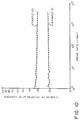
- Fig. 8 illustrates the invariance of the product coupler concentration as a function of manufacturing time in the continuous melt-making process of this invention.
- Fig. 9 illustrates the invariance of the product turbidity as a function of manufacturing time in the continuous melt-making process of this invention.
- Fig. 10 illustrates the rheograms of melts of Examples 20 and 21.
- microprecipitated dispersions of this invention formed either by solvent or pH shift can be prepared by methods described in references (R-1) and (R-3) which are incorporated herein by reference.
- High boiling water immiscible solvent containing microprecipitated dispersion of this invention is prepared by procedure described in detail in reference (R-2), which is incorporated herein by reference.
- Procedure for the preparation of liquid carboxylic acid incorporated coupler particles for enhanced photographic activity is given in reference (R-5) and is hereby incorporated by reference.
- Microprecipitation of couplers and photographic agents inside polymer particles are described in reference (R-4) and are hereby incorporated by reference.
- latex polymers that are suitable for preparation of polymer co-precipitated dispersions, suitable for this invention are described in detail in reference (R-4) and is incorporated herein by reference.
- liquid carboxylic acids suitable for the preparation of increased activity microprecipitated dispersions of this invention are described in detail in reference (R-5) and is hereby incorporated by reference.
- Fig. 3 illustrates schematics of the device utilized in continuous preparation of the gelled microprecipitated small-particle dispersion melts of this invention.
- the word "melt" is used to describe a gelatin admixed photographic agent dispersion or emulsion.
- 56 is a water purification system to supply deionized water in the gelatin solution tank 82 through line 65.
- the gelatin tank 82 is fitted with stirrer 52 and a hot water heating jacket 50 which can render heat to raise the temperature of the content of tank 82 up to 60°C to produce the gelatin solution 51.
- Dry gelatin or moist gelatin (30-50% weight of gelatin) is added into the tank through manhole 48.
- Gelatin concentration in tank 82 can be up to about 20% by weight.
- the small-particle microprecipitated dispersion of this invention is pumped into the jacketed tank 14 through line 16.
- the hot water jacket 15 can raise the temperature of the MPS 11 up to about 60°C.
- the prop mixer 13 is utilized to slowly stir the slurry.
- the photographic agent concentration in the slurry can be up to 20% by weight.
- the gelatin solution from tank 82 is pumped into the mixing chamber 34, fitted with an electrically driven mixing device, using pump 64 through line 67 and micromotion flow meter 68.
- the pumping rate of pump 64 is adjusted to the desired value prior to the run to produce a melt of a desired gelatin concentration.
- the MPS from tank 14 is pumped into the mixing chamber 34, using pump 60 through line 59 and micromotion flow meter 62.
- the pumping rate of pump 60 is adjusted to the desired value prior to the run to produce the melt with a predetermined photographic agent concentration.
- the formed gelled dispersion melt flows through line 66 from the continuous mixer 34 into the jacketed tank 70 which is slowly stirred with prop 74.
- the hot water jacket 71 is utilized to keep the gelled melt 75 at the same temperature as that of tank 14 and 82 which are usually identical to each other.
- the product is removed for producing photographic coatings using line 73.
- the residence time in the mixing chamber 34 can be anywhere between about 0.1 to about 60 seconds, preferably between about 1 to about 10 seconds.
- the particle diameter of the microprecipitated dispersion of this invention can be between 5 to 100 nm, preferably between about 5 and about 50 nm.
- the concentration of the microprecipitated dispersion can be anywhere between about 3% and about 20% by weight, preferably between about 8% and about 15%.
- the gelatin solution can be anywhere between about 5% and about 20% by weight of gelatin, preferably between about 8% to about 15%.
- the final dispersion formed can be anywhere between about 3% to about 15% by weight in photographic agent and about 3% to about 15% by weight of gelatin.
- the microprecipitated dispersion of this invention can be free of any solvent or contain about 0.2 to about 5 times of the weight of the coupler of a high boiling water immiscible coupler solvent or a liquid carboxylic acid or a latex polymer.
- the gelatin solution will contain a viscosity reduction surfactant in amounts that in the final formed gelled dispersion will be between about 0.1 and about 0.6 g per g of the photographic agent in the final dispersion melt.
- the flow rate of the gelatin and the coupler solution is greater than about 10 ml/min.
- This invention pertains to a layer structure as in current photographic paper (R-10) in the full color multilayer structure.
- the multilayer structure of a paper system is given in Table I. Such coatings are made in a simultaneous multilayer coating machine.
- the solvents used in preparation of conventional prior milled dispersions are as follows: The proportions of these used in preparation of the dispersions will be given in the examples concerning the prior milled control dispersions.
- the yellow dye-forming coupler is The magenta dye-forming coupler is The cyan dye-forming coupler is The surfactant utilized to prepare the conventional milled dispersion is Alkanol-XC.
- the incorporated oxidized developer scavenger used has the following structure:
- the stabilizer for the magenta dye has the following structure:
- the ultraviolet radiation absorbing compounds utilized are the two following Ciba-Giegy compounds: The specific dispersions prepared with these compounds will be described in detail in the appropriate examples.
- the white light exposures of the coated films were made using a sensitometer with properly filtered white light (R-10) with a neutral step wedge of 0.15 neutral density steps. Color separation exposures were made similarly with properly filtered light. All processing was carried out using the well-known RA4 development process (R-10).
- Monochrome yellow coatings contain oily layers 7, 6, 4, 1, and the support.
- Solution reactivity rates of the dispersions were determined using an automated dispersion reactivity analysis (ADRA) method.
- a sample of the dispersion is mixed with a carbonate buffer and a solution containing CD-4 developer.
- Potassium sulfite is added as a competitor.
- the carbonate buffer raises the pH of this reaction mixture to a value close to the normal processing pH (10.0).
- An activator solution containing the oxidant potassium ferricyanide is then added.
- the oxidant generates oxidized developer which reacts with the dispersed coupler to form image dye and with sulfite to form side products.
- a clarifier solution of Triton X-100
- the dye density is read using a flow spectrometer system. The concentration of dye is derived from the optical density and a known extinction coefficient.
- a kinetic analysis is carried out by treating the coupling reaction as a homogeneous single phase reaction. It is also assumed that the coupling reaction and the sulfonation reaction (sulfite with oxidized developer) may be represented as second-order reactions. Further, the concentrations of reagents are such that the oxidant and coupler are in excess of the developer.
- k k'1n[a/(a - x)]/1n[b/(b - c + x)]
- k' the sulfonation rate constant
- a the concentration of coupler
- b the concentration of sulfite
- c the concentration of developer
- x the concentration of the dye.
- the rate constant k is taken as a measure of dispersion reactivity. From an independently determined or known value of k' and with this knowledge of all of the other parameters, the rate constant k (called the automated dispersion reactivity analysis, ADRA, rate) is computed.
- ADRA automated dispersion reactivity analysis
- the MPS of yellow dye-forming coupler (Y-1) was prepared according to the method as described in references (R-3) and (R-6). The exact procedure and equipment is described in (R-6) in Example 1 of U.S. 5,013,640.
- the coupler P of U.S. 5,013,640 is the same as coupler (Y-1) of the instant examples.
- the physical characteristics of the MPS materials of Examples 6-9 are described in Table III.
- melts of MPS materials of the type of Examples 6-9 are prepared by heating it in a stirred tank to certain temperatures (between 40°C and 60°C) and then adding a solution of gelatin (lime processed ossein) of required concentration at the same temperature containing the viscosity control agent to the MPS.
- gelatin lime processed ossein
- the resulting melts were examined for liquid reactivity (ADRA), viscosity (VISY) and floc size.
- Turbidimetric (TURB) measurements were used to evaluate the relative differences in floc sizes of the flocs formed from the primary MPS particles during the melt-making process. Measurements were made both at 450 nm and 650 nm as well. Although both provided the same relative trends, the 450 nm data were used in the analysis because of the larger signals at this wavelength.
- the generated melts were also coated in monochrome format and evaluated for both fresh sensitometry and image stability after incubation.
- the designed experiment data was analyzed by computational procedure "PROC GLM” provided by the SAS institute (R-13).
- the viscosity model was highly significant in the design space. As expected and known in prior art (R-6) and (R-7), the viscosity was overwhelmingly controlled by the level of the viscosity control agent APG-225 level, with pH and the interaction of APG-225 level * pH being significant.
- Fig. 4 shows this viscosity reduction effect of APG-225, or the gelled MPS melt of coupler (Y-1) as derived from this designed experiment.
- the ADRA solution reactivites of Table III and Table IV indicate that gelled MPS melts have about half the reactivity as the slurry, slurry meaning dispersion before addition of gelatin. This is assumed to be due to the covering of the particle surface by gelatin. However, the ADRA reactivites of all the gelled MPS melts are about 3 to 4 times larger than that of the conventional milled dispersion of Example 1, which is about 1750 l/mole * sec.
- the incorporation of the viscosity control agent APG-225 into the dispersion melt of the MPS also has a significant but smaller effect on the solution ADRA reactivity of the dispersion melt. This is shown in Fig. 5. This is relatively smaller, but significant reduction in viscosity is also hypothesized to be due to the interaction of the APG-225 surfactant with the particle surface.
- Fig. 6 shows a three-dimensional plot of the turbidity (at 450 pm) as functions of gelatin addition time and temperature of the MPS, gelatin solutin, and the melt. It is clearly seen from this three-dimensional diagram that the gelatin addition time or the rate of gelatin addition has an extremely significant effect on the turbidity of the formed dispersion melt of the MPS material. It is to be noted that larger addition time meaning smaller addition rate. It is observed that at faster addition rates, this formed MPS melts have much smaller turbidity at all temperatures, whereas at very small addition times, the turbidities of the formed melts are extremely temperature dependent. This is an extremely undesirable feature in the manufacturing process .
- the MPS materials of Examples 7, 8, and 9 were used to prepare the gelled microprecipitated small-particle dispersion melts by the continuous method of this invention, using the equipment of Fig. 3 by the process described earlier in the specification.
- the concentrations of the various solutions are indicated in the following: 16 Kg of the MPS material was placed in reacter 18 of Fig. 3 and heated with stirring to 45°C.
- a 10 Kg gelatin, APG-225 solution was prepared in reactor 82 using high purity water containing 1270 g of dry lime-processed ossein gelatin and 444.5 g of dry weight of APG-225. Stirred solution was held at 55°C.
- the coupler pump 60 was set at 620 g/min. and the gelatin solution pump 64 was set at 350 g/min.
- the stirrer in mixing chamber 34 was turned on, and the continuous melt-making process started by turning pumps 60 and 64 on simultaneously.
- the gelled dispersion was collected continuously in vessel 70.
- Samples of melt of size of about 10 g were collected every one minute from line 66 for testing.
- This formulation procedure had a theoretical aim of forming the MPS melt at 8.0% yellow coupler (Y-1), 5.0% of gelatin, and 1.6% of APG-225.
- Y-1 yellow coupler
- APG-225 1.6% of APG-225
- the concentration of the yellow coupler (Y-1) in all the collected samples were determined by high pressure liquid chromatography (HPLC). A time chart of the determinations is shown in Fig. 8, as gain, indicating the invariance and roboustness of the inventive melt manufacturing process. It is to be noted that the aim concentration of coupler (Y-1) is 8.0%. The formed dispersion shows virtually this concentration throughout the run.
- turbidities of the individually collected samples were determined at 450 nm in a 1 cm cell.
- Fig. 9 shows a plot of the time chart of it as a function of run time. It is seen again that it is invariant within variability of the experiment throughout the run indicating an invariant and roboust manufacturing process compared to the prior art method of melt manufacturing of such "small-particle" dispersions.
- the repeat preparations of gelled MPS melt of this invention were made. They were prepared identically as Example 19, except Example 21 was prepared with the viscosity control agent (R-6 and R-7), Pluronic L44, manufactured by BASF.
Landscapes
- Physics & Mathematics (AREA)
- General Physics & Mathematics (AREA)
- Chemical & Material Sciences (AREA)
- Chemical Kinetics & Catalysis (AREA)
- Engineering & Computer Science (AREA)
- Materials Engineering (AREA)
- Colloid Chemistry (AREA)
- Silver Salt Photography Or Processing Solution Therefor (AREA)
Applications Claiming Priority (2)
| Application Number | Priority Date | Filing Date | Title |
|---|---|---|---|
| US07/996,949 US5385812A (en) | 1992-12-28 | 1992-12-28 | Continuous manufacture of gelled microprecipitated dispersion melts |
| US996949 | 1992-12-28 |
Publications (2)
| Publication Number | Publication Date |
|---|---|
| EP0604934A1 true EP0604934A1 (de) | 1994-07-06 |
| EP0604934B1 EP0604934B1 (de) | 2001-02-14 |
Family
ID=25543461
Family Applications (1)
| Application Number | Title | Priority Date | Filing Date |
|---|---|---|---|
| EP93120907A Expired - Lifetime EP0604934B1 (de) | 1992-12-28 | 1993-12-27 | Kontinuierliche Herstellung gelierter Schmelzen mikroausgefällter Dispersionen |
Country Status (4)
| Country | Link |
|---|---|
| US (1) | US5385812A (de) |
| EP (1) | EP0604934B1 (de) |
| JP (1) | JPH06295006A (de) |
| DE (1) | DE69329931T2 (de) |
Cited By (1)
| Publication number | Priority date | Publication date | Assignee | Title |
|---|---|---|---|---|
| EP0769716A1 (de) * | 1995-10-20 | 1997-04-23 | Fuji Photo Film Co., Ltd. | Verfahren zur Herstellung photographischer Materialien |
Families Citing this family (2)
| Publication number | Priority date | Publication date | Assignee | Title |
|---|---|---|---|---|
| US6730469B2 (en) * | 2001-07-05 | 2004-05-04 | Fuji Photo Film Co., Ltd. | Method and apparatus for liquid preparation of photographic reagent |
| US8030376B2 (en) | 2006-07-12 | 2011-10-04 | Minusnine Technologies, Inc. | Processes for dispersing substances and preparing composite materials |
Citations (9)
| Publication number | Priority date | Publication date | Assignee | Title |
|---|---|---|---|---|
| US3860425A (en) | 1971-08-25 | 1975-01-14 | Fuji Photo Film Co Ltd | Dispersion containing nonionic surface acting agent with units of polyoxyethylene and polyoxypropylene |
| GB2063695A (en) * | 1979-10-17 | 1981-06-10 | Konishiroku Photo Ind | A method for dispersion |
| US4933270A (en) | 1988-09-26 | 1990-06-12 | Eastman Kodak Company | Process for the precipitation of stable colloidal dispersions of base degradable components of photographic systems in the absence of polymeric steric stabilizers |
| US4970139A (en) | 1989-10-02 | 1990-11-13 | Eastman Kodak Company | Methods of preparation of precipitated coupler dispersions with increased photographic activity |
| WO1990016011A1 (en) * | 1989-06-15 | 1990-12-27 | Eastman Kodak Company | Preparation of low viscosity small-particle photographic dispersions in gelatin |
| US4990431A (en) | 1989-01-17 | 1991-02-05 | Eastman Kodak Company | Methods of forming stable dispersions of photographic materials |
| US5091296A (en) | 1990-06-26 | 1992-02-25 | Eastman Kodak Company | Polymer co-precipitated coupler dispersion |
| US5104776A (en) | 1989-11-29 | 1992-04-14 | Eastman Kodak Company | Increased photographic activity precipitated coupler dispersions prepared by coprecipitation with liquid carboxylic acids |
| US5358831A (en) | 1990-12-13 | 1994-10-25 | Eastman Kodak Company | High dye stability, high activity, low stain and low viscosity small particle yellow dispersion melt for color paper and other photographic systems |
Family Cites Families (6)
| Publication number | Priority date | Publication date | Assignee | Title |
|---|---|---|---|---|
| US3907573A (en) * | 1970-08-21 | 1975-09-23 | Minnesota Mining & Mfg | Silver halide photographic emulsions with improved physical characteristics |
| US5158863A (en) * | 1989-01-17 | 1992-10-27 | Eastman Kodak Company | Methods of forming stable dispersions of photographic materials |
| US5135844A (en) * | 1989-06-15 | 1992-08-04 | Eastman Kodak Company | Preparation of low viscosity small particle photographic dispersions in gelatin |
| US5182189A (en) * | 1989-11-29 | 1993-01-26 | Eastman Kodak Company | Increased photographic activity precipitated coupler dispersions prepared by coprecipitation with liquid carboxylic acids |
| US5185230A (en) * | 1991-09-03 | 1993-02-09 | Eastman Kodak Company | Oxygen barrier coated photographic coupler dispersion particles for enhanced dye-stability |
| US5298386A (en) * | 1992-06-09 | 1994-03-29 | Eastman Kodak Company | In-line solvent incorporation for amorphous particle dispersions |
-
1992
- 1992-12-28 US US07/996,949 patent/US5385812A/en not_active Expired - Fee Related
-
1993
- 1993-12-27 EP EP93120907A patent/EP0604934B1/de not_active Expired - Lifetime
- 1993-12-27 DE DE69329931T patent/DE69329931T2/de not_active Expired - Fee Related
- 1993-12-28 JP JP5338272A patent/JPH06295006A/ja active Pending
Patent Citations (10)
| Publication number | Priority date | Publication date | Assignee | Title |
|---|---|---|---|---|
| US3860425A (en) | 1971-08-25 | 1975-01-14 | Fuji Photo Film Co Ltd | Dispersion containing nonionic surface acting agent with units of polyoxyethylene and polyoxypropylene |
| GB2063695A (en) * | 1979-10-17 | 1981-06-10 | Konishiroku Photo Ind | A method for dispersion |
| US4933270A (en) | 1988-09-26 | 1990-06-12 | Eastman Kodak Company | Process for the precipitation of stable colloidal dispersions of base degradable components of photographic systems in the absence of polymeric steric stabilizers |
| US4990431A (en) | 1989-01-17 | 1991-02-05 | Eastman Kodak Company | Methods of forming stable dispersions of photographic materials |
| WO1990016011A1 (en) * | 1989-06-15 | 1990-12-27 | Eastman Kodak Company | Preparation of low viscosity small-particle photographic dispersions in gelatin |
| US5013640A (en) | 1989-06-15 | 1991-05-07 | Eastman Kodak Company | Preparation of low viscosity small-particle photographic dispersions in gelatin |
| US4970139A (en) | 1989-10-02 | 1990-11-13 | Eastman Kodak Company | Methods of preparation of precipitated coupler dispersions with increased photographic activity |
| US5104776A (en) | 1989-11-29 | 1992-04-14 | Eastman Kodak Company | Increased photographic activity precipitated coupler dispersions prepared by coprecipitation with liquid carboxylic acids |
| US5091296A (en) | 1990-06-26 | 1992-02-25 | Eastman Kodak Company | Polymer co-precipitated coupler dispersion |
| US5358831A (en) | 1990-12-13 | 1994-10-25 | Eastman Kodak Company | High dye stability, high activity, low stain and low viscosity small particle yellow dispersion melt for color paper and other photographic systems |
Non-Patent Citations (5)
| Title |
|---|
| R-10. ANONYMOUS: "Photographic Silver Halide Emulsions, Preparations, Addenda Processing and Systems", RESEARCH DISCLOSURE, vol. 308, 1989, pages 933 - 1015 |
| R-11. CHEN, B.: "Laser Light Scattering", 1974, ACADEMIC PRESS |
| R-12. BARKER, T.B.: "Quality By Experimental Design", 1985, DEKKER |
| R-13. ANONYMOUS: "SAS User's Guide; Statistics", 1985, SAS INSTITUTE |
| R-9. KRUYT, H.R.: "Colloid Science", vol. I,II, 1952, ELSEVIER |
Cited By (1)
| Publication number | Priority date | Publication date | Assignee | Title |
|---|---|---|---|---|
| EP0769716A1 (de) * | 1995-10-20 | 1997-04-23 | Fuji Photo Film Co., Ltd. | Verfahren zur Herstellung photographischer Materialien |
Also Published As
| Publication number | Publication date |
|---|---|
| EP0604934B1 (de) | 2001-02-14 |
| DE69329931D1 (de) | 2001-03-22 |
| US5385812A (en) | 1995-01-31 |
| JPH06295006A (ja) | 1994-10-21 |
| DE69329931T2 (de) | 2001-06-07 |
Similar Documents
| Publication | Publication Date | Title |
|---|---|---|
| US5279931A (en) | Polymer co-precipitated coupler dispersion | |
| EP0289820B1 (de) | Lichtempfindliche photographische Silberhalogenidmaterialien und Prozess für die Einführung hydrophober photographischer Additive in hydrophile Kolloidzusammensetzungen | |
| EP0604934B1 (de) | Kontinuierliche Herstellung gelierter Schmelzen mikroausgefällter Dispersionen | |
| US5089380A (en) | Methods of preparation of precipitated coupler dispersions with increased photographic activity | |
| EP0555458B1 (de) | Fotografische kupplerdispersionspartikel mit luftundurchlässiger schicht für verbesserte farbstoffstabilität | |
| JPH09179246A (ja) | 凝集色素含有写真要素 | |
| EP0146337B1 (de) | Elemente mit hydrophilen Schichten die hydrophobe Substanzen in Polymerteilchen enthalten und Verfahren zu deren Herstellung | |
| US5104776A (en) | Increased photographic activity precipitated coupler dispersions prepared by coprecipitation with liquid carboxylic acids | |
| EP0609878A1 (de) | Mit einer Sauerstoff-Barriere beschichtetes photographisches Mittel, durch Vermahlen erhaltene Teilchendispersion für erhöhte Farbstoffstabilität | |
| US5264317A (en) | Oxygen barrier coated photographic coupler dispersion particles for enhanced dye-stability | |
| US5013639A (en) | Incorporation of hydrophobic photographic additives into hydrophilic colloid compositions | |
| US5182189A (en) | Increased photographic activity precipitated coupler dispersions prepared by coprecipitation with liquid carboxylic acids | |
| EP0724191B1 (de) | Mikroausgefällte Farbdispersionen enthaltende photographische Materialien geeignet für Anwendungen mit schneller Verarbeitung | |
| JP2926422B2 (ja) | ハロゲン化銀写真感光材料 | |
| JPS6280641A (ja) | ハロゲン化銀写真感光材料 | |
| RU2091848C1 (ru) | Галогенсеребряный фотографический материал | |
| JP2883891B2 (ja) | 感光性ハロゲン化銀写真材料 | |
| JPS62131248A (ja) | ハロゲン化銀写真感光材料の製造法 | |
| US5955254A (en) | Production of silver halide emulsions | |
| JPH04136935A (ja) | ハロゲン化銀写真感光材料 | |
| RU2091857C1 (ru) | Способ сенсибилизации бромйодосеребряных полидисперсных фотографических эмульсий | |
| EP0750221A1 (de) | Photographische Silberhalogenidemulsion mit vermindertem Druckschleier | |
| RU2026569C1 (ru) | Состав раствора гидрофобных цветообразующих компонент | |
| SU1027682A1 (ru) | Цветной многослойный светочувствительный материал | |
| EP0576920A2 (de) | Photographische Silberhalogenidemulsion und Verfahren zu ihrer Herstellung |
Legal Events
| Date | Code | Title | Description |
|---|---|---|---|
| PUAI | Public reference made under article 153(3) epc to a published international application that has entered the european phase |
Free format text: ORIGINAL CODE: 0009012 |
|
| AK | Designated contracting states |
Kind code of ref document: A1 Designated state(s): DE FR GB |
|
| 17P | Request for examination filed |
Effective date: 19941220 |
|
| 17Q | First examination report despatched |
Effective date: 19971020 |
|
| GRAG | Despatch of communication of intention to grant |
Free format text: ORIGINAL CODE: EPIDOS AGRA |
|
| GRAG | Despatch of communication of intention to grant |
Free format text: ORIGINAL CODE: EPIDOS AGRA |
|
| GRAH | Despatch of communication of intention to grant a patent |
Free format text: ORIGINAL CODE: EPIDOS IGRA |
|
| RBV | Designated contracting states (corrected) |
Designated state(s): DE FR GB |
|
| GRAH | Despatch of communication of intention to grant a patent |
Free format text: ORIGINAL CODE: EPIDOS IGRA |
|
| GRAA | (expected) grant |
Free format text: ORIGINAL CODE: 0009210 |
|
| AK | Designated contracting states |
Kind code of ref document: B1 Designated state(s): DE FR GB |
|
| REF | Corresponds to: |
Ref document number: 69329931 Country of ref document: DE Date of ref document: 20010322 |
|
| ET | Fr: translation filed | ||
| PGFP | Annual fee paid to national office [announced via postgrant information from national office to epo] |
Ref country code: GB Payment date: 20011102 Year of fee payment: 9 |
|
| PLBE | No opposition filed within time limit |
Free format text: ORIGINAL CODE: 0009261 |
|
| STAA | Information on the status of an ep patent application or granted ep patent |
Free format text: STATUS: NO OPPOSITION FILED WITHIN TIME LIMIT |
|
| REG | Reference to a national code |
Ref country code: GB Ref legal event code: IF02 |
|
| 26N | No opposition filed | ||
| PG25 | Lapsed in a contracting state [announced via postgrant information from national office to epo] |
Ref country code: DE Free format text: LAPSE BECAUSE OF NON-PAYMENT OF DUE FEES Effective date: 20020702 |
|
| PG25 | Lapsed in a contracting state [announced via postgrant information from national office to epo] |
Ref country code: FR Free format text: LAPSE BECAUSE OF NON-PAYMENT OF DUE FEES Effective date: 20020830 |
|
| REG | Reference to a national code |
Ref country code: FR Ref legal event code: ST |
|
| PG25 | Lapsed in a contracting state [announced via postgrant information from national office to epo] |
Ref country code: GB Free format text: LAPSE BECAUSE OF NON-PAYMENT OF DUE FEES Effective date: 20021227 |
|
| GBPC | Gb: european patent ceased through non-payment of renewal fee |
Effective date: 20021227 |