EP0605886A2 - Cassette à bande comprenant unité de mémoire pour stocker des instructions de commande de reproduction - Google Patents
Cassette à bande comprenant unité de mémoire pour stocker des instructions de commande de reproduction Download PDFInfo
- Publication number
- EP0605886A2 EP0605886A2 EP93121027A EP93121027A EP0605886A2 EP 0605886 A2 EP0605886 A2 EP 0605886A2 EP 93121027 A EP93121027 A EP 93121027A EP 93121027 A EP93121027 A EP 93121027A EP 0605886 A2 EP0605886 A2 EP 0605886A2
- Authority
- EP
- European Patent Office
- Prior art keywords
- tape
- memory unit
- reproduction
- audio
- tag
- Prior art date
- Legal status (The legal status is an assumption and is not a legal conclusion. Google has not performed a legal analysis and makes no representation as to the accuracy of the status listed.)
- Granted
Links
Images












Classifications
-
- G—PHYSICS
- G11—INFORMATION STORAGE
- G11B—INFORMATION STORAGE BASED ON RELATIVE MOVEMENT BETWEEN RECORD CARRIER AND TRANSDUCER
- G11B15/00—Driving, starting or stopping record carriers of filamentary or web form; Driving both such record carriers and heads; Guiding such record carriers or containers therefor; Control thereof; Control of operating function
- G11B15/02—Control of operating function, e.g. switching from recording to reproducing
- G11B15/04—Preventing, inhibiting, or warning against accidental erasing or double recording
-
- G—PHYSICS
- G11—INFORMATION STORAGE
- G11B—INFORMATION STORAGE BASED ON RELATIVE MOVEMENT BETWEEN RECORD CARRIER AND TRANSDUCER
- G11B15/00—Driving, starting or stopping record carriers of filamentary or web form; Driving both such record carriers and heads; Guiding such record carriers or containers therefor; Control thereof; Control of operating function
- G11B15/02—Control of operating function, e.g. switching from recording to reproducing
- G11B15/05—Control of operating function, e.g. switching from recording to reproducing by sensing features present on or derived from record carrier or container
- G11B15/087—Control of operating function, e.g. switching from recording to reproducing by sensing features present on or derived from record carrier or container by sensing recorded signals
-
- G—PHYSICS
- G11—INFORMATION STORAGE
- G11B—INFORMATION STORAGE BASED ON RELATIVE MOVEMENT BETWEEN RECORD CARRIER AND TRANSDUCER
- G11B15/00—Driving, starting or stopping record carriers of filamentary or web form; Driving both such record carriers and heads; Guiding such record carriers or containers therefor; Control thereof; Control of operating function
- G11B15/18—Driving; Starting; Stopping; Arrangements for control or regulation thereof
- G11B15/1808—Driving of both record carrier and head
- G11B15/1875—Driving of both record carrier and head adaptations for special effects or editing
-
- G—PHYSICS
- G11—INFORMATION STORAGE
- G11B—INFORMATION STORAGE BASED ON RELATIVE MOVEMENT BETWEEN RECORD CARRIER AND TRANSDUCER
- G11B27/00—Editing; Indexing; Addressing; Timing or synchronising; Monitoring; Measuring tape travel
- G11B27/005—Reproducing at a different information rate from the information rate of recording
- G11B27/007—Reproducing at a different information rate from the information rate of recording reproducing continuously a part of the information, i.e. repeating
-
- G—PHYSICS
- G11—INFORMATION STORAGE
- G11B—INFORMATION STORAGE BASED ON RELATIVE MOVEMENT BETWEEN RECORD CARRIER AND TRANSDUCER
- G11B27/00—Editing; Indexing; Addressing; Timing or synchronising; Monitoring; Measuring tape travel
- G11B27/02—Editing, e.g. varying the order of information signals recorded on, or reproduced from, record carriers
- G11B27/031—Electronic editing of digitised analogue information signals, e.g. audio or video signals
- G11B27/036—Insert-editing
-
- G—PHYSICS
- G11—INFORMATION STORAGE
- G11B—INFORMATION STORAGE BASED ON RELATIVE MOVEMENT BETWEEN RECORD CARRIER AND TRANSDUCER
- G11B27/00—Editing; Indexing; Addressing; Timing or synchronising; Monitoring; Measuring tape travel
- G11B27/10—Indexing; Addressing; Timing or synchronising; Measuring tape travel
- G11B27/102—Programmed access in sequence to addressed parts of tracks of operating record carriers
- G11B27/107—Programmed access in sequence to addressed parts of tracks of operating record carriers of operating tapes
-
- G—PHYSICS
- G11—INFORMATION STORAGE
- G11B—INFORMATION STORAGE BASED ON RELATIVE MOVEMENT BETWEEN RECORD CARRIER AND TRANSDUCER
- G11B27/00—Editing; Indexing; Addressing; Timing or synchronising; Monitoring; Measuring tape travel
- G11B27/10—Indexing; Addressing; Timing or synchronising; Measuring tape travel
- G11B27/11—Indexing; Addressing; Timing or synchronising; Measuring tape travel by using information not detectable on the record carrier
-
- G—PHYSICS
- G11—INFORMATION STORAGE
- G11B—INFORMATION STORAGE BASED ON RELATIVE MOVEMENT BETWEEN RECORD CARRIER AND TRANSDUCER
- G11B27/00—Editing; Indexing; Addressing; Timing or synchronising; Monitoring; Measuring tape travel
- G11B27/10—Indexing; Addressing; Timing or synchronising; Measuring tape travel
- G11B27/19—Indexing; Addressing; Timing or synchronising; Measuring tape travel by using information detectable on the record carrier
- G11B27/28—Indexing; Addressing; Timing or synchronising; Measuring tape travel by using information detectable on the record carrier by using information signals recorded by the same method as the main recording
- G11B27/30—Indexing; Addressing; Timing or synchronising; Measuring tape travel by using information detectable on the record carrier by using information signals recorded by the same method as the main recording on the same track as the main recording
- G11B27/3027—Indexing; Addressing; Timing or synchronising; Measuring tape travel by using information detectable on the record carrier by using information signals recorded by the same method as the main recording on the same track as the main recording used signal is digitally coded
- G11B27/3063—Subcodes
-
- G—PHYSICS
- G11—INFORMATION STORAGE
- G11B—INFORMATION STORAGE BASED ON RELATIVE MOVEMENT BETWEEN RECORD CARRIER AND TRANSDUCER
- G11B27/00—Editing; Indexing; Addressing; Timing or synchronising; Monitoring; Measuring tape travel
- G11B27/10—Indexing; Addressing; Timing or synchronising; Measuring tape travel
- G11B27/34—Indicating arrangements
-
- G—PHYSICS
- G11—INFORMATION STORAGE
- G11B—INFORMATION STORAGE BASED ON RELATIVE MOVEMENT BETWEEN RECORD CARRIER AND TRANSDUCER
- G11B2220/00—Record carriers by type
- G11B2220/60—Solid state media
- G11B2220/65—Solid state media wherein solid state memory is used for storing indexing information or metadata
- G11B2220/652—Solid state media wherein solid state memory is used for storing indexing information or metadata said memory being attached to the recording medium
- G11B2220/655—Memory in cassette [MIC]
-
- G—PHYSICS
- G11—INFORMATION STORAGE
- G11B—INFORMATION STORAGE BASED ON RELATIVE MOVEMENT BETWEEN RECORD CARRIER AND TRANSDUCER
- G11B2220/00—Record carriers by type
- G11B2220/90—Tape-like record carriers
-
- G—PHYSICS
- G11—INFORMATION STORAGE
- G11B—INFORMATION STORAGE BASED ON RELATIVE MOVEMENT BETWEEN RECORD CARRIER AND TRANSDUCER
- G11B27/00—Editing; Indexing; Addressing; Timing or synchronising; Monitoring; Measuring tape travel
- G11B27/02—Editing, e.g. varying the order of information signals recorded on, or reproduced from, record carriers
- G11B27/031—Electronic editing of digitised analogue information signals, e.g. audio or video signals
- G11B27/032—Electronic editing of digitised analogue information signals, e.g. audio or video signals on tapes
-
- H—ELECTRICITY
- H04—ELECTRIC COMMUNICATION TECHNIQUE
- H04N—PICTORIAL COMMUNICATION, e.g. TELEVISION
- H04N5/00—Details of television systems
- H04N5/76—Television signal recording
- H04N5/91—Television signal processing therefor
- H04N5/92—Transformation of the television signal for recording, e.g. modulation, frequency changing; Inverse transformation for playback
- H04N5/9201—Transformation of the television signal for recording, e.g. modulation, frequency changing; Inverse transformation for playback involving the multiplexing of an additional signal and the video signal
- H04N5/9206—Transformation of the television signal for recording, e.g. modulation, frequency changing; Inverse transformation for playback involving the multiplexing of an additional signal and the video signal the additional signal being a character code signal
-
- H—ELECTRICITY
- H04—ELECTRIC COMMUNICATION TECHNIQUE
- H04N—PICTORIAL COMMUNICATION, e.g. TELEVISION
- H04N5/00—Details of television systems
- H04N5/76—Television signal recording
- H04N5/91—Television signal processing therefor
- H04N5/92—Transformation of the television signal for recording, e.g. modulation, frequency changing; Inverse transformation for playback
- H04N5/9201—Transformation of the television signal for recording, e.g. modulation, frequency changing; Inverse transformation for playback involving the multiplexing of an additional signal and the video signal
- H04N5/9206—Transformation of the television signal for recording, e.g. modulation, frequency changing; Inverse transformation for playback involving the multiplexing of an additional signal and the video signal the additional signal being a character code signal
- H04N5/9208—Transformation of the television signal for recording, e.g. modulation, frequency changing; Inverse transformation for playback involving the multiplexing of an additional signal and the video signal the additional signal being a character code signal involving the use of subcodes
Definitions
- the present invention relates to tape cassettes including memory units storing reproduction control instructions for audio and/or video signals recorded on a tape of the cassette.
- U.S. Patent No. 4,338,644 relates to a magnetic tape cassette containing a memory circuit which is used to store information such as instantaneous tape position as well as data indicating other positions on the tape. The position information is read from the memory circuit for use in carrying out functions such as play, fast forward, fast rewind, and recording.
- a tape cassette comprises: a tape recording medium for recording audio and/or video signals; and a memory unit storing information related to the tape recording medium including positional information of audio and/or video signals stored thereon; the memory unit also storing reproduction control instructions which serve to control the operation of a tape reproduction device using the positional information stored in the memory unit.
- the tape cassette of the present invention enables the use of reproduction control instructions which are based on positional information of audio and/or video signals recorded on a tape of the cassette, thus to provide the ability to implement a variety of control operations based on the positional information without adding to or modifying the audio and/or video signals.
- the stored reproduction control instructions serve to output an image selected from among the signals recorded on the tape to create a print of the image.
- skip reproduction instructions are stored as the reproduction control instructions for selectively extracting audio and/or video signals from among those recorded on the tape.
- the instructions include reproduction speed instructions for reproducing selected audio and/or video signals at a controllable speed, such as a selected low or high speed.
- the stored instructions include voice and/or picture quality control signals which serve to control characteristics of audio and/or video signals selected from among those recorded on the tape for controllably varying a characteristic thereof.
- Still other instructions may be stored in the memory unit such as instructions for displaying printing information regarding an image to be printed to permit selection of a desired image from among the signals recorded on the tape.
- the stored instructions include repetitive reproduction instructions for repeatedly reproducing an audio and/or video signal selected on the basis of the positional information; reproduction priority instructions for determining a sequence in which signals selected on the basis of the positional information are to be reproduced; editing control instructions for controlling operations of a further recording and/or reproducing operation of an apparatus other than that which the cassette is load; and viewing/listening environment control instructions for controlling factors such as illumination of the listening/viewing area as reproduction proceeds.
- An advantageous pack structure for the reproduction control instructions provides efficient memory usage, along with programming versatility.
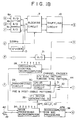
- FIG. 1 is a block diagram of a recording section of the recording/reproducing apparatus.
- a tape cassette 40 in accordance with an embodiment of the present invention includes a magnetic tape wound about a pair of spindles thereof to be driven by a tape deck of the recording/reproducing apparatus (not shown for purposes of simplicity and clarity) for recording and/or reproducing audio and/or video signals on the magnetic tape.
- the magnetic tape cassette 40 also includes a memory unit MIC (Memory In Cassette) 41 which serves to store information related to the magnetic tape including positional information of audio and/or video signals stored thereon.
- the MIC 41 also stores reproduction control instructions which serve to control the operation of the recording/reproduction apparatus using the positional information stored in the memory unit, as described in greater detail hereinbelow.
- the recording apparatus includes a communication terminal 43 and a communication controller (microcomputer for MIC processing 38) for writing the tape information and positional information in the MIC 41 based on the audio/video signals recorded on the tape.
- a communication controller microcomputer for MIC processing 38
- a television signal received by antenna 1 is selected by a tuner 2 and restored thereby to a composite video signal and a composite audio signal.
- a composite video signal is selected by a switch 3a from an external input 4.
- the selected composite video signal is applied to a Y/C separator 6 where it is divided into a luminance signal (Y) and color difference signals (R-Y, B-Y).
- the composite video signal is also applied to a sync separator 11 from which a vertical synchronizing signal (VSYNC) and a horizontal synchronizing signal (HSYNC) are derived.
- VSYNC vertical synchronizing signal
- HSELNC horizontal synchronizing signal
- These signals serve as reference signals for a PLL (Phase Locked Loop) circuit to generate a basic sampling signal of 13.5 MHz locked with the input signal. Since this frequency is not normally needed for sampling a color signal, the 13.5 MHz frequency is divided by a factor of 2 or 4 by divider 13 and the resultant frequency is used for sampling the color difference signals. Sampling is performed at a ratio of 4:1:1 for the NTSC format and 4:2:0 for the PAL format.
- the analog outputs from the Y/C separator 6 are band limited by low-pass filters (LPFs) 7a, 7b and 7c to avoid aliasing.
- LPFs low-pass filters
- the cutoff frequencies of these filters are, for example, 5.75 MHz for Y filter 7a; and 2.75 MHz for R-Y filter 7b and B-Y filter 7c.
- the filtered signals are then converted into digital signals by A/D converters 8a, 8b and 8c, and divided into code blocks of 8 samples by 8 lines each by a blocking circuit 9 and transformed thereby to frequency domain data by discrete cosine transformation.
- the resultant code is shuffled by a shuffling circuit 10 to prevent data loss due to a clogged tape head or by a transverse scratch on the tape.
- Shuffling circuit 10 also rearranges the luminance data signal and the color difference data to avoid loss of data concentrated spatially or temporally as a result of head clogging or a transverse scratch on the tape.
- a data compression encoder 14 compresses the video data by variable length coding and requantization.
- the compressed video data is then packed by a framing circuit 15 into predetermined sync blocks.
- Video auxiliary data (VAUX), audio auxiliary data (AAUX), and subcode data for storage, respectively, in video, audio and subcode track areas, and a track number to be stored in the subcode area are generated by a signal processing microcomputer 20 and are fed to interface units 17, 18, 19, respectively.
- the interface unit 17 for a VAUX sector of the video area generates an AP2 (application ID data), which is combined with the framing output by a combining circuit 16.
- the interface unit 18 for the subcode area generates data SID (sync words and ID data including absolute track address) and AP3 (for defining the data structure) and also generates pack data SDATA (for example, including information pertinent to a recorded program, such as title, chapter, and part information).
- An audio signal is selected by switch 3b either from the output of tuner 2 or from an external analog audio input signal.
- the selected audio signal is converted by A/D converter 21 into a digital signal.
- the digital signal is then shuffled by shuffling circuit 22 and packed by framing circuit 23 into audio sync blocks.
- AAUX interface unit 19 supplies the AP1 data and the AAUX data packs to combining circuit 24 for combining with the audio sync block data.
- a data generator 25 generates AV (audio/video) ID signals, a pre-sync signal and a post-sync signal, one of which, together with the ADATA, VDATA, SID and SDATA, is selected by a time-division multiplexer 26 and added to parity data produced by an error correction code generator 27.
- the resultant signal is sent to a channel encoder 44.
- randomizing circuit 29 randomizes the signal supplied thereto to minimize its DC component.
- the resultant signal is coded by a 24/25 converting circuit 30 to provide a digital automatic track finding signal for servo control.
- Circuit 30 preferably is a Partial Response Class IV Circuit suitable for digital processing.
- the signal thus obtained is combined with an audio/video sync pattern and a subcode sync pattern by combining circuit 31.
- An ITI sector generator 33 is fed with APT (Application) ID data, SP/LP (standard play/long play) data, and PF (pilot frequency) data from a mode processing microcomputer 34.
- the ITI sector generator 33 packs this data into predetermined positions and applies the resultant data to switch 32 which selects between this resultant data, pre-and post-amble data and the output of combining circuit 31 in a timed pattern.
- a switch 42 is used to select an LP or an SP recording mode and the setting of switch 42 is sent to microcomputers 34 and 38.
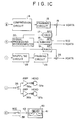
- a final recording signal obtained from channel encoder 44 is selected by a switch 35 for supply alternately to diametrically opposed heads 37a and 37b after amplification by head amplifiers 36a and 36b for recording on tape 40.
- Microcomputer for MIC processing 38 then generates pack data and APT data (for indicating data format) which is written in MIC 41 in the cassette 40 via an MIC switch 39.
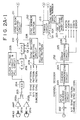
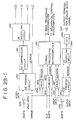
- Figs. 2A and 2B together provide a block diagram of a reproducing apparatus for reproducing data recorded by means of the recording apparatus of Fig. 1.
- Coded data in the format described above is read from a magnetic tape by heads 201a and 201b, the output of each of which is amplified by a respective amplifier 202a and 202b.
- Data from that one of the heads in contact with the tape at any given time is selected by a switch 203 and applied to an equalizing circuit 204.
- the data is provided both to the input of an analog-to-digital converter (A/D) 206 as well as to a clock extracting and phase locked loop (PLL) circuit 205 which serves to produce a clock signal from the reproduced data synchronized therewith for use in sampling the reproduced data by means of the A/D 206.
- A/D analog-to-digital converter
- PLL phase locked loop
- the digitized data is output by the A/D 206 to a time base corrector circuit including a first-in-first-out memory (FIFO) 207 which writes the data in accordance with the clock signal CK produced by the circuit 205 and outputs the data therefrom by means of a stable clock signal (SCK) produced by dividing the output of an oscillator 239 stabilized by a crystal 238 by means of a dividing circuit 240 (refer to Fig. 2B).
- FIFO first-in-first-out memory
- a timing circuit 213 provided with the clock signal CK and the stable clock signal SCK outputs a signal to a selection switch 209 for selecting an appropriate one of an ITI sync pattern, an A/V sync pattern and a subcode sync pattern for provision to a sync pattern detecting circuit 208.
- the sync pattern detecting circuit is supplied with a parallel output from the FIFO 207 for detecting an appropriate sync pattern therein for closing a switch 210 in order to supply each successively reproduced sync block to a sync block latching circuit 211.
- the sync block latching circuit 211 outputs a signal to a sync number detector 212 for detecting a sync number for use by the timing circuit 213.
- the timing circuit 213 also controls the state of a selector switch 214 for appropriately supplying a reproduced ITI sync pattern to a first channel decoder 250 which serves to decode the reproduced ITI data, or to a second channel decoder 252 which serves to decode audio data (ADATA), video data (VDATA), SID and subcode data (SDATA).
- ADATA audio data
- VDATA video data
- SID subcode data
- the first channel decoder 250 includes a subtracting circuit 215 supplied at a first input with the reproduced ITI data and at a second input with the ITI sync pattern.
- the output of the subtracting circuit 215 is supplied to an ITI decoder which separates the APT data, the SP/LP data and the PF or pilot frame data.
- the pilot frame data is employed for effecting servo control based upon the reproduced signal. This data is supplied to a mode processing microcomputer 217 for effecting servo control by means of a mechanical control microcomputer 228, as well as for other purposes.
- the reproduced audio, video and subcode data is Supplied to the second channel decoder 252 and to a first input of a subtracting circuit 222 thereof which receives the A/V sync pattern or the subcode sync pattern, as appropriate, at a second input, and outputs the remaining data to a 24/25 inverse converting circuit 223 which serves to reconvert the data to its form as input to the circuit 30 of the channel encoder 43 of Fig. 1.
- the output of the circuit 223 is supplied to an inverse randomizing circuit 224 which serves to restore the data to its form as input to the randomizing circuit 29 of Fig. 1.
- the output of the inverse randomizing circuit 224 is supplied to an error correction circuit 225 which outputs error corrected data to a demultiplexer 226, or else outputs an error signal indicating data which cannot be error corrected.
- A/V ID data as well as pre-sync and post-sync are received by a circuit 227 for use by the timing circuit 213.
- the demultiplexer 226 also provides the audio data, video data, SID and subcode data at separate outputs which are processed further as described hereinbelow.
- the apparatus as illustrated in Fig. 2A also includes a SP/LP selector switch 218 coupled with the mode processing computer 217.
- the mode processing microcomputer 217 also communicates with an MIC processing microcomputer 219 which reads information from and stores information in an MIC of a tape cassette 221 through an MIC terminal 220.
- the video data VDATA is supplied to a demultiplexer 229 which separates the video data therefrom for supply to a deframing circuit 230, as well as the VAUX data therefrom which is supplied to a VAUX circuit 248 for disassembling the various items thereof.
- the video data after deframing by the circuit 230 is subject to decompression by a decompression circuit 231 which carries out operations which are the inverse of those carried out by the compression circuit 14 of Fig. 1.
- the output of the decompression circuit 231 is deshuffled by a deshuffling circuit 233 and deblocked by a deblocking circuit 234 to separate digital Y, (R-Y) and (B-Y) data.
- the Y, (R-Y) and (B-Y) data are converted to analog form by a respective digital-to-analog converters 235a, 235b, and 235c and thereafter mixed by a Y/C mixing circuit 236 and combined with horizontal and vertical synchronizing signals generated by a sync signal generator 241 under control of the oscillator 239 to output a composite analog video signal at an output terminal 242.
- the audio data ADATA is demultiplexed by a demultiplexer 243 to separate audio data therefrom which is supplied to a deframing circuit 244 as well as AAUX data therefrom which is supplied to an AAUX circuit 250 which serves to separate the various data items therein.
- the output of the deframing circuit 244 is supplied to a deshuffling circuit 245 which then outputs a deshuffled data stream which is then reconverted to analog form by a digital-to-analog converter 246.
- the analog data supplied thereby is output at a terminal 247.
- SID and subcode data are supplied to a subcode data separation circuit 249.
- the separated data items supplied by the circuits 248, 249 and 250 are supplied thereby to a signal processing microcomputer 251 for use in generating appropriate control signals for application to the mode processing microcomputer 217 and the mechanical control microcomputer 228 of Fig. 2A.
- a keyboard 300 enables user input to a microcomputer 302 of the recording/reproducing apparatus.
- the microcomputer 302 also provides a display to the user by means of a display device 304.
- the microcomputer 302 communicates with the mode processing microcomputers 34 and 217. It will be appreciated that the input and display functions of microcomputer 302 may instead be carried out by one or more of the further microcomputers of Figs. 1, 2A and 2B.
- a pack data structure is illustrated therein, which corresponds with a recording format described in Japanese Patent Application No. 4-325618, commonly assigned with the present application.
- the pack data structure of Fig. 4 is employed according to an advantageous embodiment of the present invention for storing data in a memory unit of a tape cassette. Data having the format of Fig. 4 may also be recorded on magnetic tape as data accompanying a video or audio signal recorded thereon.
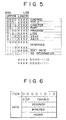
- each pack includes 5 bytes including an "item" byte designated PC0 and 4 data bytes designated PC1 through PC4.
- the item byte PC0 indicates the contents of the remaining data in the pack and is divided into four upper bits and four lower bits referred to, respectively, as a "major item” and a "minor item".
- a major item may be used, for example, to designate the use of the data contained in words PC1 through PC4, while the accompanying minor item may be used to indicate the specific contents of the following data.
- states 0000 through 0111 and 1111 are presently defined as follows: control (0000), title (0001), chapter (0010), part (0011), program (0100), line (0101), video auxiliary data (0110), audio auxiliary data (0111), and soft (programmable) mode (1111).
- control encompasses minor items including tape ID (0000), tape length (0001), timer record specification date (0010), timer record start and end time (0011), text control (1000), and text (1001).
- reproduction control instructions may be designated by minor items (1010) and (1011).
- the reproduction control instructions employ positional information regarding audio and/or video signals recorded on the tape of the corresponding cassette.
- pack structures for the control major item (0000) and minor items (1010) and (1011), respectively, in accordance with a first embodiment of the present invention are illustrated therein.
- the pack structure of Fig. 6 contains time code information obtained when a user operates the keyboard 300 for indicating a location on a tape.
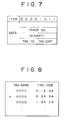
- Fig. 7 illustrates a different pack structure used for storing a tag (an instruction, for example, entered by a user by means of the keyboard 300) which references a track number included in the pack.
- a tag ID can indicate, for example, an index (starting address of desired data on the tape) or a photo marker (address of an image to be output for printing).
- CONT CONT
- CONT specifies an operation to be carried out in accordance with the instruction, such as repeated reproduction or a skip (skipping to a specified address on the tape). While the minor item (1011) designates a pack including track number or address information, the minor item (1010) indicates a pack which does not include such a track number or address.
- pack structures may be provided which include a tag name which can then be displayed on a screen (for example, the display 304) along with a corresponding time code, as shown in Fig. 8.
- a display permits a user, for example, to promptly select a desired edit position on a tape.
- a user loads a tape cassette in accordance with an embodiment of the present invention in the recording/reproducing apparatus of Figs. 1-3 and enters a reproduction mode with the use of the keyboard 300, as indicated by step ST1.
- the user selects a particular screen or image to be printed by entering a still picture mode signal by means of the keyboard 300, as indicated in step ST2.
- the user enters a tag by means of the keyboard 300 which conveys the instruction.that the selected image be output for printing, as indicated by step ST3.
- the print tag When the print tag is entered, it is stored as a reproduction control instruction by the microcomputer 302 and therefrom to the memory unit of the tape cassette. As indicated by step ST4, the user may choose to enter multiple tags and, once all have been entered, indicates this fact by an appropriate entry using the keyboard 300. Each time a tag is entered in the step ST3, the corresponding time code or track address information is stored by the microcomputer 302 in a pack including the reproduction control instruction for printing the image.
- the entered tags are likewise provided for storage in the memory unit of the tape cassette via the MIC terminal 220 of Fig. 2A.
- the user selects one by means of the keyboard 300 based on the displayed tag names (ST6) and presses a photo button of the keyboard 300 (step ST6), whereupon a photo marker is entered in the tag ID of the corresponding pack and a still-picture reproduction instruction is written in the tag control portion of thereof as stored in the memory unit of the tape cassette. Then, by selecting the tag, the image on the tape represented thereby can be printed as indicated by step ST8.
- the tape cassette may be ejected from the recording/reproducing apparatus and subsequently loaded in a further apparatus to reproduce the designated image by selecting the tag name which is then displayed on a screen thereof, such as that illustrated in Fig. 8.
- Further reproduction operations may be controlled by means of tags stored by the memory unit of the tape cassette. For example, an instruction may be stored therein for commanding a reproducing apparatus to begin reproduction from a corresponding location as indicated by a time code or track address of a corresponding pack. Further operations may thus be controlled, such as reproduction of multiple recorded segments or skipping one or more signals recorded on the tape.
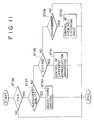
- a reproduction apparatus in which the tape cassette is loaded reads the contents of the memory unit thereof to determine whether they represent reproduction control instructions. If so, in a following step ST11, the reproduction apparatus determines whether the minor item is equal to (1011) and, if so, whether (1) skip reproduction is to be carried out (ST11), or repeated reproduction is to be carried out (ST12), or (3) reproduction speed control is to be effected (ST13), or (4) program reproduction is to be carried out (ST14).
- the minor item is equal to (1011) and, if so, whether (1) skip reproduction is to be carried out (ST11), or repeated reproduction is to be carried out (ST12), or (3) reproduction speed control is to be effected (ST13), or (4) program reproduction is to be carried out (ST14).
- step ST11 the reproducing apparatus is fast forwarded (FF) as indicated by step ST15 until a predetermined tape location is accessed (ST16). Thereupon, normal speed reproduction is carried out (ST17). In the foregoing manner, a desired recorded segment may be accessed quickly.
- step ST12 reproduction is carried out from a "current" position to detection of a "next" position on the tape. That is, in step ST18 normal reproduction is initiated and, unless a stop key of the keyboard 300 has been actuated (step ST19), reproduction continues until the "next" location or tag is detected (ST20) whereupon the tape is rewound to the "current" location or tag. If, however, actuation of the stop key is detected, reproduction is stopped (ST22) at that point.
- a reproduction speed is read from the reproduction control instruction stored in the memory unit of the tape cassette (ST23) and the reproduction apparatus carries out reproduction at the indicated speed (step ST24). Accordingly, a predetermined audio and/or video signal can be selected from among those recorded on the tape and reproduced at a desired speed, such as a slow or high speed.
- program reproduction (ST14) data is reproduced in a predetermined order indicated by a "tag number" of the reproduction control instruction (step ST25).
- audio and/or video signals may be selectively extracted from the tape at random positions (skipping or rewinding as necessary to access such locations) to reproduce the extracted signals as if they were recorded continuously.
- a tape cassette having a memory unit storing reproduction control instructions
- operations such as voice/picture quality control, editing control and viewing/listening environment control are carried out based on such reproduction control instructions.
- control can be asserted over audio characteristics, such as volume, as well as picture characteristics, such as blurring, based on an instruction stored in a tag pack (ST30).
- reproduction control instructions in the "tag control" portion of a pack can be carried out on an apparatus other than the apparatus in which the tape cassette is loaded, for example, stop and reproduction instructions. Accordingly, control of such other apparatus may be exercised to extract a desired segment while dubbing or carrying out other editing operations, which render such operations less complex for the user.
- step ST29 control of the viewing or listening environment is carried out as a part of reproduction control.
- a lighting apparatus operatively associated with the reproduction apparatus may be controlled according to the content of the reproduced audio and/or video signals.
- control of speaker apparatus within the area may be exercised to enhance a sense of presence.
- These operations may be controlled based on the content of the "tag control" of an appropriate tag pack (step ST32).
- a tag pack and a zone end pack structure are provided for storing data in such memory unit.
- the tag pack stores positional information defining a zone start point together with an instruction regarding the operational mode to adopt at the zone start.
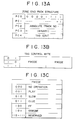
- the tag pack structure includes a minor item (1011) of byte PC0, followed by four additional bytes PC1 through PC4.
- PC1 represents the lowermost 7 bits of an absolute track number (indicating a corresponding fixed position on a tape)
- PC2 represents an intermediate 8 bits of the absolute track number
- PC3 represents the uppermost 8 bits thereof, so that the absolute track number includes a total of 23 bits.
- the lower 4 bits of PC4 constitute a tag ID, while the upper 4 bits form a text flag.
- the foregoing reproduction instructions will be described in greater detail hereinbelow.
- Bytes PC1, PC2 and PC3 specify an absolute track number constituting a zone end point.
- Byte PC4 an 8-bit tag control (TAG CONT) providing a reproduction control instruction between two points on a tape represented by respective positional data.
- TAG CONT 8-bit tag control
- Combinations of the upper four bits of the tag control implement a variety of functions.
- the 3 bits following the 2 uppermost bits of the tag control byte specify a forward mode instruction, while the lowermost three bits specify a reverse mode instruction.
- the various forward mode instructions are specified in Fig. 13C.
- (100) in the three forward mode bits of the tag control byte specify a fast forward operation, while if the corresponding bits are instead (101) a "strobe" instruction is specified (that is, to alternately display and blank an image).
- the reverse mode (RMODE) instructions are specified in Fig. 13D. For example, if the 3 lowermost bits of the tag control byte are (001), reverse reproduction is specified, while if the same three bits are instead (010), reverse slow reproduction is specified.
- Additional reverse mode instructions include (011) which specifies a rewind reproduction or "review” mode, while if the same three bits are instead (101) a reverse strobe (that is, to alternately display and blank the screen during reverse reproduction) is specified.
- the tag pack stores the zone start point as the absolute track address in bytes PC1, PC2 and PC3.
- the zone end pack stores an absolute address in bytes PC1, PC2 and PC3 which specifies the zone end position.
- a tag pack is paired with a zone end pack, or (2) when only a tag pack is provided are illustrated.
- a step ST33 after a tape cassette has been loaded in a reproducing apparatus, its memory unit is checked to determine whether a tag pack is stored therein. If a tag pack is found, then the memory is checked for the presence of a corresponding zone end pack in a step ST34. If such a zone end pack is found, it is next determined whether a program reproduction instruction is conveyed by the tag ID (ST35).
- Such instructions include program play start (0011), in which a program reproduction mode is commanded, and zone play (0100), wherein reproduction is carried out according to a command based both on the absolute track number of the tag pack and that of the zone end pack (ST37). If, on the other hand, a program reproduction instruction is not included in the tag pack (ST 35), further reproduction control operations based both on the contents of the tag pack and the zone end pack are carried out, as will be explained in greater detail below in connection with Fig. 14B.
- step ST34 If in step ST34 a zone end pack is not found which is paired with the tag pack found in step ST33, either an index operation (ST38), a skip start operation (ST40), a picture photo operation (ST42), a still operation (ST44) or a freeze operation (ST46) is carried out.
- an image corresponding to an absolute track number stored in the tag pack is reproduced as a still picture for a predetermined period of time (ST45).
- a program reproduce instruction is not found in the tag pack
- processing is carried out as illustrated in Fig. 14B. That is, when both a tag pack and a corresponding zone end pack are found, and the tag ID of the tag pack is not (0011), one of a special reproduction, an edit control and an environment control function is carried out.
- step ST48 it is determined whether a special reproduction function is specified by the tag pack. If so, in step ST49, a reproduction control operation according to a specified command is performed in a zone defined by absolute track numbers of the tag pack and the zone end pack.
- Such edit control operations include temporary suspension of an operation as well as temporary reproduction utilizing a plurality of interconnected recording/reproducing apparatus. That is, such operations can be specified by a user and stored in the memory unit of the tape cassette to perform such operations automatically, thereby enhancing editing efficiency (step ST51).
- step ST52 If an environment control function is specified, this is detected in step ST52 and the specified control is carried out in step ST53. That is, the environment of the viewing/listening area can be controlled by such instructions in synchronization with a reproduced picture/sound signal.
- Exemplary control functions include control of lighting intensity, turning on/off particular lights, and generation of artificial smells to enhance a sense of presence. Control of environment in this fashion assists in creating a miniature-scale theatrical effect.
- instructions which can be conveyed by means of the tag pack and the zone end pack are not limited to the above-mentioned control operations. They can be used, for example, for carrying out control operations providing added value information based on information recorded on the tape.
- a still reproduction control operation is illustrated therein which is specified by a tag ID of (0101).
- a tag ID 0101
- Fig. 15A address A
- An image stored at that location is reproduced as a still picture for a predetermined period of time, after which normal reproduction is resumed.
- Fig. 15B outlines the contents of the memory unit of the tape cassette.
- the memory is divided into a main area, a program event area, and a tag area arranged in the order of ascending addresses.
- the main area stores an application ID which defines a data structure for the memory, together with information about the recording medium, the cassette and the memory itself.
- the program event area stores positional information for start and end points of a program stored in the memory as well as character data concerning such program.
- a "freeze" reproduction operation is carried out in the manner illustrated in Fig. 16A.
- a reproduction apparatus transports the tape until a specified point, indicated as point "A" in Fig. 16A, corresponding to an absolute track address included in a tag pack containing a freeze instruction and captures an image recorded on the tape at that point in a memory of the reproduction apparatus.
- the captured image is output by the reproduction apparatus for a predetermined period of time.
- the reproduction apparatus continues to reproduce recorded audio as the tape is transported. Upon expiration of the predetermined period of time, normal video reproduction is resumed.
- the contents of the memory unit of the tape cassette are divided into a main area, a program event area, and a tag area in the order of ascending addresses, in the same manner as described hereinabove in connection with Fig. 15B.
- the contents of the memory unit include a tag pack having an absolute track address representing a point A along a tape illustrated schematically in Fig. 17A.
- a zone end pack is also included in the memory unit and including an absolute track address representing a point B along the tape of Fig. 17A.
- the zone end pack includes a tag control (PC4) of (01), indicating that a single reproduction operation is to be carried out.
- PC4 tag control
- zone end pack 17B instruct the reproduction apparatus to transport the tape from point A to point B without reproducing the signals therebetween, that is, to "skip" these signals.
- the tape is transported by fast forward from point A to point B
- the tape is transported from point A to point B in a cue mode.
- the zone end pack stores a reverse mode of (000) indicating no reverse operation. The skip reproduction operation is useful for deleting an unwanted segment, such as a commercial.
- a further zone operation is illustrated thereby wherein a tape is reproduced from a point A to a point B thereof, rewound from point B to point A and reproduced again to point A to point B.
- the contents of the memory unit of the tape cassette include a tag pack specifying the absolute address of the point A and a zone end pack specifying the address of the point B on the tape.
- the tag pack includes a zone play (0100) tag ID indicating a zone start point, while the zone end pack includes a tag control of (10) indicating that reproduction is to be carried out twice. Consequently, the tag control of the zone end pack also includes a forward mode of (001) indicating "play” and a reverse mode of (100) for "rewind".
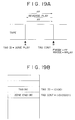
- Fig. 19A illustrates a "reverse reproduction" operation which is carried out between a point A on a tape to a point B thereon. More specifically, the tape is transported from the point A to the point B in a fast forward mode, and from point B the tape is transported in a reverse direction as its contents from point B to point A are reproduced, and once the tape returns to the point A, it is again transported in the fast forward mode to the point B.
- Fig. 19B illustrates the contents of the memory unit of the tape cassette for carrying out the reverse reproduction mode.
- a tag pack includes the absolute address of the point A together with a tag ID specifying zone play (0100).
- a zone end pack includes the absolute address of the point B, as well as a tag control of (10) together with a forward mode of (100) indicating fast forward and a reverse mode of (001) indicating reverse play.
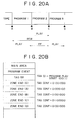
- FIG. 20A A "program reproduction” operation is illustrated by Fig. 20A.
- the "program reproduction” operation is carried out to reproduce multiple programs in a selectable order.
- programs 1, 2 and 3 are recorded in that order on the tape, but are reproduced in the order of program 2, followed by program 1 and finally program 3.
- one tag pack and five zone end packs provide the program reproduction control instructions for carrying out this sequence of operations.
- the tag pack includes a program play start tag ID (0011) together with the absolute address of the point B on the tape, indicating a program start point.
- a first zone end pack as shown in Fig.
- a second zone end pack includes an absolute address of the point A on the tape as well as a tag control of (01), with a forward mode of (000) and a reverse mode (100).
- the reproducing apparatus transports the tape from point C to point A in the rewind mode.
- the third zone end pack includes an absolute address of the track number at point B and a tag control (01) together with a forward mode of (001) and a reverse mode of (000). Consequently in response to this tag pack, the reproduction apparatus reproduces the tape from point A to point B.
- a fourth zone end pack includes an absolute address of the point C on the tape and a tag control of (01), together with a forward mode of (100) and a reverse mode of (000).
- the reproducing apparatus fast forwards the tape from point B to point C.
- the last zone end pack includes the absolute address of the point D on the tape and a tag control of (01), together with a forward mode of (001) and a reverse mode of (000). Consequently, the tape is reproduced from point C to point D, whereupon the exemplary program reproduction operation is completed.
- a zone end pack followed by another zone end pack in the memory requires only one absolute track address for specifying a single point on the tape.
- each tag pack need only relate to a first one of a plurality of zone end packs. In this manner, the memory area of the memory unit is utilized effectively.
- Figs. 21A and 21B provide a further example of a programmable play mode.
- programs 1, 2, 3 and 4 are recorded on a tape in that order and reproduced in the same order by in selectably different modes.
- one tag pack and four end packs provide the program reproduction control instructions.
- the tag pack includes a tag ID for program play start (0011) and an absolute track address of point A on the tape indicating a program start point.
- the first zone end pack includes an absolute track address for tape point B and a tag control of (10), together with forward mode of (001) and a reverse mode of (000). Consequently, the tape is played from point A to point B.
- the second zone end pack includes an absolute track address of the point C and a tag control of (01), together with a forward mode of (010) and a reverse mode of (000).
- the reproducing apparatus reproduces program 2 at a slow speed.
- the third zone end pack includes an absolute track address of tape point D and a tag control of (01), together with a forward mode of (100) and a reverse mode of (000). Consequently, the tape is fast forwarded from the point C to the point D.
- the fourth zone end pack includes an absolute track address of tape point E and a tag control of (01), together with a forward mode of (001) and a reverse mode of (000).
- the reproducing apparatus carries out normal reproduction of program 4 which is recorded between tape points D and E. It will be seen that the foregoing operations are carried out as if the tape had previously been edited.
- each zone end pack followed by another zone end pack need only specify one absolute track address.
- the tag pack need relate only to the first of the zone end packs in a following group. Consequently, limited memory area is utilized effectively.
- a programmable play mode A further example of a programmable play mode will now be explained in connection with Figs. 22A and 22B.
- programs 1, 2 and 3 recorded on a tape in that order are reproduced using selectably different modes of operation, namely, program 1 is first reproduced in a play mode, followed by two successive reproductions of program 2 in a slow play mode, followed by a single reproduction of program 3 in a normal play mode.
- One tag pack and three zone end packs as shown in Fig. 22B, provide the program reproduction control instructions.
- the tag pack includes a absolute track address of tape point A at the beginning of program 1, together with a play start (0011) tag ID indicating a program start point.
- a first zone end pack includes an absolute track address of a tape point B at the end of program 1 and the beginning of program 2, together with a tag control of (01), a forward mode of (001) and the reverse mode of (000). Consequently, program 1 is reproduced in the normal play mode form point A to point B.
- the second zone end pack includes an absolute track address of the point C at the end of program 2 and the beginning of program 3 and a tag control of (10), that is, "play twice, reproduce twice", together with a forward mode of (010) and a reverse mode of (100).
- the reproduction apparatus first reproduces program 2 in the slow mode from point B to point C, rewinds from point C to point B and then reproduces again in the slow mode from point B to point C.
- the third and final zone end pack includes an absolute track address at point D (the end of program 3) and a tag control of (01), together with a forward mode of (001) and a reverse mode of (000).
- the reproduction apparatus reproduces program 3 in the normal play mode from point C to point D.
- each zone end pack followed by another zone end pack specifies only one zone end point, while the tag pack relates only to the first of the zone end packs, so that limited memory area is effectively utilized.
- Fig. 23A illustrates a character display operation which occurs during reproduction within a specified zone from tape point A to tag point B.
- the memory unit of the tape cassette stores a text pack with stores the characters to be displayed from the point A as specified in the tag pack.
- the tag pack includes the absolute track address of the point A together with a zone play tag ID.
- the zone end pack includes a tag control having the four upper bits (0000) indicating control of character output.
- the four lower bits of the tag control specify features such as the color of the characters and the manner in which they are displayed, such as a blinking display.
- the specified characters are displayed during reproduction from the point A to the point B in order to provide a synthetic screen with embedded characters without the need to edit the data reported on the tape.
- overwriting protection is provided in a zone extending from a tape point A to a tape point 8 by means of the tag and zone end packs stored in the memory unit as illustrated in Fig. 24B.
- the tag pack includes an absolute track address for the point A and a zone play tag ID indicating a zone start.
- the zone end pack includes an absolute track address at point B and values (0001) for the upper four bits of the tag control (indicating recording-proof).
- the reproduction apparatus inhibits recording between the points A and B on the tape.
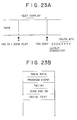
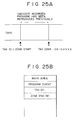
- Fig. 25A indicates an operation for providing an indication that a program recorded between tape points A and B has been reproduced at least once previously.
- a tag pack and a zone end pack are recorded in the memory unit as indicated in Fig. 25B, wherein the tag pack includes an absolute track address for the point A and a zone play tag ID indicating a zone start.
- the zone end pack includes the absolute address of the point B and a value (0010) for the upper four bits of the tag control which indicate the program within the zone has been played already. Consequently, it can easily be determined that the zone between points A and B on the tape has been reproduced one or more times after recording, which provides a convenient means for determining which of various programs recorded in a timer mode for later viewing have already been seen.
- the "already-played" indication becomes invalid.
- the memory cassette in accordance with the present invention provides a memory unit storing reproduction control instructions utilizing positional information of audio/video signals recorded on a tape of the tape cassette, so that a variety of control operations may be carried without the need to add to or modify the audio/video signals.
- a desired image can be printed easily and promptly without modifying the recorded audio/video signals; the reproducing apparatus may skip recorded signals to selectively reproduce other audio/video signals recorded on the tape without modification to any such signals; reproduction speed control instructions may be stored in the memory unit to selectably adjust reproduction speeds for the various audio/video signals recorded on the tape; audio/video control information may also be stored for selectively modifying audio and video signals as reproduced without modifying those signals as recorded; printing information may be displayed on a screen for selection of a desired image for printing; repetitive reproduction control instructions are stored to control selective repeated reproduction of audio/video signals recorded on the tape; program reproduction instructions are stored to enable prioritized reproduction of audio/video signals recorded on the tape in any desired order without modification thereof; editing control instructions are stored in the memory unit for exercising control over a recording/reproducing apparatus other than one in which the tape cassette has been loaded, thereby facilitating editing operations such as dubbing; environmental control information is stored in the memory unit so that environmental conditions such as lighting, speaker volume and sound quality may be modified in synchronism with reproduction of the
Landscapes
- Engineering & Computer Science (AREA)
- Multimedia (AREA)
- Signal Processing (AREA)
- Management Or Editing Of Information On Record Carriers (AREA)
- Signal Processing For Digital Recording And Reproducing (AREA)
- Television Signal Processing For Recording (AREA)
Applications Claiming Priority (2)
| Application Number | Priority Date | Filing Date | Title |
|---|---|---|---|
| JP34814292 | 1992-12-28 | ||
| JP348142/92 | 1992-12-28 |
Publications (3)
| Publication Number | Publication Date |
|---|---|
| EP0605886A2 true EP0605886A2 (fr) | 1994-07-13 |
| EP0605886A3 EP0605886A3 (fr) | 1996-07-10 |
| EP0605886B1 EP0605886B1 (fr) | 1999-04-14 |
Family
ID=18395032
Family Applications (1)
| Application Number | Title | Priority Date | Filing Date |
|---|---|---|---|
| EP19930121027 Expired - Lifetime EP0605886B1 (fr) | 1992-12-28 | 1993-12-28 | Cassette à bande comprenant unité de mémoire pour stocker des instructions de commande de reproduction |
Country Status (4)
| Country | Link |
|---|---|
| EP (1) | EP0605886B1 (fr) |
| AU (1) | AU677970B2 (fr) |
| CA (1) | CA2112419C (fr) |
| DE (1) | DE69324461T2 (fr) |
Cited By (3)
| Publication number | Priority date | Publication date | Assignee | Title |
|---|---|---|---|---|
| US6674599B1 (en) | 1998-03-13 | 2004-01-06 | Hewlett-Packard Development Company, L.C. | Data storage method, apparatus and medium |
| US7123444B1 (en) | 1998-05-22 | 2006-10-17 | Tanberg Data Asa | Tape cassette having an optical signal receiver and a memory for storing information optically transmitted into the cassette |
| EP1724775A1 (fr) * | 2005-05-16 | 2006-11-22 | Samsung Electronics Co., Ltd. | Appareil et méthode de mesure du rapport signal/bruit pour signal de lecture de disque optique. |
Families Citing this family (1)
| Publication number | Priority date | Publication date | Assignee | Title |
|---|---|---|---|---|
| US7075874B2 (en) | 2001-07-17 | 2006-07-11 | Hewlett-Packard Development Company, L.P. | Data storage device monitoring system, method and removable data carrier use with data storage systems |
Family Cites Families (12)
| Publication number | Priority date | Publication date | Assignee | Title |
|---|---|---|---|---|
| CH625074A5 (fr) * | 1977-08-31 | 1981-08-31 | Kobler Edith | |
| BE871690R (fr) * | 1978-10-27 | 1979-02-15 | Staar Sa | Dispositif de memorisation de la position instantanee d'une bande magnetique contenue dans une cassette |
| BE871596A (fr) * | 1978-10-27 | 1979-02-15 | Staar Sa | Dispositif de memorisation de la position instantanee d'une bande magnetique contenue dans une cassette. |
| US4774600A (en) * | 1985-05-06 | 1988-09-27 | Eastman Kodak Company | Video tape editing technique |
| JPH0823987B2 (ja) * | 1986-11-27 | 1996-03-06 | 松下電器産業株式会社 | カセツトテ−プ装置 |
| JPH0823986B2 (ja) * | 1986-12-26 | 1996-03-06 | ソニー株式会社 | テ−プカセツト |
| JP2602431B2 (ja) * | 1987-07-07 | 1997-04-23 | キヤノン株式会社 | 情報信号記録または再生装置 |
| GB8809223D0 (en) * | 1988-04-19 | 1988-05-25 | British Broadcasting Corp | Cassette for sequential access recording medium & apparatus for use therewith |
| US5164840A (en) * | 1988-08-29 | 1992-11-17 | Matsushita Electric Industrial Co., Ltd. | Apparatus for supplying control codes to sound field reproduction apparatus |
| JPH02273387A (ja) * | 1989-04-14 | 1990-11-07 | Pioneer Electron Corp | 情報再生方式 |
| DE4135419A1 (de) * | 1991-10-26 | 1993-04-29 | Thomson Brandt Gmbh | Speichereinrichtung fuer eine magnetbandkassette |
| CA2124080C (fr) * | 1991-11-22 | 2002-01-22 | Irving Tsai | Methode et appareil d'enregistrement a bande magnetique |
-
1993
- 1993-12-24 CA CA 2112419 patent/CA2112419C/fr not_active Expired - Fee Related
- 1993-12-28 EP EP19930121027 patent/EP0605886B1/fr not_active Expired - Lifetime
- 1993-12-28 DE DE1993624461 patent/DE69324461T2/de not_active Expired - Fee Related
- 1993-12-30 AU AU52797/93A patent/AU677970B2/en not_active Ceased
Cited By (3)
| Publication number | Priority date | Publication date | Assignee | Title |
|---|---|---|---|---|
| US6674599B1 (en) | 1998-03-13 | 2004-01-06 | Hewlett-Packard Development Company, L.C. | Data storage method, apparatus and medium |
| US7123444B1 (en) | 1998-05-22 | 2006-10-17 | Tanberg Data Asa | Tape cassette having an optical signal receiver and a memory for storing information optically transmitted into the cassette |
| EP1724775A1 (fr) * | 2005-05-16 | 2006-11-22 | Samsung Electronics Co., Ltd. | Appareil et méthode de mesure du rapport signal/bruit pour signal de lecture de disque optique. |
Also Published As
| Publication number | Publication date |
|---|---|
| AU5279793A (en) | 1994-07-07 |
| EP0605886A3 (fr) | 1996-07-10 |
| AU677970B2 (en) | 1997-05-15 |
| CA2112419C (fr) | 2004-04-06 |
| DE69324461D1 (de) | 1999-05-20 |
| CA2112419A1 (fr) | 1994-06-29 |
| EP0605886B1 (fr) | 1999-04-14 |
| DE69324461T2 (de) | 1999-08-05 |
Similar Documents
| Publication | Publication Date | Title |
|---|---|---|
| CA2181324C (fr) | Methode et appareil de recherche de chaines de donnees multiples | |
| AU710297B2 (en) | Portable moving picture recording device including switching control for multiple data flow configurations | |
| KR100324835B1 (ko) | 디지털비디오신호기록및재생장치 | |
| US5583654A (en) | Digital video and audio signal recording and reproducing apparatus efficiently storing a variety of different accompanying video and audio information data | |
| US6570728B2 (en) | Tape cassette including memory unit storing reproduction control instructions | |
| JPH0798965A (ja) | 画像検索用id信号の記録方法、画像検索方法、及び記録画像再生装置 | |
| US6026212A (en) | Digital video recorder | |
| EP0605886B1 (fr) | Cassette à bande comprenant unité de mémoire pour stocker des instructions de commande de reproduction | |
| US20050069289A1 (en) | Transport stream recording/editing device and recording/editing method | |
| US20030123848A1 (en) | Method of generating index image, apparatus for generating index image , method of correcting index image data, apparatus for correcting index image data, method of correcting edit auxiliary data, and apparatus for correcting edit auxiliary data | |
| JPH07272461A (ja) | 画像信号及び音声信号記録方法及び画像信号及び音声信号記録再生装置 | |
| US6128150A (en) | Video tape recording apparatus for recording reproduction control signals for stabilizing operation of a tape transport means | |
| KR930010485B1 (ko) | 자막정보 처리장치 | |
| US6198589B1 (en) | Video tape recording apparatus | |
| JP3358273B2 (ja) | 信号記録再生装置 | |
| JPS63313382A (ja) | プログラム再生装置 | |
| JP3520559B2 (ja) | 記録再生装置 | |
| JPH076559A (ja) | メモリを搭載したテープカセット | |
| JP2508496B2 (ja) | ビデオ信号記録装置 | |
| JPH03158085A (ja) | ビデオテープの編集用インデックス作成表示装置 | |
| JP3586878B2 (ja) | テープカセット、並びにテープカセットを用いて画像信号及び音声信号の記録再生を行う画像音声信号記録再生装置 | |
| JP2508495B2 (ja) | ビデオ信号再生装置 | |
| JPH02149991A (ja) | 画像信号および音声信号のディジタルオーディオテープファイル編集方法 | |
| JPH05298865A (ja) | 磁気記録再生装置 | |
| JPS60206385A (ja) | 映像信号の記録再生装置 |
Legal Events
| Date | Code | Title | Description |
|---|---|---|---|
| PUAI | Public reference made under article 153(3) epc to a published international application that has entered the european phase |
Free format text: ORIGINAL CODE: 0009012 |
|
| AK | Designated contracting states |
Kind code of ref document: A2 Designated state(s): DE FR GB |
|
| PUAL | Search report despatched |
Free format text: ORIGINAL CODE: 0009013 |
|
| AK | Designated contracting states |
Kind code of ref document: A3 Designated state(s): DE FR GB |
|
| 17P | Request for examination filed |
Effective date: 19961218 |
|
| 17Q | First examination report despatched |
Effective date: 19971006 |
|
| GRAG | Despatch of communication of intention to grant |
Free format text: ORIGINAL CODE: EPIDOS AGRA |
|
| GRAG | Despatch of communication of intention to grant |
Free format text: ORIGINAL CODE: EPIDOS AGRA |
|
| GRAH | Despatch of communication of intention to grant a patent |
Free format text: ORIGINAL CODE: EPIDOS IGRA |
|
| GRAH | Despatch of communication of intention to grant a patent |
Free format text: ORIGINAL CODE: EPIDOS IGRA |
|
| GRAA | (expected) grant |
Free format text: ORIGINAL CODE: 0009210 |
|
| AK | Designated contracting states |
Kind code of ref document: B1 Designated state(s): DE FR GB |
|
| REF | Corresponds to: |
Ref document number: 69324461 Country of ref document: DE Date of ref document: 19990520 |
|
| ET | Fr: translation filed | ||
| PLBE | No opposition filed within time limit |
Free format text: ORIGINAL CODE: 0009261 |
|
| STAA | Information on the status of an ep patent application or granted ep patent |
Free format text: STATUS: NO OPPOSITION FILED WITHIN TIME LIMIT |
|
| 26N | No opposition filed | ||
| REG | Reference to a national code |
Ref country code: GB Ref legal event code: IF02 |
|
| PGFP | Annual fee paid to national office [announced via postgrant information from national office to epo] |
Ref country code: FR Payment date: 20081212 Year of fee payment: 16 |
|
| PGFP | Annual fee paid to national office [announced via postgrant information from national office to epo] |
Ref country code: DE Payment date: 20081229 Year of fee payment: 16 |
|
| PGFP | Annual fee paid to national office [announced via postgrant information from national office to epo] |
Ref country code: GB Payment date: 20081224 Year of fee payment: 16 |
|
| GBPC | Gb: european patent ceased through non-payment of renewal fee |
Effective date: 20091228 |
|
| REG | Reference to a national code |
Ref country code: FR Ref legal event code: ST Effective date: 20100831 |
|
| PG25 | Lapsed in a contracting state [announced via postgrant information from national office to epo] |
Ref country code: FR Free format text: LAPSE BECAUSE OF NON-PAYMENT OF DUE FEES Effective date: 20091231 |
|
| PG25 | Lapsed in a contracting state [announced via postgrant information from national office to epo] |
Ref country code: DE Free format text: LAPSE BECAUSE OF NON-PAYMENT OF DUE FEES Effective date: 20100701 |
|
| PG25 | Lapsed in a contracting state [announced via postgrant information from national office to epo] |
Ref country code: GB Free format text: LAPSE BECAUSE OF NON-PAYMENT OF DUE FEES Effective date: 20091228 |