EP0606225B1 - Sequenage de proteines immobilisees sur des supports en polytetrafluoroethylene - Google Patents
Sequenage de proteines immobilisees sur des supports en polytetrafluoroethylene Download PDFInfo
- Publication number
- EP0606225B1 EP0606225B1 EP92916619A EP92916619A EP0606225B1 EP 0606225 B1 EP0606225 B1 EP 0606225B1 EP 92916619 A EP92916619 A EP 92916619A EP 92916619 A EP92916619 A EP 92916619A EP 0606225 B1 EP0606225 B1 EP 0606225B1
- Authority
- EP
- European Patent Office
- Prior art keywords
- sample
- sequencing
- terminal
- polytetrafluoroethylene
- support
- Prior art date
- Legal status (The legal status is an assumption and is not a legal conclusion. Google has not performed a legal analysis and makes no representation as to the accuracy of the status listed.)
- Expired - Lifetime
Links
Images


Classifications
-
- G—PHYSICS
- G01—MEASURING; TESTING
- G01N—INVESTIGATING OR ANALYSING MATERIALS BY DETERMINING THEIR CHEMICAL OR PHYSICAL PROPERTIES
- G01N33/00—Investigating or analysing materials by specific methods not covered by groups G01N1/00 - G01N31/00
- G01N33/48—Biological material, e.g. blood, urine; Haemocytometers
- G01N33/50—Chemical analysis of biological material, e.g. blood, urine; Testing involving biospecific ligand binding methods; Immunological testing
- G01N33/53—Immunoassay; Biospecific binding assay; Materials therefor
- G01N33/543—Immunoassay; Biospecific binding assay; Materials therefor with an insoluble carrier for immobilising immunochemicals
- G01N33/544—Immunoassay; Biospecific binding assay; Materials therefor with an insoluble carrier for immobilising immunochemicals the carrier being organic
- G01N33/545—Synthetic resin
-
- G—PHYSICS
- G01—MEASURING; TESTING
- G01N—INVESTIGATING OR ANALYSING MATERIALS BY DETERMINING THEIR CHEMICAL OR PHYSICAL PROPERTIES
- G01N33/00—Investigating or analysing materials by specific methods not covered by groups G01N1/00 - G01N31/00
- G01N33/48—Biological material, e.g. blood, urine; Haemocytometers
- G01N33/50—Chemical analysis of biological material, e.g. blood, urine; Testing involving biospecific ligand binding methods; Immunological testing
- G01N33/68—Chemical analysis of biological material, e.g. blood, urine; Testing involving biospecific ligand binding methods; Immunological testing involving proteins, peptides or amino acids
- G01N33/6803—General methods of protein analysis not limited to specific proteins or families of proteins
- G01N33/6818—Sequencing of polypeptides
Definitions
- This invention relates to the sequencing of peptides immobilized on preferably porous polytetrafluoroethylene supports. More particularly, the invention relates to automated C-terminal and N-terminal sequencing of peptides blotted from a gel onto a porous polytetrafluoroethylene support.
- EP-A-0 410 323 describes a method of immobilizing proteins and peptides onto a flat, microporous membrane surface in a form suitable for sequence analysis or other chemical or enzymatic processes.
- the process involves the formation of a thin polymer network that entraps the protein or peptide, which may be covalently linked to the cross linked polymer network or may be effectively immobilized within the polymer mesh by means of physical entrapment.
- the peptide or protein and polymer are adsorbed onto a flat membrane surface.
- PVDF is a preferred support for N-terminal sequencing, and for blotting of purified proteins from gels, such as SDS gels.
- SDS gels such as SDS gels.
- PVDF turns black and dissolves, frequently limiting some C-terminal sequencing procedures to a single cycle.
- a method employing a polytetrafluoroethylene support for both N-terminal and C-terminal sequencing.
- the supports used in the method of this invention are chemically inert and, hence, do not degrade under the conditions of N-terminal or C-terminal sequencing.
- Proteins are strongly adherent to Polytetrafluoroethylene supports and are not washed off by solvents typically used in sequencing, such as methanol, dimethylformamide, ethyl acetate and acetonitrile. Covalent coupling is not required.
- Figure 1 is a schematic depiction of a C-terminal sequencer useful in the practice of the invention.
- Figure 2 depicts chromatograms which indicate the result in each of four cycles of C-terminal sequencing in the sequencer of Figure 1 of ⁇ -lactoglobulin (350 pmol) noncovalently applied to a polytetrafluoroethylene support.
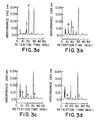
- Figure 3 depicts chromatograms which indicate the result in each of four cycles of C-terminal sequencing in the sequencer of Figure 1 of superoxide dismutase (5.2 nmol) noncovalently applied to a polytetrafluoroethylene support.
- reagent and solvent bottles associated with the instrument depicted by Figure 1 are shown. Five reagent bottles, R1-R5, and five solvent bottles, S1-S5, are utilized in the practice of the invention as illustrated by the ensuing examples.
- Reagents from bottles R1-R4 and solvents from bottles S1-S4 are delivered to the continuous flow reactor (CFR).
- Reagent from bottle R5 and solvent from bottle S5 are delivered to the conversion flask (CF).
- the CF serves to convert the ATZ derivative of the cleaved amino acid into a PTH (phenylthiohydantoin) just before analysis by HPLC.
- the CF serves as a place to hold the cleaved thiohydantoin amino acid just prior to injection into the HPLC.
- composition of the reagents and solvents is set forth in Table 1.
- Composition of Reagents and Solvents R1 10% Triethylamine in methanol
- R4 pyridine R5 2.0% trifluoroacetic acid in water
- the first four operations in the program summary involve the reagent R1. These steps are performed only once for a particular sample and are only at the beginning of a sequencing experiment.
- the "pressurize R1" step means that the pressure valve for R1 is opened and the R1 bottle is allowed to pressurize with argon for 30 seconds.
- the valve on P4 which corresponds to R1 is still open to maintain pressure on R1, but the solenoid on the reagent block (Q2) for R1 is also opened, permitting R1 to flow into the CFR.
- the solenoid on the three-way switching valve (SW 1) is opened in order to permit equalization of pressure in the closed system and to allow any overflow to go to a waste bottle. This flow is maintained for five seconds. At the end of five seconds, all of the solenoid actuated valves are closed and the R1 reagent, in this case, 10% triethylamine in methanol, is allowed to react with the protein sample for 30 seconds.
- valve BO1 is opened to permit argon flow up into the reagent valve block (Q1 and Q2).
- the waste valve (SW 1) just after the CFR is also opened. This permits the argon to push the contents of the CFR out to waste. In this case, argon is pushed through the CFR for 60 seconds and then all valves are shut off.
- the second group of four operations involve the reagent R2. These steps are practiced in the same was as described for R1. Thus, instead of opening and closing the valves for R1, the corresponding valves for R2, S1, R4 and S3 are used.
- This sequence of four events which, as illustrated entails treatment of the protein sample with phosphoryl isothiocyanate reagent (R2), rinsing with heptane (S1), treatment with gas phase pyridine (R4), and rinsing with DMF (S3), is repeated two more times in order to push the equilibrium all the way toward thiohydantoin formation.
- the next steps (18) to (37) involve rinsing the Zitex supported peptide sample with methanol, DMF, heptane, DMF, methanol.
- the CF is washed with the methanol in the CFR.
- the methanol in the CF is then sent to waste as indicated by step (35) and the residual methanol is blown out in step (37).
- solvents could be used for this purpose.
- the dried thiohydantoin amino acid in the CF must be dissolved in a solvent, e.g. 2.0% trifluoroacetic acid (R5), for injection into the HPLC.
- R5 is delivered twice in order to deliver the proper volume for injection (two deliveries of 55 ⁇ l). See steps (43) to (49).
- Injection into the HPLC is accomplished by applying argon pressure to the CF. This is accomplished by opening the valve just above the CF (BO2) and pushing the contents of the CF into the 100 ⁇ l HPLC injection loop.
- the pause step S1 is 60 seconds long in order to allow the contents of the HPLC injection loop to run onto the HPLC column.
- the last step involves rinsing the CF with methanol and flushing both the CFR and CF with argon for 180 seconds in order to clean out the system. See steps (52)-(54). The whole cycle is then repeated as often as desired.
- the injection is controlled by an optical detector described in Rusnak, U.S. Patent 5,137,695.
- the cycle time for the entire program takes approximately one hour.
- the supports of this invention may be prepared from commercially available polytetrafluoroethylene film or sheet.
- film or sheet having a thickness from about 0.15 mm (0.002 inches) to 0.76 mm (about 0.030 inches) is utilized.
- polytetrafluoroethylene be porous. For example, a pore size of 1 to 10 ⁇ m (1 to 10 microns) is appropriate.
- Porous polytetrafluoroethylene or "Teflon” of appropriate thickness and pore size is available from Norton Plastics Company under the tradename Zitex (trademark). See, e.g., "Norton Performance Plastics” (1987) available from the Norton Company which describes various Zitex G (trademark) products and sets forth related physical properties.
- the Norton product identified as Zitex G-110 (trademark) is preferred and has been used in the ensuing examples.
- SDS-PAGE Sodium dodecyl sulfate-polyacrylamide gel electrophoresis
- a ⁇ -lactoglobulin A sample present on a SDS-PAGE sample was blotted onto a porous polytetrafluoroethylene support (Zitex G-110) having a pore size of 1-2 mm (1-2 microns) a pore volume of 40% and a thickness of 0.25 mm (0.010 inches).
- the Zitex (trademark) was prewet by soaking in methanol and thereafter placed on top of the separating polyacrylamide gel bearing the sample. This assembly was then sandwiched between three layers of Whatman trademark) filter paper underneath the gel and three layers of Whatman filter paper on top of the Zitex (trademark). This whole assembly was then placed between two Scoton-Brite pads and placed in the electrotransfer unit.
- the electrotransfer buffer was 0.025 M Tris, 0.192 M glycine, pH 8.3. The transfer was accomplished with a constant current of 30 milliamps for three hours.
- Protein staining was accomplished by placing the Zitex support in a solution of 0.1% /amido Black (w/v) in 95% methonol, 5% acetic acid for 15 minutes. Destaining was accomplished by soaking the Zitex support in 95% methanol, 5% acetic acid for 5 minutes. Staining and destaining was accomplished at room temperature 22°C).
- Example II A Zitex (trademark) support bearing superoxide dismutase (5.2 nmol), and the instrument and the program described in Example II were utilized.
- Carboxy terminal sequencing of a peptide or polypeptide in which the carboxy terminal amino acid of the peptide is reacted with a mixture of phosphoroisothiocyanatidate and pyridine to form a thiohydantoin derivative may be carried out.
- a mixture of phosphoroisothiocyanatidate and pyridine to form a thiohydantoin derivative.
- triazine, Imidazole or tetrazole may be used to form the thiohydantoin derivative.
Landscapes
- Health & Medical Sciences (AREA)
- Life Sciences & Earth Sciences (AREA)
- Engineering & Computer Science (AREA)
- Immunology (AREA)
- Molecular Biology (AREA)
- Hematology (AREA)
- Chemical & Material Sciences (AREA)
- Urology & Nephrology (AREA)
- Biomedical Technology (AREA)
- Physics & Mathematics (AREA)
- Medicinal Chemistry (AREA)
- Food Science & Technology (AREA)
- Biotechnology (AREA)
- Pathology (AREA)
- Microbiology (AREA)
- General Physics & Mathematics (AREA)
- General Health & Medical Sciences (AREA)
- Cell Biology (AREA)
- Biochemistry (AREA)
- Analytical Chemistry (AREA)
- Bioinformatics & Cheminformatics (AREA)
- Bioinformatics & Computational Biology (AREA)
- Biophysics (AREA)
- Proteomics, Peptides & Aminoacids (AREA)
- Measuring Or Testing Involving Enzymes Or Micro-Organisms (AREA)
- Investigating Or Analysing Biological Materials (AREA)
Claims (5)
- Procédé de séquençage N-terminal ou C-terminal d'un échantillon de peptide supporté, caractérisé en ce que l'échantillon de peptide est supporté directement par la surface d'une feuille de polytétrafluoréthylène, où ledit échantillon est lié par une liaison non covalente a ladite feuille, sans produire de réseau polymère pour piéger l'échantillon.
- Procédé selon la revendication 1, qui comprend les étapes consistant :(i) à transférer par transfert direct un échantillon de peptide, qui a été purifié par électrophorèse sur gel de SDS, sur une feuille de polytétrafluoréthylène destinée au peptide ; et à(ii) à placer directement dans un séquenceur N-terminal ou C-terminal la feuille portant l'échantillon transféré.
- Procédé selon la revendication 2, qui comprend en outre l'étape de séquençage de l'échantillon de peptide.
- Procédé selon l'une quelconque des revendications 1 à 3, dans lequel ladite feuille de polytétrafluoréthylène est poreuse.
- Procédé selon la revendication 4, dans lequel ladite feuille a un volume des pores compris entre 40 et 60 %.
Applications Claiming Priority (2)
| Application Number | Priority Date | Filing Date | Title |
|---|---|---|---|
| PCT/US1992/006083 WO1994002855A1 (fr) | 1992-07-23 | 1992-07-23 | Sequençage de proteines immobilisees sur des supports en polytetrafluoroethylene |
| CA002119348A CA2119348A1 (fr) | 1992-07-23 | 1992-07-23 | Sequencage d'une proteine immobilisee sur des supports de polytetrafluoroethylene |
Publications (3)
| Publication Number | Publication Date |
|---|---|
| EP0606225A1 EP0606225A1 (fr) | 1994-07-20 |
| EP0606225A4 EP0606225A4 (fr) | 1994-11-30 |
| EP0606225B1 true EP0606225B1 (fr) | 1999-09-29 |
Family
ID=25677123
Family Applications (1)
| Application Number | Title | Priority Date | Filing Date |
|---|---|---|---|
| EP92916619A Expired - Lifetime EP0606225B1 (fr) | 1992-07-23 | 1992-07-23 | Sequenage de proteines immobilisees sur des supports en polytetrafluoroethylene |
Country Status (4)
| Country | Link |
|---|---|
| EP (1) | EP0606225B1 (fr) |
| JP (1) | JPH07503073A (fr) |
| CA (1) | CA2119348A1 (fr) |
| WO (1) | WO1994002855A1 (fr) |
Families Citing this family (1)
| Publication number | Priority date | Publication date | Assignee | Title |
|---|---|---|---|---|
| CN121450039A (zh) * | 2026-01-04 | 2026-02-03 | 上海凯亿医疗科技有限公司 | 蛋白沉淀板、蛋白沉淀板的制备方法和用于制备蛋白沉淀板的原料 |
Family Cites Families (2)
| Publication number | Priority date | Publication date | Assignee | Title |
|---|---|---|---|---|
| US5061635A (en) * | 1987-07-13 | 1991-10-29 | City Of Hope | Protein or peptide sequencing method |
| US5071909A (en) * | 1989-07-26 | 1991-12-10 | Millipore Corporation | Immobilization of proteins and peptides on insoluble supports |
-
1992
- 1992-07-23 CA CA002119348A patent/CA2119348A1/fr not_active Abandoned
- 1992-07-23 WO PCT/US1992/006083 patent/WO1994002855A1/fr not_active Ceased
- 1992-07-23 EP EP92916619A patent/EP0606225B1/fr not_active Expired - Lifetime
- 1992-07-23 JP JP6504387A patent/JPH07503073A/ja active Pending
Non-Patent Citations (1)
| Title |
|---|
| Analytical Biochemistry, vol.187, pages 10-19, (1990) * |
Also Published As
| Publication number | Publication date |
|---|---|
| WO1994002855A1 (fr) | 1994-02-03 |
| EP0606225A1 (fr) | 1994-07-20 |
| JPH07503073A (ja) | 1995-03-30 |
| CA2119348A1 (fr) | 1994-02-03 |
| EP0606225A4 (fr) | 1994-11-30 |
Similar Documents
| Publication | Publication Date | Title |
|---|---|---|
| Lundblad | Techniques in protein modification | |
| Lane et al. | Complete amino acid sequence of the FK506 and rapamycin binding protein, FKBP, isolated from calf thymus | |
| Hirano et al. | Microsequence analysis of the N‐terminally blocked proteins immobilized on polyvinylidene difluoride membrane by Western blotting | |
| US5223435A (en) | Amino acid sequence determination with mobile peptide | |
| Wünsch | Synthesis of naturally occurring polypeptides, problems of current research | |
| EP0606225B1 (fr) | Sequenage de proteines immobilisees sur des supports en polytetrafluoroethylene | |
| EP0495939B1 (fr) | Degradation sequentielle de la terminaison c de peptides et de proteines | |
| US5541114A (en) | Sequencing of protein immobilized on polytetrafluoroethylene supports | |
| Bailey | Chemical methods of protein sequence analysis | |
| AU666863B2 (en) | Sequencing of protein immobilized of polytetrafluoroethylene supports | |
| EP0575463B1 (fr) | Sequencage de peptides a terminaison c a l'aide de phosphoro-isothiocyanatidate diphenyle et de pyridine | |
| US5717075A (en) | Immobilization of polypeptides on a polyvinylidene difluoride membrane containing ENOL ester and sulfonate groups | |
| Baumann | Comparative gas phase and pulsed liquid phase sequencing on a modified Applied Biosystems 477A sequencer | |
| EP0594164B1 (fr) | Méthode d'analyse de séquences de fragments C-terminaux de peptides | |
| WO1995022060A1 (fr) | Sequençage c-terminal de peptides pouvant renfermer de la proline | |
| US5254475A (en) | Sequential C-terminal degradation of peptides and proteins | |
| JPS6325555A (ja) | アミノ酸配列の決定法および該方法に用いられる装置 | |
| AU682343B2 (en) | C-terminal sequencing of peptides which may include proline | |
| US5998213A (en) | C-terminal sequencing of peptides which may include proline | |
| US5254476A (en) | Method and system for analysis of peptides and proteins | |
| US5306781A (en) | Carboxylic acid modified polyethylene membrane activated by a linker coupled amide | |
| EP0697112A1 (fr) | Sequen age c-terminal de peptides pouvant renfermer de la proline | |
| Nokihara et al. | Instrumentation and applications of an automated C-terminal fragment peptide fractionator for C-terminal sequence analysis of proteins | |
| CA2159980A1 (fr) | Sequencage c-terminal de peptides pouvant renfermer de la proline | |
| Kamp et al. | Enzymatic and chemical deblocking of N-terminally modified proteins |
Legal Events
| Date | Code | Title | Description |
|---|---|---|---|
| PUAI | Public reference made under article 153(3) epc to a published international application that has entered the european phase |
Free format text: ORIGINAL CODE: 0009012 |
|
| 17P | Request for examination filed |
Effective date: 19940419 |
|
| AK | Designated contracting states |
Kind code of ref document: A1 Designated state(s): DE FR GB |
|
| A4 | Supplementary search report drawn up and despatched | ||
| AK | Designated contracting states |
Kind code of ref document: A4 Designated state(s): DE FR GB |
|
| 17Q | First examination report despatched |
Effective date: 19960906 |
|
| GRAG | Despatch of communication of intention to grant |
Free format text: ORIGINAL CODE: EPIDOS AGRA |
|
| GRAG | Despatch of communication of intention to grant |
Free format text: ORIGINAL CODE: EPIDOS AGRA |
|
| GRAH | Despatch of communication of intention to grant a patent |
Free format text: ORIGINAL CODE: EPIDOS IGRA |
|
| GRAH | Despatch of communication of intention to grant a patent |
Free format text: ORIGINAL CODE: EPIDOS IGRA |
|
| GRAA | (expected) grant |
Free format text: ORIGINAL CODE: 0009210 |
|
| AK | Designated contracting states |
Kind code of ref document: B1 Designated state(s): DE FR GB |
|
| REF | Corresponds to: |
Ref document number: 69230070 Country of ref document: DE Date of ref document: 19991104 |
|
| ET | Fr: translation filed | ||
| PLBE | No opposition filed within time limit |
Free format text: ORIGINAL CODE: 0009261 |
|
| 26N | No opposition filed | ||
| REG | Reference to a national code |
Ref country code: GB Ref legal event code: IF02 |
|
| PGFP | Annual fee paid to national office [announced via postgrant information from national office to epo] |
Ref country code: FR Payment date: 20020709 Year of fee payment: 11 |
|
| PGFP | Annual fee paid to national office [announced via postgrant information from national office to epo] |
Ref country code: GB Payment date: 20020717 Year of fee payment: 11 |
|
| PGFP | Annual fee paid to national office [announced via postgrant information from national office to epo] |
Ref country code: DE Payment date: 20020731 Year of fee payment: 11 |
|
| PG25 | Lapsed in a contracting state [announced via postgrant information from national office to epo] |
Ref country code: GB Free format text: LAPSE BECAUSE OF NON-PAYMENT OF DUE FEES Effective date: 20030723 |
|
| PG25 | Lapsed in a contracting state [announced via postgrant information from national office to epo] |
Ref country code: DE Free format text: LAPSE BECAUSE OF NON-PAYMENT OF DUE FEES Effective date: 20040203 |
|
| GBPC | Gb: european patent ceased through non-payment of renewal fee |
Effective date: 20030723 |
|
| PG25 | Lapsed in a contracting state [announced via postgrant information from national office to epo] |
Ref country code: FR Free format text: LAPSE BECAUSE OF NON-PAYMENT OF DUE FEES Effective date: 20040331 |
|
| REG | Reference to a national code |
Ref country code: FR Ref legal event code: ST |