EP0606465B1 - Materiau photosensible developpable thermiquement - Google Patents
Materiau photosensible developpable thermiquement Download PDFInfo
- Publication number
- EP0606465B1 EP0606465B1 EP93918418A EP93918418A EP0606465B1 EP 0606465 B1 EP0606465 B1 EP 0606465B1 EP 93918418 A EP93918418 A EP 93918418A EP 93918418 A EP93918418 A EP 93918418A EP 0606465 B1 EP0606465 B1 EP 0606465B1
- Authority
- EP
- European Patent Office
- Prior art keywords
- complete
- color
- sulfur
- cyclic
- image
- Prior art date
- Legal status (The legal status is an assumption and is not a legal conclusion. Google has not performed a legal analysis and makes no representation as to the accuracy of the status listed.)
- Expired - Lifetime
Links
- 239000000463 material Substances 0.000 title claims description 108
- 239000000975 dye Substances 0.000 claims description 116
- 150000001875 compounds Chemical class 0.000 claims description 78
- -1 silver ions Chemical class 0.000 claims description 69
- 229910052709 silver Inorganic materials 0.000 claims description 60
- 239000004332 silver Substances 0.000 claims description 59
- 125000004122 cyclic group Chemical group 0.000 claims description 55
- 125000004432 carbon atom Chemical group C* 0.000 claims description 33
- 125000004429 atom Chemical group 0.000 claims description 30
- 238000000034 method Methods 0.000 claims description 27
- 125000003003 spiro group Chemical group 0.000 claims description 25
- 238000003776 cleavage reaction Methods 0.000 claims description 20
- 108010010803 Gelatin Proteins 0.000 claims description 19
- 239000008273 gelatin Substances 0.000 claims description 19
- 229920000159 gelatin Polymers 0.000 claims description 19
- 235000019322 gelatine Nutrition 0.000 claims description 19
- 235000011852 gelatine desserts Nutrition 0.000 claims description 19
- 125000005647 linker group Chemical group 0.000 claims description 19
- GGCZERPQGJTIQP-UHFFFAOYSA-N sodium;9,10-dioxoanthracene-2-sulfonic acid Chemical compound [Na+].C1=CC=C2C(=O)C3=CC(S(=O)(=O)O)=CC=C3C(=O)C2=C1 GGCZERPQGJTIQP-UHFFFAOYSA-N 0.000 claims description 19
- 230000007017 scission Effects 0.000 claims description 18
- 229910052727 yttrium Inorganic materials 0.000 claims description 18
- 229910052799 carbon Inorganic materials 0.000 claims description 17
- 239000000126 substance Substances 0.000 claims description 17
- 125000004433 nitrogen atom Chemical group N* 0.000 claims description 16
- 239000011230 binding agent Substances 0.000 claims description 15
- 229910052739 hydrogen Inorganic materials 0.000 claims description 15
- 239000001257 hydrogen Substances 0.000 claims description 15
- 125000004435 hydrogen atom Chemical class [H]* 0.000 claims description 15
- BQCADISMDOOEFD-UHFFFAOYSA-N Silver Chemical compound [Ag] BQCADISMDOOEFD-UHFFFAOYSA-N 0.000 claims description 14
- 239000003638 chemical reducing agent Substances 0.000 claims description 13
- 239000003446 ligand Substances 0.000 claims description 12
- 239000002243 precursor Substances 0.000 claims description 12
- 238000012546 transfer Methods 0.000 claims description 11
- 125000002373 5 membered heterocyclic group Chemical group 0.000 claims description 10
- 125000004070 6 membered heterocyclic group Chemical group 0.000 claims description 10
- 238000009792 diffusion process Methods 0.000 claims description 9
- 125000002947 alkylene group Chemical group 0.000 claims description 8
- 239000004848 polyfunctional curative Substances 0.000 claims description 7
- 125000000623 heterocyclic group Chemical group 0.000 claims description 6
- 238000005304 joining Methods 0.000 claims description 6
- 125000000962 organic group Chemical group 0.000 claims description 6
- 230000001590 oxidative effect Effects 0.000 claims description 6
- IBWXIFXUDGADCV-UHFFFAOYSA-N 2h-benzotriazole;silver Chemical compound [Ag].C1=CC=C2NN=NC2=C1 IBWXIFXUDGADCV-UHFFFAOYSA-N 0.000 claims description 3
- 125000002837 carbocyclic group Chemical group 0.000 claims description 3
- 239000010410 layer Substances 0.000 description 79
- YMWUJEATGCHHMB-UHFFFAOYSA-N Dichloromethane Chemical compound ClCCl YMWUJEATGCHHMB-UHFFFAOYSA-N 0.000 description 29
- 239000000203 mixture Substances 0.000 description 23
- 150000003254 radicals Chemical class 0.000 description 23
- 239000002904 solvent Substances 0.000 description 18
- 239000000839 emulsion Substances 0.000 description 17
- XLYOFNOQVPJJNP-UHFFFAOYSA-N water Substances O XLYOFNOQVPJJNP-UHFFFAOYSA-N 0.000 description 17
- OKKJLVBELUTLKV-UHFFFAOYSA-N Methanol Chemical compound OC OKKJLVBELUTLKV-UHFFFAOYSA-N 0.000 description 15
- 238000012545 processing Methods 0.000 description 15
- 150000001299 aldehydes Chemical class 0.000 description 14
- 238000011161 development Methods 0.000 description 14
- 238000009826 distribution Methods 0.000 description 14
- 239000006185 dispersion Substances 0.000 description 12
- 0 CCN(C)c(cc1)cc(C)c1N=C(C(*c(c(Cl)c1)ccc1Cl)=O)C(C(C)(C)C)=O Chemical compound CCN(C)c(cc1)cc(C)c1N=C(C(*c(c(Cl)c1)ccc1Cl)=O)C(C(C)(C)C)=O 0.000 description 11
- LFQSCWFLJHTTHZ-UHFFFAOYSA-N Ethanol Chemical compound CCO LFQSCWFLJHTTHZ-UHFFFAOYSA-N 0.000 description 11
- UHOVQNZJYSORNB-UHFFFAOYSA-N Benzene Chemical compound C1=CC=CC=C1 UHOVQNZJYSORNB-UHFFFAOYSA-N 0.000 description 9
- VEXZGXHMUGYJMC-UHFFFAOYSA-N Hydrochloric acid Chemical compound Cl VEXZGXHMUGYJMC-UHFFFAOYSA-N 0.000 description 9
- ZMANZCXQSJIPKH-UHFFFAOYSA-N Triethylamine Chemical compound CCN(CC)CC ZMANZCXQSJIPKH-UHFFFAOYSA-N 0.000 description 9
- 238000003384 imaging method Methods 0.000 description 9
- 239000000543 intermediate Substances 0.000 description 9
- IAZDPXIOMUYVGZ-UHFFFAOYSA-N Dimethylsulphoxide Chemical compound CS(C)=O IAZDPXIOMUYVGZ-UHFFFAOYSA-N 0.000 description 8
- 238000007792 addition Methods 0.000 description 8
- 238000006243 chemical reaction Methods 0.000 description 8
- 238000010438 heat treatment Methods 0.000 description 8
- 238000004949 mass spectrometry Methods 0.000 description 8
- ZQXIMYREBUZLPM-UHFFFAOYSA-N 1-aminoethanethiol Chemical compound CC(N)S ZQXIMYREBUZLPM-UHFFFAOYSA-N 0.000 description 7
- OGYGFUAIIOPWQD-UHFFFAOYSA-N 1,3-thiazolidine Chemical compound C1CSCN1 OGYGFUAIIOPWQD-UHFFFAOYSA-N 0.000 description 6
- GNETVHIDZPYGGD-UHFFFAOYSA-N 1-aminoethanethiol;hydrochloride Chemical compound Cl.CC(N)S GNETVHIDZPYGGD-UHFFFAOYSA-N 0.000 description 6
- XEKOWRVHYACXOJ-UHFFFAOYSA-N Ethyl acetate Chemical compound CCOC(C)=O XEKOWRVHYACXOJ-UHFFFAOYSA-N 0.000 description 6
- YXFVVABEGXRONW-UHFFFAOYSA-N Toluene Chemical compound CC1=CC=CC=C1 YXFVVABEGXRONW-UHFFFAOYSA-N 0.000 description 6
- 125000000732 arylene group Chemical group 0.000 description 6
- 230000006870 function Effects 0.000 description 6
- LEQAOMBKQFMDFZ-UHFFFAOYSA-N glyoxal Chemical compound O=CC=O LEQAOMBKQFMDFZ-UHFFFAOYSA-N 0.000 description 6
- 239000007800 oxidant agent Substances 0.000 description 6
- 238000002360 preparation method Methods 0.000 description 6
- 150000003378 silver Chemical class 0.000 description 6
- VYPSYNLAJGMNEJ-UHFFFAOYSA-N Silicium dioxide Chemical compound O=[Si]=O VYPSYNLAJGMNEJ-UHFFFAOYSA-N 0.000 description 5
- 229920000915 polyvinyl chloride Polymers 0.000 description 5
- 239000004800 polyvinyl chloride Substances 0.000 description 5
- 239000011347 resin Substances 0.000 description 5
- 229920005989 resin Polymers 0.000 description 5
- 238000005160 1H NMR spectroscopy Methods 0.000 description 4
- DSVIHYOAKPVFEH-UHFFFAOYSA-N 4-(hydroxymethyl)-4-methyl-1-phenylpyrazolidin-3-one Chemical compound N1C(=O)C(C)(CO)CN1C1=CC=CC=C1 DSVIHYOAKPVFEH-UHFFFAOYSA-N 0.000 description 4
- UIIMBOGNXHQVGW-UHFFFAOYSA-M Sodium bicarbonate Chemical compound [Na+].OC([O-])=O UIIMBOGNXHQVGW-UHFFFAOYSA-M 0.000 description 4
- GWEVSGVZZGPLCZ-UHFFFAOYSA-N Titan oxide Chemical compound O=[Ti]=O GWEVSGVZZGPLCZ-UHFFFAOYSA-N 0.000 description 4
- 239000003153 chemical reaction reagent Substances 0.000 description 4
- 239000011248 coating agent Substances 0.000 description 4
- 238000000576 coating method Methods 0.000 description 4
- 150000002430 hydrocarbons Chemical group 0.000 description 4
- 150000002576 ketones Chemical class 0.000 description 4
- 229910052751 metal Inorganic materials 0.000 description 4
- 239000002184 metal Substances 0.000 description 4
- 229910052757 nitrogen Inorganic materials 0.000 description 4
- 238000005691 oxidative coupling reaction Methods 0.000 description 4
- 229920000642 polymer Polymers 0.000 description 4
- 239000000047 product Substances 0.000 description 4
- 230000000717 retained effect Effects 0.000 description 4
- 239000000243 solution Substances 0.000 description 4
- 229910052717 sulfur Inorganic materials 0.000 description 4
- 125000004434 sulfur atom Chemical group 0.000 description 4
- NSPMIYGKQJPBQR-UHFFFAOYSA-N 4H-1,2,4-triazole Chemical compound C=1N=CNN=1 NSPMIYGKQJPBQR-UHFFFAOYSA-N 0.000 description 3
- 238000005481 NMR spectroscopy Methods 0.000 description 3
- FOIXSVOLVBLSDH-UHFFFAOYSA-N Silver ion Chemical compound [Ag+] FOIXSVOLVBLSDH-UHFFFAOYSA-N 0.000 description 3
- PMZURENOXWZQFD-UHFFFAOYSA-L Sodium Sulfate Chemical compound [Na+].[Na+].[O-]S([O-])(=O)=O PMZURENOXWZQFD-UHFFFAOYSA-L 0.000 description 3
- PCSMJKASWLYICJ-UHFFFAOYSA-N Succinic aldehyde Chemical compound O=CCCC=O PCSMJKASWLYICJ-UHFFFAOYSA-N 0.000 description 3
- 125000003118 aryl group Chemical group 0.000 description 3
- 230000015572 biosynthetic process Effects 0.000 description 3
- 238000004440 column chromatography Methods 0.000 description 3
- 239000003480 eluent Substances 0.000 description 3
- 229940015043 glyoxal Drugs 0.000 description 3
- 229910017464 nitrogen compound Inorganic materials 0.000 description 3
- 150000004986 phenylenediamines Chemical class 0.000 description 3
- 229920006267 polyester film Polymers 0.000 description 3
- 239000011241 protective layer Substances 0.000 description 3
- ZUNKMNLKJXRCDM-UHFFFAOYSA-N silver bromoiodide Chemical compound [Ag].IBr ZUNKMNLKJXRCDM-UHFFFAOYSA-N 0.000 description 3
- 230000003595 spectral effect Effects 0.000 description 3
- 238000003756 stirring Methods 0.000 description 3
- QGKMIGUHVLGJBR-UHFFFAOYSA-M (4z)-1-(3-methylbutyl)-4-[[1-(3-methylbutyl)quinolin-1-ium-4-yl]methylidene]quinoline;iodide Chemical compound [I-].C12=CC=CC=C2N(CCC(C)C)C=CC1=CC1=CC=[N+](CCC(C)C)C2=CC=CC=C12 QGKMIGUHVLGJBR-UHFFFAOYSA-M 0.000 description 2
- LUBJCRLGQSPQNN-UHFFFAOYSA-N 1-Phenylurea Chemical compound NC(=O)NC1=CC=CC=C1 LUBJCRLGQSPQNN-UHFFFAOYSA-N 0.000 description 2
- 238000001644 13C nuclear magnetic resonance spectroscopy Methods 0.000 description 2
- WOHLSTOWRAOMSG-UHFFFAOYSA-N 2,3-dihydro-1,3-benzothiazole Chemical compound C1=CC=C2SCNC2=C1 WOHLSTOWRAOMSG-UHFFFAOYSA-N 0.000 description 2
- FECNOIODIVNEKI-UHFFFAOYSA-N 2-[(2-aminobenzoyl)amino]benzoic acid Chemical class NC1=CC=CC=C1C(=O)NC1=CC=CC=C1C(O)=O FECNOIODIVNEKI-UHFFFAOYSA-N 0.000 description 2
- IVFLRGJMYXNABF-UHFFFAOYSA-N 2-[4-(2-aminoethoxy)butoxy]ethanamine Chemical compound NCCOCCCCOCCN IVFLRGJMYXNABF-UHFFFAOYSA-N 0.000 description 2
- LPYUENQFPVNPHY-UHFFFAOYSA-N 3-methoxycatechol Chemical compound COC1=CC=CC(O)=C1O LPYUENQFPVNPHY-UHFFFAOYSA-N 0.000 description 2
- PLIKAWJENQZMHA-UHFFFAOYSA-N 4-aminophenol Chemical compound NC1=CC=C(O)C=C1 PLIKAWJENQZMHA-UHFFFAOYSA-N 0.000 description 2
- QZHXKQKKEBXYRG-UHFFFAOYSA-N 4-n-(4-aminophenyl)benzene-1,4-diamine Chemical compound C1=CC(N)=CC=C1NC1=CC=C(N)C=C1 QZHXKQKKEBXYRG-UHFFFAOYSA-N 0.000 description 2
- DLFVBJFMPXGRIB-UHFFFAOYSA-N Acetamide Chemical class CC(N)=O DLFVBJFMPXGRIB-UHFFFAOYSA-N 0.000 description 2
- VHUUQVKOLVNVRT-UHFFFAOYSA-N Ammonium hydroxide Chemical compound [NH4+].[OH-] VHUUQVKOLVNVRT-UHFFFAOYSA-N 0.000 description 2
- IJGRMHOSHXDMSA-UHFFFAOYSA-N Atomic nitrogen Chemical compound N#N IJGRMHOSHXDMSA-UHFFFAOYSA-N 0.000 description 2
- KXDAEFPNCMNJSK-UHFFFAOYSA-N Benzamide Chemical class NC(=O)C1=CC=CC=C1 KXDAEFPNCMNJSK-UHFFFAOYSA-N 0.000 description 2
- VTYYLEPIZMXCLO-UHFFFAOYSA-L Calcium carbonate Chemical compound [Ca+2].[O-]C([O-])=O VTYYLEPIZMXCLO-UHFFFAOYSA-L 0.000 description 2
- RTZKZFJDLAIYFH-UHFFFAOYSA-N Diethyl ether Chemical compound CCOCC RTZKZFJDLAIYFH-UHFFFAOYSA-N 0.000 description 2
- QIGBRXMKCJKVMJ-UHFFFAOYSA-N Hydroquinone Chemical compound OC1=CC=C(O)C=C1 QIGBRXMKCJKVMJ-UHFFFAOYSA-N 0.000 description 2
- XEEYBQQBJWHFJM-UHFFFAOYSA-N Iron Chemical compound [Fe] XEEYBQQBJWHFJM-UHFFFAOYSA-N 0.000 description 2
- UHBGYFCCKRAEHA-UHFFFAOYSA-N P-toluamide Chemical class CC1=CC=C(C(N)=O)C=C1 UHBGYFCCKRAEHA-UHFFFAOYSA-N 0.000 description 2
- 206010070834 Sensitisation Diseases 0.000 description 2
- WYURNTSHIVDZCO-UHFFFAOYSA-N Tetrahydrofuran Chemical compound C1CCOC1 WYURNTSHIVDZCO-UHFFFAOYSA-N 0.000 description 2
- HCHKCACWOHOZIP-UHFFFAOYSA-N Zinc Chemical compound [Zn] HCHKCACWOHOZIP-UHFFFAOYSA-N 0.000 description 2
- 239000002253 acid Substances 0.000 description 2
- 239000000654 additive Substances 0.000 description 2
- 125000000217 alkyl group Chemical group 0.000 description 2
- 239000000908 ammonium hydroxide Substances 0.000 description 2
- 239000007864 aqueous solution Substances 0.000 description 2
- QVQLCTNNEUAWMS-UHFFFAOYSA-N barium oxide Chemical compound [Ba]=O QVQLCTNNEUAWMS-UHFFFAOYSA-N 0.000 description 2
- 229910001864 baryta Inorganic materials 0.000 description 2
- QRUDEWIWKLJBPS-UHFFFAOYSA-N benzotriazole Chemical class C1=CC=C2N[N][N]C2=C1 QRUDEWIWKLJBPS-UHFFFAOYSA-N 0.000 description 2
- 239000012964 benzotriazole Substances 0.000 description 2
- 238000007068 beta-elimination reaction Methods 0.000 description 2
- 238000009835 boiling Methods 0.000 description 2
- YCIMNLLNPGFGHC-UHFFFAOYSA-N catechol Chemical compound OC1=CC=CC=C1O YCIMNLLNPGFGHC-UHFFFAOYSA-N 0.000 description 2
- 239000008199 coating composition Substances 0.000 description 2
- 238000001816 cooling Methods 0.000 description 2
- PFURGBBHAOXLIO-UHFFFAOYSA-N cyclohexane-1,2-diol Chemical compound OC1CCCCC1O PFURGBBHAOXLIO-UHFFFAOYSA-N 0.000 description 2
- 125000006575 electron-withdrawing group Chemical group 0.000 description 2
- XMBWDFGMSWQBCA-UHFFFAOYSA-N hydrogen iodide Chemical compound I XMBWDFGMSWQBCA-UHFFFAOYSA-N 0.000 description 2
- 125000001841 imino group Chemical group [H]N=* 0.000 description 2
- 239000001013 indophenol dye Substances 0.000 description 2
- CBEQRNSPHCCXSH-UHFFFAOYSA-N iodine monobromide Chemical compound IBr CBEQRNSPHCCXSH-UHFFFAOYSA-N 0.000 description 2
- 150000002500 ions Chemical class 0.000 description 2
- 238000002955 isolation Methods 0.000 description 2
- 150000002605 large molecules Chemical class 0.000 description 2
- 238000002844 melting Methods 0.000 description 2
- 230000008018 melting Effects 0.000 description 2
- 239000003921 oil Substances 0.000 description 2
- 150000002894 organic compounds Chemical class 0.000 description 2
- CTSLXHKWHWQRSH-UHFFFAOYSA-N oxalyl chloride Chemical compound ClC(=O)C(Cl)=O CTSLXHKWHWQRSH-UHFFFAOYSA-N 0.000 description 2
- 230000003647 oxidation Effects 0.000 description 2
- 238000007254 oxidation reaction Methods 0.000 description 2
- CMCWWLVWPDLCRM-UHFFFAOYSA-N phenidone Chemical compound N1C(=O)CCN1C1=CC=CC=C1 CMCWWLVWPDLCRM-UHFFFAOYSA-N 0.000 description 2
- 239000004417 polycarbonate Substances 0.000 description 2
- 229920000515 polycarbonate Polymers 0.000 description 2
- 229920000728 polyester Polymers 0.000 description 2
- 229920001721 polyimide Polymers 0.000 description 2
- 239000001267 polyvinylpyrrolidone Substances 0.000 description 2
- 235000013855 polyvinylpyrrolidone Nutrition 0.000 description 2
- BWHMMNNQKKPAPP-UHFFFAOYSA-L potassium carbonate Chemical compound [K+].[K+].[O-]C([O-])=O BWHMMNNQKKPAPP-UHFFFAOYSA-L 0.000 description 2
- 239000002244 precipitate Substances 0.000 description 2
- 239000011541 reaction mixture Substances 0.000 description 2
- 230000002829 reductive effect Effects 0.000 description 2
- 238000011160 research Methods 0.000 description 2
- 230000008313 sensitization Effects 0.000 description 2
- 239000000741 silica gel Substances 0.000 description 2
- 229910002027 silica gel Inorganic materials 0.000 description 2
- SQGYOTSLMSWVJD-UHFFFAOYSA-N silver(1+) nitrate Chemical compound [Ag+].[O-]N(=O)=O SQGYOTSLMSWVJD-UHFFFAOYSA-N 0.000 description 2
- 229910000030 sodium bicarbonate Inorganic materials 0.000 description 2
- 235000017557 sodium bicarbonate Nutrition 0.000 description 2
- 125000006850 spacer group Chemical group 0.000 description 2
- 239000011593 sulfur Substances 0.000 description 2
- 239000004408 titanium dioxide Substances 0.000 description 2
- RIOQSEWOXXDEQQ-UHFFFAOYSA-N triphenylphosphine Chemical compound C1=CC=CC=C1P(C=1C=CC=CC=1)C1=CC=CC=C1 RIOQSEWOXXDEQQ-UHFFFAOYSA-N 0.000 description 2
- 238000005406 washing Methods 0.000 description 2
- TUMNHQRORINJKE-UHFFFAOYSA-N 1,1-diethylurea Chemical compound CCN(CC)C(N)=O TUMNHQRORINJKE-UHFFFAOYSA-N 0.000 description 1
- 150000005045 1,10-phenanthrolines Chemical class 0.000 description 1
- PDHFSBXFZGYBIP-UHFFFAOYSA-N 2-[2-(2-hydroxyethylsulfanyl)ethylsulfanyl]ethanol Chemical compound OCCSCCSCCO PDHFSBXFZGYBIP-UHFFFAOYSA-N 0.000 description 1
- CDAWCLOXVUBKRW-UHFFFAOYSA-N 2-aminophenol Chemical class NC1=CC=CC=C1O CDAWCLOXVUBKRW-UHFFFAOYSA-N 0.000 description 1
- DFZGFRSTPPMOLY-UHFFFAOYSA-M 2-iodo-1-methylpyridin-1-ium;chloride Chemical compound [Cl-].C[N+]1=CC=CC=C1I DFZGFRSTPPMOLY-UHFFFAOYSA-M 0.000 description 1
- ALNUOSXDMYFQNQ-UHFFFAOYSA-N 2-nitro-1,3-thiazole Chemical compound [O-][N+](=O)C1=NC=CS1 ALNUOSXDMYFQNQ-UHFFFAOYSA-N 0.000 description 1
- HKOAFLAGUQUJQG-UHFFFAOYSA-N 2-pyrimidin-2-ylpyrimidine Chemical compound N1=CC=CN=C1C1=NC=CC=N1 HKOAFLAGUQUJQG-UHFFFAOYSA-N 0.000 description 1
- XBNVWXKPFORCRI-UHFFFAOYSA-N 2h-naphtho[2,3-f]quinolin-1-one Chemical compound C1=CC=CC2=CC3=C4C(=O)CC=NC4=CC=C3C=C21 XBNVWXKPFORCRI-UHFFFAOYSA-N 0.000 description 1
- PZFMWYNHJFZBPO-UHFFFAOYSA-N 3,5-dibromophenol Chemical compound OC1=CC(Br)=CC(Br)=C1 PZFMWYNHJFZBPO-UHFFFAOYSA-N 0.000 description 1
- XEDOXCPWJBNRBC-UHFFFAOYSA-N 3-phenyl-5-thiophen-2-yl-1h-1,2,4-triazole Chemical compound C1=CSC(C=2NN=C(N=2)C=2C=CC=CC=2)=C1 XEDOXCPWJBNRBC-UHFFFAOYSA-N 0.000 description 1
- GAMYYCRTACQSBR-UHFFFAOYSA-N 4-azabenzimidazole Chemical compound C1=CC=C2NC=NC2=N1 GAMYYCRTACQSBR-UHFFFAOYSA-N 0.000 description 1
- NBPGPQJFYXNFKN-UHFFFAOYSA-N 4-methyl-2-(4-methylpyridin-2-yl)pyridine Chemical group CC1=CC=NC(C=2N=CC=C(C)C=2)=C1 NBPGPQJFYXNFKN-UHFFFAOYSA-N 0.000 description 1
- QNGVNLMMEQUVQK-UHFFFAOYSA-N 4-n,4-n-diethylbenzene-1,4-diamine Chemical compound CCN(CC)C1=CC=C(N)C=C1 QNGVNLMMEQUVQK-UHFFFAOYSA-N 0.000 description 1
- OXMSMRJQZMTIMT-UHFFFAOYSA-N 4-phenyl-2-(4-phenylpyridin-2-yl)pyridine Chemical group C1=CC=CC=C1C1=CC=NC(C=2N=CC=C(C=2)C=2C=CC=CC=2)=C1 OXMSMRJQZMTIMT-UHFFFAOYSA-N 0.000 description 1
- XDUUQOQFSWSZSM-UHFFFAOYSA-N 5-chloro-1,10-phenanthroline Chemical compound C1=CC=C2C(Cl)=CC3=CC=CN=C3C2=N1 XDUUQOQFSWSZSM-UHFFFAOYSA-N 0.000 description 1
- PDDBTWXLNJNICS-UHFFFAOYSA-N 5-nitro-1,10-phenanthroline Chemical compound C1=CC=C2C([N+](=O)[O-])=CC3=CC=CN=C3C2=N1 PDDBTWXLNJNICS-UHFFFAOYSA-N 0.000 description 1
- SLXKOJJOQWFEFD-UHFFFAOYSA-N 6-aminohexanoic acid Chemical compound NCCCCCC(O)=O SLXKOJJOQWFEFD-UHFFFAOYSA-N 0.000 description 1
- GOILPRCCOREWQE-UHFFFAOYSA-N 6-methoxy-7h-purine Chemical compound COC1=NC=NC2=C1NC=N2 GOILPRCCOREWQE-UHFFFAOYSA-N 0.000 description 1
- 235000021357 Behenic acid Nutrition 0.000 description 1
- KHBQMWCZKVMBLN-UHFFFAOYSA-N Benzenesulfonamide Chemical compound NS(=O)(=O)C1=CC=CC=C1 KHBQMWCZKVMBLN-UHFFFAOYSA-N 0.000 description 1
- ROFVEXUMMXZLPA-UHFFFAOYSA-N Bipyridyl Chemical group N1=CC=CC=C1C1=CC=CC=N1 ROFVEXUMMXZLPA-UHFFFAOYSA-N 0.000 description 1
- CPELXLSAUQHCOX-UHFFFAOYSA-M Bromide Chemical compound [Br-] CPELXLSAUQHCOX-UHFFFAOYSA-M 0.000 description 1
- IEQBDTULEUJNHD-UHFFFAOYSA-N CC(C)([N-]C)SC Chemical compound CC(C)([N-]C)SC IEQBDTULEUJNHD-UHFFFAOYSA-N 0.000 description 1
- DYUNVVVFLBRNBC-UHFFFAOYSA-N CCSC(C)(C)N Chemical compound CCSC(C)(C)N DYUNVVVFLBRNBC-UHFFFAOYSA-N 0.000 description 1
- BWGNESOTFCXPMA-UHFFFAOYSA-N Dihydrogen disulfide Chemical compound SS BWGNESOTFCXPMA-UHFFFAOYSA-N 0.000 description 1
- 229920000084 Gum arabic Polymers 0.000 description 1
- 238000004566 IR spectroscopy Methods 0.000 description 1
- KFFQABQEJATQAT-UHFFFAOYSA-N N,N'-dibutylthiourea Chemical compound CCCCNC(=S)NCCCC KFFQABQEJATQAT-UHFFFAOYSA-N 0.000 description 1
- MGJKQDOBUOMPEZ-UHFFFAOYSA-N N,N'-dimethylurea Chemical compound CNC(=O)NC MGJKQDOBUOMPEZ-UHFFFAOYSA-N 0.000 description 1
- 239000004698 Polyethylene Substances 0.000 description 1
- 239000004642 Polyimide Substances 0.000 description 1
- 239000004743 Polypropylene Substances 0.000 description 1
- 239000004793 Polystyrene Substances 0.000 description 1
- 239000004372 Polyvinyl alcohol Substances 0.000 description 1
- BUGBHKTXTAQXES-UHFFFAOYSA-N Selenium Chemical group [Se] BUGBHKTXTAQXES-UHFFFAOYSA-N 0.000 description 1
- 241000978776 Senegalia senegal Species 0.000 description 1
- 229910021607 Silver chloride Inorganic materials 0.000 description 1
- 229920002472 Starch Polymers 0.000 description 1
- 235000021355 Stearic acid Nutrition 0.000 description 1
- NINIDFKCEFEMDL-UHFFFAOYSA-N Sulfur Chemical compound [S] NINIDFKCEFEMDL-UHFFFAOYSA-N 0.000 description 1
- YSMRWXYRXBRSND-UHFFFAOYSA-N TOTP Chemical compound CC1=CC=CC=C1OP(=O)(OC=1C(=CC=CC=1)C)OC1=CC=CC=C1C YSMRWXYRXBRSND-UHFFFAOYSA-N 0.000 description 1
- MNOILHPDHOHILI-UHFFFAOYSA-N Tetramethylthiourea Chemical compound CN(C)C(=S)N(C)C MNOILHPDHOHILI-UHFFFAOYSA-N 0.000 description 1
- RHQDFWAXVIIEBN-UHFFFAOYSA-N Trifluoroethanol Chemical compound OCC(F)(F)F RHQDFWAXVIIEBN-UHFFFAOYSA-N 0.000 description 1
- DGEZNRSVGBDHLK-UHFFFAOYSA-N [1,10]phenanthroline Chemical compound C1=CN=C2C3=NC=CC=C3C=CC2=C1 DGEZNRSVGBDHLK-UHFFFAOYSA-N 0.000 description 1
- PFRUBEOIWWEFOL-UHFFFAOYSA-N [N].[S] Chemical group [N].[S] PFRUBEOIWWEFOL-UHFFFAOYSA-N 0.000 description 1
- 239000006096 absorbing agent Substances 0.000 description 1
- 238000010521 absorption reaction Methods 0.000 description 1
- 239000000205 acacia gum Substances 0.000 description 1
- 235000010489 acacia gum Nutrition 0.000 description 1
- 239000012190 activator Substances 0.000 description 1
- 239000012042 active reagent Substances 0.000 description 1
- 230000001154 acute effect Effects 0.000 description 1
- 125000002015 acyclic group Chemical group 0.000 description 1
- 125000002252 acyl group Chemical group 0.000 description 1
- 230000010933 acylation Effects 0.000 description 1
- 238000005917 acylation reaction Methods 0.000 description 1
- 230000002411 adverse Effects 0.000 description 1
- 238000007605 air drying Methods 0.000 description 1
- 150000001298 alcohols Chemical class 0.000 description 1
- 125000003172 aldehyde group Chemical group 0.000 description 1
- 125000003368 amide group Chemical group 0.000 description 1
- 150000001408 amides Chemical class 0.000 description 1
- 229960002684 aminocaproic acid Drugs 0.000 description 1
- PYKYMHQGRFAEBM-UHFFFAOYSA-N anthraquinone Natural products CCC(=O)c1c(O)c2C(=O)C3C(C=CC=C3O)C(=O)c2cc1CC(=O)OC PYKYMHQGRFAEBM-UHFFFAOYSA-N 0.000 description 1
- 150000004056 anthraquinones Chemical class 0.000 description 1
- 239000003963 antioxidant agent Substances 0.000 description 1
- 239000002216 antistatic agent Substances 0.000 description 1
- 238000000429 assembly Methods 0.000 description 1
- 230000000712 assembly Effects 0.000 description 1
- 125000000751 azo group Chemical group [*]N=N[*] 0.000 description 1
- 210000000988 bone and bone Anatomy 0.000 description 1
- 239000012267 brine Substances 0.000 description 1
- CODNYICXDISAEA-UHFFFAOYSA-N bromine monochloride Chemical compound BrCl CODNYICXDISAEA-UHFFFAOYSA-N 0.000 description 1
- 229910000019 calcium carbonate Inorganic materials 0.000 description 1
- 125000002915 carbonyl group Chemical group [*:2]C([*:1])=O 0.000 description 1
- 150000001735 carboxylic acids Chemical class 0.000 description 1
- 239000001913 cellulose Substances 0.000 description 1
- 229920002678 cellulose Polymers 0.000 description 1
- AJPXTSMULZANCB-UHFFFAOYSA-N chlorohydroquinone Chemical compound OC1=CC=C(O)C(Cl)=C1 AJPXTSMULZANCB-UHFFFAOYSA-N 0.000 description 1
- 229910052681 coesite Inorganic materials 0.000 description 1
- 239000008119 colloidal silica Substances 0.000 description 1
- 239000000084 colloidal system Substances 0.000 description 1
- 239000007859 condensation product Substances 0.000 description 1
- 230000021615 conjugation Effects 0.000 description 1
- 238000005859 coupling reaction Methods 0.000 description 1
- 229910052906 cristobalite Inorganic materials 0.000 description 1
- 125000000753 cycloalkyl group Chemical group 0.000 description 1
- 125000002993 cycloalkylene group Chemical group 0.000 description 1
- 125000000113 cyclohexyl group Chemical group [H]C1([H])C([H])([H])C([H])([H])C([H])(*)C([H])([H])C1([H])[H] 0.000 description 1
- 230000001419 dependent effect Effects 0.000 description 1
- 238000006073 displacement reaction Methods 0.000 description 1
- UKMSUNONTOPOIO-UHFFFAOYSA-N docosanoic acid Chemical compound CCCCCCCCCCCCCCCCCCCCCC(O)=O UKMSUNONTOPOIO-UHFFFAOYSA-N 0.000 description 1
- QFTYSVGGYOXFRQ-UHFFFAOYSA-N dodecane-1,12-diamine Chemical compound NCCCCCCCCCCCCN QFTYSVGGYOXFRQ-UHFFFAOYSA-N 0.000 description 1
- 238000001035 drying Methods 0.000 description 1
- 238000011066 ex-situ storage Methods 0.000 description 1
- 238000002474 experimental method Methods 0.000 description 1
- 239000004744 fabric Substances 0.000 description 1
- 239000000706 filtrate Substances 0.000 description 1
- 125000000524 functional group Chemical group 0.000 description 1
- 239000000499 gel Substances 0.000 description 1
- 239000011521 glass Substances 0.000 description 1
- 229910052736 halogen Inorganic materials 0.000 description 1
- 150000002367 halogens Chemical class 0.000 description 1
- DKAGJZJALZXOOV-UHFFFAOYSA-N hydrate;hydrochloride Chemical compound O.Cl DKAGJZJALZXOOV-UHFFFAOYSA-N 0.000 description 1
- 230000007062 hydrolysis Effects 0.000 description 1
- 238000006460 hydrolysis reaction Methods 0.000 description 1
- 238000011065 in-situ storage Methods 0.000 description 1
- 229910052742 iron Inorganic materials 0.000 description 1
- 230000000670 limiting effect Effects 0.000 description 1
- 230000000873 masking effect Effects 0.000 description 1
- 239000006224 matting agent Substances 0.000 description 1
- QSHDDOUJBYECFT-UHFFFAOYSA-N mercury Chemical compound [Hg] QSHDDOUJBYECFT-UHFFFAOYSA-N 0.000 description 1
- DZVCFNFOPIZQKX-LTHRDKTGSA-M merocyanine Chemical compound [Na+].O=C1N(CCCC)C(=O)N(CCCC)C(=O)C1=C\C=C\C=C/1N(CCCS([O-])(=O)=O)C2=CC=CC=C2O\1 DZVCFNFOPIZQKX-LTHRDKTGSA-M 0.000 description 1
- 150000002739 metals Chemical class 0.000 description 1
- 125000000325 methylidene group Chemical group [H]C([H])=* 0.000 description 1
- 230000001617 migratory effect Effects 0.000 description 1
- SBEOUENSMWBHFN-UHFFFAOYSA-N n-dodecyl-7h-purin-6-amine Chemical compound CCCCCCCCCCCCNC1=NC=NC2=C1NC=N2 SBEOUENSMWBHFN-UHFFFAOYSA-N 0.000 description 1
- QJGQUHMNIGDVPM-UHFFFAOYSA-N nitrogen group Chemical group [N] QJGQUHMNIGDVPM-UHFFFAOYSA-N 0.000 description 1
- 230000000269 nucleophilic effect Effects 0.000 description 1
- QIQXTHQIDYTFRH-UHFFFAOYSA-N octadecanoic acid Chemical class CCCCCCCCCCCCCCCCCC(O)=O QIQXTHQIDYTFRH-UHFFFAOYSA-N 0.000 description 1
- 230000003287 optical effect Effects 0.000 description 1
- 239000003960 organic solvent Substances 0.000 description 1
- 235000011837 pasties Nutrition 0.000 description 1
- WXZMFSXDPGVJKK-UHFFFAOYSA-N pentaerythritol Chemical compound OCC(CO)(CO)CO WXZMFSXDPGVJKK-UHFFFAOYSA-N 0.000 description 1
- 239000003208 petroleum Substances 0.000 description 1
- 125000000843 phenylene group Chemical group C1(=C(C=CC=C1)*)* 0.000 description 1
- ABOYDMHGKWRPFD-UHFFFAOYSA-N phenylmethanesulfonamide Chemical compound NS(=O)(=O)CC1=CC=CC=C1 ABOYDMHGKWRPFD-UHFFFAOYSA-N 0.000 description 1
- 150000003003 phosphines Chemical class 0.000 description 1
- IEQIEDJGQAUEQZ-UHFFFAOYSA-N phthalocyanine Chemical compound N1C(N=C2C3=CC=CC=C3C(N=C3C4=CC=CC=C4C(=N4)N3)=N2)=C(C=CC=C2)C2=C1N=C1C2=CC=CC=C2C4=N1 IEQIEDJGQAUEQZ-UHFFFAOYSA-N 0.000 description 1
- 239000001007 phthalocyanine dye Substances 0.000 description 1
- 239000000049 pigment Substances 0.000 description 1
- 229920006255 plastic film Polymers 0.000 description 1
- 239000002985 plastic film Substances 0.000 description 1
- 229920003229 poly(methyl methacrylate) Polymers 0.000 description 1
- 229920000573 polyethylene Polymers 0.000 description 1
- 229920000139 polyethylene terephthalate Polymers 0.000 description 1
- 239000005020 polyethylene terephthalate Substances 0.000 description 1
- 229920000151 polyglycol Polymers 0.000 description 1
- 239000010695 polyglycol Substances 0.000 description 1
- 229920006254 polymer film Polymers 0.000 description 1
- 239000004926 polymethyl methacrylate Substances 0.000 description 1
- 229920001155 polypropylene Polymers 0.000 description 1
- 229920002223 polystyrene Polymers 0.000 description 1
- 229920002451 polyvinyl alcohol Polymers 0.000 description 1
- 229920000036 polyvinylpyrrolidone Polymers 0.000 description 1
- 229910000027 potassium carbonate Inorganic materials 0.000 description 1
- 235000018102 proteins Nutrition 0.000 description 1
- 108090000623 proteins and genes Proteins 0.000 description 1
- 102000004169 proteins and genes Human genes 0.000 description 1
- NDGRWYRVNANFNB-UHFFFAOYSA-N pyrazolidin-3-one Chemical class O=C1CCNN1 NDGRWYRVNANFNB-UHFFFAOYSA-N 0.000 description 1
- 230000005855 radiation Effects 0.000 description 1
- 238000006479 redox reaction Methods 0.000 description 1
- 150000003839 salts Chemical class 0.000 description 1
- 239000000523 sample Substances 0.000 description 1
- 229910052711 selenium Inorganic materials 0.000 description 1
- 230000035945 sensitivity Effects 0.000 description 1
- 239000000377 silicon dioxide Substances 0.000 description 1
- HKZLPVFGJNLROG-UHFFFAOYSA-M silver monochloride Chemical compound [Cl-].[Ag+] HKZLPVFGJNLROG-UHFFFAOYSA-M 0.000 description 1
- 229910001961 silver nitrate Inorganic materials 0.000 description 1
- 239000012748 slip agent Substances 0.000 description 1
- 239000002002 slurry Substances 0.000 description 1
- 239000012279 sodium borohydride Substances 0.000 description 1
- 229910000033 sodium borohydride Inorganic materials 0.000 description 1
- HPALAKNZSZLMCH-UHFFFAOYSA-M sodium;chloride;hydrate Chemical compound O.[Na+].[Cl-] HPALAKNZSZLMCH-UHFFFAOYSA-M 0.000 description 1
- 239000007787 solid Substances 0.000 description 1
- 238000010561 standard procedure Methods 0.000 description 1
- 235000019698 starch Nutrition 0.000 description 1
- 229910052682 stishovite Inorganic materials 0.000 description 1
- 238000003860 storage Methods 0.000 description 1
- 125000005504 styryl group Chemical group 0.000 description 1
- 150000005846 sugar alcohols Polymers 0.000 description 1
- 229940124530 sulfonamide Drugs 0.000 description 1
- 150000003456 sulfonamides Chemical class 0.000 description 1
- 125000000472 sulfonyl group Chemical group *S(*)(=O)=O 0.000 description 1
- 239000004094 surface-active agent Substances 0.000 description 1
- 238000003786 synthesis reaction Methods 0.000 description 1
- 239000000979 synthetic dye Substances 0.000 description 1
- YLQBMQCUIZJEEH-UHFFFAOYSA-N tetrahydrofuran Natural products C=1C=COC=1 YLQBMQCUIZJEEH-UHFFFAOYSA-N 0.000 description 1
- 238000001931 thermography Methods 0.000 description 1
- 229920005992 thermoplastic resin Polymers 0.000 description 1
- 150000003548 thiazolidines Chemical class 0.000 description 1
- IMFACGCPASFAPR-UHFFFAOYSA-N tributylamine Chemical compound CCCCN(CCCC)CCCC IMFACGCPASFAPR-UHFFFAOYSA-N 0.000 description 1
- 229910052905 tridymite Inorganic materials 0.000 description 1
- AAAQKTZKLRYKHR-UHFFFAOYSA-N triphenylmethane Chemical compound C1=CC=CC=C1C(C=1C=CC=CC=1)C1=CC=CC=C1 AAAQKTZKLRYKHR-UHFFFAOYSA-N 0.000 description 1
- WFKWXMTUELFFGS-UHFFFAOYSA-N tungsten Chemical compound [W] WFKWXMTUELFFGS-UHFFFAOYSA-N 0.000 description 1
- 229910052721 tungsten Inorganic materials 0.000 description 1
- 239000010937 tungsten Substances 0.000 description 1
- 150000003672 ureas Chemical class 0.000 description 1
- 229910052724 xenon Inorganic materials 0.000 description 1
- FHNFHKCVQCLJFQ-UHFFFAOYSA-N xenon atom Chemical compound [Xe] FHNFHKCVQCLJFQ-UHFFFAOYSA-N 0.000 description 1
Classifications
-
- G—PHYSICS
- G03—PHOTOGRAPHY; CINEMATOGRAPHY; ANALOGOUS TECHNIQUES USING WAVES OTHER THAN OPTICAL WAVES; ELECTROGRAPHY; HOLOGRAPHY
- G03C—PHOTOSENSITIVE MATERIALS FOR PHOTOGRAPHIC PURPOSES; PHOTOGRAPHIC PROCESSES, e.g. CINE, X-RAY, COLOUR, STEREO-PHOTOGRAPHIC PROCESSES; AUXILIARY PROCESSES IN PHOTOGRAPHY
- G03C8/00—Diffusion transfer processes or agents therefor; Photosensitive materials for such processes
- G03C8/02—Photosensitive materials characterised by the image-forming section
- G03C8/08—Photosensitive materials characterised by the image-forming section the substances transferred by diffusion consisting of organic compounds
- G03C8/10—Photosensitive materials characterised by the image-forming section the substances transferred by diffusion consisting of organic compounds of dyes or their precursors
-
- Y—GENERAL TAGGING OF NEW TECHNOLOGICAL DEVELOPMENTS; GENERAL TAGGING OF CROSS-SECTIONAL TECHNOLOGIES SPANNING OVER SEVERAL SECTIONS OF THE IPC; TECHNICAL SUBJECTS COVERED BY FORMER USPC CROSS-REFERENCE ART COLLECTIONS [XRACs] AND DIGESTS
- Y10—TECHNICAL SUBJECTS COVERED BY FORMER USPC
- Y10S—TECHNICAL SUBJECTS COVERED BY FORMER USPC CROSS-REFERENCE ART COLLECTIONS [XRACs] AND DIGESTS
- Y10S430/00—Radiation imagery chemistry: process, composition, or product thereof
- Y10S430/165—Thermal imaging composition
Definitions
- This invention relates to image-forming materials, specifically to color-providing compounds which, in the presence of silver ions and/or a soluble silver complex, undergo a cleavage reaction to liberate two or more color-providing moieties.
- U.S. Patent No. 3,719,489 discloses silver ion assisted cleavage reactions useful in photographic systems.
- photographically inert compounds are capable of undergoing cleavage in the presence of silver ions made available imagewise during processing of a silver halide emulsion to liberate a reagent, such as, a photographically active reagent or a dye in an imagewise distribution corresponding to that of said silver ions.
- color images are produced by using as the photographically inert compounds, color providing compounds which are substantially non-diffusible in the photographic processing composition but capable of undergoing cleavage in the presence of the imagewise distribution of silver ions and/or soluble silver complex made available in the undeveloped and partially developed areas of a silver halide emulsion as a function of development to liberate a more mobile and diffusible color-providing moiety in an imagewise distribution corresponding to the imagewise distribution of said ions and/or said complex.
- the subsequent formation of a color image is the result of the differential in diffusibility between the parent compound and liberated color-providing moiety whereby the imagewise distribution of the more diffusible color-providing moiety released in the undeveloped and partially developed areas is free to transfer.
- Color-providing compounds useful in the above process form the subject matter of U.S. Patent No. 4,098,783, a continuation in part of said U.S. Patent No. 3,719,489.
- the color-providing compounds disclosed therein may comprise one or more dye radicals and one or more 1,3-sulfur-nitrogen moieties.
- they may comprise one complete dye or dye intermediate and one cyclic 1,3-sulfur-nitrogen moiety.
- the color-providing compounds may comprise two or more cyclic moieties for each dye radical or dye intermediate and vice versa.
- Particularly useful dye-providing compounds disclosed therein comprise a dye containing from 1 to 4 and preferably 1 or 2 cyclic 1,3-sulfur-nitrogen groups and may be represented by the formula D-[(L) m-1 -Y] n wherein D represents a dye radical, i.e., the radical of an organic dye possessing at least one carbon atom, L is a divalent organic linking group containing at least one carbon atom, m is a positive integer 1 or 2, n is a positive integer from 1 to 4, and Y is a cyclic 1,3-sulfur-nitrogen group.
- D represents a dye radical, i.e., the radical of an organic dye possessing at least one carbon atom
- L is a divalent organic linking group containing at least one carbon atom
- m is a positive integer 1 or 2
- n is a positive integer from 1 to 4
- Y is a cyclic 1,3-sulfur-nitrogen group.
- U.S. Patent No. 4,468,448 discloses a different class of 1,3-sulfur-nitrogen compounds which, rather than relying on the differential in diffusibility between the colored parent compound and the liberated dye to form the color image, as in the aforementioned U.S. Patent No. 3,719,489, utilize the ability of 1,3-sulfur-nitrogen compounds to undergo silver ion assisted cleavage to provide an imagewise distribution of a colored image dye from a substantially colorless precursor of a preformed image dye. This is accomplished by employing a 1,3-sulfur-nitrogen group to maintain said precursor in its substantially colorless form until said 1,3-sulfur-nitrogen group undergoes cleavage.
- the color image may be formed by using the imagewise cleavage of the 1,3-sulfur-nitrogen group to provide the image dye directly, or the imagewise cleavage of the 1,3-sulfur-nitrogen group may be used to activate a subsequent reaction or series of reactions which in turn provide the image dye.
- Thermally developable black and white as well as color photosensitive materials whose development is effected by heating, are well known.
- systems designed to give color images are those wherein a diffusible dye is released as a result of the heat development of an organic silver salt and transferred to the image-receiving layer, whereby a color image is obtained.
- Japanese Kokai 59-180548 having a Laid-Open date of October 13, 1984 discloses a heat-developable silver halide photosensitive imaging system wherein the dye-providing material contains a heterocyclic ring containing a nitrogen atom and a sulfur or selenium atom which heterocyclic ring is subject to cleavage in the presence of silver ions to release a diffusible dye.
- a suitable dye-providing material is a thiazolidine dye such as disclosed in the aforementioned U.S. Patent No. 4,098,783.
- the process involves imagewise exposing the photosensitive system to light and subsequently or simultaneously heating the photosensitive system under a substantially water-free condition, in the presence of a base or base precursor, whereby an oxidation-reduction reaction between the exposed photosensitive silver halide and a reducing agent occurs.
- a negative silver image is formed in the exposed areas.
- the silver ion present in inverse proportion to the silver image, causes the heterocyclic ring of the dye-providing material to be cleaved releasing a diffusible dye.
- the diffusible dye is then transferred to an image-receiving layer whereby a positive dye image is formed.
- One way to lessen the diffusion of uncleaved dye-providing material is to add additional ballasting groups and/or to increase the size of the ballast groups. However, this is not very efficient since it requires a larger weight of uncleaved dye-providing material for the same amount of dye released.
- the present invention provides an image-recording material for use in a diffusion transfer process comprising:
- the present invention provides color-providing compounds of Formula I. Preferred embodiments are recited in the dependent claims.
- the color-providing compounds of the present invention are useful in photographic imaging systems utilizing silver halide wherein the method of processing employs either wet processing to develop the image such as disclosed in the aforementioned U.S. Patent No. 3,719,489, or dry processing which develops the image by heating.
- the dry processed photographic systems may be those processed in the presence of base or a base-precursor, i.e., a compound which generates a base under the processing conditions, such as those disclosed in the aforementioned Japanese Kokai No. 59-180548, or they may be those processed in the absence of base or a base precursor.
- the compounds of this invention are capable of releasing two or more color-providing moieties, the same or different, in the presence of the imagewise distribution of silver ions or silver salt complex made available during processing of a silver halide emulsion, in an imagewise distribution corresponding to that of the silver ions.
- the color-providing compounds are also useful in thermographic imaging systems wherein a source of silver ions or a soluble silver complex becomes available, upon heating in an imagewise manner, to cleave the color-providing compounds. While a particular color-providing compound may be useful in one imaging system, it may not be suitable for use in another.
- the compounds of the present invention are particularly useful in heat-developable photographic imaging systems which utilize a color-providing compound according to the present invention to release a diffusible dye in an imagewise distribution corresponding to that provided by the imagewise distribution of silver ions and/or soluble silver complex formed as a function of thermal development of an imagewise exposed photosensitive element.
- the color-providing compounds of the present invention provide improved Dmin, i.e., reduced build-up of color-providing compound in the Dmin areas of the image, when compared with analogous systems utilizing color-providing compounds comprising one dye moiety and one or more cyclic 1,3-sulfur-nitrogen groups, such as disclosed in the aforementioned U.S. Patent No.
- the color-providing compounds of the present invention are more efficient, that is, they provide more color-providing moiety per unit of molecular weight than dyes containing one color-providing moiety and one or more cyclic 1,3-sulfur-nitrogen groups and having a similar ballasting potential, i.e., a similar ability to prevent the color-providing compound from migrating prior to cleavage of the 1,3-sulfur-nitrogen groups.
- the present invention also provides for heat-developable photosensitive materials using the above described color-providing materials.
- the invention accordingly comprises the processes involving the several steps and relation and order of one or more of such steps with respect to each of the others, and the product and compositions possessing the features, properties and relation of elements which are exemplified in the following detailed disclosure, and the scope of the application of which will be indicated in the claims.
- the color-providing compounds of the present invention are compounds which comprise two to four groups, the same or different, the groups being represented by Formula I, above.
- the cyclic moiety containing the group included in the ring undergoes cleavage between the S atom and the C atom common to the S and N atoms and between the N atom and the common C atom in the presence of silver ions or a soluble silver complex to release the color-providing moiety.
- color-providing moiety is used herein to mean a complete dye or dye intermediate capable of yielding a complete dye upon subsequent reaction.
- complete dye is used herein to mean a dye radical comprising the chromophoric system of a dye.
- color-providing compounds of the present invention may be represented as shown in Formula II wherein Y and Y' represent color-providing moieties, the same or different; L and L' represent divalent organic linking groups, the same or different, each containing at least one carbon atom; m and m', the same or different, are 0 or 1; X represents a multivalent chemical linkage joining the cyclic 1,3-sulfur-nitrogen groups through their N atoms or the carbon atoms represented by Z and Z'; R 1 and R 2 , the same or different, represent hydrogen, a monovalent organic radical or together with L or L' represent the atoms necessary to complete a spiro union with one of the cyclic 1,3-sulfur-nitrogen groups when m or m' is 1 or together with Y or Y' represents the atoms necessary to complete a spiro union with one of the cyclic 1,3-sulfur-nitrogen groups when m or m' is 0; Z
- the color-providing moieties according to the present invention may be complete dyes or dye intermediates capable of yielding complete dyes upon subsequent reaction, for example, upon reaction with a suitable coupler to form a complete dye.
- the coupling reaction may take place directly after cleavage of the cyclic 1,3-sulfur-nitrogen group to liberate the dye intermediate, or it may take place after diffusion of the dye intermediate to, e.g., the image-receiving layer.
- Complete dyes which may be used in the present invention include any of the general classes of dyes heretofore known in the art, for example, nitro, thiazole, cyanine, di- and triphenylmethane, anthrapyridone, azo, anthraquinone, phthalocyanine and metal complexed azo, azomethine and phthalocyanine dyes.
- Specific radicals of organic dyes that may be used include the dye radicals comprising the dye portion of the dye developers disclosed in U.S. Pat. Nos.
- Preferred dyes are the azomethine, indoaniline, indamine, and indophenol dyes, i.e., coupler dyes formed by the oxidative coupling of a phenylene diamine with a color coupler.
- the dye intermediates which may be used as the color-providing moiety may comprise any molecule which when released is capable of forming a dye upon reaction with another molecule.
- dye intermediate and/or color-forming reagent e.g., a colorless aldehyde or ketone dye intermediate which, when released is capable of reacting with a color-forming reagent, such as a methylene coupler, to form a complete dye.
- useful color-providing moieties include compounds which are colorless or of a color other than that ultimately desired in a certain environment, such as at a particular pH level, but upon a change in environment, e.g., from acid to alkaline conditions, take on a color change.
- Color-providing materials of this nature include indicator dyes and leuco dyes. It is also contemplated that dyes may be employed which undergo a color shift or change in spectral absorption characteristics during or after processing. Such dyes may be referred to as 'temporarily shifted' dyes. The temporary shift may, for example, be effected by acylation, the acyl group being removable by hydrolysis in an alkaline environment, see for example, U.S.
- the temporary shift may be effected by an amide group which undergoes an intramolecular cleavage to form a colored image dye such as disclosed in U.S. Patent No. 4,468,451; or the temporary shift may be effected such that the colorless precursor undergoes a ⁇ -elimination reaction following the imagewise cleavage of the cyclic 1,3-sulfur-nitrogen group to form an image dye as disclosed in U.S. Patent No. 4,468,449 or the colorless precursor undergoes a ⁇ -elimination reaction which generates a moiety capable of undergoing an intramolecular accelerated nucleophilic displacement reaction to provide an image dye as described in U.S. Patent No. 4,468,450. It is also within the scope of the present invention to employ metal complexed or metal complexable dyes and to employ dyes, the non-complexed forms of which are substantially colorless, but which, when complexed during or subsequent to image formation, are of the desired color.
- color-providing moiety is primarily limited by the spectral characteristics it is desired to have in the dye product comprising the dye radical and the cyclic 1,3-sulfur-nitrogen group.
- the linking group, L may be any divalent organic radical possessing at least one carbon atom for attachment to the cyclic 1,3-sulfur-nitrogen group either by a single covalent bond or by a spiro union.
- Linking groups are well-known in the photographic art, and as discussed in U.S. Pat. Nos. 2,983,606 and 3,255,001, they are used to unite a dye radical of a desired predetermined color with a group possessing a silver halide developing function to obtain a dye developer. Ordinarily, the linking group functions as an insulating linkage to prevent or interrupt any system of conjugation or resonance extending from the dye radical comprising the chromophoric system of a dye to the developer group.
- linking groups used in the dye developer art are also useful in the present invention for uniting the dye radical with the cyclic sulfur-nitrogen group, and divalent organic radicals appropriate for use in the present invention may be selected from those disclosed in U.S. Patent No. 3,255,001 and those disclosed in the patents referred to above as showing useful dye radicals.
- the linking groups used in the subject color-providing compounds to connect the color-providing moieties, Y and Y', to the cyclic 1,3-sulfur-nitrogen groups comprise a divalent hydrocarbon residue, e.g., alkylene, arylene, or cycloalkylene including cycloalkyl, such as cyclohexyl; -CONH-; alkylene-CONH-; arylene-CONH-; ethylene, propylene, butylene, and phenylene.
- Alkylene and arylene groups have been found to be particularly useful linking groups in the present invention.
- the chemical linkage, X, in Formula II, joins the cyclic 1,3-sulfur-nitrogen groups to each other.
- the cyclic groups may be joined through their respective nitrogen atoms or through any of their respective carbon atoms except the carbon atom common to both the N and S atoms, or the cyclic moieties may be linked through the N atom of one of the cyclic groups and a carbon atom of another, provided it is not the carbon atom common to both the S and N atoms.
- the chemical linkage may be a single covalent bond, as where the atoms of the respective cyclic 1,3-sulfur-nitrogen group are directly joined to each other by a shared pair of electrons, or it may be a multivalent organic group, i.e., an organic group having two, three or four free valences attached to different atoms and joined to each of the respective atoms of the 1,3-sulfur-nitrogen groups by a single covalent bond.
- the chemical linkage, X is a multivalent organic group.
- X which may be used to form the color-providing compounds within the scope of the present invention, mention may be made of the following:
- aryl, alkylene and arylene groups referred to above are intended to also include corresponding substituted groups.
- the cyclic 1,3-sulfur-nitrogen groups are either substituted or unsubstituted 5- or 6-membered heterocyclic rings.
- the cyclic groups are a thiazolidine (III) or benzothiazolidine (IV), represented by the formulae below wherein the above formulae are intended to also include the corresponding substituted thiazolidines and benzothiazolidines.
- a further embodiment of the compounds of the present invention may be represented by Formula V wherein R 1 , Z, X, L, Y, m, and x all have the same meaning as above.
- the compounds of the present invention may be represented by Formula VI, wherein R 1 , L and m have the same meaning as above, X' represents a bivalent organic group, R 3 , R 4 , R 5 and R 6 are each hydrogen, a monovalent organic radical or taken together, R 3 and R 4 or R 5 and R 6 represent a substituted or unsubstituted carbocyclic or heterocyclic ring, and D represents a complete dye, i.e., a dye radical of an organic dye.
- R 1 , L and m have the same meaning as above
- X' represents a bivalent organic group
- R 3 , R 4 , R 5 and R 6 are each hydrogen, a monovalent organic radical or taken together
- R 3 and R 4 or R 5 and R 6 represent a substituted or unsubstituted carbocyclic or heterocyclic ring
- D represents a complete dye, i.e., a dye radical of an organic dye.
- Particularly useful dye radicals include those comprising the chromophoric system of an azomethine, indoaniline, indamine, and indophenol dye, e.g., a coupler dye formed by oxidative coupling of a phenylene diamine with a color coupler.
- coupler dyes include those described in U.S. Patent No. 4,952,479 and J. Bailey and L.A. Williams, The Chemistry of Synthetic Dyes , Vol. IV, Academic Press, New York, Chapter VI, 1971, pp. 341-387.
- the color-providing compounds of the present invention may be synthesized by condensing a dye-substituted aldehyde, i.e., DYE-CHO with the salt of a bis(aminoethanethiol), e.g., wherein X is a chemical linkage joining the two aminoethanethiol moieties.
- a bis(aminoethanethiol) compounds form the subject matter of the copending application of D. Messersmith and D. Waller, Serial No. 923,859 filed on even date herewith.
- two equivalents of an intermediate possessing an aldehyde group may be condensed with the selected bis(aminoethanethiol) and the condensation product then reacted with the appropriate molecule or molecules to yield the final dye product.
- a dye-substituted ketone may be substituted for the aldehyde, particularly where it is desired to prepare spiro derivatives.
- the dye-substituted aldehydes and ketones used above may be prepared by oxidation of the corresponding alcohol.
- the alcohols may be synthesized by procedures well known in the art.
- the azomethine dyes containing an aldehyde or ketone functionality may be prepared by oxidation of the corresponding alcohol which in turn can be made by an oxidative coupling reaction between the corresponding coupler and silver halide developer moiety.
- the coupler and developer moieties are generally commercially available. If not, they can be prepared by procedures well known to one skilled in the art.
- the color-providing compounds may be prepared by reacting two equivalents of a dye substituted with a cyclic 1,3-sulfur nitrogen group containing a reactive moiety on the nitrogen atom of the cyclic 1,3-sulfur-nitrogen group, i.e., with a divalent organic radical, e.g., H 2 N-(CH 2 ) 3 -NH 2 , to give the color-providing compound, i.e.,
- the dyes substituted with a cyclic 1,3-sulfur-nitrogen group may be prepared by the methods described in the aforementioned U.S. Patent No. 4,098,783.
- the dye aldehyde used above was prepared as follows:
- the alcohol used above was prepared by the oxidative coupling of (both of which are commercially available) in the presence of potassium ferricyanide and potassium carbonate by a procedure well known in the art.
- the compound of Formula (ii) was prepared in an analogous manner to that of the dye in Example 1 except that the bis(aminoethanethiol hydrochloride salt) condensed with the dye was and sodium bicarbonate was used in place of the triethylamine.
- the structure was confirmed by 1 HNMR and mass spectroscopy.
- the compound of Formula (iii) was prepared in the same manner as that for the compound of Example 1 except that the dye condensed with the bis(aminoethanethiol hydrochloride salt) had the structure
- the dye aldehyde was prepared in a manner similar to that for the dye aldehyde in Example 1 starting with the corresponding alcohol.
- the structure of the final dye was confirmed by infrared and mass spectroscopy.
- the aminoethanethiol used above was prepared by combining 25.7 g of 6-aminohexanoic acid with 19.5 g of bis-isobutyraldehyde disulfide and 500 mL of toluene. The resulting mixture was refluxed several hours with a Dean-Stark trap to azeotrope the water. The toluene was removed in vacuo to yield an oil. The oil was taken up in 300 mL of methanol, and 18 g of sodium borohydride was added in small portions over a 1 hour period. The resulting mixture was stirred at room temperature overnight. 100 ml of 1 N hydrochloric acid was added and the pH brought to 1 by the dropwise addition of concentrated hydrochloric acid.
- the compound was prepared according to the procedure of Example 1 except that the bis(aminoethanethiol hydrochloride salt) condensed with the dye aldehyde was The structure of the title compound was confirmed by NMR and mass spectroscopy.
- the compound was prepared by a procedure analogous to that used in Example 4 except that the thiazolidine dye precursor used had the structure and 1,12-diaminododecane replaced the 1,4-bis(2-aminoethoxy)butane.
- the structure of the title compound was confirmed by 13 CNMR, 1 HNMR and mass spectroscopy.
- the color-providing materials according to the present invention are particularly useful for forming color images in heat-developable photosensitive image-recording systems.
- the present invention provides a heat-developable color photosensitive image-recording material comprising
- the heat-developable color photosensitive image-recording material additionally contains a silver salt oxidizing material in a layer other than the image-receiving layer.
- the heat-developable color photosensitive material also preferably includes an auxiliary ligand for silver.
- auxiliary ligands for silver.
- the color-providing materials of the present invention are substantially non-diffusible in the heat-developable photographic processing composition but capable of undergoing cleavage in the presence of the imagewise distribution of silver ions and/or soluble silver complex made available in the undeveloped and partially developed areas of the photosensitive emulsion as a function of development to liberate a more mobile and diffusible color-providing moiety in an imagewise distribution corresponding to the imagewise distribution of said ions and/or said complex.
- the heat-developable color photosensitive image-recording materials using the compounds of this invention can be prepared in accordance with such procedures as disclosed in Research Disclosure No. 17029, issued June 1978.
- the photosensitive silver halide used in the present invention may be any photosensitive silver halide employed in the photographic art, such as, silver chloride, iodide, bromide, iodobromide, chlorobromide, etc. and it may be prepared in situ or ex situ by any known method including using a light-sensitive silver halide forming component in the presence of the silver salt oxidizing material so as to form the light sensitive silver halide in part of the silver salt oxidizer.
- the photosensitive silver halide emulsions used in the present invention may be spectrally sensitized by any known method in order to extend the photographic sensitivity to wavelengths other than those absorbed by the silver halide.
- suitable sensitizers include cyanine dyes, merocyanine, styryl dyes, hemicyanine dyes and oxonole dyes.
- the silver halide emulsion may be chemically sensitized using any method known in the photographic art. However, it is preferred that there be no chemical sensitization.
- the silver halide emulsion is generally added to each photosensitive layer in an amount calculated to give a coated coverage in the range of 0.5 to 8.0 mmol/m 2 , preferably 0.5 to 4.0 mmol/m 2 .
- the silver salt oxidizing material should be relatively light stable and thermally stable under the processing conditions.
- the silver salt oxidizing material is generally an organic silver salt or silver salt complex as heretofore known in the art. Any organic compound known in the photographic art to be useful for forming the organic silver salt may be employed, see, e.g., those described in U.S. Patent No. 4,729,942. See U.S. Patent No. 4,260,677 for useful silver salt complexes.
- suitable silver salt oxidizing materials include silver salts of carboxylic acids, e.g., behenic and stearic acids and silver salts of compounds having an imino group.
- Preferred silver salts are the organic silver salts having an imino group.
- the silver salts of benzotriazole and its derivatives have been found to give particularly good results in the heat-developable photosensitive systems of the present invention.
- the silver salt oxidizer used in the present invention can be prepared in a suitable binder by any known means and then used immediately without being isolated. Alternatively, the silver salt oxidizer may be isolated and then dispersed in a suitable binder.
- the silver salt oxidizer is generally used in an amount ranging from 0.5 to 8.0 mmol/m 2 , and preferably from 0.5 to 4.0 mmol/m 2 .
- the reducing agents which may be used in the present invention may be selected from among those commonly used in heat-developable photographic materials.
- Illustrative reducing agents useful in the present invention include hydroquinone and its derivatives, e.g., 2-chlorohydroquinone; aminophenol derivatives, e.g., 4-aminophenol and 3,5-dibromophenol; catechol and its derivatives, e.g., 3-methoxycatechol; phenylenediamine derivatives, e.g., N,N-diethyl-p-phenylenediamine; and, 3-pyrazolidone derivatives, e.g., 1-phenyl-3-pyrazolidone and 4-hydroxymethyl-4-methyl -1-phenyl-3-pyrazolidone.
- the preferred reducing agents are l-phenyl-3-pyrazolidone, commercially available under the tradename Phenidone®, and 4-hydroxymethyl-4-methyl-l-phenyl-3-pyrazolidone, commercially available under the tradename Dimezone-S®.
- the reducing agents may be used singly or in combination and they are generally employed in amounts ranging from 0.5 to 8.0 mmol/m 2 , and preferably 1.0 to 4.0 mmol/m 2 .
- Thermal solvents are compounds which are solids at ambient temperature but which melt at the temperature used for processing.
- the thermal solvent acts as a solvent for various components of the heat-developable photosensitive material, it helps to accelerate thermal development and it provides the medium for diffusion of various materials including silver ions and/or complexes, reducing agents and the dyes.
- Illustrative thermal solvents useful in the present invention include polar organic compounds such as the polyglycols described in U.S. Patent No. 3,347,675 and the compounds described in U.S. Patent No. 3,667,959.
- Particularly useful compounds include urea derivatives, e.g., dimethylurea, diethylurea and phenylurea; amide derivatives, e.g., acetamide, benzamide and p-toluamide; sulfonamide derivatives, e.g., benzenesulfonamide and ⁇ -toluenesulfonamide; and polyhydric alcohols, e.g., 1,2-cyclohexanediol and pentaerythritol.
- the thermal solvent designated TS-1 and having the structure has been found to give good results in the present invention.
- the thermal solvent is generally incorporated on or in the image-receiving layer and/or in the photosensitive silver halide layer of the present invention. However, it may also be added to any intermediate layers and protective layers where necessary to obtain a desired result.
- the thermal solvent is generally added in each layer in amounts ranging from 0.5 to 10.0 g/m 2 , preferably 1.0 to 5.0 g/m 2 .
- the photosensitive silver halide emulsion layer(s) and other layers of the heat-developable photosensitive image-recording material may contain various materials as binders.
- Suitable binders include water soluble synthetic high-molecular weight compounds such as polyvinyl alcohol and polyvinylpyrrolidone and, synthetic or natural high-molecular weight compounds such as gelatin, gelatin derivatives, cellulose derivatives, proteins, starches and gum arabic. A single binder or mixture of binders may be used. Gelatin is the preferred binder for use in each layer.
- the amount of binder used in each layer is generally 0.5 to 5.0 g/m 2 , preferably 0.5 to 3.0 g/m 2 .
- the layers of the heat-developable photosensitive system according to the present invention which contain a crosslinkable colloid as a binder can be hardened by using various organic and inorganic hardeners such as those described in T.H. James, The Theory of the Photographic Process , 4th Ed., MacMillan, 1977, pp. 77-87.
- the hardeners can be used alone or in combination.
- the image-recording material according to the present invention contains a hardener in the photosensitive silver halide emulsion layer. Any suitable hardener known in the photographic art may be used, however, aldehyde hardeners, e.g. succinaldehyde and glyoxal, have been found to be particularly useful when gelatin is employed as the binder.
- the hardeners are generally used in amounts ranging from 1 to 10% by weight of the total amount of gelatin coated.
- the color-providing material may be added in the same layer as the photosensitive silver halide/silver salt oxidizer emulsion layer or in a layer on either side of the photosensitive emulsion layer. However, it is generally preferred that the color-providing material be placed so that exposure does not occur through the dye. If exposure is made through the dye, the dye may absorb the light needed to expose the silver halide. In certain instances, it may be desirable to separate the color-providing material from the emulsion layer by a spacer layer.
- the color-providing material tends to be migratory during storage and/or thermal development of the heat-developable photosensitive system, it is preferred that the color-providing material be in a separate layer and more preferably, that it be in a layer furthest from the image-receiving layer.
- the amount of color-providing material used varies with the type chosen but generally an amount of 0.25 to 2.0 mmol/m 2 is used.
- the color-providing materials may be incorporated into the photographic layer(s) of the heat-developable photosensitive system by any suitable method.
- the color-providing materials can be dissolved in a low boiling and/or high boiling solvent and dispersed in the binder, they can be dispersed in aqueous solutions of suitable polymers, e.g., gelatin, by means of a ball mill, or they can be solvent coated using any organic solvent that will also dissolve gelatin, e.g., trifluoroethanol or dimethylsulfoxide (DMSO).
- suitable polymers e.g., gelatin
- DMSO dimethylsulfoxide
- Auxiliary ligands for silver which can be used in the present invention include 2,2'-bipyrimidine; 1,2,4-triazole and derivatives thereof, e.g., 3-phenyl-5-thienyl-1,2,4-triazole; phosphines, e.g., triphenylphosphine; acyclic thioureas, e.g., N,N'-di-n-butylthiourea and tetramethylthiourea; 3,6-dithia-1,8-octanediol; 6-substituted purines wherein the 6-position is substituted with -OR or -NHR' where R is hydrogen, alkyl, or aryl and R' is alkyl, e.g., 6-methoxypurine and 6-dodecylaminopurine; and, bidentate nitrogenous ligands having two nitrogen atoms which are both available to coordinate to the same silver
- the auxiliary ligand may be present in any layer of the heat-developable photosensitive system of the present invention including the image-receiving layer. It may also be present on the image-receiving layer, in which case the layer also preferably contains a thermal solvent in which the ligand is soluble and a binder. Alternatively, water soluble ligands may be coated on the negative, i.e. on the layer comprising the photosensitive silver halide, before or after hardening of the gel has been accomplished. If the silver assisted cleavage of the particular color-providing material tends to be slow, it is preferred that the auxiliary ligand be present in a layer other than the image-receiving layer.
- the auxiliary ligands are generally used in amounts which yield, after drying, a coating coverage of 1 to 36 mmol/m 2 , preferably 2 to 24 mmol/m 2 .
- the support for the image-recording elements according to the present invention must necessarily be able to withstand the heat required for processing the image, and any suitable support can be employed such as those described in Research Disclosure No. 17029, issued June 1978.
- suitable supports include synthetic plastic films, such as a polyester film, a polyvinyl chloride film or a polyimide film and paper supports, such as, photographic raw paper, printing paper, baryta paper and resin-coated paper.
- a polyester film is used.
- a subcoat may be added to the face of the support which carries the heat-developable photosensitive materials in order to increase adhesion.
- a polyester base coated with a gelatin subcoat has been found to enhance adhesion of aqueous based layers.
- the heat-developable photosensitive image-recording material according to the present invention can be used to form monochrome or multicolor images. If the image-recording material is to be used to generate a full color-image, it generally has three different heat-developable light-sensitive layers each releasing a different color dye as a result of thermal development.
- the heat-developable photosensitive diffusion transfer materials of the present invention include those wherein the photosensitive silver halide emulsion layer(s) and the image-receiving layer are initially contained in separate elements which are brought into superposition subsequent or prior to exposure. After development the two layers may be retained together in a single element, i.e., an integral negative-positive film unit or they can be peeled apart from one another. Alternatively, rather than being in separate elements, the photosensitive layer(s) and the image-receiving layer may initially be in a single element wherein the negative and positive components are contained in a heat-developable photosensitive laminate or otherwise retained together in an integral structure. After heat-development, the two layers may be retained together as a single element or they can be peeled apart from one another.
- a masking layer e.g., titanium dioxide, is necessary to conceal the untransferred dye from the final image.
- the photosensitive material of the present invention may be exposed by any of the methods used in the photographic art, e.g., a tungsten lamp, a mercury vapor lamp, a halogen lamp, fluorescent light, a xenon flash lamp or a light emitting diode including those which emit infrared radiation.
- a tungsten lamp e.g., a mercury vapor lamp, a halogen lamp, fluorescent light, a xenon flash lamp or a light emitting diode including those which emit infrared radiation.
- the photosensitive material of the present invention is heat-developed after imagewise exposure. This is generally accomplished by heating the material at a temperature in the range of 80° to 200°C, preferably in the range of 100° to 150°C, for a period of from 1 to 720 seconds, preferably 1.5 to 360 seconds.
- both heat and pressure must be applied simultaneously.
- pressure can be applied simultaneously with the heat required for thermal development by using heated rollers or heated plates.
- heat and pressure can be applied subsequent to thermal development in order to transfer the released dye.
- heating may be accomplished by using a hot plate, an iron, heated rollers or a hot drum.
- Any image-receiving layer which has the capability of receiving the dye released as a result of thermal development may be used in the present invention.
- Typical image-receiving layers which can be used are prepared by coating a support material with a suitable polymer for receiving the dye. Alternatively, certain polymers may be used as both the support and the dye receiving material.
- the image-receiving layer is generally superposed on the photosensitive negative after exposure and the two are then heated simultaneously to develop the image and cause the dye to transfer.
- the negative may be exposed and then processed with heat, followed by superposing the image-receiving sheet on the exposed and developed photosensitive material and applying heat and pressure to transfer the dye.
- the image-receiving layer is then generally peeled apart from the negative.
- Suitable polymers to be coated on the image-receiving support to receive dye include polyvinyl chloride, poly(methyl methacrylate), polyester, and polycarbonate.
- the support materials which may be used for the image-receiving layer can be transparent or opaque.
- suitable supports are polymer films, such as, polyethylene terephthalate, polycarbonate, polystyrene, polyvinyl chloride, polyethylene, polypropylene and polyimide.
- the above supports can be made opaque by incorporating pigments therein, such as, titanium dioxide and calcium carbonate.
- Other supports include baryta paper, resin coated paper having paper laminated with pigmented thermoplastic resins, fabrics, glass, and metals.
- Resin coated paper has been found to be a particularly useful support material for the image-receiving layer according to the present invention.
- the heat-developable photosensitive image-recording material of the present invention may include other materials heretofore suggested in the art but are not essential. These include, but are not limited to, antifoggants, antistatic materials, coating aids e.g, surfactants, activators and the like.
- the photosensitive elements may contain additional layers commonly used in the art, such as spacer layers, a layer of an antihalation dye, and/or a layer of a filter dye arranged between differentially color-sensitive emulsion layers.
- a protective layer may also be present in the image-recording material of the present invention.
- the protective layer may contain a variety of additives commonly employed in the photographic art. Suitable additives include matting agents, colloidal silica, slip agents, organofluoro compounds, UV absorbers, accelerators, antioxidants, etc.
- the present invention is illustrated by the following photographic experiments.
- the silver iodobromide dispersion is a 0.25 ⁇ m cubic unsensitized iodobromide (2% iodide) emulsion prepared by standard techniques known in the art.
- the silver salt oxidizer, thermal solvent, dye-providing material and reducing agents used in the Examples were added to the coating compositions as dispersions.
- the various dispersions were prepared by the specific procedures described below or by analogous procedures but using different reagents as noted.
- the 1,2,4-triazole, glyoxal and succinaldehyde when added were added to the coating compositions as aqueous solutions.
- a heat-developable photosensitive material was prepared using the dispersions described above.
- a gelatin subcoated 0.1 mm (4 mil) polyester film (available from DuPont) was coated using a #30 Meyer Rod with an aqueous composition prepared in order to yield dry coating coverages of the respective components of layer 1 as follows:
- Layer 1 Gelatin Inert, deionized, derivatized bone gelatin, available from Rousselot, France
- Dye-providing material Compound of Formula (i) 0.25mmol/m 2
- layer 1 was overcoated with a composition (applied with a #30 Meyer Rod) prepared in order to yield coated coverages of the respective components of layer 2 as follows: Layer 2 Gelatin 3000mg/m 2 Thermal Solvent (TS-1) 1500mg/m 2 Reducing Agent (Dimezone S®) 4.0mmol/m 2 Silver Benzotriazole 2.0mmol/m 2 Silver Iodobromide 2.0mmol/m 2 Glyoxal 100mg/m 2 1,2,4-Triazole 24.0mmol/m 2 The heat-developable photosensitive material was exposed to white light for 10 -3 sec.
- An image-receiving sheet comprising a resin coated paper base overcoated with polyvinylchloride (12g/m 2 ) was superposed on the exposed, heat-developable photosensitive material and the assembly was processed at 110°C for 180 sec at a pressure of 2.4 N/cm 2 (35 psi) using a heated plate.
- the photosensitive layer and dye-providing layer were peeled apart from the image-receiving layer after cooling below the melting point of the thermal solvent (104°C), approximately 5 sec after processing.
- the maximum reflection density (Dmax) and the minimum density (Dmin) of the resulting image were measured using a reflection densitometer (MacBeth, model RD 514). The measured values are reported in Table 1.
- Example 8 was repeated except that the dye-providing material of Formula (viii) was used in place of the dye-providing material of Formula (i).
- Examples 8 and 9 demonstrate that the dye-providing materials according to the present invention are useful in providing color images in a heat-developable photographic imaging system.
- Three heat-developable imaging materials were prepared in a manner similar to Example 8 except that the photosensitive silver iodobromide, the silver benzotriazole and the reducing agent were left out and the dye-providing material was different in each.
- the coated coverages of the respective components of layer 1 and layer 2 were as follows: Layer 1 Gelatin 2000mg/m 2 Dye-providing material 0.50mmol/m 2 Layer 2 Gelatin 3000mg/m 2 Thermal Solvent (TS-1) 3000mg/m 2 Succinaldehyde 100mg/m 2
- the three dye-providing materials used were the compound of Formula (i) and Compounds A and B shown below.
- An image-receiving sheet comprising a resin coated paper base overcoated with polyvinylchloride (12g/m 2 ) was superposed on each of the heat-developable materials and the resulting assemblies were processed by heating at 120°C for 180 sec. at 2.4 N/cm 2 (35 psi) using a heated plate.
- the dye-providing layer was peeled apart from the image-receiving layer after cooling below the melting point of the thermal solvent (110°C), approximately 5 sec after processing.
- the optical reflection density for each was measured and the values are reported in Table 3.
- the heat-developable photosensitive materials prepared and processed in Examples 8, 9 and 10 above were processed base-free, i.e., they did not contain any added base or base-precursor and they were processed water-free, i.e., no water was added to aid in development or transfer. It is recognized what while certain of the auxiliary ligands used in the Examples may be classified as weak bases, such ligands would not be considered to be bases or base-precursors as those terms are used in Japanese Kokai No. 59-180548. However, as stated earlier, the color-providing compounds of the present invention may also be used in heat-developable imaging materials containing a base or base-precursor such as disclosed in the aforementioned Japanese Kokai No. 59-180548.
Landscapes
- Physics & Mathematics (AREA)
- General Physics & Mathematics (AREA)
- Non-Silver Salt Photosensitive Materials And Non-Silver Salt Photography (AREA)
- Plural Heterocyclic Compounds (AREA)
Claims (21)
- Matériau pour enregistrement d'image, destiné à être utilisé dans un procédé à diffusion-transfert, qui comprend :caractérisé en ce que ledit produit fournissant une couleur comprend deux à quatre groupes, identiques ou différents, représentés par la formule générale :(a) un ou deux supports, chaque support contenant dans une ou plusieurs couches une source d'ions argent et un produit fournissant une couleur, capable de libérer par coupure en présence desdits ions argent un fragment diffusible fournissant une couleur, et(b) sur le même support ou sur le second support, une couche réceptrice d'image, capable de recevoir le fragment diffusible fournissant une couleur, libéré par ledit produit fournissant une couleur,dans laquelle Y représente un fragment diffusible fournissant une couleur, L représente un groupe de liaison organique divalent, contenant au moins un atome de carbone, m est égal à 0 ou 1, R1 représente un atome d'hydrogène ou un groupe organique monovalent, ou bien représente avec L, lorsque m est égal à 1, les atomes nécessaires pour former une structure spiro avec le groupe cyclique 1,3-thia-aza, ou bien représente avec Y, lorsque m est égal à 0, les atomes nécessaires pour former une structure spiro avec le groupe cyclique 1,3-thia-aza, et Z représente les atomes de carbone nécessaires pour compléter un noyau hétérocyclique à 5 ou 6 chaínons, substitué ou non substitué,
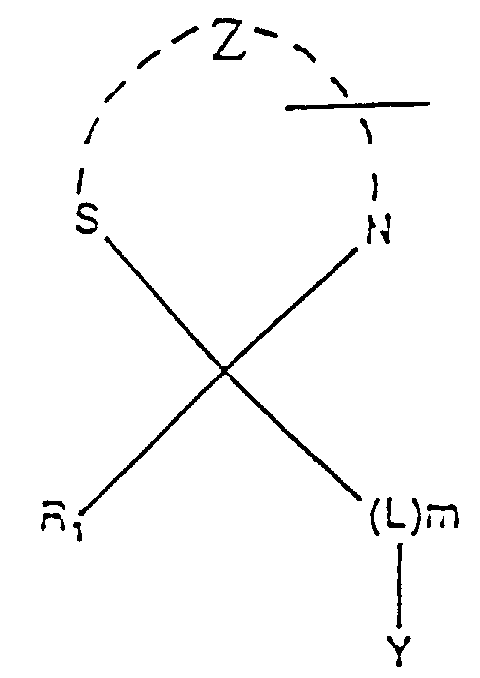
étant entendu que chaque groupe représenté par ladite formule est relié aux autres par un groupe de liaison chimique plurivalent, qui relie les groupes par l'intermédiaire de l'atome d'azote ou par l'intermédiaire des atomes de carbone représentés par Z. - Matériau pour enregistrement d'image selon la revendication 1, pour lequel ledit produit fournissant une couleur est représenté par la formule :dans laquelle Y et Y' représentent des fragments diffusibles fournissant une couleur, L et L' représentent des groupes de liaison organiques divalents, contenant au moins un atome de carbone, m et m', qui sont identiques ou différents, sont égaux à 0 ou 1, X représente un groupe de liaison chimique plurivalent, reliant les groupes cycliques 1,3-thia-aza, R1 et R2 représentent chacun un atome d'hydrogène ou un groupe organique monovalent, ou bien représentent avec L ou L', lorsque m ou m' est égal à 1, les atomes nécessaires pour former une structure spiro avec l'un des groupes cycliques 1,3-thia-aza, ou bien représentent avec Y ou Y', lorsque m ou m' est égal à 0, les atomes nécessaires pour former une structure spiro avec l'un des groupes cycliques 1,3-thia-aza, Z et Z' représentent les atomes nécessaires pour compléter un noyau hétérocyclique à 5 ou 6 chaínons, substitué ou non substitué, et x représente un nombre entier positif, ayant une valeur de 1 à 3.

- Matériau pour enregistrement d'image selon la revendication 2, pour lequel lesdits Y et Y' représentent des colorants complets.
- Matériau pour enregistrement d'image selon la revendication 1, pour lequel ledit produit fournissant une couleur est représenté par la formule :dans laquelle Y représente un fragment fournissant une couleur, L représente un groupe de liaison organique divalent, contenant au moins un atome de carbone, m est égal à 0 ou 1, X représente un groupe de liaison chimique plurivalent, reliant les groupes cycliques 1,3-thia-aza, R1 représente un atome d'hydrogène ou un groupe organique monovalent, ou bien représente avec L, lorsque m est égal à 1, les atomes nécessaires pour former une structure spiro avec l'un des groupes cycliques 1,3-thia-aza, ou bien représente avec Y, lorsque m est égal à 0, les atomes nécessaires pour former une structure spiro avec l'un des groupes cycliques 1,3-thia-aza, Z représente les atomes nécessaires pour compléter un noyau hétérocyclique à 5 ou 6 chaínons, substitué ou non substitué, et x représente un nombre entier positif, ayant une valeur de 1 à 3.
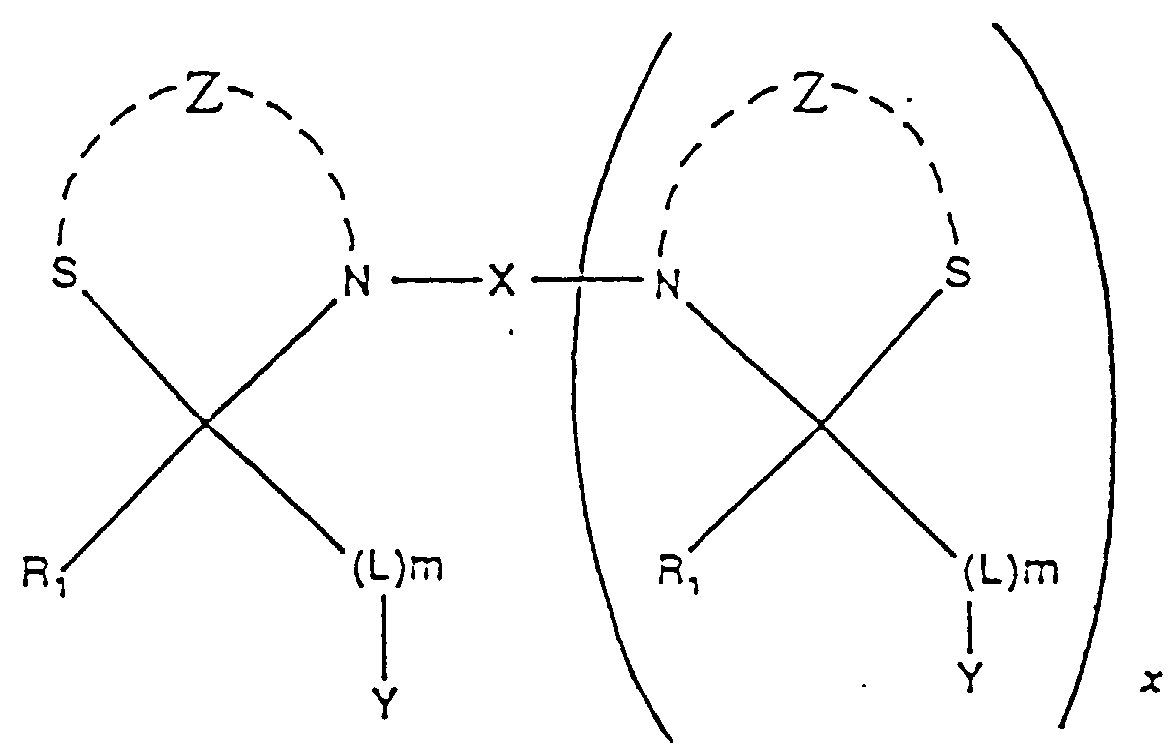
- Matériau pour enregistrement d'image selon la revendication 4, pour lequel ledit produit fournissant une couleur est représenté par la formule :dans laquelle L représente un groupe de liaison organique divalent, contenant au moins un atome de carbone, m est égal à O ou 1, R1 représente un atome d'hydrogène ou un groupe organique monovalent, ou bien représente avec L, lorsque m est égal à 1, les atomes nécessaires pour former une structure spiro avec l'un des groupes cycliques 1,3-thia-aza, ou bien représente avec D, lorsque m est égal à 0, les atomes nécessaires pour former une structure spiro avec l'un des groupes cycliques 1,3-thia-aza, X' représente un groupe organique bivalent, R3, R4, R5 et R6 représentent chacun un atome d'hydrogène ou un groupe organique monovalent, ou bien R3 et R4 pris ensemble ou R5 et R6 pris ensemble forment un noyau carbocyclique ou hétérocyclique, substitué ou non substitué, et D représente un colorant complet.
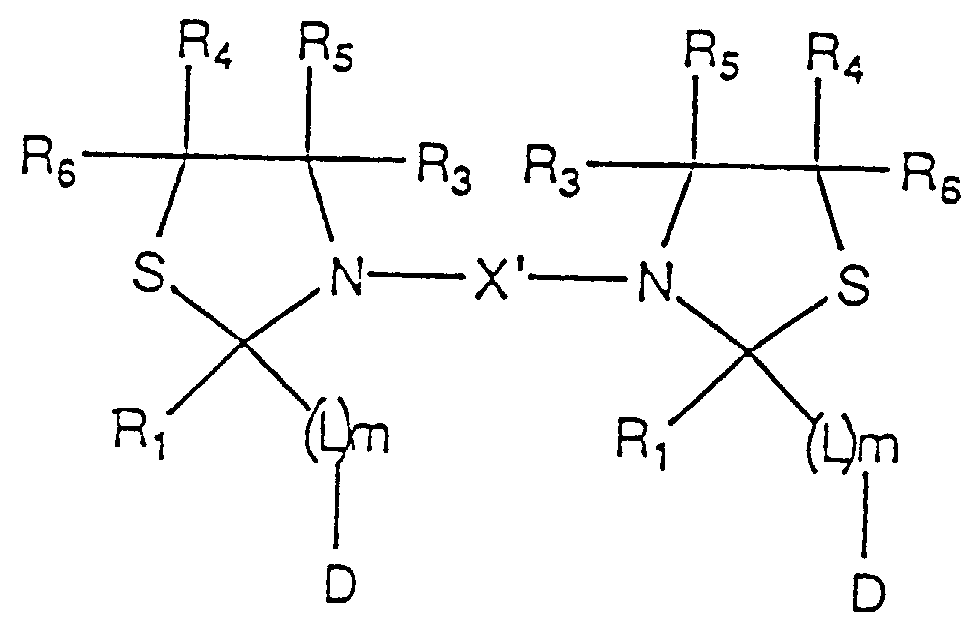
- Matériau pour enregistrement d'image selon la revendication 5, dans lequel m est égal à 1 et X' représente -R-O-R'-O-R- ou -R-, R et R' qui sont identiques ou différents, représentant des groupes alkylène.
- Matériau pour enregistrement d'image selon la revendication 5, dans lequel D représente :

- Matériau pour enregistrement d'image selon la revendication 5, pour lequel ledit produit fournissant une couleur répond à la formule :
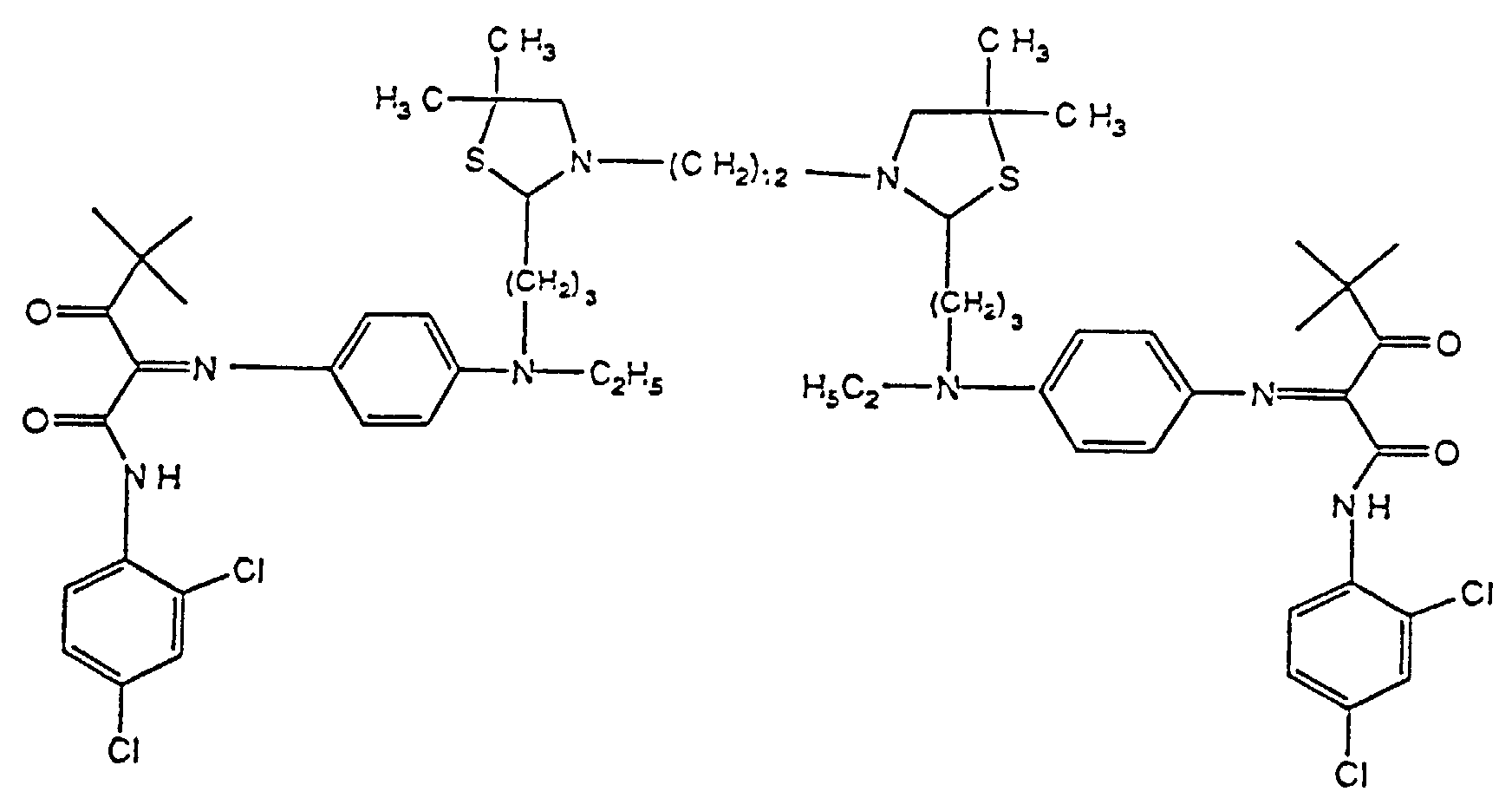
- Matériau pour enregistrement d'image selon l'une quelconque des revendications 1 à 8, qui est exempt de base et de précurseur de base.
- Matériau pour enregistrement d'image selon l'une quelconque des revendications 1 à 9, qui renferme en plus un produit oxydant sel d'argent, de préférence le sel d'argent du benzotriazole.
- Matériau pour enregistrement d'image selon l'une quelconque des revendications 1 à 10, qui contient en plus un ligand auxiliaire pour l'argent.
- Matériau pour enregistrement d'image selon l'une quelconque des revendications 1 à 11, qui contient en outre un halogénure d'argent photosensible, un réducteur et un liant, ledit liant étant de préférence de la gélatine.
- Matériau pour enregistrement d'image selon la revendication 12, qui contient en plus un durcisseur pour la gélatine.
- Composé comprenant deux à quatre groupes, identiques ou différents, représentés par la formule générale :dans laquelle Y représente un fragment fournissant une couleur, L représente un groupe de liaison organique divalent, contenant au moins un atome de carbone, m est égal à 0 ou 1, R1 représente un atome d'hydrogène ou un groupe organique monovalent, ou bien représente avec L, lorsque m est égal à 1, les atomes nécessaires pour former une structure spiro avec le groupe cyclique 1,3-thia-aza, ou bien représente avec Y, lorsque m est égal à 0, les atomes nécessaires pour former une structure spiro avec le groupe cyclique 1,3-thia-aza, et Z représente les atomes de carbone nécessaires pour compléter un noyau hétérocyclique à 5 ou 6 chaínons, substitué ou non substitué, étant entendu que chaque groupe représenté par ladite formule est relié aux autres par un groupe de liaison chimique plurivalent qui relie les groupes par l'intermédiaire de l'atome d'azote ou par l'intermédiaire des atomes de carbone représentés par Z.

- Composé selon la revendication 14, qui est représenté par la formule :dans laquelle Y et Y', qui sont identiques ou différents, représentent des fragments fournissant une couleur, L et L', qui sont identiques ou différents, représentent des groupes de liaison organiques divalents, contenant au moins un atome de carbone, m et m', qui sont identiques ou différents, représentent des nombres égaux à O ou 1, X représente un groupe de liaison chimique plurivalent, qui relie les groupes cycliques 1,3-thia-aza, R1 et R2 qui sont identiques ou différents, représentent chacun un atome d'hydrogène ou un groupe organique monovalent, ou bien représentent avec L ou L', lorsque m est égal à 1, les atomes nécessaires pour former une structure spiro avec l'un des groupes cycliques 1,3-thia-aza, ou bien représentent avec Y ou Y', lorsque m est égal à 0, les atomes nécessaires pour former une structure spiro avec l'un des groupes cycliques 1,3-thia-aza, Z et Z' représentent les atomes nécessaires pour compléter un noyau hétérocyclique à 5 ou 6 chaínons, substitué ou non substitué, et x représente un nombre entier positif, ayant une valeur de 1 à 3.
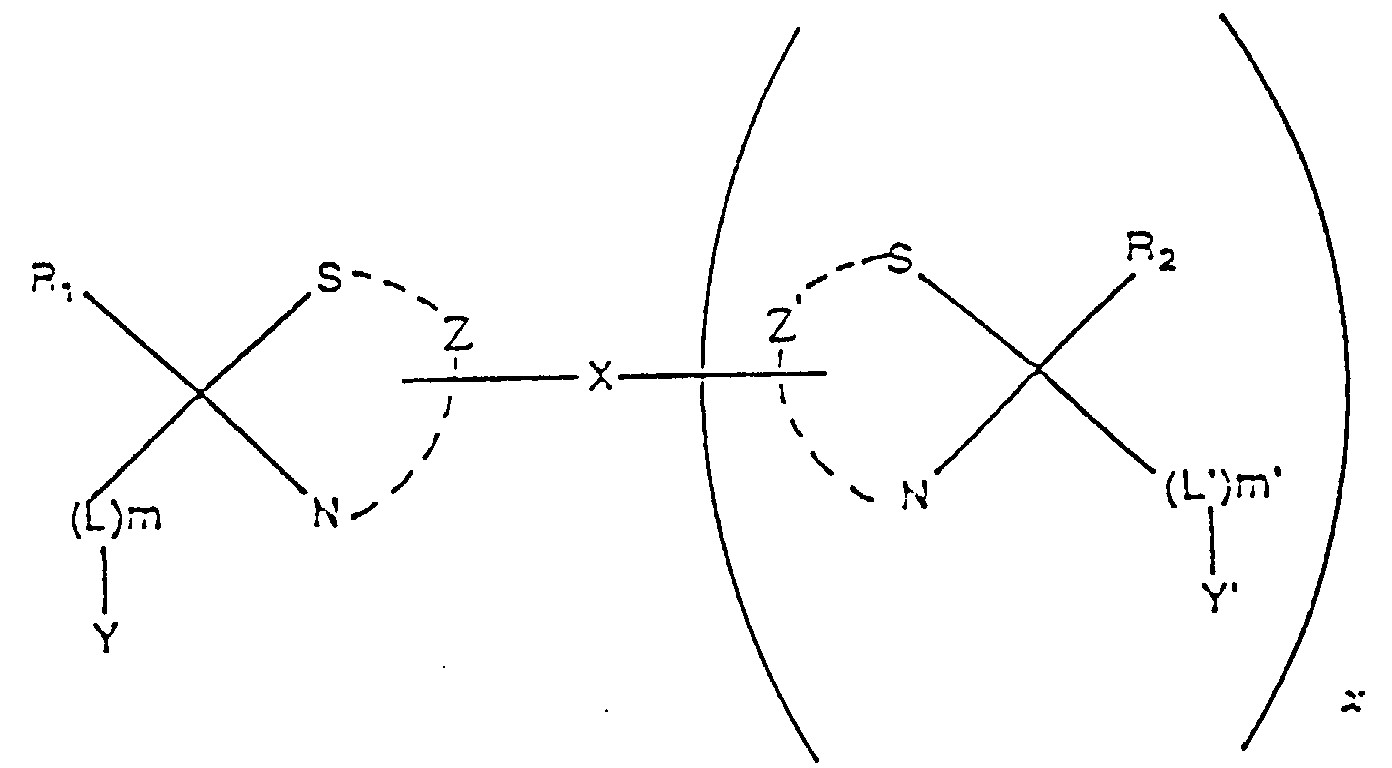
- Composé selon la revendication 15, dans lequel lesdits Y et Y' représentent des colorants complets.
- Composé selon la revendication 14, qui est représenté par la formule :dans laquelle Y représente un fragment fournissant une couleur, L représente un groupe de liaison organique divalent, contenant au moins un atome de carbone, m est égal à O ou 1, X représente un groupe de liaison chimique plurivalent, qui relie les groupes cycliques 1,3-thia-aza, R1 représente un atome d'hydrogène ou un groupe organique monovalent, ou bien représente avec L, lorsque m est égal à 1, les atomes nécessaires pour former une structure spiro avec l'un des groupes cycliques 1,3-thia-aza, ou bien représente avec Y, lorsque m est égal à 0, les atomes nécessaires pour former une structure spiro avec l'un des groupes cycliques 1,3-thia-aza, Z représente les atomes nécessaires pour compléter un noyau hétérocyclique à 5 ou 6 chaínons, substitué ou non substitué, et x représente un nombre entier positif, ayant une valeur de 1 à 3.

- Composé selon la revendication 17, qui est représenté par la formule :dans laquelle L représente un groupe de liaison organique divalent, contenant au moins un atome de carbone, m est égal à O ou 1, R1 représente un atome d'hydrogène ou un groupe organique monovalent, ou bien représente avec L, lorsque m est égal à 1, les atomes nécessaires pour former une structure spiro avec l'un des groupes cycliques 1,3-thia-aza, ou bien représente avec D, lorsque m est égal à 0, les atomes nécessaires pour former une structure spiro avec l'un des groupes cycliques 1,3-thia-aza, X représente un groupe organique bivalent, R3, R4, R5 et R6 représentent chacun un atome d'hydrogène ou un groupe organique monovalent, ou bien R3 et R4 pris ensemble ou R5 et R6 pris ensemble forment un noyau carbocyclique ou hétérocyclique, substitué ou non substitué, et D représente un colorant complet.

- Composé selon la revendication 18, dans lequel m est égal à 1 et X représente -R-O-R'-O-R- ou -R-, R et R' étant identiques ou différents et représentant des groupes alkylène.
- Composé selon la revendication 18, dans lequel D représente

- Composé selon la revendication 18, qui est représenté par la formule :
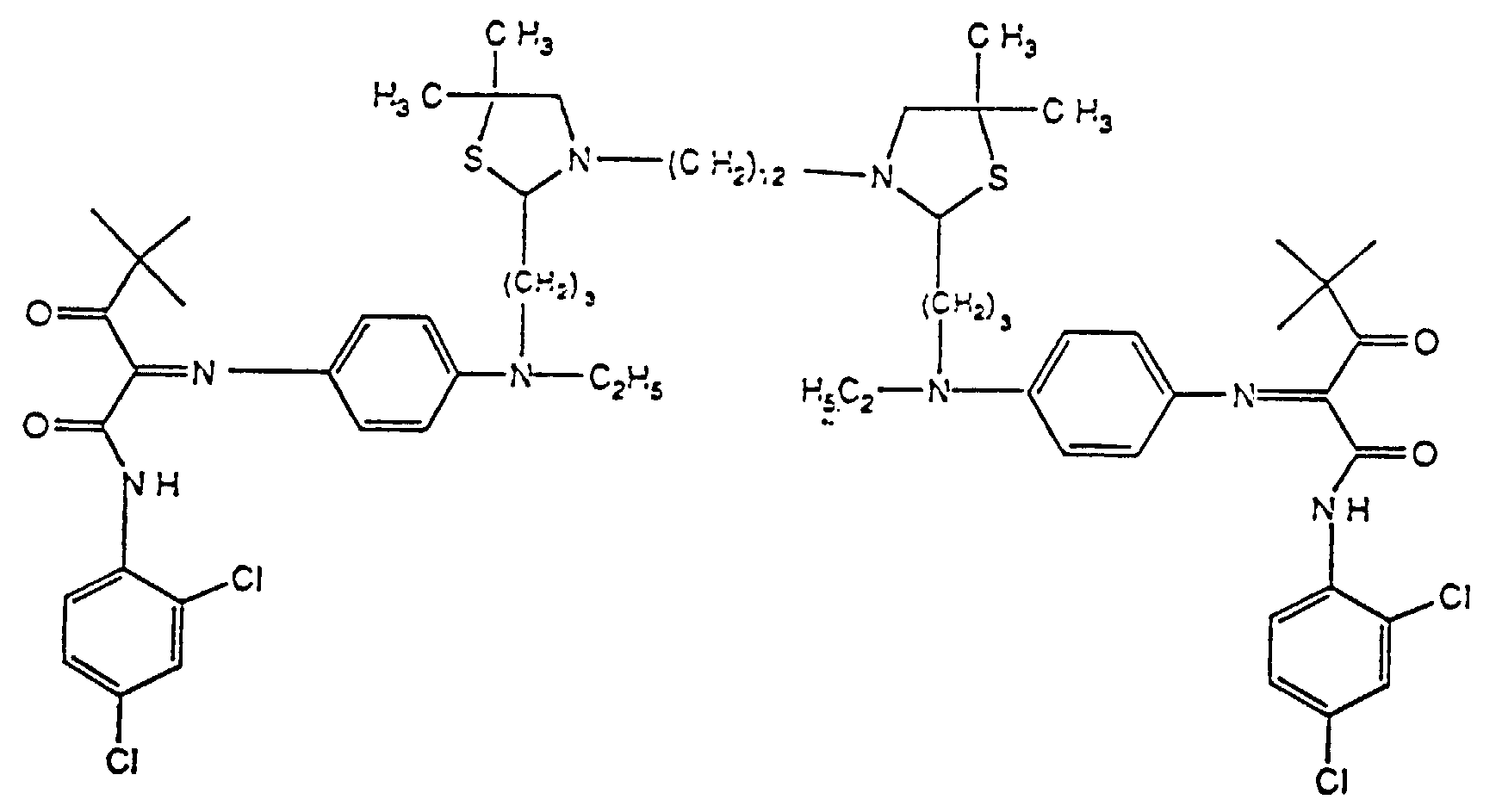
Applications Claiming Priority (3)
| Application Number | Priority Date | Filing Date | Title |
|---|---|---|---|
| US923843 | 1992-07-31 | ||
| US07/923,843 US5316887A (en) | 1992-07-31 | 1992-07-31 | Thermally developable photosensitive material |
| PCT/US1993/007048 WO1994003835A1 (fr) | 1992-07-31 | 1993-07-27 | Materiau photosensible developpable thermiquement |
Publications (2)
| Publication Number | Publication Date |
|---|---|
| EP0606465A1 EP0606465A1 (fr) | 1994-07-20 |
| EP0606465B1 true EP0606465B1 (fr) | 1999-02-17 |
Family
ID=25449342
Family Applications (1)
| Application Number | Title | Priority Date | Filing Date |
|---|---|---|---|
| EP93918418A Expired - Lifetime EP0606465B1 (fr) | 1992-07-31 | 1993-07-27 | Materiau photosensible developpable thermiquement |
Country Status (6)
| Country | Link |
|---|---|
| US (3) | US5316887A (fr) |
| EP (1) | EP0606465B1 (fr) |
| JP (1) | JP2945477B2 (fr) |
| CA (1) | CA2112240C (fr) |
| DE (1) | DE69323537T2 (fr) |
| WO (1) | WO1994003835A1 (fr) |
Families Citing this family (10)
| Publication number | Priority date | Publication date | Assignee | Title |
|---|---|---|---|---|
| US5340689A (en) * | 1992-07-31 | 1994-08-23 | Polaroid Corporation | Image-recording materials with cyclic 1,3-sulfur-nitrogen dye providing compounds |
| CA2119136C (fr) * | 1992-12-22 | 1997-06-10 | James R. Freedman | Enregistreur d'images thermographique |
| GB9404805D0 (en) * | 1994-03-11 | 1994-04-27 | Minnesota Mining & Mfg | Novel developing agents for (photo)thermographic systems |
| JPH08146579A (ja) * | 1994-11-24 | 1996-06-07 | Konica Corp | 拡散転写型熱現像感光材料 |
| US5569574A (en) * | 1995-11-13 | 1996-10-29 | Polaroid Corporation | Image-recording materials |
| US5667933A (en) * | 1996-02-26 | 1997-09-16 | Polaroid Corporation | Image-recording element |
| US5658705A (en) * | 1996-02-26 | 1997-08-19 | Polaroid Corporation | Image-recording materials with 1,3-sulfur-nitrogen dye releasers |
| US5716754A (en) * | 1996-09-18 | 1998-02-10 | Polaroid Corporation | Image-recording materials |
| US5691458A (en) * | 1996-09-18 | 1997-11-25 | Polaroid Corporation | Benzoisothiazole azo dyes |
| AU2002310202B2 (en) | 2001-05-30 | 2008-05-15 | Eisai Inc. | Thiolalkyl benzoic acid derivatives |
Family Cites Families (8)
| Publication number | Priority date | Publication date | Assignee | Title |
|---|---|---|---|---|
| US3719489A (en) * | 1971-06-21 | 1973-03-06 | Polaroid Corp | Novel photographic processes and products |
| US4098783A (en) * | 1974-04-30 | 1978-07-04 | Polaroid Corporation | Dye substituted cyclic 1,3-sulfur-nitrogen compounds as dye image-forming materials in photography |
| US4260677A (en) * | 1976-03-12 | 1981-04-07 | Minnesota Mining And Manufacturing Company | Thermographic and photothermographic materials having silver salt complexes therein |
| US4386150A (en) * | 1981-12-18 | 1983-05-31 | Polaroid Corporation | Novel image dye-providing materials and photographic products and processes |
| JPS59180548A (ja) * | 1983-03-31 | 1984-10-13 | Fuji Photo Film Co Ltd | 画像形成方法 |
| US4468448A (en) * | 1983-06-02 | 1984-08-28 | Polaroid Corporation | Photographic products and processes |
| US4535051A (en) * | 1984-08-27 | 1985-08-13 | Polaroid Corporation | Photographic products and processes with color shifted dye |
| EP0345839A1 (fr) * | 1988-06-07 | 1989-12-13 | Agfa-Gevaert N.V. | Composés libérant un colorant magenta |
-
1992
- 1992-07-31 US US07/923,843 patent/US5316887A/en not_active Expired - Fee Related
-
1993
- 1993-07-27 EP EP93918418A patent/EP0606465B1/fr not_active Expired - Lifetime
- 1993-07-27 DE DE69323537T patent/DE69323537T2/de not_active Expired - Fee Related
- 1993-07-27 CA CA 2112240 patent/CA2112240C/fr not_active Expired - Lifetime
- 1993-07-27 JP JP6505387A patent/JP2945477B2/ja not_active Expired - Fee Related
- 1993-07-27 WO PCT/US1993/007048 patent/WO1994003835A1/fr not_active Ceased
-
1994
- 1994-02-04 US US08/192,043 patent/US5415970A/en not_active Expired - Lifetime
- 1994-02-04 US US08/191,084 patent/US5430156A/en not_active Expired - Lifetime
Also Published As
| Publication number | Publication date |
|---|---|
| JPH06507259A (ja) | 1994-08-11 |
| US5430156A (en) | 1995-07-04 |
| EP0606465A1 (fr) | 1994-07-20 |
| US5316887A (en) | 1994-05-31 |
| US5415970A (en) | 1995-05-16 |
| DE69323537T2 (de) | 1999-06-17 |
| CA2112240A1 (fr) | 1994-02-01 |
| WO1994003835A1 (fr) | 1994-02-17 |
| CA2112240C (fr) | 1994-02-01 |
| JP2945477B2 (ja) | 1999-09-06 |
| DE69323537D1 (de) | 1999-03-25 |
Similar Documents
| Publication | Publication Date | Title |
|---|---|---|
| EP0606465B1 (fr) | Materiau photosensible developpable thermiquement | |
| EP0627096B1 (fr) | Matieres pour l'enregistrement d'images | |
| EP0665465B1 (fr) | Elément photosensible développable thermiquement | |
| EP0625942B1 (fr) | Materiau pour enregistrement d'images thermographique | |
| US5328799A (en) | Thermographic and photothermographic imaging materials | |
| WO1994014620A9 (fr) | Materiau pour enregistrement d'images thermographique | |
| US5658705A (en) | Image-recording materials with 1,3-sulfur-nitrogen dye releasers | |
| EP0803083B1 (fr) | Materiaux photographiques | |
| EP0626077B1 (fr) | Materiaux pour l'enregistrement d'images | |
| US5414091A (en) | Dye-providing compounds |
Legal Events
| Date | Code | Title | Description |
|---|---|---|---|
| PUAI | Public reference made under article 153(3) epc to a published international application that has entered the european phase |
Free format text: ORIGINAL CODE: 0009012 |
|
| 17P | Request for examination filed |
Effective date: 19940317 |
|
| AK | Designated contracting states |
Kind code of ref document: A1 Designated state(s): DE FR GB NL |
|
| 17Q | First examination report despatched |
Effective date: 19970707 |
|
| GRAG | Despatch of communication of intention to grant |
Free format text: ORIGINAL CODE: EPIDOS AGRA |
|
| GRAG | Despatch of communication of intention to grant |
Free format text: ORIGINAL CODE: EPIDOS AGRA |
|
| GRAH | Despatch of communication of intention to grant a patent |
Free format text: ORIGINAL CODE: EPIDOS IGRA |
|
| GRAH | Despatch of communication of intention to grant a patent |
Free format text: ORIGINAL CODE: EPIDOS IGRA |
|
| GRAA | (expected) grant |
Free format text: ORIGINAL CODE: 0009210 |
|
| AK | Designated contracting states |
Kind code of ref document: B1 Designated state(s): DE FR GB NL |
|
| PG25 | Lapsed in a contracting state [announced via postgrant information from national office to epo] |
Ref country code: NL Free format text: LAPSE BECAUSE OF FAILURE TO SUBMIT A TRANSLATION OF THE DESCRIPTION OR TO PAY THE FEE WITHIN THE PRESCRIBED TIME-LIMIT Effective date: 19990217 Ref country code: FR Free format text: THE PATENT HAS BEEN ANNULLED BY A DECISION OF A NATIONAL AUTHORITY Effective date: 19990217 |
|
| ET | Fr: translation filed | ||
| REF | Corresponds to: |
Ref document number: 69323537 Country of ref document: DE Date of ref document: 19990325 |
|
| PGFP | Annual fee paid to national office [announced via postgrant information from national office to epo] |
Ref country code: GB Payment date: 19990618 Year of fee payment: 7 |
|
| PGFP | Annual fee paid to national office [announced via postgrant information from national office to epo] |
Ref country code: DE Payment date: 19990628 Year of fee payment: 7 |
|
| NLV1 | Nl: lapsed or annulled due to failure to fulfill the requirements of art. 29p and 29m of the patents act | ||
| PLBE | No opposition filed within time limit |
Free format text: ORIGINAL CODE: 0009261 |
|
| STAA | Information on the status of an ep patent application or granted ep patent |
Free format text: STATUS: NO OPPOSITION FILED WITHIN TIME LIMIT |
|
| 26N | No opposition filed | ||
| REG | Reference to a national code |
Ref country code: FR Ref legal event code: ST |
|
| PG25 | Lapsed in a contracting state [announced via postgrant information from national office to epo] |
Ref country code: GB Free format text: LAPSE BECAUSE OF NON-PAYMENT OF DUE FEES Effective date: 20000727 |
|
| GBPC | Gb: european patent ceased through non-payment of renewal fee |
Effective date: 20000727 |
|
| PG25 | Lapsed in a contracting state [announced via postgrant information from national office to epo] |
Ref country code: DE Free format text: LAPSE BECAUSE OF NON-PAYMENT OF DUE FEES Effective date: 20010501 |