EP0606778B1 - Zigarettenherstellungsmaschine - Google Patents
Zigarettenherstellungsmaschine Download PDFInfo
- Publication number
- EP0606778B1 EP0606778B1 EP93310614A EP93310614A EP0606778B1 EP 0606778 B1 EP0606778 B1 EP 0606778B1 EP 93310614 A EP93310614 A EP 93310614A EP 93310614 A EP93310614 A EP 93310614A EP 0606778 B1 EP0606778 B1 EP 0606778B1
- Authority
- EP
- European Patent Office
- Prior art keywords
- tobacco
- approximately
- air
- fibres
- heat source
- Prior art date
- Legal status (The legal status is an assumption and is not a legal conclusion. Google has not performed a legal analysis and makes no representation as to the accuracy of the status listed.)
- Expired - Lifetime
Links
- 235000019504 cigarettes Nutrition 0.000 title abstract description 39
- 230000006872 improvement Effects 0.000 title description 3
- 238000010438 heat treatment Methods 0.000 claims abstract description 30
- 238000005188 flotation Methods 0.000 claims abstract description 17
- 238000000034 method Methods 0.000 claims abstract description 15
- 241000208125 Nicotiana Species 0.000 claims description 116
- 235000002637 Nicotiana tabacum Nutrition 0.000 claims description 116
- XLYOFNOQVPJJNP-UHFFFAOYSA-N water Substances O XLYOFNOQVPJJNP-UHFFFAOYSA-N 0.000 claims description 9
- 238000004891 communication Methods 0.000 claims description 4
- 239000012530 fluid Substances 0.000 claims description 4
- 239000000835 fiber Substances 0.000 claims 1
- 239000002245 particle Substances 0.000 abstract description 17
- 239000000945 filler Substances 0.000 abstract description 11
- 230000015556 catabolic process Effects 0.000 description 8
- 238000006731 degradation reaction Methods 0.000 description 8
- 238000012856 packing Methods 0.000 description 7
- 239000000428 dust Substances 0.000 description 5
- 230000008569 process Effects 0.000 description 5
- 230000000694 effects Effects 0.000 description 4
- 230000005855 radiation Effects 0.000 description 4
- 238000000926 separation method Methods 0.000 description 4
- 230000001133 acceleration Effects 0.000 description 3
- 238000004519 manufacturing process Methods 0.000 description 3
- 238000002156 mixing Methods 0.000 description 3
- XAGFODPZIPBFFR-UHFFFAOYSA-N aluminium Chemical compound [Al] XAGFODPZIPBFFR-UHFFFAOYSA-N 0.000 description 2
- 229910052782 aluminium Inorganic materials 0.000 description 2
- 239000004411 aluminium Substances 0.000 description 2
- 210000001520 comb Anatomy 0.000 description 2
- 238000009826 distribution Methods 0.000 description 2
- 238000000605 extraction Methods 0.000 description 2
- 239000000203 mixture Substances 0.000 description 2
- 238000012986 modification Methods 0.000 description 2
- 230000004048 modification Effects 0.000 description 2
- 238000012545 processing Methods 0.000 description 2
- 230000000391 smoking effect Effects 0.000 description 2
- 229910001220 stainless steel Inorganic materials 0.000 description 2
- 239000010935 stainless steel Substances 0.000 description 2
- 229920005439 Perspex® Polymers 0.000 description 1
- 230000000712 assembly Effects 0.000 description 1
- 238000000429 assembly Methods 0.000 description 1
- 230000015572 biosynthetic process Effects 0.000 description 1
- 238000009960 carding Methods 0.000 description 1
- 238000001816 cooling Methods 0.000 description 1
- 230000001419 dependent effect Effects 0.000 description 1
- 238000010586 diagram Methods 0.000 description 1
- 239000000796 flavoring agent Substances 0.000 description 1
- 235000019634 flavors Nutrition 0.000 description 1
- 238000011835 investigation Methods 0.000 description 1
- 239000000463 material Substances 0.000 description 1
- 239000004033 plastic Substances 0.000 description 1
- 229920003023 plastic Polymers 0.000 description 1
- 239000004926 polymethyl methacrylate Substances 0.000 description 1
- 230000009467 reduction Effects 0.000 description 1
- 238000005728 strengthening Methods 0.000 description 1
- 239000008400 supply water Substances 0.000 description 1
- 238000012546 transfer Methods 0.000 description 1
- 210000003462 vein Anatomy 0.000 description 1
Images


Classifications
-
- A—HUMAN NECESSITIES
- A24—TOBACCO; CIGARS; CIGARETTES; SIMULATED SMOKING DEVICES; SMOKERS' REQUISITES
- A24C—MACHINES FOR MAKING CIGARS OR CIGARETTES
- A24C5/00—Making cigarettes; Making tipping materials for, or attaching filters or mouthpieces to, cigars or cigarettes
- A24C5/14—Machines of the continuous-rod type
- A24C5/18—Forming the rod
- A24C5/1864—Conditioning means, e.g. drying
Definitions
- This invention relates to the processing of cigarette tobacco and in particular to the making of cigarettes with reduced packing density without significant loss of firmness.
- pneumatic conveying systems are used to transport the cut tobacco filler to the cigarette maker.
- An air lock at the entrance to the cigarette maker is used to separate the tobacco from the driving air stream, with the tobacco dropping out of the air lock into a hopper.
- the hopper is equipped with means to form a uniform tobacco flow, open out the bulk tobacco and generate single fibres, and to eliminate foreign parts and stems.
- the tobacco is fed in small portions into a reservoir from which a steep-angle conveyer belt armed with needles or spikes continuously feeds the tobacco into a bulking chute.
- a level sensor in combination with a speed control of the steep-angle conveyer belt keeps the level in the hopper constant.
- At the downstream end of the chute is a discharge roller armed with needles.
- This roller picks up the tobacco at a uniform rate generating a continuous flow of tobacco.
- a relatively fast rotating picker-roller then combs the tobacco out of the carded drum and projects it into a fast-moving air stream belt.
- winnowers generally veins and stems of the tobacco leaf
- a rotating collector tube supports the upward acceleration of the fibres. During this transport and heavy particle separation process some degradation of tobacco particles occurs leading to a loss in quality of resulting cigarettes.
- the tobacco rod is formed by a narrow perforated conveyor belt of about eight to ten millimetres in width moving quickly at right angles to the direction of pneumatic conveyance. Degradation in cigarette making machines occurs mostly in the elevator conveyor, carding drums and picker winnower assemblies.
- Characteristics of cigarettes which are affected by the tobacco are generally considered to include (a) smoking flavour, (b) occurrences of spotting, (c) firmness of the tobacco rod, (d) collapse during smoking, (e) cull strength, and (f) degree of end fallout. Characteristics, or attributes, (c) to (f) are purely physical and normally can be predicted with a high degree of confidence by four properties of the tobacco rod. Those properties are (i) tobacco packing density, (ii) blend filling power, (iii) level and type of add-backs, and (iv) particle size distribution.
- the fragility of cigarettes is closely related to the packing density of the tobacco and to particle size. Reduction of the packing density using current manufacturing methods has not been satisfactorily achieved as the resulting cigarettes tend to be too fragile leading to significant handling losses. Further, the tobacco particle size normally found in cigarettes produced by current manufacturing methods is generally well below that which would produce optimum quality cigarettes. There are several reasons for this, including ( ⁇ ) the size of the threshed lamina, ( ⁇ ) the primary processing, ( ⁇ ) the handling of the cut filler, and ( ⁇ ) degradation of tobacco particles in the cigarette making machine.
- DE-C-903 436 discloses a drier for cut tobacco in which relatively warm air is blown through a layer of tobacco on a conveyor belt.
- DE-A-2 211 520 discloses apparatus for preparing tobacco comprising a tobacco supply including a carded drum, a conveyor for conveying the separated tobacco fibres to a tobacco rod former and a heat source for heating the separated tobacco fibres prior to the said conveying means.
- apparatus for preparing tobacco comprising means for supplying tobacco, means for separating supplied tobacco into fibres, means for conveying the separated tobacco fibres to a tobacco rod former and a heat source for heating the separated tobacco fibres prior to said conveying means conveying the separated tobacco fibres to the rod former, characterised in that the apparatus further comprises a flotation chamber in fluid communication with the supplying means and the conveying means, means for winnowing undesired components from the separated tobacco fibres in the flotation chamber before the undesired components are conveyed to the rod former and first ducting for directing air from the heat source to the flotation chamber to heat tobacco fibres therein.
- a method of preparing tobacco comprising the steps of providing to a pneumatic chimney a supply of tobacco fibres having a moisture content greater than approximately 12.4%, pneumatically conveying the supply of tobacco fibres to a tobacco rod former via driven air, and heating the tobacco fibres in the pneumatic chimney prior to arrival at the tobacco rod former characterised in that the tobacco fibres are heated in the pneumatic chimney to a temperature greater than approximately 35°C.
- particles of tobacco filler having a moisture content of between 13.5% and 17% by weight are heated by being exposed to a heating means having a temperature of between 35° and 60° Celsius before being formed into tobacco rods.
- a heating means having a temperature of between 35° and 60° Celsius before being formed into tobacco rods.
- a temperature range of between 43° and 52° Celsius is employed.
- the heating means may be selected from infrared radiation sources, hot water jackets, heating coils, microwave radiation sources or air heated by any one or more of the foregoing.
- the heating process may take place during the acceleration of the tobacco filler particles from the distributor up to the permeable rod conveyor belt or from the tobacco feeding system supplying the distributor.
- an improved cigarette making machine wherein the improvement comprises the provision of means to heat tobacco filler particles prior to the making of cigarettes.
- the heating means may comprise or may be selected from infrared radiation sources, hot water jackets, heating coils, microwave radiation sources or air heated by any one or more of the foregoing.
- the heating means is heated air fed into the pneumatic conveying system either prior to entry of the tobacco filler into the cigarette maker or prior to the making of tobacco rod.
- the making of cigarettes from tobacco fibres heated in this way has been found to result in reduced degradation of the tobacco during transport and reduced degradation within the cigarette maker.
- the first effect arises because the employment of an elevated temperature during cigarette making increases the moisture loss during the transport of tobacco material between the hopper and the cigarette maker.
- the initial moisture content in the cut filler must be higher than would be the case were the tobacco to be at a lower temperature. This increase in moisture content is believed to result in better resistance to degradation during mechanical and pneumatic handling.
- attempts to produce cigarettes using cut filler at ambient temperature and having a high moisture content resulted in inferior products.
- a second effect arises from the imparting of a false order to the tobacco particles due to the heating itself, contributing to increased pliability of the tobacco particles which has the effect of potentially reducing degradation during the cigarette making process.
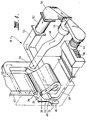
- the numeral 10 denotes a predistributor hopper containing cut tobacco 12.
- Level sensor 14 in combination with a speed control of steep-angle conveyor 16 keeps the level of tobacco below a predetermined maximum so that the pressure against the steep-angle conveyor 16, and consequently the amount of tobacco picked up by needles 18, is very uniform.
- the steep-angle conveyor continuously feeds cut tobacco past refuse roller 20 and elevator cleaner 22 into a bulking chute 24.
- a carded drum 26 armed with needles 28 at the downstream end of bulk chute 24 picks up the cut tobacco at a uniform rate thereby generating a continuous flow of tobacco.
- Counter-rotating smaller carded drum 30 thins out the layer of cut tobacco on the surface of carded drum.
- a relatively fast rotating picker-roller 32 combs the tobacco off the surface of the carded drum 26 and projects it into an upwardly directed fast-moving air stream generated by air passing through jet block 34.
- Rotating collector tube 36 supports the upward acceleration of the cut tobacco. Winnowers are separated out of the air stream because of differences in ratio of particle mass to aerodynamic resistance. Further separation occurs in flotation chamber 38 with the winnowers falling into spill pipe 40. The tobacco particles are accelerated up chimney 42 to the cigarette forming part of the maker.
- Modification of the cigarette maker to put the invention into effect includes removing the standard and small fan 44 and small fan motor 46 from within the confines of the making machine and relocating them to the rear of the machine.
- the fan speed is increased by using different pulleys.
- Ducting 48 incorporating sliding joints to allow for variation between machines, is installed between fan 44 and dust separator 50.
- a heat exchanger 52 is interposed in existing ducting 54 between the small fan 44 and the flotation chamber 38, at a 90° bend 56.
- the plastic air diffuser in the ducting is replaced by a stainless steel diffuser 58 to prevent warping. Air, after heating in heat exchanger 52, passes along ducting 54 to the stainless steel diffuser from whence it is diverted evenly up the chimney door after passing through jet block 34.
- the tobacco particles are heated whilst being transported over the jet block 34 and within the flotation chamber 38. Return air goes through ducting 48, via dust separator 50, to small fan 44 thus completing the loop.
- the dust separator 50 performs the same functions as in an unmodified cigarette maker.
- the temperature of the air stream after heating of the tobacco has occurred is measured by a thermocouple at the top of chimney 42.
- the temperature is monitored by a Eurotherm control device (not shown here) which also activates a motorised, three-way mixing valve in the pipes (not shown here) which supply water to the heat exchanger 52.
- the water temperature in the heat exchanger 52 is maintained at a substantially constant 82° Celsius by means of a boiler system (not shown here). With water flow controlled and air speed substantially constant, the heat exchanger 52 maintains air temperature in the ducting 54 at between 35° Celsius and 60° Celsius.
- a perspex cover plate 60 is fitted to the front of the chamber, allowing a two to eight millimetre adjustable gap 62 for air entry.
- An aluminium strengthening bar 64 is used at the base of the cover to prevent warping.
- Heated air to the flotation chamber 38 is drawn through a heating coil 66 ( Figures 3 and 4), located at the rear of the machine, and a 50 millimetre by 600 millimetre duct 68 located under the machine.
- the hot water supplied to the heating coil 66 is connected in series to the heat exchanger 52.
- Tobacco stem is extracted to the central dust system after separation in the flotation chamber.
- the object of the flotation chamber is to remove overlarge stem pieces from the tobacco mix.
- the temperature of the air drawn into the chamber is increased by a six row heating coil.
- This heating coil provides even heat transfer from aluminium fins within the casing. Hot water flow rate through the coil is the same as for the heat exchanger. Variations in inlet temperature are slight, as the air is drawn into the chamber at a low velocity.
- Stem extraction to the central system is via a spill pipe 40, which is installed as a kit and passes under the machine. Air temperature in chimney 42 is dependent on the flotation chamber setting.
- An enlarged rear vent 70 is provided to direct air flow and stop tobacco entering the spill pipe and dust extraction system.
- a motor driven mixing valve is used to proportion water to the heat exchanger. With velocity held constant by the fan, air passing through can be controlled to ⁇ 1° Celsius. Temperature is sensed at the chimney exit by a PT100 thermocouple and a Eurotherm type 818 controller may be used to adjust the three way mixing valve in the water supply. Flow to the system may be stopped either by turning off the control or manually controlling the valve.
- the Eurotherm device may incorporate preset alarms which can be used to shut down the making machine should water temperature be outside pre-defined upper and lower limits.
Landscapes
- Manufacture Of Tobacco Products (AREA)
- Manufacturing Of Cigar And Cigarette Tobacco (AREA)
- Formation And Processing Of Food Products (AREA)
- Mechanical Pencils And Projecting And Retracting Systems Therefor, And Multi-System Writing Instruments (AREA)
- Processes Of Treating Macromolecular Substances (AREA)
Claims (30)
- Vorrichtung (10) zum Vorbereiten von Tabak, umfassend eine Einrichtung zum Zuführen von Tabak, eine Einrichtung (26,30) zum Separieren von zugeführtem Tabak in Fasern, eine Einrichtung zum Fördern der separierten Tabakfasern zu einer Tabakstrangbildungseinrichtung und eine Wärmequelle (52,66) zum Erwärmen der separierten Tabakfasern vor der Fördereinrichtung, die die separierten Tabakfasern zur Strangbildungseinrichtung fördert, dadurch gekennzeichnet, daß die Vorrichtung weiter umfaßt: eine Flotationskammer (38) in Fluidverbindung mit der Zufuhreinrichtung und der Fördereinrichtung, eine Einrichtung zum Abtrennen von unerwünschten Bestandteilen aus den separierten Tabakfasern in der Flotationskammer, bevor die unerwünschten Bestandteile zur Strangbildungseinrichtung gefördert werden, sowie eine erste Leitung (68), um Luft von der Wärmequelle zur Flotationskammer zu leiten, um Tabakfasern darin zu erwärmen.
- Vorrichtung nach Anspruch 1, bei der die Tabakzufuhreinrichtung Tabak zuführt, der einen Feuchtigkeitsgehalt aufweist, der größer ist als etwa 12,4%.
- Vorrichtung nach Anspruch 1 oder 2, bei der die Tabakzufuhreinrichtung Tabak zuführt, der einen Feuchtigkeitsgehalt bis zu etwa 17% aufweist.
- Vorrichtung nach Anspruch 1, 2 oder 3, bei der die Wärmequelle die separierten Tabakfasern auf eine Temperatur erwärmt, die höher ist als etwa 35°C.
- Vorrichtung nach einem vorangehenden Anspruch, bei der die Wärmequelle eine Temperatur zwischen etwa 35°C und etwa 60°C aufweist.
- Vorrichtung nach Anspruch 1, 2, 3 oder 4, bei der die Wärmequelle eine Temperatur zwischen etwa 43°C und etwa 52°C aufweist.
- Vorrichtung nach einem vorangehenden Anspruch, bei der die Fördereinrichtung ein Gebläse (44) umfaßt, das Blasluft bereitstellt, um die Tabakfasern zu fördern.
- Vorrichtung nach einem vorangehenden Anspruch, bei der die Fördereinrichtung umfaßt: einen Luftkamin (42), der Blasluft bereitstellt, die die separierten Tabakfasern fördert, und weiter umfaßt: eine zweite Leitung (54), um die erwärmte Luft von der Wärmequelle (52,66) zu der die separierten Tabakfasern fördernden Blasluft des Luftkamins zu leiten, um die Tabakfasern zu erwärmen.
- Vorrichtung nach Anspruch 8, bei der die zweite Leitung (54) zum Leiten der erwärmten Luft umfaßt: eine Leitung, die von der Wärmequelle (52,66) zum Luftkamin (42) führt, an eine Stelle, wo die separierten Fasern anfänglich durch Blasluft aus der Luftkammer gefördert werden.
- Vorrichtung nach Anspruch 8 oder 9, bei der die Fördereinrichtung weiter umfaßt: ein Gebläse (44), das die Blasluft zum Luftkamin liefert, wobei der Gebläse Luft zum Erwärmen an der Wärmequelle (52,66) vorbei durch die zweite Leitung (54) zum Luftkamin (42) bläst.
- Vorrichtung nach Anspruch 8, 9 oder 10, bei der die Wärmequelle (52,66) die vorbeigeleitete Luft auf zwischen etwa 35°C und etwa 50°C erwärmt.
- Vorrichtung nach Anspruch 8, 9, 10 oder 11 weiter umfassend: eine dritte Leitung (48), um Luft zum Erwärmen zur Wärmequelle zu leiten, wobei die dritte Leitung in Fluidverbindung mit dem Luftkamin (42) steht, wodurch ein geschlossener Luftkreislauf gebildet wird.
- Vorrichtung nach Anspruch 12, bei der der Luftkamin (42) die erwärmten Tabakfasern zu einem Transportband fördert, das sich unter einem rechten Winkel dazu bewegt, wobei die dritte Leitung (48) zum Leiten von Luft zur Wärmequelle mit dem Luftkamin (42) an einem Oberteil des Kamins vor dem Transportband in Fluidverbindung steht.
- Vorrichtung nach einem der Ansprüche 8 bis 13, bei der die Wärmequelle umfaßt: einen ersten Erhitzer (52) zum Erwärmen von Luft, die zum Luftkamin (42) geblasen wird, und einen zweiten Erhitzer (66) zum Erwärmen von Luft, die zur Flotationskammer (38) geblasen wird.
- Vorrichtung nach einem der Ansprüche 8 bis 14, bei der der Luftkamin (42) eine obere Öffnung aufweist, die unmittelbar mit der Tabakstrangbildungseinrichtung in Verbindung steht.
- Vorrichtung nach einem vorangehenden Anspruch, bei der die Wärmequelle ein Wärmetauscher (52) ist.
- Vorrichtung nach einem vorangehenden Anspruch, bei der die Wärmequelle ein Wärmetauscher (52) ist, der heißes Wasser enthält.
- Vorrichtung nach Anspruch 17, bei der das heiße Wasser etwa 82°C heiß ist.
- Vorrichtung nach einem vorangehenden Anspruch, weiter umfassend eine Steuereinrichtung zum Steuern der Temperatur der Wärmequelle.
- Vorrichtung nach einem vorangehenden Anspruch, bei der die Wärmequelle eine Heizschlange (66) umfaßt.
- Vorrichtung nach einem vorangehenden Anspruch, weiter umfassend eine Einrichtung zum Verändern eines Volumens der Flotationskammer, wobei die Volumenveränderungseinrichtung eine Temperatur von erwärmter Luft verändert, um Tabakfasern darin zu erwärmen.
- Vorrichtung nach einem vorangehenden Anspruch, bei der die Tabakzufuhreinrichtung Tabak zuführt, der einen Feuchtigkeitsgehalt aufweist, der größer ist als etwa 13,5%.
- Vorrichtung nach einem vorangehenden Anspruch, bei der die Tabakzufuhreinrichtung Tabak zuführt, der einen Feuchtigkeitsgehalt aufweist, der zwischen etwa 13,5% und etwa 17% liegt.
- Verfahren zum Vorbereiten von Tabak, umfassend die Schritte: Liefern eines Nachschubs von Tabakfasern mit einem Feuchtigkeitsgehalt, der größer ist als etwa 12,4%, zu einem Luftkamin (42), pneumatisches Fördern des Nachschubs von Tabakfasern zu einer Tabakstrangbildungseinrichtung durch Blasluft und Erwärmen der Tabakfasern im Luftkamin vor der Ankunft an der Tabakstrangbildungseinrichtung, dadurch gekennzeichnet, daß die Tabakfasern im Luftkamin auf eine Temperatur erwärmt werden, die größer ist als etwa 35°C.
- Verfahren nach Anspruch 24, bei dem der Lieferschritt das Bereitstellen von Tabak mit einem Feuchtigkeitsgehalt bis zu etwa 17% umfaßt.
- Verfahren nach Anspruch 24 oder 25, bei dem der Erwärmungsschritt ein Erwärmen der Tabakfasern auf eine Temperatur zwischen etwa 35°C und etwa 65°C umfaßt.
- Verfahren nach einem der Ansprüche 24, 25 oder 26, bei dem der Erwärmungsschritt ein Erwärmen der Tabakfasern auf eine Temperatur zwischen etwa 43°C und etwa 52°C umfaßt.
- Verfahren nach einem der Ansprüche 24 bis 27, bei dem der Erwärmungsschritt ein Erwärmen der Blasluft auf zwischen etwa 35°C und etwa 50°C umfaßt.
- Verfahren nach einem der Ansprüche 24 bis 28, bei dem der Lieferschritt Bereitstellen von Tabak mit einem Feuchtigkeitsgehalt, der größer ist als etwa 13,5%, umfaßt.
- Verfahren nach einem der Ansprüche 24 bis 29, bei dem der Lieferschritt Bereitstellen von Tabak mit einem Feuchtigkeitsgehalt zwischen etwa 13,5% und etwa 17% umfaßt.
Applications Claiming Priority (3)
| Application Number | Priority Date | Filing Date | Title |
|---|---|---|---|
| AUPL6631/92 | 1992-12-31 | ||
| AUPL663192 | 1992-12-31 | ||
| AUPL663192 | 1992-12-31 |
Publications (2)
| Publication Number | Publication Date |
|---|---|
| EP0606778A1 EP0606778A1 (de) | 1994-07-20 |
| EP0606778B1 true EP0606778B1 (de) | 1999-08-04 |
Family
ID=3776635
Family Applications (1)
| Application Number | Title | Priority Date | Filing Date |
|---|---|---|---|
| EP93310614A Expired - Lifetime EP0606778B1 (de) | 1992-12-31 | 1993-12-30 | Zigarettenherstellungsmaschine |
Country Status (8)
| Country | Link |
|---|---|
| US (1) | US5533528A (de) |
| EP (1) | EP0606778B1 (de) |
| AT (1) | ATE182751T1 (de) |
| BR (1) | BR9305387A (de) |
| DE (1) | DE69325885T2 (de) |
| ES (1) | ES2134831T3 (de) |
| GR (1) | GR3031247T3 (de) |
| SG (1) | SG52737A1 (de) |
Families Citing this family (3)
| Publication number | Priority date | Publication date | Assignee | Title |
|---|---|---|---|---|
| US5908032A (en) * | 1996-08-09 | 1999-06-01 | R.J. Reynolds Tobacco Company | Method of and apparatus for expanding tobacco |
| CN102000665B (zh) * | 2010-10-29 | 2013-01-23 | 广东中烟工业有限责任公司 | 用于烟丝掺配的多级风选机 |
| MX364209B (es) * | 2012-04-30 | 2019-04-16 | Philip Morris Products Sa | Substrato de tabaco. |
Family Cites Families (19)
| Publication number | Priority date | Publication date | Assignee | Title |
|---|---|---|---|---|
| US1785822A (en) * | 1924-01-25 | 1930-12-23 | Int Cigar Mach Co | Cigar machine |
| DE560878C (de) * | 1931-11-18 | 1932-10-07 | Neuerburg Sche Verwaltungsgese | Verfahren zum Herstellen packfertiger Zigaretten |
| DE903436C (de) * | 1939-08-24 | 1954-02-04 | Reemtsma Cigarettenfabriken G | Verfahren und Vorrichtung zur Herstellung von packfertigen Zigaretten |
| US2737955A (en) * | 1950-02-08 | 1956-03-13 | Koerber & Co Kg | Method and apparatus for drying tobacco products |
| US2747581A (en) * | 1953-04-24 | 1956-05-29 | Arenco Ab | Apparatus for shaping and drying cigar bunches or the like |
| GB953862A (en) * | 1959-04-17 | 1964-04-02 | Desmond Walter Molins | Improvements in or relating to continuous rod cigarette-making machines |
| US3057361A (en) * | 1961-08-28 | 1962-10-09 | Jno H Swisher & Son Inc | Cigar shaping method and apparatus |
| GB1224972A (en) * | 1969-02-27 | 1971-03-10 | British American Tobacco Co | Improvements relating to cigarette-making machinery |
| US3974839A (en) * | 1971-10-19 | 1976-08-17 | Hauni-Werke Korber & Co., Kg | Conditioning of tobacco |
| DE2211520A1 (de) * | 1972-03-10 | 1973-09-13 | Hauni Werke Koerber & Co Kg | Verfahren und vorrichtung zum bilden eines zigarettenstranges |
| US3773055A (en) * | 1972-04-17 | 1973-11-20 | Brown & Williamson Tobacco Corp | Microwave treatment of cigarettes on a making machine |
| US4333482A (en) * | 1980-07-22 | 1982-06-08 | Philip Morris Incorporated | Process for increasing filling power of reconstituted tobacco |
| US4488562A (en) * | 1982-08-03 | 1984-12-18 | Philip Morris, Incorporated | Cigarette making with temperature conditioning |
| US4966170A (en) * | 1984-08-03 | 1990-10-30 | Philip Morris Incorporated | Tobacco processing |
| DE3543358A1 (de) * | 1985-12-07 | 1987-06-11 | Hauni Werke Koerber & Co Kg | Verfahren und vorrichtung zum vergleichmaessigen der feuchte eines tabakstranges |
| IT1187403B (it) * | 1985-12-20 | 1987-12-23 | Gd Spa | Macchina confezionatrice per la produzione di sigarette composte di prorzioni di tabacco presentanti caratteristiche differenti |
| DE3710677A1 (de) * | 1987-03-31 | 1988-10-13 | Bat Cigarettenfab Gmbh | Vorrichtung zum expandieren von zerkleinertem tabakmaterial |
| US4867180A (en) * | 1988-05-04 | 1989-09-19 | Rothmans, Benson & Hedges Inc. | Cigarette making machine hopper |
| US5095923A (en) * | 1991-04-11 | 1992-03-17 | R. J. Reynolds Tobacco Company | Tobacco expansion process using 1,1,1,2-tetrafluoroethane |
-
1993
- 1993-12-30 BR BR9305387A patent/BR9305387A/pt not_active Application Discontinuation
- 1993-12-30 US US08/175,990 patent/US5533528A/en not_active Expired - Fee Related
- 1993-12-30 EP EP93310614A patent/EP0606778B1/de not_active Expired - Lifetime
- 1993-12-30 SG SG1996008544A patent/SG52737A1/en unknown
- 1993-12-30 AT AT93310614T patent/ATE182751T1/de not_active IP Right Cessation
- 1993-12-30 DE DE69325885T patent/DE69325885T2/de not_active Expired - Fee Related
- 1993-12-30 ES ES93310614T patent/ES2134831T3/es not_active Expired - Lifetime
-
1999
- 1999-09-16 GR GR990402340T patent/GR3031247T3/el unknown
Also Published As
| Publication number | Publication date |
|---|---|
| DE69325885T2 (de) | 2000-01-05 |
| BR9305387A (pt) | 1994-08-16 |
| DE69325885D1 (de) | 1999-09-09 |
| ATE182751T1 (de) | 1999-08-15 |
| SG52737A1 (en) | 1998-09-28 |
| ES2134831T3 (es) | 1999-10-16 |
| EP0606778A1 (de) | 1994-07-20 |
| US5533528A (en) | 1996-07-09 |
| GR3031247T3 (en) | 1999-12-31 |
Similar Documents
| Publication | Publication Date | Title |
|---|---|---|
| US6840248B2 (en) | Method of and apparatus for recovering and recycling tobacco dust | |
| US4241515A (en) | Method and apparatus for conditioning tobacco | |
| US4346524A (en) | Method and apparatus for conditioning tobacco | |
| CA2165525C (en) | Method of and apparatus for adjusting the moisture content of a fuel component for a smoking article | |
| US4889138A (en) | Method of and apparatus for simultaneously making plural tobacco streams | |
| US3799176A (en) | Method and apparatus for conditioning tobacco | |
| US3409025A (en) | Method and apparatus for treating tobacco leaves | |
| CA1188592A (en) | Method for expanding tobacco with steam at high temperature and velocity | |
| US4143471A (en) | Method and apparatus for conditioning tobacco | |
| JP3807551B2 (ja) | タバコの低滞留時間再乾燥方法及び装置 | |
| JPH04173079A (ja) | たばこ原料の気流乾燥方法およびその装置 | |
| JPS62186781A (ja) | 比較的乾燥されたたばこから刻みたばこを造るための方法およびプラント | |
| US4044780A (en) | Apparatus for total blend expansion | |
| US4685476A (en) | Apparatus for supplying particles of tobacco to processing machines | |
| US5533528A (en) | Method and apparatus for elevating tobacco temperature | |
| US4856539A (en) | Method of and apparatus for uniformizing the moisture content of tobacco | |
| US5645086A (en) | Apparatus for evacuating surplus air for the distributor of a tobacco processing machine | |
| JPH05506567A (ja) | 紙巻きタバコ製造機械用のタバコ供給システム | |
| US4488562A (en) | Cigarette making with temperature conditioning | |
| AU676693B2 (en) | Method and apparatus for elevating tobacco temperature | |
| US6814080B2 (en) | Apparatus for making a tobacco rod | |
| GB2280015A (en) | Cooling tobacco on a conveyor | |
| US3613692A (en) | Apparatus for building a continuous tobacco stream | |
| US4883077A (en) | Apparatus for transporting and treating particles of tobacco and the like | |
| US4869273A (en) | Method and apparatus for building a continuous stream of tobacco or the like |
Legal Events
| Date | Code | Title | Description |
|---|---|---|---|
| PUAI | Public reference made under article 153(3) epc to a published international application that has entered the european phase |
Free format text: ORIGINAL CODE: 0009012 |
|
| AK | Designated contracting states |
Kind code of ref document: A1 Designated state(s): AT BE CH DE DK ES FR GB GR IE IT LI LU MC NL PT SE |
|
| 17P | Request for examination filed |
Effective date: 19950120 |
|
| 17Q | First examination report despatched |
Effective date: 19970204 |
|
| GRAG | Despatch of communication of intention to grant |
Free format text: ORIGINAL CODE: EPIDOS AGRA |
|
| GRAG | Despatch of communication of intention to grant |
Free format text: ORIGINAL CODE: EPIDOS AGRA |
|
| GRAH | Despatch of communication of intention to grant a patent |
Free format text: ORIGINAL CODE: EPIDOS IGRA |
|
| GRAH | Despatch of communication of intention to grant a patent |
Free format text: ORIGINAL CODE: EPIDOS IGRA |
|
| GRAA | (expected) grant |
Free format text: ORIGINAL CODE: 0009210 |
|
| AK | Designated contracting states |
Kind code of ref document: B1 Designated state(s): AT BE CH DE DK ES FR GB GR IE IT LI LU MC NL PT SE |
|
| PG25 | Lapsed in a contracting state [announced via postgrant information from national office to epo] |
Ref country code: SE Free format text: THE PATENT HAS BEEN ANNULLED BY A DECISION OF A NATIONAL AUTHORITY Effective date: 19990804 Ref country code: NL Free format text: LAPSE BECAUSE OF FAILURE TO SUBMIT A TRANSLATION OF THE DESCRIPTION OR TO PAY THE FEE WITHIN THE PRESCRIBED TIME-LIMIT Effective date: 19990804 Ref country code: GR Free format text: LAPSE BECAUSE OF NON-PAYMENT OF DUE FEES Effective date: 19990804 Ref country code: BE Free format text: LAPSE BECAUSE OF FAILURE TO SUBMIT A TRANSLATION OF THE DESCRIPTION OR TO PAY THE FEE WITHIN THE PRESCRIBED TIME-LIMIT Effective date: 19990804 Ref country code: AT Free format text: LAPSE BECAUSE OF FAILURE TO SUBMIT A TRANSLATION OF THE DESCRIPTION OR TO PAY THE FEE WITHIN THE PRESCRIBED TIME-LIMIT Effective date: 19990804 |
|
| REF | Corresponds to: |
Ref document number: 182751 Country of ref document: AT Date of ref document: 19990815 Kind code of ref document: T |
|
| REG | Reference to a national code |
Ref country code: CH Ref legal event code: NV Representative=s name: BOVARD AG PATENTANWAELTE Ref country code: CH Ref legal event code: EP |
|
| REF | Corresponds to: |
Ref document number: 69325885 Country of ref document: DE Date of ref document: 19990909 |
|
| ET | Fr: translation filed | ||
| REG | Reference to a national code |
Ref country code: IE Ref legal event code: FG4D |
|
| REG | Reference to a national code |
Ref country code: ES Ref legal event code: FG2A Ref document number: 2134831 Country of ref document: ES Kind code of ref document: T3 |
|
| ITF | It: translation for a ep patent filed | ||
| PG25 | Lapsed in a contracting state [announced via postgrant information from national office to epo] |
Ref country code: PT Free format text: LAPSE BECAUSE OF FAILURE TO SUBMIT A TRANSLATION OF THE DESCRIPTION OR TO PAY THE FEE WITHIN THE PRESCRIBED TIME-LIMIT Effective date: 19991104 Ref country code: DK Free format text: LAPSE BECAUSE OF FAILURE TO SUBMIT A TRANSLATION OF THE DESCRIPTION OR TO PAY THE FEE WITHIN THE PRESCRIBED TIME-LIMIT Effective date: 19991104 |
|
| PG25 | Lapsed in a contracting state [announced via postgrant information from national office to epo] |
Ref country code: LU Free format text: LAPSE BECAUSE OF NON-PAYMENT OF DUE FEES Effective date: 19991230 Ref country code: IE Free format text: LAPSE BECAUSE OF NON-PAYMENT OF DUE FEES Effective date: 19991230 Ref country code: GB Free format text: LAPSE BECAUSE OF NON-PAYMENT OF DUE FEES Effective date: 19991230 |
|
| PG25 | Lapsed in a contracting state [announced via postgrant information from national office to epo] |
Ref country code: LI Free format text: LAPSE BECAUSE OF NON-PAYMENT OF DUE FEES Effective date: 19991231 Ref country code: CH Free format text: LAPSE BECAUSE OF NON-PAYMENT OF DUE FEES Effective date: 19991231 |
|
| NLV1 | Nl: lapsed or annulled due to failure to fulfill the requirements of art. 29p and 29m of the patents act | ||
| PLBE | No opposition filed within time limit |
Free format text: ORIGINAL CODE: 0009261 |
|
| STAA | Information on the status of an ep patent application or granted ep patent |
Free format text: STATUS: NO OPPOSITION FILED WITHIN TIME LIMIT |
|
| PG25 | Lapsed in a contracting state [announced via postgrant information from national office to epo] |
Ref country code: MC Free format text: LAPSE BECAUSE OF NON-PAYMENT OF DUE FEES Effective date: 20000630 |
|
| 26N | No opposition filed | ||
| GBPC | Gb: european patent ceased through non-payment of renewal fee |
Effective date: 19991230 |
|
| PG25 | Lapsed in a contracting state [announced via postgrant information from national office to epo] |
Ref country code: FR Free format text: LAPSE BECAUSE OF NON-PAYMENT OF DUE FEES Effective date: 20000831 |
|
| PG25 | Lapsed in a contracting state [announced via postgrant information from national office to epo] |
Ref country code: DE Free format text: LAPSE BECAUSE OF NON-PAYMENT OF DUE FEES Effective date: 20001003 |
|
| REG | Reference to a national code |
Ref country code: IE Ref legal event code: MM4A |
|
| REG | Reference to a national code |
Ref country code: FR Ref legal event code: ST |
|
| PG25 | Lapsed in a contracting state [announced via postgrant information from national office to epo] |
Ref country code: ES Free format text: LAPSE BECAUSE OF NON-PAYMENT OF DUE FEES Effective date: 20001231 |
|
| REG | Reference to a national code |
Ref country code: ES Ref legal event code: FD2A Effective date: 20010113 |
|
| PG25 | Lapsed in a contracting state [announced via postgrant information from national office to epo] |
Ref country code: IT Free format text: LAPSE BECAUSE OF NON-PAYMENT OF DUE FEES;WARNING: LAPSES OF ITALIAN PATENTS WITH EFFECTIVE DATE BEFORE 2007 MAY HAVE OCCURRED AT ANY TIME BEFORE 2007. THE CORRECT EFFECTIVE DATE MAY BE DIFFERENT FROM THE ONE RECORDED. Effective date: 20051230 |