EP0607048B1 - Procédé pour la détection de type de matière plastique - Google Patents
Procédé pour la détection de type de matière plastique Download PDFInfo
- Publication number
- EP0607048B1 EP0607048B1 EP19940300251 EP94300251A EP0607048B1 EP 0607048 B1 EP0607048 B1 EP 0607048B1 EP 19940300251 EP19940300251 EP 19940300251 EP 94300251 A EP94300251 A EP 94300251A EP 0607048 B1 EP0607048 B1 EP 0607048B1
- Authority
- EP
- European Patent Office
- Prior art keywords
- derivative
- plastic
- determining
- plastics
- unknown
- Prior art date
- Legal status (The legal status is an assumption and is not a legal conclusion. Google has not performed a legal analysis and makes no representation as to the accuracy of the status listed.)
- Expired - Lifetime
Links
- 229920003023 plastic Polymers 0.000 title claims description 87
- 239000004033 plastic Substances 0.000 title claims description 87
- 238000000034 method Methods 0.000 title claims description 29
- 238000001228 spectrum Methods 0.000 claims description 88
- 238000005259 measurement Methods 0.000 claims description 37
- -1 polyethylene Polymers 0.000 claims description 21
- 239000004698 Polyethylene Substances 0.000 claims description 10
- 229920000573 polyethylene Polymers 0.000 claims description 10
- 239000004800 polyvinyl chloride Substances 0.000 claims description 10
- 239000005020 polyethylene terephthalate Substances 0.000 claims description 9
- 229920000139 polyethylene terephthalate Polymers 0.000 claims description 9
- 229920000915 polyvinyl chloride Polymers 0.000 claims description 9
- 239000004743 Polypropylene Substances 0.000 claims description 8
- 229920001155 polypropylene Polymers 0.000 claims description 8
- 239000004793 Polystyrene Substances 0.000 claims description 6
- 229920002223 polystyrene Polymers 0.000 claims description 5
- 238000000862 absorption spectrum Methods 0.000 claims description 3
- 230000001678 irradiating effect Effects 0.000 claims description 2
- 238000004458 analytical method Methods 0.000 description 7
- 230000005484 gravity Effects 0.000 description 4
- 229920000642 polymer Polymers 0.000 description 4
- 239000002699 waste material Substances 0.000 description 4
- 239000000463 material Substances 0.000 description 3
- 239000013502 plastic waste Substances 0.000 description 3
- 230000000694 effects Effects 0.000 description 2
- 235000013305 food Nutrition 0.000 description 2
- 238000002372 labelling Methods 0.000 description 2
- 239000008188 pellet Substances 0.000 description 2
- 238000002360 preparation method Methods 0.000 description 2
- 235000014214 soft drink Nutrition 0.000 description 2
- 238000004611 spectroscopical analysis Methods 0.000 description 2
- 239000004215 Carbon black (E152) Substances 0.000 description 1
- 238000002835 absorbance Methods 0.000 description 1
- NIXOWILDQLNWCW-UHFFFAOYSA-N acrylic acid group Chemical group C(C=C)(=O)O NIXOWILDQLNWCW-UHFFFAOYSA-N 0.000 description 1
- 239000000470 constituent Substances 0.000 description 1
- 238000007796 conventional method Methods 0.000 description 1
- 239000000945 filler Substances 0.000 description 1
- 239000000446 fuel Substances 0.000 description 1
- 230000006870 function Effects 0.000 description 1
- 229930195733 hydrocarbon Natural products 0.000 description 1
- 150000002430 hydrocarbons Chemical class 0.000 description 1
- 238000004898 kneading Methods 0.000 description 1
- 238000004519 manufacturing process Methods 0.000 description 1
- 238000000491 multivariate analysis Methods 0.000 description 1
- 239000003208 petroleum Substances 0.000 description 1
- 239000000049 pigment Substances 0.000 description 1
- 238000000275 quality assurance Methods 0.000 description 1
- 230000005855 radiation Effects 0.000 description 1
- 238000004064 recycling Methods 0.000 description 1
- 230000004044 response Effects 0.000 description 1
- 230000003595 spectral effect Effects 0.000 description 1
- 238000010183 spectrum analysis Methods 0.000 description 1
- 239000000126 substance Substances 0.000 description 1
- 238000009736 wetting Methods 0.000 description 1
Images


Classifications
-
- G—PHYSICS
- G01—MEASURING; TESTING
- G01N—INVESTIGATING OR ANALYSING MATERIALS BY DETERMINING THEIR CHEMICAL OR PHYSICAL PROPERTIES
- G01N21/00—Investigating or analysing materials by the use of optical means, i.e. using sub-millimetre waves, infrared, visible or ultraviolet light
- G01N21/17—Systems in which incident light is modified in accordance with the properties of the material investigated
- G01N21/25—Colour; Spectral properties, i.e. comparison of effect of material on the light at two or more different wavelengths or wavelength bands
- G01N21/31—Investigating relative effect of material at wavelengths characteristic of specific elements or molecules, e.g. atomic absorption spectrometry
- G01N21/35—Investigating relative effect of material at wavelengths characteristic of specific elements or molecules, e.g. atomic absorption spectrometry using infrared light
- G01N21/359—Investigating relative effect of material at wavelengths characteristic of specific elements or molecules, e.g. atomic absorption spectrometry using infrared light using near infrared light
-
- G—PHYSICS
- G01—MEASURING; TESTING
- G01N—INVESTIGATING OR ANALYSING MATERIALS BY DETERMINING THEIR CHEMICAL OR PHYSICAL PROPERTIES
- G01N21/00—Investigating or analysing materials by the use of optical means, i.e. using sub-millimetre waves, infrared, visible or ultraviolet light
- G01N21/17—Systems in which incident light is modified in accordance with the properties of the material investigated
- G01N21/25—Colour; Spectral properties, i.e. comparison of effect of material on the light at two or more different wavelengths or wavelength bands
- G01N21/31—Investigating relative effect of material at wavelengths characteristic of specific elements or molecules, e.g. atomic absorption spectrometry
- G01N21/35—Investigating relative effect of material at wavelengths characteristic of specific elements or molecules, e.g. atomic absorption spectrometry using infrared light
- G01N21/3563—Investigating relative effect of material at wavelengths characteristic of specific elements or molecules, e.g. atomic absorption spectrometry using infrared light for analysing solids; Preparation of samples therefor
Definitions
- the present invention relates to a method of determining the type of plastics.
- the present invention relates to a method of determining the type of plastics, which, in disposing of or recycling diverse waste of plastics such as plastic bottles for soft drink and plastic packages of foods, is adapted to be used for classifying plastic waste by materials.
- plastics including plastic bottles for soft drink and plastic packages of foods are rejected as waste after use in large quantities and are disposed of by incineration or dumping for reclamation.
- the conventional methods already in industrial use for classifying plastics include a method using the difference in specific gravity between different types of plastics and a method of identifying polyvinyl chloride based on X ray examination.
- polyvinyl chloride is the only plastics that this method can identify and classify, so that this cannot be practicable over a range of plastics.
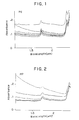
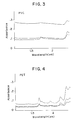
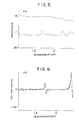
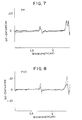
- Figs. 1 to 5 are graphs illustrating NIR spectra of plastics used for the preparation of reference files in an embodiment of the method of determination of the present invention.
- the NIR spectra were measured from a transmitted beam of near-infrared rays.
- Fig. 1 shows NIR spectra obtained by irradiating with near-infrared rays while continuously scanning within a wavelength region of from 1 to 2.5 ⁇ m for seven kinds of polyethylene (PE).
- Fig. 2 shows NIR spectra determined for five kinds of polypropylene (PP); Fig. 3, three kinds of polyvinyl chloride (PVC); Fig.4, three kinds of polyethylene terephthalate (PET); and Fig. 5, two kinds of polystyrene (PS).
- PP polypropylene
- PVC polyvinyl chloride
- PET polyethylene terephthalate
- PS polystyrene
- the method may comprise measuring the NIR spectrum of the target plastics, calculating a derivative spectrum, and determining the type of plastics from whether the wavelength region containing the peak of the resultant derivative spectrum (differential peak) agrees or not.
- the technique of determining a derivative spectrum such as a first-derivative or a second-derivative through measurement of NIR spectrum is a known one, and permits expectation of such effects as: (1) eliminating biases present over the entire region of measurement, such as the influence of opacity or stain of the sample of measurement; (2) converting superposed spectra into signals which are easier to analyze; and (3) the presence of a zero-crossover point on the wavelength axis.
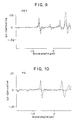
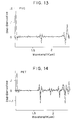
- First-derivatives derived from the NIR spectra shown in Figs. 1 to 5 are illustrated in Figs. 6 to 10, and second-derivatives thereof, in Figs. 11 to 15.
- biases present throughout the entire measurement wavelength region as observed in the NIR spectra have been eliminated, and superposed peaks have been converted into a waveform easier to analyze.
- a zero-crossover point is existent on the wavelength axis.
- This zero-crossover point is the point where the waveform curve of the NIR spectrum intersects the wavelength axis having a differential value of zero. In the first-derivative, this corresponds to the maximum peak wavelength of NIR spectrum, and in the second-derivative, to the wavelength at which a point of inflection of NIR spectrum appears.
- the zero-crossover point in a derivative spectrum is therefore a singular point of function intrinsic to a particular type of plastics, irrespective of the thickness of density of the particular plastics.
- the wave-length region in which the differential peak appears differs with the type of plastics for both first-derivatives and second-derivatives. It is therefore possible to determine the type of an unknown plastics by previously determining the wavelength region in which the differential peak appears for a plastics of a known type, and seeing whether or not the wavelength region in which the differential peak appears of an unknown plastics agrees with it.
- the method of a first embodiment of the present invention comprises the following steps.
- data processing is accomplished by a computer connected to a near-infrared spectrometer.
- a prescribed wavelength region such as from 1 to 2.5 pm for a plastics of a known type
- determining first-derivative or second-derivative thereof and determining the derivative spectrum at prescribed intervals of wavelength within a range of from several nm to 10 nm, at intervals of 6 nm for example, over the entire measurement wavelength region, thereby determining the class as to whether the derivative spectrum for each of the measurement wavelengths is on the plus-side, minus-side or any other side.
- Table 1 shows 256 data obtained by measuring a measurement wavelength region of 1 to 2.5 ⁇ m at intervals of wavelength width of 6 nm.
- Table 2 Data No. 0 1 2 3 ... n-1 n n+1 ... 253 254 255 Label 0 0 +1 +1 0 -1 -1 0 0 0 0 (4) Then, comparing all the data of the classification table of an unknown plastics with all the data of the classification table of reference file for each data No. one by one to determine the number of data showing agreement of labels. Conducting this operation for all the reference files of the previously stored known plastics. (5) Then, determining the ratio of the number of data showing labels in agreement to all the number of data, investigating the highest agreement ratio, and determining that the plastics of the reference file of the highest agreement ratio is the type of the unknown plastics.
- the use of the above-mentioned agreement ratio means determination of the degree of agreement of the wavelength region in which the differential peak of the unknown plastics appears with the wavelength region in which the differential peak of the known plastics appears.
- the plastics showing the highest agreement ratio is the type of the unknown plastics, thus the type of the unknown plastics is determined. This of course assumes that the classification table of all plastics which may appear as the unknown plastics are available.
- the second embodiment of the present invention which permits further improvement of the determination accuracy and is therefore more preferable, comprises the following steps;
- the class of derivative spectrum for each measurement wavelength is determined by setting the determination standard region marked off with certain plus and minus values with the maximum absolute value of derivative spectrum to standardize the derivative spectrum, while avoiding comparison of data labelled "0" which have a small S/N ratio of waveform (differential signal) because of the slight value of derivative spectrum (differential value), thus permitting remarkable improvement of the determining accuracy of the class of plastics.
- Both the above-mentioned embodiment have comprised continuously measuring NIR spectrum within a prescribed wavelength region to determine the derivative spectrum thereof, and measuring the derivative spectrum at prescribed intervals of wavelength over a region of measurement wavelengths although small discrete steps of wavelength can be used provided the required derivatives can be obtained thereby determining the class of the derivative spectra at each measurement wavelength.
- the present invention is not however limited to these embodiments, but the kind of derivative spectrum at each measurement wavelength may be determined, by measuring NIR spectrum at prescribed intervals of wavelength from the very beginning over a prescribed region of wavelengths, from derivative spectra thereof.
- a classification table of derivative spectra at each measurement wavelength has been prepared for an unknown plastics, and data of this classification table have been compared with data of a classification table of reference file. It is not always necessary, however, to compare the class data of derivative spectra of the unknown plastics after preparing the classification table, but comparison with the data of the classification table of reference file may be made every time a class data of the differential spectrum at each measurement wavelength is obtained.
- a first-derivative or second-derivative has been used in the above-mentioned embodiments, but a similar operation may be accomplished through determination of a tertiary or a higher-degree derivative spectrum.
- the absorption spectrum can be measured from a transmitted beam or reflected beam of near-infrared rays irradiated to the target plastics.
- NIR spectrum was continuously measured in a wavelength region of from 1 to 2.5 ⁇ m for plastics samples including PE ( polyethylene), PET (polyethylene terephthalate), PP (polypropyrene), PVC (polyvinyl chloride) and PS (polystylene) in the form of plastics bags and the like.
- Second derivatives were determined from the results of measurement, and the derivative spectrum was measured at intervals of wavelength of 6nm.
- the class of the derivative spectrum for each measurement wavelength was determined. The labels of these class data were compared with the lables of all the data numbers in the classification table of reference file previously prepared for secondary derivative spectra shown in Figs. 11 to 15, except for the data numbers labelled "0," to determined the type of plastics samples from the agreement ratios.
- each of the plastics samples shows a maximum agreement ratio of at least 70% at a point corresponding to the type of plastics employed, thus demonstrating that the type of plastics was accurately determined from the agreement ratio.
- the method of the present invention permits the simple and rapid determination of the type of the unknown plastics.
- the method of the present invention is suitably applicable for the determination of the type of plastics in various areas, including classification of plastics waste into individual materials.
Landscapes
- Physics & Mathematics (AREA)
- Spectroscopy & Molecular Physics (AREA)
- Biochemistry (AREA)
- Life Sciences & Earth Sciences (AREA)
- Chemical & Material Sciences (AREA)
- Analytical Chemistry (AREA)
- Health & Medical Sciences (AREA)
- General Health & Medical Sciences (AREA)
- General Physics & Mathematics (AREA)
- Immunology (AREA)
- Pathology (AREA)
- Investigating Or Analysing Materials By Optical Means (AREA)
- Spectrometry And Color Measurement (AREA)
Claims (5)
- Procédé de détermination du type d'une matière plastique inconnue, comprenant les étapes suivantes :(a) irradiation de la matière plastique inconnue avec des rayons du proche infrarouge pour mesurer un spectre d'absorption de la matière plastique inconnue sur une gamme de longueurs d'onde de mesure dans une région du proche infrarouge ;(b) calcul et mesure d'un spectre dérivé de la matière plastique inconnue à des intervalles de longueur d'onde égaux allant jusqu'à 10 nm pour obtenir une mesure de spectre dérivé pour chaque intervalle de mesure ;(c) détermination d'une classe de mesure du spectre dérivé pour chaque intervalle ;(d) comparaison de la classe de mesure du spectre dérivé de la matière plastique inconnue avec une classe de mesure d'un spectre dérivé déterminée au préalable pour une pluralité de matières plastiques de types connus, pour chaque intervalle ;(e) calcul du taux de concordance pour chaque matière plastique connue en divisant le nombre de fois que la classe de mesure du spectre dérivé de la matière plastique inconnue concorde avec la classe de mesure du spectre dérivé de chaque matière plastique connue par le nombre total d'intervalles comparés ; et(f) détermination du type de la matière plastique inconnue comme étant celui de la matière plastique connue ayant le taux de concordance le plus élevé ;l'étape de détermination d'une classe de mesure du spectre dérivé pour chaque intervalle consistant soit à :(g) déterminer si chaque mesure du spectre dérivé est positive, négative ou nulle ; soit à(h) déterminer une valeur absolue maximale des mesures du spectre dérivé dans la gamme de longueurs d'onde de mesure pour obtenir une région de détermination standard définie dans des limites supérieure et inférieure, respectivement au-dessus et au-dessous de l'axe de longueurs d'onde, à une distance de l'axe de longueurs d'onde égale à une fraction prédéterminée de la valeur absolue maximale, et à déterminer si chaque mesure du spectre dérivé est au-dessus, au-dessous, ou dans la région de détermination standard.
- Procédé de détermination du type d'une matière plastique inconnue selon la revendication 1, dans lequel lesdites matières plastiques de types connus comprennent le polyéthylène, le polypropylène, le polychlorure de vinyle, le polyéthylène-téréphtalate, et le polystyrène.
- Procédé de détermination du type d'une matière plastique inconnue selon la revendication 1 ou 2, dans lequel ledit spectre dérivé est une première dérivée ou une seconde dérivée.
- Procédé de détermination du type d'une matière plastique inconnue selon la revendication 1, 2 ou 3, dans lequel ledit spectre est mesuré pour un faisceau transmis de rayons du proche infrarouge irradié sur ladite matière plastique inconnue.
- Procédé de détermination du type d'une matière plastique inconnue selon la revendication 1, 2, ou 3, dans lequel ledit spectre est mesuré pour un faisceau réfléchi de rayons du proche infrarouge irradié sur ladite matière plastique inconnue.
Applications Claiming Priority (2)
| Application Number | Priority Date | Filing Date | Title |
|---|---|---|---|
| JP2186593A JPH07111397B2 (ja) | 1993-01-14 | 1993-01-14 | プラスチックの種類判定方法 |
| JP21865/93 | 1993-01-14 |
Publications (2)
| Publication Number | Publication Date |
|---|---|
| EP0607048A1 EP0607048A1 (fr) | 1994-07-20 |
| EP0607048B1 true EP0607048B1 (fr) | 1997-11-05 |
Family
ID=12067026
Family Applications (1)
| Application Number | Title | Priority Date | Filing Date |
|---|---|---|---|
| EP19940300251 Expired - Lifetime EP0607048B1 (fr) | 1993-01-14 | 1994-01-13 | Procédé pour la détection de type de matière plastique |
Country Status (4)
| Country | Link |
|---|---|
| US (1) | US5512752A (fr) |
| EP (1) | EP0607048B1 (fr) |
| JP (1) | JPH07111397B2 (fr) |
| DE (1) | DE69406557T2 (fr) |
Cited By (8)
| Publication number | Priority date | Publication date | Assignee | Title |
|---|---|---|---|---|
| GB2284477A (en) * | 1993-11-27 | 1995-06-07 | Bruker Analytische Messtechnik | Identification of plastics by infra-red spectroscopy |
| US5712797A (en) * | 1994-10-07 | 1998-01-27 | Bp Chemicals Limited | Property determination |
| US5740073A (en) * | 1994-10-07 | 1998-04-14 | Bp Chemicals Limited | Lubricant property determination |
| US5763883A (en) * | 1994-10-07 | 1998-06-09 | Bp Chemicals Limited | Chemicals property determination |
| US5861228A (en) * | 1994-10-07 | 1999-01-19 | Bp Chemicals Limited | Cracking property determination |
| WO2001036944A1 (fr) * | 1999-11-17 | 2001-05-25 | Der Grüne Punkt - Duales System Deutschland Ag | Procede et dispositif pour determiner le type de materiau utilise dans une matiere plastique |
| US6555822B1 (en) | 1999-07-29 | 2003-04-29 | Sony International (Europe) Gmbh | Method for identification of plastic materials by optical measurements |
| US6563119B1 (en) | 1999-07-29 | 2003-05-13 | Sony International (Europe) Gmbh | Method and apparatus for identification of plastic materials by optical measurements |
Families Citing this family (30)
| Publication number | Priority date | Publication date | Assignee | Title |
|---|---|---|---|---|
| EP0801298B1 (fr) * | 1996-04-09 | 2006-06-21 | Innovene Europe Limited | Procédé de commande de processus |
| DE19515447C2 (de) * | 1995-04-27 | 1997-08-07 | Rational Beratungsgesellschaft | Gerät zum Erkennen eines Kunststoffes |
| EP0801299B1 (fr) * | 1996-04-09 | 2004-03-17 | Eutech Engineering Solutions Limited | Commande de processus |
| JPH0910703A (ja) * | 1995-06-30 | 1997-01-14 | Toa Denpa Kogyo Kk | 異種プラスチック包装材の混入判別方法 |
| JP3252682B2 (ja) * | 1995-11-13 | 2002-02-04 | 株式会社豊田中央研究所 | 赤外分光分析法による樹脂の高速同定方法およびそのシステム |
| DE19601950C1 (de) * | 1996-01-10 | 1997-04-03 | Lla Umwelttechnische Analytik | Verfahren zur Erkennung von Materialsorten, insbesondere Kunststoffsorten |
| DE19609916A1 (de) * | 1996-03-14 | 1997-09-18 | Robert Prof Dr Ing Massen | Preisgünstiger spektroskopischer Sensor für die Erkennung von Kunststoffen |
| WO1999001750A1 (fr) | 1997-07-02 | 1999-01-14 | Spectra Code, Inc. | Systeme raman utile pour une identification rapide d'echantillons |
| GB9715550D0 (en) * | 1997-07-24 | 1997-10-01 | Ciba Geigy Ag | Plastics compostions |
| US6433338B1 (en) * | 1998-02-09 | 2002-08-13 | Tomra Systems Asa | Method and device for identification of a type of material in an object and utilization therefor |
| US6297508B1 (en) | 1998-08-10 | 2001-10-02 | Cryovac Inc. | Method of determining authenticity of a packaged product |
| JP3908879B2 (ja) * | 1999-10-04 | 2007-04-25 | Idec株式会社 | プラスチック判別装置および判別方法 |
| JP2002267601A (ja) * | 2001-03-07 | 2002-09-18 | Kurabo Ind Ltd | プラスチック材等の材質判別方法及び装置 |
| KR100408811B1 (ko) * | 2001-05-31 | 2003-12-06 | 주식회사 이오니아 | 근적외선에 의한 플라스틱 선별장치 |
| WO2003038412A1 (fr) * | 2001-10-29 | 2003-05-08 | Matsushita Eco Technology Center Co., Ltd. | Dispositif et procede d'identification de plastique |
| EP1450152A4 (fr) * | 2001-11-28 | 2009-11-25 | Panasonic Eco Technology Ct Co | Procede d'identification de plastique |
| JP3647799B2 (ja) * | 2001-12-03 | 2005-05-18 | 株式会社御池鐵工所 | 使用済みボトルの色別・材質別選別装置 |
| KR100487447B1 (ko) * | 2002-06-29 | 2005-05-03 | (주)이오니아이엔티 | 플라스틱 선별시스템의 광접속장치 |
| GB0305738D0 (en) * | 2003-03-13 | 2003-04-16 | Next Tec Ltd | Recycling of plastics material |
| KR100528403B1 (ko) * | 2003-04-01 | 2005-11-21 | (주)이오니아이엔티 | 플라스틱 자동 분류장치 및 자동 분류방법 |
| DE10346769A1 (de) * | 2003-10-06 | 2005-04-21 | Zimmer Ag | Analyseautomat und Verfahren zur Überwachung der Polymerherstellung mittels Massenspektroskopie |
| DE10346768A1 (de) * | 2003-10-06 | 2005-04-21 | Zimmer Ag | Verfahren zur automatischen Analyse von polymerhaltigem Abfall und Analyseautomat hierzu |
| JP2005246631A (ja) * | 2004-03-01 | 2005-09-15 | Seiko Precision Inc | 異種プリプレグの検出装置およびその検出方法、プリプレグ供給装置およびその供給方法、ならびに、多層プリント配線板の製造装置およびその製造方法 |
| NO329603B1 (no) * | 2007-11-22 | 2010-11-22 | Integrated Optoelectronics As | Fremgangsmate og system for maling og bestemmelse / gjenkjenning av ulike materialer |
| JP2017101988A (ja) * | 2015-12-01 | 2017-06-08 | 株式会社島津製作所 | プラスチック判別方法及びプラスチック判別装置 |
| CN106018324A (zh) * | 2016-08-15 | 2016-10-12 | 中国计量大学 | 一种基于近红外光谱分析的塑料识别装置和方法 |
| JP7137772B2 (ja) * | 2017-11-07 | 2022-09-15 | 大日本印刷株式会社 | 検査システム、検査方法及び検査システムの製造方法 |
| CN110376157B (zh) * | 2019-07-19 | 2022-04-05 | 应急管理部天津消防研究所 | 一种判定泡沫塑料种类及其阻燃性能的检测分析方法 |
| EP3912737B1 (fr) | 2020-05-22 | 2023-12-27 | Inndeo Proyectos Industriales, S.L. | Système et procédé de tri de produits conditionnés |
| CN113792082A (zh) * | 2021-09-02 | 2021-12-14 | 深圳创景数科信息技术有限公司 | 一种基于数据库的面料成分检索方法 |
Family Cites Families (4)
| Publication number | Priority date | Publication date | Assignee | Title |
|---|---|---|---|---|
| US5015856A (en) * | 1990-03-28 | 1991-05-14 | E. I. Du Pont De Nemours And Company | Automated process for permeability determinations of barrier resins |
| US5150307A (en) * | 1990-10-15 | 1992-09-22 | Automation Industrial Control, Inc. | Computer-controlled system and method for sorting plastic items |
| DE4036201A1 (de) * | 1990-11-14 | 1992-05-21 | Bayer Ag | Spektroskopisches analyseverfahren fuer kunststoffgemische |
| US5134291A (en) * | 1991-04-30 | 1992-07-28 | The Dow Chemical Company | Method for sorting used plastic containers and the like |
-
1993
- 1993-01-14 JP JP2186593A patent/JPH07111397B2/ja not_active Expired - Lifetime
-
1994
- 1994-01-13 DE DE69406557T patent/DE69406557T2/de not_active Expired - Fee Related
- 1994-01-13 US US08/181,517 patent/US5512752A/en not_active Expired - Fee Related
- 1994-01-13 EP EP19940300251 patent/EP0607048B1/fr not_active Expired - Lifetime
Cited By (12)
| Publication number | Priority date | Publication date | Assignee | Title |
|---|---|---|---|---|
| GB2284477A (en) * | 1993-11-27 | 1995-06-07 | Bruker Analytische Messtechnik | Identification of plastics by infra-red spectroscopy |
| US5510619A (en) * | 1993-11-27 | 1996-04-23 | Brunker Analytische Messtechnik Gmbh | Method for the routine identification of plastics |
| GB2284477B (en) * | 1993-11-27 | 1997-12-10 | Bruker Analytische Messtechnik | Method for the routine identification of plastics |
| US5712797A (en) * | 1994-10-07 | 1998-01-27 | Bp Chemicals Limited | Property determination |
| US5740073A (en) * | 1994-10-07 | 1998-04-14 | Bp Chemicals Limited | Lubricant property determination |
| US5763883A (en) * | 1994-10-07 | 1998-06-09 | Bp Chemicals Limited | Chemicals property determination |
| US5861228A (en) * | 1994-10-07 | 1999-01-19 | Bp Chemicals Limited | Cracking property determination |
| US6555822B1 (en) | 1999-07-29 | 2003-04-29 | Sony International (Europe) Gmbh | Method for identification of plastic materials by optical measurements |
| US6563119B1 (en) | 1999-07-29 | 2003-05-13 | Sony International (Europe) Gmbh | Method and apparatus for identification of plastic materials by optical measurements |
| WO2001036944A1 (fr) * | 1999-11-17 | 2001-05-25 | Der Grüne Punkt - Duales System Deutschland Ag | Procede et dispositif pour determiner le type de materiau utilise dans une matiere plastique |
| DE19955135A1 (de) * | 1999-11-17 | 2001-05-31 | Der Gruene Punkt Duales Syst | Verfahren und Vorrichtung zum Bestimmen der Materialsorte eines Kunststoffes |
| DE19955135C2 (de) * | 1999-11-17 | 2001-10-18 | Der Gruene Punkt Duales Syst | Vorrichtung zum Bestimmen der Materialsorte bei Folien aus Kunststoff als Bestandteil einer Wertstoffsortieranlage |
Also Published As
| Publication number | Publication date |
|---|---|
| DE69406557T2 (de) | 1998-06-25 |
| JPH06308022A (ja) | 1994-11-04 |
| DE69406557D1 (de) | 1997-12-11 |
| EP0607048A1 (fr) | 1994-07-20 |
| US5512752A (en) | 1996-04-30 |
| JPH07111397B2 (ja) | 1995-11-29 |
Similar Documents
| Publication | Publication Date | Title |
|---|---|---|
| EP0607048B1 (fr) | Procédé pour la détection de type de matière plastique | |
| US5134291A (en) | Method for sorting used plastic containers and the like | |
| Zhu et al. | Plastic solid waste identification system based on near infrared spectroscopy in combination with support vector machine | |
| Bonifazi et al. | A hierarchical classification approach for recognition of low-density (LDPE) and high-density polyethylene (HDPE) in mixed plastic waste based on short-wave infrared (SWIR) hyperspectral imaging | |
| US6313423B1 (en) | Application of Raman spectroscopy to identification and sorting of post-consumer plastics for recycling | |
| US20050010374A1 (en) | Method of analysis of NIR data | |
| EP1450152A1 (fr) | Procede d'identification de plastique | |
| Pieszczek et al. | Improvement of recyclable plastic waste detection–A novel strategy for the construction of rigorous classifiers based on the hyperspectral images | |
| Kulcke et al. | On-line classification of synthetic polymers using near infrared spectral imaging | |
| Koinig et al. | Influence of reflective materials, emitter intensity and foil thickness on the variability of near-infrared spectra of 2D plastic packaging materials | |
| Westerhaus et al. | Quantitative analysis | |
| JPH1038807A (ja) | プラスチックの判別方法およびプラスチックの判別装置 | |
| Taneepanichskul et al. | Automatic identification and classification of compostable and biodegradable plastics using hyperspectral imaging | |
| JP4581039B2 (ja) | 高分子材料のグレード識別方法 | |
| Jull et al. | Classification of recyclables using laser-induced breakdown spectroscopy for waste management | |
| CN103499552A (zh) | 一种快速、智能的废旧塑料分类方法 | |
| Holub et al. | Classification of diverse plastic samples by LIBS and Raman data fusion | |
| Cielecki et al. | Identification of black plastics with terahertz time-domain spectroscopy and machine learning | |
| Scott et al. | Indentification of plastic waste using spectroscopy and neural networks | |
| JPH0570781B2 (fr) | ||
| Taneepanichskul et al. | Using hyperspectral imaging to identify and classify large microplastic contamination in industrial composting processes | |
| JP3239784B2 (ja) | 材料、特にプラスチック材料の種類の識別方法 | |
| Broek et al. | Application of a spectroscopic infrared focal plane array sensor for on-line identification of plastic waste | |
| Wienke et al. | Comparison of an adaptive resonance theory based neural network (ART-2a) against other classifiers for rapid sorting of post consumer plastics by remote near-infrared spectroscopic sensing using an InGaAs diode array | |
| Laasonen et al. | Near infrared reflectance spectroscopy for the fast identification of PVC-based films |
Legal Events
| Date | Code | Title | Description |
|---|---|---|---|
| PUAI | Public reference made under article 153(3) epc to a published international application that has entered the european phase |
Free format text: ORIGINAL CODE: 0009012 |
|
| AK | Designated contracting states |
Kind code of ref document: A1 Designated state(s): DE FR GB IT |
|
| 17P | Request for examination filed |
Effective date: 19940704 |
|
| 17Q | First examination report despatched |
Effective date: 19960719 |
|
| GRAG | Despatch of communication of intention to grant |
Free format text: ORIGINAL CODE: EPIDOS AGRA |
|
| GRAH | Despatch of communication of intention to grant a patent |
Free format text: ORIGINAL CODE: EPIDOS IGRA |
|
| GRAH | Despatch of communication of intention to grant a patent |
Free format text: ORIGINAL CODE: EPIDOS IGRA |
|
| GRAA | (expected) grant |
Free format text: ORIGINAL CODE: 0009210 |
|
| ITF | It: translation for a ep patent filed | ||
| AK | Designated contracting states |
Kind code of ref document: B1 Designated state(s): DE FR GB IT |
|
| REF | Corresponds to: |
Ref document number: 69406557 Country of ref document: DE Date of ref document: 19971211 |
|
| ET | Fr: translation filed | ||
| PLBE | No opposition filed within time limit |
Free format text: ORIGINAL CODE: 0009261 |
|
| STAA | Information on the status of an ep patent application or granted ep patent |
Free format text: STATUS: NO OPPOSITION FILED WITHIN TIME LIMIT |
|
| 26N | No opposition filed | ||
| REG | Reference to a national code |
Ref country code: GB Ref legal event code: IF02 |
|
| PGFP | Annual fee paid to national office [announced via postgrant information from national office to epo] |
Ref country code: GB Payment date: 20040108 Year of fee payment: 11 |
|
| PGFP | Annual fee paid to national office [announced via postgrant information from national office to epo] |
Ref country code: FR Payment date: 20040113 Year of fee payment: 11 |
|
| PGFP | Annual fee paid to national office [announced via postgrant information from national office to epo] |
Ref country code: DE Payment date: 20040325 Year of fee payment: 11 |
|
| PG25 | Lapsed in a contracting state [announced via postgrant information from national office to epo] |
Ref country code: IT Free format text: LAPSE BECAUSE OF NON-PAYMENT OF DUE FEES;WARNING: LAPSES OF ITALIAN PATENTS WITH EFFECTIVE DATE BEFORE 2007 MAY HAVE OCCURRED AT ANY TIME BEFORE 2007. THE CORRECT EFFECTIVE DATE MAY BE DIFFERENT FROM THE ONE RECORDED. Effective date: 20050113 Ref country code: GB Free format text: LAPSE BECAUSE OF NON-PAYMENT OF DUE FEES Effective date: 20050113 |
|
| PG25 | Lapsed in a contracting state [announced via postgrant information from national office to epo] |
Ref country code: DE Free format text: LAPSE BECAUSE OF NON-PAYMENT OF DUE FEES Effective date: 20050802 |
|
| GBPC | Gb: european patent ceased through non-payment of renewal fee |
Effective date: 20050113 |
|
| PG25 | Lapsed in a contracting state [announced via postgrant information from national office to epo] |
Ref country code: FR Free format text: LAPSE BECAUSE OF NON-PAYMENT OF DUE FEES Effective date: 20050930 |
|
| REG | Reference to a national code |
Ref country code: FR Ref legal event code: ST |