EP0608760A2 - Faserverstärktes Cycloolefincopolymer-Material, Verfahren zu seiner Herstellung und Formkörper aus dem Material - Google Patents
Faserverstärktes Cycloolefincopolymer-Material, Verfahren zu seiner Herstellung und Formkörper aus dem Material Download PDFInfo
- Publication number
- EP0608760A2 EP0608760A2 EP94100710A EP94100710A EP0608760A2 EP 0608760 A2 EP0608760 A2 EP 0608760A2 EP 94100710 A EP94100710 A EP 94100710A EP 94100710 A EP94100710 A EP 94100710A EP 0608760 A2 EP0608760 A2 EP 0608760A2
- Authority
- EP
- European Patent Office
- Prior art keywords
- group
- cycloolefin
- olefin
- weight
- general formula
- Prior art date
- Legal status (The legal status is an assumption and is not a legal conclusion. Google has not performed a legal analysis and makes no representation as to the accuracy of the status listed.)
- Granted
Links
Classifications
-
- C—CHEMISTRY; METALLURGY
- C08—ORGANIC MACROMOLECULAR COMPOUNDS; THEIR PREPARATION OR CHEMICAL WORKING-UP; COMPOSITIONS BASED THEREON
- C08F—MACROMOLECULAR COMPOUNDS OBTAINED BY REACTIONS ONLY INVOLVING CARBON-TO-CARBON UNSATURATED BONDS
- C08F232/00—Copolymers of cyclic compounds containing no unsaturated aliphatic radicals in a side chain, and having one or more carbon-to-carbon double bonds in a carbocyclic ring system
- C08F232/08—Copolymers of cyclic compounds containing no unsaturated aliphatic radicals in a side chain, and having one or more carbon-to-carbon double bonds in a carbocyclic ring system having condensed rings
-
- C—CHEMISTRY; METALLURGY
- C08—ORGANIC MACROMOLECULAR COMPOUNDS; THEIR PREPARATION OR CHEMICAL WORKING-UP; COMPOSITIONS BASED THEREON
- C08F—MACROMOLECULAR COMPOUNDS OBTAINED BY REACTIONS ONLY INVOLVING CARBON-TO-CARBON UNSATURATED BONDS
- C08F210/00—Copolymers of unsaturated aliphatic hydrocarbons having only one carbon-to-carbon double bond
- C08F210/02—Ethene
-
- C—CHEMISTRY; METALLURGY
- C08—ORGANIC MACROMOLECULAR COMPOUNDS; THEIR PREPARATION OR CHEMICAL WORKING-UP; COMPOSITIONS BASED THEREON
- C08F—MACROMOLECULAR COMPOUNDS OBTAINED BY REACTIONS ONLY INVOLVING CARBON-TO-CARBON UNSATURATED BONDS
- C08F232/00—Copolymers of cyclic compounds containing no unsaturated aliphatic radicals in a side chain, and having one or more carbon-to-carbon double bonds in a carbocyclic ring system
- C08F232/02—Copolymers of cyclic compounds containing no unsaturated aliphatic radicals in a side chain, and having one or more carbon-to-carbon double bonds in a carbocyclic ring system having no condensed rings
- C08F232/04—Copolymers of cyclic compounds containing no unsaturated aliphatic radicals in a side chain, and having one or more carbon-to-carbon double bonds in a carbocyclic ring system having no condensed rings having one carbon-to-carbon double bond
-
- C—CHEMISTRY; METALLURGY
- C08—ORGANIC MACROMOLECULAR COMPOUNDS; THEIR PREPARATION OR CHEMICAL WORKING-UP; COMPOSITIONS BASED THEREON
- C08K—Use of inorganic or non-macromolecular organic substances as compounding ingredients
- C08K3/00—Use of inorganic substances as compounding ingredients
- C08K3/02—Elements
- C08K3/04—Carbon
-
- C—CHEMISTRY; METALLURGY
- C08—ORGANIC MACROMOLECULAR COMPOUNDS; THEIR PREPARATION OR CHEMICAL WORKING-UP; COMPOSITIONS BASED THEREON
- C08K—Use of inorganic or non-macromolecular organic substances as compounding ingredients
- C08K3/00—Use of inorganic substances as compounding ingredients
- C08K3/40—Glass
-
- C—CHEMISTRY; METALLURGY
- C08—ORGANIC MACROMOLECULAR COMPOUNDS; THEIR PREPARATION OR CHEMICAL WORKING-UP; COMPOSITIONS BASED THEREON
- C08K—Use of inorganic or non-macromolecular organic substances as compounding ingredients
- C08K7/00—Use of ingredients characterised by shape
- C08K7/02—Fibres or whiskers
- C08K7/04—Fibres or whiskers inorganic
- C08K7/06—Elements
-
- C—CHEMISTRY; METALLURGY
- C08—ORGANIC MACROMOLECULAR COMPOUNDS; THEIR PREPARATION OR CHEMICAL WORKING-UP; COMPOSITIONS BASED THEREON
- C08K—Use of inorganic or non-macromolecular organic substances as compounding ingredients
- C08K7/00—Use of ingredients characterised by shape
- C08K7/02—Fibres or whiskers
- C08K7/04—Fibres or whiskers inorganic
- C08K7/14—Glass
-
- C—CHEMISTRY; METALLURGY
- C08—ORGANIC MACROMOLECULAR COMPOUNDS; THEIR PREPARATION OR CHEMICAL WORKING-UP; COMPOSITIONS BASED THEREON
- C08L—COMPOSITIONS OF MACROMOLECULAR COMPOUNDS
- C08L45/00—Compositions of homopolymers or copolymers of compounds having no unsaturated aliphatic radicals in side chain, and having one or more carbon-to-carbon double bonds in a carbocyclic or in a heterocyclic ring system; Compositions of derivatives of such polymers
-
- C—CHEMISTRY; METALLURGY
- C09—DYES; PAINTS; POLISHES; NATURAL RESINS; ADHESIVES; COMPOSITIONS NOT OTHERWISE PROVIDED FOR; APPLICATIONS OF MATERIALS NOT OTHERWISE PROVIDED FOR
- C09D—COATING COMPOSITIONS, e.g. PAINTS, VARNISHES OR LACQUERS; FILLING PASTES; CHEMICAL PAINT OR INK REMOVERS; INKS; CORRECTING FLUIDS; WOODSTAINS; PASTES OR SOLIDS FOR COLOURING OR PRINTING; USE OF MATERIALS THEREFOR
- C09D145/00—Coating compositions based on homopolymers or copolymers of compounds having no unsaturated aliphatic radicals in a side chain, and having one or more carbon-to-carbon double bonds in a carbocyclic or in a heterocyclic system; Coating compositions based on derivatives of such polymers
Definitions
- the present invention relates to "chemically uniform" cycloolefin copolymers which, as monomers, contain at least one polycycloolefin, e.g. Contain norbornene, and at least one monocycloolefin and / or an acyclic olefin, and are reinforced by fibers, in particular glass fibers.
- Cycloolefin copolymers are a class of polymers with an outstanding level of properties. Among other things, they excel due to its high heat resistance, hydrolytic stability, low water absorption, weather resistance and high rigidity.
- cycloolefins can be polymerized using various catalysts. Depending on the catalyst, the polymerization proceeds via ring opening (US 3,557,072) or by opening the double bond (EP 156464, US 5,087,677).
- JP 3207739, DD 203059 and EP 451858 report on thermoplastic combinations which consist of statistical polymers of cycloolefins and ethylene or polycycloolefins and ethylene. Such thermoplastic combinations are characterized, for example, by a particularly high rigidity.
- these materials have the decisive disadvantage that, because of their amorphous character, they have to be processed at least 170 ° C. above the glass transition temperature. Since the thermal stability of the cycloolefin polymers is only guaranteed up to 350 ° C., only the heat resistance up to a maximum of 180 ° C. can be set with the mixtures described in JP 3207739, DD 203059 and in EP 451858.
- the present invention solves this problem.
- a fiber-reinforced cycloolefin copolymer material which consists of 1 to 99% by weight of reinforcing fibers and 99-1% by weight of at least one cycloolefin copolymer which consists of at least one polycycloolefin of the general formula I to VI wherein R1, R2, R3, R4, R5, R6, R7 and R8 are the same or different and represent a hydrogen atom, a C6-C16 aryl or a C1-C8 alkyl radical, and at least one olefin selected from the group Group of the monocycloolefins of the formula VII where n is a number from 2 to 10, and / or the group of the acyclic olefins of the formula VIII wherein R9, R10, R11 and R12 are the same or different and represent a hydrogen atom or a C1-C8 alkyl radical, is built up.
- the cycloolefin polymer material is characterized in that the polycycloolefins of the general formula I to VI, the monocycloolefins of the general formula VII and / or the acyclic olefins of the general formula VIII are not randomly distributed in the polymer molecule, but are not directly adjacent to two polycycloolefin units, but are each separated by at least one unit VII and / or VIII.
- the monomer VIII should preferably always, the monomer VII may additionally be present.
- each of the copolymers is "chemically uniform".
- the production of chemically uniform cycloolefin copolymers is described in European patent application EP 0 503 422, to which reference is expressly made here.
- alkyl stands for straight-chain or branched alkyl.
- the monocyclic olefin VII can also be substituted (e.g. by aryl or alkyl radicals).
- Polymerization is preferably carried out in liquid polycycloolefin I-VI, in mixtures of polycycloolefin or in concentrated solutions.
- the second comonomer is preferably an acyclic olefin of the formula VIII, in which R9, R10, R11 and R12 are identical or different and denote a hydrogen atom or a C1-C8 alkyl radical. Ethylene or propylene are preferred.
- copolymers of polycyclic olefins preferably of the formulas I and III, are produced with the acyclic olefins VIII.
- cycloolefins are norbornene and tetracyclododecene, which can be substituted by (C1-C6) alkyl. They are preferably copolymerized with ethylene; ethylene / norbornene copolymers are of particular importance.
- polycyclic olefins monocyclic olefins and open chain olefins to understand mixtures of two or more olefins of the respective type. This means that in addition to polycyclic bicopolymers, ter- and multicopolymers can also be produced.
- the fiber-reinforced materials according to the invention are particularly suitable for the production of extrusion parts such as foils, hoses, tubes, rods and fibers as well as for the production of injection molded articles of any shape and size.
- the particular advantage of the chemically uniform cycloolefin copolymers lies in their particularly simple manufacture and their particularly pronounced solvent stability compared to non-polar solvents.
- the advantageous properties known from other cycloolefin statistical copolymers such as hydrolytic stability, low water absorption and weather resistance, have been retained.
- the degree of crystallinity of chemically uniform cycloolefin copolymers is between 0.1 and 50%, preferably between 2 and 40%. It can be determined using the literature-known method of radiography (see K. Kakudo, N. Kasai, X-Ray Diffraction by Polymers, Elsevier, Amsterdam 1972).
- the fiber-reinforced cycloolefin copolymer preferably consists of a single polycycloolefin of the general formula I to VI and either at least one monocycloolefin of the general VII or at least one acyclic olefin of the general formula VIII. Blocks of polycycloolefin are missing in the polymer molecule. In the limiting case, the polycycloolefin and the olefin VII and / or VIII are arranged regularly and alternately in the polymer molecule.
- a 1-olefin such as ethylene, propylene or butene-1 is used as the acyclic olefin of the general formula VIII. It is particularly preferred if the copolymer consists of equimolar amounts of norbornene and ethylene and the two monomer molecules are arranged regularly and alternately in the polymer.
- the fibers used for reinforcement can consist of carbon, metal, ceramic or aramid. In this way, opaque materials with high strength can be produced. For economic reasons, it is advantageous to use glass fibers for reinforcement. If the cycloolefin copolymer used is transparent and the refractive indices of the copolymer and the glass fiber match, a transparent fiber-reinforced cycloolefin polymer material can be obtained. If the difference in the refractive indices is too large or the cycloolefin copolymer used has too high a crystallinity, ie is no longer transparent, the fiber-reinforced cycloolefin copolymer material is also not transparent. However, transparency is not important for many purposes.
- the material according to the invention is usually further processed in the form of granules. Long fiber reinforced material can be used to wrap pipes.
- the melt can be processed about 10-20 K above the melting point, ie at about 295 - 310 ° C.
- the fiber material can be incorporated into the melt.
- amorphous COC only have a glass transition temperature and can only be processed about 170 K above the glass transition temperature (around 350 ° C).
- the COC according to EP 503 422 are transparent up to a partial crystallinity of 20%. With a partial crystallinity of 20 - 40%, they become less and less transparent. The degree of crystallinity can be reduced by quenching from the melt.
- the shrinkage is specified as the so-called processing speed, which is determined according to DIN 53464.
- the processing speed of chemically uniform cycloolefin copolymers is less than 0.4%.
- a significant improvement in the mechanical properties of filled and unfilled chemically uniform cycloolefin copolymers can be achieved by thermal aftertreatment and / or the use of a suitable nucleating agent.
- the proportion of reinforcing fibers, in particular glass fibers, in the material according to the invention is preferably 10 to 90% by weight, in particular 15 to 75% by weight.
- Cycloolefin copolymer material is mixed with the melt of a chemically defined cycloolefin copolymer defined in more detail above with the desired proportion of reinforcing fibers.
- the glass fibers used usually have sizes that protect glass filaments against mechanical stress and loosely connect glass filaments with each other.
- the main constituents of sizes are film-forming polymers and lubricants and, if required, adhesion promoters and other additives.
- the film-forming polymers are dispersible, soluble or emulsifiable in an aqueous medium, as is the reaction product with process aids.
- the water content in the aqueous-chemical combination of the size constituents is designed in such a way that these result in the effective content of solid matter on the glass fiber.
- the water-chemical combination for the treatment of glass fibers can be used in any method for the production of cut glass fiber or continuous glass fiber. It can e.g. can be applied to the wet cutting operation, in which the fibers are combined in bundles and cut directly in the production process or the chemically treated glass fibers are combined in bundles or strands, wound up and only subsequently cut.
- Adhesion promoters have therefore already been used in this context for better coupling. These adhesion promoters are applied to the glass fiber either during treatment with the aqueous chemical combination of the size constituents or through a separate treatment with a solution of the adhesion promoter.
- adhesion promoter into the polymer melt. This method has the advantage that no solutions have to be processed.
- adhesion promoters can also advantageously be incorporated into the composite by providing masterbatches that take advantage of the dilution principle.
- adhesion promoters are also advantageous in the process according to the invention for producing glass fiber-reinforced, chemically uniform cycloolefin copolymers.
- a polymer melt adhesion promoter can be added or the glass fiber can be coated with an adhesion promoter.
- Known adhesion promoters can be selected from the group of vinylsilanes, methacyrylsilanes, aminosilanes, epoxysilanes and methacrylate-chromium chloride complexes.
- Organic polymer-based adhesion promoters are preferred, the organic adhesion promoters which are functionalized cycloolefin copolymers being particularly preferred.
- a functionalized, "chemically uniform" cycloolefin copolymer is advantageously used as an adhesion promoter.
- the functionalized "chemically uniform" cycloolefin copolymer is prepared by grafting a chemically uniform cycloolefin copolymer with a polar monomer.
- the polar monomer used in the grafting is selected from the group of the alpha, beta-unsaturated carboxylic acids, the alpha, beta-unsaturated carboxylic acid derivatives, the organic silicon compounds with olefinically unsaturated and hydrolyzable group, the olefinically unsaturated compounds with hydroxyl group and the olefinically unsaturated epoxy monomers.
- Similar grafted polymers that However, they are not known to be derived from "chemically uniform" cycloolefin copolymers.
- the invention thus comprises an adhesion promoter which is produced by grafting a "chemically uniform" cycloolefin copolymer described above with a polar monomer.
- the content of the grafted polar monomer in the polymer is 0.01 to 50% by weight.
- the glass fibers consist of magnesium alumino-silicate with a refractive index of 1.50 to 1.56 and contain 60 to 68 wt .-% SiO2, 23 to 29 wt .-% Al2O3 and 8 to 12 wt .-% MgO.
- the fiber material to be incorporated usually has an average fiber length of 0.0001-7 mm, in particular 0.1 to 2 mm. The invention is illustrated by the examples.
- a 70 liter reactor was filled with ethylene and charged with 17.6 liters of an 85 percent by weight solution of norbornene in toluene and with 12.4 liters of decalin. The solution was saturated with ethylene by pressing ethylene (6 bar) several times. A pressure of 3.0 bar (excess pressure) was set, 950 cm 3 of toluene methylaluminoxane solution (10.1% by weight of methylaluminoxane with a molecular weight of 1300 g / mol after cryoscopic determination) were added to the reactor and the mixture was stirred at 70 ° C. for 15 minutes.
- reaction solution thus stopped was discharged into a precipitation reactor and stirred into 200 l of acetone. This precipitation bath was then passed through a pressure filter so that the precipitated solid could be isolated. This solid was washed several times with acetone and then dried at 80 ° C. and a pressure of 0.2 bar for 14 hours.
- a 70 liter reactor was filled with ethylene and charged with 17.6 liters of an 85 percent by weight solution of norbornene in toluene and with 12.4 liters of decalin. The solution was saturated with ethylene by pressing ethylene (6 bar) several times. A pressure of 6.0 bar (positive pressure) was set, 950 cm 3 of toluene methylaluminoxane solution (10.1% by weight of methylaluminoxane with a molecular weight of 1300 g / mol after cryoscopic determination) were added to the reactor and the mixture was stirred at 70 ° C. for 15 minutes.
- This polymer is called COC A2 below.
- Example 3 (Filling the polymers with glass fibers and granulation)
- the COC A1 was extruded together with 30% by weight of glass fibers in an extruder and processed into granules.
- the extrusion temperature was between 260 and 300 ° C (different temperatures in different heating zones of the extruder).
- a vacuum of 100 mbar was applied to degas the polymer melt.
- the glass fibers used are textile glass roving P 365 (commercial product from VETROTEX; Herzogenrath, Federal Republic of Germany).
- the nominal filament diameter (DIN 53811) of the glass fibers is 14 ⁇ m
- the strand count (DIN 53830) is 2400 tex
- the filament count (DIN 53830) is 300 tex.
- the extrusion temperature had to be raised to 310 to 350 ° C.
- the other conditions correspond to the above-mentioned extrusion conditions for glass fiber-filled COC A1. Since 350 ° C is already the upper processing temperature for COC, damage to the polymer already occurred during this granulation, which resulted in a clear yellow coloration of the
- thermoplastic polymers The processability of thermoplastic polymers is characterized by the MFI.
- MFI The higher the MFI (DIN 53735) at the processing temperature, the lower the viscosity of the polymer melt and the better the material can be processed by extrusion and injection molding. The MFI was therefore determined on the granules obtained. The value found is listed in Table 1 together with comparative values for other cycloolefin copolymers filled with glass fibers.
- Table 1 MFIs from COC A1 and COC A2 are each filled with 30% by weight of glass fibers MFI (g / 10 min) 310 ° C; 10kg COC A1 284 COC A2 73
- Standard test specimens were produced from glass fiber reinforced COC A1 and COC A2 (each 30% glass fibers) and from unfilled COC A1 by injection molding. The mechanical properties were determined on them by tensile tests. The mechanical properties were determined at room temperature and at 210 ° C. The corresponding values are listed in Tables 3, 4, 5 and 6.
- Examples 1 to 5 demonstrate that it is only possible to achieve a heat resistance (HDT-B) of greater than 180 ° C., good mechanical properties such as high rigidity and at the same time good processability with glass fiber-reinforced chemically uniform cycloolefin copolymers.
- HDT-B heat resistance
- the tensile strength ie. H. the tensile stress at which the standard tensile bar breaks and the elongation at break, d. H. determines the maximum elongation according to DIN 53455.
- the modulus of elasticity is calculated from the tension-elongation curve according to DIN 53457.
- the heat resistance HDT-B was determined according to DIN 53461.
- the MFI was determined in accordance with DIN 53735.
- the viscosity number was determined in accordance with DIN 53726.
- the granules were produced using a Leistritz laboratory extruder LSM 30.34 (Leistritz; Nuremberg, Federal Republic of Germany).
- the standard test specimens were produced by injection molding using an Krauss Maffei KM 90-210 B injection molding machine (Krauss Maffei, Kunststofftechnik GmbH; Düsseldorf; Federal Republic of Germany).
Landscapes
- Chemical & Material Sciences (AREA)
- Organic Chemistry (AREA)
- Health & Medical Sciences (AREA)
- Chemical Kinetics & Catalysis (AREA)
- Medicinal Chemistry (AREA)
- Polymers & Plastics (AREA)
- Life Sciences & Earth Sciences (AREA)
- Engineering & Computer Science (AREA)
- Materials Engineering (AREA)
- Wood Science & Technology (AREA)
- Addition Polymer Or Copolymer, Post-Treatments, Or Chemical Modifications (AREA)
- Compositions Of Macromolecular Compounds (AREA)
- Manufacture Of Macromolecular Shaped Articles (AREA)
- Transition And Organic Metals Composition Catalysts For Addition Polymerization (AREA)
Abstract
worin R⁹, R¹⁰, R¹¹ und R¹² gleich oder verschieden sind und ein Wasserstoffatom oder einen C₁-C₈-Alkylrest bedeuten. VII ist vorzugsweise Ethylen. Im Cycloolefincopolymer-Molekül sind die Monomer-Einheiten des (Polycyclo)-olefins jeweils durch Monomer-Einheiten der cyclischen Olefine VII und/oder der acyclischen Olefine der allgemeinen Formel VIII getrennt.
Description
- Die vorliegende Erfindung betrifft "chemisch einheitliche" Cycloolefincopolymere, die als Monomere mindestens ein Polycycloolefin, wie z.B. Norbornen, sowie mindestens ein Monocycloolefin und/oder ein acyclisches Olefin enthalten, und durch Fasern, insbesondere Glasfasern, verstärkt sind.
- Cycloolefincopolymere sind eine Polymerklasse mit herausragendem Eigenschaftsniveau. Sie zeichnen sich u.a. durch hohe Wärmeformbeständigkeit, hydrolytische Stabilität, geringe Wasseraufnahme, Witterungsbeständigkeit und hohe Steifigkeit aus.
- Es ist bekannt, daß Cycloolefine mittels verschiedener Katalysatoren polymerisiert werden können. Dabei verläuft die Polymerisation in Abhängigkeit vom Katalysator über Ringeröffnung (US 3 557 072) oder unter Öffnung der Doppelbindung (EP 156464, US 5.087.677).
- Bekannt ist, daß in Cycloolefincopolymere Verstärkungsstoffe eingearbeitet werden können. So wird in JP 3207739, DD 203059 sowie in EP 451858 über Thermoplast-Kombinationen berichtet, die aus statistischen Polymerisaten von Cycloolefinen und Ethylen oder Polycycloolefinen und Ethylen bestehen. Derartige Thermoplast-Kombinationen zeichen sich beispielsweise durch eine besonders hohe Steifigkeit aus. Diese Materialien weisen jedoch den entscheidenden Nachteil auf, daß sie auf Grund ihres amorphen Charakters mindestens 170 °C oberhalb der Glastemperatur verarbeitet werden müssen. Da die thermische Stabilität der Cycloolefinpolymeren nur bis 350 °C gewährleistet ist, können mit den in JP 3207739, DD 203059 und in EP 451858 beschriebenen Mischungen nur Wärmeformbeständigkeiten bis maximal 180 °C eingestellt werden.
- Ziel der Entwicklung bei polymeren Werkstoffen ist es stets, eine maximale Wärmeformbeständigkeit einzustellen. Es bestand daher die Aufgabe, faserverstärkte Materialien auf der Basis von Cycloolefinpolymeren anzugeben, die eine Wärmeformbeständigkeit von mindestens 180 °C und eine gute thermoplastische Verarbeitbarkeit aufweisen. Die vorliegende Erfindung löst diese Aufgabe.
- Es wurde nun ein faserverstärktes Cycloolefincopolymer-Material gefunden, das aus 1 bis 99 Gew.-% Verstärkungsfasern und 99 - 1 Gew.-% mindestens eines Cycloolefincopolymeren besteht, welches aus mindestens einem Polycycloolefin der allgemeinen Formel I bis VI


worin R¹, R², R³, R⁴, R⁵, R⁶, R⁷ und R⁸ gleich oder verschieden sind und ein Wasserstoffatom, einen C₆-C₁₆-Aryl- oder einen C₁-C₈-Alkylrest bedeuten, und mindestens einem Olefin, das ausgewählt wird aus der Gruppe der Monocycloolefine der Formel VII
worin n eine Zahl von 2 bis 10 ist,
und/oder der Gruppe der acyclischen Olefine der Formel VIII
worin R⁹, R¹⁰, R¹¹ und R¹² gleich oder verschieden sind und ein Wasserstoffatom oder einen C₁-C₈-Alkylrest bedeuten, aufgebaut ist. Das Cycloolefinpolymer-Material ist dadurch gekennzeichnet, daß die Polycycloolefine der allgemeinen Formel I bis VI, die Monocycloolefine der allgemeinen Formel VII und/oder die acyclischen Olefine der allgemeinen Formel VIII im Polymermolekül nicht statistisch verteilt sind, sondern zwei Polycycloolefin-Einheiten nicht unmittelbar benachbart, sondern jeweils durch mindestens eine Einheit VII und/oder VIII getrennt sind. Das Monomer VIII soll vorzugsweise immer, das Monomer VII kann zusätzlich vorhanden sein. - Vorzugsweise ist zwischen zwei Polycycloolefin-Einheiten jeweils nur eine Einheit VII oder VIII, insbesondere ausschließlich VIII angeordnet. Polymere mit der oben beschriebenen regelmäßigen Anordnung der Monomere werden nachfolgend "chemisch einheitlich" genannt, wobei dieser Begriff hier zum Teil enger gebraucht wird als in EP 0 503 422.
- Falls das faserverstärkte Cycloolefincopolymer-Material aus mehreren Cycloolefincopolymeren besteht, so ist jedes der Copolymere "chemisch einheitlich". Die Herstellung von chemisch einheitlichen Cycloolefincopolymeren ist in der europäischen Patentanmeldung EP 0 503 422 beschrieben, auf die hier ausdrücklich Bezug genommen wird.
- Die Herstellung eines "chemisch einheitlichen" Cycloolefincopolymers erfolgt gemäß EP 0 503 422 durch Polymerisation von 0,1 bis 99,9 Gew.-%, bezogen auf die Gesamtmenge der Monomeren, mindestens eines Monomers der Formeln I, II, III, IV, V oder VI
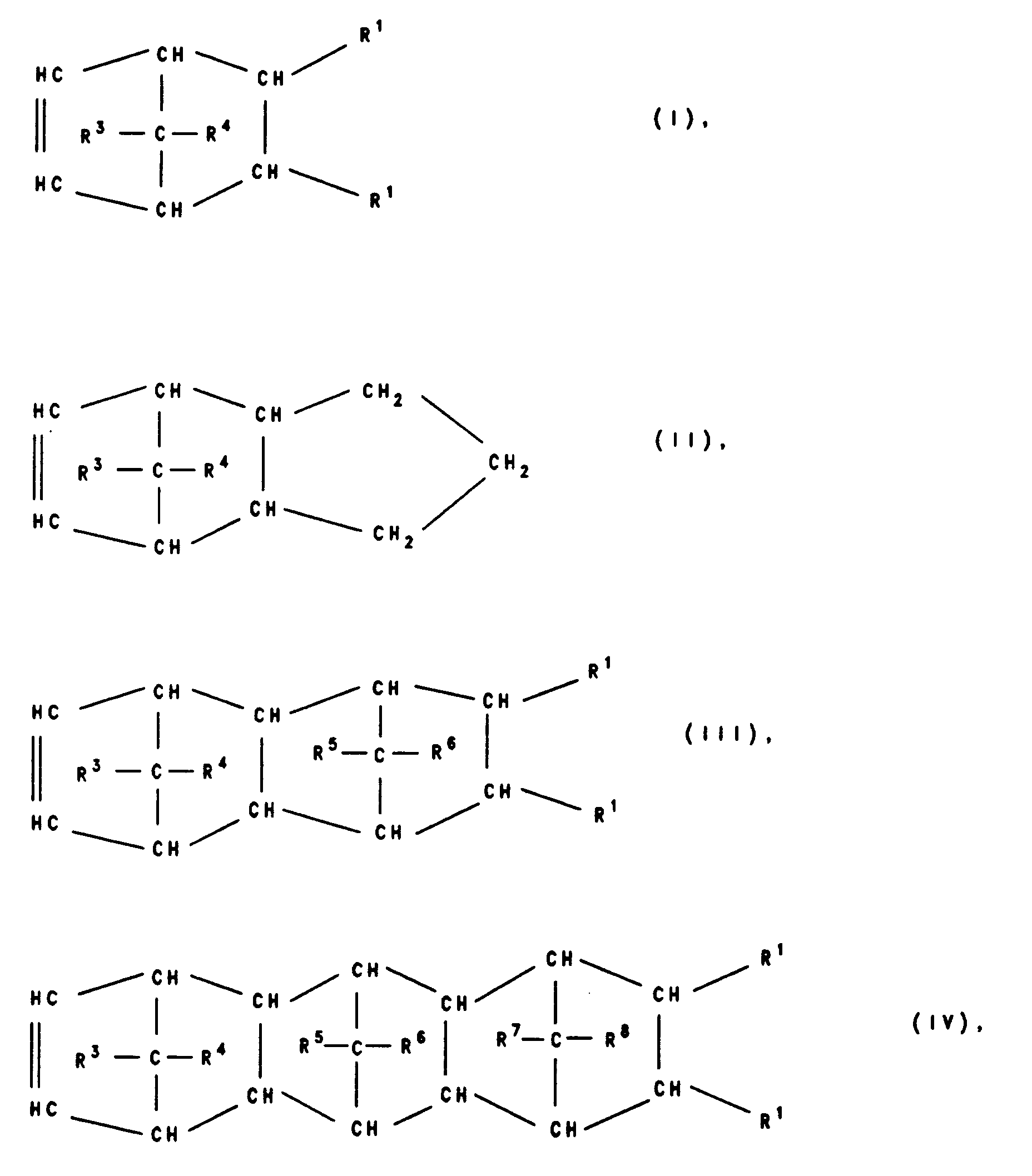

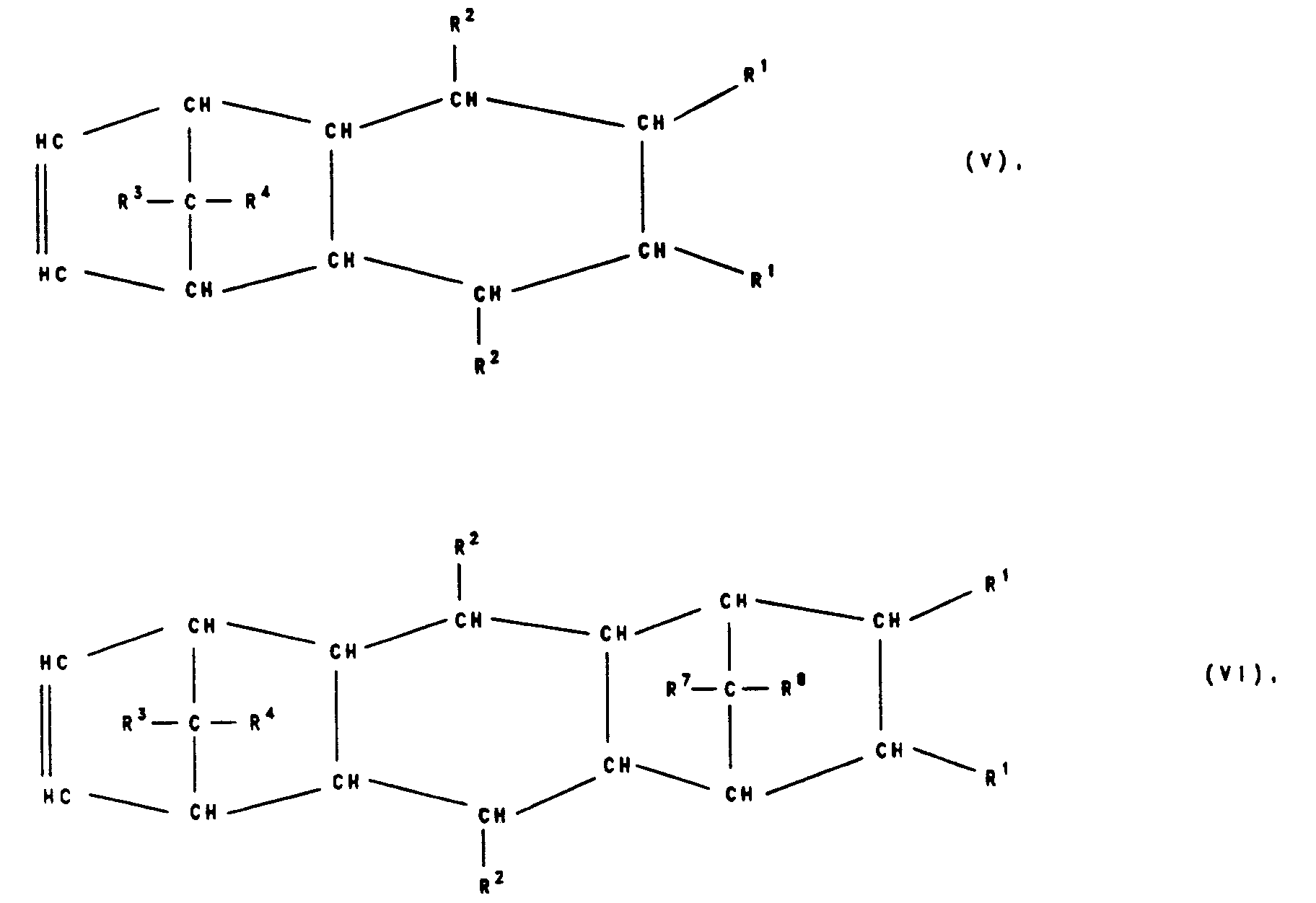
worin R¹, R², R³, R⁴, R⁵, R⁶, R⁷ und R⁸ gleich oder verschieden sind und ein Wasserstoffatom, einen C₆-C₁₆-Aryl- oder einen C₁-C₈-Alkylrest bedeuten, wobei gleiche Reste in den verschiedenen Formeln eine unterschiedliche Bedeutung haben können,
0 bis 99,9 Gew.-%, bezogen auf die Gesamtmenge der Monomeren, eines Cycloolefins der Formel VII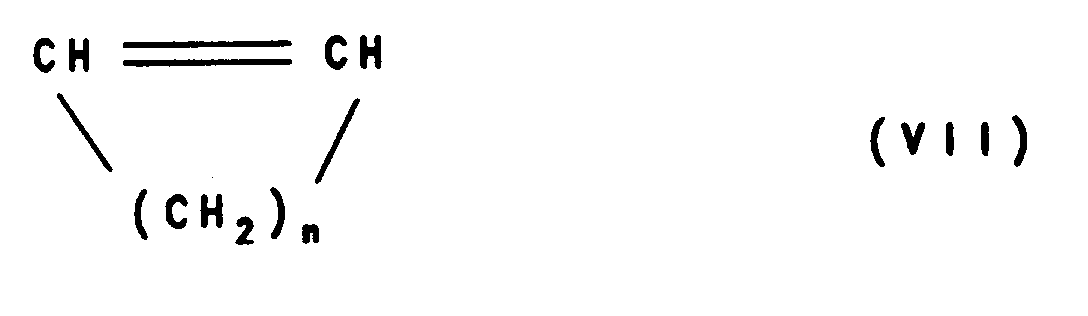
worin n eine Zahl von 2 bis 10 ist, und
0 bis 99,9 Gew.-%, bezogen auf die Gesamtmenge der Monomeren, mindestens eines acyclischen Olefins der Formel VIII
worin R⁹, R¹⁰, R¹¹ und R¹² gleich oder verschieden sind und ein Wasserstoffatom oder einen C₁-C₈-Alkylrest bedeuten, bei Temperaturen von -78 bis 150°C und einem Druck von 0,01 bis 64 bar, in Gegenwart eines Katalysators, welcher aus einem Aluminoxan der Formel IX
(= linearer Typ) und/oder der Formel X
(= cyclischer Typ), wobei in den Formeln IX und X die Reste R¹³ gleich oder verschieden sind und eine C₁-C₆-Alkylgruppe oder Phenyl oder Benzyl bedeuten und n eine ganze Zahl von 0 bis 50 ist, und einem Metallocen der Formel XI
besteht, worin - M¹
- Titan, Zirkon, Hafnium, Vanadium, Niob oder Tantal ist,
- R¹⁴ und R¹⁵
- gleich oder verschieden sind und ein Wasserstoffatom, ein Halogenatom, eine C₁-C₁₀-Alkylgruppe, eine C₁-C₁₀-Alkoxygruppe, eine C₆-C₁₀-Arylgruppe, eine C₆-C₁₀-Aryloxygruppe, eine C₂-C₁₀-Alkenylgruppe, eine C₇-C₄₀-Arylalkylgruppe, eine C₇-C₄₀-Alkylarylgruppe oder eine C₈-C₄₀- Arylalkenylgruppe bedeuten,
- R¹⁶ und R¹⁷
- gleich oder verschieden sind und einen ein- oder mehrkernigen Kohlenwasserstoffrest, welcher mit dem Zentralatom M¹ eine Sandwichstruktur bilden kann, bedeuten,
- R¹⁸
-

gleich oder verschieden sind und ein Wasserstoffatom, ein Halogenatom, eine C₁-C₁₀-Alkylgruppe, eine C₁-C₁₀-Fluoralkylgruppe, eine C₆-C₁₀-Fluorarylgruppe, eine C₆-C₁₀-Arylgruppe, eine C₁-C₁₀-Alkoxygruppe, eine C₂-C₁₀-Alkenylgruppe, eine C₇-C₄₀-Arylalkylgruppe, eine C₈-C₄₀-Arylalkenylgruppe oder eine C₇-C₄₀-Alkylarylgruppe bedeuten oder R¹⁹ und R²⁰ oder R¹⁹ und R²¹ jeweils mit den sie verbindenden Atomen einen Ring bilden, und - M²
- Silizium, Germanium oder Zinn ist. Dabei weist der Teil des Metallocenmoleküls, der durch M¹ und die Substituenten R¹⁶-R¹⁷ gebildet wird, C₁-Symmetrie auf oder liegt, falls R¹⁶ und R¹⁷ gleich sind, in der meso-Form vor.
- Dabei steht der Ausdruck Alkyl für geradkettiges oder verzweigtes Alkyl.
- Das monocyclische Olefin VII kann auch substituiert sein (z.B. durch Aryl- oder Alkylreste).
- Bevorzugt wird in flüssigem Polycycloolefin I - VI, in Gemischen von Polycycloolefin oder in konzentrierten Lösungen polymerisiert.
- Beim Verfahren zur Herstellung von "chemisch einheitlichen" Cycloolefincopolymeren, die geeignet sind zur Herstellung der erfindungsgemäßen faserverstärkten Materialien, wird mindestens ein polycyclisches Olefin der Formeln I, II, III, IV, V oder VI, vorzugsweise ein Polycycloolefin der Formeln I oder III, polymerisiert. Das zweite Comonomer ist dabei vorzugsweise ein acyclisches Olefin der Formel VIII, worin R⁹, R¹⁰, R¹¹ und R¹² gleich oder verschieden sind und ein Wasserstoffatom oder einen C₁-C₈-Alkylrest bedeuten. Bevorzugt sind Ethylen oder Propylen. Gegebenenfalls wird zusätzlich auch ein monocyclisches Olefin der Formel VII, worin n eine Zahl von 2 bis 10 ist, verwendet.
- Insbesondere werden Copolymere von polycyclischen Olefinen, vorzugsweise der Formeln I und III, mit den acyclischen Olefinen VIII hergestellt.
- Besonders bevorzugte Cycloolefine sind Norbornen und Tetracyclododecen, wobei diese durch (C₁-C₆)-Alkyl substituiert sein können. Sie werden vorzugsweise mit Ethylen copolymerisiert; besondere Bedeutung besitzen Ethylen/Norbornen-Copolymere.
- Als polycyclische Olefine, monocyclische Olefine und offenkettige Olefine sind auch Gemische zweier oder mehrerer Olefine des jeweiligen Typs zu verstehen. Das heißt, es können neben polycyclischen Bicopolymeren auch Ter- und Multicopolymere hergestellt werden.
- Die erfindungsgemäßen faserverstärkten Materialien eignen sich besonders zur Herstellung von Extrusionsteilen wie Folien, Schläuchen, Rohren, Stangen und Fasern als auch zur Herstellung von Spritzgußartikeln beliebiger Form und Größe.
- Der besondere Vorteil der chemisch einheitlichen Cycloolefincopolymeren besteht in ihrer besonders einfachen Herstellbarkeit und ihrer besonders ausgeprägten Lösungsmittelstabilität gegenüber unpolaren Lösungsmitteln. Die von anderen statistischen Cycloolefincopolymeren bekannten vorteilhaften Eigenschaften wie hydrolytische Stabilität, geringe Wasseraufnahme und Witterungsbeständigkeit sind jedoch erhalten.
Der Kristallinitätsgrad von chemisch einheitlichen Cycloolefincopolymeren liegt zwischen 0.1 und 50 %, vorzugsweise zwischen 2 und 40 %.
Er ist bestimmbar nach der literaturbekannten Methode der Röntgenographie (vgl. K. Kakudo, N. Kasai, X-Ray Diffraction by Polymers, Elsevier, Amsterdam 1972).
Vorzugsweise besteht das mit Fasern verstärkte Cycloolefincopolymere aus einem einzigen Polycycloolefin der allgemeinen Formel I bis VI und entweder mindestens einem Monocycloolefin der allgemeinen VII oder mindestens einem acyclischen Olefin der allgemeinen Formel VIII. Blöcke aus Polycycloolefin fehlen im Polymermolekül. Im Grenzfall sind das Polycycloolefin und das Olefin VII und/oder VIII im Polymermolekül regelmäßig und alternierend angeordnet. - Besonders bevorzugt ist es, wenn als acyclisches Olefin der allgemeinen Formel VIII ein 1-Olefin wie Ethylen, Propylen oder Buten-1 verwendet wird.
Insbesondere bevorzugt ist es, wenn das Copolymere aus äquimolaren Mengen Norbornen und Ethylen besteht und die beiden Monomer-Moleküle im Polymer regelmäßig und alternierend angeordnet sind. - Die zur Verstärkung dienenden Fasern können aus Kohlenstoff, Metall, Keramik oder Aramid bestehen. Auf diese Weise lassen sich licht-undurchlässige Materialien mit hoher Festigkeit erzeugen. Aus wirtschaftlichen Gründen ist es vorteilhaft, Glasfasern zur Verstärkung zu verwenden. Falls das eingesetzte Cycloolefincopolymer transparent ist und die Brechungsindices von Copolymer und Glasfaser übereinstimmen, kann man ein transparentes faserverstärktes Cycloolefinpolymer-Material erhalten. Falls der Unterschied der Brechungsindices zu groß ist oder das eingesetzte Cycloolefincopolymer eine zu hohe Kristallinität aufweist, also nicht mehr transparent ist, so ist auch das faserverstärkte Cycloolefincopolymer-Material nicht transparent. Auf die Transparenz kommt es aber bei vielen Einsatzzwecken nicht an. Das erfindungsgemäße Material wird meist in Form von Granulat weiterverarbeitet. Langfaserverstärktes Material kann zum Wickeln von Rohren verwendet werden.
- Die Cycloolefincopolymere (= "COC") gemäß EP 503 422 sind teilkristallin und besitzen daher einen Schmelzpunkt. Die Schmelze ist etwa 10-20 K oberhalb des Schmelzpunkts, d.h. bei etwa 295 - 310 °C verarbeitbar. In die Schmelze kann beispielsweise das Fasermaterial eingearbeitet werden.
Dagegen besitzen amorphe COC nur eine Glastemperatur und sind erst etwa 170 K oberhalb der Glastemperatur (etwa bei 350 °C) verarbeitbar. Die COC gemäß EP 503 422 sind bis zu einer Teilkristallinität von 20 % transparent. Bei einer Teilkristallinität von 20 - 40 % werden sie immer weniger transparent. Durch Abschrecken aus der Schmelze kann der Kristallinitätsgrad verringert werden. Die Verwendung von symmetrischen Monomer-Molekülen, die Reduzierung der Anzahl der Monomeren und eine Annäherung an ein äquimolares Molverhältnis bei der Synthese von COC erhöht die Kristallisationsneigung. Ein COC, das von Methyl-Norbornen als polycyclischem Olefin abgeleitet ist, wird eine geringere Kristallisationsneigung aufweisen als ein analoges COC, das sich von Norbornen ableitet.
Die nach dem Verfahren gemäß EP 50 3 422 herstellbaren COC sind praktisch frei von Blöcken die aus Monomeren der Formel I bis VI ("Norbornen-Blöcke") bestehen. Im allgemeinen folgt auf ein polycyclisches Monomer der Formel I bis VI mindestens ein Monomer der Formeln VII und/oder VIII.
Es ist überraschend, daß bei Einarbeitung von Verstärkungsfasern, insbesonders von Glasfasern in die COC gemäß EP 503 422 die Duktilität (z.B. die Reißdehnung) bei Temperaturen oberhalb der Glastemperatur zunimmt. Diesen Effekt kennt man sonst nur von teilkristallinen Polymeren mit einem Kristallinitätsgrad von mindestens 20 %, während er bei den 'chemisch einheitlichen' COC bereits bei deutlich niedrigeren Kristallinitätsgraden (zumindest ab 5 %) auftritt. Die erfindungsgemäßen faserverstärkten Materialien sind den faserverstärkten Materialien gemäß EP 451 858, die ein amorphes COC enthalten, überlegen. Dies zeigt sich in der höheren Wärmeformbeständigkeit sowie in der verbesserten thermoplastischen Verarbeitbarkeit der COC gemäß EP 503422. - Daß chemisch einheitliche Cycloolefincopolymere überraschenderweise besonders gut mit Glasfasern verstärkt werden können, liegt möglicherweise daran, daß sie einen sehr geringen Schrumpf nach der Verarbeitung aufweisen und es so nicht zu Ablösungen der Glasfaser von der Polymermatrix kommt. Dies führt zu einer besseren geometrischen Haftung.
- Der Schrumpf wird als sogenannte Verarbeitungsgeschwindigkeit angegeben, die nach DIN 53464 bestimmt wird. Die Verarbeitungsgeschwindigkeit von chemisch einheitlichen Cycloolefincopolymeren beträgt weniger als 0,4 %.
- Eine deutliche Verbesserung der mechanischen Eigenschaften von gefüllten und ungefüllten chemisch einheitlichen Cycloolefincopolymeren kann durch eine thermische Nachbehandlung und/oder den Einsatz eines geeigneten Nukleierungsmittels erreicht werden.
- Der Anteil an Verstärkungsfasern, insbesondere Glasfasern, im erfindungsgemäßen Material beträgt vorzugsweise 10 bis 90 Gew.-%, insbesondere 15 bis 75 Gew.-%.
Zur Herstellung eines erfindungsgemäßen faserverstärkten Cycloolefincopolymer-Materials vermischt man die Schmelze eines oben näher definierten chemisch einheitlichen Cycloolefincopolymeren mit dem gewünschten Anteil an Verstärkungsfasern. - Die verwendeten Glasfasern besitzen meist Schlichten, die Glasfilamente gegen mechanische Beanspruchung schützen und Spinnfäden aus Glas locker miteinander verbinden.
- Hauptbestandteile von Schlichten sind gemäß WO 86/ 01811 filmbildende Polymere und Gleitmittel sowie bei Bedarf Haftvermittler und sonstige Additive. Die filmbildenden Polymere sind in einem wässrigen Medium dispergierbar, löslich oder emulgierbar, gleichfalls das Reaktionsprodukt mit Prozeßhilfsmitteln. Der Gehalt an Wasser in der wässrig-chemischen Kombination der Schlichtebestandteile ist so ausgelegt, daß diese den effektiven Gehalt an Feststoff auf der Glasfaser ergeben.
- Die wässrig-chemische Kombination zur Behandlung von Glasfasern kann bei jeder Methode für die Herstellung von geschnittener Glasfaser oder Endlosglasfaser eingesetzt werden. Sie kann z.B. auf die Naß-Schneideoperation angewendet werden, bei der die Fasern in Bündeln zusammengefaßt und direkt im Entstehungsprozeß geschnitten werden oder die chemisch behandelten Glasfasern in Bündeln oder Strängen zusammengefaßt, aufgewunden und erst nachfolgend geschnitten werden.
- Bei dem zum Stand der Technik gehörenden Materialien aus glasfaserverstärktem Kunststoff tritt das Problem auf, daß die (polaren) Glasfasern an unpolaren Polymeren manchmal schlecht haften und daher die mechanische Beständigkeit der Formkörper nicht optimal ist. Man hat daher in diesem Zusammenhang zur besseren Kopplung bereits Haftvermittler eingesetzt. Diese Haftvermittler werden entweder bei der Behandlung mit der wässrigenchemischen Kombination der Schlichte-Bestandteile oder durch eine separate Behandlung mit einer Lösung des Haftvermittlers auf die Glasfaser aufgebracht.
- Außerdem ist es möglich, die Haftvermittler in die Schmelze des Polymeren einzutragen. Diese Methode besitzt den Vorteil, daß keine Lösungen verarbeitet werden müssen. Die Haftvermittler können auch, wie bei den sonstigen Additiven möglich, durch Bereitstellung von Masterbatches, die das Verdünnungsprinzip ausnutzen, vorteilhaft in den Composite eingearbeitet werden.
- Dieser Zusatz von Haftvermittlern ist auch bei dem erfindungsgemäßen Verfahren zur Herstellung von glasfaserverstärkten chemisch einheitlichen Cycloolefincopolymeren von Vorteil. Man kann erfindungsgemäß sowohl einen Polymerschmelz-Haftvermittler zusetzen oder die Glasfaser mit einem Haftvermittler überziehen.
- Bekannte Haftvermittler sind auswählbar aus der Gruppe der Vinylsilane, der Methacyrylsilane, der Aminosilane, der Epoxysilane und der Methacrylat-Chromchlorid-Komplexe.
- Bevorzugt sind organische Haftvermittler auf Polymerbasis, wobei besonders bevorzugt die organischen Haftvermittler sind, bei denen es sich um funktionalisierte Cycloolefincopolymere handelt. Vorteilhafterweise wird dabei ein funktionalisiertes, "chemisch einheitliches" Cycloolefincopolymer als Haftvermittler eingesetzt.
- Vorzugsweise wird das funktionalisierte "chemisch einheitliche" Cycloolefincopolymer durch Pfropfung eines chemisch einheitlichen Cycloolefincopolymeren mit einem polaren Monomeren hergestellt. Besonders vorteilhaft ist es, wenn das bei der Pfropfung verwendete polare Monomere ausgewählt wird aus der Gruppe der alpha, beta-ungesättigten Carbonsäuren, der alpha, beta-ungesättigten Carbonsäurederivate, der organischen Siliziumverbindungen mit olefinisch ungesättigter und hydrolysierbarer Gruppe, der olefinisch ungesättigten Verbindungen mit Hydroxylgruppe und der olefinisch ungesättigten Epoxymonomeren. Ähnliche gepfropfte Polymere, die sich allerdings nicht von "chemisch einheitlichen" Cycloolefincopolymeren ableiten, sind bereits bekannt.
- Die Erfindung umfaßt somit einen Haftvermittler, der hergestellt wird durch Pfropfung eines oben beschriebenen "chemisch einheitlichen" Cycloolefincopolymeren mit einem polaren Monomeren. Der Gehalt des gepropften polaren Monomeren im Polymeren liegt bei 0,01 bis 50 Gew.-%. An das verwendete Glas werden keine besonderen Anforderungen gestellt. Vorzugsweise bestehen die Glasfasern aus Magnesium-Alumo-Silikat mit einem Brechungsindex von 1,50 bis 1,56 und enthalten 60 bis 68 Gew.-% SiO₂, 23 bis 29 Gew.-% Al₂O₃ und 8 bis 12 Gew.-% MgO. Das einzuarbeitende Fasermaterial weist üblicherweise eine mittlere Faserlänge von 0,0001 - 7 mm, insbesondere 0,1 bis 2 mm auf.
Die Erfindung wird durch die Beispiele näher erläutert. - Ein 70 l-Reaktor wurde mit Ethylen gefüllt und mit 17,6 l einer 85 gewichtsprozentigen Lösung von Norbornen in Toluol sowie mit 12,4 l Dekalin gefüllt. Durch mehrfaches Aufdrücken von Ethylen (6 bar) wurde die Lösung mit Ethylen gesättigt. Es wurde ein Druck von 3,0 bar (Überdruck) eingestellt, 950 cm³ toluolische Methylaluminoxanlösung (10,1 Gew. % Methylaluminoxan der Molmasse 1300 g/mol nach kryoskopischer Bestimmung) in den Reaktor gegeben und 15 min bei 70°C gerührt. Eine Lösung von 157 mg Isopropylen-(9-fluorenyl)(1-(3-methyl)-cyclopentadienyl)zirkondichlorid in 80 cm³ toluolischer Methylaluminoxanlösung wurde nach 15 min Voraktivierung zugegeben (zum Zweck der Molekulargewichtsregelung kann Wasserstoff vor der Katalysatorzugabe eindosiert werden). Unter Rühren (750 Upm) wurde 30 Minuten bei 70°C polymerisiert, wobei der Ethylendruck durch Nachdosieren bei 3,0 bar gehalten wurde. Die Reaktionslösung wurde anschließend in einen zweiten Reaktor eingeleitet, in dem 200 ml Isopropanol als Stoppungsmittel vorgelegt waren. Die so abgestoppte Reaktionslösung wurde in einen Fällungsreaktor abgelassen und dabei in 200 l Aceton eingerührt. Anschließend wurde dieses Fällungsbad über eine Drucknutsche geleitet, so daß der ausgefallene Feststoff isoliert werden konnte. Dieser Feststoff wurde noch mehrmals mit Aceton gewaschen und anschließend bei 80°C und einem Druck von 0,2 bar 14 Stunden getrocknet.
- Es wurden 1,89 kg eines farblosen Polymeren erhalten. Es wurde eine Viskositätszahl (Dekalin, 135°C) von 75 cm³/g und eine Glastemperatur von 137°C sowie ein Schmelzpunkt von 287°C gemessen. Das Norbornen/Ethylen - Einbauverhältnis ist gemäß NMR-Spektrum etwa 50 Mol-% Norbornen zu 50 Mol-% Ethylen. Dieses Cycloolefincopolymere wird nachstehend als COC A1 bezeichnet.
- Ein 70 l-Reaktor wurde mit Ethylen gefüllt und mit 17,6 l einer 85 gewichtsprozentigen Lösung von Norbornen in Toluol sowie mit 12,4 l Dekalin gefüllt. Durch mehrfaches Aufdrücken von Ethylen (6 bar) wurde die Lösung mit Ethylen gesättigt. Es wurde ein Druck von 6,0 bar (Überdruck) eingestellt, 950 cm³ toluolische Methylaluminoxanlösung (10,1 Gew. % Methylaluminoxan der Molmasse 1300 g/mol nach kryoskopischer Bestimmung) in den Reaktor gegeben und 15 min bei 70°C gerührt. Eine Lösung von 75 mg Diphenylmethylen(9-Fluorenyl)-cyclopentadienyl-zirkondichlorid in 40 cm³ toluolischer Methylaluminoxanlösung wurde nach 15 min Voraktivierung zugegeben (zum Zweck der Molekulargewichtsregelung kann Wasserstoff vor der Katalysatorzugabe eindosiert werden). Unter Rühren (750 Upm) wurde 30 Minuten bei 70°C polymerisiert, wobei der Ethylendruck durch Nachdosieren bei 6,0 bar gehalten wurde. Die Reaktionslösung wurde anschließend in einen zweiten Reaktor eingeleitet, in dem 200 ml Isopropanol als Stoppungsmittel vorgelegt waren. Die so abgestoppte Reaktionslösung wurde in einen Fällungsreaktor abgelassen und dabei in 200 l Aceton eingerührt. Anschließend wurde dieses Fällungsbad über eine Drucknutsche geleitet, so daß der ausgefallene Feststoff isoliert werden konnte. Dieser Feststoff wurde noch mehrmals mit Aceton gewaschen und anschließend bei 80°C und einem Druck von 0,2 bar 14 Stunden getrocknet.
- Es wurden 7,8 kg Polymer erhalten, das eine Glastemperatur von 181°C und eine Viskositätszahl (gemessen in Dekalin bei 135°C) von 108 aufweist. Das Polymer setzt sich zusammen aus 46 Gew. % Ethylen und 54 Gew. % Norbornen, die statistisch im Polymeren verteilt sind.
- Dieses Polymere wird nachfolgend COC A2 genannt.
- In einem Extruder wurde das COC A1 zusammen mit 30 Gewichtsprozent Glasfasern extrudiert und zu Granulat verarbeitet. Die Extrusionstemperatur lag zwischen 260 und 300°C (unterschiedliche Temperaturen in unterschiedlichen Heizzonen des Extruders). Zur Entgasung der Polymerschnelze wurde ein Vakuum von 100 mbar angelegt. Bei den verwendeten Glasfasern handelt es sich um Textilglasroving P 365 (Handelsprodukt der Fa. VETROTEX; Herzogenrath, Bundesrepublik Deutschland). Der Nennfilamentdurchmesser (DIN 53811) der Glasfasern beträgt 14 µm, die Strangfeinheit (DIN 53830) 2400 tex und die Spinnfadenfeinheit (DIN 53830) 300 tex. Es wurde ein farbloses Granulat aus COC A1, das mit 30 Gewichtsprozent Glasfasern gefüllt ist, erhalten.
- Zur Herstellung eines mit 30 Gew. % Glasfasern gefüllten Granulats von COC A2 mußte die Extrusionstemperatur auf 310 bis 350°C angehoben werden. Die übrigen Bedingungen entsprechen den oben genannten Extrusionsbedingungen für glasfasergefülltes COC A1. Da 350°C bereits die obere Verarbeitungstemperatur für COC darstellt, trat bei dieser Granulierung bereits eine Schädigung des Polymeren auf, die sich in einer deutlichen Gelbfärbung des
- Die Verarbeitbarkeit von thermoplastischen Polymeren wird durch den MFI charakterisiert. Je höher der MFI (DIN 53735) bei der Verarbeitungstemperatur ist, desto niedriger viskos ist die Polymerschmelze und desto besser läßt sich das Material durch Extrusion und Spritzguß verarbeiten. Daher wurde an dem erhaltenen Granulat der MFI bestimmt. Der gefundenene Wert ist zusammen mit Vergleichswerten für andere mit Glasfasern gefüllte Cycloolefincopolymere in Tabelle 1 aufgeführt.
Tabelle 1 MFI von COC A1 und COC A2 jeweils mit 30 Gew. % Glasfasern gefüllt MFI (g/10 min) 310°C; 10kg COC A1 284 COC A2 73 - Die aufgeführten Daten zeigen eindeutig, daß glasfasergefüllte Composites von COC A1 eine überlegene thermoplastische Verarbeitbarkeit aufweisen.
- Aus dem unter Beispiel 2 hergestelltem Granulat wurden durch Spritzguß Normprüfkörper hergstellt. An diesen Normprüfkörper erfolgte die Bestimmung der HDT-B gemäß DIN 53461 . Die ermittelten Werte sind in Tabelle 2 zusammengestellt.
Tabelle 2 HDT-B von COC-A1 und COC-A2 jeweils mit 30 Gew.-% Glasfasern gefüllt HDT-B/°C COC A1 244 COC A2 177 - Diese Werte belegen, daß das mit Glasfasern gefüllte chemisch einheitliche Cycloolefincopolymer eine deutlich höhere Wärmeformbeständigkeit aufweist als die entsprechenden Composites auf Basis des Cycloolefincopolymeren COC A2 .
- Es wurden durch Spritzguß Normprüfkörper aus glasfaserverstärktem COC A1 und COC A2 (jeweils 30 % Glasfasern) sowie aus ungefülltem COC A1 hergestellt. An ihnen wurden durch Zug-Dehnungs-Versuche die mechanischen Eigenschaften bestimmt. Die Bestimmung der mechanischen Eigenschaften erfolgte bei Raumtemperatur und bei 210°C. Die entsprechenden Werte sind in Tabelle 3, 4, 5 und 6 aufgeführt.
Tabelle 3 Mechanische Eigenschaften von COC A1 mit und ohne Glasfaser bei 23°C E-Modul in MPa Bruchspannung in MPa Reißdehnung in % COC A1 ohne Glasfasern 3971 43,7 1,8 COC A1 mit 30 Gew. % Glasfasern 10230 83,5 1,8 Tabelle 4 Mechanische Eigenschaften von COC A1 mit und ohne Glasfaser bei 210°C E-Modul in MPa Bruchspannung in MPa Reißdehnung in % COC A1 ohne Glasfasern 35 3,9 55,6 COC A1 mit 30 Gew. % Glasfasern 463 1,9 17,3 - Die in Tabelle 3 und 4 aufgeführten Werte zeigen, daß durch das Eintragen von Glasfasern in chemisch einheitliche Polymere eine deutliche Verbesserung der mechanischen Eigenschaften des Polymeren erzielt wird. Besonders deutlich ist die überlegene Steifigkeit des mit Glasfasern gefüllten COC A1 bei 210°C.
Tabelle 5 Mechanische Eigenschaften von COC A1 und COC A2 mit 30 Gew. % Glasfaser gefüllt, bei 23°C E-Modul in MPa Bruchspannung in MPa Reißdehnung in % COC A1 10230 83,5 1,8 COC A2 8320 75,1 1,6 Tabelle 6 Mechanische Eigenschaften von COC A1 und COC A2 jeweils mit 30 Gew. % Glasfaser gefüllt, bei 210°C E-Modul in MPa Bruchspannung in MPa Reißdehnung in % COC A1 463 1,9 17,3 COC A2 nicht mehr meßbar - Die in Tabelle 5 und 6 zusammengestellten Werte zeigen, daß die mechanischen Eigenschaften eines mit Glasfasern gefüllten chemisch einheitlichen Cycloolefincopolymeren denen eines mit Glasfasern gefüllten statistischen Cycloolefincopolymeren deutlich überlegen sind.
- Die Beispiele 1 bis 5 belegen, daß es nur mit glasfaserverstärkten chemisch einheitlichen Cycloolefincopolymeren gelingt, eine Wärmeformbeständigkeit (HDT-B) von größer 180°C, gute mechanische Eigenschaften wie hohe Steifigkeit und gleichzeitig eine gute Verarbeitbarkeit zu realisieren.
- Mit Hilfe einer Zugprüfmaschine ®Instron (Fa. Instron, Offenbach, Bundesrepublik Deutschland) wurden die Reißfestigkeit, d. h. die Zugspannung, bei der der Normzugstab reißt und die Reißdehnung, d. h. die maximale Dehnung nach DIN 53455 bestimmt. Der E-Modul berechnet sich aus der Zug-Dehnungs-Kurve nach DIN 53457. Die Wärmeformbeständigkeit HDT-B wurde nach DIN 53461 bestimmt. Die Bestimmung des MFI erfolgte gemäß DIN 53735. Die Viskositätszahl wurde gemäß DIN 53726 bestimmt.
- Die Herstellung des Granulates erfolgte mit einem Leistritz Laborextruder LSM 30.34 (Fa. Leistritz; Nürnberg, Bundesrepublik Deutschland).
- Die Normprüfkörper wurden durch Spritzguß unter Verwendung einer Spritzgußmaschine Krauss Maffei KM 90-210 B (Fa. Krauss Maffei, Kunststofftechnik GmbH ; Düsseldorf; Bundesrepublik Deutschland) hergestellt.
Claims (17)
- Faserverstärktes Cycloolefinpolymer-Material bestehend aus 1 bis 99 Gew.-% Verstärkungsfasern und 99 bis 1 Gew.-% eines Cycloolefincopolymeren, das aus mindestens einem Polycycloolefin der allgemeinen Formel I bis VI


und/oder der Gruppe der acyclischen Olefine VIII,
dadurch gekennzeichnet, daß im Cycloolefincopolymer-Molekül die Monomer-Einheiten des Polycycloolefins der allgemeinen Formel I bis VI jeweils durch Monomer-Einheiten der cyclischen Olefine VII und/oder der acyclischen Olefine der allgemeinen Formel VIII getrennt sind. - Material gemäß Anspruch 1, dadurch gekennzeichnet daß ein einziges Polycycloolefin der Formel I bis VI und entweder mindestens ein monocyclisches Olefin der allgemeinen Formel VII oder mindestens ein acyclisches Olefin der allgemeinen Formel VIII im Polymermolekül vorhanden sind.
- Material gemäß Anspruch 1 oder 2, dadurch gekennzeichnet, daß im Polymermolekül als Polycycloolefin Norbornen oder Tetracyclododecen und als acyclisches Olefin ein 1-Olefin vorhanden sind.
- Material gemäß Anspruch 3, dadurch gekennzeichnet, daß im Polymermolekül Norbornen oder Tetracyclododecen sowie Ethylen vorhanden und regelmäßig angeordnet sind.
- Material gemäß Anspruch 1, dadurch gekennzeichnet, daß das Cycloolefinpolymer-Material hergestellt wird durch Polymerisation von 0,1 bis 99,9 Gew.-%, bezogen auf die Gesamtmenge der Monomeren, mindestens eines Monomers der Formeln I, II, III, IV, V oder VI


O bis 99,9 Gew.-%, bezogen auf die Gesamtmenge der Monomeren, eines Cycloolefins der Formel VII
0 bis 99,9 Gew.-%, bezogen auf die Gesamtmenge der Monomeren, mindestens eines acyclischen Olefins der Formel VIII


 M¹ Titan, Zirkon, Hafnium, Vanadium, Niob oder Tantal ist,R¹⁴ und R¹⁵ gleich oder verschieden sind und ein Wasserstoffatom, ein Halogenatom, eine C₁-C₁₀-Alkylgruppe, eine C₁-C₁₀-Alkoxygruppe, eineR¹⁶ und R¹⁷ gleich oder verschieden sind und einen ein- oder mehrkernigen Kohlenwasserstoffrest, welcher mit dem Zentralatom M¹ eine Sandwichstruktur bilden kann, bedeuten,
C₆-C₁₀-Arylgruppe, eine C₆-C₁₀-Aryloxygruppe, eine C₂-C₁₀-Alkenylgruppe, eine C₇-C₄₀-Arylalkylgruppe, eine C₇-C₄₀-Alkylarylgruppe oder eine C₈-C₄₀-Arylalkenylgruppe bedeuten,
R¹⁸
gleich oder verschieden sind und ein Wasserstoffatom, ein Halogenatom, eine C₁-C₁₀-Alkylgruppe, eine C₁-C₁₀-Fluoralkylgruppe, eine C₆-C₁₀-Fluorarylgruppe, eine C₆-C₁₀-Arylgruppe, eine C₁-C₁₀-Alkoxygruppe, eine C₂-C₁₀-Alkenylgruppe, eine C₇-C₄₀-Arylalkylgruppe, eine C₈-C₄₀-Arylalkenylgruppe oder eine C₇-C₄₀-Alkylarylgruppe bedeuten oder R¹⁹ und R²⁰ oder R¹⁹ und R²¹ jeweils mit den sie verbindenden Atomen einen Ring bilden, und
M² Silizium, Germanium oder Zinn ist, dadurch gekennzeichnet, daß der Teil des Metallocenmoleküls, der durch M¹ und die Substituenten R¹⁶-R¹⁷ gebildet wird, C₁-Symmetrie aufweist oder, falls R¹⁶ und R¹⁷ gleich sind, in der meso-Form vorliegt. - Material gemäß Anspruch 1 oder 3, dadurch gekennzeichnet, daß die Verstärkungsfasern aus Glasfaser bestehen.
- Material gemäß Anspruch 1, dadurch gekennzeichnet, daß die Verstärkungsfasern aus Kohlenstoff, Metall, Keramik oder Aramid bestehen.
- Material gemäß Anspruch 1, dadurch gekennzeichnet, daß das eingesetzte Cycloolefincopolymere transparent ist.
- Material gemäß Anspruch 1, dadurch gekennzeichnet, daß das eingesetzte Cycloolefincopolymere nicht transparent ist.
- Material gemäß Anspruch 6, dadurch gekennzeichnet, daß der Anteil an Glasfaser 10 bis 90 Gew.-% und der Anteil an Cycloolefincopolymeren 90 bis 10 Gew.-% beträgt.
- Formkörper aus einem Material nach einem der Ansprüche 1 bis 10.
- Verfahren zur Herstellung eines faserverstärkten Cycloolefinpolymer-Materials, wobei man eine Schmelze des Cycloolefincopolymeren mit Verstärkungsfasern vermischt und dabei einen Anteil von 1 bis 99 Gew.-% Verstärkungsfasern einstellt, dadurch gekennzeichnet, daß das Cycloolefincopolymere aus mindestens einem Polycycloolefin der allgemeinen Formel I bis VI und mindestens einem Olefin, das ausgewählt wird aus der Gruppe der Monocycloolefine der allgemeinen Formel VII und/oder der Gruppe der acyclischen Olefine der allgemeinen Formel VIII, besteht, wobei im Polymermolekül die eingesetzten Monomer-Einheiten des Polycycloolefins der allgemeinen Formel I bis VI jeweils durch Monomer-Einheiten des monocyclischen Olefins VII und/oder der acyclischen Olefine VIII getrennt sind.
- Verfahren nach Anspruch 12, dadurch gekennzeichnet, daß man als Verstärkungsfaser Glasfaser mit einem Brechungindex von 1,50 bis 1,56 verwendet.
- Verfahren nach Anspruch 13, dadurch gekennzeichnet, daß man die Glasfaser mit einem Haftvermittler überzieht und dann mit der Schmelze des Cycloolefincopolymeren vereinigt.
- Verfahren nach Anspruch 14, dadurch gekennzeichnet, daß man der Schmelze des Cycloolefincopolymeren einen Haftvermittler zusetzt.
- Verfahren nach Anspruch 14 oder 15, dadurch gekennzeichnet, daß man als Haftvermittler ein funktionalisiertes Cycloolefincopolymer einsetzt.
- Haftvermittler für Glasfaser bestehend ausa) 50 bis 99,9 Gew.-% eines Cycloolefincopolymeren, das aufgebaut ist aus mindestens einem Polycycloolefin der allgemeinen Formel I bis VI, einem monocyclischen Olefin der allgemeinen Formel VII und/oder mindestens einem acyclischen Olefin der allgemeinen Formel VIII, wobei im Polymermolekül die eingesetzten Monomer-Einheiten des Polycycloolefins der allgemeinen Formel I bis VI jeweils durch MonomerusEinheiten des monocyclischen Olefins VII und/oder der acyclischen Olefine VIII getrennt sind undb) 0,1 bis 50 Gew.-% eines aufgepropften polaren Monomeren.
Applications Claiming Priority (2)
| Application Number | Priority Date | Filing Date | Title |
|---|---|---|---|
| DE4302569 | 1993-01-29 | ||
| DE4302569 | 1993-01-29 |
Publications (3)
| Publication Number | Publication Date |
|---|---|
| EP0608760A2 true EP0608760A2 (de) | 1994-08-03 |
| EP0608760A3 EP0608760A3 (de) | 1994-11-17 |
| EP0608760B1 EP0608760B1 (de) | 2004-09-15 |
Family
ID=6479250
Family Applications (1)
| Application Number | Title | Priority Date | Filing Date |
|---|---|---|---|
| EP94100710A Expired - Lifetime EP0608760B1 (de) | 1993-01-29 | 1994-01-19 | Faserverstärktes Cycloolefincopolymer-Material, Verfahren zu seiner Herstellung und Formkörper aus dem Material |
Country Status (6)
| Country | Link |
|---|---|
| US (1) | US5428098A (de) |
| EP (1) | EP0608760B1 (de) |
| JP (1) | JPH06263955A (de) |
| KR (1) | KR940018403A (de) |
| AU (1) | AU676228B2 (de) |
| DE (1) | DE59410387D1 (de) |
Cited By (1)
| Publication number | Priority date | Publication date | Assignee | Title |
|---|---|---|---|---|
| EP1775312A4 (de) * | 2004-07-09 | 2009-09-30 | Mitsui Chemicals Inc | Thermoplastisches harz |
Families Citing this family (43)
| Publication number | Priority date | Publication date | Assignee | Title |
|---|---|---|---|---|
| US5475060A (en) * | 1993-02-18 | 1995-12-12 | Hoechst Ag | Cycloolefin block copolymers and a process for their preparation |
| DE19521561A1 (de) * | 1995-06-19 | 1997-01-02 | Hoechst Ag | Absorptionsmittel |
| US5783624A (en) * | 1996-12-13 | 1998-07-21 | Hoechst Celanese Corporation | Transparent polymer composites having a low thermal expansion coefficient |
| DE19652340A1 (de) * | 1996-12-17 | 1998-06-18 | Hoechst Ag | Verfahren zur Herstellung von Cycloolefincopolymers |
| DE19652338A1 (de) * | 1996-12-17 | 1998-06-18 | Hoechst Ag | Verfahren zur Herstellung eines Cycloolefincopolymers |
| US6063338A (en) * | 1997-06-02 | 2000-05-16 | Aurora Biosciences Corporation | Low background multi-well plates and platforms for spectroscopic measurements |
| US6426050B1 (en) | 1997-05-16 | 2002-07-30 | Aurora Biosciences Corporation | Multi-well platforms, caddies, lids and combinations thereof |
| US6171780B1 (en) | 1997-06-02 | 2001-01-09 | Aurora Biosciences Corporation | Low fluorescence assay platforms and related methods for drug discovery |
| US6229603B1 (en) | 1997-06-02 | 2001-05-08 | Aurora Biosciences Corporation | Low background multi-well plates with greater than 864 wells for spectroscopic measurements |
| US5910287A (en) * | 1997-06-03 | 1999-06-08 | Aurora Biosciences Corporation | Low background multi-well plates with greater than 864 wells for fluorescence measurements of biological and biochemical samples |
| US6517781B1 (en) | 1997-06-02 | 2003-02-11 | Aurora Biosciences Corporation | Low fluorescence assay platforms and related methods for drug discovery |
| US6861035B2 (en) | 1998-02-24 | 2005-03-01 | Aurora Discovery, Inc. | Multi-well platforms, caddies, lids and combinations thereof |
| AU2768701A (en) * | 2000-01-05 | 2001-07-16 | Owens Corning | Catalytically polymerized fiber-reinforced composites |
| US6436476B1 (en) | 2000-02-14 | 2002-08-20 | Owens Corning Fiberglas Technology, Inc. | Polyolefin fiber-reinforced composites using a fiber coating composition compatible with romp catalysts |
| US6875719B2 (en) * | 2000-04-27 | 2005-04-05 | Industrial Technology Research Institute | Catalyst composition for preparing olefin polymers |
| GB0114684D0 (en) * | 2001-06-15 | 2001-08-08 | Dow Chemical Co | Automobile assembly |
| DE10137924B4 (de) * | 2001-08-07 | 2005-12-01 | Ticona Gmbh | Langfaserverstärkte Polyolefin-Kunststoff Struktur, Verfahren zu seiner Herstellung und daraus hergestellte Formkörper |
| TW200420515A (en) * | 2002-07-23 | 2004-10-16 | Ppg Ind Ohio Inc | Glass fiber sizing compositions, sized glass fibers, and polyolefin composites |
| US20060257678A1 (en) * | 2005-05-10 | 2006-11-16 | Benson Olester Jr | Fiber reinforced optical films |
| US20060257679A1 (en) * | 2005-05-10 | 2006-11-16 | Benson Olester Jr | Polymeric optical body containing inorganic fibers |
| US20070150482A1 (en) * | 2005-08-12 | 2007-06-28 | Jacob Taylor | Customer relationship management system and method |
| US20070153384A1 (en) * | 2005-12-30 | 2007-07-05 | Ouderkirk Andrew J | Reinforced reflective polarizer films |
| US20070236049A1 (en) * | 2006-03-31 | 2007-10-11 | Dow Global Technologies Inc. | Modular assembly for a vehicle |
| US20070236939A1 (en) * | 2006-03-31 | 2007-10-11 | 3M Innovative Properties Company | Structured Composite Optical Films |
| US20070237938A1 (en) * | 2006-03-31 | 2007-10-11 | 3M Innovative Properties Company | Reinforced Optical Films |
| US20070236938A1 (en) * | 2006-03-31 | 2007-10-11 | 3M Innovative Properties Company | Structured Composite Optical Films |
| US20080274293A1 (en) * | 2006-03-31 | 2008-11-06 | 3M Innovative Properties Company | Spiral Multilayer Fibers |
| US7327923B2 (en) * | 2006-03-31 | 2008-02-05 | 3M Innovative Properties Company | Spiral multilayer fibers |
| US20080033112A1 (en) * | 2006-08-04 | 2008-02-07 | Squire Kevin R | Polymer compositions comprising cyclic olefin copolymers and polyolefin modifiers |
| WO2008018951A1 (en) * | 2006-08-04 | 2008-02-14 | Exxonmobil Chemical Patents Inc. | Polymer compositions comprising cyclic olefin polymers, polyolefin modifiers, and fillers |
| US8148472B1 (en) | 2006-08-04 | 2012-04-03 | Exxonmobil Research And Engineering Company | Polymer compositions comprising cyclic olefin polymers, polyolefin modifiers and non-functionalized plasticizers |
| US7599592B2 (en) * | 2006-08-30 | 2009-10-06 | 3M Innovative Properties Company | Polymer fiber polarizers with aligned fibers |
| US20080057277A1 (en) * | 2006-08-30 | 2008-03-06 | 3M Innovative Properties Company | Polymer fiber polarizers |
| US7773834B2 (en) | 2006-08-30 | 2010-08-10 | 3M Innovative Properties Company | Multilayer polarizing fibers and polarizers using same |
| US8519056B2 (en) * | 2007-06-01 | 2013-08-27 | Exxonmobil Chemical Patents Inc. | Blends of co-precipitated hydrogenated ethylene-dicyclpentadiene and elastomeric polymers to provide impact modified structural polyolefins |
| US20090156735A1 (en) * | 2007-12-14 | 2009-06-18 | General Electric Company | Composition, article, and associated method |
| US20090156726A1 (en) * | 2007-12-14 | 2009-06-18 | General Electric Company | Composition, article, and associated method |
| ES2805289T3 (es) | 2011-06-17 | 2021-02-11 | Materia Inc | Promotores de la adherencia y modificadores de la gelificación para composiciones de metátesis de olefinas |
| US20150152283A1 (en) | 2012-06-12 | 2015-06-04 | Materia, Inc. | Method and composition for improving adhesion of metathesis compositions to substrates |
| US9527982B2 (en) | 2012-12-19 | 2016-12-27 | Materia, Inc. | Storage stable adhesion promoter compositions for cyclic olefin resin compositions |
| US9598531B2 (en) | 2013-02-27 | 2017-03-21 | Materia, Inc. | Olefin metathesis catalyst compositions comprising at least two metal carbene olefin metathesis catalysts |
| EP3092204A4 (de) | 2014-01-10 | 2017-12-20 | Materia, Inc. | Verfahren und zusammensetzung zur verbesserung der haftung von metathesezusammensetzungen an substraten |
| JP2023079212A (ja) * | 2021-11-26 | 2023-06-07 | 三井化学株式会社 | 環状オレフィン系共重合体および環状オレフィン系共重合体の製造方法 |
Family Cites Families (11)
| Publication number | Priority date | Publication date | Assignee | Title |
|---|---|---|---|---|
| US3624143A (en) * | 1968-05-10 | 1971-11-30 | Merck & Co Inc | Compounds of the class {62 -aralkylthio-substituted-{60 -amino acids |
| DD134236B1 (de) * | 1977-11-08 | 1980-05-28 | Leuna Werke Veb | Verstaerkte polyolefine |
| US4534874A (en) * | 1983-11-21 | 1985-08-13 | Ciba-Geigy Corporation | Anti-oxidative, anti-thermal, and anti-actinic degradation amides of hydroxyphenylalkylthio alkanoic acids, compositions, and method of use therefor |
| US4808572A (en) * | 1985-12-06 | 1989-02-28 | Ciba-Geigy Corporation | α-Hydroxy thioethers |
| JPH0757811B2 (ja) * | 1988-06-21 | 1995-06-21 | 日本ゼオン株式会社 | ガラス繊維強化ノルボルネン系ポリマーおよびその製造法 |
| JPH03179022A (ja) * | 1989-10-03 | 1991-08-05 | Hercules Inc | ゴム状架橋メタセシス重合体成形物およびその製法 |
| US5204427A (en) * | 1989-11-01 | 1993-04-20 | Nippon Zeon Co., Ltd. | Method of making ring-opened polynorbornene polymers using pot life extending agents |
| JP2977274B2 (ja) * | 1989-12-26 | 1999-11-15 | 日本ゼオン株式会社 | 成形用材料および成形品 |
| JPH04218557A (ja) * | 1990-04-13 | 1992-08-10 | Nippon Zeon Co Ltd | 熱可塑性飽和ノルボルネン系ポリマー成形品 |
| ATE223440T1 (de) * | 1991-03-09 | 2002-09-15 | Basell Polyolefine Gmbh | Metallocen und katalysator |
| DE4240784A1 (de) * | 1992-12-04 | 1994-06-09 | Hoechst Ag | Glasfaserverstärktes Cycloolefinpolymer-Material und Verfahren zu seiner Herstellung |
-
1994
- 1994-01-19 EP EP94100710A patent/EP0608760B1/de not_active Expired - Lifetime
- 1994-01-19 DE DE59410387T patent/DE59410387D1/de not_active Expired - Fee Related
- 1994-01-27 AU AU53981/94A patent/AU676228B2/en not_active Ceased
- 1994-01-27 US US08/187,224 patent/US5428098A/en not_active Expired - Fee Related
- 1994-01-28 KR KR1019940001549A patent/KR940018403A/ko not_active Ceased
- 1994-01-31 JP JP6009365A patent/JPH06263955A/ja active Pending
Cited By (1)
| Publication number | Priority date | Publication date | Assignee | Title |
|---|---|---|---|---|
| EP1775312A4 (de) * | 2004-07-09 | 2009-09-30 | Mitsui Chemicals Inc | Thermoplastisches harz |
Also Published As
| Publication number | Publication date |
|---|---|
| EP0608760A3 (de) | 1994-11-17 |
| JPH06263955A (ja) | 1994-09-20 |
| AU5398194A (en) | 1994-08-04 |
| KR940018403A (ko) | 1994-08-16 |
| EP0608760B1 (de) | 2004-09-15 |
| DE59410387D1 (de) | 2004-10-21 |
| AU676228B2 (en) | 1997-03-06 |
| US5428098A (en) | 1995-06-27 |
Similar Documents
| Publication | Publication Date | Title |
|---|---|---|
| EP0608760B1 (de) | Faserverstärktes Cycloolefincopolymer-Material, Verfahren zu seiner Herstellung und Formkörper aus dem Material | |
| EP0566988B1 (de) | Polymerlegierungen aus Cycloolefinpolymeren und Polyolefinen | |
| EP0485893B1 (de) | Massepolymerisation mit speziellen Metallocenkatalysatoren zur Herstellung von Cycloolefinpolymeren | |
| EP1228101B1 (de) | Polyethylen formmasse mit verbesserter escr-steifigkeitsrelation und schwellrate, verfahren zu ihrer herstellung und ihre verwendung | |
| EP0683797B1 (de) | Verfahren zur herstellung von cycloolefincopolymeren mit niedriger schmelzeviskosität und niedriger optischer dämpfung | |
| DE1794361C2 (de) | Polymere des Propylens oder Butens-1. Ausscheidung aus: 1494168 | |
| DE69914383T2 (de) | Heterophasische copolymere | |
| EP0610851B1 (de) | Verfahren zur Herstellung von Cycloolefincopolymeren | |
| DE69020865T2 (de) | Geformte Gegenstände aus syndiotaktischem Polypropylen und Verfahren zu deren Herstellung. | |
| DE69719751T2 (de) | Mischungen mit cycloolefin-polymer mit verbesserter schlagbeständigkeit ung guter transparenz | |
| DE69624844T2 (de) | Verfahren zur Olefinpolymerisation | |
| EP0844077B1 (de) | Biaxial orientierte Folie aus cycloolefinischen Polymeren, Verfahren zu ihrer Herstellung und ihre Verwendung | |
| EP0433989A2 (de) | Verfahren zur Herstellung einer Polypropylen-Formmasse | |
| DE69029620T2 (de) | Neue Polypropylen-Faser und Verfahren zur Herstellung | |
| DE69120601T2 (de) | Polymerzusammensetzungen | |
| DE4139261A1 (de) | Ethylen-copolymerisate niederer dichte | |
| EP0601456A1 (de) | Glasfaserverstärktes Cycloolefinpolymer-Material und Verfahren zu seiner Herstellung | |
| EP0610847B1 (de) | Fasern aus Cycloolefincopolymeren | |
| EP0920465B1 (de) | Elastomere cycloolefincopolymere | |
| DE4213219A1 (de) | Polymerlegierungen aus Cycloolefinpolymeren und Polyolefinen | |
| EP0530767A2 (de) | Polymerlegierungen aus Cycloolefinpolymeren und Polyacetalen | |
| DE69232690T2 (de) | Verfahren zur Herstellung von Polyphenylensulfidharzen | |
| EP0683798B1 (de) | Verfahren zur herstellung von cycloolefincopolymeren mit hoher reissfestigkeit und niedriger optischer dämpfung | |
| WO1992016585A1 (de) | Legierungen aus cycloolefinpolymeren und flüssigkristallinen polyestern | |
| DE4209063A1 (de) | Polymerlegierungen aus cycloolefinpolymeren und polyacetalen |
Legal Events
| Date | Code | Title | Description |
|---|---|---|---|
| PUAI | Public reference made under article 153(3) epc to a published international application that has entered the european phase |
Free format text: ORIGINAL CODE: 0009012 |
|
| AK | Designated contracting states |
Kind code of ref document: A2 Designated state(s): DE FR GB IT |
|
| PUAL | Search report despatched |
Free format text: ORIGINAL CODE: 0009013 |
|
| AK | Designated contracting states |
Kind code of ref document: A3 Designated state(s): BE CH DE ES FR GB IT LI NL |
|
| 17P | Request for examination filed |
Effective date: 19950517 |
|
| RAP1 | Party data changed (applicant data changed or rights of an application transferred) |
Owner name: TICONA GMBH |
|
| RAP1 | Party data changed (applicant data changed or rights of an application transferred) |
Owner name: TICONA GMBH |
|
| RBV | Designated contracting states (corrected) |
Designated state(s): DE FR GB IT |
|
| 17Q | First examination report despatched |
Effective date: 20020124 |
|
| RAP1 | Party data changed (applicant data changed or rights of an application transferred) |
Owner name: TICONA GMBH |
|
| GRAP | Despatch of communication of intention to grant a patent |
Free format text: ORIGINAL CODE: EPIDOSNIGR1 |
|
| GRAS | Grant fee paid |
Free format text: ORIGINAL CODE: EPIDOSNIGR3 |
|
| GRAA | (expected) grant |
Free format text: ORIGINAL CODE: 0009210 |
|
| AK | Designated contracting states |
Kind code of ref document: B1 Designated state(s): DE FR GB IT |
|
| REG | Reference to a national code |
Ref country code: GB Ref legal event code: FG4D Free format text: NOT ENGLISH |
|
| REF | Corresponds to: |
Ref document number: 59410387 Country of ref document: DE Date of ref document: 20041021 Kind code of ref document: P |
|
| GBT | Gb: translation of ep patent filed (gb section 77(6)(a)/1977) |
Effective date: 20050126 |
|
| PLBE | No opposition filed within time limit |
Free format text: ORIGINAL CODE: 0009261 |
|
| STAA | Information on the status of an ep patent application or granted ep patent |
Free format text: STATUS: NO OPPOSITION FILED WITHIN TIME LIMIT |
|
| ET | Fr: translation filed | ||
| 26N | No opposition filed |
Effective date: 20050616 |
|
| PGFP | Annual fee paid to national office [announced via postgrant information from national office to epo] |
Ref country code: DE Payment date: 20070110 Year of fee payment: 14 |
|
| PGFP | Annual fee paid to national office [announced via postgrant information from national office to epo] |
Ref country code: GB Payment date: 20070119 Year of fee payment: 14 |
|
| PGFP | Annual fee paid to national office [announced via postgrant information from national office to epo] |
Ref country code: IT Payment date: 20070627 Year of fee payment: 14 |
|
| PGFP | Annual fee paid to national office [announced via postgrant information from national office to epo] |
Ref country code: FR Payment date: 20070111 Year of fee payment: 14 |
|
| GBPC | Gb: european patent ceased through non-payment of renewal fee |
Effective date: 20080119 |
|
| PG25 | Lapsed in a contracting state [announced via postgrant information from national office to epo] |
Ref country code: DE Free format text: LAPSE BECAUSE OF NON-PAYMENT OF DUE FEES Effective date: 20080801 |
|
| REG | Reference to a national code |
Ref country code: FR Ref legal event code: ST Effective date: 20081029 |
|
| PG25 | Lapsed in a contracting state [announced via postgrant information from national office to epo] |
Ref country code: GB Free format text: LAPSE BECAUSE OF NON-PAYMENT OF DUE FEES Effective date: 20080119 |
|
| PG25 | Lapsed in a contracting state [announced via postgrant information from national office to epo] |
Ref country code: FR Free format text: LAPSE BECAUSE OF NON-PAYMENT OF DUE FEES Effective date: 20080131 |
|
| PG25 | Lapsed in a contracting state [announced via postgrant information from national office to epo] |
Ref country code: IT Free format text: LAPSE BECAUSE OF NON-PAYMENT OF DUE FEES Effective date: 20080119 |