EP0608896B1 - Procédé de préparation d'amides aromatiques utilisables comme coupleur cyan en photographie en couleurs - Google Patents
Procédé de préparation d'amides aromatiques utilisables comme coupleur cyan en photographie en couleurs Download PDFInfo
- Publication number
- EP0608896B1 EP0608896B1 EP94101285A EP94101285A EP0608896B1 EP 0608896 B1 EP0608896 B1 EP 0608896B1 EP 94101285 A EP94101285 A EP 94101285A EP 94101285 A EP94101285 A EP 94101285A EP 0608896 B1 EP0608896 B1 EP 0608896B1
- Authority
- EP
- European Patent Office
- Prior art keywords
- compound
- general formula
- condensation
- acid chloride
- reaction
- Prior art date
- Legal status (The legal status is an assumption and is not a legal conclusion. Google has not performed a legal analysis and makes no representation as to the accuracy of the status listed.)
- Expired - Lifetime
Links
- 0 C*C(C1CC1)C(*C)(CCC(C1C(C*(C)*)C1)*(C)CC1)CC1C1C*CC1 Chemical compound C*C(C1CC1)C(*C)(CCC(C1C(C*(C)*)C1)*(C)CC1)CC1C1C*CC1 0.000 description 4
- BMBIGLQYNVLLTN-UHFFFAOYSA-N [O-][N+](c(c(O)c1Cl)cc(Cl)c1I)=O Chemical compound [O-][N+](c(c(O)c1Cl)cc(Cl)c1I)=O BMBIGLQYNVLLTN-UHFFFAOYSA-N 0.000 description 1
Classifications
-
- C—CHEMISTRY; METALLURGY
- C07—ORGANIC CHEMISTRY
- C07C—ACYCLIC OR CARBOCYCLIC COMPOUNDS
- C07C231/00—Preparation of carboxylic acid amides
- C07C231/02—Preparation of carboxylic acid amides from carboxylic acids or from esters, anhydrides, or halides thereof by reaction with ammonia or amines
-
- C—CHEMISTRY; METALLURGY
- C07—ORGANIC CHEMISTRY
- C07C—ACYCLIC OR CARBOCYCLIC COMPOUNDS
- C07C235/00—Carboxylic acid amides, the carbon skeleton of the acid part being further substituted by oxygen atoms
- C07C235/02—Carboxylic acid amides, the carbon skeleton of the acid part being further substituted by oxygen atoms having carbon atoms of carboxamide groups bound to acyclic carbon atoms and singly-bound oxygen atoms bound to the same carbon skeleton
- C07C235/04—Carboxylic acid amides, the carbon skeleton of the acid part being further substituted by oxygen atoms having carbon atoms of carboxamide groups bound to acyclic carbon atoms and singly-bound oxygen atoms bound to the same carbon skeleton the carbon skeleton being acyclic and saturated
- C07C235/18—Carboxylic acid amides, the carbon skeleton of the acid part being further substituted by oxygen atoms having carbon atoms of carboxamide groups bound to acyclic carbon atoms and singly-bound oxygen atoms bound to the same carbon skeleton the carbon skeleton being acyclic and saturated having at least one of the singly-bound oxygen atoms further bound to a carbon atom of a six-membered aromatic ring, e.g. phenoxyacetamides
- C07C235/24—Carboxylic acid amides, the carbon skeleton of the acid part being further substituted by oxygen atoms having carbon atoms of carboxamide groups bound to acyclic carbon atoms and singly-bound oxygen atoms bound to the same carbon skeleton the carbon skeleton being acyclic and saturated having at least one of the singly-bound oxygen atoms further bound to a carbon atom of a six-membered aromatic ring, e.g. phenoxyacetamides having the nitrogen atom of at least one of the carboxamide groups bound to a carbon atom of a six-membered aromatic ring
Definitions
- the present invention relates to a process for producing aromatic amide compounds that are used as a cyan coupler for color photographs.
- amidation condensation the former process requires complicated operations, e.g., solvent replacement with an acidic solvent such as acetic acid in the condensation reaction through amidation (hereinafter referred to as amidation condensation), and the latter process requires less available reagents such as quinoline. Further, these processes cannot provide aromatic amide compounds in a satisfactory yield.
- N-acylated dialkylaminophenols are produced at greater yields under mild reaction conditions by a process which begins with catalytic hydrogenation of dialkylnitrosophenols in an aprotic organic reaction medium. Acylation can subsequently be carried out without isolation of the aminophenol from the reaction medium, and in an aprotic solvent under an oxygen-free environment.
- the object of the present invention is to develop a process for producing a high-quality cyan coupler for color photographs in a high yield on an industrial scale.
- This object has been solved by the finding that an aromatic amide compound can be obtained in a high yield by the amidation condensation of an o-aminophenol compound with an acid chloride compound having a sulfur content of 0.5% or less, based on the weight of the acid chloride compound, under an atmosphere of an inert gas having an oxygen concentration of 1% or less without any solvent replacement, wherein the o-aminophenol compound is obtained by the reduction of an o-nitrophenol compound in acetone or an aromatic hydrocarbon solvent under the presence of a nickel catalyst.
- an aromatic amide compound can be obtained in a high yield by the amidation condensation of an o-aminophenol hydrochloride salt with an acid chloride compound having a sulfur content of 0.8% or less, based on the weight of the acid chloride compound, in an inert solvent with no use of reagents such as acetic acid or quinoline.
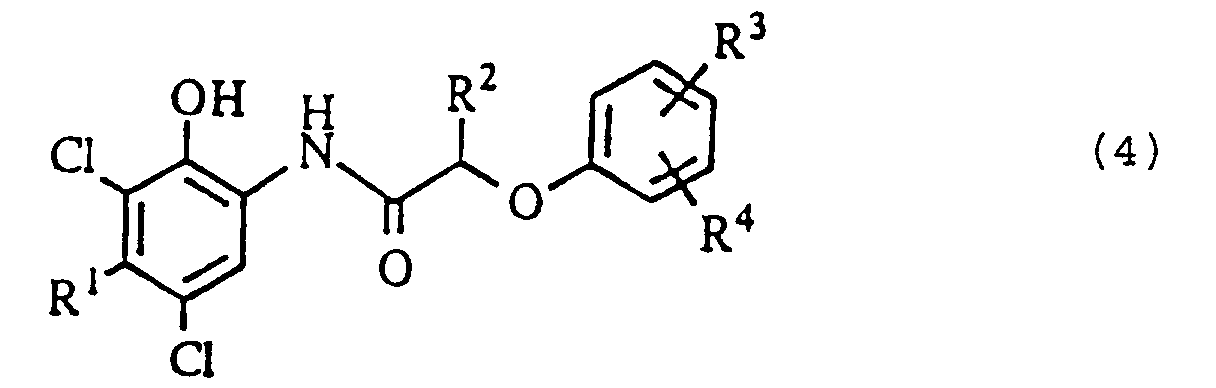
- the present invention provides a process for producing an aromatic amide compound of the general formula: wherein R 1 is a C 1 -C 4 alkyl group, and R 2 , R 3 and R 4 are independently a hydrogen atom or a C 1 -C 6 alkyl group, which process is characterized in that:
- the present invention also provides another process for producing an aromatic amide compound of the general formula: wherein R 1 , R 2 , R 3 and R 4 are each as defined above, which process is characterized in that:
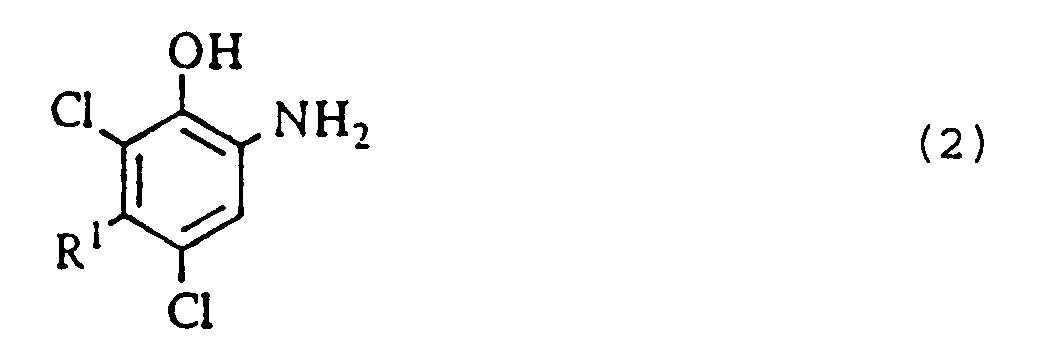
- the following will describe the first step in the first production process of the present invention, that is, the step (a) of subjecting an o-nitrophenol compound of the general formula (1) to catalytic reduction in acetone or an aromatic hydrocarbon solvent in the presence of a nickel catalyst to give an o-aminophenol compound of the general formula (2).
- the starting material to be used in the catalytic reduction is an o-nitrophenol compound of the general formula (1), wherein R 1 is a C 1 -C 4 alkyl group such as a methyl, an ethyl, a n-propyl, an isopropyl, a n-butyl or a sec-butyl group.
- R 1 is a C 1 -C 4 alkyl group such as a methyl, an ethyl, a n-propyl, an isopropyl, a n-butyl or a sec-butyl group.
- Typical examples of the o-nitrophenol compound are 2-nitro-4,6-dichloro-5-methylphenol, 2-nitro-4,6-dichloro-5-ethylphenol, 2-nitro-4,6-dichloro-5-n-propylphenol, 2-nitro-4,6-dichloro-5-isopropylphenol, 2-nitro-4,6-dichloro-5-n-butylphenol and 2-nitro-4,6-dichloro-5-sec-butylphenol.
- the o-nitrophenol compound of the general formula (1) is subjected to catalytic reduction in acetone or an aromatic hydrocarbon solvent such as toluene or xylene.
- the amount of solvent to be used is usually 1 to 10 times, preferably 2 to 6 times, as much as the weight of the raw material o-nitrophenol compound.
- the catalyst to be used in the catalytic reduction is a nickel catalyst.
- the nickel catalyst are Raney nickel or catalysts carrying nickel on a support such as activated carbon or a metal oxide (e.g., alumina, magnesia, silica, titania, zirconia).
- the amount of catalyst is dependent upon the content of nickel.
- the amount of nickel used for the reaction is usually 0.1% to 6% by weight, preferably 0.5% to 3% by weight, based on the weight of the raw material o-nitrophenol compound.
- the use of a nickel catalyst makes it possible to reduce the amount of mono-chlorinated impurities produced by the replacement of a chlorine atom in the chlorinated o-aminophenol compound with a hydrogen atom.
- the reaction selectivity to the o-aminophenol compound of the general formula (2), which is a target compound for the reduction is improved.
- the reduction is preferably carried out under the coexistence of activated carbon.
- the reduction may be carried out under ordinary pressure or increased pressure, usually under a hydrogen pressure of 0.1 to 20 kg/cm 2 (gauge pressure), at a temperature of 20° to 60°C, preferably 30° to 50°C.
- the reaction mixture containing the o-amino-phenol compound obtained by the reduction can be subjected to the subsequent condensation with an acid chloride compound of the general formula (3) without any further treatment or after removal of the reduction catalyst by filtration; if necessary, the condensation may be carried out after adjustment of the solvent amount.
- the o-aminophenol compound thus obtained is kept under an atmosphere of an inert gas having an oxygen concentration of 1% or less, because the o-aminophenol is liable to form colored ingredients in air, which finally deteriorate the quality of the aromatic amide compound. Under this condition, the o-aminophenol compound can be stored for about 30 hours without being deteriorated, so that there is no problem in the yield and quality of an aromatic amide compound obtained by the amidation condensation of this o-aminophenol compound.
- the o-aminophenol compound obtained in this manner can be used, as described below, without any solvent replacement which is done in a conventional process.
- the production process of the present invention is quite advantageous, because complicated operations are not required.
- the substituent R 1 is a C 1 -C 4 alkyl group such as a methyl, an ethyl, a n-propyl, an isopropyl, a n-butyl or a sec-butyl group.
- Typical examples of the o-aminophenol compound are 2-amino-4,6-dichloro-5-methylphenol, 2-amino-4,6-dichloro-5-ethylphenol, 2-amino-4,6-dichloro-5-n-propyl-phenol, 2-amino-4,6-dichloro-5-isopropylphenol, 2-amino-4,6-dichloro-5-n-butylphenol and 2-amino-4,6-dichloro-5-sec-butylphenol.
- Such an acid chloride compound can also be produced using a reagent having no sulfur content, such as phosgene or oxalyl chloride, other than thionyl chloride.
- the acid chloride compound of the general formula (3) having a sulfur content of 0.5% or less is obtained by distillating a crude acid chloride compound which is obtained by a reaction of a carboxylic acid compound (5) with thionyl chloride.
- an acid chloride compound of the general formula (3) which is obtained without any distillation as described above, for example, by the reaction of a carboxylic acid compound of the general formula: wherein R 2 , R 3 and R 4 are independently a hydrogen atom or a C 1 -C 6 alkyl group, with thionyl chloride, the reaction mixture of which is then concentrated to have a sulfur content of 0.5% or less.
- an acid chloride compound to be reacted with an o-aminophenol compound for the amidation condensation can readily be obtained in a high yield by the concentration of a reaction mixture obtained after the reaction of a carboxylic acid compound with thionyl chloride, for the adjustment of its sulfur content without any distillation of the acid chloride compound.
- the concentration of a solution containing the acid chloride compound is carried out, for example, at 65°C under a reduced pressure of 4 kPa (30 mmHg), or when a reaction solvent is used in the reaction for obtaining the acid chloride compound, the amount of reaction solvent remaining after the concentration is usually reduced to 50% by weight or less, preferably 20% by weight or less, as compared with the amount of reaction solvent before the concentration.
- the amount of thionyl chloride to be used is usually 1 to 6 times, preferably 1 to 2 times, as much as the mole of the carboxylic acid compound.
- the reaction is usually carried out at a temperature of 40° to 80°C under a stream of an inert gas such as nitrogen gas, optionally with the addition of a pyridine compound, such as pyridine or picoline, or an amide compound, such as N,N-dimethylformamide or N-methylpyrrolidone, in an amount of 5% by mole or less, to the raw material carboxylic acid compound.
- reaction solvent examples include aromatic hydrocarbons such as toluene and xylene. These solvents are usually used in an amount of 0.1 to 5 times as much as the weight of the carboxylic acid compound. It is not always essential to use such a reaction solvent.
- the substituents R 2 , R 3 and R 4 are independently a hydrogen atom or a C 1 -C 6 alkyl group such as a methyl, an ethyl, a n-propyl, an isopropyl, a n-butyl, an isobutyl, a sec-butyl, a t-butyl, a n-amyl, an isoamyl, a sec-amyl, a t-amyl, a neo-pentyl, a n-hexyl, a 2-hexyl, a 3-hexyl or a t-hexyl group.
- Typical examples of the acid chloride compound are (2-ethylphenoxy)acetyl chloride, (4-ethylphenoxy)acetyl chloride, 2-(2-isopropylphenoxy)butyryl chloride, 2-(3,5-diisopropylphenoxy)butyryl chloride, 2-(2-t-amyl-4-methylphenoxy)butyryl chloride, 2-(2,4-di-t-amylphenoxy)butyryl chloride, 2-(2,4-di-t-amylphenoxy)valeryl chloride, 2-(2,4-di-t-amylphenoxy)hexanolyl chloride, 2-(2,4-di-t-amylphenoxy)heptanoyl chloride and 2-(2,4-di-t-amylphenoxy)octanoyl chloride.
- amidation condensation which is the second step in the first production process of the present invention.
- the amount of acid chloride compound to be used is usually in the range of 1 to 1.5 times, preferably 1 to 1.35 times, as much as the mole of the o-aminophenol compound.
- reaction solvent examples include acetone and aromatic hydrocarbons such as toluene and xylene.
- the amount of reaction solvent to be used is usually in the range of 3 to 25 times, preferably 3 to 18 times, as much as the weight of the o-aminophenol compound.
- the reaction is usually carried out at a temperature of 40° to 100°C in such a manner that the acid chloride compound is added dropwise to a solution of the o-amino-phenol compound.
- the amidation condensation is carried out under an atmosphere of an inert gas having an oxygen concentration of 1% or less, for example, under an atmosphere of nitrogen gas, to prevent the deterioration of the o-aminophenol compound by oxygen in the atmosphere.
- Examples of the acid scavenger which can be used are organic bases such as tertiary alkylamines (e.g., triethylamine, tributylamine) and pyridine compounds (e.g., pyridine, picoline); and inorganic bases such as alkali metal carbonates (e.g., sodium carbonate) and alkali metal hydrogencarbonates (e.g., sodium hydrogencarbonate, potassium hydrogencarbonate).
- organic bases such as tertiary alkylamines (e.g., triethylamine, tributylamine) and pyridine compounds (e.g., pyridine, picoline)
- inorganic bases such as alkali metal carbonates (e.g., sodium carbonate) and alkali metal hydrogencarbonates (e.g., sodium hydrogencarbonate, potassium hydrogencarbonate).
- the amount of acid scavenger to be used is usually up to about 1 time as much as the mole of the o-aminophenol compound when a diacidic base is used as the acid scavenger, and it is up to about 2 times as much as the mole of the o-aminophenol compound when a monoacidic base is used as the acid scavenger.
- the reaction mixture after the condensation may be subjected to the subsequent crystallization step without any further treatment.
- an acid scavenger is used, the reaction mixture is subjected, if necessary, to washing and separation with a separatory funnel, or if necessary, to filtration, after which the reaction mixture is usually subjected to the subsequent crystallization step, although the desired compound can be obtained from the reaction mixture by concentration.
- the amount of solvent and the solvent composition are conveniently adjusted by the distillation or addition of the reaction solvent, or if necessary, by the addition of water.
- the amount of solvent to be used in the crystallization step is usually in the range of 3 to 15 times as much as the weight of the o-aminophenol compound.
- the solvent composition is adjusted to 10-40% water-containing acetone by adding water to the reaction mixture after amidation condensation.
- an aromatic hydrocarbon solvent such as toluene or xylene is used in the amidation condensation step, crystallization can be conducted only by adjusting the amount of solvent.
- the crystallization is carried out, while the reaction mixture is usually cooled from a temperature of 40° to 100°C to a temperature of 5° to 10°C.
- the deposited crystals are filtered, washed and dried, which afforded the desired compound as a product having no remaining solvent or water content.
- Typical examples of the compound which can be obtained in this production process are 2-(2,4-di-t-amylphenoxy)-N-(3,5-dichloro-4-ethyl-2-hydroxyphenyl)butyramide, 2-(2,4-di-t-amylphenoxy)-N-(3,5-dichloro-4-methyl-2-hydroxyphenyl)butyramide, 2-(2,4-di-t-amylphenoxy)-N-(3,5-dichloro-4-ethyl-2-hydroxyphenyl)acetamide, 2-(2,4-di-t-amylphenoxy)-N-(3,5-dichloro-4-methyl-2-hydroxyphenyl)acetamide, 2-(2-t-amyl-4-methylphenoxy)-N-(3,5-dichloro-4-ethyl-2-hydroxyphenyl)butyramide, 2-(2-t-amyl-4-methylphenoxy)-N-(3,5-dichlor
- the substituent R 1 is a C 1 -C 4 alkyl group such as a methyl, an ethyl, a n-propyl, an isopropyl, a n-butyl or a sec-butyl group.
- Typical compounds of the o-aminophenol hydrochloride salt are 2-amino-4,6-dichloro-5-methylphenol hydrochloride, 2-amino-4,6-dichloro-5-ethylphenol hydrochloride, 2-amino-4,6-dichloro-5-n-propylphenol hydrochloride, 2-amino-4,6-dichloro-5-isopropylphenol hydrochloride, 2-amino-4,6-dichloro-5-n-butylphenol hydrochloride and 2-amino-4,6-dichloro-5-sec-butylphenol hydrochloride.
- Examples of the acid chloride compound are similar to those used in the first production process of the present invention.
- the maximum permissible sulfur content of an acid chloride compound is greater than the case of amidation in the first production process of the present invention. Even if an acid chloride compound has a sulfur content of 0.8% or less, based on the weight of the acid chloride compound, it can be used. More preferred is an acid chloride compound of the general formula (3) having a sulfur content of 0.5% or less.
- Such an acid chloride compound can also be obtained, for example, by a process in which phosgene or oxalyl chloride having no sulfur content is allowed to react with a carboxylic acid compound.
- acid chloride compound of the general formula (3) those having a sulfur content of 0.8% or less, preferably 0.5% or less, may be used, which can be obtained by distillating a crude acid chloride compound which is obtained by the reaction of a carboxylic acid compound (5) with thionyl chloride.
- the amidation can preferably be carried out, for example, by a process in which a carboxylic acid compound of the general formula: wherein R 2 , R 3 and R 4 are independently a hydrogen atom or a C 1 -C 6 alkyl group, is allowed to react with thionyl chloride, and the resultant reaction mixture is concentrated so as to have a sulfur content of 0.8% or less, preferably 0.5% or less, resulting in an acid chloride compound of the general formula (3), without any distillation of the acid chloride compound as described above, after which the acid chloride compound is then allowed to react with an o-aminophenol hydrochloride salt of the general formula (6).
- This case is advantageous as compared with the case where a distilled acid chloride compound is used, because the distillation step can be omitted for convenience and the yield of an acid chloride compound can be prevented from decreasing by distillation.
- the reaction of a carboxylic acid compound with thionyl chloride is usually carried out by the same procedures as used when an acid chloride compound is obtained in the first production process of the present invention.
- concentration is carried out, for example, at 65°C under a reduced pressure of 6.7 kPa (50 mmHg), preferably 4 kPa (30 mmHg).
- the amount of reaction solvent remaining after the concentration is usually reduced to 50% by weight or less, preferably 20% by weight or less, as compared with the amount of reaction solvent before the concentration.
- the amount of acid chloride compound to be used is usually 1 to 1.5 times, preferably 1 to 1.35 times, as much as the mole of the o-aminophenol hydrochloride salt of the general formula (3).
- the amidation condensation is usually carried out in an inert solvent at 40° to 100°C.
- the inert solvent are C 1 -C 2 alkylnitriles such as acetonitrile and propionitrile; aromatic hydrocarbons such as toluene and xylene; and C 3 -C 6 alkylketones such as acetone, 2-butanone, methyl propyl ketone, methyl isopropyl ketone and methyl isobutyl ketone.
- the amount of inert solvent to be used is usually 3 to 30 times, preferably 3 to 25 times, as much as the weight of the o-aminophenol hydrochloride salt.
- the reaction is usually carried out in such a manner that an acid chloride compound is added dropwise to a slurry of the o-aminophenol hydrochloride salt, or both reagents are placed in a reaction vessel at a temperature below 40°C, and heated.
- the amidation condensation can usually be carried out in air
- the reaction is preferably carried out under an atmosphere of an inert gas, such as nitrogen gas, having an oxygen concentration of 5% or less, more preferably 1% or less, to give an aromatic amide compound in a high yield, because oxygen in the atmosphere has an adverse effect on the reaction.
- an inert gas such as nitrogen gas
- inorganic bases which can be used as an acid scavenger are alkali metal carbonates (e.g., sodium carbonate, potassium carbonate) and alkali metal hydrogencarbonates (e.g., sodium hydrogencarbonate, potassium hydrogencarbonate).
- alkali metal carbonates e.g., sodium carbonate, potassium carbonate
- alkali metal hydrogencarbonates e.g., sodium hydrogencarbonate, potassium hydrogencarbonate
- the amount of acid scavenger to be used is usually up to about 1.5 times as much as the mole of the o-aminophenol hydrochloride salt when a diacidic base is used as the acid scavenger, and it is up to about 3 times as much as the mole of the o-aminophenol hydrochloride salt when a monoacidic base is used as the acid scavenger.
- the reaction mixture after the condensation may be subjected, if necessary, to washing, separation with a separatory funnel or filtration, after which the aromatic amide compound is obtained from the reaction mixture by concentration, and the resultant crude aromatic amide compound may be recrystallized.
- the reaction mixture after the condensation can be subjected, without any complicated operations as described above, to the subsequent step without any further treatment, or when an acid scavenger is used, the reaction mixture can be subjected, if necessary, to washing, separation with a separatory funnel or filtration, after which it may be subjected either to the subsequent step or to the crystallization step in which a high-quality aromatic amide compound can be obtained as the desired compound from the reaction mixture.
- the amount of solvent and the solvent composition are conveniently adjusted by the distillation or addition of the reaction solvent, or if necessary, by the addition of water.
- the amount of solvent to be used is usually in the range of 3 to 15 times as much as the weight of the raw material o-aminophenol hydrochloride salt.
- C 2 -C 3 alkylnitrile solvent such as acetonitrile or propionitrile, or an aromatic hydrocarbon solvent such as toluene or xylene is used in the amidation condensation step, crystallization can be conducted only by adjusting the amount of solvent within the above range.
- the solvent composition is adjusted to 10-40% water-containing acetone by adding water to the reaction mixture after amidation condensation so as to crystallize the reaction product.
- the crystallization is carried out by cooling the reaction mixture usually from a temperature of 40° to 100°C to a temperature of 5° to 10°C.
- the deposited crystals are filtered, washed and dried, which afforded the desired aromatic amide compound as a product having no remaining solvent or water content.
- Typical examples of the aromatic amide compound which can be obtained in this process are 2-(2,4-di-t-amylphenoxy)-N-(3,5-dichloro-4-ethyl-2-hydroxyphenyl)butyramide, 2-(2,4-di-t-amylphenoxy)-N-(3,5-dichloro-4-methyl-2-hydroxyphenyl)butyramide, 2-(2,4-di-t-amylphenoxy)-N-(3,5-dichloro-4-ethyl-2-hydroxyphenyl)acetamide, 2-(2,4-di-t-amylphenoxy)-N-(3,5-dichloro-4-methyl-2-hydroxyphenyl)acetamide, 2-(2-t-amyl-4-methylphenoxy)-N-(3,5-dichloro-4-ethyl-2-hydroxyphenyl)butyramide, 2-(2-t-amyl-4-methylphenoxy)-N-(3,5-d
- the first and second production processes of the present invention can make it possible to readily obtain an aromatic amide compound of the general formula (4) in a high yield, which has a high quality and can therefore be used as a cyan coupler capable of forming excellent images of color photographs.
- 2,4-Di-t-amylphenol (668.6 g), toluene (1450.9 g) and 95% sodium hydroxide (119.4 g) were placed in a 5-liter flask, and the mixture was dehydrated by azeotropic distillation to have a water content of 400 ppm or less. Then, ethyl 2-bromo-butyrate (585 g) was added dropwise at 50°C for 3 hours. The mixture was kept at 50°C for 9 hours, and the reaction was completed. To the reaction mixture, concentrated hydrochloric acid (325.3 g) and water (1337.2 g) were added at 40°C with stirring.
- the water layer was separated with a separatory funnel, and the oil layer was washed with water (668.6 g). Then, the oil layer was purified by distillation at a temperature of 60° to 250°C under a reduced pressure of 100 to 3 mmHg with a packed column having the theoretical plate number of 7, which afforded ethyl 2-(2,4-di-t-amylphenoxy)butyrate having a purity of 99% in a yield of 70% on the basis of 2,4-diamylphenol.
- the toluene layer was concentrated by distillation under ordinary pressure for the recovery of toluene, which afforded a concentrated solution (357.6 g) of the desired carboxylic acid compound in toluene.
- the analysis revealed that the concentrated solution contained the desired carboxylic acid compound in a yield of 99% yield on the basis of the raw material ester compound.
- the purity of an amide compound as described herein is determined from the percentage area in the chromatogram of the amide compound by an analysis using a liquid chromatography analyzing apparatus (model LC6A, Shimazu Seisakusho).
- the analysis conditions are as follows: column, SUMIPACK ODS A212; mobile phase, 0.1% trifluoroacetic acid - 10% water-containing acetonitrile; and measurement temperature, 40°C.
- the sulfur content was determined by ion chromatography, after the pretreatment of a sample with oxygen flame combustion to convert sulfur into sulfate ions.
- the determined value was calculated in terms of sulfur and expressed as a value based on the weight of the acid chloride compound.
- 2,4-Di-t-amylphenol (698 g), toluene(1520 g) and 95% sodium hydroxide (124.6 g) were placed in a 5-liter flask, and the mixture was dehydrated by azeotropic distillation to have a water content of 400 ppm or less. Then, ethyl 2-bromobutyrate (610.7 g) was added dropwise at 50°C for 3 hours. The mixture was kept at 50°C for 9 hours, and the reaction was completed. To the reaction mixture, concentrated hydrochloric acid (339.5 g) and water (698 g) were added at 40°C with stirring. The water layer was separated with a separatory funnel, and the oil layer was washed with water (698 g).
- the oil layer was concentrated by heating at a temperature of 60° to 250°C under a reduced pressure of 100 to 10 mmHg for the recovery of toluene and ethyl 2-bromobutyrate, which afforded a concentrated solution (988.2 g) of the ester compound in toluene.
- the analysis revealed that the concentrated solution contained the desired ester compound in a yield of 91 % on the basis of the 2,4-di-t-amylphenol.
- the toluene layer was concentrated by distillation under ordinary pressure for the recovery of toluene, which afforded a concentrated solution (370.2 g) of the carboxylic acid compound in toluene.
- the concentrated solution (370.2 g) of the carboxylic acid compound in toluene as described in Reference Example 2(2) and N,N-dimethylformamide (0.3 g) were placed in a 2-liter flask, to which thionyl chloride (127.7 g) was added dropwise at 68°C under an atmosphere of nitrogen gas having an oxygen concentration of 1% or less for 1 hour. The mixture was kept at the same temperature for 4 hours, and the reaction was completed. After completion of the reaction, the remaining thionyl chloride and part of the toluene solution were distilled off at 65°C under a reduced pressure of 300 to 30 mmHg, which afforded a concentrated solution (333.3 g) of the acid chloride compound in toluene. The analysis revealed that the concentrated solution had a sulfur content of 0.45% and contained the desired 2-(2,4-di-t-amylphenoxy)butyryl chloride in a yield of 99% on the basis of the raw material carboxylic acid compound.
- 2,4-Di-t-amylphenol (668.6 g), toluene (1450.9 g) and 95% sodium hydroxide (119.4 g) were placed in a 5-liter flask, and the mixture was dehydrated by azeotropic distillation to have a water content of 400 ppm or less. Then, ethyl 2-bromo-acetate (497.5 g) was added dropwise at 50°C for 3 hours. The mixture was kept at 50°C for 9 hours, and the reaction was completed. To the reaction mixture, concentrated hydrochloric acid (325.3 g) and water (1337.2 g) were added at 40°C with stirring.
- the water layer was separated with a separatory funnel, and the oil layer was washed with water (668.6 g). Then, the oil layer was purified by distillation at a temperature of 60° to 250°C under a reduced pressure of 3 to 100 mmHg using a packed column having the theoretical plate number of 7, which afforded ethyl 2-(2,4-di-t-amylphenoxy)acetate having a purity of 98.8% in a yield of 69.5% on the basis of 2,4-di-t-amylphenol.
- the toluene layer was concentrated by distillation under ordinary pressure for the recovery of toluene, which afforded a concentrated solution (357.6 g) of the carboxylic acid compound in toluene.
- the analysis revealed that the concentrated solution contained the desired carboxylic acid compound in a yield of 99% on the basis of the raw material ester compound.
- the concentrated solution (307.6 g) of the carboxylic acid compound in toluene as described in Reference Example 3(2) and N,N-dimethylformamide (0.33 g) were placed in a 1-liter flask, and the mixture was kept at 68°C under an atmosphere of nitrogen gas having an oxygen concentration of 1% or less. Then, thionyl chloride (127.6 g) was added dropwise at 68°C for 1 hour. The mixture was kept at the same temperature with stirring for 4 hours, and the reaction was completed.
- condensation amidation was carried out under an atmosphere of nitrogen gas having an oxygen concentration of 5%.
- 2,4-Di-t-amylphenol (668.6 g), toluene (1450.9 g) and 95% sodium hydroxide (119.4 g) were placed in a 5-liter flask, and the mixture was dehydrated by azeotropic distillation to have a water content of 400 ppm or less. Then, ethyl 2-bromo-butyrate (585 g) was added dropwise at 50°C for 3 hours. The mixture was kept at the same temperature for 9 hours, and the reaction was completed. To the reaction mixture, concentrated hydrochloric acid (325.3 g) and water(1337.2 g) were added at 40°C with stirring.
- the water layer was separated with a separatory funnel, and the oil layer was washed with water (668.6 g). Then, the oil layer was purified by distillation at a temperature of 60° to 250°C under a reduced pressure of 100 to 3 mmHg with a packed column having the theoretical plate number of 7, which afforded ethyl 2-(2,4-di-t-amylphenoxy)butyrate having a purity of 99% in a yield of 70% on the basis of 2,4-diamylphenol.
- the toluene layer was concentrated by distillation under ordinary pressure for the removal of toluene, which afforded a concentrated solution (357.6 g) of the carboxylic acid compound in toluene.
- the analysis revealed that the concentrated solution contained the desired carboxylic acid compound in a yield of 99% on the basis of the raw material ester compound.
- the concentrated solution (85.5 g) having the same composition as the concentrated solution of the carboxylic acid compound as obtained in Reference Example 4(2) and N,N-dimethylformamide (0.08 g) were placed in a 1-liter flask, to which thionyl chloride (30.54 g) was added dropwise at 68°C under an atmosphere of nitrogen gas for 1 hour. The mixture was kept at the same temperature for 4 hours, and the reaction was completed. After completion of the reaction, the remaining thionyl chloride and part of the toluene solution were distilled off at 65°C under a reduced pressure of 30 mmHg for 3.0 hours, which afforded a concentrated solution (74.51 g) of the acid chloride compound in toluene.
- the analysis revealed that the concentrated solution contained the acid chloride compound in a yield of 99% on the basis of the carboxylic acid compound and had a sulfur content of 0.07% based on the weight of the acid chloride compound.
- the acid chloride compound (30.8 g), 6-amino-2,4-dichloro-3-ethylphenol hydrochloride (20.7 g, 97.5% content) and acetonitrile (207 g) were placed in a flask, and the mixture was heated under reflux under an atmosphere of nitrogen gas having an oxygen concentration of 1% or less for 3 hours. After completion of the reaction, the reaction mixture was cooled to 10°C and kept at the same temperature for 1 hour, which resulted in a crystallization of the amide compound.
- the concentrated solution (85.5 g) having the same composition as the concentrated solution of the carboxylic acid compound as obtained in Reference Example 4(2) and N,N-dimethylformamide (0.08 g) were placed in a 1-liter flask, to which thionyl chloride (30.54 g) was added dropwise at 68°C under an atmosphere of nitrogen gas for 1 hour. The mixture was kept at the same temperature for 4 hours, and the reaction was completed. After the completion of the reaction, the remaining thionyl chloride and part of the toluene solution were distilled off at 65°C under a reduced pressure of 30 mmHg for 2 hours, which afforded a concentrated solution (75.26 g) of the acid chloride compound in toluene .
- the analysis revealed that the concentrated solution contained the acid chloride compound in a yield of 99% on the basis of the carboxylic acid compound and had a sulfur content of 0.13% on the basis of the acid chloride compound.
- the mixture was heated to 65°C, and the remaining thionyl chloride and part of the toluene solution were distilled off under a reduced pressure of 300 to 50 mmHg, which afforded a concentrated solution (51.98 g) of the acid chloride compound in toluene.
- the analysis revealed that the concentrated solution had a sulfur content of 0.8% and contained the desired acid chloride compound in a yield of 99% on the basis of the raw material carboxylic acid compound.
- reaction was carried out under an atmosphere having an oxygen concentration of 5%.
- 6-Amino-2,4-dichloro-3-ethylphenol hydrochloride (20.7 g, 97.5% content), acetone (140 g) and sodium hydrogencarbonate (14.0 g) were placed in a flask, to which the acid chloride compound (33.8 g, 0.40% sulfur content) as obtained in Example 11 was added dropwise under an atmosphere of nitrogen gas having an oxygen concentration of 1% or less, followed by heating under reflux for 2 hours. After completion of the reaction, the undissolved matter in the reaction mixture was filtered off and washed with a small amount of acetone. To the combined filtrate and the washing liquid, water (4.3 g) and acetone (24.2 g) were added, after which the mixture was cooled to 30°C.
- Example 12 The same procedures were conducted as described in Example 12, except that sodium carbonate (17.6 g) was used as an acid scavenger in place of sodium hydrogen-carbonate. As the result, 34.1 g of the desired amide compound was obtained (m.p., 145-146°C, 99.7% purity, 80.2% yield in the amidation step).
Landscapes
- Chemical & Material Sciences (AREA)
- Organic Chemistry (AREA)
- Chemical Kinetics & Catalysis (AREA)
- Organic Low-Molecular-Weight Compounds And Preparation Thereof (AREA)
Claims (15)
- Procédé pour produire un composé amide aromatique de formule générale :
 (a) soumettre un composé o-nitrophénol de formule générale :
 (b) soumettre le composé o-aminophénol obtenu dans l'étape (a) à une condensation avec un composé chlorure d'acide ayant une teneur en soufre de 0,5 % ou moins, par rapport au poids du composé chlorure d'acide, de formule générale :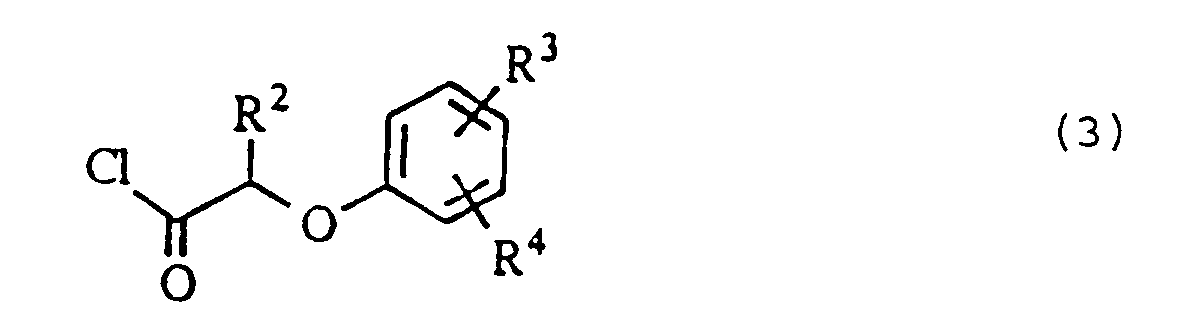
- Procédé pour produire un composé amide aromatique de formule générale :
 (a) laisser réagir un composé acide carboxylique de formule générale :
 (b) soumettre un composé o-nitrophénol de formule générale :
 (c) soumettre le composé o-aminophénol obtenu dans l'étape (b) à une condensation avec le composé chlorure d'acide obtenu dans l'étape (a) sous une atmosphère de gaz inerte ayant une concentration d'oxygène de 1 % ou moins, dans de l'acétone ou un solvant hydrocarboné aromatique.
 - Procédé selon la revendication 1 ou 2, dans lequel les solvants utilisés dans la réduction catalytique et la condensation sont chacun choisis parmi les solvants hydrocarbonés aromatiques, et une fois la condensation terminée, le composé amide aromatique de formule générale (4) est cristallisé à partir du mélange réactionnel.
- Procédé selon la revendication 1 ou 2, dans lequel les solvants utilisés dans la réduction catalytique et la condensation sont tous deux l'acétone, et une fois la condensation terminée, de l'eau est ajoutée au mélange réactionnel de façon que soit cristallisé à partir de celui-ci le composé amide aromatique de formule générale (4).
- Procédé selon l'une quelconque des revendications 1 à 4, dans lequel la réduction catalytique se déroule en présence conjointe de charbon activé.
- Procédé selon l'une quelconque des revendications 1 à 5, dans lequel la condensation se déroule en présence d'un épurateur d'acide.
- Procédé selon la revendication 6, dans lequel l'épurateur d'acide est de l'hydrogénocarbonate de sodium.
- Procédé pour produire un composé amide aromatique de formule générale :

soumettre un sel chlorhydrate d'o-aminophénol de formule générale :

- Procédé selon la revendication 8, dans lequel on laisse réagir un composé acide carboxylique de formule générale :

- Procédé selon la revendication 8 ou 9, dans lequel le composé chlorure d'acide de formule générale (3) a une teneur en soufre de 0,5 % ou moins, par rapport au poids du composé chlorure d'acide.
- Procédé selon l'une quelconque des revendications 8 à 10, dans lequel la condensation se déroule sous une atmosphère de gaz inerte ayant une concentration d'oxygène de 5 % ou moins.
- Procédé selon l'une quelconque des revendications 8 à 10, dans lequel la condensation se déroule sous une atmosphère de gaz inerte ayant une concentration d'oxygène de 1 % ou moins.
- Procédé selon l'une quelconque des revendications 8 à 12, dans lequel le solvant utilisé dans la condensation est choisi parmi le toluène, le xylène et les alkylnitriles en C2 à C3, et une fois la condensation terminée, le composé amide aromatique de formule générale (4) est cristallisé à partir du mélange réactionnel.
- Procédé selon l'une quelconque des revendications 8 à 12, dans lequel le solvant utilisé dans la condensation est l'acétone, et une fois la condensation terminée, de l'eau est ajoutée au mélange réactionnel de façon que soit cristallisé à partir de celui-ci le composé amide aromatique de formule générale (4).
- Procédé selon l'une quelconque des revendications 8 à 14, dans lequel la condensation se déroule en présence de bases minérales.
Applications Claiming Priority (12)
| Application Number | Priority Date | Filing Date | Title |
|---|---|---|---|
| JP13647/93 | 1993-01-29 | ||
| JP13646/93 | 1993-01-29 | ||
| JP1364693 | 1993-01-29 | ||
| JP1364793 | 1993-01-29 | ||
| JP1364793 | 1993-01-29 | ||
| JP1364693 | 1993-01-29 | ||
| JP250599/93 | 1993-10-06 | ||
| JP25059893A JP3765837B2 (ja) | 1993-01-29 | 1993-10-06 | 芳香族アミド類の製造法 |
| JP250598/93 | 1993-10-06 | ||
| JP25059893 | 1993-10-06 | ||
| JP25059993A JP3460264B2 (ja) | 1993-01-29 | 1993-10-06 | 芳香族アミド類の製法 |
| JP25059993 | 1993-10-06 |
Publications (3)
| Publication Number | Publication Date |
|---|---|
| EP0608896A1 EP0608896A1 (fr) | 1994-08-03 |
| EP0608896B1 true EP0608896B1 (fr) | 1997-07-30 |
| EP0608896B2 EP0608896B2 (fr) | 2000-11-02 |
Family
ID=27456047
Family Applications (1)
| Application Number | Title | Priority Date | Filing Date |
|---|---|---|---|
| EP94101285A Expired - Lifetime EP0608896B2 (fr) | 1993-01-29 | 1994-01-28 | Procédé de préparation d'amides aromatiques utilisables comme coupleur cyan en photographie en couleurs |
Country Status (4)
| Country | Link |
|---|---|
| US (1) | US5442114A (fr) |
| EP (1) | EP0608896B2 (fr) |
| CA (1) | CA2113288A1 (fr) |
| DE (1) | DE69404486T3 (fr) |
Families Citing this family (5)
| Publication number | Priority date | Publication date | Assignee | Title |
|---|---|---|---|---|
| FR2788691B1 (fr) | 1999-01-21 | 2002-06-14 | Oreal | Compositions pour la teinture d'oxydation des fibres keratiniques comprenant un coupleur cationique, nouveaux coupleurs cationiques, leur utilisation pour la teinture d'oxydation, et procedes de teinture |
| FR2788768B1 (fr) | 1999-01-21 | 2001-02-16 | Oreal | Nouveaux 2-acylaminophenols cationiques, leur utilisation a titre de coupleur pour la teinture d'oxydation, compositions les comprenant, et procedes de teinture |
| US6509500B2 (en) * | 2001-05-24 | 2003-01-21 | Eastman Chemical Company | Continuous preparation of incorporated photographic amides |
| DE102004044379B4 (de) | 2004-09-10 | 2008-01-10 | Basf Ag | Verfahren zur Herstellung von Papier, Pappe und Karton und Verwendung einer Retentionsmittelkombination |
| CN101914028B (zh) * | 2010-08-13 | 2013-08-14 | 常州大学 | 一种制备2-氨基-4,6-二氯苯酚的方法 |
Family Cites Families (16)
| Publication number | Priority date | Publication date | Assignee | Title |
|---|---|---|---|---|
| BE543745A (fr) * | 1954-12-20 | |||
| US3772002A (en) * | 1971-10-14 | 1973-11-13 | Minnesota Mining & Mfg | Phenolic couplers |
| US4126461A (en) * | 1977-06-13 | 1978-11-21 | Eastman Kodak Company | Black-and-white photographic elements and processes |
| NZ190995A (en) * | 1978-09-05 | 1982-03-09 | American Cyanamid Co | Substituted omega propionyl or butyryl l-prolines and pharmaceutical compositions |
| JPS59166956A (ja) * | 1983-03-14 | 1984-09-20 | Fuji Photo Film Co Ltd | ハロゲン化銀カラ−写真感光材料 |
| JPS60209735A (ja) * | 1984-04-03 | 1985-10-22 | Konishiroku Photo Ind Co Ltd | ハロゲン化銀カラ−写真感光材料 |
| JPS6139045A (ja) * | 1984-07-31 | 1986-02-25 | Fuji Photo Film Co Ltd | ハロゲン化銀カラ−写真感光材料 |
| US4990671A (en) * | 1988-04-18 | 1991-02-05 | Mallinckrodt, Inc. | Method for making aminophenols and their amide derivatives |
| WO1989010347A1 (fr) * | 1988-04-18 | 1989-11-02 | Mallinckrodt, Inc. | Procede de production d'aminophenols et de leurs derives d'amide |
| FR2632951B1 (fr) * | 1988-06-15 | 1990-09-21 | Rhone Poulenc Chimie | Procede de preparation de dichloro-2,6 amino-4 phenol |
| SU1680690A1 (ru) * | 1989-06-09 | 1991-09-30 | Ивановский Химико-Технологический Институт | Способ получени галоиданилинов |
| JP2578217B2 (ja) † | 1989-09-25 | 1997-02-05 | 富士写真フイルム株式会社 | アミドフェノール類の製造方法 |
| JPH03110553A (ja) * | 1989-09-25 | 1991-05-10 | Fuji Photo Film Co Ltd | アミドフェノール類の製造方法 |
| JPH0446141A (ja) * | 1990-06-08 | 1992-02-17 | Daicel Chem Ind Ltd | 核ハロゲン化芳香族アミンの製法 |
| DE4039862A1 (de) * | 1990-12-13 | 1992-06-17 | Bayer Ag | Verfahren zur herstellung von p-amino-phenolen |
| JP3106568B2 (ja) * | 1991-07-30 | 2000-11-06 | 住友化学工業株式会社 | 2−アミノ−4,6−ジクロロ−5−アルキルフェノール類の製造方法 |
-
1994
- 1994-01-12 CA CA002113288A patent/CA2113288A1/fr not_active Abandoned
- 1994-01-18 US US08/182,460 patent/US5442114A/en not_active Expired - Lifetime
- 1994-01-28 DE DE69404486T patent/DE69404486T3/de not_active Expired - Lifetime
- 1994-01-28 EP EP94101285A patent/EP0608896B2/fr not_active Expired - Lifetime
Also Published As
| Publication number | Publication date |
|---|---|
| DE69404486D1 (de) | 1997-09-04 |
| CA2113288A1 (fr) | 1994-07-30 |
| EP0608896B2 (fr) | 2000-11-02 |
| US5442114A (en) | 1995-08-15 |
| EP0608896A1 (fr) | 1994-08-03 |
| DE69404486T3 (de) | 2001-06-07 |
| DE69404486T2 (de) | 1997-12-04 |
Similar Documents
| Publication | Publication Date | Title |
|---|---|---|
| EP0608896B1 (fr) | Procédé de préparation d'amides aromatiques utilisables comme coupleur cyan en photographie en couleurs | |
| JP6915189B1 (ja) | 高純度2−ナフチルアセトニトリル及びその製造方法 | |
| TWI770120B (zh) | 有機碘化化合物、一鍋法製備有機碘化化合物之方法及有機碘化化合物之用途 | |
| JP7655572B2 (ja) | カプサイシン誘導体の合成 | |
| CN112272665A (zh) | 制备立他司特的方法 | |
| JPH0735363B2 (ja) | 不飽和カルバミン酸エステル類の製法 | |
| JP3460264B2 (ja) | 芳香族アミド類の製法 | |
| US20050277788A1 (en) | Process for preparing phthaloyl chloride | |
| WO2008072773A1 (fr) | Procédé destiné à produire (1r,2r)-2-amino-1-cyclopentanol | |
| US4211723A (en) | Process for producing chlorosulfonylbenzoylchloride | |
| JPH09124605A (ja) | 3,4−ジヒドロカルボスチリルの製造方法 | |
| JP2004182658A (ja) | 脂環式テトラカルボン酸の製造法 | |
| JPH06279380A (ja) | 芳香族アミド類の製造法 | |
| RU2315747C2 (ru) | Способ получения ацетиленового соединения | |
| KR940003066B1 (ko) | 방향족 우레탄의 제조방법 | |
| US7745471B2 (en) | Derivatives of 1,2-benzisoxazole-3-methane sulfonic acid as novel intermediates for the synthesis of zonisamide | |
| JPH0920741A (ja) | ヒドロキシカルボン酸アニリドを製造する方法 | |
| JP2708582B2 (ja) | 酢酸p―アミノフェニルの製造法 | |
| JP3890543B2 (ja) | グアニジン類の製造方法 | |
| JP5115972B2 (ja) | 芳香族アミド類の製造法 | |
| US20070093675A1 (en) | Process for preparing n, n'-dialkoxy-n, n'-dialkyl oxamide | |
| CN101289436B (zh) | 糠醛的制备方法 | |
| CA2605399A1 (fr) | Ester 4-mercaptophenyle d'acide acetique et son procede de fabrication | |
| WO2007072841A1 (fr) | Procede de fabrication d'un compose de 2-oxindole | |
| JPH0753491A (ja) | 酸アミドの製造法 |
Legal Events
| Date | Code | Title | Description |
|---|---|---|---|
| PUAI | Public reference made under article 153(3) epc to a published international application that has entered the european phase |
Free format text: ORIGINAL CODE: 0009012 |
|
| AK | Designated contracting states |
Kind code of ref document: A1 Designated state(s): BE CH DE FR GB IT LI NL |
|
| 17P | Request for examination filed |
Effective date: 19950116 |
|
| 17Q | First examination report despatched |
Effective date: 19960226 |
|
| GRAG | Despatch of communication of intention to grant |
Free format text: ORIGINAL CODE: EPIDOS AGRA |
|
| GRAH | Despatch of communication of intention to grant a patent |
Free format text: ORIGINAL CODE: EPIDOS IGRA |
|
| GRAH | Despatch of communication of intention to grant a patent |
Free format text: ORIGINAL CODE: EPIDOS IGRA |
|
| GRAA | (expected) grant |
Free format text: ORIGINAL CODE: 0009210 |
|
| AK | Designated contracting states |
Kind code of ref document: B1 Designated state(s): BE CH DE FR GB IT LI NL |
|
| REG | Reference to a national code |
Ref country code: CH Ref legal event code: NV Representative=s name: A. BRAUN, BRAUN, HERITIER, ESCHMANN AG PATENTANWAE Ref country code: CH Ref legal event code: EP |
|
| ITF | It: translation for a ep patent filed | ||
| REF | Corresponds to: |
Ref document number: 69404486 Country of ref document: DE Date of ref document: 19970904 |
|
| ET | Fr: translation filed | ||
| PLBI | Opposition filed |
Free format text: ORIGINAL CODE: 0009260 |
|
| PLBF | Reply of patent proprietor to notice(s) of opposition |
Free format text: ORIGINAL CODE: EPIDOS OBSO |
|
| 26 | Opposition filed |
Opponent name: BAYER AG KONZERNBEREICH RP PATENTE UND LIZENZEN Effective date: 19980428 |
|
| NLR1 | Nl: opposition has been filed with the epo |
Opponent name: BAYER AG KONZERNBEREICH RP PATENTE UND LIZENZEN |
|
| PLBF | Reply of patent proprietor to notice(s) of opposition |
Free format text: ORIGINAL CODE: EPIDOS OBSO |
|
| PLBF | Reply of patent proprietor to notice(s) of opposition |
Free format text: ORIGINAL CODE: EPIDOS OBSO |
|
| PLBF | Reply of patent proprietor to notice(s) of opposition |
Free format text: ORIGINAL CODE: EPIDOS OBSO |
|
| PLAW | Interlocutory decision in opposition |
Free format text: ORIGINAL CODE: EPIDOS IDOP |
|
| PLAW | Interlocutory decision in opposition |
Free format text: ORIGINAL CODE: EPIDOS IDOP |
|
| PUAH | Patent maintained in amended form |
Free format text: ORIGINAL CODE: 0009272 |
|
| STAA | Information on the status of an ep patent application or granted ep patent |
Free format text: STATUS: PATENT MAINTAINED AS AMENDED |
|
| 27A | Patent maintained in amended form |
Effective date: 20001102 |
|
| AK | Designated contracting states |
Kind code of ref document: B2 Designated state(s): BE CH DE FR GB IT LI NL |
|
| ITF | It: translation for a ep patent filed | ||
| REG | Reference to a national code |
Ref country code: CH Ref legal event code: AEN Free format text: AUFRECHTERHALTUNG DES PATENTES IN GEAENDERTER FORM |
|
| ET3 | Fr: translation filed ** decision concerning opposition | ||
| NLR2 | Nl: decision of opposition | ||
| NLR3 | Nl: receipt of modified translations in the netherlands language after an opposition procedure | ||
| REG | Reference to a national code |
Ref country code: GB Ref legal event code: IF02 |
|
| PGFP | Annual fee paid to national office [announced via postgrant information from national office to epo] |
Ref country code: NL Payment date: 20020131 Year of fee payment: 9 Ref country code: CH Payment date: 20020131 Year of fee payment: 9 |
|
| PGFP | Annual fee paid to national office [announced via postgrant information from national office to epo] |
Ref country code: BE Payment date: 20020321 Year of fee payment: 9 |
|
| PG25 | Lapsed in a contracting state [announced via postgrant information from national office to epo] |
Ref country code: LI Free format text: LAPSE BECAUSE OF NON-PAYMENT OF DUE FEES Effective date: 20030131 Ref country code: CH Free format text: LAPSE BECAUSE OF NON-PAYMENT OF DUE FEES Effective date: 20030131 Ref country code: BE Free format text: LAPSE BECAUSE OF NON-PAYMENT OF DUE FEES Effective date: 20030131 |
|
| PG25 | Lapsed in a contracting state [announced via postgrant information from national office to epo] |
Ref country code: NL Free format text: LAPSE BECAUSE OF NON-PAYMENT OF DUE FEES Effective date: 20030801 |
|
| REG | Reference to a national code |
Ref country code: CH Ref legal event code: PL |
|
| NLV4 | Nl: lapsed or anulled due to non-payment of the annual fee |
Effective date: 20030801 |
|
| PGFP | Annual fee paid to national office [announced via postgrant information from national office to epo] |
Ref country code: FR Payment date: 20120202 Year of fee payment: 19 |
|
| PGFP | Annual fee paid to national office [announced via postgrant information from national office to epo] |
Ref country code: DE Payment date: 20120125 Year of fee payment: 19 |
|
| PGFP | Annual fee paid to national office [announced via postgrant information from national office to epo] |
Ref country code: IT Payment date: 20120117 Year of fee payment: 19 Ref country code: GB Payment date: 20120125 Year of fee payment: 19 |
|
| GBPC | Gb: european patent ceased through non-payment of renewal fee |
Effective date: 20130128 |
|
| REG | Reference to a national code |
Ref country code: FR Ref legal event code: ST Effective date: 20130930 |
|
| PG25 | Lapsed in a contracting state [announced via postgrant information from national office to epo] |
Ref country code: DE Free format text: LAPSE BECAUSE OF NON-PAYMENT OF DUE FEES Effective date: 20130801 |
|
| REG | Reference to a national code |
Ref country code: DE Ref legal event code: R119 Ref document number: 69404486 Country of ref document: DE Effective date: 20130801 |
|
| PG25 | Lapsed in a contracting state [announced via postgrant information from national office to epo] |
Ref country code: FR Free format text: LAPSE BECAUSE OF NON-PAYMENT OF DUE FEES Effective date: 20130131 Ref country code: GB Free format text: LAPSE BECAUSE OF NON-PAYMENT OF DUE FEES Effective date: 20130128 |
|
| PG25 | Lapsed in a contracting state [announced via postgrant information from national office to epo] |
Ref country code: IT Free format text: LAPSE BECAUSE OF NON-PAYMENT OF DUE FEES Effective date: 20130128 |