EP0608926A1 - Noyau perdu pour procédé de moulage - Google Patents
Noyau perdu pour procédé de moulage Download PDFInfo
- Publication number
- EP0608926A1 EP0608926A1 EP94200070A EP94200070A EP0608926A1 EP 0608926 A1 EP0608926 A1 EP 0608926A1 EP 94200070 A EP94200070 A EP 94200070A EP 94200070 A EP94200070 A EP 94200070A EP 0608926 A1 EP0608926 A1 EP 0608926A1
- Authority
- EP
- European Patent Office
- Prior art keywords
- core
- binder
- sand
- casting
- forming
- Prior art date
- Legal status (The legal status is an assumption and is not a legal conclusion. Google has not performed a legal analysis and makes no representation as to the accuracy of the status listed.)
- Granted
Links
- 238000005266 casting Methods 0.000 title claims abstract description 86
- 239000011230 binding agent Substances 0.000 claims abstract description 133
- 239000008273 gelatin Substances 0.000 claims abstract description 54
- 229920000159 gelatin Polymers 0.000 claims abstract description 54
- 108010010803 Gelatin Proteins 0.000 claims abstract description 53
- 235000019322 gelatine Nutrition 0.000 claims abstract description 53
- 235000011852 gelatine desserts Nutrition 0.000 claims abstract description 53
- 238000000034 method Methods 0.000 claims abstract description 52
- 239000000203 mixture Substances 0.000 claims abstract description 30
- 108090000623 proteins and genes Proteins 0.000 claims abstract description 27
- 102000004169 proteins and genes Human genes 0.000 claims abstract description 27
- 235000018102 proteins Nutrition 0.000 claims abstract description 25
- 150000001875 compounds Chemical class 0.000 claims abstract description 15
- DHMQDGOQFOQNFH-UHFFFAOYSA-N Glycine Chemical compound NCC(O)=O DHMQDGOQFOQNFH-UHFFFAOYSA-N 0.000 claims abstract description 12
- 230000015556 catabolic process Effects 0.000 claims abstract description 12
- WHUUTDBJXJRKMK-VKHMYHEASA-N L-glutamic acid Chemical compound OC(=O)[C@@H](N)CCC(O)=O WHUUTDBJXJRKMK-VKHMYHEASA-N 0.000 claims abstract description 9
- 239000004471 Glycine Substances 0.000 claims abstract description 6
- ONIBWKKTOPOVIA-BYPYZUCNSA-N L-Proline Chemical compound OC(=O)[C@@H]1CCCN1 ONIBWKKTOPOVIA-BYPYZUCNSA-N 0.000 claims abstract description 6
- QNAYBMKLOCPYGJ-REOHCLBHSA-N L-alanine Chemical compound C[C@H](N)C(O)=O QNAYBMKLOCPYGJ-REOHCLBHSA-N 0.000 claims abstract description 6
- CKLJMWTZIZZHCS-REOHCLBHSA-N L-aspartic acid Chemical compound OC(=O)[C@@H](N)CC(O)=O CKLJMWTZIZZHCS-REOHCLBHSA-N 0.000 claims abstract description 6
- 238000006731 degradation reaction Methods 0.000 claims abstract description 6
- 235000004279 alanine Nutrition 0.000 claims abstract description 4
- XLYOFNOQVPJJNP-UHFFFAOYSA-N water Substances O XLYOFNOQVPJJNP-UHFFFAOYSA-N 0.000 claims description 21
- 239000002245 particle Substances 0.000 claims description 11
- 239000004411 aluminium Substances 0.000 claims description 10
- 229910052782 aluminium Inorganic materials 0.000 claims description 10
- XAGFODPZIPBFFR-UHFFFAOYSA-N aluminium Chemical compound [Al] XAGFODPZIPBFFR-UHFFFAOYSA-N 0.000 claims description 10
- 239000000084 colloidal system Substances 0.000 claims description 9
- UQSXHKLRYXJYBZ-UHFFFAOYSA-N iron oxide Inorganic materials [Fe]=O UQSXHKLRYXJYBZ-UHFFFAOYSA-N 0.000 claims description 8
- NDLPOXTZKUMGOV-UHFFFAOYSA-N oxo(oxoferriooxy)iron hydrate Chemical compound O.O=[Fe]O[Fe]=O NDLPOXTZKUMGOV-UHFFFAOYSA-N 0.000 claims description 8
- 239000011236 particulate material Substances 0.000 claims description 7
- WBJZTOZJJYAKHQ-UHFFFAOYSA-K iron(3+) phosphate Chemical compound [Fe+3].[O-]P([O-])([O-])=O WBJZTOZJJYAKHQ-UHFFFAOYSA-K 0.000 claims description 5
- 229910000399 iron(III) phosphate Inorganic materials 0.000 claims description 5
- 238000005058 metal casting Methods 0.000 claims description 5
- 239000005955 Ferric phosphate Substances 0.000 claims description 4
- 235000007144 ferric diphosphate Nutrition 0.000 claims description 4
- 239000011706 ferric diphosphate Substances 0.000 claims description 4
- 229940032958 ferric phosphate Drugs 0.000 claims description 4
- CADNYOZXMIKYPR-UHFFFAOYSA-B ferric pyrophosphate Chemical compound [Fe+3].[Fe+3].[Fe+3].[Fe+3].[O-]P([O-])(=O)OP([O-])([O-])=O.[O-]P([O-])(=O)OP([O-])([O-])=O.[O-]P([O-])(=O)OP([O-])([O-])=O CADNYOZXMIKYPR-UHFFFAOYSA-B 0.000 claims description 4
- 229940036404 ferric pyrophosphate Drugs 0.000 claims description 4
- 239000000463 material Substances 0.000 claims description 4
- 239000004475 Arginine Substances 0.000 claims description 3
- WHUUTDBJXJRKMK-UHFFFAOYSA-N Glutamic acid Natural products OC(=O)C(N)CCC(O)=O WHUUTDBJXJRKMK-UHFFFAOYSA-N 0.000 claims description 3
- 229920000084 Gum arabic Polymers 0.000 claims description 3
- PMMYEEVYMWASQN-DMTCNVIQSA-N Hydroxyproline Chemical compound O[C@H]1CN[C@H](C(O)=O)C1 PMMYEEVYMWASQN-DMTCNVIQSA-N 0.000 claims description 3
- AGPKZVBTJJNPAG-WHFBIAKZSA-N L-isoleucine Chemical compound CC[C@H](C)[C@H](N)C(O)=O AGPKZVBTJJNPAG-WHFBIAKZSA-N 0.000 claims description 3
- ROHFNLRQFUQHCH-YFKPBYRVSA-N L-leucine Chemical compound CC(C)C[C@H](N)C(O)=O ROHFNLRQFUQHCH-YFKPBYRVSA-N 0.000 claims description 3
- KZSNJWFQEVHDMF-BYPYZUCNSA-N L-valine Chemical compound CC(C)[C@H](N)C(O)=O KZSNJWFQEVHDMF-BYPYZUCNSA-N 0.000 claims description 3
- ROHFNLRQFUQHCH-UHFFFAOYSA-N Leucine Natural products CC(C)CC(N)C(O)=O ROHFNLRQFUQHCH-UHFFFAOYSA-N 0.000 claims description 3
- KDXKERNSBIXSRK-UHFFFAOYSA-N Lysine Natural products NCCCCC(N)C(O)=O KDXKERNSBIXSRK-UHFFFAOYSA-N 0.000 claims description 3
- 239000004472 Lysine Substances 0.000 claims description 3
- ONIBWKKTOPOVIA-UHFFFAOYSA-N Proline Natural products OC(=O)C1CCCN1 ONIBWKKTOPOVIA-UHFFFAOYSA-N 0.000 claims description 3
- KZSNJWFQEVHDMF-UHFFFAOYSA-N Valine Natural products CC(C)C(N)C(O)=O KZSNJWFQEVHDMF-UHFFFAOYSA-N 0.000 claims description 3
- 235000010489 acacia gum Nutrition 0.000 claims description 3
- 239000000205 acacia gum Substances 0.000 claims description 3
- 235000009697 arginine Nutrition 0.000 claims description 3
- ODKSFYDXXFIFQN-UHFFFAOYSA-N arginine Natural products OC(=O)C(N)CCCNC(N)=N ODKSFYDXXFIFQN-UHFFFAOYSA-N 0.000 claims description 3
- 235000003704 aspartic acid Nutrition 0.000 claims description 3
- OQFSQFPPLPISGP-UHFFFAOYSA-N beta-carboxyaspartic acid Natural products OC(=O)C(N)C(C(O)=O)C(O)=O OQFSQFPPLPISGP-UHFFFAOYSA-N 0.000 claims description 3
- PMMYEEVYMWASQN-UHFFFAOYSA-N dl-hydroxyproline Natural products OC1C[NH2+]C(C([O-])=O)C1 PMMYEEVYMWASQN-UHFFFAOYSA-N 0.000 claims description 3
- 235000013922 glutamic acid Nutrition 0.000 claims description 3
- 239000004220 glutamic acid Substances 0.000 claims description 3
- 238000010438 heat treatment Methods 0.000 claims description 3
- 229960002591 hydroxyproline Drugs 0.000 claims description 3
- 235000014705 isoleucine Nutrition 0.000 claims description 3
- 229960000310 isoleucine Drugs 0.000 claims description 3
- AGPKZVBTJJNPAG-UHFFFAOYSA-N isoleucine Natural products CCC(C)C(N)C(O)=O AGPKZVBTJJNPAG-UHFFFAOYSA-N 0.000 claims description 3
- 235000005772 leucine Nutrition 0.000 claims description 3
- 235000018977 lysine Nutrition 0.000 claims description 3
- 235000013930 proline Nutrition 0.000 claims description 3
- FGMPLJWBKKVCDB-UHFFFAOYSA-N trans-L-hydroxy-proline Natural products ON1CCCC1C(O)=O FGMPLJWBKKVCDB-UHFFFAOYSA-N 0.000 claims description 3
- 235000014393 valine Nutrition 0.000 claims description 3
- 239000004474 valine Substances 0.000 claims description 3
- ODKSFYDXXFIFQN-BYPYZUCNSA-P L-argininium(2+) Chemical compound NC(=[NH2+])NCCC[C@H]([NH3+])C(O)=O ODKSFYDXXFIFQN-BYPYZUCNSA-P 0.000 claims 2
- KDXKERNSBIXSRK-YFKPBYRVSA-N L-lysine Chemical compound NCCCC[C@H](N)C(O)=O KDXKERNSBIXSRK-YFKPBYRVSA-N 0.000 claims 2
- 241000978776 Senegalia senegal Species 0.000 claims 2
- 239000011248 coating agent Substances 0.000 claims 2
- 238000000576 coating method Methods 0.000 claims 2
- 229960005191 ferric oxide Drugs 0.000 claims 2
- VYPSYNLAJGMNEJ-UHFFFAOYSA-N Silicium dioxide Chemical group O=[Si]=O VYPSYNLAJGMNEJ-UHFFFAOYSA-N 0.000 abstract description 89
- 239000004576 sand Substances 0.000 abstract description 65
- 238000009716 squeeze casting Methods 0.000 abstract description 15
- 230000007613 environmental effect Effects 0.000 abstract description 12
- 231100000252 nontoxic Toxicity 0.000 abstract description 8
- 230000003000 nontoxic effect Effects 0.000 abstract description 8
- 238000007792 addition Methods 0.000 abstract description 6
- 229940024606 amino acid Drugs 0.000 abstract description 6
- 235000001014 amino acid Nutrition 0.000 abstract description 6
- 150000001413 amino acids Chemical class 0.000 abstract description 6
- 229960003767 alanine Drugs 0.000 abstract description 4
- 229960005261 aspartic acid Drugs 0.000 abstract description 4
- 229960002989 glutamic acid Drugs 0.000 abstract description 4
- 229960002429 proline Drugs 0.000 abstract description 4
- CKLJMWTZIZZHCS-UHFFFAOYSA-N D-OH-Asp Natural products OC(=O)C(N)CC(O)=O CKLJMWTZIZZHCS-UHFFFAOYSA-N 0.000 abstract description 3
- CKLJMWTZIZZHCS-UWTATZPHSA-N L-Aspartic acid Natural products OC(=O)[C@H](N)CC(O)=O CKLJMWTZIZZHCS-UWTATZPHSA-N 0.000 abstract description 3
- 229930182821 L-proline Natural products 0.000 abstract description 3
- 229960002449 glycine Drugs 0.000 abstract description 3
- 230000008030 elimination Effects 0.000 abstract description 2
- 238000003379 elimination reaction Methods 0.000 abstract description 2
- 229920000642 polymer Polymers 0.000 description 14
- 229910052751 metal Inorganic materials 0.000 description 10
- 239000002184 metal Substances 0.000 description 10
- XEEYBQQBJWHFJM-UHFFFAOYSA-N Iron Chemical compound [Fe] XEEYBQQBJWHFJM-UHFFFAOYSA-N 0.000 description 8
- 239000000377 silicon dioxide Substances 0.000 description 8
- 239000002002 slurry Substances 0.000 description 8
- 238000000465 moulding Methods 0.000 description 6
- 150000002736 metal compounds Chemical class 0.000 description 5
- 239000004033 plastic Substances 0.000 description 5
- 229920003023 plastic Polymers 0.000 description 5
- 229910000838 Al alloy Inorganic materials 0.000 description 4
- 230000002411 adverse Effects 0.000 description 4
- 239000000470 constituent Substances 0.000 description 4
- 230000018044 dehydration Effects 0.000 description 4
- 238000006297 dehydration reaction Methods 0.000 description 4
- 238000009472 formulation Methods 0.000 description 4
- 229910052742 iron Inorganic materials 0.000 description 4
- 150000002739 metals Chemical class 0.000 description 4
- 230000003647 oxidation Effects 0.000 description 4
- 238000007254 oxidation reaction Methods 0.000 description 4
- 229920001184 polypeptide Polymers 0.000 description 4
- 102000004196 processed proteins & peptides Human genes 0.000 description 4
- 108090000765 processed proteins & peptides Proteins 0.000 description 4
- 229920001169 thermoplastic Polymers 0.000 description 4
- 229920001187 thermosetting polymer Polymers 0.000 description 4
- 239000004416 thermosoftening plastic Substances 0.000 description 4
- LYCAIKOWRPUZTN-UHFFFAOYSA-N Ethylene glycol Chemical compound OCCO LYCAIKOWRPUZTN-UHFFFAOYSA-N 0.000 description 3
- CWYNVVGOOAEACU-UHFFFAOYSA-N Fe2+ Chemical compound [Fe+2] CWYNVVGOOAEACU-UHFFFAOYSA-N 0.000 description 3
- 239000000383 hazardous chemical Substances 0.000 description 3
- 238000002844 melting Methods 0.000 description 3
- 230000008018 melting Effects 0.000 description 3
- 238000002156 mixing Methods 0.000 description 3
- 239000012768 molten material Substances 0.000 description 3
- 239000000843 powder Substances 0.000 description 3
- 239000004634 thermosetting polymer Substances 0.000 description 3
- QNAYBMKLOCPYGJ-UHFFFAOYSA-N D-alpha-Ala Natural products CC([NH3+])C([O-])=O QNAYBMKLOCPYGJ-UHFFFAOYSA-N 0.000 description 2
- QNAYBMKLOCPYGJ-UWTATZPHSA-N L-Alanine Natural products C[C@@H](N)C(O)=O QNAYBMKLOCPYGJ-UWTATZPHSA-N 0.000 description 2
- XSQUKJJJFZCRTK-UHFFFAOYSA-N Urea Chemical compound NC(N)=O XSQUKJJJFZCRTK-UHFFFAOYSA-N 0.000 description 2
- 229920001807 Urea-formaldehyde Polymers 0.000 description 2
- 239000003377 acid catalyst Substances 0.000 description 2
- -1 aluminium Chemical class 0.000 description 2
- 239000006227 byproduct Substances 0.000 description 2
- 230000000694 effects Effects 0.000 description 2
- 239000007789 gas Substances 0.000 description 2
- LEQAOMBKQFMDFZ-UHFFFAOYSA-N glyoxal Chemical compound O=CC=O LEQAOMBKQFMDFZ-UHFFFAOYSA-N 0.000 description 2
- 150000002506 iron compounds Chemical class 0.000 description 2
- 238000004519 manufacturing process Methods 0.000 description 2
- 238000007528 sand casting Methods 0.000 description 2
- 239000007787 solid Substances 0.000 description 2
- 239000002904 solvent Substances 0.000 description 2
- 239000012815 thermoplastic material Substances 0.000 description 2
- 231100000331 toxic Toxicity 0.000 description 2
- 230000002588 toxic effect Effects 0.000 description 2
- 229910052845 zircon Inorganic materials 0.000 description 2
- GFQYVLUOOAAOGM-UHFFFAOYSA-N zirconium(iv) silicate Chemical compound [Zr+4].[O-][Si]([O-])([O-])[O-] GFQYVLUOOAAOGM-UHFFFAOYSA-N 0.000 description 2
- 244000215068 Acacia senegal Species 0.000 description 1
- 241000894006 Bacteria Species 0.000 description 1
- 229920001661 Chitosan Polymers 0.000 description 1
- 229920001353 Dextrin Polymers 0.000 description 1
- 239000004375 Dextrin Substances 0.000 description 1
- 229910000640 Fe alloy Inorganic materials 0.000 description 1
- 229920002472 Starch Polymers 0.000 description 1
- 229930006000 Sucrose Natural products 0.000 description 1
- CZMRCDWAGMRECN-UGDNZRGBSA-N Sucrose Chemical compound O[C@H]1[C@H](O)[C@@H](CO)O[C@@]1(CO)O[C@@H]1[C@H](O)[C@@H](O)[C@H](O)[C@@H](CO)O1 CZMRCDWAGMRECN-UGDNZRGBSA-N 0.000 description 1
- 240000008042 Zea mays Species 0.000 description 1
- 235000005824 Zea mays ssp. parviglumis Nutrition 0.000 description 1
- 235000002017 Zea mays subsp mays Nutrition 0.000 description 1
- QCWXUUIWCKQGHC-UHFFFAOYSA-N Zirconium Chemical compound [Zr] QCWXUUIWCKQGHC-UHFFFAOYSA-N 0.000 description 1
- 238000003915 air pollution Methods 0.000 description 1
- 230000003466 anti-cipated effect Effects 0.000 description 1
- QVGXLLKOCUKJST-UHFFFAOYSA-N atomic oxygen Chemical compound [O] QVGXLLKOCUKJST-UHFFFAOYSA-N 0.000 description 1
- 230000001580 bacterial effect Effects 0.000 description 1
- 239000000440 bentonite Substances 0.000 description 1
- 229910000278 bentonite Inorganic materials 0.000 description 1
- SVPXDRXYRYOSEX-UHFFFAOYSA-N bentoquatam Chemical compound O.O=[Si]=O.O=[Al]O[Al]=O SVPXDRXYRYOSEX-UHFFFAOYSA-N 0.000 description 1
- 239000004621 biodegradable polymer Substances 0.000 description 1
- 239000004202 carbamide Substances 0.000 description 1
- 239000005018 casein Substances 0.000 description 1
- BECPQYXYKAMYBN-UHFFFAOYSA-N casein, tech. Chemical compound NCCCCC(C(O)=O)N=C(O)C(CC(O)=O)N=C(O)C(CCC(O)=N)N=C(O)C(CC(C)C)N=C(O)C(CCC(O)=O)N=C(O)C(CC(O)=O)N=C(O)C(CCC(O)=O)N=C(O)C(C(C)O)N=C(O)C(CCC(O)=N)N=C(O)C(CCC(O)=N)N=C(O)C(CCC(O)=N)N=C(O)C(CCC(O)=O)N=C(O)C(CCC(O)=O)N=C(O)C(COP(O)(O)=O)N=C(O)C(CCC(O)=N)N=C(O)C(N)CC1=CC=CC=C1 BECPQYXYKAMYBN-UHFFFAOYSA-N 0.000 description 1
- 235000021240 caseins Nutrition 0.000 description 1
- 235000013339 cereals Nutrition 0.000 description 1
- 239000007795 chemical reaction product Substances 0.000 description 1
- 239000004927 clay Substances 0.000 description 1
- 238000004140 cleaning Methods 0.000 description 1
- 238000005056 compaction Methods 0.000 description 1
- 239000000356 contaminant Substances 0.000 description 1
- 238000011109 contamination Methods 0.000 description 1
- 235000005822 corn Nutrition 0.000 description 1
- 238000004132 cross linking Methods 0.000 description 1
- 230000006378 damage Effects 0.000 description 1
- 238000000354 decomposition reaction Methods 0.000 description 1
- 230000000593 degrading effect Effects 0.000 description 1
- 230000006866 deterioration Effects 0.000 description 1
- 230000001627 detrimental effect Effects 0.000 description 1
- 235000019425 dextrin Nutrition 0.000 description 1
- 238000001035 drying Methods 0.000 description 1
- 230000002708 enhancing effect Effects 0.000 description 1
- 230000003628 erosive effect Effects 0.000 description 1
- 230000001747 exhibiting effect Effects 0.000 description 1
- 238000011049 filling Methods 0.000 description 1
- 235000013312 flour Nutrition 0.000 description 1
- SLGWESQGEUXWJQ-UHFFFAOYSA-N formaldehyde;phenol Chemical group O=C.OC1=CC=CC=C1 SLGWESQGEUXWJQ-UHFFFAOYSA-N 0.000 description 1
- 239000000499 gel Substances 0.000 description 1
- 239000003292 glue Substances 0.000 description 1
- 229940015043 glyoxal Drugs 0.000 description 1
- 239000003673 groundwater Substances 0.000 description 1
- 230000007062 hydrolysis Effects 0.000 description 1
- 238000006460 hydrolysis reaction Methods 0.000 description 1
- 230000006698 induction Effects 0.000 description 1
- 239000003350 kerosene Substances 0.000 description 1
- 235000021388 linseed oil Nutrition 0.000 description 1
- 239000000944 linseed oil Substances 0.000 description 1
- 238000012423 maintenance Methods 0.000 description 1
- WSFSSNUMVMOOMR-NJFSPNSNSA-N methanone Chemical compound O=[14CH2] WSFSSNUMVMOOMR-NJFSPNSNSA-N 0.000 description 1
- 229910021652 non-ferrous alloy Inorganic materials 0.000 description 1
- 239000003235 non-water-soluble binding agent Substances 0.000 description 1
- 230000001590 oxidative effect Effects 0.000 description 1
- 239000001301 oxygen Substances 0.000 description 1
- 229910052760 oxygen Inorganic materials 0.000 description 1
- 229920001568 phenolic resin Polymers 0.000 description 1
- 239000002952 polymeric resin Substances 0.000 description 1
- ODGAOXROABLFNM-UHFFFAOYSA-N polynoxylin Chemical compound O=C.NC(N)=O ODGAOXROABLFNM-UHFFFAOYSA-N 0.000 description 1
- 229920005862 polyol Polymers 0.000 description 1
- 150000003077 polyols Chemical class 0.000 description 1
- 239000000047 product Substances 0.000 description 1
- 230000000750 progressive effect Effects 0.000 description 1
- 239000011819 refractory material Substances 0.000 description 1
- 229920005989 resin Polymers 0.000 description 1
- 239000011347 resin Substances 0.000 description 1
- 235000019698 starch Nutrition 0.000 description 1
- 239000008107 starch Substances 0.000 description 1
- 239000005720 sucrose Substances 0.000 description 1
- 229920003002 synthetic resin Polymers 0.000 description 1
- 238000005979 thermal decomposition reaction Methods 0.000 description 1
- 239000010891 toxic waste Substances 0.000 description 1
- 230000007704 transition Effects 0.000 description 1
- 238000004065 wastewater treatment Methods 0.000 description 1
- 238000009736 wetting Methods 0.000 description 1
- 229910009112 xH2O Inorganic materials 0.000 description 1
- 229910052726 zirconium Inorganic materials 0.000 description 1
Images
Classifications
-
- B—PERFORMING OPERATIONS; TRANSPORTING
- B22—CASTING; POWDER METALLURGY
- B22C—FOUNDRY MOULDING
- B22C3/00—Selection of compositions for coating the surfaces of moulds, cores, or patterns
-
- B—PERFORMING OPERATIONS; TRANSPORTING
- B22—CASTING; POWDER METALLURGY
- B22C—FOUNDRY MOULDING
- B22C1/00—Compositions of refractory mould or core materials; Grain structures thereof; Chemical or physical features in the formation or manufacture of moulds
- B22C1/16—Compositions of refractory mould or core materials; Grain structures thereof; Chemical or physical features in the formation or manufacture of moulds characterised by the use of binding agents; Mixtures of binding agents
- B22C1/20—Compositions of refractory mould or core materials; Grain structures thereof; Chemical or physical features in the formation or manufacture of moulds characterised by the use of binding agents; Mixtures of binding agents of organic agents
- B22C1/22—Compositions of refractory mould or core materials; Grain structures thereof; Chemical or physical features in the formation or manufacture of moulds characterised by the use of binding agents; Mixtures of binding agents of organic agents of resins or rosins
- B22C1/2293—Natural polymers
-
- B—PERFORMING OPERATIONS; TRANSPORTING
- B22—CASTING; POWDER METALLURGY
- B22C—FOUNDRY MOULDING
- B22C9/00—Moulds or cores; Moulding processes
- B22C9/10—Cores; Manufacture or installation of cores
Definitions
- the present invention generally relates to binders used with sand-casting processes and operations. More particularly, this invention relates to a method of making cores of the type which are placed in a mould cavity to form the interior surfaces of a casting, as specified in the preamble of claim 1.
- Metal-casting is a widely practised process for making ferrous and non-ferrous articles which involves providing a mould cavity and pouring molten metal into the cavity so as to form a cast article.
- a core-moulding process is employed which entails placing a shaped and somewhat rigid form, termed a "core", within the mould cavity to form particular features of the casting, such as interior surfaces of cavities and intricate features in the exterior surface of the casting.
- cores can be readily used in a casting process, either as assembled units or individually in separate areas of the mould cavity. Cores can be used in both sand-casting and permanent-mould casting methods and are typically formed of sand.
- the shape of the core is maintained by the use of binders which adhere the sand particles together.
- the type of binder employed depends upon such factors as the green-strength required of the core for handling, the anticipated interval between the time the core is formed and used, possible degradation by moisture or other atmospheric conditions, and the hot-strength required of the core during the moulding operation for maintenance of the core geometry until the casting has sufficiently solidified.
- Hot-strength is a particularly important property for cores used in squeeze-casting processes, wherein high pressure is typically applied by a hydraulic press and maintained on the molten metal as it solidifies.
- Squeeze-casting is a highly desirable technique for forming castings because it can be used for a variety of ferrous and non-ferrous alloys to produce pore-free, fine-grain castings with excellent mechanical properties.
- squeeze-casting is a relatively economical process and can be automated to operate at high rates of production.
- the high pressures associated with squeeze-casting are particularly detrimental to the structural integrity of sand cores used within the mould cavity.
- binders are known, both organic and inorganic, for adhering the sand particles together.
- Linseed oil-based organic binders are widely used and contain a resin and thinner, such as high-grade kerosene, to provide good wetting and workability properties.
- Other known organic binders including plastics of the urea- and phenol-formaldehyde groups, are also widely used. These organic binders generally entail a two-part polymer resin which is set during the core-forming process so as to form an extremely durable core.
- plastics binders have generally performed well in iron-casting operations, such binders are not readily volatilized or broken down at lower moulding temperatures, such as those associated with aluminium-casting operations. As a result, all or some of the core sand may not be readily removable from the casting after it has cooled. Obviously, a casting will be unusable if the core cannot be removed from the casting. Furthermore, where the core has not sufficiently degraded to allow the sand to flow freely from the casting, mechanical operations used to forcibly shake or extract the core from the casting may result in the destruction of the casting. In addition, because most current binders are thermoplastic materials, they also tend to flow or distort under the high heat and pressure of a squeeze-casting operation, and therefore do not produce dimensionally-accurate cavities when used in such operations.
- binders which can be more readily extracted from the sand with less concern for their impact on the environment are generally preferred.
- Such binders include corn flour and dextrin, which both rely upon the hydrolysis of starch to form a colloidal product which can bind the sand particles together.
- both of these binders must often be used in conjunction with adjuncts, such as urea- or phenol-formaldehyde resins and acid catalysts, to achieve adequate green-strength and/or improve the shelf life thereof.
- adjuncts such as urea- or phenol-formaldehyde resins and acid catalysts
- 4,711,669 suggests mixing the reaction product of glyoxal, urea, formaldehyde, ethylene glycol, an acid catalyst and a solvent with a polyol to improve the cross-linking of the polymers and thereby improve the resistance of the core to deterioration by moisture.
- a particular disadvantage to increasing the cross-linkage of the polymers is that higher temperatures are necessary to break the bonds of the polymer structure, and therefore sufficiently degrade the binder so as to free the sand from the casting.
- such an adjunct-doped binder poses to some degree the same environmental hazards and economic disadvantages noted above with plastics binders.
- protein binders such as gelatin, casein and glues. These binders may generally be characterised as providing improved flowability of the sand, high binding power, rapid drying, fair resistance to moisture, and a low burn-out temperature, with only a small volume of gas being produced as the binder becomes volatilized. Protein binders also have a crystalline structure and therefore do not have a transition temperature for melting as do thermoplastic materials. As a result, protein binders do not soften when heated, but hold their crystalline structural shape until they begin to decompose by oxidation. In addition, disposal of protein binders does not pose an environmental hazard in that such binders readily decompose to a non-toxic form. However, the nature of the green-strength of cores made with protein binders and their slow breakdown by oxidation generally hinder the ability of protein binders to be tailored to a particular casting process, in view of such factors as temperature, pressure and casting size.
- a core sand binder which is relatively economical to use and provides adequate structural strength to the core and, in particular, sufficient hot-strength to withstand the high pressures associated with squeeze-casting processes.
- a binder be readily and controllably degraded at elevated temperatures and easily washed from the sand, so as to permit the core sand to be recycled within a foundry operation or returned to the environment without posing an adverse environmental impact.
- it would be particularly desirable if such a binder would have the above characteristics even when used with relatively low-temperature casting operations, such as that associated with casting aluminium alloys.
- a method for forming a core used in a casting process according to the invention is characterised by the features specified in the characterising portion of claim 1.
- such a binder be characterised as being non-flammable and non-toxic and also capable of being readily and controllably degraded for removal from the casting, even when casting temperatures are relatively low, such as when casting aluminium alloys.
- a sand core binder and a method for forming cores with such a binder wherein the cores are characterised as exhibiting sufficient structural strength at room temperature for handling, as well as at elevated temperatures for use in a variety of casting processes, particularly squeeze-casting processes.
- the binder is characterised as being water-soluble, non-toxic and readily and controllably broken down at aluminium-casting temperatures such that the core sand may be readily removed and recycled or returned to the environment without posing an environmental hazard.
- the preferred binder is a suitable mixture of gelatin and a small amount of a metal compound to facilitate binder decomposition.
- the gelatin, or the gelatin-like equivalent is a conventional, commercially available mixture of complex polypeptides comprising amino acids including glycine, L-proline, L-alanine, L-glutamic acid, L-aspartic acid and, optionally, small percentages of other proteins.
- the metal compound is an iron compound present in quantities of less than about 1 weight percent. The ratio of these components may be varied to adjust the physical characteristics of the core, such as the brittleness-to-toughness ratio and the curing time and temperature required of the core.
- the above constituents are colloidal by nature and serve as a binder in the presence of water.
- the protein polymers are considerably less cross-linked than the aforementioned plastics polymers.
- significantly lower amounts of heat are required to break the bonds of the protein structure and thermally degrade the binder, so as to permit the sand to move individually and freely from the casting.
- the metal compound further promotes the thermal oxidation of the binder using the available oxygen trapped within the interstitial spaces of the sand.
- the binder is also water-soluble, it can be readily washed from the cavities of the casting, and the core sand can be easily cleansed of the binder to permit its re-use or return to the environment. Even if the binder does not completely thermally degrade during the casting process, the core sand can be readily washed from the casting with water because the binder is water-soluble. This aspect is a distinct advantage over non-water-soluble binders known in the art which, if not sufficiently degraded during the casting process, may necessitate the scrapping of the casting if the core cannot be physically removed or the casting is damaged during efforts to remove the core therefrom.
- the preferred processing and moulding method of the present invention improves the strength of the core by minimising voids in the core and removes the residual water from the core through vacuum-heating operations, which are well-suited for foundry operations and conditions.
- the process includes mixing a quantity of core sand with a predetermined amount of the binder in the form of a dry powder. A small amount of moisture is then added to adjust the total moisture content of the mixture. The mixture is then introduced into a core mould under pressure. The mixture within the core mould is then heated to a temperature and for a duration which is sufficient to cure the binder. Any remaining moisture within the core can then be removed by the application of a vacuum thereto. Once cooled, the core can then be removed from the mould cavity for immediate use.
- the process described above causes the binder to adhere the core sand together so that the core is characterised by a closely-packed particulate structure having structural strength which is sufficient to permit ordinary handling procedures within a foundry environment, whilst also having sufficient hot-strength to be structurally capable of withstanding the high pressures associated with squeeze-casting processes.
- Another advantage of this invention is that the binder readily degrades when subjected to casting temperatures as low as those associated with aluminium-casting, i.e., as low as about 675°C.
- the amount of the metal compound present promotes the degradation of the binder, such that the rate at which the core breaks down may be controlled.
- the core composition may be adjusted so that the core will be completely broken-down during the casting process, allowing the core sand to flow freely from the casting at the end of the casting operation and after the casting has solidified.
- the binder of this invention is also water-soluble, non-flammable and non-toxic, that the binder can be easily and safely washed from the core sand with water without the binder residue posing an environmental hazard.
- the core sand can be readily recycled for use in a later casting operation or can be returned to the environment without posing an adverse environmental impact.
- the core-forming method of the present invention involves the use of a single-component binder, which serves to simplify the process by which the core is formed, mixed with a metal compound to promote thermal degradation of the binder.
- the gelatin-based binder is also water-soluble so that it can be easily eliminated from the core sand at the end of the casting process.
- the binder readily degrades at relatively low casting temperatures, such as those associated with aluminium casting processes, such that the core degrades sufficiently to permit the sand to flow freely from the casting without the need for additional core-removal operations.
- the binder is non-toxic, so that its elimination from the sand, to reclaim the sand for re-use, does not pose an environmental hazard.
- cores used in casting processes are formed as green-sand cores or dry-sand cores, the difference being that green-sand cores are made from standard moulding-sand mixtures, such as a mixture of silica sand and clay or bentonite, whilst dry-sand cores are made from silica sand and a binder which hardens when subjected to heat.
- the present invention pertains to dry-sand cores, which are much less fragile than green-sand cores. Whilst silica sand is the conventional particulate material used to make these types of cores, the use of other materials as substitutes for sand is foreseeable and within the scope of this invention.
- the preferred binder of the present invention is a gelatin, or a gelatin-like equivalent, which is a water-soluble, organic binder made from a mixture of proteins, i.e., polymers of amino acids, such as glycine, L-proline, L-alanine, L-glutamic acid, and L-aspartic acid.
- the preferred binder composition is commercially available as food-grade gelatin, generally having the following preferred composition, in weight percent: about 25 percent glycine, about 18 percent proline, about 14 percent hydroxyproline, about 11 percent glutamic acid, about 8 percent alanine, about 8 percent arginine, about 6 percent aspartic acid, about 4 percent lysine, about 3.2 percent leucine, about 2.5 percent valine and about 1.4 percent iso-leucine, with the balance generally being other known amino acids.
- the ratio of these components may be varied to adjust the physical characteristics of the core, such as the brittleness-to-toughness ratio, and the curing time and temperature of the core.
- polypeptide proteins the above constituents are colloidal by nature in the presence of water.
- the preferred formulation of the binder can be described in terms of a Bloom number, which is an arbitrary scale used for rating the strength of gelatin gels.
- a Bloom number which is an arbitrary scale used for rating the strength of gelatin gels.
- higher Bloom numbers indicate a higher average molecular weight of the polypeptides (which are the polymers of the amino acids), though Bloom numbers are assigned by evaluating the viscosity of a colloid and not its molecular weight per se.
- the preferred binder formulation of this invention contains about 65 to about 100 weight percent Bloom 175 colloids, up to about 10 weight percent Bloom 225 colloids, and up to about 10 weight percent Bloom 300 colloids.
- the colloids having the higher Bloom numbers create a harder, more brittle core.
- the hardness and brittleness of the core may be altered by adjusting the amount of higher Bloom number constituents within the binder.
- the preferred binder formulation contains up to about 5 weight percent gum arabic and up to about 10 weight percent of a sugar, such as sucrose, which serve to promote crystalline strength and durability of the final dried core.
- cores made in accordance with this invention include the addition of a ferric compound in quantities of less than about 1 weight percent. More preferably, the ferric compound is ferric oxide (Fe2O3) in amounts from about 0.02 to about 0.2 weight percent, or ferric phosphate (FePO4 ⁇ H2O) or ferric pyrophosphate (Fe4(P2O7)3 ⁇ xH2O) in amounts up to about 0.5 weight percent.
- the ferric compound is preferably added as a fine powder with a particle size of about one micrometre.
- the addition of the ferric compounds is for the purpose of enhancing the thermal breakdown of the binder when the core is surrounded by the molten metal during the casting process.
- the iron within each compound serves to catalyse the oxidative breakdown of the binder and therefore tends to make pour-out of the sand easier after the metal cools.
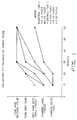
- FIG. 1 An example of the effectiveness of the use of ferric oxide in combination with the organic binder of this invention is illustrated in Figure 1.
- the graph illustrates the progressive breakdown of the core base material from "Charred solid mass” to "Fine sand original colour", when it is held in a simulated aluminium-casting at 450°C (a realistic post-casting core temperature) for the times shown on the horizontal axis of the graph.
- the organic binder material itself fails to completely breakdown after one hour at 450°C (solid bullets) and requires one hour to breakdown at 500°C (hollow bullets).
- the gelatin binder of this invention is preferred over thermoplastic and thermosetting binders known in the prior art in that protein polymers are considerably less cross-linked than such plastics polymers. As a result, significantly lower amounts of heat are required to break the bonds of the protein structure and thermally degrade the binder, permitting the sand to move individually and freely from the cast article.
- This aspect makes the binder of this invention particularly adapted for use with low melting-point metals, such as aluminium, though it would be expected to work well when casting iron and other higher melting-point metals.
- Amino acid polymers are also preferred over thermoplastic and thermosetting polymers because, as a colloid, protein polymers are crystalline when dehydrated and have a high crystalline strength, even when heated. As a result, they possess good hot-strength and do not tend to yield plastically under high heat and pressure.
- This aspect is particularly advantageous when the desired casting method is a squeeze-casting process, which entails subjecting the molten metal within the mould cavity to high pressures.
- Such methods are particularly suited for the casting of fine-grain aluminium articles which must exhibit high strength, such as cast aluminium alloy engine blocks for the automotive industry.
- the preferred core-forming process includes mixing silica or zirconium sand with the preferred gelatin-based binder, wherein the gelatin is preferably provided in a dry powder form. Water is then added to the dry sand-gelatin mixture so as to suspend the gelatin in the water so that the gelatin becomes colloidal.
- the gelatin can be pre-dissolved in an amount of water, such as a solution containing the preferred binder and up to about 2/3 water by weight. This solution can then be mixed with the sand, after which the water content can be adjusted to attain a preferred level for forming the core.
- the ferric compound is water-insoluble, it can be added at any convenient time, such as being mixed in with the sand or mixed in with the preferred gelatin prior to the gelatin being added to the sand.
- the preferred final range of constituents within the mixture is about 0.5 to about 3 weight percent of the preferred gelatin, up to about 4 weight percent water and up to about 1 weight percent of the ferric compound, with the balance being silica sand.
- a more preferred formulation is about 0.75 weight percent gelatin, from about 2.5 to about 3 weight percent water, and ferric oxide in amounts from about 0.02 to about 0.2 weight percent, or ferric phosphate or ferric pyrophosphate in amounts of up to about 0.5 weight percent, with the balance being silica sand.
- a water content of above about 4 weight percent is undesirable in that the subsequent dehydration process required to form the desired rigid core shape may be overly expensive or impractical.
- the quantity of the preferred binder employed may vary within the above range, depending in part on the type of sand used.
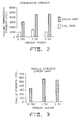
- Figures 2 and 3 illustrate the effect that binder content has on the mechanical strength of test cores made from zircon and silica sand for compressive strength and for tensile strength using zircon sand. In each case, increasing the amount of gelatin binder used beyond the recommended range does not result in further increases in core strength.
- the preferred mixture will generally have the consistency of a slurry.
- This slurry may be pre-heated to a temperature of about 60°C to about 70°C prior to introducing the slurry into the core mould cavity so as to facilitate the filling of the cavity. Otherwise, the slurry may be introduced into the cavity at room temperature.
- the mould may also be pre-heated or heated after the slurry has been injected into the cavity.
- the slurry is preferably packed tightly by either applying air pressure or through the use of a mechanical press to bring the sand grains into close proximity with each other so as to increase the strength of the final core by eliminating voids between individual sand particles.
- the mould and slurry are heated to a cure temperature of about 70°C to about 80° C, and more preferably to about 70°C, by any known means, such as infra-red irradiation, radio-frequency induction or microwave irradiation.
- the preferred duration for which the slurry is held at the cure temperature is from about 2 to about 5 minutes, which is sufficient to consolidate the sand and gelatin to form the core.
- the mould and mixture may then be allowed to cool to room temperature.
- a vacuum be applied to remove the residual water from the core.
- This dehydration step is critical in that any residual moisture within the core will weaken the water-soluble gelatin binder and cause erosion of the sand, such that the surface quality of the core will be adversely effected. Therefore, it is preferable that this dehydration step be performed before the mould and the core mixture are cooled to room temperature and after curing so as to maximise the integrity of the core. However, this step may not be necessary under some circumstances. After dehydration, the core is cooled to room temperature and released from the core mould cavity. The core is at this time ready for use in a casting operation.
- the core may be further treated if desirable or necessary.
- the core may be coated with a refractory material to improve its performance, as is known to those skilled in the art.
- the core may be coated with a water-insoluble and preferably bio-degradable polymer such as poly( ⁇ -hydroxyalkynoates) or chitosan, as well as others, to improve the shelf life of the core.
- the use of a sand core in a casting process includes placing the core within a mould cavity to form interior surfaces and/or intricate exterior surfaces of the casting.
- a molten material such as iron or an aluminium alloy, is then introduced into the mould cavity.
- the mould halves are mechanically pressed together, typically by a hydraulic press, during the moulding operation. This action imposes physical loads on the cores, in addition to the elevated casting temperatures which will begin to degrade the core.
- the core made by the above process possesses sufficient hot-strength such that it is capable of withstanding the pressures imposed by a squeeze-casting operation.
- the melting temperature of the molten material is sufficient to degrade the preferred gelatin binder so that the sand will flow freely from the casting after the molten material has cooled.
- the preferred gelatin binder of this invention begins to thermally degrade due to oxidation at about 450°C.
- the gelatin binder readily degrades during casting, due to the presence of the molten aluminium which has a relatively low melting temperature of about 675°C or lower.
- the sand may be cleaned by flowing clean water through it to remove the residual polymer proteins.
- the gelatin binder is organic, non-toxic and bio-degradable
- the cleaning water does not pose an environmental hazard but is enriched by the polymer proteins removed from the sand.
- this water can be used within a foundry operation as feedstock or broth for the foundry waste-water treatment plant. This broth will fortify the bacterial colony that is resident in the treatment plant and guard against die-off of the bacteria due to toxic or environmental contaminants which are often introduced during normal foundry operation.
- an advantageous feature of the present invention is that the gelatin binder is able to adhere the core sand together such that the core is characterised by a closely-packed particulate structure having sufficient hot-strength to perform well in a squeeze-casting operation. Because the gelatin binder is colloidal, the protein polymers are crystalline when dried. As a result, they do not tend to yield plastically under high heat and pressure, as do thermoplastic and thermosetting polymers typically used for such purposes.
- gelatin-based binder of this invention is also advantageous in that, as a result of the presence of the ferric compound, the gelatin-based binder readily degrades when subjected to casting temperatures as low as those associated with aluminium-casting, i.e., 675°C or lower. As a result, the core is readily broken down during the casting process so that the core sand flows freely from the casting. This is contrary to results obtained with conventional thermoplastic and thermosetting polymer binders, which do not sufficiently break down when exposed to aluminium-casting temperatures, making the core very difficult or impossible to remove from the cast article.
- the preferred gelatin binder of this invention is also water-soluble, non-flammable and non-toxic, such that the preferred gelatin binder can be easily and safely washed from the core sand with water without the binder residue posing an environmental hazard.
- the water-solubility of the preferred gelatin binder is a particularly advantageous feature in that it permits the core to be washed from the casting even if the gelatin binder has not completely broken down from the heat of the casting process. This feature also enables the core sand to be readily recycled for use in a later casting operation or returned to the environment without posing an adverse environmental impact.
Landscapes
- Engineering & Computer Science (AREA)
- Mechanical Engineering (AREA)
- Chemical & Material Sciences (AREA)
- Materials Engineering (AREA)
- Mold Materials And Core Materials (AREA)
- Molds, Cores, And Manufacturing Methods Thereof (AREA)
- Colloid Chemistry (AREA)
- Adhesives Or Adhesive Processes (AREA)
Applications Claiming Priority (2)
| Application Number | Priority Date | Filing Date | Title |
|---|---|---|---|
| US08/010,025 US5320157A (en) | 1993-01-28 | 1993-01-28 | Expendable core for casting processes |
| US10025 | 1993-01-28 |
Publications (2)
| Publication Number | Publication Date |
|---|---|
| EP0608926A1 true EP0608926A1 (fr) | 1994-08-03 |
| EP0608926B1 EP0608926B1 (fr) | 1997-08-06 |
Family
ID=21743393
Family Applications (1)
| Application Number | Title | Priority Date | Filing Date |
|---|---|---|---|
| EP94200070A Expired - Lifetime EP0608926B1 (fr) | 1993-01-28 | 1994-01-13 | Noyau pour procédé de moulage |
Country Status (5)
| Country | Link |
|---|---|
| US (1) | US5320157A (fr) |
| EP (1) | EP0608926B1 (fr) |
| JP (1) | JP2752316B2 (fr) |
| CA (1) | CA2102448C (fr) |
| DE (1) | DE69404687T2 (fr) |
Cited By (6)
| Publication number | Priority date | Publication date | Assignee | Title |
|---|---|---|---|---|
| EP1449602A1 (fr) * | 2003-02-04 | 2004-08-25 | General Motors Corporation | Méthode de fabrication d'un moule de coulée au sable |
| EP1464420A1 (fr) * | 2003-03-14 | 2004-10-06 | Fata Aluminium S.p.A. | Procédé et dispositif pour fabriquer des noyaux de coulage |
| EP1483072A4 (fr) * | 2001-07-23 | 2005-05-04 | Hormel Food Corp | Noyau de sable recouvert de gelatine et procede de fabrication correspondant |
| US7073557B2 (en) | 2004-02-18 | 2006-07-11 | Hormel Foods, Llc | Method of drying a sand mold using a vacuum |
| US7163045B2 (en) | 2002-03-18 | 2007-01-16 | Hormel Foods, Llc | Method and apparatus for making a sand core with an improved production rate |
| US11253913B2 (en) | 2017-12-22 | 2022-02-22 | HÜTTENES-ALBERTUS Chemische Werke Gesellschaft mit beschränkter Haftung | Process for producing a metallic casting or a cured shaped part using aliphatic polymers comprising hydroxy groups |
Families Citing this family (22)
| Publication number | Priority date | Publication date | Assignee | Title |
|---|---|---|---|---|
| US5582231A (en) * | 1995-04-28 | 1996-12-10 | General Motors Corporation | Sand mold member and method |
| US5906235A (en) * | 1995-06-16 | 1999-05-25 | Thomas Robert Anthony | Pressurized squeeze casting apparatus and method and low pressure furnace for use therewith |
| SE515393C2 (sv) * | 1995-10-03 | 2001-07-23 | Skf Nova Ab | Sätt att forma kroppar av en uppslamning av pulver i vatten med ett irreversibelt gelbildande protein |
| GB9523581D0 (en) * | 1995-11-17 | 1996-01-17 | British Textile Tech | Cross-linking |
| US5701944A (en) * | 1995-11-17 | 1997-12-30 | Doehler-Jarvis Technologies, Inc. | Die casting machine and method |
| US5749409A (en) | 1995-12-18 | 1998-05-12 | General Motors Corporation | Method of forming refractory coated foundry core |
| US5558151A (en) * | 1995-12-18 | 1996-09-24 | General Motors Corporation | Die casting mold having lock rings for mounting an insert to a mandrel |
| US5730205A (en) * | 1996-07-15 | 1998-03-24 | Thomas; Robert Anthony | Die assembly for squeeze casting |
| US6090915A (en) * | 1996-10-18 | 2000-07-18 | Hormel Foods Corporation | Collagen or gelatin crumble composition and uses |
| US6447593B1 (en) | 2001-04-12 | 2002-09-10 | General Motors Corporation | Foundry sand with oxidation promoter |
| US6986810B1 (en) * | 2002-11-21 | 2006-01-17 | Mohammad Behi | Aqueous binder formulation for metal and ceramic feedstock for injection molding and aqueous coating composition |
| WO2004103607A2 (fr) * | 2003-05-13 | 2004-12-02 | Ashland Inc. | Procede de production de formes pour la fonderie |
| DE102008004929A1 (de) * | 2008-01-18 | 2009-07-23 | Ks Aluminium-Technologie Gmbh | Druckfester Kern mit verbessertem Binder |
| US7984750B2 (en) * | 2008-11-14 | 2011-07-26 | GM Global Technology Operations LLC | Binder degradation of sand cores |
| DE102009033158A1 (de) * | 2009-07-13 | 2011-01-27 | Gelita Ag | Konzentrat zur Herstellung eines Kühl- und Trennmittels sowie derartiges Kühl- und Trennmittel |
| US8853299B2 (en) | 2009-10-06 | 2014-10-07 | Amcol International Corp. | Lignite-based urethane resins with enhanced suspension properties and foundry sand binder performance |
| US8436073B2 (en) | 2009-10-06 | 2013-05-07 | Amcol International | Lignite-based foundry resins |
| US8623959B2 (en) * | 2009-10-06 | 2014-01-07 | Joseph M. Fuqua | Non-veining urethane resins for foundry sand casting |
| IT1396481B1 (it) * | 2009-11-17 | 2012-12-14 | Maprof Sas Di Renzo Moschini E C | Metodo di fabbricazione di corpi cavi monolitici mediante un processo di colata o di stampaggio ad iniezione. |
| DE102012110258A1 (de) * | 2012-10-26 | 2014-04-30 | Ks Aluminium-Technologie Gmbh | Verfahren zur Herstellung eines Zylinderkurbelgehäuses |
| DE102016123051A1 (de) | 2016-11-29 | 2018-05-30 | HÜTTENES-ALBERTUS Chemische Werke Gesellschaft mit beschränkter Haftung | Aminosäure enthaltende Formstoffmischung zur Herstellung von Formkörpern für die Gießereiindustrie |
| US11724306B1 (en) | 2020-06-26 | 2023-08-15 | Triad National Security, Llc | Coating composition embodiments for use in investment casting methods |
Citations (4)
| Publication number | Priority date | Publication date | Assignee | Title |
|---|---|---|---|---|
| US2145317A (en) * | 1935-01-17 | 1939-01-31 | Borden Co | Foundry core binder |
| US2206369A (en) * | 1938-04-29 | 1940-07-02 | Harold K Salzberg | Foundry sand binder |
| JPS59212144A (ja) * | 1983-05-16 | 1984-12-01 | Takara Denpun Kagaku Kk | 自硬性鋳型用組成物 |
| JPS60108138A (ja) * | 1983-11-16 | 1985-06-13 | Mitsubishi Heavy Ind Ltd | 鋳造用鋳型組成物 |
Family Cites Families (11)
| Publication number | Priority date | Publication date | Assignee | Title |
|---|---|---|---|---|
| US2684344A (en) * | 1950-08-31 | 1954-07-20 | American Cyanamid Co | Core binding composition |
| US2974048A (en) * | 1957-12-30 | 1961-03-07 | Int Minerals & Chem Corp | Core binder |
| US2974050A (en) * | 1958-06-27 | 1961-03-07 | Int Minerals & Chem Corp | Core binder |
| US3166808A (en) * | 1958-08-18 | 1965-01-26 | Pittsburgh Plate Glass Co | Core reinforcement means |
| US3196505A (en) * | 1961-01-02 | 1965-07-27 | Mo Och Domsjoe Ab | Methods of making sand molds or cores for casting |
| US3212145A (en) * | 1963-04-12 | 1965-10-19 | United States Steel Corp | Mold coating and method of pouring ingots |
| US3523094A (en) * | 1969-02-19 | 1970-08-04 | Krause Milling Co | Foundry cores comprising cereal binder and a critical amount of water |
| US4013629A (en) * | 1975-02-21 | 1977-03-22 | Krause Milling Company | Art of catalyzing the reaction between a polyol and a polyaldehyde |
| US4711669A (en) * | 1985-11-05 | 1987-12-08 | American Cyanamid Company | Method of manufacturing a bonded particulate article by reacting a hydrolyzed amylaceous product and a heterocyclic compound |
| US4500453A (en) * | 1984-06-29 | 1985-02-19 | Dynagel Incorporated | Cross-linked protein composition using aluminum salts of acetic acid |
| US4814012A (en) * | 1985-11-05 | 1989-03-21 | American Cyanamid Company | Method of manufacturing a bonded particulate article by reacting a hydrolyzed amylaceous product and a heterocyclic compound |
-
1993
- 1993-01-28 US US08/010,025 patent/US5320157A/en not_active Expired - Lifetime
- 1993-11-04 CA CA002102448A patent/CA2102448C/fr not_active Expired - Lifetime
-
1994
- 1994-01-13 DE DE69404687T patent/DE69404687T2/de not_active Expired - Lifetime
- 1994-01-13 EP EP94200070A patent/EP0608926B1/fr not_active Expired - Lifetime
- 1994-01-28 JP JP6008229A patent/JP2752316B2/ja not_active Expired - Lifetime
Patent Citations (4)
| Publication number | Priority date | Publication date | Assignee | Title |
|---|---|---|---|---|
| US2145317A (en) * | 1935-01-17 | 1939-01-31 | Borden Co | Foundry core binder |
| US2206369A (en) * | 1938-04-29 | 1940-07-02 | Harold K Salzberg | Foundry sand binder |
| JPS59212144A (ja) * | 1983-05-16 | 1984-12-01 | Takara Denpun Kagaku Kk | 自硬性鋳型用組成物 |
| JPS60108138A (ja) * | 1983-11-16 | 1985-06-13 | Mitsubishi Heavy Ind Ltd | 鋳造用鋳型組成物 |
Non-Patent Citations (2)
| Title |
|---|
| PATENT ABSTRACTS OF JAPAN vol. 9, no. 261 (M - 422) 18 October 1985 (1985-10-18) * |
| PATENT ABSTRACTS OF JAPAN vol. 9, no. 84 (M - 371) 13 April 1985 (1985-04-13) * |
Cited By (8)
| Publication number | Priority date | Publication date | Assignee | Title |
|---|---|---|---|---|
| EP1483072A4 (fr) * | 2001-07-23 | 2005-05-04 | Hormel Food Corp | Noyau de sable recouvert de gelatine et procede de fabrication correspondant |
| US7163045B2 (en) | 2002-03-18 | 2007-01-16 | Hormel Foods, Llc | Method and apparatus for making a sand core with an improved production rate |
| EP1449602A1 (fr) * | 2003-02-04 | 2004-08-25 | General Motors Corporation | Méthode de fabrication d'un moule de coulée au sable |
| US6843303B2 (en) | 2003-02-04 | 2005-01-18 | General Motors Corporation | Method of sand coremaking |
| EP1464420A1 (fr) * | 2003-03-14 | 2004-10-06 | Fata Aluminium S.p.A. | Procédé et dispositif pour fabriquer des noyaux de coulage |
| US6923240B2 (en) | 2003-03-14 | 2005-08-02 | Fata Aluminium S.P.A. | Process and apparatus for producing casting cores |
| US7073557B2 (en) | 2004-02-18 | 2006-07-11 | Hormel Foods, Llc | Method of drying a sand mold using a vacuum |
| US11253913B2 (en) | 2017-12-22 | 2022-02-22 | HÜTTENES-ALBERTUS Chemische Werke Gesellschaft mit beschränkter Haftung | Process for producing a metallic casting or a cured shaped part using aliphatic polymers comprising hydroxy groups |
Also Published As
| Publication number | Publication date |
|---|---|
| JP2752316B2 (ja) | 1998-05-18 |
| DE69404687T2 (de) | 1998-01-08 |
| DE69404687D1 (de) | 1997-09-11 |
| CA2102448C (fr) | 1998-04-21 |
| JPH06292938A (ja) | 1994-10-21 |
| CA2102448A1 (fr) | 1994-07-29 |
| EP0608926B1 (fr) | 1997-08-06 |
| US5320157A (en) | 1994-06-14 |
Similar Documents
| Publication | Publication Date | Title |
|---|---|---|
| EP0608926B1 (fr) | Noyau pour procédé de moulage | |
| US5884688A (en) | Methods for fabricating shapes by use of organometallic ceramic precursor binders | |
| US4925492A (en) | Ceramic core for investment casting and method for preparation | |
| US2869194A (en) | Auto-hardening phenol-formaldehyde composition and method of preparing shell molds therefrom | |
| EP0476966A1 (fr) | Sable de fonderie | |
| CA2025826C (fr) | Methode permettant un retrait aise des formes en stable de pieces coulees | |
| CA1144338A (fr) | Noyaux perdus pour la coulee en moule | |
| CN1921969B (zh) | 铸件的制造方法 | |
| US3686006A (en) | Refractory cores and methods of making the same | |
| US4413666A (en) | Expendable die casting sand core | |
| JPS649898B2 (fr) | ||
| US6673141B2 (en) | Foundry sand with oxidation promoter | |
| Campbell et al. | Molding and casting processes | |
| US3057026A (en) | Foundry process and molding mixture | |
| JP2918180B2 (ja) | 鋳型および中子製造のための破砕されたかつグレード化された鉱石、好ましくは磁鉄鉱鉱石の使用 | |
| US3004312A (en) | Process of shell molding | |
| US5318092A (en) | Method for controlling the collapsibility of foundry molds and cores | |
| JPS6015421B2 (ja) | 精密鋳造用鋳型の製造法 | |
| EP0099470A1 (fr) | Coulée de métaux non-ferreux | |
| GB2096928A (en) | Method of casting grey iron | |
| US2997759A (en) | Shell molding mixture | |
| JPH0240412B2 (fr) | ||
| JPH03165951A (ja) | 消耗性被覆砂中子の製造法 | |
| WO2005021188A2 (fr) | Compositions et utilisation de sable et de poudres se pretant au chauffage par energie micro-ondes ou induction | |
| RU2291026C2 (ru) | Способ изготовления отливок, формовочный материал и его применение для осуществления способа |
Legal Events
| Date | Code | Title | Description |
|---|---|---|---|
| PUAI | Public reference made under article 153(3) epc to a published international application that has entered the european phase |
Free format text: ORIGINAL CODE: 0009012 |
|
| AK | Designated contracting states |
Kind code of ref document: A1 Designated state(s): DE FR GB |
|
| 17P | Request for examination filed |
Effective date: 19950203 |
|
| 17Q | First examination report despatched |
Effective date: 19951113 |
|
| GRAG | Despatch of communication of intention to grant |
Free format text: ORIGINAL CODE: EPIDOS AGRA |
|
| GRAH | Despatch of communication of intention to grant a patent |
Free format text: ORIGINAL CODE: EPIDOS IGRA |
|
| GRAH | Despatch of communication of intention to grant a patent |
Free format text: ORIGINAL CODE: EPIDOS IGRA |
|
| GRAA | (expected) grant |
Free format text: ORIGINAL CODE: 0009210 |
|
| AK | Designated contracting states |
Kind code of ref document: B1 Designated state(s): DE FR GB |
|
| REF | Corresponds to: |
Ref document number: 69404687 Country of ref document: DE Date of ref document: 19970911 |
|
| ET | Fr: translation filed | ||
| PLBE | No opposition filed within time limit |
Free format text: ORIGINAL CODE: 0009261 |
|
| STAA | Information on the status of an ep patent application or granted ep patent |
Free format text: STATUS: NO OPPOSITION FILED WITHIN TIME LIMIT |
|
| 26N | No opposition filed | ||
| REG | Reference to a national code |
Ref country code: GB Ref legal event code: IF02 |
|
| REG | Reference to a national code |
Ref country code: GB Ref legal event code: 732E Free format text: REGISTERED BETWEEN 20090226 AND 20090304 |
|
| REG | Reference to a national code |
Ref country code: GB Ref legal event code: 732E Free format text: REGISTERED BETWEEN 20090305 AND 20090311 |
|
| REG | Reference to a national code |
Ref country code: GB Ref legal event code: 732E Free format text: REGISTERED BETWEEN 20091029 AND 20091104 |
|
| REG | Reference to a national code |
Ref country code: GB Ref legal event code: 732E Free format text: REGISTERED BETWEEN 20091105 AND 20091111 |
|
| PGFP | Annual fee paid to national office [announced via postgrant information from national office to epo] |
Ref country code: FR Payment date: 20130204 Year of fee payment: 20 Ref country code: DE Payment date: 20130109 Year of fee payment: 20 Ref country code: GB Payment date: 20130109 Year of fee payment: 20 |
|
| REG | Reference to a national code |
Ref country code: DE Ref legal event code: R071 Ref document number: 69404687 Country of ref document: DE |
|
| REG | Reference to a national code |
Ref country code: DE Ref legal event code: R071 Ref document number: 69404687 Country of ref document: DE |
|
| REG | Reference to a national code |
Ref country code: GB Ref legal event code: PE20 Expiry date: 20140112 |
|
| PG25 | Lapsed in a contracting state [announced via postgrant information from national office to epo] |
Ref country code: DE Free format text: LAPSE BECAUSE OF EXPIRATION OF PROTECTION Effective date: 20140114 Ref country code: GB Free format text: LAPSE BECAUSE OF EXPIRATION OF PROTECTION Effective date: 20140112 |