EP0609939A1 - Verfahren zur Verarbeitung eines photographischen Silberhalogenidmaterials - Google Patents
Verfahren zur Verarbeitung eines photographischen Silberhalogenidmaterials Download PDFInfo
- Publication number
- EP0609939A1 EP0609939A1 EP94200183A EP94200183A EP0609939A1 EP 0609939 A1 EP0609939 A1 EP 0609939A1 EP 94200183 A EP94200183 A EP 94200183A EP 94200183 A EP94200183 A EP 94200183A EP 0609939 A1 EP0609939 A1 EP 0609939A1
- Authority
- EP
- European Patent Office
- Prior art keywords
- developer
- ion
- bromide ion
- bromide
- solution
- Prior art date
- Legal status (The legal status is an assumption and is not a legal conclusion. Google has not performed a legal analysis and makes no representation as to the accuracy of the status listed.)
- Granted
Links
Images

Classifications
-
- G—PHYSICS
- G03—PHOTOGRAPHY; CINEMATOGRAPHY; ANALOGOUS TECHNIQUES USING WAVES OTHER THAN OPTICAL WAVES; ELECTROGRAPHY; HOLOGRAPHY
- G03C—PHOTOSENSITIVE MATERIALS FOR PHOTOGRAPHIC PURPOSES; PHOTOGRAPHIC PROCESSES, e.g. CINE, X-RAY, COLOUR, STEREO-PHOTOGRAPHIC PROCESSES; AUXILIARY PROCESSES IN PHOTOGRAPHY
- G03C7/00—Multicolour photographic processes or agents therefor; Regeneration of such processing agents; Photosensitive materials for multicolour processes
- G03C7/30—Colour processes using colour-coupling substances; Materials therefor; Preparing or processing such materials
- G03C7/407—Development processes or agents therefor
- G03C7/413—Developers
-
- G—PHYSICS
- G03—PHOTOGRAPHY; CINEMATOGRAPHY; ANALOGOUS TECHNIQUES USING WAVES OTHER THAN OPTICAL WAVES; ELECTROGRAPHY; HOLOGRAPHY
- G03C—PHOTOSENSITIVE MATERIALS FOR PHOTOGRAPHIC PURPOSES; PHOTOGRAPHIC PROCESSES, e.g. CINE, X-RAY, COLOUR, STEREO-PHOTOGRAPHIC PROCESSES; AUXILIARY PROCESSES IN PHOTOGRAPHY
- G03C5/00—Photographic processes or agents therefor; Regeneration of such processing agents
- G03C5/26—Processes using silver-salt-containing photosensitive materials or agents therefor
- G03C5/29—Development processes or agents therefor
- G03C5/31—Regeneration; Replenishers
-
- G—PHYSICS
- G03—PHOTOGRAPHY; CINEMATOGRAPHY; ANALOGOUS TECHNIQUES USING WAVES OTHER THAN OPTICAL WAVES; ELECTROGRAPHY; HOLOGRAPHY
- G03C—PHOTOSENSITIVE MATERIALS FOR PHOTOGRAPHIC PURPOSES; PHOTOGRAPHIC PROCESSES, e.g. CINE, X-RAY, COLOUR, STEREO-PHOTOGRAPHIC PROCESSES; AUXILIARY PROCESSES IN PHOTOGRAPHY
- G03C7/00—Multicolour photographic processes or agents therefor; Regeneration of such processing agents; Photosensitive materials for multicolour processes
- G03C7/30—Colour processes using colour-coupling substances; Materials therefor; Preparing or processing such materials
- G03C7/44—Regeneration; Replenishers
Definitions
- This invention relates to a method of processing photographic silver halide material such as photographic film and paper. In particular it relates to a method of processing colour negative film.
- Colour negative films are processed in an industry standard process called C-41.
- C-41 systems are run on the basis that a replenisher solution is added to the developer and excess developer is removed by letting it overflow.
- the developer solution thus achieves a stable condition in which chemicals used up during processing are replenished to maintain a working concentration and seasoning products e.g. bromide and iodide ions and antifoggant fragments from DIR couplers entering the developer solution from the film are kept at an acceptable level.
- Recent C-41 systems are run on a developer replenishment rate of from 500 to 1800 ml/m2 of film processed. Colour papers and black and white photographic materials can also be processed by replenishment systems.
- CD4 (4-(N-ethyl-N-2-hydroxyethyl)-2-methylphenylenediamine sulphate) effluent produced during the development of colour negative films.
- One way to achieve this is to lower the CD4 concentration in the developer and to compensate somewhere else in the overall system to restore the necessary development activity.
- a lower bromide ion level in the development solution can help in this regard.
- a method of processing photographic silver halide material characterised in that it includes a step in which a developing solution is treated with means to remove continuously substantially all bromide ion from the solution and to maintain the solution substantially free from bromide ion during operation of the method.
- bromide ion is substantially absent from the developer or replenisher developer used in the method of the invention and bromide ion formed by the reduction of silver bromide during development is removed substantially completely as it is formed so that bromide ion effectively takes no part in the development reaction.
- the method of the invention is applicable to the processing of any form of silver halide photographic material such as colour negative film, colour paper and black and white materials. It is very suitable for processing colour negative film, particularly by the C-41 process.
- Colour negative films which may be processed include for example films that are commercially available and films described in Research Disclosure Item 17643, December 1978, pages 22-31, Published by Kenneth Mason Publications of Emsworth, Hampshire, United Kingdom.
- bromide ion produced during development is removed from development solution which is continuously withdrawn from a development tank into a treatment loop with the treated solution being thereafter returned to the tank.
- Bromide ion removal can be effected by any suitable means including ion-exchange, electrodialysis, dialysis and reverse osmosis, with ion-exchange removal being preferred. Whatever the removal means, it has suitably sufficient capacity to achieve removal of substantially all potential bromide.
- the method of the present invention can be used in the low effluent replenishment system for colour negative developers which is described and claimed in our PCT/EP 90/01854.
- the ion-exchange resin is preferably anionic (for the exchange of anions).
- anionic resin is based on a polystyrene matrix cross-linked, for example, with 3% to 5% of divinylbenzene.Its strongly basic character is derived from quaternary ammonium groups. Examples of suitable anionic exchange resins are: IRA 400 Rohm and Haas Dowex 1-X8 Dow Chemical, and Duolite A113 Diamond Shamrock.
- the ion-exchange resin is preferably located in a cartridge through which the contents of the developer tank are pumped either continuously or when required. When it has been exhausted it may be discarded or regenerated as will be well understood.
- the replenisher which is added to the development solution may be in the form of a solution, having a pH of 10.09, of the following composition: Potassium carbonate 37.5 g/l Sodium bromide 0.45 g/l Anti-cal 6.5 ml/l Sodium sulphite 4.85 g/l Hydroxylamine sulphate 3.4 g/l CD4 5.9 g/l where Anti-cal is the penta sodium salt of diethylene triamine penta acetic acid.
- the method of the invention allows developer solutions to be used which contain lower levels of colour developers compared with the solutions used in the standard C-41 process.
- the levels which can be used suitably are between 10% and 100% of those used in the standard process and preferably in the range 25% to 50% of those used in the standard C-41 process.
- Figure 1 shows a developer tank to which additions of activator solution and solid CD4 colour developing agent are made. There is a carry-out of developer solution on the film and, should the volume drop, due to evaporation, the level is made up with water.
- the ion-exchange cartridge is attached to the tank as shown and developer is circulated through it, e.g. with a pump, preferably only when there is film being processed.
- the ion-exchange resin used is preferably anionic as described above and is preferably located in a cartridge also as described above.
- the replenisher may be a solution or a solid and may be added by one of the ways described above.
- bromide ion was removed from C-41 developer solution as shown in Figure 1.
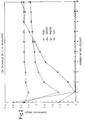
- Analysis of the solution after the ion-exchange treatment gave the results which are summarised in Figure 2, which shows plots for concentrations of (1) sodium bromide, (2) sodium sulphite, (3) sodium sulphate and (4) CD4 against the number of bed volumes.
- One bed volume is equal to the volume of resin beads in the column and was about 50 ml.
- the resin used was IRA 400 ( Rohm and Haas ). This was regenerated with ten bed volumes of potassium carbonate solution,(5%) and then washed with five bed volumes of water.
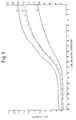
- a series of single layer coatings with a fast magenta emulsion and a magenta coupler (Iso 400 speed) were processed in standard C-41 developer (a) and in an experimental developer containing zero bromide ion and half the CD4 level of C-41 (b) to (d).
- the compositions of the developers were as follows: Standard 4.5 g/L CD4 developer, 1.3 g/L NaBr Experimental 2.25 g/L CD4 developer, 0.0 g/L NaBr Using the experimental developer processing took place at 3 different development times i.e. 0.5 minutes (b), 0.75 minutes (c) and 1.0 minutes (d).
- the development time for the standard was 2.5 minutes. In all cases the development temperature was 37.8 o C.
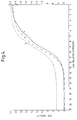
- Curve a) is for standard C-41 developer containing 1.3 g/l sodium bromide
- Curve b) is for experimental developer containing 1.125 g/l CD-4 and zero bromide ion
- Curve c) is for experimental developer containing 1.125 g/l CD-4, zero bromide ion and 0.002 g/l of 5-methyl benzotriazole. Development times were a) 2.5 minutes and b) and c) 2.08 minutes each.
Landscapes
- Physics & Mathematics (AREA)
- General Physics & Mathematics (AREA)
- Silver Salt Photography Or Processing Solution Therefor (AREA)
Applications Claiming Priority (2)
| Application Number | Priority Date | Filing Date | Title |
|---|---|---|---|
| GB9301852 | 1993-01-30 | ||
| GB939301852A GB9301852D0 (en) | 1993-01-30 | 1993-01-30 | Method of processing photographic silver halide material |
Publications (2)
| Publication Number | Publication Date |
|---|---|
| EP0609939A1 true EP0609939A1 (de) | 1994-08-10 |
| EP0609939B1 EP0609939B1 (de) | 1999-11-03 |
Family
ID=10729568
Family Applications (1)
| Application Number | Title | Priority Date | Filing Date |
|---|---|---|---|
| EP19940200183 Expired - Lifetime EP0609939B1 (de) | 1993-01-30 | 1994-01-27 | Verfahren zur Verarbeitung eines photographischen Silberhalogenidmaterials |
Country Status (4)
| Country | Link |
|---|---|
| EP (1) | EP0609939B1 (de) |
| JP (1) | JPH06242559A (de) |
| DE (1) | DE69421424T2 (de) |
| GB (1) | GB9301852D0 (de) |
Families Citing this family (2)
| Publication number | Priority date | Publication date | Assignee | Title |
|---|---|---|---|---|
| US5643399A (en) | 1994-05-17 | 1997-07-01 | Carlisle Corporation | Composite roofing product and apparatus and method for cleaning vulcanized rubber and for making a composite roofing product |
| US5456785A (en) | 1994-05-17 | 1995-10-10 | Venable; Jesse S. | Composite roofing product and method and apparatus for making a composite roofing product |
Citations (4)
| Publication number | Priority date | Publication date | Assignee | Title |
|---|---|---|---|---|
| US4529687A (en) * | 1982-10-07 | 1985-07-16 | Fuji Photo Film Co., Ltd. | Method to form color image |
| EP0368340A1 (de) * | 1988-11-10 | 1990-05-16 | Fuji Photo Film Co., Ltd. | Verarbeitungsverfahren für silberhalogenidhaltende lichtempfindliche Farbmaterialien |
| WO1991007698A1 (en) * | 1989-11-09 | 1991-05-30 | Kodak Limited | Low effluent replenishment system for colour negative developers |
| US5051342A (en) * | 1988-03-22 | 1991-09-24 | Fuji Photo Film Co., Ltd. | Silver halide photographic materials and method for color development thereof |
-
1993
- 1993-01-30 GB GB939301852A patent/GB9301852D0/en active Pending
-
1994
- 1994-01-27 EP EP19940200183 patent/EP0609939B1/de not_active Expired - Lifetime
- 1994-01-27 DE DE1994621424 patent/DE69421424T2/de not_active Expired - Fee Related
- 1994-01-31 JP JP6009317A patent/JPH06242559A/ja active Pending
Patent Citations (4)
| Publication number | Priority date | Publication date | Assignee | Title |
|---|---|---|---|---|
| US4529687A (en) * | 1982-10-07 | 1985-07-16 | Fuji Photo Film Co., Ltd. | Method to form color image |
| US5051342A (en) * | 1988-03-22 | 1991-09-24 | Fuji Photo Film Co., Ltd. | Silver halide photographic materials and method for color development thereof |
| EP0368340A1 (de) * | 1988-11-10 | 1990-05-16 | Fuji Photo Film Co., Ltd. | Verarbeitungsverfahren für silberhalogenidhaltende lichtempfindliche Farbmaterialien |
| WO1991007698A1 (en) * | 1989-11-09 | 1991-05-30 | Kodak Limited | Low effluent replenishment system for colour negative developers |
Also Published As
| Publication number | Publication date |
|---|---|
| EP0609939B1 (de) | 1999-11-03 |
| GB9301852D0 (en) | 1993-03-17 |
| DE69421424D1 (de) | 1999-12-09 |
| DE69421424T2 (de) | 2000-05-25 |
| JPH06242559A (ja) | 1994-09-02 |
Similar Documents
| Publication | Publication Date | Title |
|---|---|---|
| WO1993001524A1 (en) | Method for forming a photographic colour image | |
| EP0500592B1 (de) | Abwasserarmes regeneriersystem für farbnegativentwickler | |
| EP0609939B1 (de) | Verfahren zur Verarbeitung eines photographischen Silberhalogenidmaterials | |
| EP0609940B1 (de) | Verfahren zur Verarbeitung eines photographischen Silberhalogenidmaterials | |
| EP0500764B1 (de) | Regenerier- und nachfüllsystem für farbbildentwickler | |
| EP0330442B1 (de) | Verfahren zum Verarbeiten farbphotographischer Materialien | |
| EP0530889B1 (de) | Methode zur Auffüllung von photographischen Entwicklerlösungen | |
| US5756270A (en) | Method of processing a photographic silver halide color material | |
| EP0733946A1 (de) | Verwendung eines alkalischen Vorbads zur Aktivierung einer sauren Peroxidbleichlösung für die Verarbeitung farbphotographischer Elemente | |
| US5869223A (en) | Method for replenishing an ascorbic acid developer | |
| US5702874A (en) | Method of processing photographic silver halide materials | |
| EP0465228A2 (de) | Verarbeitungsverfahren für farbphotographisches Silberhalogenidmaterial | |
| US5884116A (en) | Photographic processing apparatus | |
| EP0224858A2 (de) | Verfahren zur Behandlung eines lichtempfindlichen farbphotographischen Silberhalogenidmaterials | |
| US5858631A (en) | Processing color photographic materials | |
| JPH08254802A (ja) | 経時した写真発色現像液からの錫の除去方法 | |
| EP0742481A1 (de) | Verfahren zur Verarbeitung photographischer Schwarzweissmaterialien | |
| EP0617324B1 (de) | Verwendung von Pyrazolidinon-Verbindungen zur Verringerung der Granularität von photographischen Silberhalogenid-Materialien | |
| EP0514868A1 (de) | Verfahren zur Verarbeitung eines photographischen lichtempfindlichen Silberhalogenidmaterials und Verfahren zur Wiederverwendung einer photographischen Lösung | |
| US6479223B2 (en) | Method of producing a photographic image | |
| JP2673699B2 (ja) | ハロゲン化銀写真感光材料の処理方法及び装置並びに通電装置 | |
| EP0742482A1 (de) | Verfahren zur Verarbeitung photographischer Schwarzweiss-Silberhalogenidmaterialien | |
| JPH03141352A (ja) | ハロゲン化銀感光材料の処理方法 | |
| JPH06242574A (ja) | 感光材料処理方法及び処理装置 | |
| EP0600338A1 (de) | Farbfotografisches Verarbeitungsverfahren |
Legal Events
| Date | Code | Title | Description |
|---|---|---|---|
| PUAI | Public reference made under article 153(3) epc to a published international application that has entered the european phase |
Free format text: ORIGINAL CODE: 0009012 |
|
| AK | Designated contracting states |
Kind code of ref document: A1 Designated state(s): DE FR GB |
|
| 17P | Request for examination filed |
Effective date: 19950113 |
|
| 17Q | First examination report despatched |
Effective date: 19980514 |
|
| GRAG | Despatch of communication of intention to grant |
Free format text: ORIGINAL CODE: EPIDOS AGRA |
|
| GRAG | Despatch of communication of intention to grant |
Free format text: ORIGINAL CODE: EPIDOS AGRA |
|
| GRAH | Despatch of communication of intention to grant a patent |
Free format text: ORIGINAL CODE: EPIDOS IGRA |
|
| RBV | Designated contracting states (corrected) |
Designated state(s): DE FR GB |
|
| RAP1 | Party data changed (applicant data changed or rights of an application transferred) |
Owner name: EASTMAN KODAK COMPANY Owner name: KODAK LIMITED |
|
| GRAH | Despatch of communication of intention to grant a patent |
Free format text: ORIGINAL CODE: EPIDOS IGRA |
|
| GRAA | (expected) grant |
Free format text: ORIGINAL CODE: 0009210 |
|
| AK | Designated contracting states |
Kind code of ref document: B1 Designated state(s): DE FR GB |
|
| PG25 | Lapsed in a contracting state [announced via postgrant information from national office to epo] |
Ref country code: FR Free format text: LAPSE BECAUSE OF FAILURE TO SUBMIT A TRANSLATION OF THE DESCRIPTION OR TO PAY THE FEE WITHIN THE PRESCRIBED TIME-LIMIT Effective date: 19991103 |
|
| REF | Corresponds to: |
Ref document number: 69421424 Country of ref document: DE Date of ref document: 19991209 |
|
| PG25 | Lapsed in a contracting state [announced via postgrant information from national office to epo] |
Ref country code: GB Free format text: LAPSE BECAUSE OF NON-PAYMENT OF DUE FEES Effective date: 20000203 |
|
| EN | Fr: translation not filed | ||
| PLBE | No opposition filed within time limit |
Free format text: ORIGINAL CODE: 0009261 |
|
| STAA | Information on the status of an ep patent application or granted ep patent |
Free format text: STATUS: NO OPPOSITION FILED WITHIN TIME LIMIT |
|
| GBPC | Gb: european patent ceased through non-payment of renewal fee |
Effective date: 20000203 |
|
| 26N | No opposition filed | ||
| PG25 | Lapsed in a contracting state [announced via postgrant information from national office to epo] |
Ref country code: DE Free format text: LAPSE BECAUSE OF NON-PAYMENT OF DUE FEES Effective date: 20001101 |