EP0610007A2 - Kodierung und Dekodierung mit hoher Wirksamkeit - Google Patents
Kodierung und Dekodierung mit hoher Wirksamkeit Download PDFInfo
- Publication number
- EP0610007A2 EP0610007A2 EP94300502A EP94300502A EP0610007A2 EP 0610007 A2 EP0610007 A2 EP 0610007A2 EP 94300502 A EP94300502 A EP 94300502A EP 94300502 A EP94300502 A EP 94300502A EP 0610007 A2 EP0610007 A2 EP 0610007A2
- Authority
- EP
- European Patent Office
- Prior art keywords
- bit allocation
- channels
- information signals
- signals
- block
- Prior art date
- Legal status (The legal status is an assumption and is not a legal conclusion. Google has not performed a legal analysis and makes no representation as to the accuracy of the status listed.)
- Granted
Links
Images




Classifications
-
- H—ELECTRICITY
- H04—ELECTRIC COMMUNICATION TECHNIQUE
- H04B—TRANSMISSION
- H04B1/00—Details of transmission systems, not covered by a single one of groups H04B3/00 - H04B13/00; Details of transmission systems not characterised by the medium used for transmission
- H04B1/66—Details of transmission systems, not covered by a single one of groups H04B3/00 - H04B13/00; Details of transmission systems not characterised by the medium used for transmission for reducing bandwidth of signals; for improving efficiency of transmission
- H04B1/665—Details of transmission systems, not covered by a single one of groups H04B3/00 - H04B13/00; Details of transmission systems not characterised by the medium used for transmission for reducing bandwidth of signals; for improving efficiency of transmission using psychoacoustic properties of the ear, e.g. masking effect
Definitions
- This invention relates to high efficiency encoding methods and devices for encoding input digital data by high efficiency encoding, whereupon the encoded data may be transmitted or recorded, and to high efficiency decoding methods and devices for reproducing and decoding the encoded data to produce replay data.
- a sub-band coding (SBC) system which is a non-block forming frequency band dividing system which comprises dividing the time-domain signals into signals of plural frequency bands without dividing the time-domain audio signals into plural blocks
- SBC sub-band coding
- a block-forming frequency band dividing system which comprises dividing time-domain signals into plural blocks, transforming the resulting blocks into frequency-domain signals by orthogonal transformation, and encoding the resulting frequency-domain signals from one frequency band to another, also known as transform coding.
- high efficiency encoding comprising a combination of sub-band coding and transform coding, in which the time-domain signals are divided into signals of plural frequency bands by sub-band coding, and the signals of the respective bands are orthogonally transformed into frequency-domain signals which are then encoded from one band to another.
- a filter employed in the above methods may be exemplified by a quadrature mirror filter (QMF) discussed in 1976 R.E. Crochiere, Digital Coding of Speech in Sub-bands, Bell Syst. Tech. J., Vol. 55, No.8, 1976.
- QMF quadrature mirror filter
- An equal-band filter dividing method employing a polyphase quadrature filter is discussed in ICASSP 83, Boston, Polyphase Quadrature Filter - A New Sub-band Coding Technique, by Joseph H. Rothweiler.
- the orthogonal transform may be enumerated by an orthogonal transform consisting in forming input audio signals into blocks at an interval of a pre-set unit time period (frame), and processing the resulting blocks by a fast Fourier transform (FFT), discrete cosine transform (DCT) or modified DCT (MDCT) for transforming time-domain signals into frequency-domain signals.
- FFT fast Fourier transform
- DCT discrete cosine transform
- MDCT modified DCT
- the frequency bands are selected to take into account the characteristics of the human aural sense. That is, the audio signals are divided into a plurality of bands, for example 25 bands, known as critical bands, in which the bandwidths become broader in a direction of increasing frequencies.
- a pre-set number of bits are allocated to each band, or variable numbers of bits are allocated to each band by way of adaptive bit allocation. For example, when encoding coefficient data obtained by MDCT by bit allocation, the MDCT coefficient data of the respective bands obtained by block-based MDCT are encoded by adaptive numbers of bits. The following two bit allocation methods are known.
- bit allocation is made based on the magnitudes of the signals of the respective bands.
- the quantization noise spectrum becomes flatter and the noise energy becomes minimum.
- the noise as actually perceived by the ear is not optimum because the aural masking effect is not utilized.
- pre-echo means a phenomenon in which the quantization noise produced directly before the small information signal is abruptly changed to the larger information signal is heard without being covered by backward masking to cause deterioration in the sound quality.
- a high efficiency encoding method in which pre-set bit allocation is made for digital information signals of plural channels and the encoded information signals are obtained on the basis of the allocated bits, characterised in that the amount of bit allocation among the channels is performed based on temporal changes of the information signals of the respective channels.
- a preferred embodiment of the invention described in detail hereinbelow seeks to provide a method for bit allocation which is free from pre-echo insofar as the human aural sense is concerned.
- pre-echo is prevented by preferentially allocating at least a part of the bits that may be used for bit allocation to channels having larger temporal changes of the information signals in dependence upon the temporal changes of the information signals between channels.
- Detection and decision of the magnitude of temporal changes of the information signals in dependence upon temporal changes of a scale factor as normalization information of the frequency components of the information signals is effective for avoiding new arithmetic and logical operations because this parameter forms a part of the sub-data to be transmitted from the encoder to the decoder.
- detection and decision based on temporal changes of the amplitude information of sub-blocks on a time scale obtained on further division of the time width of the block having the scale factor is also desirable for performance.
- Changing the bit allocation not only between channels but also in the channels based on the temporal changes of the signal information between neighboring blocks in the channels is effective in further reducing pre-echo.
- a structure in which an output of non-block forming frequency analysis means such as a filter, an output of block forming frequency analysis, such as an orthogonal transform, or an output of the non-block forming frequency analysis mapped on the frequency scale by block-forming frequency analysis, such as an orthogonal transform, may be employed.
- bit allocation it is possible to allocate a portion of the bits available for bit allocation as a first bit allocation depending on the information signal spectrum of the respective channels and to employ the remaining bits by appendage to the first bit allocation.
- bit allocation can be made for the channels in conformity with the temporal characteristics of the information signals and among the channels.
- the block size of the orthogonal transform is adaptively changed depending on time characteristics of the information signals, at the same time that the bit allocation is made between the channels, it becomes possible to increase the block length to raise the frequency resolution if the information signal are sub-steady signals, while it is also possible to raise the time resolution to reduce the time of occurrence of pre-echo to prevent the sound quality from being lowered if the information signals are non-steady signals.
- the preferred embodiment provides a system which is capable of reducing deterioration in sound quality due to pre-echo likely to be produced in high efficiency encoding and which is convenient for an audio recording and replay of cinema or an audio system in which high sound quality is necessary.
- input digital signals are divided by a filter or the like into a plurality of frequency bands and orthogonally transformed from one frequency band to another to produce frequency-domain spectral data which is encoded by adaptive bit allocation on the basis of the critical bands which take into account the characteristics of the human aural sense as later explained.
- the critical bands are sub-divided into blocks as the frequency is increased.
- the frequency bands may naturally be of equal widths in the case of the non-block forming system which is performed with the aid of a filter or the like.
- the block size or the block length is adaptively changed prior to orthogonal transform depending on the input signals and a floating operation is performed on the basis of critical bands or of blocks sub-divided from the critical bands for higher frequencies.
- the critical bands mean the frequency bands which result from frequency division taking into account the characteristics of the human aural sense. That is, the critical band is the band proper to a narrow band noise which masks a pure tone having the same intensity as the noise and the frequency in the vicinity of the noise frequency.
- the total frequency range of from 0 to 22 kHz is divided into e.g. 25 critical bands which are selected so that the bandwidths become broader towards the higher frequencies. 25 critical bands.
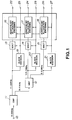
- audio PCM signals having the frequency range of from 0 to 22 kHz are supplied to an input terminal 10.
- the input signals are divided by a band-dividing filter 11, such as a QMF filter, into a band of from 0 to 11 kHz and a band of from 11 to 22 kHz.
- the frequency band of 0 to 11 kHz is divided by a band-dividing filter 12 into a band of 0 to 5.5 kHz and a band of 5.5 to 112 kHz.
- the 11 kHz to 22 kHz signal from the filter 11 is supplied to a modified discrete cosine transform (MDCT) circuit 13, as an example of an orthogonal transform circuit, while the 5.5 kHz to 11 kHz signal from the filter 12 is supplied to a modified discrete cosine transform (MDCT) circuit 14 and the 0 kHz to 5.5 kHz signal from the filter 12 is supplied to a modified discrete cosine transform (MDCT) circuit 15 so as to be processed with MDCT.
- MDCT modified discrete cosine transform
- Fig.2 shows a concrete example of a block size for the MDCT circuits 13 to 15.
- each of the three filter outputs has two block sizes for orthogonal transform. That is, for low frequency signals in the frequency band of 0 to 5.5 kHz and mid frequency signals in the frequency band of 5.5 to 11 kHz, each block is made up of 128 samples and 32 samples for the long block size (Fig.2A) and for the short block size (Fig.2B), respectively. On the other hand, for high frequency signals in the frequency band of 11 to 22 kHz, each block is made up of 256 samples and 32 samples for the long block size (Fig.2A) and for the short block size (Fig.2B), respectively. If the short block size is selected in this manner, the time resolution is increased towards the higher frequency and the number of kinds of the windows employed is decreased, with the number of samples of the orthogonal transform for each band remaining the same.
- the frequency-domain spectral data or MDCT coefficients, obtained by the MDCT circuits 13 to 15 by MDCT, are grouped according to the critical bands or, in a higher frequency range, according to small-sized blocks further divided from the critical bands, and transmitted to adaptive bit allocation encoding circuits 16, 17 and 18.
- the spectral data or the MDCT coefficient data are re-quantized depending on the number of bits allocated by the adaptive bit allocation encoding circuits 16, 17 and 18 for each of the critical bands or, in a higher frequency range, for each of the small-sized blocks further divided from the critical bands.
- the data thus encoded are outputted at output terminals 22, 24 and 26.
- the scale factor indicating which normalization is used as to the signal magnitude and the bit length information indicating which bit length has been used are transmitted simultaneously.
- the signal energies for the critical bands or those for the small-sized blocks sub-divided from the critical bands are found, such as by computing the roots of squared mean values of the respective amplitude values in the bands.
- the scale factor itself may naturally be employed for subsequent bit allocation. In such case, new energy computation becomes unnecessary resulting in saving in the hardware scale.
- the peak or mean values of the amplitude values may naturally be employed in place of the energies for the respective bands.
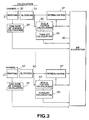
- Fig.3 The operation of the adaptive bit allocation circuit is explained by referring to Fig.3. Although there are eight channels in the present embodiment, only channels 1 and 8 are shown in Fig.3, while the remaining channels are omitted. The common portions to the channels are explained using the channel 1.
- Input information signals of the channel 1 are supplied to an input terminal 31.
- the input information signals are mapped from the time-domain signals on the frequency axis by a mapping function 32. If the filter is employed, the sub-band signals become time-domain samples. In the case of the orthogonal-transformed output, frequency-domain samples are produced. These samples are grouped into sets each consisting of plural samples by a block-forming function 33.
- temporal changes of MDCT input time-domain signals during mapping are calculated by a temporal change calculating function 44.
- the samples grouped into the blocks each consisting of plural samples by the block-forming function 33 are normalized by a normalizing function 37.
- the scale factor a coefficient for normalization, is calculated by a scale factor calculating function 35.
- the magnitude of tonality is calculated by a tonality calculating function 36.
- the parameter found in this manner is employed for bit allocation in a bit allocation function 38. If the number of bits which represents the MDCT coefficient and which is ready to be used for transmission or recording is assumed to be 800 kbps for the entire channels, the number of bits employed for the first bit allocation is determined in the present embodiment.
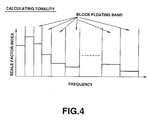
- the sum of absolute values of the differences between neighboring values of the signal spectral components divided by the number of signal spectral components is employed as an index. More precisely, the mean value of the differences between neighboring scale factor indices of the block-based scale factors for block floating is employed as the index.
- the scale factor index substantially corresponds to a logarithm of the scale factor.
- the amount of bits to be employed for the first bit allocation is associated with the value indicating the tonality and is set to a maximum value of 600 kbps and a minimum value of 300 kbps.
- Tm 1/WLmax ( ⁇ ABS (SFn - SFn - 1)
- Tav (1/CH)
- Tav channel-averaged tonality
- Tav found in this manner is associated with the first amount of bit allocation as shown in Fig.12.
- the proportion of distribution between allocation to the first bit allocation pattern and at least one other bit allocation to be appended thereto depends on the characteristics of temporal changes of the information signals.
- the time area in which the information signal amplitudes become abruptly larger is detected by comparing the peak values of the signal information for adjacent blocks for each time domain divided from the time block size for orthogonal transform to determine the proportion of distribution.
- Vt the sum for each channel of changes of the peak value of the time sub-block of each channel from a smaller value to a larger value, expressed in db
- Vm the magnitude of the largest one of the changes of the peak value of the time sub-block of each channel from a smaller value to a larger value, expressed in db
- Vmax m channel number Ch : number of channels
- Vab channel-averaged changes of the peak value of the time sub-block of each channel from a smaller value to a larger value, expressed in db
- Vav found in this manner is associated with the amount of the first bit allocation as shown in Fig.13.
- bit allocation is made for each channel for the first bit allocation.
- Adaptive bit allocation may naturally be made depending on the distribution of the scale factor on the frequency scale.
- effective bit allocation may be made by bit allocation between the channels depending on the distribution of the scale factor on the frequency scale for the totality of channels.
- the signal information of plural channels is mixed in the same sound field to reach left and right ears as in the case of speakers, it may be assumed that effective masking is made by the mixed signals of the totality of the channels. Therefore, it is effective to perform bit allocation so that the same noise level is achieved for the respective channels. To this end, it suffices to perform bit allocation in proportion to the magnitude of the scale factor indices.
- Bm the amount of first bit allocation for each channel
- B the amount of first bit allocation for totality of channels
- SFn scale factor index substantially corresponding to the logarithm of the peak value
- n band number of block floating
- bit allocation of bits not employed in the first bit allocation is carried out.
- bit allocations are carried out herein.
- Figs.8 and 9 illustrate the manner of bit allocation.
- more bits are allocated to the first bit allocation as shown in Fig.8.
- the amount of bits is decreased for the first bit allocation, as shown in Fig.9, whereas the amount of bits for the second bit allocation is increased, as shown in Fig.9, so that more bits are allocated to the signal spectrum having a larger level.
- second bit allocation is set so as to place emphasis on the low frequency side.
- there are a variety of patterns of bit allocation in which the amounts of bits of blocks of shorter time duration are distributed for the respective frequencies.
- plural patterns of bit allocation are provided in which the rates of bit allocation are different for the mid to low frequency range and the high frequency range. Such a pattern is selected in which the smaller the signal magnitude, the lesser is the amount of bit allocation to the higher frequency side. In this manner, it becomes possible to take advantage of the loudness effects in which the sensitivity for the higher frequency is lowered for a smaller signal magnitude.
- the present embodiment comprises, in addition to the above, a process of detecting the temporal change characteristics of the signals of the respective channels to change the amounts of bit allocation for the respective channels.
- An index representative of the temporal changes is found in the following manner.
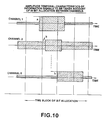
- the bit allocating time blocks as time units of bit allocation of the information input signals of the respective channels, are temporally divided into four sub-blocks for each of which the peak value is found.
- the bits are distributed between the channels depending on the magnitude of the differences of the peak values of the sub-blocks which are changed from a smaller value to a larger value.
- T a + b + c + d + e + f + g + h.
- the bit allocation may be made by (C - t)*a/T, (C - t)*b/T, ....(C - t)*h/T bits.
- the t-bits are allocated preferentially. Consequently, more t-bits are allocated to this channel so that pre-echo may be decreased significantly.
- the t-bits may be allocated to one of them.
- the t-bits may be allocated to a woofer channel.
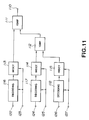
- Fig.11 shows a decoding circuit for decoding the high-efficiency coded signals.
- the quantized MDCT coefficients for the respective bands are supplied to input terminals 122, 124, 126 leading to inputs of decoding circuits 116, 117 and 118, while the block size information employed is supplied to input terminals 123, 125 and 127 which lead to the decoding circuits 116, 117 and 118 and also to inverse MDCT (IMDCT) circuits 113, 114 and 115.
- IMDCT inverse MDCT
- the decoding circuits 116, 117 and 118 release bit allocation using the adaptive bit allocation information.
- the frequency domain signals are transformed into time-domain signals.
- the time-domain signals of the partial range are decoded by inverse QMF (IQMF) circuits 111, 112 into the entire range of signals and supplied to an output terminal 110.
- IQMF inverse QMF
- the present embodiment provides a method of bit allocation which is aurally desirable for compression of temporally fluctuated information signals in a multi-channel system.
Landscapes
- Engineering & Computer Science (AREA)
- Computer Networks & Wireless Communication (AREA)
- Signal Processing (AREA)
- Compression, Expansion, Code Conversion, And Decoders (AREA)
- Compression Or Coding Systems Of Tv Signals (AREA)
Applications Claiming Priority (3)
| Application Number | Priority Date | Filing Date | Title |
|---|---|---|---|
| JP15492/93 | 1993-02-02 | ||
| JP1549293A JP3186292B2 (ja) | 1993-02-02 | 1993-02-02 | 高能率符号化方法及び装置 |
| JP1549293 | 1993-02-02 |
Publications (3)
| Publication Number | Publication Date |
|---|---|
| EP0610007A2 true EP0610007A2 (de) | 1994-08-10 |
| EP0610007A3 EP0610007A3 (de) | 1995-07-12 |
| EP0610007B1 EP0610007B1 (de) | 2002-12-04 |
Family
ID=11890306
Family Applications (1)
| Application Number | Title | Priority Date | Filing Date |
|---|---|---|---|
| EP19940300502 Expired - Lifetime EP0610007B1 (de) | 1993-02-02 | 1994-01-24 | Kodierung mit hoher Wirksamkeit |
Country Status (6)
| Country | Link |
|---|---|
| US (1) | US5642111A (de) |
| EP (1) | EP0610007B1 (de) |
| JP (1) | JP3186292B2 (de) |
| KR (1) | KR100388730B1 (de) |
| CN (1) | CN1062097C (de) |
| DE (1) | DE69431816T2 (de) |
Cited By (4)
| Publication number | Priority date | Publication date | Assignee | Title |
|---|---|---|---|---|
| EP0665547A3 (de) * | 1994-01-28 | 1996-01-10 | Samsung Electronics Co Ltd | System zum Kodieren und Dekodieren. |
| WO1996010870A1 (en) * | 1994-10-04 | 1996-04-11 | Alcatel Italia S.P.A. | Psychoacoustic audio-signal coding system and method |
| EP0716409A3 (de) * | 1994-12-08 | 1998-01-07 | Nec Corporation | System zur Sprachkodierung |
| EP0825725A1 (de) * | 1996-08-20 | 1998-02-25 | Sony Corporation | Subband- Codierung mit adaptiver Bitzuteilung |
Families Citing this family (23)
| Publication number | Priority date | Publication date | Assignee | Title |
|---|---|---|---|---|
| US5765127A (en) * | 1992-03-18 | 1998-06-09 | Sony Corp | High efficiency encoding method |
| TW272341B (de) * | 1993-07-16 | 1996-03-11 | Sony Co Ltd | |
| KR960003628B1 (ko) * | 1993-12-06 | 1996-03-20 | Lg전자주식회사 | 디지탈신호의 부호화/복호화 방법 및 장치 |
| US5731767A (en) * | 1994-02-04 | 1998-03-24 | Sony Corporation | Information encoding method and apparatus, information decoding method and apparatus, information recording medium, and information transmission method |
| TW295747B (de) * | 1994-06-13 | 1997-01-11 | Sony Co Ltd | |
| JPH08190764A (ja) * | 1995-01-05 | 1996-07-23 | Sony Corp | ディジタル信号処理方法、ディジタル信号処理装置及び記録媒体 |
| JP3307138B2 (ja) * | 1995-02-27 | 2002-07-24 | ソニー株式会社 | 信号符号化方法及び装置、並びに信号復号化方法及び装置 |
| JPH0969781A (ja) * | 1995-08-31 | 1997-03-11 | Nippon Steel Corp | オーディオデータ符号化装置 |
| JPH09148937A (ja) * | 1995-11-21 | 1997-06-06 | Sony Corp | 符号化処理方法、復号化処理方法、符号化処理装置および復号化処理装置 |
| JPH1083623A (ja) * | 1996-09-10 | 1998-03-31 | Sony Corp | 信号記録方法、信号記録装置、記録媒体および信号処理方法 |
| KR100261254B1 (ko) * | 1997-04-02 | 2000-07-01 | 윤종용 | 비트율 조절이 가능한 오디오 데이터 부호화/복호화방법 및 장치 |
| TW406480B (en) * | 1998-01-23 | 2000-09-21 | Sanyo Electric Co | Encoding and decoding apparatus |
| US6654189B1 (en) * | 1998-04-16 | 2003-11-25 | Sony Corporation | Digital-signal processing apparatus capable of adjusting the amplitude of a digital signal |
| US6353807B1 (en) * | 1998-05-15 | 2002-03-05 | Sony Corporation | Information coding method and apparatus, code transform method and apparatus, code transform control method and apparatus, information recording method and apparatus, and program providing medium |
| KR100548891B1 (ko) * | 1998-06-15 | 2006-02-02 | 마츠시타 덴끼 산교 가부시키가이샤 | 음성 부호화 장치 및 음성 부호화 방법 |
| JP2000101439A (ja) | 1998-09-24 | 2000-04-07 | Sony Corp | 情報処理装置および方法、情報記録装置および方法、記録媒体、並びに提供媒体 |
| WO2001059603A1 (en) * | 2000-02-09 | 2001-08-16 | Cheng T C | Fast method for the forward and inverse mdct in audio coding |
| WO2002039386A2 (en) * | 2000-11-10 | 2002-05-16 | British Telecommunications Public Limited Company | Image characterisation |
| TW594674B (en) * | 2003-03-14 | 2004-06-21 | Mediatek Inc | Encoder and a encoding method capable of detecting audio signal transient |
| CN100339886C (zh) * | 2003-04-10 | 2007-09-26 | 联发科技股份有限公司 | 可以检测声音信号的暂态位置的编码器及编码方法 |
| AU2003275467B2 (en) | 2003-10-07 | 2010-11-25 | The Nielsen Company (Us), Llc | Methods and apparatus to extract codes from a plurality of channels |
| KR20080053739A (ko) * | 2006-12-11 | 2008-06-16 | 삼성전자주식회사 | 적응적으로 윈도우 크기를 적용하는 부호화 장치 및 방법 |
| US8204744B2 (en) * | 2008-12-01 | 2012-06-19 | Research In Motion Limited | Optimization of MP3 audio encoding by scale factors and global quantization step size |
Family Cites Families (65)
| Publication number | Priority date | Publication date | Assignee | Title |
|---|---|---|---|---|
| US3349183A (en) * | 1963-10-29 | 1967-10-24 | Melpar Inc | Speech compression system transmitting only coefficients of polynomial representations of phonemes |
| US4184049A (en) * | 1978-08-25 | 1980-01-15 | Bell Telephone Laboratories, Incorporated | Transform speech signal coding with pitch controlled adaptive quantizing |
| CH645501GA3 (de) * | 1981-07-24 | 1984-10-15 | ||
| US4455649A (en) * | 1982-01-15 | 1984-06-19 | International Business Machines Corporation | Method and apparatus for efficient statistical multiplexing of voice and data signals |
| US4625286A (en) * | 1982-05-03 | 1986-11-25 | Texas Instruments Incorporated | Time encoding of LPC roots |
| US4535472A (en) * | 1982-11-05 | 1985-08-13 | At&T Bell Laboratories | Adaptive bit allocator |
| JPH07118159B2 (ja) * | 1982-12-06 | 1995-12-18 | ソニー株式会社 | Pcm信号記録方法 |
| DE3314384A1 (de) * | 1983-04-21 | 1984-10-25 | Siemens AG, 1000 Berlin und 8000 München | Uebertragungssystem |
| CA1253255A (en) * | 1983-05-16 | 1989-04-25 | Nec Corporation | System for simultaneously coding and decoding a plurality of signals |
| JPH07118160B2 (ja) * | 1983-06-18 | 1995-12-18 | ソニー株式会社 | ディジタル情報信号の記録方法 |
| US4516241A (en) * | 1983-07-11 | 1985-05-07 | At&T Bell Laboratories | Bit compression coding with embedded signaling |
| GB8421498D0 (en) * | 1984-08-24 | 1984-09-26 | British Telecomm | Frequency domain speech coding |
| JPS61107818A (ja) * | 1984-10-30 | 1986-05-26 | Nec Corp | エントロピ−符号化方式とその装置 |
| US5128963A (en) * | 1985-01-31 | 1992-07-07 | Sony Corporation | 3-mode PCM/DPCM/APCM maximizing dynamic range |
| US4885790A (en) * | 1985-03-18 | 1989-12-05 | Massachusetts Institute Of Technology | Processing of acoustic waveforms |
| US4748579A (en) * | 1985-08-14 | 1988-05-31 | Gte Laboratories Incorporated | Method and circuit for performing discrete transforms |
| EP0267344B1 (de) * | 1986-10-30 | 1993-09-01 | International Business Machines Corporation | Verfahren zur Multigeschwindigkeitskodierung von Signalen und Einrichtung zur Durchführung dieses Verfahrens |
| AU604807B2 (en) * | 1986-12-19 | 1991-01-03 | Sony Corporation | Data recorder and method |
| US4903301A (en) * | 1987-02-27 | 1990-02-20 | Hitachi, Ltd. | Method and system for transmitting variable rate speech signal |
| US4882754A (en) * | 1987-08-25 | 1989-11-21 | Digideck, Inc. | Data compression system and method with buffer control |
| JP2618916B2 (ja) * | 1987-09-10 | 1997-06-11 | 富士通株式会社 | 動き補償のブロックサイズ決定方法 |
| US4964166A (en) * | 1988-05-26 | 1990-10-16 | Pacific Communication Science, Inc. | Adaptive transform coder having minimal bit allocation processing |
| JPH0213135A (ja) * | 1988-06-30 | 1990-01-17 | Sony Corp | ディジタル信号伝送装置 |
| JPH0783315B2 (ja) * | 1988-09-26 | 1995-09-06 | 富士通株式会社 | 可変レート音声信号符号化方式 |
| EP0370277A3 (de) * | 1988-11-24 | 1991-09-18 | Siemens Aktiengesellschaft | Subband-Übertragungssystem |
| US5142656A (en) * | 1989-01-27 | 1992-08-25 | Dolby Laboratories Licensing Corporation | Low bit rate transform coder, decoder, and encoder/decoder for high-quality audio |
| BR9007062A (pt) * | 1989-01-27 | 1991-10-08 | Dolby Lab Licensing Corp | Codificador,descodificador e codificador/descodificador de transformada de retardo de tempo baixo para audio de alta qualidade |
| US5109417A (en) * | 1989-01-27 | 1992-04-28 | Dolby Laboratories Licensing Corporation | Low bit rate transform coder, decoder, and encoder/decoder for high-quality audio |
| US5222189A (en) * | 1989-01-27 | 1993-06-22 | Dolby Laboratories Licensing Corporation | Low time-delay transform coder, decoder, and encoder/decoder for high-quality audio |
| US5016107A (en) * | 1989-05-09 | 1991-05-14 | Eastman Kodak Company | Electronic still camera utilizing image compression and digital storage |
| US4932062A (en) * | 1989-05-15 | 1990-06-05 | Dialogic Corporation | Method and apparatus for frequency analysis of telephone signals |
| JP2844695B2 (ja) * | 1989-07-19 | 1999-01-06 | ソニー株式会社 | 信号符号化装置 |
| NL8902294A (nl) * | 1989-09-14 | 1991-04-02 | Philips Nv | Werkwijze voor het vervaardigen van een uit optische vezels samengestelde vezelbundel. |
| US5115240A (en) * | 1989-09-26 | 1992-05-19 | Sony Corporation | Method and apparatus for encoding voice signals divided into a plurality of frequency bands |
| FR2653280B1 (fr) * | 1989-10-13 | 1992-01-10 | France Etat | Dispositif d'allocation de bits pour signal audio-numerique transforme, a quantification adaptative sur critere psycho-auditif. |
| US5185800A (en) * | 1989-10-13 | 1993-02-09 | Centre National D'etudes Des Telecommunications | Bit allocation device for transformed digital audio broadcasting signals with adaptive quantization based on psychoauditive criterion |
| US5040217A (en) * | 1989-10-18 | 1991-08-13 | At&T Bell Laboratories | Perceptual coding of audio signals |
| DE69028176T2 (de) * | 1989-11-14 | 1997-01-23 | Nippon Electric Co | Adaptive Transformationskodierung durch optimale Blocklängenselektion in Abhängigkeit von Unterschieden zwischen aufeinanderfolgenden Blöcken |
| JP2913731B2 (ja) * | 1990-03-07 | 1999-06-28 | ソニー株式会社 | ディジタルデータの高能率符号化方法 |
| CN1062963C (zh) * | 1990-04-12 | 2001-03-07 | 多尔拜实验特许公司 | 用于产生高质量声音信号的解码器和编码器 |
| JP2751564B2 (ja) * | 1990-05-25 | 1998-05-18 | ソニー株式会社 | ディジタル信号符号化装置 |
| JP3185214B2 (ja) * | 1990-06-12 | 2001-07-09 | 日本電気株式会社 | 改良dctの順変換計算装置および逆変換計算装置 |
| JPH0472909A (ja) * | 1990-07-13 | 1992-03-06 | Sony Corp | オーディオ信号の量子化誤差低減装置 |
| JP3033156B2 (ja) * | 1990-08-24 | 2000-04-17 | ソニー株式会社 | ディジタル信号符号化装置 |
| JP3141241B2 (ja) * | 1990-08-24 | 2001-03-05 | ソニー株式会社 | ディスク記録装置及びディスク再生装置 |
| US5235671A (en) * | 1990-10-15 | 1993-08-10 | Gte Laboratories Incorporated | Dynamic bit allocation subband excited transform coding method and apparatus |
| ZA921988B (en) * | 1991-03-29 | 1993-02-24 | Sony Corp | High efficiency digital data encoding and decoding apparatus |
| BR9204799A (pt) * | 1991-03-29 | 1993-07-13 | Sony Corp | Processo de codificacao para um sinal digital |
| EP0506394A2 (de) * | 1991-03-29 | 1992-09-30 | Sony Corporation | Einrichtung zur Kodierung von digitalen Signalen |
| JP3134338B2 (ja) * | 1991-03-30 | 2001-02-13 | ソニー株式会社 | ディジタル音声信号符号化方法 |
| JP3134337B2 (ja) * | 1991-03-30 | 2001-02-13 | ソニー株式会社 | ディジタル信号符号化方法 |
| CA2075156A1 (en) * | 1991-08-02 | 1993-02-03 | Kenzo Akagiri | Digital encoder with dynamic quantization bit allocation |
| US5388209A (en) * | 1991-08-02 | 1995-02-07 | Sony Corporation | Apparatus for high-speed recording compressed digital data with increased compression |
| JP3178026B2 (ja) * | 1991-08-23 | 2001-06-18 | ソニー株式会社 | ディジタル信号符号化装置及び復号化装置 |
| JP3198550B2 (ja) * | 1991-09-03 | 2001-08-13 | ソニー株式会社 | 圧縮データ記録方法及び圧縮データ記録再生装置 |
| JP3158556B2 (ja) * | 1991-09-27 | 2001-04-23 | ソニー株式会社 | ディスク記録装置及びディスク再生装置 |
| JP3141450B2 (ja) * | 1991-09-30 | 2001-03-05 | ソニー株式会社 | オーディオ信号処理方法 |
| DE69231369T2 (de) * | 1991-09-30 | 2001-03-29 | Sony Corp., Tokio/Tokyo | Verfahren und Einrichtung zur Audiodatenkompression |
| US5349549A (en) * | 1991-09-30 | 1994-09-20 | Sony Corporation | Forward transform processing apparatus and inverse processing apparatus for modified discrete cosine transforms, and method of performing spectral and temporal analyses including simplified forward and inverse orthogonal transform processing |
| JP3134455B2 (ja) * | 1992-01-29 | 2001-02-13 | ソニー株式会社 | 高能率符号化装置及び方法 |
| JPH0629934A (ja) * | 1992-07-10 | 1994-02-04 | Nippon Hoso Kyokai <Nhk> | 適応差分符号化伝送方法 |
| JP3508146B2 (ja) * | 1992-09-11 | 2004-03-22 | ソニー株式会社 | ディジタル信号符号化復号化装置、ディジタル信号符号化装置及びディジタル信号復号化装置 |
| JP3127600B2 (ja) * | 1992-09-11 | 2001-01-29 | ソニー株式会社 | ディジタル信号復号化装置及び方法 |
| JP3343962B2 (ja) * | 1992-11-11 | 2002-11-11 | ソニー株式会社 | 高能率符号化方法及び装置 |
| JP3185413B2 (ja) * | 1992-11-25 | 2001-07-09 | ソニー株式会社 | 直交変換演算並びに逆直交変換演算方法及びその装置、ディジタル信号符号化及び/又は復号化装置 |
-
1993
- 1993-02-02 JP JP1549293A patent/JP3186292B2/ja not_active Expired - Lifetime
-
1994
- 1994-01-19 US US08/184,471 patent/US5642111A/en not_active Expired - Lifetime
- 1994-01-24 DE DE69431816T patent/DE69431816T2/de not_active Expired - Lifetime
- 1994-01-24 EP EP19940300502 patent/EP0610007B1/de not_active Expired - Lifetime
- 1994-01-25 KR KR1019940001254A patent/KR100388730B1/ko not_active Expired - Fee Related
- 1994-02-02 CN CN94101748A patent/CN1062097C/zh not_active Expired - Lifetime
Cited By (5)
| Publication number | Priority date | Publication date | Assignee | Title |
|---|---|---|---|---|
| EP0665547A3 (de) * | 1994-01-28 | 1996-01-10 | Samsung Electronics Co Ltd | System zum Kodieren und Dekodieren. |
| WO1996010870A1 (en) * | 1994-10-04 | 1996-04-11 | Alcatel Italia S.P.A. | Psychoacoustic audio-signal coding system and method |
| EP0716409A3 (de) * | 1994-12-08 | 1998-01-07 | Nec Corporation | System zur Sprachkodierung |
| EP0825725A1 (de) * | 1996-08-20 | 1998-02-25 | Sony Corporation | Subband- Codierung mit adaptiver Bitzuteilung |
| US6097880A (en) * | 1996-08-20 | 2000-08-01 | Sony Corporation | Digital signal processing method, digital signal processing apparatus, digital signal recording method, digital signal recording apparatus, recording medium, digital signal transmission method and digital signal transmission apparatus |
Also Published As
| Publication number | Publication date |
|---|---|
| US5642111A (en) | 1997-06-24 |
| DE69431816T2 (de) | 2003-09-11 |
| JP3186292B2 (ja) | 2001-07-11 |
| DE69431816D1 (de) | 2003-01-16 |
| KR100388730B1 (ko) | 2003-09-13 |
| CN1093843A (zh) | 1994-10-19 |
| CN1062097C (zh) | 2001-02-14 |
| JPH06232761A (ja) | 1994-08-19 |
| EP0610007B1 (de) | 2002-12-04 |
| EP0610007A3 (de) | 1995-07-12 |
Similar Documents
| Publication | Publication Date | Title |
|---|---|---|
| EP0610007B1 (de) | Kodierung mit hoher Wirksamkeit | |
| EP0545017B1 (de) | Verfahren und Anordnung zur Datenkompression bei welchem Quantisierungsbits einem Block in einem gegenwärtigen Rahmen in Abhängigkeit eines Blocks in einem vergangenen Rahmen zugeteilt werden | |
| JP3134455B2 (ja) | 高能率符号化装置及び方法 | |
| US5737718A (en) | Method, apparatus and recording medium for a coder with a spectral-shape-adaptive subband configuration | |
| US5664056A (en) | Digital encoder with dynamic quantization bit allocation | |
| US5553193A (en) | Bit allocation method and device for digital audio signals using aural characteristics and signal intensities | |
| US5774844A (en) | Methods and apparatus for quantizing, encoding and decoding and recording media therefor | |
| US5758020A (en) | Methods and apparatus for encoding and decoding signals, methods for transmitting signals, and an information recording medium | |
| JPWO1995002925A1 (ja) | 高能率符号化方法,高能率符号の復号化方法,高能率符号の符号化装置,高能率符号の復号化装置,高能率符号化・復号化システム,及び記録メディア | |
| Iwadare et al. | A 128 kb/s hi-fi audio CODEC based on adaptive transform coding with adaptive block size MDCT | |
| EP0697665B1 (de) | Verfahren und Vorrichtung zur Kodierung, Übertragung und Dekodierung von Information | |
| US5832426A (en) | High efficiency audio encoding method and apparatus | |
| US5642383A (en) | Audio data coding method and audio data coding apparatus | |
| JPH0846517A (ja) | 高能率符号化及び復号化システム | |
| JP3088580B2 (ja) | 変換符号化装置のブロックサイズ決定法 | |
| US5950156A (en) | High efficient signal coding method and apparatus therefor | |
| KR100340368B1 (ko) | 고능률부호화장치,복호화장치및디지털데이터도출방법 | |
| JP3134383B2 (ja) | ディジタルデータの高能率符号化方法及び装置 | |
| JP3134384B2 (ja) | 符号化装置及び方法 | |
| JP3141853B2 (ja) | オーディオ信号処理方法 |
Legal Events
| Date | Code | Title | Description |
|---|---|---|---|
| PUAI | Public reference made under article 153(3) epc to a published international application that has entered the european phase |
Free format text: ORIGINAL CODE: 0009012 |
|
| AK | Designated contracting states |
Kind code of ref document: A2 Designated state(s): DE FR GB |
|
| PUAL | Search report despatched |
Free format text: ORIGINAL CODE: 0009013 |
|
| AK | Designated contracting states |
Kind code of ref document: A3 Designated state(s): DE FR GB |
|
| 17P | Request for examination filed |
Effective date: 19951122 |
|
| 17Q | First examination report despatched |
Effective date: 20000510 |
|
| RIC1 | Information provided on ipc code assigned before grant |
Free format text: 7H 04B 1/66 A |
|
| RTI1 | Title (correction) |
Free format text: HIGH EFFICIENCY ENCODING |
|
| GRAG | Despatch of communication of intention to grant |
Free format text: ORIGINAL CODE: EPIDOS AGRA |
|
| RIC1 | Information provided on ipc code assigned before grant |
Free format text: 7H 04B 1/66 A |
|
| RTI1 | Title (correction) |
Free format text: HIGH EFFICIENCY ENCODING |
|
| GRAG | Despatch of communication of intention to grant |
Free format text: ORIGINAL CODE: EPIDOS AGRA |
|
| GRAH | Despatch of communication of intention to grant a patent |
Free format text: ORIGINAL CODE: EPIDOS IGRA |
|
| GRAH | Despatch of communication of intention to grant a patent |
Free format text: ORIGINAL CODE: EPIDOS IGRA |
|
| GRAA | (expected) grant |
Free format text: ORIGINAL CODE: 0009210 |
|
| AK | Designated contracting states |
Kind code of ref document: B1 Designated state(s): DE FR GB |
|
| REG | Reference to a national code |
Ref country code: GB Ref legal event code: FG4D |
|
| REF | Corresponds to: |
Ref document number: 69431816 Country of ref document: DE Date of ref document: 20030116 |
|
| ET | Fr: translation filed | ||
| PLBE | No opposition filed within time limit |
Free format text: ORIGINAL CODE: 0009261 |
|
| STAA | Information on the status of an ep patent application or granted ep patent |
Free format text: STATUS: NO OPPOSITION FILED WITHIN TIME LIMIT |
|
| 26N | No opposition filed |
Effective date: 20030905 |
|
| REG | Reference to a national code |
Ref country code: GB Ref legal event code: 746 Effective date: 20120703 |
|
| REG | Reference to a national code |
Ref country code: DE Ref legal event code: R084 Ref document number: 69431816 Country of ref document: DE Effective date: 20120614 |
|
| PGFP | Annual fee paid to national office [announced via postgrant information from national office to epo] |
Ref country code: FR Payment date: 20130213 Year of fee payment: 20 Ref country code: GB Payment date: 20130122 Year of fee payment: 20 Ref country code: DE Payment date: 20130122 Year of fee payment: 20 |
|
| REG | Reference to a national code |
Ref country code: DE Ref legal event code: R071 Ref document number: 69431816 Country of ref document: DE |
|
| REG | Reference to a national code |
Ref country code: GB Ref legal event code: PE20 Expiry date: 20140123 |
|
| PG25 | Lapsed in a contracting state [announced via postgrant information from national office to epo] |
Ref country code: GB Free format text: LAPSE BECAUSE OF EXPIRATION OF PROTECTION Effective date: 20140123 Ref country code: DE Free format text: LAPSE BECAUSE OF EXPIRATION OF PROTECTION Effective date: 20140125 |