EP0610773A2 - Kassette, insbesondere Magnetbandkassette, mit einem Gehäuse - Google Patents
Kassette, insbesondere Magnetbandkassette, mit einem Gehäuse Download PDFInfo
- Publication number
- EP0610773A2 EP0610773A2 EP94101436A EP94101436A EP0610773A2 EP 0610773 A2 EP0610773 A2 EP 0610773A2 EP 94101436 A EP94101436 A EP 94101436A EP 94101436 A EP94101436 A EP 94101436A EP 0610773 A2 EP0610773 A2 EP 0610773A2
- Authority
- EP
- European Patent Office
- Prior art keywords
- cassette
- front part
- approximately
- cassette according
- thickness
- Prior art date
- Legal status (The legal status is an assumption and is not a legal conclusion. Google has not performed a legal analysis and makes no representation as to the accuracy of the status listed.)
- Withdrawn
Links
- 239000004033 plastic Substances 0.000 claims abstract description 18
- 229920003023 plastic Polymers 0.000 claims abstract description 18
- 238000004140 cleaning Methods 0.000 claims abstract description 12
- 239000000463 material Substances 0.000 claims description 15
- 229920006324 polyoxymethylene Polymers 0.000 claims description 12
- -1 polyoxymethylene Polymers 0.000 claims description 10
- 229930040373 Paraformaldehyde Natural products 0.000 claims description 8
- 239000004952 Polyamide Substances 0.000 claims description 6
- 229920002647 polyamide Polymers 0.000 claims description 6
- 229930182556 Polyacetal Natural products 0.000 claims description 4
- 239000004743 Polypropylene Substances 0.000 claims description 4
- 239000004793 Polystyrene Substances 0.000 claims description 4
- 229920001155 polypropylene Polymers 0.000 claims description 4
- 229920002223 polystyrene Polymers 0.000 claims description 4
- 229920002313 fluoropolymer Polymers 0.000 claims description 3
- 239000000835 fiber Substances 0.000 description 14
- 238000001746 injection moulding Methods 0.000 description 8
- 239000004744 fabric Substances 0.000 description 6
- 238000003466 welding Methods 0.000 description 5
- 238000005507 spraying Methods 0.000 description 4
- 239000000853 adhesive Substances 0.000 description 3
- 230000001070 adhesive effect Effects 0.000 description 3
- 238000000034 method Methods 0.000 description 3
- 230000002349 favourable effect Effects 0.000 description 2
- 238000004519 manufacturing process Methods 0.000 description 2
- 239000002184 metal Substances 0.000 description 2
- 239000002759 woven fabric Substances 0.000 description 2
- NIXOWILDQLNWCW-UHFFFAOYSA-M Acrylate Chemical compound [O-]C(=O)C=C NIXOWILDQLNWCW-UHFFFAOYSA-M 0.000 description 1
- 229920002284 Cellulose triacetate Polymers 0.000 description 1
- 229920001410 Microfiber Polymers 0.000 description 1
- 229910000831 Steel Inorganic materials 0.000 description 1
- NNLVGZFZQQXQNW-ADJNRHBOSA-N [(2r,3r,4s,5r,6s)-4,5-diacetyloxy-3-[(2s,3r,4s,5r,6r)-3,4,5-triacetyloxy-6-(acetyloxymethyl)oxan-2-yl]oxy-6-[(2r,3r,4s,5r,6s)-4,5,6-triacetyloxy-2-(acetyloxymethyl)oxan-3-yl]oxyoxan-2-yl]methyl acetate Chemical compound O([C@@H]1O[C@@H]([C@H]([C@H](OC(C)=O)[C@H]1OC(C)=O)O[C@H]1[C@@H]([C@@H](OC(C)=O)[C@H](OC(C)=O)[C@@H](COC(C)=O)O1)OC(C)=O)COC(=O)C)[C@@H]1[C@@H](COC(C)=O)O[C@@H](OC(C)=O)[C@H](OC(C)=O)[C@H]1OC(C)=O NNLVGZFZQQXQNW-ADJNRHBOSA-N 0.000 description 1
- 238000005299 abrasion Methods 0.000 description 1
- DHKHKXVYLBGOIT-UHFFFAOYSA-N acetaldehyde Diethyl Acetal Natural products CCOC(C)OCC DHKHKXVYLBGOIT-UHFFFAOYSA-N 0.000 description 1
- 150000001241 acetals Chemical class 0.000 description 1
- 239000002390 adhesive tape Substances 0.000 description 1
- 230000002411 adverse Effects 0.000 description 1
- 239000011324 bead Substances 0.000 description 1
- 238000005452 bending Methods 0.000 description 1
- 239000011230 binding agent Substances 0.000 description 1
- 239000003086 colorant Substances 0.000 description 1
- 150000001875 compounds Chemical class 0.000 description 1
- 229920001577 copolymer Polymers 0.000 description 1
- 230000000254 damaging effect Effects 0.000 description 1
- 230000006735 deficit Effects 0.000 description 1
- 238000006073 displacement reaction Methods 0.000 description 1
- 239000000428 dust Substances 0.000 description 1
- 230000003628 erosive effect Effects 0.000 description 1
- 238000002347 injection Methods 0.000 description 1
- 239000007924 injection Substances 0.000 description 1
- 238000009940 knitting Methods 0.000 description 1
- 239000003658 microfiber Substances 0.000 description 1
- 239000004745 nonwoven fabric Substances 0.000 description 1
- 229920002239 polyacrylonitrile Polymers 0.000 description 1
- 239000004417 polycarbonate Substances 0.000 description 1
- 229920000515 polycarbonate Polymers 0.000 description 1
- 229920006149 polyester-amide block copolymer Polymers 0.000 description 1
- 229920000642 polymer Polymers 0.000 description 1
- 229920002635 polyurethane Polymers 0.000 description 1
- 239000004814 polyurethane Substances 0.000 description 1
- QQONPFPTGQHPMA-UHFFFAOYSA-N propylene Natural products CC=C QQONPFPTGQHPMA-UHFFFAOYSA-N 0.000 description 1
- 239000004627 regenerated cellulose Substances 0.000 description 1
- 238000007788 roughening Methods 0.000 description 1
- 238000010008 shearing Methods 0.000 description 1
- 239000002904 solvent Substances 0.000 description 1
- 229910001220 stainless steel Inorganic materials 0.000 description 1
- 239000010935 stainless steel Substances 0.000 description 1
- 239000010959 steel Substances 0.000 description 1
- 239000000126 substance Substances 0.000 description 1
- 238000004381 surface treatment Methods 0.000 description 1
- 229920001169 thermoplastic Polymers 0.000 description 1
- 239000012815 thermoplastic material Substances 0.000 description 1
- 239000004416 thermosoftening plastic Substances 0.000 description 1
- 238000009941 weaving Methods 0.000 description 1
- 210000002268 wool Anatomy 0.000 description 1
Images



Classifications
-
- G—PHYSICS
- G11—INFORMATION STORAGE
- G11B—INFORMATION STORAGE BASED ON RELATIVE MOVEMENT BETWEEN RECORD CARRIER AND TRANSDUCER
- G11B23/00—Record carriers not specific to the method of recording or reproducing; Accessories, e.g. containers, specially adapted for co-operation with the recording or reproducing apparatus ; Intermediate mediums; Apparatus or processes specially adapted for their manufacture
- G11B23/02—Containers; Storing means both adapted to cooperate with the recording or reproducing means
- G11B23/04—Magazines; Cassettes for webs or filaments
- G11B23/08—Magazines; Cassettes for webs or filaments for housing webs or filaments having two distinct ends
- G11B23/087—Magazines; Cassettes for webs or filaments for housing webs or filaments having two distinct ends using two different reels or cores
- G11B23/08707—Details
- G11B23/08785—Envelopes
-
- G—PHYSICS
- G11—INFORMATION STORAGE
- G11B—INFORMATION STORAGE BASED ON RELATIVE MOVEMENT BETWEEN RECORD CARRIER AND TRANSDUCER
- G11B23/00—Record carriers not specific to the method of recording or reproducing; Accessories, e.g. containers, specially adapted for co-operation with the recording or reproducing apparatus ; Intermediate mediums; Apparatus or processes specially adapted for their manufacture
- G11B23/02—Containers; Storing means both adapted to cooperate with the recording or reproducing means
- G11B23/04—Magazines; Cassettes for webs or filaments
- G11B23/08—Magazines; Cassettes for webs or filaments for housing webs or filaments having two distinct ends
- G11B23/087—Magazines; Cassettes for webs or filaments for housing webs or filaments having two distinct ends using two different reels or cores
- G11B23/08707—Details
- G11B23/08735—Covers
-
- G—PHYSICS
- G11—INFORMATION STORAGE
- G11B—INFORMATION STORAGE BASED ON RELATIVE MOVEMENT BETWEEN RECORD CARRIER AND TRANSDUCER
- G11B23/00—Record carriers not specific to the method of recording or reproducing; Accessories, e.g. containers, specially adapted for co-operation with the recording or reproducing apparatus ; Intermediate mediums; Apparatus or processes specially adapted for their manufacture
- G11B23/02—Containers; Storing means both adapted to cooperate with the recording or reproducing means
- G11B23/04—Magazines; Cassettes for webs or filaments
- G11B23/08—Magazines; Cassettes for webs or filaments for housing webs or filaments having two distinct ends
- G11B23/087—Magazines; Cassettes for webs or filaments for housing webs or filaments having two distinct ends using two different reels or cores
- G11B23/08707—Details
- G11B23/08757—Guiding means
- G11B23/08771—Pressure pads
Definitions
- the invention relates to a cassette, in particular a magnetic tape cassette, with a housing consisting of base and cover parts, formed from base and cover walls and rear wall, front wall and side walls, the front wall having at least one head entry opening which can be closed with a closure part, and the front part and the closure part.
- Such a cassette is known from EP-A-406 943.
- the closure member described and shown therein is made in one piece from thin, stainless steel. In practice, its shape is formed by stamping or wire erosion and bending.
- the cassette housing is usually made of a thermoplastic material using the injection molding process, the choice of plastic material and the spraying process parameters being very limited due to very thin sections of the front and bottom walls, since otherwise excessive internal stresses and distortion, particularly after temperature loads, occur.
- the cassette housing has at least one guide groove for guided displacement of the closure part. The latter has certain bends and / or extensions for engaging in the groove for the same purpose.
- the closure part is usually pushed over the housing after the upper and lower parts of the housing have been joined, and assembly errors and damage to the housing and closure part can occur due to the sharp edges and extensions.
- closure part is extremely expensive due to its expensive material and the complex production.
- US-A-4 633 354 describes a separable frame part for the front of a compact cassette, which is detachably attached to the cassette housing by means of clamping elements.
- This frame part contains the standardized head and guide element openings and can be removed by hand if the tape is to be pulled out of the cassette for recording / reproduction of higher density.
- the present invention aims to avoid such disadvantages from the outset in cassettes with a closure part.
- a cassette in particular a magnetic tape cassette
- a housing composed of base and cover parts, formed from base and cover walls and rear wall, front wall and side walls, the front wall having at least one head entry opening which can be closed with a closure part, if a the front wall is provided in the area of the head inlet opening and is known per se, separate front part which can be fastened to the housing and if the closure part and front part consist of sprayable plastic material.
- a cassette according to the invention is to be used for a compact cassette system standardized by IEC standard 94-7 / 1985, the specified housing wall thicknesses of the IEC standard must also be met for this cassette.
- the thickness of the front part is several times smaller than the greatest thickness of the front wall.
- This multiple factor should be between 2.2 and 3.5, so that the thickness of the front part is extremely thin and lies at the lower limit of the injection molding possibilities. The loss of strength that is inevitably obtained as a result can therefore be accepted, since the front part is mostly covered and protected by the closure part and is only freely accessible from the device when it is in operation.
- closure part has a thickness of approximately 0.4 to approximately 0.65 mm and the front part has a thickness of approximately 0.35 to approximately 0.5 mm.
- the closure part has a supplementary part for the wall of the bottom part, especially if the thickness of the bottom wall is standardized in the area of the head entry opening, which is the case in the above IEC standard.
- a cassette contains a tape pressure device behind its head entry opening, it is advantageous according to the invention that the front part engages under the tape pressure device.
- the front part is fastened according to the invention by means of fasteners which interact at least predominantly with the walls of the base and cover parts of the cassette.
- these front part fastening elements can consist of web-shaped or hook-shaped projections and the walls of the base and cover parts have appropriately shaped fastening grooves. After mounting the front part on the housing by engaging the webs and grooves, the front part is also securely in its target position.
- the fasteners must interlock so tightly and securely that by or after assembling the locking part and moving it, neither disengagement from, nor moving to or loosening of the front part from the cassette housing can take place.
- the plastic material for the front part and / or the closure part is advantageously one from the group polyacetal, FEP fluoroplastics (poly-fluoroethylene propylene) or polyamide, since these are particularly suitable for spraying such thin wall thicknesses.
- FEP fluoroplastics poly-fluoroethylene propylene
- polyamide polyamide
- Polystyrene or polypropylene can then expediently be used as sprayable plastics for the housing.
- the spraying conditions for the rest of the cassette housing can be set in an optimal manner, so that it is possible to produce warp-free and thus more temperature-stable cassette housings with the cheaper plastic materials mentioned.
- the thickness of the thin parts of the front wall can be reduced to a minimum without negative influence on the housing, which is around 0.35 mm lies, are reduced, so that space for a partially thicker but also economically producible in the injection molding closure part from the same group of plastics is made possible.
- the front part has tape cleaning elements on its side facing the housing, particularly for cassette types with a high recording density.
- the belt cleaning elements can e.g. consist of a strip of non-woven material so that the tape is cleaned in operation on the device in front of and behind the A / W magnetic head.
- the front part with the tape cleaning elements for cassettes with a closure part and the closure part for one and the same plastic material, in particular polyoxymethylene, for the same type of cassette are also to be regarded as inventive.
- the closure part is e.g. cheap from a back part with a greater thickness and two side parts with a smaller thickness.
- a cassette C according to the prior art (FIG. 3) consists of a thermoplastic housing upper part 1 and lower part 2, the housing enclosing the tape-shaped recording medium 3 and holding and releasing it at the front openings 4 a-c for engagement with device elements (not shown).
- the openings are 4 ac, 4 a head inlet opening and 4 b, 4 c front openings, and the drive openings, not shown, in the lower housing part 2 by a closure part 5, which is made of a thin stamped and bent, rustproof Metal sheet is covered.
- the closure part 5 is shown in Fig. 3 b in its position before the assembly connection with the cassette shown in Fig. 3 a.
- Fig. 4 shows the closure part 5 in a section of a cross section IV-IV through the cassette C in the middle of the head inlet opening 4 a in its position mounted on the cassette housing.
- the tape-shaped recording medium 3 is shown in its central position in contact with one of the guide pins 10 a / b arranged to the left and right of the front opening 4 a behind the front walls 8 and 9 and the webs 15.
- the slot 11 for receiving tape pressure elements (not shown here), a shielding plate 12 arranged behind it and a free space 13 for the winding-shaped supply rolls 14 for the recording medium 3 are shown.
- the receiving part 11 a for the band pressure elements is attached to the bottom wall surface 7 b.
- S3 0.2 mm remain since the closure part 5 on the one hand slide on the cassette housing and therefore must have a game, and on the other hand must not protrude beyond the outer surfaces of the cassette C.
- Another disadvantage of the known cassette is that when welding the upper housing part with the lower part at the joints 17 between the front walls 8 and / or 9 inside and outside slightly protruding welding beads 18 can occur, which either scratch the recording medium 3 or the Can hinder movement of the closure member 5.
- Figure 1 a shows the cassette 20 according to the invention with a separate front part 21 and an unchanged locking part 45, but each made of easily sprayable plastic material.
- the thin front walls 8, 9 and the webs 15 have been omitted, which creates space for the front part 21 in this area.
- the spraying conditions for the housing halves, base and cover parts 22 and 23 can therefore be optimized without taking into account the front walls of the cassette 20.
- Both parts of the front part 21 and the closure part 45 are injection molded from the plastics mentioned below.
- the bottom and cover parts 22 and 23 have locking grooves 24 and 26 on the cover part 23 and locking grooves 25 and 27 on the bottom part 22, the locking grooves 24 and 25 being on the outside and the locking grooves 26 and 27 being on the inside.
- the cross-section of the locking grooves 24-27 is arbitrary, only a suitable locking or hooking between the locking grooves 24-27 and the web-like or hook-like projections 28 to 31 to be described must be ensured in terms of assembly and thereafter.
- the projections 28 and 29 are provided in the middle of the front part 21 and the projections 30 and 31 are arranged to the right and left of the center.
- the front part 21 itself consists of an elongated wall 32 with a rectangular head entry opening 33 in the middle.
- the projections 28-31 are attached approximately at right angles to the upper and lower edges of the wall 32, which has approximately the height of the front opening 34 of the cassette 20.
- the upper middle projection 28 is at a short distance from the wall 32 with the catch or hook extension directed downward.
- the lower middle projection 29 is longer, extends in the cassette housing under the pressure device 35 projecting into the housing opening 34 from above.
- the projection 29 is designed as a supplementary part of the bottom wall, more precisely the recess 36.
- the position of the locking grooves 24-27 can best be seen in FIG.
- the locking groove 25 lies behind the shielding element 12 and the locking or hook extension engages there.
- the groove 24 is of identical design, only the groove 24 lies somewhat above the pressure device, of which only the guide block 37 attached to the projecting end of the cover part 23 is shown.
- the projections 30 and 31 engage in the inner latching or hook grooves 26 and 27 assigned to them, so that a secure, symmetrical attachment of the front part 21 is ensured. In all cases, it is the flat walls of the lid or bottom parts 23 and 22 with which the projections 28 - 31 come into engagement. If the front part 21 is fastened in its desired position, the same front openings 4 a - 4 c are present as in the case of the cassette C in FIG. 3.
- the wall 32 and the additional projection 29 can be made with a thickness d 1 of approximately 0 , 35 to about 0.5 mm, preferably d 1 of about 0.4 mm.
- the sum of the thicknesses of the closure part 45 and the front part 21 is thus about 1 mm.
- the closure part 45 which can advantageously be made of the same material, but does not necessarily have to, there is just enough space to accommodate the wall thicknesses d 4 of approximately 0.6 mm on the back part 38 of the closure part 45, and d 3, which can be realized with injection molding of about 0.45 mm on the side parts 39 and 40 of the closure part 45.
- the thickness of the closure part 45 is advantageously from about 0.4 (d 3) to about 0.65 mm (d 4).
- the thickness d 4 is also greater than d 3 for reasons of greater strength in this front area.
- the core locks 41 and the spring lug 42 of the closure part 45 are also formed in one operation during production.
- the front part 21 and the closure part 45 were made of polyoxymethylene (POM), an acetal.
- POM is a temperature-resistant, wear-resistant and easily sliding plastic material that can also be colored in various colors.
- the closure part according to the invention consisting of plastic and designed with different wall thicknesses, does not require any reworking and / or surface treatment and can be used as a colored design element. The same naturally also applies to the separate front part.
- the cassette housing according to the invention can be produced from standard polystyrene or polypropylene without impairment of function.
- Standard polystyrene saves 30% compared to ABS polycarbonate.
- the limit factors 2.2 to 3.5 result for the thickness of the front part 21.
- the thickness range specified above was used for the front part 21.
- the same limit factors also apply to the side parts 39 and 40 of the closure part 45, while the factor of approximately 2 applies to the back part 38 of the closure part 45.
- FIG. 5 shows on the inside of the wall 32 of the front part 21 a belt cleaning element 47 which is arranged directly opposite the belt 3 and is intended to be in constant contact with the belt over its entire bandwidth.
- the cleaning element, or rather the cleaning elements 47 (FIG. 6), which are advantageously arranged on both sides of the opening 33 on the inside of the front part 21, expediently consists of a nonwoven material which is characterized by high abrasion resistance and great fluffiness and extensive freedom from solvents.
- the layer covering consisting of the knitted or woven parts and possibly a roughening part is produced as a knitted fabric in a knitting process or as a woven fabric in a weaving process.
- the surface is then roughened, for example with short-needle brushes, in such a way that the knitted or woven connections are partially destroyed or broken up and fiber ends partially protrude. By shearing the fiber ends, a fluffy, suede-like surface is obtained, which is very suitable as a contact surface for the back of the ribbon and the head mirror.
- the thicknesses of the knitted or woven parts are approximately 0.5 mm or approximately 0.15 mm to approximately 0.3 mm, preferably approximately 0.25 mm, so that a total thickness of the layer covering can be approximately 0.8 mm .
- An average fiber thickness of about 10 ⁇ m was used with a fiber weight of 1.5 g per 10000 m.
- the basis weight of the knitted fabric / fabric was about 160 to about 180 g / m2 (fiber thickness about 10 ⁇ m).
- a fleece as a layer covering consists of fibers with an average length of approx. 50 mm and a fiber thickness of approx. 5 to approx. 15 ⁇ m with a basis weight of approx. 85 g / m2 to approx. 110 g / m2 or up to approx. 25 ⁇ m for larger basis weights.
- the basis weight of the fiber layers can, however, in principle be in the range between about 30 to about 300 g / m 2 in order to be usable in the technical sense and with the stated advantages for the present invention.
- the thickness of the nonwoven is about 0.15 to about 0.6 mm, preferably 0.25 mm, the last value applies particularly to a nonwoven layer when glued on.
- the quasi-static measured friction coefficients of the knitted fabric / fabric and the fleece against the back of the tape were about 0.35 and 0.38, respectively, measured over a steel drum with a diameter of 10 cm and a 180 ° wrap when loaded with the material 20 g.
- the thickness of the nonwoven should be greater than the effective knitted / woven and nonwoven layers, since their thickness does not serve as a spring base to support and even out the contact pressure, the thickness of which, when glued, is in the range of approx. 0.15 to approx. 0 , 3 mm.
- the thickness of the nonwoven should be at least 0.5 mm in the glued-on state, but can also be chosen to be larger.
- connection via thermal welding is also conceivable.
- the welding spots should be selected to be very small and an approximately uniform thickness of the fleece should be ensured after welding.
- Chemical fiber compounds are also known.
- Binding agents of any kind should not be present at least in the area of the layer contacting the tape, since these can have extremely disruptive or damaging effects on the tape running and head function.
- the knitted or fabric layer pads are on the felt pad with conventional adhesives, e.g. Polyurethane, acrylate adhesive or a mixed adhesive made of polyurethane-butadiene-acrylic-nitrile, can be stuck on.
- the fleece layer overlay can e.g. can be glued on using double-sided adhesive tape or in another suitable manner.
- the fibers of the layer pads consist e.g. Made of polyamide fibers for knitted and woven fabrics and polyester / polyamide microfibers for nonwovens.
- all layer pads can also consist of all other suitable fibers, e.g. Polypropylene, polyacrylonitrile, regenerated cellulose, wool or cellulose triacetate.
- the invention can generally be used for all cassettes with a closure part, e.g. a slide, whereby either thin or very thin wall thicknesses are required either on the front wall of the cassette or directly on adjacent areas.
- a closure part e.g. a slide
- thin or very thin wall thicknesses are required either on the front wall of the cassette or directly on adjacent areas.
- a cassette according to the invention consists of essentially flat housing parts and front, rear and side walls and a closure member for the openings on the front side, the front side being partially completed by means of a front part which can be fastened to the housing.
- the front part and the closure member are made with suitable thicknesses of suitable, sprayable plastic.
- the front part is provided with cleaning elements.
- the cassette can be used whenever thin wall thicknesses are required and a locking device is available.
Landscapes
- Packaging Of Annular Or Rod-Shaped Articles, Wearing Apparel, Cassettes, Or The Like (AREA)
Abstract
Description
- Die Erfindung betrifft eine Kassette, insbesondere Magnetbandkassette, mit einem Gehäuse aus Boden- und Deckelteilen, gebildet aus Boden- und Deckelwänden und Rückwand, Vorderwand und Seitenwänden, wobei die Vorderwand wenigstens eine mit einem Verschlußteil verschließbare Kopfeintrittsöffnung aufweist, sowie das Frontteil und das Verschlußteil.
- Eine solche Kassette ist aus der EP-A-406 943 bekannt. Das darin beschriebene und dargestellte Verschlußteil ist einstückig aus dünnem, rostfreien Stahl hergestellt. Seine Form wird in der Praxis durch Stanzen oder Drahterosion und Biegen ausgebildet.
- Das Kassettengehäuse wird üblicherweise aus einem thermoplastischen Kunststoff im Spritzgußverfahren hergestellt, wobei durch sehr dünne Teilstücke der Front- und Bodenwand die Wahl des Kunststoffmaterials und der Spritzverfahrensparameter sehr eingeschränkt ist, da sonst zu starke innere Spannungen und Verzugserscheinungen, insbesondere nach Temperaturbelastungen, auftreten. Das Kassettengehäuse besitzt wenigstens eine Führungsnut zum geführten Verschieben des Verschlußteils. Letzteres weist zum selben Zweck zum Eingreifen in die Nut bestimmte Abkantungen und/oder Fortsätze auf.
- Das Verschlußteil wird üblicherweise nach dem Zusammenfügen von Gehäuseober- und -unterteil über das Gehäuse geschoben, wobei aufgrund der scharfkantigen Abkantungen und Fortsätze sowohl Montagestörungen als auch Gehäuse- und Verschlußteilbeschädigungen auftreten können.
- Darüber hinaus ist das Verschlußteil wegen seines teuren Materials und der aufwendigen Herstellung äußerst kostenträchtig.
- Mit der US-A-4 633 354 ist ein trennbares Rahmenteil für die Frontseite einer Kompakt-Kassette beschrieben, das am Kassettengehäuse lösbar über Klemmelemente befestigt ist. Dieses Rahmenteil enthält die genormten Kopf- und Führungselement-Öffnungen und ist von Hand entfernbar, wenn das Band für eine Aufzeichnung/Wiedergabe höherer Dichte aus der Kassette herausziehbar sein soll.
- Die vorliegende Erfindung will derartige Nachteile bei Kassetten mit Verschlußteil von vornherein vermeiden.
- Die gestellte Aufgabe wird mit einer Kassette, insbesondere Magnetbandkassette, mit einem Gehäuse aus Boden- und Deckelteilen, gebildet aus Boden- und Deckelwänden und Rückwand, Vorderwand und Seitenwänden, wobei die Vorderwand wenigstens eine mit einem Verschlußteil verschließbare Kopfeintrittsöffnung aufweist, erfindungsgemäß gelöst, wenn ein die Vorderwand im Bereich der Kopfeintrittsöffnung bildendes, an sich bekanntes, separates, am Gehäuse befestigbares Frontteil vorgesehen ist und wenn Verschlußteil und Frontteil aus spritzbarem Kunststoff-Material bestehen.
- Dadurch lassen sich im Vorderwandbereich sehr dünne Wandteile ausbilden, ohne daß das übrige Gehäuse, wie oben ausgeführt, nachteilig beeinflußt würde. Außerdem lassen sich die Nachteile eines Metall-Verschlußteils vermeiden.
- Wenn eine Kassette nach der Erfindung für ein durch IEC-Standard 94-7/1985 genormtes Kompakt-Kassettensystem einsetzbar sein soll, müssen die festgelegten Gehäusewandstärken des IEC-Standards auch bei dieser Kassette erfüllt werden. Das heißt aber, daß für die Dicken (Wandstärken) des Frontteils und des Verschlußteils Maximalwerte eingehalten werden müssen, die spritzgußtechnisch schwierig zu realisieren sind. Dafür ist es günstig, wenn die Dicke des Frontteils im Vergleich zur größten Dicke der Vorderwand um ein Mehrfaches kleiner ist.
- Dieser Mehrfach-Faktor soll zwischen 2,2 und 3,5 liegen, so daß die Dicke des Frontteils extrem dünn ist und an der unteren Grenze der Spritzgußmöglichkeiten liegt. Der dadurch zwangsläufig erhaltene Verlust an Festigkeit kann deshalb hingenommen werden, da das Frontteil meistenteils durch das Verschlußteil abgedeckt und geschützt wird und nur bei Betrieb auf dem Gerät von diesem frei zugänglich ist.
- Da beim Kompakt-Kassetten-System die Kassette ohne Verschlußteil konstruiert ist, müssen bei einer Kassette mit Verschlußteil die Maße desselben berücksichtigt werden.
- Diese Forderung wird erfüllt, wenn die Summe der Dicken des Verschlußteils und des Frontteils eine vorgegebene Dicke insbesondere von etwa 1 mm entspricht.
- Praktisch ist das erfüllbar, wenn das Verschlußteil eine Dicke von etwa 0,4 bis etwa 0,65 mm und das Frontteil eine Dicke von etwa 0,35 bis etwa 0,5 mm besitzt.
- Damit wird auch eine ausreichende Festigkeit des Verschlußteils erzielt bei gerade noch maßgenau spritzbaren Wandstärken. Es ist auch zweckmäßig, daß das Frontteil einen Ergänzungsteil für die Wand des Bodenteils aufweist, besonders wenn auch die Dicke der Bodenwand im Bereich der Kopfeintrittsöffnung genormt ist, was in obigem IEC-Standard der Fall ist.
- Falls eine Kassette hinter ihrer Kopfeintrittsöffnung eine Bandandruck-Einrichtung enthält, ist es erfindungsgemäß günstig, daß das Frontteil die Bandandruck-Einrichtung untergreift.
- Die Befestigung des Frontteils erfolgt erfindungsgemäß mittels Befestigungselementen desselben, die zumindest überwiegend mit den Wänden der Boden- und Deckelteile der Kassette zusammenwirken.
- Praktisch können diese Frontteilbefestigungselemente aus steg- oder hakenförmigen Vorsprüngen bestehen und die Wände der Boden- und Deckelteile entsprechend geformte Befestigungsnuten aufweisen. Nach Montage des Frontteils am Gehäuse durch In-Eingriffkommen der Stege und Nuten ist das Frontteil auch sicher in seiner Sollage. Die Befestigungsmittel müssen so fest und sicher ineinandergreifen, daß durch oder nach Montage des Verschlußteils und Verschieben desselben weder ein Außer-Eingriff-kommen vom, noch ein Verschieben zum oder Lösen des Frontteils vom Kassettengehäuse erfolgen kann.
- Das Kunststoff-Material für das Frontteil und/oder das Verschlußteil ist vorteilhaft eines aus der Gruppe Polyacetal, FEP Fluorkunststoffe (Poly-Fluoräthylenpropylen) oder Polyamid, da sich diese besonders für das Spritzen derartig dünner Wandstärken eignen. Für das Gehäuse sind dann zweckmäßig Polystyrol oder Polypropylen als spritzbare Kunststoffe verwendbar.
- Durch die separate Herstellbarkeit des Frontteils mit den besonders dünnen Wandstärken lassen sich die Spritzbedingungen für das übrige Kassettengehäuse in optimaler Weise einstellen, so daß es möglich wird, mit den genannten billigeren Kunststoffmaterialien verzugsfreie und damit temperaturstabilere Kassettengehäuse herzustellen.
- Durch die Verwendung der höherwertigen reibungsarmen und verschleißfesten Kunststoffe Polyacetal, FEP-Fluor-Copolymere und Polyamid, die optimale Spritzgußbedingungen garantieren, können die Dicken der dünnen Teile der Vorderwand ohne negativen Einfluß auf das Gehäuse bis auf ein Minimum, das etwa bei 0,35 mm liegt, reduziert werden, so daß Raum für ein teilweise dickeres aber wirtschaftlich auch im Spritzgußverfahren herstellbares Verschlußteil aus derselben Gruppe von Kunststoffen ermöglicht wird. Damit wird der Einsatz eines Kunststoff-Verschlußteils in einem Kassettentyp, der obenerwähnte, durch IEC-Standard festgelegte Kassetten im Betrieb ersetzen soll, überhaupt erst möglich, bei erstaunlich guter Qualität und Maßhaltigkeit der Kassettengehäuse.
- Es ist sehr vorteilhaft, wenn das Frontteil auf seiner dem Gehäuse zugekehrten Seite Bandreinigungselemente aufweist, besonders für Kassettentypen mit hoher Aufzeichnungsdichte. Praktisch können die Bandreinigungselemente jeweils z.B. aus einem Vliesmaterial-Streifen bestehen, so daß das Band im Betrieb auf dem Gerät vor und hinter dem A/W-Magnetkopf gereinigt wird.
- Als erfindungsmäßig sind auch anzusehen das Frontteil mit den Bandreinigungselementen für Kassetten mit Verschlußteil sowie das aus einem der oben genannten Kunststoff-Materialien, insbesondere aus Polyoxymethylen, bestehende Verschlußteil für denselben Kassettentyp.
- Das Verschlußteil besteht z.B. günstig aus einem Rückenteil mit größerer Dicke und zwei Seitenteilen mit geringerer Dicke.
- Die Erfindung wird anhand von Ausführungsbeispielen in der Zeichnung dargestellt und beschrieben.
- Darin zeigen:
- Fig. 1 a-c
- die erfindungsgemäße Kassette mit Aufzeichnungsträger mit separatem Front- und Verschlußteil aus Kunststoff
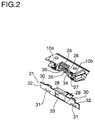
- Fig. 2
- einen vergrößerten perspektivischen Ausschnitt auf die Front und das Frontteil der erfindungsgemäßen Kassette ohne Aufzeichnungsträgerband
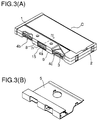
- Fig. 3 a, b
- die Kassette mit Aufzeichnungsträgerband und Verschlußteil gemäß dem Stand der Technik
- Fig. 4
- einen Ausschnitt eines Querschnitts durch die Mitte (IV-IV) der herkömmlichen Kassette
- Fig. 5
- einen Ausschnitt eines Querschnitts durch die Mitte der Kassettenfront mit erfindungsgemäßem Front- und Verschlußteil
- Fig. 6
- eine Rückansicht des Frontteils mit Reinigungselementen.
- Eine Kassette C gemäß Stand der Technik (Figur 3) besteht aus einem thermoplastischen Gehäuseoberteil 1 und -unterteil 2, wobei das Gehäuse den bandförmigen Aufzeichnungsträger 3 umschließt und an den Frontöffnungen 4 a-c zum Eingriff mit nicht dargestellten Geräteelementen hält und freigibt.
- Um den Aufzeichnungsträger 3 vor Staubanfall und Beschädigung zu schützen, sind die Öffnungen 4 a-c, 4 a Kopfeintrittsöffnung und 4 b, 4 c Frontöffnungen, und die nicht dargestellten Antriebsöffnungen im Gehäuseunterteil 2 durch ein Verschlußteil 5, das aus einem dünnen gestanzten und gebogenen, rostfreien Metallblech besteht, abgedeckt. Zur besseren Übersicht ist das Verschlußteil 5 in Fig. 3 b in seiner Position vor der montagemäßigen Verbindung mit der in Fig. 3 a dargestellten Kassette gezeigt.
- Fig. 4 zeigt das Verschlußteil 5 in einem Ausschnitt eines Querschnitts IV-IV durch die Kassette C in der Mitte der Kopfeintrittsöffnung 4 a in seiner auf das Kassettengehäuse montierten Lage. Dabei ist der bandförmige Aufzeichnungsträger 3 in seiner Mittenlage in Anlage an einem der links und rechts der Frontöffnung 4 a hinter den Frontwänden 8 und 9 und den Stegen 15 angeordneten Führungsstiften 10 a/b gezeigt. Des weiteren ist der Schlitz 11 zur Aufnahme von hier nicht dargestellten Bandandruckelementen, ein dahinter angeordnetes Abschirmblech 12 und ein Freiraum 13 für die wickelförmigen Vorratsrollen 14 für den Aufzeichnungsträger 3 gezeigt. Das Aufnahmeteil 11 a für die Bandandruckelemente ist an der Bodenwandfläche 7 b angebracht.
- Da auf Geräten für die bekannte Kassette auch Kompakt Kassetten gemäß IEC-Standard (s.o.) abgespielt werden sollen, sind z.B. die Lage der Innenwände 7 b zur Grundebene A mit max. 1 mm und der Innenwand 7 a zur Frontwand B mit max. 1,2 mm limitiert. Die Frontwände 8 und 9 können deshalb maximal S1 = 0,75 mm und die Bodenwand 16 im Bereich der Kopfeintrittsöffnung 4 a maximal S2 = 0,6 mm dick sein. Für die zulässige Dicke des Verschlußteils 5 bleiben dabei nur ca. S3 = 0,2 mm übrig, da das Verschlußteil 5 einerseits auf dem Kassettengehäuse gleiten und daher ein Spiel haben muß, und andererseits nicht über die Außenflächen der Kassette C überstehen darf. Diese Maße sind für ein im Spritzguß gefertigtes Kassettengehäuse sehr ungünstig, da sowohl das Material als auch die Spritzgußparameter für das ganze Gehäuse mit sonst günstigeren Dicken und Querschnitten hauptsächlich auf diese dünnen Teilwände abgestimmt werden muß. Die daraus resultierenden Nachteile sind oben diskutiert worden.
- Ein weiterer Nachteil der bekannten Kassette besteht darin, daß es beim Verschweißen des Gehäuseoberteils mit dem -unterteil an den Stoßstellen 17 zwischen den Frontwänden 8 und/oder 9 innen wie außen leicht zu überstehenden Schweißwülsten 18 kommen kann, die entweder den Aufzeichnungsträger 3 verkratzen oder die Bewegung des Verschlußteils 5 behindern können.
- Figur 1 a zeigt die erfindungsgemäße Kassette 20 mit einem davon getrennten Frontteil 21 und einem formmäßig unveränderten Verschlußteil 45, jedoch jeweils aus leicht spritzbarem Kunststoff-Material.
- Gegenüber der Kassette C in Figur 3 sind die dünnen Vorderwände 8, 9 und die Stege 15 fortgelassen worden, wodurch in diesem Bereich Raum für das Frontteil 21 geschaffen ist. Die Spritzbedingungen für die Gehäusehälften, Boden- und Deckelteile 22 und 23, sind deshalb ohne Rücksicht auf die Vorderwände der Kassette 20 optimierbar. Beide Teile Frontteil 21 und Verschlußteil 45 sind aus unten erwähnten Kunststoffen im Spritzguß hergestellt.
- Die Boden- und Deckelteile 22 und 23 weisen Rastnuten 24 und 26 am Deckelteil 23 sowie Rastnuten 25 und 27 am Bodenteil 22 auf, wobei die Rastnuten 24 und 25 außen liegen und die Rastnuten 26 und 27 innen liegen. Der Querschnitt der Rastnuten 24 - 27 ist beliebig, es muß nur ein geeignetes Verrasten oder Verhaken zwischen den Rastnuten 24 - 27 und den noch zu beschreibenden steg- oder hakenartigen Vorsprüngen 28 bis 31 montagemäßig und danach gewährleistet sein.
- Die Vorsprünge 28 und 29 sind dabei in der Mitte des Frontteils 21 vorgesehen und die Vorsprünge 30 und 31 sind rechts und links der Mitte angeordnet.
- Das Frontteil 21 selbst besteht aus einer langgestreckten Wand 32 mit einer rechteckigen Kopfeintrittsöffnung 33 in der Mitte.
- Die Vorsprünge 28 - 31 sind etwa rechtwinklig an den Ober- und Unterkanten der Wand 32, die etwa die Höhe der Frontöffnung 34 der Kassette 20 besitzt, angebracht. Dabei hat der obere mittlere Vorsprung 28 einen kurzen Abstand von der Wand 32 mit nach unten gerichtetem Rast- oder Hakenfortsatz. Der untere mittlere Vorsprung 29 ist länger ausgebildet, reicht im Kassettengehäuse unter die von oben in die Gehäuseöffnung 34 ragende Andruckeinrichtung 35. Der Vorsprung 29 ist dabei als Ergänzungsteil der Bodenwand, genauer der Aussparung 36, ausgebildet. Die Lage der Rastnuten 24 - 27 ist am besten in Figur 5 erkennbar. Die Rastnut 25 liegt dabei hinter dem Abschirmelement 12 und der Rast- oder Hakenfortsatz greift da hinein. Die Nut 24 ist formmäßig gleich ausgebildet, nur liegt die Nut 24 etwas oberhalb der Andruckeinrichtung, von der hier nur der am vorragenden Ende des Deckelteils 23 angebrachte Führungsblock 37 dargestellt ist. Die Vorsprünge 30 und 31 greifen in die ihnen zugeordneten inneren Rast- oder Hakennuten 26 bzw. 27 ein, so daß eine sichere, zur Mitte symmetrische Befestigung des Frontteils 21 sichergestellt ist. In allen Fällen sind es die flachen Wände der Deckel- oder Bodenteile 23 bzw. 22, mit denen die Vorsprünge 28 - 31 in Eingriff kommen. Wenn das Frontteil 21 in seiner Sollage befestigt ist, sind dieselben Frontöffnungen 4 a - 4 c vorhanden wie bei der Kassette C in Figur 3.
- Wird das Frontteil 21, das eine Grundfläche von etwa 8 · 41 mm² besitzt und aus einem leicht fließenden Polyacetal, vorzugsweise Polyoxymethylen, einem FEP Fluorkunststoff oder Polyamid hergestellt, so lassen sich die Wand 32 sowie der Ergänzungsvorsprung 29 in einer Dicke d 1 von etwa 0,35 bis etwa 0,5 mm, vorzugsweise d 1 von etwa 0,4 mm herstellen. Die Summe der Dicken des Verschlußteils 45 und des Frontteils 21 beträgt damit etwa 1 mm. Für das Verschlußteil 45, das vorteilhaft aus demselben Material hergestellt sein kann, aber nicht zwingend muß, bleibt gerade noch soviel Raum, um die im Spritzguß sicher realisierbaren Wandstärken d 4 von etwa 0,6 mm am Rückenteil 38 des Verschlußteils 45, und d 3 von etwa 0,45 mm an den Seitenteilen 39 und 40 des Verschlußteils 45 auszulegen. Die Dicke des Verschlußteils 45 beträgt vorteilhaft von etwa 0,4 (d 3) bis etwa 0,65 mm (d 4). Die Dicke d 4 ist auch aus Gründen der in diesem Frontbereich größeren Festigkeit größer als d 3. Die Kernarretierungen 41 und die Federnase 42 des Verschlußteils 45 sind dabei in einem Arbeitsgang bei der Herstellung mit ausgebildet. Praktisch wurden Frontteil 21 und verschlußteil 45 aus Polyoxymethylen (POM), einem Acetal, hergestellt. POM ist ein temperaturbeständiges, verschleißfestes und leicht gleitendes Kunststoff-Material, das auch in den verschiedenen Farben einfärbbar ist.
- Das erfindungsgemäße, aus Kunststoff bestehende und mit verschiedenen Wandstärken ausgebildete Verschlußteil bedarf keiner Nachbearbeitung und/oder Oberflächenbehandlung und kann als farbiges Design-Element eingesetzt werden. Dasselbe gilt natürlich auch für das separate Frontteil.
- Das erfindungsgemäße Kassettengehäuse kann ohne Funktionsminderung aus Standard-Polystyrol oder auch Polypropylen hergestellt werden. Bei Standard-Polystyrol beträgt die Ersparnis 30 % gegenüber ABS-Polycarbonat.
- Gegenüber der bekannten auf dem Markt befindlichen DCC Kassette ist durch das erfindungsgemäße Verschlußteil eine ca. 50 %ige und durch das Frontteil eine nochmalige 15 %ige Ersparnis erzielbar.
- Da die größte Dicke d 5 der Vorderwand 48 (Fig. 1) etwa d 5 = 1,22 mm beträgt, ergeben sich für die Dicke des Frontteils 21 die Grenz-Faktoren 2,2 bis 3,5. Dabei wurde der oben angegebene Dickenbereich für das Frontteil 21 zugrundegelegt. Dieselben Grenzfaktoren gelten auch für die Seitenteile 39 und 40 des Verschlußteils 45, während für das Rückenteil 38 des Verschlußteils 45 der Faktor von etwa 2 gilt.
- Figur 5 zeigt an der Innenseite der Wand 32 des Frontteils 21 ein Band-Reinigungselement 47, das direkt dem Band 3 gegenüber angeordnet ist und ständig mit demselben in Kontakt stehen soll über dessen ganze Bandbreite. Das Reinigungselement oder besser die Reinigungselemente 47 (Figur 6), die günstig beidseitig der Öffnung 33 an der Innenseite des Frontteils 21 angeordnet sind, besteht zweckmäßig aus einem Vliesmaterial, das sich durch hohe Abriebfestigkeit und große Flauschigkeit und weitgehende Lösemittelfreiheit auszeichnet.
- Die aus den Gewirk- oder Gewebe-Teilen und evtl. einem Aufrauhungsteil bestehende Schichtauflage wird als Gewirk in einem Wirkvorgang oder als Gewebe in einem Webvorgang hergestellt. Anschließend wird die Oberfläche z.B. mit Kurznadel-Bürsten so aufgerauht, daß die Wirk- oder Webverbindungen teilweise zerstört oder aufgebrochen werden und Faserenden teilweise herausstehen. Durch Abscheren der Faserenden wird eine flauschige, wildlederartige Oberfläche erhalten, die als Berührungsfläche für Bandrückseite und Kopfspiegel sehr geeignet ist. Die Dicken der Gewirk- oder Gewebe-Teile betragen dabei etwa 0,5 mm bzw. etwa 0,15 mm bis etwa 0,3 mm, vorzugsweise etwa 0,25 mm, so daß eine Gesamtdicke der Schichtauflage etwa 0,8 mm betragen kann. Dabei wurde eine mittlere Faserstärke von etwa 10 µm bei einem Fasergewicht von 1,5 g pro 10000 m benutzt. Generell ist eine mittlere Faserstärke von etwa 10 bis etwa 25 µm bei Fasergewichten von ca. 1,5 bis etwa 5 g/10 000 m benutzbar.
- Das Flächengewicht des Gewirkes/Gewebes betrug dabei ca. 160 bis ca. 180 g/m² (Faserstärke etwa 10 µm).
- Ein Vlies als Schichtauflage besteht aus Fasern von einer mittleren Länge von ca. 50 mm und einer Faserstärke von etwa 5 bis etwa 15 µm bei einem Flächengewicht von etwa 85 g/m² bis etwa 110 g/m² oder bis etwa 25 µm bei größeren Flächengewichten.
- Das Flächengewicht der Faserschichten kann jedoch prinzipiell im Bereich zwischen etwa 30 bis etwa 300 g/m² liegen, um im technischen Sinne und mit den angegebenen Vorteilen für die vorliegende Erfindung verwendbar zu sein.
- Die Dicke des Vlieses beträgt etwa 0,15 bis etwa 0,6 mm, vorzugsweise 0,25 mm, der letzte Wert gilt besonders für eine Vliesschicht im aufgeklebten Zustand. Die quasi-statisch gemessenen Reibungs-Koeffizienten des Gewirkes/Gewebes und des Vlieses gegen die Bandrückseite betrugen etwa 0,35 bzw. 0,38, gemessen über einer mit dem Material überzogene Stahltrommel mit 10 cm Durchmesser und einer 180°-Umschlingung bei Belastung mit 20 g.
- Die Dicke des Vlieses sollte, da keine als Feder dienende Filzunterlage zur Abstützung und Vergleichmäßigung der Andruckkräfte dient, größer sein als die wirksamen Gewirk-/Gewebe- und Vliesschichten, deren Dicken im angeklebten Zustand im Bereich von ca. 0,15 bis ca. 0,3 mm liegen können.
- Die Dicke des Vlieses sollte im aufgeklebten Zustand wenigstens 0,5 mm betragen, kann jedoch ohne weiteres auch größer gewählt werden.
- Eine Verbindung über thermisches Schweißen ist ebenfalls denkbar. Die Schweißpunkte sollten dabei jedoch sehr klein gewählt und nach dem Verschweißen eine etwa gleichmäßige Dicke des Vlieses sichergestellt sein. Auch chemische Faserverbindungen sind bekannt.
- Bindemittel, gleich welcher Art, sollten zumindest im Bereich der das Band berührenden Schichtauflage nicht vorhanden sein, da diese äußerst Bandlauf- und Kopffunktion-störende oder -schädigende Einflüsse bewirken können.
- Die Gewirk- oder Gewebe-Schichtauflagen sind auf die Filz-Unterlage mit herkömmlichen Klebemitteln, z.B. Polyurethan-, Acrylatkleber oder einem Mischkleber aus Polyurethan-Butadien-Acryl-Nitril, aufklebbar. Die Vlies-Schichtauflage kann z.B. mittels doppelseitigen Klebebandes oder in anderer geeigneter Weise aufgeklebt werden.
- Die Fasern der Schichtauflagen bestehen z.B. aus Polyamidfasern bei Gewirken und Geweben und Polyester/Polyamid-Mikrofasern bei Vliesen. Selbstverständlich können alle Schichtauflagen auch aus allen anderen geeigneten Faser bestehen, wie z.B. Polypropylen, Polyacrylnitril, regenerierter Zellulose, Wolle oder Zellulose-Triacetat.
- Verwendbar ist die Erfindung generell für alle Kassetten mit Verschlußteil, z.B. einem Schieber, wobei entweder an der Kassetten-Vorderwand oder direkt an daran angrenzenden Bereichen dünne oder sehr dünne Wandstärken erforderlich sind. Ein besonderer Vorteil liegt, wie oben beispielhaft beschrieben, natürlich dann vor, wenn ein erstes Kassettensystem für die zusätzliche Verwendung der Kassetten eines zweiten Kassettensystems nutzbar gemacht werden soll und eine sehr wirtschaftliche Herstellung der Kassettenteile angestrebt ist.
- Eine Kassette gemäß der Erfindung besteht aus im wesentlichen flachen Gehäuseteilen und Front-, Rück- und Seitenwänden sowie einem Verschlußorgan für die Öffnungen der Frontseite, wobei die Frontseite teilweise mittels eines am Gehäuse befestigbaren Frontteils vervollständigbar ist. Frontteil und Verschlußorgan sind dabei mit ihnen zugeordneten Dickenmaßen aus geeignetem, spritzbarem Kunststoff hergestellt. Das Frontteil ist mit Reinigungselementen versehen.
- Verwendbar ist die Kassette immer dann, wenn dünne Wanddicken erforderlich sind und ein Verschlußorgan vorhanden ist.
Claims (19)
- Kassette, insbesondere Magnetbandkassette, mit einem Gehäuse aus Boden- und Deckelteilen (22, 23) und Rückwand, Vorderwand (48) und Seitenwänden, wobei die Vorderwand wenigstens eine mit einem Verschlußteil (45) verschließbare Kopfeintrittsöffnung (33) aufweist, dadurch gekennzeichnet, daß ein die Vorderwand (48) im Bereich der Kopfeintrittsöffnung (33) bildendes, an sich bekanntes, separates, am Gehäuse (22, 23) befestigbares Frontteil (21) vorgesehen ist und daß Verschlußteil (45) und Frontteil (21) aus Kunststoff-Material bestehen.
- Kassette nach Anspruch 1, dadurch gekennzeichnet, daß die Dicke des Frontteils (21) im Vergleich zur größten Dicke (d 5) der Vorderwand (48) um ein Mehrfaches kleiner ist.
- Kassette nach Anspruch 2, dadurch gekennzeichnet, daß der Mehrfach-Faktor zwischen 2,2 und 3,5 liegt.
- Kassette nach Anspruch 1 und einem oder mehreren der Ansprüche 2 und 3, dadurch gekennzeichnet, daß das Frontteil (21) einen Ergänzungsteil (29) für das Bodenteil (22) aufweist.
- Kassette nach einem der Ansprüche 1 - 4, dadurch gekennzeichnet, daß die Summe der größten Dicken (d 1, d 4) des Verschlußteils (45) und des Frontteils (21) etwa 1 mm beträgt.
- Kassette nach einem der Ansprüche 1 - 5, wobei hinter der Kopfeintrittsöffnung (33) eine Bandandruck-Einrichtung (35) angeordnet ist, dadurch gekennzeichnet, daß das Ergänzungsteil (29) des Frontteils (21) die Bandandruck-Einrichtung (35) untergreift.
- Kassette nach Anspruch 1 und einem der Ansprüche 2 oder 6, dadurch gekennzeichnet, daß das Frontteil (21) Befestigungselemente (28 - 31) aufweist, die zumindest überwiegend mit den Wänden der Boden- und Deckelteile (22, 23) der Kassette (20) zusammenwirken.
- Kassette nach Anspruch 1 und einem oder mehreren der Ansprüche 2 bis 7, dadurch gekennzeichnet, daß die Frontteil-Befestigungselemente (28 - 31) aus Vorsprüngen bestehen und die Wände der Boden- und Deckelteile (22, 23) entsprechend geformte Befestigungsnuten (24 - 27) aufweisen.
- Kassette nach Anspruch 1 und einem oder mehreren der Ansprüche 2 bis 8, dadurch gekennzeichnet, daß Verschlußteil (45) und Frontteil (21) aus einem Kunststoff, ausgewählt aus der Gruppe Polyacetal, FEP Fluorkunststoff oder Polyamid, bestehen.
- Kassette nach Anspruch 1 und einem oder mehreren der Ansprüche 2 bis 9, dadurch gekennzeichnet, daß das Verschlußteil eine Dicke zwischen etwa 0,4 bis etwa 0,65 mm und das Frontteil eine Dicke zwischen etwa 0,35 bis etwa 0,5 mm besitzt und Verschlußteil (45) und Frontteil (21) aus Polyoxymethylen bestehen.
- Kassette nach Anspruch 1 und 9 und einem oder mehreren der Ansprüche 2 bis 8 und 10, dadurch gekennzeichnet, daß das Gehäuse (22, 23) aus Polystyrol oder Polypropylen besteht.
- Kassette nach Anspruch 1 und einem oder mehreren der Ansprüche 2 bis 11, dadurch gekennzeichnet, daß das Frontteil (21) auf seiner dem Gehäuse zugekehrten Seite Band-Reinigungselemente (47) aufweist.
- Kassette nach Anspruch 12, dadurch gekennzeichnet, daß die Bandreinigungselemente (37) aus Vliesstreifen bestehen.
- Frontteil für eine Kassette nach Anspruch 1 und 10, gekennzeichnet durch eine Dicke (d 1) von etwa 0,35 bis etwa 0,5 mm.
- Frontteil nach Anspruch 14, dadurch gekennzeichnet, daß es aus Polyoxymethylen besteht.
- Frontteil nach Anspruch 14 oder 15, dadurch gekennzeichnet, daß es wenigstens ein Band-Reinigungselement (47), insbesondere aus Gewirk-, Gewebe- oder Vliesmaterial, aufweist.
- Verschlußteil für eine Kassette nach Anspruch 1 und 10, gekennzeichnet durch eine Dicke (d 3, d 4) von etwa 0,4 mm bis etwa 0,65 mm.
- Verschlußteil nach Anspruch 17, dadurch gekennzeichnet, daß es aus Polyoxymethylen besteht.
- Verschlußteil nach Anspruch 17 oder 18, dadurch gekennzeichnet, daß dasselbe im Querschnitt gesehen aus einem Rückenteil (38) mit größerer Dicke (d 4) und zwei Seitenteilen (39, 40) mit geringerer Dicke (d 3) besteht.
Applications Claiming Priority (2)
| Application Number | Priority Date | Filing Date | Title |
|---|---|---|---|
| DE9301652U DE9301652U1 (de) | 1993-02-06 | 1993-02-06 | Kassette, insbesondere Magnetbandkassette, mit einem Gehäuse |
| DE9301652U | 1993-02-06 |
Publications (2)
| Publication Number | Publication Date |
|---|---|
| EP0610773A2 true EP0610773A2 (de) | 1994-08-17 |
| EP0610773A3 EP0610773A3 (de) | 1994-08-31 |
Family
ID=6889057
Family Applications (1)
| Application Number | Title | Priority Date | Filing Date |
|---|---|---|---|
| EP19940101436 Withdrawn EP0610773A3 (de) | 1993-02-06 | 1994-02-01 | Kassette, insbesondere Magnetbandkassette, mit einem Gehäuse |
Country Status (4)
| Country | Link |
|---|---|
| EP (1) | EP0610773A3 (de) |
| JP (1) | JPH06302148A (de) |
| CN (1) | CN1095515A (de) |
| DE (2) | DE9301652U1 (de) |
Family Cites Families (5)
| Publication number | Priority date | Publication date | Assignee | Title |
|---|---|---|---|---|
| JPS59168891U (ja) * | 1983-04-26 | 1984-11-12 | 富士写真フイルム株式会社 | 磁気テ−プカセツト |
| US4614270A (en) * | 1983-09-16 | 1986-09-30 | Fuji Photo Film Co., Ltd. | Magnetic tape cassette |
| JPS6089676U (ja) * | 1983-11-28 | 1985-06-19 | 株式会社福武書店 | カセツトテ−プ |
| DE8621947U1 (de) * | 1986-08-16 | 1986-10-16 | Basf Ag, 6700 Ludwigshafen | Quaderform-Kassette für bandförmige Aufzeichnungsträger |
| YU123090A (sh) * | 1989-07-03 | 1994-04-05 | N.V. Philips Gloelampenfabrieken | Sistem za snemanje/reprodukcijo signalov na/s magnetnega traku v kaseti |
-
1993
- 1993-02-06 DE DE9301652U patent/DE9301652U1/de not_active Expired - Lifetime
-
1994
- 1994-01-27 JP JP746794A patent/JPH06302148A/ja active Pending
- 1994-02-01 EP EP19940101436 patent/EP0610773A3/de not_active Withdrawn
- 1994-02-02 DE DE9401669U patent/DE9401669U1/de not_active Expired - Lifetime
- 1994-02-05 CN CN 94102766 patent/CN1095515A/zh active Pending
Also Published As
| Publication number | Publication date |
|---|---|
| EP0610773A3 (de) | 1994-08-31 |
| DE9401669U1 (de) | 1994-03-31 |
| DE9301652U1 (de) | 1993-04-01 |
| CN1095515A (zh) | 1994-11-23 |
| JPH06302148A (ja) | 1994-10-28 |
Similar Documents
| Publication | Publication Date | Title |
|---|---|---|
| DE2918271C2 (de) | ||
| DE69402688T2 (de) | Luftfilter und verfahren zu seiner herstellung | |
| EP0187319B1 (de) | Bandführungsvorrichtung für Bandtransporteinrichtungen, insbesondere Magnetbandeinrichtungen, und Bandkassetten damit | |
| EP0015398A1 (de) | Magazin für Magnetbandkassetten | |
| DE3618498A1 (de) | Magnetbandkassette | |
| DE3149441C2 (de) | ||
| DE3433705A1 (de) | Magnetbandcassette | |
| AT401833B (de) | Andruckeinrichtung für bandförmige aufzeichnungsträger und kassette damit | |
| DE3887965T2 (de) | Bandkassette. | |
| EP0283973A2 (de) | Vorrichtung zur Befestigung von Gehäusen in Öffnungen einer Schalttafel oder einer Rastersystemwand | |
| DE4306474A1 (de) | Lager- und Transportgestell für Flächenbauteile | |
| DE3511227A1 (de) | Magnetbandkassette | |
| DE9401669U1 (de) | Kassette, insbesondere Magnetbandkassette, mit einem Gehäuse | |
| DE8625683U1 (de) | Reinigungshilfsvorrichtung aus einem genadelten Textilfilz mit thermo-plastischem Kunststoffanteil im Fasergewebe | |
| DE9215671U1 (de) | Thermisch isolierende Batterieabdeckung | |
| DE2621723A1 (de) | Kassette, insbesondere bandkassette fuer die spule eines breiten aufzeichnungstraegers | |
| DE7149292U (de) | Gewebebahn zur herstellung von versteifungseinlagen fuer kleidungsstuecke | |
| DE60127899T2 (de) | Führungsvorrichtung für Laufwerk | |
| EP0200278B1 (de) | Scherkopf für einen Trockenrasierapparat | |
| DE4219021A1 (de) | Fotofilmkassette | |
| DE2726349C2 (de) | Magnetbandkassette | |
| DE69512308T2 (de) | Bandspule mit in einem Flansch geformten Luftauslassschlitzen | |
| DE9301651U1 (de) | Kassette für Aufzeichnungsträger, insbesondere Magnetband, und Gehäuse-Ergänzungsteil dafür | |
| DD149239A5 (de) | Vorrichtung zum befestigen eines nadelstreifens in einem u-foermigen nadeltraeger bei nadeltragenden textilmaschinen | |
| EP0234253B1 (de) | Bandcassette mit steckbarem Bandabstreifer |
Legal Events
| Date | Code | Title | Description |
|---|---|---|---|
| PUAI | Public reference made under article 153(3) epc to a published international application that has entered the european phase |
Free format text: ORIGINAL CODE: 0009012 |
|
| PUAL | Search report despatched |
Free format text: ORIGINAL CODE: 0009013 |
|
| AK | Designated contracting states |
Kind code of ref document: A2 Designated state(s): AT DE FR GB IT |
|
| AK | Designated contracting states |
Kind code of ref document: A3 Designated state(s): AT DE FR GB IT |
|
| 17P | Request for examination filed |
Effective date: 19941007 |
|
| RAP1 | Party data changed (applicant data changed or rights of an application transferred) |
Owner name: BASF MAGNETICS GMBH |
|
| RAP1 | Party data changed (applicant data changed or rights of an application transferred) |
Owner name: EMTEC MAGNETICS GMBH |
|
| 17Q | First examination report despatched |
Effective date: 19970515 |
|
| STAA | Information on the status of an ep patent application or granted ep patent |
Free format text: STATUS: THE APPLICATION IS DEEMED TO BE WITHDRAWN |
|
| 18D | Application deemed to be withdrawn |
Effective date: 19970926 |