EP0610814A2 - Teilkristalline Cycloolefin-Copolymer-Folie - Google Patents
Teilkristalline Cycloolefin-Copolymer-Folie Download PDFInfo
- Publication number
- EP0610814A2 EP0610814A2 EP94101638A EP94101638A EP0610814A2 EP 0610814 A2 EP0610814 A2 EP 0610814A2 EP 94101638 A EP94101638 A EP 94101638A EP 94101638 A EP94101638 A EP 94101638A EP 0610814 A2 EP0610814 A2 EP 0610814A2
- Authority
- EP
- European Patent Office
- Prior art keywords
- film according
- film
- formula
- monomer
- films
- Prior art date
- Legal status (The legal status is an assumption and is not a legal conclusion. Google has not performed a legal analysis and makes no representation as to the accuracy of the status listed.)
- Granted
Links
- 0 CC(C1*)C2C=*C1C2(*)* Chemical compound CC(C1*)C2C=*C1C2(*)* 0.000 description 7
Images

Classifications
-
- C—CHEMISTRY; METALLURGY
- C08—ORGANIC MACROMOLECULAR COMPOUNDS; THEIR PREPARATION OR CHEMICAL WORKING-UP; COMPOSITIONS BASED THEREON
- C08J—WORKING-UP; GENERAL PROCESSES OF COMPOUNDING; AFTER-TREATMENT NOT COVERED BY SUBCLASSES C08B, C08C, C08F, C08G or C08H
- C08J5/00—Manufacture of articles or shaped materials containing macromolecular substances
- C08J5/18—Manufacture of films or sheets
-
- C—CHEMISTRY; METALLURGY
- C08—ORGANIC MACROMOLECULAR COMPOUNDS; THEIR PREPARATION OR CHEMICAL WORKING-UP; COMPOSITIONS BASED THEREON
- C08F—MACROMOLECULAR COMPOUNDS OBTAINED BY REACTIONS ONLY INVOLVING CARBON-TO-CARBON UNSATURATED BONDS
- C08F6/00—Post-polymerisation treatments
- C08F6/02—Neutralisation of the polymerisation mass, e.g. killing the catalyst also removal of catalyst residues
-
- C—CHEMISTRY; METALLURGY
- C08—ORGANIC MACROMOLECULAR COMPOUNDS; THEIR PREPARATION OR CHEMICAL WORKING-UP; COMPOSITIONS BASED THEREON
- C08J—WORKING-UP; GENERAL PROCESSES OF COMPOUNDING; AFTER-TREATMENT NOT COVERED BY SUBCLASSES C08B, C08C, C08F, C08G or C08H
- C08J2345/00—Characterised by the use of homopolymers or copolymers of compounds having no unsaturated aliphatic radicals in side chain, and having one or more carbon-to-carbon double bonds in a carbocyclic or in a heterocyclic ring system; Derivatives of such polymers
-
- G—PHYSICS
- G02—OPTICS
- G02F—OPTICAL DEVICES OR ARRANGEMENTS FOR THE CONTROL OF LIGHT BY MODIFICATION OF THE OPTICAL PROPERTIES OF THE MEDIA OF THE ELEMENTS INVOLVED THEREIN; NON-LINEAR OPTICS; FREQUENCY-CHANGING OF LIGHT; OPTICAL LOGIC ELEMENTS; OPTICAL ANALOGUE/DIGITAL CONVERTERS
- G02F1/00—Devices or arrangements for the control of the intensity, colour, phase, polarisation or direction of light arriving from an independent light source, e.g. switching, gating or modulating; Non-linear optics
- G02F1/01—Devices or arrangements for the control of the intensity, colour, phase, polarisation or direction of light arriving from an independent light source, e.g. switching, gating or modulating; Non-linear optics for the control of the intensity, phase, polarisation or colour
- G02F1/13—Devices or arrangements for the control of the intensity, colour, phase, polarisation or direction of light arriving from an independent light source, e.g. switching, gating or modulating; Non-linear optics for the control of the intensity, phase, polarisation or colour based on liquid crystals, e.g. single liquid crystal display cells
- G02F1/133—Constructional arrangements; Operation of liquid crystal cells; Circuit arrangements
- G02F1/1333—Constructional arrangements; Manufacturing methods
- G02F1/133305—Flexible substrates, e.g. plastics, organic film
Definitions
- the invention relates to semi-crystalline films made from cycloolefin copolymers, a process for producing such films and the use thereof.
- DD-A 224 538 and DD-A 241 971 describe cast films made from ethylene-norbornene copolymers.
- EP-A 0 384 694 also describes films made from cyclic copolymers. With a few exceptions, however, the cycloolefinic starting materials mentioned there are all amorphous.
- a serious disadvantage of all previously known films made from amorphous cycloolefin copolymers is the far too low solvent resistance to aprotic, non-polar solvents such as aliphatic or aromatic Hydrocarbons that exclude these films from many areas of application.
- EP-A 384 694 also discloses partially crystalline cycloolefin copolymers with a degree of crystallinity of 0 to 10%, which are said to have a glass transition temperature of 50 to 230 ° C at the same time.
- polyethylene components are formed as a side reaction, which are partially crystalline, so that the amorphous cycloolefin copolymer mixed with polyethylene components appears as a whole to be partially crystalline.
- the partial crystallinity is usually so low that no melting point can be observed in the DSC measurement curve.
- the task was to provide cycloolefin copolymer films with high chemical resistance, improved dimensional stability, increased tensile modulus of elasticity and better stretchability.
- the glass transition temperatures T g of the foils are above 100 ° C and the melting points T m above 200 ° C.
- the transparent foils are easy to deep-draw.
- the liquid cycloolefin monomer is preferably polymerized in concentrated solutions, which are suspensions or solutions.
- At least one polycyclic olefin of the formula I, II, III, IV, V, VI, VII, VIII or IX preferably a cycloolefin of the formula I or III, in which R1, R2, R3, R4, R5, R6, R7 and R8 the same or different are and represent a hydrogen atom or a C1-C8-alkyl radical, where the same radicals in the different formulas can have a different meaning.
- An acyclic olefin of the formula X is used as comonomer, in which R18, R19, R20 and R21 are identical or different and denote a hydrogen atom or a C1-C8alkyl radical. Ethylene or propylene are preferred.
- copolymers of symmetrical polycyclic olefins preferably of the formulas I and III, with the acyclic olefins X are preferably produced.
- Symmetrical polycyclic olefins are understood to mean in particular those compounds of the formulas I and III in which the substituents R 1 and R 2 are chemically identical and have the same spatial arrangement.
- cycloolefins are norbornene and tetracyclododecene. They are preferably copolymerized with ethylene; ethylene / norbornene copolymers are of particular importance.
- incorporation ratios of the comonomers I to VI to the comonomers X in the copolymer are between 45:55 and 55:45 mol%. In particular, installation ratios of approximately 50:50 mol% are preferred.
- the polycyclic olefin (I to IX) is used in an amount of 0.1 to 99.9% by weight, based in each case on the total amount of the monomers.
- dienes of the formulas VII, VIII and / or IX and / or monomers of the formulas I to VI which have at least one further double bond in one of their radicals are used, their incorporation ratio in the polymer is preferably> 0 to 5 mol%.
- the concentration of the open-chain olefin results from the solubility of the open-chain olefin in the reaction medium at a given pressure and temperature.
- Suitable primary catalysts of the transition metal type consist of a metallocene of the formula XI
- M1 is from the group titanium, zirconium, hafnium, vanadium, niobium and tantalum, preferably zirconium and hafnium.
- Zirconium is particularly preferably used.
- aluminoxane is suitable as a cocatalyst.
- R22 and R23 are the same or different and represent a hydrogen atom, a C1-C10-, preferably C1-C3-alkyl group, a C1-C10-, preferably C1-C3-alkoxy group, a C6-C10-, preferably C6-C8-aryl group , a C6-C10-, preferably C6-C8-aryloxy group, a C2-C10-, preferably C2-C4-alkenyl group, a C7-C40-, preferably C7-C10-arylalkyl group, a C7-C40-, preferably C7-C12 -Alkylaryl group, a C8-C40-, preferably C8-C12-arylalkenyl group or a halogen atom, preferably chlorine.
- R24 is fluorenyl, indenyl or cyclopentadienyl and R25 indenyl or cyclopentadienyl, where these radicals can be substituted and C1 symmetry is present, or both radicals are the same and mean optionally substituted indenyl or substituted cyclopentadienyl (meso form).
- R26 is preferably a radical and particularly preferred
- ligand systems R24 - R26 which can exert a different steric interaction on the ligands R22 and R23.
- the nature of the ligands R22 and R23 is irrelevant.
- a salt-like compound for example of the formula R x NH 4-x BR'4 or the formula R3PHBR'4, is used as the cocatalyst.
- x 1, 2 or 3
- R C1-C6-alkyl or aryl, the same or different
- R ' aryl, which can also be fluorinated or partially fluorinated.
- the catalyst consists of the reaction product of a metallocene with one of the compounds mentioned (cf. EP-A 277 004).
- solvent is added to the reaction mixture, then it is common inert solvents such as e.g. aliphatic or cycloaliphatic hydrocarbons, gasoline or hydrogenated diesel oil fractions, toluene, chlorobenzene, o-dichlorobenzene or chloronaphthalene.
- solvents such as e.g. aliphatic or cycloaliphatic hydrocarbons, gasoline or hydrogenated diesel oil fractions, toluene, chlorobenzene, o-dichlorobenzene or chloronaphthalene.
- the metallocene compound is used in a concentration, based on the transition metal, of 10 ⁇ 3 to 10 ⁇ 8, preferably 10 ⁇ 4 to 10 ⁇ 7 mol transition metal per dm3 reactor volume.
- the aluminoxane is in a Concentration of 10 ⁇ 4 to 10 ⁇ 1, preferably 10 ⁇ 4 to 2 ⁇ 10 ⁇ 2 mol per dm3 reactor volume used, based on the content of aluminum. In principle, however, higher concentrations are also possible.
- the molar ratios of the polycyclic olefin to the open-chain olefin used can be varied within a wide range. Molar ratios of 3: 1 to 100: 1 cycloolefin to open-chain olefin are preferably used.
- the choice of the polymerization temperature, the concentration of the catalyst components and the molar ratio used or the pressure of the gaseous, open-chain olefin allow the rate of comonomer incorporation to be controlled almost as desired. Installation rates of between 45 and 55 mol% of the cyclic components are preferred, and installation rates of approximately 50 mol% of the cyclic components are particularly preferred.
- the average molecular weight of the copolymer formed can be controlled in a known manner by metering in hydrogen or varying the temperature.
- the polydispersity M w / M n of the copolymers is quite narrow with values between 2.0 and 3.5. This results in a property profile of the polymers, which - after special preparation - makes them particularly suitable for film production by extrusion.
- the cycloolefin copolymers obtained should be virtually free of catalyst and solvent residues.
- the cleaning process described in EP-A 503 422 is not sufficient to produce films with the required properties described above. It is only when the residual catalyst content drops below 100 ppm that it is possible to achieve films with the required properties.
- Catalyst residues are understood to mean in particular the aluminum-containing cocatalysts, since these are present in the polymer in a considerably higher concentration. If the aluminum content has dropped to below 100, preferably below 10, in particular below 1 ppm, it can be assumed that the content of metallocene catalysts is still lower and is therefore no longer critical. It should also be ensured that no chlorine-containing solvents such as hydrochloric acid are used in the preparation of the polymers. Remains of such chlorine-containing solvents can lead to undesirable browning of the films.
- Non-polar, optionally halogenated hydrocarbons in particular aromatic, aliphatic and cycloaliphatic hydrocarbons such as decalin, tetralin, chloronaphthalene or o-dichlorobenzene, are suitable as solvents. Preferred are those with a high boiling point, in particular> 100 ° C. to approximately 300 ° C. Polar solid substances which are insoluble under the process conditions have proven to be suitable filter aids.
- diatomaceous earth made from deposits of diatoms (e.g.: Celite 545, LuV, Hamburg), Perlite, made from obsidian-like material of volcanic origin (e.g.: Celite Perlite I-100) or modified cellulose (e.g.: Diacel).
- Porous carbon and absorptive asbestos fibers are also suitable, although not preferred.
- the temperature should be kept at at least 100 ° C., preferably at least 135 ° C. to a maximum of 300 ° C., particularly preferably 150-170 ° C.
- the dissolved, filtered polymer can then finally be precipitated using a polar solvent such as acetone.
- the films can be produced by various methods. Casting from solution is possible, but thermoplastic processing is usually more advantageous. Plate presses are well suited for experiments, but continuous processes such as extrusion or calendering are more economical for industrial production.
- Extruded films can be formed as a tube or flat film. Coextrusion is recommended for the production of multilayer films.
- the films are often oriented to further improve the mechanical properties. This is done by stretching.
- the stretching temperatures should expediently lie in a temperature interval of 40 ° C. below the glass temperature (T g -40 ° C.) up to a maximum of the melting temperature T m .
- the orientation can be uniaxial or biaxial.
- Stretching temperatures above T g are suitable for industrial production because this allows faster production because of the higher achievable stretching speeds.
- the temperature, stretching rate and stretching ratio must be coordinated so that the film does not tear.
- the stretching speed is preferably 1-500000% / min.
- the stretching ratio in The longitudinal and transverse directions are 1.1: 1 - 10: 1, preferably 1.5: 1 - 4: 1.
- the area stretch ratio should preferably be 3-20.
- Amorphous polymers relax very quickly when stretched above the glass transition temperature T g if the heat required for stretching is not dissipated quickly enough. Part of the orientation that was brought in by the stretching process is then lost again through the relaxation process. A loss of orientation reduces mechanical strength, rigidity, toughness, hardness and transparency, among other things.
- the relaxation takes place more slowly with the semi-crystalline cycloolefin copolymers, so that the stretching process including cooling of the film is less critical than with amorphous cycloolefin copolymers.
- Another advantage of a film made from a partially crystalline cycloolefin copolymer compared to that made from an amorphous one is the possibility of increasing the crystallinity of the film after the stretching process in an annealing furnace. This achieves a fixation of the film, which manifests itself in improved mechanical, chemical and thermal behavior.
- the continuous use temperature (T d ) of the film can also increase the fixation; Tensions are reduced. Dimensional stability and barrier properties are improved.
- the surfaces of the foils can be used to achieve e.g. Adhesion mediation or printability or antistatic or non-stick properties can be modified. This modification can be carried out either by treatment methods such as corona, flame, plasma or oxidation treatment or by applying a coating from solution or dispersion.
- the film contains fine, inert particles which improve the slip and winding behavior.
- particles which can be contained in amounts of 0-1% are, for example: SiO2, Al2O3, silicates with an SiO2 content of at least 30% by weight, amorphous and crystalline clay minerals, aluminosilicates, oxides of Mg, Zn, Zr and Ti, sulfates of Ca, Mg and Ba, phosphates of Li, Na and Ca.
- the film can also contain suitable additives such as stabilizers, lubricants or antioxidants.
- additives that are used for polyolefins such as polyethylene or polypropylene are also for the cycloolefin copolymer films suitable.
- UV stabilizers which can be used are absorbers such as hydroxyphenylbenzotriazoles, hydroxybenzophenones, formamidine or benzylidene-camphor, quenchers such as cinnamic acid esters or nickel chelates, radical scavengers such as sterically hindered phenols, hydroperoxide decomposers such as nickel or zinc complexes of sulfur-containing compounds or light stabilizers, and HAL type stabilizers whose mixtures are used.
- lubricants examples include: fatty acids and their esters, amides and salts, silicones or waxes such as PP or PE waxes.
- Free radical scavengers such as substituted phenols and aromatic amines and / or peroxide decomposers such as phosphites, phosphonates and thio compounds can be added as antioxidants, for example.
- the film according to the invention can have one or more layers. At least one layer predominantly exists, i.e. at least 85% by weight, preferably 90-100% by weight, from the cycloolefin copolymers described above. A preferred embodiment is the monofilm.
- the main layer according to the invention carries one or two thin polymer cover layers with lower softening temperatures than the main layer. If the thin polymer cover layer is partially crystalline, then its melting temperature T m should preferably be at least 20 ° C. below T m of the main layer. In the case of a thin amorphous cover layer, its glass transition temperature T g should preferably be at least 20 ° C. below T m of the main layer.
- the film can be coated to modify the properties.
- the film according to the invention can contain other compatible or incompatible polymers to improve the properties. These polymers can form separate layers or blended with the cycloolefin copolymer be. Examples of such polymers are: polyethylene, polypropylene, polymethylbutene-1, poly (4-methylpentene-1), polybutene-1 and polystyrene, polyvinyl chloride, polyvinylidene chloride, polyvinyl fluoride, polytetrafluoroethylene, polychloroprene, polyacrylate, polymethacrylate, polyacrylamide, polyacrylonitrile, acrylonitrile / butadiene / Styrene copolymers, acrylonitrile / styrene copolymers and acrylonitrile / styrene / acrylate copolymers, polyvinyl alcohol, polyvinyl acetate, polyvinyl stearate, polyvinyl benzoate, polyvinyl maleate, polyvinyl
- the films according to the invention have glass transition temperatures T g of 100 ° C. T g 250 ° C. and melting temperatures T m of 200 ° C. T m 500 ° C. Their continuous use temperatures are T D T G ⁇ T D ⁇ T m .
- the tensile modulus of elasticity E determined according to DIN 53 455, of the films according to the invention is 1.5 GPa ⁇ E ⁇ 8 GPa, preferably 2 GPa ⁇ E ⁇ 5 GPa.
- the tensile strength ⁇ R is 20 MPa ⁇ ⁇ R ⁇ 400 MPa, preferably 30 MPa ⁇ ⁇ R ⁇ 150 MPa.
- the elongation at break ⁇ R is 1% ⁇ ⁇ R ⁇ 100%, preferably 1% ⁇ ⁇ R ⁇ 60%.
- the water absorption is below 0.1%, in particular between 0 to 0.05%.
- a particular advantage of the semi-crystalline cycloolefin copolymer films over the amorphous films is their excellent solvent resistance, in particular also against aliphatic, cycloaliphatic and aromatic hydrocarbons.
- the film can be used as a capacitor film, electrical insulating film, separating film, repro film, adhesive tape film, film for the production of membrane keyboards, film switches and as a packaging film or as a substrate for liquid crystal displays.
- the glass transition temperature (T g ) was determined as a sudden increase in heat capacity in the DSC diagram.
- the DSC diagrams were recorded with a Perkin-Elmer DSC 7.
- VZ viscosity number
- the mechanical properties of the films were tested in accordance with DIN 53 455 using a Zwick tensile testing machine 1445 on 15 mm wide samples with a clamping length of 100 mm.
- the tensile modulus of elasticity was determined in the elongation range from 0.3 to 0.5% at an elongation rate of 10 mm / min.
- the tensile strength and elongation at break were determined at 100 mm / min.
- the ball indentation hardness was determined according to ISO 2039, part 1 (30s value).
- a density gradient column was used to determine the density .
- the residual catalyst content was determined by X-ray fluorescence measurement .
- a 75 dm3 reactor was filled with ethylene and filled with 15 dm3 norbornene and 15 dm3 decalin.
- the solution was saturated with ethylene by repeatedly squeezing ethylene (6 bar).
- a pressure of 2.5 bar (gauge pressure) was set.
- 500 cm3 of toluene methylaluminoxane solution (10.1% by weight methylaluminoxane with a molecular weight of 1300 g / mol after cryoscopic determination) were added to the reactor and stirred at 70 ° C. for 15 minutes.
- the mixture was polymerized with stirring (750 rpm) at 70 ° C., the ethylene pressure being kept at 2.5 bar by further metering.
- reaction solution was quickly discharged into the second stirred kettle.
- the mixture was heated to 170 ° C. with stirring. Approx. 2 bar pressure was reached.
- the polymer solution was filtered through the pressure filter.
- the procedure was such that the filtrate was first fed back into the nutsche for 15 minutes (i.e. pumped in a circle). A pressure of 2.8 bar nitrogen was built up over the solution.
- the polymer solution was then stirred into 500 l of acetone using a disperser (Ultraturrmax) and precipitated in the process.
- the acetone suspension was circulated through a 680 l stirring pressure filter with the bottom valve open. After closing the bottom valve, it was filtered.
- the polymeric solid was washed three times with acetone. 50 g of stabilizer (Irganox 1010, Ciba) were added to the last wash.
- the acetone was then pressed off completely and the product was predried at 100 ° C. for three hours. The final drying takes place for 10 hours at 10 mbar and 160 ° C with a weak nitrogen blanket in the drying cabinet.
- a 1.5 dm3 reactor was filled with ethylene and filled with 600 cm3 of an 85 weight percent solution of norbornene in toluene. The solution was saturated with ethylene by pressing ethylene (6 bar) several times. A pressure of 2 bar (gauge pressure) was set. 5 cm3 of toluene solution of methylaluminoxane (10.1% by weight of methylaluminoxane with a molecular weight of 1300 g / mol after cryoscopic determination) were added to the reactor and stirred at 40 ° C. for 15 minutes.
- the mixture was polymerized for one hour at 40 ° C. with stirring (750 rpm), the ethylene pressure being kept at 2 bar by metering in further quantities.
- reaction solution was drained into a vessel and quickly poured into 5 dm3 of acetone, stirred for 10 minutes and then filtered.
- the solid obtained was washed several times with 10% hydrochloric acid and acetone alternately. It was washed neutral and stirred again with acetone. The refiltered polymer was dried at 80 ° C. and a pressure of 0.2 bar for 15 hours.
- a clean and dry 75 dm3 polymerization reactor with stirrer was purged with nitrogen and then with ethylene and filled with 22000 g of norbornene melt at 50 ° C. The reactor was then kept at a temperature of 50 ° C. with stirring and 15 bar of ethylene (excess pressure) were injected.
- toluene methylaluminoxane solution (MAO solution, 10.1% by weight of methylaluminoxane with a molecular weight of 1300 g / mol after cryoscopic determination) were metered into the reactor and the mixture was stirred at 50 ° C. for 15 minutes, with subsequent metering the ethylene pressure was kept at 15 bar.
- MAO solution 10.1% by weight of methylaluminoxane with a molecular weight of 1300 g / mol after cryoscopic determination
- the solution of the complex was then metered into the reactor and 3.5 l of hydrogen were then metered in via a lock. (The hydrogen was used to regulate the molecular weight.)
- the mixture was then polymerized for 45 minutes at 50 ° C. with stirring (700 rpm), the ethylene pressure being kept at 15 bar by metering in further quantities.
- the preparation was carried out analogously to Example 1.
- the filtration was carried out at 70.degree.
- the product was dried at 80 ° C and 0.2 bar for 15 hours. A product amount of 4500 g was obtained. A viscosity number (Vz) of 103 cm3 / g and a glass transition temperature (T g ) of 123 ° C. were measured on the product. No melting point could be detected. The residual catalyst content was 2.1 ppm.
- Injection-molded sheets 4 mm thick were produced from the polymer, produced according to Example 1, which were then pressed in a plate press for 15 minutes at 300 ° C. to give sheets 400 ⁇ m thick with the dimensions 200 ⁇ 200 mm.
- the film was crystal clear and had no yellowing.
- a film as described in Example 10 was produced from polymers produced according to Example 8.
- the film had a clear brownish-yellow color.
- the film showed gel particles (specks) that resulted from local cross-linking of the polymer should be. In addition, turbidity was found, which was attributed to catalyst residues.
- a film as described in Example 10 was produced from polymers produced according to Example 9.
- the film was crystal clear and had no yellowing.
- Example 12 E-module GPa 4th 3.6 3.2
- Tensile strength MPa 60 54 46 Elongation at break % 3rd 3rd 3rd T g ° C 126 133 123 T m ° C 284 289 - density g / cm3 1,032 1,030 1,018 Ball indentation hardness N / mm2 254 246 200 Light transmission 1) % 82 41 87 Turbidity 2) % 5 12th 3rd Resistance to solvents 3) ⁇ M in% 0.1 0.1 soluble toluene 0.1 0.1 soluble Cyclohexane 0 0 !
- the films were weighed (M1) and then stored in toluene, cyclohexane, hexane, chloroform and dichloromethane at room temperature for 24 hours.
- the films were then washed by briefly immersing them in pentane.
- Adhesive solvent evaporated within a few minutes.
- the percentage change in mass was determined by weighing again (M2), at the latest 3 minutes after washing the pentane, and forming a difference (M2-M1)
- Fig. 1 shows the 13 C-NMR spectra of the polymers obtained according to Example 1 (metallocene catalyst with C1 symmetry in the part of the metallocene molecule which is formed by M1 and R24 and R25) and Example 9 (conventional metallocene catalyst). The differences can be clearly seen.
Landscapes
- Chemical & Material Sciences (AREA)
- Engineering & Computer Science (AREA)
- Chemical Kinetics & Catalysis (AREA)
- Medicinal Chemistry (AREA)
- Polymers & Plastics (AREA)
- Organic Chemistry (AREA)
- Health & Medical Sciences (AREA)
- Manufacturing & Machinery (AREA)
- Materials Engineering (AREA)
- Manufacture Of Macromolecular Shaped Articles (AREA)
- Addition Polymer Or Copolymer, Post-Treatments, Or Chemical Modifications (AREA)
- Transition And Organic Metals Composition Catalysts For Addition Polymerization (AREA)
- Laminated Bodies (AREA)
- Shaping By String And By Release Of Stress In Plastics And The Like (AREA)
- Compositions Of Macromolecular Compounds (AREA)
Abstract
Description
- Die Erfindung betrifft teilkristalline Folien aus Cycloolefincopolymeren, ein Verfahren zur Herstellung solcher Folien sowie deren Verwendung.
- Cycloolefincopolymere weisen folgende, speziell für Folien vorteilhafte Eigenschaften auf:
- hohe Transparenz (für optische Anwendungen)
- gute dielektrische Eigenschaften (als Kondensatordielektrikum)
- gute Lösungsmittelbeständigkeit gegenüber protisch polaren Lösungsmitteln wie Wasser, Aceton, Alkoholen oder Dimethylformamid sowie gegenüber wässrigen Säuren und Laugen
- hohe Erweichungstemperaturen, insbesondere bei hohem Cycloolefingehalt (für Hochtemperaturanwendungen) und
- gute Gasbarriere (für Anwendungen auf dem Verpackungssektor).
- Folien aus amorphen Cycloolefincopolymeren sind bekannt. Die DD-A 224 538 und DD-A 241 971 beschreiben Gießfolien aus Ethylen-Norbornen-Copolymeren.
- Die EP-A 0 384 694 beschreibt ebenfalls Folien aus zyklischen Copolymeren. Bis auf wenige Ausnahmen sind die dort erwähnten cycloolefinischen Ausgangsmaterialien jedoch alle amorph.
- Ein gravierender Nachteil bei allen bisher bekannten Folien aus amorphen Cycloolefincopolymeren ist die viel zu geringe Lösungsmittelbeständigkeit gegenüber aprotisch, unpolaren Lösungsmitteln wie aliphatische oder aromatische Kohlenwasserstoffe, die diese Folien von vielen Anwendungsbereichen ausschließt.
- Die EP-A 384 694 offenbart jedoch auch teilkristalline Cycloolefincopolymere mit einem Kristallinitätsgrad von 0 bis 10 %, die gleichzeitig eine Glastemperatur von 50 bis 230 °C besitzen sollen. Eigene Versuche haben jedoch ergeben, daß bei Verwendung der Katalysatoren gemäß EP-A-0 384 694 außer den amorphen Cycloolefincopolymeren als Nebenreaktion Polyethylen-Anteile entstehen, die teilkristallin sind, so daß das amorphe Cycloolefincopolymer mit Polyethylen-Anteilen versetzt, insgesamt als teilkristallin erscheint. Die Teilkristallinität ist jedoch meist derart gering, daß kein Schmelzpunkt in der DSC-Meßkurve beobachtet werden kann. Weiterhin wurde festgestellt, daß der Schmelzpunkt der in der EP-A 384 694 als teilkristallin beschriebenen Cycloolefincopolymere unter 135 °C liegt, was für Ethylen-Sequenzen typisch ist. Tatsächlich teilkristalline Cycloolefincopolymere sind demnach in der EP-A 384 694 nicht beschrieben.
- Die Aufgabe bestand nun darin, eine Cycloolefincopolymer-Folie zur Verfügung zu stellen, die die oben genannten Nachteile von Folien aus amorphen Cycloolefincopolymeren nicht aufweist. Insbesondere bestand die Aufgabe darin, Cycloolefincopolymerfolien mit einer hohen Chemikalienbeständigkeit, verbesserter Dimensionsstabilität, erhöhtem Zug-E-Modul und besserer Verstreckbarkeit zur Verfügung stellen.
- Es wurde gefunden, daß mit teilkristallinen Cycloolefincopolymer-Folien die Aufgabe gelöst werden kann. Teilkristalline Cycloolefincopolymere werden mit Hilfe von ausgewählten Metallocen-Katalysatoren, wie sie in der EP-A-0 503 422 beschrieben sind, hergestellt. Bei einer Verarbeitung über die Schmelze erwiesen sich diese Produkte als thermisch wenig stabil. Dies äußerte sich in einer Braunfärbung des Polymers. An dünnen Preßplatten zeigten sich deutlich Gelpartikel (Stippen), die durch eine lokale Vernetzung des Polymers entstanden sein dürften. Außerdem wurde eine Trübung festgestellt, die auf Katalysatorreste zurückgeführt werden können und welche die Transparenz des Produktes mindert. Versuche, aus solchen Polymeren Folien herzustellen, insbesondere Streckversuche verliefen unbefriedigend, da die Folien um die Stippen aufrissen. Es wurde festgestellt, daß sich diese Cycloolefincopolymere erst dann zur Herstellung von Folien mit den geforderten Eigenschaften eignen, wenn der Gehalt an Katalysatorresten, insbesondere den Aluminiumhaltigen, < 100 ppm ist.
- Die Glastemperaturen Tg der Folien liegen über 100 °C und die Schmelzpunkte Tm über 200 °C. Die transparenten Folien lassen sich gut tiefziehen.
- Das zur Herstellung der erfindungsgemäßen Folien benötigte Cycloolefincopolymer wird durch Polymerisation von 0,1 bis 99,9 Gew.-%, bezogen auf die Gesamtmenge der Monomeren, mindestens eines Monomers der Formeln I, II, III, IV, V, VI, VII, VIII oder IX


worin - R¹ bis R⁸
- gleich oder verschieden sind und ein Wasserstoffatom, einen C₆-C₁₆-Aryl- oder einen C₁-C₈-Alkylrest bedeuten, wobei gleiche Reste in den verschiedenen Formeln die gleiche oder eine unterschiedliche Bedeutung haben und worin
- R⁹ bis R²⁰
- gleich oder verschieden sind und einen C₁-C₁₆-Alkyl-, C₂-c₁₆-Alkenyl oder C₆-C₁₆-Aryl-Rest bedeuten oder wobei die Restepaare R⁹/R¹⁰, R¹¹/R¹², R¹³/R¹⁴, R¹⁵/R¹⁶, R¹⁷/R¹⁸ und/oder R¹⁹/R²⁰ zusammen mit dem bzw. den C-Atomen, an denen sie gebunden sind einen C₄-C₈-Cycloalkyl-Rest bilden,
- Die teilkristallinen Cycloolefincopolymeren entstehen jedoch nur, wenn in der Polymerisationsreaktion ein Metallocen-Katalysator der Formel XI verwendet wird,

worin - M¹
- Titan, Zirkon, Hafnium, Vanadium, Niob oder Tantal ist,
- R²² und R²³
- gleich oder verschieden sind und ein Wasserstoffatom, ein Halogenatom, eine C₁-C₁₀-Alkylgruppe, eine C₁-C₁₀-Alkoxygruppe, eine C₆-C₁₀-Arylgruppe, eine C₆-C₁₀-Aryloxygruppe, eine C₂-C₁₀-Alkenylgruppe, eine C₇-C₄₀-Arylalkylgruppe, eine C₇-C₄₀-Alkylarylgruppe oder eine C₈-C₄₀-Arylalkenylgruppe bedeuten,
- R²⁴ und R²⁵
- gleich oder verschieden sind und einen ein- oder mehrkernigen Kohlenwasserstoffrest, welcher mit dem Zentralatom M¹ eine Sandwichstruktur bilden kann, bedeuten,
- R²⁶
-

- R²⁷, R²⁸ und R²⁹
- gleich oder verschieden sind und ein Wasserstoffatom, ein Halogenatom, eine C₁-C₁₀-Alkylgruppe, eine C₁-C₁₀-Fluoralkylgruppe, eine C₆-C₁₀-Fluorarylgruppe, eine C₆-C₁₀-Arylgruppe, eine C₁-6₁₀-Alkoxygruppe, eine C₂-C₁₀-Alkenylgruppe, eine C₇-C₄₀-Arylalkylgruppe, eine C₆-C₄₀-Arylalkenylgruppe oder eine C₇-C₄₀-Alkylarylgruppe bedeuten oder R²⁸ und R²⁹ oder R²⁸ und R²⁹ jeweils mit den sie verbindenden Atomen einen Ring bilden, und
- M²
- Silizium, Germanium oder Zinn ist,
- Es hat sich als zweckmäßig erwiesen, die Polymerisation in Anwesenheit eines Cokatalysators durchzuführen, welcher z.B. aus einem Aluminoxan der Formel XII
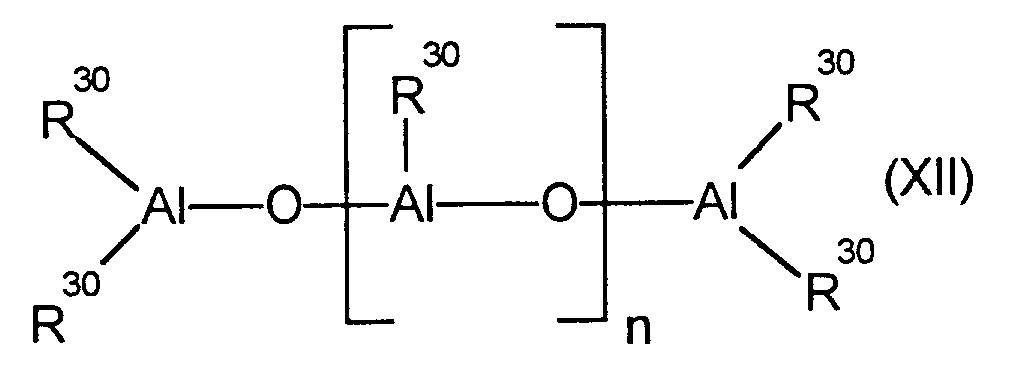
für den linearen Typ und/oder der Formel XIII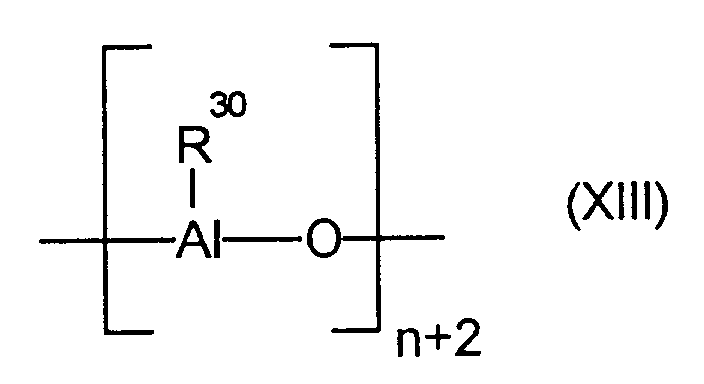
für den cyclischen Typ besteht, wobei in den Formeln XII und XIII die Reste - R³⁰
- gleich oder verschieden sind und eine C₁-C₆-Akygruppe oder Phenyl oder Benzyl bedeuten und
- n
- eine ganze Zahl von 0 bis 50 ist.
- Bevorzugt wird im flüssigen Cycloolefinmonomer in konzentrierten Lösungen polymerisiert, wobei es sich um Suspensionen oder Lösungen handelt.
- Bei der Polymerisationsreaktion wird mindestens ein polycyclisches Olefin der Formel I, II, III, IV, V, VI, VII, VIII oder IX, vorzugsweise ein Cycloolefin der Formel I oder III, worin R¹, R², R³, R⁴, R⁵, R⁶, R⁷ und R⁸ gleich oder verschieden sind und ein Wasserstoffatom oder einen C₁-C₈-Alkylrest bedeuten, wobei gleiche Reste in den verschiedenen Formeln eine unterschiedliche Bedeutung haben können, polymerisiert.
- Als Comonomer wird ein acyclisches Olefin der Formel X eingesetzt, worin R¹⁸, R¹⁹, R²⁰ und R²¹ gleich oder verschieden sind und ein Wasserstoffatom oder einen C₁-C₈-Alkylrest bedeuten. Bevorzugt sind Ethylen oder Propylen.
- Insbesondere werden bevorzugt Copolymere von symmetrischen polycyclischen Olefinen, vorzugsweise der Formeln I und III, mit den acyclischen Olefinen X hergestellt. Unter symmetrischen polycyclischen Olefinen werden insbesondere solche Verbindungen der Formeln I und III verstanden, in denen die Substituenten R¹ und R² chemisch und in ihrer räumlichen Anordnung identisch sind.
- Besonders bevorzugte Cycloolefine sind Norbornen und Tetracyclododecen. Sie werden vorzugsweise mit Ethylen copolymerisiert; besondere Bedeutung besitzen Ethylen/Norbornen-Copolymere.
- Bevorzugte Einbauverhältnisse der Comonomeren I bis VI zu den Comonomeren X in das Copolymer liegen zwischen 45:55 und 55:45 Mol-%. Insbesondere werden Einbauverhältnisse von ca. 50:50 Mol-% bevorzugt.
- Das polycyclische Olefin (I bis IX) wird in einer Menge von 0,1 bis 99,9 Gew.-%, jeweils bezogen auf die Gesamtmenge der Monomeren, eingesetzt.
- Werden Diene der Formeln VII, VIII und/oder IX und/oder Monomere der Formeln I bis VI, die mindestens eine weitere Doppelbindung in einem ihrer Reste aufweisen, eingesetzt, so beträgt deren Einbauverhältnis im Polymer vorzugsweise >0 bis 5 Mol-%.
- Die Konzentration des offenkettigen Olefins ergibt sich aus der Löslichkeit des offenkettigen Olefins in dem Reaktionsmedium bei gegebenem Druck und gegebener Temperatur.
- Geeignete Primärkatalysatoren vom Übergangsmetalltyp bestehen aus einem Metallocen der Formel XI
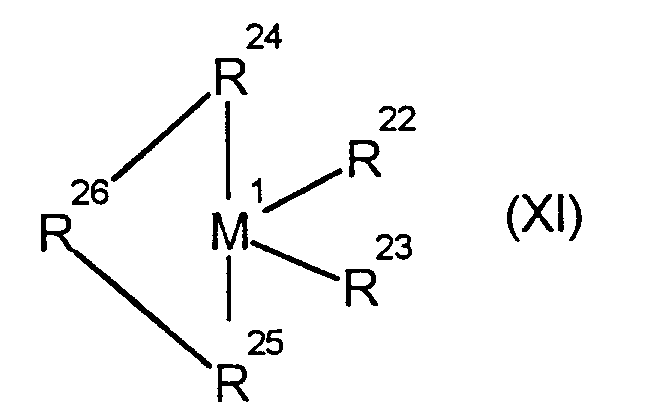
In Formel XI ist M¹ aus der Gruppe Titan, Zirkonium, Hafnium, Vanadium, Niob und Tantal, vorzugsweise Zirkonium und Hafnium. Besonders bevorzugt wird Zirkonium verwendet. Als Cokatalysator ist zum Beispiel Aluminoxan geeignet. - R²² und R²³ sind gleich oder verschieden und bedeuten ein Wasserstoffatom, eine C₁-C₁₀-, vorzugsweise C₁-C₃-Alkylgruppe, eine C₁-C₁₀-, vorzugsweise C₁-C₃-Alkoxygruppe, eine C₆-C₁₀-, vorzugsweise C₆-C₈-Arylgruppe, eine C₆-C₁₀-, vorzugsweise C₆-C₈-Aryloxygruppe, eine C₂-C₁₀-, vorzugsweise C₂-C₄-Alkenylgruppe, eine C₇-C₄₀-, vorzugsweise C₇-C₁₀-Arylalkylgruppe, eine C₇-C₄₀-, vorzugsweise C₇-C₁₂-Alkylarylgruppe, eine C₈-C₄₀-, vorzugsweise C₈-C₁₂-Arylalkenylgruppe oder ein Halogenatom, vorzugsweise Chlor.
- Bevorzugt ist R²⁴ Fluorenyl, Indenyl oder Cyclopentadienyl und R²⁵ Indenyl oder Cyclopentadienyl, wobei diese Reste substituiert sein können und C₁-Symmetrie vorliegt, oder beide Reste sind gleich und bedeuten gegebenenfalls substituiertes Indenyl oder substituiertes Cyclopentadienyl (meso-Form).
- R²⁶ ist eine ein- oder mehrgliedrige Brücke, welche die Reste R²⁴ und R²⁵ verknüpft und bedeutet vorzugsweise

= BR²⁷ = AlR²⁷, -Ge-, -Sn-, -O-, -S-, = SO, = SO₂ = NR²⁷, = CO, = PR²⁷ oder = P(O)R²⁷, wobei R²⁷, R²⁸ und R²⁹ gleich oder verschieden sind und ein Wasserstoffatom, ein Halogenatom, eine C₁-C₁₀-Alkylgruppe, eine C₁-C₁₀-Fluoralkylgruppe, eine C₆-C₁₀-Arylgruppe, eine C₁-C₁₀-Alkoxygruppe, eine C₂-C₁₀-Alkenylgruppe, eine C₇-C₄₀-Arylalkylgruppe, eine C₈-C₄₀-Arylalkenylgruppe oder eine C₇-C₄₀-Alkylarylgruppe bedeuten, oder R²⁷ und R²⁸ oder R²⁷ und R²⁹ bilden jeweils zusammen mit den sie verbindenden Atomen einen C₄-C₆-Alkylring. M² ist bevorzugt Si. - Bevorzugt ist R²⁶ ein Rest
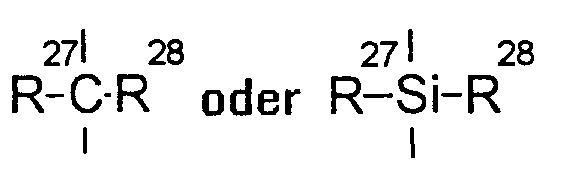
und besonders bevorzugt
- Von den Metallocenen XI, welche in dem Teil des Moleküls, der durch das Zentralatom M¹ und die Substituenten R²⁴-R²⁵ gebildet wird, C₁-Symmetrie aufweisen (d.h. dieser Molekülteil weist keinerlei höhere Symmetrieelemente auf und ist nur durch eine Drehung um 360° - einzählige Achse - mit sich selbst zur Deckung zu bringen), sind besonders zu nennen:
Isopropylen-(9-fluorenyl)(1-(3-isopropyl)cyclopentadienyl)-zirkondichlorid, Isopropylen-(9-fluorenyl)(1-(3-methyl)cyclopentadienyl)-zirkondichlorid, Diphenylmethylen-(9-fluorenyl)(1-(3-methyl)cyclopentadienyl)-zirkondichlorid, Methylphenylmethylen-(9-fluorenyl)(1-(3-methyl)cyclopentadienyl)-zirkondichlo rid, Dimethylsilyl-(9-fluorenyl)(1-(3-methyl)cyclopentadienyl)-zirkondichlorid, Diphenylsilyl-(9-fluorenyl)(1-(3-methyl)cyclopentadienyl)-zirkondichlorid, Diphenylmethylen-(9-fluorenyl)(1-(3-tert.-butyl)cyclopentadienyl)-zirkondichlorid und Isopropylen-(9-fluorenyl)(1-(3-tert.-butyl)cyclopentadienyl)-zirkondichlorid und die entsprechenden Hafniumdichloride. - Zur Bedeutung des Begriffs C₁-Symmetrie vgl. K. Mislow "Einführung in die Stereochemie", Verlag Chemie, 1. Auflage 1967, S. 23 f.
- Allgemein bevorzugt sind Ligandensysteme (R²⁴ - R²⁶), die eine unterschiedliche sterische Wechselwirkung auf die Liganden R²² und R²³ ausüben können. Die Natur der Liganden R²² und R²³ ist dabei ohne Bedeutung.
- Eine weitere mögliche Ausgestaltung des Polymerisationsverfahrens besteht darin, daß man an Stelle oder neben eines Aluminoxans eine salzartige Verbindung z.B. der Formel RxNH4-xBR'₄ oder der Formel R₃PHBR'₄ als Cokatalysator verwendet. Dabei sind x = 1, 2 oder 3, R = C₁-C₆-Alkyl oder Aryl, gleich oder verschieden, und R' = Aryl, das auch fluoriert oder teilfluoriert sein kann. In diesem Fall besteht der Katalysator aus dem Reaktionsprodukt eines Metallocens mit einer der genannten Verbindungen (vgl. EP-A 277 004).
- Falls dem Reaktionsgemisch Lösemittel zugesetzt wird, dann handelt es sich um gebräuchliche inerte Lösemittel wie z.B. aliphatische oder cycloaliphatische Kohlenwasserstoffe, Benzin- bzw. hydrierte Dieselölfraktionen, Toluol, Chlorbenzol, o-Dichlorbenzol oder Chlornaphthalin.
- Die Metallocenverbindung wird in einer Konzentration, bezogen auf das Übergangsmetall, von 10⁻³ bis 10⁻⁸, vorzugsweise 10⁻⁴ bis 10⁻⁷ mol Übergangsmetall pro dm³ Reaktorvolumen angewendet. Das Aluminoxan wird in einer Konzentration von 10⁻⁴ bis 10⁻¹, vorzugsweise 10⁻⁴ bis 2·10⁻² mol pro dm³ Reaktorvolumen verwendet, bezogen auf den Gehalt an Aluminium. Prinzipiell sind aber auch höhere Konzentrationen möglich.
- Bei der Herstellung von Copolymerisaten kann die Variation der Molverhältnisse des polycyclischen Olefins zum eingesetzten offenkettigen Olefin in einem weiten Bereich erfolgen. Bevorzugt werden molare Verhältnisse von 3:1 bis 100:1 Cycloolefin zu offenkettigem Olefin eingesetzt. Durch die Wahl der Polymerisationstemperatur, durch die Konzentration der Katalysatorkomponenten und das eingesetzte Molverhältnis bzw. den Druck des gasförmigen, offenkettigen Olefins läßt sich die Einbaurate an Comonomer beinahe beliebig steuern. Bevorzugt werden Einbauraten zwischen 45 und 55 Mol-% der cyclischen Komponenten und besonders bevorzugt werden Einbauraten von ca. 50 Mol-% der cyclischen Komponenten.
- Die mittlere Molmasse des gebildeten Copolymers läßt sich durch Wasserstoff-Dosierung oder Variation der Temperatur in bekannter Weise steuern.
- Die Polydispersität Mw/Mn der Copolymeren ist mit Werten zwischen 2,0 - 3,5 recht eng. Dadurch resultiert ein Eigenschaftbild der Polymerisate, das diese - nach spezieller Aufbereitung - für die Folienherstellung durch Extrusion besonders geeignet macht.
- Es wurde anhand von NMR-Spektren festgestellt, daß sich diese Cycloolefincopolymere auch in ihrer Mikrostruktur deutlich von denen unterscheiden, die mit herkömmlichen Metallocenkatalysatoren hergestellt worden sind (vgl. Fig. 1). Dieser Unterschied könnte darauf beruhen, daß die hier benutzten Metallocenkatalysatoren aufgrund ihrer speziellen Symmetrie alternierend polymerisieren. Es ist anzunehmen, daß die so hergestellten Cycloolefincopolymere taktische, alternierende Cycloolefin-Olefin-Sequenzen enthalten, die eine strukturelle Differenzierung nach NMR ermöglichen (vgl. Figur 1).
- Um die geforderten Folieneigenschaften zu erhalten, sollten die gewonnenen - Cycloolefincopolymere quasi frei von Katalysator- und Lösungsmittelresten sein. Das in der EP-A 503 422 beschriebene Reinigungsverfahren reicht nicht aus, um daraus Folien mit den oben beschriebenen geforderten Eigenschaften herzustellen. Erst wenn der Restkatalysatorgehalt unter 100 ppm sinkt, ist es möglich Folien mit den geforderten Eigenschaften zu erzielen. Unter Katalysatorresten werden insbesondere die aluminiumhaltigen Cokatalysatoren verstanden, da diese in erheblich höherer Konzentration im Polymeren vorhanden sind. Ist der Aluminiumgehalt auf unter 100, vorzugsweise unter 10, insbesondere unter 1 ppm gesunken, so ist davon auszugehen, daß der Gehalt an Metallocenkatalysatoren noch geringer ist und somit nicht mehr kritisch ist. Gleichfalls sollte darauf geachtet werden, daß keine chlorhaltigen Lösungsmittel wie Salzsäure bei der Aufbereitung der Polymere verwendet werden. Überreste solcher chlorhaltigen Lösungsmittel können zu unerwünschten Braunfärbungen der Folien führen.
- Es hat sich als zweckmäßig erwiesen, die rohen Cycloolefincopolymere in einem Lösungsmittel bevorzugt in Anwesenheit eines Filterhilfsmittels aufzulösen und bei erhöhter Temperatur zu filtrieren. Nachdem die Polymere auf diese Weise von Katalysatorresten befreit sind, werden sie aus der Lösung wieder ausgefällt. Als Lösungsmittel kommen unpolare, gegebenenfalls halogenierte Kohlenwasserstoffe, insbesondere aromatische, aliphatische und cycloaliphatische Kohlenwasserstoffe wie Decalin, Tetralin, Chlornaphthalin oder o-Dichlorbenzol in Frage. Bevorzugt sind solche mit einem hohen Siedepunkt, insbesondere >100°C bis ca. 300°C. Als geeignete Filterhilfsmittel haben sich polare feste Stoffe erwiesen, die unter den Prozessbedingungen unlöslich sind. Beispiele hierfür sind Kieselgur, hergestellt aus Diatomeen-Ablagerungen (z.B.: Celite 545, LuV, Hamburg), Perlite, hergestellt aus obsidianähnlichem Material vulkanischen Ursprungs (z.B.: Celite Perlite I-100) oder modifizierte Cellulose (z.B.: Diacel). Ebenfalls geeignet, wenn auch nicht bevorzugt sind poröser Kohlenstoff und absorptive Asbestfasern. Während des Filtriervorgangs sollte die Temperatur auf mindestens 100°C, bevorzugt mindestens 135°C bis maximal 300°C, besonders bevorzugt 150-170°C gehalten werden. Das gelöste, filtrierte Polymer kann dann schließlich mittels eines polaren Lösungsmittels wie Aceton ausgefällt werden.
- Die Folien können durch verschiedene Verfahren hergestellt werden. Gießen aus Lösung ist möglich, aber die thermoplastische Verarbeitung ist in der Regel vorteilhafter. Plattenpressen eignet sich gut für Versuche, jedoch sind kontinuierliche Verfahren wie Extrusion oder Kalandrieren für die industrielle Herstellung wirtschaftlicher.
- Extrudierte Folien können als Schlauch oder Flachfolie geformt werden. Zur Herstellung von mehrschichtigen Folien empfiehlt sich die Coextrusion.
- Häufig werden die Folien zur weiteren Verbesserung der mechanischen Eigenschaften orientiert. Dies erfolgt durch Streckung. Die Strecktemperaturen sollten zweckmäßigerweise in einem Temperaturintervall von 40°C unter der Glastemperatur (Tg-40°C) bis maximal zur Schmelztemperatur Tm liegen. Die Orientierung kann uniaxial oder biaxial erfolgen.
- Für die industrielle Fertigung eignen sich Strecktemperaturen oberhalb Tg, weil dies wegen der höheren erzielbaren Streckgeschwindigkeiten eine schnellere Fertigung erlaubt. Temperatur, Streckrate und Streckverhältnisse müssen so aufeinander abgestimmt sein, daß die Folie nicht reißt. Die Streckgeschwindigkeit beträgt bevorzugt 1 - 500000 %/Min.. Die Streckverhältnisse in Längs- und Querrichtung betragen jeweils 1,1:1 - 10:1, vorzugsweise 1,5:1 - 4:1. Das Flächenstreckverhältnis sollte vorzugsweise 3-20 betragen.
- Bei biaxialer Orientierung kann die Streckung simultan oder sequentiell durchgeführt werden. Bei Flachfolien sind Tenterverfahren geeignet, aber auch Simultanstreckrahmen. Schlauchfolien werden durch Aufblasen bei gleichzeitigem Abzug biaxial orientiert.
- Ein Vorteil der teilkristallinen Cycloolefincopolymer-Folien gegenüber den amorphen Folien ist ihre bessere Verstreckbarkeit. Amorphe Polymere relaxieren sehr schnell bei einer Streckung über der Glastemperatur Tg, wenn die zur Streckung benötigte Wärme nicht schnell genug abgeführt wird. Durch den Relaxationsprozeß geht dann ein Teil der Orientierung, die durch den Streckprozeß hereingebracht wurde, wieder verloren. Ein Verlust an Orientierung reduziert u.a. die mechanische Festigkeit, Steifigkeit, Zähigkeit, Härte und Transparenz.
- Bei den teilkristallinen Cycloolefincopolymeren geschieht die Relaxation langsamer, so daß der Streckprozeß inklusive Abkühlung der Folie unkritischer als bei amorphen Cycloolefincopolymeren ist.
- Ein weiterer Vorteil einer Folie aus einem teilkristallinen Cycloolefincopolymer gegenüber einer solchen aus einem amorphen liegt in der Möglichkeit, die Kristallinität der Folie nach dem Streckprozeß in einem Temperofen zu erhöhen. Man erreicht damit eine Fixierung der Folie, die sich in verbessertem mechanischen, chemischen und thermischen Verhalten äußert. Die Dauergebrauchstemperatur (Td) der Folie kann sich auch die Fixierung erhöhen; Spannungen werden abgebaut. Die Dimensionsstabilität und die Barriereeigenschaften werden verbessert.
- Es ist auch möglich, durch schnelles Abkühlen des Extrudates, bestehend aus einem kristallierfähigen Cycloolefincopolymer eine wenig kristalline bzw. amorphe Vorfolie herzustellen, die anschließend mit den oben beschriebenen Verfahren mono- oder biaxial gestreckt wird. In einem Temperschritt wird nach dem Streckvorgang die Folie zur Eigenschaftsverbesserung durchkristallisiert.
- Die Oberflächen der Folien können zur Erzielung von z.B. Haftvermittlung oder Bedruckbarkeit oder Antistatik oder Antihaft-Eigenschaften modifiziert werden. Diese Modifizierung kann entweder durch Behandlungsmethoden wie Corona-, Flamm-, Plasma- oder Oxidationsbehandlung erfolgen oder auch durch die Aufbringung einer Beschichtung aus Lösung oder Dispersion.
- In einer bevorzugten Ausführung enthält die Folie feine inerte Partikel, die das Schlupf- und Wickelverhalten verbessern. Solche Partikel, die in Mengen von 0-1% enthalten sein können sind beispielsweise:
SiO₂, Al₂O₃, Silikate mit einem SiO₂-Anteil von mindestens 30 Gew.-%, amorphe und kristalline Tonminerale, Alumosilikate, Oxide von Mg, Zn, Zr und Ti, Sulfate von Ca, Mg und Ba, Phosphate von Li, Na und Ca (inclusive der Monohydrogensalze und Dihydrogensalze), Benzoate von Li, Na und K, Terephthalate von Ca,Ba, Zn und Mn, Titanate von Mg, Ca, Ba, Zn, Cd, Pb, Sr, Mn, Fe, Co und Ni, Chromate von Ba und Pb, Kohlenstoff (z.B. Ruß oder Graphit), Glas (Glaspulver und Glaskugeln), Carbonate von Ca und Mg, Flußspat, Sulfide von Zn und Mo, organische Polymersubstanzen wie Polytetrafluorethylenpolyethylen, Talkum, Lithiumfluorid, und die Ca-, Ba-, Zn- und Mn-Salze von organischen Säuren. - Die Folie kann auch geeignete Additive wie z.B. Stabilisatoren, Gleitmittel oder Antioxidantien enthalten. Prinzipiell sind Additive, die für Polyolefine wie Polyethylen oder Polypropylen verwendet werden, auch für die Cycloolefincopolymerfolien geeignet. Als UV-Stabilisatoren können beispielsweise Absorber wie Hydroxyphenylbenzotriazole, Hydroxybenzophenone, Formamidin oder Benzyliden-Campher, Quencher wie Zimtsäureester oder Nickel-Chelate, Radikalfänger wie sterisch gehinderte Phenole, Hydroperoxidzersetzer wie Nickel- oder Zink-Komplexe schwefelhaltiger Verbindungen oder Lichtstabilisatoren vom HALS-Typ, sowie deren Gemische eingesetzt werden. Als Gleitmittel können beispielsweise verwendet werden: Fettsäuren sowie deren Ester, Amide und Salze, Silikone oder Wachse wie PP- oder PE-Wachse. Als Antioxidantien können beispielsweise zugesetzt werden Radikalfänger wie substituierte Phenole und aromatische Amine und/oder Peroxidzersetzer wie Phosphite, Phosphonate und Thioverbindungen.
- Die erfindungsgemäße Folie kann ein- oder mehrschichtig sein. Mindestens eine Schicht besteht überwiegend, d.h. zu mindestens 85 Gew.-%, bevorzugt zu 90-100 Gew.-%, aus den oben beschriebenen Cycloolefincopolymeren. Eine bevorzugte Ausführung ist die Monofolie.
- In einer anderen bevorzugten Ausführung trägt die erfindungsgemäße Hauptschicht eine oder zwei dünne Polymerdeckschichten mit niedrigeren Erweichungstemperaturen als die Hauptschicht. Ist die dünne Polymerdeckschicht teilkristallin, dann sollte ihre Schmelztemperatur Tm vorzugsweise mindestens 20°C unterhalb Tm der Hauptschicht liegen. Im Falle einer dünnen amorphen Deckschicht sollte deren Glastemperatur Tg um vorzugsweise mindestens 20°C unterhalb Tm der Hauptschicht liegen.
- Zur Eigenschaftsmodifizierung kann die Folie beschichtet sein.
- Die erfindungsgemäße Folie kann zur Eigenschaftsverbesserung andere kompatible oder nicht kompatible Polymere enthalten. Diese Polymere können separate Schichten bilden oder mit dem Cycloolefincopolymeren vermischt sein. Beispiele für solche Polymere sind: Polyethylen, Polypropylen, Polymethylbuten-1, Poly(4-methylpenten-1), Polybuten-1 und Polystyrol, Polyvinylchlorid, Polyvinylidenchlorid, Polyvinylfluorid, Polytetrafluoroethylen, Polychloropren, Polyacrylat, Polymethacrylat, Polyacrylamid, Polyacrylnitril, Acrylnitril/Butadien/Styrol-Copolymere, Acrylnitril/Styrol-Copolymere und Acrylnitril/Styrol/Acrylat-Copolymere, Polyvinylalkohol, Polyvinylacetat, Polyvinylstearat, Polyvinylbenzoat, Polyvinylmaleat, Polyvinylbutyral, Polyallylphthalat, Polyallylmelamin, Copolymere aus den o.g. Monomeren wie Ethylen/Vinylacetat-Copolymer, Polyethylenoxid und Polymere aus Bis-Glycidylether, Polyoxymethylen, Polyoxyethylen und Polyoxymethylen/Ethylenoxid-Copolymere, Polyphenyloxidpolymere, Polycarbonate, Polysulfone, Polyurethane, Nylon 6, Nylon 66, Nylon 11 und Nylon 12, Polyethylenterephthalat, Polybutylenterephthalat und Poly-1,4-dimethylolcyclohexanterephthalat, Polyethylennaphthalat (PEN), Polyethylennaphthalatbibenzoat (PENBB), Phenolformaldehydharze und Melaminformaldehydharze, Cellulose, Cellulosepropionate und Celluloseether sowie Proteine.
- Die erfindungsgemäßen Folien haben Glasumwandlungstemperaturen Tg von 100 °C ≦ Tg ≦ 250 °C und Schmelztemperaturen Tm von 200 °C ≦ Tm ≦ 500 °C. Ihre Dauergebrauchstemperaturen TD betragen

- Die nach DIN 53 455 bestimmten Zug-E-Moduli E der erfindungsgemäßen Folien betragen 1,5 GPa ≦ E ≦ 8 GPa, vorzugsweise 2 GPa ≦ E ≦ 5 GPa. Die Reißfestigkeit σR beträgt 20 MPa ≦ σR ≦ 400 MPa, vorzugsweise 30 MPa ≦ σR ≦ 150 MPa. Die Reißdehnung εR beträgt 1 % ≦ εR ≦ 100 %, vorzugsweise 1 % ≦ εR ≦ 60 %.
- Die Wasseraufnahme liegt unter 0,1 %, insbesondere zwischen 0 bis 0,05 %. Ein besonderer Vorteil der teilkristallinen Cycloolefin-Copolymer-Folien gegenüber den amorphen ist deren ausgezeichnete Lösungsmittelbeständigkeit, insbesondere auch gegenüber aliphatischen, cycloaliphatischen und aromatischen Kohlenwasserstoffen. Die Folie kann verwendet werden als Kondensatorfolie, Elektroisolierfolie, Trennfolie, Reprofolie, Klebebandfolie, Folie zur Herstellung von Folientastaturen, Folienschaltern und als Verpackungsfolie oder als Substrat für Flüssigkristallanzeigen.
- Im Folgenden ist die Erfindung anhand von Beispielen näher erläutert.
- In den nachfolgenden Beispielen werden folgenden Untersuchungsmethoden verwendet.
- Die Glastemperatur (T g ) wurde als sprunghafter Anstieg der Wärmekapazität im DSC-Diagramm bestimmt. Die DSC-Diagramme wurden mit einem Perkin-Elmer DSC 7 aufgenommen.
- Die Viskositätszahl (VZ) wurde entsprechend DIN 53 728 in Dekalin bei 135°C bestimmt.
- Die mechanischen Eigenschaften der Folien wurden gemäß DIN 53 455 mit einer Zugprüfmaschine 1445 der Fa. Zwick an 15 mm breiten Proben einer Einspannlänge von 100 mm untersucht. Der Zug-E-Modul wurde im Dehnungsbereich von 0,3 bis 0,5 % bei einer Dehnungsgeschwindigkeit von 10 mm/min bestimmt. Die Reißfestigkeit und -dehnung wurden bei 100 mm/min bestimmt.
- Die Kugeldruckhärte wurde nach ISO 2039, Teil 1 (30s-Wert) bestimmt.
- Für die Bestimmung der Dichte wurde eine Dichtegradientensäule verwendet.
- Der Restkatalysatorgehalt wurde durch Röntgenfluoreszenzmessung be stimmt.
- Ein 75-dm³-Reaktor wurde mit Ethylen gefüllt und mit 15 dm³ Norbornen und 15 dm³ Decalin gefüllt. Durch mehrfaches Ausdrücken von Ethylen (6 bar) wurde die Lösung mit Ethylen gesättigt. Es wurde ein Druck von 2,5 bar (Überdruck) eingestellt. 500 cm³ toluolische Methylaluminoxanlösung (10,1 Gew.-% Methylaluminoxan der Molmasse 1300 g/mol nach kryoskopischer Bestimmung) in den Reaktor gegeben und 15 min bei 70 °C gerührt. Eine Lösung von 150 mg Isopropylen-(9-fluorenyl)(1-(3-methyl-cyclopentadienyl)-zirkondichlorid in 500 cm³ toluolischer Methylaluminoxanlösung wurde nach 15 minütiger Voraktivierung zugegeben. (Zur Molekulargewichtsregelung kann Wasserstoff vor der Katalysatorzugabe zudosiert werden.)
- Unter Rühren (750 UPM) wurde bei 70 °C polymerisiert, wobei der Ethylendruck durch Nachdosieren bei 2,5 bar gehalten wurde.
- In einen zweiten Rührkessel (150 dm³) wurden 50 l Decalin gefüllt und darin 500 g Diatomeenerde (Celite®, LuV Hamburg) suspendiert. In der Mischung wurden 200 ml Wasser dispergiert. Das Wasser wurde dabei von der Diatomeenerde absorbiert. Der Suspension wurde 0,5 g Antioxidans (Hostanox SE 10) und 0,5 g Peroxidzersetzer (Hostanox 03) zugesetzt und auf 90 °C temperiert.
- Nach 60 min Reaktionszeit wurde die Reaktionslösung schnell in den zweiten Rührkessel abgelassen. Unter Rühren wurde auf 170 °C erhitzt. Dabei wurden ca. 2 bar Druck erreicht.
- Auf dem Filtergewebe einer 120 l Drucknutsche wurde ein Filterkuchen aus 500 g Celite, suspendiert in 10 l einer hydrierten Dieselölfraktion, aufgebaut und die Nutsche anschließend auf 160 °C temperiert.
- Die Polymerlösung wurde über die Drucknutsche filtriert. Dabei wurde so verfahren, daß das Filtrat zunächst 15 min in die Nutsche zurückgefördert wurde (d.h. im Kreis gepumpt wurde). Über der Lösung wurde ein Druck von 2,8 bar Stickstoff aufgebaut.
- Die Polymerlösung wurde anschließend mittels eines Dispergators (Ultraturrmax) in 500 l Aceton eingerührt und dabei gefällt. Die Acetonsuspension wurde über eine 680 l Rührdrucknutsche bei geöffnetem Bodenventil im Kreis gefördert. Nach Schließen des Bodenventils wurde filtriert. Der polymere Feststoff wurde dreimal mit Aceton gewaschen. Der letzten Wäsche wurden 50 g Stabilisator (Irganox 1010, Ciba) zugesetzt.
- Danach wurde das Aceton vollständig abgedrückt und das Produkt bei 100 °C drei Stunden vorgetrocknet. Die Endtrocknung erfolgt 10 Stunden bei 10 mbar und 160 °C bei schwacher Stickstoffüberlagerung im Trockenschrank.
- Es wurden 2100 g farbloses pulverförmiges Polymer erhalten. Die Glastemperatur (Tg) betrug 126 °C und die Schmelztemperatur (Tm) 284°C. Die Viskositätszahl wurde nach einstündigem Lösen bei 180 °C bei 135 °C mit 59 ml/g gemessen. Der Restkatalysatorgehalt betrug 18 ppm.
- Die Polymerisationen wurden analog zu Beispiel 1 durchgeführt, wobei die Ethylenüberdrucke gemäß Tabelle 1 variiert wurden.

- Ein 1,5-dm³-Reaktor wurde mit Ethylen gefüllt und mit 600 cm³ einer 85-gewichtsprozentigen Lösung von Norbornen in Toluol gefüllt. Durch mehrfaches Aufdrücken von Ethylen (6 bar) wurde die Lösung mit Ethylen gesättigt. Es wurde ein Druck von 2 bar (Überdruck) eingestellt. 5 cm³ toluolische Methylaluminoxanlösung (10,1 Gew.-% Methylaluminoxan der Molmasse 1300 g/mol nach kryoskopischer Bestimmung) in den Reaktor gegeben und 15 min bei 40 °C gerührt. Eine Lösung von 5 mg Isopropylen-(9-fluorenyl)(1-(3-methyl)-cyclopentadienyl)-zirkondichlord in 5 cm³ toluolischer Methylaminoxanlösung wurde nach 15-minütiger Voraktivierung zugegeben. (Zur Molekulargewichtsregelung kann Wasserstoff vor der Katalysatorzugabe zudosiert werden.)
- Unter Rühren (750 UPM) wurde eine Stunde bei 40 °C polymerisiert, wobei der Ethylendruck durch Nachdosieren bei 2 bar gehalten wurde.
- Die Reaktionslösung wurde in ein Gefäß abgelassen und schnell in 5 dm³ Aceton eingegossen, 10 min gerührt und anschließend filtriert.
- Der erhaltene Feststoff wurde mehrfach mit 10%iger Salzsäure und Aceton im Wechsel gewaschen. Es wurde neutral gewaschen und nochmals mit Aceton gerührt. Das erneut filtrierte Polymer wurde bei 80 °C und einem Druck von 0,2 bar 15 Stunden getrocknet.
- Es wurden 54 g eines farblosen Polymers erhalten. Es wurde eine Viskositätszahl (VZ) von 131 ml/g, eine Glastemperatur (Tg) von 133 °C und eine Schmelztemperatur (Tm) von 289 °C gemessen. Das Norbornen/Ethylen-Einbauverhältnis ist gemäß NMR-Spektrum ca. 50 Mol-% Norbornen zu 50 Mol-% Ethylen. Der Restkatalysatorgehalt betrug 315 ppm.
- Ein sauberer und trockener 75 dm³-Polymerisationsreaktor mit Rührer wurde mit Stickstoff und dann mit Ethylen gespült und mit 22000 g Norbornen-Schmelze bei 50 °C gefüllt. Unter Rühren wurde dann der Reaktor auf einer Temperatur von 50 °C gehalten und 15 bar Ethylen (Überdruck) aufgedrückt.
- Danach wurden 580 cm³ toluolische Methylaluminoxan-Lösung (MAO-Lsg., 10,1 Gew.-% Methylaluminoxan mit Molmasse 1300 g/mol nach kryoskopischer Bestimmung) in den Reaktor dosiert und die Mischung 15 Minuten bei 50 °C gerührt, wobei durch Nachdosieren der Ethylendruck bei 15 bar gehalten wurde. Parallel dazu wurden 1000 mg Diphenylmethylen-(cyclopentadienyl)-(9-fluorenyl)-zirkondichlorid (Metallocen-Katalysator) in 1000 ml MAO-Lösung (Konzentration und Qualität wie oben) gelöst und durch 15-minütiges Stehenlassen voraktiviert. Dann wurde die Lösung des Komplexes in den Reaktor dosiert und gleich anschließend 3,5 l Wasserstoff über eine Schleuse eindosiert. (Der Wasserstoff diente zur Molekulargewichtsregulierung.) Unter Rühren (700 UPM) wurde dann 45 Minuten bei 50 °C polymerisiert, wobei der Ethylendruck durch Nachdosieren bei 15 bar gehalten wurde.
- Die Aufbereitung erfolgte analog Beispiel 1. Die Filtration wurde bei 70 °C durchgeführt.
- Das Produkt wurde bei 80 °C und 0,2 bar 15 Stunden getrocknet. Es wurde eine Produktmenge von 4500 g erhalten. An dem Produkt wurde eine Viskositätszahl (Vz) von 103 cm³/g und eine Glastemperatur (Tg) von 123 °C gemessen. Es konnte kein Schmelzpunkt nachgewiesen werden. Der Restkatalysatorgehalt betrug 2,1 ppm.
- Aus dem Polymeren, hergestellt gemäß Beispiel 1, wurden 4 mm dicke Spritzgußplatten hergestellt, die anschließend in einer Plattenpresse 15 Minuten lang bei 300 °C zu Folien der Dicke 400 µm mit den Maßen 200x200 mm gepreßt wurden.
- Die Folie war glasklar und wies keine Gelbfärbung auf.
- Die Eigenschaften sind in Tabelle 2 beschrieben.
- Aus Polymeren, hergestellt gemäß Beispiel 8, wurde eine Folie, wie in Beispiel 10 beschrieben, hergestellt.
- Die Folie wies eine deutliche bräunlich-gelbe Färbung auf. Die Folie zeigte Gelpartikel (Stippen), die durch lokale Vernetzungen des Polymers entstanden sein dürften. Außerdem wurde eine Trübung festgestellt, die auf Katalysatorreste zurückgeführt wurde.
- Die Eigenschaften sind in Tabelle 2 beschrieben.
- Aus Polymeren, hergestellt gemäß Beispiel 9, wurde eine Folie, wie in Beispiel 10 beschrieben, hergestellt.
- Die Folie war glasklar und wies keine Gelbfärbung auf.
- Die Eigenschaften sind in Tabelle 2 beschrieben.
Tabelle 2 Vergleich der Eigenschaften Beispiel 10 Beispiel 11 Beispiel 12 E-Modul GPa 4 3,6 3,2 Reißfestigkeit MPa 60 54 46 Reißdehnung % 3 3 3 Tg °C 126 133 123 Tm °C 284 289 - Dichte g/cm³ 1.032 1.030 1.018 Kugeldruckhärte N/mm² 254 246 200 Lichttransmission 1) % 82 41 87 Trübung2) % 5 12 3 Lösungsmittelbeständigkeit3) ΔM in % 0,1 0,1 löslich Toluol 0,1 0,1 löslich Cyclohexan 0 0 !00 Hexan 0,8 0,9 zerfließt Dichlormethan 1,1 1,0 löslich Chloroform 1) gemessen bei der Wellenlänge λ = 500 nm 2) gemessen nach ASTM-D 1003-61 (Gardner) 3) Die Folien wurden gewogen (M1) und anschließend in Toluol, Cyclohexan, Hexan, Chloroform und Dichlormethan bei Raumtemperatur 24 Stunden gelagert. Anschließend wurden die Folien durch kurzes Eintauchen in Pentan gewaschen. Anhaftendes Lösungsmittel verdampfte innerhalb weniger Minuten. Durch erneutes Wiegen (M2), spätestens 3 Minuten nach der Pentan-Wäsche, und Differenzbildung (M2-M1) wurde die prozentuale Masseänderung ermittelt - Fig. 1 zeigt die ¹³C-NMR-Spektren der Polymere, die gemäß Beispiel 1 (Metallocenkatalysator mit C₁-Symmetrie in dem Teil des Metallocenmoleküls, der durch M¹ und R²⁴ und R²⁵ gebildet wird) und Beispiel 9 (herkömmlicher Metallocenkatalysator) erhalten wurden. Die Unterschiede sind deutlich zu erkennen.
H₂C = CH - R²¹ (X)
worin R²¹ ein Wasserstoffatom oder einen C₁-C₁₆-Alkyl- oder C₆-C₁₆-Arylrest bedeutet, gewonnen.
Claims (17)
- Ein- oder mehrschichtige unorientierte oder mono- oder biaxial orientierte Folie bei der mindestens eine Schicht ein teilkristallines Cycloolefincopolymer enthält, welches 0,1 bis 99,9 Gew.-%, bezogen auf die Gesamtmenge der Monomeren, mindestens eines Monomers der Formeln I, II, III, IV, V, VI, VII, VIII oder IX

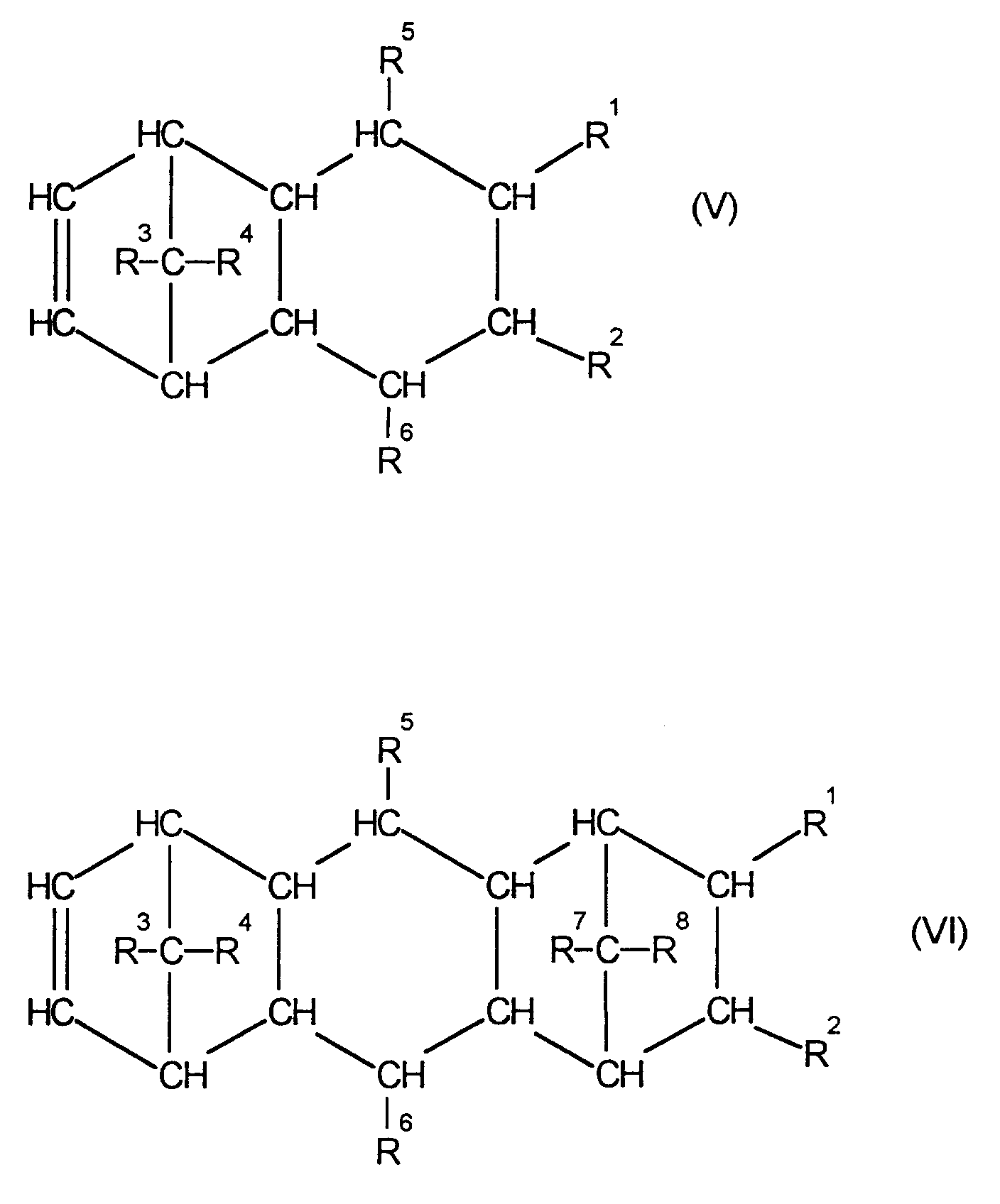
 R¹ bis R⁸ gleich oder verschieden sind und ein Wasserstoffatom, einen C₆-C₁₆-Aryl- oder einen C₁-C₈-Alkylrest bedeuten, wobei gleiche Reste in den verschiedenen Formeln die gleiche oder eine unterschiedliche Bedeutung haben und worinR⁹ bis R²⁰ gleich oder verschieden sind und einen C₁-6₁₆-Alkyl-, C₂-C₁₆-Alkenyl oder C₆-C₁₆-Aryl-Rest bedeuten oder wobei die Restepaare R⁹/R¹⁰, R¹¹/R¹², R¹³/R¹⁴, R¹⁵/R¹⁶, R¹⁷/R¹⁸ und/oder R¹⁹/R²⁰ zusammen mit dem bzw. den C-Atomen, an denen sie gebunden sind einen C₄-C₈-Cycloalkyl-Rest bilden,und 99,9 bis 0,1 Gew.-%, bezogen auf die Gesamtmenge der Monomeren, mindestens eines acyclischen Olefins der Formel X
H₂C = CH - R²¹ (X)
worin R²¹ ein Wasserstoffatom oder einen C₁-C₁₆-Alkyl- oder C₆-C₁₆-Arylrest bedeutet, enthält, dadurch gekennzeichnet, daß das Cycloolefincopolymer einen Gehalt an Katalysatorresten von <100 ppm aufweist. - Folie nach Anspruch 1, dadurch gekennzeichnet, daß die Glastemperatur >100 °C und die Schmelztemperatur >200 °C ist.
- Folie nach Anspruch 1 oder 2, dadurch gekennzeichnet, daß das cyclische Monomer der Formel I, II, III, IV, V und VI symmetrisch ist .
- Folie nach Anspruch 1, 2 oder 3, dadurch gekennzeichnet, daß das Einbauverhältnis von Monomer der Formel I, II, III, IV, V und VI zu dem Monomer der Formel X ca. 50/50 Mol-% ist.
- Folie nach einem oder mehreren der Ansprüche 1 bis 4, dadurch gekennzeichnet, daß das Monomer der Formel I Norbornen ist.
- Folie nach einem oder mehreren der Ansprüche 1 bis 4, dadurch gekennzeichnet, daß das Monomer der Formel I Tetracyclododecen ist.
- Folie nach einem oder mehreren der Ansprüche 1 bis 6, dadurch gekennzeichnet, daß das Cycloolefincopolymer durch Metallocenkatalyse hergestellt ist.
- Folie nach einem oder mehreren der Ansprüche 1 bis 7, dadurch gekennzeichnet, daß das Cycloolefincopolymer aus Norbornen und Ethylen im Molverhältnis 50 : 50 besteht.
- Folie nach einem oder mehreren der Ansprüche 1 bis 8, dadurch gekennzeichnet, daß sie einschichtig ist.
- Folie nach einem oder mehreren der Ansprüche 1 bis 9, dadurch gekennzeichnet, daß sie uniaxial orientiert ist.
- Folie nach einem oder mehreren der Ansprüche 1 bis 9, dadurch gekennzeichnet, daß sie biaxial orientiert ist.
- Folie nach einem oder mehreren der Ansprüche 1 bis 11, dadurch gekennzeichnet, daß sie >0 bis 2 % inerte Partikel enthält.
- Verwendung einer Folie nach einem oder mehreren der Ansprüche 1 bis 12, als Kondensatorfolie.
- Verwendung einer Folie nach einem oder mehreren der Ansprüche 1 bis 12, als Reprofolie.
- Verwendung einer Folie nach einem oder mehreren der Ansprüche 1 bis 12, zur Herstellung von Folientastaturen und Folienschaltern.
- Verwendung einer Folie nach einem oder mehreren der Ansprüche 1 bis 12, als Substrat für Flüssigkristallanzeigen.
- Verwendung einer Folie nach einem oder mehreren der Ansprüche 1 bis 12, als Verpackungsfolie.
Applications Claiming Priority (2)
| Application Number | Priority Date | Filing Date | Title |
|---|---|---|---|
| DE4304310 | 1993-02-12 | ||
| DE4304310A DE4304310A1 (de) | 1993-02-12 | 1993-02-12 | Teilkristalline Cycloolefin-Copolymer-Folie |
Publications (3)
| Publication Number | Publication Date |
|---|---|
| EP0610814A2 true EP0610814A2 (de) | 1994-08-17 |
| EP0610814A3 EP0610814A3 (en) | 1995-10-11 |
| EP0610814B1 EP0610814B1 (de) | 1999-06-02 |
Family
ID=6480349
Family Applications (1)
| Application Number | Title | Priority Date | Filing Date |
|---|---|---|---|
| EP94101638A Expired - Lifetime EP0610814B1 (de) | 1993-02-12 | 1994-02-03 | Teilkristalline Cycloolefin-Copolymer-Folie |
Country Status (10)
| Country | Link |
|---|---|
| US (1) | US5552504A (de) |
| EP (1) | EP0610814B1 (de) |
| JP (1) | JPH06298956A (de) |
| KR (1) | KR100315270B1 (de) |
| CN (1) | CN1052252C (de) |
| AU (1) | AU670849B2 (de) |
| CA (1) | CA2115196C (de) |
| DE (2) | DE4304310A1 (de) |
| MX (1) | MX9401118A (de) |
| TW (1) | TW305858B (de) |
Cited By (7)
| Publication number | Priority date | Publication date | Assignee | Title |
|---|---|---|---|---|
| EP0649737A1 (de) * | 1993-10-26 | 1995-04-26 | Mitsui Petrochemical Industries, Ltd. | Mehrschichtige Polyolefinlaminate und ihre Verwendung |
| EP0677553A3 (de) * | 1994-03-26 | 1996-05-15 | Hoechst Ag | Orientierte Polyolefinfolie mit amorphem Polymer, Verfahren zu ihrer Herstellung und ihre Verwendung. |
| WO1996040806A1 (en) * | 1995-06-07 | 1996-12-19 | Exxon Chemical Patents Inc. | Polymerization of crystalline copolymers of olefins and cyclic olefins |
| EP0773102A4 (de) * | 1994-07-05 | 1997-08-06 | Mitsui Petrochemical Ind | Mehrschichtfolie und ihre verwendung |
| US6551653B1 (en) | 1995-10-20 | 2003-04-22 | Ticona Gmbh | Metalized polyolefin film |
| US8063163B2 (en) | 2005-11-24 | 2011-11-22 | Polypastics Co., Ltd. | Cycloolefin copolymer |
| WO2022089771A1 (de) * | 2020-10-27 | 2022-05-05 | Topas Advanced Polymers Gmbh | Kondensator enthaltend biaxial verstreckte polypropylen-cycloolefinpolymer-folie als dielektrikum und verwendung dieser folie |
Families Citing this family (54)
| Publication number | Priority date | Publication date | Assignee | Title |
|---|---|---|---|---|
| US6964798B2 (en) | 1993-11-16 | 2005-11-15 | Baxter International Inc. | Multi-layered polymer based thin film structure for medical grade products |
| DE19647954A1 (de) * | 1996-11-20 | 1998-06-04 | Hoechst Ag | Biaxial orientierte Folie aus cycloolefinischen Polymeren, Verfahren zu deren Herstellung und deren Verwendung |
| DE19652774A1 (de) * | 1996-12-19 | 1998-06-25 | Hoechst Ag | Folien |
| US6111019A (en) * | 1997-03-31 | 2000-08-29 | Exxon Chemical Patents, Inc. | LLDPE blends with an ethylene-norbornene copolymer for resins of improved toughness and processibility for film production |
| US5942587A (en) * | 1997-11-21 | 1999-08-24 | Exxon Chemical Patents Inc. | Ethylene polymers with a norbornene comonomer for LLDPE like resins of improved toughness and processibility for film production |
| JP4598903B2 (ja) * | 1998-07-24 | 2010-12-15 | 出光興産株式会社 | 電子部品 |
| US6423778B1 (en) * | 1999-06-30 | 2002-07-23 | Basf Corporation | Process for coating olefinic substrates |
| US6590033B2 (en) | 1999-09-09 | 2003-07-08 | Baxter International Inc. | Cycloolefin blends and method for solvent bonding polyolefins |
| US6632318B1 (en) | 1999-09-09 | 2003-10-14 | Baxter International Inc. | Method for solvent bonding polyolefins |
| US6613187B1 (en) | 1999-09-09 | 2003-09-02 | Baxter International Inc | Solvent bonding method for polyolefin materials |
| US6255396B1 (en) | 1999-09-09 | 2001-07-03 | Baxter International Inc. | Cycloolefin blends and method for solvent bonding polyolefins |
| US6297322B1 (en) | 1999-09-09 | 2001-10-02 | Baxter International Inc. | Cycloolefin blends and method for solvent bonding polyolefins |
| MXPA02006197A (es) | 1999-12-20 | 2002-12-09 | Exxon Chemical Patents Inc | Procesos para la preparacion de resinas de poliolefinas usando catalizadores ionicos soportados. |
| US6497676B1 (en) | 2000-02-10 | 2002-12-24 | Baxter International | Method and apparatus for monitoring and controlling peritoneal dialysis therapy |
| US6875719B2 (en) * | 2000-04-27 | 2005-04-05 | Industrial Technology Research Institute | Catalyst composition for preparing olefin polymers |
| DE10036708A1 (de) * | 2000-07-27 | 2002-04-11 | Tesa Ag | Klebeband zum Nachweis des unbefugten Öffnen einer Verpackung |
| US6372848B1 (en) | 2000-10-10 | 2002-04-16 | Baxter International Inc. | Blend of ethylene and α-olefin copolymers obtained using a metallocene catalyst for fabricating medical films and tubings |
| US7511104B2 (en) * | 2001-06-20 | 2009-03-31 | Exxonmobil Chemical Patents Inc. | Polyolefins made by catalyst comprising a noncoordinating anion and articles comprising them |
| US20030125662A1 (en) | 2002-01-03 | 2003-07-03 | Tuan Bui | Method and apparatus for providing medical treatment therapy based on calculated demand |
| US7238164B2 (en) | 2002-07-19 | 2007-07-03 | Baxter International Inc. | Systems, methods and apparatuses for pumping cassette-based therapies |
| EP1592745B1 (de) * | 2003-01-28 | 2007-04-11 | Cryovac, Inc. | Cycloolefinpolymer für hochmodulige folien |
| EP1589055A4 (de) | 2003-01-31 | 2010-06-02 | Zeon Corp | Verfahren zur herstellung eines cycloolefinharzfilms und verfahren zur herstellung einer cycloolefinharzfolie oder eines cycloolefinharzfilms |
| MXPA06011837A (es) | 2004-04-27 | 2007-01-16 | Baxter Int | Sistema de reactor de tanque agitado. |
| US20080113116A1 (en) * | 2004-11-25 | 2008-05-15 | Sekisui Chemical Co., Ltd | Retardation Film |
| AT501412A1 (de) | 2004-11-29 | 2006-08-15 | Ebert Folien Ndl Der Haendler | Dreheinschlagfolie sowie deren verwendung als verpackungsfolie |
| KR100789247B1 (ko) * | 2005-01-05 | 2008-01-02 | 주식회사 엘지화학 | 광반응성 중합체 및 이의 제조 방법 |
| JP2006257399A (ja) * | 2005-02-21 | 2006-09-28 | Kureha Corp | 離型フィルム、積層離型フィルム及びそれらの製造方法 |
| US7989670B2 (en) * | 2005-07-19 | 2011-08-02 | Exxonmobil Chemical Patents Inc. | Process to produce high viscosity fluids |
| WO2007011462A1 (en) | 2005-07-19 | 2007-01-25 | Exxonmobil Chemical Patents Inc. | Lubricants from mixed alpha-olefin feeds |
| US8748361B2 (en) * | 2005-07-19 | 2014-06-10 | Exxonmobil Chemical Patents Inc. | Polyalpha-olefin compositions and processes to produce the same |
| JP5555490B2 (ja) * | 2006-07-19 | 2014-07-23 | エクソンモービル・ケミカル・パテンツ・インク | メタロセン触媒を用いたポリオレフィンの製造方法 |
| US7731689B2 (en) | 2007-02-15 | 2010-06-08 | Baxter International Inc. | Dialysis system having inductive heating |
| US8870812B2 (en) | 2007-02-15 | 2014-10-28 | Baxter International Inc. | Dialysis system having video display with ambient light adjustment |
| US8361023B2 (en) | 2007-02-15 | 2013-01-29 | Baxter International Inc. | Dialysis system with efficient battery back-up |
| US7998115B2 (en) | 2007-02-15 | 2011-08-16 | Baxter International Inc. | Dialysis system having optical flowrate detection |
| US8558964B2 (en) | 2007-02-15 | 2013-10-15 | Baxter International Inc. | Dialysis system having display with electromagnetic compliance (“EMC”) seal |
| US8513478B2 (en) * | 2007-08-01 | 2013-08-20 | Exxonmobil Chemical Patents Inc. | Process to produce polyalphaolefins |
| WO2009097069A1 (en) * | 2008-01-31 | 2009-08-06 | Exxonmobil Chemical Patents Inc. | Improved utilization of linear alpha olefins in the production of metallocene catalyzed poly-alpha olefins |
| US8865959B2 (en) * | 2008-03-18 | 2014-10-21 | Exxonmobil Chemical Patents Inc. | Process for synthetic lubricant production |
| CN101977944A (zh) | 2008-03-31 | 2011-02-16 | 埃克森美孚化学专利公司 | 剪切稳定的高粘度pao的制备 |
| CN102666806B (zh) * | 2009-12-24 | 2015-09-16 | 埃克森美孚化学专利公司 | 用于生产新型合成基础油料的方法 |
| US9815915B2 (en) | 2010-09-03 | 2017-11-14 | Exxonmobil Chemical Patents Inc. | Production of liquid polyolefins |
| US9234151B2 (en) | 2011-10-10 | 2016-01-12 | Exxonmobil Research And Engineering Company | Lubricating compositions |
| KR101414417B1 (ko) * | 2012-03-26 | 2014-07-01 | 신흥에스이씨주식회사 | 고내열성 전극단자용 필름, 이의 제조방법 및 이에 의한 전극단자 구조 |
| TWI505868B (zh) * | 2014-08-18 | 2015-11-01 | 中原大學 | 阻水氣複合膜及其製備方法 |
| CN108602928B (zh) * | 2016-02-12 | 2022-01-28 | 埃克森美孚化学专利公司 | 环烯烃共聚物及其制备方法 |
| EP3455286B8 (de) * | 2016-05-12 | 2021-03-10 | SHPP Global Technologies B.V. | Kondensatorfolien mit hoher temperaturleistung, verfahren zur herstellung und artikel daraus |
| DE102017004111A1 (de) | 2017-04-27 | 2018-10-31 | Topas Advanced Polymers Gmbh | Polyolefinfolie und deren Verwendung |
| DE102017118202A1 (de) | 2017-05-15 | 2018-11-15 | Epcos Ag | Folienkondensator |
| US11179516B2 (en) | 2017-06-22 | 2021-11-23 | Baxter International Inc. | Systems and methods for incorporating patient pressure into medical fluid delivery |
| CN109593152B (zh) * | 2017-09-30 | 2022-01-28 | 中国石化扬子石油化工有限公司 | 一种乙烯-环烯烃的共聚合方法 |
| WO2019168603A1 (en) | 2018-02-28 | 2019-09-06 | Exxonmobil Chemical Patents Inc. | Polyethylene and cyclic olefin copolymer blend compositions with oxygen barrier properties and articles made therefrom |
| DE102021128332A1 (de) | 2021-10-29 | 2023-05-04 | Brückner Maschinenbau GmbH & Co. KG | Biaxial-orientierte Folie enthaltend Cycloolefinpolymere und alpha-Olefinpolymere, Verfahren zu ihrer Herstellung, sowie ihre Verwendung im Kondensator |
| JP2023079212A (ja) * | 2021-11-26 | 2023-06-07 | 三井化学株式会社 | 環状オレフィン系共重合体および環状オレフィン系共重合体の製造方法 |
Family Cites Families (8)
| Publication number | Priority date | Publication date | Assignee | Title |
|---|---|---|---|---|
| DE241971C (de) * | ||||
| DE224538C (de) * | ||||
| IL85097A (en) * | 1987-01-30 | 1992-02-16 | Exxon Chemical Patents Inc | Catalysts based on derivatives of a bis(cyclopentadienyl)group ivb metal compound,their preparation and their use in polymerization processes |
| JPH0819189B2 (ja) * | 1987-10-02 | 1996-02-28 | 三井石油化学工業株式会社 | 環状オレフイン系ランダム共重合体の製法 |
| CA2010320C (en) * | 1989-02-20 | 2001-04-17 | Yohzoh Yamamoto | Sheet or film of cyclo-olefin polymer |
| AU634533B2 (en) * | 1989-03-21 | 1993-02-25 | United States of America, as represented by the Secretary, U.S. Department of Commerce, The | Matrix metalloproteinase inhibitor peptides |
| ATE223440T1 (de) * | 1991-03-09 | 2002-09-15 | Basell Polyolefine Gmbh | Metallocen und katalysator |
| TW286324B (de) * | 1992-04-22 | 1996-09-21 | Hoechst Ag |
-
1993
- 1993-02-12 DE DE4304310A patent/DE4304310A1/de not_active Withdrawn
-
1994
- 1994-02-03 DE DE59408319T patent/DE59408319D1/de not_active Expired - Fee Related
- 1994-02-03 EP EP94101638A patent/EP0610814B1/de not_active Expired - Lifetime
- 1994-02-08 CN CN94101366A patent/CN1052252C/zh not_active Expired - Fee Related
- 1994-02-08 CA CA002115196A patent/CA2115196C/en not_active Expired - Fee Related
- 1994-02-10 AU AU55051/94A patent/AU670849B2/en not_active Ceased
- 1994-02-11 MX MX9401118A patent/MX9401118A/es unknown
- 1994-02-12 KR KR1019940002498A patent/KR100315270B1/ko not_active Expired - Fee Related
- 1994-02-14 US US08/195,077 patent/US5552504A/en not_active Expired - Fee Related
- 1994-02-14 JP JP6039179A patent/JPH06298956A/ja active Pending
- 1994-02-18 TW TW083101322A patent/TW305858B/zh active
Cited By (12)
| Publication number | Priority date | Publication date | Assignee | Title |
|---|---|---|---|---|
| EP0649737A1 (de) * | 1993-10-26 | 1995-04-26 | Mitsui Petrochemical Industries, Ltd. | Mehrschichtige Polyolefinlaminate und ihre Verwendung |
| US5532030A (en) * | 1993-10-26 | 1996-07-02 | Mitsui Petrochemical Industries, Ltd. | Polyolefin multilayer laminate, vessel and packaging material |
| EP0677553A3 (de) * | 1994-03-26 | 1996-05-15 | Hoechst Ag | Orientierte Polyolefinfolie mit amorphem Polymer, Verfahren zu ihrer Herstellung und ihre Verwendung. |
| US5573717A (en) * | 1994-03-26 | 1996-11-12 | Hoechst Aktiengesellschaft | Oriented polyolefin film with amorphous polymer, a process for its production and its use |
| US5885704A (en) * | 1994-03-26 | 1999-03-23 | Ticona Gmbh | Oriented polyolefin film with amorphous polymer, a process for its production and its use |
| EP0773102A4 (de) * | 1994-07-05 | 1997-08-06 | Mitsui Petrochemical Ind | Mehrschichtfolie und ihre verwendung |
| US6165573A (en) * | 1994-07-05 | 2000-12-26 | Mitsui Petrochemical Industries Ltd | Multi-layer laminates and uses thereof |
| WO1996040806A1 (en) * | 1995-06-07 | 1996-12-19 | Exxon Chemical Patents Inc. | Polymerization of crystalline copolymers of olefins and cyclic olefins |
| US5621054A (en) * | 1995-06-07 | 1997-04-15 | Exxon Chemical Patents Inc. | Copolymerization process for the preparation of crystalline copolymers of olefins and cyclic olefins |
| US6551653B1 (en) | 1995-10-20 | 2003-04-22 | Ticona Gmbh | Metalized polyolefin film |
| US8063163B2 (en) | 2005-11-24 | 2011-11-22 | Polypastics Co., Ltd. | Cycloolefin copolymer |
| WO2022089771A1 (de) * | 2020-10-27 | 2022-05-05 | Topas Advanced Polymers Gmbh | Kondensator enthaltend biaxial verstreckte polypropylen-cycloolefinpolymer-folie als dielektrikum und verwendung dieser folie |
Also Published As
| Publication number | Publication date |
|---|---|
| AU670849B2 (en) | 1996-08-01 |
| CN1052252C (zh) | 2000-05-10 |
| KR100315270B1 (ko) | 2002-02-19 |
| DE59408319D1 (de) | 1999-07-08 |
| DE4304310A1 (de) | 1994-08-18 |
| EP0610814B1 (de) | 1999-06-02 |
| TW305858B (de) | 1997-05-21 |
| US5552504A (en) | 1996-09-03 |
| CN1101057A (zh) | 1995-04-05 |
| AU5505194A (en) | 1994-08-18 |
| JPH06298956A (ja) | 1994-10-25 |
| MX9401118A (es) | 1994-08-31 |
| EP0610814A3 (en) | 1995-10-11 |
| CA2115196A1 (en) | 1994-08-13 |
| CA2115196C (en) | 2004-11-30 |
Similar Documents
| Publication | Publication Date | Title |
|---|---|---|
| EP0610814B1 (de) | Teilkristalline Cycloolefin-Copolymer-Folie | |
| EP0610816B1 (de) | Steife Cycloolefincopolymer-Folie | |
| EP0610815B1 (de) | Folie aus Cycloolefincopolymeren | |
| EP0485893B1 (de) | Massepolymerisation mit speziellen Metallocenkatalysatoren zur Herstellung von Cycloolefinpolymeren | |
| EP0683797B1 (de) | Verfahren zur herstellung von cycloolefincopolymeren mit niedriger schmelzeviskosität und niedriger optischer dämpfung | |
| EP0610851B1 (de) | Verfahren zur Herstellung von Cycloolefincopolymeren | |
| EP0503422B1 (de) | Verfahren zur Herstellung chemisch einheitlicher Cycloolefincopolymere | |
| EP0647676B1 (de) | Modifiziertes Cycloolefincopolymer | |
| EP0690078B1 (de) | Cycloolefinpolymere | |
| EP0501370B1 (de) | Verfahren zur Herstellung von Cycloolefin(co)polymeren mit enger Molekulargewichtsverteilung | |
| EP0844077B1 (de) | Biaxial orientierte Folie aus cycloolefinischen Polymeren, Verfahren zu ihrer Herstellung und ihre Verwendung | |
| EP0946618B1 (de) | Cycloolefincopolymere, ihre verwendung und daraus hergestellte formkörper | |
| EP1268661B1 (de) | Polymergemisch enthaltend ein cycloolefinpolymer und ein amorphes cycloolefinpolymer | |
| DE2830160C2 (de) | ||
| EP0769371B1 (de) | Metallisierte Polyolefinfolie | |
| EP0610847B1 (de) | Fasern aus Cycloolefincopolymeren | |
| EP0647677A1 (de) | Polymer-Legierung | |
| EP0700406B1 (de) | Statistische copolymerisate des propylens | |
| DE4213219A1 (de) | Polymerlegierungen aus Cycloolefinpolymeren und Polyolefinen | |
| EP0683798A1 (de) | Cycloolefincopolymere mit hoher reissfestigkeit und niedriger optischer dämpfung |
Legal Events
| Date | Code | Title | Description |
|---|---|---|---|
| PUAI | Public reference made under article 153(3) epc to a published international application that has entered the european phase |
Free format text: ORIGINAL CODE: 0009012 |
|
| AK | Designated contracting states |
Kind code of ref document: A2 Designated state(s): DE FR GB IT LU NL |
|
| PUAL | Search report despatched |
Free format text: ORIGINAL CODE: 0009013 |
|
| AK | Designated contracting states |
Kind code of ref document: A3 Designated state(s): DE FR GB IT LU NL |
|
| 17P | Request for examination filed |
Effective date: 19960411 |
|
| 17Q | First examination report despatched |
Effective date: 19970807 |
|
| RAP1 | Party data changed (applicant data changed or rights of an application transferred) |
Owner name: TICONA GMBH |
|
| GRAG | Despatch of communication of intention to grant |
Free format text: ORIGINAL CODE: EPIDOS AGRA |
|
| RAP1 | Party data changed (applicant data changed or rights of an application transferred) |
Owner name: TICONA GMBH |
|
| GRAG | Despatch of communication of intention to grant |
Free format text: ORIGINAL CODE: EPIDOS AGRA |
|
| GRAH | Despatch of communication of intention to grant a patent |
Free format text: ORIGINAL CODE: EPIDOS IGRA |
|
| GRAH | Despatch of communication of intention to grant a patent |
Free format text: ORIGINAL CODE: EPIDOS IGRA |
|
| GRAA | (expected) grant |
Free format text: ORIGINAL CODE: 0009210 |
|
| AK | Designated contracting states |
Kind code of ref document: B1 Designated state(s): DE FR GB IT LU NL |
|
| REF | Corresponds to: |
Ref document number: 59408319 Country of ref document: DE Date of ref document: 19990708 |
|
| GBT | Gb: translation of ep patent filed (gb section 77(6)(a)/1977) |
Effective date: 19990625 |
|
| ITF | It: translation for a ep patent filed | ||
| ET | Fr: translation filed | ||
| PLBE | No opposition filed within time limit |
Free format text: ORIGINAL CODE: 0009261 |
|
| STAA | Information on the status of an ep patent application or granted ep patent |
Free format text: STATUS: NO OPPOSITION FILED WITHIN TIME LIMIT |
|
| 26N | No opposition filed | ||
| REG | Reference to a national code |
Ref country code: GB Ref legal event code: IF02 |
|
| PGFP | Annual fee paid to national office [announced via postgrant information from national office to epo] |
Ref country code: DE Payment date: 20060214 Year of fee payment: 13 |
|
| PGFP | Annual fee paid to national office [announced via postgrant information from national office to epo] |
Ref country code: NL Payment date: 20060215 Year of fee payment: 13 Ref country code: LU Payment date: 20060215 Year of fee payment: 13 |
|
| PGFP | Annual fee paid to national office [announced via postgrant information from national office to epo] |
Ref country code: FR Payment date: 20060216 Year of fee payment: 13 |
|
| PGFP | Annual fee paid to national office [announced via postgrant information from national office to epo] |
Ref country code: GB Payment date: 20060221 Year of fee payment: 13 |
|
| PGFP | Annual fee paid to national office [announced via postgrant information from national office to epo] |
Ref country code: IT Payment date: 20060228 Year of fee payment: 13 |
|
| GBPC | Gb: european patent ceased through non-payment of renewal fee |
Effective date: 20070203 |
|
| NLV4 | Nl: lapsed or anulled due to non-payment of the annual fee |
Effective date: 20070901 |
|
| REG | Reference to a national code |
Ref country code: FR Ref legal event code: ST Effective date: 20071030 |
|
| PG25 | Lapsed in a contracting state [announced via postgrant information from national office to epo] |
Ref country code: NL Free format text: LAPSE BECAUSE OF NON-PAYMENT OF DUE FEES Effective date: 20070901 Ref country code: DE Free format text: LAPSE BECAUSE OF NON-PAYMENT OF DUE FEES Effective date: 20070901 |
|
| PG25 | Lapsed in a contracting state [announced via postgrant information from national office to epo] |
Ref country code: GB Free format text: LAPSE BECAUSE OF NON-PAYMENT OF DUE FEES Effective date: 20070203 Ref country code: FR Free format text: LAPSE BECAUSE OF NON-PAYMENT OF DUE FEES Effective date: 20070228 |
|
| PG25 | Lapsed in a contracting state [announced via postgrant information from national office to epo] |
Ref country code: LU Free format text: LAPSE BECAUSE OF NON-PAYMENT OF DUE FEES Effective date: 20070203 |
|
| PG25 | Lapsed in a contracting state [announced via postgrant information from national office to epo] |
Ref country code: IT Free format text: LAPSE BECAUSE OF NON-PAYMENT OF DUE FEES Effective date: 20070203 |