EP0610953B1 - Thermoplastische Schaumstoffgegenstände und deren Herstellungsverfahren - Google Patents
Thermoplastische Schaumstoffgegenstände und deren Herstellungsverfahren Download PDFInfo
- Publication number
- EP0610953B1 EP0610953B1 EP94102162A EP94102162A EP0610953B1 EP 0610953 B1 EP0610953 B1 EP 0610953B1 EP 94102162 A EP94102162 A EP 94102162A EP 94102162 A EP94102162 A EP 94102162A EP 0610953 B1 EP0610953 B1 EP 0610953B1
- Authority
- EP
- European Patent Office
- Prior art keywords
- temperature
- pressure
- density
- foamed
- polymer
- Prior art date
- Legal status (The legal status is an assumption and is not a legal conclusion. Google has not performed a legal analysis and makes no representation as to the accuracy of the status listed.)
- Expired - Lifetime
Links
- 229920001169 thermoplastic Polymers 0.000 title claims description 58
- 239000004416 thermosoftening plastic Substances 0.000 title claims description 17
- 238000004519 manufacturing process Methods 0.000 title description 5
- 238000000034 method Methods 0.000 claims description 80
- 210000004027 cell Anatomy 0.000 claims description 78
- 230000008569 process Effects 0.000 claims description 65
- CURLTUGMZLYLDI-UHFFFAOYSA-N Carbon dioxide Chemical compound O=C=O CURLTUGMZLYLDI-UHFFFAOYSA-N 0.000 claims description 54
- 239000006260 foam Substances 0.000 claims description 49
- 239000012530 fluid Substances 0.000 claims description 40
- 229910002092 carbon dioxide Inorganic materials 0.000 claims description 30
- 239000001569 carbon dioxide Substances 0.000 claims description 30
- 239000000654 additive Substances 0.000 claims description 26
- 239000002904 solvent Substances 0.000 claims description 19
- VGGSQFUCUMXWEO-UHFFFAOYSA-N Ethene Chemical compound C=C VGGSQFUCUMXWEO-UHFFFAOYSA-N 0.000 claims description 17
- 239000005977 Ethylene Substances 0.000 claims description 15
- 230000000996 additive effect Effects 0.000 claims description 12
- 238000013022 venting Methods 0.000 claims description 12
- XPDWGBQVDMORPB-UHFFFAOYSA-N Fluoroform Chemical compound FC(F)F XPDWGBQVDMORPB-UHFFFAOYSA-N 0.000 claims description 10
- 230000009477 glass transition Effects 0.000 claims description 9
- GQPLMRYTRLFLPF-UHFFFAOYSA-N Nitrous Oxide Chemical compound [O-][N+]#N GQPLMRYTRLFLPF-UHFFFAOYSA-N 0.000 claims description 8
- 238000010438 heat treatment Methods 0.000 claims description 8
- 239000002861 polymer material Substances 0.000 claims description 7
- 239000007787 solid Substances 0.000 claims description 7
- BFKJFAAPBSQJPD-UHFFFAOYSA-N tetrafluoroethene Chemical group FC(F)=C(F)F BFKJFAAPBSQJPD-UHFFFAOYSA-N 0.000 claims description 7
- BQCIDUSAKPWEOX-UHFFFAOYSA-N 1,1-Difluoroethene Chemical group FC(F)=C BQCIDUSAKPWEOX-UHFFFAOYSA-N 0.000 claims description 5
- OTMSDBZUPAUEDD-UHFFFAOYSA-N Ethane Chemical compound CC OTMSDBZUPAUEDD-UHFFFAOYSA-N 0.000 claims description 5
- WMIYKQLTONQJES-UHFFFAOYSA-N hexafluoroethane Chemical compound FC(F)(F)C(F)(F)F WMIYKQLTONQJES-UHFFFAOYSA-N 0.000 claims description 5
- 238000009738 saturating Methods 0.000 claims description 5
- TXEYQDLBPFQVAA-UHFFFAOYSA-N tetrafluoromethane Chemical compound FC(F)(F)F TXEYQDLBPFQVAA-UHFFFAOYSA-N 0.000 claims description 5
- 210000002421 cell wall Anatomy 0.000 claims description 4
- 239000001272 nitrous oxide Substances 0.000 claims description 4
- 230000001413 cellular effect Effects 0.000 claims description 3
- 230000001143 conditioned effect Effects 0.000 claims description 3
- 229920000642 polymer Polymers 0.000 description 84
- 239000007789 gas Substances 0.000 description 42
- 239000000463 material Substances 0.000 description 34
- 238000005187 foaming Methods 0.000 description 25
- -1 triacetates Chemical compound 0.000 description 19
- 239000007858 starting material Substances 0.000 description 16
- YMWUJEATGCHHMB-UHFFFAOYSA-N Dichloromethane Chemical group ClCCl YMWUJEATGCHHMB-UHFFFAOYSA-N 0.000 description 15
- 239000004697 Polyetherimide Substances 0.000 description 14
- 229920001601 polyetherimide Polymers 0.000 description 14
- 239000007788 liquid Substances 0.000 description 13
- IJGRMHOSHXDMSA-UHFFFAOYSA-N Atomic nitrogen Chemical compound N#N IJGRMHOSHXDMSA-UHFFFAOYSA-N 0.000 description 12
- 239000011324 bead Substances 0.000 description 12
- 239000004926 polymethyl methacrylate Substances 0.000 description 11
- 229920002223 polystyrene Polymers 0.000 description 11
- 239000004793 Polystyrene Substances 0.000 description 10
- 239000004014 plasticizer Substances 0.000 description 10
- 229920003229 poly(methyl methacrylate) Polymers 0.000 description 9
- 239000008188 pellet Substances 0.000 description 8
- 229920006395 saturated elastomer Polymers 0.000 description 8
- 239000000126 substance Substances 0.000 description 8
- 230000000694 effects Effects 0.000 description 7
- 239000003921 oil Substances 0.000 description 7
- 239000004417 polycarbonate Substances 0.000 description 7
- 229910052757 nitrogen Inorganic materials 0.000 description 6
- 229920000515 polycarbonate Polymers 0.000 description 6
- 230000009467 reduction Effects 0.000 description 6
- 239000011800 void material Substances 0.000 description 6
- 239000004604 Blowing Agent Substances 0.000 description 5
- 239000004698 Polyethylene Substances 0.000 description 5
- 229920004738 ULTEM® Polymers 0.000 description 5
- 230000008901 benefit Effects 0.000 description 5
- 150000001875 compounds Chemical class 0.000 description 5
- 229920001577 copolymer Polymers 0.000 description 5
- 230000001419 dependent effect Effects 0.000 description 5
- 238000009792 diffusion process Methods 0.000 description 5
- 239000000835 fiber Substances 0.000 description 5
- 239000002245 particle Substances 0.000 description 5
- 229920000573 polyethylene Polymers 0.000 description 5
- 230000000717 retained effect Effects 0.000 description 5
- 238000001878 scanning electron micrograph Methods 0.000 description 5
- 239000011162 core material Substances 0.000 description 4
- 239000010408 film Substances 0.000 description 4
- VNWKTOKETHGBQD-UHFFFAOYSA-N methane Chemical compound C VNWKTOKETHGBQD-UHFFFAOYSA-N 0.000 description 4
- 230000035515 penetration Effects 0.000 description 4
- 230000000704 physical effect Effects 0.000 description 4
- 238000000053 physical method Methods 0.000 description 4
- 229920003023 plastic Polymers 0.000 description 4
- 239000004033 plastic Substances 0.000 description 4
- 229920002635 polyurethane Polymers 0.000 description 4
- 239000004814 polyurethane Substances 0.000 description 4
- DQEFEBPAPFSJLV-UHFFFAOYSA-N Cellulose propionate Chemical compound CCC(=O)OCC1OC(OC(=O)CC)C(OC(=O)CC)C(OC(=O)CC)C1OC1C(OC(=O)CC)C(OC(=O)CC)C(OC(=O)CC)C(COC(=O)CC)O1 DQEFEBPAPFSJLV-UHFFFAOYSA-N 0.000 description 3
- 238000004965 Hartree-Fock calculation Methods 0.000 description 3
- 239000002671 adjuvant Substances 0.000 description 3
- 238000004458 analytical method Methods 0.000 description 3
- 239000003963 antioxidant agent Substances 0.000 description 3
- 230000010261 cell growth Effects 0.000 description 3
- 229920006218 cellulose propionate Polymers 0.000 description 3
- 239000003086 colorant Substances 0.000 description 3
- 238000001816 cooling Methods 0.000 description 3
- 239000007822 coupling agent Substances 0.000 description 3
- 239000003995 emulsifying agent Substances 0.000 description 3
- 239000000945 filler Substances 0.000 description 3
- 239000003063 flame retardant Substances 0.000 description 3
- 239000011521 glass Substances 0.000 description 3
- 239000012760 heat stabilizer Substances 0.000 description 3
- 229920001903 high density polyethylene Polymers 0.000 description 3
- 239000004700 high-density polyethylene Substances 0.000 description 3
- 229920000092 linear low density polyethylene Polymers 0.000 description 3
- 239000004707 linear low-density polyethylene Substances 0.000 description 3
- 239000004620 low density foam Substances 0.000 description 3
- 239000000314 lubricant Substances 0.000 description 3
- 239000006082 mold release agent Substances 0.000 description 3
- 229920002959 polymer blend Polymers 0.000 description 3
- 239000003755 preservative agent Substances 0.000 description 3
- 238000012545 processing Methods 0.000 description 3
- 238000010791 quenching Methods 0.000 description 3
- 230000002787 reinforcement Effects 0.000 description 3
- 238000007614 solvation Methods 0.000 description 3
- 239000000326 ultraviolet stabilizing agent Substances 0.000 description 3
- XLYOFNOQVPJJNP-UHFFFAOYSA-N water Substances O XLYOFNOQVPJJNP-UHFFFAOYSA-N 0.000 description 3
- HSFWRNGVRCDJHI-UHFFFAOYSA-N Acetylene Chemical compound C#C HSFWRNGVRCDJHI-UHFFFAOYSA-N 0.000 description 2
- KAKZBPTYRLMSJV-UHFFFAOYSA-N Butadiene Chemical compound C=CC=C KAKZBPTYRLMSJV-UHFFFAOYSA-N 0.000 description 2
- 229920005439 Perspex® Polymers 0.000 description 2
- XYFCBTPGUUZFHI-UHFFFAOYSA-N Phosphine Chemical compound P XYFCBTPGUUZFHI-UHFFFAOYSA-N 0.000 description 2
- 239000004696 Poly ether ether ketone Substances 0.000 description 2
- 239000004743 Polypropylene Substances 0.000 description 2
- 241000183024 Populus tremula Species 0.000 description 2
- PPBRXRYQALVLMV-UHFFFAOYSA-N Styrene Chemical compound C=CC1=CC=CC=C1 PPBRXRYQALVLMV-UHFFFAOYSA-N 0.000 description 2
- 229920004747 ULTEM® 1000 Polymers 0.000 description 2
- 230000009471 action Effects 0.000 description 2
- 230000015572 biosynthetic process Effects 0.000 description 2
- WTEOIRVLGSZEPR-UHFFFAOYSA-N boron trifluoride Chemical compound FB(F)F WTEOIRVLGSZEPR-UHFFFAOYSA-N 0.000 description 2
- 229910052799 carbon Inorganic materials 0.000 description 2
- 210000003850 cellular structure Anatomy 0.000 description 2
- 238000006243 chemical reaction Methods 0.000 description 2
- 239000002131 composite material Substances 0.000 description 2
- 238000001035 drying Methods 0.000 description 2
- 238000000605 extraction Methods 0.000 description 2
- NBVXSUQYWXRMNV-UHFFFAOYSA-N fluoromethane Chemical compound FC NBVXSUQYWXRMNV-UHFFFAOYSA-N 0.000 description 2
- 210000000497 foam cell Anatomy 0.000 description 2
- 230000000977 initiatory effect Effects 0.000 description 2
- 239000002184 metal Substances 0.000 description 2
- 229910052751 metal Inorganic materials 0.000 description 2
- 239000000203 mixture Substances 0.000 description 2
- 238000012986 modification Methods 0.000 description 2
- 230000004048 modification Effects 0.000 description 2
- 239000002667 nucleating agent Substances 0.000 description 2
- 230000006911 nucleation Effects 0.000 description 2
- 238000010899 nucleation Methods 0.000 description 2
- 229920002530 polyetherether ketone Polymers 0.000 description 2
- 229920001155 polypropylene Polymers 0.000 description 2
- 239000000843 powder Substances 0.000 description 2
- 238000002360 preparation method Methods 0.000 description 2
- 238000007711 solidification Methods 0.000 description 2
- 230000008023 solidification Effects 0.000 description 2
- 229910001220 stainless steel Inorganic materials 0.000 description 2
- 239000010935 stainless steel Substances 0.000 description 2
- GFADZIUESKAXAK-UHFFFAOYSA-N tetrafluorohydrazine Chemical compound FN(F)N(F)F GFADZIUESKAXAK-UHFFFAOYSA-N 0.000 description 2
- SYNPRNNJJLRHTI-UHFFFAOYSA-N 2-(hydroxymethyl)butane-1,4-diol Chemical compound OCCC(CO)CO SYNPRNNJJLRHTI-UHFFFAOYSA-N 0.000 description 1
- NLHHRLWOUZZQLW-UHFFFAOYSA-N Acrylonitrile Chemical compound C=CC#N NLHHRLWOUZZQLW-UHFFFAOYSA-N 0.000 description 1
- 238000012935 Averaging Methods 0.000 description 1
- 229910015900 BF3 Inorganic materials 0.000 description 1
- 229920002284 Cellulose triacetate Polymers 0.000 description 1
- VEXZGXHMUGYJMC-DYCDLGHISA-N Deuterium chloride Chemical compound [2H]Cl VEXZGXHMUGYJMC-DYCDLGHISA-N 0.000 description 1
- 239000001856 Ethyl cellulose Substances 0.000 description 1
- ZZSNKZQZMQGXPY-UHFFFAOYSA-N Ethyl cellulose Chemical compound CCOCC1OC(OC)C(OCC)C(OCC)C1OC1C(O)C(O)C(OC)C(CO)O1 ZZSNKZQZMQGXPY-UHFFFAOYSA-N 0.000 description 1
- VEXZGXHMUGYJMC-UHFFFAOYSA-N Hydrochloric acid Chemical compound Cl VEXZGXHMUGYJMC-UHFFFAOYSA-N 0.000 description 1
- VVQNEPGJFQJSBK-UHFFFAOYSA-N Methyl methacrylate Chemical group COC(=O)C(C)=C VVQNEPGJFQJSBK-UHFFFAOYSA-N 0.000 description 1
- 229920002020 Microcellular plastic Polymers 0.000 description 1
- 239000004727 Noryl Substances 0.000 description 1
- 229920001207 Noryl Polymers 0.000 description 1
- CBENFWSGALASAD-UHFFFAOYSA-N Ozone Chemical compound [O-][O+]=O CBENFWSGALASAD-UHFFFAOYSA-N 0.000 description 1
- 239000002033 PVDF binder Substances 0.000 description 1
- 229930040373 Paraformaldehyde Natural products 0.000 description 1
- 229920012485 Plasticized Polyvinyl chloride Polymers 0.000 description 1
- 239000004952 Polyamide Substances 0.000 description 1
- 239000004642 Polyimide Substances 0.000 description 1
- 229920002367 Polyisobutene Polymers 0.000 description 1
- 239000004721 Polyphenylene oxide Substances 0.000 description 1
- 239000004372 Polyvinyl alcohol Substances 0.000 description 1
- 229920001328 Polyvinylidene chloride Polymers 0.000 description 1
- 229910018503 SF6 Inorganic materials 0.000 description 1
- BLRPTPMANUNPDV-UHFFFAOYSA-N Silane Chemical compound [SiH4] BLRPTPMANUNPDV-UHFFFAOYSA-N 0.000 description 1
- 229910000831 Steel Inorganic materials 0.000 description 1
- 229920006355 Tefzel Polymers 0.000 description 1
- 229920004695 VICTREX™ PEEK Polymers 0.000 description 1
- NNLVGZFZQQXQNW-ADJNRHBOSA-N [(2r,3r,4s,5r,6s)-4,5-diacetyloxy-3-[(2s,3r,4s,5r,6r)-3,4,5-triacetyloxy-6-(acetyloxymethyl)oxan-2-yl]oxy-6-[(2r,3r,4s,5r,6s)-4,5,6-triacetyloxy-2-(acetyloxymethyl)oxan-3-yl]oxyoxan-2-yl]methyl acetate Chemical compound O([C@@H]1O[C@@H]([C@H]([C@H](OC(C)=O)[C@H]1OC(C)=O)O[C@H]1[C@@H]([C@@H](OC(C)=O)[C@H](OC(C)=O)[C@@H](COC(C)=O)O1)OC(C)=O)COC(=O)C)[C@@H]1[C@@H](COC(C)=O)O[C@@H](OC(C)=O)[C@H](OC(C)=O)[C@H]1OC(C)=O NNLVGZFZQQXQNW-ADJNRHBOSA-N 0.000 description 1
- DHKHKXVYLBGOIT-UHFFFAOYSA-N acetaldehyde Diethyl Acetal Natural products CCOC(C)OCC DHKHKXVYLBGOIT-UHFFFAOYSA-N 0.000 description 1
- 150000001241 acetals Chemical class 0.000 description 1
- 150000001338 aliphatic hydrocarbons Chemical class 0.000 description 1
- 230000004075 alteration Effects 0.000 description 1
- 238000013459 approach Methods 0.000 description 1
- 150000004945 aromatic hydrocarbons Chemical class 0.000 description 1
- 238000009835 boiling Methods 0.000 description 1
- RJCQBQGAPKAMLL-UHFFFAOYSA-N bromotrifluoromethane Chemical compound FC(F)(F)Br RJCQBQGAPKAMLL-UHFFFAOYSA-N 0.000 description 1
- 239000006227 byproduct Substances 0.000 description 1
- 230000008859 change Effects 0.000 description 1
- 239000002666 chemical blowing agent Substances 0.000 description 1
- 230000002925 chemical effect Effects 0.000 description 1
- 239000003795 chemical substances by application Substances 0.000 description 1
- 150000008280 chlorinated hydrocarbons Chemical class 0.000 description 1
- ZIOUHCMXEAFYSA-UHFFFAOYSA-N chlorodifluoroamine Chemical compound FN(F)Cl ZIOUHCMXEAFYSA-UHFFFAOYSA-N 0.000 description 1
- AFYPFACVUDMOHA-UHFFFAOYSA-N chlorotrifluoromethane Chemical compound FC(F)(F)Cl AFYPFACVUDMOHA-UHFFFAOYSA-N 0.000 description 1
- 239000006185 dispersion Substances 0.000 description 1
- 238000006073 displacement reaction Methods 0.000 description 1
- 238000004090 dissolution Methods 0.000 description 1
- 238000009826 distribution Methods 0.000 description 1
- 238000011067 equilibration Methods 0.000 description 1
- QHSJIZLJUFMIFP-UHFFFAOYSA-N ethene;1,1,2,2-tetrafluoroethene Chemical compound C=C.FC(F)=C(F)F QHSJIZLJUFMIFP-UHFFFAOYSA-N 0.000 description 1
- 150000002170 ethers Chemical class 0.000 description 1
- 229920001249 ethyl cellulose Polymers 0.000 description 1
- 235000019325 ethyl cellulose Nutrition 0.000 description 1
- 238000011156 evaluation Methods 0.000 description 1
- XUCNUKMRBVNAPB-UHFFFAOYSA-N fluoroethene Chemical compound FC=C XUCNUKMRBVNAPB-UHFFFAOYSA-N 0.000 description 1
- 238000007429 general method Methods 0.000 description 1
- QUZPNFFHZPRKJD-UHFFFAOYSA-N germane Chemical compound [GeH4] QUZPNFFHZPRKJD-UHFFFAOYSA-N 0.000 description 1
- 229910052986 germanium hydride Inorganic materials 0.000 description 1
- 239000003365 glass fiber Substances 0.000 description 1
- 239000011491 glass wool Substances 0.000 description 1
- 238000004442 gravimetric analysis Methods 0.000 description 1
- 230000005484 gravity Effects 0.000 description 1
- 230000012010 growth Effects 0.000 description 1
- 229930195733 hydrocarbon Natural products 0.000 description 1
- 150000002430 hydrocarbons Chemical class 0.000 description 1
- IXCSERBJSXMMFS-UHFFFAOYSA-N hydrogen chloride Substances Cl.Cl IXCSERBJSXMMFS-UHFFFAOYSA-N 0.000 description 1
- 229910000041 hydrogen chloride Inorganic materials 0.000 description 1
- 238000007654 immersion Methods 0.000 description 1
- 230000006872 improvement Effects 0.000 description 1
- 230000006698 induction Effects 0.000 description 1
- 238000009413 insulation Methods 0.000 description 1
- 239000012774 insulation material Substances 0.000 description 1
- 230000003993 interaction Effects 0.000 description 1
- 150000002576 ketones Chemical class 0.000 description 1
- 230000007246 mechanism Effects 0.000 description 1
- 239000000155 melt Substances 0.000 description 1
- 238000002844 melting Methods 0.000 description 1
- 230000008018 melting Effects 0.000 description 1
- 239000002923 metal particle Substances 0.000 description 1
- QKCGXXHCELUCKW-UHFFFAOYSA-N n-[4-[4-(dinaphthalen-2-ylamino)phenyl]phenyl]-n-naphthalen-2-ylnaphthalen-2-amine Chemical compound C1=CC=CC2=CC(N(C=3C=CC(=CC=3)C=3C=CC(=CC=3)N(C=3C=C4C=CC=CC4=CC=3)C=3C=C4C=CC=CC4=CC=3)C3=CC4=CC=CC=C4C=C3)=CC=C21 QKCGXXHCELUCKW-UHFFFAOYSA-N 0.000 description 1
- ZEIYBPGWHWECHV-UHFFFAOYSA-N nitrosyl fluoride Chemical compound FN=O ZEIYBPGWHWECHV-UHFFFAOYSA-N 0.000 description 1
- 231100000252 nontoxic Toxicity 0.000 description 1
- 230000003000 nontoxic effect Effects 0.000 description 1
- 210000002261 nucleate cell Anatomy 0.000 description 1
- 239000003960 organic solvent Substances 0.000 description 1
- GTLACDSXYULKMZ-UHFFFAOYSA-N pentafluoroethane Chemical compound FC(F)C(F)(F)F GTLACDSXYULKMZ-UHFFFAOYSA-N 0.000 description 1
- 229910000073 phosphorus hydride Inorganic materials 0.000 description 1
- 229920000058 polyacrylate Polymers 0.000 description 1
- 229920002647 polyamide Polymers 0.000 description 1
- 229920001083 polybutene Polymers 0.000 description 1
- 229920001748 polybutylene Polymers 0.000 description 1
- 229920000728 polyester Polymers 0.000 description 1
- 229920006149 polyester-amide block copolymer Polymers 0.000 description 1
- 229920001721 polyimide Polymers 0.000 description 1
- 229920006254 polymer film Polymers 0.000 description 1
- 238000006116 polymerization reaction Methods 0.000 description 1
- 229920000193 polymethacrylate Polymers 0.000 description 1
- 229920000306 polymethylpentene Polymers 0.000 description 1
- 239000011116 polymethylpentene Substances 0.000 description 1
- 229920006324 polyoxymethylene Polymers 0.000 description 1
- 229920006380 polyphenylene oxide Polymers 0.000 description 1
- 229920001296 polysiloxane Polymers 0.000 description 1
- 239000004810 polytetrafluoroethylene Substances 0.000 description 1
- 229920001343 polytetrafluoroethylene Polymers 0.000 description 1
- 229920006264 polyurethane film Polymers 0.000 description 1
- 229920002689 polyvinyl acetate Polymers 0.000 description 1
- 239000011118 polyvinyl acetate Substances 0.000 description 1
- 229920002451 polyvinyl alcohol Polymers 0.000 description 1
- 239000004800 polyvinyl chloride Substances 0.000 description 1
- 229920000915 polyvinyl chloride Polymers 0.000 description 1
- 229920001289 polyvinyl ether Polymers 0.000 description 1
- 239000005033 polyvinylidene chloride Substances 0.000 description 1
- 229920002981 polyvinylidene fluoride Polymers 0.000 description 1
- 230000000171 quenching effect Effects 0.000 description 1
- 239000011347 resin Substances 0.000 description 1
- 229920005989 resin Polymers 0.000 description 1
- 229910000077 silane Inorganic materials 0.000 description 1
- ABTOQLMXBSRXSM-UHFFFAOYSA-N silicon tetrafluoride Chemical compound F[Si](F)(F)F ABTOQLMXBSRXSM-UHFFFAOYSA-N 0.000 description 1
- 239000002002 slurry Substances 0.000 description 1
- 230000007928 solubilization Effects 0.000 description 1
- 238000005063 solubilization Methods 0.000 description 1
- 239000012453 solvate Substances 0.000 description 1
- 230000006641 stabilisation Effects 0.000 description 1
- 238000011105 stabilization Methods 0.000 description 1
- 238000010561 standard procedure Methods 0.000 description 1
- 239000010959 steel Substances 0.000 description 1
- SFZCNBIFKDRMGX-UHFFFAOYSA-N sulfur hexafluoride Chemical compound FS(F)(F)(F)(F)F SFZCNBIFKDRMGX-UHFFFAOYSA-N 0.000 description 1
- 229960000909 sulfur hexafluoride Drugs 0.000 description 1
- 230000008961 swelling Effects 0.000 description 1
- 238000005979 thermal decomposition reaction Methods 0.000 description 1
- 229920002725 thermoplastic elastomer Polymers 0.000 description 1
- 239000012815 thermoplastic material Substances 0.000 description 1
- 239000010409 thin film Substances 0.000 description 1
- 231100000331 toxic Toxicity 0.000 description 1
- 230000002588 toxic effect Effects 0.000 description 1
- XYFCBTPGUUZFHI-FIBGUPNXSA-N trideuteriophosphane Chemical compound [2H]P([2H])[2H] XYFCBTPGUUZFHI-FIBGUPNXSA-N 0.000 description 1
- WFKWXMTUELFFGS-UHFFFAOYSA-N tungsten Chemical compound [W] WFKWXMTUELFFGS-UHFFFAOYSA-N 0.000 description 1
- 229910052721 tungsten Inorganic materials 0.000 description 1
- 239000010937 tungsten Substances 0.000 description 1
- 238000005406 washing Methods 0.000 description 1
- 229910052724 xenon Inorganic materials 0.000 description 1
- FHNFHKCVQCLJFQ-UHFFFAOYSA-N xenon atom Chemical compound [Xe] FHNFHKCVQCLJFQ-UHFFFAOYSA-N 0.000 description 1
Images


Classifications
-
- B—PERFORMING OPERATIONS; TRANSPORTING
- B29—WORKING OF PLASTICS; WORKING OF SUBSTANCES IN A PLASTIC STATE IN GENERAL
- B29C—SHAPING OR JOINING OF PLASTICS; SHAPING OF MATERIAL IN A PLASTIC STATE, NOT OTHERWISE PROVIDED FOR; AFTER-TREATMENT OF THE SHAPED PRODUCTS, e.g. REPAIRING
- B29C44/00—Shaping by internal pressure generated in the material, e.g. swelling or foaming ; Producing porous or cellular expanded plastics articles
- B29C44/34—Auxiliary operations
- B29C44/3442—Mixing, kneading or conveying the foamable material
- B29C44/3446—Feeding the blowing agent
- B29C44/3453—Feeding the blowing agent to solid plastic material
-
- B—PERFORMING OPERATIONS; TRANSPORTING
- B29—WORKING OF PLASTICS; WORKING OF SUBSTANCES IN A PLASTIC STATE IN GENERAL
- B29C—SHAPING OR JOINING OF PLASTICS; SHAPING OF MATERIAL IN A PLASTIC STATE, NOT OTHERWISE PROVIDED FOR; AFTER-TREATMENT OF THE SHAPED PRODUCTS, e.g. REPAIRING
- B29C44/00—Shaping by internal pressure generated in the material, e.g. swelling or foaming ; Producing porous or cellular expanded plastics articles
- B29C44/34—Auxiliary operations
- B29C44/3469—Cell or pore nucleation
- B29C44/348—Cell or pore nucleation by regulating the temperature and/or the pressure, e.g. suppression of foaming until the pressure is rapidly decreased
-
- C—CHEMISTRY; METALLURGY
- C08—ORGANIC MACROMOLECULAR COMPOUNDS; THEIR PREPARATION OR CHEMICAL WORKING-UP; COMPOSITIONS BASED THEREON
- C08J—WORKING-UP; GENERAL PROCESSES OF COMPOUNDING; AFTER-TREATMENT NOT COVERED BY SUBCLASSES C08B, C08C, C08F, C08G or C08H
- C08J9/00—Working-up of macromolecular substances to porous or cellular articles or materials; After-treatment thereof
- C08J9/04—Working-up of macromolecular substances to porous or cellular articles or materials; After-treatment thereof using blowing gases generated by a previously added blowing agent
- C08J9/12—Working-up of macromolecular substances to porous or cellular articles or materials; After-treatment thereof using blowing gases generated by a previously added blowing agent by a physical blowing agent
-
- C—CHEMISTRY; METALLURGY
- C08—ORGANIC MACROMOLECULAR COMPOUNDS; THEIR PREPARATION OR CHEMICAL WORKING-UP; COMPOSITIONS BASED THEREON
- C08J—WORKING-UP; GENERAL PROCESSES OF COMPOUNDING; AFTER-TREATMENT NOT COVERED BY SUBCLASSES C08B, C08C, C08F, C08G or C08H
- C08J9/00—Working-up of macromolecular substances to porous or cellular articles or materials; After-treatment thereof
- C08J9/04—Working-up of macromolecular substances to porous or cellular articles or materials; After-treatment thereof using blowing gases generated by a previously added blowing agent
- C08J9/12—Working-up of macromolecular substances to porous or cellular articles or materials; After-treatment thereof using blowing gases generated by a previously added blowing agent by a physical blowing agent
- C08J9/122—Hydrogen, oxygen, CO2, nitrogen or noble gases
-
- C—CHEMISTRY; METALLURGY
- C08—ORGANIC MACROMOLECULAR COMPOUNDS; THEIR PREPARATION OR CHEMICAL WORKING-UP; COMPOSITIONS BASED THEREON
- C08J—WORKING-UP; GENERAL PROCESSES OF COMPOUNDING; AFTER-TREATMENT NOT COVERED BY SUBCLASSES C08B, C08C, C08F, C08G or C08H
- C08J9/00—Working-up of macromolecular substances to porous or cellular articles or materials; After-treatment thereof
- C08J9/04—Working-up of macromolecular substances to porous or cellular articles or materials; After-treatment thereof using blowing gases generated by a previously added blowing agent
- C08J9/12—Working-up of macromolecular substances to porous or cellular articles or materials; After-treatment thereof using blowing gases generated by a previously added blowing agent by a physical blowing agent
- C08J9/14—Working-up of macromolecular substances to porous or cellular articles or materials; After-treatment thereof using blowing gases generated by a previously added blowing agent by a physical blowing agent organic
- C08J9/141—Hydrocarbons
-
- C—CHEMISTRY; METALLURGY
- C08—ORGANIC MACROMOLECULAR COMPOUNDS; THEIR PREPARATION OR CHEMICAL WORKING-UP; COMPOSITIONS BASED THEREON
- C08J—WORKING-UP; GENERAL PROCESSES OF COMPOUNDING; AFTER-TREATMENT NOT COVERED BY SUBCLASSES C08B, C08C, C08F, C08G or C08H
- C08J9/00—Working-up of macromolecular substances to porous or cellular articles or materials; After-treatment thereof
- C08J9/16—Making expandable particles
- C08J9/18—Making expandable particles by impregnating polymer particles with the blowing agent
-
- C—CHEMISTRY; METALLURGY
- C08—ORGANIC MACROMOLECULAR COMPOUNDS; THEIR PREPARATION OR CHEMICAL WORKING-UP; COMPOSITIONS BASED THEREON
- C08J—WORKING-UP; GENERAL PROCESSES OF COMPOUNDING; AFTER-TREATMENT NOT COVERED BY SUBCLASSES C08B, C08C, C08F, C08G or C08H
- C08J2201/00—Foams characterised by the foaming process
- C08J2201/02—Foams characterised by the foaming process characterised by mechanical pre- or post-treatments
- C08J2201/032—Impregnation of a formed object with a gas
-
- C—CHEMISTRY; METALLURGY
- C08—ORGANIC MACROMOLECULAR COMPOUNDS; THEIR PREPARATION OR CHEMICAL WORKING-UP; COMPOSITIONS BASED THEREON
- C08J—WORKING-UP; GENERAL PROCESSES OF COMPOUNDING; AFTER-TREATMENT NOT COVERED BY SUBCLASSES C08B, C08C, C08F, C08G or C08H
- C08J2203/00—Foams characterized by the expanding agent
- C08J2203/06—CO2, N2 or noble gases
-
- C—CHEMISTRY; METALLURGY
- C08—ORGANIC MACROMOLECULAR COMPOUNDS; THEIR PREPARATION OR CHEMICAL WORKING-UP; COMPOSITIONS BASED THEREON
- C08J—WORKING-UP; GENERAL PROCESSES OF COMPOUNDING; AFTER-TREATMENT NOT COVERED BY SUBCLASSES C08B, C08C, C08F, C08G or C08H
- C08J2203/00—Foams characterized by the expanding agent
- C08J2203/14—Saturated hydrocarbons, e.g. butane; Unspecified hydrocarbons
-
- C—CHEMISTRY; METALLURGY
- C08—ORGANIC MACROMOLECULAR COMPOUNDS; THEIR PREPARATION OR CHEMICAL WORKING-UP; COMPOSITIONS BASED THEREON
- C08J—WORKING-UP; GENERAL PROCESSES OF COMPOUNDING; AFTER-TREATMENT NOT COVERED BY SUBCLASSES C08B, C08C, C08F, C08G or C08H
- C08J2205/00—Foams characterised by their properties
- C08J2205/04—Foams characterised by their properties characterised by the foam pores
- C08J2205/044—Micropores, i.e. average diameter being between 0,1 micrometer and 0,1 millimeter
-
- C—CHEMISTRY; METALLURGY
- C08—ORGANIC MACROMOLECULAR COMPOUNDS; THEIR PREPARATION OR CHEMICAL WORKING-UP; COMPOSITIONS BASED THEREON
- C08J—WORKING-UP; GENERAL PROCESSES OF COMPOUNDING; AFTER-TREATMENT NOT COVERED BY SUBCLASSES C08B, C08C, C08F, C08G or C08H
- C08J2301/00—Characterised by the use of cellulose, modified cellulose or cellulose derivatives
- C08J2301/08—Cellulose derivatives
- C08J2301/10—Esters of organic acids
-
- C—CHEMISTRY; METALLURGY
- C08—ORGANIC MACROMOLECULAR COMPOUNDS; THEIR PREPARATION OR CHEMICAL WORKING-UP; COMPOSITIONS BASED THEREON
- C08J—WORKING-UP; GENERAL PROCESSES OF COMPOUNDING; AFTER-TREATMENT NOT COVERED BY SUBCLASSES C08B, C08C, C08F, C08G or C08H
- C08J2323/00—Characterised by the use of homopolymers or copolymers of unsaturated aliphatic hydrocarbons having only one carbon-to-carbon double bond; Derivatives of such polymers
- C08J2323/02—Characterised by the use of homopolymers or copolymers of unsaturated aliphatic hydrocarbons having only one carbon-to-carbon double bond; Derivatives of such polymers not modified by chemical after treatment
- C08J2323/04—Homopolymers or copolymers of ethene
- C08J2323/06—Polyethene
-
- C—CHEMISTRY; METALLURGY
- C08—ORGANIC MACROMOLECULAR COMPOUNDS; THEIR PREPARATION OR CHEMICAL WORKING-UP; COMPOSITIONS BASED THEREON
- C08J—WORKING-UP; GENERAL PROCESSES OF COMPOUNDING; AFTER-TREATMENT NOT COVERED BY SUBCLASSES C08B, C08C, C08F, C08G or C08H
- C08J2323/00—Characterised by the use of homopolymers or copolymers of unsaturated aliphatic hydrocarbons having only one carbon-to-carbon double bond; Derivatives of such polymers
- C08J2323/02—Characterised by the use of homopolymers or copolymers of unsaturated aliphatic hydrocarbons having only one carbon-to-carbon double bond; Derivatives of such polymers not modified by chemical after treatment
- C08J2323/10—Homopolymers or copolymers of propene
- C08J2323/12—Polypropene
-
- C—CHEMISTRY; METALLURGY
- C08—ORGANIC MACROMOLECULAR COMPOUNDS; THEIR PREPARATION OR CHEMICAL WORKING-UP; COMPOSITIONS BASED THEREON
- C08J—WORKING-UP; GENERAL PROCESSES OF COMPOUNDING; AFTER-TREATMENT NOT COVERED BY SUBCLASSES C08B, C08C, C08F, C08G or C08H
- C08J2323/00—Characterised by the use of homopolymers or copolymers of unsaturated aliphatic hydrocarbons having only one carbon-to-carbon double bond; Derivatives of such polymers
- C08J2323/02—Characterised by the use of homopolymers or copolymers of unsaturated aliphatic hydrocarbons having only one carbon-to-carbon double bond; Derivatives of such polymers not modified by chemical after treatment
- C08J2323/18—Homopolymers or copolymers of hydrocarbons having four or more carbon atoms
- C08J2323/20—Homopolymers or copolymers of hydrocarbons having four or more carbon atoms having four to nine carbon atoms
-
- C—CHEMISTRY; METALLURGY
- C08—ORGANIC MACROMOLECULAR COMPOUNDS; THEIR PREPARATION OR CHEMICAL WORKING-UP; COMPOSITIONS BASED THEREON
- C08J—WORKING-UP; GENERAL PROCESSES OF COMPOUNDING; AFTER-TREATMENT NOT COVERED BY SUBCLASSES C08B, C08C, C08F, C08G or C08H
- C08J2325/00—Characterised by the use of homopolymers or copolymers of compounds having one or more unsaturated aliphatic radicals, each having only one carbon-to-carbon double bond, and at least one being terminated by an aromatic carbocyclic ring; Derivatives of such polymers
- C08J2325/02—Homopolymers or copolymers of hydrocarbons
- C08J2325/04—Homopolymers or copolymers of styrene
- C08J2325/06—Polystyrene
-
- C—CHEMISTRY; METALLURGY
- C08—ORGANIC MACROMOLECULAR COMPOUNDS; THEIR PREPARATION OR CHEMICAL WORKING-UP; COMPOSITIONS BASED THEREON
- C08J—WORKING-UP; GENERAL PROCESSES OF COMPOUNDING; AFTER-TREATMENT NOT COVERED BY SUBCLASSES C08B, C08C, C08F, C08G or C08H
- C08J2327/00—Characterised by the use of homopolymers or copolymers of compounds having one or more unsaturated aliphatic radicals, each having only one carbon-to-carbon double bond, and at least one being terminated by a halogen; Derivatives of such polymers
- C08J2327/02—Characterised by the use of homopolymers or copolymers of compounds having one or more unsaturated aliphatic radicals, each having only one carbon-to-carbon double bond, and at least one being terminated by a halogen; Derivatives of such polymers not modified by chemical after-treatment
- C08J2327/04—Characterised by the use of homopolymers or copolymers of compounds having one or more unsaturated aliphatic radicals, each having only one carbon-to-carbon double bond, and at least one being terminated by a halogen; Derivatives of such polymers not modified by chemical after-treatment containing chlorine atoms
- C08J2327/06—Homopolymers or copolymers of vinyl chloride
-
- C—CHEMISTRY; METALLURGY
- C08—ORGANIC MACROMOLECULAR COMPOUNDS; THEIR PREPARATION OR CHEMICAL WORKING-UP; COMPOSITIONS BASED THEREON
- C08J—WORKING-UP; GENERAL PROCESSES OF COMPOUNDING; AFTER-TREATMENT NOT COVERED BY SUBCLASSES C08B, C08C, C08F, C08G or C08H
- C08J2333/00—Characterised by the use of homopolymers or copolymers of compounds having one or more unsaturated aliphatic radicals, each having only one carbon-to-carbon double bond, and only one being terminated by only one carboxyl radical, or of salts, anhydrides, esters, amides, imides, or nitriles thereof; Derivatives of such polymers
- C08J2333/04—Characterised by the use of homopolymers or copolymers of compounds having one or more unsaturated aliphatic radicals, each having only one carbon-to-carbon double bond, and only one being terminated by only one carboxyl radical, or of salts, anhydrides, esters, amides, imides, or nitriles thereof; Derivatives of such polymers esters
- C08J2333/06—Characterised by the use of homopolymers or copolymers of compounds having one or more unsaturated aliphatic radicals, each having only one carbon-to-carbon double bond, and only one being terminated by only one carboxyl radical, or of salts, anhydrides, esters, amides, imides, or nitriles thereof; Derivatives of such polymers esters of esters containing only carbon, hydrogen, and oxygen, the oxygen atom being present only as part of the carboxyl radical
- C08J2333/10—Homopolymers or copolymers of methacrylic acid esters
- C08J2333/12—Homopolymers or copolymers of methyl methacrylate
-
- C—CHEMISTRY; METALLURGY
- C08—ORGANIC MACROMOLECULAR COMPOUNDS; THEIR PREPARATION OR CHEMICAL WORKING-UP; COMPOSITIONS BASED THEREON
- C08J—WORKING-UP; GENERAL PROCESSES OF COMPOUNDING; AFTER-TREATMENT NOT COVERED BY SUBCLASSES C08B, C08C, C08F, C08G or C08H
- C08J2355/00—Characterised by the use of homopolymers or copolymers, obtained by polymerisation reactions only involving carbon-to-carbon unsaturated bonds, not provided for in groups C08J2323/00 - C08J2353/00
- C08J2355/02—Acrylonitrile-Butadiene-Styrene [ABS] polymers
-
- C—CHEMISTRY; METALLURGY
- C08—ORGANIC MACROMOLECULAR COMPOUNDS; THEIR PREPARATION OR CHEMICAL WORKING-UP; COMPOSITIONS BASED THEREON
- C08J—WORKING-UP; GENERAL PROCESSES OF COMPOUNDING; AFTER-TREATMENT NOT COVERED BY SUBCLASSES C08B, C08C, C08F, C08G or C08H
- C08J2369/00—Characterised by the use of polycarbonates; Derivatives of polycarbonates
-
- C—CHEMISTRY; METALLURGY
- C08—ORGANIC MACROMOLECULAR COMPOUNDS; THEIR PREPARATION OR CHEMICAL WORKING-UP; COMPOSITIONS BASED THEREON
- C08J—WORKING-UP; GENERAL PROCESSES OF COMPOUNDING; AFTER-TREATMENT NOT COVERED BY SUBCLASSES C08B, C08C, C08F, C08G or C08H
- C08J2371/00—Characterised by the use of polyethers obtained by reactions forming an ether link in the main chain; Derivatives of such polymers
- C08J2371/08—Polyethers derived from hydroxy compounds or from their metallic derivatives
-
- C—CHEMISTRY; METALLURGY
- C08—ORGANIC MACROMOLECULAR COMPOUNDS; THEIR PREPARATION OR CHEMICAL WORKING-UP; COMPOSITIONS BASED THEREON
- C08J—WORKING-UP; GENERAL PROCESSES OF COMPOUNDING; AFTER-TREATMENT NOT COVERED BY SUBCLASSES C08B, C08C, C08F, C08G or C08H
- C08J2375/00—Characterised by the use of polyureas or polyurethanes; Derivatives of such polymers
- C08J2375/04—Polyurethanes
-
- C—CHEMISTRY; METALLURGY
- C08—ORGANIC MACROMOLECULAR COMPOUNDS; THEIR PREPARATION OR CHEMICAL WORKING-UP; COMPOSITIONS BASED THEREON
- C08J—WORKING-UP; GENERAL PROCESSES OF COMPOUNDING; AFTER-TREATMENT NOT COVERED BY SUBCLASSES C08B, C08C, C08F, C08G or C08H
- C08J2379/00—Characterised by the use of macromolecular compounds obtained by reactions forming in the main chain of the macromolecule a linkage containing nitrogen with or without oxygen, or carbon only, not provided for in groups C08J2361/00 - C08J2377/00
- C08J2379/04—Polycondensates having nitrogen-containing heterocyclic rings in the main chain; Polyhydrazides; Polyamide acids or similar polyimide precursors
- C08J2379/08—Polyimides; Polyester-imides; Polyamide-imides; Polyamide acids or similar polyimide precursors
Definitions
- This invention relates to partially to fully foamed articles and a process using supercritical fluids for making the same.
- Foamed polymers are used in a wide variety of structural applications when weight savings are desired, but as is often the case, foam strength is often sacrificed as the density is reduced. This may be due to the size of the cells resulting from the foaming process.
- the preparation of a polymeric foam typically involves (1) the formation of gas bubbles in a liquid system, (2) the growth of these bubbles to form cells, and (3) the stabilization of the cells by viscosity increase and/or solidification of the foamed media.
- foam production There are two major classifications of methods for foam production, (1) chemical methods and (2) physical methods.
- a gas phase may be obtained using a gas in liquid polymer phase.
- the gas is typically dispersed within the liquid polymer phase.
- the gas may be obtained either as a by-product of a polymerization reaction, or generated by thermal decomposition of an added compound (blowing agent) to the polymer phase. Since chemical methods are applicable only over a limited temperature range, the viscosity of the polymer determines the resultant cellular structure.
- foams There are several commonly known physical methods of producing foams.
- air, N 2 or other gas is dispersed into a polymeric starting material at a high pressure and a temperature below the glass transition temperature. When the pressure is released, a supersaturated specimen is produced. When this specimen is then heated to the glass transition temperature, a large number of bubbles nucleate.
- low-boiling liquids such as chlorofluorocarbons or hydrocarbons are dispersed into the polymeric starting material. The mixture is then heated and the blowing agent is volatilized, thereby forming cells in the polymeric starting material.
- the viscosity using a physical method is controlled by the temperature at which foaming is to occur.
- the conventional processes are limited in a number of other ways, such as (1) restrictive classes of polymers that can be foamed ; (2) limitations of controllability of the density of the foamed polymer; (3) lack of control over the cell size formed; (4) undesirable residuals remaining in the polymers; or (5) sacrificing foam strength to obtain low density.
- microcellular processes have been developed for manufacturing foamed plastics having greater cell densities and smaller cell sizes. These processes include presaturating the polymeric material with a uniform concentration of a gas under pressure and the provision of a sudden induction of thermodynamic instability to nucleate a large number of cells.
- the material may be presaturated with the gas and maintained under pressure at its glass transition temperature. The material is suddenly exposed to a low pressure to nucleate cells and promote cell growth to a desired size, depending on the desired final density, thereby producing a foamed material having microcellular voids, or cells, therein. The material is then quickly further cooled, or quenched to maintain the microcellular structure.
- Such techniques tend to increase the cell density, that is, the number of cells per unit volume of the parent material, and to produce much smaller cell sizes than those in typical cellular structures.
- Many microcellular processes tend to provide cell sizes that are generally smaller than the critical sizes of flaws that preexist in polymers so that the densities and the mechanical properties of the materials involved can be controlled without sacrificing the mechanical properties of some polymers.
- Such processes have produced materials having average cell sizes in the range of 2 to 10 micrometers, with void fractions of up to 50% of the total volume and cell densities of about 10 9 voids/cm 3 of parent material.
- microcellular plastics have been processed at or near ambient temperature, so as to eliminate the need to heat the plastic Burin the process, thereby simplifying the manufacturing process.
- WO 92/17533 relates generally to foamed materials, preferably foamed plastic materials, and to techniques for making and using such materials, and, more particularly, to the use of supercritical fluids for producing supermicrocellular foamed materials which can achieve a relatively wide range of material densities and a large number of extremely small voids or cells per unit volume therein.
- publications by MIT describe a method wherein a two "pot" process is used to provide foamed articles.
- the article is saturated with a supercritical fluid above the critical pressure and temperature: then the pressure is released, the temperature drops to near ambient and the article is removed. At ambient pressure, the temperature is then increased to cause foaming. This results in loss of some of the dissolved gas from the article during the heat-up step, and subsequently less reduction of density.
- use of a supercritical fluid above critical conditions takes place during the saturation step.
- the second separate step of initiating foaming begins at noncritical conditions.
- the present invention relates to a process for producing low density cellular foamed thermoplastic articles wherein the densities and cell sizes of the foamed article can be controlled and wherein the foam densities are greater than 0.03 grams per cubic centimeters, cell sizes are in the range of 10 to 300 micrometers, and cell wall thicknesses are greater than 0.1 micrometers but less than 2 micrometers, said process comprising the steps of:
- the gas is carbon dioxide, nitrous oxide, ethylene, ethane, tetrafluoroethylene, perfluoroethane, tetrafluoromethane, trifluoromethane, or 1,1-difluoroethylene.
- the additive is a solvent.
- a foamed article comprising a thermoplastic polymer having a foamed density of greater than 0.03 grams per cubic centimeters (g/cm 3 ), cell sizes in the range of 10 to 300 micrometers ( ⁇ m), preferably 20-100 ⁇ m, most preferably 20-80 ⁇ m, with cell wall thicknesses of greater than 0.1 ⁇ m but less than 2 ⁇ m.
- the thermoplastic polymers identified herein that are suitable for use in practicing the present invention may have amorphous, semi-crystalline, or crystalline morphologies, preferably the thermoplastic polymers have amorphous or semi-crystalline morphologies.
- the physical form of the polymers include but are not limited to thin films, beads, rods, thick sheets, bars, or other shapes.
- the foamed article is a thermoplastic having a glass transition temperature above 150°C and has a density of greater than 0.08 g/cm 3 , cell sizes in the range of 10 to 300 ⁇ m, preferably from 80 to 300 ⁇ m, with wall thicknesses of greater than 0.1 ⁇ m but less than 2 ⁇ m.
- partially foamed articles are provided.
- Partially foamed as used in this application means the polymer starting material is retained in its unfoamed state at the interior of the article, surrounded by an external low density fully foamed layer.
- Such a partially foamed article is prepared using the process of the present invention and adjusting the duration of the saturating step, hence the depth of supercritical fluid (SCF) penetration can be varied. Since there typically exists a line of demarcation between the SCF saturated and unsaturated portion of the polymer, a distinct boundary is produced in the polymer starting material when rapid depressurization occurs.
- SCF supercritical fluid
- additives may be added to the pressure vessel during step (1).
- additives include solvents, emulsifiers, fillers, hollow particles (produces syntactic foams), reinforcements, colorants, coupling agents, antioxidants, antistatic compounds, flame retardants, heat stabilizers, lubricants, mold release agents, plasticizers, preservatives, ultraviolet stabilizers and the like.
- solvents emulsifiers
- fillers hollow particles (produces syntactic foams)
- the process of the present invention provides the ability to foam preformed articles having an initial (pre-foamed) thickness of greater than 75 ⁇ m.
- high strength foams can be readily achieved, but not at the expense of obtaining low density foams, which may be important for many applications.
- thermoplastic polymer materials including high temperature thermoplastics, co-polymers or polymer blends, and thermoplastic materials containing high molecular weight plasticizers without extraction of the plasticizers; (2) small or microcellular foams; (3) high strength materials; (4) foams essentially free of toxic residuals; (5) foams essentially free of residual nucleation agents; (6) foamed materials of any thickness; (7) foams having various shapes or forms, such as beads, films, and fibers; and (8) partially foamed thermoplastics having a controllable foam depth.
- the present application describes a one "pot" process whereby both saturation with a SCF and initiation of foaming are carried out above the critical conditions of the SCF, with the proviso the saturation temperature be in the range of the Vicat softening temperature of the polymer to be foamed.
- Some advantages of this approach include: (1) all the supercritical fluid is retained in the article thus providing greater reduction of density as well as; (2) production of foamed articles of greater thickness; (3) the process is self-quenching, thus making it easier to control the characteristics of the final foam throughout the entire thickness; and (4) foamed articles with shear strengths comparable to those comprised of smaller cell sizes (10 micrometers versus ⁇ 20 micrometers diameter) are achieved [See Fig. 13 (in this application)].
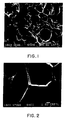
- Figure 1 is a scanning electron micrograph of a typical cross-sectional view of foamed polymethylmethacrylate at a magnification of 200 times.
- Figure 2 is a scanning electron micrograph of a typical cross-sectional view of foamed polyetherimide at a magnification of 7200 times.
- Figure 3 is a scanning electron micrograph of a typical cross-sectional view of foamed polycarbonate at a magnification of 4000 times showing a vertex in detail.
- Figure 4 is a scanning electron micrograph of a typical cross-sectional view of foamed polyetherimide at a magnification of 2000 times showing a vertex in detail.
- Figure 5 is a scanning electron micrograph of a typical cross-sectional view of a partially foamed article of the present invention.
- Figure 6A and 6B are graphical representations of pressure vs. specific volume showing the region in which a supercritical state is achieved for carbon dioxide.
- Figure 6C is a graphical representation of pressure vs. temperature showing the region in which a supercritical state is achieved for carbon dioxide.
- Figure 7 is a graphical representation of critical fluid reduced density vs. reduced pressure.
- Figure 8 is a graphical representation of cell size (micrometers) vs. pressure (psig) for polystyrene.
- Figure 9 is a graphical representation of cell size (micrometers) vs. temperature (°C) for polystyrene at 4 different pressures.
- Figure 10A is a graphical representation of polymer density (mg/cc) vs. temperature (°C) for polystyrene.
- Figure 10B is a graphical representation of polymer density (mg/cc) vs. temperature (°C) for polycarbonate.
- Figure 11 is a graphical representation of polymer density (mg/cc) vs. temperature (°C) for Ultem polyetherimide.
- Figure 12 is a graphical representation of polymer density (mg/cc) vs. temperature (°C) for Ultem polyetherimide at 3 different melt indexes.
- a foamed article comprising a thermoplastic having a foamed density of greater than 0.03 grams per cubic centimeters (g/cm 3 ), cell sizes in the range of 10 to 300 micrometers ( ⁇ m), preferably 20-100 ⁇ m, most preferably 20-80 ⁇ m, with cell wall thicknesses of greater than 0.1 ⁇ m but less than 2 ⁇ m.
- the foamed article is a thermoplastic having a glass transition temperature above 150°C and has a density of greater than 0.08 g/cm 3 , cell sizes in the range of 10 to 300 ⁇ m, preferably 80-300 ⁇ m, with wall thicknesses of greater than 0.1 ⁇ m but less than 2 ⁇ m.
- Foam void volumes range from 5 to 97 %.
- FIG. 1 Representative examples of the foamed articles of the present invention are illustrated in Figures 1-4.
- a foamed polymethylmethacrylate having cell sizes in the range of 20 to 100 ⁇ m is illustrated.
- FIG 2 cells of a foamed polyetherimide are illustrated.
- the polyetherimide foam had a density of 0.6 g/cm 3 .
- a vertex of cell in foamed polycarbonate (density of 0.2 g/cm 3 ) is shown in detail in Figure 3.
- a vertice of a cell in foamed polyetherimide (density of 0.09 g/cm 3 ) is shown in detail in Figure 4.
- the cells may be open or closed, although the foams are predominately composed of closed cells.
- the shape of the cells may be elongated and have an aspect ratio of about 2.0 or more. However, the cells have generally a more uniform, polyhedral shape.
- the cell shapes are similar to bubbles whose juxtaposition to one another tends to cause their sides to become flattened as they expand and squeeze against one another. This pattern is typical of a fully formed 3-D Voronoi tessellation foam.
- the SEM photograph in Figure 2 shows a typical cell structure in a foamed article of the present invention.
- Syntactic foams and foams that contain particles dispersed in the polymeric starting material are also provided.
- Suitable particles include but are not limited to other polymers, glass bubbles, metal particles, fibers or other such materials.
- Partially foamed articles are also provided. "Partially foamed" as used in this application means a portion of the thermoplastic polymer starting material is retained in its unfoamed state at the interior of the article, that is, the central core of the article and is surrounded by a low density fully foamed layer.
- a representative example of a partially foamed article is illustrated in Figure 5.
- Such a partially foamed article may be prepared using the process of the present invention.
- the thickness of the fully foamed layer depends on the depth of SCF penetration and such penetration can be varied by adjusting the duration of the saturating step. Since there typically exists a line of demarcation between the SCF saturated and unsaturated portion of the polymer, a distinct boundary is produced in the polymer starting material when rapid depressurization occurs.
- layered, multilayered or alternating foamed and unfoamed composites may be prepared by treating fully foamed or partially foamed articles with a thermal energy source, such as a laser.
- a thermal energy source such as a laser.
- the outer layers may be melted or collapsed thereby causing the foamed polymer to revert back to original unfoamed polymer.
- an unfoamed shell can be prepared around a foamed portion that surrounds the unfoamed core. If the polymer was completely foamed, then an unfoamed shell or skin can be constructed around or on one or more sides of a foamed core.
- thermoplastic polymers and co-polymers may have amorphous, semi-crystalline or crystalline morphologies.
- thermoplastic polymers and co-polymers include: cellulose propionate, triacetates, ethyl cellulose, polyoxymethylene, polyisobutylene, polymethylpentene, polybutene, polypropylene, polyethylene, polystyrene, acrylonitrile copolymer, polyacrylate, polyetheretherketone, polymethacrylate, polyvinylchloride, polyvinylidene chloride, polyvinyl acetate, polyvinyl alcohol and acetal, polyvinyl ether, polyvinylidene fluoride, polytetrafluoroethylene, polyphenylene oxide ("Noryl” commercially available from General Electric), polyethylene:tetrafluoroethylene (“Tefzel” commercially available from DuPont), polyamide, polyesteramide, thermoplastic elastomers, such as polyurethane, linear polyesters
- Fully or partially foamed articles may contain a variety of additives. Such additives may or may not be in addition to hollow particles (syntactic foams) or filled foams.
- Nonlimiting additives include but are not limited to solvents, emulsifiers, fillers, reinforcements, colorants, coupling agents, antioxidants, antistatic compounds, flame retardants, heat stabilizers, lubricants, mold release agents, plasticizers, preservatives, ultraviolet stabilizers and the like. These additives may vary according to the thermoplastic and the application use of the foamed article.
- One or more additives may be contained in the foamed article. The amount of additive present is dependent on the application use of the foamed article and may be present in an amount that is effective for the known use of a particular additive.
- a process for producing low density microcellular foamed thermoplastic articles comprising the steps :
- the process of the present invention provides the ability to foam preformed articles having an initial (pre-foamed) thickness of greater than 75 ⁇ m.
- high strength foams can readily be achieved, but not at the expense of obtaining low density foams, which may be important for many applications.
- the process of the present invention comprises exposing and allowing saturation of a polymeric material to a SCF. While not intending to be bound by theory, it is believed the SCF has the chemical effect of plasticization and solvation of the polymeric starting material. The physical effect is that SCF generates a high pressure within the polymeric starting material to physically displace viscous polymers and blow the bubbles or cells when depressurization of the pressure vessel occurs.
- a SCF can be defined as a material that is maintained at a temperature that exceeds a critical temperature and at a pressure that exceeds a critical pressure so as to place the material in a supercritical state.
- the SCF has properties that cause it to act, in effect, as both a gas and a liquid.
- such a fluid in the supercritical state, has the solvent characteristics of a liquid, but the surface tension thereof is substantially less than that of a liquid so that the fluid can diffuse much more readily into the solute material, as in the nature of a gas.
- FIGS 6A and 6B depicts (curves 10 and 12) pressure vs. specific volume ( Figure 6A) and temperature vs. specific entropy ( Figure 6B) for CO 2 .
- Figure 6C shows pressure vs.
- critical fluid (CF) or “SCF” are used interchangeably in this invention and the terms mean any temperature and pressure combination of a substance above the critical point value.
- SCFs suitable for use in this invention should be non-reactive to the thermoplastic polymer.
- suitable SCFs have physico-chemical characteristics such that the combination of critical fluid pressure and solubility parameter at saturation conditions, result in a potential pressure differential of at least 7584 kPa ⁇ g (1,100 psig) or greater.
- SCFs exhibit thermodynamic and physical properties that are unique to the CF state and are generally intermediate between gas state properties and liquid state properties. The thermodynamic and physical properties vary with pressure. Some representative characteristics include diffusivity, density, dynamic viscosity, cohesive energy density, heat capacity, and thermal conductivity.
- the type of critical fluid employed can influence the resultant foam, as solubility from one SCF to another varies by several weight percent in a particular polymer system, hence void size and distribution can vary. As the temperature of the polymer is increased, so will the size of the cells that form. Generally, this size can be reduced by increasing SCF pressure.
- Gases that are suitable supercritical fluids and are useful in practicing this invention include, but are not limited to, carbon dioxide, nitrous oxide, ethylene, ethane, tetrafluoroethylene, perfluoroethane, tetrafluoromethane, trifluoromethane, 1,1-difluoroethylene, trifluoroamide oxide, cis-difluorodiazine, trans-difluorodiazine, nitrogen chloride difluoride, phosphorous trideuteride, dinitrogen tetrafluoride, ozone, phosphine, nitrosyl fluoride, nitrogen trifluoride, deuterium chloride, hydrogen chloride, xenon, sulfur hexafluoride, fluoromethane, perfluoroethane, tetrafluoroethene, pentafluoroethane, tetrafluoromethane, trifluoromethane, 1,1-difluoroeth
- the preferred gases include carbon dioxide, nitrous oxide, ethylene, ethane, tetrafluoroethylene, perfluoroethane, tetrafluoromethane, trifluoromethane, and 1,1-difluoroethylene.
- the more preferred gas is carbon dioxide since carbon dioxide is nonflammable, and nontoxic,as well as being relatively inexpensive.
- the preferred SCF, CO 2 is thermally stable and non-reactive to most polymer systems, even at high process temperatures.
- CO 2 can effectively be used to produce foams of high temperature thermoplastics (for example, those with Vicat softening temperatures above 150°C), such as polyetherimide where conventional blowing agents would either decompose well before the polymer was in a viscosity range that could allow any cell growth to occur or cells would be very large.
- Using the process of the present invention offers the advantage of controlling both the density and cell size of such high temperature polymers.
- additives may be added to the pressure vessel during step (1).
- additives include solvents, emulsifiers, fillers, hollow particles (produces syntactic foams), reinforcements, colorants, coupling agents, antioxidants, antistatic compounds, flame retardants, heat stabilizers, lubricants, mold release agents, plasticizers, preservatives, ultraviolet stabilizers and the like.
- solvents emulsifiers
- fillers hollow particles (produces syntactic foams)
- Solvents in particular solvents that solubilize the thermoplastic polymers are particularly useful additives.
- solvents include aromatic hydrocarbons, ketones, ethers, aliphatic hydrocarbons, chlorinated hydrocarbons and the like.
- the most preferred solvent is methylene chloride.
- the added solvent may be used in amounts up to about 40 weight percent of the SCF.
- the process of the present invention comprises charging a pressure vessel with a gas and a thermoplastic polymer material and heating the thermoplastic polymer material charged into a pressure vessel via an external heat source, such as an oil bath, to a temperature approaching the Vicat softening temperature (as determined from ASTM D 1525-91) or the glass transition temperature of the thermoplastic polymer material.
- the pressure and temperature are such that the gas is in a supercritical state.
- the pressure may be adjusted by adding or venting the gas.
- the SCF is rapidly evacuated from the void spaces of the pressure vessel. During this rapid depressurization, the SCF that has been dissolved in the polymer rapidly nucleates and grows bubbles or cells in the softened polymer.
- the polymer Since the expanding SCF or gas undergoes an adiabatic or a Joule-Thomson expansion, the polymer is also rapidly cooled.
- the temperature reduction of the polymer is sufficient to reduce the polymer temperature to a range below which the material no longer has enough fluidity to continue expanding, that is, rapid depressurization provides a self-quenching mechanism.
- the polymer is stabilized and deformation can no longer occur.
- a softening point such as Vicat may be used.
- the initial temperature selected would be slightly above the T g or Vicat softening temperature.
- the process would then be repeated with incremental changes, such as in the range of 3° to 8°C for each step, above and below the initial temperature. This is done for at least two, preferably three or more temperatures above and below the initial temperature.
- the density of the resulting foam is measured according to ASTM D792-86 modified as described below in the Examples.
- the data acquired is then plotted as "Density vs. Temperature". From this generally U-shaped curve, appropriate conditions may be selected to provide desired foam characteristics.
- the temperature may be held constant, and the pressure varied.
- a plot of "Density vs. Pressure" can then be obtained which will exhibit the same general shape as described above. It is desirable to ensure that any changes in either temperature or pressure are such that the supercritical fluid is maintained in this state (see Figure 6C, shaded region).
- Shear strength has been reported to be the single most important property in the use of core materials in structures. The strength is strongly dependent on the material density. See “Foam Filled Composite Sandwich Structures for Marine Application,” presented by Northrop at a conference name in Savannah, Georgia, 11/93. Further, the cell size has been demonstrated to be critical to the shear strength properties of the foamed article (see Figure 13). At a given density, a stronger foam is obtained from smaller cells.
- the optimum temperature and pressure, to prepare a polymer with the lowest density, smallest cell size and highest strength can be experimentally determined by evaluating the plots described above.
- a constraining device or mold may have any shape, since the expanding polymer will fill the cavity of the device or mold as the cells grow.
- the density and cell size of the foamed article can also be influenced by the molecular weight of the polymeric starting material.
- the melt viscosity (or melt index) of the polymeric starting material increases with increasing molecular weight, the conditions required to foam the polymeric starting material may also vary. For example, the temperature at which the minimum density is achieved tends to shift as polymer molecular weight (as indicated by its melt index) increases.
- the SCF should have some degree of solubility in the polymeric starting material. Generally, if polymer films are too thin so as to permit a rapid rate of diffusion of the SCF out of the material, the SCF is not retained within the film for a period sufficient enough to perform a work of expansion, that is, no foaming is observed. This phenomena is observed with a film thickness averaging 0.13 mm or less and depends upon the process condition, as well as the type of material. Thick samples, in excess of 6.35 mm may be readily foamed, but as the samples become thicker, diffusion time (saturation time). increases. The time required for diffusion is also polymer specific and may be limited by factors that typically limit diffusion processes, such as temperature, pressure, and the SCF selected. Under process conditions, the SCF diffuses promptly into the polymer under an elevated temperature and pressure state. It has been observed the T g of the polymer may be significantly lowered during gas saturation processes and it is believed this is due to the plasticization effect of the gas in the polymer.
- Solubility parameters can be useful for characterizing SCF/polymer systems.
- the solubility parameter of a SCF is a function of critical fluid pressure and temperature. As the difference between solvent solubility parameter and polymer solubility parameter become greater, less SCF becomes dissolved in the polymer. Typically, the greater the difference between the solubility parameter of the solvent and the polymer, the less likely effective solubilization will take place and complete dissolution will not occur. As a result the polymer will not dissolve but instead will only swell in the solvent. The amount of swelling depends upon the degree of affinity between the polymer and solvent.
- the suitability of a SCF to solvate and plasticize a particular polymer is based upon the solvent strength that can be developed in the process, which in turn is dependent on its state relative to its critical conditions.
- the solvation property of the SCF is a contributing factor to the foaming process.
- Foamed polymers are produced according to this process by exposing a polymer to a suitable SCF, at temperatures between ambient and the polymer T m .
- SCF pressures up to 96 MPa (14,000 psig) have been used to give the necessary solubility.
- the polymer With high, liquid-like fluid densities, the polymer swells as it would in a normal organic solvent due to a relaxation of the polymer chain interaction with its neighbors. Heating the polymer allows further relaxation and softening so it becomes more pliable for the subsequent expansion step.
- the pressure vessel is rapidly vented at the processing temperature, thus allowing the dissolved SCF in the softened polymer to expand the polymer, producing cells.
- a rapid rate of venting is preferable to achieve the maximum in foaming action.
- the rapid venting allows the warm, plasticized, softened polymer to expand easily before cooling is sufficient enough to freeze the free movement of the polymer.
- Slow venting inhibits the work of expansion of the SCF and allows some diffusion out of the softened polymer without nucleating cells, thereby limiting the final density of the polymer.
- the cells in a foaming system would collapse as they are produced under the force of the expanding SCF. Under rapid depressurization cell expansion is effectively inhibited by the solidification of the foam as the foamed material adiabatically cools.
- the final density is determined by the pre-expansion temperature and the type of SCF used. Generally, the higher the pre-expansion temperature at the start of depressurization, the lower the final density, the higher the pressure, the smaller the cells.
- Fibers about 25 ⁇ m in diameter were placed in an autoclave. Ethylene was added to bring the final pressure to 31 MPa (4,500 psig) at 109°C. The fibers were held at this temperature and pressure for 15 minutes before rapid venting. Fiber density was 590 mg ⁇ cm -3 with 7 to 10 ⁇ m diameter cells.
- Cellulose triacetate pellets (10 grams, Aldrich Chemical Co.) were exposed to carbon dioxide at 220°C at 31 MPa (4,500 psig). Exposure time from first charging the autoclave to the final vent down was 55 minutes. The foamed pellets had a density of 300 mg ⁇ cm -3 .
- Polyurethane film was foamed to a density of 300 mg ⁇ cm -3 by exposing the polymer to ethylene at 175°C for a total saturation time of 113 minutes.
- the autoclave was rapidly vented down to atmospheric pressure from 31 MPa (4,500 psig).
- Polystyrene pellets (5 grams, Aldrich Chemical Co.) were exposed to 34 MPa (5,000 psig) of ethylene at 110°C for 100 minutes before venting the system rapidly. Analysis showed the cells to have an average diameter of 25 ⁇ m. The density of the pellets was 78 mg ⁇ cm -3 .
- Polymethylmethacrylate (“Perspex"-ICI) one-half disk, was placed in an autoclave and stabilized at 165°C as the pressure was adjusted to 105 MPa (15,300 psig) with methane.
- the polymethylmethacrylate disk was saturated at these conditions for 120 minutes before rapidly venting off the methane.
- the recovered material was a white colored foam, which was significantly larger in size that the starting disk.
- the density of the white colored foam was 40 mg ⁇ cm -3 .
- Analysis of a liquid nitrogen fractured sample indicated the cell diameters were in the range of 20-40 ⁇ m.
- Polymethylmethacrylate powder (ICI) was blended with 40 wt% methyl methacrylate monomer containing 60 wt% of 0.5 ⁇ m tungsten metal powder until a slurry was obtained. This blend was poured into small tubes (6.3 mm diameter). The tubes were cured overnight at 45°C in an atmosphere of nitrogen at a pressure of 1.38 MPa (200 psig) to produce polymer rods. The polymer rods were placed in an autoclave and exposed to ethylene at 115°C and 41 MPa (6,000 psig) for 2 hours. Rapid vent down yielded a metal-filled foamed rod having a density of 231 mg ⁇ cm - 3.
- ICI Polymethylmethacrylate powder
- a polycarbonate piece measuring 76 x 12.7 x 6.3 mm (3"x 1/2"x 1/4") was placed in an autoclave and foamed to low density by exposure of the piece to carbon dioxide at 185°C and a pressure of 14 MPa (2,100 psig) for a period of about 120 minutes before a rapid vent down.
- the resultant foam had a density of 140 mg ⁇ cm -3 and cell diameters in the range of 40 to 50 ⁇ m as determined by analyzing a liquid nitrogen fractured sample.
- a sample of polyetherimide (GE Ultem 1000) measuring 127 x 6.3 x 9.5 mm (5"x 1/4"x 3/8") was foamed to low density by exposing the polymer to carbon dioxide for 4 hours at 230°C.
- the system pressure prior to vent down was 34.5 MPa (5,000 psig).
- the foamed material had a density of 293 mg ⁇ cm -3 .
- Analysis of a liquid nitrogen fractured sample indicated uniform cells throughout the sample having cell diameters in the range of 10 to 15 ⁇ m.
- TygonTM tubing Plasticized polyvinylchloride (TygonTM tubing) was foamed without significant reduction in plasticizer content using an underwater technique.
- a 4.7 gram section of TygonTM tubing was foamed by immersing the tubing in water while in an autoclave. The autoclave was then charged with ethylene and stabilized at 41.4 MPa (6,000 psig) at 130°C to saturate the tubing with the supercritical ethylene. After rapid pressure release, the material foamed to a density of 477 mg ⁇ cm -3 .
- the tubing remained soft and flexible because the plasticizer content was not significantly reduced based on gravimetric analysis.
- ICI "Victrex 150G” Semi-crystalline low viscosity polyetheretherketone was foamed to a density of 800 mg ⁇ cm -3 by exposure to supercritical carbon dioxide at 260°C and 34.5 MPa (5,000 psig) for (4.5 hrs.).
- Linear low density polyethylene (Dow Chemical "Aspen 6806", MFI 180°C) (10 grams) was melt blended with 0.5 gram of glass wool to form a uniform dispersion in the polyethylene. Several pieces of this material was placed in an autoclave and the system was charged with ethylene. After about 4 hours the system stabilized at 31.0 MPa (4,500 psig) at 114°C. A foamed article having a density of 420 mg ⁇ cm -3 was recovered.
- ABS Acrylonitrile/butadiene/styrene resin
- a polymer blend of polybutylene and polypropylene film was exposed to ethylene at 33.1 MPa (4,800 psig) and 123°C.
- the polymer blend was saturated for about 70 minutes before a rapid vent down to yield a material having a density of 562 mg ⁇ cm -3 .
- Table 1 summarizes various additional examples that exemplify the capability of the SCF foaming process to produce thermoplastics of variable density and cell size. The following notations identify the polymers summarized in Table 1.
- thermoplastics The following general method was used for the following examples. Particular deviations or variations are specifically identified as necessary.
- the materials and operating conditions for various thermoplastics are tabulated in Tables 2-9. Saturation times were varied, however once the thermoplastic has been fully saturated, additional saturation time did not affect the resulting foamed article.
- thermoplastic polymer sample is placed in a high pressure steel or stainless steel vessel and the vessel is sealed.
- the vessel is then completely immersed in an oil bath set at a predetermined temperature.
- the oil temperature is monitored and controlled via a thermocouple placed in the oil, and the pressure is monitored by a pressure transducer connected to the vessel.
- the fluid (either as a gas or as a supercritical fluid) is transferred via a compressor or pump attached to the pressure vessel and adjusted until the requisite pressure is attained.
- thermoplastic polymer is exposed to the supercritical fluid for a period of time necessary to completely or partially saturate the thermoplastic polymer.
- the pressure vessel is opened by means of a remote control vent, which allows the internal pressure to come to atmospheric pressure within a few seconds.
- the vessel is immediately disconnected and placed in a water bath for cooling before opening the vessel and recovering the foamed thermoplastic polymer.
- Linear low density polyethylene was foamed using the general foaming process using ethylene (Examples 27-29) and ethane (Examples 30-32) as the supercritical fluids. After the pressure vessel was charged to approximately half of the desired final pressure. The temperature was allowed to stabilize for 20 minutes. The vessel was then pressurized to the final desired pressure, the system remained in the oil bath for an additional 1/2 hours before rapidly venting the pressure vessel over a period of 1 to 3 seconds to atmospheric pressure. All the samples were in the form of beads.
- Example Amount Pressure MPa
- Temp °C
- Saturation Time hr.
- Density mg ⁇ cm -3 ) 27 5 grams 31 111 1 NA 28 5 grams 32 120 0.5 NA 29 5 grams 32 114 0.6 240 30 7 grams 32 120 0.5 276 31 7 grams 34 130 0.75 227 32 7 grams 34 125 0.6 196
- Polyurethane samples were foamed using the general foaming process using ethylene as the supercritical fluid.
- the polyurethane sheet was 0.8 mm thick.
- High density polyethylene (HDPE) samples were foamed using the general foaming process using carbon dioxide as the supercritical fluid.
- the HDPE was wrapped in a fibrous glass insulation material and placed in a sample holder and then placed in the pressure vessel.
- the pressure vessel was placed in the oil bath and equilibrated at the run conditions. After a predetermined period of time (saturation time) at run conditions, the vessel was rapidly vented over a period of about 10 seconds.
- Polyetherimide samples (commercially available from General Electric under the trade designation ULTEM) were foamed using the general foaming process using carbon dioxide as the supercritical fluid. The samples are summarized in Table 6. All the samples were 6.8 x 6.3 x 3.2 mm and were saturated for a period of 4 hours.
- Polyetherimde samples (commercially available from General Electric under the trade designation ULTEM) were foamed using the general foaming process using carbon dioxide as the supercritical fluid.
- the polymer samples were wrapped with glass insulation and placed in a rectangular stainless steel holder.
- a pressure vessel (7.6 liters) was added the methylene chloride along with the polyetherimide samples.
- the vessel was closed and mounted in a stand and adjusted to process conditions of the run by adding the carbon dioxide.
- the pressure was adjusted using the carbon dioxide.
- the vessel was electrically heated.
- the samples remained at temperature for 17 hours before rapid release of pressure over a 60 second interval.
- Methylene chloride may be used together with the carbon dioxide to assist in the solvation of the polyetherimide to aid in achieving additional density reductions over the carbon dioxide alone.
- UltemTM polyetherimide of various molecular weights were processed as described in Examples 78-80 using a fixed pressure of 31 MPa (4500 psi) and a temperature range of 225 to 245°C. As can be seen from the curves obtained, shown in Figure 12, the point of minimum density is shifted to higher temperatures as the molecular weight (melt index) of the initial polymer is increased.
- PMMA poly(methyl methacrylate)
- MW of 1 x 10 6 MW of 1 x 10 6
- PMMA may be foamed at 135°C and 41 MPa (6000 psig); but at a higher molecular weight (MW > 4 x 10 6 ) it may require a higher temperature, such as 165°C, at the same pressure.
Landscapes
- Chemical & Material Sciences (AREA)
- Engineering & Computer Science (AREA)
- Materials Engineering (AREA)
- Health & Medical Sciences (AREA)
- Chemical Kinetics & Catalysis (AREA)
- Medicinal Chemistry (AREA)
- Polymers & Plastics (AREA)
- Organic Chemistry (AREA)
- Manufacture Of Porous Articles, And Recovery And Treatment Of Waste Products (AREA)
Claims (3)
- Verfahren zur Herstellung zellulärer thermoplastischer Schaumstoffgegenstände mit niedriger Dichte, wobei die Dichten und Zellgrößen des Schaumstoffgegenstandes reguliert werden können und wobei die Schaumstoffdichten größer als 0,03 g/cm3 sind, Zellgrößen im Bereich von 10 bis 300 µm liegen und Zellwandstärken größer als 0,1 µm, aber weniger als 2 µm sind, wobei das Verfahren die Schritte umfasst:(1) Füllen eines Druckgefäßes mit einem festen thermoplastischen Polymer, das gegebenenfalls ein Additiv enthält;(2) Erwärmen des Druckgefäßes, das das feste thermoplastische Polymer und gegebenenfalls ein Additiv enthält, mit einer externen Heizquelle auf eine vorher bestimmte Sättigungstemperatur, um ein weiches thermoplastisches Polymer bereitzustellen,
wobei die Sättigungstemperatur innerhalb eines Temperaturbereiches liegt, welcher definiert ist durch den Temperaturbereich einer U-förmigen Kurve "Dichte gegen Temperatur" bei einem festen Druck, welche zwei Temperaturen zeigt, bei denen Schaumstoffe mit derselben Dichte erhalten werden, wobei die Zellgrößen der Schaumstoffe verschieden sind,
wobei die U-förmige Kurve erhalten wird durch Auftragen einer Anfangssättigungstemperatur, welche leicht oberhalb der Glasübergangstemperatur oder der Vicat-Temperatur (wie durch ASTM D 1529-91 bestimmt) des thermoplastischen Polymermaterials liegt, gegen die Dichte des so erhaltenen Schaumstoffes (wie durch ASTM D 792-86 bestimmt, mit der Maßgabe, daß die Proben nicht für 40 h vor der Dichtebestimmung konditioniert wurden, und die Feuchtigkeitsbedingungen nicht bei 50% gehalten wurden) und durch Wiederholen dieses Verfahrens mit inkrementalen Änderungen oberhalb und unterhalb der Anfangstemperatur;(3) Gleichzeitiges Einleiten eines Gases während des Erwärmens des Druckgefäßes;(4) Equilibrieren des Druckgefäßes, des weichen thermoplastischen Polymers und des Gases mit der Temperatur der externen Heizquelle ;(5) Einstellen des Druckes im Druckgefäß durch Hinzufügen von zusätzlichem Gas, um einen Enddruck zu erreichen, bei welchem das Gas ein überkritisches Fluid und in dem weichen thermoplastischen Polymer löslich ist;(6) Sättigen des weichen thermoplastischen Polymers mit dem überkritischen Fluid für einen vorher bestimmten Zeitraum; und(7) Entlüften des Druckgefäßes, um im Druckgefäß zur Schäumung des thermoplastischen Polymers rasch Druck abzubauen. - Verfahren gemäß Anspruch 1, wobei das Gas Kohlendioxid, Distickstoffoxid, Ethylen, Ethan, Tetrafluorethylen, Perfluorethan, Tetrafluormethan, Trifluormethan, oder 1,1-Difluorethylen ist.
- Verfahren gemäß Anspruch 1, wobei das Additiv ein Lösungsmittel ist.
Applications Claiming Priority (4)
| Application Number | Priority Date | Filing Date | Title |
|---|---|---|---|
| US1660293A | 1993-02-11 | 1993-02-11 | |
| US16602 | 1993-02-11 | ||
| US08/181,696 US5670102A (en) | 1993-02-11 | 1994-01-25 | Method of making thermoplastic foamed articles using supercritical fluid |
| US181696 | 1994-01-25 |
Publications (2)
| Publication Number | Publication Date |
|---|---|
| EP0610953A1 EP0610953A1 (de) | 1994-08-17 |
| EP0610953B1 true EP0610953B1 (de) | 2003-06-04 |
Family
ID=26688827
Family Applications (1)
| Application Number | Title | Priority Date | Filing Date |
|---|---|---|---|
| EP94102162A Expired - Lifetime EP0610953B1 (de) | 1993-02-11 | 1994-02-11 | Thermoplastische Schaumstoffgegenstände und deren Herstellungsverfahren |
Country Status (6)
| Country | Link |
|---|---|
| US (1) | US5670102A (de) |
| EP (1) | EP0610953B1 (de) |
| JP (1) | JP3544556B2 (de) |
| KR (1) | KR940019777A (de) |
| CA (1) | CA2115123A1 (de) |
| DE (1) | DE69432771T2 (de) |
Families Citing this family (134)
| Publication number | Priority date | Publication date | Assignee | Title |
|---|---|---|---|---|
| US5866053A (en) * | 1993-11-04 | 1999-02-02 | Massachusetts Institute Of Technology | Method for providing continuous processing of microcellular and supermicrocellular foamed materials |
| FI100803B (fi) * | 1994-02-25 | 1998-02-27 | Valtion Teknillinen | Mikrohuokoiset selluloosajohdokset ja menetelmä niiden valmistamiseksi |
| WO1997006935A1 (en) * | 1995-08-14 | 1997-02-27 | Massachusetts Institute Of Technology | Gear throttle as a nucleation device in a continuous microcellular extrusion system |
| JPH09111034A (ja) * | 1995-10-23 | 1997-04-28 | Sekisui Plastics Co Ltd | ポリプロピレン系予備発泡樹脂粒子、ポリプロピレン系樹脂発泡成形体及びそれらの製造方法 |
| US5728315A (en) * | 1996-05-01 | 1998-03-17 | Alliedsignal Inc. | Azeotrope-like compositions of trifluoromethane, carbon dioxide, ethane and hexafluoroethane |
| US5830923A (en) * | 1996-05-22 | 1998-11-03 | E. I. Du Pont De Nemours And Company | Foamed fluoropolymer |
| US6884377B1 (en) | 1996-08-27 | 2005-04-26 | Trexel, Inc. | Method and apparatus for microcellular polymer extrusion |
| JP4240540B2 (ja) | 1996-08-27 | 2009-03-18 | トレクセル・インコーポレーテッド | 微孔性ポリマーの押出方法及び押出装置 |
| US6884823B1 (en) * | 1997-01-16 | 2005-04-26 | Trexel, Inc. | Injection molding of polymeric material |
| US6235380B1 (en) | 1997-07-24 | 2001-05-22 | Trexel, Inc. | Lamination of microcellular articles |
| US6506808B1 (en) * | 1997-10-31 | 2003-01-14 | Lonza Ag | Microcellular thermoset foams and method for producing the same |
| FR2771818B1 (fr) * | 1997-12-03 | 2000-02-18 | Centre Nat Rech Scient | Procede et dispositif pour l'etude de l'effet d'un fluide supercritique sur la transition d'un materiau de l'une a l'autre de deux phases condensees et leur application au cas d'un materiau polymere |
| US6706223B1 (en) | 1997-12-19 | 2004-03-16 | Trexel, Inc. | Microcelluar extrusion/blow molding process and article made thereby |
| DE69829208T3 (de) | 1997-12-19 | 2012-10-25 | Trexel, Inc. | Mikrozellulares schaumstoff-extrusions/blasformverfahren und damit hergestellter gegenstand |
| US6231942B1 (en) | 1998-01-21 | 2001-05-15 | Trexel, Inc. | Method and apparatus for microcellular polypropylene extrusion, and polypropylene articles produced thereby |
| DE19808266A1 (de) * | 1998-02-27 | 1999-09-09 | Messer France Sa | Verfahren und Vorrichtung zum Schäumen von Kunststoffen |
| US6080798A (en) * | 1998-09-28 | 2000-06-27 | Handa; Paul | Manufacturing foams by stress-induced nucleation |
| WO2000026005A1 (en) * | 1998-11-04 | 2000-05-11 | Trexel, Inc. | Molded polymeric material including microcellular, injection-molded, and low-density polymeric material |
| US6555589B1 (en) * | 1999-01-29 | 2003-04-29 | Seng C. Tan | Transparent supermicrocellular polymer foams and method for their manufacture |
| US6555590B1 (en) * | 1999-01-29 | 2003-04-29 | Seng C. Tan | Transparent supermicrocellular polymer foams from high Tg polymers and method for manufacture |
| US6391931B1 (en) | 1999-04-28 | 2002-05-21 | 3M Innovative Properties Co | Uniform small cell foams and a continuous process for making same |
| US6613811B1 (en) * | 1999-06-03 | 2003-09-02 | Trexel, Inc. | Microcellular thermoplastic elastomeric structures |
| JP4117986B2 (ja) * | 1999-06-07 | 2008-07-16 | 日東電工株式会社 | 耐熱性ポリマ発泡体とその製造法、及び発泡体基板 |
| IL147302A0 (en) * | 1999-06-28 | 2002-08-14 | California Inst Of Techn | Microfabricated elastomeric valve and pump systems |
| BR0012513A (pt) * | 1999-07-16 | 2002-04-02 | Wavin Bv | Processo para formação de um artigo compreendendo microespuma de célula fechada a partir de termoplásticos |
| JP4159199B2 (ja) | 1999-09-16 | 2008-10-01 | 日東電工株式会社 | 多孔質体及び多孔質体の製造方法 |
| US6403663B1 (en) | 1999-09-20 | 2002-06-11 | North Carolina State University | Method of making foamed materials using surfactants and carbon dioxide |
| JP2003023693A (ja) * | 1999-10-04 | 2003-01-24 | Matsushita Electric Ind Co Ltd | スピーカ |
| TW528930B (en) | 1999-11-26 | 2003-04-21 | Nitto Denko Corp | Photosensitive resin composition and porous resin |
| US6593384B2 (en) * | 2000-05-25 | 2003-07-15 | Trexel, Inc. | Polymer foam processing with low blowing agent levels |
| EP1162051B1 (de) * | 2000-06-07 | 2006-08-02 | Fraunhofer-Gesellschaft zur Förderung der angewandten Forschung e.V. | Verfahren und Vorrichtung zur Herstellung von geschäumten thermoplastischen Formteilen |
| GB0015430D0 (en) * | 2000-06-24 | 2000-08-16 | Victrex Mfg Ltd | Bio-compatible polymeric materials |
| AU2001287403A1 (en) * | 2000-08-17 | 2002-02-25 | Mold-Masters Limited | Improved powder injection molding process and apparatus |
| WO2002018481A1 (en) * | 2000-08-28 | 2002-03-07 | Mitsui Chemicals, Inc. | Polymer composition, molded articles containing the same and processes for the production of both |
| SG99324A1 (en) * | 2000-08-30 | 2003-10-27 | Nitto Denko Corp | Microporous soundproofing material |
| EP1320457B1 (de) * | 2000-09-29 | 2016-04-20 | Trexel, Inc. | Verfahren zur Herstellung eines im Werkzeug verzierten Artikels |
| EP1266928A4 (de) * | 2000-10-18 | 2003-06-11 | Mitsui Chemicals Inc | Schaum aus thermoplastischer urethanelastomerzusammensetzung sowie verfahren zur herstellung des schaums |
| US6596388B1 (en) * | 2000-11-29 | 2003-07-22 | Psiloquest | Method of introducing organic and inorganic grafted compounds throughout a thermoplastic polishing pad using a supercritical fluid and applications therefor |
| JP4386564B2 (ja) | 2000-11-30 | 2009-12-16 | 日東電工株式会社 | 低分子量物を含むポリイミド前駆体又はポリイミドからの低分子量物の除去方法 |
| JP4721385B2 (ja) | 2001-07-02 | 2011-07-13 | キヤノン株式会社 | 射出成形機への樹脂材料の供給方法及び装置 |
| JPWO2003004552A1 (ja) * | 2001-07-05 | 2004-10-28 | 出光石油化学株式会社 | 難燃性発泡体およびその製造方法 |
| JP4896309B2 (ja) * | 2001-07-13 | 2012-03-14 | 日東電工株式会社 | 多孔質ポリイミド樹脂の製造方法 |
| US20040171339A1 (en) * | 2002-10-28 | 2004-09-02 | Cabot Microelectronics Corporation | Microporous polishing pads |
| US6913517B2 (en) * | 2002-05-23 | 2005-07-05 | Cabot Microelectronics Corporation | Microporous polishing pads |
| US8557884B2 (en) * | 2002-05-31 | 2013-10-15 | Owens Corning Intellectual Capital, Llc | To enhance the thermal insulation of polymeric foam by reducing cell anisotropic ratio and the method for production thereof |
| US20030225172A1 (en) * | 2002-05-31 | 2003-12-04 | Miller Larry M. | To enhance the thermal insulation of polymeric foam by reducing cell anisotropic ratio and the method for production thereof |
| US7951449B2 (en) | 2002-06-27 | 2011-05-31 | Wenguang Ma | Polyester core materials and structural sandwich composites thereof |
| JP3780236B2 (ja) | 2002-08-07 | 2006-05-31 | キヤノン株式会社 | ガスが浸透した材料の保管方法 |
| US7771818B2 (en) * | 2002-09-20 | 2010-08-10 | Bha Group, Inc. | Treatment of porous article |
| US7407703B2 (en) * | 2002-09-20 | 2008-08-05 | Bha Group, Inc. | Composite membrane having oleophobic properties |
| TWI256961B (en) * | 2002-10-23 | 2006-06-21 | Ind Tech Res Inst | Method of manufacturing polymeric foam using supercritical fluids |
| EP1480087B1 (de) * | 2003-05-19 | 2013-08-28 | Ricoh Company, Ltd. | Pulverisierungs- und Knetverfahren zur Herstellung von Tonern |
| SG109581A1 (en) * | 2003-08-22 | 2005-03-30 | Nitto Denko Corp | Foamed dustproof material and dustproof structure using foamed dustproof material |
| JPWO2005019320A1 (ja) * | 2003-08-25 | 2007-11-08 | ダイキン工業株式会社 | 混合ポリテトラフルオロエチレン粉体及びポリテトラフルオロエチレン多孔成形体及びこれらの製造方法、ポリテトラフルオロエチレン多孔発泡成形体並びに高周波信号伝送用製品 |
| JP2007077275A (ja) * | 2005-09-14 | 2007-03-29 | Shin Etsu Polymer Co Ltd | 熱可塑性ポリイミド発泡体の製造方法及び熱可塑性ポリイミド発泡体 |
| US7790255B2 (en) * | 2006-03-20 | 2010-09-07 | Plastic Technologies, Inc. | Foamed-wall container having a silvery appearance |
| US20100264052A1 (en) * | 2006-03-20 | 2010-10-21 | Semersky Frank E | Foamed-wall container with foamed and unfoamed regions |
| US20080281011A1 (en) * | 2007-05-10 | 2008-11-13 | William Strauss | High temperature resistant, structural polymer foam |
| US9381723B2 (en) * | 2007-09-12 | 2016-07-05 | University Of Washington | Microcellular thermoplastic thin films formed by a solid-state foaming process |
| JP5372782B2 (ja) | 2008-01-28 | 2013-12-18 | 日本特殊陶業株式会社 | 生体インプラント及びその製造方法 |
| DE112009000318T5 (de) * | 2008-02-13 | 2011-03-03 | Bando Chemical Industries, Ltd., Kobe-shi | Reibantriebsriemen |
| WO2010029754A1 (ja) * | 2008-09-10 | 2010-03-18 | Komatsu Michio | 成形体及びその製造方法 |
| JP2010138220A (ja) * | 2008-12-09 | 2010-06-24 | Nitto Denko Corp | 発泡シート製造方法及び発泡シート |
| EP2246172A3 (de) * | 2009-03-16 | 2014-06-18 | Lucobit AG | Verfahren zur Herstellung von Leichtbauteilen aus geschäumtem Kunststoff |
| JP5713908B2 (ja) * | 2009-09-08 | 2015-05-07 | 積水化成品工業株式会社 | 発泡性樹脂粒子の製造方法、予備発泡粒子及び発泡成形体 |
| WO2011030732A1 (ja) * | 2009-09-08 | 2011-03-17 | 積水化成品工業株式会社 | 発泡成形体及びその製造方法 |
| JP2011097578A (ja) * | 2009-09-30 | 2011-05-12 | Nitto Denko Corp | 2次元通信用低誘電シートおよびその製造方法、通信用シート構造体 |
| JP5976714B2 (ja) * | 2009-09-30 | 2016-08-24 | 日東電工株式会社 | 2次元通信用低誘電シートおよびその製造方法、通信用シート構造体 |
| US8536087B2 (en) | 2010-04-08 | 2013-09-17 | International Imaging Materials, Inc. | Thermographic imaging element |
| US8636929B2 (en) * | 2010-05-21 | 2014-01-28 | Basf Se | Nanoporous foamed active compound-containing preparations based on pharmaceutically acceptable thermoplastically workable polymers |
| DE102010053064A1 (de) * | 2010-12-01 | 2012-06-06 | Universität Zu Köln | Erzeugung Nanodisperser Einschlüsse in einer hochviskosen Matrix |
| US9708456B2 (en) | 2011-01-27 | 2017-07-18 | New Balance Athletics, Inc. | Injection molding systems and methods for forming materials used in footwear and materials manufactured by said systems and methods |
| WO2012112118A1 (en) * | 2011-02-20 | 2012-08-23 | Franciscus Hubertus Jacobus Maurer | Expanded polymeric membranes |
| EA027560B1 (ru) * | 2011-08-18 | 2017-08-31 | Роквул Интернэшнл А/С | Пенообразующая композиция, композитный пеноматериал, способ его изготовления и изделие |
| US20130116354A1 (en) * | 2011-11-07 | 2013-05-09 | Battelle Memorial Institute | High performance foam and composite foam structures and processes for making same |
| CN104136220B (zh) * | 2011-12-06 | 2015-12-23 | 3M创新有限公司 | 粘结聚酯基材的方法 |
| US9511523B2 (en) | 2012-03-28 | 2016-12-06 | Sabic Global Technologies B.V. | Static-dissipative foam extrusion calibration with minimized expansion loss |
| JP5919185B2 (ja) | 2012-12-17 | 2016-05-18 | 日東電工株式会社 | ポリエーテルイミド多孔質体及びその製造方法 |
| JP5919184B2 (ja) | 2012-12-17 | 2016-05-18 | 日東電工株式会社 | ポリエーテルイミド多孔質体及びその製造方法 |
| CA2905297A1 (en) * | 2013-03-14 | 2014-10-02 | Honeywell International, Inc. | Compositions and methods comprising vinylidene fluoride |
| US9498927B2 (en) | 2013-03-15 | 2016-11-22 | Nike, Inc. | Decorative foam and method |
| US20140259753A1 (en) * | 2013-03-15 | 2014-09-18 | Nike, Inc. | Modified thermoplastic elastomers for increased compatibility with supercritical fluids |
| US9375866B2 (en) | 2013-03-15 | 2016-06-28 | Nike, Inc. | Process for foaming thermoplastic elastomers |
| US9243104B2 (en) | 2013-03-15 | 2016-01-26 | Nike, Inc. | Article with controlled cushioning |
| TWI656153B (zh) * | 2013-10-11 | 2019-04-11 | 巴斯夫歐洲公司 | 膨脹熱塑性彈性體珠粒之製造 |
| BR112016009327B1 (pt) * | 2013-10-29 | 2022-01-11 | Performance Polyamides, Sas | Composição de poliamida espumável, seu método de produção, espuma, seu uso, e veículo motorizado |
| DE102015000393A1 (de) | 2014-01-21 | 2015-07-23 | Frank Becher | Verfahren zur Herstellung von geschlossen-porigen Erzeugnissen mit hohlen Zellen, mittels dessen der Druck in den Zellen kontrolliert während des Aufschäumens erhöht oder reduziert werden kann, sowie Erzeugnisse, die nach diesem Verfahren hergestellt werden |
| KR101768711B1 (ko) * | 2014-07-21 | 2017-08-17 | 서울대학교산학협력단 | 안정성이 우수한 발포고분자로 둘러싸인 자성입자를 함유하는 자기유변체 및 그 제조방법 |
| AT516572A1 (de) * | 2014-08-05 | 2016-06-15 | Austrotherm Gmbh | Niederdichte, mikrozellulare, geschlossenzellige, thermoplastische Schaumstoffe und ihre Herstellung |
| US9956732B2 (en) | 2014-08-06 | 2018-05-01 | New Balance Athletics, Inc. | Injection molding systems and methods for forming materials used in footwear and materials manufactured by said systems and methods |
| TWI600688B (zh) | 2014-09-30 | 2017-10-01 | 積水化成品工業股份有限公司 | 顆粒發泡成形體、樹脂發泡粒子、樹脂發泡粒子之製造方法,以及顆粒發泡成形體之製造方法 |
| US10358537B2 (en) * | 2014-11-25 | 2019-07-23 | The University Of Massachusetts | Polymeric solutions, methods of manufacture thereof and articles manufactured therefrom |
| JP6353807B2 (ja) * | 2015-03-30 | 2018-07-04 | 積水化成品工業株式会社 | 発泡粒子及び発泡成形体 |
| JP2017179140A (ja) * | 2016-03-30 | 2017-10-05 | 積水化成品工業株式会社 | 酸化防止剤含有発泡性樹脂粒子とその製造方法、発泡粒子及び発泡成形体 |
| KR102391751B1 (ko) | 2016-05-04 | 2022-04-29 | 바스프 에스이 | 자기 냉각성, 폼 포함 복합 재료 |
| EP3478516B1 (de) | 2016-06-29 | 2021-09-08 | Nike Innovate C.V. | Mehrlagige strukturen und verfahren zur herstellung davon |
| WO2018020746A1 (ja) * | 2016-07-25 | 2018-02-01 | 日東電工株式会社 | 多孔質の低誘電性ポリマーフィルム及びミリ波アンテナ用フィルム |
| CN106336523A (zh) * | 2016-08-31 | 2017-01-18 | 杭州博适特新材料科技有限公司 | 一种制备热塑性聚合物发泡珠粒的方法 |
| US20190203010A1 (en) * | 2016-09-27 | 2019-07-04 | Sekisui Plastics Co., Ltd. | Expanded beads, molded foam, fiber-reinforced composite, and automotive component |
| CN110291246B (zh) * | 2016-11-16 | 2022-07-05 | 亨茨曼国际有限公司 | 用于热塑性聚氨酯染色和发泡的方法 |
| TWI627975B (zh) | 2017-01-12 | 2018-07-01 | 國立中山大學 | 以超臨界流體處理生醫材料之方法 |
| TWI651104B (zh) * | 2017-01-12 | 2019-02-21 | 國立中山大學 | 以超臨界流體處理生醫材料之方法 |
| EP3571244B1 (de) | 2017-01-20 | 2022-03-16 | DSM IP Assets B.V. | Expandierte zusammensetzung |
| US20200032026A1 (en) * | 2017-04-06 | 2020-01-30 | Nitto Denko Corporation | Film for millimeter-wave antenna |
| US10982067B2 (en) | 2017-05-10 | 2021-04-20 | Nike, Inc. | Foam ionomer compositions and uses thereof |
| CN106985327A (zh) * | 2017-06-02 | 2017-07-28 | 段辉 | 超临界微发泡高光塑料及塑料基复合材料的制备方法及其塑料或塑料基复合材料 |
| JP6968601B2 (ja) * | 2017-06-15 | 2021-11-17 | 信越ポリマー株式会社 | 発泡成形体の製造方法 |
| CN107417936A (zh) * | 2017-07-18 | 2017-12-01 | 晋江创赢新材料科技有限公司 | 一种原位染色tpu发泡珠粒的加工方法 |
| CN107501592A (zh) * | 2017-07-18 | 2017-12-22 | 晋江创赢新材料科技有限公司 | 一种彩色tpu发泡珠粒的制备方法 |
| EP3673009A1 (de) * | 2017-08-24 | 2020-07-01 | Evonik Operations GmbH | Pei-partikelschäume für anwendungen im luftfahrt-interieur |
| IT201800004727A1 (it) * | 2018-04-19 | 2019-10-19 | Metodo per la realizzazione di materiali polimerici espansi stratificati | |
| CN109385058B (zh) * | 2018-09-06 | 2020-08-11 | 广东奔迪新材料科技有限公司 | 一种超临界流体制备无模立体结构发泡制品的方法 |
| CN112996662B (zh) | 2018-09-13 | 2023-05-23 | 耐克创新有限合伙公司 | 多层结构及其用途 |
| CN112969745B (zh) | 2018-11-13 | 2022-09-30 | 帝斯曼知识产权资产管理有限公司 | 发泡组合物 |
| CN109955423B (zh) * | 2019-04-30 | 2024-04-02 | 广东奔迪新材料科技有限公司 | 一种大型超高压热塑性聚合物发泡成型装置及其方法 |
| IT201900012666A1 (it) * | 2019-07-23 | 2021-01-23 | Materias S R L | Perline espanse con gradienti di morfologia e/o densità, e schiume sinterizzate da esse ottenute |
| CN114375167A (zh) | 2019-09-12 | 2022-04-19 | 耐克创新有限合伙公司 | 用于鞋类物品的缓冲元件 |
| TWI698471B (zh) * | 2019-09-20 | 2020-07-11 | 寶成工業股份有限公司 | 發泡鞋材及其製造方法 |
| JP7722927B2 (ja) | 2019-11-25 | 2025-08-13 | 日東電工株式会社 | 樹脂発泡体 |
| CN117924784A (zh) * | 2020-02-10 | 2024-04-26 | 株式会社力森诺科 | 成型体和成型体的制造方法 |
| WO2021243231A2 (en) | 2020-05-29 | 2021-12-02 | Nike, Inc. | Structurally-colored articles and methods for making and using structurally-colored articles |
| JP7627818B2 (ja) * | 2021-05-17 | 2025-02-07 | ルーマス ポリマーズ エルエルシー | レーザ焼結用のポリケトン粉末 |
| CN117203031A (zh) * | 2021-05-17 | 2023-12-08 | 捷普有限公司 | 用于激光烧结的聚酮粉末 |
| WO2022271595A1 (en) | 2021-06-23 | 2022-12-29 | International Imaging Materials, Inc. | Thermographic imaging element |
| EP4116058B1 (de) | 2021-07-09 | 2024-03-13 | SHPP Global Technologies B.V. | Verfahren zum schäumen und formen einer thermoplastischen platte und zugehörige vorrichtung und geformte geschäumte thermoplastische platte |
| CN115960383B (zh) * | 2021-08-05 | 2024-06-25 | 江苏大毛牛新材料有限公司 | 一种制备物理发泡材料的方法 |
| WO2023019919A1 (zh) * | 2021-08-17 | 2023-02-23 | 江苏大毛牛新材料有限公司 | 一种使用二氧化碳溶液发泡的工艺 |
| CN114854079B (zh) * | 2022-06-20 | 2023-05-23 | 台州玉米环保科技有限公司 | 一种耐温pla吸塑餐饮具的制备方法 |
| CN117624482A (zh) * | 2022-08-10 | 2024-03-01 | 华为技术有限公司 | 预发泡材料及其制备方法和应用 |
| JP7842383B2 (ja) * | 2022-12-07 | 2026-04-08 | 株式会社戸上電機製作所 | 開閉器の消弧室、及び開閉器 |
| CN116162278B (zh) * | 2023-03-14 | 2025-04-04 | 华东理工大学 | 一种高透光发泡材料及其制备方法 |
| CN116426027A (zh) * | 2023-03-15 | 2023-07-14 | 中国科学院宁波材料技术与工程研究所 | 一种耐高温聚合物发泡材料的制备方法及其应用 |
| CN118930946B (zh) * | 2024-08-27 | 2025-05-13 | 阿尔法(广东)高新材料有限公司 | 一种高回弹热塑性弹性体发泡材料及其制备方法 |
| CN119458746A (zh) * | 2024-11-13 | 2025-02-18 | 昊太(江苏)新材料科技有限公司 | 一种超临界流体发泡热塑性纤维制备方法及制备的泡沫纤维 |
Family Cites Families (30)
| Publication number | Priority date | Publication date | Assignee | Title |
|---|---|---|---|---|
| US2751627A (en) * | 1951-11-29 | 1956-06-26 | Lonza Electric & Chem Works | Process for producing cellular thermoplastic bodies |
| US3140266A (en) * | 1960-12-30 | 1964-07-07 | Minnesota Mining & Mfg | Process for foaming synthetic polymers |
| US3342760A (en) * | 1961-10-26 | 1967-09-19 | Koppers Co Inc | Expandable polymers |
| US3227664A (en) * | 1961-12-07 | 1966-01-04 | Du Pont | Ultramicrocellular structures of crystalline organic polymer |
| US3542715A (en) * | 1964-01-24 | 1970-11-24 | Du Pont | Foamed strand of an organic polymeric material |
| US3298975A (en) * | 1966-03-18 | 1967-01-17 | Hercules Inc | Expandable partially-foamed and cured polypropylene composition |
| GB1220053A (en) * | 1967-01-23 | 1971-01-20 | Ici Ltd | Foamed thermoplastic polymers |
| US3681270A (en) * | 1970-05-22 | 1972-08-01 | Dynamit Nobel Ag | Process for the manufacture of foam materials containing plasticizer from polyvinylchloride and copolymers thereof |
| US3912800A (en) * | 1970-09-21 | 1975-10-14 | Int Plastics | Method of producing porous polymeric articles |
| JPS492183B1 (de) * | 1970-11-13 | 1974-01-18 | ||
| DE2126812C3 (de) * | 1971-05-29 | 1979-03-29 | Basf Ag, 6700 Ludwigshafen | Verfahren zur Herstellung von Schaumstoffen aus hochmolekularen Olefinpolymerisaten |
| US3856717A (en) * | 1971-12-12 | 1974-12-24 | Gulf Research Development Co | Rigid polyethylene foam |
| GB1474774A (en) * | 1973-10-09 | 1977-05-25 | Furukawa Electric Co Ltd | Process and apparatus for producing a foamed thermoplastic resin article |
| US3959197A (en) * | 1973-10-16 | 1976-05-25 | Monsanto Research Corporation | Use of solvent mixtures in making foamable compositions |
| DE3205289C2 (de) * | 1982-02-15 | 1984-10-31 | Akzo Gmbh, 5600 Wuppertal | Verfahren zur Herstellung von porösen Körpern mit einstellbarem Gesamtporenvolumen, einstellbarer Porengröße und einstellbarer Porenwandung |
| US4473665A (en) * | 1982-07-30 | 1984-09-25 | Massachusetts Institute Of Technology | Microcellular closed cell foams and their method of manufacture |
| US4464484A (en) * | 1982-12-20 | 1984-08-07 | Japan Styrene Paper Corporation | Process for producing prefoamed polymer particles |
| US4532094A (en) * | 1983-12-12 | 1985-07-30 | Mobil Oil Corporation | Thermoplastic foam molding |
| US4535100A (en) * | 1983-12-12 | 1985-08-13 | Mobil Oil Corporation | Polymer foam, thermoformed shapes thereof and methods of forming same |
| US4532263A (en) * | 1983-12-12 | 1985-07-30 | Mobil Oil Corporation | Expansible polymer molding process and the resultant product |
| US4704239A (en) * | 1984-04-28 | 1987-11-03 | Japan Styrene Paper Corp. | Process for the production of expanded particles of a polymeric material |
| US4761256A (en) * | 1987-01-27 | 1988-08-02 | Eastman Kodak Company | Method for producing microcellular foamed plastic material with smooth integral skin |
| US4873218A (en) * | 1988-05-26 | 1989-10-10 | The United States Department Of Energy | Low density, resorcinol-formaldehyde aerogels |
| US4906672A (en) * | 1988-07-29 | 1990-03-06 | Pmc, Inc. | Blowing agents for polyurethane foam |
| US4911869A (en) * | 1988-10-11 | 1990-03-27 | Arco Chemical Technology, Inc. | Reimpregnation of plastic foam particles with CO2 |
| JPH0768403B2 (ja) * | 1988-12-15 | 1995-07-26 | 東洋エンジニアリング株式会社 | 発泡体の製造方法 |
| US5049328A (en) * | 1990-07-02 | 1991-09-17 | Arco Chemical Technology, Inc. | Purification, impregnation and foaming of polymer particles with carbon dioxide |
| US5158986A (en) * | 1991-04-05 | 1992-10-27 | Massachusetts Institute Of Technology | Microcellular thermoplastic foamed with supercritical fluid |
| US5128382A (en) * | 1991-11-15 | 1992-07-07 | The University Of Akron | Microcellular foams |
| US5271886A (en) * | 1992-10-14 | 1993-12-21 | Arco Chemical Technology, L.P. | Process and apparatus for rapid pre-expension and molding of expandable polymer particles |
-
1994
- 1994-01-25 US US08/181,696 patent/US5670102A/en not_active Expired - Fee Related
- 1994-02-07 CA CA002115123A patent/CA2115123A1/en not_active Abandoned
- 1994-02-08 KR KR1019940002383A patent/KR940019777A/ko not_active Ceased
- 1994-02-10 JP JP01619994A patent/JP3544556B2/ja not_active Expired - Fee Related
- 1994-02-11 EP EP94102162A patent/EP0610953B1/de not_active Expired - Lifetime
- 1994-02-11 DE DE69432771T patent/DE69432771T2/de not_active Expired - Fee Related
Also Published As
| Publication number | Publication date |
|---|---|
| EP0610953A1 (de) | 1994-08-17 |
| KR940019777A (ko) | 1994-09-15 |
| CA2115123A1 (en) | 1994-08-12 |
| DE69432771D1 (de) | 2003-07-10 |
| US5670102A (en) | 1997-09-23 |
| JP3544556B2 (ja) | 2004-07-21 |
| DE69432771T2 (de) | 2004-04-08 |
| JPH06322168A (ja) | 1994-11-22 |
Similar Documents
| Publication | Publication Date | Title |
|---|---|---|
| EP0610953B1 (de) | Thermoplastische Schaumstoffgegenstände und deren Herstellungsverfahren | |
| US5334356A (en) | Supermicrocellular foamed materials | |
| US5830923A (en) | Foamed fluoropolymer | |
| Ramesh et al. | The heterogeneous nucleation of microcellular foams assisted by the survival of microvoids in polymers containing low glass transition particles. Part I: Mathematical modeling and numerical simulation | |
| US5369135A (en) | Controlled microcellular foams of crystalline amorphous polymers | |
| US6080798A (en) | Manufacturing foams by stress-induced nucleation | |
| Chen et al. | Effects of shear stress and pressure drop rate on microcellular foaming process | |
| US5358675A (en) | Controlling heterogeneous nucleation and growth of foams | |
| JP3207219B2 (ja) | ポリオレフィン系樹脂の低発泡粒子及びその製造方法 | |
| JP2011074152A (ja) | 予備発泡粒子及びその製造方法 | |
| Daigneault et al. | Blends of CO2 and 2-ethyl hexanol as replacement foaming agents for extruded polystyrene | |
| JP2014118548A (ja) | ポリフッ化ビニリデン系樹脂発泡粒子、ポリフッ化ビニリデン系樹脂発泡粒子の製造方法、及びポリフッ化ビニリデン系樹脂発泡粒子成形体 | |
| US3503907A (en) | Polyvinyl chloride foam structure | |
| Chuaponpat et al. | The effects of foaming conditions on plasticized polyvinyl chloride foam morphology by using supercritical carbon dioxide | |
| Marcilla et al. | Crosslinking of rotational molding foams of polyethylene | |
| Li et al. | Study on using high temperature steam preparation of ultra light foam TPU pellets based supercritical CO2 | |
| DK160770B (da) | Fremgangsmaade til fremstilling af skumplanker af ethylenisk polymer harpiks og skumplanke fremstillet ved fremgangsmaaden | |
| JPH02279738A (ja) | 押出し発泡体の製造法 | |
| EP1149680B1 (de) | Verfahren zur Herstellung eines flexiblen thermoplastischen Schaumstoffes mit niedriger Dichte und derart hergestellter Schaum | |
| KR940004537B1 (ko) | 발포성 조성물 및 그의 제조방법과 경질 발포체 및 그의 제조방법 | |
| JPH0971675A (ja) | 発泡体及びその製造方法 | |
| Nosrati et al. | Investigation of the physical, mechanical and morphological properties of the foam obtained from polylactic acid and microcrystalline cellulose | |
| Matsukawa et al. | Preparation of Polyvinyl Chloride Foam via Combined Melt-Gelation and CO2 Foaming Processes | |
| Lee | Extrusion processing of low-bulk density, microcellular, open-cell thermoplastic foams. | |
| JPS6021208A (ja) | ポリエチレン系樹脂発泡粒子とその製造方法 |
Legal Events
| Date | Code | Title | Description |
|---|---|---|---|
| PUAI | Public reference made under article 153(3) epc to a published international application that has entered the european phase |
Free format text: ORIGINAL CODE: 0009012 |
|
| AK | Designated contracting states |
Kind code of ref document: A1 Designated state(s): DE FR GB IT |
|
| 17P | Request for examination filed |
Effective date: 19950210 |
|
| 17Q | First examination report despatched |
Effective date: 19960409 |
|
| GRAG | Despatch of communication of intention to grant |
Free format text: ORIGINAL CODE: EPIDOS AGRA |
|
| GRAG | Despatch of communication of intention to grant |
Free format text: ORIGINAL CODE: EPIDOS AGRA |
|
| GRAG | Despatch of communication of intention to grant |
Free format text: ORIGINAL CODE: EPIDOS AGRA |
|
| GRAH | Despatch of communication of intention to grant a patent |
Free format text: ORIGINAL CODE: EPIDOS IGRA |
|
| GRAH | Despatch of communication of intention to grant a patent |
Free format text: ORIGINAL CODE: EPIDOS IGRA |
|
| GRAA | (expected) grant |
Free format text: ORIGINAL CODE: 0009210 |
|
| RAP1 | Party data changed (applicant data changed or rights of an application transferred) |
Owner name: MINNESOTA MINING AND MANUFACTURING COMPANY |
|
| AK | Designated contracting states |
Designated state(s): DE FR GB IT |
|
| PG25 | Lapsed in a contracting state [announced via postgrant information from national office to epo] |
Ref country code: IT Free format text: LAPSE BECAUSE OF FAILURE TO SUBMIT A TRANSLATION OF THE DESCRIPTION OR TO PAY THE FEE WITHIN THE PRESCRIBED TIME-LIMIT;WARNING: LAPSES OF ITALIAN PATENTS WITH EFFECTIVE DATE BEFORE 2007 MAY HAVE OCCURRED AT ANY TIME BEFORE 2007. THE CORRECT EFFECTIVE DATE MAY BE DIFFERENT FROM THE ONE RECORDED. Effective date: 20030604 |
|
| REG | Reference to a national code |
Ref country code: GB Ref legal event code: FG4D |
|
| REF | Corresponds to: |
Ref document number: 69432771 Country of ref document: DE Date of ref document: 20030710 Kind code of ref document: P |
|
| ET | Fr: translation filed | ||
| PLBE | No opposition filed within time limit |
Free format text: ORIGINAL CODE: 0009261 |
|
| STAA | Information on the status of an ep patent application or granted ep patent |
Free format text: STATUS: NO OPPOSITION FILED WITHIN TIME LIMIT |
|
| 26N | No opposition filed |
Effective date: 20040305 |
|
| PGFP | Annual fee paid to national office [announced via postgrant information from national office to epo] |
Ref country code: GB Payment date: 20070223 Year of fee payment: 14 |
|
| PGFP | Annual fee paid to national office [announced via postgrant information from national office to epo] |
Ref country code: DE Payment date: 20070330 Year of fee payment: 14 |
|
| PGFP | Annual fee paid to national office [announced via postgrant information from national office to epo] |
Ref country code: FR Payment date: 20070221 Year of fee payment: 14 |
|
| GBPC | Gb: european patent ceased through non-payment of renewal fee |
Effective date: 20080211 |
|
| REG | Reference to a national code |
Ref country code: FR Ref legal event code: ST Effective date: 20081031 |
|
| PG25 | Lapsed in a contracting state [announced via postgrant information from national office to epo] |
Ref country code: DE Free format text: LAPSE BECAUSE OF NON-PAYMENT OF DUE FEES Effective date: 20080902 |
|
| PG25 | Lapsed in a contracting state [announced via postgrant information from national office to epo] |
Ref country code: FR Free format text: LAPSE BECAUSE OF NON-PAYMENT OF DUE FEES Effective date: 20080229 |
|
| PG25 | Lapsed in a contracting state [announced via postgrant information from national office to epo] |
Ref country code: GB Free format text: LAPSE BECAUSE OF NON-PAYMENT OF DUE FEES Effective date: 20080211 |