EP0611739A2 - Keramischer Körper - Google Patents
Keramischer Körper Download PDFInfo
- Publication number
- EP0611739A2 EP0611739A2 EP94200366A EP94200366A EP0611739A2 EP 0611739 A2 EP0611739 A2 EP 0611739A2 EP 94200366 A EP94200366 A EP 94200366A EP 94200366 A EP94200366 A EP 94200366A EP 0611739 A2 EP0611739 A2 EP 0611739A2
- Authority
- EP
- European Patent Office
- Prior art keywords
- ceramic body
- ceramic
- silicon
- magnesium
- oxygen
- Prior art date
- Legal status (The legal status is an assumption and is not a legal conclusion. Google has not performed a legal analysis and makes no representation as to the accuracy of the status listed.)
- Granted
Links
Images
Classifications
-
- C—CHEMISTRY; METALLURGY
- C04—CEMENTS; CONCRETE; ARTIFICIAL STONE; CERAMICS; REFRACTORIES
- C04B—LIME, MAGNESIA; SLAG; CEMENTS; COMPOSITIONS THEREOF, e.g. MORTARS, CONCRETE OR LIKE BUILDING MATERIALS; ARTIFICIAL STONE; CERAMICS; REFRACTORIES; TREATMENT OF NATURAL STONE
- C04B35/00—Shaped ceramic products characterised by their composition; Ceramics compositions; Processing powders of inorganic compounds preparatory to the manufacturing of ceramic products
- C04B35/622—Forming processes; Processing powders of inorganic compounds preparatory to the manufacturing of ceramic products
- C04B35/64—Burning or sintering processes
- C04B35/645—Pressure sintering
-
- C—CHEMISTRY; METALLURGY
- C04—CEMENTS; CONCRETE; ARTIFICIAL STONE; CERAMICS; REFRACTORIES
- C04B—LIME, MAGNESIA; SLAG; CEMENTS; COMPOSITIONS THEREOF, e.g. MORTARS, CONCRETE OR LIKE BUILDING MATERIALS; ARTIFICIAL STONE; CERAMICS; REFRACTORIES; TREATMENT OF NATURAL STONE
- C04B35/00—Shaped ceramic products characterised by their composition; Ceramics compositions; Processing powders of inorganic compounds preparatory to the manufacturing of ceramic products
- C04B35/515—Shaped ceramic products characterised by their composition; Ceramics compositions; Processing powders of inorganic compounds preparatory to the manufacturing of ceramic products based on non-oxide ceramics
- C04B35/58—Shaped ceramic products characterised by their composition; Ceramics compositions; Processing powders of inorganic compounds preparatory to the manufacturing of ceramic products based on non-oxide ceramics based on borides, nitrides, i.e. nitrides, oxynitrides, carbonitrides or oxycarbonitrides or silicides
- C04B35/58085—Shaped ceramic products characterised by their composition; Ceramics compositions; Processing powders of inorganic compounds preparatory to the manufacturing of ceramic products based on non-oxide ceramics based on borides, nitrides, i.e. nitrides, oxynitrides, carbonitrides or oxycarbonitrides or silicides based on silicides
-
- C—CHEMISTRY; METALLURGY
- C04—CEMENTS; CONCRETE; ARTIFICIAL STONE; CERAMICS; REFRACTORIES
- C04B—LIME, MAGNESIA; SLAG; CEMENTS; COMPOSITIONS THEREOF, e.g. MORTARS, CONCRETE OR LIKE BUILDING MATERIALS; ARTIFICIAL STONE; CERAMICS; REFRACTORIES; TREATMENT OF NATURAL STONE
- C04B35/00—Shaped ceramic products characterised by their composition; Ceramics compositions; Processing powders of inorganic compounds preparatory to the manufacturing of ceramic products
- C04B35/515—Shaped ceramic products characterised by their composition; Ceramics compositions; Processing powders of inorganic compounds preparatory to the manufacturing of ceramic products based on non-oxide ceramics
- C04B35/58—Shaped ceramic products characterised by their composition; Ceramics compositions; Processing powders of inorganic compounds preparatory to the manufacturing of ceramic products based on non-oxide ceramics based on borides, nitrides, i.e. nitrides, oxynitrides, carbonitrides or oxycarbonitrides or silicides
- C04B35/584—Shaped ceramic products characterised by their composition; Ceramics compositions; Processing powders of inorganic compounds preparatory to the manufacturing of ceramic products based on non-oxide ceramics based on borides, nitrides, i.e. nitrides, oxynitrides, carbonitrides or oxycarbonitrides or silicides based on silicon nitride
-
- C—CHEMISTRY; METALLURGY
- C04—CEMENTS; CONCRETE; ARTIFICIAL STONE; CERAMICS; REFRACTORIES
- C04B—LIME, MAGNESIA; SLAG; CEMENTS; COMPOSITIONS THEREOF, e.g. MORTARS, CONCRETE OR LIKE BUILDING MATERIALS; ARTIFICIAL STONE; CERAMICS; REFRACTORIES; TREATMENT OF NATURAL STONE
- C04B35/00—Shaped ceramic products characterised by their composition; Ceramics compositions; Processing powders of inorganic compounds preparatory to the manufacturing of ceramic products
- C04B35/515—Shaped ceramic products characterised by their composition; Ceramics compositions; Processing powders of inorganic compounds preparatory to the manufacturing of ceramic products based on non-oxide ceramics
- C04B35/58—Shaped ceramic products characterised by their composition; Ceramics compositions; Processing powders of inorganic compounds preparatory to the manufacturing of ceramic products based on non-oxide ceramics based on borides, nitrides, i.e. nitrides, oxynitrides, carbonitrides or oxycarbonitrides or silicides
- C04B35/584—Shaped ceramic products characterised by their composition; Ceramics compositions; Processing powders of inorganic compounds preparatory to the manufacturing of ceramic products based on non-oxide ceramics based on borides, nitrides, i.e. nitrides, oxynitrides, carbonitrides or oxycarbonitrides or silicides based on silicon nitride
- C04B35/593—Shaped ceramic products characterised by their composition; Ceramics compositions; Processing powders of inorganic compounds preparatory to the manufacturing of ceramic products based on non-oxide ceramics based on borides, nitrides, i.e. nitrides, oxynitrides, carbonitrides or oxycarbonitrides or silicides based on silicon nitride obtained by pressure sintering
-
- C—CHEMISTRY; METALLURGY
- C04—CEMENTS; CONCRETE; ARTIFICIAL STONE; CERAMICS; REFRACTORIES
- C04B—LIME, MAGNESIA; SLAG; CEMENTS; COMPOSITIONS THEREOF, e.g. MORTARS, CONCRETE OR LIKE BUILDING MATERIALS; ARTIFICIAL STONE; CERAMICS; REFRACTORIES; TREATMENT OF NATURAL STONE
- C04B35/00—Shaped ceramic products characterised by their composition; Ceramics compositions; Processing powders of inorganic compounds preparatory to the manufacturing of ceramic products
- C04B35/515—Shaped ceramic products characterised by their composition; Ceramics compositions; Processing powders of inorganic compounds preparatory to the manufacturing of ceramic products based on non-oxide ceramics
- C04B35/58—Shaped ceramic products characterised by their composition; Ceramics compositions; Processing powders of inorganic compounds preparatory to the manufacturing of ceramic products based on non-oxide ceramics based on borides, nitrides, i.e. nitrides, oxynitrides, carbonitrides or oxycarbonitrides or silicides
- C04B35/597—Shaped ceramic products characterised by their composition; Ceramics compositions; Processing powders of inorganic compounds preparatory to the manufacturing of ceramic products based on non-oxide ceramics based on borides, nitrides, i.e. nitrides, oxynitrides, carbonitrides or oxycarbonitrides or silicides based on silicon oxynitride, e.g. SIALONS
-
- H—ELECTRICITY
- H10—SEMICONDUCTOR DEVICES; ELECTRIC SOLID-STATE DEVICES NOT OTHERWISE PROVIDED FOR
- H10W—GENERIC PACKAGES, INTERCONNECTIONS, CONNECTORS OR OTHER CONSTRUCTIONAL DETAILS OF DEVICES COVERED BY CLASS H10
- H10W40/00—Arrangements for thermal protection or thermal control
- H10W40/20—Arrangements for cooling
- H10W40/25—Arrangements for cooling characterised by their materials
- H10W40/259—Ceramics or glasses
-
- H—ELECTRICITY
- H10—SEMICONDUCTOR DEVICES; ELECTRIC SOLID-STATE DEVICES NOT OTHERWISE PROVIDED FOR
- H10W—GENERIC PACKAGES, INTERCONNECTIONS, CONNECTORS OR OTHER CONSTRUCTIONAL DETAILS OF DEVICES COVERED BY CLASS H10
- H10W70/00—Package substrates; Interposers; Redistribution layers [RDL]
- H10W70/60—Insulating or insulated package substrates; Interposers; Redistribution layers
- H10W70/67—Insulating or insulated package substrates; Interposers; Redistribution layers characterised by their insulating layers or insulating parts
- H10W70/69—Insulating materials thereof
- H10W70/692—Ceramics or glasses
Definitions
- the invention relates to a ceramic body.
- the invention also relates to a method of manufacturing a ceramic body.
- Ceramic bodies have particular properties rendering them suitable for many applications.
- ceramic bodies in the form of blocks or rods are available, for example, for use as refractory materials.
- a very important further use of ceramic bodies is their application as carriers or substrates.
- These substrates generally consist of a thin layer of sintered ceramic material, such as aluminium oxide (Al2O3), magnesium oxide (M g O), beryllium oxide (BeO), aluminium nitride (AlN) or silicon carbide (SiC).
- Al2O3 aluminium oxide
- M g O magnesium oxide
- BeO beryllium oxide
- AlN aluminium nitride
- SiC silicon carbide
- the known ceramic bodies generally exhibit a combination of a number of favourable and a number of unfavourable properties.
- substrates of relatively impure aluminium oxide and magnesium oxide have the advantage that they are cheap.
- substrates exhibit a rather poor heat conduction. Due to this poor heat conduction they are unsuitable for use as substrate material in electrical components in which a high development of heat occurs, which heat must be dissipated via the substrate.
- a further disadvantage of these oxidic ceramic materials is that they have a relatively high coefficient of expansion, rendering them less suitable for a number of applications, in particular in the field of silicon semiconductor technology.
- the coefficient of expansion of silicon ranges from 4 to 5.
- Beryllium oxide, aluminium nitride and silicon carbide have a much higher heat conduction than aluminium oxide and magnesium oxide and, hence, can more suitably be used as a heat-dissipating substrate or "heat sink" of an electrical component.
- ceramic bodies of aluminium nitride and silicon carbide have a coefficient of expansion which corresponds more to that of silicon, so that they are more suitable for use as substrates in the silicon semiconductor technology.
- the ceramic aluminium nitride technology is difficult due to the poor reproducibility and problems relating to purity.
- ceramic substrates of pure aluminium nitride are relatively expensive.
- Ceramic substrates of silicon carbide are also relatively expensive because the material is difficult to process.
- ceramic silicon carbide has a relatively high dielectric constant, so that this material is relatively unsuitable for use as a substrate in electrical components.
- ceramic bodies of beryllium oxide have the important disadvantage that they are toxic.
- the intended ceramic body should exhibit, on the one hand, a considerably higher heat conduction and a lower coefficient of expansion than impure aluminium oxide and magnesium oxide.
- the manufacture of the intended ceramic body must be simpler and considerably cheaper than that of ceramic aluminium nitride.
- the ceramic body in accordance with the invention must further have a relatively low dielectric constant.
- a ceramic body which is characterized according to the invention in that the body comprises 20-30 at.% of magnesium, 20-30 at.% of silicon, 40-60 at.% of nitrogen and maximally 15 at.% of oxygen.
- a ceramic body of the above composition has a relatively high heat conduction. Further, the coefficient of expansion of the inventive material is much lower than that of the said oxidic ceramic bodies.
- the manufacture of the material in accordance with the invention is very reproducible and, in comparison with aluminium nitride and silicon carbide, relatively inexpensive.
- the ceramic body in accordance with the invention further exhibits a satisfactory resistance to superalkaline solutions.
- the inventive ceramic body further exhibits a relatively low rigidity, a good resistance to thermal shocks and a relatively low dielectric constant.
- the ceramic body in accordance with the invention may comprise other elements, such as Ca and Be.
- the mechanical and electrical properties of the ceramic body can be influenced by incorporating relatively small quantities of said elements. It has been found, however, that in ceramic bodies which comprise less than 20 at.% or more than 30 at.% of magnesium or silicon, the quantity of different-phase material is so large that the mechanical and electrical properties of such ceramic bodies are unacceptably bad. If the oxygen content in the ceramic body is in excess of 15 at.%, the heat conduction is insufficient for the intended application.
- the quantity of oxygen present in the ceramic body is inversely proportional to the heat conduction of said body. Therefore, the aim is to minimize the quantity of oxygen in the ceramic body.
- the ceramic body contains less than 10 at.% of oxygen.
- An even higher heat conduction is attained if the ceramic body in accordance with the invention contains less than 5 at.% of oxygen.
- the invention also relates to methods of manufacturing a ceramic body.
- a first method is characterized in that a magnesium-silicon-nitride powder comprising 20-30 at.% of magnesium, 20-30 at.% of silicon, 40-60 at.% of nitrogen and maximally 15 at.% of oxygen is densified into a moulded product which is subsequently sintered into a ceramic body in an inert atmosphere at a temperature in the range from 1400-1600°C.
- a second method is characterized in that a magnesium-silicon-nitride powder comprising 20-30 at.% of magnesium, 20-30 at.% of silicon, 40-60 at.% of nitrogen and maximally 15 at% of oxygen is hot-pressed at a temperature in the range from 1400-1600°C.
- a preferred embodiment of this inventive method is characterized in that the composition of the powder corresponds to the formula MgSiN 2-x O x , where x is smaller than 0.5. It is noted that the preparation of a powder of MgSiN2 as well as the crystal structure of this compound are known per se from Bull. Soc. fr. Mineral. Cristallogr. 93 153-159 (1970).
- ceramic bodies manufactured by the method in accordance with the invention are substantially completely densified in the sintering process.
- the relative density of the ceramic bodies is 95% or more.
- the powder can be densified into a moulded product.
- argon is used as the inert gas.
- the ceramic body in accordance with the invention is preferably in the form of a substrate. The highest densities are obtained by hot-pressing, which yields densities of 99% or more.
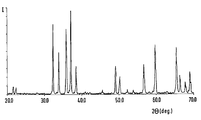
- the sole Figure shows an X-ray diffraction pattern of a ceramic body in accordance with the invention.
- a stoichiometric mixture of Mg3N2 powder (Cerac, 99.9% pure) and amorphous Si3N4 powder (Sylvania, Sn 402) were thoroughly mixed and subsequently placed in an aluminium oxide crucible.
- the crucible was properly closed to preclude evaporation of Mg3N2.
- the crucible including its contents was subjected to a thermal treatment under a nitrogen atmosphere for 16 hours at 1250°C. After cooling, the mixture was ground in a ball mill, while excluding oxygen, until an average particle size of the material of approximately 1 micrometer was obtained.
- the powder consisted of substantially pure single-phase MgSiN2, in which a small quantity of MgO and ⁇ -Si3N4 were present as side phases. The presence of oxygen is probably caused by contamination of the amorphous Si3N4.
- the powder was converted into moulded products.
- Two densification methods were used. In accordance with the first method, a pellet having a thickness of 30 nm and a cross-section of 6 nm was manufactured. In this method, a quantity of powder was isostatically compressed in two steps at a pressure of 5 and 200 MPa, respectively, at room temperature. The density of the moulded product was 50% of the theoretically maximum density.
- a second method a thin substrate having a thickness of 2 mm was manufactured. In this method a quantity of the powder obtained was dispersed in alcohol after which the dispersion was drawn off on to a filter. The layer thus formed was subsequently dried at a relatively high temperature and sub-atmospheric pressure. The density of the moulded product was approximately 50% of the theoretically maximum density.
- the moulded products thus manufactured were placed in an Mo crucible which further contained a quantity of the above-mentioned powder.
- the crucible was then filled with argon and closed. Subsequently, the crucible was heated for 5 hours to a temperature of 1550°C and subsequently cooled. The warming-up rate was 1000°C and the cooling rate was 200°C.
- the composition of the sintered moulded products was subsequently determined by means of an element analysis.
- the composition corresponded to the formula Mg 1.00 Si 0.97 N 1.77 O 0.19 .
- the density of the ceramic body was 3.11 g/cm3. On the basis of a calculated theoretically maximum density of 3.128 g/cm3, this means that the ceramic body in accordance with the invention had a density of 99.4%.
- a ceramic body of MgSiN2 was manufactured by means of hot-pressing.
- This powder was introduced into a hot press (HP20; Thermal Technology Ind.) comprising a graphite mould. Sintering was preformed by pressing the powder at a temperature in the range from 1400-1600°C under a pressure of 75 MPa for 2 hours. The density of the sintered material was 99.6% of the theoretically maximum density.
- the X-ray diffraction spectrum of a ceramic body in accordance with the invention is shown in the Figure. From this spectrum it can be derived that the ceramic body was substantially monophase and that a small quantity of Mg2SiO4 and ⁇ -Si3N4 was present in the ceramic body. The quantity thereof was less than 5 at.%.
- the Table also lists a number of properties of the ceramic body in accordance with the invention.
- the measured properties relate to the strength ⁇ , the Young's modulus E, the transverse contraction constant ⁇ , the thermal coefficient of expansion ⁇ , the coefficient of thermal conduction k, the resistance to fracture or tearing strength K lc , and the hardness H.
- the ceramic body in accordance with the invention combines a number of satisfactory properties.
- the coefficient of expansion of the body in accordance with the invention is lower than that of the cheap aluminium oxide.
- the processing of the ceramic body in accordance with the invention is simpler and cheaper than that of aluminium nitride.
Landscapes
- Engineering & Computer Science (AREA)
- Chemical & Material Sciences (AREA)
- Ceramic Engineering (AREA)
- Manufacturing & Machinery (AREA)
- Materials Engineering (AREA)
- Structural Engineering (AREA)
- Organic Chemistry (AREA)
- Inorganic Chemistry (AREA)
- Ceramic Products (AREA)
Priority Applications (1)
| Application Number | Priority Date | Filing Date | Title |
|---|---|---|---|
| EP94200366A EP0611739B1 (de) | 1993-02-18 | 1994-02-11 | Keramischer Körper |
Applications Claiming Priority (3)
| Application Number | Priority Date | Filing Date | Title |
|---|---|---|---|
| EP93200467 | 1993-02-18 | ||
| EP93200467 | 1993-02-18 | ||
| EP94200366A EP0611739B1 (de) | 1993-02-18 | 1994-02-11 | Keramischer Körper |
Publications (3)
| Publication Number | Publication Date |
|---|---|
| EP0611739A2 true EP0611739A2 (de) | 1994-08-24 |
| EP0611739A3 EP0611739A3 (de) | 1995-01-18 |
| EP0611739B1 EP0611739B1 (de) | 1998-01-14 |
Family
ID=26133664
Family Applications (1)
| Application Number | Title | Priority Date | Filing Date |
|---|---|---|---|
| EP94200366A Expired - Lifetime EP0611739B1 (de) | 1993-02-18 | 1994-02-11 | Keramischer Körper |
Country Status (1)
| Country | Link |
|---|---|
| EP (1) | EP0611739B1 (de) |
Family Cites Families (1)
| Publication number | Priority date | Publication date | Assignee | Title |
|---|---|---|---|---|
| EP0100380B1 (de) * | 1981-02-05 | 1987-06-16 | Sumitomo Electric Industries Limited | Verfahren zur plastischen Verformung von Nichteisenmetallen |
-
1994
- 1994-02-11 EP EP94200366A patent/EP0611739B1/de not_active Expired - Lifetime
Also Published As
| Publication number | Publication date |
|---|---|
| EP0611739B1 (de) | 1998-01-14 |
| EP0611739A3 (de) | 1995-01-18 |
Similar Documents
| Publication | Publication Date | Title |
|---|---|---|
| US4540673A (en) | Sintered aluminum nitride and semi-conductor device using the same | |
| US6242374B1 (en) | High thermal conductive silicon nitride sintered body and method of producing the same | |
| EP0219933B1 (de) | Siliziumcarbidsinterkörper mit hohem elektrischem Widerstand | |
| US4672046A (en) | Sintered aluminum nitride body | |
| EP0287841B1 (de) | Sinterformkörper aus Aluminiumnitrid | |
| EP0166073B1 (de) | Gesinterter Aluminiumnitridkörper | |
| US5482905A (en) | Aluminum nitride sintered body and method of producing the same | |
| EP2189431A2 (de) | Gesintertes Aluminiumoxidprodukt, Verfahren zu dessen Herstellung und dieses Produkts enthaltende elektrostatische Einspannvorrichtung | |
| EP0267623B1 (de) | Schwarze Sinterformkörper aus Aluminiumnitrid und Verfahren zu ihrer Herstellung | |
| US5411924A (en) | Ceramic body | |
| JPS638261A (ja) | 多結晶炭化ケイ素からの電気絶縁性基体材料と、アイソスタチツク熱間圧縮によるその製造方法 | |
| EP0611739B1 (de) | Keramischer Körper | |
| EP0393524A2 (de) | Verfahren zur Herstellung eines Sinterkörpers aus Aluminiumnitrid | |
| KR100404815B1 (ko) | 세라믹 물질 기판 | |
| JP2678213B2 (ja) | 窒化アルミニウム焼結体の製造方法 | |
| JP2742600B2 (ja) | 窒化アルミニウム質焼結体およびその製造方法 | |
| EP0266277B1 (de) | Verfahren zur Herstellung von Aluminiumnitrid-Sinterkörper mit hoher Wärmeleitfähigkeit | |
| EP0338556B1 (de) | Target aus supraleitenden Oxyd mit geringem Widerstand | |
| KR102626997B1 (ko) | 산화스칸듐을 소결조제로 포함하는 질화알루미늄 세라믹스 제조용 조성물, 질화알루미늄 세라믹스 및 그 제조방법 | |
| JP2664063B2 (ja) | 窒化アルミニウム予備焼結体、窒化アルミニウム焼結体およびそれらの製造方法 | |
| JPH046162A (ja) | AlN―BN系複合焼結体およびその製造方法 | |
| EP0260865A1 (de) | Verfahren zur Herstellung von gesintertem Aluminiumnitridmaterial | |
| JPH02307871A (ja) | セラミックス焼結体の製造方法 | |
| JP2778732B2 (ja) | 窒化ほう素―窒化アルミニウム系複合焼結体およびその製造方法 | |
| JPH07187789A (ja) | 窒化アルミニウム焼結体および窒化アルミニウム多層回路基板 |
Legal Events
| Date | Code | Title | Description |
|---|---|---|---|
| PUAI | Public reference made under article 153(3) epc to a published international application that has entered the european phase |
Free format text: ORIGINAL CODE: 0009012 |
|
| AK | Designated contracting states |
Kind code of ref document: A2 Designated state(s): DE FR GB NL |
|
| PUAL | Search report despatched |
Free format text: ORIGINAL CODE: 0009013 |
|
| AK | Designated contracting states |
Kind code of ref document: A3 Designated state(s): DE FR GB NL |
|
| 17P | Request for examination filed |
Effective date: 19950718 |
|
| 17Q | First examination report despatched |
Effective date: 19950920 |
|
| GRAG | Despatch of communication of intention to grant |
Free format text: ORIGINAL CODE: EPIDOS AGRA |
|
| GRAG | Despatch of communication of intention to grant |
Free format text: ORIGINAL CODE: EPIDOS AGRA |
|
| GRAH | Despatch of communication of intention to grant a patent |
Free format text: ORIGINAL CODE: EPIDOS IGRA |
|
| GRAH | Despatch of communication of intention to grant a patent |
Free format text: ORIGINAL CODE: EPIDOS IGRA |
|
| GRAA | (expected) grant |
Free format text: ORIGINAL CODE: 0009210 |
|
| AK | Designated contracting states |
Kind code of ref document: B1 Designated state(s): DE FR GB NL |
|
| PG25 | Lapsed in a contracting state [announced via postgrant information from national office to epo] |
Ref country code: NL Free format text: LAPSE BECAUSE OF FAILURE TO SUBMIT A TRANSLATION OF THE DESCRIPTION OR TO PAY THE FEE WITHIN THE PRESCRIBED TIME-LIMIT Effective date: 19980114 |
|
| REF | Corresponds to: |
Ref document number: 69407832 Country of ref document: DE Date of ref document: 19980219 |
|
| ET | Fr: translation filed | ||
| NLV1 | Nl: lapsed or annulled due to failure to fulfill the requirements of art. 29p and 29m of the patents act | ||
| RAP4 | Party data changed (patent owner data changed or rights of a patent transferred) |
Owner name: KONINKLIJKE PHILIPS ELECTRONICS N.V. |
|
| REG | Reference to a national code |
Ref country code: FR Ref legal event code: CD |
|
| PLBE | No opposition filed within time limit |
Free format text: ORIGINAL CODE: 0009261 |
|
| STAA | Information on the status of an ep patent application or granted ep patent |
Free format text: STATUS: NO OPPOSITION FILED WITHIN TIME LIMIT |
|
| 26N | No opposition filed | ||
| REG | Reference to a national code |
Ref country code: GB Ref legal event code: IF02 |
|
| REG | Reference to a national code |
Ref country code: GB Ref legal event code: 746 Effective date: 20021016 |
|
| REG | Reference to a national code |
Ref country code: FR Ref legal event code: D6 |
|
| PGFP | Annual fee paid to national office [announced via postgrant information from national office to epo] |
Ref country code: FR Payment date: 20030224 Year of fee payment: 10 |
|
| PGFP | Annual fee paid to national office [announced via postgrant information from national office to epo] |
Ref country code: GB Payment date: 20030228 Year of fee payment: 10 |
|
| PGFP | Annual fee paid to national office [announced via postgrant information from national office to epo] |
Ref country code: DE Payment date: 20030416 Year of fee payment: 10 |
|
| PG25 | Lapsed in a contracting state [announced via postgrant information from national office to epo] |
Ref country code: GB Free format text: LAPSE BECAUSE OF NON-PAYMENT OF DUE FEES Effective date: 20040211 |
|
| PG25 | Lapsed in a contracting state [announced via postgrant information from national office to epo] |
Ref country code: DE Free format text: LAPSE BECAUSE OF NON-PAYMENT OF DUE FEES Effective date: 20040901 |
|
| GBPC | Gb: european patent ceased through non-payment of renewal fee |
Effective date: 20040211 |
|
| PG25 | Lapsed in a contracting state [announced via postgrant information from national office to epo] |
Ref country code: FR Free format text: LAPSE BECAUSE OF NON-PAYMENT OF DUE FEES Effective date: 20041029 |
|
| REG | Reference to a national code |
Ref country code: FR Ref legal event code: ST |