EP0611768A2 - Phenylimino-thiadiazabicyclononanon-Salze mit herbiziden Eigenschaften - Google Patents
Phenylimino-thiadiazabicyclononanon-Salze mit herbiziden Eigenschaften Download PDFInfo
- Publication number
- EP0611768A2 EP0611768A2 EP94810070A EP94810070A EP0611768A2 EP 0611768 A2 EP0611768 A2 EP 0611768A2 EP 94810070 A EP94810070 A EP 94810070A EP 94810070 A EP94810070 A EP 94810070A EP 0611768 A2 EP0611768 A2 EP 0611768A2
- Authority
- EP
- European Patent Office
- Prior art keywords
- formula
- compounds
- compound
- alkaline earth
- alkali
- Prior art date
- Legal status (The legal status is an assumption and is not a legal conclusion. Google has not performed a legal analysis and makes no representation as to the accuracy of the status listed.)
- Withdrawn
Links
- 0 *c(cc(c(S*)c1)Cl)c1N=CC=S Chemical compound *c(cc(c(S*)c1)Cl)c1N=CC=S 0.000 description 2
Classifications
-
- C—CHEMISTRY; METALLURGY
- C07—ORGANIC CHEMISTRY
- C07D—HETEROCYCLIC COMPOUNDS
- C07D513/00—Heterocyclic compounds containing in the condensed system at least one hetero ring having nitrogen and sulfur atoms as the only ring hetero atoms, not provided for in groups C07D463/00, C07D477/00 or C07D499/00 - C07D507/00
- C07D513/02—Heterocyclic compounds containing in the condensed system at least one hetero ring having nitrogen and sulfur atoms as the only ring hetero atoms, not provided for in groups C07D463/00, C07D477/00 or C07D499/00 - C07D507/00 in which the condensed system contains two hetero rings
- C07D513/04—Ortho-condensed systems
-
- A—HUMAN NECESSITIES
- A01—AGRICULTURE; FORESTRY; ANIMAL HUSBANDRY; HUNTING; TRAPPING; FISHING
- A01N—PRESERVATION OF BODIES OF HUMANS OR ANIMALS OR PLANTS OR PARTS THEREOF; BIOCIDES, e.g. AS DISINFECTANTS, AS PESTICIDES OR AS HERBICIDES; PEST REPELLANTS OR ATTRACTANTS; PLANT GROWTH REGULATORS
- A01N43/00—Biocides, pest repellants or attractants, or plant growth regulators containing heterocyclic compounds
- A01N43/90—Biocides, pest repellants or attractants, or plant growth regulators containing heterocyclic compounds having two or more relevant hetero rings, condensed among themselves or with a common carbocyclic ring system
-
- C—CHEMISTRY; METALLURGY
- C07—ORGANIC CHEMISTRY
- C07C—ACYCLIC OR CARBOCYCLIC COMPOUNDS
- C07C331/00—Derivatives of thiocyanic acid or of isothiocyanic acid
- C07C331/16—Isothiocyanates
- C07C331/28—Isothiocyanates having isothiocyanate groups bound to carbon atoms of six-membered aromatic rings
-
- C—CHEMISTRY; METALLURGY
- C07—ORGANIC CHEMISTRY
- C07D—HETEROCYCLIC COMPOUNDS
- C07D237/00—Heterocyclic compounds containing 1,2-diazine or hydrogenated 1,2-diazine rings
- C07D237/02—Heterocyclic compounds containing 1,2-diazine or hydrogenated 1,2-diazine rings not condensed with other rings
- C07D237/04—Heterocyclic compounds containing 1,2-diazine or hydrogenated 1,2-diazine rings not condensed with other rings having less than three double bonds between ring members or between ring members and non-ring members
Definitions
- the present invention relates to new phenylimino-thiadiazabicyclononanone salts and their use as a herbicide.
- Herbicidally active phenylimino-thiadiazabicyclononanone derivatives are e.g. known from EP-A-0 238 711, EP-A-0 273 417, EP-A-0 312 064 and JP Patent Kokai Hei 1-186894. These derivatives have different substituents on the phenyl ring.
- the present invention thus relates to the compounds of the formula I. wherein R is hydrogen or fluorine; and M is an alkali or alkaline earth metal ion or an ammonium cation.
- alkali and alkaline earth metal hydroxides as salt formers, the hydroxides of lithium, sodium, potassium, magnesium or calcium should be emphasized, but especially those of sodium or potassium.
- amines suitable for salt formation are primary, secondary and tertiary aliphatic and aromatic amines such as methylamine, ethylamine, n-propylamine, iso-propylamine, the four isomeric butylamines, n-amylamine, iso-amylamine, hexylamine, heptylamine, octylamine, nonylamine, decylamine, pentadecylamine, hexadecylamine, heptadecylamine, octadecylamine, octadecylamine ethylamine, methyl-isopropylamine, methyl-hexylamine, methyl-nonylamine, methyl-pentadecylamine, methyl-octadecylamine, ethyl-butylamine, ethyl-heptylamine, ethyl
- Examples of quaternary ammonium bases are generally the cations of halogen ammonium salts, e.g. the tetramethylammonium cation, the trimethylbenzylammonium cation, the triethylbenzylammonium cation, the tetraethylammonium cation, the trimethylethylammonium cation, but also the ammonium cation.
- halogen ammonium salts e.g. the tetramethylammonium cation, the trimethylbenzylammonium cation, the triethylbenzylammonium cation, the tetraethylammonium cation, the trimethylethylammonium cation, but also the ammonium cation.
- the present invention also relates to herbicidal compositions which comprise the compounds according to the invention as active ingredient, processes for the preparation of these compounds and the use of these compounds and compositions for the selective control of weeds.
- the process according to the invention for the preparation of the compounds of the formula I is carried out analogously to known processes, as described, for example, in EP-A-0 312 064 and EP-A-0 468 924, and is characterized in that a compound of the formula II with thiophosgene under normal conditions in the isothiocyanate of formula III transferred and then this with hexahydropyridazine of formula V into the compound of formula IV converts, in the compounds of formulas II, III and IV R hydrogen or fluorine; and M represents an alkali or alkaline earth metal ion or an ammonium cation, and then the compound of formula IV obtained can react with phosgene, diphosgene (chloroformic acid trichloromethyl ester) or triphosgene (bis (trichloromethyl) carbonate) to give the compound of formula I.
- the isothiocyanate of formula III is obtained in a manner known per se by reacting the corresponding amine of formula II with thiophosgene.
- Such methods are described, for example, in EP-A-0 304 920, pages 53 and 55; EP-A-0 312 064, page 11, last section and page 12, lines 12-18; and EP-A-0 468 924, page 21, lines 29-47, page 22, example H2, and page 27, example H17.
- the compound of the formula IV is obtained in a manner known per se by reacting the isothiocyanate of the formula III with hexahydropyridazine of the formula V.
- Such implementations are described, for example, in EP-A-0 312 064, page 11, last section, page 12, Lines 19-24; EP-A-0 468 924, page 16, last section and page 17, first section, page 19, lines 42-46 and page 22, example H3.
- cyclization of the hexahydropyridazinyl-thiocarbonylamino derivative of the formula IV can conveniently be carried out using phosgene, diphosgene (trichloromethyl chloroformate) or triphosgene (bis (trichloromethyl) carbonate) in an inert solvent at low temperatures, preferably 0 to 50 ° C., particularly preferably at 0 up to 15 ° C.
- phosgene diphosgene (trichloromethyl chloroformate) or triphosgene (bis (trichloromethyl) carbonate
- inert solvent preferably 0 to 50 ° C., particularly preferably at 0 up to 15 ° C.
- Such cyclizations are described, for example, in EP-A-0 312 064, page 11, lines 1-40 and production examples 1 to 5 on pages 13 and 14; and EP-A-0 468 924, page 19, lines 47-51, page 23, example H4 and page 28, example H19.
- hexahydropyridazine of the formula V is known or can be prepared analogously to processes known from the literature, for example Bull. Soc. Chim. France 1957 , 704; EP-A-0 304 920, pages 9-11 (schemes 2-4); and EP-A-0 468 924, page 19, last section, page 20, first section and page 28, example H18.
- the end product of formula I can be isolated in the usual way by gentle concentration and / or evaporation of the solvent in vacuo and purified by recrystallization or trituration of the solid residue in solvents in which it does not dissolve well, such as ethers, aromatic hydrocarbons or chlorinated hydrocarbons will.
- the customary agricultural application methods such as, for example, pre-emergence application, post-emergence application and seed dressing, and also various methods and techniques, such as, for example, the controlled release of active ingredient, are suitable.
- the active ingredient is drawn up in solution onto mineral granulate carriers or polymerized granules (urea / formaldehyde) and dried.
- an additional coating (coating granules) can be applied, which allows the active ingredient to be dispensed in a metered manner over a certain period of time.
- the compound of formula I can be used in unchanged form, i.e. as is obtained from the synthesis, but is preferably processed in the usual way with the auxiliaries customary in formulation technology, e.g. to emulsifiable concentrates, directly sprayable or dilutable solutions, diluted emulsions, wettable powders, soluble powders, dusts, granules or microcapsules.
- the application methods such as spraying, atomizing, dusting, wetting, scattering or pouring, are selected in the same way as the type of agent, in accordance with the intended goals and the prevailing conditions.
- the formulations i.e. the agents, preparations or compositions containing the active ingredient of formula I and optionally one or more solid or liquid additives are prepared in a known manner, e.g. by intimately mixing and / or grinding the active ingredient with extenders, e.g. with solvents, solid carriers and optionally surface-active compounds (surfactants).
- extenders e.g. with solvents, solid carriers and optionally surface-active compounds (surfactants).
- Possible solvents are: aromatic hydrocarbons, in particular fractions C8 to C12, such as mixtures of alkylbenzenes, e.g. Xylene mixtures or alkylated naphthalenes; aliphatic and cycloaliphatic hydrocarbons such as paraffins, cyclohexane or tetrahydronaphthalene; Alcohols such as ethanol, propanol or butanol; Glycols and their ethers and esters, such as propylene glycol or dipropylene glycol ether, ketones such as cyclohexanone, isophorone or diacetone alcohol, strong polar solvents such as N-methyl-2-pyrrolidone, dimethyl sulfoxide or water; Vegetable oils and their esters, such as rapeseed, castor or soybean oil; possibly also silicone oils.
- aromatic hydrocarbons in particular fractions C8 to C12, such as mixtures of alkylbenzenes, e.g
- Natural rock flours such as calcite, talc, kaolin, montmorillonite or attapulgite, are generally used as solid carriers, for example for dusts and dispersible powders.
- highly disperse silica or highly disperse absorbent polymers can also be added.
- Porous types such as pumice, broken brick, sepiolite or bentonite can be used as granular, adsorptive granulate carriers, and non-sorptive carrier materials, such as calcite or sand.
- a variety of pre-granulated materials of inorganic or organic nature such as especially dolomite or crushed plant residues be used.
- suitable surface-active compounds are nonionic, cationic and / or anionic surfactants with good emulsifying, dispersing and wetting properties.
- surfactants are also understood to mean surfactant mixtures.
- Suitable anionic surfactants can be both so-called water-soluble soaps and water-soluble synthetic surface-active compounds.
- soaps are the alkali, alkaline earth or optionally substituted ammonium salts of higher fatty acids (C10-C22), such as the Na or K salts of oleic or stearic acid, or of natural fatty acid mixtures called e.g. can be obtained from coconut or tallow oil.
- the fatty acid methyl taurine salts should also be mentioned.
- the fatty alcohol sulfonates or sulfates are usually present as alkali, alkaline earth or optionally substituted ammonium salts and have an alkyl radical with 8 to 22 carbon atoms, alkyl also including the alkyl part of acyl radicals, e.g. the Na or Ca salt of lignin sulfonic acid, dodecylsulfuric acid ester or a fatty alcohol sulfate mixture made from natural fatty acids.
- This subheading also includes the salts of sulfuric acid esters and sulphonic acids from fatty alcohol-ethylene oxide adducts.
- the sulfonated benzimidazole derivatives preferably contain 2 sulfonic acid groups and a fatty acid residue with 8-22 carbon atoms.
- Alkylarylsulfonates are e.g. the Na, Ca or triethanolamine salts of dodecylbenzenesulfonic acid, dibutylnaphthalenesulfonic acid, or a naphthalenesulfonic acid-formaldehyde condensation product.
- Corresponding phosphates such as e.g. Salts of the phosphoric acid ester of a p-nonylphenol (4-14) ethylene oxide adduct or phospholipids in question.
- Suitable nonionic surfactants are primarily polyglycol ether derivatives of aliphatic or cycloaliphatic alcohols, saturated or unsaturated fatty acids and alkylphenols, the 3 to 30 glycol ether groups and 8 to 20 carbon atoms may contain in the (aliphatic) hydrocarbon radical and 6 to 18 carbon atoms in the alkyl radical of the alkylphenols.
- nonionic surfactants are the water-soluble polyethylene oxide adducts containing 20 to 250 ethylene glycol ether groups and 10 to 100 propylene glycol ether groups with polypropylene glycol, ethylene diaminopolypropylene glycol and alkyl polypropylene glycol with 1 to 10 carbon atoms in the alkyl chain.
- the compounds mentioned usually contain 1 to 5 ethylene glycol units per propylene glycol unit.
- nonionic surfactants are nonylphenol polyethoxyethanols, castor oil polyglycol ethers, polypropylene-polyethylene oxide adducts, tributylphenoxypolyethoxyethanol, polyethylene glycol and octylphenoxypolyethoxyethanol.
- Fatty acid esters of polyoxyethylene sorbitan such as polyoxyethylene sorbitan trioleate, are also suitable.
- the cationic surfactants are primarily quaternary ammonium salts which contain at least one alkyl radical having 8 to 22 carbon atoms as N substituents and have low, optionally halogenated alkyl, benzyl or lower hydroxyalkyl radicals as further substituents.
- the salts are preferably in the form of halides, methyl sulfates or ethyl sulfates, e.g. the stearyl trimethyl ammonium chloride or the benzyl di (2-chloroethyl) ethyl ammonium bromide.
- the herbicidal preparations generally contain 0.1 to 99%, in particular 0.1 to 95%, active ingredient of the formula I, 1 to 99.9% of a solid or liquid Additive and 0 to 25%, in particular 0.1 to 25% of a surfactant.
- the agents can also contain other additives such as stabilizers e.g. optionally epoxidized vegetable oils (epoxidized coconut oil, rapeseed oil or soybean oil), defoamers, e.g. Contain silicone oil, preservatives, viscosity regulators, binders, adhesives as well as fertilizers or other active ingredients to achieve special effects.
- stabilizers e.g. optionally epoxidized vegetable oils (epoxidized coconut oil, rapeseed oil or soybean oil), defoamers, e.g. Contain silicone oil, preservatives, viscosity regulators, binders, adhesives as well as fertilizers or other active ingredients to achieve special effects.
- the active ingredient of the formula I is generally used successfully with application rates of 0.001 to 2 kg / ha, in particular 0.005 to 1 kg / ha.
- the dosage required for the desired effect can be determined by experiment. It depends on the type of action, the stage of development of the crop and the weed, and on the application (place, time, method) and, depending on these parameters, can vary within wide ranges.
- the compound of the formula I is distinguished by herbicidal properties which make it excellent for use in crops of useful plants, in particular in cereals, rice, corn and soybeans.
- Cultures are also to be understood as those which have been made tolerant to herbicides or classes of herbicides by means of conventional breeding or genetic engineering methods.
- Example H1 (2-chloro-4-fluoro-5-isothiocyanatophenylthio) acetic acid
- Example H2 1- [2-chloro-4-fluoro-5- (1-hexahydropyridazinyl-thiocarbonylamino) phenylthio] acetic acid
- Example H3 9- [4-chloro-2-fluoro-5- (1-oxycarbonylmethylthio) phenylimino] -8-thia-16-diazabicyclo [4.3.0] nonan-7-one
- Example H4 Sodium salt of 9- [4-chloro-2-fluoro-5- (1-oxycarbonylmethylthio) phenylimino] -8-thia-1,6-diazabicyclo [4.3.0] nonan-7-one
- Example H5 Sodium salt of 9- [4-chloro-5- (1-oxycarbonylmethylthio) phenylimino] -8-thia-1,6-diazabicyclo [4.3.0] nonan-7-one
- Wettable powder a) b) c) Compound of formula I. 25% 50% 75% Na lignin sulfonate 5% 5% - Na lauryl sulfate 3% - 5% Na diisobutylnaphthalenesulfonate - 6% 10% Octylphenol polyethylene glycol ether (7-8 mol AeO) - 2% - Fumed silica 5% 10% 10% kaolin 62% 27% -
- Emulsion concentrate Compound of formula I. 10% Octylphenol polyethylene glycol ether (4-5 mol AeO) 3% Ca dodecylbenzenesulfonate 3% Castor oil polyglycol ether (36 mol AeO) 4% Cyclohexanone 30% Xylene mixture 50%
- Emulsions of any desired concentration can be prepared from this concentrate by dilution with water.
- F3. Dusts a) b) Compound of formula I. 5% 8th % talc 95% - kaolin - 92%
- Ready-to-use dusts are obtained by mixing the active ingredient with the carriers and grinding them in a suitable mill.
- the finely ground active ingredient is intimately mixed with the additives. This gives a suspension concentrate from which suspensions of any desired concentration can be prepared by dilution with water.
- Example B1 Herbicidal action before emergence of the plants (pre-emergent)
- Table B1 Pre-emergent effect Active ingredient of the formula Test plant: Sinapis Solanum Ipomoea Setaria Cyperus 1,001 1 1 4th 2nd 3rd 1,002 1 1 4th 2nd 3rd 1,003 1 1 1 4th 2nd
Landscapes
- Chemical & Material Sciences (AREA)
- Organic Chemistry (AREA)
- Life Sciences & Earth Sciences (AREA)
- Agronomy & Crop Science (AREA)
- Pest Control & Pesticides (AREA)
- Plant Pathology (AREA)
- Health & Medical Sciences (AREA)
- Engineering & Computer Science (AREA)
- Dentistry (AREA)
- General Health & Medical Sciences (AREA)
- Wood Science & Technology (AREA)
- Zoology (AREA)
- Environmental Sciences (AREA)
- Agricultural Chemicals And Associated Chemicals (AREA)
- Nitrogen- Or Sulfur-Containing Heterocyclic Ring Compounds With Rings Of Six Or More Members (AREA)
- Plural Heterocyclic Compounds (AREA)
- Nitrogen And Oxygen Or Sulfur-Condensed Heterocyclic Ring Systems (AREA)
- Organic Low-Molecular-Weight Compounds And Preparation Thereof (AREA)
Abstract
Verbindungen der Formel I
worin
R Wasserstoff oder Fluor; und
M ein Alkali- oder Erdalkalimetallion oder ein Ammoniumkation ist, die Herstellung dieser Verbindungen und ihre Verwendung als herbizide Wirkstoffe sind beschrieben.
worin
R Wasserstoff oder Fluor; und
M ein Alkali- oder Erdalkalimetallion oder ein Ammoniumkation ist, die Herstellung dieser Verbindungen und ihre Verwendung als herbizide Wirkstoffe sind beschrieben.
Description
- Die vorliegende Erfindung betrifft neue Phenylimino-thiadiazabicyclononanon-Salze und ihre Verwendung als Herbizid.
- Herbizid wirksame Phenylimino-thiadiazabicyclononanon-Derivate sind z.B. aus EP-A-0 238 711, EP-A-0 273 417, EP-A-0 312 064 und JP Patent Kokai Hei 1-186894 bekannt. Diese Derivate weisen unterschiedliche Substituenten am Phenylring auf.
- Es wurden nun Salze aus dieser Reihe von Wirkstoffen mit guten herbiziden Eigenschaften gefunden. Gegenstand der vorliegenden Erfindung sind somit die Verbindungen der Formel I

worin
R Wasserstoff oder Fluor; und
M ein Alkali- oder Erdalkalimetallion oder ein Ammoniumkation ist. - Unter Alkali- und Erdalkalimetallhydroxiden als Salzbildner sind die Hydroxide von Lithium, Natrium, Kalium, Magnesium oder Calcium hervorzuheben, insbesondere aber die von Natrium oder Kalium.
- Beispiele für zur Salzbildung geeignete Amine sind primäre, sekundäre und tertiäre aliphatische und aromatische Amine wie Methylamin, Ethylamin, n-Propylamin, iso-Propylamin, die vier isomeren Butylamine, n-Amylamin, iso-Amylamin, Hexylamin, Heptylamin, Octylamin, Nonylamin, Decylamin, Pentadecylamin, Hexadecylamin, Heptadecylamin, Octadecylamin, Methyl-ethylamin, Methyl-isopropylamin, Methyl-hexylamin, Methyl-nonylamin, Methyl-pentadecylamin, Methyl-octadecylamin, Ethyl-butylamin, Ethyl-heptylamin, Ethyl-octylamin, Hexyl-heptylamin, Hexyl-octylamin, Dimethylamin, Diethylamin, Di-n-propylamin, Di-iso-propylamin, Di-n-butylamin, Di-n-amylamin, Di-iso-amylamin, Dihexylamin, Diheptylamin, Dioctylamin, Ethanolamin, n-Propanolamin, iso-Propanolamin, N,N-Diethylethanolamin, N-Ethylpropanolamin, N-Butylethanolamin, Allylamin, n-Butenyl-2-amin, n-Pentenyl-2-amin, 2,3-Dimethylbutenyl-2-amin, Di-butenyl-2-amin, n-Hexenyl-2-amin, Propylendiamin, Diethanolamin, Trimethylamin, Triethylamin, Tri-n-propylamin, Tri-iso-propylamin, Tri-n-butylamin, Tri-iso-butylamin, Tri-sek.-butylamin, Tri-n-amylamin; heterocyclische Amine wie z.B. Pyridin, Chinolin, iso-Chinolin, Morpholin, Thiomorpholin, N-Methylmorpholin, N-Methyl-thiomorpholin , Piperidin, Pyrrolidin, Indolin, Chinuclidin und Azepin; primäre Arylamine wie z.B. Aniline, Methoxyaniline, Ethoxyaniline, o,m,p-Toluidine, Phenylendiamine, Benzidine, Naphthylamine und o,m,p-Chloraniline.
- Beispiele für quaternäre Ammoniumbasen sind im allgemeinen die Kationen von Halogenammoniumsalzen, z.B. das Tetramethylammoniumkation, das Trimethylbenzylammoniumkation, das Triethylbenzylammoniumkation, das Tetraethylammoniumkation, das Trimethylethylammoniumkation, aber auch das Ammoniumkation.
- Weitere Gegenstände der vorliegenden Erfindung sind auch herbizide Mittel, welche die erfindungsgemässen Verbindungen als Wirkstoff enthalten, Verfahren zur Herstellung dieser Verbindungen, sowie die Verwendung dieser Verbindungen und Mittel zur selektiven Bekämpfung von Unkräutern.
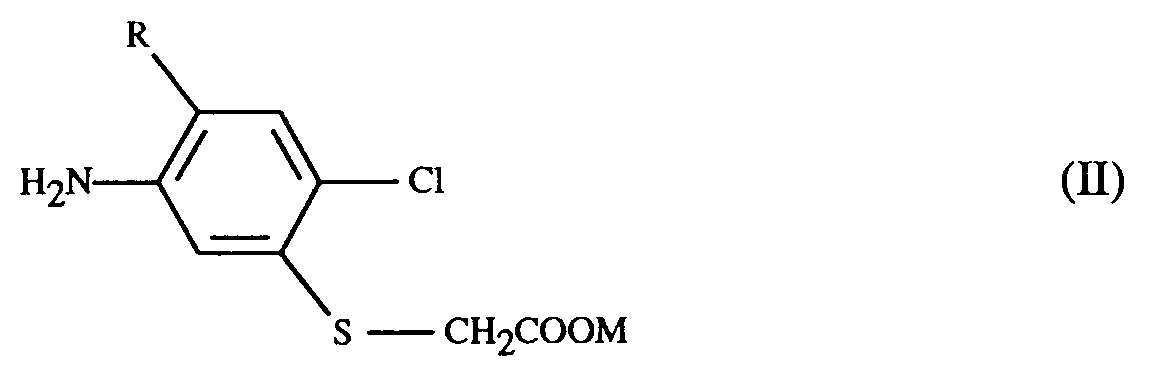
- Das erfindungsgemässe Verfahren zur Herstellung der Verbindungen der Formel I erfolgt in Analogie zu bekannten Verfahren, wie z.B. in EP-A-0 312 064 und EP-A-0 468 924 beschrieben, und ist dadurch gekennzeichnet, dass man eine Verbindung der Formel II

mit Thiophosgen unter üblichen Bedingungen in das Isothiocyanat der Formel III
überführt und dieses anschliessend mit Hexahydropyridazin der Formel V
in die Verbindung der Formel IV
umsetzt, wobei in den Verbindungen der Formeln II, III und IV R Wasserstoff oder Fluor; und M ein Alkali- oder Erdalkalimetallion oder ein Ammoniumkation bedeutet, und anschliessend die erhaltene Verbindung der Formel IV mit Phosgen, Diphosgen (Chlorameisensäure-trichlormethylester) oder Triphosgen (Bis-(trichlormethyl)-carbonat) zur Verbindung der Formel I reagieren lässt. - Dieses Herstellungsverfahren wird im folgenden Reaktionsschema beispielhaft näher erläutert.

- Das Isothiocyanat der Formel III wird in an sich bekannter Weise durch Umsetzen des entsprechenden Amins der Formel II mit Thiophosgen erhalten. Derartige Verfahren sind beispielsweise in EP-A-0 304 920, Seiten 53 und 55; EP-A-0 312 064, Seite 11, letzter Abschnitt und Seite 12, Zeilen 12-18; und EP-A-0 468 924, Seite 21, Zeilen 29-47, Seite 22, Beispiel H2, und Seite 27, Beispiel H17, beschrieben.
- Die Verbindung der Formel IV wird in an sich bekannter Weise durch Umsetzen des Isothiocyanats der Formel III mit Hexahydropyridazin der Formel V erhalten. Derartige Umsetzungen sind beispielsweise in EP-A-0 312 064, Seite 11, letzter Abschnitt, Seite 12, Zeilen 19-24; EP-A-0 468 924, Seite 16, letzter Abschnitt und Seite 17, erster Abschnitt, Seite 19, Zeilen 42-46 und Seite 22, Beispiel H3, beschrieben.
- Die Cyclisierung des Hexahydropyridazinyl-thiocarbonylamino-Derivats der Formel IV kann zweckmässigerweise mit Phosgen, Diphosgen (Chlorameisensäuretrichlormethylester) oder Triphosgen (Bis-(trichlormethyl)-carbonat) in einem inerten Lösungsmittel bei niedrigen Temperaturen, vorzugsweise 0 bis 50°C, besonders bevorzugt bei 0 bis 15°C, erfolgen. Derartige Cyclisierungen sind beispielsweise in EP-A-0 312 064, Seite 11, Zeilen 1-40 und Herstellungsbeispiele 1 bis 5 auf Seiten 13 und 14; und EP-A-0 468 924, Seite 19, Zeilen 47-51, Seite 23, Beispiel H4 und Seite 28, Beispiel H19, beschrieben.
- Die Zwischenprodukte der Formeln III und IV sind neu und wurden speziell für die Synthese der Verbindungen der Formel I entwickelt. Sie bilden daher auch einen Gegenstand der vorliegenden Erfindung.
- Die Herstellung der Ausgangsverbindung der Formel II ist in EP-A-0 126 419 beschrieben.
- Das Hexahydropyridazin der Formel V ist bekannt oder lässt sich analog zu literaturbekannten Verfahren herstellen, beispielsweise Bull. Soc. Chim. France 1957, 704; EP-A-0 304 920, Seiten 9-11 (Schemata 2-4); und EP-A-0 468 924, Seite 19, letzter Abschnitt, Seite 20, erster Abschnitt und Seite 28, Beispiel H18.
- Das Endprodukt der Formel I kann auf übliche Weise durch schonendes Einengen und/oder Verdampfen des Lösungsmittels im Vakuum isoliert und durch Umkristallisieren oder Zerreiben des festen Rückstandes in Lösungsmitteln, in denen es sich nicht gut löst, wie Ether, aromatischen Kohlenwasserstoffe oder chlorierten Kohlenwasserstoffe, gereinigt werden.
- Für die erfindungsgemäße Verwendung der Verbindungen der Formel I oder diese enthaltende Mittel kommen alle in der Landwirtschaft üblichen Applikationsmethoden wie z.B. preemergente Applikation, postemergente Applikation und Saatbeizung, sowie verschiedene Methoden und Techniken in Betracht, wie beispielsweise die kontrollierte Wirkstoffabgabe. Dazu wird der Wirkstoff in Lösung auf mineralische Granulatträger oder polymerisierte Granulate (Harnstoff/Formaldehyd) aufgezogen und getrocknet.
- Gegebenenfalls kann zusätzlich ein Überzug aufgebracht werden (Umhüllungsgranulate), der es erlaubt, den Wirkstoff über einen bestimmten Zeitraum dosiert abzugeben.
- Die Verbindung der Formel I kann in unveränderter Form, d.h. wie sie aus der Synthese anfällt, eingesetzt werden, vorzugsweise verarbeitet man sie aber auf übliche Weise mit den in der Formulierungstechnik üblichen Hilfsmitteln z.B. zu emulgierbaren Konzentraten, direkt versprühbaren oder verdünnbaren Lösungen, verdünnten Emulsionen, Spritzpulvern, löslichen Pulvern, Stäubemitteln, Granulaten oder Mikrokapseln. Die Anwendungsverfahren wie Versprühen, Vernebeln, Verstäuben, Benetzen, Verstreuen oder Gießen werden gleich wie die Art der Mittel den angestrebten Zielen und den gegebenen Verhältnissen entsprechend gewählt.
- Die Formulierungen, d.h. die den Wirkstoff der Formel I und gegebenenfalls einen oder mehrere feste oder flüssige Zusatzstoffe enthaltenden Mittel, Zubereitungen oder Zusammensetzungen werden in bekannter Weise hergestellt, z.B. durch inniges Vermischen und/oder Vermahlen des Wirkstoffs mit Streckmitteln, wie z.B. mit Lösungsmitteln, festen Trägerstoffen und gegebenenfalls oberflächenaktiven Verbindungen (Tensiden).
- Als Lösungsmittel können in Frage kommen: Aromatische Kohlenwasserstoffe, insbesondere die Fraktionen C₈ bis C₁₂, wie Mischungen von Alkylbenzolen, z.B. Xylolgemische oder alkylierte Naphthaline; aliphatische und cycloaliphatische Kohlenwasserstoffe wie Paraffine, Cyclohexan oder Tetrahydronaphthalin; Alkohole, wie Ethanol, Propanol oder Butanol; Glykole sowie deren Ether und Ester, wie Propylenglykol oder Dipropylenglykolether, Ketone wie Cyclohexanon, Isophoron oder Diacetonalkohol, starke polare Lösungsmittel wie N-Methyl-2-pyrrolidon, Dimethylsulfoxid oder Wasser; Pflanzenöle sowie deren Ester, wie Raps-, Ricinus- oder Sojaöl; gegebenenfalls auch Silikonöle.
- Als feste Trägerstoffe, z.B. für Stäubemittel und dispergierbare Pulver, werden in der Regel natürliche Gesteinsmehle verwendet, wie Calcit, Talkum, Kaolin, Montmorillonit oder Attapulgit. Zur Verbesserung der physikalischen Eigenschaften können auch hochdisperse Kieselsäure oder hochdisperse saugfähige Polymerisate zugesetzt werden. Als gekörnte, adsorptive Granulatträger kommen poröse Typen wie z.B. Bimsstein, Ziegelbruch, Sepiolit oder Bentonit, als nicht sorptive Trägermaterialien z.B. Calcit oder Sand in Frage. Darüber hinaus kann eine Vielzahl von vorgranulierten Materialien anorganischer oder organischer Natur wie insbesondere Dolomit oder zerkleinerte Pflanzenrückstände verwendet werden.
- Als oberflächenaktive Verbindungen kommen je nach der Art des zu formulierenden Wirkstoffes der Formel I nichtionogene, kation- und/oder anionaktive Tenside mit guten Emulgier-, Dispergier- und Netzeigenschaften in Betracht. Unter Tensiden sind auch Tensidgemische zu verstehen.
- Geeignete anionische Tenside können sowohl sog. wasserlösliche Seifen wie wasserlösliche synthetische oberflächenaktive Verbindungen sein.
- Als Seifen seien die Alkali-, Erdalkali oder gegebenenfalls substituierten Ammoniumsalze von höheren Fettsäuren (C₁₀-C₂₂), wie z.B. die Na- oder K-Salze der Öl- oder Stearinsäure, oder von natürlichen Fettsäuregemischen genannt, die z.B. aus Kokosnuß- oder Talgöl gewonnen werden können. Ferner sind auch die Fettsäure-methyl-taurinsalze zu erwähnen.
- Häufiger werden jedoch sog. synthetische Tenside verwendet, insbesondere Fettalkoholsulfonate, Fettalkoholsulfate, sulfonierte Benzimidazolderivate oder Alkylarylsulfonate.
- Die Fettalkoholsulfonate oder -sulfate liegen in der Regel als Alkali-, Erdalkali- oder gegebenenfalls substituierte Ammoniumsalze vor und weisen einen Alkylrest mit 8 bis 22 C-Atomen auf, wobei Alkyl auch den Alkylteil von Acylresten einschließt, z.B. das Na- oder Ca-Salz der Ligninsulfonsäure, des Dodecylschwefelsäureesters oder eines aus natürlichen Fettsäuren hergestellten Fettalkoholsulfatgemisches. Hierher gehören auch die Salze der Schwefelsäureester und Sulfonsäuren von Fettalkohol-Ethylenoxid-Addukten. Die sulfonierten Benzimidazolderivate enthalten vorzugsweise 2 Sulfonsäuregruppen und einen Fettsäurerest mit 8-22 C-Atomen. Alkylarylsulfonate sind z.B. die Na-, Ca- oder Triethanolaminsalze der Dodecylbenzolsulfonsäure, der Dibutylnaphthalinsulfonsäure, oder eines Naphthalinsulfonsäure-Formaldehydkondensationsproduktes.
- Ferner kommen auch entsprechende Phosphate wie z.B. Salze des Phosphorsäureesters eines p-Nonylphenol-(4-14)-Ethylenoxid-Adduktes oder Phospholipide in Frage.
- Als nichtionische Tenside kommen in erster Linie Polyglykoletherderivate von aliphatischen oder cycloaliphatischen Alkoholen, gesättigten oder ungesättigten Fettsäuren und Alkylphenolen in Frage, die 3 bis 30 Glykolethergruppen und 8 bis 20 Kohlenstoffatome im (aliphatischen) Kohlenwasserstoffrest und 6 bis 18 Kohlenstoffatome im Alkylrest der Alkylphenole enthalten können.
- Weitere geeignete nichtionische Tenside sind die wasserlöslichen, 20 bis 250 Ethylenglykolethergruppen und 10 bis 100 Propylenglykolethergruppen, enthaltenden Polyethylenoxidaddukte an Polypropylenglykol, Ethylendiaminopolypropylenglykol und Alkylpolypropylenglykol mit 1 bis 10 Kohlenstoffatomen in der Alkylkette. Die genannten Verbindungen enthalten üblicherweise pro Propylenglykol-Einheit 1 bis 5 Ethylenglykoleinheiten.
- Als Beispiele nicht ionischer Tenside seien Nonylphenolpolyethoxyethanole, Ricinusölpolyglykolether, Polypropylen-Polyethylenoxidaddukte, Tributylphenoxypolyethoxyethanol, Polyethylenglykol und Octylphenoxypolyethoxyethanol erwähnt.
- Ferner kommen auch Fettsäureester von Polyoxyethylensorbitan wie das Polyoxyethylensorbitan-trioleat in Betracht.
- Bei den kationischen Tensiden handelt es sich vor allem um quartäre Ammoniumsalze, welche als N-Substituenten mindestens einen Alkylrest mit 8 bis 22 C-Atomen enthalten und als weitere Substituenten niedrige, gegebenenfalls halogenierte Alkyl-, Benzyl- oder niedrige Hydroxyalkylreste aufweisen. Die Salze liegen vorzugsweise als Halogenide, Methylsulfate oder Ethylsulfate vor, z.B. das Stearyltrimethylammoniumchlorid oder das Benzyldi-(2-chlorethyl)-ethylammoniumbromid.
- Die in der Formulierungstechnik gebräuchlichen Tenside, die auch in den erfindungsgemässen Mitteln verwendet werden können, sind u.a. in folgenden Publikationen beschrieben:
- "Mc Cutcheon's Detergents and Emulsifiers Annual", Mc Publishing Corp., Glen Rock, New Jersey, 1988.
- M. and J. Ash, "Encyclopedia of Surfactants", Vol. I-III, Chemical Publishing Co., New York, 1980-1981.
- Dr. Helmut Stache Tensid-Taschenbuch", Carl Hanser Verlag, München/Wien 1981.
- Die herbiziden Zubereitungen enthalten in der Regel 0,1 bis 99 %, insbesondere 0,1 bis 95 %, Wirkstoff der Formel I, 1 bis 99,9 % eines festen oder flüssigen Zusatzstoffes und 0 bis 25 %, insbesondere 0,1 bis 25 % eines Tensides.
- Während als Handelsware eher konzentrierte Mittel bevorzugt werden, verwendet der Endverbraucher in der Regel verdünnte Mittel.
- Die Mittel können auch weitere Zusätze wie Stabilisatoren z.B. gegebenenfalls epoxydierte Pflanzenöle (epoxydiertes Kokosnußöl, Rapsöl oder Sojaöl), Entschäumer, z.B. Silikonöl, Konservierungsmittel, Viskositätsregulatoren, Bindemittel, Haftmittel sowie Dünger oder andere Wirkstoffe zur Erzielung spezieller Effekte enthalten.
- Insbesondere setzen sich bevorzugte Formulierungen folgendermaßen zusammen: (% = Gewichtsprozent)
Emulgierbare Konzentrate: Aktiver Wirkstoff: 1 bis 90 %, vorzugsweise 5 bis 50 % oberflächenaktives Mittel: 5 bis 30 %, vorzugsweise 10 bis 20 % flüssiges Trägermittel: 15 bis 94 %, vorzugsweise 70 bis 85 % Stäube: Aktiver Wirkstoff: 0,1 bis 50 %, vorzugsweise 0,1 bis 1 % festes Trägermittel: 99,9 bis 90 %, vorzugsweise 99,9 bis 99 % Suspensions-Konzentrate: Aktiver Wirkstoff: 5 bis 75 %, vorzugsweise 10 bis 50 % Wasser: 94 bis 24 %, vorzugsweise 88 bis 30 % oberflächenaktives Mittel: 1 bis 40 %, vorzugsweise 2 bis 30 % Benetzbare Pulver: Aktiver Wirkstoff: 0,5 bis 90 %, vorzugsweise 1 bis 80 % oberflächenaktives Mittel: 0,5 bis 20 %, vorzugsweise 1 bis 15 % festes Trägermaterial: 5 bis 95 %, vorzugsweise 15 bis 90 % Granulate: Aktiver Wirkstoff: 0,5 bis 30 %, vorzugsweise 3 bis 15 % festes Trägermittel: 99,5 bis 70 %, vorzugsweise 97 bis 85 % - Der Wirkstoff der Formel I wird in der Regel mit Aufwandmengen von 0,001 bis 2 kg/ha insbesondere 0,005 bis 1 kg/ha erfolgreich eingesetzt. Die für die erwünschte Wirkung erforderliche Dosierung kann durch Versuche ermittelt werden. Sie ist abhängig von der Art der Wirkung, dem Entwicklungsstadium der Kulturpflanze und des Unkrauts sowie von der Applikation (Ort, Zeit, Verfahren) und kann, bedingt durch diese Parameter, innerhalb weiter Bereiche variieren.
- Die Verbindung der Formel I zeichnet sich durch herbizide Eigenschaften aus, die sie ausgezeichnet zum Einsatz in Kulturen von Nutzpflanzen, insbesondere in Getreide, Reis, Mais und Soja befähigen.
- Unter Kulturen sind auch solche zu verstehen, die durch konventionelle züchterische oder gentechnologische Methoden gegen Herbizide bzw. Herbizidklassen tolerant gemacht worden sind.
- Die nachfolgenden Beispiele erläutern die Erfindung weiter, ohne sie zu beschränken.
-

- Zu einem Gemisch aus 7,5 g Calciumcarbonat, 5 ml Thiophosgen in 100 ml Ethylenchlorid und 100 ml Wasser gibt man unter Rühren bei Raumtemperatur eine Lösung von 11,8 g 1-(5-Amino-2-chlor-4-fluorphenylthio)-essigsäure in 100 ml Ethylenchlorid tropfenweise hinzu. Nach sechsstündigem Rühren bei Raumtemperatur werden die festen Anteile der Reaktionsmischung abfiltriert und in einem Essigsäureethylester/Wasser-Gemisch aufgenommen. Unter Rühren versetzt man diese Suspension mit 2N Salzsäurelösung und rührt währen 1/2 Stunde weiter. Die organische Phase wird abgetrennt, über Natriumsulfat getrocknet und anschliessend eingedampft. Man erhält 11,5 g 1-(2-Chlor-4-fluor-5-isocyanato-phenylthio)-essigsäure mit einem Smp. von 118°C.
-

- Zu einer Lösung aus 5,0 g Hexahydropyridazin in 100 ml Ethanol gibt man unter Rühren bei Raumtemperatur eine Lösung von 11,5 g 1-(2-Chlor-4-fluor-5-isothiocyanatophenylthio)-essigsäure in 100 ml Ethylenchlorid tropfenweise hinzu. Nach dreistündigem Rühren bei Raumtemperatur wird die Reaktionsmischung im Vakuum eingedampft. Man erhält 14,5 g 1-[2-Chlor-4-fluor-5-(1-hexahydropyridazinyl-thiocarbonylamino)-phenylthio]-essigsäure mit einem Smp. von 110-118°C.
-

- Zu einer 40 ml 20%iger toluolischer Phosgenlösung gibt man unter Rühren bei einer Temperatur von 0-5°C eine Lösung von 14,5 g 1-[2-Chlor-4-fluor-5-(1-hexahydropyndazinyl-thiocarbonylamino)-phenylthio]-essigsäure in 100 ml Ethylenchlorid tropfenweise hinzu. Anschliessend lässt man die Reaktionsmischung bei Raumtemperatur während 6 Stunden rühren und giesst sie dann in Eiswasser. Die organische Phase wird abgetrennt und über Natriumsulfat getrocknet. Nach dem Eindampfen im Vakuum erhält man 15,0 g 9-[4-Chlor-2-fluor-5-(1-oxycarbonylmethylthio)-phenylimino]-8-thia-1,6-diazabicyclo-[4.3.0]nonan-7-on mit einem Smp. von 170-172°C.
-

- Zu einer Suspension von 1,94 g (0,005 Mol) 9-[4-Chlor-2-fluor-5-(1-oxycarbonylmethylthio)-phenylimino]-8-thia-1,6-diazabicyclo[4.3.0]nonan-7-on in 75 ml Methanol wird 0,28 g Natriummethylat bei Raumtemperatur zugegeben, wobei die Suspension in Lösung geht. Es wird während 15 Minuten bei Raumtemperatur weitergerührt und anschliessend das Lösungsmittel im Vakuum schonend abgedampft. Zurück bleibt ein glasiges Produkt, das in Diethylether digeriert wird. Man erhält 1,7 g (83% Ausbeute) des gewünschten Na-Salzes von 9-[4-Chlor-2-fluor-5-(1-oxycarbonylmethylthio)-phenylimino]-8-thia-1,6-diazabicyclo[4.3.0]nonan-7-on als Pulver; Smp. 203°C.
-

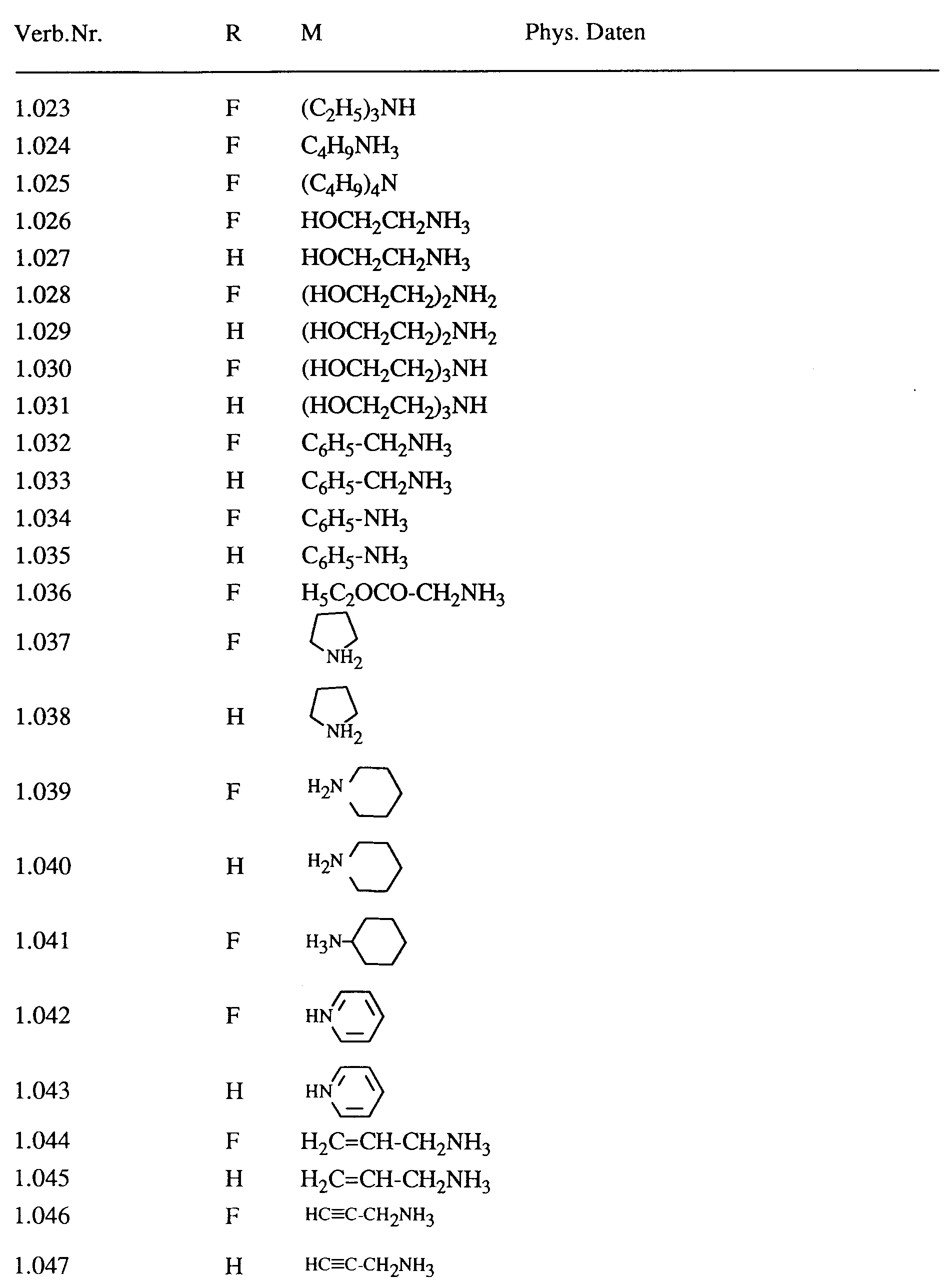
wird analog zu Beispiel H4 erhalten; Smp. 208-215°C. - Auf analoge Weise können auch die in der Tabelle 1 zusammengestellten Verbindungen der Formel I hergestellt werden.

-
F1. Spritzpulver a) b) c) Verbindung der Formel I 25 % 50 % 75 % Na-Ligninsulfonat 5 % 5 % - Na-Laurylsulfat 3 % - 5 % Na-Diisobutylnaphthalinsulfonat - 6 % 10 % Octylphenolpolyethylenglykolether (7-8 Mol AeO) - 2 % - Hochdisperse Kieselsäure 5 % 10 % 10 % Kaolin 62 % 27 % - - Der Wirkstoff wird mit den Zusatzstoffen gut vermischt und in einer geeigneten Mühle gut vermahlen. Man erhält Spritzpulver, die sich mit Wasser zu Suspensionen jeder gewünschten Konzentration verdünnen lassen.
F2. Emulsions-Konzentrat Verbindung der Formel I 10 % Octylphenolpolyethylenglykolether (4-5 Mol AeO) 3 % Ca-Dodecylbenzolsulfonat 3 % Ricinusölpolyglykolether (36 Mol AeO) 4 % Cyclohexanon 30 % Xylolgemisch 50 % - Aus diesem Konzentrat können durch Verdünnen mit Wasser Emulsionen jeder gewünschten Konzentration hergestellt werden.
F3. Stäubemittel a) b) Verbindung der Formel I 5 % 8 % Talkum 95 % - Kaolin - 92 % - Man erhält anwendungsfertige Stäubemittel, indem der Wirkstoff mit den Trägern vermischt und auf einer geeigneten Mühle vermahlen wird.
F4. Extruder-Granulat Verbindung der Formel I 10 % Na-Ligninsulfonat 2 % Carboxymethylcellulose 1 % Kaolin 87 % - Der Wirkstoff wird mit den Zusatzstoffen vermischt, vermahlen und mit Wasser angefeuchtet. Dieses Gemisch wird extrudiert und anschließend im Luftstrom getrocknet.
F5. Umhüllungs-Granulat Verbindung der Formel I 3 % Polyäthylenglykol (MG200) 3 % Kaolin 94 % - Der fein gemahlene Wirkstoff wird in einem Mischer auf das mit Polyethylenglykol angefeuchtete Kaolin gleichmäßig aufgetragen. Auf diese Weise erhält man staubfreie Umhüllungs-Granulate.
F6. Suspensions-Konzentrat Verbindung der Formel I 40 % Propylenglykol 10 % Nonylphenolpolyethylenglykolether (15 Mol AeO) 6 % Na-Ligninsulfonat 10 % Carboxymethylcellulose 1 % Silikonöl in Form einer 75%-igen wäßrigen Emulsion 1 % Wasser 32 % - Der fein gemahlene Wirkstoff wird mit den Zusatzstoffen innig vermischt. Man erhält so ein Suspensions-Konzentrat, aus welchem durch Verdünnen mit Wasser Suspensionen jeder gewünschten Konzentration hergestellt werden können.
- Dikotyle Testpflanzen werden in Kunststofftöpfen in Standarderde angesät. Unmittelbar nach der Saat werden die Prüfsubstanzen in wäßriger Suspension, hergestellt aus einem 25 %igen Spritzpulver (Beispiel F1, a)), entsprechend der Dosierung von 2 kg AS/ha aufgesprüht (500 l Wasser/ha). Anschließend werden die Testpflanzen im Gewächshaus unter optimalen Bedingungen kultiviert. Nach 3 Wochen Testdauer wird der Versuch ausgewertet mit einer neunstufigen Notenskala (1 = vollständige Schädigung, 9 = keine Wirkung). Boniturnoten von 1 bis 4 (insbesondere 1 bis 3) bedeuten eine gute bis sehr gute Herbizidwirkung.
Tabelle B1 Pre-emergente Wirkung Wirkstoff der Formel Testpflanze: Sinapis Solanum Ipomoea Setaria Cyperus 1.001 1 1 4 2 3 1.002 1 1 4 2 3 1.003 1 1 1 4 2 - Dieselben Resultate werden erhalten, wenn man die Verbindungen der Formel I gemäß den Beispielen F2 bis F6 formuliert.
- Dikotyle Testpflanzen werden im Gewächshaus in Kunststofftöpfen mit Standarderde angezogen und im 4- bis 6-Blattstadium mit einer wässrigen Suspension der Prüfsubstanzen, hergestellt aus einem 25 %igen Spritzpulver (Beispiel F1, a)), besprüht, entsprechend einer Dosierung von 2 kg AS/ha (500 l Wasser/ha). Anschliessend werden die Testpflanzen im Gewächshaus unter optimalen Bedingungen weiterkultiviert. Nach ca. 18 Tagen Testdauer wird der Versuch ausgewertet mit einer neunstufigen Notenskala (1 = vollständige Schädigung, 9 = keine Wirkung). Boniturnoten von 1 bis 4 (insbesondere 1 bis 3) bedeuten eine gute bis sehr gute Herbizidwirkung.
Tabelle B2 Post-emergente Wirkung Wirkstoff der Formel Testpflanze: Sinapis Solanum Ipomoea Setaria Stellaria Cyperus 1.001 1 1 1 3 2 3 1.002 1 1 1 3 2 3 1.003 1 1 1 1 3 4 - Dieselben Resultate werden erhalten, wenn man die Verbindungen der Formel I gemäß den Beispielen F2 bis F6 formuliert.
Claims (11)
- Verbindungen der Formel I

R Wasserstoff oder Fluor; und
M ein Alkali- oder Erdalkalimetallion oder ein Ammoniumkation ist. - Verfahren zur Herstellung der Verbindungen der Formel I gemäss Anspruch 1, dadurch gekennzeichnet, dass man eine Verbindung der Formel II


- Verbindungen der Formel III

- Verbindungen der Formel IV

- Herbizides Mittel, dadurch gekennzeichnet, dass es die Verbindungen der Formel I gemäss Anspruch 1 enthält.
- Mittel gemäss Anspruch 5, dadurch gekennzeichnet, dass es 0,1 bis 95% der Verbindungen der Formel I, 1 bis 99,9% eines festen oder flüssigen Zusatzstoffes und 0 bis 25%, insbesondere 0,1 bis 25% eines Tensides enthält.
- Verfahren zur Bekämpfung unerwünschten Pflanzenwachstums, dadurch gekennzeichnet, dass man die Verbindungen der Formel I gemäss Anspruch 1 oder ein diese Verbindungen enthaltendes Mittel in einer wirksamen Menge auf die Pflanzen oder deren Lebensraum appliziert.
- Verfahren gemäss Anspruch 7, dadurch gekennzeichnet, dass man die Verbindungen der Formel I in einer Menge von 0,001 bis 2 kg pro Hektar appliziert.
- Verfahren gemäss Anspruch 7 zur selektiven pre- oder post-emergenten Bekämpfung von Unkräutern in Nutzpflanzenkulturen, insbesondere Getreide, Reis, Mais und Soja.
- Verwendung der Verbindungen der Formel I gemäss Anspruch 1 zur selektiven pre- oder post-emergenten Bekämpfung von Unkräutern in Nutzpflanzenkulturen, insbesondere Getreide, Reis, Mais und Soja.
- Verwendung eines Mittels gemäss Anspruch 5 zur selektiven pre- oder post-emergenten Bekämpfung von Unkräutern in Nutzpflanzenkulturen, insbesondere Getreide, Reis, Mais und Soja.
Applications Claiming Priority (2)
| Application Number | Priority Date | Filing Date | Title |
|---|---|---|---|
| CH486/93 | 1993-02-17 | ||
| CH48693 | 1993-02-17 |
Publications (2)
| Publication Number | Publication Date |
|---|---|
| EP0611768A2 true EP0611768A2 (de) | 1994-08-24 |
| EP0611768A3 EP0611768A3 (de) | 1995-02-01 |
Family
ID=4188116
Family Applications (1)
| Application Number | Title | Priority Date | Filing Date |
|---|---|---|---|
| EP94810070A Withdrawn EP0611768A3 (de) | 1993-02-17 | 1994-02-08 | Phenylimino-thiadiazabicyclononanon-Salze mit herbiziden Eigenschaften. |
Country Status (4)
| Country | Link |
|---|---|
| EP (1) | EP0611768A3 (de) |
| JP (1) | JPH06271585A (de) |
| CA (1) | CA2115725A1 (de) |
| MX (1) | MX9401051A (de) |
Family Cites Families (9)
| Publication number | Priority date | Publication date | Assignee | Title |
|---|---|---|---|---|
| JPS59212472A (ja) * | 1983-05-16 | 1984-12-01 | Sumitomo Chem Co Ltd | 4,5,6,7−テトラヒドロ−2h−イソインド−ル−1,3−ジオン誘導体、その製造法およびそれを有効成分とする除草剤 |
| EP0238711B1 (de) * | 1986-03-25 | 1990-11-28 | Kumiai Chemical Industry Co., Ltd. | Thiadiazabicyclononanderivate, Verfahren zu ihrer Herstellung und herbizide Zusammensetzungen |
| EP0273417B1 (de) * | 1986-12-24 | 1991-08-21 | Kumiai Chemical Industry Co., Ltd. | Thiadiazabicyclononanderivate und herbizide Zusammensetzungen |
| CA1309716C (en) * | 1987-08-28 | 1992-11-03 | Jun Satow | Condensed heterocyclic derivative, process for their production and herbicides |
| DE3889412T2 (de) * | 1987-10-16 | 1994-12-22 | Ihara Chemical Ind Co | Thiadiazabicyclononanderivate und herbizide Zubereitungen. |
| JPH01186894A (ja) * | 1988-01-21 | 1989-07-26 | Nissan Chem Ind Ltd | 縮合ヘテロ環誘導体および除草剤 |
| JPH0245488A (ja) * | 1988-08-06 | 1990-02-15 | Kumiai Chem Ind Co Ltd | チアジアザビシクロノナン誘導体及び除草剤 |
| EP0457714A1 (de) * | 1990-03-22 | 1991-11-21 | Ciba-Geigy Ag | Thiadiazabicyclononanderivate, Verfahren zu ihrer Herstellung, Zwischenprodukte und ihre Verwendung als Herbizide |
| EP0468924A3 (en) * | 1990-07-23 | 1992-04-29 | Ciba-Geigy Ag | New herbicides |
-
1994
- 1994-02-08 EP EP94810070A patent/EP0611768A3/de not_active Withdrawn
- 1994-02-10 MX MX9401051A patent/MX9401051A/es unknown
- 1994-02-15 CA CA 2115725 patent/CA2115725A1/en not_active Abandoned
- 1994-02-17 JP JP6045057A patent/JPH06271585A/ja active Pending
Also Published As
| Publication number | Publication date |
|---|---|
| MX9401051A (es) | 1994-08-31 |
| JPH06271585A (ja) | 1994-09-27 |
| CA2115725A1 (en) | 1994-08-18 |
| EP0611768A3 (de) | 1995-02-01 |
Similar Documents
| Publication | Publication Date | Title |
|---|---|---|
| EP0099339B1 (de) | Anellierte N-Phenylsulfonyl-N'-pyrimidinyl- und -triazinylharnstoffe | |
| EP0044807B1 (de) | N-Phenylsulfonyl-N'-pyrimidinyl- und -triazinylharnstoffe | |
| EP0116518B1 (de) | N-Phenylsulfonyl-N'-pyrimidinyl- und -triazinylharnstoffe | |
| EP0120814B1 (de) | N-Phenylsulfonyl-N'-pyrimidinyl- und -triazinylharnstoffe | |
| EP0070802B1 (de) | N-Phenylsulfonyl-N'-pyrimidinyl- und -triazinylharnstoffe | |
| EP0600836B1 (de) | Selektiv-herbizides Mittel | |
| EP0072347B1 (de) | N-Phenylsulfonyl-N'-pyrimidinyl- und -triazinylharnstoffe | |
| EP0097122A2 (de) | N-Heterocyclosulfonyl-N'-pyrimidinyl- und -triazinylharnstoffe | |
| DE69126836T2 (de) | Herbizide | |
| EP0128116B1 (de) | Anellierte N-Phenylsulfonyl-N'-pyrimidinyl- und -triazinylharnstoffe | |
| EP0459949B1 (de) | Sulfonylharnstoffe mit herbizider und pflanzenwuchsregulierender Wirkung | |
| EP0558445A1 (de) | Sulfonylharnstoffe als Herbizide | |
| DD212643A5 (de) | Herbizide und wachstumsregulierende mittel | |
| EP0558448A1 (de) | 1,5-Diphenylpyrazol-3-Carbonsäure-Derivate als Antidots für Sulfonylharnstoffherbizide | |
| DE3811777A1 (de) | Heterocyclisch substituierte alkyl- und alkenylsulfonylharnstoffe, verfahren zu ihrer herstellung und ihre verwendung als herbizide oder pflanzenwachstumsregulatoren | |
| EP0145664B1 (de) | Herbizide Sulfonylharnstoffe | |
| EP0597807A1 (de) | Selektiv-herbizides Mittel | |
| EP0259265B1 (de) | 3-Methylphthalimide | |
| EP0471646B1 (de) | Sulfonylharnstoffe als Herbizide | |
| DD283762A5 (de) | Herbizide und pflanzenwuchsregulierende mittel | |
| EP0582021A1 (de) | Sulfonylharnstoffe als Herbizide | |
| EP0319689B1 (de) | Heterocyclisch substituierte N-Sultam-sulfonamide, Verfahren zu ihrer Herstellung und ihre Verwendung als Herbizide und Pflanzenwachstumsregulatoren | |
| EP0337946A1 (de) | Harnstoffe | |
| EP0303114B1 (de) | Heterocyclisch substituierte Sulfamidsäurephenylester, Verfahren zu ihrer Herstellung und ihre Verwendung als Herbizide und Pflanzenwachstumsregulatoren | |
| EP0528765B1 (de) | Benzothiazolon Herbizide |
Legal Events
| Date | Code | Title | Description |
|---|---|---|---|
| PUAI | Public reference made under article 153(3) epc to a published international application that has entered the european phase |
Free format text: ORIGINAL CODE: 0009012 |
|
| AK | Designated contracting states |
Kind code of ref document: A2 Designated state(s): AT BE CH DE DK ES FR GB GR IE IT LI LU MC NL PT SE |
|
| PUAL | Search report despatched |
Free format text: ORIGINAL CODE: 0009013 |
|
| AK | Designated contracting states |
Kind code of ref document: A3 Designated state(s): AT BE CH DE DK ES FR GB GR IE IT LI LU MC NL PT SE |
|
| STAA | Information on the status of an ep patent application or granted ep patent |
Free format text: STATUS: THE APPLICATION IS DEEMED TO BE WITHDRAWN |
|
| 18D | Application deemed to be withdrawn |
Effective date: 19950802 |