EP0613306B1 - Appareil de contrÔle de quantification dans un compresseur de signal vidéo - Google Patents
Appareil de contrÔle de quantification dans un compresseur de signal vidéo Download PDFInfo
- Publication number
- EP0613306B1 EP0613306B1 EP94301100A EP94301100A EP0613306B1 EP 0613306 B1 EP0613306 B1 EP 0613306B1 EP 94301100 A EP94301100 A EP 94301100A EP 94301100 A EP94301100 A EP 94301100A EP 0613306 B1 EP0613306 B1 EP 0613306B1
- Authority
- EP
- European Patent Office
- Prior art keywords
- quantizing
- blocks
- quantization
- factors
- data
- Prior art date
- Legal status (The legal status is an assumption and is not a legal conclusion. Google has not performed a legal analysis and makes no representation as to the accuracy of the status listed.)
- Expired - Lifetime
Links
- 238000013139 quantization Methods 0.000 claims description 90
- 239000011159 matrix material Substances 0.000 claims description 10
- 238000007906 compression Methods 0.000 description 15
- 230000006835 compression Effects 0.000 description 14
- 238000000034 method Methods 0.000 description 11
- 230000008569 process Effects 0.000 description 11
- 239000013598 vector Substances 0.000 description 7
- 230000003044 adaptive effect Effects 0.000 description 6
- 230000006870 function Effects 0.000 description 4
- 230000002457 bidirectional effect Effects 0.000 description 3
- 238000004364 calculation method Methods 0.000 description 2
- 230000001186 cumulative effect Effects 0.000 description 2
- 230000001419 dependent effect Effects 0.000 description 2
- 238000010586 diagram Methods 0.000 description 2
- 230000009471 action Effects 0.000 description 1
- 230000001174 ascending effect Effects 0.000 description 1
- 230000009286 beneficial effect Effects 0.000 description 1
- 230000005540 biological transmission Effects 0.000 description 1
- 230000008859 change Effects 0.000 description 1
- 230000001143 conditioned effect Effects 0.000 description 1
- 230000002939 deleterious effect Effects 0.000 description 1
- 239000000463 material Substances 0.000 description 1
- 238000012544 monitoring process Methods 0.000 description 1
- 230000008520 organization Effects 0.000 description 1
- 230000009467 reduction Effects 0.000 description 1
- 230000008054 signal transmission Effects 0.000 description 1
Images




Classifications
-
- H—ELECTRICITY
- H04—ELECTRIC COMMUNICATION TECHNIQUE
- H04N—PICTORIAL COMMUNICATION, e.g. TELEVISION
- H04N19/00—Methods or arrangements for coding, decoding, compressing or decompressing digital video signals
- H04N19/10—Methods or arrangements for coding, decoding, compressing or decompressing digital video signals using adaptive coding
- H04N19/134—Methods or arrangements for coding, decoding, compressing or decompressing digital video signals using adaptive coding characterised by the element, parameter or criterion affecting or controlling the adaptive coding
- H04N19/146—Data rate or code amount at the encoder output
- H04N19/152—Data rate or code amount at the encoder output by measuring the fullness of the transmission buffer
-
- H—ELECTRICITY
- H04—ELECTRIC COMMUNICATION TECHNIQUE
- H04N—PICTORIAL COMMUNICATION, e.g. TELEVISION
- H04N19/00—Methods or arrangements for coding, decoding, compressing or decompressing digital video signals
- H04N19/10—Methods or arrangements for coding, decoding, compressing or decompressing digital video signals using adaptive coding
- H04N19/134—Methods or arrangements for coding, decoding, compressing or decompressing digital video signals using adaptive coding characterised by the element, parameter or criterion affecting or controlling the adaptive coding
- H04N19/146—Data rate or code amount at the encoder output
- H04N19/15—Data rate or code amount at the encoder output by monitoring actual compressed data size at the memory before deciding storage at the transmission buffer
-
- H—ELECTRICITY
- H04—ELECTRIC COMMUNICATION TECHNIQUE
- H04N—PICTORIAL COMMUNICATION, e.g. TELEVISION
- H04N19/00—Methods or arrangements for coding, decoding, compressing or decompressing digital video signals
- H04N19/10—Methods or arrangements for coding, decoding, compressing or decompressing digital video signals using adaptive coding
- H04N19/102—Methods or arrangements for coding, decoding, compressing or decompressing digital video signals using adaptive coding characterised by the element, parameter or selection affected or controlled by the adaptive coding
- H04N19/124—Quantisation
-
- H—ELECTRICITY
- H04—ELECTRIC COMMUNICATION TECHNIQUE
- H04N—PICTORIAL COMMUNICATION, e.g. TELEVISION
- H04N19/00—Methods or arrangements for coding, decoding, compressing or decompressing digital video signals
- H04N19/10—Methods or arrangements for coding, decoding, compressing or decompressing digital video signals using adaptive coding
- H04N19/102—Methods or arrangements for coding, decoding, compressing or decompressing digital video signals using adaptive coding characterised by the element, parameter or selection affected or controlled by the adaptive coding
- H04N19/124—Quantisation
- H04N19/126—Details of normalisation or weighting functions, e.g. normalisation matrices or variable uniform quantisers
-
- H—ELECTRICITY
- H04—ELECTRIC COMMUNICATION TECHNIQUE
- H04N—PICTORIAL COMMUNICATION, e.g. TELEVISION
- H04N19/00—Methods or arrangements for coding, decoding, compressing or decompressing digital video signals
- H04N19/10—Methods or arrangements for coding, decoding, compressing or decompressing digital video signals using adaptive coding
- H04N19/169—Methods or arrangements for coding, decoding, compressing or decompressing digital video signals using adaptive coding characterised by the coding unit, i.e. the structural portion or semantic portion of the video signal being the object or the subject of the adaptive coding
- H04N19/17—Methods or arrangements for coding, decoding, compressing or decompressing digital video signals using adaptive coding characterised by the coding unit, i.e. the structural portion or semantic portion of the video signal being the object or the subject of the adaptive coding the unit being an image region, e.g. an object
- H04N19/176—Methods or arrangements for coding, decoding, compressing or decompressing digital video signals using adaptive coding characterised by the coding unit, i.e. the structural portion or semantic portion of the video signal being the object or the subject of the adaptive coding the unit being an image region, e.g. an object the region being a block, e.g. a macroblock
-
- H—ELECTRICITY
- H04—ELECTRIC COMMUNICATION TECHNIQUE
- H04N—PICTORIAL COMMUNICATION, e.g. TELEVISION
- H04N19/00—Methods or arrangements for coding, decoding, compressing or decompressing digital video signals
- H04N19/60—Methods or arrangements for coding, decoding, compressing or decompressing digital video signals using transform coding
- H04N19/61—Methods or arrangements for coding, decoding, compressing or decompressing digital video signals using transform coding in combination with predictive coding
Definitions
- This invention relates to the quantizing apparatus in a video signal compression system.
- Video signal compression apparatus typically include circuitry to quantize codewords of partially compressed signal, causing many of the quantized codewords to have similar values, which condition is conducive to run length encoding. Thereafter the quantized codewords are typically run and variable length encoded to provide the signal in compressed format.
- the term "partially compressed signal” refers to signal provided by, for example, a discrete cosine transform, or DCT, processor.
- Video data provided by DCT processors occurs in blocks of, for example, 8 x 8 coefficients representing a matrix of 8 x 8 contiguous pixels.
- the respective coefficients in a block are quantized by different amounts depending upon the relative importance of the respective coefficients. In quantizing a block of such coefficients a quantization matrix is utilized.
- This quantization matrix includes the quantizing values to be applied to the respective coefficients in a block. Quantization of the video data may be performed by applying the same matrix or table of quantization values to all blocks of coefficients (codewords). This is referred to herein as fixed quantization, even though the quantizing values in the matrix may be different. Since different frames of video signal represent different images, it will be readily appreciated that the amount of compressed video data resulting from fixed quantization will be variable from frame to frame, giving rise to variable bit rate, VBR, compression.
- CBR constant bit rate compression systems
- the quantization of codewords is made adaptive to control the number of compressed data.
- the volume of compressed data is monitored and the quantization values are changed in inverse proportion to the volume of compressed data in order to render the number of compressed bits per frame substantially constant.
- Adaptive quantizing systems also utilize tables of quantizing values for quantizing the blocks of coefficients. Adaptivity is typically realized by simply scaling the quantizing values as they are output from the table for application to the respective coefficients of a block. Nominally all quantizing values provided from the quantization table are scaled by the same factor, but the scale factor may vary from block to block.
- CBR compression systems tend to cause the image quality from frame to frame to vary, but constant bit rate is advantageous if the compressed signal is to be multiplexed with other signals for transmission.
- VBR compressed signal tends to provide substantially uniform image quality from frame to frame, but is more difficult to transmit in a multiplexed signal situation.
- the present invention which in its broadest aspect is defined in claim 1, is a quantizing system which provides limits to the amount of data, but substantially retains image quality uniformity from frame to frame.
- This system includes a quantizer for quantizing coded video data and further apparatus for monitoring the amount of output data. Dependent upon the amount of output data being lesser or greater than a predetermined value, the quantizer is conditioned to operate in different modes.
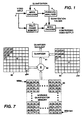
- FIGURES 1 and 2 are block diagrams of alternative video signal compression systems including quantization apparatus embodying the present invention.
- FIGURE 3 is a flow chart of the operation of the FORWARD ANALYSER shown in FIGURE 2.
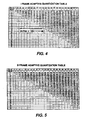
- FIGURE 4, 5 and 6 are tables of representative quantization values for frames of video signal compressed according to intraframe processing, forward interframe processing and bidirectional interframe processing respectively.
- FIGURE 7 is a pictorial representation of a quantizing system.
- FIGURE 8 is a flow diagram of an adaptive quantization system wherein the threshold value is changed on a frame/field basis.
- MPEG is a system standard developed by the Moving Picture Experts Committee of the International Organization for Standardization.
- An example of an MPEG-like system may be found in United States Patent No. 5,122,875.
- the MPEG-like systems perform motion compensated predictive compression on respective successive groups of frames, GOP's. Within a compressed GOP the frames are designated I, P or B depending upon whether they are compressed by intraframe processing, forward interframe processing and bidirectional interframe processing respectively. Because the different frame types are compressed differently, the volume of compressed data for the different frame types may be different, even for the same image, hence different quantization values are appropriate for the different compressed frame types.
- Compressed image data in an MPEG-like system is arranged in macroblocks which represent a matrix of e.g., 16 x 16 contiguous pixels.
- Respective macroblocks are configured of four 8 x 8 blocks of luminance data and two 8 x 8 blocks of chrominance data.
- Each 8 x 8 block of chrominance data represents the entire 16 x 16 matrix of pixels.
- the macroblocks are arranged in slices, with each slice representing , for example, 16 horizontal lines of video signal.
- One frame of 496 active lines can therefor be represented by 31 slices.
- MPEG-like systems typically quantize data on a macroblock basis.
- Quantization in the present invention is nominally performed using fixed quantization values as long as the total coded data does not exceed a predetermined amount. In one embodiment, if it does then only the macroblocks of data that exceed certain limits are adaptively quantized, with all other macroblocks undergoing fixed quantization.
- a maximum codeword target value is established for a GOP. This maximum target R GOP is distributed amongst the respective frames in the GOP according to the compression process utilized for the respective frames. The R GOP is reflected in global quantization factors Q I , Q P , Q B used to modify the quantization values in the respective quantization matrices.
- nominal values may be used for r I , r P , r B in the first GOP, and thereafter the values from the prior GOP may be utilized until the first I, P and B frames are encoded for the current GOP.
- the value ThV may be computed using the volume of data in respective macroblocks either prior to or after quantization. That is ThV may be a function of unquantized data or quantized data.
- the frame is coded in normal VBR mode with the fixed quantization used in the first compression pass. If it is not, a second compression pass is invoked. In the second pass, fixed quantization is used for all macroblocks whose size is less than ThV. For the remaining macroblocks a larger quantization factor is selected. This larger quantization factor may be selected according to a formula and/or dependent upon, for example, the difference between mb size (i) and ThV. In this instance the possible difference values may be divided into ranges, and a quantization factor increment assigned to each range.
- the potential difference values are divided into three ranges which encompass 50, 30 and 20 percent of the possible values, with the 50, 30 and 20 percent ranges including the lowest to the highest values respectively.
- the 50, 30 and 20 percent ranges may be assigned increment values of 1, 2 and 3 respectively.
- the current quantization factor for that block is incremented by 2.
- FIGURES 6, 7, and 8 represent such empirical lookup tables.
- two quantities are used to enter the empirical table. These two quantities are the current quantization factor and the variable xs-frac.
- the output from the table is an updated quantization factor which is used to quantize the current macroblock.
- Different tables are used for the different encoded frame types.
- the tables in FIGURES 6, 7 and 8 correspond to values developed for use with I, P and B frames respectively. It should be noted that certain macroblocks in P and B encoded frames may be intraframe encoded. In this instance the I table will be used for such I-type macroblocks found in P or B frames.
- the values labelled OLD qi are the current quantization factors (used to address the table)
- the values labelled NEW qi are the new quantization factors output from the table
- the values shown internal to the table are the values xs-frac multiplied by a predetermined amount, e.g. one hundred, which xs-frac values are also used to address the respective tables.
- ThV n ⁇ n (ThV)
- Successive values of ⁇ are reduced by the quantity ⁇ n K n .
- the factor ⁇ n is utilized to insure that the quantity ⁇ n K n does not grow too rapidly, that is to insure that ⁇ is not reduced too rapidly. Both factors are a function of the accumulated number of bits occurring in the preceding macroblocks.
- bits-cut refers to the number of coded bits by which the preceding macroblocks have been reduced as a result of adaptive quantization of the macroblocks exceeding ThV.
- ⁇ n is computed using the equation; and bears a very small value until a significant number of the busier macroblocks in a frame have been processed.
- ⁇ n may be assigned fixed values for different groupings of macroblocks. This value may be zero, 0.1 and 0.25 for the first occurring one third of the macroblocks, the second occurring one third of the macroblocks and the third occurring one third of the macroblocks respectively. Note that the values calculated in equations (6) through (10), after processing the n th macroblock, are applied in processing the n + 1 th macroblock.
- the foregoing process may be iterated several times before the total coded bits satisfy equation (5).
- the variable xs-frac is weighted in a direction to provide larger quantization factors from the empirical tables.
- a working table of quantization factors is kept, in which the quantization factor for each macroblock is stored.
- quantization factors for respective macroblocks are changed the corresponding quantization factor in the table is updated.
- the respective frame is recoded using the quantization factors stored in the table for quantizing the respective macroblocks.
- FIGURE 1 illustrates a general form of a system for practicing the invention.
- This particular system assumes MPEG encoding, but it will be recognized that any encoder which operates on a block basis may incorporate the invention.
- Video signal to be encoded i s applied to a bus 2, which is coupled to the input of an MPEG encoder 4 and a memory device 7.
- the encoder 4 is coupled to a forward analyzer 6, and communicates thereto information related to the encoding process. This information primarily comprises the current frame type, the current macroblock type, the current quantization factor for respective macroblocks and the number of bits encoded. From this data the forward analyzer performs the computations of equations (1) - (10) and generates new quantization factors which are loaded in the aforementioned working table.
- the forward analyzer 6 forces sufficient coding iterations of each frame to adapt the quantization factors such that equation (5) is satisfied.
- the video data stored in the memory 7 is coupled to a second MPEG encoder 8, a frame at a time, after quantization factors for the corresponding frame have been determined by the forward analyzer.
- the forward analyzer couples the quantization factors from the working table of quantization factors selected for that corresponding frame.
- the MPEG encoder 8 uses these quantization factors for encoding the corresponding frame of video data.
- FIGURE 1 A system like that illustrated in FIGURE 1 can process more data per unit time but tends to be hardware intensive.
- FIGURE 2 A less hardware intensive system is illustrated in FIGURE 2, wherein certain parts of the apparatus are operated in time division multiplexed fashion to perform the respective operations of forward analysis and encoding.
- the elements 10 to 22 comprise a typical motion compensated predictive encoder.
- the motion compensation apparatus 20 operates on the luminance signal to generate motion vectors, which vectors are used in the three processing paths.
- a common controller 21 communicates with the respective processing circuitry and directs the general operation of the encoder. The operation of motion compensated predictive encoders is well known and will not be described in detail herein.
- the apparatus of FIGURE 2 also includes a forward analyzer 25 including a storage element 26, a processor 27, and a counter 28.
- the processor 27 controls the storage element 26, the counter 28, and communicates with the controller 21 to interrupt processing to allow iteration of quantization adaption.
- a frame of video signal is applied to the bus 10 and compressed (encoded) using fixed quantization.
- the respective blocks of partially compressed data are generated by the DCT processor,13, these blocks are stored in the memory 26 to be used for subsequent iterations of quantization factor generation.
- the quantized data from the quantizing element 14, is applied to a run-length and variable length encoder 15.
- Run and variable length encoded data from the encoder 15 and motion vectors from element 20 are coupled to a formatter 22.
- the formatter 22 generates header data and arranges the blocks of data from the encoder 15, the motion vectors, and the header data into macroblocks, slices, frames and GOP's etc.
- Coded data from either the encoder 15 or the formatter 22 is counted by the counter 28 to determine the data r j for the encoded frame. Whether the data from the formatter 22 or the encoder 15 is counted depends upon whether the amount of data corresponding to motion vectors and/or header data is relatively constant and predictable for the respective frame types. If it is, then data may be counted at the output of either device, and if it is not then the data to be counted must be derived from the output of the formatter 22.
- the processor 27 is programmed to communicate with the system controller 21 to acquire the bit rate R GOP , and at the end of each encoding pass to acquire the count of encoded bits from the counter 28. Using this data the processor 27 performs the quantization factor adaption. This process will be described with the aid of the flowchart of FIGURE 3.
- the system is initialized [50] by applying user parameters to the system controller 21, which parameters indicate for example the type of video source material, the desired coding resolution, the desired image quality etc.
- the system controller is substantially a state machine and these parameters establish the starting and selected states. If such user parameters are not entered, the system controller loads a set of default parameters, one of which is R GOP.
- the R GOP value is communicated to the processor 27, and nominal values for r I , r P , r B are accessed from, for example, read only memory. Using these values the processor 27 calculates the respective R j values.
- the system controller accesses [51] the first frame of data.
- the respective frames are designated I, P, B by the controller 21 according to the relative position in the sequence of input frames that particular frames occur.
- the frame is encoded [52] using a quantization table and a global quantization factor Q j selected to provide a predetermined image quality.
- the blocks of data provided from the DCT apparatus are stored in the memory 26.
- a count value from the counter 28 associated with the macroblock is also stored. This count value may be the cumulative count from the beginning of the frame, or a value indicating the amount of coded data for the respective macroblock. The latter value may be obtained by storing the output from the counter for one macroblock period and subtracting the respective stored count value from the cumulative count value associated with the next successive macroblock.
- the total data, r j for the encoded frame is acquired from the counter 28 and the variable xs-frac is calculated [53] according to equation (5).
- the threshold value ThV is also calculated.
- the variable xs-frac is tested [54] to determine if it is positive. If it is positive, the encoded data for the frame are less than the R j , and no quantization adjustments are required.
- the global quantization factor is loaded [55] into all of the locations of a working quantization table (q MEM) within the processor 27.
- the system can be instructed to re-encode the frame using the global quantization factor, and to output the encoded data to further circuitry such as a rate buffer (not shown). In this instance such further circuitry would be inhibited from accepting data from the formatter until after the decision made in step [54].
- the formatter may be coupled to a memory which stores the lastmost frame of encoded data. Then if the condition of step [54] is true the encoded data in such memory is output, obviating re-encoding the frame.
- xs-frac is not less than zero [54]
- the quantization adaption process is initiated [56].
- Variables ⁇ and ⁇ are set [57] to 1, and the variable xs-frac is scaled [60] by ⁇ .
- ⁇ is equal to 1
- xs-frac is unchanged.
- ⁇ is incremented hence xs-frac is increased providing two results. The first is that quantization values selected from the respective tables will be greater. The second is that the variable ⁇ will change more rapidly.
- the first macroblock in the frame is accessed [66] from the memory 26, and the macroblock is tested [67] to determine if the amount of coded data for that macroblock exceeds the current threshold value.
- the current threshold value is the original threshold value ThV scaled by the variable ⁇ n . If the amount of coded data for the current macroblock exceeds the current threshold value, the appropriate empirical table is addressed [68] using the current quantization factor and the value xs-frac to secure a new quantization factor for that specific macroblock. That quantization factor is loaded [77] in the working quantization table (q MEM in the processor 27) , at an address location associated with the respective macroblock.
- variable bits-cut is updated [69] and the variable Cut-frac is updated [70] from data stored in the memory 26 and data provided from the counter 28..
- the variables ⁇ n G n and ⁇ n are updated according to equations (7, 8 and 10) at step [71].
- a check is made [72] to determine if the last macroblock has been processed. If not, the macroblock address is incremented [73] and the next macroblock of data is accessed from the memory 26.
- variable xs-frac is tested [74] against the variable Cut-frac to determine if sufficient data reduction has been attained. If it has, then the system is instructed to re-encode the frame with the quantization factors in the working quantization table, and then to get the next frame [51].
- step [67] if the test is not true, no action need be taken regarding the tested macroblocks, and the process jumps to step [70] to update Cut-frac in preparation for examining the next macroblock.
- step [74] if the test is true a further iteration is initiated. ⁇ is incremented [75] (by a small amount, for example 0.1), and the macroblock address is reset [76] to the first macroblock of a frame and ⁇ is reset to 1.
- the block 83 represents a block of coefficient data from a given macroblock.
- the respective coefficients C i (corresponding to discrete cosine transform coefficients for example) are arranged in a predetermined order such as according to the ascending index i.
- the block designated 80 represents a matrix of quantization values q i .. These quantization values are selected so as to provide greater and lesser quantization to coefficients in the block 83 which are of lesser and greater importance, respectively, to image reproduction.
- coefficients c1, c2, ...c8 etc. are applied to the quantizer 81
- quantization values q1, q2, ...q8 etc. are concurrently accessed and applied to perform the quantization.
- the values qi are indirectly applied to the quantizer 81 via a variable scaling circuit 82.
- the respective quantization values are scaled by weighting factors stored in the working quantization memory 84.
- the respective blocks in the memory 84 correspond to the quantization factor to be applied to a particular macroblock in a frame.
- the memory 84 is loaded with one value which is equal to a global quantization factor related to the particular frame type i.e. Q I , Q P or Q B .
- the Q's in the blocks of the memory 84 represent the global quantization factor.
- the X's represent updated quantization factors resulting from the foregoing quantization adaption process. These updated values are inserted into memory 84 at step [77] in FIGURE 3.
- the corresponding quantization factor from the memory 84 is applied to the scaling circuit 82 to produce quantization values Q j (q i ) or X(q i ), which are coupled to the quantizer 81.
- variable xs-frac was changed or updated on a frame basis. This variable may be updated on a shorter basis such as every slice or every W macroblocks.
- FIGURE 8 illustrates a flowchart for a simplified adaptive quantizing system.
- the threshold value ThV n is changed on a frame basis rather than a macroblock basis. Changing the threshold on a frame basis requires a more accurate estimate of the initial threshold value, but provides more uniform image quality.
- the system of FIGURE 8 does not require the calculation of the variables defined in equations (8) and (10). In this instance ⁇ is decremented by a constant each iteration.
- the value of BITS-CUT is given by where bits-cut(i) is equal to the number of bits a particular macroblock is reduced from the initial encoding pass.
- a major feature of this invention is that adaptive quantization is performed on only certain blocks (macroblocks) in each frame. These blocks tend to be blocks which contain a greater amount of image detail then average blocks within a respective frame. Adaptively quantizing these "busier" blocks has the least deleterious affect on image quality, hence subjective image quality is not substantially affected by the process.
- the invention has not been optimized since sufficient statistics for compressed video data were not available to the inventors. However, it is very probable, when such statistics are available, that a threshold value function which is related to the amount of data in respective macroblocks will be determined, which will allow quantization factor determination from the data generated during the first compression pass with fixed quantization.
Landscapes
- Engineering & Computer Science (AREA)
- Multimedia (AREA)
- Signal Processing (AREA)
- Compression Or Coding Systems Of Tv Signals (AREA)
- Television Signal Processing For Recording (AREA)
- Color Television Systems (AREA)
Claims (5)
- Appareil de compression d'un signal vidéo segmenté en blocs, lequel appareil comporte un quantificateur sensible à des facteurs de quantification pour quantifier le signal vidéo bloc par bloc, caractérisé par; un analyseur (25) comportant de la circuiterie pour:un quantificateur (14) sensible:a) déterminer le volume de données comprimées pour desdits blocs respectifs lorsqu'elles sont comprimées à l'aide d'un premier ou de premiers facteur(s) de quantification prédéterminé(s),b) déterminer une valeur seuil liée à une moyenne du volume de données comprimées pour une pluralité desdits blocs;c) déterminer des blocs dont le volume est supérieur ou inférieur audit seuil; etd) déterminer des facteurs de quantification supplémentaires qui réaliseront une quantification plus grossière que ledit ou lesdits premier(s) facteur(s);a) audit premier facteur de quantification prédéterminé pour quantifier des blocs dont le volume est inférieur audit seuil afin de générer des données comprimées à débit binaire variable; etb) auxdits facteurs de quantification supplémentaires pour quantifier des blocs entiers dont le volume est supérieur audit seuil.
- Appareil selon la revendication 1, caractérisé en outre en ce que ledit analyseur (25) détermine lesdits facteurs de quantification supplémentaires de manière adaptative en fonction de la différence entre un volume cible de données comprimées pour une pluralité de blocs et le volume réel de données comprimées pour ladite pluralité de blocs.
- Appareil selon la revendication 2, caractérisé en outre en ce que ledit analyseur (25) détermine de manière itérative lesdits facteurs de quantification supplémentaires de manière adaptative par plusieurs passes, des facteurs de quantification supplémentaires respectifs pour des blocs respectifs étant incrémentés dans des passes successives jusqu'à ce que ledit volume réel soit inférieur ou égal audit volume cible.
- Appareil selon la revendication 1, dans lequel ledit quantificateur (14) est caractérisé par;une source d'une matrice de valeurs de quantification;un circuit de pondération; et un moyen pour appliquer lesdits facteurs de quantification, en tant que multiplicateurs, et lesdites valeurs de quantification de la matrice en tant que multiplicandes, audit circuit de pondération.
- Appareil selon la revendication 1, dans lequel ledit analyseur (25) est caractérisé par l'incorporation d'une circuiterie pour décrémenter ledit seuil pour des blocs successifs.
Applications Claiming Priority (2)
| Application Number | Priority Date | Filing Date | Title |
|---|---|---|---|
| US20920 | 1993-02-22 | ||
| US08/020,920 US5426463A (en) | 1993-02-22 | 1993-02-22 | Apparatus for controlling quantizing in a video signal compressor |
Publications (3)
| Publication Number | Publication Date |
|---|---|
| EP0613306A2 EP0613306A2 (fr) | 1994-08-31 |
| EP0613306A3 EP0613306A3 (fr) | 1995-09-20 |
| EP0613306B1 true EP0613306B1 (fr) | 1999-11-17 |
Family
ID=21801295
Family Applications (1)
| Application Number | Title | Priority Date | Filing Date |
|---|---|---|---|
| EP94301100A Expired - Lifetime EP0613306B1 (fr) | 1993-02-22 | 1994-02-16 | Appareil de contrÔle de quantification dans un compresseur de signal vidéo |
Country Status (8)
| Country | Link |
|---|---|
| US (1) | US5426463A (fr) |
| EP (1) | EP0613306B1 (fr) |
| JP (1) | JP3688730B2 (fr) |
| KR (1) | KR100327650B1 (fr) |
| DE (1) | DE69421636T2 (fr) |
| ES (1) | ES2138647T3 (fr) |
| MX (1) | MX9401310A (fr) |
| SG (1) | SG64871A1 (fr) |
Families Citing this family (84)
| Publication number | Priority date | Publication date | Assignee | Title |
|---|---|---|---|---|
| US5887115A (en) * | 1993-01-13 | 1999-03-23 | Hitachi America, Ltd. | Method and apparatus for implementing a video tape recorder for recording digital video signals having either a fixed or variable data transmission rate |
| DE69430877T2 (de) * | 1993-04-09 | 2003-02-06 | Sony Corp., Tokio/Tokyo | Bildkodierungsverfahren und -vorrichtung |
| US5703646A (en) * | 1993-04-09 | 1997-12-30 | Sony Corporation | Picture encoding method, picture encoding apparatus and picture recording medium |
| JP2531106B2 (ja) * | 1993-08-17 | 1996-09-04 | 日本電気株式会社 | 動画像符号化制御方式 |
| US5576843A (en) * | 1993-10-29 | 1996-11-19 | Time Warner Entertainment Co., L.P. | System and method for controlling play of multiple dialog audio tracks of a software carrier |
| BE1007808A3 (nl) * | 1993-11-30 | 1995-10-24 | Philips Electronics Nv | Inrichting voor het coderen van een videosignaal. |
| JPH07177464A (ja) * | 1993-12-16 | 1995-07-14 | Pioneer Video Corp | リアルタイム画像圧縮処理装置 |
| EP0660619A1 (fr) * | 1993-12-22 | 1995-06-28 | Laboratoires D'electronique Philips S.A.S. | Procédé de codage d'images à longueur variable et dispositif de mise en oeuvre d'un tel procédé |
| EP0665653B1 (fr) * | 1994-01-28 | 2001-12-05 | Matsushita Electric Industrial Co., Ltd. | Appareil et méthode pour décoder des codes à longueur variable |
| JP3097437B2 (ja) * | 1994-03-14 | 2000-10-10 | 松下電器産業株式会社 | 圧縮動画像の記録方法と再生装置 |
| FR2720582B1 (fr) * | 1994-05-27 | 1996-08-14 | Sgs Thomson Microelectronics | Circuit de détermination du coefficient de quantification dans une chaîne de compression d'image. |
| JP2935334B2 (ja) * | 1994-07-28 | 1999-08-16 | 日本電気株式会社 | 符号量制御方法 |
| JP2882287B2 (ja) * | 1994-08-22 | 1999-04-12 | 日本電気株式会社 | 動画像符号化装置 |
| JPH0888848A (ja) * | 1994-09-12 | 1996-04-02 | Daewoo Electron Co Ltd | 量子化パターンコードブック構成方法 |
| US5623311A (en) * | 1994-10-28 | 1997-04-22 | Matsushita Electric Corporation Of America | MPEG video decoder having a high bandwidth memory |
| US5920352A (en) * | 1994-10-28 | 1999-07-06 | Matsushita Electric Industrial Co., Ltd. | Image memory storage system and method for a block oriented image processing system |
| US5889561A (en) * | 1994-11-04 | 1999-03-30 | Rca Thomson Licensing Corporation | Method and apparatus for scaling a compressed video bitstream |
| US5617142A (en) * | 1994-11-08 | 1997-04-01 | General Instrument Corporation Of Delaware | Method and apparatus for changing the compression level of a compressed digital signal |
| EP0753235B1 (fr) * | 1994-12-28 | 2000-07-12 | Koninklijke Philips Electronics N.V. | Gestion de tampons destinee a des systemes de compression a debit binaire variable |
| KR100727787B1 (ko) * | 1995-01-25 | 2007-11-09 | 톰슨 | 비디오신호압축시스템들을위한양자화회로 |
| EP0758513B1 (fr) * | 1995-02-24 | 1999-08-25 | Koninklijke Philips Electronics N.V. | Dispositif et procede de codage d'images video |
| US5841476A (en) * | 1995-03-03 | 1998-11-24 | Kokusai Denshin Denwa Co. Ltd. | Coding apparatus for encoding motion picture |
| US6151360A (en) * | 1995-04-28 | 2000-11-21 | Sony Corporation | Method for encoding video signal using statistical information |
| KR0153671B1 (ko) * | 1995-06-30 | 1998-11-16 | 배순훈 | 고선명 텔레비젼 엔코더의 레이트 콘트롤러 |
| FR2736743B1 (fr) * | 1995-07-10 | 1997-09-12 | France Telecom | Procede de controle de debit de sortie d'un codeur de donnees numeriques representatives de sequences d'images |
| US6160579A (en) * | 1995-08-01 | 2000-12-12 | Canon Kabushiki Kaisha | Image processing apparatus and method |
| RU2093968C1 (ru) * | 1995-08-02 | 1997-10-20 | Закрытое акционерное общество "Техно-ТМ" | Способ кодирования-декодирования изображений и устройство для его осуществления |
| US5926222A (en) * | 1995-09-28 | 1999-07-20 | Intel Corporation | Bitrate estimator for selecting quantization levels for image encoding |
| US5909249A (en) * | 1995-12-15 | 1999-06-01 | General Instrument Corporation | Reduction of noise visibility in a digital video system |
| US5686963A (en) * | 1995-12-26 | 1997-11-11 | C-Cube Microsystems | Method for performing rate control in a video encoder which provides a bit budget for each frame while employing virtual buffers and virtual buffer verifiers |
| KR970057947A (ko) * | 1995-12-28 | 1997-07-31 | 배순훈 | 영상 부호화기에서의 타입 결정 및 버퍼 제어 장치 |
| KR970057995A (ko) * | 1995-12-30 | 1997-07-31 | 배순훈 | Mpeg 복호기에서 역양자화기의 최적화 장치 |
| US5731837A (en) * | 1996-01-25 | 1998-03-24 | Thomson Multimedia, S.A. | Quantization circuitry as for video signal compression systems |
| US6957350B1 (en) | 1996-01-30 | 2005-10-18 | Dolby Laboratories Licensing Corporation | Encrypted and watermarked temporal and resolution layering in advanced television |
| US6337879B1 (en) * | 1996-08-14 | 2002-01-08 | Sony Corporation | Video data compression apparatus and method of same |
| WO1998035500A1 (fr) * | 1997-02-11 | 1998-08-13 | Sharp Kabushiki Kaisha | Procede et dispositif pour optimiser les valeurs de quantification dans un codeur d'images |
| US5974182A (en) * | 1997-04-24 | 1999-10-26 | Eastman Kodak Company | Photographic image compression method and system |
| US6181821B1 (en) * | 1997-04-30 | 2001-01-30 | Massachusetts Institute Of Technology | Predictive source encoding and multiplexing |
| US6088392A (en) * | 1997-05-30 | 2000-07-11 | Lucent Technologies Inc. | Bit rate coder for differential quantization |
| KR20000068362A (ko) * | 1997-07-01 | 2000-11-25 | 이데이 노부유끼 | 화상 부호화 제어장치와 방법, 부호화 시스템, 전송 시스템 및방송 시스템 |
| KR100756596B1 (ko) | 1997-07-08 | 2007-09-10 | 소니 가부시끼 가이샤 | 비디오 데이터 부호화 장치 및 비디오 데이터 부호화 방법 |
| US6335950B1 (en) * | 1997-10-14 | 2002-01-01 | Lsi Logic Corporation | Motion estimation engine |
| JP4531871B2 (ja) * | 1997-10-30 | 2010-08-25 | 富士通セミコンダクター株式会社 | 画像情報処理装置及び符号装置 |
| US6366704B1 (en) | 1997-12-01 | 2002-04-02 | Sharp Laboratories Of America, Inc. | Method and apparatus for a delay-adaptive rate control scheme for the frame layer |
| US6067118A (en) * | 1997-12-16 | 2000-05-23 | Philips Electronics North America Corp. | Method of frame-by-frame calculation of quantization matrices |
| US6173069B1 (en) | 1998-01-09 | 2001-01-09 | Sharp Laboratories Of America, Inc. | Method for adapting quantization in video coding using face detection and visual eccentricity weighting |
| US6278735B1 (en) | 1998-03-19 | 2001-08-21 | International Business Machines Corporation | Real-time single pass variable bit rate control strategy and encoder |
| US6895048B2 (en) * | 1998-03-20 | 2005-05-17 | International Business Machines Corporation | Adaptive encoding of a sequence of still frames or partially still frames within motion video |
| US6396956B1 (en) | 1998-03-31 | 2002-05-28 | Sharp Laboratories Of America, Inc. | Method and apparatus for selecting image data to skip when encoding digital video |
| CN1234246C (zh) * | 1998-09-29 | 2005-12-28 | 松下电器产业株式会社 | 可变比特率编码装置 |
| US6526097B1 (en) * | 1999-02-03 | 2003-02-25 | Sarnoff Corporation | Frame-level rate control for plug-in video codecs |
| JP2000253397A (ja) * | 1999-03-01 | 2000-09-14 | Nec Corp | 動画像符号化装置 |
| JP4289727B2 (ja) * | 1999-07-06 | 2009-07-01 | キヤノン株式会社 | 画像符号化装置、方法及びコンピュータ読み取り可能な記憶媒体 |
| US6535251B1 (en) | 1999-10-26 | 2003-03-18 | Sharplabs Of America, Inc. | Video encoder and method for adjusting quantization step in real time |
| JP2001169281A (ja) * | 1999-12-13 | 2001-06-22 | Matsushita Electric Ind Co Ltd | 動画像符号化装置、および動画像符号化方法 |
| KR100357266B1 (ko) * | 2000-12-06 | 2002-10-19 | 엘지전자 주식회사 | 데이터 분할 기법을 이용한 영상 부호화 전송방법 |
| JP4534106B2 (ja) * | 2000-12-26 | 2010-09-01 | 日本電気株式会社 | 動画像符号化システム及び方法 |
| US8374237B2 (en) | 2001-03-02 | 2013-02-12 | Dolby Laboratories Licensing Corporation | High precision encoding and decoding of video images |
| US7266150B2 (en) | 2001-07-11 | 2007-09-04 | Dolby Laboratories, Inc. | Interpolation of video compression frames |
| US8111754B1 (en) | 2001-07-11 | 2012-02-07 | Dolby Laboratories Licensing Corporation | Interpolation of video compression frames |
| US20030112863A1 (en) | 2001-07-12 | 2003-06-19 | Demos Gary A. | Method and system for improving compressed image chroma information |
| US7042941B1 (en) * | 2001-07-17 | 2006-05-09 | Vixs, Inc. | Method and apparatus for controlling amount of quantization processing in an encoder |
| US20030123540A1 (en) * | 2001-12-27 | 2003-07-03 | Koninklijke Philips Electronics N.V. | Dynamic control in complexity-constrained data compression |
| US7295610B2 (en) * | 2002-03-27 | 2007-11-13 | Scientific-Atlanta, Inc. | Hybrid rate control in a digital stream transcoder |
| US7190723B2 (en) * | 2002-03-27 | 2007-03-13 | Scientific-Atlanta, Inc. | Digital stream transcoder with a hybrid-rate controller |
| KR20040058929A (ko) * | 2002-12-27 | 2004-07-05 | 삼성전자주식회사 | Dtc 기반의 개선된 동영상 부호화 방법 및 그 장치 |
| US8031768B2 (en) * | 2004-12-15 | 2011-10-04 | Maxim Integrated Products, Inc. | System and method for performing optimized quantization via quantization re-scaling |
| US7974193B2 (en) | 2005-04-08 | 2011-07-05 | Qualcomm Incorporated | Methods and systems for resizing multimedia content based on quality and rate information |
| US20060280242A1 (en) * | 2005-06-13 | 2006-12-14 | Nokia Corporation | System and method for providing one-pass rate control for encoders |
| US20070201388A1 (en) * | 2006-01-31 | 2007-08-30 | Qualcomm Incorporated | Methods and systems for resizing multimedia content based on quality and rate information |
| US8792555B2 (en) * | 2006-01-31 | 2014-07-29 | Qualcomm Incorporated | Methods and systems for resizing multimedia content |
| JP4250638B2 (ja) * | 2006-06-30 | 2009-04-08 | 株式会社東芝 | 動画像符号化装置及びその方法 |
| US8724698B2 (en) * | 2007-04-13 | 2014-05-13 | Apple Inc. | Method and system for video rate control |
| US8995522B2 (en) * | 2007-04-13 | 2015-03-31 | Apple Inc. | Method and system for rate control |
| TW200845723A (en) * | 2007-04-23 | 2008-11-16 | Thomson Licensing | Method and apparatus for encoding video data, method and apparatus for decoding encoded video data and encoded video signal |
| US8213498B2 (en) * | 2007-05-31 | 2012-07-03 | Qualcomm Incorporated | Bitrate reduction techniques for image transcoding |
| JP4915317B2 (ja) * | 2007-09-05 | 2012-04-11 | ソニー株式会社 | 画像処理装置、および画像処理方法、並びにコンピュータ・プログラム |
| US8218653B2 (en) * | 2008-03-31 | 2012-07-10 | Sony Corporation | Lossy frame memory compression using intra refresh |
| CN102113326A (zh) | 2008-08-04 | 2011-06-29 | 杜比实验室特许公司 | 重叠块差异估计和补偿体系结构 |
| KR101517100B1 (ko) * | 2008-08-21 | 2015-05-15 | 삼성전자주식회사 | 동영상의 부호화 및 복호화를 위한 장치 및 방법 |
| KR20100057388A (ko) * | 2008-11-21 | 2010-05-31 | 삼성전자주식회사 | 버퍼 상태에 적응적인 영상 부호화 방법 및 장치, 영상 복호화 방법 및 장치 |
| US8768082B2 (en) | 2011-06-22 | 2014-07-01 | Blackberry Limited | Compressing image data |
| US8837582B2 (en) | 2011-06-22 | 2014-09-16 | Blackberry Limited | Compressing image data |
| CN110121074B (zh) * | 2019-04-25 | 2021-06-11 | 西安空间无线电技术研究所 | 一种性能预知的卫星图像大压缩方法 |
Family Cites Families (21)
| Publication number | Priority date | Publication date | Assignee | Title |
|---|---|---|---|---|
| AU564770B2 (en) * | 1981-07-17 | 1987-08-27 | Nippon Electric Co. Ltd. | Forward and inverse quantization by varying a reference step size |
| CA1212452A (fr) * | 1982-06-11 | 1986-10-07 | Tokumichi Murakami | Quantificateur vectoriel |
| JP2604371B2 (ja) * | 1987-04-30 | 1997-04-30 | 日本電気株式会社 | 直交変換符号化装置 |
| US4972260A (en) * | 1988-08-22 | 1990-11-20 | Matsushita Electric Industrial Co., Ltd. | Apparatus for coding a moving-picture signal |
| JPH02119486A (ja) * | 1988-10-28 | 1990-05-07 | Nec Corp | 動画像信号の符号化制御方法および符号化制御器 |
| JPH02131038A (ja) * | 1988-11-10 | 1990-05-18 | Pioneer Electron Corp | 信号伝送装置 |
| JPH0797753B2 (ja) * | 1989-01-24 | 1995-10-18 | 日本ビクター株式会社 | 符号化出力データ量の制御方式 |
| CA2000156C (fr) * | 1989-02-14 | 1995-05-02 | Kohtaro Asai | Dispositif de codage et de decodage de signaux d'imagerie |
| US5144426A (en) * | 1989-10-13 | 1992-09-01 | Matsushita Electric Industrial Co., Ltd. | Motion compensated prediction interframe coding system |
| JP2830184B2 (ja) * | 1989-10-14 | 1998-12-02 | ソニー株式会社 | 映像信号符号化装置及び映像信号符号化方法 |
| JPH03129987A (ja) * | 1989-10-14 | 1991-06-03 | Sony Corp | 映像信号符号化装置及び映像信号符号化方法 |
| JP3085465B2 (ja) * | 1989-10-31 | 2000-09-11 | オリンパス光学工業株式会社 | 画像データの符号化装置および符号化方法 |
| DE69032177T2 (de) * | 1989-12-25 | 1998-11-12 | Mitsubishi Electric Corp | Kodierungsgerät |
| US5146324A (en) * | 1990-07-31 | 1992-09-08 | Ampex Corporation | Data compression using a feedforward quantization estimator |
| GB9022326D0 (en) * | 1990-10-15 | 1990-11-28 | British Telecomm | Signal coding |
| US5150208A (en) * | 1990-10-19 | 1992-09-22 | Matsushita Electric Industrial Co., Ltd. | Encoding apparatus |
| US5136377A (en) * | 1990-12-11 | 1992-08-04 | At&T Bell Laboratories | Adaptive non-linear quantizer |
| US5122875A (en) * | 1991-02-27 | 1992-06-16 | General Electric Company | An HDTV compression system |
| US5159447A (en) * | 1991-05-23 | 1992-10-27 | At&T Bell Laboratories | Buffer control for variable bit-rate channel |
| US5144424A (en) * | 1991-10-15 | 1992-09-01 | Thomson Consumer Electronics, Inc. | Apparatus for video data quantization control |
| JPH05167998A (ja) * | 1991-12-16 | 1993-07-02 | Nippon Telegr & Teleph Corp <Ntt> | 画像の符号化制御処理方法 |
-
1993
- 1993-02-22 US US08/020,920 patent/US5426463A/en not_active Expired - Lifetime
- 1993-12-27 JP JP35486593A patent/JP3688730B2/ja not_active Expired - Fee Related
-
1994
- 1994-02-16 SG SG1996002305A patent/SG64871A1/en unknown
- 1994-02-16 ES ES94301100T patent/ES2138647T3/es not_active Expired - Lifetime
- 1994-02-16 DE DE69421636T patent/DE69421636T2/de not_active Expired - Fee Related
- 1994-02-16 EP EP94301100A patent/EP0613306B1/fr not_active Expired - Lifetime
- 1994-02-18 KR KR1019940002898A patent/KR100327650B1/ko not_active Expired - Fee Related
- 1994-02-21 MX MX9401310A patent/MX9401310A/es not_active IP Right Cessation
Also Published As
| Publication number | Publication date |
|---|---|
| MX9401310A (es) | 1994-08-31 |
| KR940020836A (ko) | 1994-09-16 |
| DE69421636D1 (de) | 1999-12-23 |
| ES2138647T3 (es) | 2000-01-16 |
| JPH06268986A (ja) | 1994-09-22 |
| SG64871A1 (en) | 1999-05-25 |
| EP0613306A2 (fr) | 1994-08-31 |
| KR100327650B1 (ko) | 2002-06-20 |
| EP0613306A3 (fr) | 1995-09-20 |
| DE69421636T2 (de) | 2000-03-02 |
| US5426463A (en) | 1995-06-20 |
| JP3688730B2 (ja) | 2005-08-31 |
Similar Documents
| Publication | Publication Date | Title |
|---|---|---|
| EP0613306B1 (fr) | Appareil de contrÔle de quantification dans un compresseur de signal vidéo | |
| EP1074148B1 (fr) | Codage d'images animees a debit binaire global constant | |
| US7889790B2 (en) | Method and apparatus for dynamically adjusting quantization offset values | |
| EP0966163B1 (fr) | Dispositif de codage d'image | |
| US6084636A (en) | Video signal encoding method and apparatus employing an adaptive quantization technique | |
| US6160846A (en) | Apparatus and method for optimizing the rate control in a coding system | |
| US6008848A (en) | Video compression using multiple computing agents | |
| US5933194A (en) | Method and circuit for determining quantization interval in image encoder | |
| US8731052B2 (en) | Image processing device and image processing method with feedback control | |
| EP0751687B1 (fr) | Unité de commande pour un système de codage de signal vidéo | |
| US5892548A (en) | Adaptive quantizer with modification of high frequency coefficients | |
| RU2502213C2 (ru) | Устройство обработки изображений и способ обработки изображений | |
| EP0786905A2 (fr) | Circuit de quantification pour systèmes de compression de signaux vidéo | |
| KR100238066B1 (ko) | 양자화활동도를 이용한 비트 발생량 제어방법 및 그 영상 부호화장치 | |
| EP0987902B1 (fr) | Dispositif et procédé de codage | |
| JPH05145773A (ja) | ビデオ画像の符号化装置と方法 | |
| US5907362A (en) | Picture coding apparatus | |
| EP1619900B1 (fr) | Contrôleur de débit binaire | |
| JP3626779B2 (ja) | 画像符号化方法及び装置 | |
| WO1998054904A1 (fr) | Procede de codage et dispositif de codage utilisant ledit procede | |
| KR100337103B1 (ko) | 데이터신호의복잡도결정장치 | |
| KR100918560B1 (ko) | 실시간 h.263 영상 부호율 제어를 위한 비트량 예측 장치및 그 방법 | |
| KR100195718B1 (ko) | 양자화기 | |
| KR0185832B1 (ko) | 고선명 텔레비젼의 레이트제어장치 | |
| KR100209417B1 (ko) | 비디오 신호 부호화 시스템 제어기 |
Legal Events
| Date | Code | Title | Description |
|---|---|---|---|
| PUAI | Public reference made under article 153(3) epc to a published international application that has entered the european phase |
Free format text: ORIGINAL CODE: 0009012 |
|
| AK | Designated contracting states |
Kind code of ref document: A2 Designated state(s): DE ES FR GB IT |
|
| PUAL | Search report despatched |
Free format text: ORIGINAL CODE: 0009013 |
|
| AK | Designated contracting states |
Kind code of ref document: A3 Designated state(s): DE ES FR GB IT |
|
| 17P | Request for examination filed |
Effective date: 19960309 |
|
| 17Q | First examination report despatched |
Effective date: 19980220 |
|
| GRAG | Despatch of communication of intention to grant |
Free format text: ORIGINAL CODE: EPIDOS AGRA |
|
| GRAG | Despatch of communication of intention to grant |
Free format text: ORIGINAL CODE: EPIDOS AGRA |
|
| GRAH | Despatch of communication of intention to grant a patent |
Free format text: ORIGINAL CODE: EPIDOS IGRA |
|
| GRAH | Despatch of communication of intention to grant a patent |
Free format text: ORIGINAL CODE: EPIDOS IGRA |
|
| GRAA | (expected) grant |
Free format text: ORIGINAL CODE: 0009210 |
|
| AK | Designated contracting states |
Kind code of ref document: B1 Designated state(s): DE ES FR GB IT |
|
| REF | Corresponds to: |
Ref document number: 69421636 Country of ref document: DE Date of ref document: 19991223 |
|
| ET | Fr: translation filed | ||
| ITF | It: translation for a ep patent filed | ||
| REG | Reference to a national code |
Ref country code: ES Ref legal event code: FG2A Ref document number: 2138647 Country of ref document: ES Kind code of ref document: T3 |
|
| REG | Reference to a national code |
Ref country code: GB Ref legal event code: 732E |
|
| PLBE | No opposition filed within time limit |
Free format text: ORIGINAL CODE: 0009261 |
|
| STAA | Information on the status of an ep patent application or granted ep patent |
Free format text: STATUS: NO OPPOSITION FILED WITHIN TIME LIMIT |
|
| 26N | No opposition filed | ||
| REG | Reference to a national code |
Ref country code: GB Ref legal event code: IF02 |
|
| REG | Reference to a national code |
Ref country code: FR Ref legal event code: D6 |
|
| REG | Reference to a national code |
Ref country code: GB Ref legal event code: 746 Effective date: 20030228 |
|
| PGFP | Annual fee paid to national office [announced via postgrant information from national office to epo] |
Ref country code: GB Payment date: 20070104 Year of fee payment: 14 |
|
| PGFP | Annual fee paid to national office [announced via postgrant information from national office to epo] |
Ref country code: DE Payment date: 20070220 Year of fee payment: 14 |
|
| PGFP | Annual fee paid to national office [announced via postgrant information from national office to epo] |
Ref country code: FR Payment date: 20070215 Year of fee payment: 14 Ref country code: ES Payment date: 20080324 Year of fee payment: 15 |
|
| PGFP | Annual fee paid to national office [announced via postgrant information from national office to epo] |
Ref country code: IT Payment date: 20080226 Year of fee payment: 15 |
|
| GBPC | Gb: european patent ceased through non-payment of renewal fee |
Effective date: 20080216 |
|
| REG | Reference to a national code |
Ref country code: FR Ref legal event code: ST Effective date: 20081031 |
|
| PG25 | Lapsed in a contracting state [announced via postgrant information from national office to epo] |
Ref country code: DE Free format text: LAPSE BECAUSE OF NON-PAYMENT OF DUE FEES Effective date: 20080902 |
|
| PG25 | Lapsed in a contracting state [announced via postgrant information from national office to epo] |
Ref country code: FR Free format text: LAPSE BECAUSE OF NON-PAYMENT OF DUE FEES Effective date: 20080229 |
|
| PG25 | Lapsed in a contracting state [announced via postgrant information from national office to epo] |
Ref country code: GB Free format text: LAPSE BECAUSE OF NON-PAYMENT OF DUE FEES Effective date: 20080216 |
|
| REG | Reference to a national code |
Ref country code: ES Ref legal event code: FD2A Effective date: 20090217 |
|
| PG25 | Lapsed in a contracting state [announced via postgrant information from national office to epo] |
Ref country code: ES Free format text: LAPSE BECAUSE OF NON-PAYMENT OF DUE FEES Effective date: 20090217 |
|
| PG25 | Lapsed in a contracting state [announced via postgrant information from national office to epo] |
Ref country code: IT Free format text: LAPSE BECAUSE OF NON-PAYMENT OF DUE FEES Effective date: 20090216 |