EP0613899B1 - Kokainderivat,Proteinkonjugat,davon,einen monoklonalen Antikörper produzierende Hybridom-Zellinie, Verfahren zur Herstellung der Hybridom-Zellinie und des monoklonalen Antikörpers - Google Patents
Kokainderivat,Proteinkonjugat,davon,einen monoklonalen Antikörper produzierende Hybridom-Zellinie, Verfahren zur Herstellung der Hybridom-Zellinie und des monoklonalen Antikörpers Download PDFInfo
- Publication number
- EP0613899B1 EP0613899B1 EP93111445A EP93111445A EP0613899B1 EP 0613899 B1 EP0613899 B1 EP 0613899B1 EP 93111445 A EP93111445 A EP 93111445A EP 93111445 A EP93111445 A EP 93111445A EP 0613899 B1 EP0613899 B1 EP 0613899B1
- Authority
- EP
- European Patent Office
- Prior art keywords
- cocaine
- cell line
- derivative
- monoclonal antibody
- hybridoma cell
- Prior art date
- Legal status (The legal status is an assumption and is not a legal conclusion. Google has not performed a legal analysis and makes no representation as to the accuracy of the status listed.)
- Expired - Lifetime
Links
- 0 C*C(CCC(C)C1N)CC1O Chemical compound C*C(CCC(C)C1N)CC1O 0.000 description 1
- PGTJGWZYDATCGY-UHFFFAOYSA-N CC(CCCCN)S Chemical compound CC(CCCCN)S PGTJGWZYDATCGY-UHFFFAOYSA-N 0.000 description 1
Images

Classifications
-
- G—PHYSICS
- G01—MEASURING; TESTING
- G01N—INVESTIGATING OR ANALYSING MATERIALS BY DETERMINING THEIR CHEMICAL OR PHYSICAL PROPERTIES
- G01N33/00—Investigating or analysing materials by specific methods not covered by groups G01N1/00 - G01N31/00
- G01N33/48—Biological material, e.g. blood, urine; Haemocytometers
- G01N33/50—Chemical analysis of biological material, e.g. blood, urine; Testing involving biospecific ligand binding methods; Immunological testing
- G01N33/94—Chemical analysis of biological material, e.g. blood, urine; Testing involving biospecific ligand binding methods; Immunological testing involving narcotics or drugs or pharmaceuticals, neurotransmitters or associated receptors
- G01N33/946—CNS-stimulants, e.g. cocaine, amphetamines
-
- A—HUMAN NECESSITIES
- A61—MEDICAL OR VETERINARY SCIENCE; HYGIENE
- A61K—PREPARATIONS FOR MEDICAL, DENTAL OR TOILETRY PURPOSES
- A61K47/00—Medicinal preparations characterised by the non-active ingredients used, e.g. carriers or inert additives; Targeting or modifying agents chemically bound to the active ingredient
- A61K47/50—Medicinal preparations characterised by the non-active ingredients used, e.g. carriers or inert additives; Targeting or modifying agents chemically bound to the active ingredient the non-active ingredient being chemically bound to the active ingredient, e.g. polymer-drug conjugates
- A61K47/51—Medicinal preparations characterised by the non-active ingredients used, e.g. carriers or inert additives; Targeting or modifying agents chemically bound to the active ingredient the non-active ingredient being chemically bound to the active ingredient, e.g. polymer-drug conjugates the non-active ingredient being a modifying agent
- A61K47/56—Medicinal preparations characterised by the non-active ingredients used, e.g. carriers or inert additives; Targeting or modifying agents chemically bound to the active ingredient the non-active ingredient being chemically bound to the active ingredient, e.g. polymer-drug conjugates the non-active ingredient being a modifying agent the modifying agent being an organic macromolecular compound, e.g. an oligomeric, polymeric or dendrimeric molecule
- A61K47/59—Medicinal preparations characterised by the non-active ingredients used, e.g. carriers or inert additives; Targeting or modifying agents chemically bound to the active ingredient the non-active ingredient being chemically bound to the active ingredient, e.g. polymer-drug conjugates the non-active ingredient being a modifying agent the modifying agent being an organic macromolecular compound, e.g. an oligomeric, polymeric or dendrimeric molecule obtained otherwise than by reactions only involving carbon-to-carbon unsaturated bonds, e.g. polyureas or polyurethanes
- A61K47/60—Medicinal preparations characterised by the non-active ingredients used, e.g. carriers or inert additives; Targeting or modifying agents chemically bound to the active ingredient the non-active ingredient being chemically bound to the active ingredient, e.g. polymer-drug conjugates the non-active ingredient being a modifying agent the modifying agent being an organic macromolecular compound, e.g. an oligomeric, polymeric or dendrimeric molecule obtained otherwise than by reactions only involving carbon-to-carbon unsaturated bonds, e.g. polyureas or polyurethanes the organic macromolecular compound being a polyoxyalkylene oligomer, polymer or dendrimer, e.g. PEG, PPG, PEO or polyglycerol
-
- A—HUMAN NECESSITIES
- A61—MEDICAL OR VETERINARY SCIENCE; HYGIENE
- A61K—PREPARATIONS FOR MEDICAL, DENTAL OR TOILETRY PURPOSES
- A61K47/00—Medicinal preparations characterised by the non-active ingredients used, e.g. carriers or inert additives; Targeting or modifying agents chemically bound to the active ingredient
- A61K47/50—Medicinal preparations characterised by the non-active ingredients used, e.g. carriers or inert additives; Targeting or modifying agents chemically bound to the active ingredient the non-active ingredient being chemically bound to the active ingredient, e.g. polymer-drug conjugates
- A61K47/51—Medicinal preparations characterised by the non-active ingredients used, e.g. carriers or inert additives; Targeting or modifying agents chemically bound to the active ingredient the non-active ingredient being chemically bound to the active ingredient, e.g. polymer-drug conjugates the non-active ingredient being a modifying agent
- A61K47/62—Medicinal preparations characterised by the non-active ingredients used, e.g. carriers or inert additives; Targeting or modifying agents chemically bound to the active ingredient the non-active ingredient being chemically bound to the active ingredient, e.g. polymer-drug conjugates the non-active ingredient being a modifying agent the modifying agent being a protein, peptide or polyamino acid
- A61K47/64—Drug-peptide, drug-protein or drug-polyamino acid conjugates, i.e. the modifying agent being a peptide, protein or polyamino acid which is covalently bonded or complexed to a therapeutically active agent
- A61K47/643—Albumins, e.g. HSA, BSA, ovalbumin or a Keyhole Limpet Hemocyanin [KHL]
-
- C—CHEMISTRY; METALLURGY
- C07—ORGANIC CHEMISTRY
- C07D—HETEROCYCLIC COMPOUNDS
- C07D451/00—Heterocyclic compounds containing 8-azabicyclo [3.2.1] octane, 9-azabicyclo [3.3.1] nonane, or 3-oxa-9-azatricyclo [3.3.1.0<2,4>] nonane ring systems, e.g. tropane or granatane alkaloids, scopolamine; Cyclic acetals thereof
- C07D451/02—Heterocyclic compounds containing 8-azabicyclo [3.2.1] octane, 9-azabicyclo [3.3.1] nonane, or 3-oxa-9-azatricyclo [3.3.1.0<2,4>] nonane ring systems, e.g. tropane or granatane alkaloids, scopolamine; Cyclic acetals thereof containing not further condensed 8-azabicyclo [3.2.1] octane or 3-oxa-9-azatricyclo [3.3.1.0<2,4>] nonane ring systems, e.g. tropane; Cyclic acetals thereof
- C07D451/04—Heterocyclic compounds containing 8-azabicyclo [3.2.1] octane, 9-azabicyclo [3.3.1] nonane, or 3-oxa-9-azatricyclo [3.3.1.0<2,4>] nonane ring systems, e.g. tropane or granatane alkaloids, scopolamine; Cyclic acetals thereof containing not further condensed 8-azabicyclo [3.2.1] octane or 3-oxa-9-azatricyclo [3.3.1.0<2,4>] nonane ring systems, e.g. tropane; Cyclic acetals thereof with hetero atoms directly attached in position 3 of the 8-azabicyclo [3.2.1] octane or in position 7 of the 3-oxa-9-azatricyclo [3.3.1.0<2,4>] nonane ring system
- C07D451/06—Oxygen atoms
- C07D451/12—Oxygen atoms acylated by aromatic or heteroaromatic carboxylic acids, e.g. cocaine
-
- C—CHEMISTRY; METALLURGY
- C07—ORGANIC CHEMISTRY
- C07K—PEPTIDES
- C07K16/00—Immunoglobulins [IG], e.g. monoclonal or polyclonal antibodies
- C07K16/16—Immunoglobulins [IG], e.g. monoclonal or polyclonal antibodies against material from plants
Definitions
- the present invention relates to a cocaine-protein conjugate for use as an antigen to produce an anti-cocaine antibody, a cocaine derivative as a starting material for the conjugate, a monoclonal antibody producing hybridoma cell line obtained from the antigen and a monoclonal antibody produced by the hybridoma cell line.
- the monoclonal antibody is useful in immunochemically detecting cocaine or its derivative out of blood or air with high sensitiveness.
- J. Pharmacol. Exp. Ther., vol.199, p171 (1976) proposes a synthesis of an anti-cocaine antibody for use in an immunoassay for cocaine, and an antigen necessary in preparing the antibody.
- the antibody reported is, however, a polyclonal antibody which can be obtained from refined blood of a goat or rabbit immunized using an antigen of ecgonine of Formula (1).
- a cocaine-protein conjugate must be formed by using a derivative keeping the cocaine framework as precise as possible.
- ecgonine lacks a methoxycarbonyl group and benzoyl group each of them characteristic of the cocaine molecule.
- the polyclonal antibodies of the prior art can simply be prepared; on the other hand, it is less reproducible because the properties of the product depend on every individual of the experimental animals. Thus, it is quite difficult to provide antibodies of the same quality.
- Polyclonal antibodies are a mixture of a diversity of antibodies having respective affinity. All the affinities they have prevent us using a polyclonal antibody. in a sensitive detection system because of their low affinity for a molecule of interest. In accordance with the above paper, we tried to obtain a monoclonal antibody of much affinity for cocaine; however, we could not succeed because ecgonine as an antigen is too different in structure from cocaine.
- U.S. Patent No. 4, 045, 420 provides cocaine derivatives with non-oxo carbonyl functionalities for binding to proteins. These derivatives are used as antigenic material for the production of antibodies to ecgonine or cocaine.
- Chemical Abstract Vol. 118(3), 1993, 20930m discloses a conjugate of ecgonine conjugated via its carboxy group to an amino group of chicken ⁇ -globulin, bovine serum albumin or shell hemocyanin for the production of anti-cocaine antibodies.
- U.S. Patent No. 3, 888, 866 discloses nitrogen derivatives of benzoyl ecgonine and cocaine conjugated to antigenic proteins for the formation of antibodies to benzoyl ecgonine and/or cocaine.
- the invention aims to provide a pyridyl dithio derivative of an amino cocaine derivative based on cocaine characterized by a methoxy carbonyl group and a benzoyl group and a cocaine-protein conjugate containing said pyridyl dithio derivative of an amino cocaine derivative.
- the invention further aims to provide a monoclonal antibody of high affinity for cocaine or cocaine derivatives by immunizing with the cocaine-protein conjugate.
- the invention further aims to provide a hybridoma cell line for producing the monoclonal antibody.
- the inventors brought about an amino derivative of cocaine based on norcocaine substituted with an amino alkyl group in its secondary amino group, a pyridyl dithio derivative of an amino cocaine derivative substituted with a 3-(2-pyridyl dithio)propynoyl group in its amino group, and a cocaine-protein conjugate. Further, the inventors established a monoclonal antibody producing hybridoma cell line by fusing a spleen cell derived from mouse immunized with an antigenic cocaine-protein conjugate and a cell line derived from a myeloma cell culture and cloning the fusion.
- n is an integer of 1 or more and Ph is a benzene ring.
- the cocaine-protein conjugate of the invention is the cocaine derivative of Formula (3) conjugated to a protein by a disulfide bond.
- the method for preparing a monoclonal antibody producing hybridoma cell line comprises fusing a spleen cell derived from a mouse immunized with the antigen of the cocaine-protein conjugate and a cell line derived from a myeloma cell line and cloning the fusion.
- the protein is keyhole limpet hemocyanin.
- the cell line derived from a myeloma cell line is P3X63-Ag8.653.
- the mouse is derived from an A/J strain.
- the cell line of the invention is preferably a monoclonal antibody producing hybridoma cell line deposited in Fermentation Research Institute Agency of Industrial Science and Technology, Japanese Ministry of Industrial Trade and Industry as No.BP-4177 produced with the above method, characterized by producing an antibody capable of specifically binding to cocaine or cocaine derivatives.
- the invention further aims to provide a monoclonal antibody from the above monoclonal producing hybridoma cell line.
- a compound useful to result in the compound of the invention is shown in Formula (2): wherein n is an integer of 1 or more and Ph is a benzene ring.
- a cocaine-protein conjugate of the above cocaine derivative conjugated to a protein monoclonal antibodies of high affinity for cocaine or a cocaine derivative using said conjugate and a cell line for producing the antibody may be prepared, however, are not included within the present invention.
- the amino derivatives of cocaine as mentioned above, one can readily prepare the present pyridyl dithio derivative of an amino cocaine derivative having a disulfide group capable of linking to a protein, keeping the cocaine framework as it is.
- a cocaine-protein conjugate made from the above pyridyl dithio derivative one can get a cell line for producing an antibody of higher affinity for cocaine because the cocaine-protein conjugate holds the cocaine framework.
- antibody-producing cells are stored in spleen. Although a spleen is unable to reproduce by itself, it can proliferate and produce a hybridoma cell line by fusing with a cell line derived from myeloma.
- the hybridoma cell line vigorously produces antibodies as it proliferates.
- By selecting a hybridoma cell which has high multiplication ability and produces an antibody having the highest affinity for a certain molecule and cloning the hybridoma one can produce a desired monoclonal antibody.
- the monoclonal antibody thus obtained is a single kind of antibody, and of high-affinity.
- a constant quality of monoclonal antibodies can permanently be provided by culturing the hybridoma.
- an amino derivative of cocaine is obtained from norcocaine and an amino group.
- the amino group is, for example, X(CH 2 ) n R where X is a halogen, n is an integer of 1 or more, and R is succinimidyl or maleimidyl or phthalimidyl.
- the pyridyl dithio derivative of cocaine of the present invention is obtained by introducing a 3-(2-pyridyldithio)propynoyl group to the above amino derivative.
- KLH keyhole limpet hemocyanin
- mice such as A/J, BALB/c, DBA/2, C57BL/6, C3H/He and found that an A/J mouse was the best candidate to produce an antiserum with the highest titer.
- the proliferation ability of a hybridoma depends largely on the kind of cell line derived from the mouse myeloma in the cell fusion.
- Our experiments using cell lines derived from different mice revealed that the cell line P3X63-Ag8.653 makes a hybridoma proliferate at the highest possible speed.
- a method for preparing an amino derivative of cocaine will be explained with reference to an example using an aminobutyl group. Firstly, norcocaine was prepared from cocaine. Then, the norcocaine was subjected to react with butyl phthalimide to form the object amino derivative.
- Norcocaine of Formula (4) was prepared as follows.
- norcocaine was subjected to react with butyl phthalimide to form an object amino derivative.
- the butyl phthalimide derivative of norcocaine of Formula (5) was prepared as follows.
- the amino derivative of Formula(6) was prepared as follows.
- Butyl phthalimide derivative of Formula (5) (100 mg, 0.20 mmol) was dissolved in 95% ethanol (3 ml), to which hydrazine hydrate (0.20 mmol) was added before a 2-hour reflux.
- bromo alkylphthalimide was used for preparation of the amino derivative in the above embodiment; besides, other amino groups containing an amino alkyl group were also usable.
- the 2-pyridyl dithio derivative of cocaine of Formula (7) was prepared as follows.
- the starting material was an amino butyl derivative. Instead of that, other amino alkyl derivatives were usable as well.
- SPDP was used to introduce a pyridyl dithio group to the amino cocaine derivative.
- other compounds were usable as well as long as they contain a 3-(2-pyridyl-dithio)propynoyl group.
- KLH-SPDP KLH-SPDP
- KLH (200 mg) was dissolved in 30ml phosphate buffered saline (hereinafter abbreviated as PBS). To the solution was added dropwise 0.5ml SPDP (9.4 mg, 15 eq.) in ethanol while stirring at room temperature for 30 minutes. The resulting precipitate was removed by a 10min centrifugation at 20000 rpm. The obtained supernatant was subjected to gel filtration chromatography using a 2 ⁇ 80 cm Sephadex G25 column (Pharmacia Fine Chemicals) to give a solution of KLH-SPDP in PBS (40 ml). The number of SPDP binding to a KLH molecule was determined as follows.
- a compound name in brackets means a molar concentration of the compound.
- the concentration is equivalent to that of SPDP introduced to KLH.
- a cocaine-KLH conjugate was prepared as follows. DTT (77.1 mg, 50 eq.) was added to 40ml KLH-SPDP/PBS solution (2.3265 ⁇ 10 -5 M), followed by stirring at room temperature for 30 minutes. After removing the resulting precipitate by a 10 min centrifugation at 20000 rpm, the obtained supernatant was subjected to gel filtration chromatography using a 2 ⁇ 80 cm Sephadex G25 column (Pharmacia Fine Chemicals) to give 48ml KLH-SPDP (SH free)/PBS solution (1.7316 ⁇ 10 -5 M).
- the obtained supernatant was subjected to gel filtration chromatography using a 2 ⁇ 80 cm Sephadex G25 column (Pharmacia Fine Chemicals) to give 48ml cocaine-KLH/PBS solution.
- the concentration is equivalent to that of the pyridyl dithio derivative introduced to KLH.
- an antigen was prepared using KLH as a protein.
- an immunogen for the preparation of a monoclonal antibody producing cell line can similarly be prepared using other carrier proteins such as bovine serum albumin or chicken-gamma-globulin instead of KLH.
- KLH was used as a protein to bind cocaine
- a monoclonal antibody producing hybridoma cell line can similarly be produced using other carrier proteins such as bovine serum albumin or chicken-gamma-globulin instead of KLH.
- An antigenic solution of BSA in a concentration of 0.1 mg/ml was prepared by diluting with PBS containing 0.4wt% sodium azide, a conjugate prepared in the way similar to CC-KLH preparation where a cocaine molecule binds to a BSA molecule in a ratio of 1:1.
- This solution will be abbreviated as BSA ⁇ PBS ⁇ Az.
- the antigenic solution was equally placed into a 96 well vinyl-chloride microplate (Coster) in a concentration of 100 ⁇ l/well. The microplate was allowed to stand at 20°C overnight.
- BSA ⁇ PBS ⁇ Az solution was placed into the plate in a concentration of 250 ⁇ l/well.
- the microplate was allowed to stand at room temperature for 30 minutes before removing BSA ⁇ PBS ⁇ Az with an aspirator. Unless the plate was used that day, the plate was preserved on a wet filter paper in an airtight container at 4°C for future use.
- Antibody solutions such as antiserum, culture supernatant, or purifed antibody, each of which was diluted in different concentrations with a BSA ⁇ PBS ⁇ Az solution, were placed into the above plate in a concentration of 100 ⁇ l/well.
- Inhibition solution 50 ⁇ l/well
- ecgonine i.e., cocaine, norcocaine, ecgonine, methylecgonine,and benzoylecgonine solutions
- was placed into the plate followed by addition of the antigenic solution (50 ⁇ l/well) while shaking.
- the plate was kept at room temperature for 3 hours. Then, the antigenic solution was removed with an aspirator and the plate was washed three times with PBS, which was then removed completely with an aspirator.
- a secondary antibody solution of 0.2 ⁇ g/ml peroxidase-labelled goat antimouse IgG (KLP, Cat.141806 lot. HL10-5) in PBS containing 1 wt% BSA was placed into the plate in a ratio of 50 ⁇ l/well. The plate was allowed to stand at room temperature for 30 minutes. Then, the secondary antigenic solution was removed with an aspirator and the plate was washed three times with PBS, which was then removed completely with an aspirator.
- the absorbance at more than 492 nm was measured using a TOYOSODA MICRO PLATE READER.
- a reference value was usually given in a first row of wells each containing purified water.
- a control value of absorbance for the wells going through no (c) process was used appropriately.
- Figure 1 shows the binding ability between each concentration of a monoclonal antibody solution and CC-BSA as a solid phase antigen coating the plate.
- vertical and horizontal lines in Figure 1 show the absorbance and the logarithm of the antibody concentration mole/l (hereinafter referred to as M), respectively.
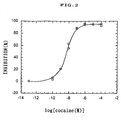
- the binding is saturated in a concentration of more than 10 -9 M; that is, the inhibition value at 10 -9 M cocaine is zero or more.
- Inhibition (%) (1-OD x /OD max ) ⁇ 100
- the monoclonal antibody seems to have a fair affinity for structually related substances of the corresponding immunogen.
- Cocaine derivatives will be detected with a monoclonal antibody produced by the immunomethodology using CC-KLH though that detectability was rather reduced.
- relative sensitivity means the lowest detectable concentration ratio of every substance to that of cocaine. A higher figure means lower detectability.
- the invention provides a cocaine-protein conjugate having methoxy carbonyl and benzoyl groups both characteristic of cocaine from an amino derivative of norcocaine substituted with an amino alkyl group in its secondary amino group, and a pyridyl dithio derivative of the above amino derivative substituted with a 2-pyridyl dithio propynoyl group in its amino group.
- the invention provides a monoclonal antibody with high affinity for cocaine or cocaine derivatives and a monoclonal antibody producing hybridoma cell line.
Landscapes
- Health & Medical Sciences (AREA)
- Life Sciences & Earth Sciences (AREA)
- Chemical & Material Sciences (AREA)
- Engineering & Computer Science (AREA)
- Molecular Biology (AREA)
- Organic Chemistry (AREA)
- Bioinformatics & Cheminformatics (AREA)
- Medicinal Chemistry (AREA)
- General Health & Medical Sciences (AREA)
- Immunology (AREA)
- Proteomics, Peptides & Aminoacids (AREA)
- Pharmacology & Pharmacy (AREA)
- Biochemistry (AREA)
- Urology & Nephrology (AREA)
- Biomedical Technology (AREA)
- Epidemiology (AREA)
- Animal Behavior & Ethology (AREA)
- Hematology (AREA)
- Public Health (AREA)
- Veterinary Medicine (AREA)
- Analytical Chemistry (AREA)
- Biotechnology (AREA)
- Physics & Mathematics (AREA)
- Microbiology (AREA)
- Cell Biology (AREA)
- General Physics & Mathematics (AREA)
- Pathology (AREA)
- Food Science & Technology (AREA)
- Botany (AREA)
- Biophysics (AREA)
- Genetics & Genomics (AREA)
- Preparation Of Compounds By Using Micro-Organisms (AREA)
- Peptides Or Proteins (AREA)
- Micro-Organisms Or Cultivation Processes Thereof (AREA)
Claims (10)
- Pyridyldithioderivat eines Aminococainderivats der Formel Bwobei n eine ganze Zahl von 1 oder mehr ist und Ph einen Benzolring darstellt.

- Cocainderivat nach Anspruch 1, das durch eine Dilsulfidbindung an ein Protein konjugiert ist.
- Verfahren zur Herstellung einer Hybridomzelllinie, die einen monoclonalen Antikörper produziert, der gegen das Protein-konjugierte Derivat nach Anspruch 2 gerichtet ist, umfassend das Fusionieren einer Milzzelle, die von einer Maus abstammt, die mit einem Antigen immunisiert ist, das das Protein-konjugierte Derivat nach Anspruch 2 umfasst, und einer von einer Myelomzelle abstammenden Zelllinie, sowie das Clonieren des Fusionsprodukts.
- Verfahren nach Anspruch 3, dadurch gekennzeichnet, dass das Protein Keyhole-Limpet-Hämocyanin ist.
- Verfahren nach Anspruch 3, dadurch gekennzeichnet, dass die von einer Myelomzelllinie abstammende Zelllinie P3X63-Ag8.653 ist.
- Verfahren nach Anspruch 3, dadurch gekennzeichnet, dass die Maus von einem A/J-Stamm abstammt.
- Hybridomzelllinie, die einen monoclonalen Antikörper produziert, der gegen das Protein-konjugierte Cocainderivat nach Anspruch 2 gerichtet ist.
- Hybridomzelllinie, hergestellt gemäß dem Verfahren nach Anspruch 3, die beim National Institute of Bioscience and Human Technology Agency of Industrial Science and Technology, Japanese Ministry of Industrial Trade and Industry unter der Nummer BP-4177 hinterlegt ist, gekennzeichnet durch die Herstellung eines Antikörpers, der Cocain oder ein Cocainderivat spezifisch binden kann.
- Monoclonaler Antikörper, der gegen das Protein-konjugierte Cocainderivat nach Anspruch 2 gerichtet ist.
- Monoclonaler Antikörper, hergestellt durch die Hybridomzelllinie nach Anspruch 8.
Applications Claiming Priority (6)
| Application Number | Priority Date | Filing Date | Title |
|---|---|---|---|
| JP4350293 | 1993-03-04 | ||
| JP5043502A JPH06256345A (ja) | 1993-03-04 | 1993-03-04 | コカイン誘導体およびそのタンパク質コンジュゲート |
| JP43502/93 | 1993-03-04 | ||
| JP53380/93 | 1993-03-15 | ||
| JP5338093 | 1993-03-15 | ||
| JP5053380A JPH06261782A (ja) | 1993-03-15 | 1993-03-15 | モノクローナル抗体産生細胞ライン作製方法、モノクローナル抗体産生細胞ラインおよびモノクローナル抗体 |
Publications (3)
| Publication Number | Publication Date |
|---|---|
| EP0613899A2 EP0613899A2 (de) | 1994-09-07 |
| EP0613899A3 EP0613899A3 (de) | 1995-01-18 |
| EP0613899B1 true EP0613899B1 (de) | 2003-01-15 |
Family
ID=26383284
Family Applications (1)
| Application Number | Title | Priority Date | Filing Date |
|---|---|---|---|
| EP93111445A Expired - Lifetime EP0613899B1 (de) | 1993-03-04 | 1993-07-16 | Kokainderivat,Proteinkonjugat,davon,einen monoklonalen Antikörper produzierende Hybridom-Zellinie, Verfahren zur Herstellung der Hybridom-Zellinie und des monoklonalen Antikörpers |
Country Status (3)
| Country | Link |
|---|---|
| US (2) | US6174723B1 (de) |
| EP (1) | EP0613899B1 (de) |
| DE (1) | DE69332637T2 (de) |
Cited By (1)
| Publication number | Priority date | Publication date | Assignee | Title |
|---|---|---|---|---|
| US7247502B2 (en) | 1998-12-01 | 2007-07-24 | Nabi Biopharmaceuticals | Hapten-carrier conjugates for treating and preventing nicotine addiction |
Families Citing this family (6)
| Publication number | Priority date | Publication date | Assignee | Title |
|---|---|---|---|---|
| US5623588A (en) * | 1992-12-14 | 1997-04-22 | New York University | Computer user interface with non-salience deemphasis |
| DK1329226T3 (da) * | 1995-03-31 | 2007-09-24 | Xenova Res Ltd | Haptenbærerkonjugater til anvendelse i behandling af stofmisbrug |
| US5840307A (en) * | 1995-03-31 | 1998-11-24 | Immulogic Pharmacuetical Corp. | Hapten-carrier conjugates for use in drug-abuse therapy and methods for preparation |
| US20020102659A1 (en) * | 1997-03-21 | 2002-08-01 | Jean-Michel Scherrmann | Cocaethylene immunogens and antibodies |
| DE10326821A1 (de) * | 2003-06-11 | 2005-01-05 | Medical Enzymes Ag | Pharmazeutische Kombinationspräparate zur Krebstherapie |
| US7105643B2 (en) * | 2003-07-30 | 2006-09-12 | The United States Of America As Represented By The Attorney General Of The Dept. Of Justice | Monoclonal antibodies specific for crack cocaine metabolites, a cell line producing the same, and crack cocaine conjugates |
Family Cites Families (5)
| Publication number | Priority date | Publication date | Assignee | Title |
|---|---|---|---|---|
| US4045420A (en) * | 1973-05-29 | 1977-08-30 | Syva Company | Non-oxo-carbonyl containing benzoyl ecgonine and cocaine compounds polypeptide and derivatives thereof |
| US3888866A (en) * | 1973-06-01 | 1975-06-10 | Syva Co | Nitrogen derivatives of benzoyl ecgonine |
| JPH04182499A (ja) * | 1990-11-14 | 1992-06-30 | Matsushita Electric Ind Co Ltd | エクゴニン・タンパク質コンジュゲート及びその誘導体 |
| US5233042A (en) * | 1991-12-16 | 1993-08-03 | Biosite Diagnostics, Inc. | Cocaine derivatives |
| US5808074A (en) * | 1996-02-02 | 1998-09-15 | Georgetown University | Benzoylecgonine conjugate diagnostic reagents |
-
1993
- 1993-07-16 EP EP93111445A patent/EP0613899B1/de not_active Expired - Lifetime
- 1993-07-16 DE DE69332637T patent/DE69332637T2/de not_active Expired - Fee Related
-
1997
- 1997-12-02 US US08/982,963 patent/US6174723B1/en not_active Expired - Fee Related
-
2000
- 2000-11-07 US US09/706,774 patent/US6271381B1/en not_active Expired - Fee Related
Cited By (3)
| Publication number | Priority date | Publication date | Assignee | Title |
|---|---|---|---|---|
| US7247502B2 (en) | 1998-12-01 | 2007-07-24 | Nabi Biopharmaceuticals | Hapten-carrier conjugates for treating and preventing nicotine addiction |
| US7776620B2 (en) | 1998-12-01 | 2010-08-17 | Nabi Biopharmaceuticals | Hapten-carrier conjugates for treating and preventing nicotine addiction |
| US8026109B2 (en) | 1998-12-01 | 2011-09-27 | Nabi Biopharmaceuticals, Inc. | Hapten-carrier conjugates for treating and preventing nicotine addiction |
Also Published As
| Publication number | Publication date |
|---|---|
| EP0613899A2 (de) | 1994-09-07 |
| US6271381B1 (en) | 2001-08-07 |
| US6174723B1 (en) | 2001-01-16 |
| DE69332637T2 (de) | 2003-10-23 |
| EP0613899A3 (de) | 1995-01-18 |
| DE69332637D1 (de) | 2003-02-20 |
Similar Documents
| Publication | Publication Date | Title |
|---|---|---|
| US5573922A (en) | Immunological detection method for triazines | |
| US20080287658A1 (en) | Docetaxel Immunoassay | |
| US20120214184A1 (en) | Doxorubicin immunoassay | |
| CN109111394B (zh) | 一种啶虫脒半抗原与抗原的制备方法及应用 | |
| US5817766A (en) | Reagents for a cannabinoid immunoassay | |
| EP0613899B1 (de) | Kokainderivat,Proteinkonjugat,davon,einen monoklonalen Antikörper produzierende Hybridom-Zellinie, Verfahren zur Herstellung der Hybridom-Zellinie und des monoklonalen Antikörpers | |
| US5112738A (en) | Histamine derivatives, immunogen conjugates and antibodies raised thereto | |
| JP3714942B2 (ja) | 生物体液中のバンコマイシンの検出および定量化用試薬および方法 | |
| CN109053477B (zh) | 一种仲丁灵半抗原与抗原的制备方法及应用 | |
| EP0208953B1 (de) | Histamin-Derivate, Immunogen-Konjugate und dadurch induzierte Antikörper | |
| JP4711509B2 (ja) | 生物学的流体中のバンコマイシンの検出および定量化 | |
| CN112813034A (zh) | 一株分泌恶霜灵单克隆抗体的杂交瘤细胞株及其应用 | |
| US20110165699A1 (en) | Irinotecan immunoassay | |
| JPH01273582A (ja) | モノクローナル抗体産生細胞ライン及びモノクローナル抗体及び免疫原 | |
| JPH0257177A (ja) | モノクローナル抗体産生細胞ラインおよびモノクローナル抗体 | |
| JPH06261782A (ja) | モノクローナル抗体産生細胞ライン作製方法、モノクローナル抗体産生細胞ラインおよびモノクローナル抗体 | |
| WO2012067670A1 (en) | Irinotecan immunoassay | |
| JP2605418B2 (ja) | ハプテンである抗原に対し高親和性を持つ抗体 | |
| JPH0346562A (ja) | 免疫方法および免疫測定方法 | |
| US20110136253A1 (en) | Irinotecan Immunoassay | |
| JPH0257178A (ja) | モノクローナル抗体産生細胞ラインおよびモノクローナル抗体 | |
| CN118010983A (zh) | 一种检测尼古丁的试纸条及其应用 | |
| JP2001255324A (ja) | フサライドの抗体及び測定方法 | |
| CN117186176A (zh) | 腾毒素半抗原、抗原、抗体、检测装置及其制备和应用 | |
| JPH01269486A (ja) | モノクローナル抗体産生細胞ラインおよびモノクローナル抗体 |
Legal Events
| Date | Code | Title | Description |
|---|---|---|---|
| PUAI | Public reference made under article 153(3) epc to a published international application that has entered the european phase |
Free format text: ORIGINAL CODE: 0009012 |
|
| AK | Designated contracting states |
Kind code of ref document: A2 Designated state(s): DE FR GB |
|
| PUAL | Search report despatched |
Free format text: ORIGINAL CODE: 0009013 |
|
| AK | Designated contracting states |
Kind code of ref document: A3 Designated state(s): DE FR GB |
|
| 17P | Request for examination filed |
Effective date: 19950117 |
|
| 17Q | First examination report despatched |
Effective date: 19981028 |
|
| RTI1 | Title (correction) |
Free format text: COCAINE DERIVATIVE, PROTEIN CONJUGATE THEREOF, MONOCLONAL ANTIBODY PRODUCING HYBRIDOMA CELL LINE, METHOD FOR PREPARING THE HYBRIDOMA CELL LINE AND MONOCLONAL ANTIBODY |
|
| GRAG | Despatch of communication of intention to grant |
Free format text: ORIGINAL CODE: EPIDOS AGRA |
|
| GRAG | Despatch of communication of intention to grant |
Free format text: ORIGINAL CODE: EPIDOS AGRA |
|
| GRAG | Despatch of communication of intention to grant |
Free format text: ORIGINAL CODE: EPIDOS AGRA |
|
| GRAH | Despatch of communication of intention to grant a patent |
Free format text: ORIGINAL CODE: EPIDOS IGRA |
|
| GRAH | Despatch of communication of intention to grant a patent |
Free format text: ORIGINAL CODE: EPIDOS IGRA |
|
| GRAA | (expected) grant |
Free format text: ORIGINAL CODE: 0009210 |
|
| RIC1 | Information provided on ipc code assigned before grant |
Free format text: 7C 07D 451/12 A, 7C 12N 15/06 B, 7C 07K 16/00 B, 7C 12N 5/18 B, 7G 01N 33/94 - |
|
| AK | Designated contracting states |
Kind code of ref document: B1 Designated state(s): DE FR GB |
|
| REG | Reference to a national code |
Ref country code: GB Ref legal event code: FG4D |
|
| REF | Corresponds to: |
Ref document number: 69332637 Country of ref document: DE Date of ref document: 20030220 Kind code of ref document: P |
|
| ET | Fr: translation filed | ||
| PLBE | No opposition filed within time limit |
Free format text: ORIGINAL CODE: 0009261 |
|
| STAA | Information on the status of an ep patent application or granted ep patent |
Free format text: STATUS: NO OPPOSITION FILED WITHIN TIME LIMIT |
|
| 26N | No opposition filed |
Effective date: 20031016 |
|
| PGFP | Annual fee paid to national office [announced via postgrant information from national office to epo] |
Ref country code: FR Payment date: 20050708 Year of fee payment: 13 |
|
| PGFP | Annual fee paid to national office [announced via postgrant information from national office to epo] |
Ref country code: GB Payment date: 20050713 Year of fee payment: 13 |
|
| PGFP | Annual fee paid to national office [announced via postgrant information from national office to epo] |
Ref country code: DE Payment date: 20050714 Year of fee payment: 13 |
|
| PG25 | Lapsed in a contracting state [announced via postgrant information from national office to epo] |
Ref country code: GB Free format text: LAPSE BECAUSE OF NON-PAYMENT OF DUE FEES Effective date: 20060716 |
|
| PG25 | Lapsed in a contracting state [announced via postgrant information from national office to epo] |
Ref country code: DE Free format text: LAPSE BECAUSE OF NON-PAYMENT OF DUE FEES Effective date: 20070201 |
|
| GBPC | Gb: european patent ceased through non-payment of renewal fee |
Effective date: 20060716 |
|
| REG | Reference to a national code |
Ref country code: FR Ref legal event code: ST Effective date: 20070330 |
|
| PG25 | Lapsed in a contracting state [announced via postgrant information from national office to epo] |
Ref country code: FR Free format text: LAPSE BECAUSE OF NON-PAYMENT OF DUE FEES Effective date: 20060731 |