EP0614980A1 - TAT transdominante Variante aus Human Immunodeficiency Virus - Google Patents
TAT transdominante Variante aus Human Immunodeficiency Virus Download PDFInfo
- Publication number
- EP0614980A1 EP0614980A1 EP94400005A EP94400005A EP0614980A1 EP 0614980 A1 EP0614980 A1 EP 0614980A1 EP 94400005 A EP94400005 A EP 94400005A EP 94400005 A EP94400005 A EP 94400005A EP 0614980 A1 EP0614980 A1 EP 0614980A1
- Authority
- EP
- European Patent Office
- Prior art keywords
- variant
- une
- tat
- trans
- tat protein
- Prior art date
- Legal status (The legal status is an assumption and is not a legal conclusion. Google has not performed a legal analysis and makes no representation as to the accuracy of the status listed.)
- Granted
Links
- 241000725303 Human immunodeficiency virus Species 0.000 title claims abstract description 40
- 101710149951 Protein Tat Proteins 0.000 claims abstract description 81
- 230000014509 gene expression Effects 0.000 claims abstract description 56
- 239000012634 fragment Substances 0.000 claims abstract description 36
- 108020004414 DNA Proteins 0.000 claims abstract description 29
- 238000011282 treatment Methods 0.000 claims abstract description 7
- 208000031886 HIV Infections Diseases 0.000 claims abstract description 5
- 230000002265 prevention Effects 0.000 claims abstract description 4
- 210000004027 cell Anatomy 0.000 claims description 68
- 108090000623 proteins and genes Proteins 0.000 claims description 48
- 235000001014 amino acid Nutrition 0.000 claims description 39
- 102000004169 proteins and genes Human genes 0.000 claims description 24
- 235000018102 proteins Nutrition 0.000 claims description 23
- 235000004279 alanine Nutrition 0.000 claims description 22
- QNAYBMKLOCPYGJ-REOHCLBHSA-N L-alanine Chemical compound C[C@H](N)C(O)=O QNAYBMKLOCPYGJ-REOHCLBHSA-N 0.000 claims description 21
- 239000004475 Arginine Substances 0.000 claims description 19
- AYFVYJQAPQTCCC-UHFFFAOYSA-N Threonine Natural products CC(O)C(N)C(O)=O AYFVYJQAPQTCCC-UHFFFAOYSA-N 0.000 claims description 19
- ODKSFYDXXFIFQN-UHFFFAOYSA-N arginine Natural products OC(=O)C(N)CCCNC(N)=N ODKSFYDXXFIFQN-UHFFFAOYSA-N 0.000 claims description 19
- 235000009697 arginine Nutrition 0.000 claims description 19
- CKLJMWTZIZZHCS-REOHCLBHSA-N aspartic acid group Chemical group N[C@@H](CC(=O)O)C(=O)O CKLJMWTZIZZHCS-REOHCLBHSA-N 0.000 claims description 19
- 125000003295 alanine group Chemical group N[C@@H](C)C(=O)* 0.000 claims description 15
- MTCFGRXMJLQNBG-UHFFFAOYSA-N Serine Natural products OCC(N)C(O)=O MTCFGRXMJLQNBG-UHFFFAOYSA-N 0.000 claims description 14
- WHUUTDBJXJRKMK-UHFFFAOYSA-N Glutamic acid Natural products OC(=O)C(N)CCC(O)=O WHUUTDBJXJRKMK-UHFFFAOYSA-N 0.000 claims description 13
- 238000000034 method Methods 0.000 claims description 13
- 239000004473 Threonine Substances 0.000 claims description 11
- HNDVDQJCIGZPNO-UHFFFAOYSA-N histidine Natural products OC(=O)C(N)CC1=CN=CN1 HNDVDQJCIGZPNO-UHFFFAOYSA-N 0.000 claims description 11
- 230000035772 mutation Effects 0.000 claims description 9
- 241000713772 Human immunodeficiency virus 1 Species 0.000 claims description 8
- 235000003704 aspartic acid Nutrition 0.000 claims description 7
- OQFSQFPPLPISGP-UHFFFAOYSA-N beta-carboxyaspartic acid Natural products OC(=O)C(N)C(C(O)=O)C(O)=O OQFSQFPPLPISGP-UHFFFAOYSA-N 0.000 claims description 7
- 125000003275 alpha amino acid group Chemical group 0.000 claims description 6
- 235000013922 glutamic acid Nutrition 0.000 claims description 6
- 239000004220 glutamic acid Substances 0.000 claims description 6
- 239000001963 growth medium Substances 0.000 claims description 5
- 125000000539 amino acid group Chemical group 0.000 claims description 4
- 230000002401 inhibitory effect Effects 0.000 claims description 4
- 230000001225 therapeutic effect Effects 0.000 claims description 4
- 208000037357 HIV infectious disease Diseases 0.000 claims description 3
- 239000003795 chemical substances by application Substances 0.000 claims description 3
- 210000003527 eukaryotic cell Anatomy 0.000 claims description 3
- 208000033519 human immunodeficiency virus infectious disease Diseases 0.000 claims description 3
- 239000008194 pharmaceutical composition Substances 0.000 claims description 3
- 238000002360 preparation method Methods 0.000 claims description 3
- 210000001236 prokaryotic cell Anatomy 0.000 claims description 3
- 230000000069 prophylactic effect Effects 0.000 claims description 3
- 230000010076 replication Effects 0.000 claims description 3
- 125000000637 arginyl group Chemical group N[C@@H](CCCNC(N)=N)C(=O)* 0.000 claims description 2
- 239000003814 drug Substances 0.000 claims description 2
- 125000000291 glutamic acid group Chemical group N[C@@H](CCC(O)=O)C(=O)* 0.000 claims description 2
- 125000003607 serino group Chemical group [H]N([H])[C@]([H])(C(=O)[*])C(O[H])([H])[H] 0.000 claims description 2
- 230000001747 exhibiting effect Effects 0.000 abstract 1
- 239000013598 vector Substances 0.000 description 41
- 229940024606 amino acid Drugs 0.000 description 37
- DHMQDGOQFOQNFH-UHFFFAOYSA-N Glycine Chemical compound NCC(O)=O DHMQDGOQFOQNFH-UHFFFAOYSA-N 0.000 description 36
- 150000001413 amino acids Chemical class 0.000 description 34
- 230000000694 effects Effects 0.000 description 34
- 108020004705 Codon Proteins 0.000 description 21
- ZDXPYRJPNDTMRX-VKHMYHEASA-N L-glutamine Chemical compound OC(=O)[C@@H](N)CCC(N)=O ZDXPYRJPNDTMRX-VKHMYHEASA-N 0.000 description 20
- ROHFNLRQFUQHCH-YFKPBYRVSA-N L-leucine Chemical compound CC(C)C[C@H](N)C(O)=O ROHFNLRQFUQHCH-YFKPBYRVSA-N 0.000 description 20
- ROHFNLRQFUQHCH-UHFFFAOYSA-N Leucine Natural products CC(C)CC(N)C(O)=O ROHFNLRQFUQHCH-UHFFFAOYSA-N 0.000 description 20
- ZDXPYRJPNDTMRX-UHFFFAOYSA-N glutamine Natural products OC(=O)C(N)CCC(N)=O ZDXPYRJPNDTMRX-UHFFFAOYSA-N 0.000 description 20
- 229960002743 glutamine Drugs 0.000 description 20
- 229960003136 leucine Drugs 0.000 description 20
- MTCFGRXMJLQNBG-REOHCLBHSA-N (2S)-2-Amino-3-hydroxypropansäure Chemical compound OC[C@H](N)C(O)=O MTCFGRXMJLQNBG-REOHCLBHSA-N 0.000 description 18
- DCXYFEDJOCDNAF-UHFFFAOYSA-N Asparagine Natural products OC(=O)C(N)CC(N)=O DCXYFEDJOCDNAF-UHFFFAOYSA-N 0.000 description 18
- 239000004471 Glycine Substances 0.000 description 18
- ODKSFYDXXFIFQN-BYPYZUCNSA-P L-argininium(2+) Chemical compound NC(=[NH2+])NCCC[C@H]([NH3+])C(O)=O ODKSFYDXXFIFQN-BYPYZUCNSA-P 0.000 description 18
- DCXYFEDJOCDNAF-REOHCLBHSA-N L-asparagine Chemical compound OC(=O)[C@@H](N)CC(N)=O DCXYFEDJOCDNAF-REOHCLBHSA-N 0.000 description 18
- OUYCCCASQSFEME-QMMMGPOBSA-N L-tyrosine Chemical compound OC(=O)[C@@H](N)CC1=CC=C(O)C=C1 OUYCCCASQSFEME-QMMMGPOBSA-N 0.000 description 18
- 229960003121 arginine Drugs 0.000 description 18
- 229960001230 asparagine Drugs 0.000 description 18
- 235000009582 asparagine Nutrition 0.000 description 18
- 229960002449 glycine Drugs 0.000 description 18
- 230000003612 virological effect Effects 0.000 description 18
- 229960004441 tyrosine Drugs 0.000 description 17
- OUYCCCASQSFEME-UHFFFAOYSA-N tyrosine Natural products OC(=O)C(N)CC1=CC=C(O)C=C1 OUYCCCASQSFEME-UHFFFAOYSA-N 0.000 description 17
- QIVBCDIJIAJPQS-VIFPVBQESA-N L-tryptophane Chemical compound C1=CC=C2C(C[C@H](N)C(O)=O)=CNC2=C1 QIVBCDIJIAJPQS-VIFPVBQESA-N 0.000 description 16
- QIVBCDIJIAJPQS-UHFFFAOYSA-N Tryptophan Natural products C1=CC=C2C(CC(N)C(O)=O)=CNC2=C1 QIVBCDIJIAJPQS-UHFFFAOYSA-N 0.000 description 16
- XUJNEKJLAYXESH-UHFFFAOYSA-N cysteine Natural products SCC(N)C(O)=O XUJNEKJLAYXESH-UHFFFAOYSA-N 0.000 description 16
- 229960004799 tryptophan Drugs 0.000 description 16
- WHUUTDBJXJRKMK-VKHMYHEASA-N L-glutamic acid Chemical compound OC(=O)[C@@H](N)CCC(O)=O WHUUTDBJXJRKMK-VKHMYHEASA-N 0.000 description 15
- AGPKZVBTJJNPAG-WHFBIAKZSA-N L-isoleucine Chemical compound CC[C@H](C)[C@H](N)C(O)=O AGPKZVBTJJNPAG-WHFBIAKZSA-N 0.000 description 15
- 241000700605 Viruses Species 0.000 description 15
- RXWNCPJZOCPEPQ-NVWDDTSBSA-N puromycin Chemical compound C1=CC(OC)=CC=C1C[C@H](N)C(=O)N[C@H]1[C@@H](O)[C@H](N2C3=NC=NC(=C3N=C2)N(C)C)O[C@@H]1CO RXWNCPJZOCPEPQ-NVWDDTSBSA-N 0.000 description 15
- ONIBWKKTOPOVIA-BYPYZUCNSA-N L-Proline Chemical compound OC(=O)[C@@H]1CCCN1 ONIBWKKTOPOVIA-BYPYZUCNSA-N 0.000 description 14
- KZSNJWFQEVHDMF-BYPYZUCNSA-N L-valine Chemical compound CC(C)[C@H](N)C(O)=O KZSNJWFQEVHDMF-BYPYZUCNSA-N 0.000 description 14
- 241000829100 Macaca mulatta polyomavirus 1 Species 0.000 description 14
- ONIBWKKTOPOVIA-UHFFFAOYSA-N Proline Natural products OC(=O)C1CCCN1 ONIBWKKTOPOVIA-UHFFFAOYSA-N 0.000 description 14
- KZSNJWFQEVHDMF-UHFFFAOYSA-N Valine Natural products CC(C)C(N)C(O)=O KZSNJWFQEVHDMF-UHFFFAOYSA-N 0.000 description 14
- AGPKZVBTJJNPAG-UHFFFAOYSA-N isoleucine Natural products CCC(C)C(N)C(O)=O AGPKZVBTJJNPAG-UHFFFAOYSA-N 0.000 description 14
- 229960000310 isoleucine Drugs 0.000 description 14
- 229960002429 proline Drugs 0.000 description 14
- 229960004295 valine Drugs 0.000 description 14
- 239000004474 valine Substances 0.000 description 14
- 239000013604 expression vector Substances 0.000 description 13
- 230000006870 function Effects 0.000 description 13
- 229960001153 serine Drugs 0.000 description 13
- 238000013518 transcription Methods 0.000 description 12
- 230000035897 transcription Effects 0.000 description 12
- 208000030507 AIDS Diseases 0.000 description 11
- AYFVYJQAPQTCCC-GBXIJSLDSA-N L-threonine Chemical compound C[C@@H](O)[C@H](N)C(O)=O AYFVYJQAPQTCCC-GBXIJSLDSA-N 0.000 description 11
- KDXKERNSBIXSRK-UHFFFAOYSA-N Lysine Natural products NCCCCC(N)C(O)=O KDXKERNSBIXSRK-UHFFFAOYSA-N 0.000 description 11
- 108700004027 tat Genes Proteins 0.000 description 11
- 101150098170 tat gene Proteins 0.000 description 11
- HNDVDQJCIGZPNO-YFKPBYRVSA-N L-histidine Chemical compound OC(=O)[C@@H](N)CC1=CN=CN1 HNDVDQJCIGZPNO-YFKPBYRVSA-N 0.000 description 10
- KDXKERNSBIXSRK-YFKPBYRVSA-N L-lysine Chemical compound NCCCC[C@H](N)C(O)=O KDXKERNSBIXSRK-YFKPBYRVSA-N 0.000 description 10
- COLNVLDHVKWLRT-QMMMGPOBSA-N L-phenylalanine Chemical compound OC(=O)[C@@H](N)CC1=CC=CC=C1 COLNVLDHVKWLRT-QMMMGPOBSA-N 0.000 description 10
- 235000018417 cysteine Nutrition 0.000 description 10
- 229960002885 histidine Drugs 0.000 description 10
- 229960002898 threonine Drugs 0.000 description 10
- XUJNEKJLAYXESH-REOHCLBHSA-N L-Cysteine Chemical compound SC[C@H](N)C(O)=O XUJNEKJLAYXESH-REOHCLBHSA-N 0.000 description 9
- 239000004472 Lysine Substances 0.000 description 9
- 229960002433 cysteine Drugs 0.000 description 9
- 229960003646 lysine Drugs 0.000 description 9
- FFEARJCKVFRZRR-BYPYZUCNSA-N L-methionine Chemical compound CSCC[C@H](N)C(O)=O FFEARJCKVFRZRR-BYPYZUCNSA-N 0.000 description 8
- 108091034117 Oligonucleotide Proteins 0.000 description 8
- 230000004913 activation Effects 0.000 description 8
- 101150055766 cat gene Proteins 0.000 description 8
- 108020004999 messenger RNA Proteins 0.000 description 8
- 229930182817 methionine Natural products 0.000 description 8
- 229960004452 methionine Drugs 0.000 description 8
- 238000002703 mutagenesis Methods 0.000 description 8
- 231100000350 mutagenesis Toxicity 0.000 description 8
- 229960005190 phenylalanine Drugs 0.000 description 8
- COLNVLDHVKWLRT-UHFFFAOYSA-N phenylalanine Natural products OC(=O)C(N)CC1=CC=CC=C1 COLNVLDHVKWLRT-UHFFFAOYSA-N 0.000 description 8
- 239000006035 Tryptophane Substances 0.000 description 7
- 208000015181 infectious disease Diseases 0.000 description 7
- 239000013612 plasmid Substances 0.000 description 7
- 229950010131 puromycin Drugs 0.000 description 7
- 108091032973 (ribonucleotides)n+m Proteins 0.000 description 6
- XEKOWRVHYACXOJ-UHFFFAOYSA-N Ethyl acetate Chemical compound CCOC(C)=O XEKOWRVHYACXOJ-UHFFFAOYSA-N 0.000 description 6
- FAPWRFPIFSIZLT-UHFFFAOYSA-M Sodium chloride Chemical compound [Na+].[Cl-] FAPWRFPIFSIZLT-UHFFFAOYSA-M 0.000 description 6
- 229960005261 aspartic acid Drugs 0.000 description 6
- 239000000284 extract Substances 0.000 description 6
- 230000023603 positive regulation of transcription initiation, DNA-dependent Effects 0.000 description 6
- 230000001177 retroviral effect Effects 0.000 description 6
- 102100034349 Integrase Human genes 0.000 description 5
- 238000012512 characterization method Methods 0.000 description 5
- 238000012761 co-transfection Methods 0.000 description 5
- 238000010276 construction Methods 0.000 description 5
- 229960002989 glutamic acid Drugs 0.000 description 5
- 210000004698 lymphocyte Anatomy 0.000 description 5
- 238000004519 manufacturing process Methods 0.000 description 5
- 230000008488 polyadenylation Effects 0.000 description 5
- 108020003175 receptors Proteins 0.000 description 5
- 230000002829 reductive effect Effects 0.000 description 5
- 238000001890 transfection Methods 0.000 description 5
- 101150004167 HMG gene Proteins 0.000 description 4
- 101100005713 Homo sapiens CD4 gene Proteins 0.000 description 4
- 108010092799 RNA-directed DNA polymerase Proteins 0.000 description 4
- 240000004808 Saccharomyces cerevisiae Species 0.000 description 4
- 108700005077 Viral Genes Proteins 0.000 description 4
- 239000000872 buffer Substances 0.000 description 4
- 230000001413 cellular effect Effects 0.000 description 4
- 239000003623 enhancer Substances 0.000 description 4
- 230000005764 inhibitory process Effects 0.000 description 4
- 239000002773 nucleotide Substances 0.000 description 4
- 125000003729 nucleotide group Chemical group 0.000 description 4
- YBYRMVIVWMBXKQ-UHFFFAOYSA-N phenylmethanesulfonyl fluoride Chemical compound FS(=O)(=O)CC1=CC=CC=C1 YBYRMVIVWMBXKQ-UHFFFAOYSA-N 0.000 description 4
- 241001430294 unidentified retrovirus Species 0.000 description 4
- 238000011144 upstream manufacturing Methods 0.000 description 4
- QKNYBSVHEMOAJP-UHFFFAOYSA-N 2-amino-2-(hydroxymethyl)propane-1,3-diol;hydron;chloride Chemical compound Cl.OCC(N)(CO)CO QKNYBSVHEMOAJP-UHFFFAOYSA-N 0.000 description 3
- 241000206602 Eukaryota Species 0.000 description 3
- 108091005904 Hemoglobin subunit beta Proteins 0.000 description 3
- 108010070875 Human Immunodeficiency Virus tat Gene Products Proteins 0.000 description 3
- OKKJLVBELUTLKV-UHFFFAOYSA-N Methanol Chemical compound OC OKKJLVBELUTLKV-UHFFFAOYSA-N 0.000 description 3
- 241000283973 Oryctolagus cuniculus Species 0.000 description 3
- 108010076504 Protein Sorting Signals Proteins 0.000 description 3
- HEMHJVSKTPXQMS-UHFFFAOYSA-M Sodium hydroxide Chemical compound [OH-].[Na+] HEMHJVSKTPXQMS-UHFFFAOYSA-M 0.000 description 3
- 102100036011 T-cell surface glycoprotein CD4 Human genes 0.000 description 3
- 210000001744 T-lymphocyte Anatomy 0.000 description 3
- 108010067390 Viral Proteins Proteins 0.000 description 3
- 230000003213 activating effect Effects 0.000 description 3
- 238000010367 cloning Methods 0.000 description 3
- 238000004520 electroporation Methods 0.000 description 3
- 238000001415 gene therapy Methods 0.000 description 3
- 108020004707 nucleic acids Proteins 0.000 description 3
- 102000039446 nucleic acids Human genes 0.000 description 3
- 150000007523 nucleic acids Chemical class 0.000 description 3
- 239000002245 particle Substances 0.000 description 3
- 239000013641 positive control Substances 0.000 description 3
- 239000011780 sodium chloride Substances 0.000 description 3
- 238000003146 transient transfection Methods 0.000 description 3
- 238000013519 translation Methods 0.000 description 3
- IJGRMHOSHXDMSA-UHFFFAOYSA-N Atomic nitrogen Chemical compound N#N IJGRMHOSHXDMSA-UHFFFAOYSA-N 0.000 description 2
- 108091003079 Bovine Serum Albumin Proteins 0.000 description 2
- 108010041397 CD4 Antigens Proteins 0.000 description 2
- 210000004366 CD4-positive T-lymphocyte Anatomy 0.000 description 2
- HEDRZPFGACZZDS-UHFFFAOYSA-N Chloroform Chemical compound ClC(Cl)Cl HEDRZPFGACZZDS-UHFFFAOYSA-N 0.000 description 2
- KCXVZYZYPLLWCC-UHFFFAOYSA-N EDTA Chemical compound OC(=O)CN(CC(O)=O)CCN(CC(O)=O)CC(O)=O KCXVZYZYPLLWCC-UHFFFAOYSA-N 0.000 description 2
- 239000006145 Eagle's minimal essential medium Substances 0.000 description 2
- 241000588724 Escherichia coli Species 0.000 description 2
- 108700024394 Exon Proteins 0.000 description 2
- 102100039556 Galectin-4 Human genes 0.000 description 2
- 101000608765 Homo sapiens Galectin-4 Proteins 0.000 description 2
- 241000700588 Human alphaherpesvirus 1 Species 0.000 description 2
- 108020004440 Thymidine kinase Proteins 0.000 description 2
- 108091023040 Transcription factor Proteins 0.000 description 2
- ZSLZBFCDCINBPY-ZSJPKINUSA-N acetyl-CoA Chemical compound O[C@@H]1[C@H](OP(O)(O)=O)[C@@H](COP(O)(=O)OP(O)(=O)OCC(C)(C)[C@@H](O)C(=O)NCCC(=O)NCCSC(=O)C)O[C@H]1N1C2=NC=NC(N)=C2N=C1 ZSLZBFCDCINBPY-ZSJPKINUSA-N 0.000 description 2
- 239000002253 acid Substances 0.000 description 2
- 230000009471 action Effects 0.000 description 2
- 210000004102 animal cell Anatomy 0.000 description 2
- 239000003443 antiviral agent Substances 0.000 description 2
- 230000015572 biosynthetic process Effects 0.000 description 2
- AIYUHDOJVYHVIT-UHFFFAOYSA-M caesium chloride Chemical compound [Cl-].[Cs+] AIYUHDOJVYHVIT-UHFFFAOYSA-M 0.000 description 2
- 239000001506 calcium phosphate Substances 0.000 description 2
- 229910000389 calcium phosphate Inorganic materials 0.000 description 2
- 235000011010 calcium phosphates Nutrition 0.000 description 2
- 210000000234 capsid Anatomy 0.000 description 2
- 229960005091 chloramphenicol Drugs 0.000 description 2
- WIIZWVCIJKGZOK-RKDXNWHRSA-N chloramphenicol Chemical compound ClC(Cl)C(=O)N[C@H](CO)[C@H](O)C1=CC=C([N+]([O-])=O)C=C1 WIIZWVCIJKGZOK-RKDXNWHRSA-N 0.000 description 2
- 238000007796 conventional method Methods 0.000 description 2
- 201000010099 disease Diseases 0.000 description 2
- 208000037265 diseases, disorders, signs and symptoms Diseases 0.000 description 2
- VHJLVAABSRFDPM-QWWZWVQMSA-N dithiothreitol Chemical compound SC[C@@H](O)[C@H](O)CS VHJLVAABSRFDPM-QWWZWVQMSA-N 0.000 description 2
- 238000002474 experimental method Methods 0.000 description 2
- 229930182830 galactose Natural products 0.000 description 2
- 108091006104 gene-regulatory proteins Proteins 0.000 description 2
- 102000034356 gene-regulatory proteins Human genes 0.000 description 2
- 238000010353 genetic engineering Methods 0.000 description 2
- 125000000404 glutamine group Chemical group N[C@@H](CCC(N)=O)C(=O)* 0.000 description 2
- 230000003394 haemopoietic effect Effects 0.000 description 2
- 238000000338 in vitro Methods 0.000 description 2
- 230000001939 inductive effect Effects 0.000 description 2
- 230000000977 initiatory effect Effects 0.000 description 2
- 125000003588 lysine group Chemical group [H]N([H])C([H])([H])C([H])([H])C([H])([H])C([H])([H])C([H])(N([H])[H])C(*)=O 0.000 description 2
- 239000002609 medium Substances 0.000 description 2
- 238000010369 molecular cloning Methods 0.000 description 2
- 230000030648 nucleus localization Effects 0.000 description 2
- 239000002244 precipitate Substances 0.000 description 2
- 230000001566 pro-viral effect Effects 0.000 description 2
- 230000037432 silent mutation Effects 0.000 description 2
- 238000002741 site-directed mutagenesis Methods 0.000 description 2
- PFNFFQXMRSDOHW-UHFFFAOYSA-N spermine Chemical compound NCCCNCCCCNCCCN PFNFFQXMRSDOHW-UHFFFAOYSA-N 0.000 description 2
- 210000000130 stem cell Anatomy 0.000 description 2
- QORWJWZARLRLPR-UHFFFAOYSA-H tricalcium bis(phosphate) Chemical compound [Ca+2].[Ca+2].[Ca+2].[O-]P([O-])([O-])=O.[O-]P([O-])([O-])=O QORWJWZARLRLPR-UHFFFAOYSA-H 0.000 description 2
- 125000001493 tyrosinyl group Chemical group [H]OC1=C([H])C([H])=C(C([H])=C1[H])C([H])([H])C([H])(N([H])[H])C(*)=O 0.000 description 2
- 241000701161 unidentified adenovirus Species 0.000 description 2
- 210000002845 virion Anatomy 0.000 description 2
- CABVTRNMFUVUDM-VRHQGPGLSA-N (3S)-3-hydroxy-3-methylglutaryl-CoA Chemical compound O[C@@H]1[C@H](OP(O)(O)=O)[C@@H](COP(O)(=O)OP(O)(=O)OCC(C)(C)[C@@H](O)C(=O)NCCC(=O)NCCSC(=O)C[C@@](O)(CC(O)=O)C)O[C@H]1N1C2=NC=NC(N)=C2N=C1 CABVTRNMFUVUDM-VRHQGPGLSA-N 0.000 description 1
- JKMHFZQWWAIEOD-UHFFFAOYSA-N 2-[4-(2-hydroxyethyl)piperazin-1-yl]ethanesulfonic acid Chemical compound OCC[NH+]1CCN(CCS([O-])(=O)=O)CC1 JKMHFZQWWAIEOD-UHFFFAOYSA-N 0.000 description 1
- NKDFYOWSKOHCCO-YPVLXUMRSA-N 20-hydroxyecdysone Chemical compound C1[C@@H](O)[C@@H](O)C[C@]2(C)[C@@H](CC[C@@]3([C@@H]([C@@](C)(O)[C@H](O)CCC(C)(O)C)CC[C@]33O)C)C3=CC(=O)[C@@H]21 NKDFYOWSKOHCCO-YPVLXUMRSA-N 0.000 description 1
- FWMNVWWHGCHHJJ-SKKKGAJSSA-N 4-amino-1-[(2r)-6-amino-2-[[(2r)-2-[[(2r)-2-[[(2r)-2-amino-3-phenylpropanoyl]amino]-3-phenylpropanoyl]amino]-4-methylpentanoyl]amino]hexanoyl]piperidine-4-carboxylic acid Chemical compound C([C@H](C(=O)N[C@H](CC(C)C)C(=O)N[C@H](CCCCN)C(=O)N1CCC(N)(CC1)C(O)=O)NC(=O)[C@H](N)CC=1C=CC=CC=1)C1=CC=CC=C1 FWMNVWWHGCHHJJ-SKKKGAJSSA-N 0.000 description 1
- 241000894006 Bacteria Species 0.000 description 1
- 125000001433 C-terminal amino-acid group Chemical group 0.000 description 1
- 101100283604 Caenorhabditis elegans pigk-1 gene Proteins 0.000 description 1
- UXVMQQNJUSDDNG-UHFFFAOYSA-L Calcium chloride Chemical compound [Cl-].[Cl-].[Ca+2] UXVMQQNJUSDDNG-UHFFFAOYSA-L 0.000 description 1
- 108090000565 Capsid Proteins Proteins 0.000 description 1
- 102100023321 Ceruloplasmin Human genes 0.000 description 1
- 108010035563 Chloramphenicol O-acetyltransferase Proteins 0.000 description 1
- 102000004594 DNA Polymerase I Human genes 0.000 description 1
- 108010017826 DNA Polymerase I Proteins 0.000 description 1
- 108010014303 DNA-directed DNA polymerase Proteins 0.000 description 1
- 102000016928 DNA-directed DNA polymerase Human genes 0.000 description 1
- 241000701832 Enterobacteria phage T3 Species 0.000 description 1
- 101710091045 Envelope protein Proteins 0.000 description 1
- 241000233866 Fungi Species 0.000 description 1
- 108700039691 Genetic Promoter Regions Proteins 0.000 description 1
- 229930182566 Gentamicin Natural products 0.000 description 1
- CEAZRRDELHUEMR-URQXQFDESA-N Gentamicin Chemical compound O1[C@H](C(C)NC)CC[C@@H](N)[C@H]1O[C@H]1[C@H](O)[C@@H](O[C@@H]2[C@@H]([C@@H](NC)[C@@](C)(O)CO2)O)[C@H](N)C[C@@H]1N CEAZRRDELHUEMR-URQXQFDESA-N 0.000 description 1
- 239000007995 HEPES buffer Substances 0.000 description 1
- 241000282412 Homo Species 0.000 description 1
- 101100273713 Homo sapiens CD2 gene Proteins 0.000 description 1
- 108010048209 Human Immunodeficiency Virus Proteins Proteins 0.000 description 1
- 108700005091 Immunoglobulin Genes Proteins 0.000 description 1
- 241000713666 Lentivirus Species 0.000 description 1
- 241000124008 Mammalia Species 0.000 description 1
- 101710161955 Mannitol-specific phosphotransferase enzyme IIA component Proteins 0.000 description 1
- 241000713869 Moloney murine leukemia virus Species 0.000 description 1
- 241000713862 Moloney murine sarcoma virus Species 0.000 description 1
- 241000713883 Myeloproliferative sarcoma virus Species 0.000 description 1
- 125000001429 N-terminal alpha-amino-acid group Chemical group 0.000 description 1
- 229930193140 Neomycin Natural products 0.000 description 1
- 208000001388 Opportunistic Infections Diseases 0.000 description 1
- 229910019142 PO4 Inorganic materials 0.000 description 1
- 102000035195 Peptidases Human genes 0.000 description 1
- 108091005804 Peptidases Proteins 0.000 description 1
- 108010033276 Peptide Fragments Proteins 0.000 description 1
- 102000007079 Peptide Fragments Human genes 0.000 description 1
- 102000011755 Phosphoglycerate Kinase Human genes 0.000 description 1
- 108010004729 Phycoerythrin Proteins 0.000 description 1
- 239000004365 Protease Substances 0.000 description 1
- 101710188315 Protein X Proteins 0.000 description 1
- 108700008625 Reporter Genes Proteins 0.000 description 1
- 239000006146 Roswell Park Memorial Institute medium Substances 0.000 description 1
- VYPSYNLAJGMNEJ-UHFFFAOYSA-N Silicium dioxide Chemical compound O=[Si]=O VYPSYNLAJGMNEJ-UHFFFAOYSA-N 0.000 description 1
- 101710172711 Structural protein Proteins 0.000 description 1
- 102100025237 T-cell surface antigen CD2 Human genes 0.000 description 1
- 101001099217 Thermotoga maritima (strain ATCC 43589 / DSM 3109 / JCM 10099 / NBRC 100826 / MSB8) Triosephosphate isomerase Proteins 0.000 description 1
- 102000006601 Thymidine Kinase Human genes 0.000 description 1
- 102000040945 Transcription factor Human genes 0.000 description 1
- 108010003533 Viral Envelope Proteins Proteins 0.000 description 1
- IXKSXJFAGXLQOQ-XISFHERQSA-N WHWLQLKPGQPMY Chemical compound C([C@@H](C(=O)N[C@@H](CC=1C2=CC=CC=C2NC=1)C(=O)N[C@@H](CC(C)C)C(=O)N[C@@H](CCC(N)=O)C(=O)N[C@@H](CC(C)C)C(=O)N1CCC[C@H]1C(=O)NCC(=O)N[C@@H](CCC(N)=O)C(=O)N[C@@H](CC(O)=O)C(=O)N1CCC[C@H]1C(=O)N[C@@H](CCSC)C(=O)N[C@@H](CC=1C=CC(O)=CC=1)C(O)=O)NC(=O)[C@@H](N)CC=1C2=CC=CC=C2NC=1)C1=CNC=N1 IXKSXJFAGXLQOQ-XISFHERQSA-N 0.000 description 1
- JLCPHMBAVCMARE-UHFFFAOYSA-N [3-[[3-[[3-[[3-[[3-[[3-[[3-[[3-[[3-[[3-[[3-[[5-(2-amino-6-oxo-1H-purin-9-yl)-3-[[3-[[3-[[3-[[3-[[3-[[5-(2-amino-6-oxo-1H-purin-9-yl)-3-[[5-(2-amino-6-oxo-1H-purin-9-yl)-3-hydroxyoxolan-2-yl]methoxy-hydroxyphosphoryl]oxyoxolan-2-yl]methoxy-hydroxyphosphoryl]oxy-5-(5-methyl-2,4-dioxopyrimidin-1-yl)oxolan-2-yl]methoxy-hydroxyphosphoryl]oxy-5-(6-aminopurin-9-yl)oxolan-2-yl]methoxy-hydroxyphosphoryl]oxy-5-(6-aminopurin-9-yl)oxolan-2-yl]methoxy-hydroxyphosphoryl]oxy-5-(6-aminopurin-9-yl)oxolan-2-yl]methoxy-hydroxyphosphoryl]oxy-5-(6-aminopurin-9-yl)oxolan-2-yl]methoxy-hydroxyphosphoryl]oxyoxolan-2-yl]methoxy-hydroxyphosphoryl]oxy-5-(5-methyl-2,4-dioxopyrimidin-1-yl)oxolan-2-yl]methoxy-hydroxyphosphoryl]oxy-5-(4-amino-2-oxopyrimidin-1-yl)oxolan-2-yl]methoxy-hydroxyphosphoryl]oxy-5-(5-methyl-2,4-dioxopyrimidin-1-yl)oxolan-2-yl]methoxy-hydroxyphosphoryl]oxy-5-(5-methyl-2,4-dioxopyrimidin-1-yl)oxolan-2-yl]methoxy-hydroxyphosphoryl]oxy-5-(6-aminopurin-9-yl)oxolan-2-yl]methoxy-hydroxyphosphoryl]oxy-5-(6-aminopurin-9-yl)oxolan-2-yl]methoxy-hydroxyphosphoryl]oxy-5-(4-amino-2-oxopyrimidin-1-yl)oxolan-2-yl]methoxy-hydroxyphosphoryl]oxy-5-(4-amino-2-oxopyrimidin-1-yl)oxolan-2-yl]methoxy-hydroxyphosphoryl]oxy-5-(4-amino-2-oxopyrimidin-1-yl)oxolan-2-yl]methoxy-hydroxyphosphoryl]oxy-5-(6-aminopurin-9-yl)oxolan-2-yl]methoxy-hydroxyphosphoryl]oxy-5-(4-amino-2-oxopyrimidin-1-yl)oxolan-2-yl]methyl [5-(6-aminopurin-9-yl)-2-(hydroxymethyl)oxolan-3-yl] hydrogen phosphate Polymers Cc1cn(C2CC(OP(O)(=O)OCC3OC(CC3OP(O)(=O)OCC3OC(CC3O)n3cnc4c3nc(N)[nH]c4=O)n3cnc4c3nc(N)[nH]c4=O)C(COP(O)(=O)OC3CC(OC3COP(O)(=O)OC3CC(OC3COP(O)(=O)OC3CC(OC3COP(O)(=O)OC3CC(OC3COP(O)(=O)OC3CC(OC3COP(O)(=O)OC3CC(OC3COP(O)(=O)OC3CC(OC3COP(O)(=O)OC3CC(OC3COP(O)(=O)OC3CC(OC3COP(O)(=O)OC3CC(OC3COP(O)(=O)OC3CC(OC3COP(O)(=O)OC3CC(OC3COP(O)(=O)OC3CC(OC3COP(O)(=O)OC3CC(OC3COP(O)(=O)OC3CC(OC3COP(O)(=O)OC3CC(OC3COP(O)(=O)OC3CC(OC3CO)n3cnc4c(N)ncnc34)n3ccc(N)nc3=O)n3cnc4c(N)ncnc34)n3ccc(N)nc3=O)n3ccc(N)nc3=O)n3ccc(N)nc3=O)n3cnc4c(N)ncnc34)n3cnc4c(N)ncnc34)n3cc(C)c(=O)[nH]c3=O)n3cc(C)c(=O)[nH]c3=O)n3ccc(N)nc3=O)n3cc(C)c(=O)[nH]c3=O)n3cnc4c3nc(N)[nH]c4=O)n3cnc4c(N)ncnc34)n3cnc4c(N)ncnc34)n3cnc4c(N)ncnc34)n3cnc4c(N)ncnc34)O2)c(=O)[nH]c1=O JLCPHMBAVCMARE-UHFFFAOYSA-N 0.000 description 1
- 230000001133 acceleration Effects 0.000 description 1
- 229940100228 acetyl coenzyme a Drugs 0.000 description 1
- 239000002671 adjuvant Substances 0.000 description 1
- 238000004458 analytical method Methods 0.000 description 1
- 238000000376 autoradiography Methods 0.000 description 1
- 230000008901 benefit Effects 0.000 description 1
- 230000004071 biological effect Effects 0.000 description 1
- 230000033228 biological regulation Effects 0.000 description 1
- 210000001185 bone marrow Anatomy 0.000 description 1
- 229940098773 bovine serum albumin Drugs 0.000 description 1
- 239000001110 calcium chloride Substances 0.000 description 1
- 235000011148 calcium chloride Nutrition 0.000 description 1
- 229910001628 calcium chloride Inorganic materials 0.000 description 1
- 230000034303 cell budding Effects 0.000 description 1
- 210000000170 cell membrane Anatomy 0.000 description 1
- 230000007969 cellular immunity Effects 0.000 description 1
- 238000005119 centrifugation Methods 0.000 description 1
- 239000003153 chemical reaction reagent Substances 0.000 description 1
- 238000004587 chromatography analysis Methods 0.000 description 1
- 238000004737 colorimetric analysis Methods 0.000 description 1
- 230000008094 contradictory effect Effects 0.000 description 1
- 239000012228 culture supernatant Substances 0.000 description 1
- 150000001945 cysteines Chemical class 0.000 description 1
- 230000007812 deficiency Effects 0.000 description 1
- 238000011161 development Methods 0.000 description 1
- 229960000633 dextran sulfate Drugs 0.000 description 1
- 239000003085 diluting agent Substances 0.000 description 1
- 238000010790 dilution Methods 0.000 description 1
- 239000012895 dilution Substances 0.000 description 1
- 238000006471 dimerization reaction Methods 0.000 description 1
- 230000008030 elimination Effects 0.000 description 1
- 238000003379 elimination reaction Methods 0.000 description 1
- 238000005516 engineering process Methods 0.000 description 1
- 108700004025 env Genes Proteins 0.000 description 1
- 239000003797 essential amino acid Substances 0.000 description 1
- 235000020776 essential amino acid Nutrition 0.000 description 1
- 238000011156 evaluation Methods 0.000 description 1
- 239000013613 expression plasmid Substances 0.000 description 1
- 238000000605 extraction Methods 0.000 description 1
- 239000012894 fetal calf serum Substances 0.000 description 1
- 238000001943 fluorescence-activated cell sorting Methods 0.000 description 1
- 108700004026 gag Genes Proteins 0.000 description 1
- 101150098622 gag gene Proteins 0.000 description 1
- XLYOFNOQVPJJNP-ZSJDYOACSA-N heavy water Substances [2H]O[2H] XLYOFNOQVPJJNP-ZSJDYOACSA-N 0.000 description 1
- 210000005260 human cell Anatomy 0.000 description 1
- 238000002649 immunization Methods 0.000 description 1
- 230000003053 immunization Effects 0.000 description 1
- 238000001727 in vivo Methods 0.000 description 1
- 238000011534 incubation Methods 0.000 description 1
- 238000003780 insertion Methods 0.000 description 1
- 230000037431 insertion Effects 0.000 description 1
- 230000003834 intracellular effect Effects 0.000 description 1
- 125000000741 isoleucyl group Chemical group [H]N([H])C(C(C([H])([H])[H])C([H])([H])C([H])([H])[H])C(=O)O* 0.000 description 1
- 230000000670 limiting effect Effects 0.000 description 1
- 239000007788 liquid Substances 0.000 description 1
- 239000006166 lysate Substances 0.000 description 1
- 210000004962 mammalian cell Anatomy 0.000 description 1
- 238000000520 microinjection Methods 0.000 description 1
- 238000013508 migration Methods 0.000 description 1
- 230000005012 migration Effects 0.000 description 1
- 239000000203 mixture Substances 0.000 description 1
- 230000004048 modification Effects 0.000 description 1
- 238000012986 modification Methods 0.000 description 1
- 229960004927 neomycin Drugs 0.000 description 1
- 229910052757 nitrogen Inorganic materials 0.000 description 1
- 230000003287 optical effect Effects 0.000 description 1
- 230000003204 osmotic effect Effects 0.000 description 1
- 238000004806 packaging method and process Methods 0.000 description 1
- 108700004029 pol Genes Proteins 0.000 description 1
- 239000002243 precursor Substances 0.000 description 1
- 239000000047 product Substances 0.000 description 1
- 230000001737 promoting effect Effects 0.000 description 1
- 230000022532 regulation of transcription, DNA-dependent Effects 0.000 description 1
- 230000001105 regulatory effect Effects 0.000 description 1
- 230000009711 regulatory function Effects 0.000 description 1
- 230000003362 replicative effect Effects 0.000 description 1
- 230000000717 retained effect Effects 0.000 description 1
- 238000003345 scintillation counting Methods 0.000 description 1
- 238000007790 scraping Methods 0.000 description 1
- 230000028327 secretion Effects 0.000 description 1
- 230000035939 shock Effects 0.000 description 1
- 239000000741 silica gel Substances 0.000 description 1
- 229910002027 silica gel Inorganic materials 0.000 description 1
- 229940063675 spermine Drugs 0.000 description 1
- 239000006228 supernatant Substances 0.000 description 1
- 208000010648 susceptibility to HIV infection Diseases 0.000 description 1
- 238000012360 testing method Methods 0.000 description 1
- 238000002560 therapeutic procedure Methods 0.000 description 1
- 238000004809 thin layer chromatography Methods 0.000 description 1
- 125000000341 threoninyl group Chemical group [H]OC([H])(C([H])([H])[H])C([H])(N([H])[H])C(*)=O 0.000 description 1
- 210000001519 tissue Anatomy 0.000 description 1
- 238000000844 transformation Methods 0.000 description 1
- 230000009466 transformation Effects 0.000 description 1
- 241001515965 unidentified phage Species 0.000 description 1
- 239000013603 viral vector Substances 0.000 description 1
Images


Classifications
-
- C—CHEMISTRY; METALLURGY
- C07—ORGANIC CHEMISTRY
- C07K—PEPTIDES
- C07K14/00—Peptides having more than 20 amino acids; Gastrins; Somatostatins; Melanotropins; Derivatives thereof
- C07K14/005—Peptides having more than 20 amino acids; Gastrins; Somatostatins; Melanotropins; Derivatives thereof from viruses
-
- A—HUMAN NECESSITIES
- A61—MEDICAL OR VETERINARY SCIENCE; HYGIENE
- A61P—SPECIFIC THERAPEUTIC ACTIVITY OF CHEMICAL COMPOUNDS OR MEDICINAL PREPARATIONS
- A61P31/00—Antiinfectives, i.e. antibiotics, antiseptics, chemotherapeutics
- A61P31/12—Antivirals
-
- A—HUMAN NECESSITIES
- A61—MEDICAL OR VETERINARY SCIENCE; HYGIENE
- A61P—SPECIFIC THERAPEUTIC ACTIVITY OF CHEMICAL COMPOUNDS OR MEDICINAL PREPARATIONS
- A61P31/00—Antiinfectives, i.e. antibiotics, antiseptics, chemotherapeutics
- A61P31/12—Antivirals
- A61P31/14—Antivirals for RNA viruses
- A61P31/18—Antivirals for RNA viruses for HIV
-
- A—HUMAN NECESSITIES
- A61—MEDICAL OR VETERINARY SCIENCE; HYGIENE
- A61K—PREPARATIONS FOR MEDICAL, DENTAL OR TOILETRY PURPOSES
- A61K39/00—Medicinal preparations containing antigens or antibodies
- A61K2039/51—Medicinal preparations containing antigens or antibodies comprising whole cells, viruses or DNA/RNA
- A61K2039/525—Virus
-
- A—HUMAN NECESSITIES
- A61—MEDICAL OR VETERINARY SCIENCE; HYGIENE
- A61K—PREPARATIONS FOR MEDICAL, DENTAL OR TOILETRY PURPOSES
- A61K38/00—Medicinal preparations containing peptides
-
- A—HUMAN NECESSITIES
- A61—MEDICAL OR VETERINARY SCIENCE; HYGIENE
- A61K—PREPARATIONS FOR MEDICAL, DENTAL OR TOILETRY PURPOSES
- A61K48/00—Medicinal preparations containing genetic material which is inserted into cells of the living body to treat genetic diseases; Gene therapy
-
- C—CHEMISTRY; METALLURGY
- C12—BIOCHEMISTRY; BEER; SPIRITS; WINE; VINEGAR; MICROBIOLOGY; ENZYMOLOGY; MUTATION OR GENETIC ENGINEERING
- C12N—MICROORGANISMS OR ENZYMES; COMPOSITIONS THEREOF; PROPAGATING, PRESERVING, OR MAINTAINING MICROORGANISMS; MUTATION OR GENETIC ENGINEERING; CULTURE MEDIA
- C12N2740/00—Reverse transcribing RNA viruses
- C12N2740/00011—Details
- C12N2740/10011—Retroviridae
- C12N2740/16011—Human Immunodeficiency Virus, HIV
- C12N2740/16311—Human Immunodeficiency Virus, HIV concerning HIV regulatory proteins
- C12N2740/16322—New viral proteins or individual genes, new structural or functional aspects of known viral proteins or genes
Definitions
- the subject of the present invention is new variants of the TAT protein of the human immunodeficiency virus (HIV), as well as the DNA fragments coding for said variants, the expression cassettes allowing their expression by recombinant means and the cells. containing said expression cassettes. Variants of the TAT protein, cassettes and cells are particularly useful for the prevention or treatment of HIV infections.
- HIV human immunodeficiency virus
- AIDS Acquired immunodeficiency syndrome
- AIDS remains a disease whose mortality rate was still very high in 1992. In fact, 90% of people die within 2 years of the onset of AIDS. So far, no treatment has been shown to be completely satisfactory despite the multiple efforts invested. The development of effective treatments has come up against the particular complexity of the HIV virus.
- HIV is a retrovirus that belongs to the lentivirus family. Like all retroviruses, HIV is made up of an envelope surrounding a protein-like capsid, which contains the genetic material consisting of an RNA molecule associated with various viral proteins necessary for the first stages of the replicative cycle.
- RNA After infection of a T lymphocyte, the RNA molecule is copied by viral reverse transcriptase into DNA. DNA integrates into the cell genome and is what is commonly called a provirus.
- the proviral DNA can remain latent there or can be transcribed into RNA by the cellular machinery to produce on the one hand the viral genomic RNA and on the other hand the messenger RNAs (mRNA) which will be translated into viral proteins .
- mRNA messenger RNAs
- the formation of new viral particles or virions is carried out by packaging the viral genomic RNA in the capsid.
- the particle thus formed detaches from the cell by budding, entraining a part of the cell membrane, in which the viral envelope glycoprotein is incorporated.
- the virions thus released are capable of infecting other lymphoid cells thanks to a specific and reciprocal recognition of the CD4 receptor expressed on the surface of T4 lymphocytes and of the envelope protein of HIV.
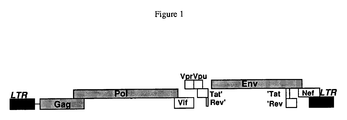
- the HIV genome includes, as shown in Figure 1: 3 structural genes: gag, pol and env respectively coding for the capsid proteins, the envelope and the reverse transcriptase, at least 6 genes: tat, rev, nef, vif, vpr and vpu, which code for proteins probably having regulatory functions that are still poorly defined for some and, the cis-regulatory sequences essential for transcription, located at the 2 5 ′ and 3 ′ ends of proviral DNA at the LTRs (Long Terminal Repeat).
- the 5 'LTR contains the promoter sequences and the regulatory elements required for the initiation of transcription, while the 3' LTR is involved in the termination of transcription.
- the transcription of viral genes is subject to complex regulation controlled in particular by the viral proteins TAT and REV.
- the TAT protein is a regulatory protein expressed early during the viral cycle. Its place of action is the nucleus. Its role is to trans-activate the expression of genes coding for all HIV proteins.
- the TAT protein interacts specifically with a short nucleotide sequence of the viral genome: the TAR (Trans-Activation Responsive Region) sequence located at the 5 'end of the HIV genome between nucleotides (nt) -17 to +80 of the 5' LTR . This sequence is therefore partly present in all viral mRNAs. It is assumed that the TAT-TAR complex, probably in combination with other cellular factors, promotes the transcription of viral genes, stabilizes the mRNAs thus obtained and improves the translation of these mRNAs into proteins. So the virus multiplies very quickly as soon as the tat gene is activated.
- the trans-activation effect induced by the TAT protein could be evaluated in vitro using an indicator gene whose expression can be easily measured, such as the CAT gene (Chloramphenicol Acetyl Transferase).
- the CAT gene placed under the control of the 5 ′ LTR of the HIV virus including the TAR sequence, was introduced into animal cells by transfection. In cells which do not express TAT, for example cells not infected with the HIV virus, transcription of the CAT gene from the viral promoter is blocked or reduced to a minimum, so that no or very little product of the gene CAT is highlighted. Whereas in the presence of the TAT protein, there is an increase in gene expression by a factor of 100 to 1000 depending on the cells, which results from an acceleration of transcription associated with a better efficiency of translation.
- the HIV tat trans-activator gene includes 2 coding exons.
- the first is located in the central region of the genome, between the sequences encoding the pol and env genes , and encodes the essential part of the protein, namely the 72 N-terminal amino acids.
- the second which only codes for the 14 C-terminal amino acids, is not essential for biological activity.
- TAT protein The structure of the TAT protein is suggested by its function. It must include at least one domain which allows the activation of the transcription of viral genes, said activation domain, a domain which binds to the nucleotide sequence TAR, its target sequence, and a domain which allows its nuclear localization.
- TAT protein consists of 5 domains (Fig 2): a first domain (amino acids 1 to 37) has a sequence rich in cysteines, the function of which is still unknown. Some studies suggest that this region is involved in the folding of the protein and in the dimerization of TAT molecules and would protect it against proteases, the domain consisting of amino acids 38 to 48 corresponds to the first activation domain, the domain consisting of amino acids 49 to 57 has the nuclear localization and TAR element attachment sequences, the domain consisting of amino acids 58 to 72 corresponds to the second activation domain of TAT, the domain consisting of amino acids 73 to 86 is not essential to the activity of TAT.
- trans-activator genes encoding proteins capable of activating the transcription of viral genes from LTRs.
- many variants of these trans-activating proteins derived from different types of virus have been described, among them negative and dominant variants (Wachsman et al., Science, 1987, 235 , 674-677; Friedman et al ., Nature, 1988, 335 , 452-454), designated below as trans-dominant variants.
- Trans-dominant variants have been defined as variants which have a reduced capacity to induce the activation of the expression of genes placed under the control of the viral promoter (reduced trans-activating activity) but which have the capacity to recognize their sequence target located at the same promoter, so that they can competitively inhibit the function of the native trans-activator protein.
- this technology consists in genetically modifying cells in order to make them synthesize a protein or nucleic acids giving them a particular advantage, as for example according to the concept defined by D. Baltimore (Nature, 1988, 335 , 395 -396), resistance against infection by a given virus, such as the HIV virus.
- These variants are particularly useful in the context of anti-AIDS therapy, since they exhibit a reduced trans-activating activity and they interfere in a dominant manner with the function of the native TAT protein.
- These new variants could constitute effective antiviral agents to inhibit the replication and spread of the HIV virus. Indeed, the action of these trans-dominant variants would take place from the first cycle of infection even before the virus could synthesize the proteins and RNA necessary for the formation of new viral particles.
- the subject of the present invention is therefore a trans-dominant variant of the TAT protein of the HIV virus or of a functional fragment of said protein comprising at least one mutation; said mutation being characterized by the presence of an amino acid residue different from the natural residue in position 38, 40, 41, 45, 47, provided however that the amino acid in position 41 is different from an alanine or a threonine and that the amino acid at position 47 is different from an alanine or a histidine.
- sequence of a variant of the TAT protein should be described on the basis of the sequence of the TAT protein of the HIV1 isolate Lai virus, as disclosed by Wain-Hobson et al. (Cell, 1985, 40 , 9-17).
- the TAT protein and the DNA fragment which codes for the TAT protein were originally described from the viral strain HIV 1, isolate Lai.
- the viral strains and the viral isolates described within the same strain exist in large numbers.
- a particular virus is susceptible to variability during its spread. Therefore, the DNA fragment that codes for the TAT protein may have a different nucleotide sequence from virus to virus.
- the TAT protein may have an amino acid sequence different from one virus to another.
- the common denominator is the function of the protein which is trans-activate the expression of genes placed under the control of a promoter containing a TAR target sequence, such as the promoter of the HIV virus included in the LTR 5 ′ of the viral genome.
- HIV TAT protein is meant any protein giving a transactivation result substantially identical to that presented by the TAT protein of the HIV1 isolate Lai virus.
- sequence of a variant of the TAT protein is aligned with that of the TAT protein of the HIV1 virus.
- the numbering of amino acids in the sequence of a variant of the TAT protein will therefore be modeled on that established for the TAT protein of the HIV1 virus.
- an amino acid residue in position, for example, 41 in the sequence of a variant of the TAT protein is in fact an amino acid residue which corresponds after alignment with the amino acid in position 41 in the sequence of the native TAT protein HIV1 virus.
- a variant of the TAT protein according to the invention exhibits in particular a trans-dominant phenotype characterized by a trans-activating activity of less than about 50% compared to that of the native TAT protein, advantageously less than 20 % and preferably less than 10% and an inhibitory activity of the native TAT function, as determined in a concentration / variant / native TAT ratio of 10/1, greater than 50%, advantageously greater than 75% and preferably greater than 90%.
- Different methods of measuring trans-activating activity are currently known. They vary according to the reporter gene used. By way of example, mention is made of the method using the CAT gene placed under the control of the LTR5 'of the HIV virus, described in the examples below.
- a variant of the TAT protein according to the invention can be derived from a functional fragment of said protein and be mutated at the level of a residue as indicated above, the numbering of the amino acids also being aligned with that established for the TAT protein native to the reference HIV1 virus.
- functional fragment of the TAT protein is meant any fragment of said protein which is capable of inducing trans-activation of the expression of genes placed under the control of a promoter comprising the TAR sequence, such as the virus promoter HIV.
- a variant of the TAT protein according to the invention can be generated after mutation of a fragment of the TAT protein, such as a fragment starting at amino acid 1 and ending at amino acid 72.
- a variant of the TAT protein according to the invention may contain several mutations with respect to the TAT protein native to HIV. It can include a combination of at least 2 mutations as described above.
- a variant of the TAT protein according to the invention has in particular a sequence whose degree of homology with the native TAT sequence of HIV1 is greater than 75%, advantageously greater than 90% and preferably greater than 95%.
- residues to be mutated can be replaced by any amino acid other than the natural residue, except the residue at position 41 which can be replaced by an arginine, asparagine, aspartic acid, cysteine, glycine, glutamic acid, glutamine, histidine, isoleucine, leucine, methionine, phenylalanine, proline, serine, tryptophan, tyrosine and valine; and the residue at position 47 which can be replaced by an arginine, asparagine, aspartic acid, cysteine, glycine, glutamic acid, glutamine, isoleucine, leucine, lysine, methionine, phenylalanine, proline, serine, threonine, tryptophan and valine.
- the invention also relates to a DNA fragment coding for said variant of the TAT protein.
- the sequence coding for a variant of the TAT protein can be obtained according to conventional techniques of genetic engineering, for example by site-directed mutagenesis.
- the DNA fragment comprising the gene coding for the TAT protein native to HIV or a portion of said sequence is cloned into a phage of type M13.
- the sequence is modified by using an appropriate oligonucleotide, so as to obtain the desired mutation (s).
- the invention also includes an expression cassette comprising a DNA fragment coding for a variant of the TAT protein according to the invention, placed under the control of appropriate elements allowing its expression.
- An expression cassette is in particular useful for making it possible to synthesize a variant of the TAT protein in a heterologous expression system or else as an element a vector intended for gene therapy such as a retroviral or adenoviral vector.
- appropriate elements allowing the expression of the DNA fragment coding for a variant of the TAT protein means all of the elements allowing the transcription of said DNA fragment into mRNA and the translation of mRNA into protein.
- promoter means any transcriptional control element involved in the expression of a DNA fragment depending on the host cell which has been retained.
- control elements are well known to those skilled in the art and are inserted into the expression cassette by conventional techniques of genetic engineering.
- the promoter chosen can be of cellular or viral origin.
- the promoter can be of the ubiquitous type allowing permanent expression of the DNA fragment. This is the case of the PGK promoter (phosphoglycerate kinase) functional in yeast or of the late promoter of the SV40 virus (Simian Virus 40), of the promoter of the HMG gene (Hydroxy-Methyl-Glutaryl coenzyme A reductase), of the promoter of the gene thymidine kinase (TK) of the Herpes Simplex virus type 1 (HSV1), of the EIII promoter and MLP (Major Late Promoter) of the adenovirus and of the LTR of the MoMuLV virus (Moloney Murine Leukemia Virus) which are functional in animal cells.
- PGK promoter phosphoglycerate kinase
- HMG gene Hydroxy-Methyl-Glutaryl coenzyme A reductase
- promoter also includes a regulator-like promoter, for example a tissue-specific promoter such as the lymphocyte-specific immunoglobulin gene promoter.
- the expression cassette can allow the expression of a variant of the TAT protein inside a host cell, and preferably inside a lymphocyte.
- the expression cassette can also allow the production of the variant of the TAT protein in the culture medium from which it can be easily harvested.
- the DNA fragment codes for a precursor of the variant of the TAT protein comprising, upstream of the mature sequence, a signal peptide allowing the secretion of said variant from the host cell.
- signal peptides are well known to those skilled in the art, for example the signal sequence of the yeast Mat alpha factor.
- the expression cassette is inserted into an expression vector which is used to transform a host cell in which the promoter and the appropriate elements are functional.
- a vector can be in the form of a plasmid or a viral vector, for example a retroviral vector derived from MoMuLV or an adenoviral vector derived from type 5 adenovirus.
- the present invention extends to cells comprising an expression cassette according to the invention, the cells possibly being of eukaryotic or prokaryotic origin.
- the host cell can be a bacterium, a fungus, for example a yeast or a mammalian cell.
- the host cell will be a human cell of the hematopoietic line.
- the invention also covers a variant of the TAT protein obtained by the implementation of said method.
- the invention also extends to the therapeutic use of a variant of the TAT protein according to the invention of an expression cassette or of a cell producing said variant for inhibiting the replication of the HIV virus.
- the present invention relates to the use of a variant of the TAT protein or of an expression cassette or of a cell producing said variant for the manufacture of a medicament intended for the treatment or prevention of AIDS in mammals, preferably humans.
- an expression cassette or a cell according to the invention can be used for the purposes of anti-AIDS gene therapy.
- the expression cassette is inserted into a retroviral type vector which is introduced into the stem cells of the hematopoietic line taken from the bone marrow of an individual (preferably infected with HIV).
- the stem cells thus transfected are reinjected into the donor. They are able to divide and differentiate among other things into lymphocytes.
- the lymphocytes which comprise the retroviral vector will express, over a long period of time, the gene coding for a trans-dominant variant of the TAT protein making said cells resistant to HIV infection.
- the invention also relates to a pharmaceutical composition which comprises, as therapeutic or prophylactic agent, a variant according to the invention, an expression cassette or a cell producing such a variant.
- a pharmaceutical composition according to the invention can be prepared according to the techniques commonly used. For example, the therapeutic or prophylactic agent is combined in a therapeutically effective amount with an acceptable carrier, diluent or adjuvant.
- the invention relates to a treatment method according to which a therapeutically effective amount of a variant of the TAT protein according to the invention is administered, an expression cassette or a cell producing such a variant to a patient.
- Figure 1 is a schematic representation of the genome of the HIV virus, the genes coding for the proteins being represented according to the reading frame used; LTR: black boxes; genes coding for structural proteins: gray boxes; genes coding for regulatory proteins: white boxes.
- FIG. 2 is a schematic representation of the different domains constituting the TAT protein native to the HIV virus, the amino acids constituting each domain being indicated above each of the domains.
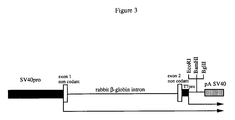
- Figure 3 is a schematic representation of the eukaryotic expression vector pSG5 which comprises in sequence the promoter SV40 (SV40 pro; black box), the 3 'fragment of exon 1 not coding for the rabbit ⁇ globin gene (box white), the intron of the rabbit ⁇ globin gene (solid line), the non-coding start of exon 2 of the rabbit ⁇ globin gene (white box), the promoter of bacteriophage T7 (T7 pro; black box), unique sites EcoRI, BamHI, BglII allowing the cloning of a gene of interest and the polyadenylation signal of the SV40 virus (pA SV40; gray box).
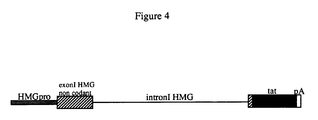
- FIG. 4 is a schematic representation of the expression vector of the native TAT protein pHMG-Tat which comprises in sequence: the promoter of the HMG gene (HMGpro), the non-coding exon I of the HMG gene (striped box), the intron I and the acceptor site for the splicing of the HMG gene, the DNA-copy coding for the 86 amino acids of the TAT protein (black box) and the polyadenylation signal of SV40 (pA, white box).
- FIG. 5 is a schematic representation of the retroviral vector pLXSP comprising in sequence the 5 'LTR of the MSV virus (Murine Sarcoma virus) including the viral promoter region, an encapsidation region (psi), the 5' part of the viral gag gene ( gag °), multiple cloning sites allowing the insertion of heterologous genes (gene x), the SV40 virus promoter directing gene expression of resistance to puromycin (PAC) and the LTR3 'of the MPSV virus (Myelo Proliferative Sarcoma Virus) including the polyadenylation signals.
- MSV virus MSV virus
- psi encapsidation region
- gag ° the 5' part of the viral gag gene
- multiple cloning sites allowing the insertion of heterologous genes (gene x), the SV40 virus promoter directing gene expression of resistance to puromycin (PAC) and the LTR3 'of the MPSV virus (Myelo Pro
- a DNA fragment comprising the DNA-copy corresponding to the 2 exons of the tat gene of the HIV-isolate genome Lai was modified in order to create a BamHI site 5 ′ of the initiating ATG.
- a BamHI site naturally exists 53 bp after the stop codon of the tat gene .
- the BamHI fragment of 300 bp comprising the non-mutated tat gene was purified by the Gene Clean kit (Bio 101, Inc, PO Box 2284, La Jolla) and inserted into a vector M13TG130 (Kieny et al., Gene, 1983, 26 , 91-99) in order to give the vector M13TG2306, on which the mutagenesis are carried out.
- the mutation of the codon coding for residue 38 is on M13TG2306 using the Amersham kit (Oligonucleotide-directed in vitro mutagenesis system, version 2.1 RPN 1523) and using the oligonucleotide described in the sequence identifier SEQ ID NO: 1.
- the oligonucleotide was designed so as to replace the codon coding for the phenylalanine residue (Phe) at position 38 with an aspartic acid (Asp) and also to create a HindIII restriction site at the level of the codon coding for the residue at position 42 of the TAT sequence without modifying the amino acid for which it codes.
- the presence of a restriction site makes it possible to easily identify the mutated vectors of the parents during the analysis of the DNAs of the bacteriophage by the technique of mini-preparation described by Maniatis et al. (Molecular cloning: a laboratory manual, 1989, Cold Spring Harbor Laboratory).
- the BamHI fragment comprising the mutated tat gene is then transferred into the eukaryotic expression vector pSG5 (Green et al., Nucleic Acids Res, 1988, 16 , 369) illustrated in Figure 3.
- the resulting plasmid, pTG2332 allows the expression of the TAT variant (Phe38 -> Asp).
- the trans-dominant variants TAT of the prior art were created by site-directed mutagenesis of the vector M13TG2306, using the oligonucleotides respectively described in SEQ ID NO: 2 for modifying the codon coding for the lysine residue in position 41 with an alanine and, in SEQ ID NO: 3 for creating a stop codon in place of the codon coding for the glutamine residue in position 54.
- the mutated tat gene is inserted into the eukaryotic expression vector pSG5, giving respectively pTG2351 allowing the production of the TAT mutant (Lys41 -> Ala) and pTG2352 allowing the production of ⁇ TAT.
- TAT mutant Lys41 -> Ala
- pTG2352 allowing the production of ⁇ TAT.
- the trans-activating activity of the TAT variant is evaluated by transient transfection into HeLa cells of the expression vector pTG2332 with the reporter vector LTR-CAT (Emerman et al., EMBO J., 1987, 6 , 37-55).
- the cells are transfected according to the calcium phosphate technique (Maniatis et al., Molecular cloning: a laboratory manual, 1989, Cold Spring Harbor Laboratory).
- Other protocols for introducing a nucleic acid into a cell can also be used, such as the dextran sulfate technique, electroelution, methods based on osmotic shock or microinjection of a selected cell.
- Human HeLa cells are cultured at 37 ° C. in the presence of 5% CO2 in MEM (Eagle's minimum essential medium) medium supplemented with 10% fetal calf serum, 1% non-essential amino acids, 1% glutamine and 1% gentamycin.
- MEM Eagle's minimum essential medium
- the plasmid DNAs are purified on a cesium chloride gradient. 1 ⁇ g of pTG2332 and 0.5 ⁇ g of the LTR-CAT plasmid are co-transfected into cultured HeLa cells, spread at a rate of 4x10⁵ cells per dish. The transfection of 1 ⁇ g of pHMG-Tat (FIG. 4) and 0.5 ⁇ g of LTR-CAT constitutes the positive control for trans-activation.
- the pHMG-tat vector is derived from the cloning of the BamHI fragment comprising the DNA-copy of the tat gene coding for the 86 amino acids of the TAT protein, in the BamHI site of the pHMG vector (Mehtali et al., Gene, 1990, 91 , 179-184).
- the plasmid DNAs to be transfected are taken up in 420 ⁇ l of TE (10 mM Tris-HCl, pH 7.5; 1 mM EDTA) and mixed with 60 ⁇ l of 2M CaCl2.
- HBSx2 NaCl 280mM; HEPES 50mM; Na2HPO4-2H2O 1.5mM adjusted to pH 7.12 with NaOH
- HBSx2 NaCl 280mM
- HEPES 50mM Na2HPO4-2H2O 1.5mM adjusted to pH 7.12 with NaOH
- the medium is changed 24 hours after transfection in order to eliminate the excess precipitate.
- Cell extracts are analyzed 48 hours after the transformations in order to evaluate the expression of the CAT gene.
- HeLa cells are collected by scraping in a CAT buffer (Tris-HCl 150mM pH8; KCl 60mM; NaCl 15mM; EDTA 2mM; spermine 0.15mM; dithiothreitol (DTT) 1mM; phenylmethylsulfonyl fluoride (PMSF) 0.4mM).
- CAT buffer Tris-HCl 150mM pH8; KCl 60mM; NaCl 15mM; EDTA 2mM; spermine 0.15mM; dithiothreitol (DTT) 1mM; phenylmethylsulfonyl fluoride (PMSF) 0.4mM.
- PMSF phenylmethylsulfonyl fluoride
- the expression of the CAT gene is determined on an aliquot of extract corresponding to 10 to 20 ⁇ g of proteins.
- the adequate volume of cell extract previously incubated is incubated at 300 ⁇ l with 0.25 M Tris-HCl buffer pH 7.8 with 32 ⁇ l of 5 mM acetyl-coenzyme A and 20 ⁇ l (0.5 ⁇ Ci) of 14C chloramphenicol at 37 ° C. for 1h30. After extraction with ethyl acetate and centrifugation at 10,000 rpm for Smn, the upper phase is lyophylized.
- the trans-dominant activity of the TAT variant (Phe38 -> Asp) is evaluated by measuring its capacity to inhibit the trans-activating function of the native TAT protein.
- Trans-dominant activity is determined by transient transfection into cells HeLa of the expression vector pTG2332 with the reporter vector LTR-CAT and the expression vector of the native TAT protein pHMG-Tat. 10 ⁇ g of pTG2332, 1 ⁇ g of pHMG-Tat and 0.5 ⁇ g of LTR-CAT are co-transfected according to the protocol described above.
- the TAT variant (Phe38-> Asp) is an effective trans-dominant mutant since the trans-activating activity which it exhibits is minute (expression of the CAT gene evaluated at 1.4% compared to that measured with the native TAT protein. ) and since it strongly inhibits the activity of the native TAT protein (98% inhibition in the presence of pTG2332).
- the variant of the prior art ⁇ TAT produced by pTG2352 indeed constitutes a cross-dominance witness, which confirms the validity of these experiments. It inhibits the trans-activating activity of the native TAT protein by 92%. However, this variant is capable of inducing expression of the CAT gene placed under the control of the HIV LTR (28%), the trans-activation being however less than that measured with the positive control pHMG-Tat.
- the vector M13TG2306 is subjected to a directed mutagenesis in order to replace the codon coding for the threonine residue (Thr) in position 40 of the TAT protein of HIV by a codon coding for an alanine residue (Ala) and to introduce silent mutations of so as to create a HindIII restriction site at the level of the codon coding for residue 42 allowing rapid identification of the mutated vectors.
- the oligonucleotide used is described in SEQ ID NO: 4.
- the tat gene mutated is transferred into the vector pSG5 giving rise to pTG2333 which makes it possible to produce the TAT variant (Thr40 -> Ala).
- the vector pTG2333 is transiently transfected in HeLa cells with the vector LTR-CAT in order to determine the trans-activating activity of the TAT variant (Thr40 -> Ala) according to the protocol described above. At the same time, its trans-dominant activity is determined by co-transfection of pTG2333, pHMG-Tat and LTR-CAT in a concentration ratio of 10: 1: 0.5.
- the vector M13TG2306 is subjected to a directed mutagenesis in order to replace the codon coding for the lysine residue (Lys) in position 41 of the TAT protein of HIV by a codon coding for a glutamic acid residue (Glu) and to introduce silent mutations so as to create a HindIII restriction site at the codon coding for residue 42 allowing rapid identification of the mutated vectors.
- the oligonucleotide used is described in SEQ ID NO: 5.
- the mutated tat gene is transferred into the vector pSG5 giving rise to pTG2340 which makes it possible to produce the TAT variant (Lys41 -> Glu).
- the vector pTG2340 is transiently transfected in HeLa cells with the vector LTR-CAT in order to determine the trans-activating activity of the TAT variant (Lys41 -> Glu) according to the protocol described above.
- his Trans-dominant activity is determined by co-transfection of pTG2340, pHMG-Tat and LTR-CAT in a concentration ratio of 10: 1: 0.5.
- TAT variant (Lys41 -> Glu) has a trans-dominant phenotype as defined according to the invention.
- the variant's trans-activating activity is weak (3% of the activity conferred by the native TAT protein) and it is capable of effectively inhibiting the trans-activating function of the native TAT protein (97% of inhibition).
- the TAT variant (Lys41 -> Glu) produced by pTG2340 and the variant of the prior art TAT (Lys41 -> Ala) which behaves like the native TAT protein, are mutated on the same residue.
- the phenotype of the variant obtained may therefore be totally different.
- the replacement of Lys41 by a Glu gives the generated variant a trans-dominant phenotype.
- the vector M13TG2306 is subjected to a directed mutagenesis in order to replace the codon coding for the isoleucine residue (Ile) in position 45 of the TAT protein of HIV by a codon coding for a serine residue (Ser) and to create a BamHI restriction site at the level of the codon coding for residue 45 allowing rapid identification of the mutated vectors.
- the oligonucleotide used is described in SEQ ID NO: 6.
- the mutated tat gene is transferred into the vector pSG5 giving rise to pTG2358 which makes it possible to produce the TAT variant (Ile45 -> Ser).
- the vector pTG2358 is transiently transfected in HeLa cells with the vector LTR-CAT in order to determine the trans-activating activity of the TAT variant (Ile45 -> Ser) according to the protocol described above. At the same time, its trans-dominant activity is determined by co-transfection of pTG2358, pHMG-Tat and LTR-CAT in a concentration ratio of 10: 1: 0.5.
- TAT variant (Ile45 -> Ser) has a trans-dominant phenotype as defined according to the invention. It partially inhibits the function of the native TAT protein to 62.5% and it retains a moderate trans-activating activity of 47%
- the vector M13TG2306 is subjected to a directed mutagenesis in order to replace the codon coding for the tyrosine residue (Tyr) in position 47 of the TAT protein of HIV by a codon coding for an arginine residue (Arg) and to create an XbaI restriction site at level of the codon coding for residue 47 allowing rapid identification of the mutated vectors.
- the oligonucleotide used is described in SEQ ID NO: 7.
- the mutated tat gene is transferred into the vector pSG5 giving rise to pTG2348 which makes it possible to produce the TAT variant (Tyr47 -> Arg).
- the vector pTG2348 is transiently transfected in HeLa cells with the vector LTR-CAT in order to determine the trans-activating activity of the TAT variant (Tyr47 -> Arg) according to the protocol described above. At the same time, its trans-dominant activity is determined by co-transfection of pTG2348, pHMG-Tat and LTR-CAT in a concentration ratio of 10: 1: 0.5.
- TAT variant (Tyr47 -> Arg) has a moderate trans-dominant phenotype as defined according to the invention. It inhibits the function of the native TAT protein by 78% and it retains a 56% trans-activating activity
- EXAMPLE 6 Establishment of stable cell lines expressing a trans-dominant variant TAT and evaluation of their resistance to infection by the HIV virus.
- Stable cell lines producing the trans-dominant variant TAT have been established in order to validate the efficacy of the variants for possible use in vivo , for example in a gene therapy protocol.
- TAT trans-dominant variant
- the Bam HI fragment comprising the gene coding for the trans-dominant variant TAT (Phe38 -> Asp) is inserted into the BamHI site of the retroviral vector pLXSP (FIG. 5) generating pTG2350.
- the vector pLXSP is derived from pLXSN (Miller and Rossman, Biotechniques, 7 , 1989, 980-988) and results from the replacement of the neomycin gene with a gene conferring resistance to puromycin and of LTR3 'of MSV by that of MPSV.
- the plasmid DNA of pTG2350 is introduced into CEM-A3 cells by electroporation. 20 ⁇ g of purified DNA are taken up on a cesium chloride gradient in 2041 of PBS buffer (KH2 PO4 1mM; KCl 2mM; NaCl 136mM, Na2 HPO4 3mM). The DNA preparation is mixed with 2 ⁇ 107 cells resuspended in 180 ⁇ l of PBS in an electroporation tank (Biorad). Preincubate at room temperature for 10 minutes.
- the cells After electroporation (Gene pulser Biorad, voltage 210V, capacitance 960 ⁇ F), the cells are kept at room temperature for 10 minutes and incubated at 37 ° C in 6 ml of RPMI (Gibco-BRL) in the presence of 5% of CO2.
- RPMI Gibco-BRL
- the CEM-A3 clones resistant to puromycin are isolated by limiting dilution (puromycin 0.5 ⁇ g / ml).
- the plasmid DNA pTG2350 is co-transfected in HeLa cells with pTG620 by the calcium phosphate transfection technique previously described. Clones of HeLa cells resistant to puromycin are isolated by successive subcultures (puromycin 2 ⁇ g / ml). The expression of the human CD4 receptor on the surface of the cells is analyzed by fluorocytometry (FACS: Fluorescence Activated Cell Sorter, Becton Dickinson scan) using the leu3A antibody labeled with phycoerythrin (Becton Dickinson) directed against this receptor.
- FACS Fluorescence Activated Cell Sorter, Becton Dickinson scan
- the expression of the TAT protein in the CEM-A3 cell line is detected by carrying out transient transfections of the LTR-CAT and pHMG-Tat vectors according to the technique described above.
- Three clones from the CEM-A3 cell line resistant to puromycin and expressing the trans-dominant TAT variant and for which different degrees of inhibition of the native TAT protein have been observed, are infected with the HIV virus.
- the spread of the virus can be evaluated by measuring the reverse transcriptase activity in the culture supernatants. We were thus able to detect an offset of 2 days of viral multiplication in one of the clones of the CEM-A3 cell line expressing the trans-dominant variant relative to the result obtained in CEM-A3 cells not expressing a trans-dominant variant.
- the reverse transcriptase activity is reduced by 90% in said clone.
Landscapes
- Health & Medical Sciences (AREA)
- Life Sciences & Earth Sciences (AREA)
- Chemical & Material Sciences (AREA)
- Organic Chemistry (AREA)
- Virology (AREA)
- General Health & Medical Sciences (AREA)
- Medicinal Chemistry (AREA)
- Molecular Biology (AREA)
- Pharmacology & Pharmacy (AREA)
- Animal Behavior & Ethology (AREA)
- General Chemical & Material Sciences (AREA)
- Oncology (AREA)
- Nuclear Medicine, Radiotherapy & Molecular Imaging (AREA)
- Communicable Diseases (AREA)
- Chemical Kinetics & Catalysis (AREA)
- Genetics & Genomics (AREA)
- Proteomics, Peptides & Aminoacids (AREA)
- Public Health (AREA)
- Veterinary Medicine (AREA)
- Gastroenterology & Hepatology (AREA)
- Biochemistry (AREA)
- Biophysics (AREA)
- Tropical Medicine & Parasitology (AREA)
- AIDS & HIV (AREA)
- Micro-Organisms Or Cultivation Processes Thereof (AREA)
- Peptides Or Proteins (AREA)
- Medicines That Contain Protein Lipid Enzymes And Other Medicines (AREA)
- Preparation Of Compounds By Using Micro-Organisms (AREA)
- Medicines Containing Material From Animals Or Micro-Organisms (AREA)
- Medicines Containing Antibodies Or Antigens For Use As Internal Diagnostic Agents (AREA)
Priority Applications (2)
| Application Number | Priority Date | Filing Date | Title |
|---|---|---|---|
| EP03025262A EP1424394A3 (de) | 1993-01-04 | 1994-01-03 | TAT transdominante Variante aus HIV Virus |
| EP04023571A EP1580272A3 (de) | 1993-01-04 | 1994-01-03 | TAT Transdominante Variante des humänen Immundefizienzvirus (HIV) |
Applications Claiming Priority (2)
| Application Number | Priority Date | Filing Date | Title |
|---|---|---|---|
| FR9300004 | 1993-01-04 | ||
| FR9300004A FR2700169B1 (fr) | 1993-01-04 | 1993-01-04 | Nouveaux variants trans-dominants TAT du virus de l'immunodéficience humaine. |
Related Child Applications (2)
| Application Number | Title | Priority Date | Filing Date |
|---|---|---|---|
| EP03025262A Division EP1424394A3 (de) | 1993-01-04 | 1994-01-03 | TAT transdominante Variante aus HIV Virus |
| EP04023571A Division EP1580272A3 (de) | 1993-01-04 | 1994-01-03 | TAT Transdominante Variante des humänen Immundefizienzvirus (HIV) |
Publications (2)
| Publication Number | Publication Date |
|---|---|
| EP0614980A1 true EP0614980A1 (de) | 1994-09-14 |
| EP0614980B1 EP0614980B1 (de) | 2005-04-13 |
Family
ID=9442808
Family Applications (3)
| Application Number | Title | Priority Date | Filing Date |
|---|---|---|---|
| EP03025262A Withdrawn EP1424394A3 (de) | 1993-01-04 | 1994-01-03 | TAT transdominante Variante aus HIV Virus |
| EP04023571A Withdrawn EP1580272A3 (de) | 1993-01-04 | 1994-01-03 | TAT Transdominante Variante des humänen Immundefizienzvirus (HIV) |
| EP94400005A Expired - Lifetime EP0614980B1 (de) | 1993-01-04 | 1994-01-03 | TAT transdominante Variante aus Human Immunodeficiency Virus |
Family Applications Before (2)
| Application Number | Title | Priority Date | Filing Date |
|---|---|---|---|
| EP03025262A Withdrawn EP1424394A3 (de) | 1993-01-04 | 1994-01-03 | TAT transdominante Variante aus HIV Virus |
| EP04023571A Withdrawn EP1580272A3 (de) | 1993-01-04 | 1994-01-03 | TAT Transdominante Variante des humänen Immundefizienzvirus (HIV) |
Country Status (10)
| Country | Link |
|---|---|
| US (2) | US5889175A (de) |
| EP (3) | EP1424394A3 (de) |
| JP (2) | JP3613734B2 (de) |
| AT (1) | ATE292981T1 (de) |
| AU (1) | AU668441B2 (de) |
| CA (1) | CA2112652A1 (de) |
| DE (1) | DE69434328T2 (de) |
| DK (1) | DK0614980T3 (de) |
| ES (1) | ES2236688T3 (de) |
| FR (1) | FR2700169B1 (de) |
Cited By (7)
| Publication number | Priority date | Publication date | Assignee | Title |
|---|---|---|---|---|
| WO1998014587A1 (en) * | 1996-10-04 | 1998-04-09 | THE GOVERNMENT OF THE UNITED STATES OF AMERICA, represented by THE SECRETARY, DEPARTEMENT OF HEAL TH AND HUMAN SERVICES | Inhibition of hiv replication using soluble tat peptide analogs |
| US6686333B1 (en) * | 1996-10-04 | 2004-02-03 | The United States Of America As Represented By The Department Of Health And Human Resources | Inhibition of HIV replication using soluble Tat peptide analogs |
| EP1246647A4 (de) * | 1999-08-12 | 2005-09-21 | Inist Inc | Nicht-immunsuppresives hiv tat-protein |
| US8323928B2 (en) | 1999-08-12 | 2012-12-04 | Pin Pharma, Inc. | Vaccines and immunotherapeutics derived from the human immunodeficiency virus (HIV) transactivator of transcription protein for the treatment and prevention of HIV disease |
| WO2013068096A1 (fr) | 2011-11-08 | 2013-05-16 | Institut National De La Recherche Agronomique (Inra) | Cassette d'expression inductible et ses utilisations |
| US9206239B2 (en) | 2009-03-23 | 2015-12-08 | Pin Pharma, Inc. | Treatment of cancers with immunostimulatory HIV Tat derivative polypeptides |
| US9663556B2 (en) | 2013-10-04 | 2017-05-30 | Pin Pharma, Inc. | Treatment of cancers with immunostimulatory HIV tat derivative polypeptides |
Families Citing this family (15)
| Publication number | Priority date | Publication date | Assignee | Title |
|---|---|---|---|---|
| FR2731355B1 (fr) * | 1995-03-08 | 1997-05-30 | Neovacs | Nouveaux immunogenes, nouveaux anticorps, procede de preparation et compositions pharmaceutiques les renfermant |
| ATE196255T1 (de) * | 1995-03-08 | 2000-09-15 | Neovacs | Von einem retroviralen regulationsprotein abstammende, detoxifierte immunogene, dagegen gerichtete antikörper, verfahren zur deren herstellung und diese immunogene oder antikörper enthaltende, pharmazeutische zusammensetzungen. |
| US5888767A (en) | 1996-11-27 | 1999-03-30 | The Johns Hopkins University School Of Medicine | Method of using a conditionally replicating viral vector to express a gene |
| US5885806A (en) * | 1995-11-28 | 1999-03-23 | The Johns Hopkins University School Of Medicine | Methods to prepare conditionally replicating viral vectors |
| EP0852626B1 (de) * | 1996-01-29 | 2002-04-03 | Virologic, Inc. | Verfahren und zusammensetzungen zur bestimmung der empfindlichkeit und resistenz gegen antivirale wirkstoffe und screening für antivirale wirkstoffe |
| US5891994A (en) * | 1997-07-11 | 1999-04-06 | Thymon L.L.C. | Methods and compositions for impairing multiplication of HIV-1 |
| FR2792206B1 (fr) * | 1999-04-13 | 2006-08-04 | Centre Nat Rech Scient | Vaccin anti-vih-1 comprenant tout ou partie de la proteine tat de vih-1 |
| FR2792204B1 (fr) * | 1999-04-13 | 2001-07-13 | Centre Nat Rech Scient | Vaccin anti-vih-1 comprenant tout en partie de la proteine tat de vih-1 |
| US20050226890A1 (en) * | 1999-08-12 | 2005-10-13 | Cohen David I | Tat-based vaccine compositions and methods of making and using same |
| US6399067B1 (en) * | 2000-04-28 | 2002-06-04 | Thymon L.L.C. | Methods and compositions for impairing multiplication of HIV-1 |
| US20080044435A1 (en) * | 2004-03-16 | 2008-02-21 | Cohen David I | Tat-Based Tolerogen Compositions and Methods of Making and Using Same |
| US6946267B2 (en) * | 2002-03-13 | 2005-09-20 | Dr. Chip Biotechnology Inc. | Method for detecting Staphylococcus aureus |
| US7927580B2 (en) * | 2004-03-16 | 2011-04-19 | Nanirx, Inc. | Tat-based immunomodulatory compositions and methods of their discovery and use |
| JP2008535783A (ja) | 2005-02-15 | 2008-09-04 | サイモン・エル・エル・シー | Hiv−1の増殖を弱めるための方法および組成物 |
| IT1397569B1 (it) | 2009-12-10 | 2013-01-16 | Icgeb | Peptidi e loro derivati che inibiscono il rilascio extracellulare della proteina tat di hiv-1 e la replicazione di hiv-1. |
Citations (1)
| Publication number | Priority date | Publication date | Assignee | Title |
|---|---|---|---|---|
| WO1989012461A1 (en) * | 1988-06-16 | 1989-12-28 | St. Louis University | Antagonists of viral transactivating proteins |
-
1993
- 1993-01-04 FR FR9300004A patent/FR2700169B1/fr not_active Expired - Fee Related
- 1993-12-30 JP JP35527893A patent/JP3613734B2/ja not_active Expired - Fee Related
- 1993-12-30 CA CA002112652A patent/CA2112652A1/fr not_active Abandoned
- 1993-12-31 AU AU52803/93A patent/AU668441B2/en not_active Ceased
-
1994
- 1994-01-03 ES ES94400005T patent/ES2236688T3/es not_active Expired - Lifetime
- 1994-01-03 AT AT94400005T patent/ATE292981T1/de not_active IP Right Cessation
- 1994-01-03 EP EP03025262A patent/EP1424394A3/de not_active Withdrawn
- 1994-01-03 DK DK94400005T patent/DK0614980T3/da active
- 1994-01-03 EP EP04023571A patent/EP1580272A3/de not_active Withdrawn
- 1994-01-03 DE DE69434328T patent/DE69434328T2/de not_active Expired - Fee Related
- 1994-01-03 EP EP94400005A patent/EP0614980B1/de not_active Expired - Lifetime
- 1994-01-04 US US08/177,145 patent/US5889175A/en not_active Expired - Fee Related
-
1998
- 1998-06-12 US US09/096,172 patent/US6284252B1/en not_active Expired - Fee Related
-
2003
- 2003-08-19 JP JP2003207954A patent/JP2004065256A/ja active Pending
Patent Citations (1)
| Publication number | Priority date | Publication date | Assignee | Title |
|---|---|---|---|---|
| WO1989012461A1 (en) * | 1988-06-16 | 1989-12-28 | St. Louis University | Antagonists of viral transactivating proteins |
Non-Patent Citations (3)
| Title |
|---|
| GARCIA, J. A. ET AL.: "Functional domains required for tat-induced transcriptional activation of the HIV-1 long terminal repeat", EMBO JOURNAL., vol. 7, no. 10, October 1988 (1988-10-01), EYNSHAM, OXFORD GB, pages 3143 - 3147, XP002339272 * |
| GREEN, M. ET AL.: "Mutational analysis of HIV-1 Tat minimal domain peptides: identification of trans-dominant mutants that suppress HIV-LTR-driven gene expression", CELL., vol. 58, no. 1, 14 July 1989 (1989-07-14), CAMBRIDGE, NA US, pages 215 - 223, XP023883635, DOI: doi:10.1016/0092-8674(89)90417-0 * |
| KUPPUSWAMY, M. ET AL.: "Multiple functional domains of Tat, the trans-activator of HIV-1, defined by mutational analysis", NUCLEIC ACIDS RESEARCH., vol. 17, no. 9, 1989, ARLINGTON, VIRGINIA US, pages 3551 - 3561, XP000095267, DOI: doi:10.1093/nar/17.9.3551 * |
Cited By (8)
| Publication number | Priority date | Publication date | Assignee | Title |
|---|---|---|---|---|
| WO1998014587A1 (en) * | 1996-10-04 | 1998-04-09 | THE GOVERNMENT OF THE UNITED STATES OF AMERICA, represented by THE SECRETARY, DEPARTEMENT OF HEAL TH AND HUMAN SERVICES | Inhibition of hiv replication using soluble tat peptide analogs |
| US6686333B1 (en) * | 1996-10-04 | 2004-02-03 | The United States Of America As Represented By The Department Of Health And Human Resources | Inhibition of HIV replication using soluble Tat peptide analogs |
| EP1246647A4 (de) * | 1999-08-12 | 2005-09-21 | Inist Inc | Nicht-immunsuppresives hiv tat-protein |
| US8323928B2 (en) | 1999-08-12 | 2012-12-04 | Pin Pharma, Inc. | Vaccines and immunotherapeutics derived from the human immunodeficiency virus (HIV) transactivator of transcription protein for the treatment and prevention of HIV disease |
| US9206239B2 (en) | 2009-03-23 | 2015-12-08 | Pin Pharma, Inc. | Treatment of cancers with immunostimulatory HIV Tat derivative polypeptides |
| WO2013068096A1 (fr) | 2011-11-08 | 2013-05-16 | Institut National De La Recherche Agronomique (Inra) | Cassette d'expression inductible et ses utilisations |
| US9663556B2 (en) | 2013-10-04 | 2017-05-30 | Pin Pharma, Inc. | Treatment of cancers with immunostimulatory HIV tat derivative polypeptides |
| US10159707B2 (en) | 2013-10-04 | 2018-12-25 | Pin Pharma, Inc. | Treatment of cancers with immunostimulatory HIV Tat derivative polypeptides |
Also Published As
| Publication number | Publication date |
|---|---|
| JP2004065256A (ja) | 2004-03-04 |
| JP3613734B2 (ja) | 2005-01-26 |
| ATE292981T1 (de) | 2005-04-15 |
| EP0614980B1 (de) | 2005-04-13 |
| FR2700169A1 (fr) | 1994-07-08 |
| FR2700169B1 (fr) | 1995-03-24 |
| EP1424394A3 (de) | 2005-10-05 |
| EP1424394A2 (de) | 2004-06-02 |
| AU5280393A (en) | 1994-07-14 |
| EP1580272A3 (de) | 2005-10-05 |
| DK0614980T3 (da) | 2005-08-08 |
| EP1580272A2 (de) | 2005-09-28 |
| AU668441B2 (en) | 1996-05-02 |
| ES2236688T3 (es) | 2005-07-16 |
| US5889175A (en) | 1999-03-30 |
| JPH06234791A (ja) | 1994-08-23 |
| CA2112652A1 (fr) | 1994-07-05 |
| US6284252B1 (en) | 2001-09-04 |
| DE69434328D1 (de) | 2005-05-19 |
| DE69434328T2 (de) | 2006-03-09 |
Similar Documents
| Publication | Publication Date | Title |
|---|---|---|
| EP0614980B1 (de) | TAT transdominante Variante aus Human Immunodeficiency Virus | |
| Mahalingam et al. | Identification of residues in the N-terminal acidic domain of HIV-1 Vpr essential for virion incorporation | |
| EP1071804B1 (de) | Verwendung von dns-sequenzen mit triplex-structur zum transfer von nukleotidsequenzen | |
| CA2375627A1 (en) | Polyepitopic protein fragments of the e6 and e7 proteins of hpv, their production and their use particularly in vaccination | |
| CA2370563C (fr) | Vaccin anti-vih-1 comprenant tout ou partie de la proteine tat de vih-1 | |
| Hout et al. | Vpu: a multifunctional protein that enhances the pathogenesis of human immunodeficiency virus type 1 | |
| WO1998026075A1 (fr) | Souches de vih-1 non-m non-o, fragments et applications | |
| FR2713657A1 (fr) | Nouveaux vecteurs pour le traitement du sida. | |
| Huang et al. | Myristylation of Pr60gag of the murine AIDS-defective virus is required to induce disease and notably for the expansion of its target cells | |
| EP1737959A2 (de) | Stabilisiertes tat-antigen und dessen verwendung zur impfung gegen hiv | |
| EP0682708B9 (de) | Zusammensetzung von transdominanten varianten von virus- proteinen zur antiviralen wirkung | |
| EP0796338A1 (de) | Verpakungszellinie zur transkomplementierung von defektiven retroviren-vektoren | |
| FR2646606A1 (fr) | Retrovirus hautement cytopathogenique hiv-ndk. fragment d'adn de ce retrovirus, procede de preparation d'une proteine et/ou enzyme de ce virus et leurs utilisations | |
| EP1006123A2 (de) | Hüllproteine, Verfahren und Anwendungen | |
| CA2372456C (en) | Viral infection inhibitor targeting integrase n-terminal domain | |
| FR2792204A1 (fr) | Vaccin anti-vih-1 comprenant tout en partie de la proteine tat de vih-1 |
Legal Events
| Date | Code | Title | Description |
|---|---|---|---|
| PUAI | Public reference made under article 153(3) epc to a published international application that has entered the european phase |
Free format text: ORIGINAL CODE: 0009012 |
|
| AK | Designated contracting states |
Kind code of ref document: A1 Designated state(s): AT BE CH DE DK ES FR GB GR IE IT LI LU MC NL PT SE |
|
| 17P | Request for examination filed |
Effective date: 19950123 |
|
| 17Q | First examination report despatched |
Effective date: 20000807 |
|
| GRAP | Despatch of communication of intention to grant a patent |
Free format text: ORIGINAL CODE: EPIDOSNIGR1 |
|
| RAP1 | Party data changed (applicant data changed or rights of an application transferred) |
Owner name: TRANSGENE S.A. |
|
| GRAS | Grant fee paid |
Free format text: ORIGINAL CODE: EPIDOSNIGR3 |
|
| GRAA | (expected) grant |
Free format text: ORIGINAL CODE: 0009210 |
|
| AK | Designated contracting states |
Kind code of ref document: B1 Designated state(s): AT BE CH DE DK ES FR GB GR IE IT LI LU MC NL PT SE |
|
| REG | Reference to a national code |
Ref country code: GB Ref legal event code: FG4D Free format text: NOT ENGLISH |
|
| RIC1 | Information provided on ipc code assigned before grant |
Ipc: 7A 61K 39/21 A |
|
| REG | Reference to a national code |
Ref country code: CH Ref legal event code: EP |
|
| REG | Reference to a national code |
Ref country code: CH Ref legal event code: NV Representative=s name: MICHELI & CIE INGENIEURS-CONSEILS |
|
| REG | Reference to a national code |
Ref country code: IE Ref legal event code: FG4D Free format text: LANGUAGE OF EP DOCUMENT: FRENCH |
|
| REF | Corresponds to: |
Ref document number: 69434328 Country of ref document: DE Date of ref document: 20050519 Kind code of ref document: P |
|
| REG | Reference to a national code |
Ref country code: SE Ref legal event code: TRGR |
|
| PG25 | Lapsed in a contracting state [announced via postgrant information from national office to epo] |
Ref country code: GR Free format text: LAPSE BECAUSE OF FAILURE TO SUBMIT A TRANSLATION OF THE DESCRIPTION OR TO PAY THE FEE WITHIN THE PRESCRIBED TIME-LIMIT Effective date: 20050713 |
|
| REG | Reference to a national code |
Ref country code: ES Ref legal event code: FG2A Ref document number: 2236688 Country of ref document: ES Kind code of ref document: T3 |
|
| REG | Reference to a national code |
Ref country code: DK Ref legal event code: T3 |
|
| GBT | Gb: translation of ep patent filed (gb section 77(6)(a)/1977) |
Effective date: 20050804 |
|
| PG25 | Lapsed in a contracting state [announced via postgrant information from national office to epo] |
Ref country code: PT Free format text: LAPSE BECAUSE OF FAILURE TO SUBMIT A TRANSLATION OF THE DESCRIPTION OR TO PAY THE FEE WITHIN THE PRESCRIBED TIME-LIMIT Effective date: 20050913 |
|
| PGFP | Annual fee paid to national office [announced via postgrant information from national office to epo] |
Ref country code: IT Payment date: 20060131 Year of fee payment: 13 |
|
| PLBE | No opposition filed within time limit |
Free format text: ORIGINAL CODE: 0009261 |
|
| STAA | Information on the status of an ep patent application or granted ep patent |
Free format text: STATUS: NO OPPOSITION FILED WITHIN TIME LIMIT |
|
| 26N | No opposition filed |
Effective date: 20060116 |
|
| PGFP | Annual fee paid to national office [announced via postgrant information from national office to epo] |
Ref country code: IE Payment date: 20061213 Year of fee payment: 14 |
|
| PGFP | Annual fee paid to national office [announced via postgrant information from national office to epo] |
Ref country code: CH Payment date: 20061214 Year of fee payment: 14 |
|
| PGFP | Annual fee paid to national office [announced via postgrant information from national office to epo] |
Ref country code: MC Payment date: 20061218 Year of fee payment: 14 |
|
| PGFP | Annual fee paid to national office [announced via postgrant information from national office to epo] |
Ref country code: ES Payment date: 20061220 Year of fee payment: 14 |
|
| PGFP | Annual fee paid to national office [announced via postgrant information from national office to epo] |
Ref country code: AT Payment date: 20061222 Year of fee payment: 14 |
|
| PGFP | Annual fee paid to national office [announced via postgrant information from national office to epo] |
Ref country code: SE Payment date: 20070108 Year of fee payment: 14 |
|
| PGFP | Annual fee paid to national office [announced via postgrant information from national office to epo] |
Ref country code: LU Payment date: 20070110 Year of fee payment: 14 |
|
| PGFP | Annual fee paid to national office [announced via postgrant information from national office to epo] |
Ref country code: DK Payment date: 20070111 Year of fee payment: 14 |
|
| PGFP | Annual fee paid to national office [announced via postgrant information from national office to epo] |
Ref country code: GB Payment date: 20070112 Year of fee payment: 14 |
|
| PGFP | Annual fee paid to national office [announced via postgrant information from national office to epo] |
Ref country code: DE Payment date: 20070130 Year of fee payment: 14 |
|
| PGFP | Annual fee paid to national office [announced via postgrant information from national office to epo] |
Ref country code: NL Payment date: 20070131 Year of fee payment: 14 |
|
| PGFP | Annual fee paid to national office [announced via postgrant information from national office to epo] |
Ref country code: BE Payment date: 20070206 Year of fee payment: 14 |
|
| PGFP | Annual fee paid to national office [announced via postgrant information from national office to epo] |
Ref country code: FR Payment date: 20070124 Year of fee payment: 14 |
|
| BERE | Be: lapsed |
Owner name: S.A. *TRANSGENE Effective date: 20080131 |
|
| PG25 | Lapsed in a contracting state [announced via postgrant information from national office to epo] |
Ref country code: MC Free format text: LAPSE BECAUSE OF NON-PAYMENT OF DUE FEES Effective date: 20080131 |
|
| REG | Reference to a national code |
Ref country code: CH Ref legal event code: PL |
|
| REG | Reference to a national code |
Ref country code: DK Ref legal event code: EBP |
|
| EUG | Se: european patent has lapsed | ||
| GBPC | Gb: european patent ceased through non-payment of renewal fee |
Effective date: 20080103 |
|
| NLV4 | Nl: lapsed or anulled due to non-payment of the annual fee |
Effective date: 20080801 |
|
| REG | Reference to a national code |
Ref country code: IE Ref legal event code: MM4A |
|
| PG25 | Lapsed in a contracting state [announced via postgrant information from national office to epo] |
Ref country code: NL Free format text: LAPSE BECAUSE OF NON-PAYMENT OF DUE FEES Effective date: 20080801 Ref country code: LI Free format text: LAPSE BECAUSE OF NON-PAYMENT OF DUE FEES Effective date: 20080131 Ref country code: DE Free format text: LAPSE BECAUSE OF NON-PAYMENT OF DUE FEES Effective date: 20080801 Ref country code: CH Free format text: LAPSE BECAUSE OF NON-PAYMENT OF DUE FEES Effective date: 20080131 |
|
| PG25 | Lapsed in a contracting state [announced via postgrant information from national office to epo] |
Ref country code: AT Free format text: LAPSE BECAUSE OF NON-PAYMENT OF DUE FEES Effective date: 20080103 |
|
| REG | Reference to a national code |
Ref country code: FR Ref legal event code: ST Effective date: 20081029 |
|
| PG25 | Lapsed in a contracting state [announced via postgrant information from national office to epo] |
Ref country code: GB Free format text: LAPSE BECAUSE OF NON-PAYMENT OF DUE FEES Effective date: 20080103 |
|
| PG25 | Lapsed in a contracting state [announced via postgrant information from national office to epo] |
Ref country code: SE Free format text: LAPSE BECAUSE OF NON-PAYMENT OF DUE FEES Effective date: 20080104 Ref country code: IE Free format text: LAPSE BECAUSE OF NON-PAYMENT OF DUE FEES Effective date: 20080103 Ref country code: DK Free format text: LAPSE BECAUSE OF NON-PAYMENT OF DUE FEES Effective date: 20080131 |
|
| PG25 | Lapsed in a contracting state [announced via postgrant information from national office to epo] |
Ref country code: BE Free format text: LAPSE BECAUSE OF NON-PAYMENT OF DUE FEES Effective date: 20080131 |
|
| REG | Reference to a national code |
Ref country code: ES Ref legal event code: FD2A Effective date: 20080104 |
|
| PG25 | Lapsed in a contracting state [announced via postgrant information from national office to epo] |
Ref country code: FR Free format text: LAPSE BECAUSE OF NON-PAYMENT OF DUE FEES Effective date: 20080131 |
|
| PG25 | Lapsed in a contracting state [announced via postgrant information from national office to epo] |
Ref country code: ES Free format text: LAPSE BECAUSE OF NON-PAYMENT OF DUE FEES Effective date: 20080104 |
|
| PG25 | Lapsed in a contracting state [announced via postgrant information from national office to epo] |
Ref country code: IT Free format text: LAPSE BECAUSE OF NON-PAYMENT OF DUE FEES Effective date: 20070103 |
|
| PG25 | Lapsed in a contracting state [announced via postgrant information from national office to epo] |
Ref country code: LU Free format text: LAPSE BECAUSE OF NON-PAYMENT OF DUE FEES Effective date: 20080103 |