EP0615367A1 - Querverbindung eines kommunikationsnetzes - Google Patents
Querverbindung eines kommunikationsnetzes Download PDFInfo
- Publication number
- EP0615367A1 EP0615367A1 EP93900372A EP93900372A EP0615367A1 EP 0615367 A1 EP0615367 A1 EP 0615367A1 EP 93900372 A EP93900372 A EP 93900372A EP 93900372 A EP93900372 A EP 93900372A EP 0615367 A1 EP0615367 A1 EP 0615367A1
- Authority
- EP
- European Patent Office
- Prior art keywords
- data
- drop
- add
- virtual containers
- cross connect
- Prior art date
- Legal status (The legal status is an assumption and is not a legal conclusion. Google has not performed a legal analysis and makes no representation as to the accuracy of the status listed.)
- Granted
Links
Images







Classifications
-
- H—ELECTRICITY
- H04—ELECTRIC COMMUNICATION TECHNIQUE
- H04Q—SELECTING
- H04Q11/00—Selecting arrangements for multiplex systems
- H04Q11/04—Selecting arrangements for multiplex systems for time-division multiplexing
- H04Q11/0428—Integrated services digital network, i.e. systems for transmission of different types of digitised signals, e.g. speech, data, telecentral, television signals
- H04Q11/0478—Provisions for broadband connections
-
- H—ELECTRICITY
- H04—ELECTRIC COMMUNICATION TECHNIQUE
- H04J—MULTIPLEX COMMUNICATION
- H04J3/00—Time-division multiplex systems
- H04J3/02—Details
- H04J3/08—Intermediate station arrangements, e.g. for branching, for tapping-off
-
- H—ELECTRICITY
- H04—ELECTRIC COMMUNICATION TECHNIQUE
- H04J—MULTIPLEX COMMUNICATION
- H04J3/00—Time-division multiplex systems
- H04J3/16—Time-division multiplex systems in which the time allocation to individual channels within a transmission cycle is variable, e.g. to accommodate varying complexity of signals, to vary number of channels transmitted
- H04J3/1605—Fixed allocated frame structures
- H04J3/1611—Synchronous digital hierarchy [SDH] or SONET
-
- H—ELECTRICITY
- H04—ELECTRIC COMMUNICATION TECHNIQUE
- H04J—MULTIPLEX COMMUNICATION
- H04J2203/00—Aspects of optical multiplex systems other than those covered by H04J14/05 and H04J14/07
- H04J2203/0001—Provisions for broadband connections in integrated services digital network using frames of the Optical Transport Network [OTN] or using synchronous transfer mode [STM], e.g. SONET, SDH
- H04J2203/0003—Switching fabrics, e.g. transport network, control network
- H04J2203/0005—Switching elements
-
- H—ELECTRICITY
- H04—ELECTRIC COMMUNICATION TECHNIQUE
- H04J—MULTIPLEX COMMUNICATION
- H04J2203/00—Aspects of optical multiplex systems other than those covered by H04J14/05 and H04J14/07
- H04J2203/0001—Provisions for broadband connections in integrated services digital network using frames of the Optical Transport Network [OTN] or using synchronous transfer mode [STM], e.g. SONET, SDH
- H04J2203/0028—Local loop
- H04J2203/0039—Topology
- H04J2203/0041—Star, e.g. cross-connect, concentrator, subscriber group equipment, remote electronics
-
- H—ELECTRICITY
- H04—ELECTRIC COMMUNICATION TECHNIQUE
- H04J—MULTIPLEX COMMUNICATION
- H04J2203/00—Aspects of optical multiplex systems other than those covered by H04J14/05 and H04J14/07
- H04J2203/0001—Provisions for broadband connections in integrated services digital network using frames of the Optical Transport Network [OTN] or using synchronous transfer mode [STM], e.g. SONET, SDH
- H04J2203/0028—Local loop
- H04J2203/0039—Topology
- H04J2203/0042—Ring
-
- H—ELECTRICITY
- H04—ELECTRIC COMMUNICATION TECHNIQUE
- H04J—MULTIPLEX COMMUNICATION
- H04J2203/00—Aspects of optical multiplex systems other than those covered by H04J14/05 and H04J14/07
- H04J2203/0001—Provisions for broadband connections in integrated services digital network using frames of the Optical Transport Network [OTN] or using synchronous transfer mode [STM], e.g. SONET, SDH
- H04J2203/0064—Admission Control
- H04J2203/0067—Resource management and allocation
- H04J2203/0071—Monitoring
-
- H—ELECTRICITY
- H04—ELECTRIC COMMUNICATION TECHNIQUE
- H04J—MULTIPLEX COMMUNICATION
- H04J2203/00—Aspects of optical multiplex systems other than those covered by H04J14/05 and H04J14/07
- H04J2203/0001—Provisions for broadband connections in integrated services digital network using frames of the Optical Transport Network [OTN] or using synchronous transfer mode [STM], e.g. SONET, SDH
- H04J2203/0089—Multiplexing, e.g. coding, scrambling, SONET
Definitions
- the present invention relates to interconnecting communications networks, and in particular the present invention relates to digital cross connect equipment.
- the International Brass and Telephone Consultative Committee has established a set of recommendations describing the methodology for a recently-proposed digital transport network called Synchronous Digital Hierarchy (SDH).
- SDH Synchronous Digital Hierarchy
- the CCITT recommendations are concerned with functionality and are not specific to particular equipment implementation strategies. Therefore it is possible to combine several specific functional blocks to form a particular equipment type.
- the present invention can provide equipment conforming to the relevant standards set out in the recommendations, and can assist in arriving at integrated system solutions to equipment design problems in particular SDH applications.
- DXC Digital Cross Connect element
- the switching capacity of the switching matrix must be large since all of the ring channels must pass through it. Commonly only a few through channels between two rings are actually required, so that the conventional DXC as outlined above is wasteful of hardware and hence expensive to install.
- a major problem with rings of all kinds is that if the service demand grows unexpectedly on a portion of the ring the whole ring must be re-engineered and new capacity installed. Since the conventional DXC is already expensive and inherently wasteful of capacity it is not normal to provide spare capacity, so that as the traffic on the ring increases the DXC requires expensive modification or even complete replacement.
- An embodiment of the present invention employs the combination of the very powerful and flexible functions of Add/Drop and Cross Connect to provide a new combined functional element which will be referred to hereinafter as Add/Drop Cross Connect (ADX).
- ADX Add/Drop Cross Connect
- the Add/Drop function is defined for Multiplexer equipments whereas the Cross Connect function has been introduced only within the functional block description of Synchronous Digital Cross Connect equipments.
- Add/Drop functions are generally used conventionally in ring network architectures whereas Cross Connect functions are more normally used in the more complex mesh networks. Incidentally, the ability to use the ring architecture for the transmission networks has only been made possible by the recent adaption of SDH recommendations.
- the ADX concept can combine the flexibility of cross connect equipments with the functionality of add/drop multiplexer equipment, when required as part of the same solution, and affords full expansion capabilities of the cross connect.
- digital cross-connection apparatus for interconnecting first and second communication networks having respective first and second pluralities of data channels, information data and communication management data of the channels in each network being multiplexed together therein, which apparatus comprises an add/drop unit, connected to the said first network and operable selectively to extract therefrom the data of a selected channel of the said first plurality, and a digital switching matrix having an output connected to the said second network and having an input connected to the said add/drop unit for receiving therefrom such extracted data including management data from the said first network, whereby such management data can pass through the said switching matrix to the said second network so that end-to-end path monitoring between the two networks is facilitated.
- the management information of the channels passing through the switching matrix is not stripped (disassembled) therefrom, so that it is not necessary to regenerate this information at the output side of the switching means.
- This enables better path continuity from a node on one ring to a node on another ring to be maintained, thereby facilitating reliable end-to-end path monitoring.
- digital cross connect apparatus for interconnecting first and second communication networks carrying respectively first and second data streams including first and second pluralities of data channels
- apparatus includes: first add/drop means for interposition in the first network; second add/drop means for interposition in the second network; and switching means connected between the said first and second add/drop means for passing data therebetween; the said first add/drop means being operable to selectively drop from the first data stream the data of a preselected data channel of the said first plurality, which dropped data is passed via the said switching means to the said second add/drop means for addition thereby to the said second data stream; and the said second add/drop means being operable to selectively drop from the second data stream the data of a preselected data channel of the said second plurality, which dropped data is passed via the said switching means to the said first add/drop means for addition thereby to the said first data stream; the apparatus being such that management information relating to the dropped channels of the said first and second data streams is maintained and passes through the said switching means,
- ADX equipment embodying the present invention will be as a gateway node element for connection of traffic from several rings and also connection of transmission traffic to other network elements.
- ADX equipment embodying the present invention over conventional multiplexers or Cross Connect equipments is that it is possible for the ring traffic integrity to be preserved and for only the required selection of traffic channels to pass through the cross connect switch. This will have implications in simplifying the management and control of the network.
- the capacity of those means can be smaller than in a conventional DXC in which all of the channels of each ring are applied to the switch, i.e. local-only (non-through) channels are applied to the switching means.
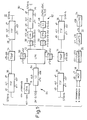
- Figure 1 illustrates the proposed functional architecture for ADX equipment 10 embodying the present invention, wherein the switching unit LPX (Lower Order Path Cross Connection) 12 acts as the central unit for switching of the transmission traffic channels to the required direction.
- LPX Lower Order Path Cross Connection
- the virtual container (VC) paths are interconnected through the cross connect of Figure 1 without needing to terminate and regenerate the path overhead of the constituent VC traffic passing through the ADX. This is important in preserving the path continuity and path monitoring from end to end as is desired in all SDH networks.
- the Time Slot Assignment Function (TSAF) 14 enables selection of appropriate channels for the SDH frame for cross connection in the LPX 12 without needing to demultiplex and terminate all the incoming traffic channels, as in the case with a conventional cross connect (DXC). More efficient use of the switch facility is made since only the paths that are cross connected between the different networks are passed through the LPX 12.
- Overhead Access Function (OHA) 16 provides access in an integrated manner to the transmission overhead functions where necessary.
- Message Communication Function (MCF) 18 receives and buffers messages from the Data Communication Channels (DCCs), Q-and F-interfaces and adx (SEME) 20.
- ADX Synchronous Equipment Management Function (adxSEMF) 20 converts performance data and implementation specific hardware alarms into object orientated messages for transmission on the DCCs and or a Q interface. It also converts object oriented messages related to other management functions for passing across the Sn reference points.
- ADX Timing Source function (adx TS) 22 provides timing reference to appropriate functional blocks as indicated in Figure 1.
- ADX Timing Physical Interface (adx TPI) 24 provides the interface between the external synchronization signal and the adx TS22 and should have the physical characteristics of one of the G.703 synchronization interfaces. The other function blocks are explained with reference to Figure 2.
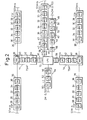
- FIG 2 illustrates the constituent functional blocks within the compound functional elements (TTF, etc.) of the ADX 10 shown in Figure 1. Definition of the individual functional blocks illustrated in Figure 2 can be found in CCITT recommendation G.782, and G.783.
- the Transport Terminal Function (TTF) 26 includes an SDH Physical Interface (SPI) 28, a Regenerator Section Termination (RST) 30, a Multiplex Section Termination (MST) 32, a Multiplex Section Protection (MSP) 34 and a Section Adaptation (SA) 36.
- SPI SDH Physical Interface
- RST Regenerator Section Termination
- MST Multiplex Section Termination
- MSP Multiplex Section Protection
- SA Section Adaptation
- the MST 32 generates a Multiplex Section Overhead (MSOH) comprising rows 5 to 9 of the SOH of the STM-N signal in the process of forming an SDH frame signal and terminates the MSOH in the reverse direction.
- the MSP 34 provides capability for switching a signal between and including two MST functions, from a 'working' to a 'protection' section.
- the SA 36 process an AU-3/4 pointer to indicate the phase of the VC-3/4 path Overhead (POH) relative to the STM-N SOH and assembles/diassembles the complete STM-N frame.
- the TSAF 14 includes a Higher order Path Connection (HPC) 38, a Higher order Path Termination (HPT) 40, Higher order Path Adaptation (HPA) 42, and Lower order Path Connection (LPC) 44.
- HPC 38 provides for flexible interconnection of higher order VCs (VC-3/4).
- the HPT 40 terminates a higher order path by generating and adding the appropriate VC POH to the relevant container at the path source and removing the VC POH and reading it at the path sink.
- the HPA 42 adapts a lower order VC (VC-1/2/3) to a higher order VC (VC-3/4) by processing the TU pointer which indicates the phase of the VC-1/2/3 POH relative to the VC-3/4 POH and assembling/disassembling the complete VC-3/4.
- the LPC 44 allows flexible interconnection of the lower order VCs (VC-1/2/3).
- the Higher order Assembler (HA) 46 includes the HPT 40 and the HPA 42.
- the Higher order Interface (HI) 48 includes a Physical Interface (PI) 50, a Lower order Path Adaptation (LPA) 52 and the HPT 40.
- the LPA 52 adapts a PDH (Plesiochronous Digital Hierarchy) signal to an SDH network by mapping/demapping the signal into/out of a synchronous container. If the signal is asynchronous, the mapping process will include bit level justification.
- the Lower order Interface (LI) 54 includes the PI 50, the LPA 52 and a Lower order Path Termination (LPT) 56.
- the LPT 56 terminates a lower order path by generating and adding the appropriate VC POH to the relevant container at the path source and removing the VC POH and reading it at the path sink.
- the Lower order Connection Supervision (LCS) 58 enables supervision of the unassigned and assigned Lower Order connections. Since it has identical information flow across it's input and outputs it may be optional or degenerate. (LCS acts as a source and sink for parts of the lower order path overhead.)
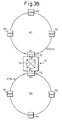
- Figures 3A and 3B illustrate a comparative example for explaining differences between the conventional Cross Connect DXC approach and the new Add/Drop Cross Connect ADX approach.
- Figure 3A illustrates a conventional method of interconnecting two ring networks 60, 62 such as optical ring networks.
- Each loop 60, 62 has connected thereto a plurality of items of communications equipment (not shown), each of which is linked to its ring by an Add/Drop Multiplexer (ADM) 64.
- ADM Add/Drop Multiplexer
- These Add/Drop Multiplexers 64 allow the items of equipment to receive (drop) data from a particular channel of the data stream carried by the ring (for example at 140 MHz) or to transmit (add) data on a particular channel.
- Figure 4 is an expansion of the concept illustrated in Figure 3. It is a simplified illustration of the comparison between the operation of the conventional DXC and the ADX for one level of the SDH hierarchy.
- ADX disappears if all the traffic channels (VC-3's) from the STM-1 lines are to be cross connected, in which case the total number of the LPX ports occupied for the ADX are the same as that of the DXC.
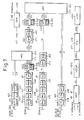
- FIG. 5 further illustrates the same principle as Figure 3.
- the STM frame 76 is processed by the TTF (Transport Terminal Function) 26 which provides access to the management information contained in the DCC (data communications channel) included in the STM frame overheads.
- the VC-3's are passed to the LPX 12 of the conventional DXC which carries out the switching function on all the input VC-3's and the output from the LPX 12 is multiplexed up to a VC-4 in the HA (Higher Order Assembler function) 46 and passed to the TTF function 26 for insertion of the appropriate path overhead and management information.
- the STM frame is processed by the TTF (transport terminal function) 26 which provides access to the management information contained in the DCC (data communications channel) included in the STM frame overheads.
- the TTF transport terminal function
- DCC data communications channel
- the appropriate (shaded) VC-3 is passed to the LPX 12 of the ADX which carries out the switching function between the two VC-3's to be cross connected between the STM-1 frames.
- the respective VC-3's that have passed through the LPX 12 are then assembled in the appropriate output STM frame by the TSAF's 14 and sent to the TTF's 26 for insertion of the appropriate overhead and management information.
- ADX equipment embodying the invention offers more (in terms of function and flexiblity) than the mere sum of its constituent functional elements combined in conventional manner. This is because, as noted above, the ADX approach leads to savings in terms of hardware requirements and in the simplification of the management and control of the transmission network traffic.
- the functional architecture of a synchronous Digital Cross Connect (DXC) shown in the CCITT recommendations and the constituent functional block within the compound functional elements are shown in Figure 6 and 7, respectively.
- DXC Digital Cross Connect
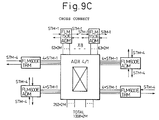
- the ADX equipment of the present invention can inplement SDH elements such as a terminal multiplexer, an add/drop multiplexer, an add/drop cross connect by utilizing these three branches and in conjunction with other line transmission equipment such as FLM 2400E, FLM 600E, and FLM 150E.
- FIG 8 illustrates some application examples of how ADX equipment embodying the invention (ADX 4/1) can be used in conjunction with Fujitsu's FLM 2400E and FLM 600E range of line transmission equipments for SDH.
- Figure 8A represents application of the ADX as a Terminal Multiplexer in which 16 ⁇ STM-1 lines from FLM 2400E TRM unit are demultiplexed down to primary rate of 2 MBit/s.
- Figure 8B represent application of the ADX as an Add/Drop Multiplexer in which 16 ⁇ STM-1 lines from FLM 2400E ADM unit are demultiplexed down to primary rate of 2 MBit/s.
- any of the 2 MBit/s channels within the main STM-16 line (Ring) can be accessed through the ADX.
- Figure 8C represents application of the ADX as an Add/Drop Cross Connect in which 8 ⁇ STM-1 lines from each of the FLM 2400E ADM units are demultiplexed down to primary rate of 2 MBit/s, and any of the 2 MBit/s channels within the 8 ⁇ STM-1 frames of the main STM-16 lines (Rings) can be accessed through the ADX.
- Figure 8D represents application of the ADX as a Cross Connect in which 8 ⁇ STM-1 lines from the FLM 2400E ADM unit are demultiplexed down to a primary rate of 2 MBit/s, and any of the 2 MBit/s channels within 8 ⁇ STM-1 frames of the main STM-16 line (Rings) can be accessed through the ADX.
- the traffic from the FLM 2400E ADM can also be interconnected to selected traffic channels from the two FLM 600E TRM and ADM units.
- FIG 9 illustrates some application examples of how ADX equipment embodying the invention (ADX 4/1) can be used in conjunction with Fujitsu's FLM 600E and FLM 150E range of line transmission equipments for SDH.
- Figure 9A represents application of the ADX as a Terminal Multiplexer in which 4 ⁇ STM-1 lines from four FLM 600E TRM units are demultiplexed down to primary rate of 2 MBit/s.
- Figure 9B represents application of the ADX as an Add/Drop Cross Connect in which 4 ⁇ STM-1 lines from FLM 2400E ADM units are demultiplexed down to primary rate of 2 MBit/s.
- any of the 2 MBit/s channels within the main STM-4 lines (Rings) can be accessed through the ADX.
- Figure 9C represents application of the ADX as a Cross Connect in which 4 ⁇ STM-1 lines from each of the FLM 600E units are demultiplexed down to primary rate of 2 MBit/s, and any of the 2 MBit/s channels within the 4 ⁇ STM-1 frames of the main STM-4 lines can be accessed through the ADX.
- the traffic from the FLM 600E units can also be cross connected to 8 STM-1 lines (rings) connected to the ADX through FLM 150E's using 2 MBit/s interfaces.
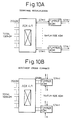
- FIG 10 illustrates some application examples of how the ADX 4/1 can be used in conjunction with Fujitsu's FLM 150E range of line transmission equipments for SDH.
- Figure 10A represents application of the ADX as a Terminal Multiplexer in which 16 ⁇ STM-1 lines from sixteen FLM 150E TRM units are demultiplexed down to primary rate of 2 MBit/s.
- Figure 10B represents application of the ADX as an Add/Drop Cross Connect in which 16 ⁇ STM-1 lines from FLM 150E ADM units are demultiplexed down to primary rate of 2 MBit/s.
- any of the 2 MBit/s channels within the main STM-1 lines (rings) can be accessed through the ADX.
- Figure 10C represents application of the ADX as a Cross Connect in which 16 ⁇ STM-1 lines from each of the FLM 150E ADMs are demultiplexed down to primary rate of 2 MBit/s, and any of the 2 MBit/s channels within the STM-1 frames of the main STM-1 lines can be accessed through the ADX.
- the traffic from the FLM 150E units can also be cross connected between 32 STM-1 lines (rings) connected to the ADX through FLM 150E's using 2 MBit/s interfaces.
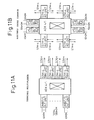
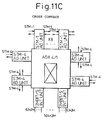
- FIG 11 illustrates some application examples of how the ADX 4/1 can be used with STM-1 AD, STM-4 TRM and STM-4 AD interface units.
- Figure 11A represents application of the ADX as a Terminal Multiplexer in which 4 ⁇ STM-1 lines are demultiplexed down to primary rate of 2 MBit/s.
- Figure 11B represents application of the ADX as an Add/Drop cross connect in which 4 ⁇ STM-4 lines are demultiplexed down to primary rate of 2 MBit/s.
- any of the 2 MBit/s channels within the main STM-4 lines (rings) can be accessed through the ADX.
- Figure 11C represents application of the ADX as a Cross Connect in which 4 ⁇ STM-4 lines are demultiplexed down to primary rate of 2 MBit/s, and any of the 2 MBit/s channels within the 4 ⁇ STM-1 frames of the main STM-4 lines can be accessed through the ADX.
- the traffic from the STM-4 lines can also be cross connected to 8 STM-1 lines (rings) connected to the ADX through the STM-1 AD interfaces.
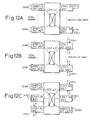
- Figure 12 illustrates some application examples of how the ADX 4/1 can be used in conjunction with Fujitsu's FLM 150E range of line transmission equipments for SDH.
- Figure 12A represents application of the ADX as a Terminal Multiplexer in which 16 ⁇ STM-1 lines from sixteen FLM 150E TRM units are demultiplexed down to primary rate of 2 MBit/s.
- Figure 12B represents application of the ADX as an Add/Drop Cross Connect in which 16 ⁇ STM-1 lines from the FLM 150E ADM units are demultiplexed down to primary rate of 2 MBit/s.
- any of the 2 MBit/s channels within the main STM-1 line (rings) can be accessed through the ADX.
- Figure 12C represents application of the ADX as a Cross Connect in which 16 ⁇ STM-1 lines from each of the FLM 150E ADMs are demultiplexed down to primary rate of 2 MBit/s, and any of the 2 MBit/s channels within the STM-1 frames of the main STM-1 lines can be accessed through the ADX.
- the traffic from the FLM 150E units can be cross connected between 32 STM-1 lines (rings) connected to the ADX through the FLM 150E's using 2 MBit/s interfaces.
- the equipment has the ability to handle the following interfaces: 1.5 MBit/s, 2 MBit/s, 34 MBit/s, 45 MBit/s interfaces as defined by CCITT recommendations. 140 MBit/s PDH Interfaces STM-1 with electrical and optical interfaces STM-4 with optical interfaces.
- FIG. 13 illustrates the application of the ADX as a gateway node for local, regional and national network traffic.
- traffic from the trunk national network is accessed via an FLM 2400E ADM.
- 8 ⁇ STM-1 channels from the main STM-16 line (ring) are demultiplexed down to STM-1 tributaries which in turn are then connected to the ADX via 8 STM-1 Tributary Terminal units.
- the STM-1 tributaries are then demultiplexed down to the primary rate and appropriate paths set up to any of the ADX Tributary units serving the regional and local networks and vice versa.
- Transmission traffic from the local network can be directed to other tributaries in the local network or to regional or national network and vice versa.
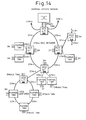
- FIG 14 shows an example for the use of ADX in interconnection of ring network traffic and also connection to other network elements.
- an ADX connects two STM-4 ring traffics to each other and to a central office switch.
- Other ADX equipments are used at different nodes as illustrated for flexible interconnection of traffic from the STM-1 local loop, and other network elements as illustrated.
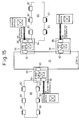
- FIG. 15 illustrates the application of ADX for connection of three ring networks to central office switching equipments and to each other using STM-1 and STM-4 Add/Drop interfaces.
- the reference numeral 80 denotes the FLM 150E Add/Drop Multiplexer
- the reference numeral 82 denotes an STM-4 Add/Drop Optical unit
- the reference numeral 84 denotes an STM-1 Add/Drop Optical unit
- the reference numeral 86 denotes a 2 MBit/s G.703 Interface unit.
- the traffic collected by loop 88 and loop 90 can be connected to the central switching equipment at any of the nodes 92, 94, or 96. It can also be connected to any other node as a leased line circuit.
Landscapes
- Engineering & Computer Science (AREA)
- Computer Networks & Wireless Communication (AREA)
- Signal Processing (AREA)
- Time-Division Multiplex Systems (AREA)
- Small-Scale Networks (AREA)
Applications Claiming Priority (3)
| Application Number | Priority Date | Filing Date | Title |
|---|---|---|---|
| GB9127116 | 1991-12-20 | ||
| GB919127116A GB9127116D0 (en) | 1991-12-20 | 1991-12-20 | Interconnecting communications networks |
| PCT/JP1992/001673 WO1993013615A1 (fr) | 1991-12-20 | 1992-12-21 | Interconnexion d'un reseau de transmission |
Publications (3)
| Publication Number | Publication Date |
|---|---|
| EP0615367A1 true EP0615367A1 (de) | 1994-09-14 |
| EP0615367A4 EP0615367A4 (de) | 1995-01-25 |
| EP0615367B1 EP0615367B1 (de) | 1998-03-11 |
Family
ID=10706632
Family Applications (1)
| Application Number | Title | Priority Date | Filing Date |
|---|---|---|---|
| EP93900372A Expired - Lifetime EP0615367B1 (de) | 1991-12-20 | 1992-12-21 | Querverbindung eines kommunikationsnetzes |
Country Status (7)
| Country | Link |
|---|---|
| US (1) | US5416768A (de) |
| EP (1) | EP0615367B1 (de) |
| JP (1) | JP3144804B2 (de) |
| CA (1) | CA2104455C (de) |
| DE (1) | DE69224751T2 (de) |
| GB (1) | GB9127116D0 (de) |
| WO (1) | WO1993013615A1 (de) |
Cited By (1)
| Publication number | Priority date | Publication date | Assignee | Title |
|---|---|---|---|---|
| US5754545A (en) * | 1995-02-23 | 1998-05-19 | Fujitsu Limited | Add-drop multiplexer with enhancement of accessibility to signals in different hierarchical levels and flexibility in various services and circuit setting operations |
Families Citing this family (23)
| Publication number | Priority date | Publication date | Assignee | Title |
|---|---|---|---|---|
| JP2541107B2 (ja) * | 1993-06-30 | 1996-10-09 | 日本電気株式会社 | クロスコネクト用インタフェ―スおよび装置 |
| US5583855A (en) * | 1993-11-10 | 1996-12-10 | Fujitsu Limited | Add/drop multiplexer apparatus |
| IT1265424B1 (it) * | 1993-12-22 | 1996-11-22 | Alcatel Italia | Metodo e disposizione ciruitale di realizzazione della funzione di hpa negli apparati sdh |
| US5742605A (en) * | 1994-02-28 | 1998-04-21 | Sprint Communications Co., L.P. | Synchronous optical network using a ring architecture |
| DK133395A (da) * | 1995-11-24 | 1997-05-25 | Dsc Communications As | Datatransmissionssystem til transmission af et stort antal telefonkanaler og fremgangsmåde i forbindelse hermed |
| US5754549A (en) * | 1995-12-05 | 1998-05-19 | International Business Machines Corporation | Inexpensive two-way communications switch |
| US5920412A (en) * | 1996-04-24 | 1999-07-06 | Bellsouth Corporation | Method and apparatus for signal routing in an optical network and an ATM system |
| US5864608A (en) * | 1996-06-26 | 1999-01-26 | Mci Communications Corporation | System and method for formatting performance data in a telecommunications system |
| US7301953B1 (en) * | 1996-10-22 | 2007-11-27 | Sprint Communications Company L.P. | Method and system for transporting a secondary communication signal with a primary communication signal |
| US7643500B1 (en) | 1996-10-22 | 2010-01-05 | Sprint Communications Company L.P. | Overhead replication for SONET signals |
| JP3366214B2 (ja) * | 1997-02-26 | 2003-01-14 | 富士通株式会社 | 多重化伝送装置 |
| IT1291744B1 (it) * | 1997-05-16 | 1999-01-21 | Alsthom Cge Alcatel | Miglioramenti ad una rete di telecomunicazioni a fibre ottiche a gerarchia sincrona sdh dotata di sistema di protezione condiviso |
| US5959986A (en) * | 1997-09-30 | 1999-09-28 | Alcatel Network Systems, Inc. | Lightwave transmission telecommunications system employing a stacked matrix architecture |
| US6128321A (en) * | 1997-12-19 | 2000-10-03 | Alcatel Usa Sourcing, L.P. | System and method for centrally-managing switching functions |
| JPH11266220A (ja) * | 1998-03-18 | 1999-09-28 | Fujitsu Ltd | Sdh方式の伝送装置 |
| IT1314145B1 (it) * | 1999-12-21 | 2002-12-04 | Cit Alcatel | Metodo e dispositivo per convertire un segnale stm-1 in un segnale sub-stm-1 e vice-versa in trasmissioni radio |
| US6433903B1 (en) | 1999-12-29 | 2002-08-13 | Sycamore Networks, Inc. | Optical management channel for wavelength division multiplexed systems |
| JP2002084249A (ja) * | 2000-09-08 | 2002-03-22 | Fujitsu Ltd | 集中管理装置 |
| DE10065929A1 (de) * | 2000-12-27 | 2002-07-04 | Abb Power Automation Ag Baden | Datenübertragungseinheit zur Erstellung einer digitalen Cross-Connect-Verbindung |
| KR100557138B1 (ko) * | 2003-07-16 | 2006-03-03 | 삼성전자주식회사 | 광 가입자망에서의 영상 데이터 처리 장치 |
| JP4421974B2 (ja) * | 2004-08-19 | 2010-02-24 | 日本電気株式会社 | ディジタル変復調装置 |
| ES2317752B1 (es) * | 2006-08-01 | 2010-01-08 | Miguel Angel Lopez Maqueda | Repartidor digital gestionable para tramas de 2 mbit/s. |
| RU2530298C1 (ru) * | 2010-08-10 | 2014-10-10 | Хуавэй Текнолоджиз Ко., Лтд. | Способ, система и устройство передачи сигналов синхронной цифровой иерархии по микроволне |
Family Cites Families (10)
| Publication number | Priority date | Publication date | Assignee | Title |
|---|---|---|---|---|
| JPS62226744A (ja) * | 1986-03-28 | 1987-10-05 | Hitachi Ltd | ル−プネツトワ−クシステムの伝送装置 |
| JPS6478548A (en) * | 1987-09-19 | 1989-03-24 | Matsushita Electric Industrial Co Ltd | Video signal transmission system |
| JPH022745A (ja) * | 1988-06-16 | 1990-01-08 | Hitachi Ltd | Lan間情報転送制御方法 |
| US4967405A (en) * | 1988-12-09 | 1990-10-30 | Transwitch Corporation | System for cross-connecting high speed digital SONET signals |
| US5185736A (en) * | 1989-05-12 | 1993-02-09 | Alcatel Na Network Systems Corp. | Synchronous optical transmission system |
| EP0425146B1 (de) * | 1989-10-23 | 1996-03-13 | AT&T Corp. | Anordnung für die Steuerung eines digitalen Verzweigerschalters von einem Vermittlungssystem aus |
| GB9005723D0 (en) * | 1990-03-14 | 1990-05-09 | Plessey Telecomm | Switch for multiplexes |
| US5311501A (en) * | 1991-03-15 | 1994-05-10 | Fujitsu Limited | Routing system for linear add-drop multiplexer |
| US5189673A (en) * | 1991-07-30 | 1993-02-23 | Alcatel Network Systems, Inc. | Method and apparatus for controlling switched video in an optical fiber telecommunications system |
| US5216666A (en) * | 1991-12-12 | 1993-06-01 | Alcatel Network Systems, Inc. | 1:n ring-type signal protection apparatus |
-
1991
- 1991-12-20 GB GB919127116A patent/GB9127116D0/en active Pending
-
1992
- 1992-12-21 WO PCT/JP1992/001673 patent/WO1993013615A1/ja not_active Ceased
- 1992-12-21 US US08/107,683 patent/US5416768A/en not_active Expired - Fee Related
- 1992-12-21 DE DE69224751T patent/DE69224751T2/de not_active Expired - Fee Related
- 1992-12-21 JP JP50880793A patent/JP3144804B2/ja not_active Expired - Fee Related
- 1992-12-21 CA CA002104455A patent/CA2104455C/en not_active Expired - Fee Related
- 1992-12-21 EP EP93900372A patent/EP0615367B1/de not_active Expired - Lifetime
Cited By (2)
| Publication number | Priority date | Publication date | Assignee | Title |
|---|---|---|---|---|
| US5754545A (en) * | 1995-02-23 | 1998-05-19 | Fujitsu Limited | Add-drop multiplexer with enhancement of accessibility to signals in different hierarchical levels and flexibility in various services and circuit setting operations |
| GB2298767B (en) * | 1995-02-23 | 2000-02-23 | Fujitsu Ltd | Add-drop multiplexers |
Also Published As
| Publication number | Publication date |
|---|---|
| WO1993013615A1 (fr) | 1993-07-08 |
| DE69224751D1 (de) | 1998-04-16 |
| DE69224751T2 (de) | 1998-07-09 |
| GB9127116D0 (en) | 1992-02-19 |
| JP3144804B2 (ja) | 2001-03-12 |
| CA2104455A1 (en) | 1993-06-21 |
| EP0615367A4 (de) | 1995-01-25 |
| EP0615367B1 (de) | 1998-03-11 |
| CA2104455C (en) | 2002-09-17 |
| US5416768A (en) | 1995-05-16 |
Similar Documents
| Publication | Publication Date | Title |
|---|---|---|
| US5416768A (en) | Interconnecting communications networks | |
| EP1183835B1 (de) | Architektur für einen hybriden stm/atm add-drop-multiplexer | |
| US5850387A (en) | Processor device for terminating and creating synchronous transport signals | |
| EP0559090B1 (de) | Netzwerkelement mit Querverbindungsmatrix und Server | |
| CA2490792C (en) | Transparent flexible concatenation | |
| JPWO1993013615A1 (ja) | 通信ネットワークの相互接続 | |
| US5465252A (en) | Method for receiving and delivering section overheads of and for STM-1 signals in a section-overhead server of a network node | |
| US6671271B1 (en) | Sonet synchronous payload envelope pointer control system | |
| US5799001A (en) | Composite network protective/recovering device for synchronous digital hierarchy DXC | |
| EP0788696B1 (de) | Verfahren zur bildung einer netzschnittstelle und netzschnittstelle für ein digitales übertragungsnetz | |
| US6891836B1 (en) | Switching complex architecture and operation | |
| US7023848B2 (en) | Rearrangement of data streams | |
| US20010053146A1 (en) | Processor device for terminating and creating synchronous transport signals | |
| Ferguson | Implications of SONET and SDH | |
| EP0957603B1 (de) | Integrierte Leitungssyteme und Cross Connect | |
| JP2677198B2 (ja) | 無線通信方式 | |
| EP0638223A1 (de) | Verfahren und querverbindungsarchitektur für eine fehlerfreie umschaltung einerquerverbindungskoppelmatrix | |
| Hwu et al. | International gateway for SDH and SONET interconnection | |
| Lee et al. | Implementation of Broadband Digital Cross-Connect System for SDH Transport Network | |
| JP2001501423A (ja) | トランスポートループ―およびカード保護を有するリング回路 | |
| Matthews | The Synchronous Digital Hierarchy (SDH) | |
| HK1002304B (en) | Network interfacing method and a network interface for a digital transmission network |
Legal Events
| Date | Code | Title | Description |
|---|---|---|---|
| PUAI | Public reference made under article 153(3) epc to a published international application that has entered the european phase |
Free format text: ORIGINAL CODE: 0009012 |
|
| 17P | Request for examination filed |
Effective date: 19930914 |
|
| AK | Designated contracting states |
Kind code of ref document: A1 Designated state(s): DE FR GB |
|
| A4 | Supplementary search report drawn up and despatched | ||
| AK | Designated contracting states |
Kind code of ref document: A4 Designated state(s): DE FR GB |
|
| 17Q | First examination report despatched |
Effective date: 19960729 |
|
| GRAG | Despatch of communication of intention to grant |
Free format text: ORIGINAL CODE: EPIDOS AGRA |
|
| GRAG | Despatch of communication of intention to grant |
Free format text: ORIGINAL CODE: EPIDOS AGRA |
|
| GRAH | Despatch of communication of intention to grant a patent |
Free format text: ORIGINAL CODE: EPIDOS IGRA |
|
| GRAH | Despatch of communication of intention to grant a patent |
Free format text: ORIGINAL CODE: EPIDOS IGRA |
|
| GRAA | (expected) grant |
Free format text: ORIGINAL CODE: 0009210 |
|
| AK | Designated contracting states |
Kind code of ref document: B1 Designated state(s): DE FR GB |
|
| REF | Corresponds to: |
Ref document number: 69224751 Country of ref document: DE Date of ref document: 19980416 |
|
| ET | Fr: translation filed | ||
| PLBE | No opposition filed within time limit |
Free format text: ORIGINAL CODE: 0009261 |
|
| STAA | Information on the status of an ep patent application or granted ep patent |
Free format text: STATUS: NO OPPOSITION FILED WITHIN TIME LIMIT |
|
| 26N | No opposition filed | ||
| REG | Reference to a national code |
Ref country code: GB Ref legal event code: IF02 |
|
| PGFP | Annual fee paid to national office [announced via postgrant information from national office to epo] |
Ref country code: FR Payment date: 20051208 Year of fee payment: 14 |
|
| PGFP | Annual fee paid to national office [announced via postgrant information from national office to epo] |
Ref country code: DE Payment date: 20051215 Year of fee payment: 14 |
|
| PGFP | Annual fee paid to national office [announced via postgrant information from national office to epo] |
Ref country code: GB Payment date: 20051221 Year of fee payment: 14 |
|
| PG25 | Lapsed in a contracting state [announced via postgrant information from national office to epo] |
Ref country code: DE Free format text: LAPSE BECAUSE OF NON-PAYMENT OF DUE FEES Effective date: 20070703 |
|
| GBPC | Gb: european patent ceased through non-payment of renewal fee |
Effective date: 20061221 |
|
| REG | Reference to a national code |
Ref country code: FR Ref legal event code: ST Effective date: 20070831 |
|
| PG25 | Lapsed in a contracting state [announced via postgrant information from national office to epo] |
Ref country code: GB Free format text: LAPSE BECAUSE OF NON-PAYMENT OF DUE FEES Effective date: 20061221 |
|
| PG25 | Lapsed in a contracting state [announced via postgrant information from national office to epo] |
Ref country code: FR Free format text: LAPSE BECAUSE OF NON-PAYMENT OF DUE FEES Effective date: 20070102 |