EP0617093A2 - Verfahren zur Herstellung eines kunstharzdispersionsvergüteten silikatgebundenen Beschichtungssystems - Google Patents
Verfahren zur Herstellung eines kunstharzdispersionsvergüteten silikatgebundenen Beschichtungssystems Download PDFInfo
- Publication number
- EP0617093A2 EP0617093A2 EP94104739A EP94104739A EP0617093A2 EP 0617093 A2 EP0617093 A2 EP 0617093A2 EP 94104739 A EP94104739 A EP 94104739A EP 94104739 A EP94104739 A EP 94104739A EP 0617093 A2 EP0617093 A2 EP 0617093A2
- Authority
- EP
- European Patent Office
- Prior art keywords
- dispersion
- synthetic resin
- stirring
- silicate
- process according
- Prior art date
- Legal status (The legal status is an assumption and is not a legal conclusion. Google has not performed a legal analysis and makes no representation as to the accuracy of the status listed.)
- Granted
Links
- 239000006185 dispersion Substances 0.000 title claims abstract description 29
- 229920003002 synthetic resin Polymers 0.000 title claims abstract description 14
- 239000000057 synthetic resin Substances 0.000 title claims abstract description 14
- 238000000034 method Methods 0.000 title claims abstract description 12
- 239000011248 coating agent Substances 0.000 title claims abstract description 9
- 238000000576 coating method Methods 0.000 title claims abstract description 9
- 235000019353 potassium silicate Nutrition 0.000 claims abstract description 21
- 239000000203 mixture Substances 0.000 claims abstract description 12
- 239000003973 paint Substances 0.000 claims abstract description 9
- 238000003756 stirring Methods 0.000 claims abstract description 9
- ZLMJMSJWJFRBEC-UHFFFAOYSA-N Potassium Chemical compound [K] ZLMJMSJWJFRBEC-UHFFFAOYSA-N 0.000 claims abstract description 8
- 229910052700 potassium Inorganic materials 0.000 claims abstract description 8
- 239000011591 potassium Substances 0.000 claims abstract description 8
- BPQQTUXANYXVAA-UHFFFAOYSA-N Orthosilicate Chemical compound [O-][Si]([O-])([O-])[O-] BPQQTUXANYXVAA-UHFFFAOYSA-N 0.000 claims abstract description 7
- 238000004519 manufacturing process Methods 0.000 claims abstract description 7
- 239000000945 filler Substances 0.000 claims abstract description 4
- 239000000178 monomer Substances 0.000 claims abstract description 3
- 230000000379 polymerizing effect Effects 0.000 claims abstract description 3
- 239000013615 primer Substances 0.000 claims abstract description 3
- 239000002987 primer (paints) Substances 0.000 claims abstract description 3
- NTHWMYGWWRZVTN-UHFFFAOYSA-N sodium silicate Chemical compound [Na+].[Na+].[O-][Si]([O-])=O NTHWMYGWWRZVTN-UHFFFAOYSA-N 0.000 claims description 8
- VYPSYNLAJGMNEJ-UHFFFAOYSA-N Silicium dioxide Chemical compound O=[Si]=O VYPSYNLAJGMNEJ-UHFFFAOYSA-N 0.000 claims description 4
- PPBRXRYQALVLMV-UHFFFAOYSA-N Styrene Chemical compound C=CC1=CC=CC=C1 PPBRXRYQALVLMV-UHFFFAOYSA-N 0.000 claims description 4
- 238000010438 heat treatment Methods 0.000 claims description 4
- 238000002360 preparation method Methods 0.000 claims description 3
- NIXOWILDQLNWCW-UHFFFAOYSA-M Acrylate Chemical compound [O-]C(=O)C=C NIXOWILDQLNWCW-UHFFFAOYSA-M 0.000 claims description 2
- 229910052681 coesite Inorganic materials 0.000 claims description 2
- 229910052906 cristobalite Inorganic materials 0.000 claims description 2
- 239000000377 silicon dioxide Substances 0.000 claims description 2
- 235000012239 silicon dioxide Nutrition 0.000 claims description 2
- 229910052682 stishovite Inorganic materials 0.000 claims description 2
- 229910052905 tridymite Inorganic materials 0.000 claims description 2
- NIXOWILDQLNWCW-UHFFFAOYSA-N acrylic acid group Chemical group C(C=C)(=O)O NIXOWILDQLNWCW-UHFFFAOYSA-N 0.000 claims 1
- 229920000642 polymer Polymers 0.000 claims 1
- RLQWHDODQVOVKU-UHFFFAOYSA-N tetrapotassium;silicate Chemical compound [K+].[K+].[K+].[K+].[O-][Si]([O-])([O-])[O-] RLQWHDODQVOVKU-UHFFFAOYSA-N 0.000 claims 1
- 238000003860 storage Methods 0.000 abstract description 6
- 239000004925 Acrylic resin Substances 0.000 abstract 1
- 229920000178 Acrylic resin Polymers 0.000 abstract 1
- 239000004111 Potassium silicate Substances 0.000 abstract 1
- 239000011521 glass Substances 0.000 abstract 1
- 229920003217 poly(methylsilsesquioxane) Polymers 0.000 abstract 1
- NNHHDJVEYQHLHG-UHFFFAOYSA-N potassium silicate Chemical compound [K+].[K+].[O-][Si]([O-])=O NNHHDJVEYQHLHG-UHFFFAOYSA-N 0.000 abstract 1
- 229910052913 potassium silicate Inorganic materials 0.000 abstract 1
- KWYUFKZDYYNOTN-UHFFFAOYSA-M Potassium hydroxide Chemical compound [OH-].[K+] KWYUFKZDYYNOTN-UHFFFAOYSA-M 0.000 description 5
- 229940072033 potash Drugs 0.000 description 5
- BWHMMNNQKKPAPP-UHFFFAOYSA-L potassium carbonate Substances [K+].[K+].[O-]C([O-])=O BWHMMNNQKKPAPP-UHFFFAOYSA-L 0.000 description 5
- 235000015320 potassium carbonate Nutrition 0.000 description 5
- 238000005299 abrasion Methods 0.000 description 4
- 238000001816 cooling Methods 0.000 description 2
- 230000007423 decrease Effects 0.000 description 2
- 239000000463 material Substances 0.000 description 2
- 229920005789 ACRONAL® acrylic binder Polymers 0.000 description 1
- 229920006243 acrylic copolymer Polymers 0.000 description 1
- 239000000654 additive Substances 0.000 description 1
- 239000003513 alkali Substances 0.000 description 1
- 238000010586 diagram Methods 0.000 description 1
- 239000003792 electrolyte Substances 0.000 description 1
- 230000002349 favourable effect Effects 0.000 description 1
- 238000009472 formulation Methods 0.000 description 1
- 239000000049 pigment Substances 0.000 description 1
- 238000007127 saponification reaction Methods 0.000 description 1
- 239000003381 stabilizer Substances 0.000 description 1
Images

Classifications
-
- C—CHEMISTRY; METALLURGY
- C09—DYES; PAINTS; POLISHES; NATURAL RESINS; ADHESIVES; COMPOSITIONS NOT OTHERWISE PROVIDED FOR; APPLICATIONS OF MATERIALS NOT OTHERWISE PROVIDED FOR
- C09D—COATING COMPOSITIONS, e.g. PAINTS, VARNISHES OR LACQUERS; FILLING PASTES; CHEMICAL PAINT OR INK REMOVERS; INKS; CORRECTING FLUIDS; WOODSTAINS; PASTES OR SOLIDS FOR COLOURING OR PRINTING; USE OF MATERIALS THEREFOR
- C09D5/00—Coating compositions, e.g. paints, varnishes or lacquers, characterised by their physical nature or the effects produced; Filling pastes
- C09D5/34—Filling pastes
-
- C—CHEMISTRY; METALLURGY
- C04—CEMENTS; CONCRETE; ARTIFICIAL STONE; CERAMICS; REFRACTORIES
- C04B—LIME, MAGNESIA; SLAG; CEMENTS; COMPOSITIONS THEREOF, e.g. MORTARS, CONCRETE OR LIKE BUILDING MATERIALS; ARTIFICIAL STONE; CERAMICS; REFRACTORIES; TREATMENT OF NATURAL STONE
- C04B28/00—Compositions of mortars, concrete or artificial stone, containing inorganic binders or the reaction product of an inorganic and an organic binder, e.g. polycarboxylate cements
- C04B28/24—Compositions of mortars, concrete or artificial stone, containing inorganic binders or the reaction product of an inorganic and an organic binder, e.g. polycarboxylate cements containing alkyl, ammonium or metal silicates; containing silica sols
- C04B28/26—Silicates of the alkali metals
-
- C—CHEMISTRY; METALLURGY
- C09—DYES; PAINTS; POLISHES; NATURAL RESINS; ADHESIVES; COMPOSITIONS NOT OTHERWISE PROVIDED FOR; APPLICATIONS OF MATERIALS NOT OTHERWISE PROVIDED FOR
- C09D—COATING COMPOSITIONS, e.g. PAINTS, VARNISHES OR LACQUERS; FILLING PASTES; CHEMICAL PAINT OR INK REMOVERS; INKS; CORRECTING FLUIDS; WOODSTAINS; PASTES OR SOLIDS FOR COLOURING OR PRINTING; USE OF MATERIALS THEREFOR
- C09D1/00—Coating compositions, e.g. paints, varnishes or lacquers, based on inorganic substances
- C09D1/02—Coating compositions, e.g. paints, varnishes or lacquers, based on inorganic substances alkali metal silicates
- C09D1/04—Coating compositions, e.g. paints, varnishes or lacquers, based on inorganic substances alkali metal silicates with organic additives
-
- C—CHEMISTRY; METALLURGY
- C09—DYES; PAINTS; POLISHES; NATURAL RESINS; ADHESIVES; COMPOSITIONS NOT OTHERWISE PROVIDED FOR; APPLICATIONS OF MATERIALS NOT OTHERWISE PROVIDED FOR
- C09D—COATING COMPOSITIONS, e.g. PAINTS, VARNISHES OR LACQUERS; FILLING PASTES; CHEMICAL PAINT OR INK REMOVERS; INKS; CORRECTING FLUIDS; WOODSTAINS; PASTES OR SOLIDS FOR COLOURING OR PRINTING; USE OF MATERIALS THEREFOR
- C09D125/00—Coating compositions based on homopolymers or copolymers of compounds having one or more unsaturated aliphatic radicals, each having only one carbon-to-carbon double bond, and at least one being terminated by an aromatic carbocyclic ring; Coating compositions based on derivatives of such polymers
- C09D125/02—Homopolymers or copolymers of hydrocarbons
- C09D125/04—Homopolymers or copolymers of styrene
- C09D125/08—Copolymers of styrene
- C09D125/14—Copolymers of styrene with unsaturated esters
-
- C—CHEMISTRY; METALLURGY
- C04—CEMENTS; CONCRETE; ARTIFICIAL STONE; CERAMICS; REFRACTORIES
- C04B—LIME, MAGNESIA; SLAG; CEMENTS; COMPOSITIONS THEREOF, e.g. MORTARS, CONCRETE OR LIKE BUILDING MATERIALS; ARTIFICIAL STONE; CERAMICS; REFRACTORIES; TREATMENT OF NATURAL STONE
- C04B2111/00—Mortars, concrete or artificial stone or mixtures to prepare them, characterised by specific function, property or use
- C04B2111/00474—Uses not provided for elsewhere in C04B2111/00
- C04B2111/00482—Coating or impregnation materials
-
- C—CHEMISTRY; METALLURGY
- C08—ORGANIC MACROMOLECULAR COMPOUNDS; THEIR PREPARATION OR CHEMICAL WORKING-UP; COMPOSITIONS BASED THEREON
- C08L—COMPOSITIONS OF MACROMOLECULAR COMPOUNDS
- C08L83/00—Compositions of macromolecular compounds obtained by reactions forming in the main chain of the macromolecule a linkage containing silicon with or without sulfur, nitrogen, oxygen or carbon only; Compositions of derivatives of such polymers
- C08L83/02—Polysilicates
Definitions
- the invention relates to a method for producing a synthetic resin dispersion-coated silicate-bound coating system in the form of paints, fillers, primers, wall coverings and plasters.
- the coating of these systems with synthetic resin dispersions serves in a known manner to stabilize the systems and to improve moisture protection, adhesion, resistance to chalking and processing.
- the strongly alkaline and electrolyte-containing potash water glass places high demands on the pigments, fillers and additives and, above all, on the dispersions.
- potassium water glasses and synthetic resin dispersions which are mixed with one another at room temperature are not stable. They coagulate and flocculate. The mixtures are therefore no longer usable. Potash water glasses and synthetic resin dispersions must therefore be provided separately and mixed in gently before use during preparation or during the production of the coating materials.
- the coating materials tend to increase viscosity after manufacture, i.e. to thicken.
- dispersion-silicate-based paints lose abrasion cycles when they are stored in the container when checking the wash resistance according to DIN 53778.
- Another disadvantage is that mixtures of potassium water glasses and synthetic resin dispersions cannot be stored in a silo. Since the components must be stored separately, they tie up tank capacities.
- a particularly efficient process sequence results if, after the preparation of a dispersion by polymerizing the monomers at a temperature of 80 ° C., the subsequent cooling of the dispersion is carried out by admixing cold potassium water glasses, preferably with stirring. In this case, it is not necessary to mix the components beforehand before they are heated to the favorable temperature of approx. 50 ° C. Rather, the heat treatment takes place in the course of the dispersion production by subsequent addition of the cold potash water glasses.
Landscapes
- Chemical & Material Sciences (AREA)
- Engineering & Computer Science (AREA)
- Organic Chemistry (AREA)
- Materials Engineering (AREA)
- Wood Science & Technology (AREA)
- Life Sciences & Earth Sciences (AREA)
- Ceramic Engineering (AREA)
- Inorganic Chemistry (AREA)
- Structural Engineering (AREA)
- Chemical Kinetics & Catalysis (AREA)
- Paints Or Removers (AREA)
- Processes Of Treating Macromolecular Substances (AREA)
- Curing Cements, Concrete, And Artificial Stone (AREA)
- Pigments, Carbon Blacks, Or Wood Stains (AREA)
- Silicon Polymers (AREA)
- Application Of Or Painting With Fluid Materials (AREA)
Abstract
Description
- Die Erfindung bezieht sich auf ein Verfahren zur Herstellung eines kunstharzdispersions-vergüteten silikatgebundenen Beschichtungssystems in Form von Anstrichstoffen, Spachtelmassen, Grundierungen, Wandbelägen und Putzen. Die Vergütung dieser Systeme mit Kunstharzdispersionen dient in bekannter Weise zur Stabilisierung der Systeme und zur Verbesserung des Feuchtigkeitsschutzes, der Haftung, der Kreidungsresistenz und der Verarbeitung. Dabei stellt das stark alkalische und elektrolythaltige Kaliwasserglas an die Pigmente, die Füllstoffe bzw. die Additive und vor allem an die Dispersionen hohe Anforderungen. Um lagerstabile, koagulatfreie Formulierungen zu erhalten, bedarf es des Einsatzes von alkali-, verseifungs- und wasserglasbeständigen Dispersionen.
- Es hat sich nun gezeigt, daß Kaliwassergläser und Kunstharzdispersionen, die bei Raumtemperatur miteinander vermischt werden, nicht stabil sind. Sie koagulieren und flocken aus. Die Mischungen sind folglich nicht mehr brauchbar. Kaliwassergläser und Kunstharzdispersionen müssen deshalb getrennt bereitgestellt und vor Gebrauch während des Ansetzens bzw. bei Herstellung der Beschichtungsmaterialien schonend zugemischt werden.
- Die Beschichtungsmaterialien neigen trotz des Zusatzes von Stabilisatoren nach der Herstellung zum Viskositätsanstieg, d.h. zum Eindicken. Ferner verlieren Anstrichstoffe auf Dispersions-Silikatbasis bei der Lagerung im Gebinde an Scheuerzyklen bei der Überprüfung der Waschbeständigkeit nach DIN 53778. Von Nachteil ist ferner, daß Mischungen aus Kaliwassergläsern und Kunstharzdispersionen nicht in einem Silo lagerfähig sind. Da die Komponenten getrennt gelagert werden müssen, binden sie somit Tankkapazitäten.
- Es hat sich nun gezeigt, daß Dispersionen und Kaliwassergläser in jedem Verhältnis mischbar und lagerstabil sowie ohne Koagulatrückstände miteinander verträglich sind, wenn die Mischung aus Kaliwasserglas und Acrylatmischpolymerisat auf Kunstharzdispersionsbasis vorübergehend unter Rühren auf ca. 50°C erwärmt wird. Bei Einsatz eines derartigen Beschichtungssystems hat sich die erreichte Viskositätsstabilität und die Tatsache als vorteilhaft herausgestellt, daß sie nur wenig nachdicken. Bei Systemen in Form von Anstrichstoffen haben sich höhere Scheuerzyklen nach DIN 53778 auch nach längerer Lagerung im Gebinde als positiv erwiesen. Vorteilhafterweise entstehen bei vorübergehendem Erwärmen koagulierter Mischungen unter Rühren auf ca. 50°C Mischungen ohne Rückstände. Nach Abkühlung sind die Mischungen lagerstabil und können zur Herstellung der eingangs erwähnten silikatgebundenen Beschichtungssysteme eingesetzt werden.
Als besonders vorteilhaft hat es sich erwiesen, wenn die Erwärmung unter Rühren während ca. 15 Minuten erfolgt. - Ein besonders rationeller Verfahrensablauf ergibt sich, wenn nach Herstellung einer Dispersion durch Polymerisation der Monomeren bei einer Temperatur von 80°C das anschließende Abkühlen der Dispersion durch Zumischen von kalten Kaliwassergläsern, vorzugsweise unter Rühren erfolgt. In diesem Fall bedarf es somit nicht einer vorherigen Mischung der Bestandteile, ehe sie auf die günstige Temperatur von ca. 50°C erwärmt wird. Die Wärmebehandlung findet vielmehr im Zuge der Dispersionsherstellung durch anschließendes Zumischen der kalten Kaliwassergläser statt.
- Als besonders zweckmäßig hat es sich herausgestellt, wenn als Kunstharzdispersion handelsübliche Styrol-/Acrylatdispersionen mit einer Mindestfilmbildetemperatur von 10 bis 25°C verwendet werden, beispielsweise Acronal R 290 D der Firma BASF.
- Vorteilhafterweise gelangen als Wassergläser Kaliwassergläser mit Gewichtsmodulen SiO₂ : K₂O von von 2,0 bis 3,5 : 1 (Tri-/Tetrasilikate), beispielsweise Betolin R K 28 bzw. Betolin R P 35 der Firma Woellner oder Trasol R KCK der Firma Henkel zur Anwendung.
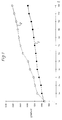
- Anhand der beigefügten Diagramme sind die Vorteile des Verfahrens nach der Erfindung verdeutlicht, und zwar zeigen
- Fig. 1
- Die Abhängigkeit der Viskosität in mPas von der Lagerdauer t in w (Wochen) sowie
- Fig. 2
- die Abhängigkeit der Scheuerzyklen n von der Lagerdauer t in w (Wochen).
- Wie Fig. 1 zeigt, nimmt bei Raumtemperatur die Visosität in mPas bei mit wärmebehandelter Wasserglas-Dispersionsmischung hergestellter Dispersionsfarbe - Kurve 1 - bei Raumtemperatur im Verlauf eines längeren Zeitraums - 12 Wochen - nur relativ geringfügig zu. Sie steigt jedoch bei mit nicht wärmebehandelter Wasserglas-Dispersionsmischung hergestellter Innensilikatfarbe - Kurve 2 - während des gleichen Zeitraums ganz erheblich stärker an.
- Aus Fig. 2 ist das Ergebnis der Überprüfung der Waschbeständigkeit nach DIN 53778 bei Lagerung der Farbe im Gebinde bis 12 Wochen ersichtlich. Wie aus dieser Figur hervorgeht, nimmt die Zahl der Scheuerzyklen bei mit wärmebehandelter Wasserglas-Dispersionsmischung hergestellter Innensilikatfarbe - jeweils durch die linken Säulen 3 veranschaulicht - über einen Zeitraum von 12 Wochen nur geringfügig ab. Bei mit nicht wärmebehandelter Wasserglas-Dispersionsmischung hergestellter Innensilikatfarbe - veranschaulicht durch die jeweils rechten Säulen 4 - ganz erheblich ab.
Claims (8)
- Verfahren zur Herstellung eines kunstharzdispersions-vergüteten silikatgebundenen Beschichtungssystems in Form von Anstrichstoffen, Spachtelmassen, Grundierungen, Wandbelägen und Putzen, dadurch gekennzeichnet, daß die Mischung aus Kaliwasserglas und Acrylatmischpolymerisat auf Kunstharzdispersionsbasis vorübergehend unter Rühren auf ca. 50°C erwärmt wird.
- Verfahren nach Anspruch 1, dadurch gekennzeichnet, daß die Erwärmung unter Rühren während ca. 15 Minuten erfolgt.
- Verfahren nach einem der Ansprüche 1 oder 2, dadurch gekennzeichnet, daß nach Herstellung einer Dispersion durch Polymerisation der Monomeren bei einer Temperatur von ca. 80°C die Dispersion durch Zumischen von kalten Kaliwassergläsern abgekühlt wird.
- Verfahren nach Anspruch 3, dadurch gekennzeichnet, daß das Zumischen von kalten Kaliwassergläsern unter Rühren erfolgt.
- Verfahren nach einem der Ansprüche 1 bis 4, dadurch gekennzeichnet, daß als Kunstharzdispersionen handelsübliche Styrol-/Acrylatdispersionen mit einer Filmbildungstemperatur von 10 bis 25°C zur Anwendung kommen.
- Verfahren nach einem der Ansprüche 1 bis 4, dadurch gekennzeichnet, daß als Wasserglas Kaliwassergläser mit Gewichtsmodulen SiO₂ : K₂O von 2,0 bis 3,5 : 1 (Tri-/Tetrasilikate eingesetzt werden.
- Verfahren nach Anspruch 5, dadurch gekennzeichnet, daß als Kunstharzdispersion Aronal R 290 D der Firma BASF verwendet wird.
- Verfahren nach Anspruch 6, dadurch gekennzeichnet, daß als Wasserglas Betolin R K 28 bzw. Betolin R P 35 der Firma Woellner oder Trasol R KCK der Firma Henkel eingesetzt wird.
Applications Claiming Priority (2)
| Application Number | Priority Date | Filing Date | Title |
|---|---|---|---|
| DE4309625A DE4309625C1 (de) | 1993-03-24 | 1993-03-24 | Verfahren zur Herstellung eines kunstharzdispersionsvergüteten silikatgebundenen Beschichtungssystems |
| DE4309625 | 1993-03-24 |
Publications (3)
| Publication Number | Publication Date |
|---|---|
| EP0617093A2 true EP0617093A2 (de) | 1994-09-28 |
| EP0617093A3 EP0617093A3 (en) | 1996-01-17 |
| EP0617093B1 EP0617093B1 (de) | 1998-12-16 |
Family
ID=6483769
Family Applications (1)
| Application Number | Title | Priority Date | Filing Date |
|---|---|---|---|
| EP94104739A Expired - Lifetime EP0617093B1 (de) | 1993-03-24 | 1994-03-24 | Verfahren zur Herstellung eines kunstharzdispersionsvergüteten silikatgebundenen Beschichtungssystems |
Country Status (6)
| Country | Link |
|---|---|
| EP (1) | EP0617093B1 (de) |
| AT (1) | ATE174611T1 (de) |
| DE (2) | DE4309625C1 (de) |
| DK (1) | DK0617093T3 (de) |
| ES (1) | ES2060553T3 (de) |
| GR (1) | GR940300075T1 (de) |
Families Citing this family (5)
| Publication number | Priority date | Publication date | Assignee | Title |
|---|---|---|---|---|
| DE10066302A1 (de) * | 2000-06-21 | 2002-01-17 | Murjahn Amphibolin Werke | Konservierungsmittelfreie dispersionsfarbe |
| DE10203669A1 (de) * | 2002-01-30 | 2003-07-31 | Hans-Dietrich Sulzer | Verfahren zum Ausbilden einer Putzschicht, Putzmischung zum Durchführen des Verfahrens und Putzschicht |
| PL2589579T3 (pl) * | 2011-11-02 | 2016-06-30 | Daw Se | Zastosowanie zestawu do obróbki powierzchni zaszpachlowanych gipsem, zatartych gipsem lub otynkowanych gipsem |
| EP3385339B1 (de) * | 2017-04-06 | 2020-05-06 | Daw Se | Wässrige beschichtungsstoffe |
| EP4467597A3 (de) | 2017-11-29 | 2025-02-19 | Celanese International Corporation | Biozid- und ammoniakfreie polymerdispersionen |
Family Cites Families (2)
| Publication number | Priority date | Publication date | Assignee | Title |
|---|---|---|---|---|
| JPS5145282B2 (de) * | 1973-11-27 | 1976-12-03 | ||
| DE2450286A1 (de) * | 1974-10-23 | 1976-04-29 | Bayer Ag | Wasserglas enthaltende beschichtungsmittel |
-
1993
- 1993-03-24 DE DE4309625A patent/DE4309625C1/de not_active Expired - Fee Related
-
1994
- 1994-03-24 EP EP94104739A patent/EP0617093B1/de not_active Expired - Lifetime
- 1994-03-24 AT AT94104739T patent/ATE174611T1/de not_active IP Right Cessation
- 1994-03-24 DE DE59407468T patent/DE59407468D1/de not_active Expired - Fee Related
- 1994-03-24 ES ES94104739T patent/ES2060553T3/es not_active Expired - Lifetime
- 1994-03-24 DK DK94104739T patent/DK0617093T3/da active
- 1994-11-30 GR GR940300075T patent/GR940300075T1/el unknown
Also Published As
| Publication number | Publication date |
|---|---|
| ES2060553T1 (es) | 1994-12-01 |
| DE59407468D1 (de) | 1999-01-28 |
| EP0617093A3 (en) | 1996-01-17 |
| DK0617093T3 (da) | 1999-08-23 |
| GR940300075T1 (en) | 1994-11-30 |
| DE4309625C1 (de) | 1994-08-18 |
| ES2060553T3 (es) | 1999-02-16 |
| ATE174611T1 (de) | 1999-01-15 |
| EP0617093B1 (de) | 1998-12-16 |
Similar Documents
| Publication | Publication Date | Title |
|---|---|---|
| DE3887089T2 (de) | Verfahren zur Verfestigung und Einbettung mittels Kern-Schale-Polymerpartikeln. | |
| DE69115546T2 (de) | Herstellung von Polymerteilchen | |
| DE2543542C2 (de) | Verfahren zur Herstellung eines Plastisols | |
| DE60025361T2 (de) | Verfahren zur kontinuierlichen herstellung von epoxy - (meth)acryl - styrolpolymeren und ihre verwendung in beschichtungsmassen | |
| DE2240183B2 (de) | Pulverfoermiges ueberzugsmittel | |
| DE2647314C2 (de) | Lufttrocknende Acrylat-Lackbindemittel | |
| DE60220866T2 (de) | Fällungsverfahren zur Herstellung von Pulverbeschichtungen aus Polyvinylidenfluorid und nach diesem Verfahren hergestellte Beschichtungen | |
| DE1520766B1 (de) | Verfahren zur herstellung von mischpolymerisaten aus ungesaettigten polyestern | |
| CH644336A5 (de) | Glaszusammensetzungen und sie enthaltende bindemittel. | |
| DE1644783A1 (de) | Waermehaertbare,fluessige UEberzugsbindemittel | |
| DE3518486A1 (de) | Verfahren zur herstellung von wasser-dispergierbaren zusammensetzungen | |
| EP0617093A2 (de) | Verfahren zur Herstellung eines kunstharzdispersionsvergüteten silikatgebundenen Beschichtungssystems | |
| DE1621822A1 (de) | Verfahren zur Herstellung von UEberzuegen | |
| CH647217A5 (de) | Glaszusammensetzung zur herstellung von in wasser aushaertenden bindemitteln. | |
| DE1519297B2 (de) | Verfahren zur herstellung eines bindemittels | |
| DE1203475B (de) | Verfahren zur Herstellung eines gegen Frost und Tauwasser mechanisch stabilen Latex | |
| CH402410A (de) | Verfahren zur Herstellung einer Polymer-Dispersion | |
| DE2951214A1 (de) | Hitzehaertbare anstrichmittel auf basis einer waessrigen dispersion und deren verwendung | |
| DE3143071A1 (de) | Verfahren zum herstellen von blockfesten, in wasser redispergierbaren polymerisat-pulvern durch verspruehen von waessrigen polymerisat-dispersionen | |
| DE1132725B (de) | Verfahren zur Herstellung von Mischpolymerisaten mit extrem heterogenem Aufbau | |
| DE1118456B (de) | Verfahren zur Herstellung von trockenen, frei fliessbaren, schmelzbaren Praepolymeren | |
| DE550883C (de) | Verfahren zur Herstellung von Kunstmassen durch Polymerisieren organischer Vinylester | |
| DE3740724A1 (de) | Radiale und verzweigte blockcopolymere, diese enthaltende zusammensetzungen, ihre herstellung und ihre verwendung in bituminoesen zusammensetzungen | |
| DE2139514A1 (de) | Verbesserte blockcopolymere sowie verfahren zu deren herstellung | |
| DE1520766C2 (de) | Verfahren zur Herstellung von Mischpolymerisaten aus ungesättigten Polyestern |
Legal Events
| Date | Code | Title | Description |
|---|---|---|---|
| PUAI | Public reference made under article 153(3) epc to a published international application that has entered the european phase |
Free format text: ORIGINAL CODE: 0009012 |
|
| AK | Designated contracting states |
Kind code of ref document: A2 Designated state(s): AT BE CH DE DK ES FR GB GR IE IT LI LU NL PT SE |
|
| RAX | Requested extension states of the european patent have changed |
Free format text: SI PAYMENT 940324 |
|
| ITCL | It: translation for ep claims filed |
Representative=s name: ING. C. GREGORJ S.P.A. |
|
| GBC | Gb: translation of claims filed (gb section 78(7)/1977) | ||
| IECL | Ie: translation for ep claims filed | ||
| REG | Reference to a national code |
Ref country code: ES Ref legal event code: BA2A Ref document number: 2060553 Country of ref document: ES Kind code of ref document: T1 |
|
| TCNL | Nl: translation of patent claims filed | ||
| EL | Fr: translation of claims filed | ||
| PUAL | Search report despatched |
Free format text: ORIGINAL CODE: 0009013 |
|
| AK | Designated contracting states |
Kind code of ref document: A3 Designated state(s): AT BE CH DE DK ES FR GB GR IE IT LI LU NL PT SE |
|
| AX | Request for extension of the european patent |
Free format text: SI PAYMENT 940324 |
|
| 17P | Request for examination filed |
Effective date: 19960311 |
|
| 17Q | First examination report despatched |
Effective date: 19970127 |
|
| GRAG | Despatch of communication of intention to grant |
Free format text: ORIGINAL CODE: EPIDOS AGRA |
|
| GRAG | Despatch of communication of intention to grant |
Free format text: ORIGINAL CODE: EPIDOS AGRA |
|
| GRAG | Despatch of communication of intention to grant |
Free format text: ORIGINAL CODE: EPIDOS AGRA |
|
| GRAH | Despatch of communication of intention to grant a patent |
Free format text: ORIGINAL CODE: EPIDOS IGRA |
|
| GRAH | Despatch of communication of intention to grant a patent |
Free format text: ORIGINAL CODE: EPIDOS IGRA |
|
| GRAA | (expected) grant |
Free format text: ORIGINAL CODE: 0009210 |
|
| AK | Designated contracting states |
Kind code of ref document: B1 Designated state(s): AT BE CH DE DK ES FR GB GR IE IT LI LU NL PT SE |
|
| AX | Request for extension of the european patent |
Free format text: SI PAYMENT 940324 |
|
| PG25 | Lapsed in a contracting state [announced via postgrant information from national office to epo] |
Ref country code: GR Free format text: LAPSE BECAUSE OF NON-PAYMENT OF DUE FEES Effective date: 19981216 |
|
| REF | Corresponds to: |
Ref document number: 174611 Country of ref document: AT Date of ref document: 19990115 Kind code of ref document: T |
|
| REG | Reference to a national code |
Ref country code: CH Ref legal event code: EP |
|
| REF | Corresponds to: |
Ref document number: 59407468 Country of ref document: DE Date of ref document: 19990128 |
|
| REG | Reference to a national code |
Ref country code: IE Ref legal event code: FG4D Free format text: GERMAN |
|
| ET | Fr: translation filed | ||
| REG | Reference to a national code |
Ref country code: ES Ref legal event code: FG2A Ref document number: 2060553 Country of ref document: ES Kind code of ref document: T3 |
|
| ITF | It: translation for a ep patent filed | ||
| REG | Reference to a national code |
Ref country code: CH Ref legal event code: NV Representative=s name: WERNER FENNER PATENTANWALT |
|
| GBT | Gb: translation of ep patent filed (gb section 77(6)(a)/1977) |
Effective date: 19990219 |
|
| PG25 | Lapsed in a contracting state [announced via postgrant information from national office to epo] |
Ref country code: LU Free format text: LAPSE BECAUSE OF NON-PAYMENT OF DUE FEES Effective date: 19990324 Ref country code: IE Free format text: LAPSE BECAUSE OF NON-PAYMENT OF DUE FEES Effective date: 19990324 Ref country code: GB Free format text: LAPSE BECAUSE OF NON-PAYMENT OF DUE FEES Effective date: 19990324 |
|
| PG25 | Lapsed in a contracting state [announced via postgrant information from national office to epo] |
Ref country code: SE Free format text: LAPSE BECAUSE OF NON-PAYMENT OF DUE FEES Effective date: 19990325 Ref country code: ES Free format text: LAPSE BECAUSE OF NON-PAYMENT OF DUE FEES Effective date: 19990325 |
|
| PG25 | Lapsed in a contracting state [announced via postgrant information from national office to epo] |
Ref country code: DK Free format text: LAPSE BECAUSE OF NON-PAYMENT OF DUE FEES Effective date: 19990331 Ref country code: BE Free format text: LAPSE BECAUSE OF NON-PAYMENT OF DUE FEES Effective date: 19990331 |
|
| REG | Reference to a national code |
Ref country code: PT Ref legal event code: SC4A Free format text: AVAILABILITY OF NATIONAL TRANSLATION Effective date: 19981222 |
|
| REG | Reference to a national code |
Ref country code: DK Ref legal event code: T3 |
|
| BERE | Be: lapsed |
Owner name: STO A.G. Effective date: 19990331 |
|
| PG25 | Lapsed in a contracting state [announced via postgrant information from national office to epo] |
Ref country code: NL Free format text: LAPSE BECAUSE OF NON-PAYMENT OF DUE FEES Effective date: 19991001 |
|
| PLBE | No opposition filed within time limit |
Free format text: ORIGINAL CODE: 0009261 |
|
| STAA | Information on the status of an ep patent application or granted ep patent |
Free format text: STATUS: NO OPPOSITION FILED WITHIN TIME LIMIT |
|
| EUG | Se: european patent has lapsed |
Ref document number: 94104739.1 |
|
| GBPC | Gb: european patent ceased through non-payment of renewal fee |
Effective date: 19990324 |
|
| PG25 | Lapsed in a contracting state [announced via postgrant information from national office to epo] |
Ref country code: FR Free format text: LAPSE BECAUSE OF NON-PAYMENT OF DUE FEES Effective date: 19991130 |
|
| NLV4 | Nl: lapsed or anulled due to non-payment of the annual fee |
Effective date: 19991001 |
|
| EUG | Se: european patent has lapsed |
Ref document number: 94104739.1 |
|
| 26N | No opposition filed | ||
| REG | Reference to a national code |
Ref country code: FR Ref legal event code: ST |
|
| REG | Reference to a national code |
Ref country code: IE Ref legal event code: MM4A |
|
| REG | Reference to a national code |
Ref country code: DK Ref legal event code: EBP |
|
| PGFP | Annual fee paid to national office [announced via postgrant information from national office to epo] |
Ref country code: AT Payment date: 20000324 Year of fee payment: 7 |
|
| PGFP | Annual fee paid to national office [announced via postgrant information from national office to epo] |
Ref country code: CH Payment date: 20000627 Year of fee payment: 7 |
|
| PG25 | Lapsed in a contracting state [announced via postgrant information from national office to epo] |
Ref country code: PT Free format text: LAPSE BECAUSE OF NON-PAYMENT OF DUE FEES Effective date: 20000930 |
|
| REG | Reference to a national code |
Ref country code: PT Ref legal event code: MM4A Free format text: LAPSE DUE TO NON-PAYMENT OF FEES Effective date: 20000930 |
|
| PG25 | Lapsed in a contracting state [announced via postgrant information from national office to epo] |
Ref country code: AT Free format text: LAPSE BECAUSE OF NON-PAYMENT OF DUE FEES Effective date: 20010324 |
|
| PG25 | Lapsed in a contracting state [announced via postgrant information from national office to epo] |
Ref country code: LI Free format text: LAPSE BECAUSE OF NON-PAYMENT OF DUE FEES Effective date: 20010331 Ref country code: CH Free format text: LAPSE BECAUSE OF NON-PAYMENT OF DUE FEES Effective date: 20010331 |
|
| REG | Reference to a national code |
Ref country code: CH Ref legal event code: PL |
|
| PGFP | Annual fee paid to national office [announced via postgrant information from national office to epo] |
Ref country code: DE Payment date: 20030522 Year of fee payment: 10 |
|
| REG | Reference to a national code |
Ref country code: ES Ref legal event code: FD2A Effective date: 20000411 |
|
| PG25 | Lapsed in a contracting state [announced via postgrant information from national office to epo] |
Ref country code: DE Free format text: LAPSE BECAUSE OF NON-PAYMENT OF DUE FEES Effective date: 20041001 |
|
| PG25 | Lapsed in a contracting state [announced via postgrant information from national office to epo] |
Ref country code: IT Free format text: LAPSE BECAUSE OF NON-PAYMENT OF DUE FEES Effective date: 20050324 |
|
| PG25 | Lapsed in a contracting state [announced via postgrant information from national office to epo] |
Ref country code: PT Free format text: LAPSE BECAUSE OF NON-PAYMENT OF DUE FEES Effective date: 19990324 |