EP0617336A2 - Révélateur d'images électrostatiques - Google Patents
Révélateur d'images électrostatiques Download PDFInfo
- Publication number
- EP0617336A2 EP0617336A2 EP94104715A EP94104715A EP0617336A2 EP 0617336 A2 EP0617336 A2 EP 0617336A2 EP 94104715 A EP94104715 A EP 94104715A EP 94104715 A EP94104715 A EP 94104715A EP 0617336 A2 EP0617336 A2 EP 0617336A2
- Authority
- EP
- European Patent Office
- Prior art keywords
- toner
- fine particle
- developer
- weight
- surface modification
- Prior art date
- Legal status (The legal status is an assumption and is not a legal conclusion. Google has not performed a legal analysis and makes no representation as to the accuracy of the status listed.)
- Granted
Links
- 239000002245 particle Substances 0.000 claims abstract description 136
- 239000010419 fine particle Substances 0.000 claims abstract description 118
- 230000004048 modification Effects 0.000 claims abstract description 78
- 238000012986 modification Methods 0.000 claims abstract description 78
- -1 polytetrafluoroethylene Polymers 0.000 claims abstract description 58
- 229920002313 fluoropolymer Polymers 0.000 claims abstract description 48
- 239000004811 fluoropolymer Substances 0.000 claims abstract description 48
- 229920001343 polytetrafluoroethylene Polymers 0.000 claims abstract description 41
- 239000004810 polytetrafluoroethylene Substances 0.000 claims abstract description 41
- 229920005989 resin Polymers 0.000 claims abstract description 37
- 239000011347 resin Substances 0.000 claims abstract description 37
- 239000011230 binding agent Substances 0.000 claims abstract description 26
- 229920000728 polyester Polymers 0.000 claims abstract description 15
- 238000004040 coloring Methods 0.000 claims abstract description 10
- 239000000049 pigment Substances 0.000 claims abstract description 10
- VYPSYNLAJGMNEJ-UHFFFAOYSA-N Silicium dioxide Chemical compound O=[Si]=O VYPSYNLAJGMNEJ-UHFFFAOYSA-N 0.000 claims description 88
- 239000000377 silicon dioxide Substances 0.000 claims description 35
- 230000002209 hydrophobic effect Effects 0.000 claims description 29
- 239000003795 chemical substances by application Substances 0.000 claims description 8
- 239000008119 colloidal silica Substances 0.000 claims description 5
- 238000011161 development Methods 0.000 description 27
- 230000018109 developmental process Effects 0.000 description 27
- 238000002156 mixing Methods 0.000 description 26
- 238000002360 preparation method Methods 0.000 description 23
- 229920001577 copolymer Polymers 0.000 description 21
- 239000007787 solid Substances 0.000 description 17
- IISBACLAFKSPIT-UHFFFAOYSA-N bisphenol A Chemical compound C=1C=C(O)C=CC=1C(C)(C)C1=CC=C(O)C=C1 IISBACLAFKSPIT-UHFFFAOYSA-N 0.000 description 14
- 238000006243 chemical reaction Methods 0.000 description 14
- 229910002012 Aerosil® Inorganic materials 0.000 description 13
- 238000000034 method Methods 0.000 description 13
- 230000006866 deterioration Effects 0.000 description 12
- 229920001225 polyester resin Polymers 0.000 description 12
- 239000004645 polyester resin Substances 0.000 description 12
- 239000000126 substance Substances 0.000 description 11
- 229920000098 polyolefin Polymers 0.000 description 8
- OFOBLEOULBTSOW-UHFFFAOYSA-N Malonic acid Chemical compound OC(=O)CC(O)=O OFOBLEOULBTSOW-UHFFFAOYSA-N 0.000 description 7
- 230000000052 comparative effect Effects 0.000 description 7
- 230000000694 effects Effects 0.000 description 7
- 239000000203 mixture Substances 0.000 description 7
- 239000011164 primary particle Substances 0.000 description 7
- 239000011163 secondary particle Substances 0.000 description 7
- KKEYFWRCBNTPAC-UHFFFAOYSA-N Terephthalic acid Chemical compound OC(=O)C1=CC=C(C(O)=O)C=C1 KKEYFWRCBNTPAC-UHFFFAOYSA-N 0.000 description 6
- 239000000654 additive Substances 0.000 description 6
- 238000013461 design Methods 0.000 description 6
- RTZKZFJDLAIYFH-UHFFFAOYSA-N ether Substances CCOCC RTZKZFJDLAIYFH-UHFFFAOYSA-N 0.000 description 6
- 239000000463 material Substances 0.000 description 6
- 239000000178 monomer Substances 0.000 description 5
- 238000010298 pulverizing process Methods 0.000 description 5
- IANQTJSKSUMEQM-UHFFFAOYSA-N 1-benzofuran Chemical compound C1=CC=C2OC=CC2=C1 IANQTJSKSUMEQM-UHFFFAOYSA-N 0.000 description 4
- XEEYBQQBJWHFJM-UHFFFAOYSA-N Iron Chemical compound [Fe] XEEYBQQBJWHFJM-UHFFFAOYSA-N 0.000 description 4
- 229920003171 Poly (ethylene oxide) Polymers 0.000 description 4
- XLOMVQKBTHCTTD-UHFFFAOYSA-N Zinc monoxide Chemical compound [Zn]=O XLOMVQKBTHCTTD-UHFFFAOYSA-N 0.000 description 4
- 239000002253 acid Substances 0.000 description 4
- 239000011324 bead Substances 0.000 description 4
- 239000002131 composite material Substances 0.000 description 4
- 238000010438 heat treatment Methods 0.000 description 4
- 239000005011 phenolic resin Substances 0.000 description 4
- 229920001451 polypropylene glycol Polymers 0.000 description 4
- 239000000843 powder Substances 0.000 description 4
- 230000008569 process Effects 0.000 description 4
- YPFDHNVEDLHUCE-UHFFFAOYSA-N propane-1,3-diol Chemical compound OCCCO YPFDHNVEDLHUCE-UHFFFAOYSA-N 0.000 description 4
- 230000009467 reduction Effects 0.000 description 4
- ARCGXLSVLAOJQL-UHFFFAOYSA-N trimellitic acid Chemical compound OC(=O)C1=CC=C(C(O)=O)C(C(O)=O)=C1 ARCGXLSVLAOJQL-UHFFFAOYSA-N 0.000 description 4
- 230000004304 visual acuity Effects 0.000 description 4
- 229910000859 α-Fe Inorganic materials 0.000 description 4
- LYCAIKOWRPUZTN-UHFFFAOYSA-N Ethylene glycol Chemical compound OCCO LYCAIKOWRPUZTN-UHFFFAOYSA-N 0.000 description 3
- PEDCQBHIVMGVHV-UHFFFAOYSA-N Glycerine Chemical compound OCC(O)CO PEDCQBHIVMGVHV-UHFFFAOYSA-N 0.000 description 3
- MUBZPKHOEPUJKR-UHFFFAOYSA-N Oxalic acid Chemical compound OC(=O)C(O)=O MUBZPKHOEPUJKR-UHFFFAOYSA-N 0.000 description 3
- 239000006229 carbon black Substances 0.000 description 3
- 239000000470 constituent Substances 0.000 description 3
- MTHSVFCYNBDYFN-UHFFFAOYSA-N diethylene glycol Chemical compound OCCOCCO MTHSVFCYNBDYFN-UHFFFAOYSA-N 0.000 description 3
- 238000009472 formulation Methods 0.000 description 3
- 229910052751 metal Inorganic materials 0.000 description 3
- 239000002184 metal Substances 0.000 description 3
- 229920000642 polymer Polymers 0.000 description 3
- 150000003839 salts Chemical class 0.000 description 3
- ARXKVVRQIIOZGF-UHFFFAOYSA-N 1,2,4-butanetriol Chemical compound OCCC(O)CO ARXKVVRQIIOZGF-UHFFFAOYSA-N 0.000 description 2
- VZCYOOQTPOCHFL-OWOJBTEDSA-N Fumaric acid Chemical compound OC(=O)\C=C\C(O)=O VZCYOOQTPOCHFL-OWOJBTEDSA-N 0.000 description 2
- QIGBRXMKCJKVMJ-UHFFFAOYSA-N Hydroquinone Chemical compound OC1=CC=C(O)C=C1 QIGBRXMKCJKVMJ-UHFFFAOYSA-N 0.000 description 2
- ISWSIDIOOBJBQZ-UHFFFAOYSA-N Phenol Chemical compound OC1=CC=CC=C1 ISWSIDIOOBJBQZ-UHFFFAOYSA-N 0.000 description 2
- 239000004952 Polyamide Substances 0.000 description 2
- 239000004743 Polypropylene Substances 0.000 description 2
- 239000004793 Polystyrene Substances 0.000 description 2
- DNIAPMSPPWPWGF-UHFFFAOYSA-N Propylene glycol Chemical compound CC(O)CO DNIAPMSPPWPWGF-UHFFFAOYSA-N 0.000 description 2
- 229910000831 Steel Inorganic materials 0.000 description 2
- RTAQQCXQSZGOHL-UHFFFAOYSA-N Titanium Chemical compound [Ti] RTAQQCXQSZGOHL-UHFFFAOYSA-N 0.000 description 2
- XSTXAVWGXDQKEL-UHFFFAOYSA-N Trichloroethylene Chemical compound ClC=C(Cl)Cl XSTXAVWGXDQKEL-UHFFFAOYSA-N 0.000 description 2
- 150000008065 acid anhydrides Chemical class 0.000 description 2
- WNLRTRBMVRJNCN-UHFFFAOYSA-N adipic acid Chemical compound OC(=O)CCCCC(O)=O WNLRTRBMVRJNCN-UHFFFAOYSA-N 0.000 description 2
- 125000005907 alkyl ester group Chemical group 0.000 description 2
- GGNQRNBDZQJCCN-UHFFFAOYSA-N benzene-1,2,4-triol Chemical compound OC1=CC=C(O)C(O)=C1 GGNQRNBDZQJCCN-UHFFFAOYSA-N 0.000 description 2
- WERYXYBDKMZEQL-UHFFFAOYSA-N butane-1,4-diol Chemical compound OCCCCO WERYXYBDKMZEQL-UHFFFAOYSA-N 0.000 description 2
- YCIMNLLNPGFGHC-UHFFFAOYSA-N catechol Chemical compound OC1=CC=CC=C1O YCIMNLLNPGFGHC-UHFFFAOYSA-N 0.000 description 2
- 239000011248 coating agent Substances 0.000 description 2
- 238000000576 coating method Methods 0.000 description 2
- 150000002009 diols Chemical class 0.000 description 2
- 238000009826 distribution Methods 0.000 description 2
- 238000009837 dry grinding Methods 0.000 description 2
- 239000003822 epoxy resin Substances 0.000 description 2
- JEIPFZHSYJVQDO-UHFFFAOYSA-N ferric oxide Chemical compound O=[Fe]O[Fe]=O JEIPFZHSYJVQDO-UHFFFAOYSA-N 0.000 description 2
- 239000011521 glass Substances 0.000 description 2
- LNEPOXFFQSENCJ-UHFFFAOYSA-N haloperidol Chemical compound C1CC(O)(C=2C=CC(Cl)=CC=2)CCN1CCCC(=O)C1=CC=C(F)C=C1 LNEPOXFFQSENCJ-UHFFFAOYSA-N 0.000 description 2
- FFUAGWLWBBFQJT-UHFFFAOYSA-N hexamethyldisilazane Chemical compound C[Si](C)(C)N[Si](C)(C)C FFUAGWLWBBFQJT-UHFFFAOYSA-N 0.000 description 2
- 238000009775 high-speed stirring Methods 0.000 description 2
- 229910052739 hydrogen Inorganic materials 0.000 description 2
- 239000001257 hydrogen Substances 0.000 description 2
- 229910052742 iron Inorganic materials 0.000 description 2
- QQVIHTHCMHWDBS-UHFFFAOYSA-N isophthalic acid Chemical compound OC(=O)C1=CC=CC(C(O)=O)=C1 QQVIHTHCMHWDBS-UHFFFAOYSA-N 0.000 description 2
- 229910044991 metal oxide Inorganic materials 0.000 description 2
- 150000004706 metal oxides Chemical class 0.000 description 2
- 230000003472 neutralizing effect Effects 0.000 description 2
- BDJRBEYXGGNYIS-UHFFFAOYSA-N nonanedioic acid Chemical compound OC(=O)CCCCCCCC(O)=O BDJRBEYXGGNYIS-UHFFFAOYSA-N 0.000 description 2
- 229920003986 novolac Polymers 0.000 description 2
- 239000003921 oil Substances 0.000 description 2
- 239000012188 paraffin wax Substances 0.000 description 2
- XNGIFLGASWRNHJ-UHFFFAOYSA-N phthalic acid Chemical compound OC(=O)C1=CC=CC=C1C(O)=O XNGIFLGASWRNHJ-UHFFFAOYSA-N 0.000 description 2
- 238000000053 physical method Methods 0.000 description 2
- WLJVNTCWHIRURA-UHFFFAOYSA-N pimelic acid Chemical compound OC(=O)CCCCCC(O)=O WLJVNTCWHIRURA-UHFFFAOYSA-N 0.000 description 2
- IVDFJHOHABJVEH-UHFFFAOYSA-N pinacol Chemical compound CC(C)(O)C(C)(C)O IVDFJHOHABJVEH-UHFFFAOYSA-N 0.000 description 2
- 229920000058 polyacrylate Polymers 0.000 description 2
- 229920002647 polyamide Polymers 0.000 description 2
- 239000004417 polycarbonate Substances 0.000 description 2
- 229920000515 polycarbonate Polymers 0.000 description 2
- 238000006068 polycondensation reaction Methods 0.000 description 2
- 229920000647 polyepoxide Polymers 0.000 description 2
- 229920005862 polyol Polymers 0.000 description 2
- 150000003077 polyols Chemical class 0.000 description 2
- 229920001155 polypropylene Polymers 0.000 description 2
- 229920002223 polystyrene Polymers 0.000 description 2
- 229920002635 polyurethane Polymers 0.000 description 2
- 239000004814 polyurethane Substances 0.000 description 2
- WQGWDDDVZFFDIG-UHFFFAOYSA-N pyrogallol Chemical compound OC1=CC=CC(O)=C1O WQGWDDDVZFFDIG-UHFFFAOYSA-N 0.000 description 2
- 239000002994 raw material Substances 0.000 description 2
- GHMLBKRAJCXXBS-UHFFFAOYSA-N resorcinol Chemical compound OC1=CC=CC(O)=C1 GHMLBKRAJCXXBS-UHFFFAOYSA-N 0.000 description 2
- 230000000717 retained effect Effects 0.000 description 2
- 229920002050 silicone resin Polymers 0.000 description 2
- 239000010959 steel Substances 0.000 description 2
- 229920003048 styrene butadiene rubber Polymers 0.000 description 2
- TYFQFVWCELRYAO-UHFFFAOYSA-N suberic acid Chemical compound OC(=O)CCCCCCC(O)=O TYFQFVWCELRYAO-UHFFFAOYSA-N 0.000 description 2
- 229920005992 thermoplastic resin Polymers 0.000 description 2
- VZCYOOQTPOCHFL-UHFFFAOYSA-N trans-butenedioic acid Natural products OC(=O)C=CC(O)=O VZCYOOQTPOCHFL-UHFFFAOYSA-N 0.000 description 2
- KQTIIICEAUMSDG-UHFFFAOYSA-N tricarballylic acid Chemical compound OC(=O)CC(C(O)=O)CC(O)=O KQTIIICEAUMSDG-UHFFFAOYSA-N 0.000 description 2
- 150000003628 tricarboxylic acids Chemical class 0.000 description 2
- 125000000391 vinyl group Chemical group [H]C([*])=C([H])[H] 0.000 description 2
- 229920002554 vinyl polymer Polymers 0.000 description 2
- 239000011787 zinc oxide Substances 0.000 description 2
- XVOUMQNXTGKGMA-OWOJBTEDSA-N (E)-glutaconic acid Chemical compound OC(=O)C\C=C\C(O)=O XVOUMQNXTGKGMA-OWOJBTEDSA-N 0.000 description 1
- MFEWNFVBWPABCX-UHFFFAOYSA-N 1,1,2,2-tetraphenylethane-1,2-diol Chemical compound C=1C=CC=CC=1C(C(O)(C=1C=CC=CC=1)C=1C=CC=CC=1)(O)C1=CC=CC=C1 MFEWNFVBWPABCX-UHFFFAOYSA-N 0.000 description 1
- OSNILPMOSNGHLC-UHFFFAOYSA-N 1-[4-methoxy-3-(piperidin-1-ylmethyl)phenyl]ethanone Chemical compound COC1=CC=C(C(C)=O)C=C1CN1CCCCC1 OSNILPMOSNGHLC-UHFFFAOYSA-N 0.000 description 1
- RTBFRGCFXZNCOE-UHFFFAOYSA-N 1-methylsulfonylpiperidin-4-one Chemical compound CS(=O)(=O)N1CCC(=O)CC1 RTBFRGCFXZNCOE-UHFFFAOYSA-N 0.000 description 1
- IEKHISJGRIEHRE-UHFFFAOYSA-N 16-methylheptadecanoic acid;propan-2-ol;titanium Chemical compound [Ti].CC(C)O.CC(C)CCCCCCCCCCCCCCC(O)=O.CC(C)CCCCCCCCCCCCCCC(O)=O.CC(C)CCCCCCCCCCCCCCC(O)=O IEKHISJGRIEHRE-UHFFFAOYSA-N 0.000 description 1
- JAHNSTQSQJOJLO-UHFFFAOYSA-N 2-(3-fluorophenyl)-1h-imidazole Chemical compound FC1=CC=CC(C=2NC=CN=2)=C1 JAHNSTQSQJOJLO-UHFFFAOYSA-N 0.000 description 1
- KKOHCQAVIJDYAF-UHFFFAOYSA-N 2-dodecylbenzenesulfonic acid;propan-2-ol;titanium Chemical compound [Ti].CC(C)O.CCCCCCCCCCCCC1=CC=CC=C1S(O)(=O)=O.CCCCCCCCCCCCC1=CC=CC=C1S(O)(=O)=O.CCCCCCCCCCCCC1=CC=CC=C1S(O)(=O)=O KKOHCQAVIJDYAF-UHFFFAOYSA-N 0.000 description 1
- XYHGSPUTABMVOC-UHFFFAOYSA-N 2-methylbutane-1,2,4-triol Chemical compound OCC(O)(C)CCO XYHGSPUTABMVOC-UHFFFAOYSA-N 0.000 description 1
- SZJXEIBPJWMWQR-UHFFFAOYSA-N 2-methylpropane-1,1,1-triol Chemical compound CC(C)C(O)(O)O SZJXEIBPJWMWQR-UHFFFAOYSA-N 0.000 description 1
- HNNQYHFROJDYHQ-UHFFFAOYSA-N 3-(4-ethylcyclohexyl)propanoic acid 3-(3-ethylcyclopentyl)propanoic acid Chemical class CCC1CCC(CCC(O)=O)C1.CCC1CCC(CCC(O)=O)CC1 HNNQYHFROJDYHQ-UHFFFAOYSA-N 0.000 description 1
- WUPHOULIZUERAE-UHFFFAOYSA-N 3-(oxolan-2-yl)propanoic acid Chemical compound OC(=O)CCC1CCCO1 WUPHOULIZUERAE-UHFFFAOYSA-N 0.000 description 1
- OKTJSMMVPCPJKN-UHFFFAOYSA-N Carbon Chemical compound [C] OKTJSMMVPCPJKN-UHFFFAOYSA-N 0.000 description 1
- 239000004709 Chlorinated polyethylene Substances 0.000 description 1
- LFQSCWFLJHTTHZ-UHFFFAOYSA-N Ethanol Chemical compound CCO LFQSCWFLJHTTHZ-UHFFFAOYSA-N 0.000 description 1
- QECVIPBZOPUTRD-UHFFFAOYSA-N N=S(=O)=O Chemical compound N=S(=O)=O QECVIPBZOPUTRD-UHFFFAOYSA-N 0.000 description 1
- 239000002033 PVDF binder Substances 0.000 description 1
- ALQSHHUCVQOPAS-UHFFFAOYSA-N Pentane-1,5-diol Chemical compound OCCCCCO ALQSHHUCVQOPAS-UHFFFAOYSA-N 0.000 description 1
- JPYHHZQJCSQRJY-UHFFFAOYSA-N Phloroglucinol Natural products CCC=CCC=CCC=CCC=CCCCCC(=O)C1=C(O)C=C(O)C=C1O JPYHHZQJCSQRJY-UHFFFAOYSA-N 0.000 description 1
- 239000004698 Polyethylene Substances 0.000 description 1
- 229920002367 Polyisobutene Polymers 0.000 description 1
- NRCMAYZCPIVABH-UHFFFAOYSA-N Quinacridone Chemical compound N1C2=CC=CC=C2C(=O)C2=C1C=C1C(=O)C3=CC=CC=C3NC1=C2 NRCMAYZCPIVABH-UHFFFAOYSA-N 0.000 description 1
- BUGBHKTXTAQXES-UHFFFAOYSA-N Selenium Chemical compound [Se] BUGBHKTXTAQXES-UHFFFAOYSA-N 0.000 description 1
- 239000006087 Silane Coupling Agent Substances 0.000 description 1
- 235000021355 Stearic acid Nutrition 0.000 description 1
- KDYFGRWQOYBRFD-UHFFFAOYSA-N Succinic acid Natural products OC(=O)CCC(O)=O KDYFGRWQOYBRFD-UHFFFAOYSA-N 0.000 description 1
- GWEVSGVZZGPLCZ-UHFFFAOYSA-N Titan oxide Chemical compound O=[Ti]=O GWEVSGVZZGPLCZ-UHFFFAOYSA-N 0.000 description 1
- ZJCCRDAZUWHFQH-UHFFFAOYSA-N Trimethylolpropane Chemical compound CCC(CO)(CO)CO ZJCCRDAZUWHFQH-UHFFFAOYSA-N 0.000 description 1
- BZHJMEDXRYGGRV-UHFFFAOYSA-N Vinyl chloride Chemical compound ClC=C BZHJMEDXRYGGRV-UHFFFAOYSA-N 0.000 description 1
- SQAMZFDWYRVIMG-UHFFFAOYSA-N [3,5-bis(hydroxymethyl)phenyl]methanol Chemical compound OCC1=CC(CO)=CC(CO)=C1 SQAMZFDWYRVIMG-UHFFFAOYSA-N 0.000 description 1
- YIMQCDZDWXUDCA-UHFFFAOYSA-N [4-(hydroxymethyl)cyclohexyl]methanol Chemical compound OCC1CCC(CO)CC1 YIMQCDZDWXUDCA-UHFFFAOYSA-N 0.000 description 1
- 239000001361 adipic acid Substances 0.000 description 1
- 235000011037 adipic acid Nutrition 0.000 description 1
- 150000001298 alcohols Chemical class 0.000 description 1
- 125000001931 aliphatic group Chemical group 0.000 description 1
- 150000001408 amides Chemical class 0.000 description 1
- JFCQEDHGNNZCLN-UHFFFAOYSA-N anhydrous glutaric acid Natural products OC(=O)CCCC(O)=O JFCQEDHGNNZCLN-UHFFFAOYSA-N 0.000 description 1
- 150000001491 aromatic compounds Chemical class 0.000 description 1
- 125000003118 aryl group Chemical group 0.000 description 1
- IRERQBUNZFJFGC-UHFFFAOYSA-L azure blue Chemical compound [Na+].[Na+].[Na+].[Na+].[Na+].[Na+].[Na+].[Na+].[Al+3].[Al+3].[Al+3].[Al+3].[Al+3].[Al+3].[S-]S[S-].[O-][Si]([O-])([O-])[O-].[O-][Si]([O-])([O-])[O-].[O-][Si]([O-])([O-])[O-].[O-][Si]([O-])([O-])[O-].[O-][Si]([O-])([O-])[O-].[O-][Si]([O-])([O-])[O-] IRERQBUNZFJFGC-UHFFFAOYSA-L 0.000 description 1
- QFFVPLLCYGOFPU-UHFFFAOYSA-N barium chromate Chemical compound [Ba+2].[O-][Cr]([O-])(=O)=O QFFVPLLCYGOFPU-UHFFFAOYSA-N 0.000 description 1
- 229920001400 block copolymer Polymers 0.000 description 1
- OZCRKDNRAAKDAN-UHFFFAOYSA-N but-1-ene-1,4-diol Chemical compound O[CH][CH]CCO OZCRKDNRAAKDAN-UHFFFAOYSA-N 0.000 description 1
- JODNECOOAJMIKX-UHFFFAOYSA-N butane-1,2,3-tricarboxylic acid Chemical compound OC(=O)C(C)C(C(O)=O)CC(O)=O JODNECOOAJMIKX-UHFFFAOYSA-N 0.000 description 1
- LOGBRYZYTBQBTB-UHFFFAOYSA-N butane-1,2,4-tricarboxylic acid Chemical compound OC(=O)CCC(C(O)=O)CC(O)=O LOGBRYZYTBQBTB-UHFFFAOYSA-N 0.000 description 1
- KDYFGRWQOYBRFD-NUQCWPJISA-N butanedioic acid Chemical compound O[14C](=O)CC[14C](O)=O KDYFGRWQOYBRFD-NUQCWPJISA-N 0.000 description 1
- 229910052980 cadmium sulfide Inorganic materials 0.000 description 1
- 150000001732 carboxylic acid derivatives Chemical class 0.000 description 1
- 150000001735 carboxylic acids Chemical class 0.000 description 1
- HNEGQIOMVPPMNR-IHWYPQMZSA-N citraconic acid Chemical compound OC(=O)C(/C)=C\C(O)=O HNEGQIOMVPPMNR-IHWYPQMZSA-N 0.000 description 1
- 229940018557 citraconic acid Drugs 0.000 description 1
- 238000004140 cleaning Methods 0.000 description 1
- XCJYREBRNVKWGJ-UHFFFAOYSA-N copper(II) phthalocyanine Chemical compound [Cu+2].C12=CC=CC=C2C(N=C2[N-]C(C3=CC=CC=C32)=N2)=NC1=NC([C]1C=CC=CC1=1)=NC=1N=C1[C]3C=CC=CC3=C2[N-]1 XCJYREBRNVKWGJ-UHFFFAOYSA-N 0.000 description 1
- 239000007822 coupling agent Substances 0.000 description 1
- WTNDADANUZETTI-UHFFFAOYSA-N cyclohexane-1,2,4-tricarboxylic acid Chemical compound OC(=O)C1CCC(C(O)=O)C(C(O)=O)C1 WTNDADANUZETTI-UHFFFAOYSA-N 0.000 description 1
- PFURGBBHAOXLIO-WDSKDSINSA-N cyclohexane-1,2-diol Chemical compound O[C@H]1CCCC[C@@H]1O PFURGBBHAOXLIO-WDSKDSINSA-N 0.000 description 1
- VKONPUDBRVKQLM-UHFFFAOYSA-N cyclohexane-1,4-diol Chemical compound OC1CCC(O)CC1 VKONPUDBRVKQLM-UHFFFAOYSA-N 0.000 description 1
- VCVOSERVUCJNPR-UHFFFAOYSA-N cyclopentane-1,2-diol Chemical compound OC1CCCC1O VCVOSERVUCJNPR-UHFFFAOYSA-N 0.000 description 1
- FOTKYAAJKYLFFN-UHFFFAOYSA-N decane-1,10-diol Chemical compound OCCCCCCCCCCO FOTKYAAJKYLFFN-UHFFFAOYSA-N 0.000 description 1
- 230000008021 deposition Effects 0.000 description 1
- 150000001991 dicarboxylic acids Chemical class 0.000 description 1
- 235000014113 dietary fatty acids Nutrition 0.000 description 1
- LIKFHECYJZWXFJ-UHFFFAOYSA-N dimethyldichlorosilane Chemical compound C[Si](C)(Cl)Cl LIKFHECYJZWXFJ-UHFFFAOYSA-N 0.000 description 1
- HTDKEJXHILZNPP-UHFFFAOYSA-N dioctyl hydrogen phosphate Chemical compound CCCCCCCCOP(O)(=O)OCCCCCCCC HTDKEJXHILZNPP-UHFFFAOYSA-N 0.000 description 1
- SZXQTJUDPRGNJN-UHFFFAOYSA-N dipropylene glycol Chemical compound OCCCOCCCO SZXQTJUDPRGNJN-UHFFFAOYSA-N 0.000 description 1
- 238000001035 drying Methods 0.000 description 1
- 150000002148 esters Chemical class 0.000 description 1
- 229920006228 ethylene acrylate copolymer Polymers 0.000 description 1
- 229920006242 ethylene acrylic acid copolymer Polymers 0.000 description 1
- 229920005648 ethylene methacrylic acid copolymer Polymers 0.000 description 1
- 229920000840 ethylene tetrafluoroethylene copolymer Polymers 0.000 description 1
- 239000005038 ethylene vinyl acetate Substances 0.000 description 1
- 239000000194 fatty acid Substances 0.000 description 1
- 229930195729 fatty acid Natural products 0.000 description 1
- 150000004665 fatty acids Chemical class 0.000 description 1
- 239000001530 fumaric acid Substances 0.000 description 1
- 230000014509 gene expression Effects 0.000 description 1
- 229920000578 graft copolymer Polymers 0.000 description 1
- 238000010559 graft polymerization reaction Methods 0.000 description 1
- 229910002804 graphite Inorganic materials 0.000 description 1
- 239000010439 graphite Substances 0.000 description 1
- RBTKNAXYKSUFRK-UHFFFAOYSA-N heliogen blue Chemical compound [Cu].[N-]1C2=C(C=CC=C3)C3=C1N=C([N-]1)C3=CC=CC=C3C1=NC([N-]1)=C(C=CC=C3)C3=C1N=C([N-]1)C3=CC=CC=C3C1=N2 RBTKNAXYKSUFRK-UHFFFAOYSA-N 0.000 description 1
- SXCBDZAEHILGLM-UHFFFAOYSA-N heptane-1,7-diol Chemical compound OCCCCCCCO SXCBDZAEHILGLM-UHFFFAOYSA-N 0.000 description 1
- GWCHPNKHMFKKIQ-UHFFFAOYSA-N hexane-1,2,5-tricarboxylic acid Chemical compound OC(=O)C(C)CCC(C(O)=O)CC(O)=O GWCHPNKHMFKKIQ-UHFFFAOYSA-N 0.000 description 1
- XXMIOPMDWAUFGU-UHFFFAOYSA-N hexane-1,6-diol Chemical compound OCCCCCCO XXMIOPMDWAUFGU-UHFFFAOYSA-N 0.000 description 1
- IHPDTPWNFBQHEB-UHFFFAOYSA-N hydrobenzoin Chemical compound C=1C=CC=CC=1C(O)C(O)C1=CC=CC=C1 IHPDTPWNFBQHEB-UHFFFAOYSA-N 0.000 description 1
- 229960004337 hydroquinone Drugs 0.000 description 1
- UCNNJGDEJXIUCC-UHFFFAOYSA-L hydroxy(oxo)iron;iron Chemical compound [Fe].O[Fe]=O.O[Fe]=O UCNNJGDEJXIUCC-UHFFFAOYSA-L 0.000 description 1
- 230000003100 immobilizing effect Effects 0.000 description 1
- 230000006872 improvement Effects 0.000 description 1
- UHOKSCJSTAHBSO-UHFFFAOYSA-N indanthrone blue Chemical compound C1=CC=C2C(=O)C3=CC=C4NC5=C6C(=O)C7=CC=CC=C7C(=O)C6=CC=C5NC4=C3C(=O)C2=C1 UHOKSCJSTAHBSO-UHFFFAOYSA-N 0.000 description 1
- 239000004615 ingredient Substances 0.000 description 1
- 239000012948 isocyanate Substances 0.000 description 1
- 230000009191 jumping Effects 0.000 description 1
- 238000004898 kneading Methods 0.000 description 1
- 150000004668 long chain fatty acids Chemical class 0.000 description 1
- VZCYOOQTPOCHFL-UPHRSURJSA-N maleic acid Chemical compound OC(=O)\C=C/C(O)=O VZCYOOQTPOCHFL-UPHRSURJSA-N 0.000 description 1
- 239000011976 maleic acid Substances 0.000 description 1
- 238000004519 manufacturing process Methods 0.000 description 1
- 238000002844 melting Methods 0.000 description 1
- 230000008018 melting Effects 0.000 description 1
- HNEGQIOMVPPMNR-NSCUHMNNSA-N mesaconic acid Chemical compound OC(=O)C(/C)=C/C(O)=O HNEGQIOMVPPMNR-NSCUHMNNSA-N 0.000 description 1
- QLOAVXSYZAJECW-UHFFFAOYSA-N methane;molecular fluorine Chemical compound C.FF QLOAVXSYZAJECW-UHFFFAOYSA-N 0.000 description 1
- LVHBHZANLOWSRM-UHFFFAOYSA-N methylenebutanedioic acid Natural products OC(=O)CC(=C)C(O)=O LVHBHZANLOWSRM-UHFFFAOYSA-N 0.000 description 1
- HNEGQIOMVPPMNR-UHFFFAOYSA-N methylfumaric acid Natural products OC(=O)C(C)=CC(O)=O HNEGQIOMVPPMNR-UHFFFAOYSA-N 0.000 description 1
- 230000005012 migration Effects 0.000 description 1
- 238000013508 migration Methods 0.000 description 1
- 238000003801 milling Methods 0.000 description 1
- WRYWBRATLBWSSG-UHFFFAOYSA-N naphthalene-1,2,4-tricarboxylic acid Chemical compound C1=CC=CC2=C(C(O)=O)C(C(=O)O)=CC(C(O)=O)=C21 WRYWBRATLBWSSG-UHFFFAOYSA-N 0.000 description 1
- LATKICLYWYUXCN-UHFFFAOYSA-N naphthalene-1,3,6-tricarboxylic acid Chemical compound OC(=O)C1=CC(C(O)=O)=CC2=CC(C(=O)O)=CC=C21 LATKICLYWYUXCN-UHFFFAOYSA-N 0.000 description 1
- DFFZOPXDTCDZDP-UHFFFAOYSA-N naphthalene-1,5-dicarboxylic acid Chemical compound C1=CC=C2C(C(=O)O)=CC=CC2=C1C(O)=O DFFZOPXDTCDZDP-UHFFFAOYSA-N 0.000 description 1
- RXOHFPCZGPKIRD-UHFFFAOYSA-N naphthalene-2,6-dicarboxylic acid Chemical compound C1=C(C(O)=O)C=CC2=CC(C(=O)O)=CC=C21 RXOHFPCZGPKIRD-UHFFFAOYSA-N 0.000 description 1
- SLCVBVWXLSEKPL-UHFFFAOYSA-N neopentyl glycol Chemical compound OCC(C)(C)CO SLCVBVWXLSEKPL-UHFFFAOYSA-N 0.000 description 1
- QIQXTHQIDYTFRH-UHFFFAOYSA-N octadecanoic acid Chemical compound CCCCCCCCCCCCCCCCCC(O)=O QIQXTHQIDYTFRH-UHFFFAOYSA-N 0.000 description 1
- OQCDKBAXFALNLD-UHFFFAOYSA-N octadecanoic acid Natural products CCCCCCCC(C)CCCCCCCCC(O)=O OQCDKBAXFALNLD-UHFFFAOYSA-N 0.000 description 1
- OEIJHBUUFURJLI-UHFFFAOYSA-N octane-1,8-diol Chemical compound OCCCCCCCCO OEIJHBUUFURJLI-UHFFFAOYSA-N 0.000 description 1
- 230000003287 optical effect Effects 0.000 description 1
- 125000000962 organic group Chemical group 0.000 description 1
- 235000006408 oxalic acid Nutrition 0.000 description 1
- 230000003647 oxidation Effects 0.000 description 1
- 238000007254 oxidation reaction Methods 0.000 description 1
- TWNQGVIAIRXVLR-UHFFFAOYSA-N oxo(oxoalumanyloxy)alumane Chemical compound O=[Al]O[Al]=O TWNQGVIAIRXVLR-UHFFFAOYSA-N 0.000 description 1
- SJHHDDDGXWOYOE-UHFFFAOYSA-N oxytitamium phthalocyanine Chemical compound [Ti+2]=O.C12=CC=CC=C2C(N=C2[N-]C(C3=CC=CC=C32)=N2)=NC1=NC([C]1C=CC=CC1=1)=NC=1N=C1[C]3C=CC=CC3=C2[N-]1 SJHHDDDGXWOYOE-UHFFFAOYSA-N 0.000 description 1
- WEAYWASEBDOLRG-UHFFFAOYSA-N pentane-1,2,5-triol Chemical compound OCCCC(O)CO WEAYWASEBDOLRG-UHFFFAOYSA-N 0.000 description 1
- QCDYQQDYXPDABM-UHFFFAOYSA-N phloroglucinol Chemical compound OC1=CC(O)=CC(O)=C1 QCDYQQDYXPDABM-UHFFFAOYSA-N 0.000 description 1
- 229960001553 phloroglucinol Drugs 0.000 description 1
- IEQIEDJGQAUEQZ-UHFFFAOYSA-N phthalocyanine Chemical compound N1C(N=C2C3=CC=CC=C3C(N=C3C4=CC=CC=C4C(=N4)N3)=N2)=C(C=CC=C2)C2=C1N=C1C2=CC=CC=C2C4=N1 IEQIEDJGQAUEQZ-UHFFFAOYSA-N 0.000 description 1
- 239000004014 plasticizer Substances 0.000 description 1
- 229920001200 poly(ethylene-vinyl acetate) Polymers 0.000 description 1
- 229920005670 poly(ethylene-vinyl chloride) Polymers 0.000 description 1
- 125000003367 polycyclic group Polymers 0.000 description 1
- 229920000573 polyethylene Polymers 0.000 description 1
- 229920002620 polyvinyl fluoride Polymers 0.000 description 1
- 229920002981 polyvinylidene fluoride Polymers 0.000 description 1
- 229940079877 pyrogallol Drugs 0.000 description 1
- 229960001755 resorcinol Drugs 0.000 description 1
- PYWVYCXTNDRMGF-UHFFFAOYSA-N rhodamine B Chemical compound [Cl-].C=12C=CC(=[N+](CC)CC)C=C2OC2=CC(N(CC)CC)=CC=C2C=1C1=CC=CC=C1C(O)=O PYWVYCXTNDRMGF-UHFFFAOYSA-N 0.000 description 1
- 229910052711 selenium Inorganic materials 0.000 description 1
- 239000011669 selenium Substances 0.000 description 1
- 125000005372 silanol group Chemical group 0.000 description 1
- 229910052710 silicon Inorganic materials 0.000 description 1
- 239000010703 silicon Substances 0.000 description 1
- 239000002904 solvent Substances 0.000 description 1
- 239000008117 stearic acid Substances 0.000 description 1
- 238000003860 storage Methods 0.000 description 1
- 229920005792 styrene-acrylic resin Polymers 0.000 description 1
- 238000010557 suspension polymerization reaction Methods 0.000 description 1
- 150000000000 tetracarboxylic acids Chemical class 0.000 description 1
- XOLBLPGZBRYERU-UHFFFAOYSA-N tin dioxide Chemical compound O=[Sn]=O XOLBLPGZBRYERU-UHFFFAOYSA-N 0.000 description 1
- 229910001887 tin oxide Inorganic materials 0.000 description 1
- 239000010936 titanium Substances 0.000 description 1
- 229910052719 titanium Inorganic materials 0.000 description 1
- OGIDPMRJRNCKJF-UHFFFAOYSA-N titanium oxide Inorganic materials [Ti]=O OGIDPMRJRNCKJF-UHFFFAOYSA-N 0.000 description 1
- ZIBGPFATKBEMQZ-UHFFFAOYSA-N triethylene glycol Chemical compound OCCOCCOCCO ZIBGPFATKBEMQZ-UHFFFAOYSA-N 0.000 description 1
- SRPWOOOHEPICQU-UHFFFAOYSA-N trimellitic anhydride Chemical compound OC(=O)C1=CC=C2C(=O)OC(=O)C2=C1 SRPWOOOHEPICQU-UHFFFAOYSA-N 0.000 description 1
- QXJQHYBHAIHNGG-UHFFFAOYSA-N trimethylolethane Chemical compound OCC(C)(CO)CO QXJQHYBHAIHNGG-UHFFFAOYSA-N 0.000 description 1
- PQDJYEQOELDLCP-UHFFFAOYSA-N trimethylsilane Chemical compound C[SiH](C)C PQDJYEQOELDLCP-UHFFFAOYSA-N 0.000 description 1
- 235000013799 ultramarine blue Nutrition 0.000 description 1
- 239000012808 vapor phase Substances 0.000 description 1
- 239000001993 wax Substances 0.000 description 1
- 230000002087 whitening effect Effects 0.000 description 1
Images
Classifications
-
- G—PHYSICS
- G03—PHOTOGRAPHY; CINEMATOGRAPHY; ANALOGOUS TECHNIQUES USING WAVES OTHER THAN OPTICAL WAVES; ELECTROGRAPHY; HOLOGRAPHY
- G03G—ELECTROGRAPHY; ELECTROPHOTOGRAPHY; MAGNETOGRAPHY
- G03G9/00—Developers
- G03G9/08—Developers with toner particles
- G03G9/0825—Developers with toner particles characterised by their structure; characterised by non-homogenuous distribution of components
-
- G—PHYSICS
- G03—PHOTOGRAPHY; CINEMATOGRAPHY; ANALOGOUS TECHNIQUES USING WAVES OTHER THAN OPTICAL WAVES; ELECTROGRAPHY; HOLOGRAPHY
- G03G—ELECTROGRAPHY; ELECTROPHOTOGRAPHY; MAGNETOGRAPHY
- G03G9/00—Developers
- G03G9/08—Developers with toner particles
- G03G9/0819—Developers with toner particles characterised by the dimensions of the particles
-
- G—PHYSICS
- G03—PHOTOGRAPHY; CINEMATOGRAPHY; ANALOGOUS TECHNIQUES USING WAVES OTHER THAN OPTICAL WAVES; ELECTROGRAPHY; HOLOGRAPHY
- G03G—ELECTROGRAPHY; ELECTROPHOTOGRAPHY; MAGNETOGRAPHY
- G03G9/00—Developers
- G03G9/08—Developers with toner particles
- G03G9/087—Binders for toner particles
- G03G9/08702—Binders for toner particles comprising macromolecular compounds obtained by reactions only involving carbon-to-carbon unsaturated bonds
- G03G9/08713—Polyvinylhalogenides
- G03G9/0872—Polyvinylhalogenides containing fluorine
-
- G—PHYSICS
- G03—PHOTOGRAPHY; CINEMATOGRAPHY; ANALOGOUS TECHNIQUES USING WAVES OTHER THAN OPTICAL WAVES; ELECTROGRAPHY; HOLOGRAPHY
- G03G—ELECTROGRAPHY; ELECTROPHOTOGRAPHY; MAGNETOGRAPHY
- G03G9/00—Developers
- G03G9/08—Developers with toner particles
- G03G9/097—Plasticisers; Charge controlling agents
Definitions
- This invention relates to an electrostatic image developer used for developing latent electrostatic images in electrophotography, electrostatic recording, electrostatic printing, etc. More particularly, this invention relates to an electrostatic image developer with negative chargeability which can give clear image quality and high image density in spite of its small-diameter or the high content of fine toner particles.
- latent electrostatic image there are well-known conventional developments of latent electrostatic image, and, for example in electrophotography, a uniformly charged photoconductor layer consisting of selenium, zinc oxide, a vinyl carbazole compound, cadmium sulfide, a phthalocyanine compound, etc. is subjected to light exposure with the same light image as depicted on a master drawing to extinguish the electrostatic charge on the exposed portions of the photoconductor to obtain a latent electrostatic image, on which a toner consisting of a binder resin, a coloring pigment and other additives is electrostatically deposited to form a toner image.
- the thus formed toner image is, as necessary, transferred to an image support such as paper, and then the toner thus transferred is fused by heating, softened or dissolved with a solvent or deformed by application of pressure to be permanently fixed onto the image support.
- the electrostatic image developers are roughly classified into two-component developer and single-component developer.
- the two-component developer consists of a toner and a carrier such as iron powders, steel beads, ferrites and glass beads, having a particle size larger than that of the toner, and the latent electrostatic image is developed by the toner charged through friction with the carrier.
- the single-component developer is further classified into magnetic single-component developer each of which consists of a toner and a magnetic substance such as triiron tetroxide, diiron trioxide and ferrite and forms a toner layer on a developer carrying member with the aid of the magnetic force and develops the latent electrostatic image; and nonmagnetic single-component developer which develops latent electrostatic images formed by the toner layers on developer carrying member by means of contact electrification, triboelectrification, etc.
- magnetic single-component developer each of which consists of a toner and a magnetic substance such as triiron tetroxide, diiron trioxide and ferrite and forms a toner layer on a developer carrying member with the aid of the magnetic force and develops the latent electrostatic image
- nonmagnetic single-component developer which develops latent electrostatic images formed by the toner layers on developer carrying member by means of contact electrification, triboelectrification, etc.
- toner a small particle prepared by using a thermoplastic resin as the binder resin, and dispersing a coloring pigment, a charge control agent and other additives into the resin by melt kneading, followed by finely milling and classification of the resulting composite to properly regulate the particle size is generally employed. Further, there is known a developer prepared by adding to such toner other materials so as to impart properties necessary as the developer.
- thermoplastic resin While vinyl resins such as polystyrenes, acrylate polymers, styrene-acrylate copolymers and styrene-butadiene copolymers; and polyesters, epoxy resins, polyamides, polyurethanes, polycarbonates, fluoropolymers, silicone resins, phenol resins, maleic resins and coumarone resins are so far known as the thermoplastic resin, particularly the polyesters among others are excellent in (a) chargeability, (b) fixing property, (c) transparency, (d) gloss and (e) plasticizer in vinyl chloride migration resistance, and are practically utilized as the binder resin encouragingly in recent years.
- vinyl resins such as polystyrenes, acrylate polymers, styrene-acrylate copolymers and styrene-butadiene copolymers; and polyesters, epoxy resins, polyamides, polyurethanes, polycarbonates, fluoropolymers, silicone resins, phenol
- British Patents Nos. 1,233,869 and 1,321,651 disclose electrostatic image developers, in which the toners are admixed with fluoropolymer fine particles, with a view to preventing adhesion of the toners onto the photoconductor, the so-called filming phenomenon, during repeated procedures of development.
- the conventional toners have an average particle size on the order of 10 ⁇ m, and it is true that some effects can be identified for improving resolving power and gradation by using a toner having a smaller particle size, typically to an average particle size of 10 ⁇ m or less, particularly 8 ⁇ m or less.
- the toner charge to mass (C/g) becomes considerably high as the particle size of the toner becomes smaller, in reverse proportion (see Annex).
- the amount of the toner necessary for electrically neutralizing the latent image formed on the photoconductor is lowered. Namely, the great reduction in the image density is attributable to the reduction of the amount of the toner to be electrostatically deposited to the latent image to form an image with a small level of toner deposition.
- the toner charge to mass must be reduced.
- the toner materials to be contained in the toner such as the binder resin, coloring pigment, charge control agent and other additives or the percentage composition thereof must be modified; the respective materials must newly be designed; or the material design and formulation design must be reconsidered.
- a polyester resin having excellent charge stability is employed as the binder resin, it is difficult to reduce the toner charge to mass due to the excellent charge stability.
- the toner image formed using the polyester as the binder resin suffers a problem that the images formed thereby have extremely low image density.
- fine toner particles contained in the toner typically those having a diameter of 4 ⁇ m or less greatly reduce the image density due to the same reasons as described above. Namely, a large amount of fine particles contained in the toner increases the toner charge to mass and reduce the amount of the toner necessary for electrically neutralizing the latent image formed on the photoconductor, leading to the lowering of the image density.
- a classification step has conventionally been incorporated into the process of producing a toner so as to remove the fine particles.
- the fine particle content tends to be higher compared with the case where a toner containing a styrene-acrylic resin as the binder resin is produced.
- the fluoropolymer fine particle is allowed to present in the toner in an independent and free form, and intended solely to prevent filming.
- the lowering in the image density which occurs when a latent electrostatic image is developed using a small-diameter toner cannot be overcome by simply mixing the toner with the fluoropolymers as described in the above patent literatures.
- an object of the invention to provide an electrostatic image developer with negative chargeability which can give clear image quality and high image density in spite of its small-diameter or the large amount of the fine toner particles contained therein.
- the present inventors made extensive studies with a view to solving the above problems to find that such electrostatic image developer with negative chargeability which can give clear image quality and high image density can be obtained by using polyesters as the binder resin and a toner having an average particle size of 9 ⁇ m or less, or a ⁇ 4 ⁇ m fine toner particle content of at least 0.1 % by weight, and by surface-modifying the toner with 0.1 to 10 % by weight of a fluoropolymer fine particle having an average particle size smaller than that of the toner, based on the amount of the toner, and they accomplished this invention.
- a fluoropolymer fine particle having an average particle size smaller than that of the toner can be employed, and the average particle size of the polymer can be determined in terms of weight average particle size using a laser diffraction/scattering particle size analyzer and the like or in terms of number average particle size using a scanning electron microscope (SEM) and the like. It is essential that the average primary particle size of the fluoropolymer fine particle is smaller than the average particle size of the toner, and it is of no problem if the fine particle should be aggregated to form secondary particles.
- the fluoropolymer fine particle can be prepared by suspension polymerization, followed by low-temperature pulverization of the fluoropolymer or pulverization after irradiation of the fluoropolymer.
- the fluoropolymer employable as the polymer fine particle includes polytetrafluoroethylene, tetrafluoroethylene-perfluoroalkyl ether copolymer, tetrafluoroethylene-hexafluoropropylene copolymer, tetrafluoroethylene-hexafluoropropylene-perfluoroalkyl vinyl ether copolymer, tetrafluoroethylene-ethylene copolymer, polychlorotrifluoroethylene, chlorotrifluoroethylene-ethylene copolymer, polyvinylidene fluoride, polyvinyl fluoride and mixtures thereof.
- fluoropolymer it is particularly preferred to use polytetrafluoroethylene, tetrafluoroethylene-perfluoroalkyl ether copolymer or tetrafluoroethylene-hexafluoropropylene copolymer as the fluoropolymer according to this invention. It should be understood that the effect of the invention shall not be limited to the properties of the fluoropolymer fine particle including molecular weight, molecular weight distribution, crystallinity and melting point.
- the toner can be surface-modified with the fluoropolymer fine particle in an amount of 0.1 to 10 % by weight, preferably 0.2 to 7 % by weight, based on the amount of the toner. If the amount of the fluoropolymer fine particle used for the surface modification is less than 0.1 % by weight, the effect of the invention, e.g. improvement of image density, image quality, etc., may not sufficiently be exhibited; whereas if it is more than 10 % by weight, insufficient resolution and insufficient fixing of the developer are brought about.
- the ratio of the surface area of the fluoropolymer fine particles to that of the toner may be 10 ⁇ 3 to 10 ⁇ 1, particularly 10 ⁇ 2 to 10 ⁇ 1.
- the surface area ratio of the fluoropolymer fine particles to the toner particles is calculated assuming that they both have spherical forms.
- the surface area ratio is typically calculated based on the weight average particle sizes of the toner and the fluoropolymer fine particle and the numbers of particles per unit weight of them as measured using a laser diffraction/scattering particle size analyzer, a Coulter counter (manufactured by Coulter) and the like; or on the weight average particle sizes of them and the densities of them as measured by means of pycnometer method, density gradient tube method and the like.
- the surface modification of the toner with the fluoropolymer fine particle can be carried out using the well-known methods of fixing or immobilizing the fluoropolymer onto the toner surface, for example, physical methods such as adhesion and immobilization of the fluoropolymer fine particle onto the toner surface utilizing mechanical shear, immobilization of the former onto the latter utilizing a combination of mixing and heating, and immobilization of the former onto the latter utilizing a combination of mixing and mechanical impact; and chemical methods, for example, immobilization of the former onto the latter by means of covelant bond between the toner and fine particles or of chemical bond such as hydrogen bond.
- physical methods such as adhesion and immobilization of the fluoropolymer fine particle onto the toner surface utilizing mechanical shear, immobilization of the former onto the latter utilizing a combination of mixing and heating, and immobilization of the former onto the latter utilizing a combination of mixing and mechanical impact
- chemical methods for example, immobilization of the former onto the latter by means of cove
- the adhesion and immobilization of the fluoropolymer fine particle onto the toner surface utilizing the mechanical shear is particularly preferred in this invention.
- Such surface modification of the toner with a fluoropolymer fine particle can be carried out using a high-speed mixing surface modification apparatus, a coating type surface modification apparatus, a high-speed dry milling surface modification apparatus, etc.
- the high-speed mixing surface modification apparatus equipped with a high-speed stirring blade therein which allows the fluoropolymer fine particle to be adhered and immobilized onto the toner surface by the shear is particularly preferably used according to this invention.
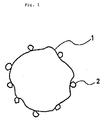
- a particle of the toner surface-modified with a fluoropolymer fine particle according to this invention is schematically shown in Fig. 1, and this can easily be identified by SEM observation.
- the surface modification in the present invention may be carried out to satisfy the following formula: X ⁇ T * W t + F * W f * 0.2 wherein X is the number of particles per unit weight in the electrostatic image developer of the present invention, T is the number of particles per unit weight in the toner before the surface modification, F is the number of particles per unit weight in the fluoropolymer fine particle for use in the surface modification of the toner, W t is the weight fraction of the toner in the developer and W f is the weight fraction of the fluoropolymer fine particle in the developer.
- a particle having an average particle size of 9 ⁇ m or less or a particle having a ⁇ 4 ⁇ m fine toner particle content of at least 0.1 % by weight can be used.
- the average particle size of the toner means the weight medium particle size and can be measured using a Coulter counter together with the fine toner particle content.
- the toner is mainly composed of a polyester binder resin and a coloring pigment, and the raw materials well-known as the toner ingredients can be employed as the constituents.
- the polyester binder resin is prepared using a dicarboxylic acid, a diol and a phenol by the polycondensation therewith as constituent monomers, and the thus obtained toner binder resin is excellent in chargeability including polarity and charging stability.
- a polyester prepared by adding to the above constituent monomers a high valent carboxylic acid such as a tricarboxylic acid, a tetracarboxylic acid, a polycarboxylic acid or a carboxylic acid copolymer; a high valent alcohol such as a triol, a tetraol and a polyol; or an isocyanate compound to form a crosslinked structure within the resin may be used.
- the dicarboxylic acid can be exemplified by maleic acid, citraconic acid, itaconic acid, fumaric acid, mesaconic acid, glutaconic acid (unsaturated aliphatic dicarboxylic acid), oxalic acid, malonic acid, succinic acid, glutaric acid, adipic acid, pimelic acid, suberic acid, azelaic acid, sebasic acid, cyclohexane dicarboxylic acid (saturated dicarboxylic acid), phthalic acid, isophthalic acid, terephthalic acid, 1,5-naphthalene dicarboxylic acid, 2,6-naphthalene dicarboxylic acid (aromatic dicarboxylic acid); as well as acid anhydrides and lower alkyl esters thereof.
- the diol to be subjected to polycondensation with these dicarboxylic acids can be exemplified by ethylene glycol, diethylene glycol, triethylene glycol, 1,2-propylene glycol, 1,3-propylene glycol, dipropylene glycol, trimethylene glycol, 1,4-butanediol, 1,4-butenediol, 1,5-pentanediol, neopentyl glycol, 1,6-hexanediol, 1,7-heptanediol, 1,8-octanediol, 1,10-decanediol, pinacol, hydrobenzoin, benzpinacol, cyclopentane-1,2-diol, cyclohexane-1,2-diol, cyclohexane-1,4-diol and 1,4-bis(hydroxymethyl)cyclohexane.
- the tricarboxylic acid can be exemplified by tricarballylic acid, 1,2,3-butanetricarboxylic acid, 1,2,4-butanetricarboxylic acid, 1,2,5-hexanetricarboxylic acid, 1,2,4-cyclohexane tricarboxylic acid, 1,2,4-benzene tricarboxylic acid, 2,5,7-naphthalene tricarboxylic acid, 1,2,4-naphthalene tricarboxylic acid; as well as acid anhydrides and lower alkyl esters thereof.
- the triol can be exemplified by glycerol, 1,2,4-butanetriol, 1,2,5-pentanetriol, 2-methylpropanetriol, 2-methyl-1,2,4-butanetriol, trimethylolethane and trimethylolpropane.
- the phenol can be exemplified by catechol, resorcinol, hydroquinone, pyrogallol, phloroglucinol, 1,2,4-benzenetriol, 1,3,5-trihydroxymethylbenzene, bisphenol A, hydrogenated bisphenol A, polyoxyethylene adduct of bisphenol A and polyoxypropylene adduct of bisphenol A.
- polyester binder resins may be used singly or as a mixture of two or more of them, or a block copolymer or a graft copolymer obtained by using two or more of these binder resins may also be employed.
- the above polyester resins may be mixed, block-copolymerized or graft-copolymerized with other resins.
- binder resins include, for example, vinyl resins such as polystyrenes, acrylate polymers, styrene-acrylate copolymers and styrene-butadiene copolymers; or epoxy resins, polyamides, polyurethanes, polycarbonates, fluoropolymers, silicone resins, phenol resins, maleic resins and coumarone resins.
- vinyl resins such as polystyrenes, acrylate polymers, styrene-acrylate copolymers and styrene-butadiene copolymers
- epoxy resins polyamides, polyurethanes, polycarbonates, fluoropolymers, silicone resins, phenol resins, maleic resins and coumarone resins.
- polyester resin prepared using terephthalic acid, 1,2,4-benzenetricarboxylic acid, polyoxyethylene adduct of bisphenol A or polyoxypropylene adduct of bisphenol A; or a polyester resin EX-102 or EX-103 manufactured by Sanyo Chemical Industries, Ltd., prepared by graft polymerization of the above polyester resin consisting of a polycarboxylic acid and polyols with the backbone polymer novolak type phenol resin oxyalkylene ether prepared by adding an alkyleneoxide to a novolak type phenol resin.
- a combination of surface modification of the toner with the fluoropolymer fine particle and surface modification of the toner with an inorganic fine powder is preferred.
- the intended effect of improving the image density according to this invention can more notably be exhibited by using the combination of the surface modification of the toner with the fluoropolymer and the surface modificaiton of the toner with an inorganic fine particle.
- the inorganic fine particle preferably has a primary particle size of 0.001 to 2 ⁇ m, preferably 0.002 to 0.2 ⁇ m, and it is of no problem if the particles should be aggregated to form secondary particles.
- the inorganic fine particle is used for the surface modification of the toner in an amount of 0.1 to 5 % by weight, particularly preferably in an amount of 0.1 to 1 % by weight, based on the amount of the toner.
- the inorganic fine particle employable according to this invention is preferably a metal oxide fine particle, and can be exemplified by silica, tin oxide, aluminum oxide, titanium oxide, zinc oxide and these metal oxides surface modified
- the silica fine particle referred to as dry process silica or colloidal silica formed by vapor phase oxidation of silicon halide is preferably employed according to this invention.
- a hydrophobic silica prepared by surface modifying an essentially hydrophilic silica with a hydrophobisation agent may preferably be used.
- silica can be exemplified by hydrophobic silica prepared by substituting the silanol groups on the surface of the silica fine particle with organic groups through reaction between a silica fine particle and a silane coupling agent such as dichlorodimethylsilane, hexamethyldisilazane and trimethylsilane or a titanium coupling agent such as isopropyltriisostearoyl titanate, isopropyltridodecylbenzenesulfonyl titanate and tetraisopropyl bis(dioctylphosphate)titanate to make the surface of the silica fine particle hydrophobic.
- a silane coupling agent such as dichlorodimethylsilane, hexamethyldisilazane and trimethylsilane
- a titanium coupling agent such as isopropyltriisostearoyl titanate, isopropyltridodecylbenzenes
- the same method as used for the surface modification of the toner with the fluoropolymer fine particle i.e. physical methods such as adhesion and immobilization of the fine particle onto the toner surface utilizing mechanical shear, immobilization of the former onto the latter utilizing a combination of mixing and heating, and immobilization of the former onto the latter utilizing a combination of mixing and mechanical impact; chemical methods, for example, immobilization by means of covelant bond between the toner and fine particles or of chemical bond such as hydrogen bond; and simple mixing of the toner with the fine particle.
- the immobilization of the inorganic fine particle onto the toner surface utilizing the mechanical shear is particularly preferred in this invention.
- Such surface modification of the toner with the inorganic fine particle can be carried out using a high-speed mixing surface modification apparatus, a coating type surface modification apparatus, a high-speed dry milling surface modification apparatus, a V-type mixer, a conical screw mixer, a double conical mixer, a ball mill, a Turbula-Shaker-Mixer, etc.
- the high-speed mixing surface modification apparatus equipped with a high-speed stirring blade therein which allows the inorganic fine particle to be adhered and immobilized onto the toner surface by the shear is particularly preferably used according to this invention.
- the surface modification of the toner with the inorganic fine particle may be carried out simultaneously with, or before or after the surface modification of the toner with the fluoropolymer fine particle.
- any well-known coloring pigment such as carbon black, iron black, Ultramarine Blue, Aniline Blue, Phthalocyanine Blue, Phthalocyanine Green, Calco Oil Blue, Chrome Yellow, quinacridone, Indanthrene Blue, Peacock Blue, Permanent Red, Lake Red, Rhodamine Lake, Hansa Yellow, Permanent Yellow, Benzidine Yellow and Rose Bengal can be employed. While the amount of these coloring pigments to be added ranges widely, it is usually added in the range of 1 to 20 parts by weight per 100 parts by weight of the binder resin.
- the toner may, as necessary, be incorporated with a known low-molecular weight polyolefins so as to prevent offset.
- the low-molecular weight polyolefins employable for such purpose includes, for example, polyolefins and co-polyolefins such as paraffin, chlorinated paraffin, polyethylene, chlorinated polyethylene, polyethylene oxide, ethylene-vinyl acetate copolymer, ethylene-acrylic acid copolymer, ethylene-acrylate copolymer, ethylene-methacrylic acid copolymer, ethylene-methacrylate copolymer, ethylene-vinyl chloride copolymer, ethylene-butene copolymer, ethylene-pentene copolymer, polypropylene, polypropylene oxide, ethylene-propylene copolymer, propylene-butene copolymer, propylene-pentene copolymer, ethylene-propylene-butene copolymer,
- polystyrene resins can be incorporated singly or in combination into the toner. While the polyolefin wax can be used over a wide range, it is usually added to the toner in an amount of 0.3 to 5 parts by weight based on the amount of the polyester binder resin.
- a charge control agent may, as necessary, be incorporated into the toner so as to regulate the charge level of the toner or stabilize the triboelectric properties of the toner.
- Such charge control agent employable according to this invention includes azo-metal complex compounds, chlorinated polyolefins, chlorinated polyesters, sulfonylamine of copper phthalocyanine, oil black, metal salts of naphthenic acid and metal salts of fatty acids.
- external additives other than the inorganic fine particle may further be added.
- Such external additives include long-chain fatty acids such as stearic acid and esters, amides or metal salts thereof, carbon black, graphite, graphite fluoride and polycyclyl aromatic compounds.
- the addition of these external additives may be carried out simultaneously with, or before or after the surface modification of the toner with the fluoropolymer fine particle and with the inorganic fine particle.
- a magnetic substance such as triiron tetroxide, diiron trioxide, ferrite, etc. may further be incorporated into the toner, or the toner surface-modified with the fluoropolymer fine particle of the invention may be mixed with a carrier such as iron powders, steel beads, ferrites and glass beads having a particle size greater than that of the toner can be employed as a magnetic developer and as a two-component developer, respectively.
- a carrier such as iron powders, steel beads, ferrites and glass beads having a particle size greater than that of the toner can be employed as a magnetic developer and as a two-component developer, respectively.
- the process for preparing the developer according to this invention will be described below.
- the toner of the invention can be prepared using a well-known technique. Namely, a polyester binder resin, a coloring pigment, a low-molecular weight polyolefin and a charge control agent are premixed, kneaded and dispersed over a heating roll, a Banbury mixer, an extruder, a kneader, etc. to give a composite.
- the composite is cooled and then roughly milled in a hammer mill and the like to a particle size of 1 mm or less, followed by pulverization step using a jet mill and further by classification step using a draft classifier, and the particles having a weight average particle size of 5 to 9 ⁇ m, or a fraction having a ⁇ 4 ⁇ m fine toner particle content of at least 0.1 % by weight is used as the toner.
- the thus obtained toner may further be surface-modified with the inorganic fine particle using a high-speed mixing surface modification apparatus and also surface modified with the fluoropolymer fine particle simultaneously with, or before or after the surface modification with the inorganic fine particle, and the resulting product can be used as the developer of the invention.
- Polyester resin prepared from polyoxypropylene adduct of bisphenol A, polyoxyethylene adduct of bisphenol A, terephthalic acid and 1,2,4-benzenetricarboxylic anhydride as monomer: 100 parts Carbon black (MA-100, Mitsubishi Kasei Corp.): 9 parts Charge control agent (TRH, Hodogaya Chemical Co., Ltd.): 2 parts Low-molecular weight polypropylene (Biscol 550P, Sanyo Chemical Industries, Ltd.): 1.5 parts
- the above raw material components were premixed and then continuously kneaded over a kneader heated to 150°C.
- the composite thus obtained was cooled to room temperature and roughly milled to about 1 mm x 1 mm using a cutter mill, followed by pulverization in a jet mill and then by classification in a draft classifier to provide a toner.
- the toner had a weight average particle size of 10 ⁇ m, had a ⁇ 4 ⁇ m fine toner particle content of 0.3 % by weight and had the number of particles per unit weight of 238 x 107/g.
- a toner was prepared in the same manner as in Preparation Example 1 except that a polyester resin (EX-103, manufactured by Sanyo Chemical Industries, Ltd.) was used as the binder resin, and that the weight average particle size and the ⁇ 4 ⁇ m fine toner particle content were 7.2 ⁇ m and 1.9 % by weight, respectively.
- the toner prepared had the number of particles per unit weight of 633 x 107/g.
- a toner was prepared in the same manner as in Preparation Example 1 except that a polyester resin (EX-103, manufactured by Sanyo Chemical Industries, Ltd.) was used as the binder resin, and that the weight average particle size and the ⁇ 4 ⁇ m fine toner particle content were 7.5 ⁇ m and 0 % by weight, respectively.
- the toner prepared had the number of particles per unit weight of 445 x 107/g.
- a toner was prepared in the same manner as in Preparation Example 1 except that a polyester resin (EX-102, manufactured by Sanyo Chemical Industries, Ltd.) was used as the binder resin, and that the weight average particle size and the ⁇ 4 ⁇ m fine toner particle content were 6.8 ⁇ m and 4.0 % by weight, respectively.
- the toner prepared had the number of particles per unit weight of 751 x 107/g.
- the toner obtained in Preparation Example 1 was surface-modified with 0.4 % by weight of a hydrophobic silica (R972, manufactured by Nippon Aerosil) based on the amount of the toner using a high-speed mixing surface modification apparatus and then with 0.2 % by weight of a polytetrafluoroethylene fine particle having a number average primary particle size of 0.3 ⁇ m and a weight average secondary particle size of 2.5 ⁇ m based on the amount of toner using the same apparatus to provide a developer.
- the ratio of the surface area of the polytetrafluoroethylene fine particle to that of the toner was 0.074.
- the number of particles per unit weight in the developer was 197 x 107/g (excepting the number of hydrophobic silica); whereas the number of particles in the polytetrafluoroethylene fine particle and the number of particles in the toner before the surface modification were 673 x 108/g and 238 x 107/g, respectively, in conversion to the number of particles per unit weight of the developer after the surface modification.
- the developer thus obtained was charged to a commercially available PC-PR 1000 printer (manufactured by NEC) equipped with a titanyl phthalocyanine photoconductor and a hot roll fuser, followed by repeated development and fixing to evaluate the image density and image quality.
- the image density was determined by measuring the values at five points arbitrarily selected on a solid black image obtained after 5000 prints using a Macbeth densitometer and calculating the average of the optical reflection density values.
- the solid black image formed by using this developer had a high image density of 1.45. No deterioration in the image quality was observed even after 10000 prints, and the same clear image quality as in the initial print was reproduced.
- the toner obtained in Preparation Example 1 was surface-modified simultaneously with 0.4 % by weight of a hydrophobic silica (R972, manufactured by Nippon Aerosil) and with 1.3 % by weight of a polytetrafluoroethylene fine particle having a weight average particle size of 3 ⁇ m, based on the amount of toner, using the high-speed mixing surface modification apparatus to provide a developer.
- the ratio of the surface area of the polytetrafluoroethylene fine particle to that of the toner was 0.049.
- the number of particles per unit weight in the developer was 219 x 107/g (excepting the number of hydrophobic silica); whereas the number of particles in the polytetrafluoroethylene fine particle and the number of particles in the toner before the surface modification were 440 x 106/g and 235 x 107/g, respectively, in conversion to the number of particles per unit weight of the developer after the surface modification.
- the developer thus obtained was charged to a PC-PR 1000 printer, followed by repeated development and fixing in the same manner as in Example 1 to evaluate the image density and image quality.
- the solid black image formed by using this developer had a high image density of 1.40. No deterioration in the image quality was observed even after 10000 prints, and the same clear image quality as in the initial print was reproduced.
- Example 2 The surface modification of Example 2 was repeated analogously, except that the polyteterafluoroethylene fine particle was replaced by a tetrafluoroethylene-perfluoroalkyl ether copolymer fine particle having a weight average particle size of 3.5 ⁇ m to provide a developer.
- the ratio of the surface area of the tetrafluoroethylene-perfluoroalkyl ether copolymer fine particle to that of the toner was 0.042.
- the number of particles per unit weight in the developer was 234 x 107/g (excepting the number of hydrophobic silica); whereas the number of particles in the polytetrafluoroethylene-perfluoroalkyl ether copolymer fine particle and the number of particles in the toner before the surface modification were 280 x 106/g and 235 x 107/g, respectively, in conversion to the number of particles per unit weight of the developer after the surface modification.
- the developer thus obtained was charged to a PC-PR 1000 printer, followed by repeated development and fixing in the same manner as in Example 1 to evaluate the image density and image quality.
- the solid black image formed by using this developer had a high image density of 1.36. No deterioration in the image quality was observed even after 10000 prints, and the same clear image quality as in the initial print was reproduced.
- the toner obtained in Preparation Example 2 was surface-modified with 4 % by weight of a polytetrafluoroethylene fine particle having a weight average particle size of 7 ⁇ m using a high-speed mixing surface modification apparatus and then with 0.7 % by weight of a hydrophobic silica (R972, manufactured by Nippon Aerosil), based on the amount of the toner, using the same apparatus to provide a developer.
- the ratio of the surface area of the polytetrafluoroethylene fine particle to that of the toner was 0.018.
- the number of particles per unit weight in the developer was 610 x 107/g (excepting the number of hydrophobic silica); whereas the number of particles in the polytetrafluoroethylene fine particle and the number of particles in the toner before the surface modification were 110 x 106/g and 608 x 107/g, respectively, in conversion to the number of particles per unit weight of the developer after the surface modification.
- the developer thus obtained was charged to a PC-PR 1000 printer, followed by repeated development and fixing in the same manner as in Example 1 to evaluate the image density and image quality.
- the solid black image formed by using this developer had a high image density of 1.38. No deterioration in the image quality was observed even after 10000 prints, and the same clear image quality as in the initial print was reproduced.
- the toner obtained in Preparation Example 2 was surface-modified with 0.2 % by weight of a hydrophobic silica (R972, manufactured by Nippon Aerosil) using a high-speed mixing surface modification apparatus and then with 0.4 % by weight of a polytetrafluoroethylene fine particle having a number average primary particle size of 0.3 ⁇ m and a weight average secondary particle size of 2.5 ⁇ m, based on the amount of toner, using the same apparatus to provide a developer.
- the ratio of the surface area of the polytetrafluoroethylene fine particle to that of the toner was 0.040.
- the number of particles per unit weight in the developer was 725 x 107/g (excepting the number of hydrophobic silica); whereas the number of particles in the polytetrafluoroethylene fine particle and the number of particles in the toner before the surface modification were 135 x 109/g and 630 x 107/g, respectively, in conversion to the number of particles per unit weight of the developer after the surface modification.
- the developer thus obtained was charged to a PC-PR 1000 printer, followed by repeated development and fixing in the same manner as in Example 1 to evaluate the image density and image quality.
- the solid black image formed by using this developer had a high image density of 1.43. No deterioration in the image quality was observed even after 10000 prints, and the same clear image quality as in the initial print was reproduced.
- Example 5 The surface modification of Example 5 was repeated analogously, except that the hydrophobic silica was replaced by a colloidal silica (No. 200, manufactured by Nippon Aerosil) subjected to no hydrophobic modification to provide a developer.
- the ratio of the surface area of the polytetrafluoroethylene fine particle to that of the toner was 0.040.
- the number of particles per unit weight in the developer was 682 x 107/g (excepting the number of colloidal silica); whereas the number of particles in the polytetrafluoroethylene fine particle and the number of particles in the toner before the surface modification were 135 x 109/g and 630 x 107/g, respectively, in conversion to the number of particles per unit weight of the developer after the surface modification.
- the developer thus obtained was charged to a PC-PR 1000 printer, followed by repeated development and fixing in the same manner as in Example 1 to evaluate the image density and image quality.
- the solid black image formed by using this developer had a high image density of 1.41. No deterioration in the image quality was observed even after 10000 prints, and the same clear image quality as in the initial print was reproduced.
- the toner obtained in Preparation Example 2 was surface-modified simultaneously with 0.2 % by weight of a hydrophobic silica (R972, manufactured by Nippon Aerosil) and with 4 % by weight of a tetrafluoroethylene-hexafluoropropylene copolymer fine particle having a weight average particle size of 2 ⁇ m, based on the amount of toner, using a high-speed mixing surface modification apparatus to provide a developer.
- the ratio of the surface area of the tetrafluoroethylene-hexafluoropropylene copolymer fine particle to that of the toner was 0.063.
- the number of particles per unit weight in the developer was 611 x 107/g (excepting the number of hydrophobic silica); whereas the number of particles in the polytetrafluoroethylene-hexafluoropropylene copolymer fine particle and the number of particles in the toner before the surface modification were 455 x 107/g and 608 x 107/g, respectively, in conversion to the number of particles per unit weight of the developer after the surface modification.
- the developer thus obtained was charged to a PC-PR 1000 printer, followed by repeated development and fixing in the same manner as in Example 1 to evaluate the image density and image quality.
- the solid black image formed by using this developer had a high image density of 1.47. No deterioration in the image quality was observed even after 10000 prints, and the same clear image quality as in the initial print was reproduced.
- the toner prepared in Preparation Example 2 was surface-modified solely with 0.4 % by weight of a polytetrafluoroethylene fine particle having a number average primary particle size of 0.3 ⁇ m and a weight average secondary particle size of 2.5 ⁇ m using a high-speed mixing surface modification apparatus to provide a toner.
- the ratio of the surface area of the polytetrafluoroethylene fine particle to that of the toner was 0.040.
- the number of particles per unit weight in the developer was 627 x 107/g; whereas the number of particles in the polytetrafluoroethylene fine particle and the number of particles in the toner before the surface modification were 135 x 109/g and 630 x 107/g, respectively, in conversion to the number of particles per unit weight of the developer after the surface modification.
- the developer thus obtained was charged to a PC-PR 1000 printer, followed by repeated development and fixing in the same manner as in Example 1 to evaluate the image density and image quality.
- the solid black image formed by using this developer had a high image density of 1.31. No deterioration in the image quality was observed even after 10000 prints, and the same clear image quality as in the initial print was reproduced.
- Example 2 The surface modification of Example 2 was repeated analogously, except that the polyteterafluoroethylene fine particle was added in an amount of 2.2 % by weight to the toner obtained in Preparation Example 3 to provide a developer.
- the ratio of the surface area of the polytetrafluoroethylene fine particle to that of the toner was 0.034.
- the number of particles per unit weight in the developer was 434 x 107/g (excepting the number of hydrophobic silica); whereas the number of particles in the polytetrafluoroethylene fine particle and the number of particles in the toner before the surface modification were 740 x 106/g and 436 x 107/g, respectively, in conversion to the number of particles per unit weight of the developer after the surface modification.
- the developer thus obtained was charged to a PC-PR 1000 printer, followed by repeated development and fixing in the same manner as in Example 1 to evaluate the image density and image quality.
- the solid black image formed by using this developer had a high image density of 1.38. No deterioration in the image quality was observed even after 10000 prints, and the same clear image quality as in the initial print was reproduced.
- Example 9 The surface modification of Example 9 was repeated analogously, except that the polyteterafluoroethylene fine particle was replaced with a polytetrafluoroethylene fine particle having a number average primary particle size of 0.3 ⁇ m and a weight average secondary particle size of 2.5 ⁇ m and that the polytetrafluoroethylene fine particle was added in an amount of 0.6 % by weight based on the amount of the toner to provide a developer.
- the ratio of the surface area of the polytetrafluoroethylene fine particle to that of the toner was 0.090.
- the number of particles per unit weight in the developer was 586 x 107/g (excepting the number of hydrophobic silica); whereas the number of particles in the polytetrafluoroethylene fine particle and the number of particles in the toner before the surface modification were 202 x 109/g and 443 x 107/g, respectively, in conversion to the number of particles per unit weight of the developer after the surface modification.
- the developer thus obtained was charged to a PC-PR 1000 printer, followed by repeated development and fixing in the same manner as in Example 1 to evaluate the image density and image quality.
- the solid black image formed by using this developer had a high image density of 1.44. No deterioration in the image quality was observed even after 10000 prints, and the same clear image quality as in the initial print was reproduced.
- the toner obtained in Preparation Example 4 was surface-modified with 0.4 % by weight of a hydrophobic silica (R972, manufactured by Nippon Aerosil) based on the amount of the toner using a high-speed mixing surface modification apparatus and then with 3.0 % by weight of a polytetrafluoroethylene fine particle having a weight average particle size of 3 ⁇ m based on the amount of toner using the same apparatus to provide a developer.
- the ratio of the surface area of the polytetrafluoroethylene fine particle to that of the toner was 0.022.
- the number of particles per unit weight in the developer was 839 x 107/g (excepting the number of hydrophobic silica); whereas the number of particles in the polytetrafluoroethylene fine particle and the number of particles in the toner before the surface modification were 101 x 107/g and 833 x 107/g, respectively, in conversion to the number of particles per unit weight of the developer after the surface modification.
- the developer thus obtained was charged to a PC-PR 1000 printer, followed by repeated development and fixing in the same manner as in Example 1 to evaluate the image density and image quality.
- the solid black image formed by using this developer had a high image density of 1.44. No deterioration in the image quality was observed even after 10000 prints, and the same clear image quality as in the initial print was reproduced.
- Example 10 The surface modification of Example 10 was repeated analogously, except that the polyteterafluoroethylene fine particle was added in an amount of 0.5 % by weight to the toner obtained in Preparation Example 4 to provide a developer.
- the ratio of the surface area of the polytetrafluoroethylene fine particle to that of the toner was 0.035.
- the number of particles per unit weight in the developer was 851 x 107/g (excepting the number of hydrophobic silica); whereas the number of particles in the polytetrafluoroethylene fine particle and the number of particles in the toner before the surface modification were 168 x 109/g and 855 x 107/g, respectively, in conversion to the number of particles per unit weight of the developer after the surface modification.
- the developer thus obtained was charged to a PC-PR 1000 printer, followed by repeated development and fixing in the same manner as in Example 1 to evaluate the image density and image quality.
- the solid black image formed by using this developer had a high image density of 1.49. No deterioration in the image quality was observed even after 10000 prints, and the same clear image quality as in the initial print was reproduced.
- the toner obtained in Preparation Example 1 was surface-modified with 0.4 % by weight of a hydrophobic silica (R972, manufactured by Nippon Aerosil) based on the amount of the toner using a high-speed mixing surface modification apparatus to provide a developer.
- a hydrophobic silica R972, manufactured by Nippon Aerosil
- the developer thus obtained was charged to a PC-PR 1000 printer, followed by repeated development and fixing in the same manner as in Example 1 to evaluate the image density and image quality.
- the solid black image formed by using this developer had a low image density of 1.28.
- the toner obtained in Preparation Example 3 was surface-modified with 0.2 % by weight of a hydrophobic silica (R972, manufactured by Nippon Aerosil) based on the amount of the toner using a high-speed mixing surface modification apparatus to provide a developer.
- a hydrophobic silica R972, manufactured by Nippon Aerosil
- the developer thus obtained was charged to a PC-PR 1000 printer, followed by repeated development and fixing in the same manner as in Example 1 to evaluate the image density and image quality.
- the solid black image formed by using this developer had a very low image density of 1.17.
- the toner obtained in Preparation Example 2 was surface-modified with 0.2 % by weight of a polytetrafluoroethylene fine particle having a weight average particle size of 7 ⁇ m based on the amount of the toner using a high-speed mixing surface modification apparatus and then with 0.4 % by weight of a hydrophobic silica (R 972, manufactured by Nippon Aerosil) based on the amount of the toner using the same apparatus to provide a developer.
- the ratio of the surface area of the polytetrafluoroethylene fine particle to that of the toner was 0.0009.
- the developer thus obtained was charged to a PC-PR 1000 printer, followed by repeated development and fixing in the same manner as in Example 1 to evaluate the image density and image quality.
- the solid black image formed by using this developer had a low image density of 1.19.
- the toner obtained in Preparation Example 4 was surface-modified simultaneously with 0.4 % by weight of a hydrophobic silica (R972, manufactured by Nippon Aerosil) and with 0.1 % by weight of a polytetrafluoroethylene fine particle having a weight average particle size of 3 ⁇ m, based on the amount of toner, using a high-speed mixing surface modification apparatus to provide a developer.
- the ratio of the surface area of the polytetrafluoroethylene fine particle to that of the toner was 0.0007.
- the developer thus obtained was charged to a PC-PR 1000 printer, followed by repeated development and fixing in the same manner as in Example 1 to evaluate the image density and image quality.
- the solid black image formed by using this developer had a low image density of 1.25.
- the toner obtained in Preparation Example 4 was surface-modified with 0.4 % by weight of a hydrophobic silica (R972, manufactured by Nippon Aerosil) and 4 % by weight of a polytetrafluoroethylene fine particle having a number average primary particle size of 0.3 ⁇ m and a weight average secondary particle size of 2.5 ⁇ m, based on the amount of toner, concurrently, using a high-speed mixing surface modification apparatus to provide a developer.
- the ratio of the surface area of the polytetrafluoroethylene fine particle to that of the toner was 0.291.
- the developer thus obtained was charged to a PC-PR 1000 printer, followed by repeated development and fixing in the same manner as in Example 1 to evaluate the image density and image quality. From the initial stage of printing, considerable smudges of non-image portion, namely background fog, and no good fixation occurred and so no clear reproduction of image could be obtained.
- the toner obtained in Preparation Example 1 was surface-modified with 0.4 % by weight of a hydrophobic silica (R972, manufactured by Nippon Aerosil) based on the amount of the toner using a high-speed mixing surface modification apparatus and then simply mixed with 4.0 % by weight of a polytetrafluoroethylene fine particle having a weight average particle size of 3 ⁇ m based on the amount of toner using a Turbula-Shaker-Mixer (trade name) to provide a developer.
- the ratio of the surface area of the polytetrafluoroethylene fine particle to that of the toner was 0.175.
- the number of particles per unit weight in the developer was 332 x 107/g (excepting the number of hydrophobic silica); whereas the number of particles in the polytetrafluoroethylene fine particle and the number of particles in the toner before the surface modification and mixing were 135 x 107/g and 202 x 107/g, respectively, in conversion to the number of particles per unit weight of the developer after the surface modification and mixing.
- the developer thus obtained was charged to a PC-PR 1000 printer, followed by repeated development and fixing in the same manner as in Example 1 to evaluate the image density and image quality. From the initial stage of printing, whitening of image portion, considerable background fog and no good fixation occurred and so no clear reproduction of image could be obtained.
- the electrostatic image developers according to this invention exhibits many excellent effects. Namely, when latent electrostatic images are to be developed using a prior art developer containing a small-diameter toner so as to obtain superior resolving power and gradation, the images thus formed come to have low image density, disadvantageously. However, the developer containing a small-diameter toner provided according to this invention suffers no such problem and can give high image density without reconsidering the material design or formulation design or causing great reduction in the toner yield in the classification step.
Landscapes
- Physics & Mathematics (AREA)
- General Physics & Mathematics (AREA)
- Chemical & Material Sciences (AREA)
- Chemical Kinetics & Catalysis (AREA)
- Spectroscopy & Molecular Physics (AREA)
- Developing Agents For Electrophotography (AREA)
Applications Claiming Priority (4)
| Application Number | Priority Date | Filing Date | Title |
|---|---|---|---|
| JP6636693 | 1993-03-25 | ||
| JP66366/93 | 1993-03-25 | ||
| JP5145302A JP2827822B2 (ja) | 1993-03-25 | 1993-06-17 | 静電荷像現像剤 |
| JP145302/93 | 1993-06-17 |
Publications (3)
| Publication Number | Publication Date |
|---|---|
| EP0617336A2 true EP0617336A2 (fr) | 1994-09-28 |
| EP0617336A3 EP0617336A3 (fr) | 1995-08-09 |
| EP0617336B1 EP0617336B1 (fr) | 1999-01-13 |
Family
ID=26407564
Family Applications (1)
| Application Number | Title | Priority Date | Filing Date |
|---|---|---|---|
| EP94104715A Expired - Lifetime EP0617336B1 (fr) | 1993-03-25 | 1994-03-24 | Révélateur d'images électrostatiques |
Country Status (4)
| Country | Link |
|---|---|
| US (1) | US5482808A (fr) |
| EP (1) | EP0617336B1 (fr) |
| JP (1) | JP2827822B2 (fr) |
| DE (1) | DE69415845T2 (fr) |
Cited By (5)
| Publication number | Priority date | Publication date | Assignee | Title |
|---|---|---|---|---|
| EP0716350A3 (fr) * | 1994-12-05 | 1996-09-11 | Canon Kk | Toner pour le développement d'images électrostatiques |
| US5800959A (en) * | 1995-07-13 | 1998-09-01 | Brother Kogyo Kabushiki Kaisha | Electrostatic latent image developer |
| US5827632A (en) * | 1994-12-05 | 1998-10-27 | Canon Kabushiki Kaisha | Toner for developing electrostatic image containing hydrophobized inorganic fine powder |
| EP1043630A3 (fr) * | 1999-04-08 | 2003-01-29 | Ricoh Company, Ltd. | Toner, procédé pour la préparation de toner, méthode de formation d'images l'utilisant et récipient de toner |
| EP1597632A4 (fr) * | 2003-01-13 | 2009-08-26 | Lg Chemical Ltd | Composition de poudre imprimante positive a monocomposant non-magnetique, a rendement de transfert superieur |
Families Citing this family (12)
| Publication number | Priority date | Publication date | Assignee | Title |
|---|---|---|---|---|
| US5702858A (en) * | 1994-04-22 | 1997-12-30 | Matsushita Electric Industrial Co., Ltd. | Toner |
| DE602004021551D1 (de) * | 2003-12-26 | 2009-07-30 | Canon Kk | Toner-Herstellungsverfahren und Gerät zur Oberflächenbehandlung von Tonerpartikeln |
| EP1711863B1 (fr) * | 2004-02-06 | 2011-04-27 | LG Chem, Ltd. | Composition de toner magnetique chargeable positive et son utilisation |
| CN101174111B (zh) | 2006-11-02 | 2012-09-05 | 花王株式会社 | 调色剂和双组分显影剂 |
| JP2009251084A (ja) * | 2008-04-02 | 2009-10-29 | Konica Minolta Business Technologies Inc | 画像表示装置 |
| JP5429963B2 (ja) * | 2009-01-26 | 2014-02-26 | 花王株式会社 | トナーの製造方法 |
| US8859176B2 (en) | 2010-06-28 | 2014-10-14 | Fuji Xerox Co., Ltd. | Toner, developer, toner cartridge, and image forming apparatus |
| US8722290B2 (en) | 2010-06-28 | 2014-05-13 | Fuji Xerox Co., Ltd. | Toner, developer, toner cartridge, and image forming apparatus |
| JP5867023B2 (ja) * | 2011-11-28 | 2016-02-24 | 富士ゼロックス株式会社 | トナー、現像剤、トナーカートリッジ、プロセスカートリッジ、画像形成装置、及び、画像形成方法 |
| JP2013120251A (ja) * | 2011-12-07 | 2013-06-17 | Ricoh Co Ltd | トナー並びに該トナーを用いた現像剤、現像剤収容容器及び画像形成方法 |
| JP6044086B2 (ja) | 2012-03-13 | 2016-12-14 | 富士ゼロックス株式会社 | 静電潜像現像用トナー、現像剤、トナーカートリッジ、プロセスカートリッジ、及び、画像形成装置 |
| JP5857834B2 (ja) | 2012-03-26 | 2016-02-10 | 富士ゼロックス株式会社 | 現像剤、プロセスカートリッジ、及び、画像形成装置 |
Family Cites Families (13)
| Publication number | Priority date | Publication date | Assignee | Title |
|---|---|---|---|---|
| CA971026A (en) * | 1969-03-24 | 1975-07-15 | Walter Crooks | Electrophotographic developer |
| CH549822A (de) * | 1969-07-03 | 1974-05-31 | Xerox Corp | Elektrostatographisches entwicklermaterial. |
| GB2114310B (en) * | 1982-01-29 | 1985-11-20 | Konishiroku Photo Ind | Electrostatic image toner |
| US4666813A (en) * | 1985-01-08 | 1987-05-19 | Canon Kabushiki Kaisha | Developer for developing electrostatic latent images contains vinylidene fluoride polymer |
| US5118588A (en) * | 1990-03-30 | 1992-06-02 | Eastman Kodak Company | Toner particles having improved transfer efficiency and which comprise a pigment surface modifier |
| JPH04177363A (ja) * | 1990-11-13 | 1992-06-24 | Minolta Camera Co Ltd | 静電潜像現像用トナー |
| JP3383975B2 (ja) * | 1990-11-08 | 2003-03-10 | ミノルタ株式会社 | 静電潜像現像用トナー |
| JPH04177365A (ja) * | 1990-11-13 | 1992-06-24 | Minolta Camera Co Ltd | 静電潜像現像用トナー |
| JP3172172B2 (ja) * | 1990-11-13 | 2001-06-04 | ミノルタ株式会社 | 静電潜像現像用トナー |
| JPH04147155A (ja) * | 1990-10-09 | 1992-05-20 | Minolta Camera Co Ltd | 静電潜像現像用トナー |
| US5219694A (en) * | 1990-10-09 | 1993-06-15 | Minolta Camera Kabushiki Kaisha | Toner for developing electrostatic latent image |
| JPH04177362A (ja) * | 1990-11-13 | 1992-06-24 | Minolta Camera Co Ltd | 静電潜像現像用トナー |
| US5253021A (en) * | 1992-02-28 | 1993-10-12 | Eastman Kodak Company | Method and apparatus of transferring toner images made up of small dry particles |
-
1993
- 1993-06-17 JP JP5145302A patent/JP2827822B2/ja not_active Expired - Fee Related
-
1994
- 1994-03-24 DE DE69415845T patent/DE69415845T2/de not_active Expired - Fee Related
- 1994-03-24 EP EP94104715A patent/EP0617336B1/fr not_active Expired - Lifetime
- 1994-03-24 US US08/217,512 patent/US5482808A/en not_active Expired - Lifetime
Cited By (5)
| Publication number | Priority date | Publication date | Assignee | Title |
|---|---|---|---|---|
| EP0716350A3 (fr) * | 1994-12-05 | 1996-09-11 | Canon Kk | Toner pour le développement d'images électrostatiques |
| US5827632A (en) * | 1994-12-05 | 1998-10-27 | Canon Kabushiki Kaisha | Toner for developing electrostatic image containing hydrophobized inorganic fine powder |
| US5800959A (en) * | 1995-07-13 | 1998-09-01 | Brother Kogyo Kabushiki Kaisha | Electrostatic latent image developer |
| EP1043630A3 (fr) * | 1999-04-08 | 2003-01-29 | Ricoh Company, Ltd. | Toner, procédé pour la préparation de toner, méthode de formation d'images l'utilisant et récipient de toner |
| EP1597632A4 (fr) * | 2003-01-13 | 2009-08-26 | Lg Chemical Ltd | Composition de poudre imprimante positive a monocomposant non-magnetique, a rendement de transfert superieur |
Also Published As
| Publication number | Publication date |
|---|---|
| JPH06332231A (ja) | 1994-12-02 |
| US5482808A (en) | 1996-01-09 |
| EP0617336A3 (fr) | 1995-08-09 |
| EP0617336B1 (fr) | 1999-01-13 |
| DE69415845T2 (de) | 1999-07-08 |
| DE69415845D1 (de) | 1999-02-25 |
| JP2827822B2 (ja) | 1998-11-25 |
Similar Documents
| Publication | Publication Date | Title |
|---|---|---|
| US5482808A (en) | Electrostatic image developer | |
| EP3379334A1 (fr) | Toner | |
| US6864030B2 (en) | Toner | |
| US5821023A (en) | Developer of electrostatic latent image, carrier therefor, method for forming image and image forming apparatus thereby | |
| US9885968B2 (en) | Toner | |
| JPH07244402A (ja) | 熱ロール定着用静電潜像現像用トナー | |
| US5536614A (en) | Method for manufacturing a nonmagnetic single-component developer | |
| JP3771601B2 (ja) | 静電荷像現像用トナー | |
| EP1291727B1 (fr) | Toner électrophotographique contenant une cire polyalkylène à base très crystalline | |
| JPH04335357A (ja) | 静電荷像現像剤 | |
| JP3217936B2 (ja) | 非磁性一成分トナー | |
| JP2007058137A (ja) | 電子写真用トナー、及びその製造方法 | |
| JPH07152207A (ja) | 静電潜像現像用トナー | |
| JP2001166540A (ja) | イエロートナー及びそれを用いたフルカラー現像用トナー | |
| JP3376191B2 (ja) | 静電荷像現像用トナー | |
| JPS60176053A (ja) | 静電荷像現像剤 | |
| GB2052774A (en) | Toner for electrostatic photography | |
| JPH0627728A (ja) | 現像剤およびその製造方法 | |
| JPH07295289A (ja) | 非磁性一成分現像剤の製造法 | |
| JP2789478B2 (ja) | 静電荷像現像剤組成物 | |
| JP2003140401A (ja) | 電子写真用トナー、現像剤及び画像形成方法 | |
| JPH0627729A (ja) | 現像剤およびその製造方法 | |
| JPH0430014B2 (fr) | ||
| JP2001166541A (ja) | マゼンタトナー及びそれを用いたフルカラー現像用トナー | |
| JP2024009671A (ja) | 二成分現像剤 |
Legal Events
| Date | Code | Title | Description |
|---|---|---|---|
| PUAI | Public reference made under article 153(3) epc to a published international application that has entered the european phase |
Free format text: ORIGINAL CODE: 0009012 |
|
| AK | Designated contracting states |
Kind code of ref document: A2 Designated state(s): DE FR GB |
|
| PUAL | Search report despatched |
Free format text: ORIGINAL CODE: 0009013 |
|
| AK | Designated contracting states |
Kind code of ref document: A3 Designated state(s): DE FR GB |
|
| 17P | Request for examination filed |
Effective date: 19950704 |
|
| 17Q | First examination report despatched |
Effective date: 19970711 |
|
| GRAG | Despatch of communication of intention to grant |
Free format text: ORIGINAL CODE: EPIDOS AGRA |
|
| GRAG | Despatch of communication of intention to grant |
Free format text: ORIGINAL CODE: EPIDOS AGRA |
|
| GRAG | Despatch of communication of intention to grant |
Free format text: ORIGINAL CODE: EPIDOS AGRA |
|
| GRAH | Despatch of communication of intention to grant a patent |
Free format text: ORIGINAL CODE: EPIDOS IGRA |
|
| GRAH | Despatch of communication of intention to grant a patent |
Free format text: ORIGINAL CODE: EPIDOS IGRA |
|
| GRAA | (expected) grant |
Free format text: ORIGINAL CODE: 0009210 |
|
| AK | Designated contracting states |
Kind code of ref document: B1 Designated state(s): DE FR GB |
|
| REF | Corresponds to: |
Ref document number: 69415845 Country of ref document: DE Date of ref document: 19990225 |
|
| ET | Fr: translation filed | ||
| PLBE | No opposition filed within time limit |
Free format text: ORIGINAL CODE: 0009261 |
|
| STAA | Information on the status of an ep patent application or granted ep patent |
Free format text: STATUS: NO OPPOSITION FILED WITHIN TIME LIMIT |
|
| 26N | No opposition filed | ||
| REG | Reference to a national code |
Ref country code: GB Ref legal event code: IF02 |
|
| PGFP | Annual fee paid to national office [announced via postgrant information from national office to epo] |
Ref country code: GB Payment date: 20090318 Year of fee payment: 16 |
|
| PGFP | Annual fee paid to national office [announced via postgrant information from national office to epo] |
Ref country code: DE Payment date: 20090319 Year of fee payment: 16 |
|
| PGFP | Annual fee paid to national office [announced via postgrant information from national office to epo] |
Ref country code: FR Payment date: 20090316 Year of fee payment: 16 |
|
| GBPC | Gb: european patent ceased through non-payment of renewal fee |
Effective date: 20100324 |
|
| REG | Reference to a national code |
Ref country code: FR Ref legal event code: ST Effective date: 20101130 |
|
| PG25 | Lapsed in a contracting state [announced via postgrant information from national office to epo] |
Ref country code: FR Free format text: LAPSE BECAUSE OF NON-PAYMENT OF DUE FEES Effective date: 20100331 |
|
| PG25 | Lapsed in a contracting state [announced via postgrant information from national office to epo] |
Ref country code: DE Free format text: LAPSE BECAUSE OF NON-PAYMENT OF DUE FEES Effective date: 20101001 |
|
| PG25 | Lapsed in a contracting state [announced via postgrant information from national office to epo] |
Ref country code: GB Free format text: LAPSE BECAUSE OF NON-PAYMENT OF DUE FEES Effective date: 20100324 |